
Specs are compiled from manufacturer listings and verified buyer reviews and can change over time — please confirm the key details on the product page before buying.
Here is the short answer: the breaker you want is the one that physically snaps into the panel you already own. A 20-Amp GFCI breaker is not a universal part — Siemens breakers fit Siemens load centers, Square D QO breakers fit QO panels, and GE or ABB breakers fit GE-style panels. Get the brand family wrong and the breaker will not seat, no matter how good the specs look. Get it right and you have ground-fault protection for a bathroom, kitchen, garage, pool pump, or hot tub circuit in a single slot.
I’m Mohammad Maruf — the founder and writer behind KitchPrep. This guide is built by comparing the manufacturers’ published specifications and the patterns across verified customer reviews, so you get each pick’s real strengths and trade-offs instead of marketing spin.
Every pick below is a genuine 20-amp GFCI breaker, grouped by the job it does best — from the crowd favorite that holds 4.8 stars across 900+ ratings to the specialty two-pole units built for pool pumps. What follows is a practical walk through panel compatibility, one-pole versus two-pole wiring, and the exact specs that decide whether a homeowner or an electrician should be the one installing it, so you can pick the right 20-amp gfci breaker the first time.
Our Picks at a Glance


How To Choose The Best 20-Amp GFCI Breaker
Buying the wrong breaker is the single most common mistake here, and it is not about quality — it is about the shape of your panel. Match the brand family first, then decide how many poles you need, then worry about the extras.
Match the breaker to your load center brand
Breakers are not interchangeable between panel brands, even when the amperage matches. A Siemens breaker seats in a Siemens load center rated to accept plug-on breakers. Square D QO breakers only fit QO load centers. GE-style and ABB Q-Line breakers share a footprint, which is why the ABB unit below is sold as a direct GE replacement. Check the sticker inside your panel door before anything else.
A plug-on neutral design means the neutral wire lands on the breaker itself rather than a separate neutral bar. That removes the pigtail (the short jumper wire that older GFCI breakers carry), which frees up gutter space in a crowded panel and shortens installation time.
One pole or two poles — what each protects
A single-pole 20-amp GFCI breaker protects one 120-volt circuit: a bathroom, a kitchen counter run, a garage receptacle, an outdoor outlet, or a sump pump line. A two-pole 20-amp GFCI breaker protects a 240-volt circuit such as a pool pump, a spa, or a hot tub feed — and it cuts both hot legs when a ground fault is detected.
Two-pole units also matter for equipment that is sensitive to small ground-current swings. Variable-speed pool pumps are the classic case, and that is exactly what three of the picks below are built around.
What the numbers on the label mean
The interrupting rating — written as 10,000 AIC on several of these — is how much fault current the breaker can safely cut off without being destroyed. Self-test, required by UL 943 on newer GFCI devices, makes the breaker check its own ground-fault circuitry on a regular cycle.
GFCI protection cuts power when current leaks to ground through water, a damaged cord, or a person. Arc-fault protection is a different job: it watches for sparking in damaged wiring. The Square D dual-function unit below does both.
Quick Comparison
| Model | Best For | Poles | Voltage | Mounting | Amazon |
|---|---|---|---|---|---|
| SIEMENS QF120A★ Best Overall | Bathrooms, kitchens, spas | 1 | 120V | Plug-In | Amazon |
| ASI NDB1L-32C-20-120VDIN Rail Pick | DIN rail and OEM panels | 1 | 120V | DIN Rail | Amazon |
| Siemens QF120ANBest for Sub-Panels | Siemens sub-panels, plug-on neutral | 1 | 240V | Plug | Amazon |
| Square D QO120PDFC | Arc and ground fault on one run | 1 | 120V | Plug-In | Amazon |
| Square D QO120GFICP | Older QO panels, outdoor circuits | 1 | — | Snap-In | Amazon |
| GE THQL1120GF | GE panels, pool and outdoor loads | 1 | 120V | Pole Mount | Amazon |
| SIEMENS Q220GF | Pool pumps and spas | 2 | 240V | Plug-In | Amazon |
| ABB THQL2120GFT | Hot tubs and 240V equipment | 2 | 240V | Plug-In | Amazon |
| Pentair PA220GF | Variable-speed pool pumps | 2 | 115V/230V | Wall Mount | Amazon |
In‑Depth Reviews
1. SIEMENS QF120A Gfci Circuit Breaker, Plug In, Self Testing, 20 Amp, 1-Pole, 120 Volt
Our pick — over 4.5★ from 950+ verified ratings; the strongest balance of quality and price.
The single-pole workhorse that fits off-brand panels and still self-checks every cycle.
If you are protecting a bathroom, kitchen, spa, or hot tub circuit on 120 volts, start here. This is a type QPF2 single-pole GFCI breaker rated 20 amps with a 10,000 AIC interrupting rating (a measure of how much fault current it can safely cut off). It carries Class A GFCI protection, the standard level of ground-fault sensitivity for people protection, and it includes self-test as required by UL 943 — so the breaker verifies its own ground-fault circuitry instead of relying on you to press a button.
What wins people over is the fit and the price, and the two go together. Owners repeatedly describe this seating cleanly in panels that were not necessarily Siemens, including one buyer who used it in a humid greenhouse to replace a plain non-GFCI breaker. A pool owner swapped out a tired pump-line breaker with this one and reported it working exactly as needed. It is physically small — 1 inch deep, 3 inches wide, and 3.1 inches high at 4 ounces — which is the reason it slips into tight gutters where a bulkier breaker would fight you for space.
The honest catch is reliability, which lands mixed: most buyers report a breaker that trips when it should and resets easily, but a minority have hit nuisance tripping. Fleet-wide, that is a small slice of a very large review base — this is the crowd favorite in the category at 4.8 stars across 900+ ratings, and it holds the highest score of any pick here. It is a plug-in design for Siemens load centers rated to accept plug-on breakers.
What earns it the top slot
- 10,000 AIC interrupting rating with Class A GFCI protection in a single-pole footprint
- Self-test built in per UL 943, so the ground-fault circuit checks itself
- 4-ounce body and a 1-inch depth that seats in tight gutters
- Fits off-brand and older panels according to owner reports
Where it can disappoint
- Nuisance tripping shows up in a minority of reports
- Plug-on design only — confirm your load center accepts plug-on breakers
- Single pole means 120-volt circuits only, not 240-volt pool feeds
Reach for this if: you want one dependable 120-volt GFCI breaker that fits a Siemens or off-brand panel and self-tests without your help.
Look elsewhere if: your circuit is 240 volts or you need arc-fault protection too — a one-pole unit cannot do that job.
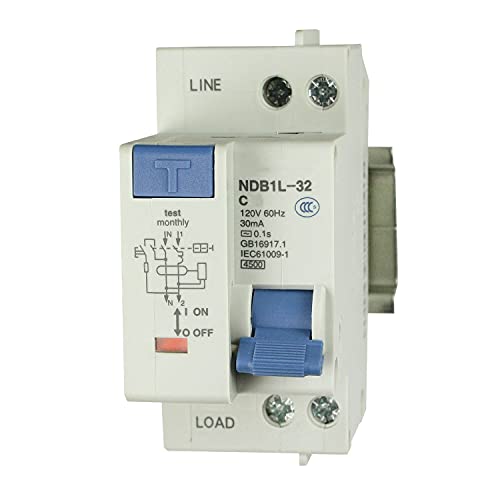
2. ASI NDB1L-32C-20-120V Ground Fault Circuit Breaker DIN Rail Mount, 20A, 120V AC, 1 Pole + Neutral Pole
The odd one out — built for DIN rail cabinets, not the panel in your garage.
Most homeowners will scroll straight past this, and they should. This is a DIN rail mount breaker, which means it clips onto the metal rail used inside industrial control cabinets and OEM equipment enclosures rather than into a residential load center. If that describes your setup — a heat trace controller, a machine panel, a small equipment enclosure — it is a genuinely useful 20-amp, 120-volt single-pole GFCI with a trip curve of C and a UL1053 recognized listing.
What it does that a standard breaker does not: a push-to-test button, a visual trip indicator so you can see at a glance which device opened, and screw clamp wire terminations described as shock proof. It trips when leakage to ground exceeds 30 mA. Owners using it on heat trace report it working well, and the unit is a genuine budget-tier option with a commensurately small review base of 49 ratings at 4.5 stars.
The trade-off is real and specific: one owner pressed the test button, heard arcing, saw smoke from around the button, and found the test function permanently broken afterward. That is a failure, not a trend — but it is the kind of thing that makes this a fit question rather than a quality verdict. If you are wiring a residential panel, buy a panel breaker. If you are replacing a DIN rail device in a cabinet, this is the one.
Built for: DIN rail cabinets, heat trace controllers, and OEM equipment where a panel breaker cannot mount.
Wrong tool if: you are working inside a residential load center — that calls for a plug-on or snap-in breaker instead.
3. 20 Amp 1-Pole GFCI Plug-On Neutral Circuit Breaker (Siemens QF120AN)
A 240-volt single-pole GFCI with a plug-on neutral that skips the pigtail entirely.
This one is easy to misread, so read carefully: it is a single-pole breaker, but it is rated 240 volts, which makes it the odd-but-useful member of the family. Compare that with the SIEMENS QF120A above, which is a 120-volt unit — different voltage, different application, same brand. It carries a 10,000 AIC rating and is HACR and SWD rated, meaning it is listed for heating and air-conditioning equipment and for switching duty circuits like lighting loads. It is UL Listed and built only for Siemens load centers rated to accept plug-on breakers.
The plug-on neutral is the feature owners call out, because the neutral lands on the breaker instead of a separate bar. That eliminates the pigtail wire and gives you back gutter space in a crowded sub-panel. Quality is what carries this pick — it is the clear top positive here, and the unit sits at 4.5 stars across roughly a hundred ratings.
Functionality is the honest qualifier. Amazon’s own read of the reviews flags it as mixed, which in plain terms means it works exactly as intended when it seats in a compatible panel and does nothing useful when it does not. Owners describe it as an exact fit for a Siemens sub-panel, and the recurring warning is worth repeating: this is not a DIY job unless you are confident working around a live electrical panel. One buyer needed a GFCI-protected outlet that could not be reached physically, and used this breaker for that reason.
The installation reality: a plug-on neutral breaker with no pigtail saves panel space and shortens the job — but only in a Siemens load center that accepts plug-on breakers.
Panel-first purchase: verify the bus and neutral arrangement before ordering, because a mismatch here does not fail gracefully.
Best for: Siemens sub-panels where you want GFCI protection on a 240-volt single-pole circuit without adding a pigtail.
Think twice if: you are not comfortable working inside an energized panel — this is licensed-electrician territory.
4. Square D by Schneider Electric QO120PDFC QO Plug-On Neutral 20 Amp Single-Pole Dual Function (CAFCI and GFCI) Circuit Breaker

Two protections in one slot: ground fault and arc fault, on a single 20-amp QO breaker.
This is the one to buy if your code or your inspector wants arc-fault protection as well as ground-fault protection on the same circuit. A plain GFCI breaker watches only for current leaking to ground. This dual-function unit adds combination arc-fault interruption (CAFCI), which watches for the sparking signature of damaged or loose wiring, and it does both jobs in one 20-amp, 120-volt, single-pole device rated 10,000 AIR and listed to ANSI and UL standards. It is compatible with QO plug-on neutral load centers only.
The plug-on neutral design is what owners keep coming back to. Rather than running a pigtail, the neutral connects through the breaker, which means fewer connections and faster installation — and a panel that looks visibly neater when the cover goes back on. One owner extended that logic to a whole garage panel, noting the breakers cost more up front but eliminate separate GFCI outlets on each circuit, which offsets the difference. Quality is the strongest theme here, and the unit holds 4.5 stars across 200+ ratings.
Where it demands honesty: reliability lands mixed, with a portion of owners reporting trips they did not expect, and installation is mixed too. Others describe it tripping when it should — a 100-A garage panel protects two bathrooms and outdoor outlets, and the breaker tripped once during a power outage and once on an over-current event with two 500W halogens and a brushed hammer drill running together; the drill alone ran fine the next day. For new panels it is an easy recommendation; for an older QO panel, confirm plug-on neutral compatibility first.
Pick this when: you want arc-fault and ground-fault protection from a single QO breaker and your panel supports plug-on neutral.
Skip the upgrade if: your inspector only requires GFCI — a straight GFCI breaker covers that at a lower cost.
5. Square D by Schneider Electric QO120GFICP QO Qwik-Gard 20 Amp Single-Pole GFCI Circuit Breaker

For QO panels that predate plug-on neutral — the fix that stops phantom GFCI trips.
If your Square D QO panel is old enough that plug-on neutral was never an option, this snap-in Qwik-Gard breaker is the practical path to GFCI protection without rewiring the house. It fits QO load centers rated 100A or higher and some smaller QO load centers, so check the panel rating before ordering. It is a 20-amp, single-pole GFCI with the red Visi-Trip feature, which shows you exactly which breaker has opened — a small thing until you are standing in front of a dark panel trying to work out which circuit dropped.
Functionality is what earns this pick its place, and the clearest example is a phantom-trip fix. An owner had a breaker that tripped randomly with nothing plugged into the circuit — sometimes barely a day between trips. The replacement went in and ran over a week with zero trips, and the owner noted this was cheaper and easier than chasing terminations or buying a leakage current meter. Another homeowner described how it adds protection to an older QO panel without a rewire, fitting in spots where a GFCI outlet would not. It carries 4.6 stars across 300+ ratings.
Two things to know before you buy. First, it takes more horizontal panel space than you might expect, which gets fiddly in a messy panel with crowded wiring — plan the slot. Second, installers have noted it is friendly enough that a careful non-electrician has completed the swap, but the same rule applies to every breaker here: if you are not comfortable in a live panel, hire it out.
Why it earns the slot: Snap-In mounting and a red Visi-Trip indicator in a breaker built specifically for existing QO load centers, so an older panel gains ground-fault protection without a rewire.
Plan the space: it occupies more horizontal room than a slim breaker, and a crowded panel with messy wiring makes the install more awkward than it needs to be.
Suits: older Square D QO panels where you want GFCI protection and cannot use a plug-on neutral breaker.
Not for you if: you have a Siemens, GE, or ABB panel — this snaps only into QO load centers.
6. GENERAL ELECTRIC THQL1120GF CIRCUIT BREAKER

The genuine OEM answer for older GE panels that need a clean, listed replacement.
Owners hunting a breaker for an older GE panel have a specific worry: what arrives might be a generic lookalike rather than a real GE part. This one settles that worry. Buyers who were nervous about exactly that reported opening the box to a genuine OEM GE unit that fits older GE panels properly. It is a 20-amp, single-pole, 120VAC breaker with ground fault circuit interrupter protection and a 10,000 A.I.C. rating, and at 8.16 ounces it has more heft in the hand than the slim Siemens units above.
The real-world use case thread runs through pools and outdoor equipment. One owner bought it specifically for an above-ground pool and described the application as perfect, mounted in the panel as advertised. Another replaced a failed breaker and had power back on the same day. That is the pattern with this unit — straightforward, undramatic restoration of a circuit that had gone dark.
Two fair caveats. The price sits at the premium end for a single-pole breaker, and more than one owner has said they could have found it cheaper elsewhere. Delivery has also been slow for some, with one buyer waiting two and a half weeks across the country — worth knowing if you are on a schedule. It holds 4.5 stars across roughly a hundred ratings, and it is a pole-mount design for GE-style panels.
Where it shines
- Confirmed genuine OEM GE part that fits older GE breaker panels
- 10,000 A.I.C. rating and GFCI protection in one 120VAC single-pole unit
- Straight replacement for pool and outdoor circuits that have failed
Cost and timing
- Priced at the top of the single-pole range, and cheaper sources exist
- Slow shipping reported by at least one buyer, so do not order under deadline
- Panel-specific — it fits GE-style load centers, not Siemens or Square D
Go with this if: your panel says GE and you want the real thing rather than a cross-brand guess.
Order early if: you have a pool or outdoor circuit already offline, because delivery timing has been the weak point.
7. SIEMENS Q220GF Ground Fault Circuit Interrupter, 20 Amp, 2-Pole GFCI Circuit Breaker
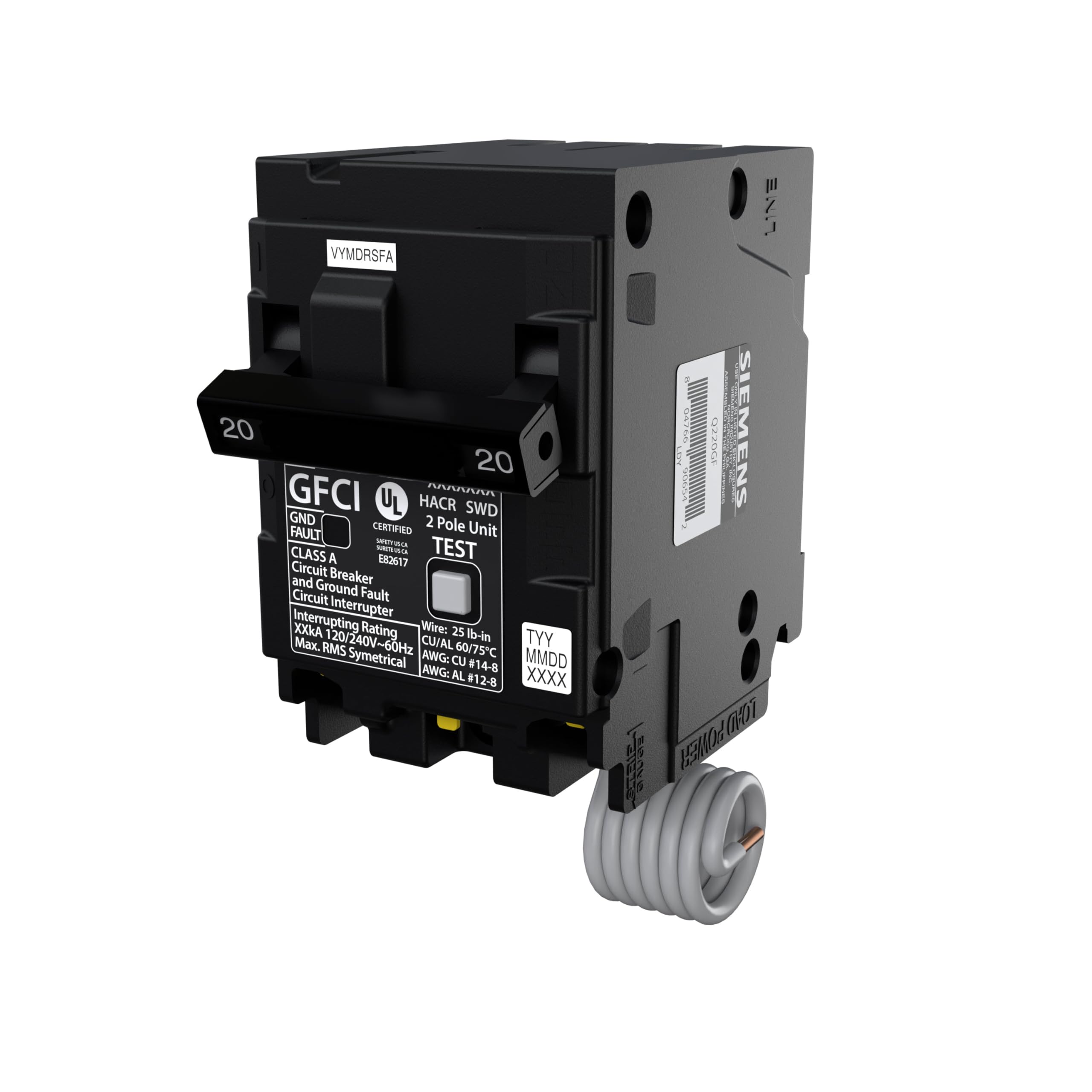
The two-pole pool breaker that made the category’s highest-rated score.
Pool owners who have fought a tripping pump will recognize everything about this breaker. It is a two-pole, 20-amp, 240-volt GFCI unit — type QPFB, replacing the Siemens QF220AP and QF220A models — and it is built for wet and damp locations such as pools, spas, HVAC equipment, and kitchen or bathroom circuits. It carries LED trip indicators to help identify a fault condition, and the reduced-size housing allows more wire bending space inside the panel. At 4.7 stars across just over a hundred ratings, it tops every other pick here on score.
The stories behind this one are consistent. A pool pump that shut down after about five seconds turned out to be a failed two-pole breaker; the replacement took minutes and the pool was back in use. Another owner had a variable-speed pump that kept tripping an older breaker and solved it outright with this unit. One buyer replaced what they described as an unreliable competitor breaker after water and heat had degraded it, and reported the Siemens working properly. A pool contractor with four decades in the trade called this the best GFCI for variable-speed pool pumps.
One caveat, and it is narrow. A reviewer gave four stars and called it quality but finicky with frequency-drive pool pumps — meaning some drive-driven pumps still demand attention. That is a pump-matching note rather than a defect. The reduced housing and plug-in mount make the physical install easy in a compatible Siemens panel; the electronics pairing is the part that needs the right pump.
The confident pick for: anyone replacing a two-pole GFCI on a spa, pool, or hot tub feed in a Siemens panel.
Check your pump first if: it is a frequency-drive variable-speed model, since that pairing can still need tuning.
8. ABB Q-Line THQL2120GFT 20A Double Pole Circuit Breaker with Self-Test
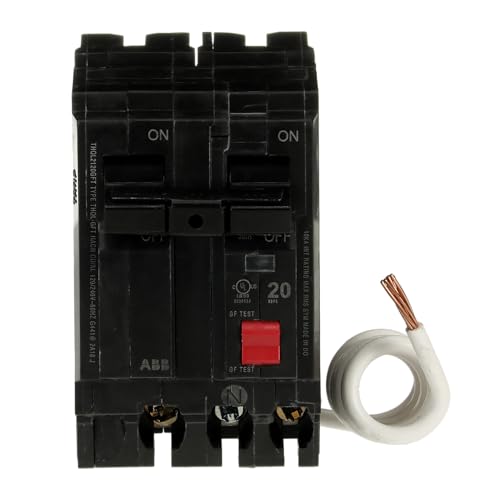
A 120/240VAC two-pole GE-style breaker with built-in self-test and hot tub history.
Here is the lineage worth knowing before you order: ABB acquired GE’s industrial solutions business, and GE’s residential electrical distribution products now carry the ABB name. That is why this breaker uses the THQL footprint and fits the same panels as the GE THQL1120GF above — same family, different pole count. This one is a 20-amp, double-pole GFCI rated 120/240 VAC, with a self-test function that automatically checks the ground-fault circuitry and a plug-in mount. It protects bathrooms, kitchens, garages, and outdoor areas on a two-pole circuit.
Hot tubs are where this unit earns its keep. One owner replaced a 20-amp breaker feeding an early-2000s hot tub that kept tripping at random, and the swap fixed the problem outright. Their one complaint was cosmetic — the throw lever carries no amperage marking, which they planned to solve with a label. Pool owners mention the same pattern: doing the replacement themselves instead of paying a pool company, with the install described as easy. Functionality is the theme owners return to most, backed by a 4.5-star standing across just over a hundred ratings.
Two honest notes. The price is high for a two-pole breaker, and some owners say so plainly. Separately, one long-term pool user is now on their third breaker replacement in nine years for a pool filter panel, and attributes the repeat failures to Florida coastal air and heat making the housing material porous and moisture-prone; they describe the current unit as feeling more solid but leave durability as an open question. That is a climate story, not a verdict on the part.
Why it earns a spot
- 120/240 VAC double-pole GFCI with an integrated self-test function
- THQL footprint fits the same panels as GE Q-Line breakers
- Fixed persistent tripping on a hot tub and multiple pool panels
Worth knowing first
- Price sits at the high end for a two-pole breaker
- Throw lever has no amperage marking — you will want a label
- Coastal humidity can shorten service life in exposed outdoor panels
The right fit for: GE-style panels running a hot tub or 240-volt outdoor circuit that needs GFCI and self-test.
Budget-conscious buyers: look at the single-pole options above if your circuit is 120 volts — this is a two-pole premium part.
9. Pentair PA220GF 2-Pole GFCI Circuit Breakers, 20-Ampere
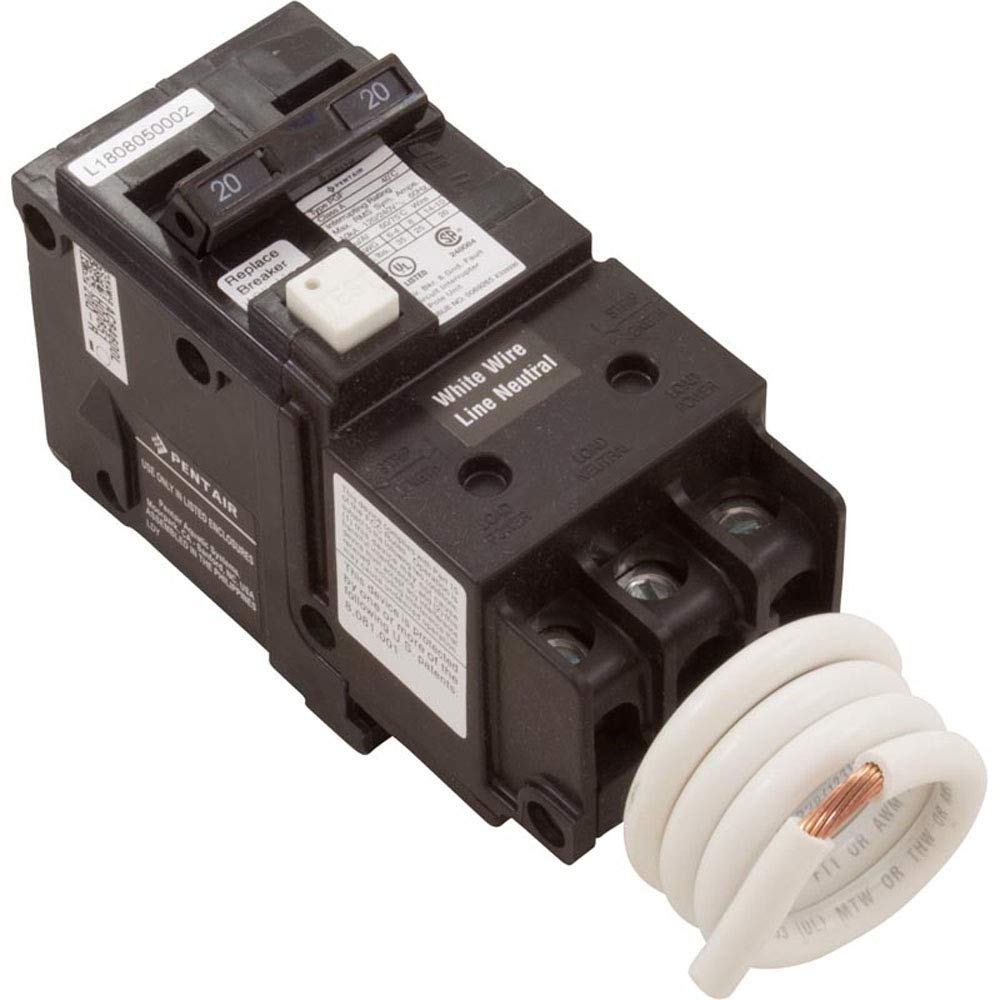
Purpose-built for the one job that makes ordinary GFCI breakers misbehave.
Nothing else on this list is designed around a single stubborn problem the way this one is. Ordinary two-pole GFCI breakers can nuisance-trip when a variable-speed pool pump starts or ramps up, and the Pentair PA220GF exists to stop that. It is a 20-amp, double-pole GFCI rated 115V/230V, wall mounted, and owners describe it powering a 220V pump without the repeated trips that sent them shopping in the first place.
The evidence here is unusually specific. One owner upgraded a pool’s non-GFCI breakers to standard GFCI units and found they tripped after a couple of hours; the Pentair replacement held. Another had a 50-amp GFCI that worked fine with older pumps but tripped with a new one, and stepping down to this 20-amp unit — matching the manufacturer’s pump specification — solved it. A third traced phantom tripping of an unrelated house GFCI to the pump’s start-up behavior and found this breaker fixed it after an electrician had been skeptical. Compatibility and the absence of false tripping are the two things owners talk about most, and both come back in the same breath.
The price is the plain trade-off: this sits at the top of the range by a wide margin, and you are paying for a narrow specialty rather than general capability. Note also that it is wall mounted, not a plug-on load center breaker, so confirm the mounting arrangement before you order. If your panel is not driving a pool pump, one of the Siemens or ABB two-pole units above will do the same job for less.
Who this is actually for: pool owners with a variable-speed pump whose existing GFCI breaker keeps tripping on start-up or speed changes, where a standard GFCI unit has already failed to hold.
The clear trade-off: it is the most expensive pick here and it fits a narrow use case — outside of a pool or spa feed, you are paying a specialty premium for nothing you need.
Buy this when: a variable-speed pool pump is tripping every standard GFCI breaker you have tried.
Look at the Siemens Q220GF instead if: you want two-pole GFCI coverage for a hot tub or spa without the pool-pump specialty cost.
Understanding the Specs
Amp rating and poles
The amp rating is how much current the circuit is designed to carry continuously — 20 amps here, which is the standard for kitchen counter circuits, bathroom circuits, and most pool equipment feeds. Poles describe how many hot wires the breaker controls. A single-pole unit manages one 120-volt circuit; a two-pole unit manages a 240-volt circuit and cuts both legs together when it trips. Ordering by amperage alone is the most common mistake — a 20-amp single-pole breaker will not substitute for a 20-amp double-pole one.
Interrupting rating and self-test
The interrupting rating, shown as 10,000 AIC or 10,000 AIR on several of these breakers, is the maximum fault current the device can cut off without being damaged. Higher is safer in panels close to the utility feed. Self-test is separate from interrupting rating: UL 943 requires GFCI devices to check their own ground-fault sensing circuitry on a regular basis. A self-testing breaker does not replace pressing the test button yourself — it just means the device is not relying solely on you.
FAQ
Will a Siemens GFCI breaker fit a Square D panel?
Do I need a one-pole or a two-pole 20-amp GFCI breaker?
What does the 10,000 AIC rating on these breakers actually mean?
What is a plug-on neutral breaker and why does it matter?
Why does my pool pump keep tripping the GFCI breaker?
Can I install a 20-amp GFCI breaker myself?
Do these GFCI breakers self-test automatically?
What is the difference between a GFCI breaker and a dual-function breaker?
Why would a DIN rail GFCI breaker be the right choice?
Can a GFCI breaker replace a GFCI outlet I cannot reach?
Final Thoughts: The Verdict
For most people, the 20-amp gfci breaker winner is the SIEMENS QF120A, because it pairs Class A GFCI protection and a 10,000 AIC rating with self-test, and it seats in off-brand and older panels where a lot of dedicated-brand breakers will not. The score backs it up — it is the highest-rated pick on this list. If you need arc-fault protection on the same circuit, grab the Square D QO120PDFC, which folds CAFCI and GFCI into one slot. And if a variable-speed pool pump is the thing tripping your breaker every few hours, the Pentair PA220GF is the one purpose-built for that fight. Check your panel brand first, order the matching family, and this becomes a five-minute job.
How We Picked
We do not accept paid placement. Every pick is matched to a real buyer and a real use-case; we do not hands-on test units.
Sources & Methodology
Specifications: manufacturer listings and product documentation. Review insights: verified customer reviews, as of September 2026. Pricing: not shown on this page (it changes often); check the current price via the retailer link.
As an Amazon Associate, KitchPrep earns from qualifying purchases. This does not affect which products we feature.
Related Guides
