
Specs are compiled from manufacturer listings and verified buyer reviews and can change over time — please confirm the key details on the product page before buying.
Buying a 1/4 inch torque wrench is really a question of two things: drive size and torque range. The 1/4 inch drive is the small-square end that fits sockets sized for delicate fasteners — bicycle stems, valve covers, transmission pans, scope mounts, small engine bolts. Tighten those by feel and you strip threads or crack aluminum. Below you will find the nine quarter-inch wrenches worth your attention, sorted by what each one is actually good at, so you can match the range on the scale to the bolts on your bench.
I’m Mohammad Maruf — the founder and writer behind KitchPrep. This guide is built by comparing the manufacturers’ published specifications and the patterns across verified customer reviews, so you get each pick’s real strengths and trade-offs instead of marketing spin.
What separates a frustrating wrench from a reliable one is narrower than most people expect — it is whether the scale starts low enough, clicks loud enough, and holds its calibration. This breakdown of the best 1/4 inch torque wrench covers every range and budget tier in plain terms.
Our Picks at a Glance


How To Choose The Best 1/4 Inch Torque Wrench
The quarter-inch drive is the smallest of the three common wrench sizes. It fits sockets and bits made for low-torque work, where over-tightening snaps a bolt head clean off. Choosing one is about matching three things: the torque range on the scale, how the wrench tells you to stop, and how long the whole package runs.
Match the range to your lowest bolt, not your highest
Your wrench only works on fasteners that fall inside its printed range, measured either in inch-pounds (in-lb, the small unit) or Newton meters (Nm, the metric version). A stem bolt on a carbon road bike might need a low single-digit Nm value, while a suspension bolt on a truck could run much higher. If the scale starts above your target, the wrench cannot help you. Look for a range that comfortably brackets every job in your garage — some sets here go as low as 10 in-lb, others start at 40 in-lb or 30 in-lb, and some go up to 240 or 265 in-lb. Pick the one whose bottom edge sits below your smallest job.
Understand the click before you trust it
A click-type wrench works by releasing a spring-loaded mechanism at a preset value, producing a sound or feel you recognize as “stop.” Accuracy is usually written as a percentage, like ±3% or ±4%, meaning the real torque could land slightly above or below your setting. The trick is that at very low settings the click can be subtle — one manufacturer openly notes it is faint under 5 Nm and firmer between 5 and 25 Nm. A digital wrench replaces the guess with an alarm. Buyers report: “the click is easy to feel when you reach the set torque.” Buy the signal type you will actually notice with your knuckles buried in a frame.
Tooth count, length, and the case you will actually use
Tooth count inside the ratchet head determines how far the handle has to swing before it catches the next tooth — a 72-tooth head needs a shorter swing than a coarser one, and a 90-tooth head shorter still. That matters when you are working in a tight space where you cannot swing the handle far. Length matters the other way: a longer handle gives more leverage but can be too big for a cramped engine bay. Finally, weigh the case — a molded or zippered case protects a tool that a dropped wrench can knock out of accuracy, which is why some makers test the case for impact resistance.
Quick Comparison
| Model | Best For | Torque Range | Accuracy | Tooth Count | Amazon |
|---|---|---|---|---|---|
| Matework 50PCS Inch Pound Torque Wrench Set★ Best Overall | Bike & MTB do-everything kit | 10-220 in-lb / 1-24.7 Nm | ±3% | 72-Tooth | Amazon |
| VEVOR 50Pcs Torque Wrench SetWidest Range | Wide-range automotive jobs | 20-240 in-lb / 2.3-27.1 Nm | ±3% | 72-Tooth | Amazon |
| LEXIVON Inch Pound Torque Wrench LX-180Compact Reach | Tight-space inch-pound work | 10-150 in-lb / 1.1-16.9 Nm | — | 72-Tooth | Amazon |
| LEXIVON Bike Torque Wrench LX-190 | Road & mountain bike maintenance | 2-26 Nm / 17.7-230.1 in-lb | ±4% CW / ±6% CCW | 72-Tooth | Amazon |
| eTORK 1/4 Inch Drive Torque Wrench | Readable scale, light duty | 40-200 in-lb / 4.5-22.6 Nm | ±3% | — | Amazon |
| SUZUME 1/4 Digital Torque Wrench | Digital alarm, four units | 13.3-265.5 in-lb / 1.1-22.2 ft-lb | ±2% | 72-Tooth | Amazon |
| TEKTON Micrometer Torque Wrench TRQ50402 | Precision SAE-scale work | 20-200 in-lb | No worse than ±3% | 90-Tooth | Amazon |
| TEKTON Micrometer Torque Wrench TRQ50502 | Metric carbon-bike precision | 2-20 Nm | No worse than ±3% | 90-Tooth | Amazon |
| GEARWRENCH 85060 Micrometer Torque Wrench | Pro-grade daily shop use | 30-200 in-lb | ±3% CW (20-100% range) | — | Amazon |
In‑Depth Reviews
1. Matework 50PCS Inch Pound Torque Wrench Set, 1/4″ Drive Bike Torque Wrench
Our pick — over 4.5★ from 900+ verified ratings; the strongest balance of quality and price.
The complete bike-side starter that arrives with every bit you will ever need.
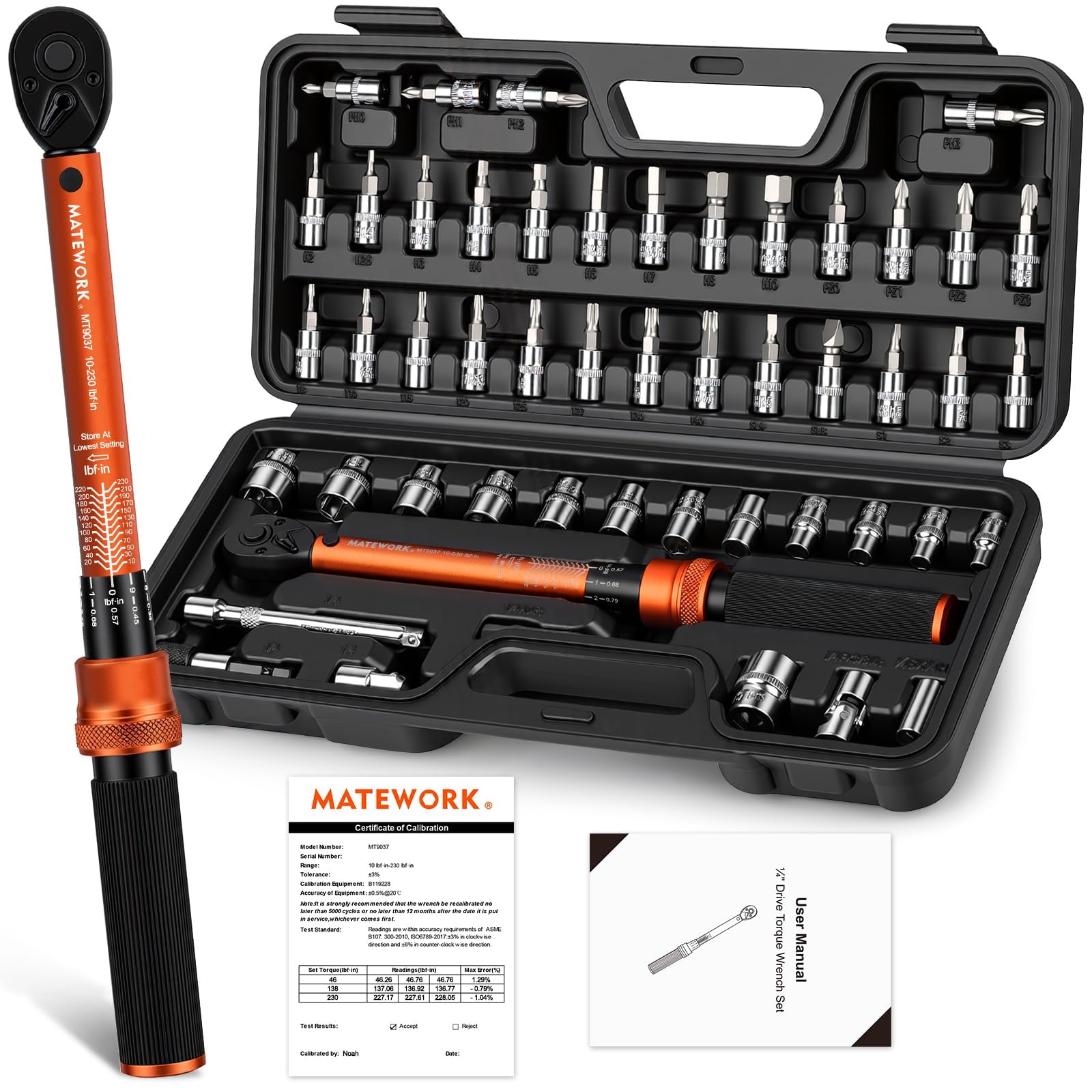
The Matework set is the strongest overall package for the money because of one number: fifty pieces. You get a 1/4 inch drive click wrench, a 72-tooth reversible ratchet head that works both clockwise and counterclockwise via a small paddle, a quick-release button for swapping sockets fast, and a spread of bit sockets covering Hex H2-H10, Torx T8-T40, Phillips PH0-PH3, Slotted SL4 and SL8, Pozi PZ0-PZ3, Robertson S1-S3, and 6-point 4mm-15mm. On top of that it carries a 1/4″ to 3/8″ adapter, a bit holder, a bit adapter, a socket adapter, a universal joint, and a 4-inch extension bar. For someone who owns one bike and a handful of tools, that single box replaces a stack of separate purchases.
What wins people over most is the quality — the most-praised trait in the feedback by a wide margin — closely followed by how much tool you get for the outlay. A bike owner summed it up: “it’s easy to use and has an adjustable range of 1-25 nm. Seems to be made well and comes with a variety of attachments that are perfect for bikes.” The head runs a dual scale of 10-220 in-lb and 1-24.7 Nm, with fine 1 in-lb (0.1 Nm) micro-adjustment, so you can dial in settings rather than eyeball them. Accuracy is rated within ±3%, and each wrench ships with a calibration certificate. It is also tested to ISO6789 and ASME B107.300. At 3.6 pounds it is the heaviest thing in this lineup, which is the honest cost of carrying fifty pieces and a powder-coated case — the VEVOR below sheds a fraction of that at 3.4 pounds, though on a job like this both stay put on the bench.
The recurring gripe is the printing — white lettering over an orange background is genuinely hard to read in bright daylight, and the bits can rattle around in the case when you move it. The click is also worth knowing about: below 5 Nm it is faint, and it firms up between 5 and 25 Nm, so if your whole job lives down at 2 or 3 Nm you have to rely on the scale rather than the sound. There is also some mixed feedback on long-term accuracy, and a handful of owners have had bits break under load. None of that changes the core picture: for a road or MTB owner doing seat posts, handlebars, stems, derailleurs, brakes, and the occasional e-bike or motorcycle job, this is the one set that covers the whole task list.
What it gets right
- Fifty pieces in one box — Hex, Torx, Phillips, Slotted, Pozi, and Robertson bits all included.
- Dual scale reads 10-220 in-lb and 1-24.7 Nm with 1 in-lb (0.1 Nm) micro-adjustment.
- 72-tooth head runs both directions with a quick-release button for fast socket swaps.
- ±3% accuracy, ISO6789 and ASME B107.300 tested, and a calibration certificate in the case.
Where it asks patience
- White-on-orange markings wash out in direct sun.
- Bits shift and rattle inside the case during transport.
- Click is faint below 5 Nm; the 3.6-pound package is not a pocket tool.
Right call if: you want one box that covers a bike from stem to seat post and grows with you into motorcycle work.
Think twice if: your only job sits at 2-3 Nm, where the faint low-end click gives you little to feel.
2. VEVOR 50Pcs Torque Wrench Set, 1/4 Inch Drive, 20-240IN.LB (2.3-27.1Nm)
The one that reaches highest on the scale without stepping up to a bigger drive.
Most quarter-inch wrenches stop somewhere around 200 in-lb. This VEVOR keeps going to 240 in-lb, or 2.3-27.1 Nm, which is the difference between a bike tool and a tool you can hand to someone doing suspension and engine work. The handle is chromium molybdenum steel through a six-stage heat treatment, with a chrome-plated rustproof finish that wipes clean. The dual-direction scale is laser-etched and highlighted for low-light reading, and the reversible ratchet head lets you change sockets one-handed.
What earns the most credit here is the sheer build quality, with the way it functions right behind it. A truck owner working on a Suburban put it plainly: “It feels solid, is easy to adjust, and the click is easy to feel when you reach the set torque. The wide torque range makes it useful for a lot of different automotive jobs.” That wide range is exactly why it sits second — it covers more ground than the Matework above even though both are 50-piece kits. Its alloy-steel head and the 3.4-pound package also undercut the Matework’s 3.6 pounds, and at 9.45 inches long it tucks into an engine bay more easily than the longer 12-inch Matework handle.
The honest trade-offs are small but real. The white markings on the orange body are hard to read in bright sun, and the wrench runs a touch short for people who want more leverage on stubborn fasteners. The included case is a molded hard-shell type rated for impact resistance, which several owners have found survives a real drop. If your work is routine home-level maintenance — suspension, engine covers, the odd brake job — there is nothing here that will hold you back.
Value read: a 50-piece kit that reaches 240 in-lb, keeps rust off the head, and ships with its own calibration certificate for ±3% accuracy — that is a lot of coverage for the tier.
The fair caveat: the short handle and sun-washed markings mean it suits a home garage better than a daily production bay.
Pick this if: you need the extra top-end range a 200 in-lb wrench cannot give and you are doing car or motorcycle work at home.
Pass if: you want maximum leverage from a long handle, since this one runs short.
3. LEXIVON Inch Pound Torque Wrench 1/4-Inch Dr. | 72-Tooth Gear Dual-Direction (LX-180)
Short, light, and built for the inch-pound jobs that a long handle cannot reach.
At 8.7 inches long and 13.44 ounces, the LX-180 is four inches shorter than the 12-inch Matework and roughly a quarter of its weight, which is the whole point when the bolt you need sits behind a wheel arch or under a dashboard. The 72-tooth gear runs both directions, the scale covers 10-150 in-lb (1.1-16.9 Nm) with micro-adjustment, and the chromium molybdenum steel head wears an electro-black coating to keep rust off. A zippered protective case keeps it safe between jobs.
The things that win people over here are how well it works in small areas and the finish on the handle — the black electro-black coating and smooth-rolling adjuster feel more expensive than the tier suggests. The mechanism carries documentation listing its accuracy, and the click is reliable in the normal working zone. If your task is pinion bearing preload or hose clamps, this is precisely the shape of wrench you want in hand.
Two quirks are worth naming. The click on this one is quiet — it is more of a feel than a sound, which is fine in a quiet workshop but easy to miss with a compressor running in the background. It is also smaller than some buyers picture when they order, which is a benefit in tight spaces and a surprise if you expected a full-length handle. So long as those fit your situation, the LX-180 delivers its 10-150 in-lb range in a form factor that fits places the bigger kits simply cannot.
What stands out
- 8.7 inches long and 13.44 ounces — genuinely easy to slot into cramped spaces.
- 72-tooth dual-direction gear with a 10-150 in-lb (1.1-16.9 Nm) scale.
- Electro-black coating over a chromium molybdenum steel head resists corrosion.
Worth knowing before you buy
- Quiet click — easy to miss over background noise if you rely on sound.
- Smaller in the hand than many buyers expect from the listing photos.
Good match for: hose clamps, pinion bearing preload, and any tight quarter-inch job where a long handle will not fit.
Look elsewhere if: you want an audible click you can hear across a noisy shop.
4. LEXIVON Bike Torque Wrench 1/4-Inch Drive, Newton Meter (LX-190)
A metric-first bike wrench with a grip designed to keep your hand from aching.
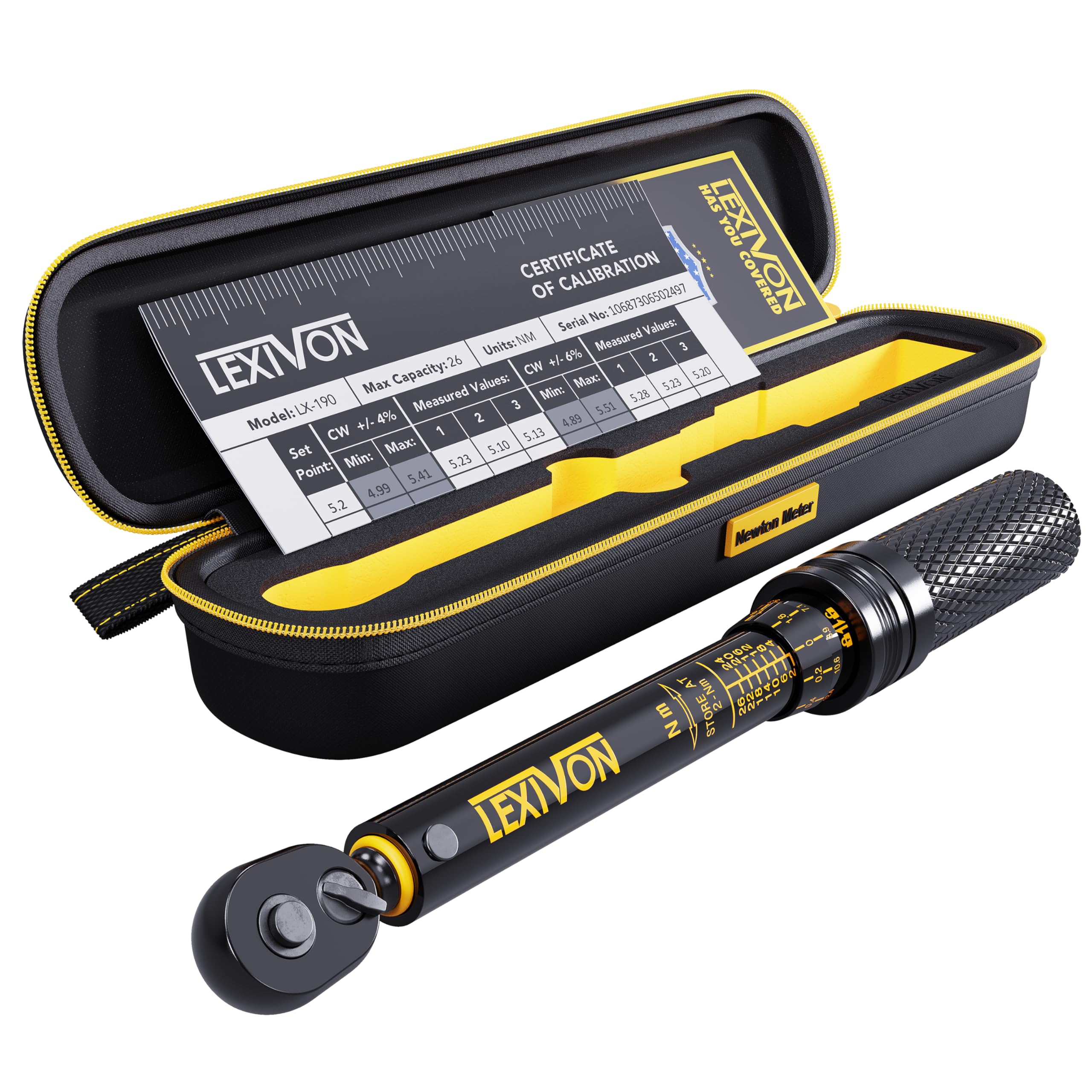
Most quarter-inch wrenches here are calibrated in inch-pounds first and converted for metric users. The LX-190 runs a Newton meter scale as its native readout, spanning 2-26 Nm (17.7-230.1 in-lb), which is exactly the band a road or mountain bike lives in. The handle is aerospace aluminum with a non-slip knurled grip, a slide-to-lock mechanism holds your torque setting in place, and the padded hardshell protective pouch goes wherever the bike does. Inside, the ratchet head is a heat-treated chrome-molybdenum piece with an electro-black coating to fight rust.
This is also the wrench in the group with the tightest accuracy figures: ±4% clockwise and ±6% counterclockwise, each one shipping with a calibration certificate and a traceable serial number. The 72-tooth reversible ratchet swings in a 5° arc, so you can work inside a frame where a coarser head would stall, and the quick-release button frees sockets with one hand. The maker’s spec sheet claims the handle cuts hand fatigue by up to 62% — a published marketing figure, not an independent test result. The yellow-on-black dual-range scale is built for low-light readability, which matters if you finish jobs at night in the garage.
On the honest side: this is a dedicated bike tool, so the top of its 26 Nm ceiling is well below what you would want for automotive suspension or big-engine fasteners. The scale is also metric-first, so if your brain works in inch-pounds you will be doing mental conversions. For the specific person who bought this — a cyclist who wants a light, well-finished wrench that stops at the right place on a carbon stem — those limits are not limits at all.
The one spec to remember: a ±4% clockwise accuracy rating and a traceable serial-numbered calibration certificate on a bike-specific wrench.
The truthful trade-off: the 2-26 Nm range is bike-focused, so car people should look at the wider automotive picks above.
Suits you if: you ride road or mountain and want a light aluminum-handled metric wrench with a snug padded pouch.
Skip if: your jobs live above 26 Nm or your mind thinks exclusively in inch-pounds.
5. eTORK 1/4 Inch Drive Inch Pound Torque Wrench (40-200 in-lb)

The wrench that makes setting and reading torque a two-second job.
The eTORK wins on the part you touch every time you use it: the scale. Instead of squinting at a fine line of numbers along the shaft, it uses a high-visibility torque window that shows the set value at a glance, which cuts the chance of leaving the wrench on the wrong setting. The range runs 40-200 in-lb (4.5-22.6 Nm) with ±3% accuracy and a calibration certificate, and the whole tool weighs in at a very pocketable 1.3 pounds. An audible and tactile click confirms arrival at your setting, and there are no batteries involved.
The verdict from people who own one is that it feels like a premium tool that does not cost like one — the read, the set, and the adjustment all draw warm mentions, and the accuracy is confirmed by owners who cross-checked it against digital adapters on a similar half-inch version. For automotive jobs like valve covers and intake manifolds, where the values sit in the 89 to 156 in-lb zone, this is the range that puts you squarely in the middle of its scale rather than dancing on the edge.
Two limits to weigh. The 40 in-lb floor means it cannot handle the truly delicate end of the spectrum — a stem bolt that wants a low single-digit Nm setting is below this wrench’s reach, so this is not a bike tool. And the click, while noticeable once you are used to it, runs on the quiet side, so you need to be listening and feeling rather than assuming you will hear it over a rattle gun. If your range is automotive-light and value matters, this is the straightforward pick.
Why it earns its place
- High-visibility torque window makes setting and reading fast without second-guessing.
- 40-200 in-lb (4.5-22.6 Nm) range, ±3% accuracy, no batteries needed.
- Only 1.3 pounds with a protective carrying case in the box.
Where it will not fit
- 40 in-lb floor rules out low-single-digit bike torque settings.
- Click runs quiet enough that you should rely on feel as much as sound.
Choose it for: valve covers, intake manifolds, and small-engine work where an unmissable scale and low weight matter most.
Not for: carbon bike components needing precision below the 40 in-lb starting figure.
6. SUZUME 1/4 Digital Torque Wrench (1.1-22.2 Ft.Lb / 13.3-265.5 In.lb)
A digital readout with an audible alarm, so you never have to trust a click.
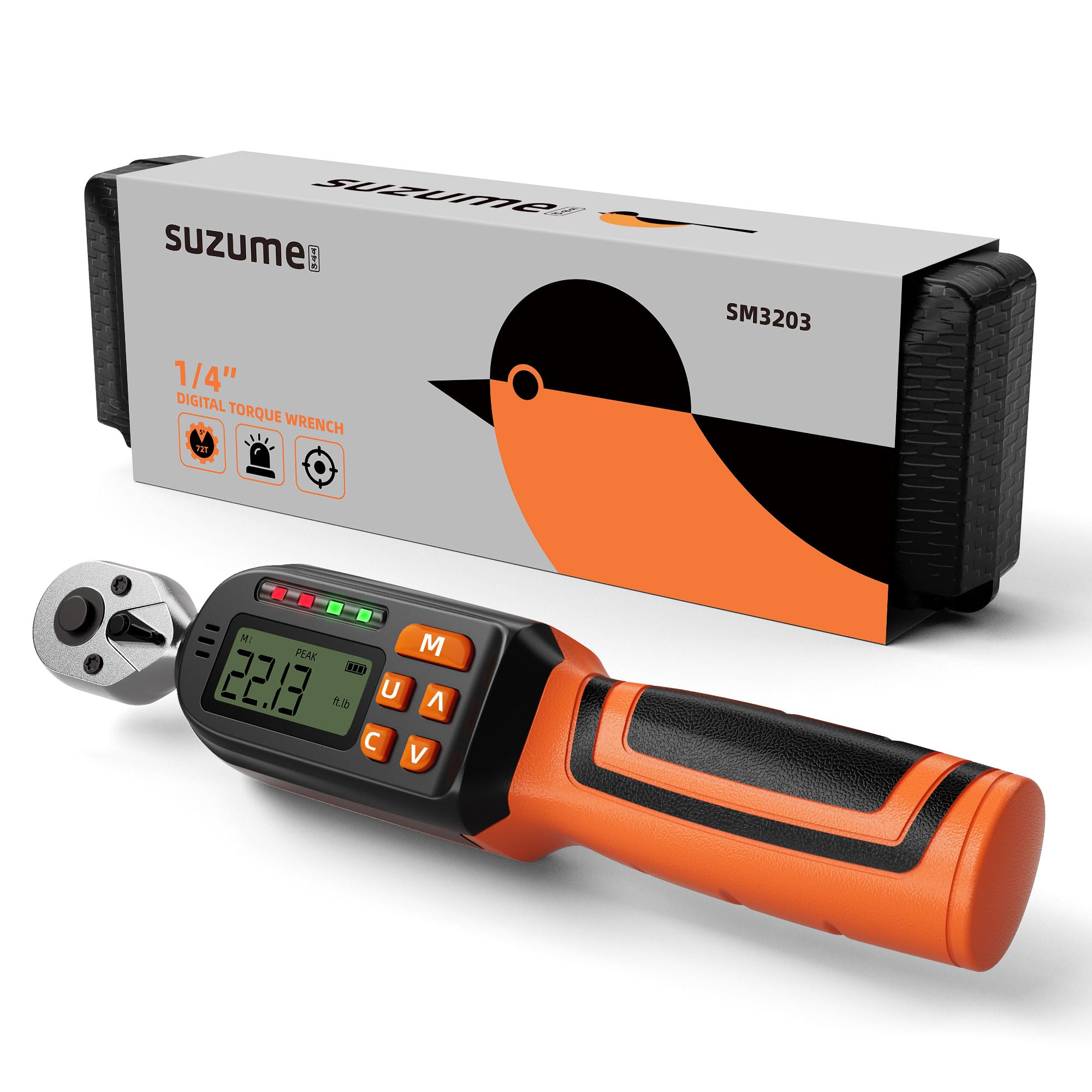
Everything else on this list asks you to sense a mechanical release. The SUZUME replaces that with electronics: when you reach your set torque, a buzzer sounds and LEDs change from blinking green to solid green, turning red if you overshoot. The maker claims ±2% accuracy, tested over 20,000 cycles and rated for 15,000 cycles without recalibration — all maker figures, not independently verified. Its range reaches as high as 265.5 in-lb (1.1-22.2 ft-lb), the highest ceiling in this group, and it reads in four units — Nm, ft-lb, in-lb, and kg-cm — so you can match whatever the service manual gives you.
The head is a 72-tooth reversible ratchet with a 5° swing and a push-button socket release, and the body is hardened chrome vanadium steel with a non-slip grip. That combination of numbers, four units, and an automatic-cycling data memory that records your use history is why the SUZUME earns the digital slot over the analogue options.
On the build itself the reviews split the way most electronic tools do: quick to praise, a little nervous about the batteries. The original cells in the box have a reputation for dying early, which is a mild inconvenience rather than a real fault, and some owners find the handle a little long for very tight engine bays. In return, this is the only pick here that remembers exactly what torque you applied and when — which for anyone doing axle nuts or suspension work is a genuine advantage over a mechanical click.
Star quality: a ±2% accuracy claim, four readout units, and a data memory that logs your torque history — a rare combination at this tier.
The small print: the original batteries do not last long, and the handle runs long for cramped bays.
For you if: you want a beep and a light to confirm torque rather than a click you might miss, and you value keeping a usage record.
Consider the analogue picks instead if: you never want to think about battery replacements.
7. TEKTON 1/4 Inch Drive Micrometer Torque Wrench | TRQ50402
The 90-tooth head that keeps engaging even when your swing arc is hopeless.
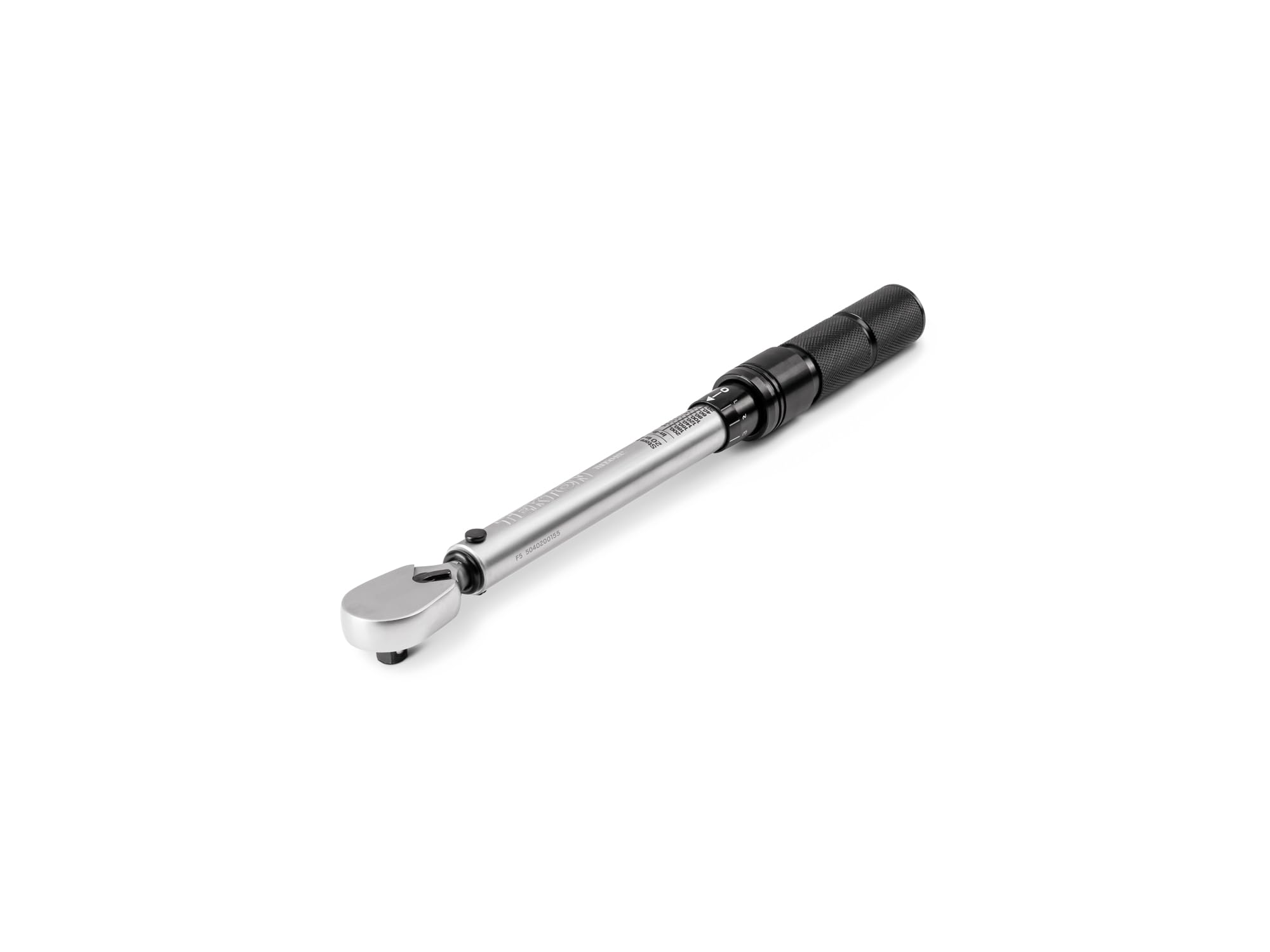
The TRQ50402 is built around a 90-tooth fixed ratchet head — the finest in this article — and a design where a single half-moon pawl keeps nine teeth engaged with the gear at all times, so it will not skip under load. That translates into a 4° swing arc, meaning you can tighten a fastener even when you can barely move the handle a few degrees. The range runs 20-200 in-lb with accuracy guaranteed to be no worse than ±3%, tested full-range to the ISO standard, which the maker states also meets and exceeds the ASME standard. A serialized certificate of calibration comes with each wrench showing test results and conditions.
The micrometer scale is marked with high-contrast laser lines on a satin-finished chrome handle body to reduce glare, so you can read your set value without turning the wrench toward a light. Owners confirm its accuracy lines up with the supplied calibration sheet, and describe it as ideal for aluminum engine components, transmission pans, valve covers, and ignition coils — the exact jobs where a stripped thread is expensive.
Two things to plan for. It is a digital-free mechanical tool, so it asks you to pull back the adjustment collar to set torque rather than spin a knob, and the adjuster moves slowly across the higher end of the range — several turns to travel from the bottom to the top of the range. And at 11.68 ounces it is light and handy, but the fine-grained 90-tooth mechanism rewards a slow, deliberate hand rather than a fast one. For anyone comfortable with that rhythm, this is a serious precision instrument at its tier.
Why it commands its price: 90 teeth, a 4° swing arc, and full-range ISO calibration with a serialized certificate — a genuinely precise head.
What to accept: adjusting up to the higher end of the 20-200 in-lb range takes several turns of the collar.
Buy it for: engine and transmission work where you need a fine swing arc and calibration you can show on paper.
Leave it if: you want a knob-and-done adjustment rather than a pull-back collar.
8. TEKTON 1/4 Inch Drive 90-Tooth Dual-Direction Micrometer Torque Wrench with Case (2-20 Nm) | TRQ50502
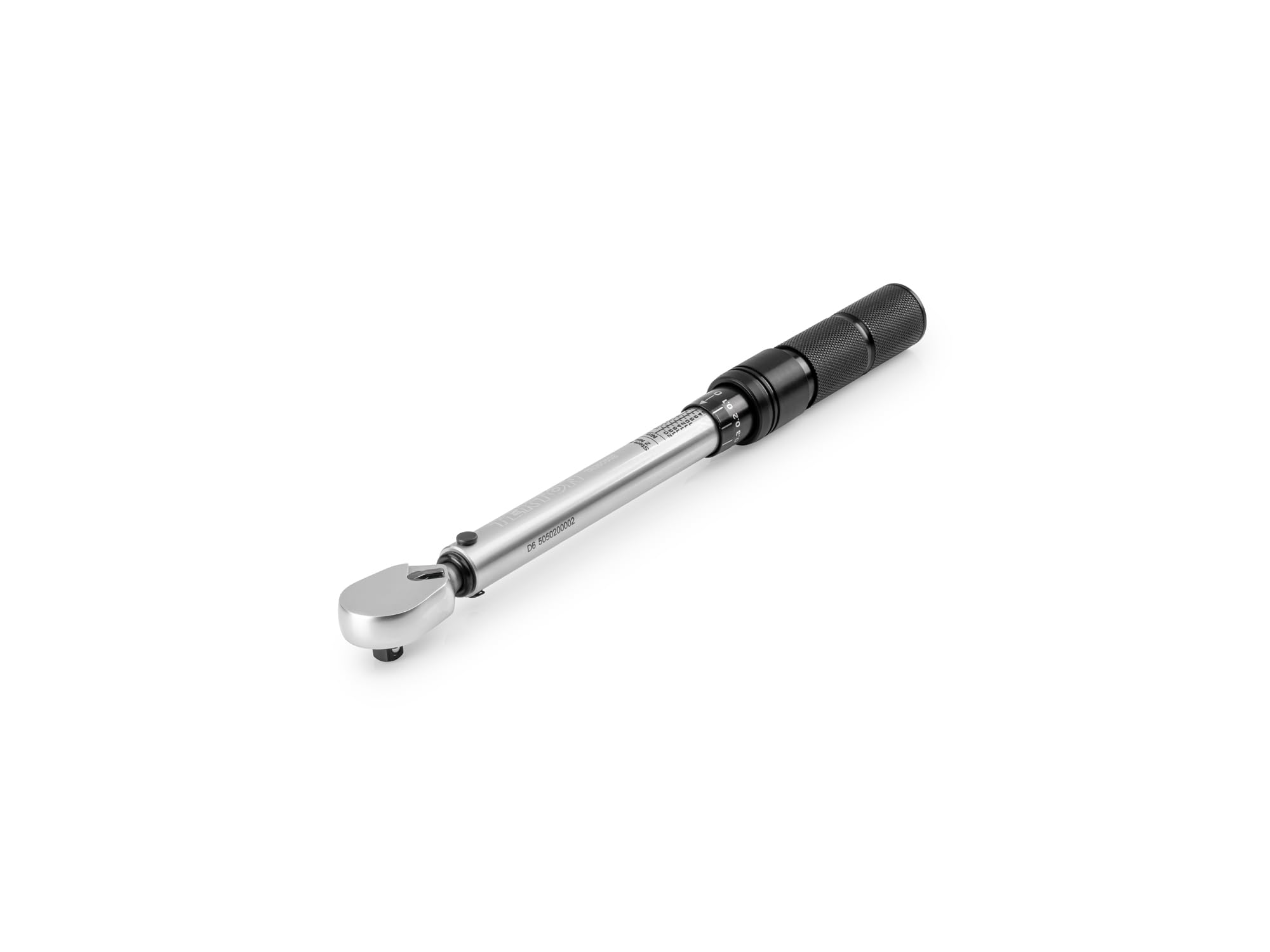
Metric-scale precision for the carbon frame, down to the tightest single-digit setting.
Same 90-tooth head, same 4° swing arc, same single-half-moon-pawl design as the TRQ50402 above — but this one is calibrated to metric, running a 2-20 Nm range with 0.1 Nm adjustment steps. For anyone working on a carbon fibre bike, the ability to set a round 5 Nm rather than approximate it is the entire reason this wrench exists. Accuracy is guaranteed no worse than ±3%, ISO-calibrated full range, with a serialized certificate showing test results. A hinged storage case with metal pinned hinges protects the head between jobs, and the box includes both a magnetic 1/4″ hex adapter and a 1/4″-to-3/8″ adapter.
Owners who chose it over the shop-standard Park Tool TW-5.2 for a carbon bike point specifically to the 0.1 Nm increments versus 0.2, the availability of round-number settings, and the individual calibration certificate. This is the same package that engineers use for BMW valve covers and Honda valve cover jobs — one reviewer reporting no oil leaks after a full valve cover replacement — and it is the same wrench that a home mechanic describes as a good buy if you do most of your own work. It is a small wrench, 11.68 ounces, and the whole kit just fits at the top end of any home mechanic’s budget.
The one friction point is the locking ring: you pull it down as you turn the torque adjuster, which feels odd the first few uses and takes some getting used to for anyone coming from a smooth-spin wrench. The 2-20 Nm ceiling also means it is a bike and small-engine tool, not an automotive suspension tool. For its actual job — protecting carbon frame bolts and precision engine components — the combination of the fine scale, the calibration sheet, and the 90-tooth head at this price is tough to top.
What separates it
- Metric-native 2-20 Nm scale with 0.1 Nm steps for round-number bike settings.
- 90-tooth head with a 4° swing arc, so it keeps catching where coarser wrenches stall.
- Serialized calibration certificate and ISO full-range calibration, no worse than ±3%.
Small catches
- The locking-ring adjuster takes some getting used to.
- 2-20 Nm ceiling rules out automotive suspension work.
Made for: carbon-fibre bike owners and small-engine mechanics who need precise single-digit Nm settings.
Not the one if: you need to reach above 20 Nm, or you dislike pulling a locking ring to change the setting.
9. GEARWRENCH 1/4″ Drive Micrometer Torque Wrench 30-200 in/lbs. – 85060

A flex-head pro wrench with a pull collar instead of a twist knob.
The 85060 occupies the top of the price ladder for one clear reason: it is the one pick here built to a professional standard, with a head you can angle out of the way instead of fighting the frame around it. The head is a flex type on a polished steel body — the polished finish also resists fingerprints and grime — and the wrench runs a range of 30-200 in-lb in both metric and SAE, so a European-made frame or a Japanese engine block is no obstacle. The pull-adjustment collar on the handle is the maker’s signature feature: instead of turning a lock ring, you simply pull the collar down and reset the torque value directly.
The accuracy claim is industry-standard for the tier: ±3% clockwise between 20% and 100% of the wrench’s capability, which is the officially confirmed working zone. A current calibration certificate ships in the box, and owners confirm it holds that calibration even after a couple of years of steady use. The flex head makes it especially good for access in a cluttered engine bay, where the extra angle means you can reach a bolt that a fixed-head wrench simply cannot.
What you trade for that flex head and pro-tier build is price — this is the priciest 1/4 inch wrench in the group, well into the premium tier. There is also a 90-day calibration warranty attached to the tool alongside one-year parts coverage, which tells you the maker expects it to be calibrated in-period as part of professional use. For a home mechanic doing occasional jobs this is more wrench than the task demands; for a working tech or a committed home box who wants the last quarter-inch tool they will ever buy, the value is straightforward.
Why the price holds up: a flex head for tight access, a pull-collar adjuster, ±3% clockwise accuracy, and calibration certificates that survive years of use.
Worth naming honestly: it is the priciest quarter-inch wrench here, and the flex head rewards careful handling over brute force.
Best fit for: working techs and serious home mechanics who want a flex head and a pull-collar adjuster over a twist knob.
Not worth it if: you only torque a handful of bolts a year, where a mid-tier wrench will serve you just as well.
Understanding the Specs
Drive size and torque range
The “1/4 inch” in this category refers to the drive — the small square nub at the head that sockets clip onto. It is the smallest of the three common drive sizes, and it exists specifically for fasteners that cannot take high torque without damage. The range printed on the wrench tells you the window of values it can handle. If your target value sits below the low end of the range, the wrench cannot help you. If it sits above the top of the range, the wrench will not click at all — you’ll just keep turning and possibly over-tighten. Always match the wrench’s range to the whole spread of jobs in your kit.
Accuracy and calibration
Accuracy is shown as a percentage — for example ±3% means when you set 100 in-lb, the actual delivered torque should land between 97 and 103 in-lb. Tighter tolerances like ±2% or ±3% are preferable for precision work, while ±4% and ±6% are more common on entry-level tools. A certificate of calibration is a small document that records the wrench’s tested accuracy when it left the factory, and some brands serialise it so it can be traced. For any work where thread damage is expensive to fix — aluminum engine components, carbon bike frames — a wrench with a serialized certificate is the safer choice.
Tooth count and swing arc
The ratchet head has internal teeth that let it catch in one direction and slip in the other. More teeth means each swing of the handle only needs to travel a short distance before the head re-engages. A 72-tooth head tends to work in moderately tight spaces, and a 90-tooth head goes finer still. When you buy, ask yourself how much room the handle will have to swing on the bolts you’ll actually be tackling. If the answer is “not much,” a 90-tooth head is a requirement, not a luxury.
Click mechanism vs digital alarm
Both types stop you at the set value, but they signal differently. A click-type wrench releases a spring-loaded mechanism when you reach your setting, producing a sound or feel you recognize as “stop.” It uses no batteries and never needs to be charged. A digital wrench replaces the click with an audible buzzer and coloured LEDs — easier to notice in a noisy shop, and often able to log your torque history for later reference. Digital wrenches need cells to run, and those cells can die at inconvenient moments; mechanical wrenches simply keep working as long as they are stored at the lowest setting.
FAQ
What torque range do I need for bicycle stem bolts?
Is a digital torque wrench more accurate than a click type?
Can I use a 1/4 inch torque wrench on car wheel lug nuts?
What is the difference between inch-pounds and Newton meters?
How do I know when a click torque wrench needs recalibration?
Do torque wrenches need to be stored at zero?
Will a 1/4 inch torque wrench work for motorcycle maintenance?
Is a 90-tooth ratchet head better than a 72-tooth one?
What does the certificate of calibration actually prove?
Can I use adapters to fit 3/8 inch sockets on my 1/4 inch wrench?
Final Thoughts: The Verdict
For most people buying a quarter-inch wrench for the first time, the 1/4 inch torque wrench to pick is the Matework 50PCS Inch Pound Torque Wrench Set, because fifty pieces, a dual 10-220 in-lb and 1-24.7 Nm scale, and a calibration certificate cover a single bike or car job end to end without further purchases. If you want the extra top-end reach the Matework cannot give, grab the VEVOR 50Pcs Torque Wrench Set for its 20-240 in-lb range. And for carbon-fibre bike work where single-digit Nm settings and a fine locking collar matter, the TEKTON TRQ50502 is the one to reach for.
One last note on the top pick: the Matework holds the strongest overall position in this group because of its range coverage and peer feedback, but if your work sits strictly at 2-5 Nm, honesty says step up to a dedicated metric tool like the TEKTON TRQ50502 — that is a fit question, not a fault with the Matework.
How We Picked
We do not accept paid placement. Every pick is matched to a real buyer and a real use-case; we do not hands-on test units.
Sources & Methodology
Specifications: manufacturer listings and product documentation. Review insights: verified customer reviews, as of September 2026. Pricing: not shown on this page (it changes often); check the current price via the retailer link.
As an Amazon Associate, KitchPrep earns from qualifying purchases. This does not affect which products we feature.
Related Guides
