
Specs are compiled from manufacturer listings and verified buyer reviews and can change over time — please confirm the key details on the product page before buying.
If you are building or repairing an intake, a charge pipe, or a one-off bracket, the piece of aluminum tubing only works if its outside diameter and wall thickness match what you are clamping or welding to. Nothing else matters half as much. Get the diameter right and the wall thick enough, and the pipe disappears into the job. Get it wrong and you are ordering again. This guide walks you through six real options, from a tight 180-degree bend to a full ten-piece fabrication kit, and tells you plainly which one fits which job.
I’m Mohammad Maruf — the founder and writer behind KitchPrep. This guide is built by comparing the manufacturers’ published specifications and the patterns across verified customer reviews, so you get each pick’s real strengths and trade-offs instead of marketing spin.
Below you will find the bends, straight sections, and kits that fabricators actually reach for. The shortlist covers wall thickness, outside diameter, bend radius, and weldability so you can match a part to your coupler before you order the 2-inch aluminum pipe that finishes your build right.
Our Picks at a Glance
How To Choose The Best 2-Inch Aluminum Pipe
Most people who buy the wrong aluminum tube buy it for the same reason: they read one number and assumed it described the whole part. A pipe has two diameters, a wall thickness, a length, a bend angle, and an alloy grade, and each one can sink your project on its own. Here is what to check in the order that matters.
Start With Outside Diameter, Not The Name On The Listing
The outside diameter (OD) is the measurement across the widest part of the tube — the surface your silicone coupler or clamp actually grips. A listing that says “2 inch” usually means 2-inch OD, which is the same as 51mm. That is the number you match to your coupler bore. If the coupler is sized for 2 inches, a tube with a 2.99-inch OD will not fit it no matter how good the price looks. Measure your coupler or your existing pipe before you order anything.
Then Look At Wall Thickness And Inside Diameter
Wall thickness is how thick the metal ring is between the outside and the inside of the tube. It sets two things at once: how much material you have to weld, and how much the tube resists denting under pressure. A thicker wall means a smaller inside diameter (ID) for the same outside diameter, because the metal eats into the opening. Thin-wall tube is lighter and easier to shape. Thick-wall tube holds a weld bead better and takes more abuse. There is no universally correct number — only the one that matches your job.
Decide if you want A Bend Or A Straight Stick
A mandrel-bent elbow gives you a smooth, wrinkle-free curve straight from the start, which is why charge pipes and intake tubes use them. A straight length is cheaper per inch and lets you cut the exact size you need, but you have to fabricate every angle yourself. Buyers who are confident with a saw and a TIG torch lean straight. Buyers who want to bolt something in and drive lean pre-bent.
Check The Alloy Grade Before You Weld
Most of these tubes are 6061 aluminum, a grade chosen for its strength-to-weight ratio and its weldability. Some intercooler kits use 6063, which polishes up beautifully and flows well. Both weld fine. The grade matters most when you need to machine the part afterward — 6061 machines more cleanly than softer alloys. If the listing does not name the grade, that is a signal to look closer at the specs before committing.
Quick Comparison
| Model | Best For | Outside Diameter | Wall Thickness | Length / Shape | Amazon |
|---|---|---|---|---|---|
| Podavelle 180 Degree Elbow★ Best Overall | Custom charge piping | 2 inches | 0.071 inches | 3.94 inches, 180° bend | Amazon |
| CAIMOTO Cast Aluminum 90° ElbowBest Value | Turbo outlet welding | 2 inches | 3mm | 90° cast elbow | Amazon |
| X AUTOHAUX 76mm Straight Tube | Cut-to-fit fabrication | 2.99 inches | 0.06 inches | 12 inches, straight | Amazon |
| OnlineMetals 6061 Schedule 40 | Precision spacers and adapters | 1.32 inches | 0.13 inches | 12 inches, straight | Amazon |
| 2TwentyTwo Steel Designs Round Tube | Heavy-wall structural jobs | 2 inches | 1/4″ | 24 inches, straight | Amazon |
| ETL INDUSTRIES 10PCS Piping Kit | Full custom intercooler builds | 2 inches | — | 10 pieces, straight and bends | Amazon |
In‑Depth Reviews
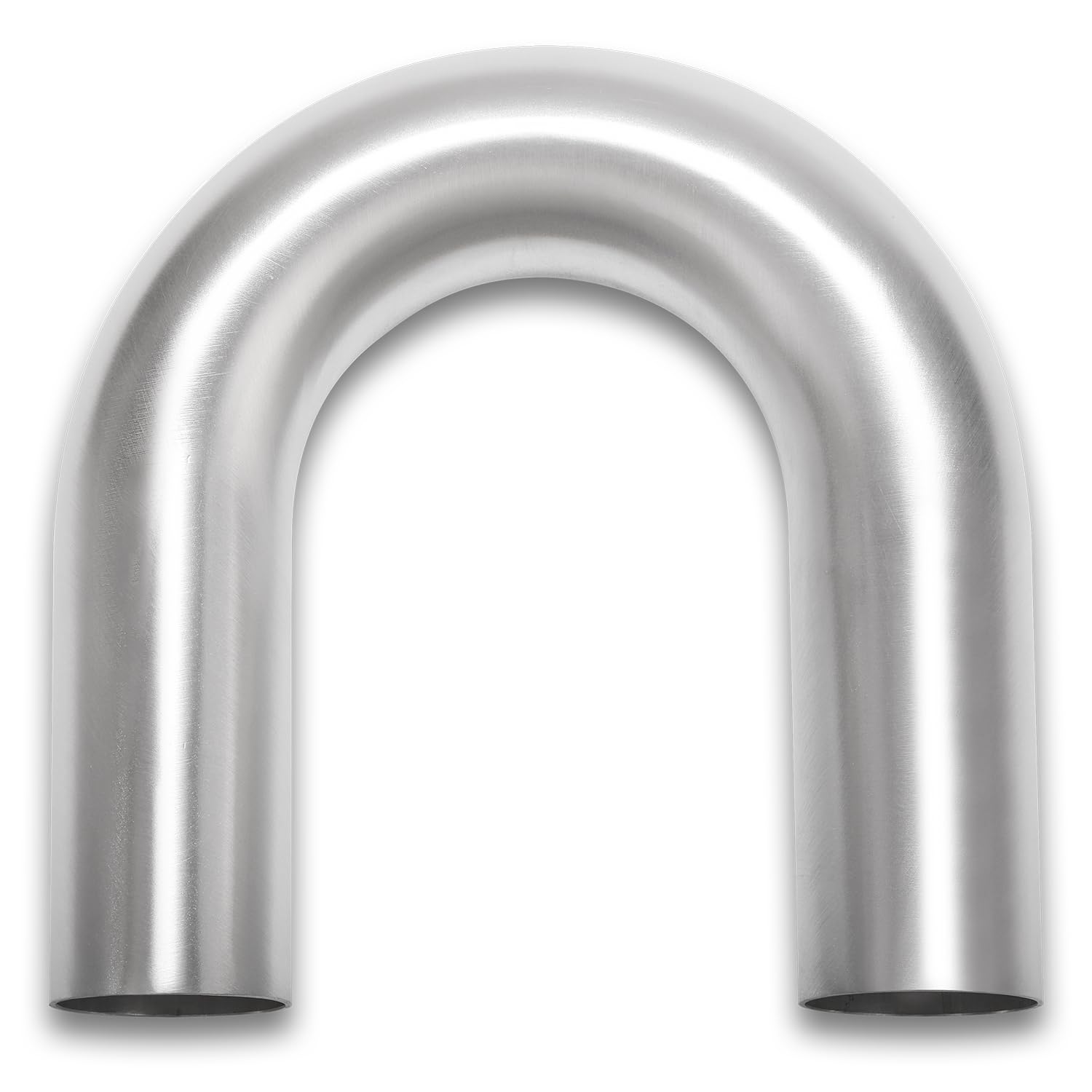
1. Podavelle 180 Degree Elbow 2 Inch 51mm OD Aluminum Intercooler Pipe
Our pick — over 4.5★ from 200+ verified ratings; the strongest balance of quality and price.
A mandrel-bent 180° elbow with a wrinkle-free 1.5D curve, ready to weld.
This is the pick for anyone routing charge piping who wants a curve that does not choke airflow or fight them at the welder. Its outside diameter is 2 inches (51mm) measured across the widest point of the tube — the surface your coupler clamps onto. Each straight leg runs 3.94 inches (100mm) long, and the centerline radius is 1.5D, which means the curve’s radius equals one and a half times the pipe’s diameter. In plain terms, that is a tight, tidy turn, not a slow sweeping arc, so it tucks into a crowded engine bay where space is short.
The wall thickness is 0.071 inches (1.8mm), and that is the number doing the quiet work here. A thicker wall on a mandrel-bent tube gives you real material to lay a bead into, so the joint holds instead of blowing through on the first hot pass. The alloy is T6061 aluminum, chosen by fabricators for its strength-to-weight ratio and its willingness to weld. The brushed finish is a bonus rather than a selling point, though it does hide handling marks better than a mirror polish would.
What wins people over is that the tube simply does its job. The bend quality comes up again and again in owner feedback — holding a clean, even curve in aluminum is genuinely hard, and this one arrives with it done. The long legs are deliberate: buyers cut them to length for their own application rather than being locked into one size. That is a feature, not a flaw, but it does mean you need a saw and a plan. As owners put it, “The size is exactly correct and install was relatively easy.”
Why fabricators keep this in stock
- 2-inch (51mm) outside diameter matches standard 2-inch couplers exactly
- 0.071-inch (1.8mm) wall gives you real meat for a strong weld bead
- 3.94-inch legs can be trimmed to your exact fitment instead of forcing one size
- 1.5D centerline radius keeps the 180-degree turn compact in a tight bay
- T6061 alloy welds predictably and holds its shape after heat
The honest caveats
- Fit is the mixed note: it is sized for 2-inch couplers, so it will not work on a 3.5-inch inlet
- You will need to cut the legs yourself for most installs
- Brushed finish is cosmetic — do not expect a mirror shine
Pick this if: you are building charge piping or intake tubing and need a ready-made smooth 180-degree turn in 2-inch diameter.
Think twice if: your coupler or filter inlet is a different size — this is a 2-inch (51mm) OD part and it fits 2-inch hardware only.
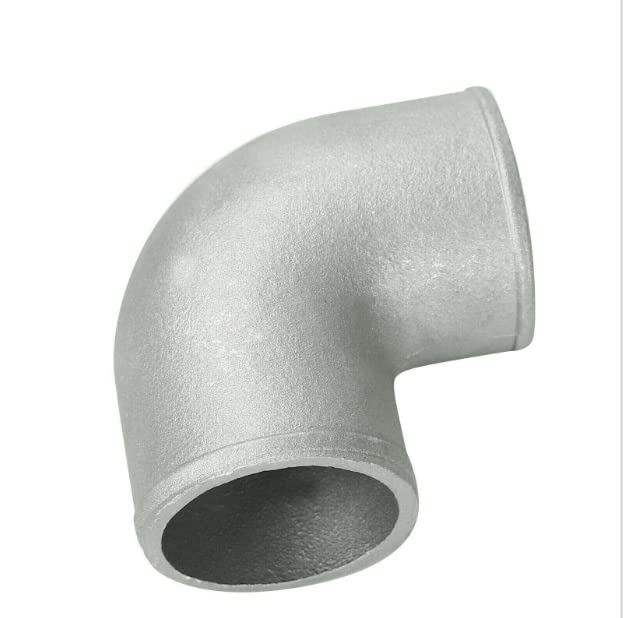
2. CAIMOTO 51mm 2″ 2 Inch Cast Aluminum Joint Elbow Turbo Intercooler Pipe 90 Degree
A cast 90° elbow with beaded ends that grip the coupler under boost.
Reach for this one if you are welding a turbo outlet or chopping the factory ends off an intercooler and need a solid 90-degree joint in 2-inch (51mm) diameter. The thickness is 3mm, cast rather than drawn, which makes it a chunkier, stiffer part than a thin-wall bent tube. Those little ridges at each end — the beaded ends — are the detail that matters most under load. A bead gives the silicone coupler a lip to grip, and that is what stops the joint from popping apart when boost pressure spikes.
Because it is a casting, it starts life a little rough. Expect a bit of surface grit and flash where the metal met the mold. That is normal for cast aluminum and not a defect — buyers report that a quick pass with a flap wheel on the edges cleans it right up before you weld. Owners who did exactly that had no trouble at all: “Worked perfect for cutting the ends off my intercooler and welding these on.” The casting has been known to carry small cosmetic imperfections, but the wall is solid with no holes, so it welds and holds.
A 90-degree sharp bend is a different animal from a smooth mandrel sweep. It turns the air harder, so if you are chasing every last bit of flow, a mandrel-bent elbow is the better tool. But for a turbo outlet or a tight packaging corner, the sharp cast turn is compact and bombproof. If you need a matching set, the maker offers 2-inch, 2.5-inch, 3-inch, 3.5-inch, and 4-inch cast pipes in the same 90-degree shape.
Where it earns its keep: the 3mm cast wall and beaded ends make it a durable, secure joint for turbo plumbing where a popped coupler means a roadside fix rather than a bench project.
Prep before you install: budget ten minutes with a flap wheel and a rag. Castings arrive dirty, and cleaning the edges first is the difference between a fussy weld and an easy one.
Ideal for: anyone welding a turbo outlet or replacing a cut intercooler end who wants a stiff, beaded 2-inch elbow.
Not the one for: flow-obsessed builds that want a smooth mandrel radius instead of a hard 90-degree cast turn.
3. X AUTOHAUX OD 3″ 76mm Length 12″ Aluminum Alloy Tube Intercooler Pipe

A 12-inch straight 76mm tube you cut to length for your own routing.
This is a 76mm tube, which works out to 2.99 inches across the outside — that is the diameter your clamp squeezes, and it is a distinctly wider piece of pipe than the 2-inch elbows above. The straight length runs 12 inches (one foot), so you get plenty of room to cut and still have a piece left over. The wall is 0.06 inches (1.5mm), 16 gauge in shop terms, which keeps the tube light and easy to shape rather than stiff and heavy.
Straight tube is the blank you cut, splice, or weld to any bend you need. You cut it, splice it, or weld it to whatever bend you need, and both ends carry raised humps that give a clamp something to bite, so your coupler stays put. The material is 6061 aluminum alloy — the same grade used across this shortlist for its strength-to-weight balance and its ability to shrug off heat and pressure. It also polishes up to a near-mirror finish, which owners mention holds up: the tube “looks like chrome” and welds clean without discoloring.
Because the diameter is 2.99 inches and not 2 inches, this one belongs to a different plumbing system than a 2-inch coupler — think larger intake and cooling runs rather than a 2-inch charge pipe. That is worth flagging before you order, since the listing name leads with “3 inch” rather than 2. The maker also notes that manual measurement means you may see small differences in the 1-to-5mm range, so measure your intended fitment if the job is tight.
The flexibility play: at 12 inches of cuttable length in a weld-friendly 6061 alloy, this is the part that bends to your project instead of the reverse.
Watch the diameter: at 2.99-inch OD it is built for larger intake and cooling plumbing — measure your coupler’s bore before committing.
Fits you when: you need a straight length of wide 76mm tube to trim and weld into a custom intake, cooling, or intercooler run.
Wrong choice when: your whole system is sized around 2-inch couplers — the 2.99-inch OD will not clamp into them.
4. OnlineMetals 6061 Aluminum Pipe, Schedule 40, 1″ Nominal

Schedule 40 pipe with a 1.049-inch ID for spacers and machined adapters.
This is the part you buy when the job is not a charge pipe at all. The inside diameter is 1.049 inches and the outside is 1.32 inches, with a 0.13-inch wall between them — a heavier wall than the intercooler tubes above, giving a stiffer, more machinable section. It is 1-inch nominal Schedule 40 pipe in 6061-T6 aluminum, extruded rather than cast, and it meets the ASTM-B249 standard for smooth aluminum pipe. That tolerance and grade are exactly why it shows up in precision work: customers note machining an inner lip into it and countersinking it to serve as a spacer between a damping rod and a cartridge emulator on a 1974 CB750 front end, where the PVC alternatives simply would not fit.
The weight is 9.28 ounces for the 12-inch piece, and at that sturdiness it machines cleanly and welds well. The 6061-T6 temper means it holds its shape under load, which suits structural brackets, bushings, spacers, and adapters as much as anything automotive. Where this pick separates from the 2-inch bent elbows is dimension: this is a 1.32-inch OD pipe, so it joins 1-inch plumbing and machined fittings, not 2-inch couplers. It is a different shelf entirely, and it is on this list because a 2-inch search often hides the one precise pipe a build actually needs.
The trade-off is reach. This is specialist stock that many people describe as hard to locate at a hardware store, so sourcing it from a metals supplier is the whole point, and it does mean the price reflects that service. Dimensions and finish arrive as specified, and compatibility is what earns the most praise — it is bought time and again precisely because it is dimensionally trustworthy.
Why machinists trust the number
- Tight 1.049-inch ID and 1.32-inch OD for true-fit spacers and adapters
- Heavy 0.13-inch wall holds shape for structural and machined use
- 6061-T6 alloy is weldable, corrosion-resistant, and machines cleanly
- Meets ASTM-B249, so the sizing is not guesswork
The fine print worth knowing
- It is small bore — this will not serve 2-inch intercooler plumbing
- Specialty metal stock is not a hardware-store item, so plan your order
- For straight fabrication runs you would cut from a longer length instead
Chosen by: builders making spacers, adapters, or bushings who need a true 1.049-inch inside diameter and a heavy wall.
Skip for: intercooler or intake plumbing — the bore is 1.32-inch OD and has nothing to do with a 2-inch coupler.
5. 2TwentyTwo Steel Designs 2″ OD x 1/4″ Wall 6061 Aluminum Round Tube

A 1/4-inch wall on a 2-inch OD tube — the thickest section on this list.
Owners of this one put it simply: dimensions land right where they need them, with almost no excess material on the outside and a clean inside finish. That is the whole pitch, and it holds up. The outside diameter is 2 inches with a 1-1/2 inch inside diameter, and the wall is a full 1/4 inch thick. For comparison, the schedule-40 pipe above carries a 0.13-inch wall, so this tube is built markedly beefier than that precision pipe — that is the difference between a machined spacer and a piece meant to stand up to real structural force.
The length is 24 inches, which is the longest single piece on this list and enough to cut several shorter sections from one tube. It is smooth, so there is no seam line running down the wall to worry about when you weld or machine it. The length carries a tolerance of plus or minus 1/8 inch, so if your layout depends on the number, measure what arrives rather than trusting the nominal figure.
This kind of heavy-wall tube shows up in the corners where lightness is not the goal and rigidity is — think a frame node, a jig component, an axle spacer, or a structural repair. The inside diameter of 1-1/2 inches is the detail most buyers overlook: with a 1/4-inch wall eating in from a 2-inch outside, the run-through is narrower than you might expect, so check whatever passes through it before ordering. The 6061 alloy, meanwhile, is the same weld-friendly, corrosion-resistant grade used across these picks.
The strength case: a 1/4-inch wall makes this the most solid single tube in this lineup, and the smooth construction keeps it clean under the torch.
Mind the bore: the 1-1/2-inch ID is tighter than the 2-inch OD suggests, so confirm the inside clearance your project needs first.
Best suited to: structural fabrication, jigs, and heavy spacer work where a 2-inch OD and 1-1/2-inch ID tube in a 1/4-inch wall is exactly the section required.
Look past it if: you are chasing light weight or a thin intercooler tube — this one is thick, long, and built for stiffness.
6. ETL INDUSTRIES 10PCS 2″ Aluminum Intercooler Piping Kit

Ten 2-inch pieces — straights, 45s, 90s, and 180s — for a full intercooler run.
Where the other picks are single parts, this kit supplies the whole run. The package holds ten pieces, all at a 2-inch piping diameter: two straight sections at 6 inches, two straight sections at 18 inches, two 45-degree bends, two 90-degree bends, and two 180-degree bends. That spread means a full custom intercooler route can be laid out in a single order rather than pieced together one part at a time. The material is T-6063 aluminum with a polished surface, chosen to resist wear, rust, and corrosion and to weld and polish nicely.
The build quality is what owners keep coming back for. The pipes arrive individually wrapped to prevent scratches, and the welding is clean enough that a newcomer to TIG found them easy to lay down: a developing welder called them straightforward to weld. Several reviewers point out how uniform and polished the finish looks, and one who had tried a rival kit first was surprised by how much nicer these came out. The joints are slip-fit, meaning the pieces slide together for positioning before you weld, which makes layout work far less fiddly — cut and weld as your routing requires.
This is the premium pick in the group, and that pricing buys you the full complement of bends, the protective wrapping, and the backing of a one-year warranty from ETL INDUSTRIES with around-the-clock support. The trade-off is scope: if you need one 180-degree elbow and nothing else, a single-piece option is the smarter spend. The kit earns its place when your build is still taking shape and you do not yet know every angle you will need.
Why it earns the box: ten pre-cut 2-inch pieces across straights, 45s, 90s, and 180s covers a complete build without repeat orders, and slip-fit joints keep the layout work simple.
Who should take a pass: if your project calls for exactly one bend, buy that one bend — the kit is a full-run purchase, not a single-part fix.
Reach for this if: you are plumbing a whole custom intercooler or cold-side system in 2-inch diameter and want every angle on hand.
Understanding the Specs
Outside Diameter (OD) And Inside Diameter (ID)
Outside diameter is the measurement across the widest part of the tube — the face your coupler or clamp grips. Inside diameter is the opening down the middle. The thicker the wall between them, the smaller the inside diameter for any given outside size, because the metal has to come from somewhere. This is why a 2-inch OD tube with a 1/4-inch wall leaves you only a 1-1/2-inch hole through the middle. Always match your coupler to the OD, and your through-flow needs to the ID.
Wall Thickness, Gauge, And Alloy Grade
Wall thickness is stated either in thousandths of an inch, in millimeters, as a fraction, or in gauge numbers — a lower gauge number means thicker metal. More wall means more to weld into and more resistance to bending under pressure, at the cost of weight and inside clearance. The alloy grade runs alongside it: 6061 is the common choice for strength and weldability, while 6063 polishes and flows well for intercooler work. Neither grade is inherently better — 6061 simply machines more cleanly if the part needs post-weld work.
FAQ
Will a 2-inch aluminum pipe fit a standard 2-inch silicone coupler?
What does 1.5D mean on a mandrel-bent elbow?
Is 6061 or 6063 aluminum better for intercooler piping?
How do I weld 2-inch aluminum tubing without blowing through it?
Can I cut an aluminum pipe shorter to fit my application?
What is the difference between pipe and tube?
Is aluminum pipe strong enough for boost pressure?
Do beaded pipe ends really make a difference?
Will a 2-inch pipe work for a turbo intake as well as an intercooler?
How do I know if I need a bend or a straight section?
Final Thoughts: The Verdict
For most builds, the winner of this 2-inch aluminum pipe shortlist is the Podavelle 180 Degree Elbow — a true 2-inch (51mm) outside diameter, a 0.071-inch wall with real material to weld, and legs you trim to fit. If you are welding a turbo outlet and want a stiff, beaded 90-degree joint, grab the CAIMOTO Cast Elbow. For a whole custom intercooler run in one order, the ten-piece ETL INDUSTRIES Kit puts every angle in the box. And if your job is a precision spacer rather than plumbing, the tight-tolerance OnlineMetals Schedule 40 pipe is the sleeper that saves the day.
How We Picked
We do not accept paid placement. Every pick is matched to a real buyer and a real use-case; we do not hands-on test units.
Sources & Methodology
Specifications: manufacturer listings and product documentation. Review insights: verified customer reviews, as of September 2026. Pricing: not shown on this page (it changes often); check the current price via the retailer link.
As an Amazon Associate, KitchPrep earns from qualifying purchases. This does not affect which products we feature.
Related Guides
