
Specs are compiled from manufacturer listings and verified buyer reviews and can change over time — please confirm the key details on the product page before buying.
A tankless water heater needs electricity to fire up, so the moment your power goes out, you lose hot water even though your gas line is still connected. That is the problem this guide solves. The picks below are the battery backup and UPS power systems that can actually carry a tankless heater through an outage, plus the ones built for whole-home and portable backup.
I’m Mohammad Maruf — the founder and writer behind KitchPrep. This guide is built by comparing the manufacturers’ published specifications and the patterns across verified customer reviews, so you get each pick’s real strengths and trade-offs instead of marketing spin.
What matters most is matching the backup unit’s output to your heater’s ignition draw, then deciding how long you need it to run. Here is a straight comparison of every battery backup for tankless water heater worth putting on your shortlist today.
Our Picks at a Glance


How To Choose The Best Battery Backup for Tankless Water Heater
A tankless water heater pulls only a small amount of electricity to run its control board and igniter, usually far less than a refrigerator. That means you do not need a huge unit to keep hot water flowing. You need one with the right output shape, the right outlets, and enough stored energy to cover however long your outages last.
Sine wave output versus simulated sine wave
Modern electronics, including most tankless heater control boards, run cleanest on a pure sine wave output — the smooth, steady power shape your wall outlet normally provides. A simulated sine wave output (a stepped approximation) works for many devices but can cause buzzing or refusal to start in sensitive electronics. If your heater’s control board is picky, choose a pure sine wave unit.
Stored energy and how long it lasts
Capacity is measured in watt-hours, written Wh. A unit rated at 153.6 Wh holds far less stored energy than one rated at 2010 Wh. A tankless heater’s ignition draw is small, so even a modest UPS can carry it for a while. But if you also want to run a fridge or a router, you need the larger capacity units.
Outlet count and spacing
Count the number of NEMA 5-15R outlets — the standard three-prong household sockets. A unit with 8 outlets lets you plug in your heater, router, and a lamp. A unit with 12 gives you room for computers and network gear too. Spacing matters: wide outlet spacing lets bulky power adapters sit side by side without blocking each other.
Quick Comparison
| Model | Best For | Output | Capacity | Outlets | Amazon |
|---|---|---|---|---|---|
| CyberPower CP1500PFCLCD★ Best Overall | Best Overall | 1500VA / 1000W | — | 12 | Amazon |
| CyberPower CP1000AVRLCDBest Value | Best Value | 1000VA / 600W | — | 9 | Amazon |
| GOLDENMATE 1000VA/600WLong Battery Life | Long Battery Life | 1000VA / 600W | 153.6 Wh | 8 | Amazon |
| GOLDENMATE 1500VA/1000W | Premium Pick | 1500VA / 1000W | 296 Wh | 8 | Amazon |
| Anker SOLIX S2000 | Best for Travel | 1500W / 3000W peak | 2010 Wh | 8 | Amazon |
| GRECELL H2400 | Budget Champion | 2400W / 4800W surge | 1843.2 Wh | 11 | Amazon |
| AFERIY 3840Wh | Most Versatile | 3600W / 7200W peak | 3840 Wh | 15 | Amazon |
| PECRON E3800 LFP | Top Performer | 4200W | 3840 Wh | 14 | Amazon |
| ABOK Ark3600 | Best for Mobility | 3600W / 4500W peak | 3840 Wh | 15 | Amazon |
| EF ECOFLOW DELTA Pro | Best Expandability | 3600W / 4500W X-Boost | 3600 Wh | 15 | Amazon |
| EF ECOFLOW DELTA Pro Ultra | Whole-House Backup | 7200W / 120-240V | 6144 Wh | — | Amazon |
In‑Depth Reviews
1. CyberPower CP1500PFCLCD PFC Sinewave UPS Battery Backup and Surge Protector
Our pick — over 4.5★ from 11,000+ verified ratings; the strongest balance of quality and price.
The pure sine wave workhorse that keeps your heater’s control board clean and steady.
If you want one unit that covers your tankless heater plus your home office gear, this is the one. It delivers a pure sine wave output — the smooth, steady power shape your wall outlet normally provides — at 1500VA/1000W. That gentle output is what tankless heater control boards and Active PFC computer power supplies actually want. With 12 NEMA 5-15R outlets (the standard three-prong household sockets), you get 6 outlets that carry both battery backup and surge protection, and 6 that carry surge protection only. That split matters: put your heater and router on the battery-backed side, and your printer on the surge-only side.
A multifunction color LCD panel shows you battery level and load in real time, and it tilts up to 22 degrees so you can read it from across the room. Automatic Voltage Regulation (AVR) corrects minor power dips without draining the battery — so brownouts and flickering lights won’t burn through your stored power before the real outage even hits. It’s UL safety certified, carries a 3-year warranty that includes the battery, and comes with a connected equipment guarantee.
What wins owners over is the reliability in real outages. The review pages describe it kicking on at the first flicker and logging every surge through the downloadable software. A recurring theme: it saved a full gaming system three times in two months in an area with weekly outages, and it runs roughly 40 minutes under a gaming load with configurable shutdown at 5 minutes. Its 1500VA/1000W output is a 50% capacity and 67% wattage step over the CP1000AVRLCD’s 1000VA/600W. One trade-off: this unit costs noticeably more than non-PFC models, and its long-term service reputation is less proven than its hardware.
Where this unit earns its keep
- Pure sine wave output keeps sensitive control boards happy
- 12 outlets with a 6/6 battery-and-surge split for flexible layouts
- Color LCD tilts 22 degrees for easy-at-a-glance monitoring
- AVR corrects voltage dips without touching the battery
- 3-year warranty includes the battery, plus connected equipment coverage
What to weigh before committing
- Priced higher than non-PFC UPS units with similar outlet counts
- Long-term service reputation is less established than the hardware quality
Best for: anyone who wants one clean, pure sine wave unit to protect both a tankless heater and a desktop PC setup.
Look elsewhere if: you only need to carry one small appliance and would rather spend less on a simpler unit.
2. CyberPower CP1000AVRLCD Intelligent LCD UPS Battery Backup
The smart-money pick for one tankless heater plus a router, nothing more.
Nine outlets, a clear LCD, and a price that leaves room for a second unit if you want one. The CP1000AVRLCD runs at 1000VA/600W with a simulated sine wave output — a stepped approximation of wall power that most control boards tolerate fine but sensitive electronics may buzz on. Five outlets carry battery backup and surge protection; the other four carry surge protection only. The multifunction LCD shows estimated runtime, battery capacity, and load capacity, so you know exactly where you stand.
Buyers chose it over pricier rivals for value and features, and the runtime data backs that up. Under a 350W max load with a typical 250W draw, buyers report around 11 minutes of battery — enough to ride out a short outage or shut things down cleanly. One owner running a 600W PSU build with dual-core AMD, 4GB RAM, two burners, four hard drives, a 24-inch monitor, and a GT240 GPU reported roughly 18 minutes. AVR corrects minor power dips without switching to battery, which stretches the battery’s life.
The recurring honest note: the heaviest-commented reliability theme is mixed — a few owners mention battery degradation after roughly 2.5 to 4.5 years. That’s a fit note, not a flaw. If you need a decades-long unit, consider a LiFePO4 alternative like the GOLDENMATE 1000VA above. If you just need a dependable, wallet-friendly bridge for your tankless heater and router, this is the smart-money pick.
The value math: nine outlets, an informative LCD, and AVR correction at a price that undercuts most rivals.
Where it may not fit: lead-acid battery chemistry means a shorter service window than lithium units, so plan on replacement every few years.
Reach for this if: you want the lowest-risk way to keep a tankless heater alive through short outages without overspending.
Step up if: you already know you’ll want the longer service life of a lithium battery.
3. GOLDENMATE 1000VA/600W Lithium UPS Battery Backup & Surge Protector
Lithium endurance that outlasts lead-acid by a mile — one battery, a decade of service.
Here’s the standout number: a rated battery life of 10 years. That’s 3.3x the CP1000AVRLCD’s 3-year lead-acid battery average life. The reason is its lithium iron phosphate (LiFePO4) battery, which tolerates more charge cycles and heat than lead-acid without swelling. The maker rates it for over 5000 charge cycles and claims 40%+ lower total cost of ownership than lead-acid over the same window.
You get clean, steady power for sensitive electronics: 1000VA/600W of pure sine wave (smooth power that electronics run on safely) across eight NEMA 5-15P outlets (standard three-prong US wall plugs), with both surge protection and battery backup. A built-in Battery Management System (BMS) — a chip that watches voltage and temperature and cuts off charging or discharging past safe limits — helps protect the battery. An active cooling fan spins up only under heavy use, keeping noise below 50 dB (about as quiet as a normal conversation). The intelligent LCD shows battery and power conditions in real time, so you can see what is happening at a glance.
What owners rave about is the performance-to-size ratio. It weighs 4.8 kg and measures 12.99 inches deep, far smaller and lighter than a comparable lead-acid UPS. Owners running corporate AV setups report it saved them during a brief outage, and others note it kept a 22W load above 90% after 40 minutes of use. The honest catch: no USB or network data port means no automatic shutdown handshake with a computer, and a 20-millisecond switchover may affect some very sensitive gear. Outlet spacing is tight for bulky AC adapters. Treat the plastic-and-battery smell as a new-unit quirk that fades. Rare but real, one unit failed early due to a blown input capacitor — and the warranty replacement process was smooth.
The breakthrough: a LiFePO4 pack rated for 10 years and over 5000 charge cycles in a 4.8 kg case — no lead-acid weight, no recurring replacement.
Worth knowing: no USB data port for PC shutdown and tighter outlet spacing than the wider 1500VA model above.
Best for: the buyer who wants to install it once and forget it for a decade, and who does not need automatic PC shutdown.
Skip if: you need a data port to trigger a low-battery hibernate on your desktop.
4. GOLDENMATE 1500VA/1000W Lithium UPS Battery Backup & Surge Protector

More watt-hours, more watts, and it talks to your PC so shutdown happens on its own.
Step up to 296Wh of stored energy and a 1500VA/1000W pure sine wave output. This is the same LiFePO4 DNA as its smaller sibling, with a 51.2V 5.8Ah pack rated at over 10 years of lifespan. What’s different: a communication port with a USB cable, so when the battery gets low the UPS can automatically trigger a Windows PC shutdown. Front-panel USB ports — one Type-C and one Type-A — put out a combined 10W for phones and tablets.
Eight NEMA 5-15P outlets carry surge protection and battery backup, and this model uses wider spacing between outlets so bulky wall warts can sit side by side. A mute-and-LCD-off switch sits right next to the main power button. Automatic Voltage Regulation smooths voltage dips without draining the battery. And unlike the CP1500PFCLCD above, this unit comfortably runs a whole gaming rig plus monitors and speakers.
Owners praise the build quality and quiet operation — it runs nearly silent under light load. Some find it pricier than they expected, though others call it the best value in the class. It ships as a fairly large, heavy metal enclosure compared to older versions. A friendly heads-up from the manufacturer notes it needs standard 110V household AC power; generator power may not meet its input requirements and the UPS will sit in battery mode without recharging. So this is wall-outlet backup, not generator backup.
Reasons this gets picked
- 296Wh stored energy and 1000W output for full desktop-plus-monitor setups
- USB data port enables automatic Windows PC shutdown
- Two front USB charging ports (one Type-C, one Type-A) totaling 10W
- Wider outlet spacing fits bulky power adapters side by side
- Quiet operation with a single mute/LCD button
Trade-offs to plan for
- Larger, heavier metal enclosure than its lithium sibling
- Not designed for generator input — needs standard wall AC to recharge
Choose this when: your heater and desktop both need backing up, and automatic shutdown matters to you.
Think twice if: you plan to feed it from a portable generator.
5. Anker SOLIX S2000 Portable Power Station
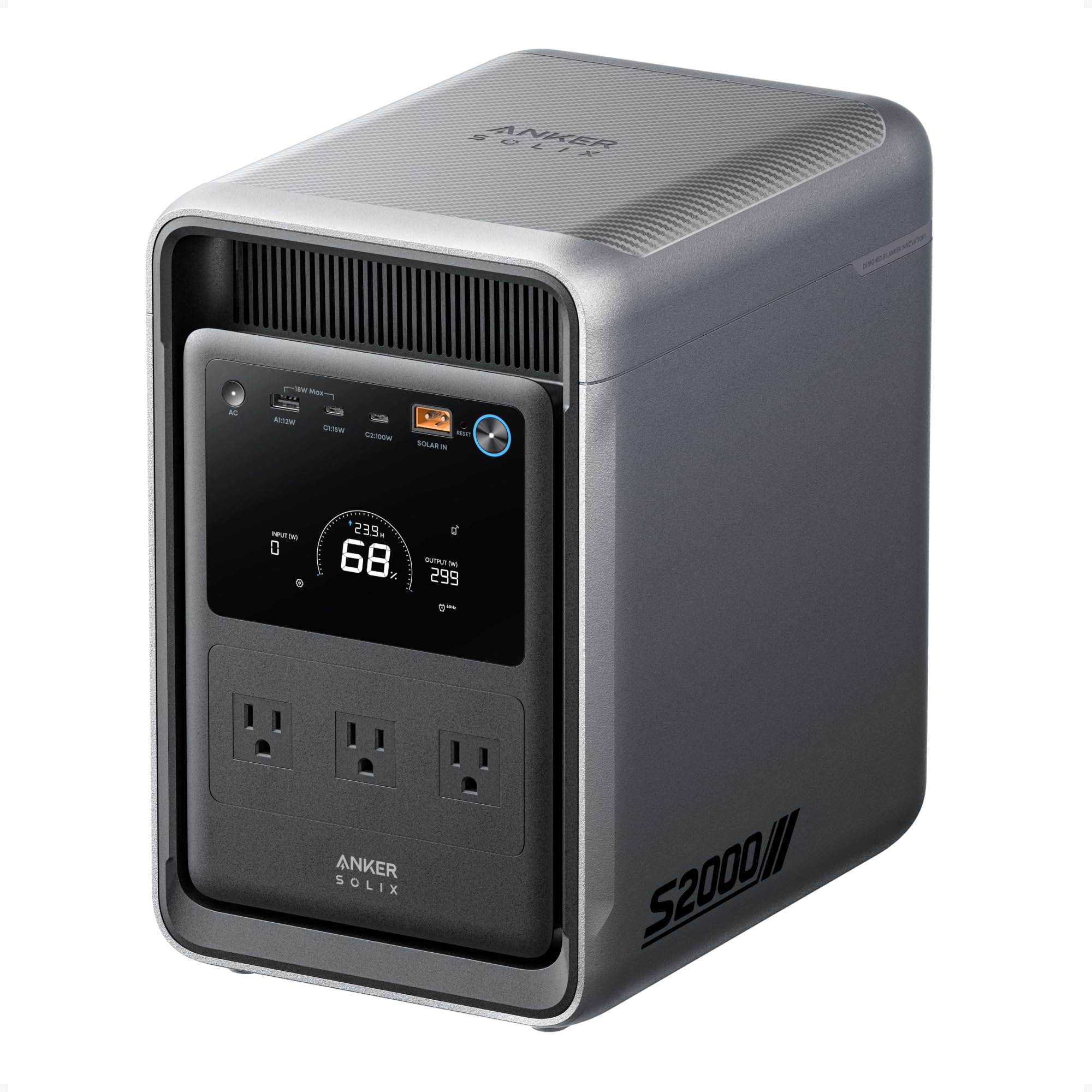
A carry-anywhere 2kWh powerhouse that runs a fridge for 35 hours and your heater for days.
If portability matters more than outlet count, this is the one to reach for. It packs 2010Wh of LFP (lithium iron phosphate) storage into just 8.2 x 11.1 x 12.7 inches and 35.7 pounds — the maker calls it the smallest and lightest 2kWh station on the market. Output runs 1500W continuous with 3000W peak, enough to boot a tankless heater’s control board, a fridge, and a router without hesitation. Six ways to recharge — wall, generator, solar up to 400W input, alternator charger, car outlet, or AC + solar together.
Customers note two very different returns on the same purchase. One owner powered through a 30-hour outage, charging from 33% to 100% in about 1.5 hours at 1200W, running a low, quiet fan and controlling everything through the WiFi app. Another ran a network rack for 13 hours during a 24-hour outage and topped up on 400W of solar to stretch it for days. The LCD shows battery percentage and real-time wattage, and there’s a UPS mode with under-10-millisecond switchover, so a tankless heater’s igniter sees almost no gap.
The honest trade-off is noise and a 12V gap. The unit has 8 outlets (front and rear), but no 12V DC port — an RV owner noted this is a limit for camper setups. Fans run quiet at low load but can ramp up under sustained draw. One owner had an LCD display fail in the first few weeks and Anker replaced it quickly under warranty. Charging speed on the app is adjustable from 100W to 1200W, which lets you keep wall draw low if your home circuit is already maxed.
The case for it: a genuinely portable 2kWh station with fast recharge, app control, and a UPS mode fast enough to hold up sensitive electronics.
The catch: eight outlets but no 12V DC port, and fan noise can rise with heavier sustained loads.
Best for: the household that wants real stored energy they can move from room to room — patio during fire season, garage during a cold snap.
Less ideal if: you need a 12V DC output for a camper or RV fridge.
6. Portable Power Station 2400W, 1843.2Wh LiFePO4 UPS Home Battery Backup

Eleven outlets, a 2400W inverter, and a UPS mode — all for a mid-tier price.
If you want the most outlets and wattage for your money, this is the balance of the whole list. It runs a 2400W AC inverter with 4800W surge (a brief burst of extra power for motor startup) on an 1843.2Wh (about 1.84kWh) LiFePO4 pack (a lithium battery that lasts longer than lead-acid), and it feeds up to 11 devices at once. Output includes four 110V/2400W AC outlets, two 12V/5A DC outputs, two 18W USB QC 3.0, two 5-20V PD 100W Type-C, one 12V/10A car charging outlet, and a 5W LED light — enough to run a tankless heater alongside a fridge and a few chargers.
Recharge speed is the headline. From a 1200W household AC input it fills in 1.6 to 2 hours, and it can top up in 1.8 hours or less via AC plus solar together (1200W max combined). Its MPPT charge controller delivers up to 40% faster solar charging. In UPS mode, it switches to battery in 10 milliseconds — fast enough that a tankless heater’s igniter stays lit and a computer never blinks.
The recurring gripe in reviews is charging quirkiness. Reviewers point out it needs a few cycles to hit full runtime, and the multi-unit reviewer noted AC full recharge under 1 hour 45 minutes on a similar model. One pulled a CPAP for a full two weeks of camping on the AirSense 11 with humidity on. The fans quiet down once charging finishes. Weight sits at 55 pounds, so it’s a roll-up-the-driveway unit, not a carry-one-handed one. Overall, owners call it worth the cost for anyone who camps or wants to cover mid-length outages.
The value read: 11 outlets and a 2400W inverter at a mid-range price — nearly twice the outlets of the CP1000AVRLCD above.
Fair warning: fan noise under heavy load and a first-charge break-in period mean it’s not perfect from the start.
Great for: campers and mid-length outage coverage where outlet count per dollar is the deciding metric.
Not for: buyers who need a fully silent unit under sustained heavy draw.
7. AFERIY 3840Wh Portable Power Station, Expandable Solar Generator to 11520Wh

A growable 3.8kWh starter battery that scales up when your outages get longer.
Start with 3840Wh today, grow to 11.5kWh tomorrow by stacking expansion packs. That expandability is the real reason this one sits near the top — you buy the base unit now and only pay for extra capacity when you actually need it. The 3600W continuous output (7200W peak) drives a refrigerator, a router, and a tankless heater’s control board with room to spare. Fifteen output ports, including AC outlets, USB-A, USB-C with PD 3.0, DC5521/DC, XT60, and a 12V car socket, cover just about anything you’d plug in.
The built-in UPS switches to battery power in under 10 milliseconds, so it’s an automatic failover for computers, security cameras, and tankless heater controls. It recharges fast — as quickly as 1.5 hours to full via AC + solar combined — and it does this from four sources: wall, solar, car, or AC plus solar together. The smart app lets you monitor charge state, battery level, schedule charging, and even select light modes.
The honest asterisk is charging reliability. The buyer consensus splits on this — some owners say it charges fully in under 90 minutes, others report units that wouldn’t charge at all. One arrived at 28% and never recovered despite a 5-hour charge attempt, and the company refunded via the warranty process. On the other side, shoppers say this thing runs an entire RV including a full 4-panel solar array, keeps a mobile video editing van running through repeated outages, and delivers solid UPS protection on a compressor startup. Fan noise splits owners too — acceptably quiet for some, an audible presence for others. The wheels-and-pull-handle layout is a welcome touch on a 104.7-pound unit.
Where it shines
- Expandable from 3840Wh up to 11.5kWh by adding battery packs
- UPS under-10ms transfer keeps sensitive gear smooth
- 15-port layout handles almost any device mix
- Fast 1.5-hour AC plus solar recharge when supported
- Rugged wheels and pull handle tame the 104.7-pound weight
Watch-outs
- Charging reliability is the split-opinion theme — a few units arrive unable to charge
- Fan noise splits owners — some find it quiet, others notice it
Worth your shortlist if: you want a station you can grow over years rather than replace.
Consider waiting if: you want near-certain first-try charging on day one.
8. PECRON E3800 LFP Portable Power Station, 3840Wh 4200W
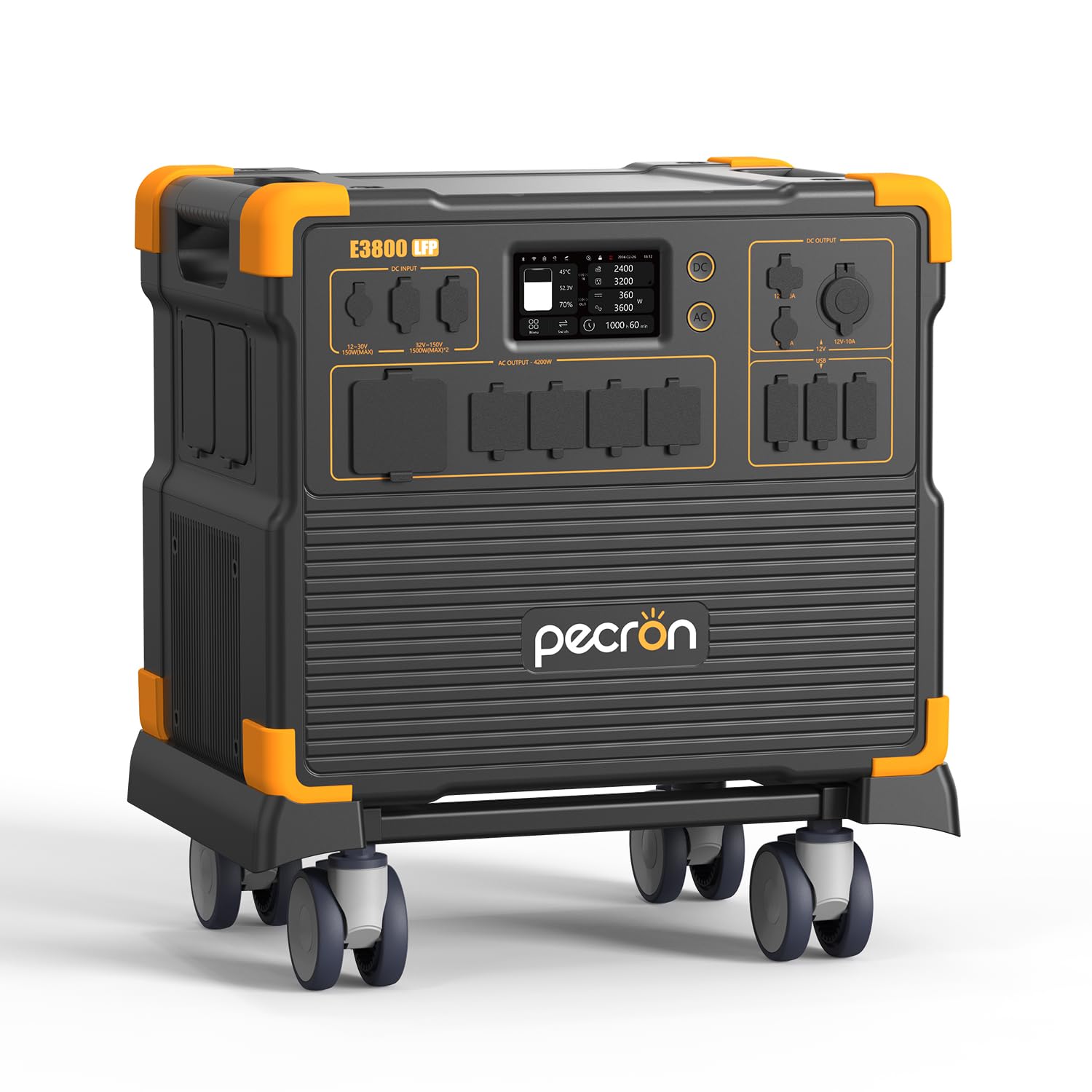
The 4200-watt bruiser that runs a mini-split and a tankless heater at once.
If your home has a mini-split AC plus a tankless water heater plus a fridge and you want one unit to cover all of them, this is the heaviest hitter here. It pushes 4200W of pure sine wave output across 14 ports — four 4200W AC outlets, one TT30-R RV-ready outlet, three 12V DC outputs (XT60, cigar port, 5525), four USB-A at 18W max, and two USB-C at 100W max. Everything runs on a UL-certified automotive-grade LiFePO4 pack rated to hold 80% capacity after 3500 full charge-discharge cycles, so it is built to keep going for years of daily use.
Recharge times are the other standout. From a 3200W AC input via the included 30A cable, it fills from empty to full in 1.4 hours. Step down to a 1800W input through the 15A cable and it takes 2.5 hours. Solar input tops out at 3000W, and pass-through charging lets you charge while powering devices. The built-in 8-to-20-millisecond UPS switchover covers computers, data centers, and home electronics — and it handles loads up to 3600W on the 30A cable or 1800W on the 15A cable.
Owners prove the output in real conditions. One ran a 1500W heater for over two hours and still handled a sump pump’s startup spike; another ran a 450-square-foot shop with a 110V mini-split 24/7 for months. Three honest quirks surface: batteries in a chained setup drain unevenly, the temperature display defaults back to Celsius, and cooling fan noise is audible when heavily loaded. This unit is heavy at 87.3 pounds, so placement should be deliberate. Support responsiveness, though, comes up as a bright spot.
The performance edge: 4200W of pure sine wave output handles a mini-split and a sump pump at the same time — more than any other unit at twice the price.
Be aware: at 87.3 pounds with audible fan behavior under heavy load, this is not a move-around-the-house model.
Built for: the household that needs maximum output to run real appliances, not just electronics.
Not for: buyers who want quiet operation during sustained heavy loads.
9. ABOK Ark3600 Portable Power Station, 3600W 3840Wh LiFePO4
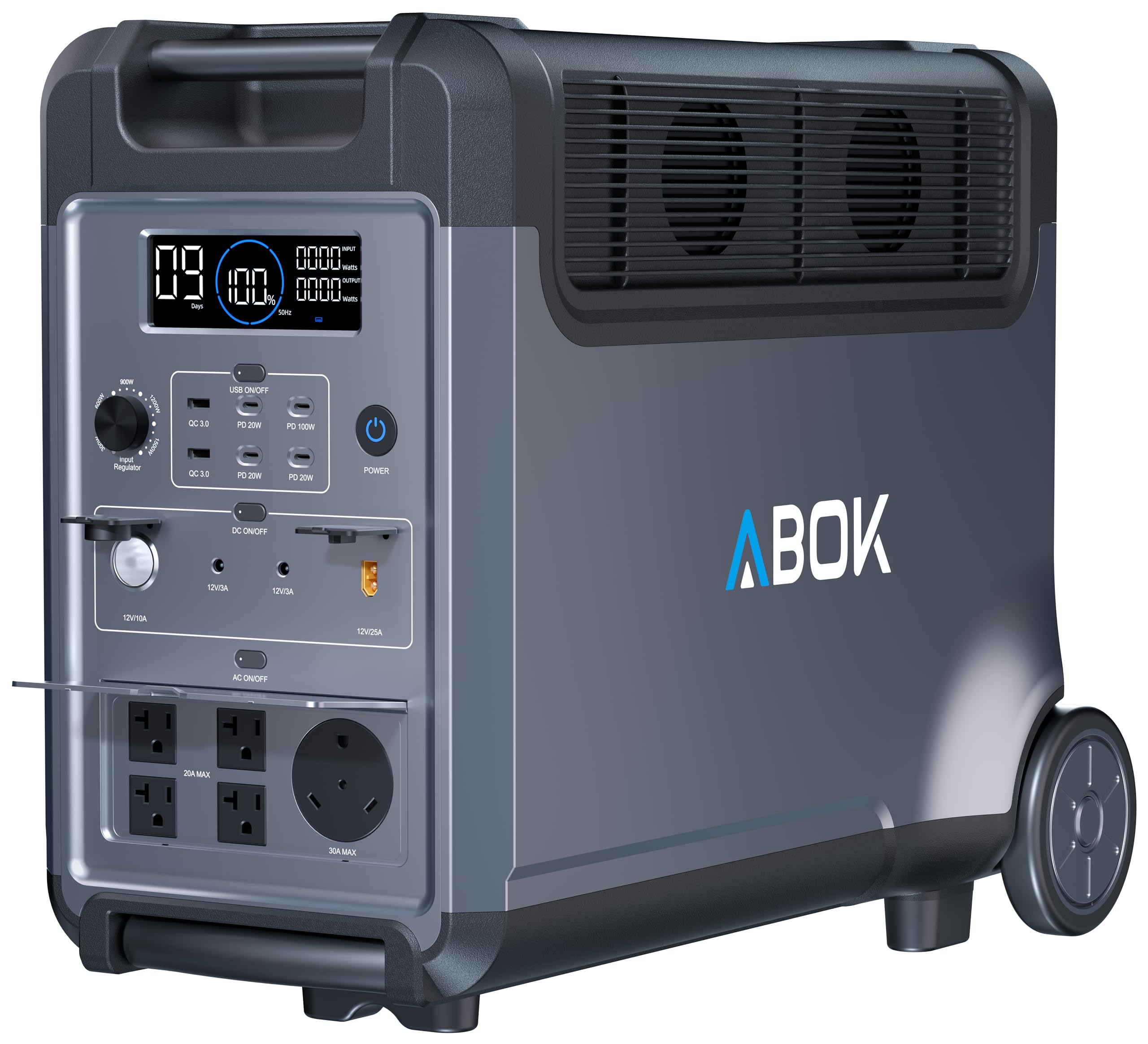
Built-in wheels and a telescoping handle turn whole-home backup into a one-person job.
Move it in a minute, roll it anywhere. That is what sets this apart — a telescoping handle and durable wheels on a 92-pound unit, so you can park it in the garage and pull it to wherever the outage hits. Inside is a 3840Wh EV-Grade LiFePO4 battery, expandable up to 11520Wh, rated for over 4000 charge cycles and up to 10 years of life. Output runs 3600W rated with 4500W peak across 15 ports, including a 30A AC outlet, four 20A AC outlets, USB-C at 100W, USB-C at 20W, USB-A with QC3.0, and DC5521, XT60, and cigarette-lighter connections.
Recharge is genuinely fast for the class — 1.29 hours to full using AC plus PV (photovoltaic, or solar) combined, or 3 hours on AC alone. Solar tops out at 2000W input and car charging at 120W. A Bluetooth app lets you monitor and adjust remotely. The maker rates it for 99% of household appliances, and its 10-millisecond UPS mode keeps control boards and computers running through switchover.
Buyers’ real-world data seals the deal. One ran a 58-quart 12V fridge from Saturday morning to Monday afternoon in 97°F heat and still had 64% battery left. Another says it saved their pipes during a -20-degree weather outage. A contractor ran a wetvac, heatgun, and SDS-Max drill simultaneously and ended the day at 22% — with no silent-fumes trade-off, since it runs indoors safely. Honest fit note: it’s 120V only, so it will not feed a 240V appliance, and the app ships with light documentation. Solar-only recharge can take around three days in cloudy weather.
The standout: whole-home 3840Wh capacity on a wheeled chassis that moves like a rolling suitcase.
Something to know: 120V-only output rules out 240V appliances, and the app is spare on guidance.
Choose this if: you want one person to be able to wheel 3840Wh wherever the outage is worst.
Look elsewhere if: you need to feed a 240V appliance.
10. EF ECOFLOW DELTA Pro Portable Power Station, 3600Wh, 120V 3600W AC Output
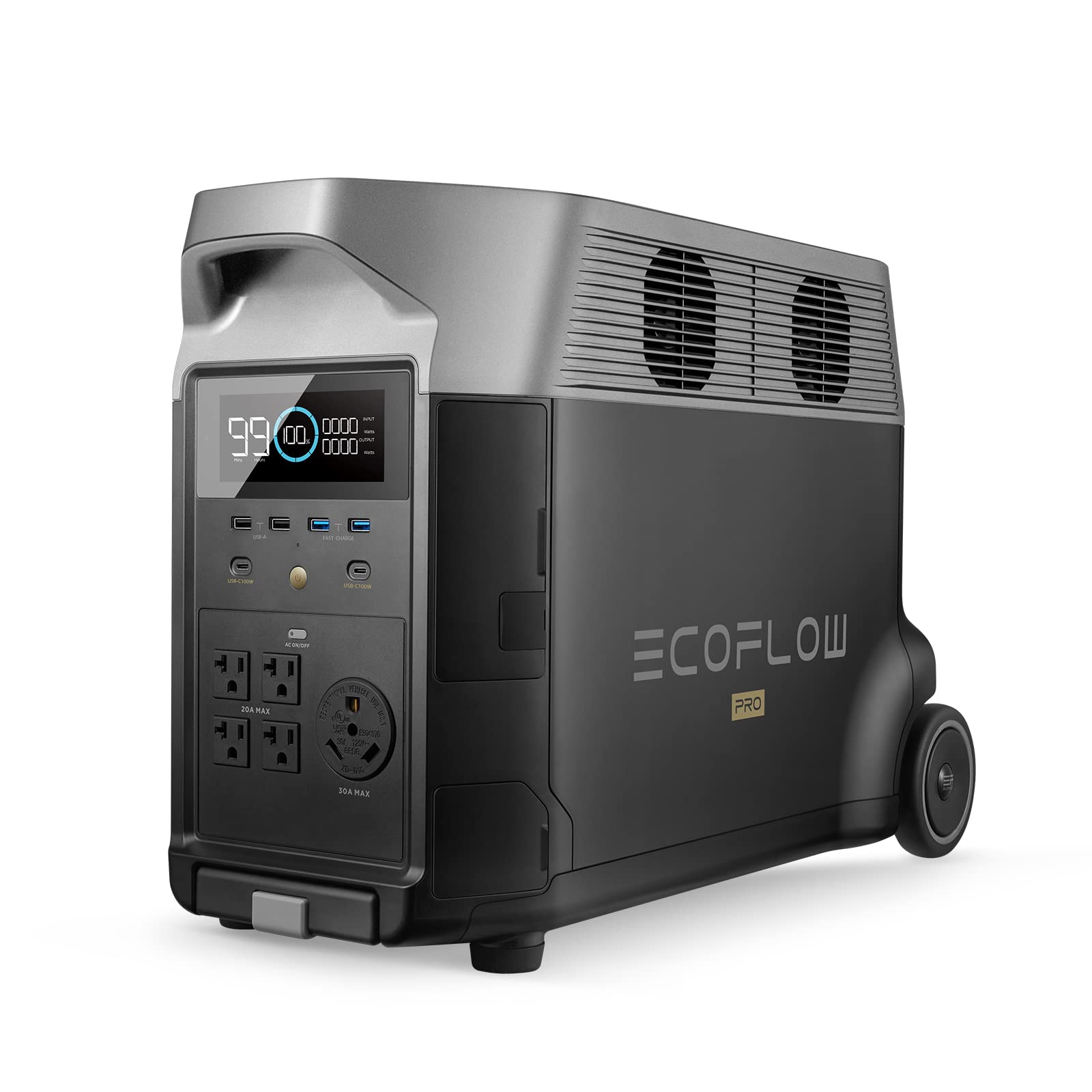
An expandable 3.6kWh platform that quietly scales to 25kWh with extra batteries.
The DELTA Pro is the platform buy: start at 3600Wh, add batteries and smart generators to reach 25kWh. A single unit pushes 3600W of AC output, expandable to 4500W with X-Boost technology (a boost feature that lets the inverter briefly run devices rated slightly above its continuous rating). Pair two units and you get 7200W. Fifteen output methods cover 2 USB-A, 2 USB-A fast charge, 2 USB-C at 100W, 5 AC outlets, 2 DC outlets, a car power output, and an Anderson port. Inside is a 3600Wh LFP battery with the same long-life chemistry the CP1500PFCLCD’s buyers can only wish for in an LFP version.
Charging speed is where the DELTA Pro pulls ahead of most rivals. From a 240V outlet at 3000W input, it fills in 1.8 hours; from a 1800W standard wall outlet, it takes 2.7 hours. Solar charging via four 400W panels tops it up in 2.8 hours with up to 23% conversion efficiency. The BMS (battery management system) keeps it safe during fast charging. A smart app via Wi-Fi or Bluetooth controls every setting and can break down your energy habits.
Owners put this unit through real work. One powered a full heat press at vendor markets with zero voltage drops — 3600W output and five 120V AC outlets, quiet and stable throughout. Another ran a fridge and lights through an outage and still showed 30% the next morning. The recurring caveat: solar input is limited to 15A, so charging from panels can be slower than the spec sheet suggests. There’s also a safety warning from owners — turn off breakers before connecting extension cords to 110V outlets to protect linemen and avoid overloading the unit. For a whole-house feel without a permanent install, this is the smart step up.
Highlights: expandable from 3.6kWh to 25kWh and flexible fast-charge options including EV station charging.
The limit: solar input caps at 15A, so panel charging isn’t as fast as the 3000W AC input.
Pick this for: mobile businesses, RV-ers, and anyone who wants whole-house expansion potential in one unit.
Keep looking if: you plan to rely mainly on solar input for daily charging.
11. EF ECOFLOW DELTA Pro Ultra Power Station, 6144Wh, 120/240V 7200W AC Output

One inverter, 7200 watts, and enough backup to run a 3-ton central air conditioner.
This is the home-scale option — the biggest, most powerful, and most expensive unit in this roundup. One inverter handles both 120V and 240V and pushes an exceptional 7200W output, enough to run almost any heavy household appliance including a 3-ton central air conditioner. Triple the inverters for a 21.6kW AC output. The included 6144Wh battery scales from one unit up to 15 for a total of 90kWh — which the maker describes as over 30 days of essential power for a standard North American household. That 7200W output covers whole-house loads, including a tankless heater, without a flicker.
Charging is quick for its class: one battery fills from empty to full in about 2 hours. The built-in online UPS transfers in 20 milliseconds, giving 24/7 protection to sensitive electronics. In everyday life, all fans stay off for the first half hour of outputting 2000W — a thoughtful detail if the unit lives near a bedroom. The EcoFlow app lets you prioritize specific house circuits, or it can analyze your power usage to offset peak rates and lean on solar to trim bills. It ships as two separate packages — inverter and battery arrive in individual boxes.
Owners who invested in the full setup sing its praises. One replaced their 100A subpanel with a Smart Home Panel 2, ran the install in a day, and reports instant failover on 12 circuits with no solar or generator needed — making it an obvious hurricane-season pick. Another linked it to a 10-circuit transfer switch plus 8 x 195W solar panels and ran 10 essential circuits over a full day without sun. The honest counterweight: charging reliability comes up as a mixed theme, with some owners reporting It doesn’t charge properly — a serious issue at this price point. It’s also 70.9 pounds for the battery alone and arrives as two boxes, so plan the install.
The value read: whole-house 120V and 240V capability with 2-hour recharge and certified UL1973 and UL9540 safety listings.
The trade-off: charging reliability on a small number of units has been mixed, and the two-box install takes planning at 70.9 pounds per unit.
Right for: the buyer who wants to protect their entire house, including a 240Vcentral AC or a well pump, and expects to spend accordingly.
Think twice if: you’re looking for a simple out-of-the-box tankless heater backup and don’t need whole-home coverage.
Understanding the Specs
VA vs. Watts — What’s the Difference?
VA (volt-amperes) and watts both describe power flow, but they measure different things. VA is the total power the unit can deliver; watts is the portion that actually does useful work. A UPS rated 1500VA/1000W can run a load up to 1000 watts of real power. Tankless heater control boards typically draw very little, so even the smaller units on this list carry them. Watts is the number that matters most when matching a backup unit to an appliance.
Transfer Time and Why It Matters
Transfer time is how quickly the unit switches from wall power to battery when the grid fails. Under 10 milliseconds is fast enough that a computer doesn’t blink and a tankless heater’s igniter stays ready. Some units are rated 8 to 20 milliseconds, which is still fast but may cause a flicker on sensitive gear. Online UPS models stay on battery power at all times, giving zero switchover at the cost of efficiency.
Battery Chemistry — LiFePO4 vs. Lead-Acid
LiFePO4 (lithium iron phosphate) batteries tolerate more charge cycles and heat than lead-acid, and they hold their capacity longer. Lead-acid batteries are cheaper upfront but typically need replacement every few years. LiFePO4 units cost more and last longer — some rated at over 10 years. For a tankless heater, either works. For long-term home backup, LiFePO4 pays off over time.
Watt-Hours — The Real Capacity Number
Watt-hours (Wh) tell you how much stored energy a unit holds. A 153.6Wh UPS carries a light load for a short time; a 6144Wh station runs a household’s essentials for days. Tankless heaters only need a small portion of that — but the same unit often backs up the fridge, router, and computer too. Total capacity is what determines how long an outage you can ride out.
FAQ
Will a battery backup actually keep my tankless water heater running during a power outage?
Do I need a pure sine wave output or is simulated sine wave fine?
How long will a battery backup run a tankless water heater during an outage?
Can I plug a portable power station directly into my tankless water heater’s outlet?
Is a basic UPS or a portable power station better for a tankless heater?
What happens if my backup unit runs out of battery during an outage?
How do I know if a UPS can handle my tankless heater’s starting surge?
Will a lithium battery in a backup unit really last ten years?
Can I use the same battery backup for a computer and a tankless heater at once?
Do I need to worry about the backup unit failing during a real outage?
Final Thoughts: The Verdict
For most people, the battery backup for tankless water heater winner is the CyberPower CP1500PFCLCD because its pure sine wave output, 12 outlets, and 6-outlet battery backup section give you the cleanest, most flexible way to keep a tankless heater running while also protecting a home office. If you value a lithium battery that outlasts lead-acid by a decade, grab the GOLDENMATE 1000VA/600W. And for whole-house coverage that also feeds a 240V central AC, the EF ECOFLOW DELTA Pro Ultra is the one to reach for. The CyberPower CP1500PFCLCD is the list’s most-reviewed pick at 4.6 stars across 11,000+ ratings. Whichever pick you land on, test it the day it arrives.
How We Picked
We do not accept paid placement. Every pick is matched to a real buyer and a real use-case; we do not hands-on test units.
Sources & Methodology
Specifications: manufacturer listings and product documentation. Review insights: verified customer reviews, as of September 2026. Pricing: not shown on this page (it changes often); check the current price via the retailer link.
As an Amazon Associate, KitchPrep earns from qualifying purchases. This does not affect which products we feature.
Related Guides
