
Specs are compiled from manufacturer listings and verified buyer reviews and can change over time — please confirm the key details on the product page before buying.
If you only need hot water at a single sink — a kitchenette, a garage washbasin, a camper, a salon chair — you do not need a whole-house system. What you need is a 120V point-of-use unit sized to that one tap, wired to its own breaker. Get the sizing wrong and you get lukewarm water and a tripped circuit. Get it right and you get hot water in seconds without waiting on a tank to recover.
I’m Mohammad Maruf — the founder and writer behind KitchPrep. This guide is built by comparing the manufacturers’ published specifications and the patterns across verified customer reviews, so you get each pick’s real strengths and trade-offs instead of marketing spin.
To pick the right unit, you need three numbers: wattage (how much power it uses), flow rate (gallons per minute, or gpm, that it can heat), and your incoming water temperature. A unit rated for one sink will not serve a shower. A unit that needs a 30-amp circuit will not run on a shared 15-amp line. The picks below cover both ends of that range, and each one names the wiring it demands so you can check your panel before you buy. Reading this list of the 120v tankless water heater options should make that match obvious.
Our Picks at a Glance
How To Choose The Best 120V Tankless Water Heater
A 120V tankless heater is a small appliance that sits under or beside a single sink and heats water as it flows through. It does not store hot water in a tank. That changes everything about how you pick one, because there is no reserve to fall back on when demand spikes. Every gallon that comes out hot is a gallon the element heated in real time.
Start With Your Breaker, Not The Box
The circuit feeding the unit sets your ceiling. A 3.5kW heater pulls hard enough to need a 30-amp breaker and 10-gauge wire, which is thick copper. A 2.4kW unit can run on a 20-amp circuit with 12-gauge wire. If your panel has no spare slot for a dedicated breaker, you are looking at an electrician visit before anything else. Check this first, because the wrong unit means rewiring, not just returning.
Flow Rate And Incoming Water Temperature
Temperature rise is the number that matters most and the one least printed on the box. A heater that raises water 22°F at 1.0 GPM will give you comfortable water in a warm climate and disappointing water in a cold one. If your cold water comes in at 50°F, you need more wattage or a slower flow to reach the same outlet temperature. This is why the same unit gets five-star reviews in Florida and one-star reviews in Minnesota.
Point Of Use Means One Tap
These heaters are rated for a single sink, and the spec sheets say so directly. Running two fixtures at once divides the flow and drops the temperature at both. If you need hot water at a kitchen sink and a bathroom sink, you buy two units rather than one bigger one. Plan the fixture count before you plan the wattage.
Quick Comparison
| Model | Best For | Heat Output | Flow Rate | Weight | Amazon |
|---|---|---|---|---|---|
| CAMPLUX 3.5kW 120V Point of Use★ Best Overall | Single sink, DIY install | 3.5 KW | 2.5 liters per minute | 3 pounds | Amazon |
| Eemax EEM12004 4KW | Low-flow handwashing | 4 KW | 0.5 gpm | — | Amazon |
| Rheem 3.5kW 120V Point of Use | Digital temperature control | 3.5 KW | 6 gpm | 4.5 pounds | Amazon |
| Eemax SPEX2412 FlowCo 2.4 Kilowatt | Low-draw circuits and outdoor taps | 2.4 KW | — | — | Amazon |
In‑Depth Reviews
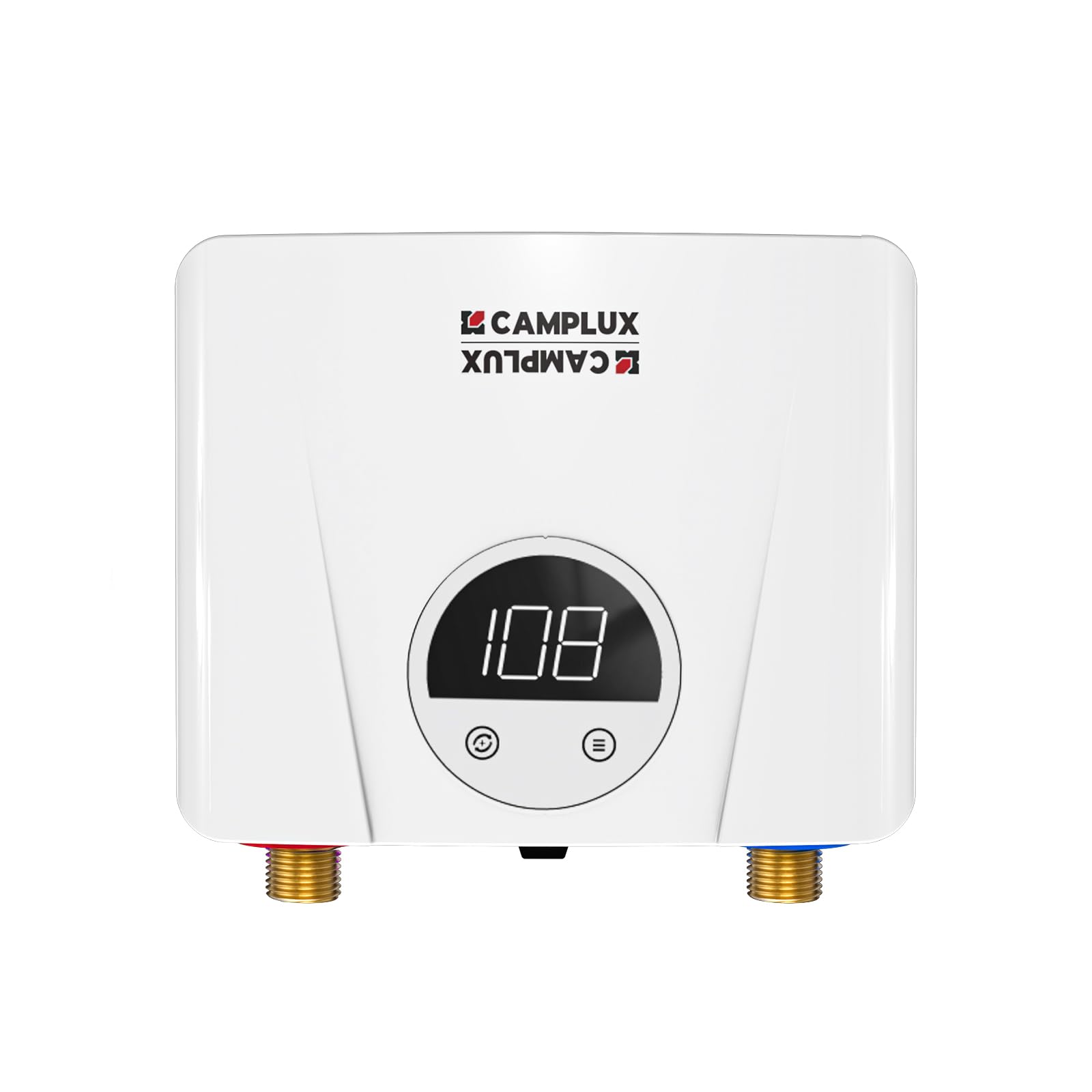
1. CAMPLUX Electric Tankless Water Heater, 3.5kW at 120 Volts Point of Use Water Heater with Self Modulating Technology, Must HardWird Requiring 10AWG Wire
Our pick — over 4★ from 100+ verified ratings; the strongest balance of quality and price.
The homeowner who wants hot water at one sink without paying an electrician twice.
This is the heater you buy when one tap matters and the rest of the house does not. It pushes 3.5 KW through a body that measures 7″W x 6″H and weighs 3 pounds, so it tucks under a cabinet or into a wet bar without eating the space. Compare that with the Rheem below at 4.5 pounds and 10.88″W x 5.88″H and you can see how much smaller this one sits on the wall.
The engineering that earns it the top spot is the self-modulating element, which adjusts its draw to the flow and the temperature you set. Instead of blasting full power the moment you open the tap, it adjusts its draw based on how much water is moving and what temperature you dialed in. CAMPLUX claims that approach saves up to 98% in energy consumption against a tank that keeps water hot around the clock, and the logic holds — you heat water only at the moment you use it. The temperature rise is 1.0 GPM is 22°F, and the spec page notes you can expect 73°F or higher, which is honest about the fact that this serves one sink and not a shower.
What wins owners over is the day-to-day performance: it fires on a light tap and holds temperature at a single sink. As one buyer put it: “This is the second tankless hot water heater, that being said, I wish I had chosen it first, I would have saved a considerable amount of money because this water heater is awesome and affordable, I definitely would buy it again,that’s for sure.” Others describe the install as quick enough that a family member handled it in an afternoon, and the design detail that gets repeated is the water path — the heating elements never sit in contact with the water, which owners see as a durability advantage over cheaper builds.
Two more things worth knowing before you buy. It is ETL safety certified with leakage and overheat protection, and the water and electrical lines run in separate channels inside the housing. It must be hardwired — there is no plug — and it needs a 32A circuit breaker, 10AWG wire, and a 1/2″ NPT water connection. The activation threshold is low, between 0.4 GPM and 0.66 GPM, so it fires up on a trickle rather than demanding you open the tap wide.
What Owners Single Out
- Self-modulating draw that trims energy use instead of running flat out.
- 3 pounds and a 7″W x 6″H footprint that fits tight cabinetry.
- Elements kept out of the water path, which owners credit for longevity.
- Fires at 0.4 GPM to 0.66 GPM, so light taps still trigger heat.
Before You Cut The Wall
- Hardwired only — no cord, no plug, no outlet install.
- Needs a 32A breaker and 10AWG wire, so panel capacity comes first.
- Some owners in colder rooms find the outlet temperature short of what they hoped for.
- Two-year limited warranty, shorter than the Eemax EEM12004’s five years on leaks.
Buy it when: you have a spare 32A breaker, one sink to feed, and you want the smallest 3.5kW body on this list.
Skip it when: your panel is full or your cold water runs so cold that 22°F of rise will not get you there.
2. Eemax EEM12004 Electric Tankless Water Heater Point of Use, 4KW, Blue

The most powerful element here, aimed squarely at handwashing and light rinsing.
If you want the hottest water this group can produce at a trickle, this is the one to look at. It runs a 4 KW element — the highest heat output of the four — through a stainless steel body. The trade-off is flow: it is rated at 0.5 gpm, against the Rheem’s 6 gpm. That is not a typo or a downgrade, it is the design. This heater is built to give you very hot water at a slow, controlled flow, and the spec page spells that out.
The 5-gallon capacity figure in the specs is the standout oddity in this comparison — it is roughly seven and a half times the CAMPLUX’s 0.66 gallons. What that reflects is a larger internal water path, which matters when you are running at 0.5 gpm and want the water to pick up heat before it leaves the unit. Eemax calls the control system the most advanced self-modulating technology available, adjusting energy input to match demand rather than running at a fixed rate.
The honest catch is reliability: some buyers report failures shortly after install, including one unit that stopped within a day. Some owners mention units that ran well, and others report failures shortly after install, including one that stopped within a day. That split is unusual enough that you should treat the five-year leak warranty and one-year parts warranty as the safety net it is. A buyer running it for a shop sink or a handwash station at low flow — the use case owners describe most — sits squarely in the zone this unit was designed for.
The install notes are worth reading closely. It needs a dedicated 30A breaker (a switch that trips if too much current flows), 10/2 wire (a thicker gauge that carries more current), and a hardwired connection with no plug. It ships with a 0.5 gpm aerator (a screen that limits flow to half a gallon per minute) that several owners found too weak and swapped for a 1.2 gpm aerator, which they report as the balance for temperature. The instruction sheet, though, is thin — it skips detail on the electrical connections and how the faceplate springs reseat on the control button, so budget time for that or hand it to someone who has done it before.
Where the heat sits: a 4 KW element is the most output in this lineup, and at 0.5 gpm it concentrates that power into a narrow stream that comes out hot fast.
The reliability read: mixed is the only fair word — some units hum along and some fail early, so buy it for a low-flow job where the warranty has time to matter and the stakes are low.
Reach for this if: you want maximum temperature at a slow flow for handwashing, a shop sink, or a rinse station.
Look elsewhere if: you need volume at the tap rather than heat, since 0.5 gpm is not built for filling anything quickly.
3. Rheem 3.5kW 120V Point of Use Tankless Electric Water Heater

The most precise temperature dial of the group, paired with the most expensive ownership experience.
Nobody else on this list lets you set an exact number. This one gives you digital temperature control in 1°F increments from 80°F to 140°F, so you dial in 104 and you get 104 — the RTEX04 and RTEX06 models only display the output temperature and are not thermostatically controlled. That 1°F precision is the reason to consider this unit, and for a camper or wet bar where incoming water swings with the season, it is a genuine convenience.
It claims a 6 gpm flow rate, which towers over the Eemax EEM12004’s 0.5 gpm on paper. Read that number carefully, though. The spec sheet notes the flow rate is rated with the unit off, not while it is raising temperature, and the reviews back that up. Owners consistently describe a three-to-four-minute wait for water above 98°F — roughly half the wait of a conventional setup, but not instant. It cannot be pre-activated, because the unit only fires when it senses flow.
Where this one gives buyers pause is durability, and it is the loudest theme in the reviews. Reports of screens going blank and units quitting after about a year are common enough to take seriously, and the value-for-money verdict trends negative too. The flip side is that the design rewards the right setting: an experienced owner running a small unit in a Florida condo, with the heater within four feet of the faucets and 80°F ground water on existing 10-gauge wire and a 30A 120V circuit, reports it working as intended. The distance between heater and faucet, and how cold your incoming water runs, decide whether this unit meets expectations or misses them. One install nuance to watch — the NPT connector (a standard threaded pipe fitting) can leak, and a thin nut or a silicone washer seats it properly.
So the verdict is conditional on your install. If you have short pipe runs, warm ground water, and an existing 30A circuit, the 1°F control is a real asset. If you are plumbing it far from the tap into cold water, the wait times add up and the reliability odds work against you.
One number to hold onto: 1°F control from 80°F to 140°F is the finest adjustment any unit here offers — nothing else lets you name the exact outlet temperature.
Best fit: a short-run install — under four feet to the faucet — on warm ground water with a spare 30A circuit already wired.
Not the one: a long pipe run on cold water, where customers note several minutes of waiting and a durability record that disappoints.
4. Eemax SPEX2412 FlowCo 2.4 Kilowatt 120 Volt Electric Point of Use Water Heater, White

The lightest load on your panel, built for circuits the bigger units cannot touch.
If your breaker panel has no room for a 30A circuit, this is your answer. At 2.4 KW (kilowatts, a measure of power) it draws less than any 3.5kW or 4 KW unit here, and reviewers point out running it on a 20A circuit with 12-2 wiring — the thinner, more forgiving gauge that makes a garage or outbuilding install realistic. A 5″W x 3″H body that weighs next to nothing and mounts in any orientation means you can tuck it wherever the plumbing lands, including sideways under a sink.
The technology is straightforward: SafeStart logic and self-diagnostics run the checks internally, and the unit activates only on demand. SafeStart logic and self-diagnostics run the checks internally, and the unit activates only on demand rather than holding a reserve. Maximum output temperature is 130°F, which is below the Rheem’s 140°F ceiling — a difference you will notice if you like your water on the hot side or you are feeding a sink far from the heater.
The reason to be careful here is that this unit is fussy about its circuit, and a mismatch is unforgiving. Shoppers say burning smells, boiling water spitting out, and the heating element shorting minutes after install when the wiring was undersized. That is not a defect so much as a hard requirement: it needs a 20A circuit and 12-2 wiring because of its current draw. Owners also report that a GFCI breaker tripped repeatedly on this unit and an AFCI breaker resolved it. Set expectations on temperature too — at 120V and 20A this gives you comfortable handwashing and dish rinsing water, not a hot shower. For an outdoor tap that used to shut down for the winter, though, it earns its place: one owner bought it so their Arizona outdoor shower could run year-round instead of only in the warm months.
The Case For It
- 2.4 KW draw runs on a 20A breaker and 12-2 wire, the lightest requirement here.
- Mounts in any orientation, so odd plumbing runs are not a problem.
- SafeStart and self-diagnostics handle the checks automatically.
- Lowest wattage of the four makes it the easiest fit for a modest panel.
Where It Asks Patience
- 130°F maximum is the lowest ceiling on this list.
- Undersized wiring is a hard failure — verify 20A and 12-2 before you buy.
- Buyers report GFCI breakers tripping and recommend an AFCI instead.
- Some units arrive non-functional, so test it inside your return window.
Pick this one for: a low-draw circuit, a garage or outbuilding tap, or an outdoor shower you want working in winter.
Leave it for later if: you want a hot shower or your wiring is already undersized, because this unit will not forgive either.
Understanding the Specs
Kilowatts And What They Draw
The wattage rating tells you how much power the element pulls and therefore which breaker you need. A 2.4 KW unit can run on a 20A circuit with 12-2 wire. A 3.5 KW unit needs a 30A breaker with 10AWG wire. A 4 KW unit draws even harder and wants the same heavy circuit. Higher wattage does less for you than you think if your flow rate and incoming water temperature are working against it — wattage sets the ceiling, not the delivered temperature. Match it to your panel first.
Flow Rate, GPM, And Temperature Rise
Flow rate is measured in gallons per minute, or GPM — the volume of water passing through the unit each minute. Temperature rise is how many degrees the heater can add to the water moving at that rate. The two are linked: push more water through and each gallon gets less heat. This is why a 6 gpm rating and a 0.5 gpm rating can both be correct for 120V units built for different jobs. For a sink, a slower flow through a hotter element gives you better water than a fast flow through a cooler one.
Point Of Use Versus Whole House
A point-of-use heater serves one fixture. A whole-house tankless unit serves every tap and typically requires far more power than a 120V circuit can supply. If you are shopping in the 120V range, you are shopping for a single sink, a camper, a shop, or a secondary tap. Two points of use means two heaters. Expecting one 120V unit to feed a bathroom and a kitchen at once will end in lukewarm water at both.
Wiring, Breakers, And Connections
Every unit here is hardwired — no plugs. That means a dedicated breaker, the correct wire gauge, and a 1/2″ NPT water connection on most models. The breaker size follows the wattage: 20A for the 2.4 KW unit, 30A for the higher-output models, and the CAMPLUX specifies a 32A breaker. Undersized wire is the most common installation failure and the one most likely to damage the unit rather than just trip a breaker. Confirm your panel has a spare slot and your wire matches before ordering.
FAQ
What size breaker does a 3.5kW 120V tankless water heater need?
Can a 120V tankless water heater run a shower?
What flow rate do I need for a kitchen sink?
Do 120V tankless water heaters need a dedicated circuit?
What is the difference between point of use and whole house tankless?
Why is the water only warm and not hot?
How long do these tankless units typically last?
Can I install a 120V tankless water heater myself?
Does a 120V tankless water heater actually save energy?
What wire gauge does a 4KW 120V water heater require?
Final Thoughts: The Verdict
For most single-sink jobs, the 120v tankless water heater winner is the CAMPLUX 3.5kW Point of Use because it balances output, a compact 7″W x 6″H body, and one of the friendlier installation stories in this group — its own buyers describe swapping a failed brand for it and wishing they had chosen it first. If you want the hottest water at a slow flow for a shop sink or a handwash station, the Eemax EEM12004 puts 4 KW behind a 0.5 gpm stream and gives you the highest element output here, backed by a five-year leak warranty. And for the lightest load on your panel — a garage tap, an outbuilding, or an outdoor shower you want running in winter — the Eemax SPEX2412 FlowCo at 2.4 KW is the one to reach for. Whichever you pick, verify your breaker size and wire gauge before you buy. That one check decides whether any of these four works the way its owners say it should.
How We Picked
We do not accept paid placement. Every pick is matched to a real buyer and a real use-case; we do not hands-on test units.
Sources & Methodology
Specifications: manufacturer listings and product documentation. Review insights: verified customer reviews, as of September 2026. Pricing: not shown on this page (it changes often); check the current price via the retailer link.
As an Amazon Associate, KitchPrep earns from qualifying purchases. This does not affect which products we feature.
Related Guides
