
Specs are compiled from manufacturer listings and verified buyer reviews and can change over time — please confirm the key details on the product page before buying.
You want dark crumbly compost to dig into your beds, not a wet smelly box you give up on by August. A dedicated bin is what separates the two. A sealed tumbler keeps rodents out and holds heat in; a cedar static bin drains and breathes. The wrong one turns into a wet, smelly box you abandon by August. Below are nine bins that hold up, sorted by what each one is genuinely good at, so you can match the shape and size to your yard instead of guessing from a product photo.
I’m Mohammad Maruf — the founder and writer behind KitchPrep. This guide is built by comparing the manufacturers’ published specifications and the patterns across verified customer reviews, so you get each pick’s real strengths and trade-offs instead of marketing spin.
You will see how cedar slat bins, sealed tumblers, and open static bins differ in aeration, capacity, and how much muscle they demand in week six. Match the bin to your space and your energy level, so your backyard compost bins keeps working long after the first batch.
Our Picks at a Glance


How To Choose The Best Backyard Compost Bins
The two families you are choosing between work in completely different ways. A tumbling composter is a sealed drum on a stand that you spin by hand — it mixes and aerates the contents every time you roll it, and it keeps animals and rain out. A static bin is an open-bottom box that sits on the ground, lets worms and soil life crawl in from below, and relies on you layering materials rather than spinning them. Your yard size, your climate, and how much turning you will actually do decide which one wins.
Capacity: match gallons to your kitchen output
Gallons tell you how much material the bin holds at once, which is really a question of how often you want to deal with finished compost. A 37-gallon single-chamber drum suits a couple or a small household that adds scraps a few times a week. Step up to a 43-gallon dual-chamber model and you get two separate sides — one maturing while the other takes fresh waste — so you are never stuck waiting for a full batch to finish before adding more. At the top end, the 173.92-gallon cedar bin handles bulk leaves and yard clippings that would overflow a small tumbler in a single autumn afternoon.
Tumbler or static bin: how much turning do you want to do
A tumbler trades floor space for convenience. Because you rotate the whole drum, the contents get mixed top to bottom in seconds, and a sealed body keeps rain, rodents, and flies out. The catch is weight — a drum that is three-quarters full of wet scraps takes real force to spin, and some owners find themselves turning it less often as it fills. A static bin skips the spinning entirely, holds far more volume, and lets the material break down where it sits, but you lose the pest-proof seal and the fast mixing. If your back or shoulders are a concern, a static bin with a bottom hatch is honestly easier to live with.
Drainage, aeration, and the smell question
A smelly compost bin almost always means too much moisture and too little air. Vents and aeration holes (small openings that let air in) on the sides and lid let oxygen reach the material, which keeps the process aerobic (oxygen-fed) and odor-free. Bins with deep internal fins or grooves break up clumps as the drum turns, so air reaches the middle, not just the edges. If your bin sits on bare ground and you get heavy rain, the contents will soak up water — a tightly sealing lid plus extra dry material like shredded cardboard fixes most of it.
Quick Comparison
| Model | Best For | Capacity | Type | Weight | Amazon |
|---|---|---|---|---|---|
| Greenes Fence Cedar Composter★ Best Overall | Bulk yard waste and leaves | 173.92 gallons | Static, cedar slat | 46 pounds | Amazon |
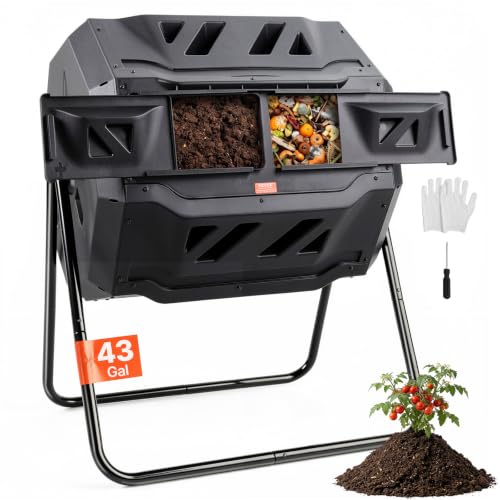
| VEVOR 43-Gal Dual Chamber TumblerBest Value | Tight budgets, first tumbler | 43 gallons | Tumbling, dual chamber | 21.9 pounds | Amazon |
| EJWOX 80-Gallon Static BinMost Capacity | Large volume, low effort | 80 gallons | Static, snap-together | 12 pounds | Amazon |
| Hourleey 43-Gal Dual Chamber | Continuous batch composting | 43 gallons | Tumbling, dual chamber | 21.7 pounds | Amazon |
| EJWOX 43-Gal Tumbler with Thermometer | Reading internal heat | 43 gallons | Tumbling, dual chamber | 23.3 pounds | Amazon |
| SQUEEZE master 43-Gal Tumbler | Heavy loads, sturdy frame | 43 gallons | Tumbling, dual chamber | — | Amazon |
| EAST OAK 43-Gal Compost Tumbler | Heat retention in cool climates | 43 gallons | Tumbling, dual chamber | 12 pounds | Amazon |
| FCMP Outdoor HOTFROG RC4000 | Zero-assembly, roll it anywhere | 37 gallons | Tumbling, single chamber | 25 pounds | Amazon |
| Good Ideas Compost Wizard Jr. | Beginners in small yards | 50 gallons | Tumbling, single chamber | 27 pounds | Amazon |
In‑Depth Reviews
1. Greenes Fence Premium Cedar Wood Composter, 36″ L x 36″ W x 31″ H
Our pick — over 4.5★ from 350+ verified ratings; the strongest balance of quality and price.
The cedar slat bin that swallows an entire autumn of leaves in one go
If your backyard produces more leaves and grass clippings than a drum could ever hold, this is the one to build. The Greenes Fence bin holds 173.92 gallons — that is roughly four times the capacity of the 43-gallon VEVOR tumbler, so a full season of raked leaves disappears inside it instead of spilling over a pile. It ships as 4 posts, 24 boards, and 40 spacers, and the boards are 3/4-inch-thick sanded North American cedar rather than the thin plastic most bins are molded from. Cedar naturally resists rot and gives off that warm woody scent, which is why buyers describe it as furniture for the yard rather than a bin.
Putting it together takes a mallet and about half an hour. As buyers report, the assembly is “easy, tool-free” and can be done by one small person in under 30 minutes, with the slats sliding smoothly once you work with the natural variation in the wood. The straightforward build is what owners praise most, and the wood quality runs a very close second — the boards arrive already sanded, so there is no prep work. The design also drains far better than a sealed tumbler, since rain and excess moisture pass straight between the slats instead of pooling in a closed drum.
Where this bin asks something of you is in the day-to-day. It is a static bin, which means you supply the mixing — there is no drum to spin, so you turn the material with a fork or add layers and let the pile do the work. Cedar also softens over the years, and a few owners have found the slats and spacers a touch fragile during assembly, so tap near the posts with a rubber mallet rather than forcing pieces. It tips the scale at 46 pounds versus the 12-pound EJWOX static bin, so plan a permanent corner for it rather than moving it around.
cedar slat aeration
- 173.92 gallons of space handles bulk leaves and storm debris that overflow smaller bins
- 3/4″-thick sanded North American cedar boards resist rot and arrive ready to use
- Open-slat sides drain excess moisture far better than a sealed tumbler
- No tools needed — a mallet is the whole kit, and expansion kits let it grow into a two- or three-bin run
bulky square footprint
- Static design means you handle the turning yourself — no drum to spin
- Slat and spacer edges are delicate; a rubber mallet and patience save cracked pieces
- At 46 pounds it is a yard fixture, not something you relocate each season
yard corner anchor: big yards, heavy leaf fall, and gardeners who want a handsome permanent structure and do not mind wielding a fork.
tight patio skip: you want to spin a drum and walk away — a tumbler does the mixing for you.
2. VEVOR Compost Bin, 43-Gal Dual Chamber Composting Tumbler
Two chambers on a steel frame, built to keep one batch cooking while the next piles up
The VEVOR solves the single annoyance of every one-chamber tumbler: you cannot add fresh scraps to a drum you are trying to finish. Two 21.5-gallon halves let one side mature while the other takes today’s coffee grounds and vegetable peelings, and each side has its own sliding door — a detachable panel with a large opening for loading and unloading. The body is BPA-free plastic over a steel frame, and VEVOR rates the load-bearing capacity at 110 pounds, which is the reason it holds up when both chambers are full and heavy. It manages all of that at 21.9 pounds, so it is movable if you decide it sits better in another corner.
You can have this bin built in about 45 minutes on a flat table. The process is more intuitive than the sparse instructions suggest — work front to back and the screws grip without a wrench, because the nuts self-thread (cut their own threads) into the plastic. Skip the power screwdriver; the screws distort easily and the included driver wears out fast. Once built, the drum turns by hand-holds molded into the panels rather than a bolted-on handle, so there is nothing sticking out to snap off, and the internal grooves break up clumps as it rolls.
Here is the honest trade-off: a full drum gets stubborn. Once the chambers are loaded and the material is wet, rotating it takes real effort, and the openings are sized for kitchen scraps rather than armloads of grass or leaves. A handful of owners also report that the plastic gives off an odor when it first sits in strong sun, which tends to fade but is worth knowing if the bin sits near a patio.
two-batch tumbling: continuous batching is the whole point here — one side finishes while the other feeds, so you are never stuck waiting on a single batch before adding more.
twin batch rotation: you want two-chamber batching on a modest budget and mostly compost kitchen scraps rather than bulk yard waste.
single batch only: you plan to load it with heavy, wet grass clippings — a full drum of those fights back when you try to spin it.
3. 80 Gallon (300L) Large Capacity Static Compost Bin – Forest Green
A big green box that snaps together in minutes and swallows food waste quietly
This EJWOX bin holds 80 gallons — nearly double the capacity of the 43-gallon tumblers here — so you can go longer between empties. Its footprint measures 24 inches long by 24 wide by 30 high, roughly waist-high and small enough to tuck beside a fence. The whole thing assembles from six pieces that snap together by hand, no screws and no tools, so setup takes minutes rather than an evening. What this bin does best is take abuse: it tolerates uneven feeding, does not demand the precise brown-to-green ratio a tumbler does, and keeps working through sun and snow thanks to UV-stabilized panels (plastic treated to resist sun damage).
The clever part is the access. A hatch at the bottom lets you pull finished compost out while you keep adding fresh material at the top, so there is no need to empty the entire bin to harvest what is ready. Vents on all four sides keep air moving through the contents so the process stays aerobic, and a rigid lid snaps down securely enough that wind will not peel it off. Most owners mention the assembly takes about five minutes, and the finished box stands stable once built.
The durability is the real caveat and it is worth taking seriously. The plastic panels are thin, and the lid tabs are the weak point — owners commonly brace the lid with a brick, and some note the top can sit slightly skewed rather than closing squarely. In high wind or around curious animals, a lighter bin like this can get knocked over, so stake it or set it on level ground away from a gate. Snap the panels together by hand and brace the lid; forcing the tabs cracks them.
huge static capacity: function and capacity are what carry this bin — it processes food waste and leaves reliably, and the large volume means you are not constantly topping it up.
volume without turning: if you want capacity without assembling a tumbler and are happy to brace the lid, this is a lot of bin for the money.
fragile lid care: the thin panels and lid tabs need a careful hand, so keep it out of heavy foot traffic and wind tunnels.
4. Hourleey Compost Bin Outdoor, 43 Gallon Dual Chamber Tumbling

Two drums that keep critters out and let you load one side while the other cooks
This Hourleey earns its spot on build quality for the money. The drum is a sturdy plastic body on a high-grade metal frame, and owners describe that stand as sturdy — genuinely sturdier than the drum itself — with corrosion-resistant and weather-resistant coverage that holds up outdoors. It is a dual-chamber 43-gallon design, so one 21.5-gallon side finishes while the other takes fresh waste, and the sealed body keeps flies and rodents away from the scraps inside.
The tumbling action is handled by deep flaps on the panels working against deep grooves, which mixes the contents as it rolls and breaks up clumps as it goes. Owners rate it around 4.3 stars, and the pattern they repeat is that it does exactly what a tumbler should: it rotates easily, it is the right size for a household of two, and it shrugs off weather. Assembly is the one hurdle. The instructions are not comprehensive, and the fiddly step is aligning the center divider.
A few owners have received black doors rather than the orange pictured, so if color matters to you, set that expectation. And while the stand is solid, the drum is the lighter half of the pairing, so do not expect it to feel like a heavy-duty machine. Treat assembly as a patience exercise and it rewards you with a bin that keeps working through rain and cold.
small household fit: perfect for a family of two that generates scraps through the week and wants a pest-sealed drum rather than an open pile.
slow setup day: the instructions are thin and the divider alignment is fussy, so bring patience and a power screwdriver.
5. EJWOX 43 Gallon Dual Chamber Tumbling Composter with Thermometer
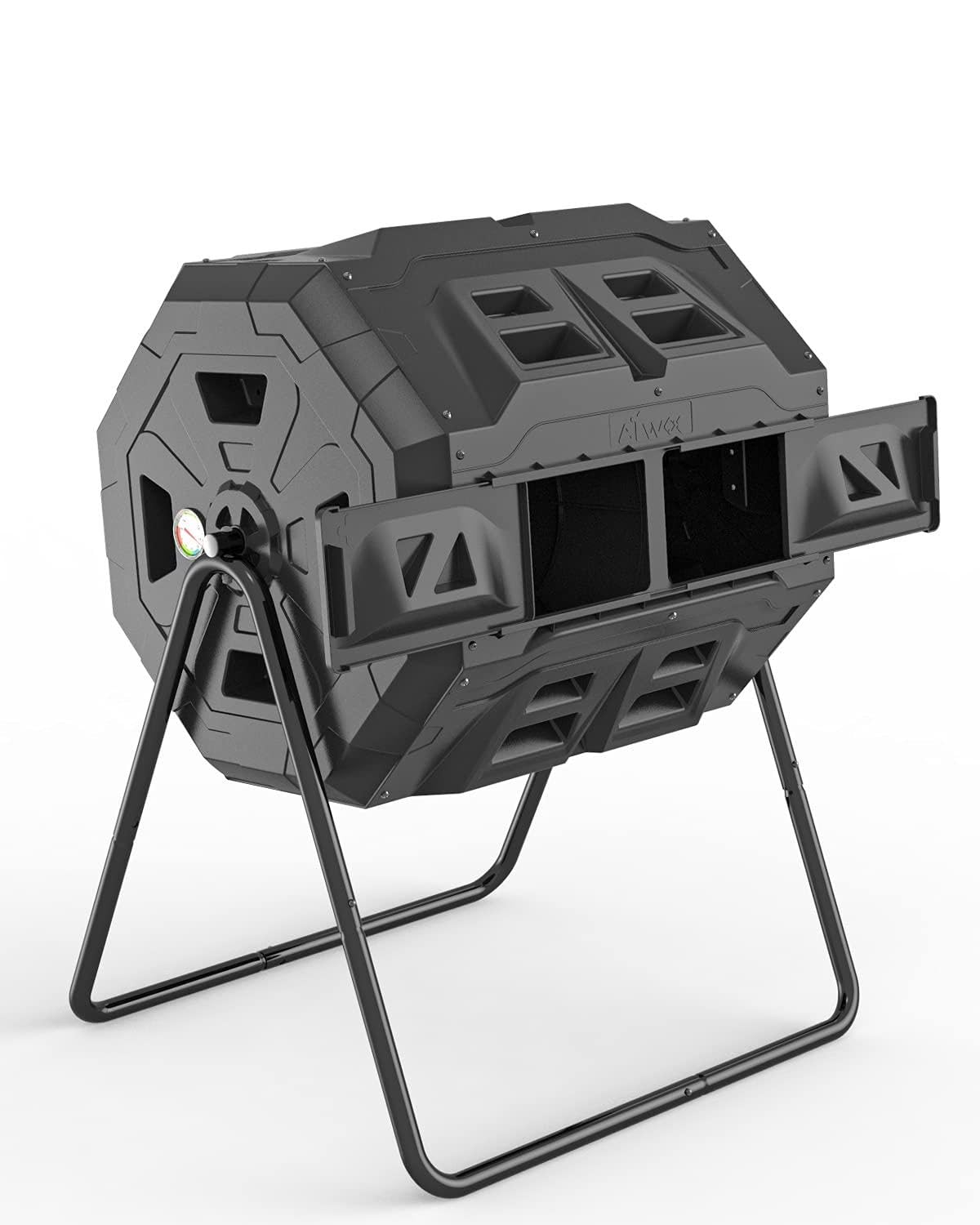
The tumbler that hands you a temperature read without popping the lid
Anyone who has nursed a batch to the heat it needs knows the guessing game this bin removes. A thermometer is built into the lid assembly, so you can check the internal temperature of the pile without opening the drum and letting the heat escape. That matters because the decomposition runs fastest when the core stays warm, and the only way to know whether yours is actually cooking is to measure it. Beyond that, it is a familiar 43-gallon dual-chamber tumbling composter — one side matures while the other takes fresh scraps — on a sturdy galvanized steel frame with a high-density plastic body.
The drum rolls and the doors slide open easily, and customers note it keeps rats out, with tough plastic and a solid metal base that should stand up to weather. Assembly runs about 45 minutes and the panel work is manageable, though the screws benefit from a drill rather than a hand driver — a few arrive defective but there are extras in the box. What reviewers keep returning to is the thermometer, which takes the guesswork out of whether a new batch is hot enough to be working.
One honest wrinkle: the thermometer can run low compared to what the inside actually feels like, so a steamy, hot pile may show a modest reading. And the opening is not huge, so scooping finished compost out by hand is awkward — a small bucket or flipping the drum works better. These are the small frictions of an otherwise tidy machine.
temperature tracking: if you want to watch the batch actively and you live where cool nights slow decomposition, the thermometer earns its keep.
puddle watch duty: the door opening is snug for harvesting, so scoop with a tool rather than reaching in.
6. SQUEEZE master Large Compost Tumbler Bin with Thermometer, 43 Gallon

Twin 21.5-gallon chambers on a frame rated to hold a very heavy load
This tumbler is rated for a maximum load bearing of 352 pounds, so it holds up even when a chamber is full and wet — which matters, because wet kitchen waste gets heavy fast. It is built from modified polypropylene (a tough plastic) on an upgraded steel frame. The twin-chamber design splits the 43 gallons into two 21.5-gallon halves, letting you alternate between a batch that is finishing and one that is fresh. A visual thermometer sits on the drum so you can track the composting temperature without lifting the lid, and a large axle runs through the center to support the drum even when it is loaded.
The tumbling action lives on that axle, and it spins with a few light turns. There is no handle to crank — just roll the drum a handful of times every few days after loading through the sliding door. Owners consistently report the function, ease of use, and sturdiness as its strengths, with the drum turning freely and the frame staying solid. Assembly has been trimmed by 28 percent fewer screws than the previous version, and it runs around 20 minutes with a good screwdriver; a power driver speeds it along further.
Two things worth flagging. The door openings are on the small side, so if you have large hands, retrieving material takes some maneuvering. Owners also note the bin can leak a little moisture, which is normal for a tumbling drum but worth placing on bare ground or a tray rather than a deck. Neither issue gets in the way of the actual composting, which is what this bin is good at.
heavy load tumbler: that 352-pound rating is the reason this bin does not flex or wobble when both chambers are full and wet — the load-bearing frame is doing real work.
high volume users: if you fill your bin fast and want a frame that will not bow under a full, wet load, this is the sturdy choice.
drip tray required: the sliding doors let a little moisture escape, so set it on gravel or a pan.
7. East Oak Compost Tumbler Outdoor, 43-Gal Dual Chamber Composter
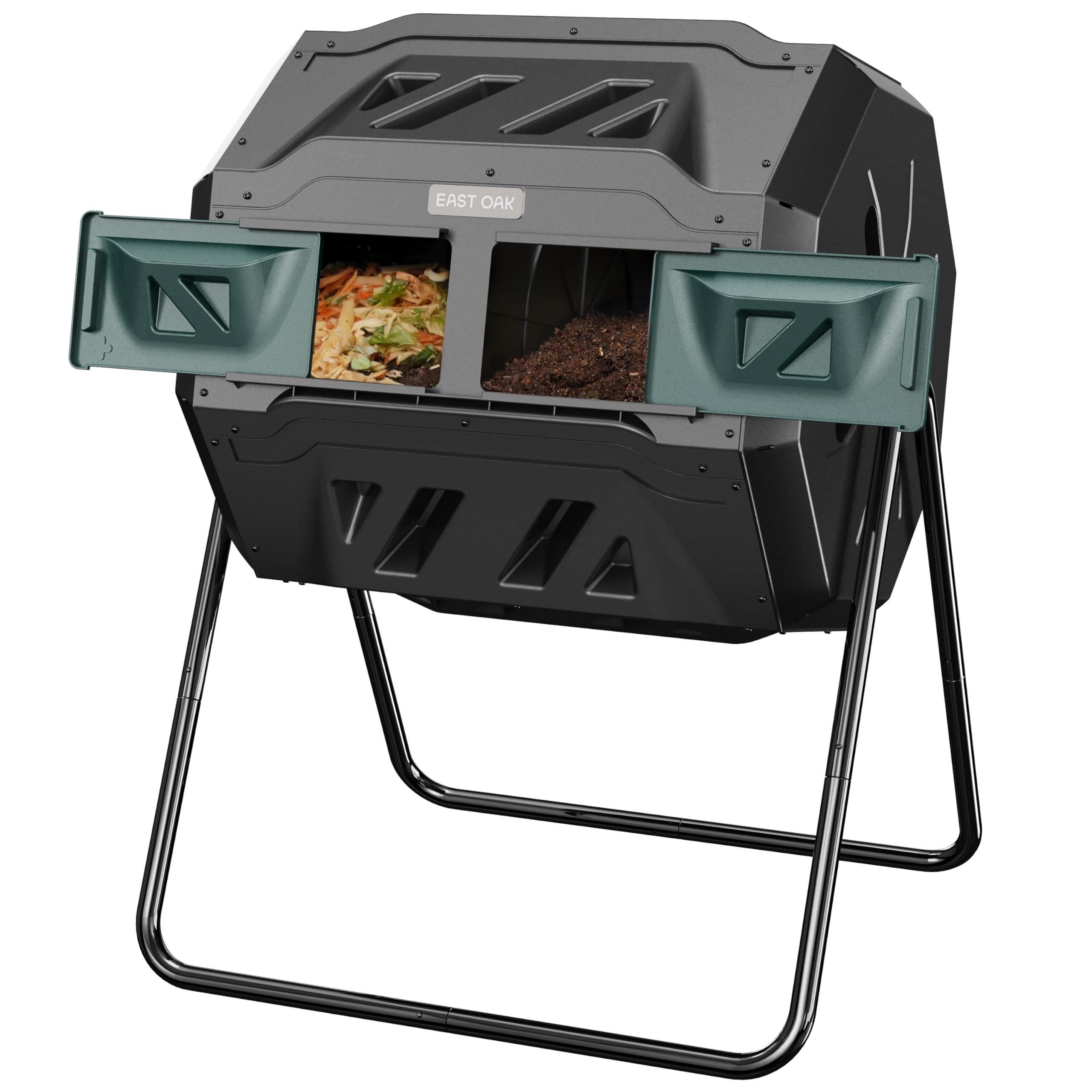
A black drum that drinks up sun heat to push the batch along faster
The color is the point here. This East Oak tumbler uses a black body specifically because dark surfaces absorb sunlight and hold heat, which is exactly what a compost pile needs to break down quickly — the manufacturer says a correct green-to-brown ratio and the right moisture can finish a batch in about 4-6 weeks. It is a dual-chamber 43-gallon design with powder-coated steel supporting a BPA-free polypropylene body, and the interlocking panels add rigidity so the drum holds its shape. Owners rate it around 4.3 stars, and durability and sturdiness are what they talk about most — one frame that holds up in severe desert heat is the kind of feedback that means something.
Airflow is managed through a ring of aeration holes paired with deep fins inside the drum, which prevent pressure from building up and keep the material from matting together, so a proper rotation mixes oxygen into the core. Assembly is documented in both a manual and a video, and with two people and a power screwdriver it comes together in under an hour. The center divider keeps the two sides spinning independently, so a finished batch does not get contaminated by fresh waste.
Two small compromises. The doors can be stiff once they have been closed for a spin, so opening them to add scraps occasionally takes a firm hand. And a little compost liquid can weep from the lower air holes, which is a normal tumbling-bin behavior but worth placing the bin where a drip does not matter. Neither is a dealbreaker — they are the kind of details you adjust to in the first week.
cooler yard choice: if your summers are short or your nights run cool, a black drum that soaks up sun helps the batch hold the warmth it needs.
rattle tolerance: stiff doors and minor weeping from the vents are the trade-off for that sealed, heat-holding body.
8. FCMP Outdoor HOTFROG Rolling Single Chamber Batch Tumbling Composter, 37-Gallon

Arrives fully built, rolls like a barrel, and needs no tools at all
If you have ever opened a composting box and stared at a pile of unlabeled panels, the HOTFROG is the pick for you. It shows up assembled — a base, a barrel, and a sliding door, three pieces and zero screws — so you can start filling it the day it lands. The design is a rolling barrel rather than a stand-mounted drum, which means you roll the whole thing around the yard to mix it and to move it where you need the compost, instead of carrying buckets back and forth. Capacity is 37 gallons (5 cubic feet) in a single chamber, so this is a batch-style bin: fill it, let it finish, empty it, start again.
The body is BPA-free, UV-inhibited recycled polyethylene, and it is a genuinely sealed, critter-proof container — a molded barrel with no metal parts to rust. Reviewers point out the tumbler keeps rodents out and, unlike some drum bins, still rotates even when full. The large opening and removable door make loading and unloading straightforward, and deep fins molded into the surface double as handholds and internal agitators. The manufacturer says that in hot, sunny conditions with the right ingredient balance a batch can finish in as little as two weeks.
The honest limits are weight and water. A full barrel is heavier than a stand-mounted drum, and rolling it takes some force rather than a light spin — there are no wheels to ease it along, just the barrel itself. The side air holes are large enough to let a bit of fine compost escape, and the lids are not fully watertight, so heavy rain can make the contents wetter than you want. Neither ruins the bin; they just mean you roll it firmly and set it where drainage is decent.
rolling batch speed: the ease of use and the no-assembly setup — this is a bin you can put straight to work, and the rolling action keeps it from ever feeling like a chore.
fast batch turns: no tools, no build time, and a sealed barrel that keeps animals out from day one.
back effort needed: the rolling design needs force when the barrel is full, so it favors those who do not mind a firm push.
9. Good Ideas Compost Wizard Jr. Tumbler, 7 Cubic Foot Capacity
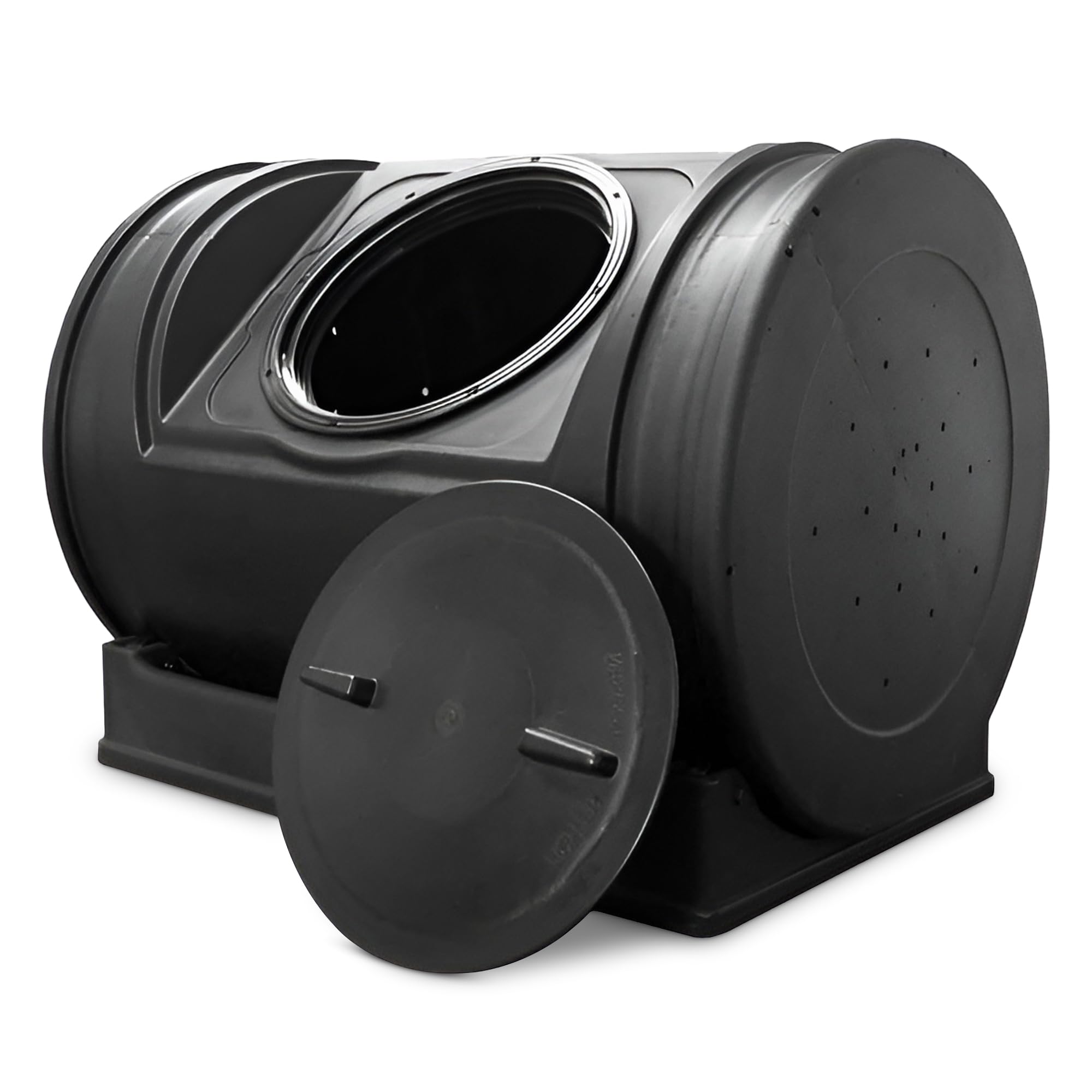
A wheeled single drum that makes the first batch feel genuinely easy
The Compost Wizard Jr. keeps the whole ritual simple: add kitchen scraps and yard waste, twist the lid shut, and roll the drum on its wheeled base to mix. The single chamber holds 50 gallons — 7 cubic feet — which packs real capacity into a footprint about the size of a patio chair, making it a sensible pick for small yards and first-time composters. Molded handholds double as internal agitators, so when you grip the drum to spin it, those same ridges are churning the contents inside. The black exterior absorbs heat from the sun, which helps the batch break down faster in warm weather.
Twelve-inch twist lids seal each chamber shut to hold in heat and moisture, and that seal is what keeps flies and smells contained — a point owners bring up when they talk about how little fuss this bin causes. It arrives fully assembled, so there is no screw-counting evening. It is rated around 4.4 stars by owners, and the thing they praise most is simply how easy it is to use: filling, rolling, and emptying all happen without a shovel, and it survives the winter without the lid freezing stuck in a way that locks you out.
The trade-off is weight once it is loaded. At three-quarters full, the drum gets heavy, and turning it takes real effort — heavy enough that some owners buy a second one to reduce how often they have to wrestle a full batch. The lid can also be fiddly to reseat, and winter ice makes that worse. Plan to keep it from overfilling and it stays manageable.
beginner starter bin: nothing to build, nothing to turn with a fork, and a sealed drum that keeps the process tidy.
three quarter cap: that is the point where spinning gets hard, so a smaller, partial batch is easier to live with.
Understanding the Specs
Capacity in gallons
Capacity tells you how much material a bin holds before you have to harvest it, and it sets how the bin fits your household. Small tumbling drums in the 37- to 43-gallon range suit a couple or a small family that adds scraps through the week — the kind of output a dual-chamber tumbler can process continuously. Step up to a static bin and the numbers climb, with an 80-gallon static model and a 173.92-gallon cedar bin available for yards that generate bulk leaves, grass clippings, and storm debris. Pick a capacity that matches your worst week, not your average one, because the autumn leaf drop is what overflows a small drum.
Tumbler or static design
The design you pick decides how much physical work the bin asks of you. A tumbling composter is a sealed drum you rotate — the rolling motion mixes and aerates the contents in seconds and keeps rain, rodents, and flies out, but a full drum gets heavy and demands force at a time when you are most busy. A static bin is an open box that sits on the ground, holds far more volume, and lets air and soil life do more of the work; in exchange, you supply the mixing with a fork and accept that it is not pest-proof. Choose by how much turning you are honestly willing to do each week, and how much capacity you need to handle.
FAQ
How long does it take to get finished compost from a tumbler?
Do compost tumblers keep rats and mice out?
Is a dual chamber composter better than a single chamber?
Why does my compost bin smell and how do I fix it?
How much physical effort does a tumbling composter take to turn?
Can I put grass clippings and leaves in a 43-gallon tumbler?
Do I need to assemble a compost bin or do any arrive ready to use?
Will a compost bin survive freezing winters and hot summers?
What is the difference between a static bin and a tumbling composter for backyard use?
How often should I turn or roll my compost bin?
Final Thoughts: The Verdict
For most yards, the winner among backyard compost bins is the Greenes Fence Premium Cedar Wood Composter, because its 173.92-gallon capacity swallows the volume of leaves and clippings that overflows every 43-gallon drum, and the sanded cedar build is the sort of thing buyers expect to own for years. If you would rather spin a sealed drum than wield a fork, the EJWOX 43-Gallon Tumbler with Thermometer gives you dual-chamber batching plus a temperature read without lifting the lid. And for a beginner who wants to start composting the day the box arrives, the FCMP Outdoor HOTFROG RC4000 needs no tools and rolls into place ready to fill. Whatever you choose, size the bin to your heaviest week of waste — the autumn leaf drop, not the average week.
How We Picked
We do not accept paid placement. Every pick is matched to a real buyer and a real use-case; we do not hands-on test units.
Sources & Methodology
Specifications: manufacturer listings and product documentation. Review insights: verified customer reviews, as of September 2026. Pricing: not shown on this page (it changes often); check the current price via the retailer link.
As an Amazon Associate, KitchPrep earns from qualifying purchases. This does not affect which products we feature.
Related Guides
