
Specs are compiled from manufacturer listings and verified buyer reviews and can change over time — please confirm the key details on the product page before buying.
You want the water to actually stop — a full, hard stop when you turn the handle, not a dribble you have to listen to all night. That is the whole job of a bathtub faucet shut-off valve, and the difference between a good one and a bad one shows up in about three months. Some of these little brass fittings hold a clean seal for years; others seize open or start weeping around the lever. This guide covers three of them, sorted by what they actually do for you.
I’m Mohammad Maruf — the founder and writer behind KitchPrep. This guide is built by comparing the manufacturers’ published specifications and the patterns across verified customer reviews, so you get each pick’s real strengths and trade-offs instead of marketing spin.
Get the thread standard right before you worry about the brand, because a valve that will not seat on your pipe leaks no matter how well it is made. The three options below split cleanly: one is an inline volume control you set and leave, one is a pull-chain valve that springs back closed on its own, and one is a quarter-turn shutoff built for a straight exposed pipe. In a bathroom or an RV, a bathtub faucet shut-off valve is the part you touch every day, so it is worth getting right.
Our Picks at a Glance
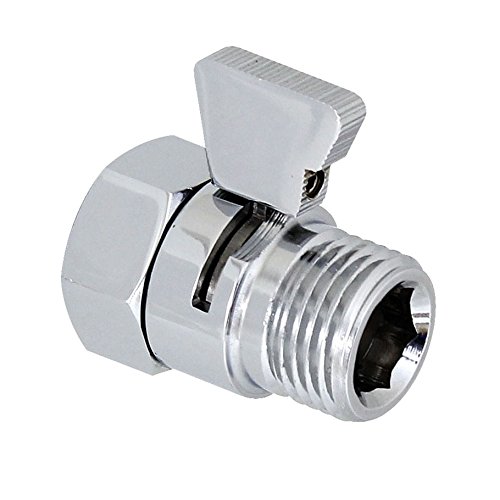
How To Choose The Best Bathtub Faucet Shut-Off Valve
A shut-off valve sits inline on the pipe feeding your shower head or hand shower, somewhere between the wall outlet and the head itself. Turn it and you cut or trim the water without touching the main mixer. That sounds simple, but three things decide whether the part you order will actually screw on, seal, and last.
Match the thread standard before anything else
The most common way a valve fails is not a manufacturing defect — it is the wrong thread. American plumbing uses NPT, which stands for National Pipe Tapered, meaning the threads are slightly conical so they tighten into a seal. European fittings often use G 1/2, a straight parallel thread of the same nominal size. They look nearly identical on the shelf. Thread a G 1/2 valve onto an NPT pipe and it will likely weep at the joint no matter how much tape you use. Check the listing wording carefully and confirm it names NPT on both inlet and outlet.
Brass body, ceramic disc — the internals that decide lifespan
The body material tells you whether the valve will corrode in a wet, humid bathroom. Solid brass with a polished chrome finish resists both. Inside, a ceramic disc cartridge works like two polished plates that rotate past each other to control flow — there is no rubber washer to wear out from repeated turning. Valves that use plastic housings or rubber seats tend to be the ones that start dribbling or stick after a season of daily use.
Decide between set-and-forget and spring-return
There are two jobs here and they are not interchangeable. An adjustable volume control lets you dial flow down to a gentle spray and leave it there — good if you want to soften a hard shower permanently. A self-closing valve springs shut the moment you release the handle, which suits a urinal or any spot where leaving water running is the problem you are solving. Buy the one that matches your habit, not the one with the nicer finish.
Quick Comparison
| Model | Best For | Connection | Ports | Handle Style | Amazon |
|---|---|---|---|---|---|
| MODONA VC01-A Water-Saver Flow Control Valve★ Best Overall | Dialing shower flow down and leaving it set | ½-inch IPS standard fittings | 2 | Brass lever, adjustable | Amazon |
| Solimeta Self-Closing Shower Valve with Pull Chain | Urinals and sinks where water must not stay running | 2 x ½-inch NPT female | 1 | Pull chain, spring-return | Amazon |
| Weirun Concealed Shower Shut-Off Valve | A quick quarter-turn cut on an exposed straight pipe | ½-inch NPT female in and out | 2 | Cross handle, quarter-turn | Amazon |
In‑Depth Reviews
1. MODONA VC01-A Water-Saver Flow Control and Shut Off Valve
Our pick — over 4★ from 100+ verified ratings; the strongest balance of quality and price.
The valve you set once at half and forget — because it holds that setting without weeping.
Buy this one if you want to soften a hard shower and then stop thinking about it. The body and the handle are both solid brass, not brass-plated plastic, so the finish will not flake off the way plated parts can. Inside sits a ceramic disc cartridge — two polished plates that slide past each other to control flow — so there is no rubber washer to harden and split over time. It uses ½-inch IPS standard fittings (the everyday American pipe thread found on shower arms and hand-shower outlets), so it threads straight onto the pipe you already have. It comes with plumber’s tape and a diagram, and most installations take minutes with a crescent wrench and no special tools.
What wins people over is how well it actually controls flow, and the water savings that come with it. Owners routinely dial the MODONA’s lever down to roughly 0.8 gallons per minute and leave it parked between 50 and 75 percent open for a gentler spray. On a line running about 80 psi, buyers report the flow still reads more than sufficient when the lever is fully open. The multi-layer polished chrome resists daily damp and tarnish, and MODONA covers the valve with a 5-year warranty.
The honest catch is the lever seal. Leak-free operation is the one area where owner experience splits — plenty of these sit bone dry for years, but a minority develop a small weep around the flow-adjustment lever. That drip does not interfere with the valve’s ability to control flow, and at the top setting some owners note the internal mechanism trims total volume slightly compared to a straight pipe with no valve at all. Neither issue ruins the part; both are worth knowing before you commit to leaving it wide open and expecting nothing to change.
What earns the top spot
- Solid brass body and brass handle — nothing plastic to crack in a wet bathroom
- Ceramic disc cartridge delivers a genuinely full stop, no dribbling from the head
- Smooth, non-sticking travel across the whole range from closed to wide open
- Cuts flow to roughly 0.8 gallons per minute for real water savings
- Ships with plumber’s tape and instructions; installs in minutes with a crescent wrench
Where it asks for patience
- A minority of units weep slightly at the adjustment lever — minor, and it does not affect flow control
- At the fully open setting the internal mechanism still trims a little volume versus an empty pipe
- Chrome is soft enough to mark if you grip it with a bare pipe wrench instead of a padded jaw
Reach for this if: you want one durable brass valve you can dial down and leave alone, and you want the lower flow rate that comes with that.
Think twice if: you need a lever that never seeps and the most water a pipe can pass — the lever seal is the one spot that occasionally seeps, and the internal mechanism trims volume even at full open.
2. Solimeta Self-Closing Heavy Duty Shower Valve with Pull Chain, Chrome

Pull the chain, get water. Let go, and it seals itself — a single-port valve for people who cannot risk a running tap.
This behaves nothing like the MODONA above. Where that one is an adjustable dial you set and leave, this is a spring-loaded return valve: you pull the bar, water flows, and the moment you release it the valve snaps closed on its own. It is a one-port design in solid brass with a chrome-plated finish, threaded 2 x ½-inch NPT female on the inlet and outlet, so it screws onto standard tapered American pipe. If you compare the two side by side on ports, the MODONA carries two to this valve’s one, because this one is built for a simple in-and-out water path rather than an adjustable mix.
That auto-close behavior is the entire point, and it makes this a natural fit for a urinal or any fixture where a tap left running is the problem. The pull bar arrives with multiple bar sections so you can extend the reach for a smaller set of hands. Owners who use the Solimeta this way describe it as simple and uncomplicated, with no pricey parts to replace down the line, and several note it works well for their urinal setup. Build and function both draw a genuinely mixed read from buyers — some call it good quality and a great value, others find it cheaply made.
Weigh this trade-off before you buy. A self-closing valve leans on an internal spring and seal to snap back every single time, and that is the part that eventually wears. The most common complaint is the return mechanism giving up — a unit that stops springing back to the off position after a few months and has to be closed by hand — and one buyer reports the valve seizing in the on position after a month. Compare that to the MODONA’s ceramic-disc lever, which has no return spring to fatigue. If your install relies on the valve closing itself every time, treat this as a wear part.
The auto-close case: nothing else here shuts off by itself, and for a urinal that hand-off behavior is the exact feature you want.
What the price buys: solid brass and a chrome finish at an entry-tier price point, with an extendable chain that suits shorter reaches.
Pick this when: your fixture needs to close without anyone remembering to close it, and a manually held chain does not bother you.
Look elsewhere when: the spring itself is your lifeline — this is a wear item, and it is the part most likely to need replacing first.
3. Weirun Concealed Shower Shut-Off Valve with Cross Handle

A quarter-turn from full off to full on, through a thick chrome cross handle that reads as a finished fixture, not a repair part.
If the MODONA is the practical plumber’s fix, this is the one for a visible install where the valve is meant to look like it belongs. The Weirun’s brass body wears a thick, glossy chrome finish that buyers describe as high quality and built to last, and it carries a cross handle instead of a lever. Operation is a quarter-turn — a single 90-degree twist takes it from full off to full on, which is faster and more positive than winding a lever across its range. It threads on with a ½-inch NPT female inlet and a 1 x ½-inch NPT female outlet, both standard American tapered threads, so it drops onto a straight exposed pipe without adapters.
Versatility is where it earns its keep. It works as a bathroom shut-off, an RV or motorhome valve, or an adjustable water saver, and the same compact body suits a kitchen line as easily as a shower pipe. Owners doing custom builds say the Weirun looks great once installed and works perfectly, and the thick chrome trim draws the most favorable comments. Between this and the pull-chain Solimeta, this is the one you mount where people can see it.
Two honest notes. First, full flow is not the same as unrestricted flow: the internal mechanism trims volume even when fully open, so a straight pipe with no valve inline will pass more water. Owners who want reduced flow accept that; owners chasing maximum volume should know it going in. Second, and more important, there are reports of units arriving with G 1/2 European straight threads rather than the NPT taper advertised, which do not seal on American pipe and leak at the joint until you add adapters, Teflon tape, and pipe sealant. Confirm the thread on the unit you receive before you tighten it down.
The finish argument: thick chrome and a cross handle make this the only pick here that looks like a permanent fixture instead of an add-on.
The patience it demands: the quarter-turn and the two standard NPT ports are exactly right for a straight pipe — if the threads you receive are not NPT, you will be adding adapters to stop a leak.
Best for a visible, finished install: a custom build or exposed pipe where a quarter-turn cut matters and the chrome is meant to be seen.
Not the one if: you need every drop of your pipe’s open volume — the internal restriction trims flow even at full open.
Understanding the Specs
Thread Standard: NPT versus G 1/2
NPT means National Pipe Tapered — the threads are slightly conical, widening toward the base, so they bite into a seal as you tighten. G 1/2 is a European straight parallel thread of the same nominal size. A straight-thread valve on a tapered pipe typically will not seat, and the joint weeps even under heavy tape. Both the Solimeta and the Weirun list NPT tapered connections, which is what you want on standard American pipe; a straight or European thread is the fastest route to a leak that adapters then have to fix.
Ports and Flow Control Type
Port count tells you the water path, not the quality. A two-port valve takes water in one side and out the other through a controllable mechanism — the MODONA and Weirun both use two ports, one as an adjustable lever and one as a quarter-turn cross handle. The Solimeta uses a single port with a spring-return pull chain, where the outlet is the only path and the valve closes itself on release. Two ports suit a set-and-forget dial or a positive shutoff; one port suits a fixture that must never be left running.
Body Material and Cartridge Type
Solid brass with a chrome or polished finish resists corrosion and tarnish in a humid bathroom, and all three picks use a brass body. The internal cartridge matters just as much as the shell — a ceramic disc cartridge rotates two polished plates past each other on the MODONA, so there is no rubber seat to harden or split. A spring-loaded mechanism, like the Solimeta’s, relies on a moving part that cycles every single use, which is why that design’s return spring is its point of wear.
Water-Saving Flow Control
An adjustable valve lets you cut flow to a fraction of full open and leave it there — the MODONA reads around 0.8 gallons per minute at a reduced setting, which keeps the spray gentle and the meter slow without shutting off entirely. A quarter-turn or spring-return valve instead gives you on and off rather than a dial. If you want a permanently softer shower, choose the adjustable lever; if you want a hard stop, choose the quarter-turn.
FAQ
Will this valve fit my existing shower arm threads?
Is an NPT thread the same as G 1/2?
What is the difference between a self-closing valve and an adjustable volume control?
Can I use one of these to reduce my shower water flow permanently?
Do these work for an RV or motorhome shower?
How long should a brass shut-off valve last?
What does quarter-turn mean on the Weirun valve?
Will a shut-off valve noticeably reduce my water pressure?
Do I need plumber’s tape or adapters to install these valves?
Are these suitable for a kitchen or basin as well as a bath?
Final Thoughts: The Verdict
The bathtub faucet shut-off valve to reach for first is the MODONA VC01-A, because a solid brass body, brass handle, and a ceramic disc cartridge give it a full, dribble-free stop and enough control to dial your shower down to roughly 0.8 gallons per minute. If your fixture needs to shut itself off, the Solimeta pull-chain valve is the right tool — just understand that its spring-return mechanism is the wear part. And for a visible custom build where the chrome is meant to be seen, the Weirun cross-handle valve brings thick chrome and a quick quarter-turn. Start by confirming your thread standard; everything else follows from that.
How We Picked
We do not accept paid placement. Every pick is matched to a real buyer and a real use-case; we do not hands-on test units.
Sources & Methodology
Specifications: manufacturer listings and product documentation. Review insights: verified customer reviews, as of September 2026. Pricing: not shown on this page (it changes often); check the current price via the retailer link.
As an Amazon Associate, KitchPrep earns from qualifying purchases. This does not affect which products we feature.
Related Guides
