
Specs are compiled from manufacturer listings and verified buyer reviews and can change over time — please confirm the key details on the product page before buying.
An 18,000 BTU mini split is the point where a wall-mounted system starts replacing a whole central unit instead of just cooling one bedroom. It is the size that handles a garage, a sunroom, a converted attic, or a 1,000-square-foot floor plan without breaking a sweat — but only if you match it to your actual space and line up the right installer. Get that match wrong and you either freeze half the house or leave a far corner sweating all summer.
I’m Mohammad Maruf — the founder and writer behind KitchPrep. This guide is built by comparing the manufacturers’ published specifications and the patterns across verified customer reviews, so you get each pick’s real strengths and trade-offs instead of marketing spin.
Here is how to read the numbers without drowning in them, and which systems earn their spot — whether you are shopping for the 18000 btu mini split to cool a workshop, a home office, or an add-on room that the central air never quite reached.
Our Picks at a Glance

How To Choose The Best 18000 BTU Mini Split
The single biggest mistake buyers make with this size is treating “18,000 BTU” as a universal guarantee. BTU stands for British Thermal Unit — the standard measure of how much heat the system moves. An 18,000 BTU unit always moves 18,000 BTU worth of cooling capacity, but the space it can comfortably hold depends on ceiling height, insulation, window area, and how leaky the room is. A tight 1,250-square-foot room and a drafty 750-square-foot garage can both want the same 18,000 BTU head.
Match the unit to your square footage, not the label
Published coverage for these systems ranges from roughly 550 to 1,250 square feet. A garage with an insulated door behaves very differently from an open-plan living room, and a workshop with roll-up doors is closer to the leaky end of that range. Measure first, then read the coverage spec — not the other way around. Overbuying wastes money on a system that cycles on and off; underbuying runs the compressor at full tilt all day and never catches up.
SEER2 and HSPF2: your summer and winter bills in two numbers
SEER2 is the updated federal efficiency rating for cooling — the higher the number, the less electricity the unit uses to move the same amount of heat. HSPF2 is the matching rating for heating season. A system marked 24.5 SEER2 will use meaningfully less power than one at 18 SEER2 for the same cooling job, and both numbers determine whether the unit qualifies for federal tax credits or local rebates. If you plan to run it through the shoulder seasons, HSPF2 matters as much as SEER2.
Voltage, line sets, and the install reality
Almost every 18,000 BTU mini split here is a 208-230V system, which means a dedicated double-pole breaker and a licensed or experienced installer for the electrical side. A few are 115V, but this size almost always wants the higher voltage. Line-set length matters too — most kits ship with a 16-foot insulated line set, and going longer usually means paying extra for refrigerant. Longer line sets need professional vacuuming and leak testing regardless of how handy you are.
Quick Comparison
| Model | Best For | Cooling Power | Coverage | Efficiency | Amazon |
|---|---|---|---|---|---|
| Senville AURA 18000 BTU★ Best Overall | Smart-home households wanting voice and app control | 17,000 BTU/h | 1,000 sq. ft. | Energy Star certified | Amazon |
| Mountman 18000 BTUBest Value | Big-room DIY buyers on a tight budget | 18,000 BTU/h | 1,250 sq. ft. | 19 SEER2 | Amazon |
| TURBRO Greenland 18,000 BTUTop Performer | Fast cooling and heating with voice control | 18,000 BTU/h | 1,000 sq. ft. | 23 SEER2 | Amazon |
| DELLA Motto Series 18000 BTU | Buyers who want Alexa + WiFi and don’t mind pro install | 18,000 BTU/h | 1,000 sq. ft. | 19 SEER2 | Amazon |
| DREO 18000 BTU Mini Split | Whole-home zones and premium quiet operation | 18,000 BTU/h | 1,000 sq. ft. | 20 SEER2 | Amazon |
| ACiQ Essentials 18000 BTU | Professional installs with a long parts warranty | 18,000 BTU/h | 600–1,000 sq. ft. | 20 SEER2 / 10 HSPF2 | Amazon |
| TOSOT Cosmo 18,000 BTU | Extreme-heat climates and large open spaces | 18,000 BTU/h | — | 20 SEER2 | Amazon |
| DELLA Vita Series 18000 BTU | Bedrooms and nurseries where silence matters | 18,000 BTU/h | 1,000 sq. ft. | 20 SEER2 | Amazon |
| Cooper & Hunter MIA 18,000 BTU | Cottage and garage upgrades with pro install | 18,000 BTU/h | — | 19.2 SEER2 | Amazon |
| Pioneer Diamante Pro 18000 BTU | Cold-climate garages and workshops | 18,000 BTU/h | 500–750 sq. ft. | 21.0 SEER2 / 9.5 HSPF2 | Amazon |
| TOSOT Aoraki 18,000 BTU | Very cold climates and fresh-air ERV setups | 18,000 BTU/h | 1,200 sq. ft. | 24.5 SEER2 | Amazon |
| Daikin Entra 18,000 BTU | Name-brand reliability with air-purifying filtration | 18,100 BTU/h | 1,000 sq. ft. | 18 SEER2 / 9 HSPF2 | Amazon |
| MRCOOL 18000 BTU DIY | Hands-on installers who want genuine DIY simplicity | 18,000 BTU/h | 750 sq. ft. | — | Amazon |
In‑Depth Reviews
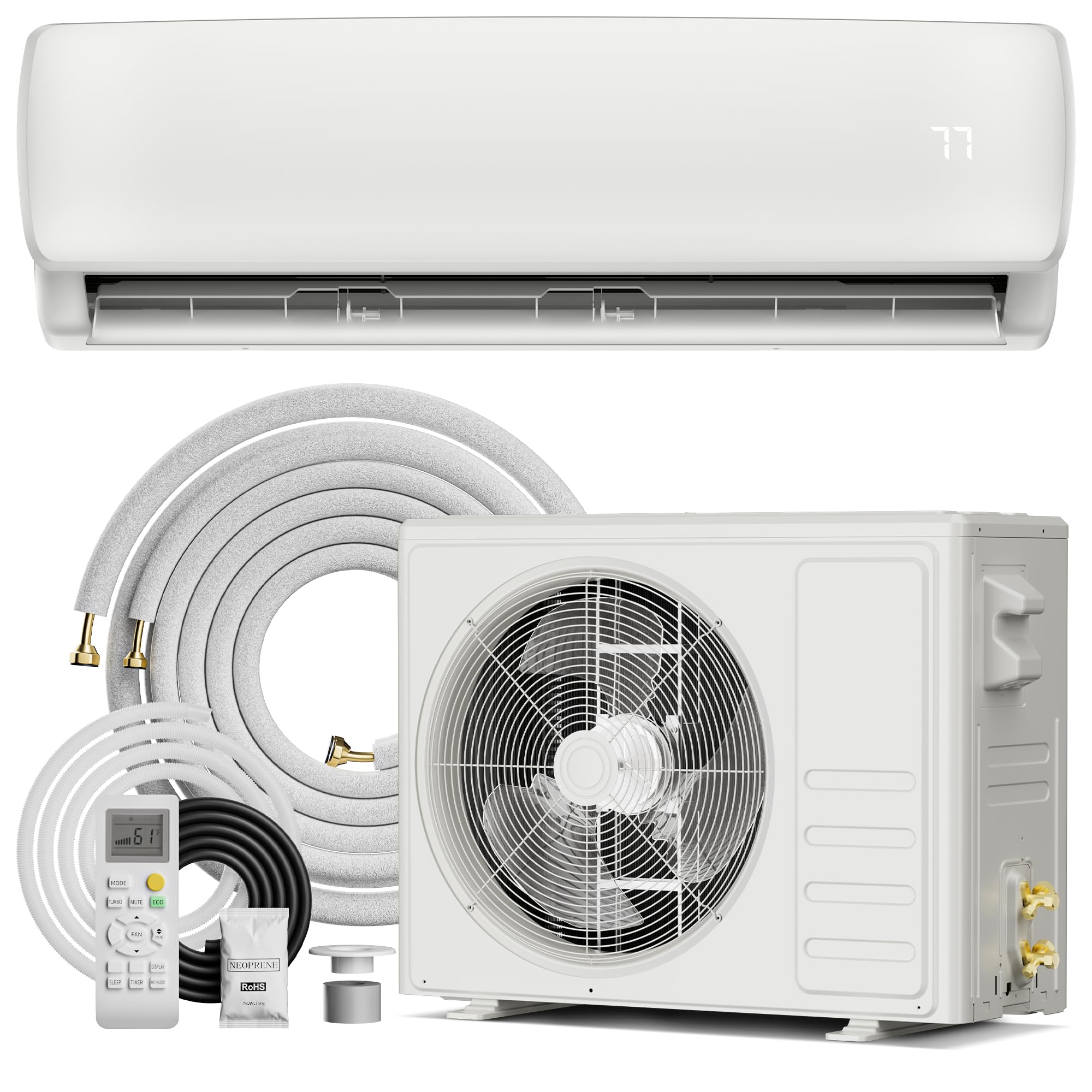
1. Senville AURA Mini Split Air Conditioner, Heat Pump, White, 18000 BTU
Our pick — 4.5★ from 500+ verified ratings; the strongest balance of quality and price.
The 18,000 BTU pick owners rate 4.5 stars across 500+ reviews for quiet, fast cooling.
Senville has been selling this exact AURA frame for years, and the review history shows why it still leads — 4.5 stars across 500+ owners, with performance drawing more praise than anything else. The Senville SENA-18HF-Z runs a 208-230V DC inverter (the motor that ramps output up and down instead of slamming on and off) and stays Energy Star certified with a 17000 BTU/h cooling output. Owners describe a 350-square-foot outbuilding swinging from stifling to comfortable in minutes, and the unit running quiet enough to forget it exists.
Alexa control is the feature that actually differentiates AURA from cheaper tiers. Custom routines and app temperature changes from anywhere matter when you leave the house and realize you forgot to kill the AC. Owners running it in a spray-foamed addition report near-silent indoor and outdoor operation, and several have bought a second and third unit for family after the first one proved itself. The one catch is that this is not a DIY mini split — Senville states professional installation is required, and the included 16-foot line set is a starting point, not a finished install.
The recurring honest gripe is documentation. Instructions are thin, the wall template is missing, and the WiFi kit is either missing or needs a firmware step that the manual barely describes. None of that stops the system from running, but if you are the type who wants a complete install narrative in the box, plan around it.
Where it earns the top spot
- Performance is the thing buyers rave about most — cooling and heating both get called out constantly.
- Energy Star certified with 208-230V DC inverter tech for consistent efficiency.
- Alexa and app control mean you can adjust temperature from anywhere.
- A 16-ft line set and communication wire ship in the box.
What to know before you buy
- Professional installation required — it is explicitly not a DIY system.
- Docs are thin: wall template missing, WiFi setup not well explained.
- One owner with a defective outdoor unit reported repeated defrost faults, though this is the outlier, not the pattern.
Pick this if: you want a proven 1,000-square-foot smart-controlled system and you have an HVAC tech lined up for the final hookup.
Look elsewhere if: you need to do every step yourself — this one is not the DIY pick.
2. Mountman 18000 BTU Mini Split AC/Heating System, 19 SEER2 208/230V Energy Efficient Ductless Inverter System, Cools Up to 1250 Sq.Ft with Pre-Charged Condenser, Heat Pump & Installation Kits
1,250 sq. ft. of coverage — a quarter more than the top pick — at a budget-tier price.
Quantify the coverage gap first: Mountman publishes 1,250 square feet of coverage against the Senville AURA’s 1,000. That’s roughly a quarter more room in the same 18,000 BTU class. The Mountman also pushes the full 18000 BTU/h of cooling power, versus 17000 BTU/h for the Senville — a modest edge that matters if you are cooling a shop with roll-up doors rather than a sealed bedroom.
The feature list reads like someone actually lives with this thing. Four modes (Cool, Heat, Dry, Fan), four fan speeds, plus a Sleep Mode that drops to 26dB (about as quiet as a library) and an ECO Mode the maker rates at up to 30% energy savings. R32 refrigerant is pre-charged from the factory, a 24-hour timer handles scheduling, and the remote’s display shuts off after 10 seconds so nothing lights up your bedroom at 2 a.m. Quality and installation are the two aspects buyers praise most, with quality mentioned well over 60 times in the review footprint.
The real question is whether the install goes smoothly. Some buyers report the manual reads like a translation project and end up on YouTube for the wiring steps. A 220/230V version uses L1 and L2 both hot with no common white — support confirms it, but the paperwork does not make that obvious. Line sets ship at 9 feet, which is short for taller rooms. And in one outlying case a flare on the 6mm tube cracked and had to be re-flared — treat the factory flares gently.
Where the value shows up
- 1,250 sq. ft. coverage — the widest span in this lineup — for a budget-friendly mid-tier price.
- Full 18000 BTU/h cooling output with a 4-star BEE rating.
- 26dB Sleep Mode, ECO mode, self-clean, and auto-defrost on board.
- Pre-charged R32 condenser takes one variable out of install day.
What the day-two reality looks like
- 9-foot line set is short — tall rooms or far corners may need an extension.
- Manual translation issues; some wiring details are clearer on YouTube than in the box.
- Metric fittings mean standard flare tools may not fit; budget for an adapter.
Buy it for: a workshop, garage, or oversized room where you want maximum coverage per dollar and you do not mind using a video to supplement the manual.
Skip the upgrade if: your install room has 10-foot ceilings or is boxed in — the 9-ft line set will need an extension.
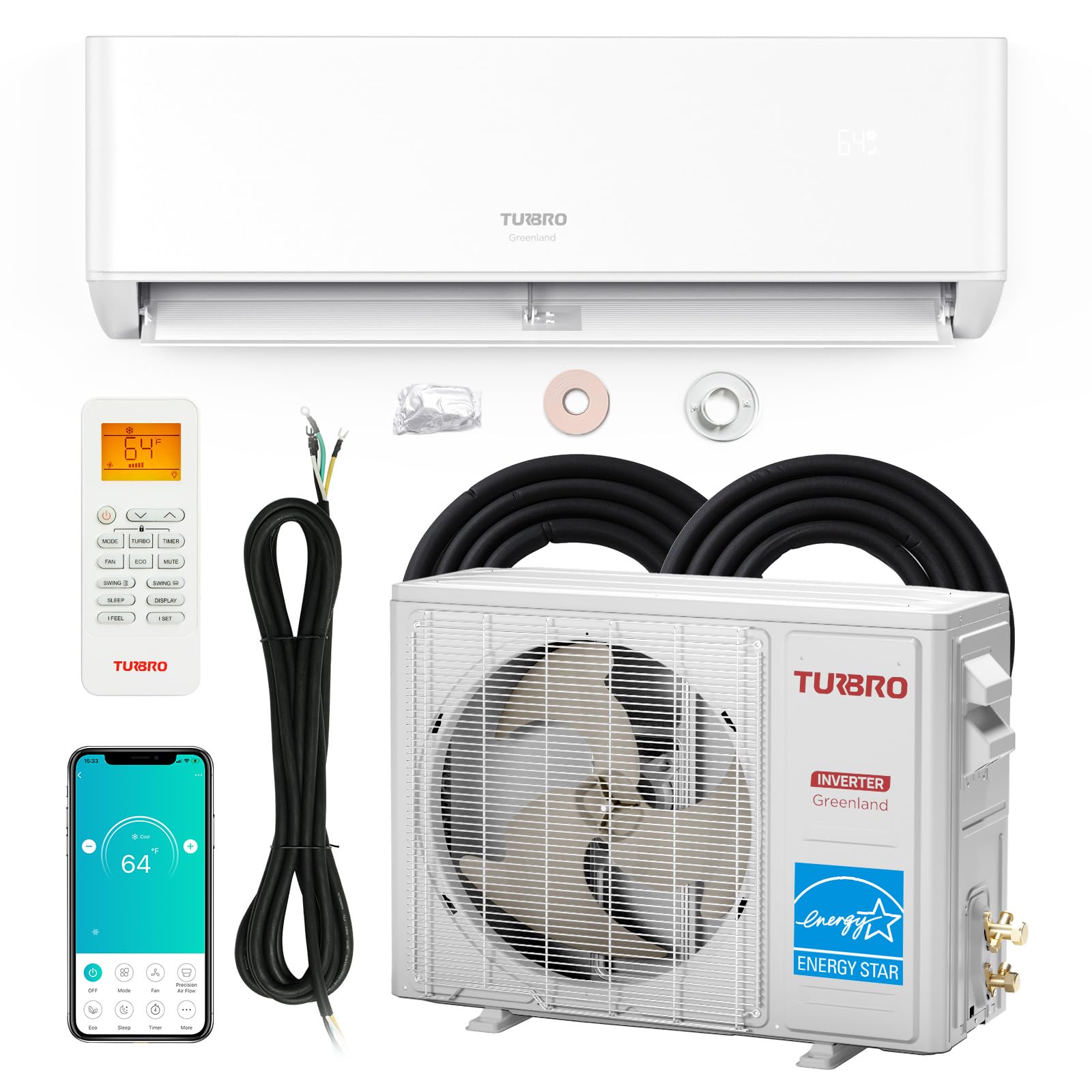
3. TURBRO 18,000 BTU Ductless Mini Split Inverter AC with Heat Pump 23 SEER2
At 23 SEER2, it is the highest efficiency rating in this roundup.
Speed is the TURBRO Greenland’s other bragging point: the maker claims super-fast cooling in as little as 30 seconds and heating in as little as 60 seconds, powered by a high-frequency inverter. That inverter also lets the unit run at up to 131°F in cool mode and down to -13°F in heat mode, so it keeps working in extremes that force cheaper systems to shut off. The 23 SEER2 rating sits above both the Mountman’s 19 SEER2 and the Senville’s Energy Star baseline, and TURBRO says the efficiency qualifies the unit for federal tax credits.
Installation leans more DIY-friendly than most in this tier. Step-by-step instructions, a numbered wiring diagram, and a pre-charged setup mean that owners installing their own report the process is doable in an afternoon, not a weekend. Voice control runs through Alexa or Google Assistant, and there’s also a smartphone app and a remote. Owners running it in a three-car garage say they can feel the cold air 20 feet away while barely hearing the unit at all — and a R454b refrigerant charge gives it a modest edge on the environmental side.
The honest caveat is that this is a 1,000-square-foot system, and one 900-square-foot building owner found it did not fully cool the space on the hottest days. If your room is genuinely at the top of the range, oversize toward the Mountman or the ACiQ. And in one edge case, a unit arrived missing a single cable — customer support handled it by email, but their responses came in a 12-to-24-hour window, so plan around that if you need urgent help.
The fast answer: If you want the best efficiency-per-dollar in this size class with genuine voice control, this is the pick. The 23 SEER2 rating is the standout number and it is backed up by the design choices around it.
One thing to size correctly: do not stretch this into a room much over 1,000 square feet. The unit delivers exactly the coverage it advertises, and asking it to cool a 1,200-square-foot shop will disappoint.
Reach for this if: efficiency and speed are your priorities and your target room is at or under 1,000 square feet.
Step up if: your space is closer to the 1,250-square-foot end — go with the Mountman instead.
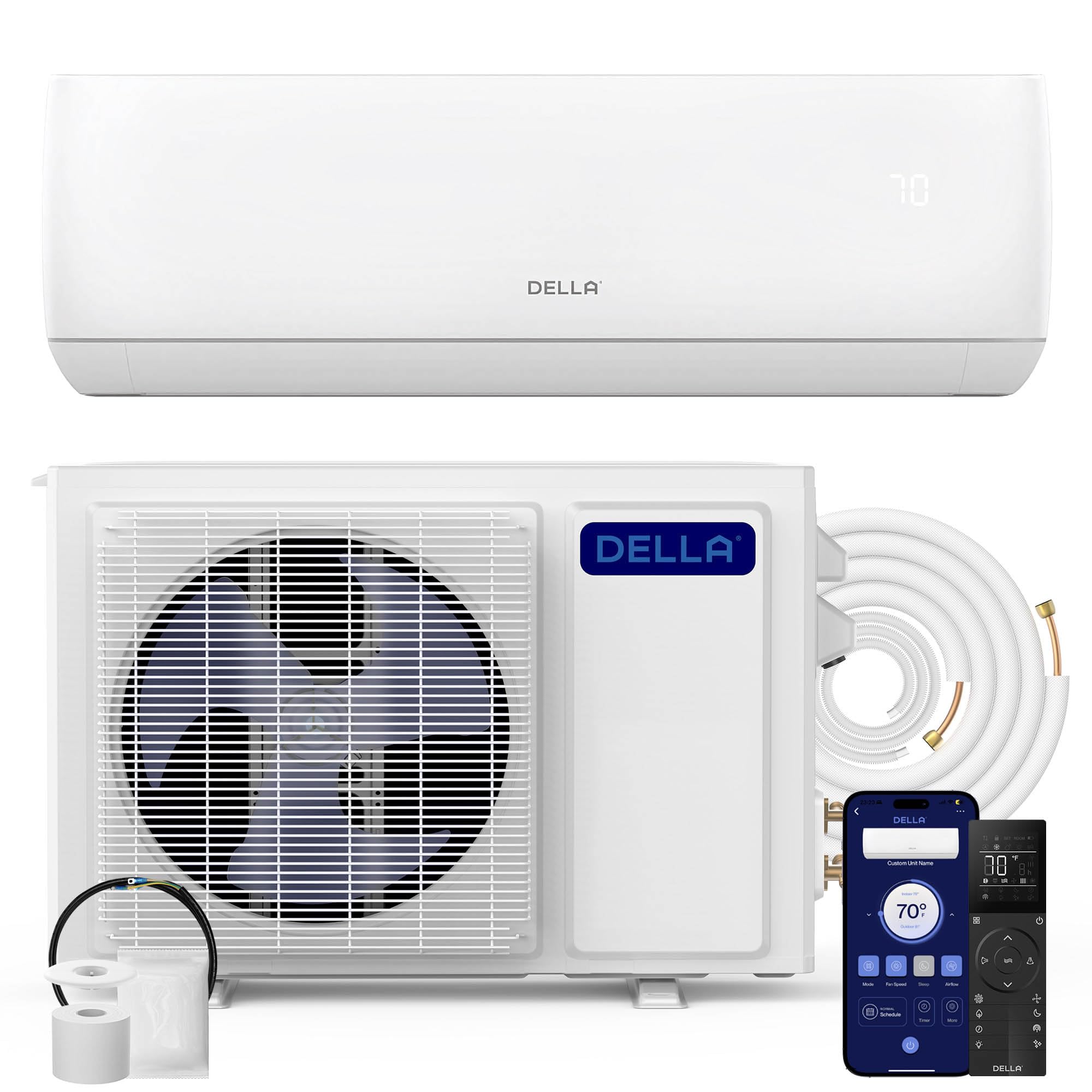
4. DELLA Motto Series 18000 BTU 19 SEER2 230V Mini Split AC, Cools Up to 1000 Sq.Ft, Works with Alexa and Wifi
The most widely owned system here, with the widest range of install experiences.
DELLA’s Motto Series sits in the well-known-name tier: 19 SEER2, 208-230V, 18000 BTU/h, ETL Listed, AHRI Certified, and a maximum fuse size of 15A. It runs R-32 refrigerant (a newer generation with lower environmental impact than the R-410A it replaces), and the outdoor condenser gets a bottom heating element so it can keep working down to 5°F. The unit hits 29 dBa in silent operation — quieter than a refrigerator hum — and the included install kit covers a 16-foot copper line in standard 1/4-inch and 1/2-inch outer diameters.
The 4D airflow feature (up-down plus left-right) and the I Feel remote sensor give owners real control over where the air lands, not just how cold it gets. Owners running this in tiny houses, garages, and outbuildings describe quick dehumidification and noticeable electric-bill drops, with one barn setup reporting roughly 800W of total usage. Alexa and WiFi are built in, so scheduling and remote temperature changes are set-and-done.
Honest trade-off: durability is the split issue in the review history. A handful of owners mention a compressor failing inside 18 months, and one owner went through two units in under two years — but the same owner bought two more, and the broader pattern is that units run for years without trouble. Auto mode temperature accuracy can also drift a few degrees from what you set. Treat the first week as a shakedown period and test cooling and heating before you paint over the wall bracket.
Why buyers keep choosing it: the brand recognition and feature-per-dollar blend. R-32 refrigerant, Alexa plus WiFi, and a 16-ft line set for a mid-tier price is a lot of system.
What to check in week one: run both modes hard while the return window is open. If the compressor has an issue, it shows up early — the failing units in the review history all went bad inside the first 18 months.
Best for: buyers who want a name they recognize, R-32 refrigerant, and smart-home integration without stepping up to premium tier.
Not for: anyone who wants zero risk on long-term durability — a pro-installed premium brand with a service network is the safer bet.
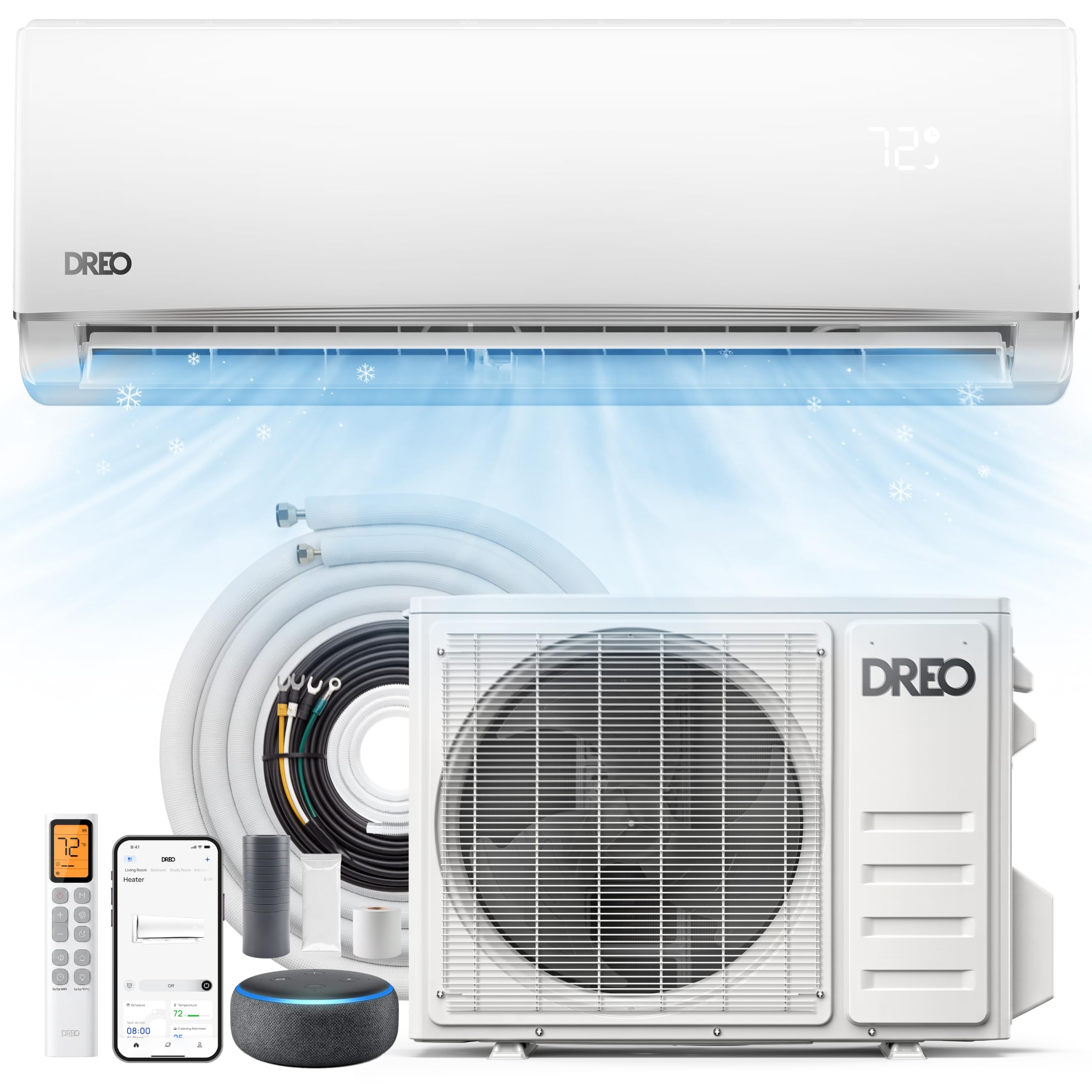
5. DREO Mini Split AC/Heating System 18000 BTU, 230V Ductless Split AC Unit
A premium system with a graphene anti-corrosion coating on the copper tubes.
The standout DREO spec is the anti-corrosion treatment on the copper tubes — a graphene coating designed to resist the kind of degradation that eventually kills mini splits in humid or coastal climates. Combined with the 20 SEER2 rating and a 1421 kWh annual energy consumption figure, this unit is built with long service life in mind, not just peak-week performance. Operating range runs from 5°F to 127°F, and the system leans on intelligent defrost protection to keep working when the outdoor unit ices up.
Startup reality: professional HVAC installation is required, and the warranty structure reflects it — 12 months on the unit, extendable to 2-year and 5-year coverage on key components when a pro installs it and you register. That is a meaningful nudge if you were hoping to DIY. Controls are the richest in this roundup: DREO’s app, remote, or Alexa voice, with a 24-hour timer, Sleep Mode, self-cleaning, and 4-way auto swing to hit every corner of a 1,000-square-foot room. The unit holds between 61°F and 88°F and runs as low as 32dB in normal operation.
A completely different buyer experience than the budget picks: owners running DREO portable appliances for years report that this mini split feels like a natural step up in build quality, and the app integration is described as quick to set up. The catch is the premium tier pricing — one owner noted DREO’s mini split sits above several competitors at the same capacity, and made peace with it because the quality felt earned. If price-per-BTU is your deciding metric, the Mountman is closer to what you want.
Where the extra money goes: the graphene anti-corrosion coating, 4-way auto swing, and the app-plus-voice control trio. If those matter to you, the DREO is the right premium buy.
Who should look down-tier: buyers who just want a working 18,000 BTU system with Alexa and do not care about tube coatings — the Mountman or DELLA Motto deliver that for less.
Suits: anyone cooling a coastal or high-humidity space who wants a system engineered to outlast the climate.
Think twice if: you plan to self-install — DREO requires a professional for the warranty extension to apply.
6. ACiQ Essentials 18000 BTU 230V 20 SEER2 Mini Split AC/Heating System, White
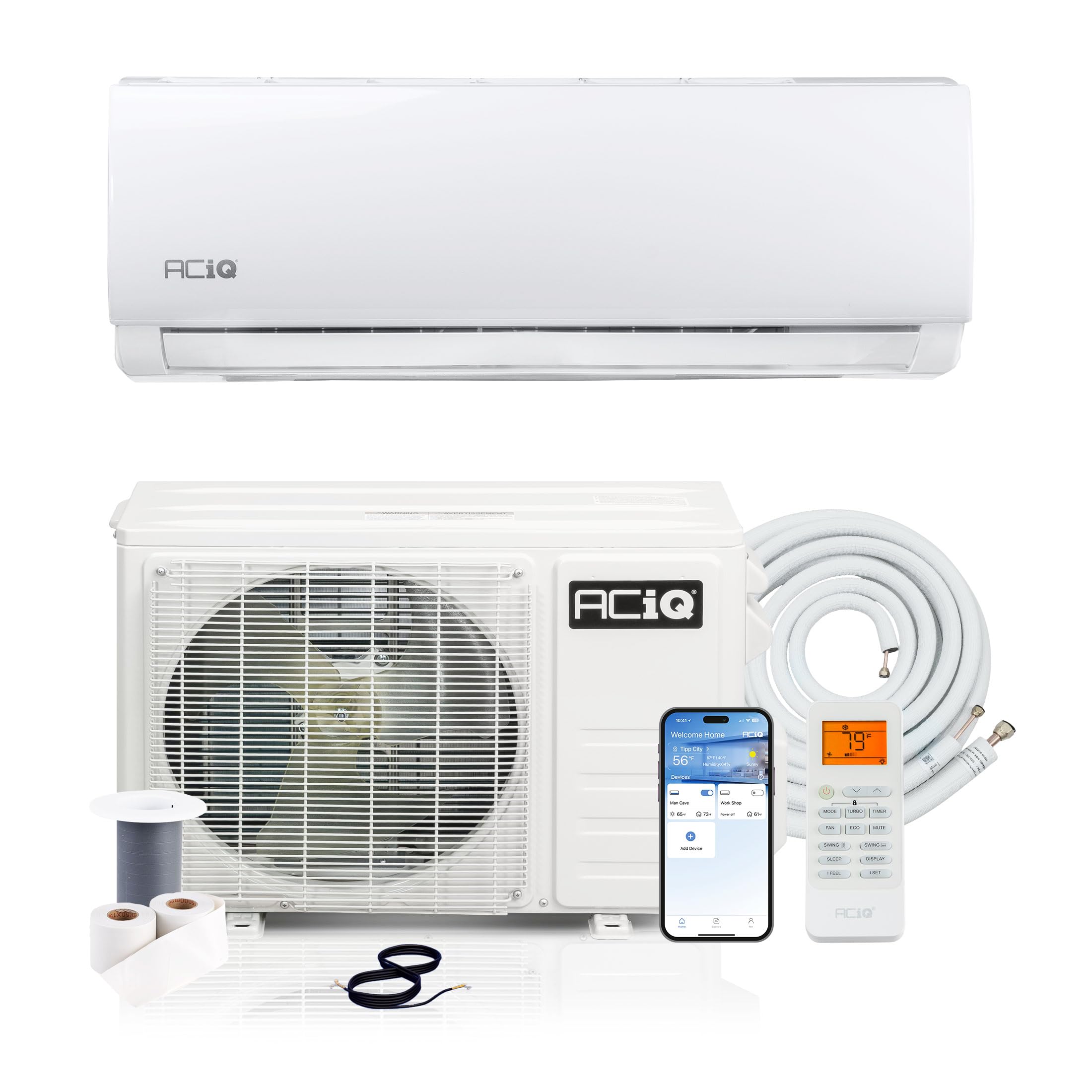
A pro-install system with 4-year parts and 6-year compressor coverage when registered.
The ACiQ Essentials pairs a 20 SEER2 cooling rating with a 10 HSPF2 heating rating — the second number matters just as much if you plan to run this through the winter. The system is AHRI rated and covers rooms from 600 to 1,000 square feet, holds outdoor heating performance down to -4°F and cooling up to 127°F, and runs on an 18K auto-adjusting inverter compressor so output matches the load rather than cycling on and off.
Where this differentiates from the crowd is the paperwork. ACiQ gives you 4 years of parts coverage and 6 years on the compressor when you register online with the manufacturer — a step above the industry’s typical baseline. The included accessory kit is unusually complete: a 16-foot line set, remote with mount, power cable, indoor mounting plate, outdoor rubber feet, plastic wrap, wall cap, drain elbow and line, plasticene, and screws with anchors. The outdoor condenser ships pre-charged with R-32, and the smart control runs through the SmartLife-SmartHome app on iOS or Android.
Realistic downsides: this is explicitly not a DIY product, the min temperature setting stops at 60°F, and there is no time-of-day programming — you get timers but not a weekday schedule. The wall unit itself was called “flimsy” in one review, and at least one unit arrived with a cracked valve cover. These are edge cases against a short but uniformly positive review footprint that centers on performance and quiet operation.
Strongest selling points
- 4-year parts / 6-year compressor warranty when registered — the longest coverage in this lineup.
- 20 SEER2 and 10 HSPF2 for balanced year-round efficiency.
- R-32 pre-charged condenser and a genuinely complete accessory kit.
- Wi-Fi ready for worldwide control through the SmartLife app.
Limitations to weigh
- Not DIY — professional HVAC installation is required by the manufacturer.
- No time-of-day scheduling, only basic timers.
- Minimum cool setting is 60°F, not the 50°F some buyers expect.
Pick this if: you are hiring a pro anyway and want the longest parts warranty on the wall.
Pass if: you need a weekday schedule or a cooler minimum setpoint — those are real gaps here.
7. TOSOT 18,000 BTU Mini-Split Air Conditioner, Wifi Enabled Ductless Inverter Split System AC Unit Heating System, Compatible with Alexa – 20 SEER2 230V
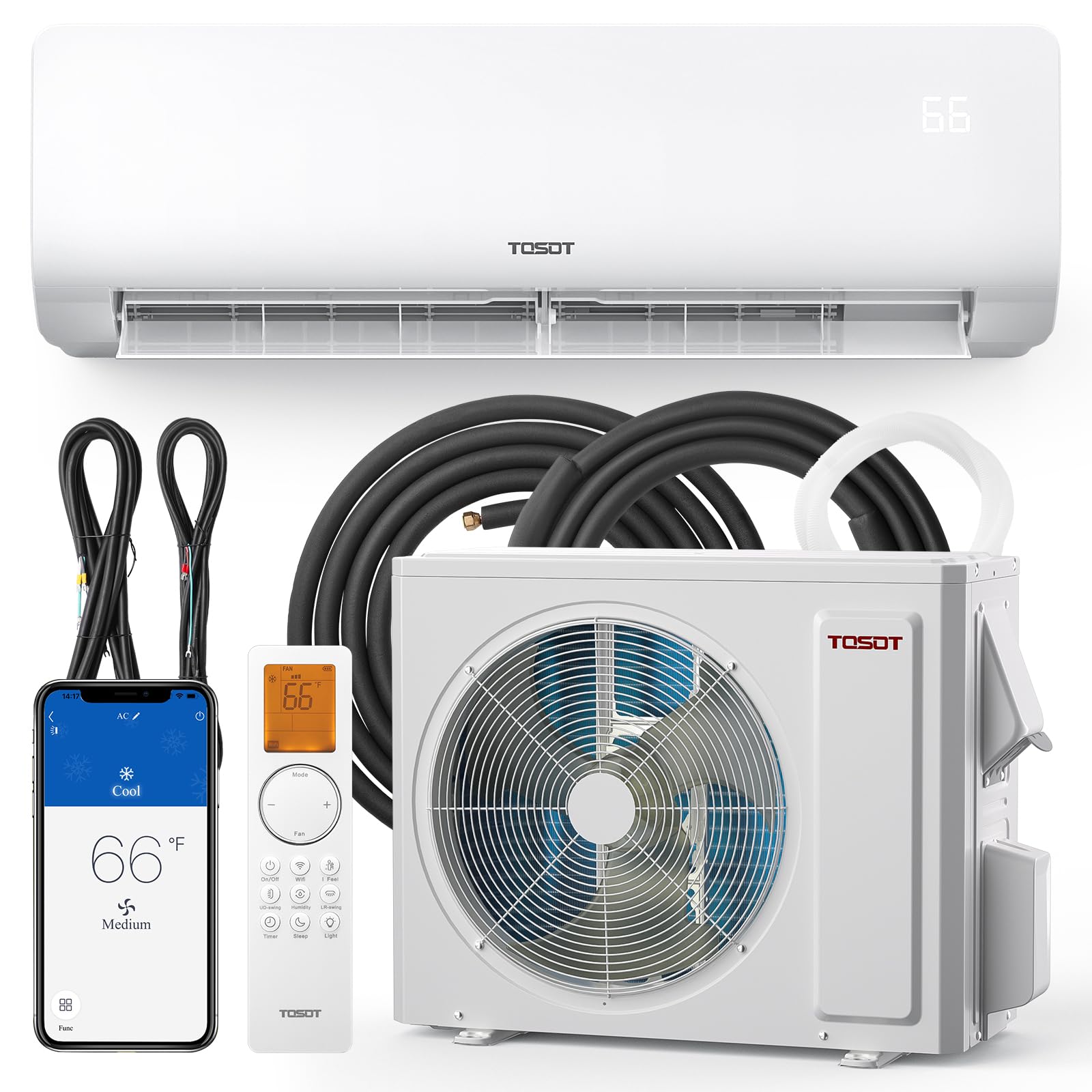
Rated to keep cooling at outdoor temperatures up to 118°F.
The TOSOT name carries extra weight in this category because TOSOT is Gree’s consumer brand — the same engineering that shows up in reviewers’ notes about this unit “likely being a Gree rebrand” and the Gree+ app running it. That matters for one simple reason: this system is rated to cool at outdoor temperatures up to 118°F and heat down to -13°F, and it pairs a 20 SEER2 efficiency rating with an annual consumption spec that has shown up as low as 1348 watts during typical use in owners’ measurements.
Performance is the aspect that buyers mention most by a wide margin, with installation close behind. The pattern is consistent: this unit cools large areas quickly, including a 2,000-square-foot shop in Texas that holds a steady 71°F at 45% humidity, and a large RV application that ran flawlessly through hot summers and mild winters on heat pump alone. At its quietest the indoor unit runs at 22dB — near-silent for a wall unit — and the outdoor condenser hum is low enough that some owners mount it directly on the wall.
The wiring caveat is worth flagging early. One owner found that the flexible cord shipped with the unit did not meet NEC requirements for through-wall runs and had to buy a replacement plus a second inspection. If your local inspector is strict, plan for a hardwired disconnect instead. A few owners also note the LED display is visible in a dark bedroom — it can be turned off, but you have to dig through the menu to find the setting.
Bottom line: the TOSOT Cosmo is the pick to beat for hot climates, thanks to the 118°F cooling ceiling and 22dB indoor quiet — those two numbers do the work.
Save your inspector some trouble: upgrade the power cord to NEC-compliant hardwiring before the install inspection, not after.
Choose this if: you live somewhere summers hit triple digits and want a mini split that keeps working past 100°F outdoors.
Skip if: your room is much over 1,000 square feet — this is not the oversize-coverage pick.
8. DELLA Vita Series 18000 BTU Mini Split Air Conditioner, 20 SEER2 230V, Cools up to 1000 Sq. Ft, 1.5 Ton Heat Pump
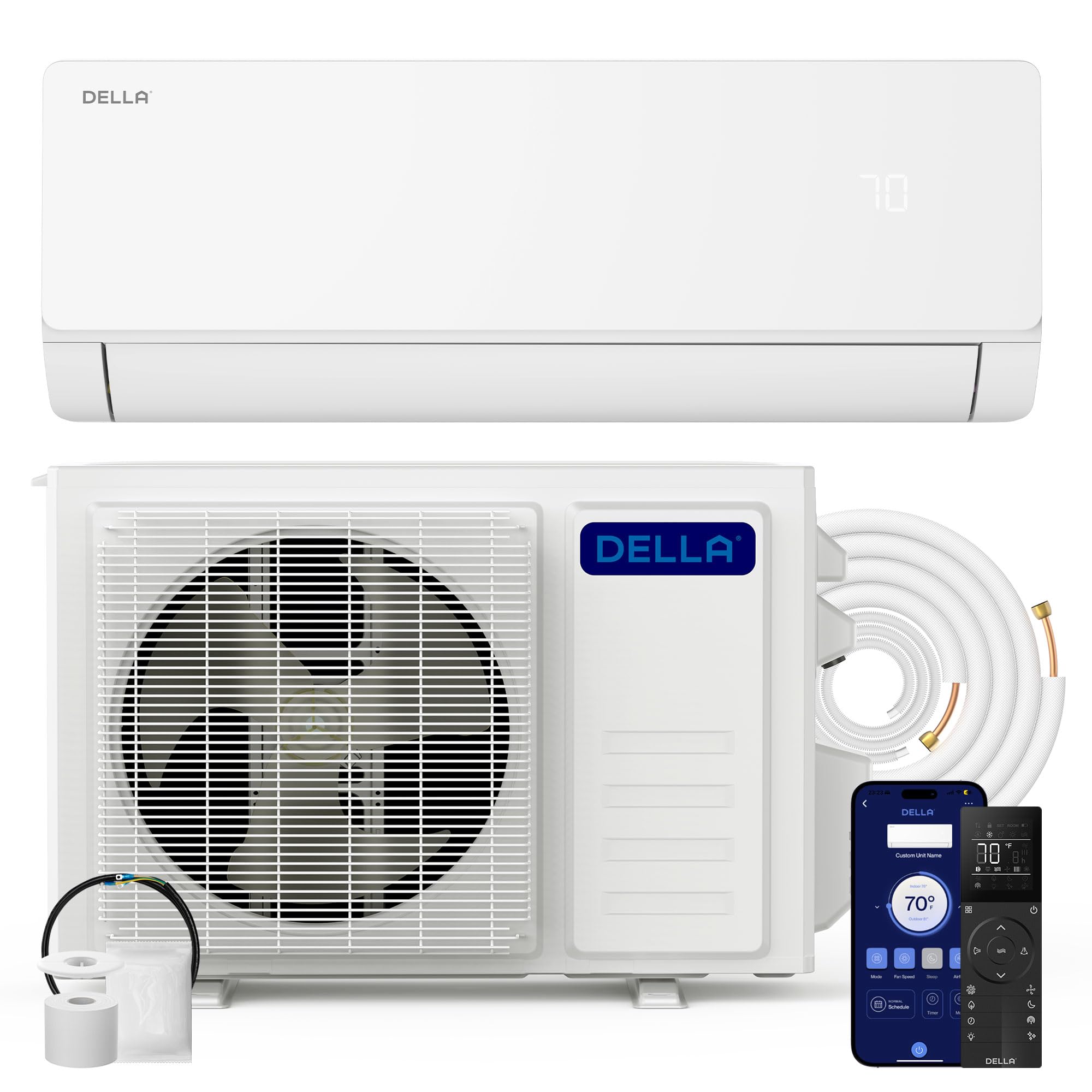
A bedroom-first system whose I Feel remote sensor reads the temperature where you sit.
What makes the Vita Series distinct from DELLA’s own Motto Series is the “I Feel” sensor — a small reader inside the remote that takes the room temperature at your location instead of at the wall unit. Sit in a hot corner and the system notices; sit on the cool side and it does not over-cool the room chasing a phantom reading. Combined with a 32dB noise floor and 4D airflow, this is the DELLA model to pick when the room is a bedroom, nursery, or home office, not a garage.
On paper it is a clean 20 SEER2 system with a 1,000-square-foot coverage rating, R-32 refrigerant that is pre-charged from the factory, and a maximum fuse size of 20A. Heating performance holds down to -4°F, and the footprint works for a 16-ft line set with a 78.7-inch drain pipe included. Alexa, Google Assistant, and the DELLA app all run the system, and there is a 24-hour timer, turbo mode, sleep mode, and multiple fan speeds if you want to fine-tune the feel.
The most common ground-level note is on installation: DELLA requires professional installation to keep the system in spec, and one reviewer running the older 24K sibling found the rated coverage was optimistic for a 1,250-square-foot shop — meaning if your real room is bigger than the spec sheet suggests, size up. But the overall owner mood is that the system performs above what the price tier suggests.
Where it wins: the I Feel sensor plus 32dB operation is a genuinely useful combination for anyone whose main complaint with mini splits is that the room never feels the same temperature everywhere.
The trade-off to accept: like every DELLA system here, this needs a pro install. Plan for that cost upfront rather than trying to skirt it.
The right fit: bedrooms, home offices, and anywhere quiet matters more than cooling speed.
Not the right fit: a garage or shop larger than 1,000 square feet — the coverage ceiling is honest.
9. Cooper & Hunter 18,000 BTU 230V Wall Mount Mini Split AC, 19.2 SEER2

The premium name that ships a full install kit in the box and shows up on thousands of walls.
Cooper & Hunter’s MIA Series runs a 19.2 SEER2 rating with an inverter compressor and a full 18000 BTU/h of both cooling and heating capacity. The wall-mount air handler is designed to sit high and spread air evenly, and the outdoor condenser is factory pre-charged. The order arrives with a 16-foot insulated copper line set, a 16-foot communication cable, and a 16-foot drainage extension — everything you need for a professional install without chasing accessories at the last minute. ETL, UL, and AHRI certifications give you paperwork to point at if an inspector asks questions.
The install story is where it separates from the budget tier: Cooper & Hunter recommends brazing (rather than mechanical flaring) on the line-set connections to avoid the slow leaks that ruin cheap installs, and they explicitly warn that self-install can void the warranty — you need a licensed HVAC tech to sign off. The heating spec covers ambient temperatures down to 5°F, and owners running it in cottages and two-car garages describe the change from old noisy units to near-silent operation as dramatic.
The real caveat: customers note durability concerns on a small minority of units, with the copper line set flagged as an occasional failure point, and inside-unit leakage on a few installs — the negative aspects exist but they sit far below the positive patterns of quality, installation, and cooling performance that drive this model’s reputation. Treat line-set care as non-negotiable: braze, do not just flare, and pressure-test before you charge the system.
What makes it worth the step up
- Full premium install kit included: 16-ft line set, communication cable, and drain extension.
- 19.2 SEER2 with inverter compressor for consistent, efficient performance.
- ETL, UL, and AHRI certified — useful for inspections and code compliance.
- Wall-mounted air handler saves floor space while spreading air evenly.
What to plan around
- Self-install voids the warranty — you need a licensed tech to sign off.
- Brazing is preferred over flaring on the line set; budget for the extra labor.
- Isolated reports of inside-unit leakage mean you should pressure-test the whole loop before charging.
Best for: buyers hiring a full-service HVAC team and wanting premium-brand certifications with no accessory scramble.
Avoid if: you plan a self-install — the warranty terms work against you on that path.
10. Pioneer Diamante Pro Mini Split Air Conditioner, Heat Pump, 18000 BTU, 230V
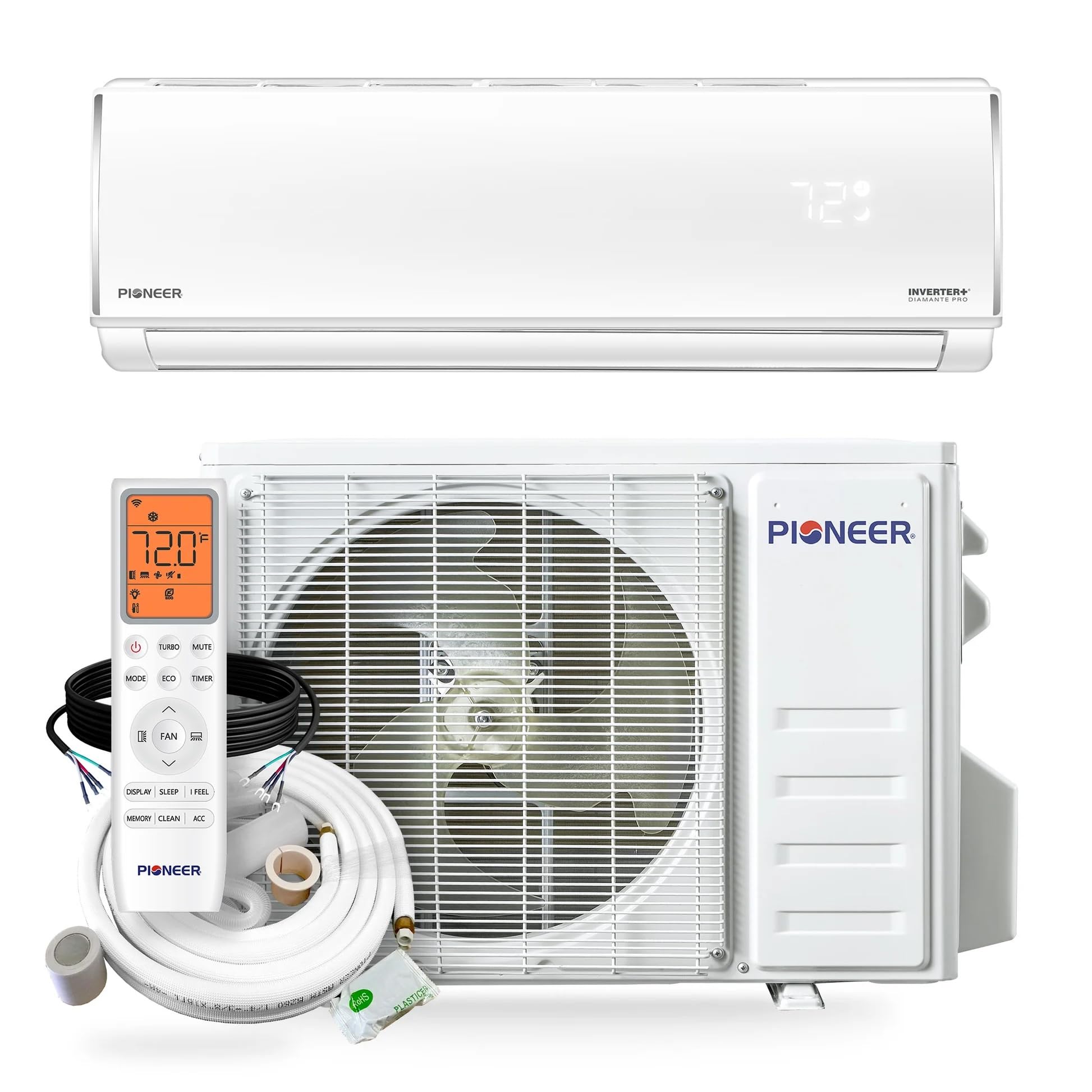
Cold-climate rated, NEEP recognized, and built for buyers who actually read HSPF2.
The Pioneer Diamante Pro delivers 21.0 SEER2 cooling efficiency with a 9.5 HSPF2 heating rating and a 18000 BTU/h cooling and heating capacity in both directions. It runs R-454B refrigerant — the newer low-GWP alternative to older blends — and carries AHRI, ETL, DOE, and ISO 9001 certifications plus NEEP ASHP recognition, which means it is tested for cold-climate operation. The published operating envelope runs down to -4°F in heating season and up to 122°F in cooling season, giving it one of the widest working ranges in this roundup.
Coverage-wise, Pioneer recommends the system for 500 to 750 square feet — notably tighter than the 1,000-square-foot claims on most of the list, and that tighter rating is a feature, not a limitation. Buyers running this in garages and workshops describe it cooling a two-car space in Central Florida “perfectly,” and one owner in California reports it keeping a 1,500-square-foot home around 75°F on a 100°F day, which puts it well beyond its official coverage in the right insulated conditions. I FEEL sensing on the remote, Turbo, Mute, Eco, Sleep, and a washable dust filter round out the indoor unit.
The honest trade-off on this one is installation effort. Reviews note it can be self-installed — one buyer did the whole thing in a weekend with a borrowed vacuum pump — but Pioneer recommends following HVAC and electrical code, and the optional Pioneer AirLink app control requires a separately sold module. If you want app control from the start, budget for that add-on. And packaging: at least one unit arrived with bent fins and dented sheet metal on the outdoor unit, cosmetic but worth photographing on delivery.
Where it belongs: this is the pick for cold climates or four-season use, thanks to the 21.0 SEER2 / 9.5 HSPF2 pairing and NEEP cold-climate rating.
The catch: coverage is honestly rated at 500–750 square feet, so if you are sizing for a larger room, the Mountman and ACiQ need to be in the conversation too.
Right for: cold-climate garages, workshops, and four-season spaces where heating efficiency actually matters.
Wrong for: rooms over 750 square feet where you need every BTU to count — coverage is smaller than most here.
11. TOSOT 18,000 BTU 24.5 SEER2 Mini Split, Aoraki Series, 208-230V, Black
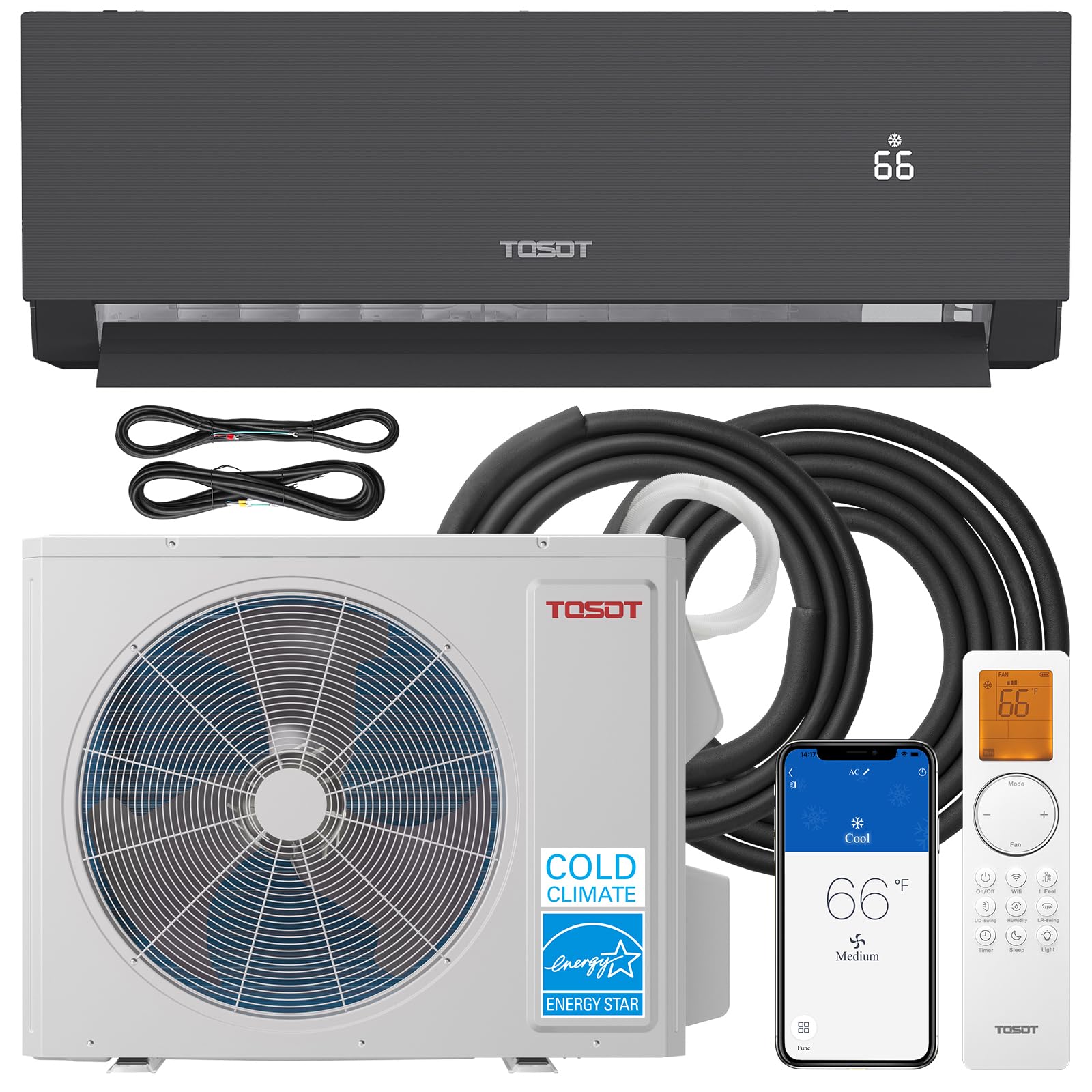
The highest efficiency rating here, plus a fresh-air option no other system in this lineup offers.
The Aoraki Series leads this entire roundup on efficiency: 24.5 SEER2, and the maker claims it saves up to 35% on energy bills compared to a 16 SEER2 unit. It holds ENERGY STAR, COLD CLIMATE, ETL, and AHRI certifications and qualifies for tax credits. But the certified headline is the working range — 18,000 BTU cooling and heating capacities running from -22°F to 122°F, backed by a dual electric heating belt that keeps the outdoor unit functioning in serious cold. Owners running it in a 1940s building describe it heating “easily” through single-digit temperatures, and one motorhome installation saw electric bills drop noticeably.
The optional ERV (energy recovery ventilation) integration is what makes this unit unique in the category: TOSOT is the first in the US to offer a ductless mini-split with this feature, and it can recycle energy from exhaust air to pre-condition incoming fresh air. It requires a separately purchased accessory and additional wall vents, so it is not for everyone — but for tight, well-sealed buildings, it is a real functional difference. The quiet side is also exceptional: the indoor unit drops to 29dB and the night mode holds the outdoor unit at 59dB, which means neighbors are not bothered either.
Two honest caveats. First, an owner running the ERV noted that the replaceable HEPA filter feeding that system is hard to source — you can find the filter on neither TOSOT’s Amazon store nor their website. Second, packaging is a recurring complaint: multiple owners received units with dented outdoor cabinets, one reporting damage on three separate deliveries before accepting a concession from the seller. Neither issue changes how the unit runs once installed, but if you are buying this, plan to inspect the delivery on the truck and register it with TOSOT for support.
Why buy the top-efficiency pick: 24.5 SEER2, -22°F heating capacity, and the first-in-class optional ERV integration make this a genuinely different system, not just a higher number.
What to plan for: the ERV filter sourcing gap and the packaging reality on delivery day. Both are fixable; neither is a dealbreaker.
The right buyer: anyone in a cold climate who wants ceiling-topping efficiency and is interested in fresh-air ventilation.
Not the right buyer: hobbyists who want a simple self-install — the ERV option and the added complexity make professional install the safer path.
12. Daikin 18,000 BTU 18 SEER2 Entra R32 Series Heat Pump Mini Split A/C

The brand-name system that trades peak SEER2 for reputation and an air-purifying filter.
Daikin’s Entra spec sheet reads like an engineering audit: 18,100 BTU/h of cooling capacity, 18,000 BTU/h of heating, a variable range from 6,900 up to 20,000 BTU cooling and 5,800 to 22,500 BTU heating, 18 SEER2, 9 HSPF2, 10.5 EER2, and 3.30 COP — all driven by DC inverter technology and R-32 refrigerant. Coverage runs to 1,000 square feet, with cooling operable from 50°F to 115°F and heating from 5°F to 65°F. The 18 SEER2 rating is lower than several picks here, though the spec sheet as a whole is unusually complete.
What actually shows up in owners’ reports is the reliability pattern. This is the system a service tech buys for a client and does not hear back about, because it just runs. One reviewer has installed over a dozen of them without a single callback. Others describe uniform cooling from a 24×40-foot insulated metal building with 10-foot walls through both winter and summer, and an owner replacing central HVAC with this unit noted it “pours out the heat” while still cooling a large room. The titanium apatite photocatalytic air-purifying filter, cold draft prevention, and self-diagnostics with a digital display round out the indoor feature set.
The trade-off is real and worth knowing upfront: Daikin’s warranty process has frustrated at least one buyer who could not successfully register the unit after an Amazon purchase. That is a single experience, not a pattern — but it is a fit-note for buyers who value streamlined warranty registration over premium-brand performance.
Why spec-savvy buyers pick it: the 18,100 BTU cooling figure and the complete operating envelope — minimum and maximum BTUs in both modes — are typical of Daikin’s detail level, and long-term reliability is the payoff.
The trade-off: 18 SEER2 is lower than several picks here, and warranty registration through Amazon can be a hold-up. If either matters, look up the efficiency ladder.
Best fit: buyers who value a name they recognize, air-purifying filtration, and long-term reliability over headline efficiency.
Consider stepping up if: you want a higher SEER2 rating or a more streamlined warranty process — the TOSOT Aoraki beats it on both.
13. MRCOOL 18000 BTU Ductless Inverter Mini Split Air Conditioner & Heat Pump
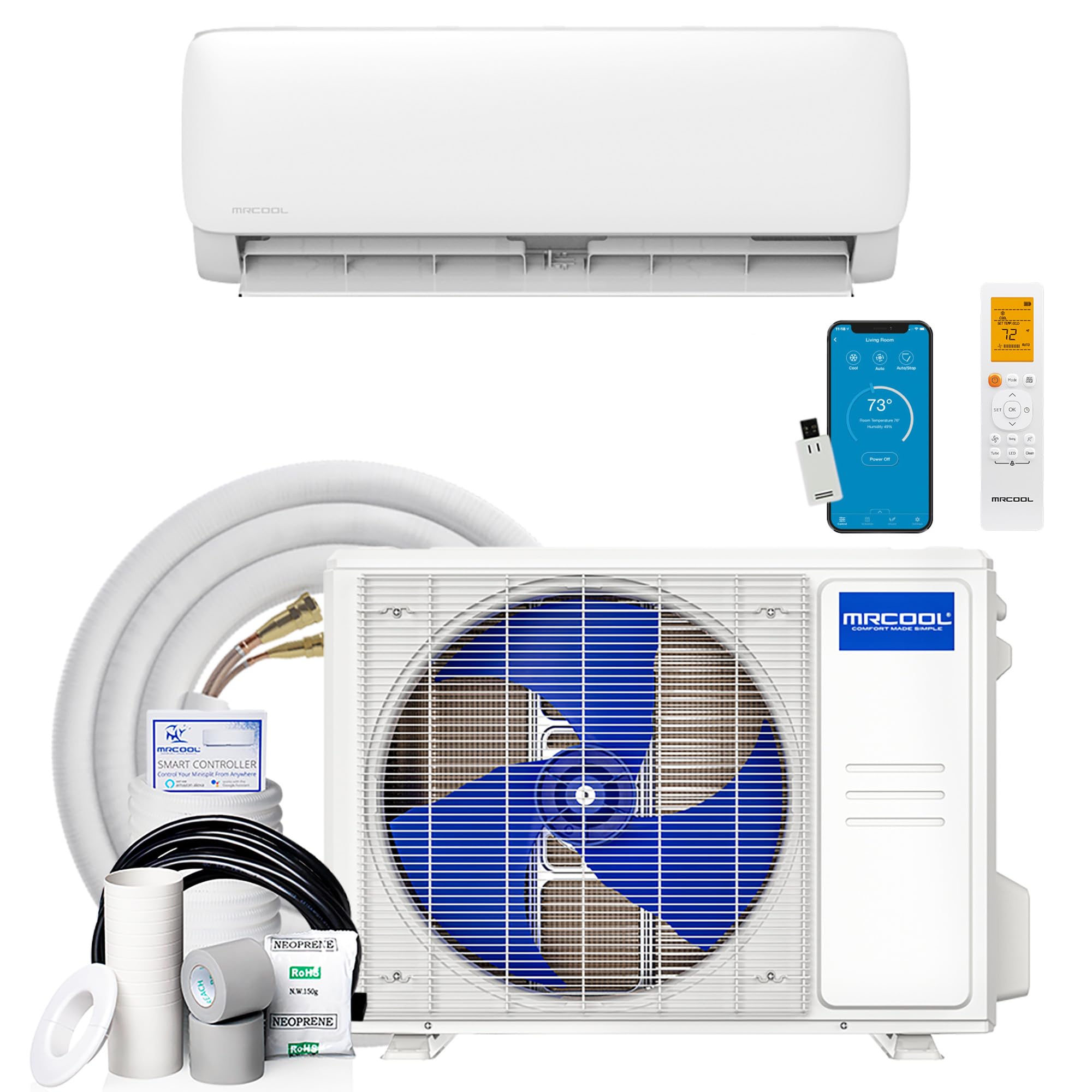
The one built for the person who wants to run every wire and pull every vacuum themselves.
MRCOOL leans into the DIY identity harder than any other system in this lineup. The product spec explicitly says installation is “streamlined, resulting in less mess and significantly reduced costs,” and owner reports back that up: several describe hand-running conduit, a disconnect box, and a whip in about four hours with a wall bracket and line-set cover. The system is 18,000 BTU/h with Wi-Fi compatibility and a Follow Me function, plus Google Assistant and Amazon Alexa integration so you can control it hands-free.
Published coverage is 750 square feet — tighter than many picks here, and that tighter number is what most owners actually need. The consistent report is a 2-car garage or an 800-square-foot shop sitting at a steady 71°F and 45% humidity in Texas heat, with a -payback-in-a-year electric saving compared to running window units or window-portable ACs. Airflow is strong enough that one owner in a sunroom described it blowing directly enough that they sometimes turn it off because it works too well.
The realistic caveat is what happens after year two. One owner reported an error code at 26 months, a failed recharge that found no leak, and a finicky app — this is the shortest lifespan story in the roundup. Against that, the price-per-BTU and the DIY simplicity make it tough to top for anyone whose priority is upfront cost plus self-install. Place the indoor head carefully: the strong output means it works best mounted where the airflow does not point straight at a seat.
What makes it the DIY pick
- Owner-reported installs finish in ~4 hours with basic 240V knowledge.
- Wi-Fi, Alexa, Google Assistant, and Follow Me controls built in.
- 750 sq. ft. honest coverage — perfect for a 2-car garage or small shop.
- Strong airflow reaches the far side of the room without extra fans.
Where it falls short
- Coverage tops out at 750 sq. ft. — smaller than the Mountman or ACiQ.
- Wi-Fi app can be finicky to pair and hold a stable connection.
- One owner hit a non-cooling error code right after the 2-year parts window closed; treat the warranty clock seriously.
Built for: hands-on owners with 240V experience who want to self-install and save on labor.
Look up-tier if: your room is over 750 square feet or you want more confidence on years 3-5 — the Mountman and ACiQ cover both.
Understanding the Specs
SEER2 and HSPF2 explained in plain language
SEER2 is the updated federal efficiency number for cooling — think of it as miles-per-gallon for the cool season. A 24.5 SEER2 system uses less electricity to move the same amount of heat than an 18 SEER2 system, and the difference shows up on your summer bill. HSPF2 is the winter version of the same idea — the higher it is, the less power the heat pump burns to warm a room. For a heat pump that runs all four seasons, both matter.
Voltage, breakers, and line sets
Nearly every 18,000 BTU mini split here runs on 208-230V, and that means a dedicated double-pole breaker sized to the unit — 15A on the DELLA Motto, 20A on others. Line sets ship at 16 feet on most kits, with MRCOOL and Mountman running shorter in some configurations. Longer runs need a factory-lengthened set plus additional refrigerant, and every install needs a vacuum pulled before the refrigerant is released, no matter how confident you are with a wrench.
Refrigerant type: R-32, R-454B, and R-410A
Refrigerant is the fluid the system pushes through the copper lines to move heat. Older systems used R-410A; most of this lineup runs R-32, and the Pioneer Diamante Pro and TURBRO units run R-454B — both newer blends with lower environmental impact than the older standard. All of these systems ship pre-charged from the factory for the included line set, and adding refrigerant later requires a licensed tech and specific tools.
Noise ratings and I Feel sensing
Indoor noise is measured in decibels, with 22dB being quieter than a library and 32dB being roughly the noise of a quiet refrigerator. The I Feel sensor is a temperature reader built into the handheld remote — instead of measuring the room at the wall unit, the system reads the temperature where you actually are, which usually feels more accurate on the couch or in bed. Outdoor unit noise matters too if you have neighbors close by; night modes typically drop outdoor output to around 59dB.
FAQ
Will an 18000 BTU mini split actually cool my 1,000-square-foot room?
Do I need a professional installer for an 18000 BTU mini split?
What is the difference between 19 SEER2 and 24.5 SEER2 in real electricity costs?
How long does a mini split heat pump last before needing major service?
Can an 18000 BTU mini split heat my garage through the winter?
What voltage does an 18000 BTU mini split need and what breaker size?
Are 18000 BTU mini splits loud enough to disturb sleep?
Do I need to re-charge the refrigerant after installing an 18000 BTU mini split?
Is R-32 refrigerant better than R-410A for a mini split?
What is Follow Me or I Feel on a mini split remote and does it help?
Final Thoughts: The Verdict
The winner of this 18000 BTU mini split roundup is the Senville AURA because it does the three things that matter most in this size class simultaneously: proven performance, Alexa-and-app control, and service support that owners describe as excellent for years after installation. If you want the best efficiency rating on the list and can handle a colder climate, the TOSOT Aoraki stands at 24.5 SEER2 with a fresh-air ERV option no other system here matches. And for pure coverage per dollar on a workshop or oversized garage, the Mountman stretches up to 1,250 square feet for a mid-tier price that keeps the math in your favor.
How We Picked
We do not accept paid placement. Every pick is matched to a real buyer and a real use-case; we do not hands-on test units.
Sources & Methodology
Specifications: manufacturer listings and product documentation. Review insights: verified customer reviews, as of September 2026. Pricing: not shown on this page (it changes often); check the current price via the retailer link.
As an Amazon Associate, KitchPrep earns from qualifying purchases. This does not affect which products we feature.
Related Guides
