
Specs are compiled from manufacturer listings and verified buyer reviews and can change over time — please confirm the key details on the product page before buying.
Here is the truth most panel packs hide: acoustic foam does not soundproof a room. It soaks up echo and reverb so your voice, your mic, and your speakers stop bouncing off bare walls. If your calls echo or your recordings sound hollow, the fix is more coverage and thicker panels, not a single magic box. This guide sorts eight real panel packs by what they actually do.
I’m Mohammad Maruf — the founder and writer behind KitchPrep. This guide is built by comparing the manufacturers’ published specifications and the patterns across verified customer reviews, so you get each pick’s real strengths and trade-offs instead of marketing spin.
Thickness, density, and panel count decide how much echo you actually remove, so compare packs by those three numbers.
Our Picks at a Glance

How To Choose The Best Acoustic Foam
Start by accepting one fact that saves you money and disappointment: foam panels are absorbers, not soundproofing. They reduce the echo inside a room by soaking up sound that bounces off hard walls. They will not fully stop bass or loud noise passing through a wall into the next apartment. Every product on this list works on that absorption principle.
Match thickness to the echo you hear
Thinner panels around one inch thick handle higher frequencies — the sharp slap of a voice in an empty room. Thicker two-inch panels carry more material depth, so they tame a broader range before sound reaches the wall. If you record vocals or podcast audio, that extra inch is the difference between a hollow room and a tight one.
Coverage beats a single pack
One panel on one wall changes almost nothing. Absorption is about how much surface you treat. A 24-panel pack covers 24 square feet; a 100-panel pack covers far more. Measure your wall and plan for edge-to-edge coverage at the spots where sound reflects first, usually the wall behind your mic or speakers and the corners.
Plan your mounting before you open the box
Many packs ship without adhesive, and the stick-on dots some include are the most common complaint across customer feedback. Decide now whether you will use spray adhesive, double-sided tape, or push pins. Also know that compressed panels need 24 to 48 hours to puff back to full thickness after you open the vacuum seal.
Quick Comparison
| Model | Best For | Panel Count | Thickness | Coverage | Amazon |
|---|---|---|---|---|---|
| 100 Pack Acoustic Panels 1 X 12 X 12 Inches★ Best Overall | Big walls, tight budget | 100 | 1 inch | 12 sq ft | Amazon |
| 50 Pack Acoustic Foam Panels 1″ X 12″ X 12″ WedgeBest Value | Small office echo | 50 | 1 inch | — | Amazon |
| 24 Pack Sound Proof Foam PanelsCompact Pick | Spot treatment and custom cuts | 24 | 2 inches | 24 sq ft | Amazon |
| 36 Pack Pyramid Acoustic Foam Panels | Studio and podcast rooms | 36 | 2 inches | 36 sq ft | Amazon |
| GUERRI Sound Proof Foam Panels | Home theater walls and ceilings | 36 | 2 inches | 36 sq ft | Amazon |
| Knightsacoustic 96 Pack | Large rooms, bulk coverage | 96 | 2 inches | 96 sq ft | Amazon |
| Focusound 50 Packs Acoustic Foam Panels | Instrument practice rooms | 50 | 2 inches | 50 sq ft | Amazon |
In‑Depth Reviews
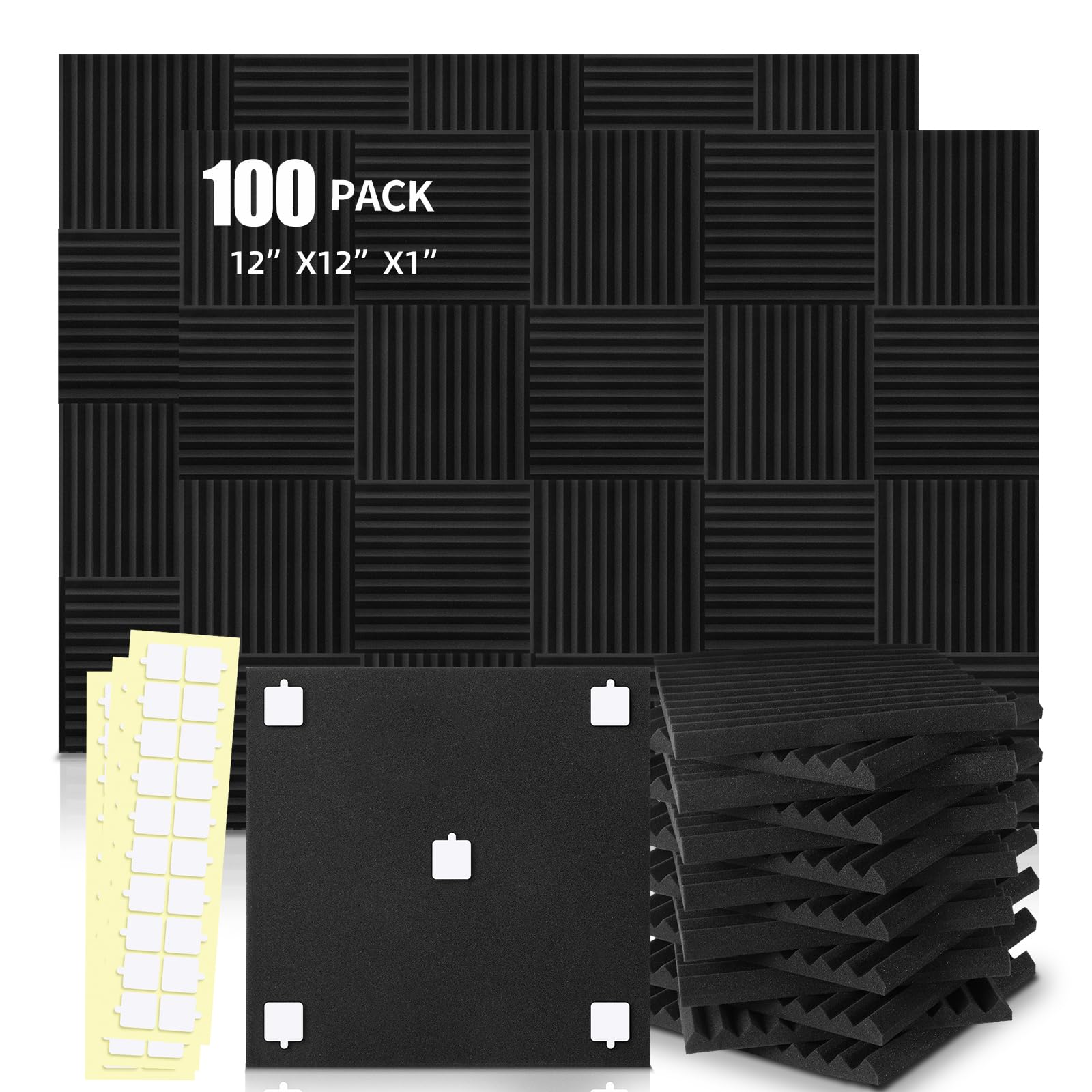
1. 100 Pack Acoustic Panels 1 X 12 X 12 Inches – Acoustic Foam Studio Foam Wedges High Density Panels
Our pick — over 4★ from 400+ verified ratings; the strongest balance of quality and price.
One hundred wedges arriving with sticky pads already in the bag — the whole wall in a single box.
If you want the most panels for your money, this is the pick. You get 100 black wedge panels, each 12 by 12 by 1 inch, and those 100 panels are the number that matters here. The pack weighs 8.78 pounds, roughly double the 4.09 pounds of the 50-pack further down this list — you are handling more foam, and that is the point. Densities and surfaces stop being guesswork once the box is open.
The installation story is the strongest thing about this pack. Each piece arrives with 5 nano adhesive stickers, so there is no extra trip for tape or spray. Buyers report the panels are “lightweight, neutral color, easy to cut, no odor,” and one owner who has moved repeatedly said the panels held up through “multiple moves” and even accepted tacks without tearing. The included nano stickers mean no separate trip for tape or spray. Corners, window frames, and awkward trim are all cuttable with a knife.
The catch is thickness. One inch is not enough to kill everything, and the honest limit is that these panels do not soundproof a room — nobody in this category claims that book, and this pack is no exception. Reviews flag that panels are vacuum-compressed and need 48 hours to expand, that edges can be fragile, and that they collect dust. Treat it as a broad echo fixer rather than a magic wall.
What lands in the box
- 100 wedge panels at 12 by 12 by 1 inch each
- Five nano adhesive stickers included per panel
- 8.78-pound pack — nearly 2x the weight of the 50-pack option
- Neutral black finish that owners say is easy to cut
Where it gets honest
- One-inch foam handles echo, not low-end bass
- Vacuum-packed, so plan for 48 hours of expansion time
- Adhesion gets the most criticism about the included mounting method
- Fragile edges can crumble if you handle the panels roughly
Where it wins: Buyers treating a whole wall on a tight budget who want installation supplies in the box.
Look elsewhere if: You need deep bass absorption — that calls for thicker foam than one inch.
2. 50 Pack Acoustic Foam Panels 1″ X 12″ X 12″ Wedge Soundproof Studio Foam for Walls
Half the panels, half the weight, and a triangular groove that takes echo down in a small office.
This is the one to grab when you are treating a corner of a room and do not want a shipping box the size of a suitcase. Fifty black wedges at 12 by 12 by 1 inch are lighter in the hand than the 100-pack above — 4.09 pounds versus 8.78 pounds — and the package itself runs 13.94 by 12.4 by 3.39 inches, roughly a third of the depth of the larger box. Stack two orders side by side and you have the same surface area without wrestling a heavier carton onto the wall.
What does the real work is the triangular groove structure. Those grooves break up the flat face of the foam so mid and low sound waves hit more surface before bouncing back. Owners use it in exactly the kind of small rooms you might have — a home office, a vocal booth, or a generator shed, where the foam went around the exhaust fan and air inlet and shaved roughly 3 decibels off the noise.
The recurring gripe is the double-sided sticker setup. Five pieces of tape per panel sounds generous until you cram them and run out with no spares. Several owners note the pads do not cling well to drywall, and one outright warns against putting the yellow tabs on drywall at all if you ever plan to move out. Buy your own mounting first and the panels behave.
The straightforward truth: A sensible mid-size pack whose lighter 4.09-pound bulk is kinder on a single person mounting a whole wall than the 100-panel option above.
Skip if: You are chasing full soundproofing rather than echo control — this pack only dampens the reflections you hear inside the room.
Pick this for: A single bedroom or home-office wall where the 50-count is more than enough.
Give it a miss when: You want mounting hardware that never fails — plan on buying your own tape or spray.
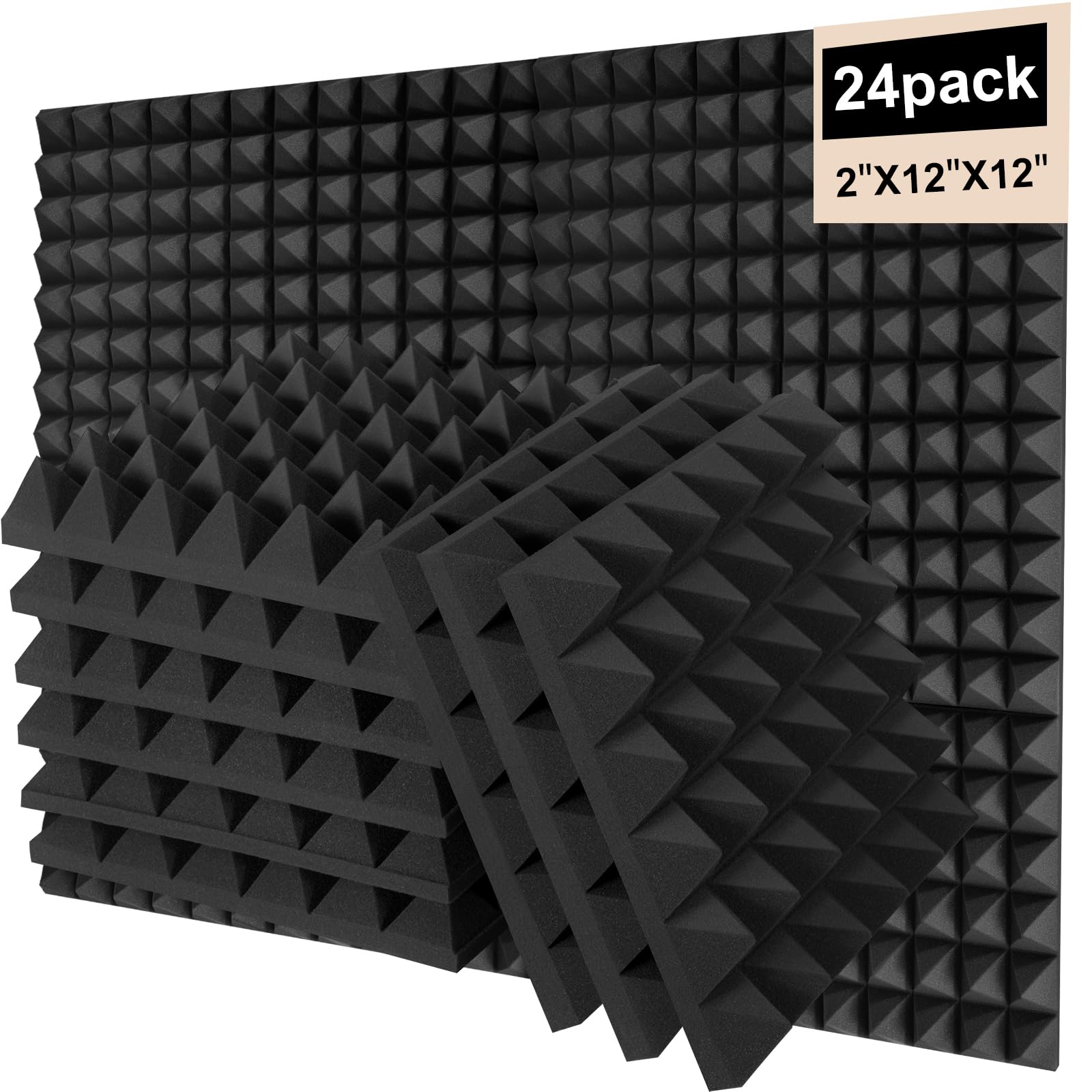
3. 24 Pack Sound Proof Foam Panels for Walls, 2″X 12″ X 12″ Pyramid Designed Acoustic Foam Panels
A small pyramid pack for tight spot treatment — the panel you cut to fit instead of tiling a whole wall.
Where the 100-pack and the 50-pack are about bulk, this Saiqiang pack is about precision. Twenty-four square pyramids at 12 by 12 by 2 inches give you 24 square feet of coverage, which is roughly a quarter of what the 100-panel pack covers. That makes it the right pick for the back of a TV, a mic isolation shield, or the single reflective wall behind your desk.
The 2-inch profile is the headline. It carries more material depth than a one-inch panel, so it absorbs a wider slice of the echo range. Customers note that loud booms inside a room softened into a duller thud once the panels went up. Side-by-side with the 50-pack above, that extra inch is why this pack handles deeper reflections even though it holds fewer pieces. The foam itself is porous inside — reflected sound enters the holes and gets soaked up rather than bounced back.
The stickies are the fussy part. Owners describe the dots as hard to peel off the backing, and a few see paint lift when they remove them. The 2-inch thickness also means these are not full sound-blockers — they tame echo, not bass coming through the wall. Give yourself a mounting plan you are comfortable with before you start.
The case for it: Owners who cut these into custom shapes — one person built a 3D-printed mic isolation shield around panels — find the 2-inch foam clean to slice without tearing.
Think twice if: You are trying to quiet a thin wall — 2 inches of foam softens room echo, it does not stop neighboring noise.
Reach for this if: You want thicker foam for a small, targeted job like a home studio corner or a TV back wall.
Not the right fit when: You need to cover a whole bedroom wall — the 24-panel count will leave gaps.
4. 36 Pack Pyramid Acoustic Foam Panels, 12″ x 12″ x 2″, Black

A 30 kg/m³ pyramid tile with real substance — the density champions pick for vocal booths and podcast rooms.
Here is the number that separates this AUSLET pack from the thinner foam on this list: 30 kg/m³ density. That is roughly 30 kilograms of foam packed into every cubic meter, so the panels hold their firm shape and stay springy rather than squashing flat. Thirty-six pyramid panels at 12 by 12 by 2 inches cover 36 square feet, matching the GUERRI pack below on surface area but with that firmer foam. The panels rebound fast — owners say they expand in as little as 3 to 5 minutes and only carry a faint initial odor that fades.
For studios and podcast setups, this is where the pack shines. The 3D pyramid surface increases the area sound hits before bouncing back, so it manages the unwanted reflections that muddy vocals and muddy speech. One owner converted a spare bedroom into a mini studio and described the sound quality change as night and day. Another uses the tiles on a 12-by-11-foot shop ceiling, on top of 3/4-inch rubber stall mats, to claw back a whole room worth of echo.
Be aware that arrivals vary. Vacuum compression crushes some tiles badly, and a few owners receive a pack where several panels never fully fluff out. That is the trade-off of a very firm foam arriving squashed in transit. Buy from a seller with a clean returns policy and inspect the panels the day the box lands.
What the density buys: A denser 30 kg/m³ tile feels heavier and firmer than standard foam, which owners say beats the thinner tiles they had before.
The fair warning: No adhesive is included, so budget for double-sided tape, spray, or nails — owners who nailed the tiles through the troughs avoided tape distortion.
Best for: Podcast, guitar, and voice-over setups where a firm, high-density 2-inch tile matters more than the lowest panel count.
Skip it for: Covering a full room — 36 square feet is a targeted treatment, not a whole-space job.
5. GUERRI Sound Proof Foam Panels – 12 x 12 x 2 Inches 36 Pack Wedges
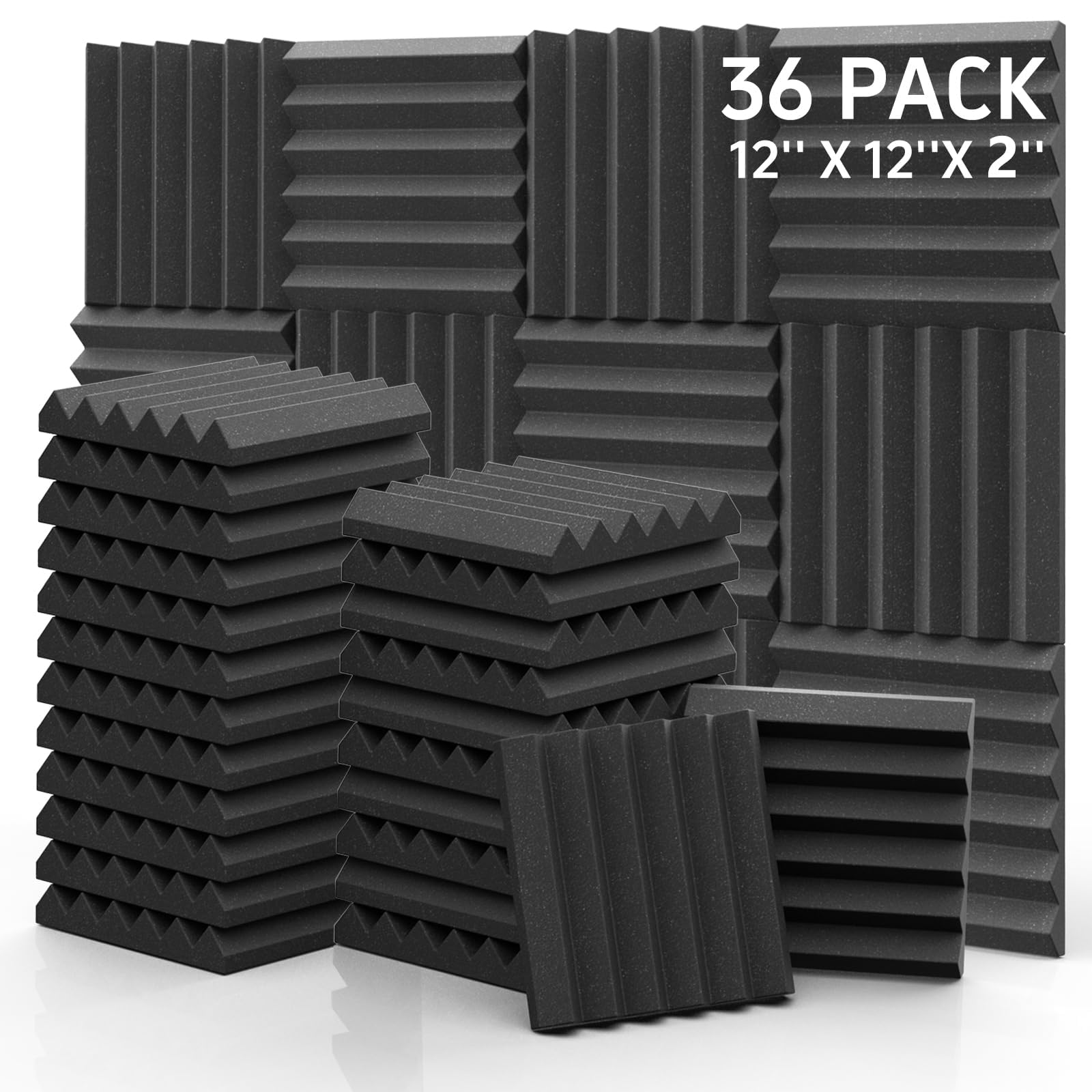
A 25 kg/m³ wedge that keeps its bounce around theater walls and pop ceilings without sagging.
The GUERRI pack lands in the same 36-square-foot zone as the AUSLET tiles above, but the two feel different in the hand. This foam is rated at 25 kg/m³ density — slightly softer than the 30 kg/m³ AUSLET tile — and the higher resilience means it snaps back to shape after compression better than a flatter, cheaper foam. Thirty-six black wedges at 12 by 12 by 2 inches cover 36 square feet, matching the AUSLET pack, and the pack weighs 5.51 pounds. It absorbs echo, flutter echoes, and standing waves — the repeated bounce-back you get in a boxy room.
The 25 kg/m³ density is what owners notice first. Owners describe how these panels soften mid and high frequencies and let mid and low tones fall away, and they work well around a home theater, a vocal room, or a wider wall. The wedge shape also doubles as a décor surface if you tile a statement wall. The high-density foam is packed cold, but it puffs to full size inside a day or so once the bags are open, with some panels needing a few minutes in the dryer on low.
The honest limit is the frequency range. Foam this thick handles highs and mids beautifully but needs something heavier under it for deep bass. If a room is thumping, no foam panel in this category will knock that out — that is a wall and ceiling problem. What foam does best is tighten the voice and music sitting in the room.
Why owners keep reordering
- 25 kg/m³ density with high resilience for shape retention
- 36 wedges covering 36 square feet of wall or ceiling
- Absorbs echo, flutter echoes, and standing waves
- Bounces back to full size within hours to a day of unbagging
Purchase notes to plan for
- No adhesive backing included on the panels
- Glue dots need extra spray or tape to hold over time
- Foam tacked to ceilings can sag without a firmer mount
- Highs and mids only — foam cannot absorb deep bass
The winner for: Anyone tiling a home-theater wall or a home-office desk zone where the wedge shape is as aesthetic as it is functional.
One caveat: Sorting a reliable mount is the real work — adhesive spray plus double-sided tape holds far better than the glue dots alone.
6. Knightsacoustic 96 Pack Sound Proof Foam Panels for Walls, 1 X 12 X 12 Inches
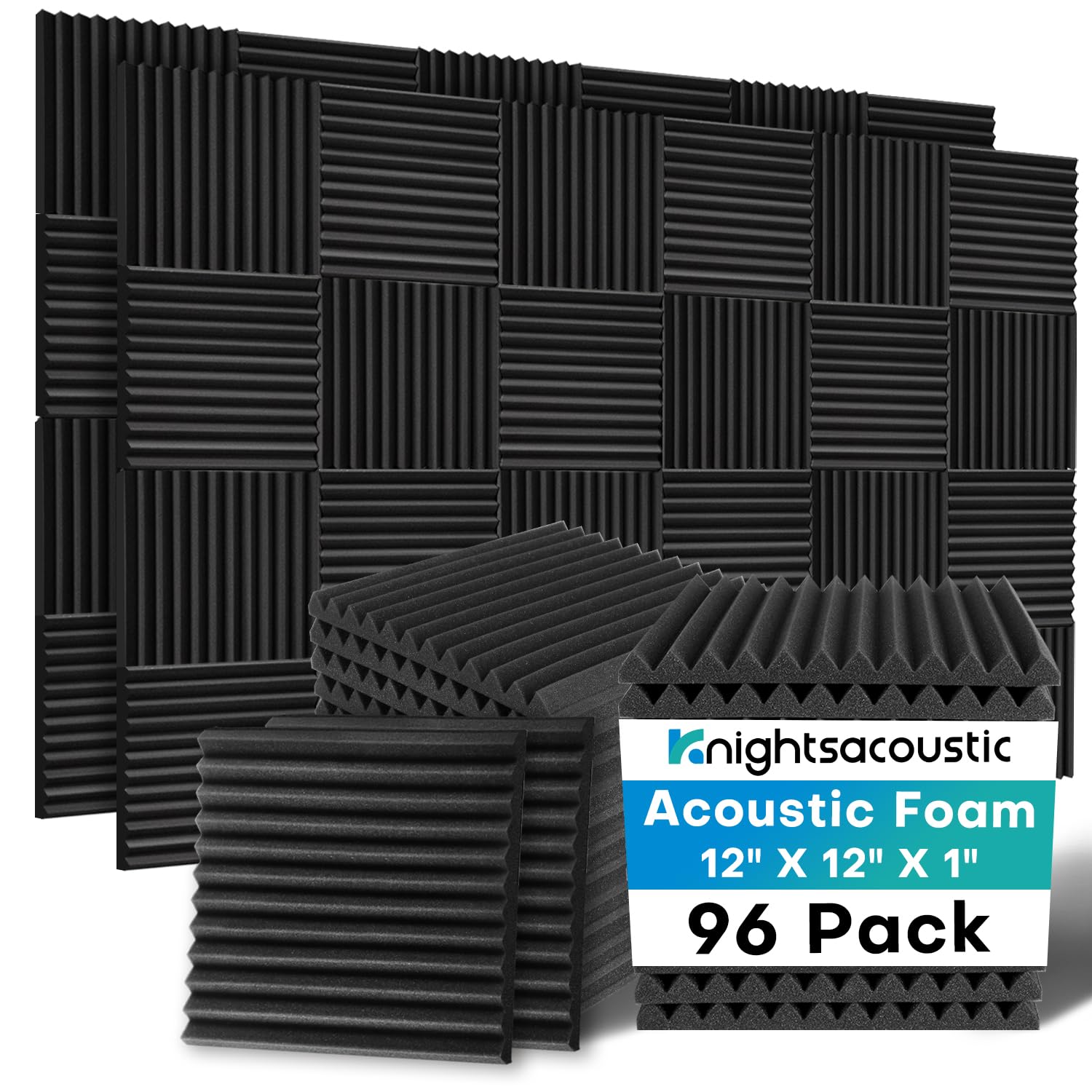
Ninety-six square feet in a single box — the fastest way to treat a whole wall, if you bring your own glue.
If your room is larger than a closet, this is the pack that finally covers it. Ninety-six black wedges at 12 by 12 by 1 inch give you 96 square feet of coverage — over four times the GUERRI pack’s 36 square feet and the biggest surface area in this stack. The foam is professional-grade polyurethane that recovers its shape fast, typically within 3 to 5 hours of proper dispersal and ventilation. If a panel will not fluff out, the maker says to soak it in water for a minute, wring it, and air dry.
Owners use it in spaces a tile-by-tile install would take all weekend: a wiring closet stuffed with printers and switches, a home theater, or a recording booth. The pack arrives with a low odor and no smell at all in some cases — a common enough result that owners say they did not bother with the wash-and-dry method. That 3-to-5-hour recovery and low odor suit a whole-wall install where every square foot counts.
The one thing you will not find in the box is adhesive. Ninety-six panels is a lot of surface to hang, and you need to supply the tape or spray yourself. Trim lines and thickness consistency also vary — the maker labels the thickness at 2 inches, yet a few owners hold a tape to the panels and measure closer to 1 inch. Add a small buffer to your coverage math if the wall is your main project.
The real edge: The 96-panel count delivers 96 square feet of coverage — the largest single-box treatment here — which lets owners cover a whole wall without ordering twice.
Not for everyone: The panels have no sticky side, so this is a job for buyers who are happy attaching every panel themselves.
Grab it when: You are treating a large wall or a room where the 24- and 36-panel packs leave a lot of bare paint.
Pass if: You want an adhesive-backed panel you can peel and press — this pack is mount-it-yourself.
7. Focusound 50 Packs Acoustic Foam Panels Wedge 2″ X 12″ X 12″
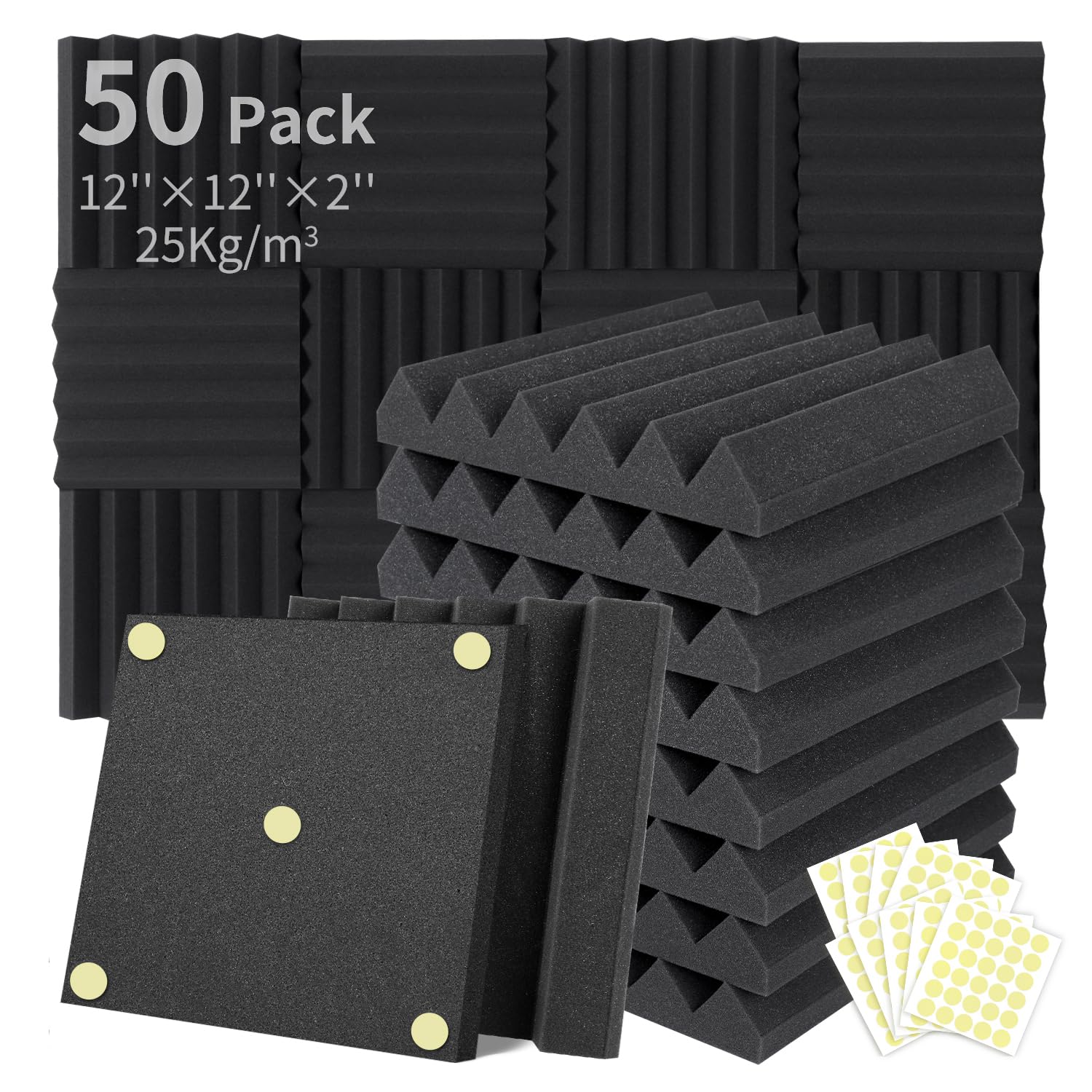
Fifty 2-inch wedges with a stated NRC of 0.65 — a real absorption number instead of vague claims.
Most foam listings tell you the foam is “high absorption” and leave it there. Focusound hands you a number: an overall Noise Reduction Coefficient (NRC) of 0.65. NRC runs from zero to one and measures how much sound a surface soaks up — a higher figure means more absorption. The wedge face carries six grooves, which increases the surface the sound waves meet, so the absorption runs deeper than a flat surface of the same size. Fifty wedges at 2 by 12 by 12 inches cover 50 square feet.
For musicians and podcasters this is the one that gets called into service. Owners use the panels around instrument practice and home-studio recording so the room stops coloring the sound. One owner built a full recording studio in a closet with a few orders, choosing the 2-inch foam specifically to mute a busy street outside. The maker rates the foam at 25 kg per cubic metre density — the same density band the GUERRI panel occupies — so it feels comparable in the hand.
The adhesive is where this pack arrives with a caveat you should hear clearly. You get 300 small double-sided adhesive pieces, 5 per wedge, but the small pads do not grip the foam itself well. Owners find the circles hold to the wall but not to the panel, and then the whole thing peels down. Order fresh spray adhesive or command strips and this problem disappears. Allow two days of ventilation for the compressed foam to puff back up.
Why it earns its spot: The stated NRC of 0.65 gives you a real reference point for comparing this pack, which most rivals do not provide.
The trade-off you accept: The 300 adhesive dots ship with the pack but often need a better glue under them — count on upgrading the tape if you want the panels to stay put.
Made for: Musicians, podcasters, and streamers who want a real absorption number on the box and 50 square feet of coverage.
Consider other picks when: You hate fussing with glue — the 100-pack above gives you sticker pads that are easier to work with.
Understanding the Specs
Thickness and coverage
Panel thickness, measured in inches, tells you how much material the sound waves must pass through before they hit your wall. Thinner panels around one inch handle the high frequencies — voice, cymbals, sharp reflections. Thicker two-inch panels handle a wider slice before sound reaches the wall. Coverage, in square feet, is the other lever: it is how much surface area the pack treats. A 24-panel pack covering 24 square feet and a 96-panel pack covering 96 square feet do the same job, just at very different scales. No number in that pair alone spells success — the two work together.
Density and NRC
Density, given in kilograms per cubic meter (kg/m³), measures how much foam is packed into the space. A denser foam is firmer, springier, and holds its shape better against compression and sagging. The AUSLET tiles above rate 30 kg/m³, GUERRI rates 25 kg/m³ — firmer and softer but in the same general band. Separately, the Noise Reduction Coefficient (NRC) is a number from zero to one that describes how much sound a surface absorbs. Zero means all sound bounces off, one means none does. Focusound publishes an NRC of 0.65 on its pack — a real reference figure worth noting.
FAQ
Will acoustic foam soundproof my room?
How long does vacuum-compressed foam take to expand?
What is the difference between 1-inch and 2-inch acoustic foam?
Do these panels come with adhesive?
Will adhesive pads hold on drywall or should I use something else?
How much coverage do I need for a small room?
Does acoustic foam really make a difference for podcast recording?
Is acoustic foam fire safe for indoors?
Can I cut acoustic foam to fit a small space?
Why does some foam smell when I open the package?
Final Thoughts: The Verdict
For most rooms, the acoustic foam winner is the 100 Pack Acoustic Panels 1 X 12 X 12 Inches because it hands you the most panels per dollar, supplies the nano adhesive stickers in the box, and customers note the pieces hold up through moves. If you want density and real 2-inch depth for a smaller studio zone, grab the AUSLET 36 Pack Pyramid Acoustic Foam Panels at 30 kg/m³. And for a full wall where you need scale, the Knightsacoustic 96 Pack delivers 96 square feet of coverage in one shipping box. If your setup is a whole wall on a tight budget, the 100-pack is genuinely the one you will keep recommending.
How We Picked
We do not accept paid placement. Every pick is matched to a real buyer and a real use-case; we do not hands-on test units.
Sources & Methodology
Specifications: manufacturer listings and product documentation. Review insights: verified customer reviews, as of September 2026. Pricing: not shown on this page (it changes often); check the current price via the retailer link.
As an Amazon Associate, KitchPrep earns from qualifying purchases. This does not affect which products we feature.
Related Guides
