
Specs are compiled from manufacturer listings and verified buyer reviews and can change over time — please confirm the key details on the product page before buying.
If you are swapping a tired lead-acid battery for a 100 amp hour lithium battery, the short answer is this: every pick below gives you a real, verified 100 amp hours of LiFePO4 (lithium iron phosphate) capacity, a 100A BMS (the built-in computer that watches over charging, heat, and short circuits), and a fraction of the weight you are used to lifting. The catch is that the differences that actually matter day to day are cold-weather cutoff behavior, whether you get app monitoring, and how the BMS handles a slow draw overnight — not the headline number.
I’m Mohammad Maruf — the founder and writer behind KitchPrep. This guide is built by comparing the manufacturers’ published specifications and the patterns across verified customer reviews, so you get each pick’s real strengths and trade-offs instead of marketing spin.
Most people upgrading from a flooded or AGM cell want three things: power that lasts a full day out, a case they can carry up a boat ramp alone, and cold-weather protection that does not strand them in November. That is exactly what this guide ranks, and it is why the 100 amp hour lithium battery market has quietly split into mini-size and full Group 24 and 31 cases.
Our Picks at a Glance


How To Choose The Best 100 Amp Hour Lithium Battery
Picking a 100 amp hour lithium battery depends on three things nobody puts on the top of the box: the case size your compartment actually accepts, whether the BMS cuts charging before freezing temperatures hit your cells, and how much weight your back is willing to argue with. Everything else — brand colors and app logos — is decoration.
Case Size Comes First, Capacity Second
Your battery tray is a fixed hole in the world, so measure it before you shop. A BCI Group 24 (a standard lead-acid battery footprint many trailers and trolling setups already use) will swallow a mini-size lithium with room to spare. Group 31 is the larger common size, and mini lithium batteries are often built to shrink into the smaller Group 24 or 22NF openings. If you previously ran a Group 24 lead-acid box, a lithium built to that standard drops straight in.
Low-Temperature Cutoff Is Not Optional
Charging a lithium cell below freezing damages it permanently. That is why the better units here carry low-temperature protection — the BMS automatically stops charging at a set cold point and resumes once temperatures climb back up. If your setup lives in an unheated garage or on a trailer that sees shoulder-season nights, treat this as a must-have, not a feature.
Series and Parallel Headroom
One battery is a starting point; the 100Ah cells on this list can be wired in series and parallel to build a larger system. Common configurations here top out at a 4S4P bank that forms a 51.2V 400Ah (20.48kWh) storage system — enough for serious off-grid or home backup. Check the manufacturer’s series limit before you plan an expandable bank, because a few models restrict 4P4S combinations.
Monitoring: App or LED Panel?
Bluetooth monitoring lets you see voltage, current, and state of charge from your phone, usually within range of 5 to 98 feet depending on the model. An LED panel on the case does the same job in three seconds without opening an app. the easiest setup is having both, but a working display beats a buggy app every time.
Quick Comparison
| Model | Best For | Capacity | Weight | Monitoring | Amazon |
|---|---|---|---|---|---|
| MARSENERGY 12V 100Ah (Group 24, 100A BMS)★ Best Overall | RV and trailer upgrades | 100 Ah | 21 lb | Bluetooth | Amazon |
| Dyness 12V 100Ah Mini (Trolling Motors, RVs)Longest Per Charge | Long trolling motor days | 100 Ah | 20.9 lb | Bluetooth | Amazon |
| Dyness 12V 100Ah Bluetooth (RV, Solar, Off-Grid)Bank Builder | Building a large bank | 100 Ah | 25.3 lb | Bluetooth 5.0 | Amazon |
| WattCycle 12V 100Ah Mini (Bluetooth 100A BMS) | Compact multi-battery banks | 100 Ah | 20.94 lb | Bluetooth | Amazon |
| DC HOUSE 12V 100Ah Bluetooth | Trolling motor and marine | 100 Ah | 23.8 lb | Bluetooth 5.1 | Amazon |
| ECO-WORTHY 12V 100Ah (SOC Display) | Remote and off-grid power | 100 Ah | 25.1 lb | Bluetooth + LED panel | Amazon |
| Renogy 12V 100Ah Mini (Core Series) | Tight teardrop and kayak spaces | 100 Ah | 22.7 lb | Optional shunt | Amazon |
| Power Queen 12V 100Ah (Group 31) | Home backup and RV | 100 Ah | 24.3 lb | Bluetooth | Amazon |
| Redodo 12V 100Ah (Group 31) | Value solar and van life | 100 Ah | 22 lb | None | Amazon |
| LiTime 12V 100Ah (Group 24 Bluetooth) | Full monitoring and warranty | 100 Ah | 21 lb | Bluetooth 5.0 | Amazon |
In‑Depth Reviews
1. MARSENERGY 12V 100Ah LiFePO4 Lithium Battery, BCI Group 24 Size, 100A BMS
Our pick — over 4.5★ from 250+ verified ratings; the strongest balance of quality and price.
The drop-in replacement that actually fits the box you already own.
The defining number here is 21 pounds. That is the whole point of the swap for most buyers — a flooded lead-acid cell of the same 100Ah capacity is a two-person lift, and this one is not. MARSENERGY built it to the BCI Group 24 standard at 10.16 x 6.54 x 8.64 inches, so if you already own a Group 24 lead-acid box, this drops straight in. Larger Group 27 or 31 boxes accept it too, which means you are not locked into one tray size.
Longevity is where the spec sheet gets interesting. MARSENERGY rates the cells for 4,500 deep cycles at 100% depth of discharge, 8,000 cycles at 80% DOD, and 15,000 cycles at 60% DOD. Traditional lead-acid, by comparison, manages 300 to 500 cycles. The cells also carry low-temperature additives — the BMS cuts discharge at -4°F and stops charging at 32°F, which is exactly the behavior you want if the battery lives in an unheated compartment.
Reviewers consistently describe constant power from a full charge, and the wireless monitoring is the quiet luxury here — you can check state of charge from your phone instead of lifting a lid. You do not get parameter adjustment from that app, only the state of charge and depletion readout, and the terminals sit flush enough that a couple of installers wished they were recessed for easier lug clearance. Full charge and load balance before first use, and use terminal blocks on multi-battery installs.
Where It Wins
- 21 pounds replaces a same-capacity lead-acid cell that takes two people to lift
- Group 24 case fits existing trays and upgrades into Group 27 or 31 boxes
- Rated to 4,500 cycles at 100% DOD and 15,000 at 60% DOD
- Low-temp additives plus BMS cutoff at -4°F discharge and 32°F charge
The Honest Trade-Offs
- App shows state of charge only, no parameter adjustment
- Terminals are not recessed, so lug clearance takes planning
- Needs a full charge and load balance before the first real use
Made For: Anyone replacing a Group 24 lead-acid cell in an RV, trailer, or sump-pump backup who wants the lightest possible drop-in at 4.8 stars across 200+ ratings.
Look Past It For: A build where you want to tweak BMS parameters from an app — the Marsenergy app is a monitor, not a control panel.
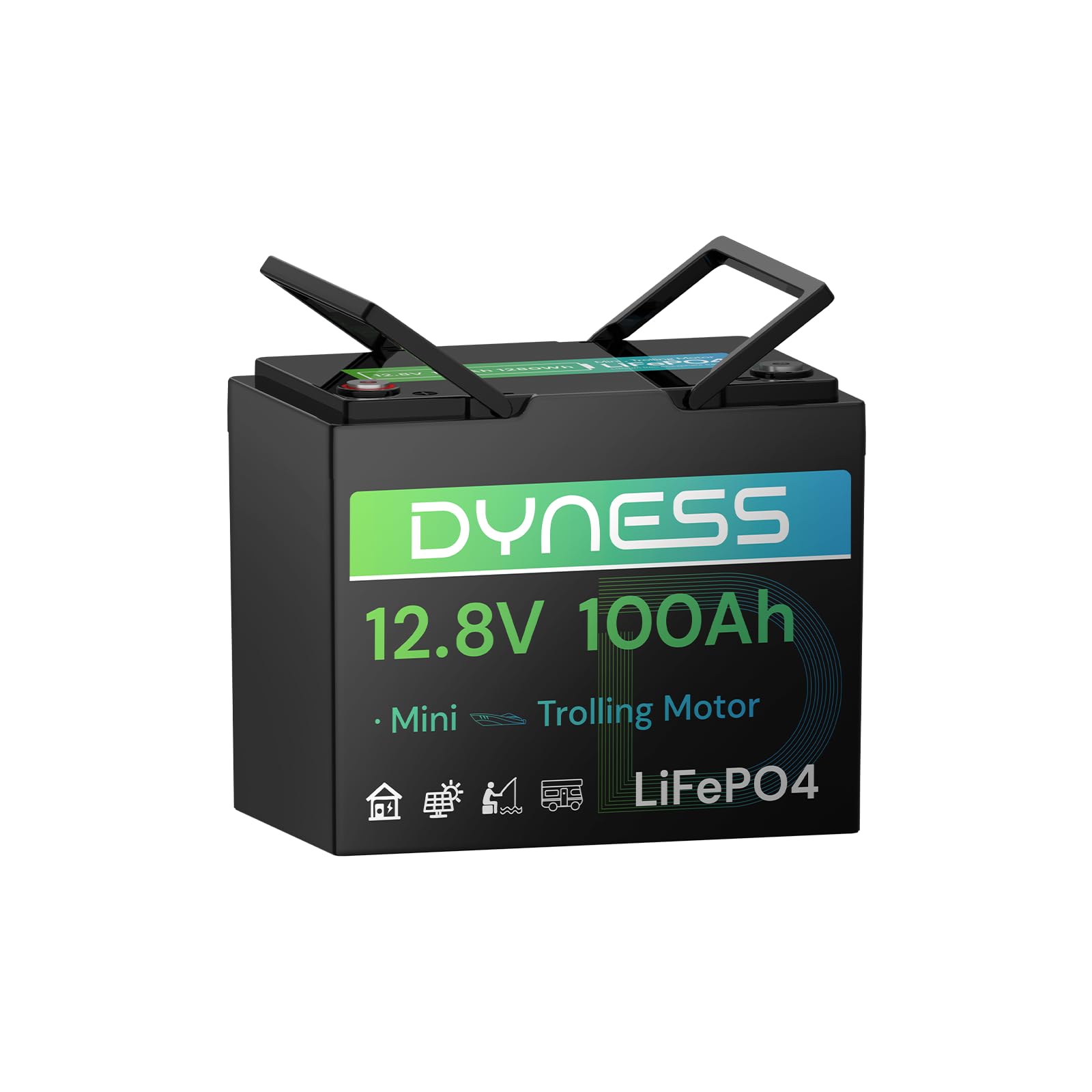
2. Dyness 12V 100Ah Mini LiFePO4 Lithium Battery for Trolling Motors and RVs
Built for the angler who runs a trolling motor from sunup to last light.
Here is the honest head-to-head against the MARSENERGY pick above: this Dyness mini is rated for 6,000+ deep cycles, running against the Dyness Bluetooth model’s 4,000+, and it is essentially the same carry weight at 20.9 pounds versus 21 — the battery weight comparison is a dead heat. Where it pulls ahead is case efficiency. Dyness claims this Group 24 cell is nearly 25% smaller than a Group 31, which is why kayak and small-skiff owners gravitate to it.
The trolling-motor story told across its review pages is what sells it: buyers report running a Newport 55lb thrust motor for the better part of three days on a single charge, mixing slow trolling with faster runs. Another buyer planned around roughly six hours of run time at 50% thrust on a kayak. On the water, that means you stop watching the capacity readout and start fishing.
Cold-weather behavior is where you should pay attention. This one carries low-temperature charging protection — it cuts charging below 32°F and resumes above 41°F, and shuts down entirely at -4°F. It will not hold up the same way as a battery with low-temp additives in deep winter, and the app can be a bit fussy about which battery it has latched onto if you run a bank. For a summer trolling setup, neither matters much.
Where The Value Sits: Serious deep-cycle headroom — 6,000+ cycles — at a carry weight that never argues with your back. In a travel trailer, it ran lights and a heater fan through two nights and still showed 74% charge without a generator.
Reach For It: Kayak, canoe, and small-boat anglers running trolling motors on long summer days who care more about runtime than app features.
Skip If: You pitch it into a four-battery bank and need rock-solid app pairing across all of them every time.
3. Dyness 12V 100Ah Bluetooth LiFePO4 Lithium Battery for RV, Solar, Off-Grid
For the off-grid owner who wants the whole bank visible from a phone screen.
The real-time monitoring is the hook. Bluetooth 5.0 feeds voltage, current, capacity, and system performance to the Dyness app within about 10 meters, which means you can watch a four-battery bank balance itself without crouching over a voltmeter. The spec sheet calls out 1,280Wh of energy — twice the range of lead-acid — and a 10-year rating on A+ grade LiFePO4 cells with a 100A BMS.
This is the model in the Dyness line built for scale. It expands to 4S4P with 16 batteries for a 51.2V 400Ah system, which is the practical way to reach a 20.48kWh home or off-grid bank. Wired in series for a 24V Garmin Force trolling motor, owners mention 14-hour fishing days with 12+ hours of trolling and the bank never below 80%. In an outage, the same build pairs with a battery generator for extended runtime, with a dual-fuel inverter generator recharging both through pass-through.
The low-temp protection handles winter properly: it stops charging below 32°F (0°C), resumes at 41°F (5°C), and cuts off entirely at -4°F (-20°C) so cells escape damage in a cold cabin. The main thing to know is that Dyness recommends their own LiFePO4-specific charger and a 0.2C recharge rate for best cell health — cheaping out on the charger is where people get into trouble. A couple of owners have also flagged that the app needs a bit of digging to find the right battery in a multi-battery bank.
What It Does Well
- Bluetooth 5.0 shows voltage, current, and capacity within 10 meters
- Expands to 4S4P and a 51.2V 400Ah (20.48kWh) system with 16 batteries
- 100A BMS plus low-temp cutoff at 32°F charge and -4°F shutdown
- 1,280Wh usable energy with a 10-year rated cell life
What To Watch
- Wants the Dyness LiFePO4-specific charger and a 0.2C recharge rate for best health
- App can be fiddly to find the right battery in a multi-battery bank
- Heaviest Dyness build here at 25.3 pounds
The Fit: Off-grid cabins, home backup, and any RV build where you plan to grow the battery bank rather than stay at one cell.
Think Twice If: You refuse to buy the matched Dyness charger — the fast-charge spec is written around it.
4. WattCycle 12V 100Ah Mini LiFePO4 Battery with Bluetooth 100A BMS Group 24
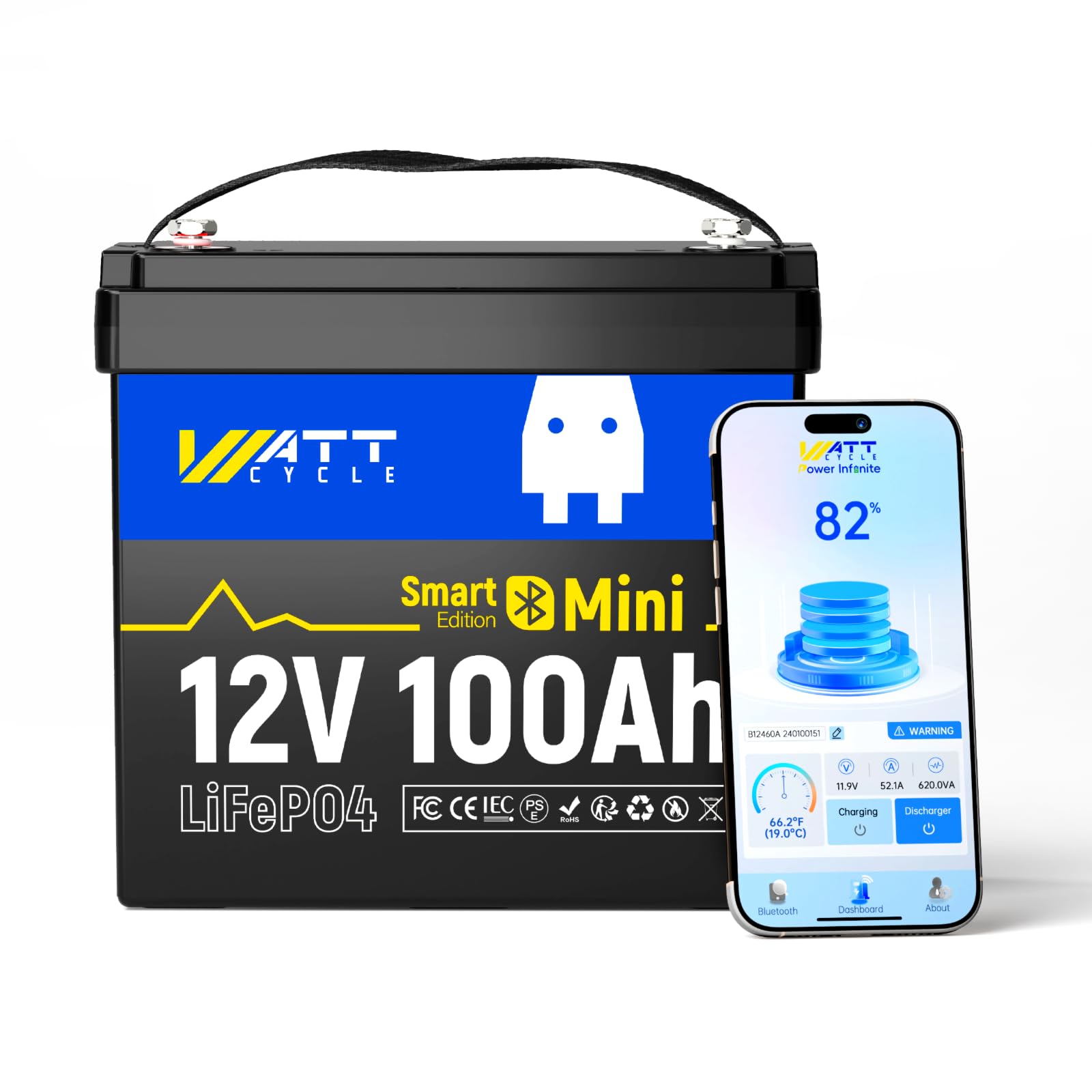
A 100Ah cell that takes up about 39% less volume than the first generation.
WattCycle squeezed this down hard: 20.94 pounds in a 9 x 5.4 x 8.2 inch case, with the maker claiming an 11% weight reduction and a 39% volume reduction against its own first-generation cell, plus an energy density of 63Wh/lbs. In a golf cart, kayak, or tight trailer bay, that is real space back. The EV-grade A+ cells are rated to 15,000 cycles and support a 4S4P bank of up to 20.48kWh.
The Bluetooth app here is the most customizable of the bunch. You can rename the battery yourself after pairing, which is genuinely useful when you are running four of them at once — each one shows up with a label you chose. Real-time voltage, current, temperature, and alarm prompts come through the screen, and a low-temp shutdown protects the cells in cold environments.
The honest part: WattCycle is the newer brand on this list, and the review record shows it. Some owners have hit BMS lockups after a cold shutdown, with units that would not restart until temperatures climbed back up, and a few report spec discrepancies between the battery and the marketing. WattCycle stands behind the 5-year warranty with replacements — but that variability is the main reason this sits behind the more proven picks for anyone running a bank they depend on daily.
The Reason People Buy It: Compact footprint at 9 x 5.4 x 8.2 inches and a 63Wh/lbs energy density that punches well above the tiny case size.
What To Plan For: A newer brand with a thinner track record — treat the BMS app and cold behavior as things to verify on your own build before you trust a critical bank to it.
Best Suited To: Multi-battery banks and space-starved installs where every inch of the compartment counts.
Consider Alternatives If: You need a decade of field-proven reliability in a mission-critical system.
5. DC HOUSE 12V 100Ah Bluetooth LiFePO4 Trolling Motor Lithium Battery
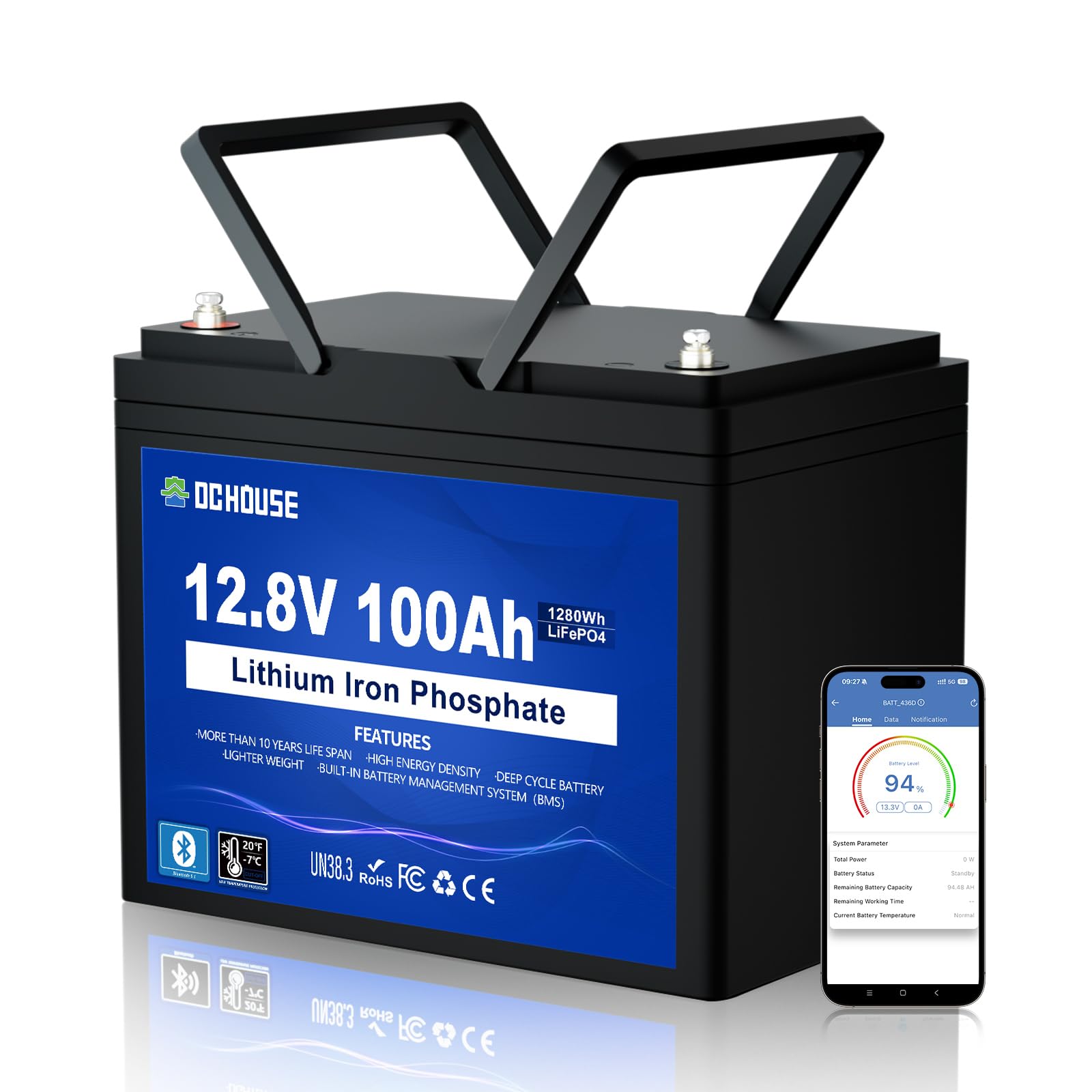
The monitor is the star — cell-level detail and fault pages over Bluetooth 5.1.
DC HOUSE apps the whole battery properly. Bluetooth 5.1 pairs within 5 to 10 meters and reports voltage, current, state of charge, and — unusually — the individual cell data, with a dedicated fault page for troubleshooting. Push notifications warn you the moment the BMS senses an anomaly. For anyone who has ever hauled a dead trolling motor onto the trailer with no idea why, that fault log earns its keep.
The cold-weather logic here is tighter than most. The BMS cuts charging below 19.4°F, cuts discharge below -4°F, and automatically recovers once temperatures rise to 32°F — which means you do not have to manually reset the battery after a cold snap. The cells are Class A LiFePO4 with UL/UN38.3 certification, rated up to 15,000 cycles and a 10-year service life.
On the water, owners put this on Minn Kota motors and smaller rigs. One reviewer noted a 55lb thrust Minn Kota at 75 to 100% speed burning only about 40% of the capacity over roughly three hours. Another ran a 16-foot aluminum boat with a Terova motor on a windy day for four hours straight and still had 60% left.
The catch is the case height. At about 0.32 inches taller than the standard Group 24 spec, it may not slot into every Group 24 tray without a little persuasion. Also, it is not built as a starting or cranking battery, and the warranty here is 3 years rather than 5 — a fair trade for a battery with this much app detail at a lower price tier.
Pick It For: Anglers who want the deepest battery telemetry — cell-level data, fault pages, and push alerts — on a trolling motor setup.
Consider Another Route If: Your tray is a true Group 24 fit with zero clearance, or you want a 5-year warranty window.
6. ECO-WORTHY 12V 100Ah LiFePO4 Battery with SOC Display Flame-Retardant
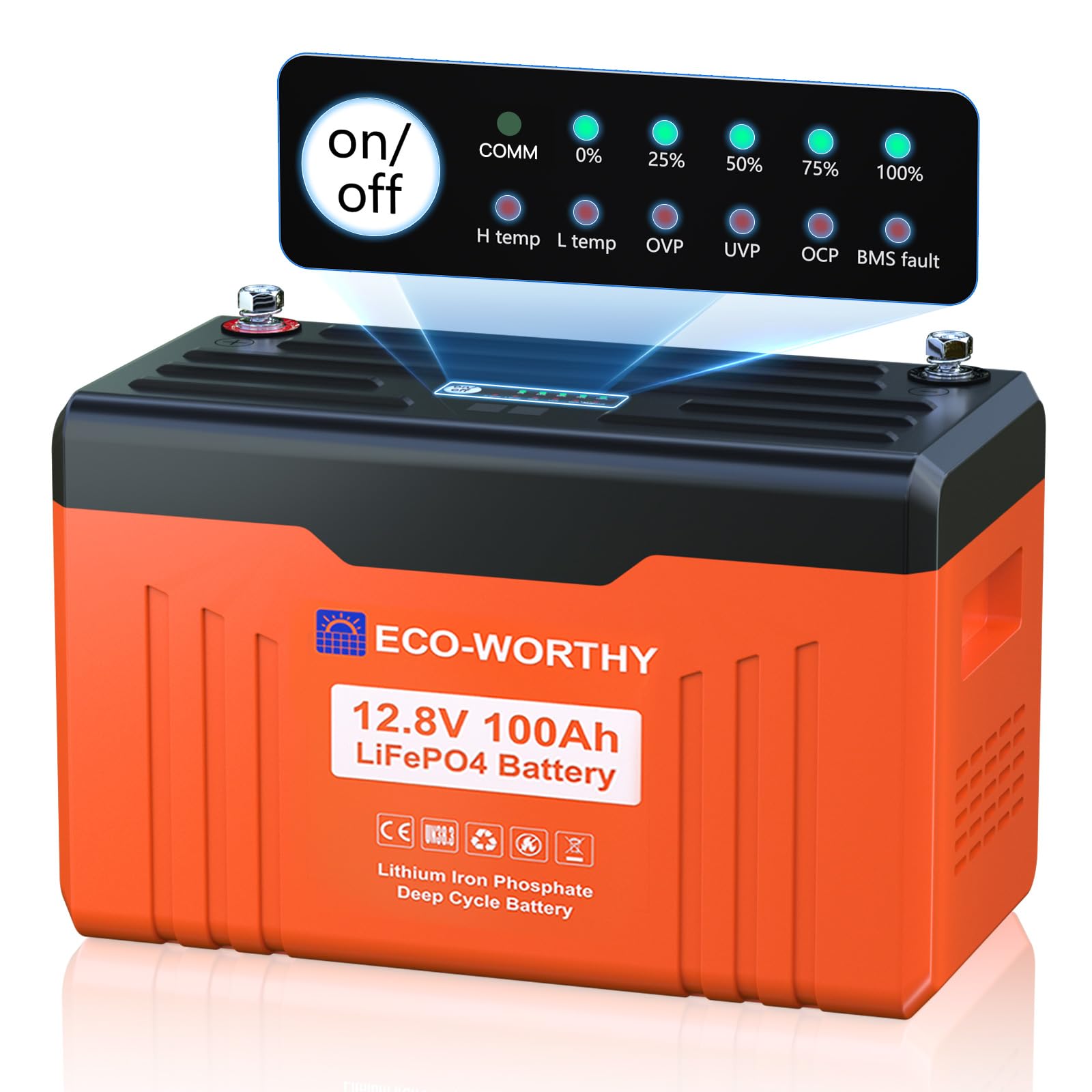
Two ways to check the charge — the panel works even when the app doesn’t.
Most batteries make you choose between a phone app and a physical display. ECO-WORTHY put both on this one. The LED panel shows state of charge and any abnormal condition in plain sight with no app required, and the Bluetooth side connects within 98 feet to show voltage, current, capacity, SOC, runtime, and individual cell voltages. There is even a built-in buzzer that sounds when the BMS detects a fault — a genuinely unusual safety addition at this tier.
The build quality is the other draw. ECO-WORTHY claims it passed over 15 strict tests, and the case uses a metal fixture to hold the cells in place against the expanding-and-flexing problem that kills cheap lithium batteries. The 100A BMS carries overcharge, over-discharge, over-current, short circuit, and low-temperature protection.
One honest note on the monitoring: several owners have pointed out that the Bluetooth app and the SOC display can read inaccurately under light loads below 1A — the coulomb counting loses track. The battery itself works fine; you just get a clearer picture of stored energy from an external voltmeter or a proper coulomb meter with a shunt. Owners running it in a pontoon boat through a full year and a winter, and others powering HAM radios and clearance lights, report no drop in performance. Budget an external meter alongside if precision matters.
Two Ways To Know Your Charge: A physical LED panel plus 98-foot Bluetooth monitoring means you can read the state of charge whether you have your phone out or not, and the buzzer catches BMS faults the moment they happen.
Made For: Off-grid and remote setups — camper trailers, pontoon boats, ham radio stations — where the LED panel gives quick answers and the buzzer gives early warning.
Skip If: You plan to trust the app’s state-of-charge number for precise load planning — an external meter is a better source of truth.
7. Renogy 12V 100Ah LiFePO4 Lithium Battery Mini Size, 100A BMS, Core Series
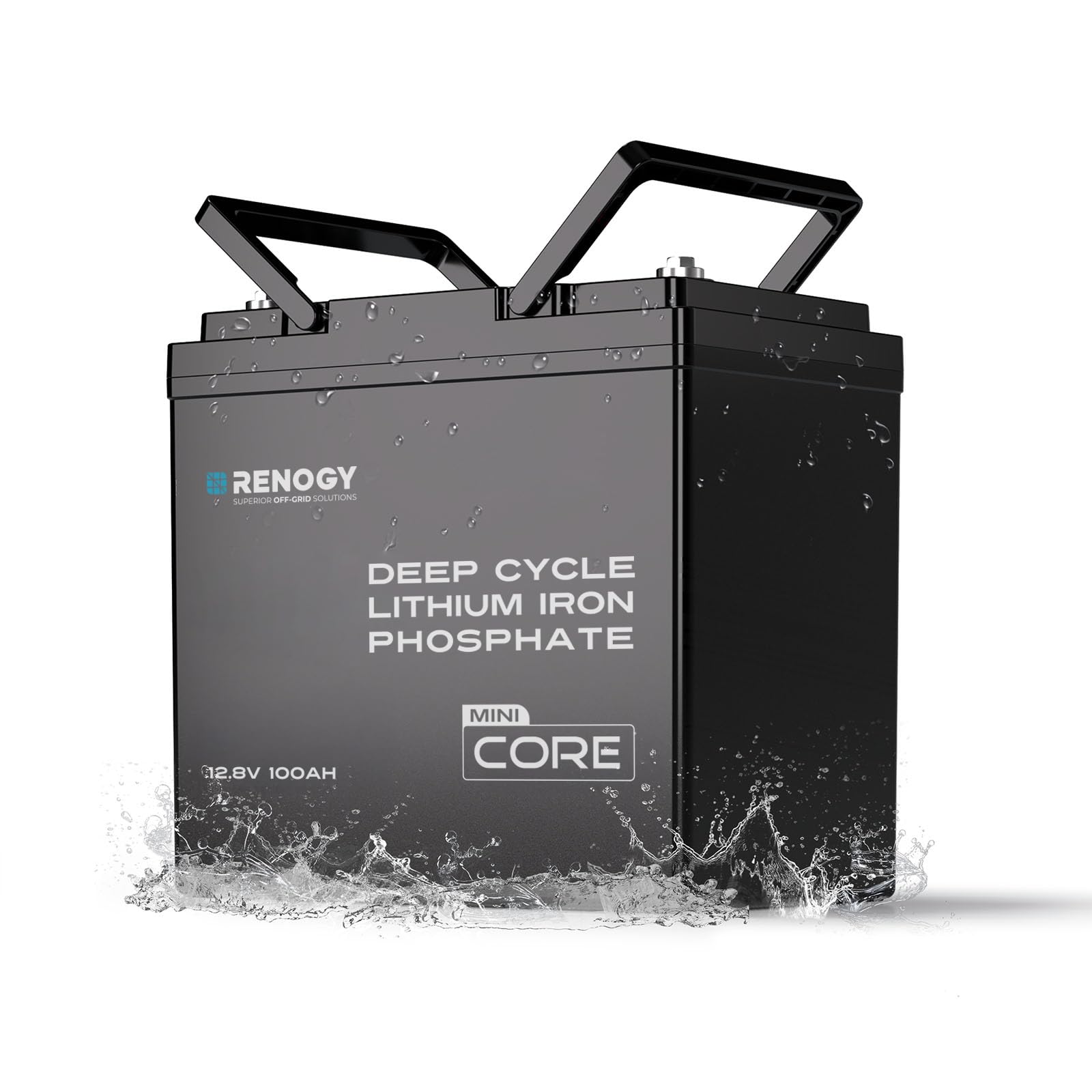
The one you buy when there is only one spot left in the compartment.
Some installs leave no margin. Renogy’s Core Mini is built as a Group 22NF at 9.02 x 5.43 x 8.39 inches — that is up to 50% smaller than a Group 31 and 13% smaller than other equivalent 12.8V 100Ah mini batteries, by Renogy’s own numbers. If your teardrop trailer, kayak, or marine locker has a space that a standard 100Ah cell will not fill, this is the one to measure against first.
Two details stand out beyond the size. The casing is IP65-rated, which means it shrugs off splashes, water, and dust in a way most of the batteries here do not claim. And the cells sit in metal spacers that keep them from moving — Renogy specifically designed this to handle unpaved roads and choppy water without shorting a cell. The BMS carries the standard suite: low-temp charging protection, high-temp, overvoltage, undervoltage, overcurrent, and short-circuit cutoffs.
Remote monitoring exists but is optional: you need a Renogy 300A Battery Shunt, sold separately, to use the DC Home app or Renogy ONE monitor. That is the biggest distinction from the Bluetooth-native picks above — the tracking is excellent if you have the hardware, and entirely absent if you do not. Long-term reliability stories across reviews are mixed: most owners praise the capacity and the fast charging, but there are reports of cells failing to hold charge, with the warranty process taking a couple of months to work through.
What Earns It A Place
- Group 22NF size — up to 50% smaller than Group 31, 13% smaller than other mini 100Ah cells
- IP65-rated casing handles splashes and dust
- Metal cell spacers resist movement on rough roads and choppy water
- Full 100A BMS protection with low-temp charging cutoff
Where It Does Not Fit Everyone
- Remote monitoring requires a Renogy 300A Battery Shunt sold separately
- Some reports of cells failing early with a slow warranty process
- Adds another piece of Renogy gear to your install to get app visibility
The One For: Teardrop trailers, kayaks, and tight marine compartments where case size rules everything else out.
Not The One For: Anyone who wants the app checked from day one — you have to buy the shunt separately.
8. Power Queen 12V 100Ah Group 31 LiFePO4 Lithium Battery for RV, Marine
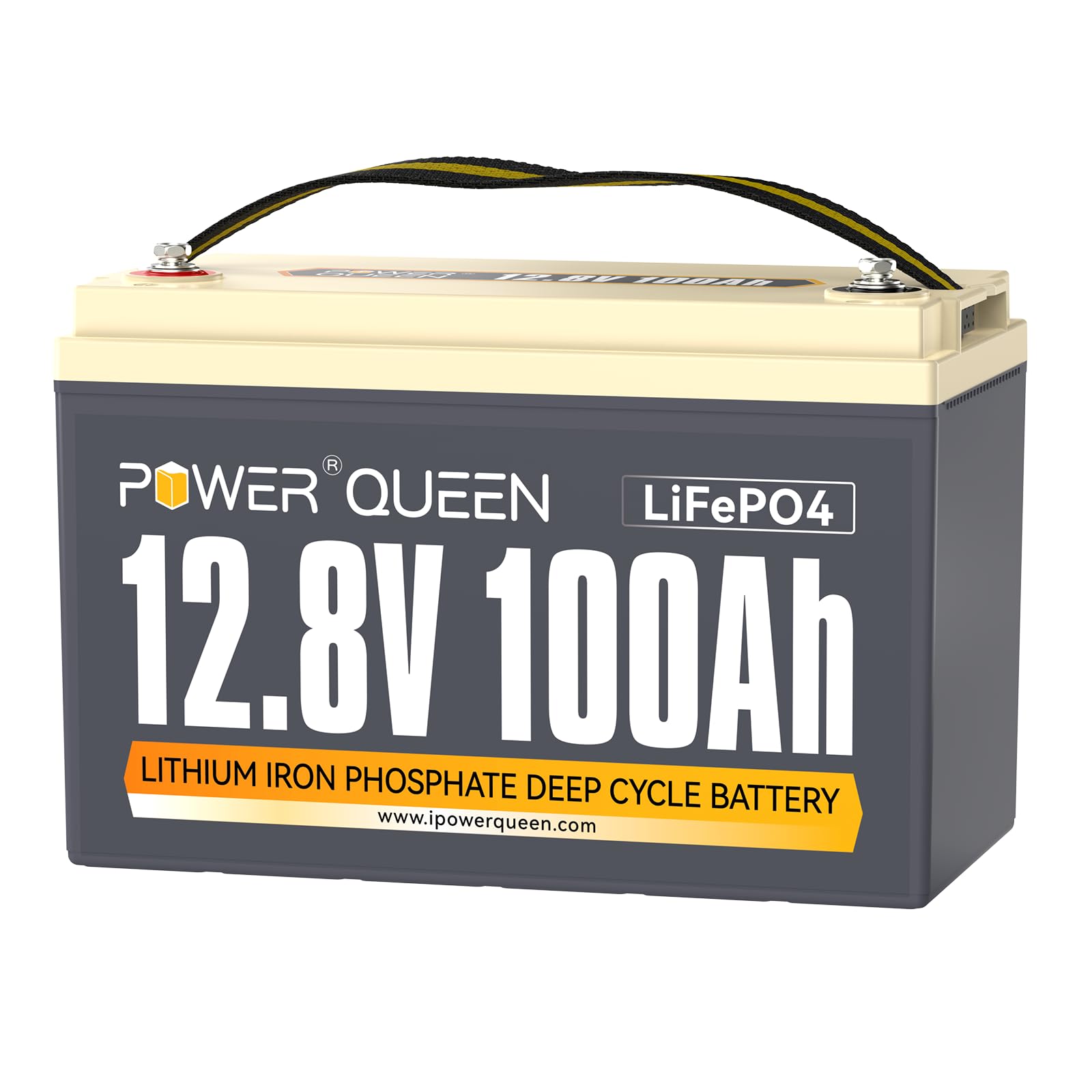
A Group 31 workhorse with the headroom to build a serious home bank.
The straightforward math here: 24.3 pounds in a BCI Group 31 case, which lands about one-third the weight of a lead-acid battery of the same capacity. The grade-A LiFePO4 cells drive a 3% self-discharge rate — the trickle loss that slowly empties a lead-acid cell while it sits — which is why owners leave these on solar for weeks at a time without worry.
The expandability spec is the real one to note. Power Queen rates this for up to 4S4P for a maximum 51.2V 400Ah (20.48kWh) system — the same architecture the more expensive picks on this list use, just in a larger case. Between the 100A BMS and the 4S4P ceiling, you can grow into a real off-grid bank without changing models. Owners running 55lb thrust trolling motors through thick grass report around 8 to 10 hours of runtime with a full charge returning in about three hours.
Two things to plan for. The case is Group 31, so it does not shrink into the Group 24 size — make sure your tray is the larger one. And the terminal bolts take a light touch; several owners have flagged the 6mm bolts with 13mm heads as prone to cross-threading when you stack multiple lugs on each post. Use a torque-spec approach and flat washers to keep them intact.
Where It Shines: Grade-A cells paired with a 100A BMS, and a 4S4P ceiling on par with the premium picks. Charging stays quick and stable, and the weight stays manageable enough to move the whole rig single-handed.
Where To Be Careful: Terminal bolts have a reputation for cross-threading with stacked lugs, so torque carefully and use washers rather than fighting the threads.
Right For: Home backup, off-grid cabins, and RVers who want a Group 31 footprint they can expand into a 4S4P bank over time.
Wrong For: Tight Group 24 compartments — this one needs the larger tray.
9. Redodo 12V 100Ah LiFePO4 Battery, Group 31, for RV, Marine
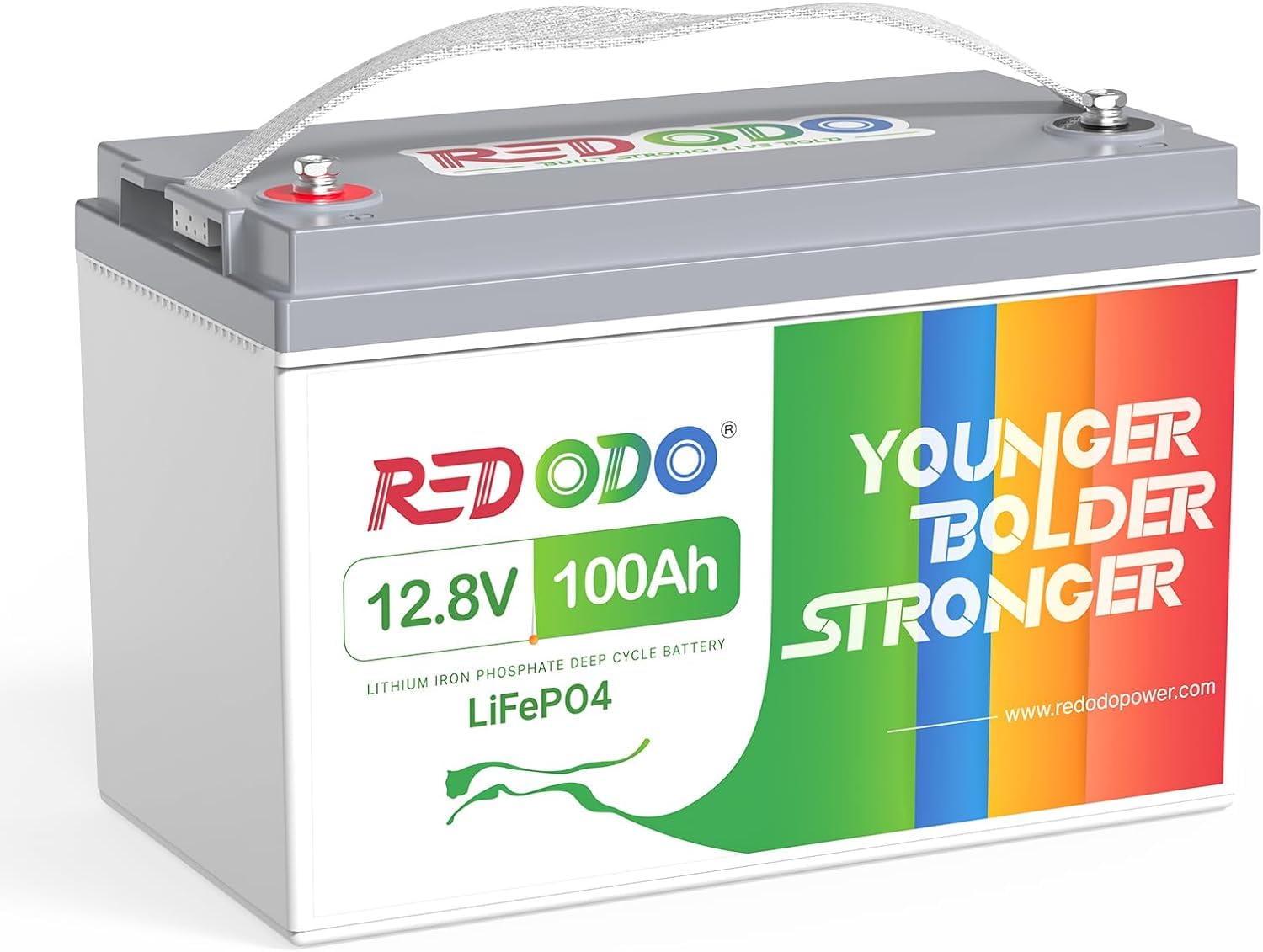
The workhorse that quietly lasts — 22 pounds and a 3% self-discharge rate.
The number that sells this one is the self-discharge rate: 3%. Lead-acid batteries typically bleed 15 to 30% of their charge just sitting there, which is why you find dead cells in storage every spring. A 3% figure means the battery you put away in October is basically the battery you pull out in April. Add in a 22 pound carrier weight and a Group 31 case that fits most trays, and most buyers never look further.
Cycle life is genuinely impressive on paper: 4,000 cycles at 100% depth of discharge, 6,000 at 80% DOD, and 15,000 at 60% DOD, with a 10-year rated lifetime. Fifty-eight watt-hours per pound of energy density is the underlying spec — versus around 20Wh/lb for a comparable lead acid — and that gap is the entire reason the case weighs 22 pounds instead of 63. Owners have confirmed full-charge times of about five hours from 200W of solar and full-day operation without recharging.
The catch: this is a no-frills battery. There is no Bluetooth, no LED panel, no app — just terminals and a BMS. The 100A protection handles overcharge, over-discharge, over-current, short circuit, and high temperature, and the cells support 4S or 4P for up to 400Ah or 48V banks. For anyone who monitors with a separate voltmeter or a solar charge controller readout, the missing app is not a loss, it is a discount.
Where The Value Really Is
- 3% self-discharge rate — 5 to 10x less bleed-off than typical lead-acid
- 4,000 to 15,000 cycle rating with a 10-year rated lifetime
- 22 pounds and 58Wh/lb energy density in a Group 31 case
- Charges from LiFePO4 charger, solar, alternator, or generator
What You Give Up
- No Bluetooth, no LED panel, no app — monitoring is external only
- Not rated for use as a starter or golf cart battery
- Needs a 30 to 70 lb thrust trolling motor range to stay in spec
Best For: Practical buyers who already monitor their system with a separate meter and want the most capacity per dollar without paying for app hardware.
Step Up If: You want phone monitoring or a case display — the Bluetooth picks above deliver both.
10. LiTime 12V 100Ah LiFePO4 Battery, Group 24 Lithium Battery for RV, Camper
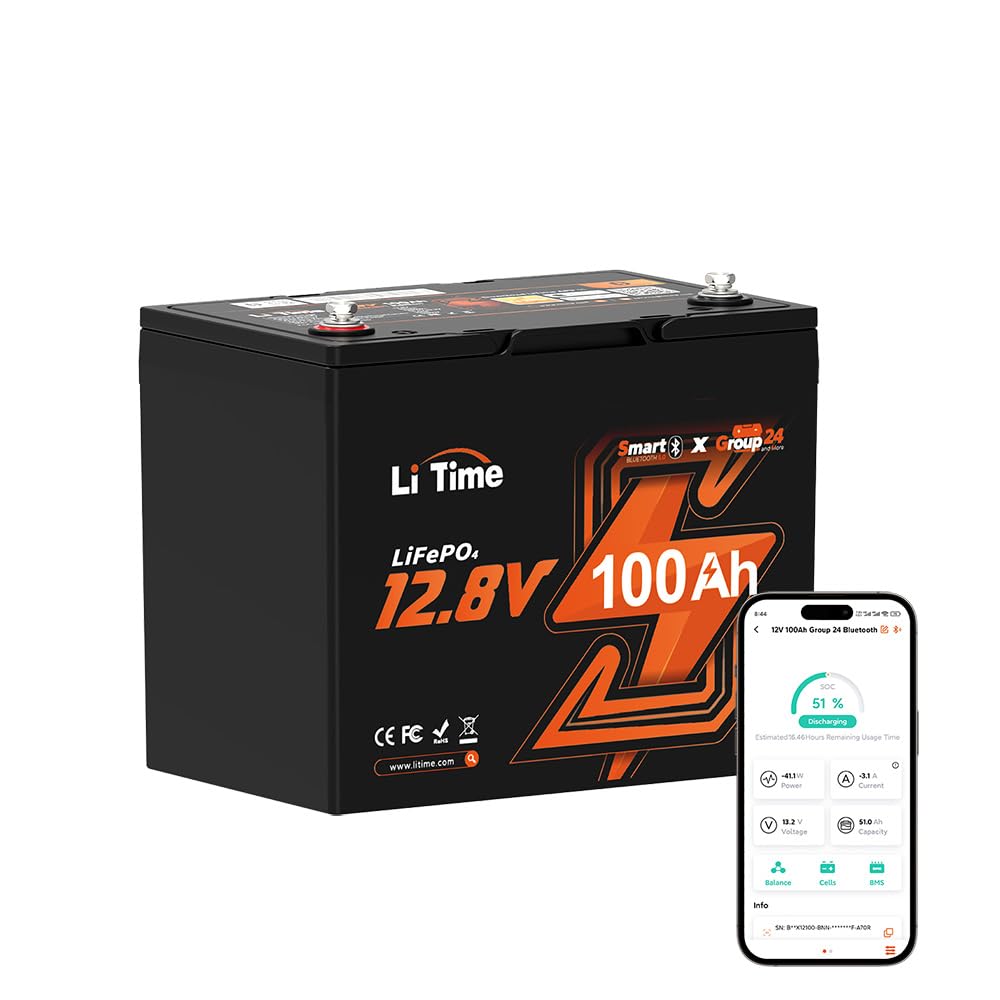
Every feature from the premium tier, in a Group 24 case at 21 pounds.
This is the one to consider when you want the Group 24 footprint, the Bluetooth monitoring, the cold-weather protection, and a 5-year warranty all in the same battery. The 21 pound weight puts it in the same class as the lightest picks on the list; the Group 24 case dimensions of 10.24 x 6.61 x 8.3 inches map to the industry-standard tray. The 1,280Wh of usable energy comes from 100% depth of discharge — versus the roughly 50% you can safely pull from a lead-acid equivalent.
The app side is where LiTime earns its keep. Bluetooth 5.0 pairs via QR code, then shows charge level, charge rate, and discharge rate from the phone. In tent trailer conversions, customers note charging to 99% on a stock RV charger, holding 99% across multiple trips, and no measurable self-discharge between trips. On the water, two fish-finder graphs and a Mega Live box ran four to eleven hours without dropping below 65%.
Honest trade-offs: the app can be glitchy during charging — sometimes needing a disconnect-and-reconnect to update — and the out-of-range alerts are a little aggressive. The 100A BMS carries 20+ safeguards including a low-temp charge cutoff, and the expansion ceiling is 4P4S to 20.48kWh. Also worth noting: this is not designed for starting an engine, a golf cart, or leveling jacks.
What You Get: A fully monitored, cold-weather-protected Group 24 cell with 4,000+ deep cycles, 5-year warranty, and 20.48kWh expansion ceiling. One owner logged 34 cycles over two years with zero issues, and the app’s discharge-rate readout replaces the guesswork of a bare voltmeter.
Choose This For: RVers, tent-trailer owners, and anglers who want a drop-in Group 24 cell with full Bluetooth monitoring and the longest warranty window on this list.
Choose Differently If: You despise a phone-first interface — the app glitches during charge cycles and pushes more alerts than some owners want.
Understanding the Specs
Amp Hours vs Usable Watt Hours
“100 amp hour” tells you the capacity — how much current the battery can deliver over time. Multiply amp hours by voltage (12.8V for LiFePO4) and you get watt hours, which is the more honest yardstick. A 100Ah 12V LiFePO4 delivers 1,280Wh of total capacity. That is where the “twice the range of lead-acid” claims come from on premium models: you can safely use nearly all 100% of LiFePO4 capacity, while lead-acid typically gives you about half. So a 100Ah lithium often replaces a 100Ah lead-acid with room to spare.
BMS: The Chip That Keeps Everything Safe
A BMS (Battery Management System) is a 100A circuit that lives inside the case and watches every cell. It cuts power if it sees overcharge, over-discharge, over-current, over-temperature, or short-circuit conditions. Modern BMS units also cut off charging when the temperature drops toward freezing — that is the low-temp protection so many spec sheets list. Some BMS chips support Bluetooth reporting of voltage, current, temperature, and per-cell balance. A poor BMS is the root cause of most premature battery failures you see in 1-star reviews across the segment.
Depth of Discharge and Cycle Counts
Depth of discharge (DOD) is how much of the stored energy you pull out before recharging. The ratings you see — 4,000 cycles at 100% DOD, 8,000 at 80% DOD, 15,000 at 60% DOD — all measure the same underlying cell: deeper discharge cycles wear the battery faster. Pulling only 60% of the charge and recharging doubles the total cycle count versus going all the way to empty. That is why off-grid owners who run 40 to 60% of capacity nightly see years of service, while trolling-motor users who drain to zero every trip hit the lower end of the cycle rating.
Series and Parallel Wiring
Series wiring stacks voltage — two 12V batteries in series give you 24V, three give 36V, four give 48V. Parallel wiring stacks capacity — four in parallel give you 400Ah at 12V. Combining both, a 4S4P bank of 16 batteries forms a 51.2V 400Ah (20.48kWh) system. Not every battery on this list supports the full 4P4S configuration, so check the manufacturer’s series limit before planning a big bank. Also make sure every battery in a bank is charged to the same level before you wire them together — mismatched charge levels lead to imbalance and premature BMS lockouts.
FAQ
Can I drop a 12V 100Ah lithium battery into a Group 24 tray that used to hold a lead-acid cell?
What does the 100A BMS actually protect against?
How many 12V 100Ah lithium batteries can I wire in series for a 48V system?
Will a 100Ah lithium battery safely power a trolling motor all day?
Is a 100Ah lithium battery really 60% lighter than the lead-acid equivalent?
Can I mix lithium and lead-acid batteries in the same bank?
Does a 100Ah lithium battery need a special charger?
Will my lithium battery survive winter storage without damage?
Do I need a lithium-specific charger for a 12V 100Ah battery?
Which 100Ah lithium battery is best for a full-time RV or van build?
Final Thoughts: The Verdict
For most people building or upgrading a 12V system, the best 100 Amp Hour Lithium Battery on this list is the MARSENERGY 12V 100Ah Group 24 — it drops into the tray you already own, cuts the carry weight to 21 pounds, and pairs 4,500 to 15,000 rated cycles with the low-temp behavior that saves cells in an unheated garage. If you want a long-range trolling motor setup instead, the Dyness 12V 100Ah Mini rates to 6,000+ deep cycles and runs for three days on a charge in real-world use. And for the full-featured RV or off-grid build, the LiTime Group 24 Bluetooth gives you a 5-year warranty, a 20.48kWh expansion ceiling, and the app monitoring everything else on this list is still chasing.
One last honest nudge: the highest-rated pick on this list sits at 4.8 stars across 200+ owner ratings, and it climbs the ladder because of the easy installs and the weight, not because of a marketing claim. Whichever you choose, charge it fully before first use, verify the case dimensions against your tray, and pair it with a LiFePO4-rated charger — those three steps are what get a new battery to the end of its rated life.
How We Picked
We do not accept paid placement. Every pick is matched to a real buyer and a real use-case; we do not hands-on test units.
Sources & Methodology
Specifications: manufacturer listings and product documentation. Review insights: verified customer reviews, as of September 2026. Pricing: not shown on this page (it changes often); check the current price via the retailer link.
As an Amazon Associate, KitchPrep earns from qualifying purchases. This does not affect which products we feature.
Related Guides
