
Specs are compiled from manufacturer listings and verified buyer reviews and can change over time — please confirm the key details on the product page before buying.
If you want fresh juice every morning without babysitting a machine, the answer is a slow juicer with a wide self-feeding hopper — one that swallows whole apples, runs quiet enough for a 6 a.m. kitchen, and squeezes pulp so dry you wonder where the juice even came from. The catch most first-time buyers hit is simple: a narrow feed chute means endless chopping, and chopping is exactly what makes people quit juicing by week three. This guide sorts the real differences — chute width, auger speed, pulp control, and how many parts you have to scrub — so you can pick the one that fits your counter and your patience.
I’m Mohammad Maruf — the founder and writer behind KitchPrep. This guide is built by comparing the manufacturers’ published specifications and the patterns across verified customer reviews, so you get each pick’s real strengths and trade-offs instead of marketing spin.
From the hands-free Hurom H320 to the budget-friendly Godspeeds, here is what actually matters when you shop for the best slow juicer.
Our Picks at a Glance

How To Choose The Best Slow Juicer
A slow juicer — also called a masticating or cold-press juicer — crushes produce with a turning auger and presses it through a strainer instead of shredding it with fast spinning blades. Because nothing spins fast, almost no heat builds up, and that is the whole point: heat and air are what turn fresh juice brown and flat. The trade-off is speed, and the honest fix for that trade-off is a wide feed chute that lets you load whole produce and walk away.
Chute width is the single biggest daily-decision spec
A feed chute is the opening you drop food into, and its width in inches decides how much knife work stands between you and a glass of juice. The 5.3-inch to 7-inch hoppers here swallow whole apples and oranges, so prep drops to a quick rinse. The Kuvings B6000S uses a 3-inch chute, which handles whole cucumbers, lemons, and carrots but still needs small apples halved. If you hate chopping, chase the widest chute your counter space allows — that one number decides whether the machine earns its spot or ends up in a cupboard.
Auger speed and motor wattage explain yield and noise
Auger speed is measured in RPM, or revolutions per minute — how many times the crushing screw turns each minute. Slower turns mean less heat and less oxidation, which is why these machines run anywhere from 58 RPM up to 60 RPM and call it a feature. Motor wattage is the muscle behind that slow turn: more watts let the auger keep pushing through fibrous carrots and celery without stalling. A quiet motor matters too, since anything at or under about 58 decibels is roughly the sound of a normal conversation and will not wake the house at breakfast.
Pulp control and parts count decide your cleanup routine
Two filters, like the interchangeable pulp screens on the Ninja JC151NV, let you choose a light or heavy pulp texture in the glass. Fewer removable parts means faster cleaning, and tool-free or dishwasher-safe components cut it further. Before you buy, count what has to be washed after a single glass — a hopper, an auger, a strainer, a pulp cup, and a juice cup add up, and that count is what drains the fun out of daily juicing.
Quick Comparison
| Model | Best For | Power | Capacity | Feed Chute / Speed | Amazon |
|---|---|---|---|---|---|
| Hurom H320★ Best Overall | Families who juice daily | 150 watts | 2 liters | Self-feeding hopper, 1 speed | Amazon |
| Godspeeds 6-inch ChuteBest Value | Whole-fruit speed on a budget | 300 watts | 473 ml | 6-inch chute, 58 RPM | Amazon |
| AMZCHEF 5.8″ Wide MouthFits Small Counters | Small kitchens, tight counters | 250 watts | 5.6 pounds | 5.8-inch chute, 60 RPM | Amazon |
| SMALLHOO 3-in-1 TM-1080SJ | Juice, nut milk and sorbet | 350 watts | 7.5 pounds | 7-inch chute, 60 RPM | Amazon |
| Aeitto Cold Press | App-guided everyday juicing | 250 watts | — | 5.3-inch chute, app recipes | Amazon |
| Ninja NeverClog JC151NV | Cooks who switch pulp levels | 150 watts | 30 fluid ounces | 2 pulp filters, 2 programs | Amazon |
| TUUMIIST 3-in-1 TM880SJ | Big batches and touchscreen ease | 350 watts | 3 liters | 6.5-inch chute, auto-reverse | Amazon |
| Kuvings B6000S | Long-haul buyers wanting a warranty | 240 watts | 400 ml | 3-inch chute, 60 RPM | Amazon |
| Hurom H400 | Premium hands-free convenience | — | — | Whole-produce hopper, button control | Amazon |
In‑Depth Reviews
1. Hurom H320 Cold Press Juicer Machine
Our pick — over 4.5★ from 200+ verified ratings; the strongest balance of quality and price.
A self-feeding hopper that turns a liter of morning juice into about ten minutes of hands-on work.
The H320’s headline trick is a self-feeding hopper built for whole produce, which means you rinse an apple or a carrot, drop it in, and let the machine chew through it while you deal with something else. Buyers report that translates to roughly ten minutes of actual hands-on work for a liter to a liter and a half of juice — the rest is walking away, which is the difference between a juicer you use daily and one you eventually resent. A control lever and both fine and coarse strainers let you dial the pulp up or down depending on if you want a clean glass or a bit of fiber left in.
The 150-watt motor presses instead of shreds, and the auger squeezes produce the way a hand-squeezer does, so the pulp leaves the machine dry rather than damp. That dry pulp is the tell: owners note the difference against a centrifugal Breville-style machine, where pulp comes out wet and heavy. Hurom’s listed capacity is 2 liters and the unit weighs 6.15 kg, so plan for a real appliance footprint — it is heavier than several picks here and takes up counter space rather than hiding in a cabinet. The payoff is freshness; the maker says juice holds its taste for up to 72 hours, and because it presses slowly, oxidation is kept to a minimum.
What wins people over is the quiet. Hurom rates this as a near-silent AC motor, and it earns that reputation — enough that the early-morning crowd keeps it on the counter instead of tucking it away. The recurring gripe is cosmetic: ginger and turmeric can stain the juicing canister and dispenser over time, so if you juice golden roots regularly, treat the clear parts as a wear item. Cleaning is quick — a rinse after each session and an occasional soapy soak — and assembly and disassembly stay simple enough that first-timers get it right away. For families and committed juicers, it is the one most likely to actually stay in rotation.
What earns its keep
- Self-feeding hopper takes whole apples, carrots, and celery with almost no prep
- 150W slow press leaves bone-dry pulp and a higher yield per piece of fruit
- Quiet enough for early mornings without waking anyone
- Fine and coarse strainers plus a control lever let you set pulp exactly
Where it asks for care
- At 6.15 kg it is the heaviest pick in the family tier — it wants permanent counter space
- Ginger and turmeric can discolor the clear canister and dispenser over time
Best for: Anyone who wants to juice most mornings and wants the machine to do most of the work.
The honest catch: It is a premium, permanently-placed appliance — if your counter is tight, measure before you commit.
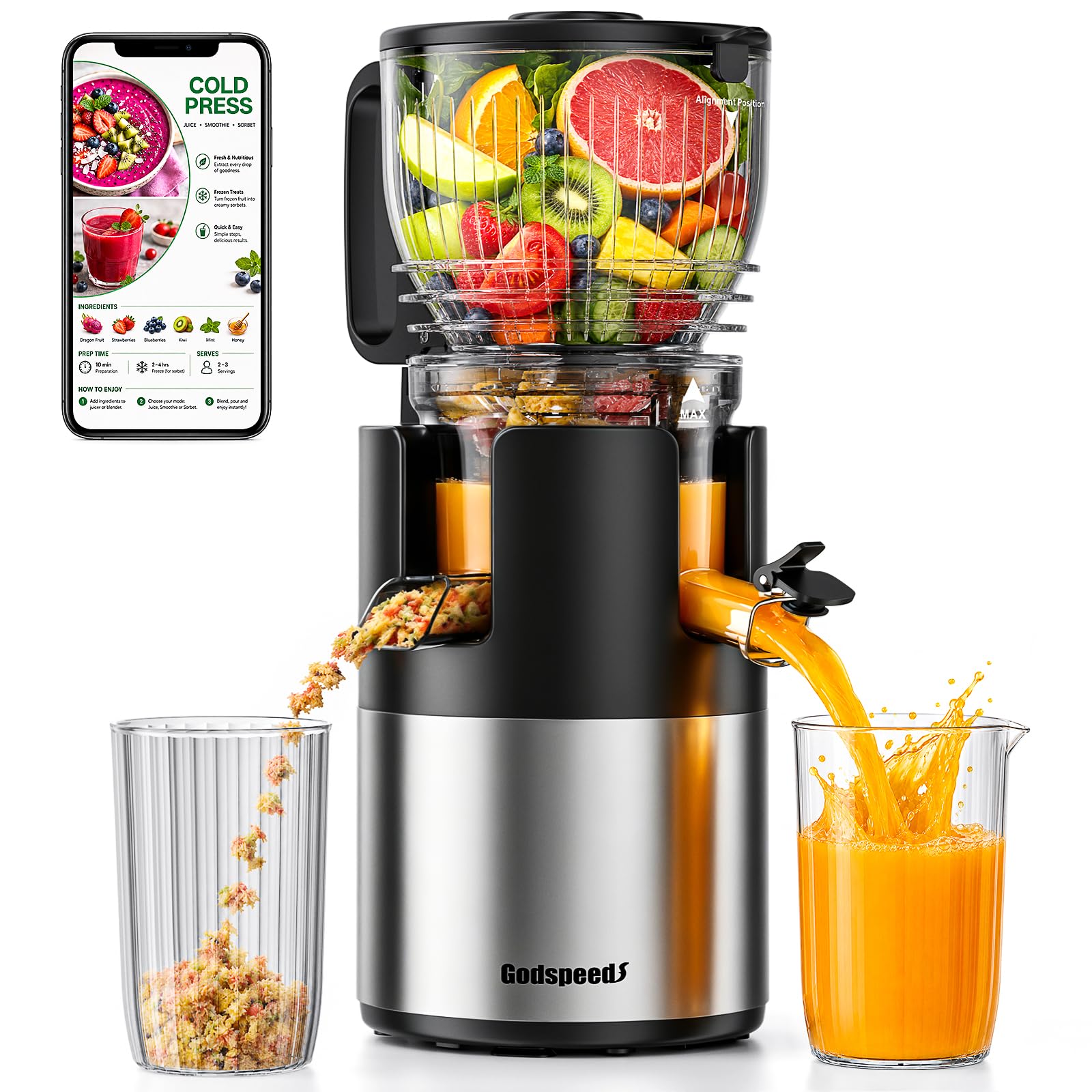
2. Godspeeds 6-inch Chute Cold Press Juicer Machine
A 6-inch chute and 300-watt motor at a starter price — whole apples in, no cutting board.
Godspeeds throws a 300-watt motor at a 58 RPM auger — more than double the wattage of the Hurom H320 — so it keeps torque up through firm, fibrous produce like carrots and celery instead of stalling. The 6-inch feed chute is the headline: owners mention they toss in whole apples and oranges without chopping and still pull a ton of juice out. That is the spec doing real work, because a chute that wide is what separates a juicer you use from one you resent. It lists a yield up to 99% and a 473 ml capacity cup, so it suits a glass or two at a time rather than bulk batches.
Noise stays under 58 dB, roughly the volume of a calm conversation, and reviewers back that up — quiet enough for an early kitchen. Where the H320 wants the counter, this one is far easier to move: it weighs 3.64 kg, and the whole unit stands 16 inches tall on a compact 6-by-6-inch base, so it tucks into tight kitchens. Cleaning is a snap-together affair. The toothed filter separates from the juicing chamber and rinses clean in about two minutes, and the package includes a juice cup, pulp cup, pusher, cleaning brush, and a recipe book. The 10-year warranty stands out at this tier — genuinely rare on a starter-priced machine.
The honest trade-offs are small and worth knowing. The top of the auger has a cavity where bits of food can lodge, so a quick unscrew is needed to clear it fully. And juice quality splits opinion — most are happy, but a few find the output inconsistent, so go in expecting very good rather than flawless. Firm staples like apples and carrots are where it shines; if you mainly juice delicate greens, a finer strainer arrangement elsewhere may suit you better. For the price, this is a lot of machine: a 300W motor, a 6-inch chute, and a decade of warranty coverage.
Fast verdicts
- 6-inch chute swallows whole fruit with almost no chopping
- 300W motor drives through carrots and celery without bogging
- 10-year warranty at a value price — far longer than most rivals at this tier
Reach for this if: You want a low-commitment first slow juicer that still handles whole fruit and firm veg.
Look elsewhere if: You mainly juice leafy greens or want a bulk-batch pitcher — the 473 ml capacity is single-glass territory.
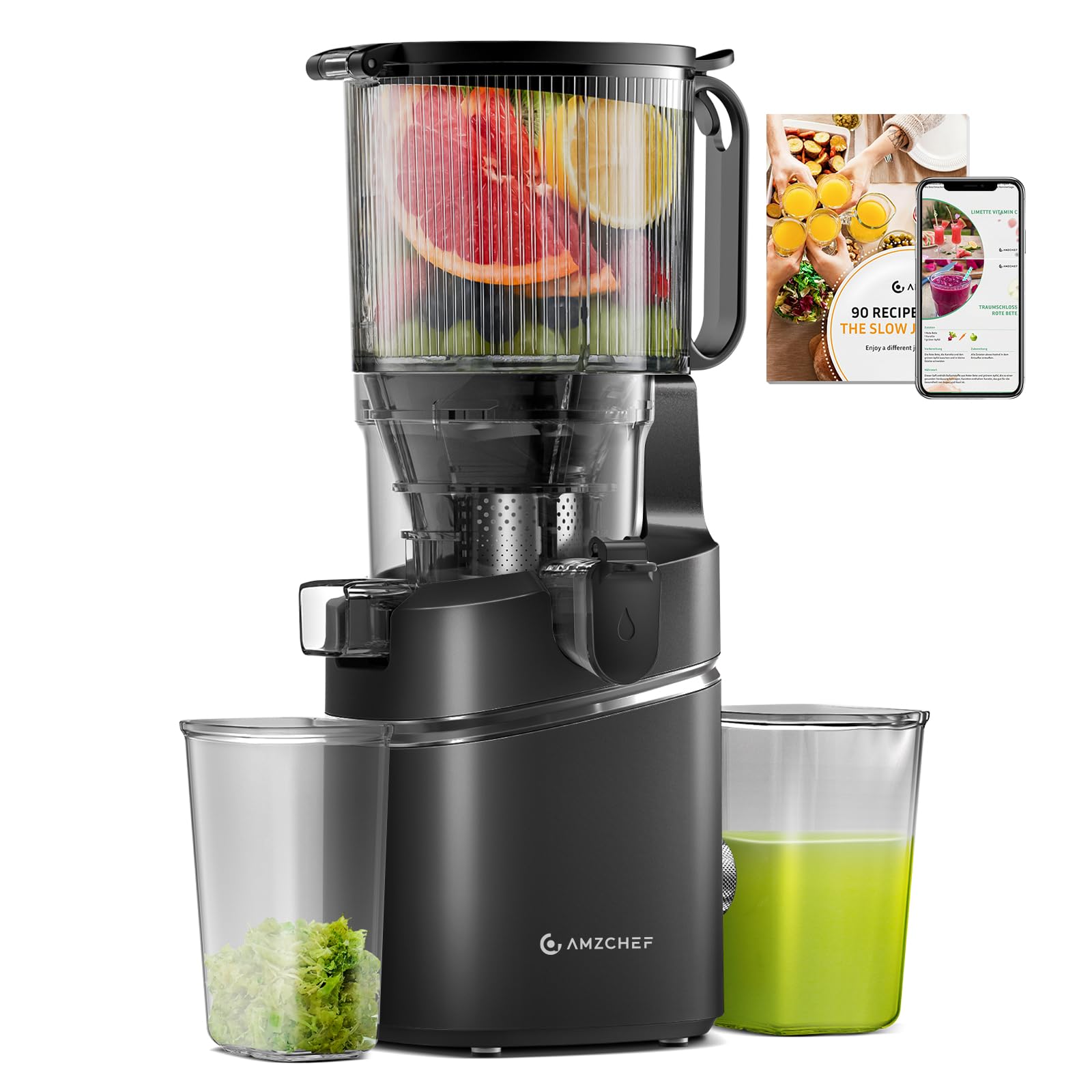
3. AMZCHEF Cold Press Juicer, 5.8″ Wide Mouth Hopper
A 5.8-inch wide-mouth hopper on a compact base — whole-fruit loading without the counter bulk.
The AMZCHEF’s pitch is simple: a 5.8-inch wide-mouth hopper plus a 250-watt motor turning at 60 RPM, so you can load whole fruits and vegetables and skip the cutting board. It is a hands-free design in the same family as the Godspeeds above, but the spec sheet tips lighter and narrower — this one is built to sit quietly on a counter rather than command it. The triple-filtration system separates pulp more aggressively, and the smart safety lock shuts the machine down if the lid is open, which is a meaningful point if there are kids in the house.
What owners keep returning to is the smoothness. The description promises “up to 30% more juice while minimizing oxidation,” and the practical read across reviews is that you get a cleaner glass with less pulp left behind — the fibers largely stay out of the liquid rather than swimming in it. The triple strainer is doing the heavy lifting there, and the result is a finer texture than a single-mesh juicer generally gives. The included kit is standard and sensible: two cups, a cleaning brush, the large feed-chute parts, the motor base, and a pusher rod.
The recurring friction points are minor and specific. The orange plug that seals the pulp path can be fussy to remove for cleaning, and the motor is not the strongest here — dense produce may need smaller loads. Instructions are clear enough on assembly but a few buyers mention wanting more detail on the rev-mode use for clearing jams, which is worth figuring out early since the machine relies on it. Most of the day-to-day experience lands positive: durable-feeling shell, straightforward assembly, and a footprint that does not monopolize a small kitchen.
Best for: Compact kitchens where counter space is the deciding constraint and you want whole-fruit loading without the bulk.
Think twice if: You routinely push very dense produce — the motor is the lightest of the wide-chute group here.
4. SMALLHOO 3-in-1 Cold Press Juicer (TM-1080SJ)
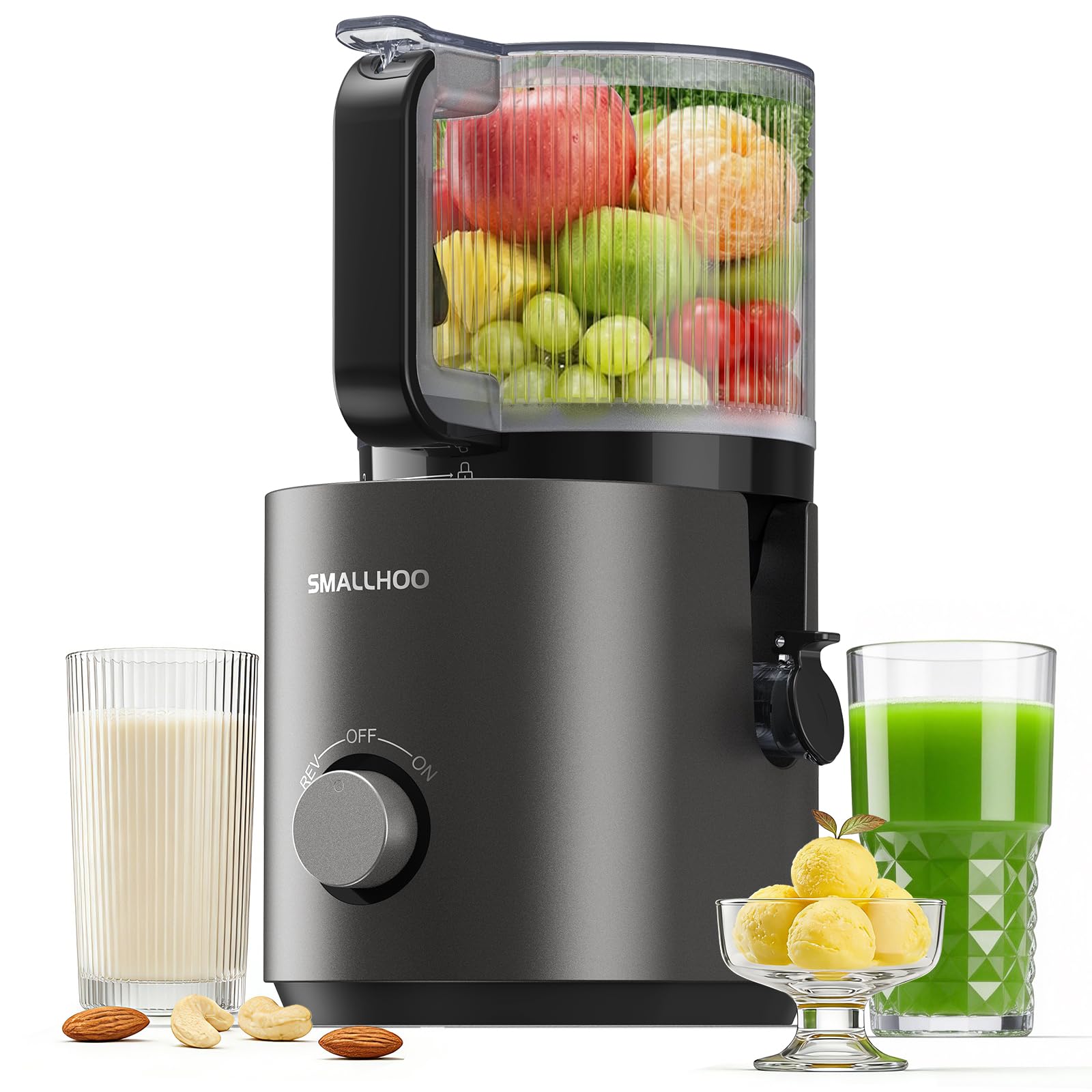
A 7-inch chute and 120 oz hopper plus nut milk and sorbet modes — built for family-size batches.
The SMALLHOO TM-1080SJ is a 350-watt, 60 RPM machine with a 7-inch chute — the widest here — and a 120 oz hopper, so it is built for whole-fruit loading at volume. The 3-in-1 feature set is the real differentiator: beyond juice, it handles nut milk (with a 3-4 hour nut soak) and natural sorbet from frozen fruit softened for 3-5 minutes. If your household has kids who will actually eat frozen-fruit sorbet but not drink a green juice, that flexibility is the argument. The stainless-steel blade and mirror-satin finish also mean this one looks the part on an open counter rather than tucked away.
Where the Hurom H320 asks for walk-away patience, the SMALLHOO matches it on hands-free loading but adds the multi-function angle — you are not just buying a juicer, you are buying a tool that can also produce dessert and dairy alternatives. Reviews back that intent: one notes it powers through “50 lbs” of grapefruit, produces very dry pulp on everything except pineapple that yields an extra bit of liquid, and cleans in about five minutes by hand. Tool-free disassembly and dishwasher-safe parts shorten that further, and a reverse function plus an automatic safety lock round out the convenience.
The honest note is durability variance. Most units run for months without issue, but a small number report food getting trapped, leaking, or early failure after a couple of months — worth registering the warranty immediately (it is a 1-year term) rather than relying on the QR code later. Speed also reads mixed: some find it exactly as expected, others want it faster. For whole-family batches of juice plus occasional nut milk and sorbet, the combination of 350 watts and 7-inch chute makes it a genuinely flexible pick.
Worth the counter space
- 7-inch chute and 120 oz hopper — the widest, biggest combo in this roundup
- 3-in-1: juice, nut milk (3-4 hour soak), and frozen-fruit sorbet (3-5 min thaw)
- Tool-free disassembly and dishwasher-safe parts cut cleanup to about five minutes
- Reverse function and auto safety lock handle jams and lid-off situations cleanly
Go in eyes open
- Speed reads mixed — a few find it slower than expected
- Durability varies across the field; register the 1-year warranty right away
Best for: Families who want to juice in bulk and also make nut milk and sorbet from the same machine.
Consider skipping if: You only ever juice fruit and want the simplest single-purpose machine.
5. Aeitto Cold Press Juicer Machines
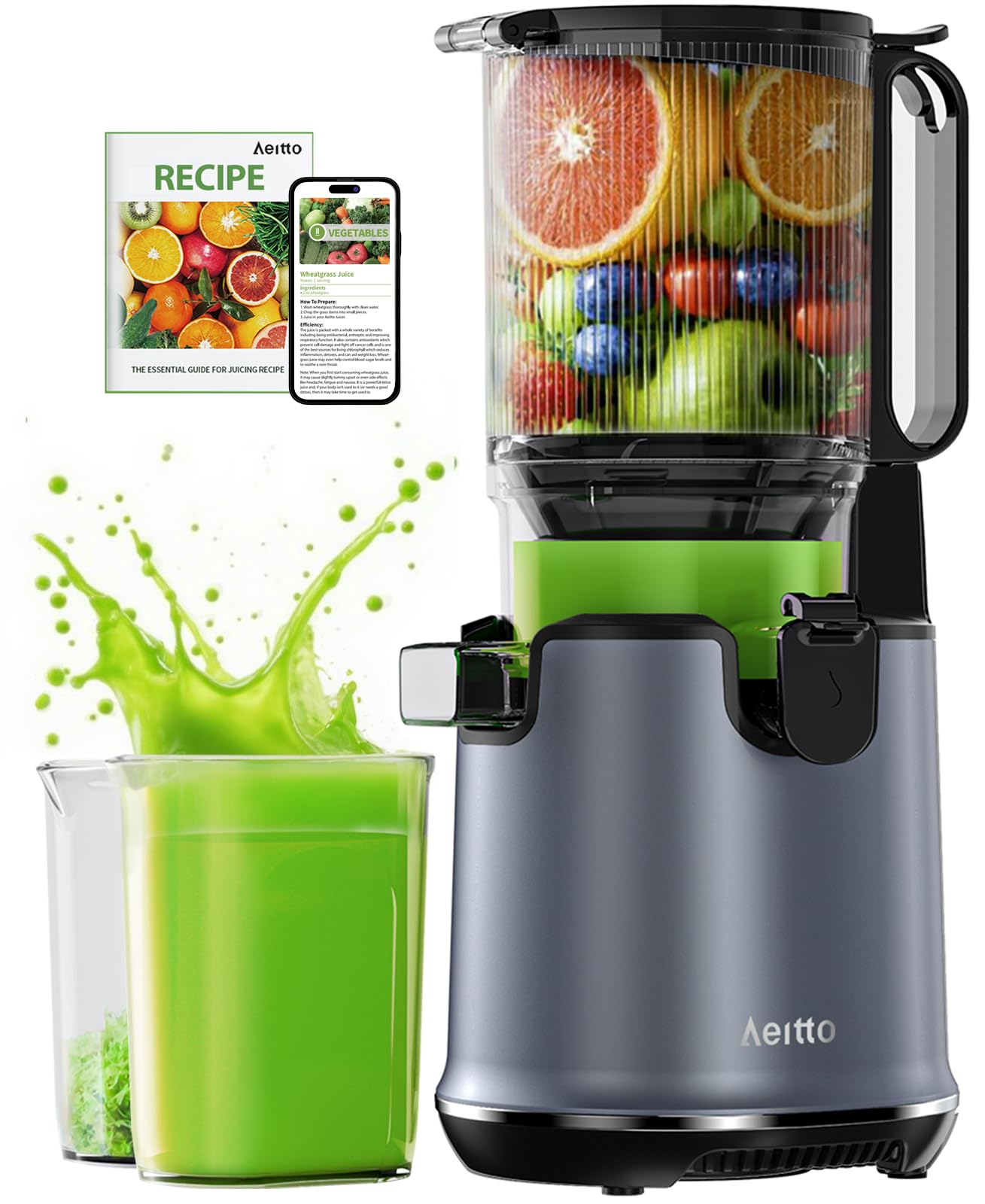
The everyday pick that pairs whole-fruit loading with an app that hands you a recipe the moment you scan a fruit.
Aeitto’s cold press machine runs on a 250-watt motor at 120 volts and combines a 5.3-inch feed chute with an auto-feeding hopper that takes whole apples, oranges, pineapples, and large vegetables — no chopping. The spec sheet is otherwise conservative: it claims up to 99% yield through slow masticating technology, a rotary control for one-touch operation, and a reverse function for clearing clogs. Where it earns its keep in this list is the companion touch: scanning a piece of fruit in the Aeitto app pulls up a matching recipe, which is a genuinely helpful hand for anyone who keeps making the same three juices because they forget the alternatives.
Effectiveness is far and away the thing owners rave about — the machine’s core squeezing and juice output draws the most consistent praise in its review pages, and the pattern is repeated: dry pulp, smooth juice, little foam, and a clean glass. Ease of cleaning follows close behind, with a few buyers explicitly noting that the low parts count and quick disassembly keep maintenance short. Noise is low, quieter than the centrifugal juicer it often replaces according to buyer discussion, and the unit fits well in modern kitchens without dominating the counter. The grey finish is understated rather than showy — this is a working appliance, not a trophy.
What to watch is the clogging angle. Stringy greens and thick stems can jam the mechanism if they go in whole, and a few customers note that the reverse function alone will not always clear it — the fix is pre-cutting greens and stems into shorter lengths before loading. The mixed signal on pulp consistency is also worth noting: standard fibrous produce gives excellent dry pulp, while softer items can leave the texture less predictable. For its price tier, the combination of 5.3-inch hopper, reverse-clearing function, and app recipe access makes it a solid daily-driver pick.
Where it shines: Whole-fruit loading via the 5.3-inch hopper and auto-feed, smooth and relatively pulp-free results, and a companion app that scans produce to suggest recipes.
Worth planning for: Stringy greens and tough stems clog easily — cut them short before loading, every time.
Right for you if: You want a straightforward low-parts juicer that works with whole apples and oranges and gives you recipe ideas on your phone.
Less suited to: Someone whose juicing routine is mostly kale and long celery stalks — those demand extra prep here.
6. Ninja NeverClog Cold Press Juicer JC151NV

Two interchangeable pulp filters and a 150-watt high-torque auger with an anti-jam design.
The NeverClog approach is the defining angle: a 150-watt high-torque motor turns the auger slowly through tough produce like apples, carrots, celery, and leafy greens with a deliberate anti-jam design. Two interchangeable pulp filters are the standout feature — one for “Less Pulp,” one for “Lots of Pulp” — so you genuinely control the texture in the glass without buying a second strainer. Two one-touch programs (Start/Stop and Reverse) keep operation dead simple, and a built-in anti-drip lever lets you pause mid-batch to pour without making a mess. Compared with the Aeitto above, the pulp flexibility here is the deciding edge.
What buyers notice in daily use is yield. One reviewer compared it to nothing less than about 2.5 times the usual juice amount from the same produce — they juiced roughly 5 lbs of oranges down to dry pulp and got a full 16 ounces from half a bag. That is a strong yield story, and a second telling detail from the same thread: it handled apples, oranges, and spinach without clogging on its first use. The juicing itself is slow and controlled, the machine sits stably, and cleanup is a quick rinse with the included brush. The non-contact parts (juice-contact parts in the spec) are dishwasher safe.
The recurring friction is plastic and pressure: forceful plunging of very hard produce, particularly carrots, can build enough pressure to crack the plastic twist-disconnect at the exit tube over time. The fix is the one the manufacturer’s own framing points at — cut pieces to the chute’s size and use the pusher gently rather than leaning on it. The other honest note is space: at 7.9 pounds with a 15.93-inch height, it is compact enough to slip under most upper cabinets, but it does occupy real counter real estate. For someone who needs to switch pulp levels batch to batch, no other pick here matches it.
What it solves: The two-filter pulp control is the reason to choose it over single-filter rivals — switch between light and thick textures without buying anything extra.
The honest caveat: The plastic twist-disconnect at the exit tube has been reported to crack under forceful plunging of hard produce — use steady pressure, not force.
Best for: Households where different drinkers want different pulp levels and simple one-touch operation is the priority.
The other side: If you juice a lot of hard carrots and tend to push them through quickly, slow down and check for the twist-fit — that is the wear point.
7. TUUMIIST 3-in-1 Cold Press Juicer Machine
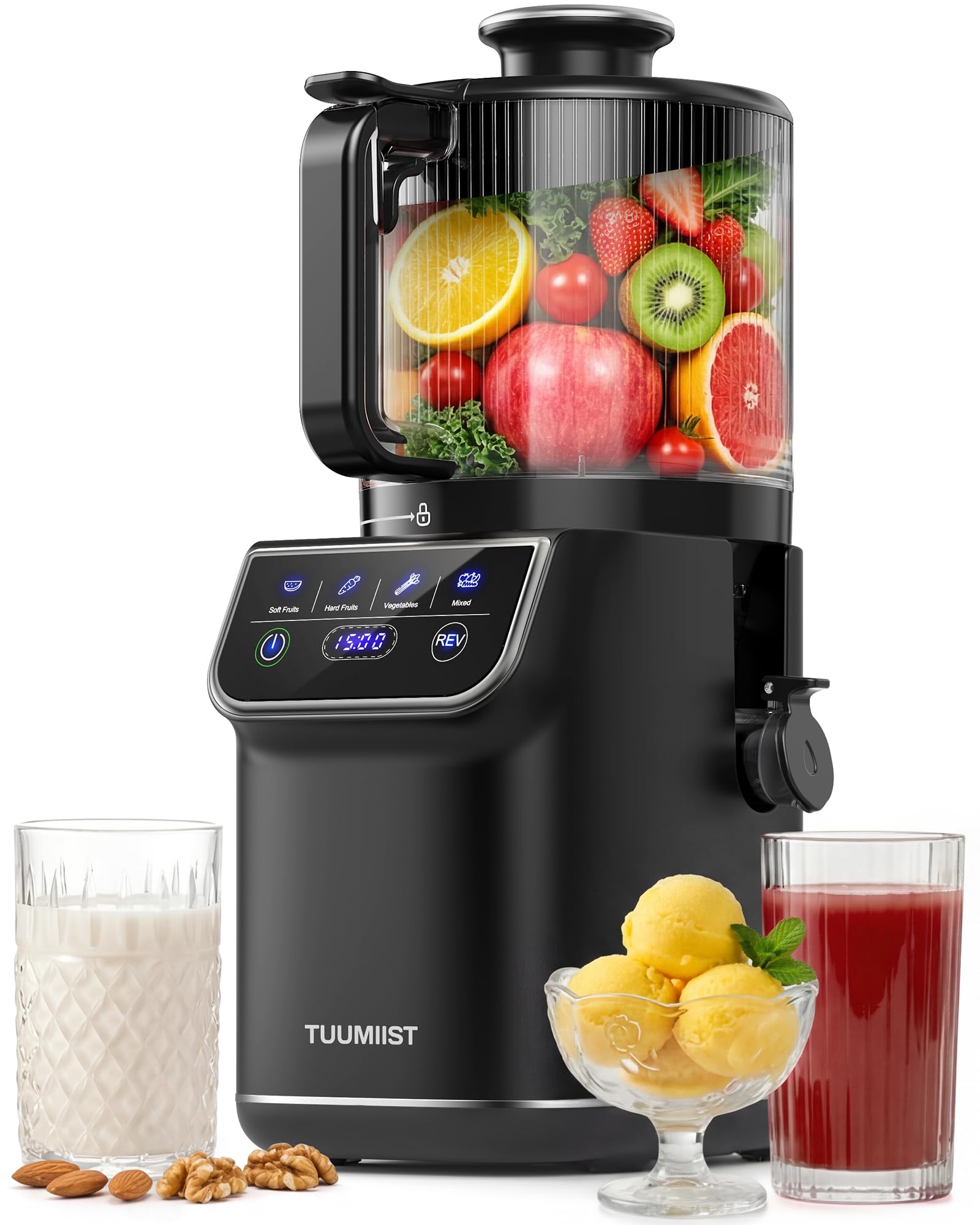
A 3-liter pitcher and 6.5-inch chute with a touchscreen covering juice, nut milk, and sorbet.
The TUUMIIST’s standout spec is scale: a 3-liter (100 oz) pitcher paired with a 6.5-inch wide self-feeding chute means whole apples and celery go in without chopping, and you can fill a full pitcher before you have to empty anything. The 350-watt motor drives the auger at slow speed, targeting up to 95% yield with bone-dry pulp, and the auto-shutoff means once you have loaded it, you can step away. A three-mode touch interface covers juice, nut milk, and sorbet — the same 3-in-1 triangle as the SMALLHOO above, but presented through a touch panel rather than buttons.
Performance is the crowd-puller here — the machine’s basic juicing output is the strongest theme in its reviews, and the pattern is consistent: dry pulp, high yield, and barely any pulp stuck in hard-to-reach places during cleanup. A three-minute rinse cycle and three-part assembly mean it stays convenient rather than becoming a project in itself. The auto-reverse function clears jams without you having to stop and disassemble, and the motor stays under 60 dB — quiet enough for a morning kitchen, though softer items like peeled oranges still prefer to be juiced alongside something firmer like carrot to avoid clogging. The mirror-satin stainless-steel finish gives it a premium look on a counter that will not be hidden.
The honest limit is durability confidence. Some users find the build is genuinely made to last, but a smaller group reports it does not feel durable enough for the long haul — worth knowing if you intend to juice every day. The 1-year warranty is shorter than the Godspeeds 10-year span, so factor that in when comparing value at the premium tier. For households that want to make a full pitcher of juice plus occasional nut milk and sorbet, the combination of the 3-liter capacity and touchscreen control makes it a strong premium-tier pick.
Where it delivers
- 3-liter (100 oz) pitcher and 6.5-inch chute let you fill a family batch in one pass
- 350W motor at slow speed produces bone-dry pulp at up to 95% yield
- Touchscreen 3-in-1 covers juice, nut milk, and sorbet with auto-reverse for jams
- Three-part assembly and a 3-minute rinse keep cleanup short
Worth knowing
- Durability confidence is mixed — some units feel premium, others less so
- 1-year warranty is shorter than the widest coverage in this roundup
The case for it: Meal-preppers who want a big-batch pitcher and a touch panel that switches between juice, nut milk, and sorbet without fiddling.
Not for you if: You want the longest warranty in this group — the coverage here is on the shorter side.
8. Kuvings Whole Slow Juicer B6000S

The long-game pick: a 60 RPM auger, a 3-inch chute, and a decade of warranty behind it.
Kuvings builds around a patented 60 RPM low-speed masticating design that crushes food and then presses it, keeping oxygen and heat out of the juice. The 240-watt motor is smaller than the TUUMIIST’s or SMALLHOO’s 350 watts, and that is intentional — the design counts on torque at low speed rather than muscle, which is why it turns quietly and durably. The chute is 3 inches, which handles whole cucumbers, lemons, and carrots but asks you to halve larger apples. Compared with the wide-chute picks above, this is the one built for the long haul rather than the fastest prep.
The 10-year warranty is the spec that keeps coming back — Kuvings has been building juicers for four decades and backs the B6000S for ten years. That matters because a slow juicer is a fixture, not a seasonal gadget. Performance is also the aspect buyers mention most: the machine handles apples, carrots, pears, and oranges with dry pulp, and the 3-in-1 flexibility extends to smoothies, baby food, and nut milk via the included blank strainer. The drip-free juice spout allows you to build mixed juices and rinse between recipes without messy overflow, and the pulp outlet duct was redesigned larger to keep juice in the glass and pulp in the bin.
The honest catches are real but manageable. Cleanup is moderate rather than instant — the bowl is flat and easier than some rivals, but leafy greens spray a little pulp into a longer chute that demands a thinner brush. Reviewers point out that a warp-resistant pusher is still warp-prone enough that it should stay out of the dishwasher. Juice quality draws mixed feedback — a handful of users want less pulp in the glass, which the sieve adjustment solves if you use it. Durability complaints exist at the review level, but the warranty stands behind the machine, and customer service has clearly replaced failed bases under that coverage.
Why it lasts: 60 RPM low-speed extraction with a 240-watt motor and a 10-year warranty that has actually replaced units when needed — this is a fixture, not a fling.
Everyday quirks: The 3-inch chute needs large apples halved, and leafy greens leave some pulp in the longer chute that wants a targeted brush.
Designed for: Buyers who plan to keep a juicer for close to a decade and want the manufacturer standing behind it the entire time.
Wrong fit if: Your priority is tossing whole apples straight in — the wider-chute picks above do that better.
9. Hurom H400 Easy Clean Slow Juicer
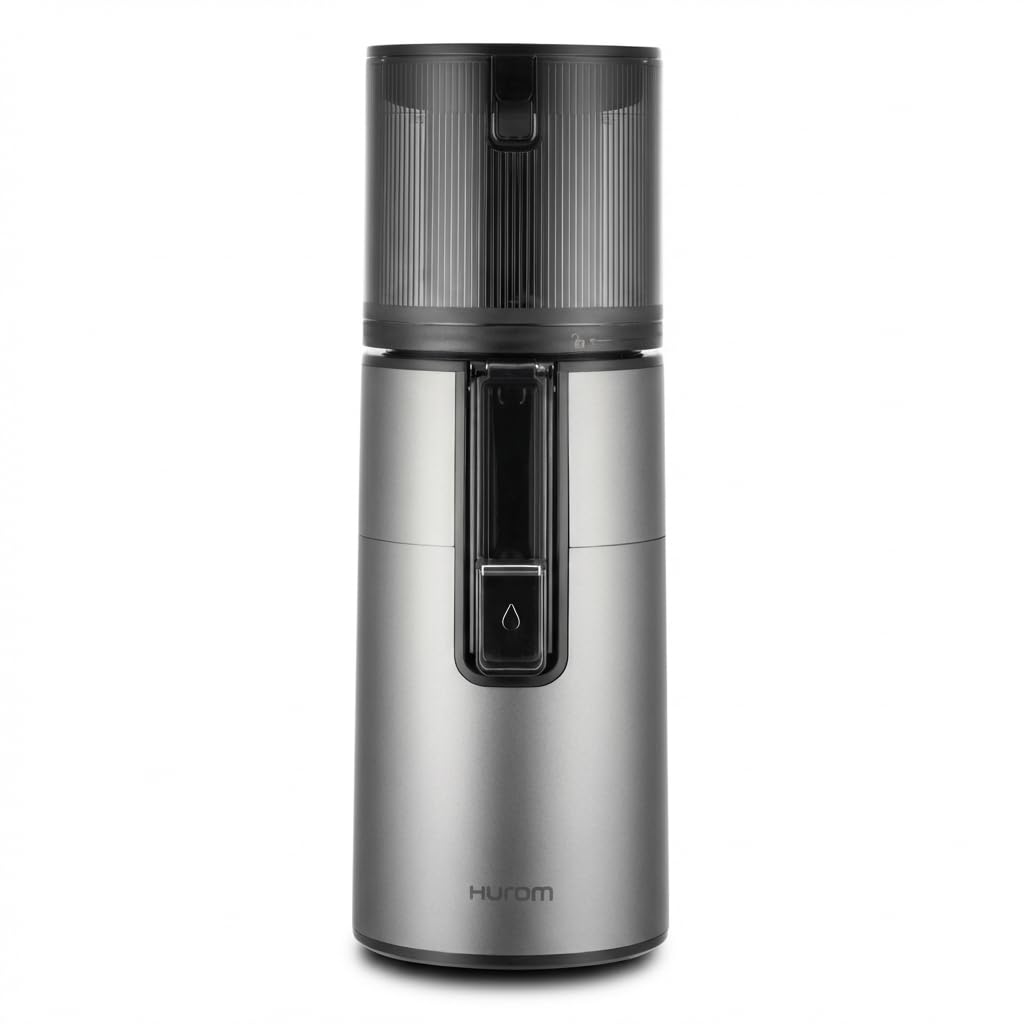
The premium top of the Hurom line: a self-feeding hopper, titanium parts, and a design built around cleaning being easy.
The H400 is Hurom’s answer to the everyday cleanup complaint. Its rear-loading hopper fits whole produce, so no chopping is required, and the juicer is built specifically around its “Easy Clean” design — a rinse with soapy water, no scrubbing, gets the parts ready for next time. The material spec is titanium, and the juice contacts are BPA-free and hand-wash only. It also carries an internal pulp container rather than a separate cup, which keeps the footprint more compact on a counter even though the unit itself is a substantial appliance. The button control and hands-free operation push it firmly into the premium tier of this roundup.
What buyers find is that the cleaning advantage is not marketing — it is the reason the machine gets used. Reviews repeatedly describe the assembly and disassembly as easy and fast, the build as luxurious and durable, and the pulp container as large enough to hold a full session without emptying. The juicing itself is versatile: citrus, watermelon, and standard fruits and vegetables all performed, and nut milk comes out pulp-free and creamy with no special accessory. It handles high produce volume without complaint, and it looks good enough to sit on an exposed counter rather than getting tucked away.
Two realities keep it honest. First, the H400 will not clean itself — leave it unwashed and dried fiber needs soaking and a soft brush to release, so the easy-clean promise depends on rinsing right after use. Second, it is the most premium-priced machine in this roundup; that is the trade for the titanium build, internal pulp storage, and long-term reputation. If you are buying a slow juicer primarily as a long-term investment and want the easiest daily cleaning, the H400 is the choice — just commit to the post-juice rinse.
What makes it premium
- Self-feeding hopper takes whole produce — load and go, no chopping
- Designed for easy cleaning — soapy rinse, no scrubbing needed
- Internal pulp container keeps the counter tidy and the footprint compact
- Titanium build and BPA-free components across juice-contact parts
Where it asks more
- Premium-tier outlay — the most expensive machine in this roundup
- Dried-in fiber is hard to clean if you do not rinse right after use
The one to buy if: You want premium titanium build, easy cleaning, and hands-free whole-produce loading in a single machine.
Be aware: The easy-clean advantage depends on you rinsing after every session — leave it sit and the pulp dries into a scrubbing job.
Understanding the Specs
Auger Speed (RPM) and Yield
RPM — revolutions per minute — is how many times the crushing auger turns each minute. Slow juicers here run from 58 RPM (Godspeeds) to 60 RPM (AMZCHEF, SMALLHOO, Kuvings). Slower is not a flaw — it is the point: less speed means less heat and less air whipped into the juice, so nutrients and flavor stay intact longer. Yield claims vary and should be read as the maker’s figure: the AMZCHEF says up to 30% more juice, the Godspeeds, Aeitto, and TUUMIIST say up to 99%, and the TUUMIIST also states it targets up to 95% with bone-dry pulp. Higher yield means less produce wasted per glass.
Motor Wattage, Chute Width, and Pulp Control
Motor wattage is the auger’s driving force, and bigger wattage generally means the auger can push through fibrous produce without stalling. The range in this roundup spans 150 watts (Hurom H320, Ninja JC151NV) up to 350 watts (SMALLHOO and TUUMIIST), with 250 watts on the AMZCHEF and Aeitto and 300 watts on the Godspeeds. Chute width — measured in inches — decides how much chopping stands between you and a glass; wider means hands-free loading. Pulp filters let you adjust texture in the glass: Ninja includes two, and the Hurom H320 offers fine and coarse strainers.
Capacity: Jug, Pitcher, or Hopper
Capacity measures how much juice you can produce before you have to stop and empty something, and it varies widely. The Godspeeds cup holds 473 ml — a glass or two. The Ninja ships with a 24 oz (30 fluid oz) jug and a 36 oz pulp container. The Hurom H320 lists 2 liters, the TUUMIIST a 3-liter (100 oz) pitcher, and the SMALLHOO a 120 oz hopper. Pick your capacity based on how many people drink juice in a sitting — the more people, the more you want batch capacity rather than refilling the cup.
Warranty, Cleaning, and Quiet Operation
Warranty coverage here spans from 1 year (SMALLHOO, TUUMIIST) up to 10 years (Godspeeds, Kuvings) — a wide gulf that matters when you plan to keep the machine for years. Cleaning is more than a convenience spec — it is what decides whether you actually use the juicer. Dishwasher-safe and tool-free parts shorten cleanup to minutes; a short parts count makes a rinse enough; a long pulp chute means more work. For noise, look at the decibel figure where given — the Godspeeds runs under 58 dB and the TUUMIIST under 60 dB, both roughly conversation-level and fine for early morning.
FAQ
What is a slow juicer and why is it different from a regular juicer?
Will a slow juicer fit under my kitchen cabinets?
How much prep work is actually required before juicing?
How long does fresh juice last from a slow juicer?
Can I juice leafy greens and hard vegetables in the same machine?
How loud is a slow juicer compared to a blender?
Do slow juicers need a lot of cleaning after every use?
Is a wider feed chute worth paying more for?
How long should a slow juicer last?
Do I need to peel and pit fruit before juicing?
What is the difference between a masticating juicer and a cold press juicer?
Final Thoughts: The Verdict
For most homes, the best slow juicer winner is the Hurom H320 because it turns juicing into a hands-off routine — a self-feeding hopper for whole produce, a genuinely quiet 150-watt motor, and dry pulp that tells you the extraction is working. It is a countertop fixture rather than a cupboard appliance, so if your space is tight, weigh that. If you want a serious slow juicer without committing to the premium tier, the Godspeeds 6-inch Chute gives you a wide chute, a 300-watt motor, and a 10-year warranty at the value end. And for anyone who wants to juice, make nut milk, and churn sorbet from one machine, the SMALLHOO TM-1080SJ is the one to reach for. Match the chute width and capacity to your counter and your daily glass count, and the machine earns its spot.
How We Picked
We do not accept paid placement. Every pick is matched to a real buyer and a real use-case; we do not hands-on test units.
Sources & Methodology
Specifications: manufacturer listings and product documentation. Review insights: verified customer reviews, as of September 2026. Pricing: not shown on this page (it changes often); check the current price via the retailer link.
As an Amazon Associate, KitchPrep earns from qualifying purchases. This does not affect which products we feature.
Related Guides
