Specs are compiled from manufacturer listings and verified buyer reviews and can change over time — please confirm the key details on the product page before buying.
Carbon monoxide gives you no warning at all — no smell, no colour, no sound — so the homes that stay safe usually cover two floors instead of one. A two-pack lets you guard the sleeping floor and the boiler level at the same time, so a leak near the furnace still wakes someone upstairs. Every pick below holds exactly two units in the box, and each one works a little differently: some plug into a wall outlet, some run on batteries alone, and the right choice depends on where you need coverage and whether an outlet sits nearby.
I’m Mohammad Maruf — the founder and writer behind KitchPrep. This guide is built by comparing the manufacturers’ published specifications and the patterns across verified customer reviews, so you get each pick’s real strengths and trade-offs instead of marketing spin.
Some models plug straight into a wall socket and keep a battery in reserve for outages, while others run on batteries alone so they can sit anywhere. Either way, a 2-pack carbon monoxide detectors setup is the cheapest way to protect two floors at once.
Our Picks at a Glance

How To Choose The Best 2-Pack Carbon Monoxide Detectors
Anything that burns fuel can make carbon monoxide — a gas boiler, a wood stove, a propane heater, even a car left running in an attached garage. The gas is colourless and odourless, so it builds up while you notice nothing. The detector does the noticing for you. Because CO spreads through a house, the standard advice is one alarm per level plus one near every sleeping area, and that is exactly where a two-pack earns its place.
The choice that decides everything: plug-in or battery-only
A plug-in alarm pulls steady power from a standard wall outlet, so you never think about it — and the good ones add a battery backup that keeps watching during a blackout. The catch is placement: it has to live near an outlet, which is rarely where you actually want it. A battery-only alarm goes anywhere you can drive a screw or set it on a shelf, which is why it suits basements, garages, and hotel rooms.
Think honestly about your house before you pick. If you have an outlet near the furnace and another in the hallway outside the bedrooms, a plug-in pair is the tidy answer. If your boiler sits in a corner with no socket, or you want one in a cabin, take the battery-only route and accept swapping batteries on a schedule.
Why the digital display matters more than you think
A plain alarm stays silent until CO crosses its threshold, then shrieks. That covers emergencies, but it tells you nothing about a slow, low-level build-up from a poorly vented appliance. A digital display shows the actual level the sensor is reading — often in parts per million (the number of gas molecules per million parts of air) — so you can watch whether a number creeps up over days or sits flat at zero.
Every alarm here with a display also keeps a memory of the highest level it has seen. That helps when you come home to a beeping unit and want to know whether it was a real event or a nuisance trip.
Loudness, lifespan, and where you put them
Loudness is measured in decibels (dB — a unit for how loud a sound is), and the alarms in this roundup all sit around the 85-decibel mark. That is roughly the volume of a busy restaurant right at your table. That is the point: it has to cut through a closed bedroom door while you are asleep. Mount yours high on a wall or on the ceiling near where you sleep, not tucked behind furniture.
Finally, no CO alarm lasts forever. The sensor inside wears out, and every unit here carries either an end-of-life signal that chirps when it is time to replace it or a stated product life you can track on a calendar. Write the install date on the back of the unit so you never guess.
Quick Comparison
| Model | Best For | Power Source | Digital Display | Alarm Volume | Amazon |
|---|---|---|---|---|---|
| Kidde Plug-In with 9V Backup (2 Pack)★ Best Overall | Whole-home coverage with a live CO readout | 120V plug-in with 9V battery backup | Yes | 85 dB | Amazon |
| Siterlink Plug-In with 10-Year Backup | Travel, hotels, and outlet-close spots | AC plug-in with 10-year battery backup | No — status light only | — | Amazon |
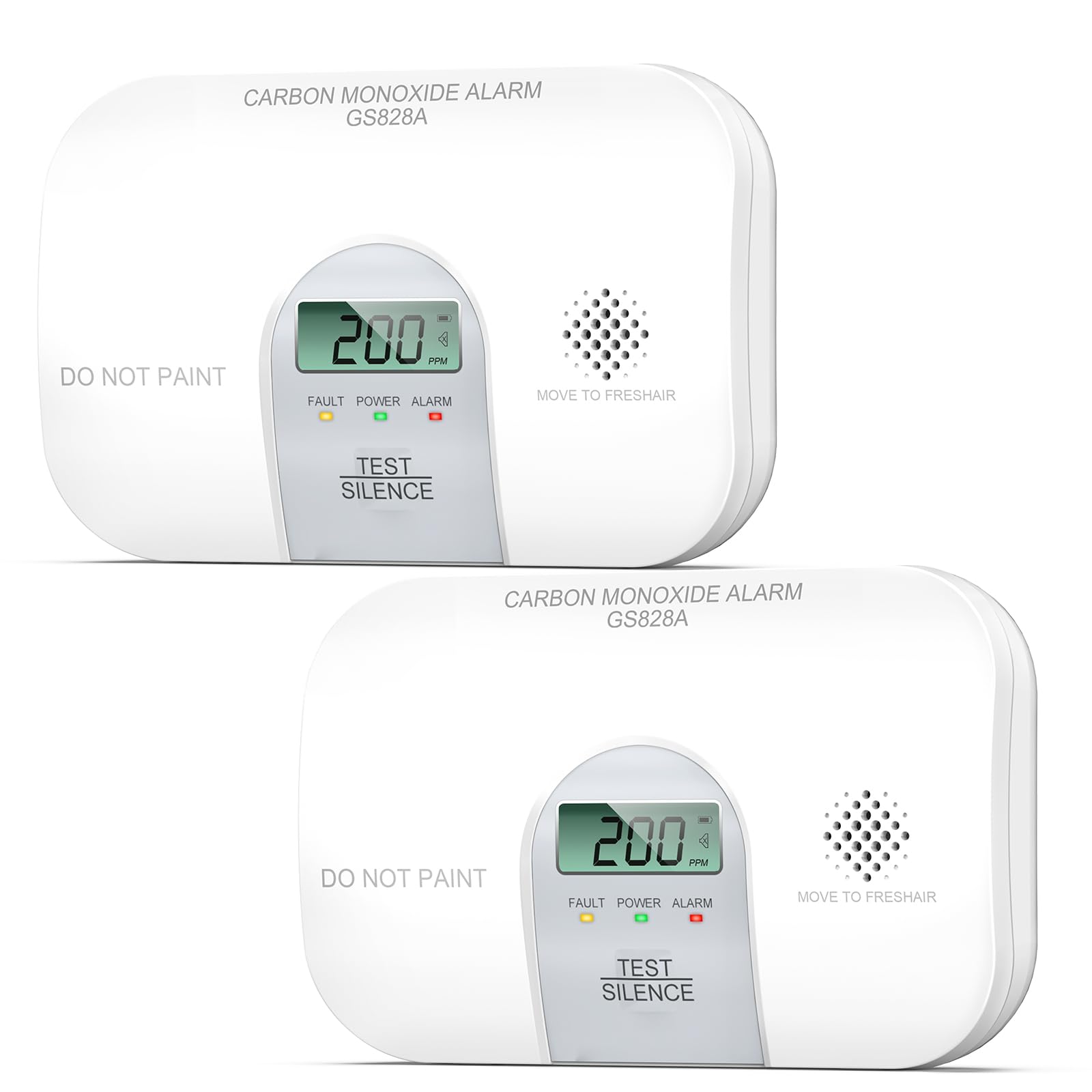
| SITERWELL GS828A LCD Alarm | Room-by-room placement with a visible CO number | AA battery only | Yes — LCD | 85 dB or more | Amazon |
In‑Depth Reviews
1. Kidde Carbon Monoxide Detector, Plug In Wall with 9-Volt Battery Backup, Digital LED Display – 2 Pack
Our pick — over 4.5★ from 700+ verified ratings; the strongest balance of quality and price.
A live CO number on the screen — not just a siren you have to guess about.
This pair tops the list because it shows you a real CO reading and keeps a battery inside for blackouts — two things the Siterlink below does not offer. Each unit plugs into a standard 120V outlet and runs on household power day to day, so there is nothing to remember. The screen displays the actual level of carbon monoxide the sensor is sensing, which turns a mystery beep into a readable number. Glance at it on your way past and you know straight away whether things are normal.
When the power drops, the included 9-volt battery takes over and the alarm keeps watching. That backup also lets the unit run on battery alone if you move it somewhere without a socket. Owners call it dependable rather than twitchy — one wrote it is “not hypersensitive as some are,” and the display “also give you an idea of what’s going on and which way it’s heading.” The Peak Level Memory is the quiet gem here: it records the last time CO was detected, so if an alarm fired while you were out, you can see how high it climbed instead of guessing.
The loudest thing buyers report is genuine relief when the alarm fires at 1:30 AM. Buyers describe both alarms sounding at 1:30 AM, one reading 463 and the other 268 and climbing when it should have read zero — the kind of night where the alarm is the only reason anyone woke up. Keep in mind the 9-volt battery is part of the deal: pull it and the unit chirps a loud low-battery warning until you fit a fresh one. Treat the battery as a real part of the system, not an optional extra.
What earns its keep
- Digital LED display shows the live CO level rather than just alarming
- Peak Level Memory records the last detection so you can see what happened
- 9-volt battery backup keeps protection alive through a power cut
- 85-decibel alarm plus easy reset and peak buttons on the face
- Backed by a 10-year limited manufacturer warranty
Worth knowing before you buy
- Needs a standard 120V outlet nearby for its main power
- Requires the 9-volt battery to be fitted or it beeps a low-battery warning
- Occasional units ship with a weak backup battery that needs swapping early
Best fit: anyone with an outlet near the furnace and another near the bedrooms who wants to see real CO numbers, not just hear a siren.
Look elsewhere if: your boiler corner has no socket at all — a battery-only pair below will serve you better there.
2. Siterlink Carbon Monoxide Detectors Plug in, 10 Year Replaceable Battery
The one that folds flat, drops in a suitcase, and works in a hotel room.
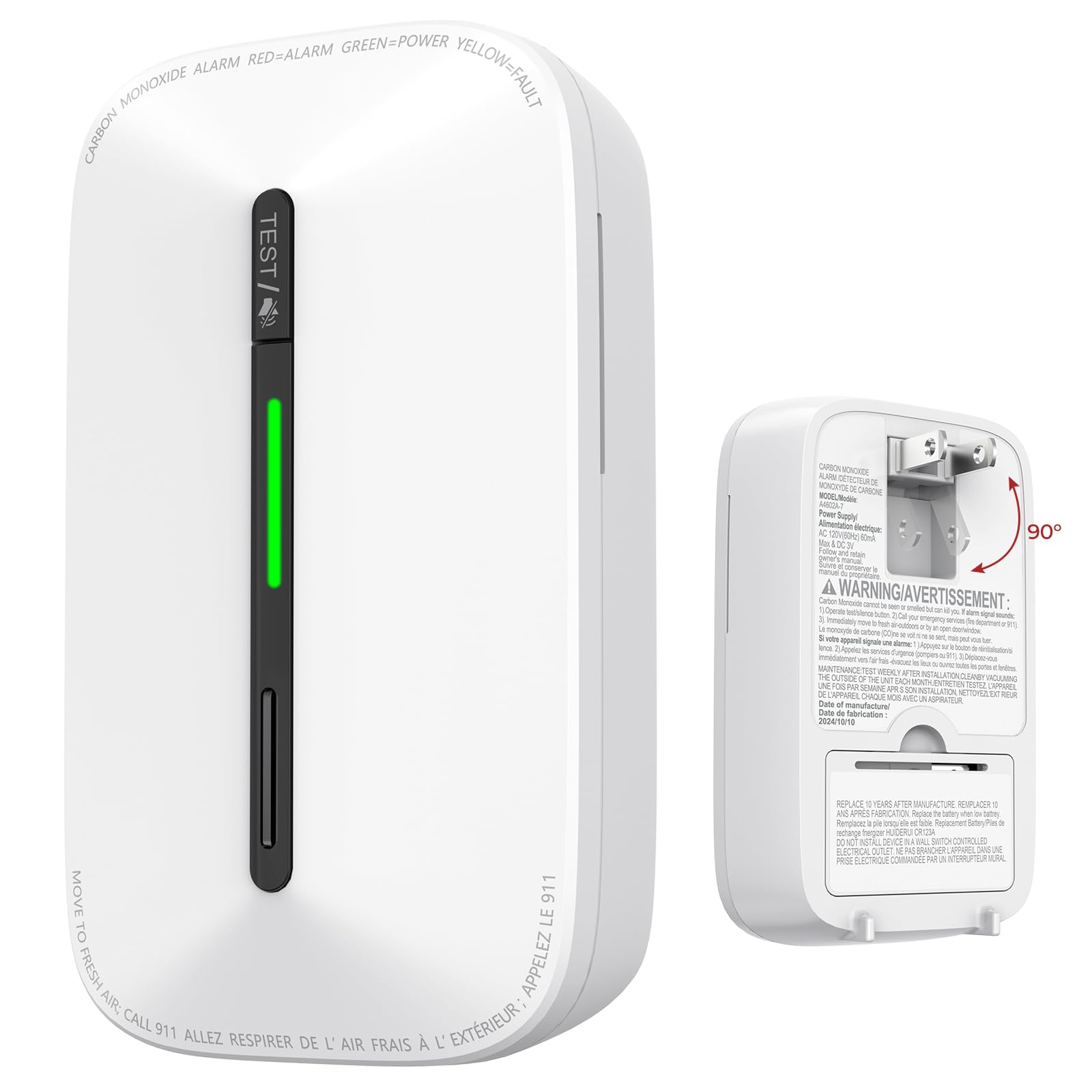
What wins this pair its spot is a plug that folds down, so the whole unit flattens into a carry-on with no cord to snag. Once you reach the other end, you unfold it, push it into any standard outlet, and you are done. Owners mention setup in minutes: unfold the plug, push it into any standard outlet, and there is nothing to wire and no app to configure.
The claimed battery story is the headline: an AC plug-in that runs on mains power, with a 10-year battery backup that keeps the sensor alive through a blackout. Elsewhere the engineering leans toward calm — a soft, breathing-style green glow designed to sit in a bedroom without lighting up the ceiling. Inside, an electrochemical sensor (a cell that reacts to carbon monoxide gas rather than burning a filament) is tuned to cut down on nuisance alarms. Owners rank the fold-flat plug and cordless setup above everything else, and the 6.06-inch body packs into a carry-on where a fixed wall alarm never could. It is smaller than the First Alert CO400 — 1.75″D x 3.75″W x 6.06″H versus that model’s 4″D x 9″W x 6″H — so it slips into a bag the CO400 never would.
Understand the trade before you commit. There is no digital readout here — you get a red, yellow, or green status indicator rather than a live CO number, so if you genuinely want to watch levels creep, the Kidde above shows figures this one will not. It is also sold as a single unit per listing, so a “pair” means buying two. For a cottage, a rental, or a hotel bag, though, the fold-flat plug is the feature you will actually notice every trip.
Why travellers pick it: the foldable plug and compact body mean this alarm lives in a carry-on as easily as it sits in a hallway outlet — and the 10-year backup means a power cut does not leave you blind. Customers note it “installs in under 5 min” — unfold the plug, push it into an outlet, done.
The honest trade: no digital display and no live CO figure, so you get a status light rather than a number. If reading levels matters to you, this is not the pair.
Reach for this if: you split time between a home, a rental, and hotel rooms, and want a detector that folds flat and sets up in minutes.
Skip if: you want to watch an actual CO number on a screen — the Kidde or SITERWELL below gives you that instead.
3. First Alert Battery Carbon Monoxide Alarm

No outlet, no cord, no excuse — it goes wherever the risk actually is.
No socket where the danger actually sits? That is the whole reason this pair made the list — it runs purely on batteries, so you screw it to a wall or set it on a shelf and it starts monitoring immediately. Reviewers point out wall-mounting in minutes with no hardwiring and no outlet needed, which is why this battery-only pair ends up in basements, garages, and cabins as often as hallways.
What has kept this model around for years is that it is a straight-ahead device: an electrochemical sensor that reads CO anywhere in the room, an 85-decibel alarm when levels turn dangerous, and a build owners call sturdy and unobtrusive. The company’s own guidance is to put one on every level and in each bedroom, and a two-pack gets you most of the way there. It arrives with a 9-volt battery included, and buyers have reported buying two 2-packs to cover a first floor, a bedroom, a basement, and even a winter car kit for the blizzard season. Note that it is a slightly larger unit than the Siterlink — 4″D x 9″W x 6″H versus that model’s 1.75″D x 3.75″W x 6.06″H — and it weighs 12.8 ounces against the Siterlink’s 16 ounces, so it stays a genuinely compact wall fixture despite the broader face.
The one thing to go in knowing is the battery situation. The alarm works on batteries alone, which is the freedom you are paying for — but a few units have arrived with a dead cell in the box, so test each one the day it lands and swap the battery if the chirp starts early. There is also an end-of-life signal built in that chirps when the unit is done, plus a five-year limited warranty. Treat it as a long-term tenant rather than a permanent fixture and it does its job quietly.
The real-world read: buyers who replace an ageing detector with this exact model tend to stay with it — a direct swap that has plainly worked for a long time, no wiring, no fuss.
The caveat that matters: because it is battery-only, a dead or weak cell silences it completely. Test on arrival, then keep a spare 9-volt on the shelf.
Built for: the boiler room with no outlet, the garage, the cabin, and the winter car bag — anywhere a plug-in can’t reach.
Think twice if: you want a live CO number on a screen, or you would rather never touch a battery again.