
Specs are compiled from manufacturer listings and verified buyer reviews and can change over time — please confirm the key details on the product page before buying.
If you are tiling a bathroom, a kitchen floor, or a whole house remodel, you already know the rental counter is a trap. You rent a wet saw for one weekend, fight a blade that wanders, and pay again the next weekend when the job runs long. A 10-inch wet tile saw cuts with a spinning diamond blade while water runs over it, which keeps dust out of the air and stops the blade from overheating. That water cooling is the whole reason wet saws cut porcelain, granite, and natural stone cleanly instead of chipping the edges.
I’m Mohammad Maruf — the founder and writer behind KitchPrep. This guide is built by comparing the manufacturers’ published specifications and the patterns across verified customer reviews, so you get each pick’s real strengths and trade-offs instead of marketing spin.
Here is the honest part up front: a few picks on this list sit slightly above or below the exact 10-inch figure, so treat “10-inch class” as a range rather than a single number. The nearest same-size or same-power machine does the same job, and you will see the real blade size named in every entry. This guide covers what to buy for backsplashes, large-format floors, and stone work, so you can pick the right 10 inch wet tile saw for the job in front of you.
Our Picks at a Glance


How To Choose The Best 10 Inch Wet Tile Saw
A wet tile saw is a specialty tool, and the specs that matter are different from a circular saw or a miter saw. You are not just cutting wood; you are cutting hard, brittle material that chips easily if the blade wobbles or runs dry. The good news is that a handful of numbers tell you almost everything about whether a saw can handle your job.
Rip capacity is the number that decides your job
Rip capacity is the longest straight cut the saw’s cart can travel through a tile. A saw with a 28-inch rip capacity can cut a 24-inch tile, but it will struggle with a 36-inch plank. If you are working with large-format porcelain or stone, look for a rip capacity that comfortably exceeds your biggest tile. The DeWalt D36000S, for example, lists a 37-inch rip cut capacity, and that is what lets it rip a 36-inch-by-36-inch tile in half.
Water delivery and containment
Every wet saw pumps water onto the blade to cool it and wash away the slurry (the fine dust-and-water paste that cutting creates). A good pump and a well-sealed pan keep that water in the tray instead of on your floor. Splash guards on the rear and sides catch most of the spray, but light mist still escapes — plan to lay down a drop cloth regardless of which saw you buy.
Quick Comparison
| Model | Best For | Blade Size | Motor / Speed | Max Rip Capacity | Amazon |
|---|---|---|---|---|---|
| DEWALT D24000S★ Best Overall | Best Overall | 10 in. | 1.5 HP, 120V | 28 in. with plunge | Amazon |
| Delta CruzerTop Precision Pick | Precision cuts | 10 in. | 15 Amp, 4,200 RPM | 34 in. | Amazon |
| VEVOR TC250VI-I | Large tile on a budget | 10 in. | 15 Amp, 4500 RPM | 36 in. | Amazon |
| DEWALT D36000S | Large-format pro jobs | 10 in. | 15 Amp, 1,220 MWO | 37 in. (41 in. plunge) | Amazon |
In‑Depth Reviews
1. DEWALT Wet Tile Saw with Stand, 10-Inch, Corded (D24000S)
Our pick — over 4.5★ from 800+ verified ratings; the strongest balance of quality and price.
A 1.5 HP, 10-inch saw with a 5-gallon water tray that keeps the deck dry.
This is the saw to buy if you are a serious DIYer who wants a professional-grade machine without renting one every weekend. The blade spins at a fixed 1.5 peak horsepower on standard 120-volt household current, drawing 1.5 amps. That is enough power to cut through marble and travertine, and the motor holds steady without tripping a typical household breaker. The 10-inch blade is common enough that you can walk into any hardware store and buy a replacement when the original wears down.
The real story here is the water system and the cutting accuracy. A 5-gallon water tray catches the spray, and side trays return the runoff, so the deck around the saw stays surprisingly dry. The cutline indicator and stainless steel rollers let you hold accuracy to within 1/32 inch over an 18-inch cut, which is the difference between a grout line you are proud of and one you try to hide behind furniture. When you need to cut a 24-inch tile, the sliding cart handles it without complaint, and the table measurements line up accurately with the markings.
The catch here is weight, and it only matters if you are moving the saw by yourself. At 53.6 pounds, this saw is noticeably lighter than some of the premium 10-inch machines, but the review pages still call it heavy and awkward. Owners do note it breaks down into pieces that take four trips to move, and the motor is loud enough that hearing protection becomes a real consideration. There is also a common gripe that the stock blade chips tough porcelain badly; upgrading to a mesh-style rim blade fixes that quickly. If you need a saw that can rip 36-inch tile, the two D36000 models below are built for that job instead.
What buyers keep coming back to
- Peak horsepower of 1.5 HP handles marble and travertine without stalling on the tile
- Cutting accuracy of 1/32 inch over 18-inch cuts thanks to the cutline indicator and steel rollers
- Water pan and side trays keep the work area genuinely dry
- Compact saw frame allows for easy transport and storage in a vehicle
- Value for money is frequently praised since it costs less than comparable models
What to know before you buy
- At 53.6 pounds it is awkward to move assembled and breaks down into multiple trips
- The 1.5 HP motor runs loud enough to need hearing protection
- The included blade can chip tough porcelain, so many owners buy a replacement immediately
- No fine adjustment for uneven surfaces on the folding stand
Grab this one: for a DIY bathroom or kitchen project where accuracy matters and you want to avoid rental fees entirely.
Think again: if you need to rip 36-inch-by-36-inch tile in half — that requires a higher-capacity machine.
2. Delta – 10 in. Cruzer Wet Tile/Stone Saw
A 12-bearing rail system that keeps the cart from wiggling during long pulls.
Cuts that taper slowly across a long tile are the hardest thing to get right on a wet saw, and the Delta Cruzer is built to prevent them. The rail system rides on 12 bearings, and that is what keeps the table from wiggling during a long pull. A pro tile setter who uses it reports the stability directly enables accurate taper cuts, and that is the whole reason to pay attention to this saw. The 15-amp motor runs at 4,200 RPM, slightly slower than the VEVOR below, which translates to a steady, controllable feed rate rather than raw speed.
For capacity, this saw cuts up to a 34-inch rip and handles a 24-inch square tile on the diagonal. The maximum depth of cut at 90 degrees reaches 3 3/8 inches, so thick stone pavers are fair game. Tilting is available at 0, 22.5, and 45 degrees for bevel work. A divider in the water tray filters the slurry, and that single detail extends pump life, which is a real money-saver over the life of the saw. Buyers who have run it through granite report a famously long pull, as one puts it: “300′ linear ft cut, straight/clean.”
The honest catch is portability and the stand. A pro who runs it daily calls it quite heavy, and reviewers who work indoors note it is difficult to push through doorways unless you remove the motor first. Delta also sells a stand separately, and at least one experienced setter decided the premium stand was not worth the extra outlay and used sawhorses instead. Also worth knowing: the sliding table can drop slightly off the rail at the very back of its travel, causing a small kick-up on full pulls. If you are short on space, the folding frame on the Delta still deploys and folds faster than most competitors.
Where it wins: The 12-bearing rail system delivers a level of cart stability at this tier that is genuinely hard to match, and the built-in divider in the tray keeps the pump alive.
The trade-off: You pay for that precision in portability, since this is a heavy machine and the matching stand is a separate purchase.
Reach for this if: you cut large-format tile regularly and want the steadiest, most accurate pass at this price tier.
Look elsewhere if: this needs to be moved from job site to job site alone, since it is heavy and awkward to carry.
3. VEVOR Wet Tile Saw with Stand 10 Inch 65Mn Steel Blade Tile Cutter Wet Saw
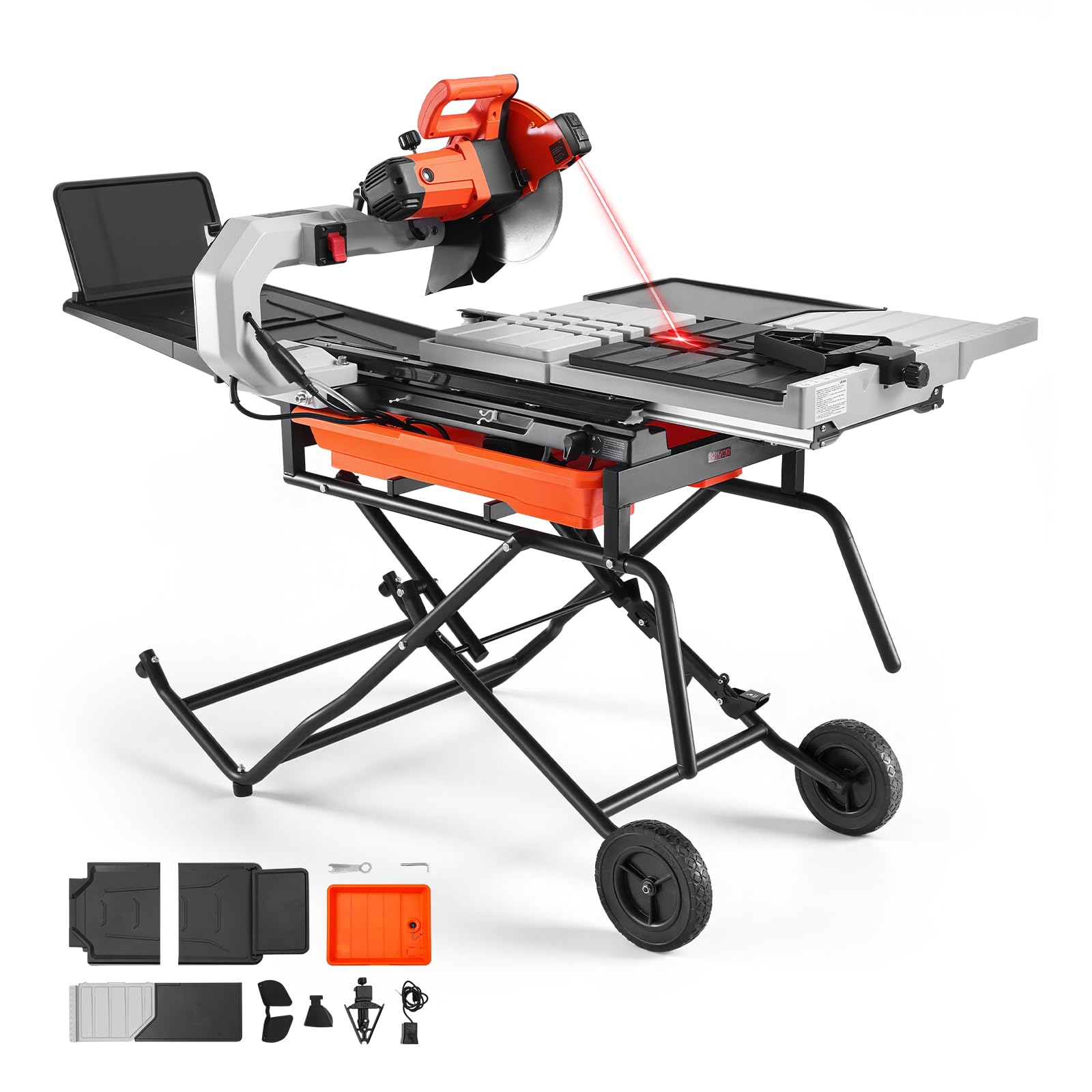
A 36-inch tile capacity and 24-inch diagonal capacity at a mid-tier price.
Here is the number that earns this saw its place: a 36-inch tile capacity with a 24-inch diagonal cutting capacity, which puts it right up against the premium machines for large-format work. The 65Mn steel blade, running on a 15-amp, 4500 RPM motor, cuts through ceramic, porcelain, floor tile, and marble. That 4500 RPM figure edges past the Delta Cruzer’s 4,200 RPM. An infrared guide line and a built-in scale help you line up straight and diagonal cuts without guessing.
The water side is well thought out for the tier. A detachable water reservoir and pump system keep the working area clean, and the idea is to reduce the dust you breathe as you cut. A 0-to-45-degree adjustable bevel, marked at 0, 22.5, and 45 degrees, opens up edge work. The base has two non-slip rubber wheels so you can roll it around a home renovation instead of dragging a bare frame. Assembly takes some patience — the printed instructions are thin and most people end up watching a video — but the machine comes together and cuts.
Be realistic about the blade. This is the machine’s known weak spot: at this price tier, the stock blade does not hold up to the same abuse as a pricier one. One 5-star buyer who used it for glass and tile put it plainly — with a better blade, it cuts well. Another left a 3-star note: “I only used it once and the blade is no good.” That is a real caveat, and the fix is simple — budget for a decent replacement blade and the saw keeps going. Also check your tile size against the cart; longer tiles can require freehand cross-cuts because the table surface is smaller than the blade’s cutting range.
This is your saw if: you want the largest tile capacity at the lowest price in this lineup and do not mind sourcing a better blade.
Skip the extra outlay promise: the con here is not the frame, it is the blade that ships in the box.
4. DEWALT Wet Tile Saw with Stand, 10 Inch, 15-Amp, 1,220 MWO, Corded (D36000S)

A 37-inch rip capacity, 41 inches with plunge, that splits 36-inch tile in half.
This saw solves the one job that stops nearly every other 10-inch saw cold: ripping 36-inch-by-36-inch tile in half. The 37-inch rip capacity does it, and if you add the plunge feature, that capacity extends to 41 inches. Left of the blade, an 18-inch cutting clearance lets you lay the large tile down flat. The 10-inch blade, running on a 15-amp motor, delivers 1,220 MWO — motor wattage output, which is a cleaner measure of cutting force than horsepower alone. That is the spec that tells you the saw will muscle through thick stone, not just backer board.
What owners rave about most is the blade and the cut accuracy. The slide glides easily and cuts large porcelain and granite without you having to flip the tile mid-pass. The cutline indicator, rigid frame, and stainless-steel rollers hold accuracy to within 1/32 inch over 30-inch cuts, and that longer certified distance is a real step up from the smaller D24000S above. A 30-year tiler who runs it daily reports it finishes a 36-inch cut in 30 to 40 seconds versus the minutes a bare-bones machine takes. And it is the driest saw in this lineup for a simple reason: the 18-inch-by-36-inch and 24-inch-by-24-inch tile footprints are fully contained inside the water tray, so slurry stays put.
The honest trade-off is weight, and it is a real consideration. At 91 pounds, this saw needs two people to move it up a flight of stairs or out of a truck. One buyer has a memorable line about needing a hand truck and a tranquilizer rifle in case the beast gets loose. It is also worth knowing that the standard DW4764 porcelain blade can chip tile initially and never fully stops doing so; many owners swap it for a Ridgid or Pearl blade to solve the issue. The 28-7/8-inch width from column to cart edge does fit through a standard 30-inch door frame, which softens the moving problem. Setup takes longer than the smaller saws, and one buyer reports the long rip cut drifting about 1/16 inch over its length.
Where it earns its keep
- 37-in. rip capacity and 41-in. with plunge handles 36-inch-by-36-inch tile
- 1,220 MWO on a 15-amp motor delivers the power to cut 1-inch-thick pavers
- Cut accuracy to within 1/32 in. over 30-in. cuts
- Full water tray containment for 18×36 and 24×24 tile keeps the work area dry
- Integrated storage keeps the cart extension, miter guide, and wrenches on the saw during transport
What to plan around
- At 91 pounds it needs two people to move and takes longer to set up
- The included blade can chip tile, so many owners upgrade to a Ridgid or Pearl blade
- Long rip cuts can drift roughly 1/16 inch across the length
Go here for: professional large-format jobs where a 36-inch rip and dry water containment are non-negotiable.
Not the one for: a solo DIYer working alone who needs to move the saw by themselves.
Understanding the Specs
Rip Capacity and Depth of Cut
Rip capacity is how long a straight cut the cart can complete, and it determines what size tile you can actually handle. A saw with 28 inches of rip capacity will cut a 24-inch tile comfortably but struggle with a 36-inch plank. Depth of cut is a separate number — it tells you how thick a slab the blade can pass all the way through. A saw like the Delta Cruzer lists a 3 3/8-inch maximum depth at 90 degrees, which is enough for thick stone pavers. Match both numbers to the largest and thickest tile in your project before you commit.
Motor Power and RPM
Wet saw motors are rated a few different ways, and the units do not always line up. Horsepower is a peak figure, while MWO (motor wattage output) is a steadier measure of cutting force — the D36000 models list 1,220 MWO, which is why they handle thick pavers and 36-inch porcelain without stalling. RPM is how fast the blade spins; the VEVOR lists 4500 RPM against the Delta’s 4,200 RPM. Higher RPM does not automatically mean better cuts — a steady feed rate at lower RPM often produces a cleaner edge on hard stone.
FAQ
Can a 10-inch wet tile saw cut through porcelain and natural stone?
What is the difference between rip capacity and depth of cut?
Do I need a stand with my wet tile saw?
How much water does a wet tile saw use while cutting?
Is a wet tile saw better than a dry tile cutter for large tile?
Will a 10-inch wet tile saw fit through a standard door frame?
What do I do about water spray when cutting indoors?
Does the included blade work for porcelain or should I buy a better one?
How heavy is a 10-inch wet tile saw and how many people does it take to move?
Final Thoughts: The Verdict
For most buyers, the 10 inch wet tile saw winner is the DEWALT D24000S because it delivers professional cutting accuracy to within 1/32 inch over 18-inch cuts, holds water in the pan, and saves you rental costs on any serious tile job. If you rip large-format tile regularly and want the steadiest cart in this lineup, the Delta Cruzer and its 12-bearing rail system is the one to reach for. And for 36-inch-by-36-inch tile that needs to split cleanly, the DEWALT D36000S and its 37-inch rip capacity is the saw that actually does the job.
How We Picked
We do not accept paid placement. Every pick is matched to a real buyer and a real use-case; we do not hands-on test units.
Sources & Methodology
Specifications: manufacturer listings and product documentation. Review insights: verified customer reviews, as of September 2026. Pricing: not shown on this page (it changes often); check the current price via the retailer link.
As an Amazon Associate, KitchPrep earns from qualifying purchases. This does not affect which products we feature.
Related Guides
