
Specs are compiled from manufacturer listings and verified buyer reviews and can change over time — please confirm the key details on the product page before buying.
If your utility keeps rejecting your meter socket, or your electrician is standing in your yard waiting on a panel that fits the space you actually have, this is the guide for you. A 200 Amp Meter Main is essentially two jobs in one box: the meter socket your power company reads, and the main breaker that shuts everything off. Choosing the right one usually depends on three things — how many breaker spaces you need, whether your feed comes from overhead or underground, and whether your utility insists on a ring or ringless meter socket. Get those three right and the rest is detail.
I’m Mohammad Maruf — the founder and writer behind KitchPrep. This guide is built by comparing the manufacturers’ published specifications and the patterns across verified customer reviews, so you get each pick’s real strengths and trade-offs instead of marketing spin.
Not every combination device fits every home, and the wrong one means a return, a re-permit, or a stalled inspection. Below you’ll find nine real 200-amp meter main options, sorted by what they actually do for the buyer — then a plain-English walkthrough of the specs that decide everything, so you can walk into the electrical supply counter knowing exactly what you need. Here’s how to pick the best 200 Amp Meter Main for your service upgrade.
Our Picks at a Glance


How To Choose The Best 200 Amp Meter Main
Call your utility before you buy anything. That one phone call saves more money than any discount — utilities approve specific meter socket types, and a rejected panel is a panel you own and cannot use. Beyond that, four specs separate a smooth install from a nightmare one.
Count your breaker spaces before you count amps
Every modern home runs out of breaker spaces before it runs out of amps. A meter main with only four spaces works fine for a simple outdoor feed to a shed or an AC unit. A whole-house panel needs sixteen or more. Ask yourself how many circuits you plan to add in the next decade — a workshop, an EV charger, a hot tub — and buy for that number, not today’s.
Overhead versus underground feed
Look at how your power actually reaches the house. Overhead feed drops from a pole to a mast on your roof; underground feed comes up through conduit from the ground. Most combination panels accept both, but some are built for one only and need an adapter for the other. Getting this wrong means a second trip to the supply house.
Ring or ringless meter socket
A ring-type socket uses a metal ring to hold the meter in place. A ringless socket holds the meter with the cover itself and no separate ring. Utilities differ on which one they will seal, so confirm your utility’s requirement directly. This single detail is the most common reason a panel gets turned down at inspection.
Quick Comparison
| Model | Best For | Amps | Circuits | Mounting/Feed | Amazon |
|---|---|---|---|---|---|
| Square D RC816F200C | Whole-house outdoor service | 200 A | 16 | Ringless, overhead/underground | Amazon |
| Siemens MM0202B1200 | Tight-space replacement | 200 A | 16 | Ring, underground/overhead | Amazon |
| Siemens MC2040B1200S | Maximum circuit capacity | 200 A | 40 | Ring, overhead surface mount | Amazon |
| ABB TSM420CSCUP | Overhead or underground flexibility | 200 A | 8 | Ring, overhead/underground | Amazon |
| Square D SC42M200PS | Solar-ready whole-house panel | 200 A | 42 | Solar-ready, outdoor surface mount | Amazon |
| Siemens MC0816B1200CT | Pole/post service builds | 200 A | 16 | Ring, overhead/underground | Amazon |
In‑Depth Reviews
1. Square D – RC816F200C Homeline 200-Amp Main Breaker 8-Space 16-Circuit Outdoor Overhead/Underground CSED
The ringless workhorse that keeps whole-house outdoor service simple.
This is the crowd favorite of the group, holding the strongest ownership base and a near-perfect score from the people who actually installed it. Its defining feature is the ringless design — no separate metal ring holds the meter in place, which is what most utilities now want for new service entrances. The enclosure is NEMA 3R rated, meaning it is built to shrug off rain, sleet, and snow while sitting on an exterior wall.
You get 16 circuits in 8 spaces, which is a practical balance for a home that wants a couple of outdoor lines — one for an AC condenser, one for a shed — without running a whole subpanel. It takes type HOM circuit breakers, so if you already run Homeline gear elsewhere in the house, your spare breakers carry over. It is rated 120/240Vac single phase and uses a 4-jaw meter socket. What owners zero in on is simple: it just works. One electrician-grade review praised the cabinet and connector quality on inspection, and the extra circuits get called out as ideal for outdoor features and an AC.
The honest catch is capacity. Eight spaces fills up fast if you are wiring a whole house with indoor and outdoor circuits — this is a service entrance for a modest setup, not a do-everything panel. Lower-amp systems also need an additional disconnect, and one exterior mounting screw is noted as stiff to turn. For most single-family outdoor service upgrades, though, this is the one to beat.
Where it earns its keep
- Ringless socket matches what most utilities seal
- NEMA 3R enclosure rated for outdoor mounting
- 16 circuits across 8 spaces handles AC and shed feeds
- Plug-on design simplifies installation and takes HOM breakers
What to weigh first
- Only 8 spaces — not built for whole-house indoor wiring
- Lower-amp setups need an extra disconnect
- An exterior mounting screw runs stiff
Reach for this if: you want a straightforward outdoor 200-amp service entrance with plenty of circuits and a utility-friendly ringless socket.
Look elsewhere if: you need to wire a full home’s worth of indoor branches — you’ll want more spaces than this box offers.
2. Siemens MM0202B1200 200-Amp Meter Main Combination
A narrow replacement box built for tight spaces and flush swaps.
When the old meter can is bolted to a wall with no room to spare, this is the panel that slides into the gap. At 18″L x 6.5″W x 17.5″H it measures notably more compact than the tall surface-mount Siemens MC2040B1200S at 14″L x 5″W x 30.5″H — the difference matters if the old meter-only box sat low on the wall. It is single phase, UL listed, and rated for outdoor use, using RX type hubs when a hub is needed.
Inside you get 16 circuits and a 200-amp main, and the terminals are copper rather than aluminum — a detail coastal owners tend to care about. The combo gives you a utility-taggable meter socket on one side and a homeowner-accessible breaker on the other, which is exactly what the newer disconnect rules ask for. A Florida homeowner who lost an outdoor meter box to hurricane damage reports it “worked great” and “passed inspection with the county.” The compact footprint is the recurring theme — owners describe it fitting where a full-size panel would not.
The critical caveat is meter style. This unit uses a ring-type socket, and plenty of utilities now require ringless instead — check before you commit, because that single mismatch means a return and a redo. Overhead applications need a weatherproofing adapter too. If your utility still accepts a ring socket and space is tight, nothing here fits better.
Where it shines: Copper main terminals, a genuinely compact footprint, and a meter-left/breaker-right layout that satisfies modern disconnect access rules make this a smart swap-in for confined walls.
The one thing to confirm: Your utility accepts a ring-type meter socket. Ringless is required in many service territories now, and that requirement alone can rule this panel out.
Fits best when wall space is limited and your utility still seals a ring meter.
Double-check first if your power company has moved to ringless sockets — verify before ordering to avoid a return.
3. Siemens MC2040B1200S 200 Amp 20 Space 40 Circuit Overhead Surface Mount Meter Load Center Combination

Forty circuits and a 22,000 AIC rating make this the capacity king.
If you are tired of running out of breaker slots, start here. This panel delivers 20 spaces and 40 circuits — 2.5 times the circuit count of the Square D RC816F200C above, which tops out at 16. That headroom is exactly what a growing home needs: wiring for a future EV charger, a hot tub, a workshop, or a generator inlet without a second subpanel. The 200-amp main sits factory-installed, and the enclosure is NEMA Type 3R for outdoor duty.
The 22,000 AIC rating is the number electricians read first — it measures how much fault current the panel can safely interrupt, so it holds up in higher-fault service areas. It is suited only for service-entrance use and overhead feed, with RX hubs for the drop. It is UL listed, has pad-locking provisions on the door, and mounts on the surface. Owners rate it well over four stars, with quality weighing most in their feedback, followed by value. It is note this is a tall, heavy unit at 33.8 pounds, and it stands 30.5″ high — noticeably heavier than the 26.6-pound Siemens MM0202B1200 above.
The common gripe is the hub. Buyers report having to source a correct fitting separately mid-install, and one noted the hub option listed did not match the box. It also needs a large knockout on the bottom that some wish came bigger. Neither changes the verdict: for sheer circuit capacity in a 200-amp overhead service, this is the panel to anchor a whole-house build around.
The capacity argument: 20 spaces and 40 circuits, backed by a 22,000 AIC rating, mean this box can absorb a decade of new loads without a rebuild.
Plan the hub before you start: The fitting is a separate buy and a frequent install snag — source the right one up front and the job goes smoothly.
Built for homeowners who want to never worry about running out of breaker slots again.
Just plan ahead on the hub fitting and the bottom knockout — line those up before install day.
4. Siemens MC2040B1200EFC 20 Space 40 Circuit 200 Amp Flush Mount Meter Load Center Combination with Ring Type Cover
 Check Price on Amazon
The GE-lineage panel built to pass a first-inspection with room to work.
The ABB TSM420CSCUP is a service-entrance meter load center with a 200-amp factory-installed main breaker and a ring-type meter socket. It runs 4 spaces and 8 circuits, so it is designed for a secondary use — feeding an outdoor subpanel, a detached garage, or a simple service — rather than wiring a full house’s indoor branches. Its standout trait is flexibility: it handles overhead or underground feed with feed-through lugs, and it takes both 1-inch THQL and 1/2-inch THQP branch breakers, which broadens your breaker choices.
The enclosure is NEMA 3R weather-rated, with a one-piece tin-plated copper bus and a G-90 galvanized steel body to resist corrosion outdoors. It meets UL, CSA, and ANSI standards, has a hinged removable door, and offers generous wire space plus pad-locking provisions. Owners describe it as sturdy and as-described, and the ability to break power right at the meter pan — giving emergency crews a fast shutoff — is a point several installers value. This is the newer ABB branding of the GE residential lineup, so the heritage behind it is well established.
Here is the one thing to settle first: this is a ring-socket unit, and utilities vary on approval. One buyer’s power company denied the ring socket, leaving the owner to buy a new meter box and breaker box. Confirm approval with your utility before you order, exactly as ABB’s own directions advise. Land that approval and this is a compact, well-built service combo.
Why owners like it
- Factory-installed 200-amp main breaker
- Handles overhead or underground feed
- Tin-plated copper bus and G-90 galvanized steel enclosure
- Hinged removable door and pad-locking provisions
What to verify
- Ring socket needs utility sign-off
- Only 4 spaces and 8 circuits — not for full-house wiring
Choose it for a secondary service or outdoor subpanel feed where you want a factory main breaker and feed flexibility.
Rule it in only after your utility confirms it accepts a ring socket — that approval is the make-or-break step.
5. Square D – SC42M200PS Homeline 200 Amp 42-Space 42-Circuit Outdoor Surface Mount Solar-Ready Combination Meter Socket and Main Breaker Load Center
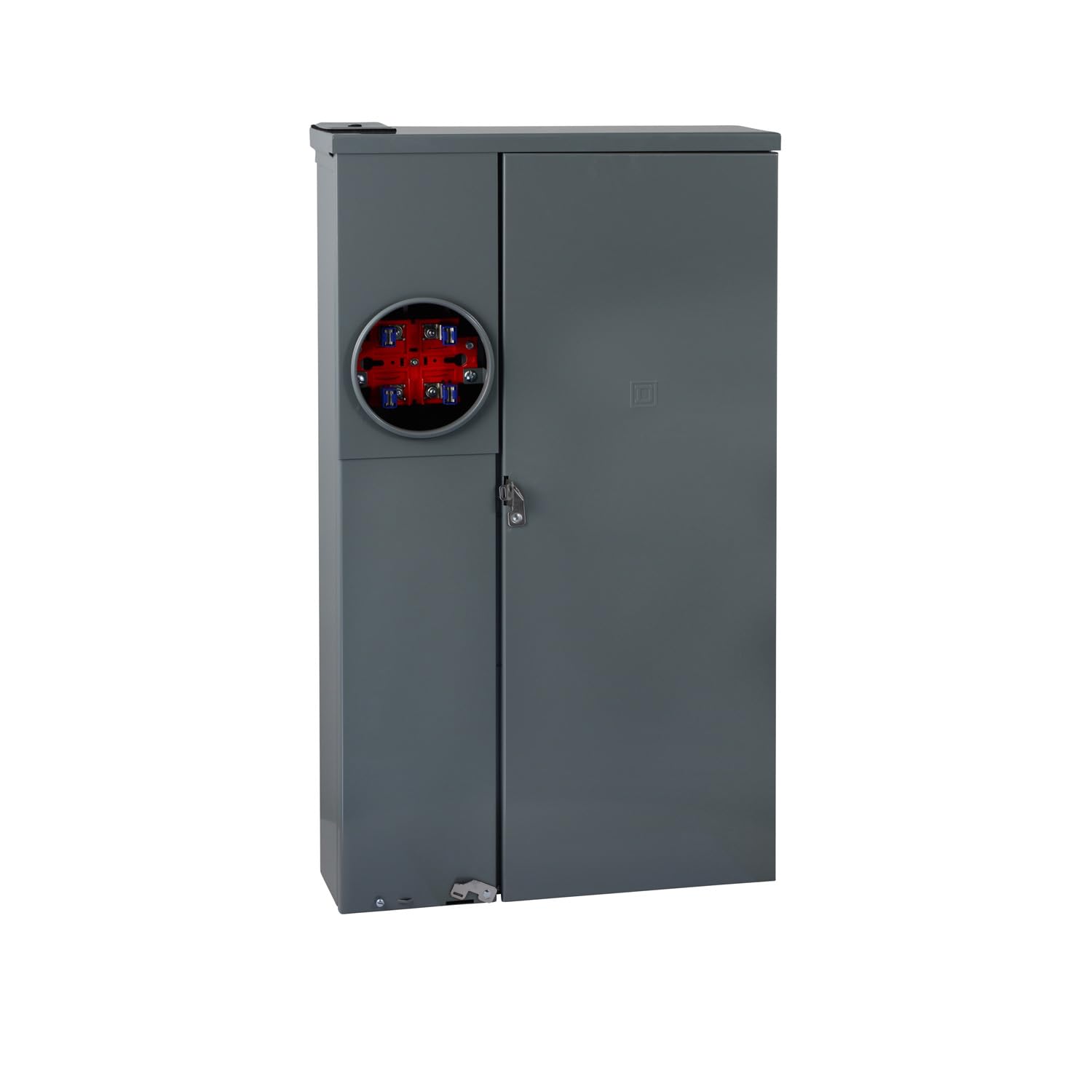
The whole-house giant that is wired for solar before you even add panels.
This is the biggest-capacity panel on the list — 42 spaces and 42 circuits, with a factory-installed 200-amp main breaker. That count tops even the Siemens MC2040B1200S’s 40 circuits, so if you want a single box to run an entire modern home, this is the one built for it. It is a surface-mount outdoor combination device that meets EUSERC specifications, and the enclosure is aluminum.
The defining feature is solar-readiness baked in. It has provisions for field-installed CTs on the line bus, takes the SR69064A solar sub-feed lug kit for connections ahead of the main breaker, and includes a fully distributed neutral bar so Homeline plug-on neutral breakers work in any space. In plain terms, you can add solar now or later without swapping the panel. Square D backs it with a 10-year warranty from installation date when paired with Square D breakers. Owners like the all-in-one layout, noting it lets them keep every breaker and the service disconnect in one place, and installation is described as easy and fast.
The trade-off is simply that it is a large, full-feature panel — more box than a small service needs, and one buyer flagged a missing green bonding ground screw on arrival. For a new build planning solar, that scale is exactly the point. Buy it if you are sizing for the long haul.
Why it wins on room: 42 spaces and 42 circuits, solar provisions, and a 10-year warranty make this the most future-proof panel here for a whole-home build.
Size it honestly: It is a lot of panel for a simple service, and it does not suit tight spaces — buy it when you are planning a full home plus solar.
Made for new construction or major upgrades with solar panels in the plan.
Too much panel if you only need a couple of outdoor circuits — scale matters here.
6. Siemens MC0816B1200CT 200A main panel, Grey
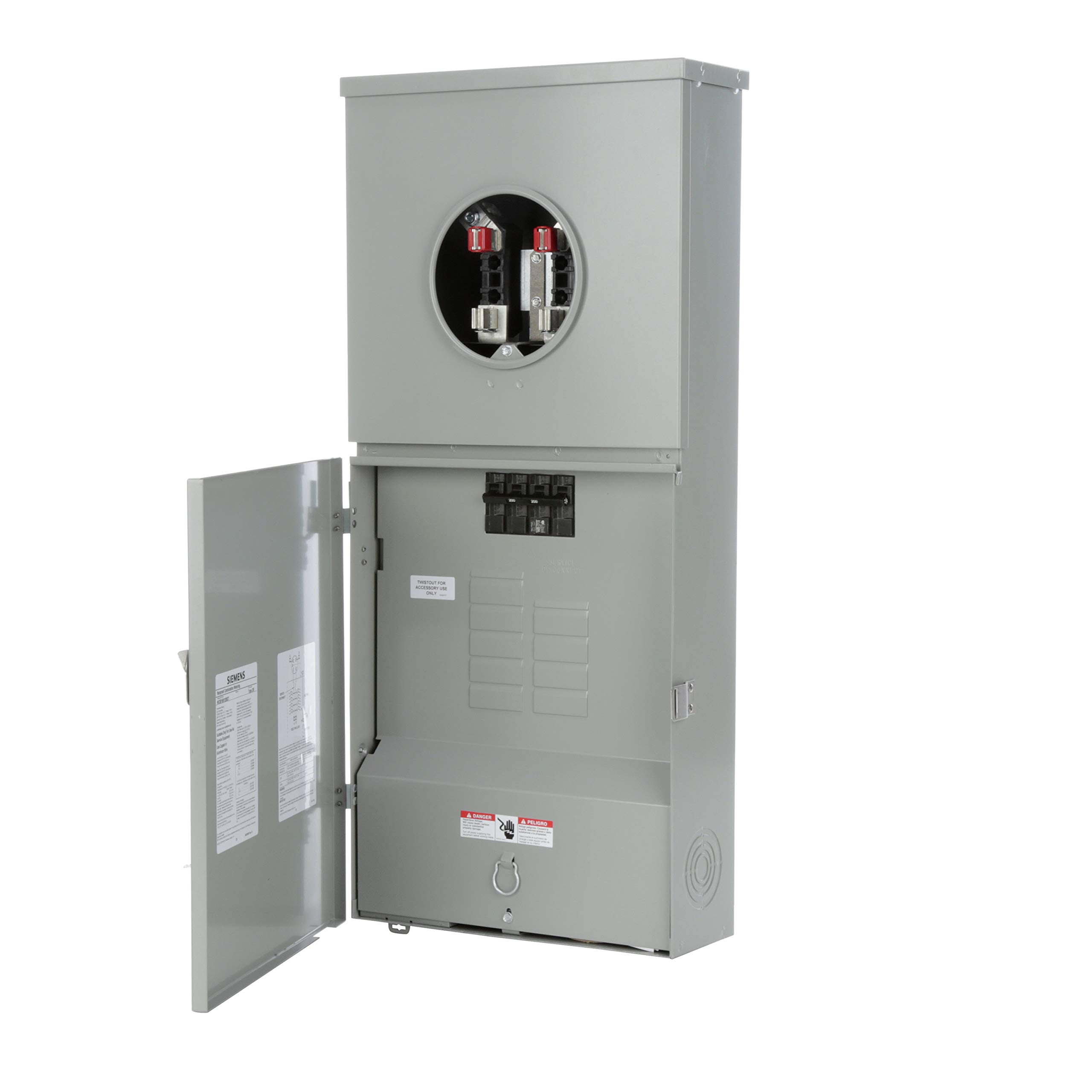
A sturdy pole-mount combo that electricians keep coming back to.
This 200-amp main panel is designed for pole or post mounting, which is why it shows up on rural properties, temporary construction services, and overhead-to-underground conversions. It packs 16 circuits with a 200-amp main, is single phase, UL listed, and outdoor rated, using RX type hubs when needed. At 32.5 pounds it has real heft, and the cabinet feels substantial in hand.
A working electrician rates it the best all-around meter/main for pole or post mounting, citing ease of install and quality, and uses it for both temporary and permanent panels near a wildfire zone. Another owner used it as a temporary service during construction before running new service underground. The panel offers room for feeders, a TVSS surge device, and breakers, with a removable raceway for bottom or left entry.
Two things to know. First, this is not a DIY job — it needs a permit and an electrician, and the swap runs a few hours with the power off. Second, the product photo shows copper bus bars but owners mention the shipped unit has aluminum bus, and the actual dimensions run larger than the listing suggests. If copper bus matters for a coastal install, verify with the seller first. For a pole-mount service, though, electricians clearly trust it.
Where it delivers
- Built for pole or post mounting
- 16 circuits with 200-amp main
- Room for feeders, TVSS, and breakers
- Removable raceway for flexible entry
Worth confirming
- Bus material may differ from the listing photo
- Requires permit and a licensed electrician
Suits you if you are mounting a service on a pole or post and want an electrician-approved combo.
Confirm before buying the actual bus material and dimensions — the listing photo does not match the shipped unit.
7. Siemens MC0408B1200T 4 Space, 8 Circuit, 200-Amp Main Breaker Meter Combination With A Ring Type Cover
Spaces and Circuits
Spaces are the physical slots in the panel; circuits are how many breakers those slots can hold, counting tandem breakers that fit two in one space. A panel with 8 spaces can hold 16 circuits. More circuits means more room to grow before you need a subpanel, so buy for the loads you plan, not just today’s.
Ring vs Ringless Meter Socket
A ring socket uses a metal ring to clamp the meter; a ringless socket clamps the meter with the cover instead. Utilities are specific about which they will seal, and a mismatch means rejection at inspection. Always confirm your utility’s requirement before ordering a panel.
AIC Rating and NEMA 3R
The AIC rating measures how much fault current the panel can safely interrupt, which matters in areas with high available fault current from the utility. NEMA 3R is the outdoor weather rating — it means the box is built to shed rain and resist the elements when mounted outside.
FAQ
How do I know if my service needs overhead or underground feed?
Will my utility approve a ring-type meter socket?
How many breaker spaces do I really need?
What does a 200 amp meter main actually do?
Is a 200 amp meter main hard to install myself?
What does the AIC rating mean on a panel?
What is the difference between ring and ringless meter sockets?
Can I add solar to a 200 amp meter main later?
Do these meter mains come with the fitting hub?
Final Thoughts: The Verdict
For most homeowners upgrading to a full 200-amp outdoor service, the 200 amp meter main to start with is the Square D RC816F200C — its ringless socket matches what most utilities now want, and it is the most proven pick here. If maximum circuit capacity is your priority, the Siemens MC2040B1200S gives you 20 spaces and 40 circuits with a 22,000 AIC rating. And if you are planning solar on a new build, the Square D SC42M200PS is the one to wire in from day one. Whichever you choose, confirm your utility’s meter socket requirement first — that one call protects the whole install.
How We Picked
We do not accept paid placement. Every pick is matched to a real buyer and a real use-case; we do not hands-on test units.
Sources & Methodology
Specifications: manufacturer listings and product documentation. Review insights: verified customer reviews, as of September 2026. Pricing: not shown on this page (it changes often); check the current price via the retailer link.
As an Amazon Associate, KitchPrep earns from qualifying purchases. This does not affect which products we feature.
Related Guides
