
Specs are compiled from manufacturer listings and verified buyer reviews and can change over time — please confirm the key details on the product page before buying.
If your basement floods every spring, the pump you pick decides whether you’re shop-vaccing at midnight or sleeping through the storm. The short answer: match the pump’s gallons-per-hour (how much water it pushes out in an hour) to your water volume, pick the right horsepower for that flow, and choose the switch design that fits your sump pit. Get those three right and the box copy stops mattering.
I’m Mohammad Maruf — the founder and writer behind KitchPrep. This guide is built by comparing the manufacturers’ published specifications and the patterns across verified customer reviews, so you get each pick’s real strengths and trade-offs instead of marketing spin.
Whether you’re replacing a pump that quit mid-storm or hardening a basement that has flooded twice, the picks below cover 1/3 to 3/4 HP and vertical-float, diaphragm, and pedestal switch styles. Read on for the best basement sump pumps.
Our Picks at a Glance

How To Choose The Best Basement Sump Pumps
To pick the right sump pump, you only need to answer three questions: how much water you need it to move, how high it has to lift that water, and what your pit looks like. Brand and price matter far less than those three numbers.
Start With Flow Rate, Not Horsepower
Manufacturers love to print the biggest number they can on the box, and that number is almost always flow rate measured at zero feet of vertical lift. If your discharge pipe climbs 10 feet to exit the house, that number doesn’t apply to you. Look for the flow rate at 10 feet instead, because that’s the number that reflects what your pump actually does when water has to travel up and out of the pit.
Match Horsepower To Water Volume
A 1/3 HP motor handles typical residential sump pits in moderate water conditions. A 1/2 HP motor gives you more margin during heavy storms or if you’re pumping from a larger basin. Move to 3/4 HP and you’re in high-volume territory — large pits, high water tables, or places where the pit refills fast enough that the pump never really rests.
Pick The Switch Type That Fits Your Pit
Vertical float switches sit in a cage or on an arm and rise with the water level. They need a certain amount of clearance. Pedestal pumps with metal switch arms let you adjust the on/off range manually, which is helpful when the baseline water level in your pit is unusual. Diaphragm switches use pressure instead of a float, eliminating float-related snags but replacing them with their own cycle-count wear pattern over the years.
Materials Tell You How Long It Lasts
Cast iron and stainless steel housings resist corrosion and heat better than thermoplastic. In a pit that runs a few times a week, a thermoplastic body may be fine for years. In a pit that cycles hundreds of times per season, the metal housings tend to earn their higher price.
Quick Comparison
| Model | Best For | Horsepower | Flow Rate | Item Weight | Amazon |
|---|---|---|---|---|---|
| WAYNE CDU980E★ Best Overall | Best Overall | 0.75 hp | 92 gpm | 12 pounds | Amazon |
| Rainbro 1/2 HP PSU051VBest Value | Budget-Friendly Pick | 0.5 hp | 56 gpm | 10 pounds | Amazon |
| WAYNE SPF33Budget Pick | Best for Tight Budgets | 0.3 hp | 63 gpm | 12 pounds | Amazon |
| Superior Pump 92551 | Best Pedestal Pick | 0.5 hp | 60 gpm | 16.5 pounds | Amazon |
| Basement Watchdog SIT-50D | Best for Narrow Pits | 0.5 hp | 73.3 gpm | 20 pounds | Amazon |
| Little Giant 6-CIA | Best Compact Pump | 0.33 hp | 46 gpm | 17 pounds | Amazon |
| Liberty Pumps 257 | Best Reliability Focus | 0.33 hp | 50 gpm | 15.2 pounds | Amazon |
| Zoeller M63 | Best Premium Pick | 0.3 hp | 43 gpm | 10 pounds | Amazon |
| Zoeller M98 Flow-Mate | Best High-Volume Pick | 0.5 hp | 72 gpm | 1.28 ounces | Amazon |
In‑Depth Reviews
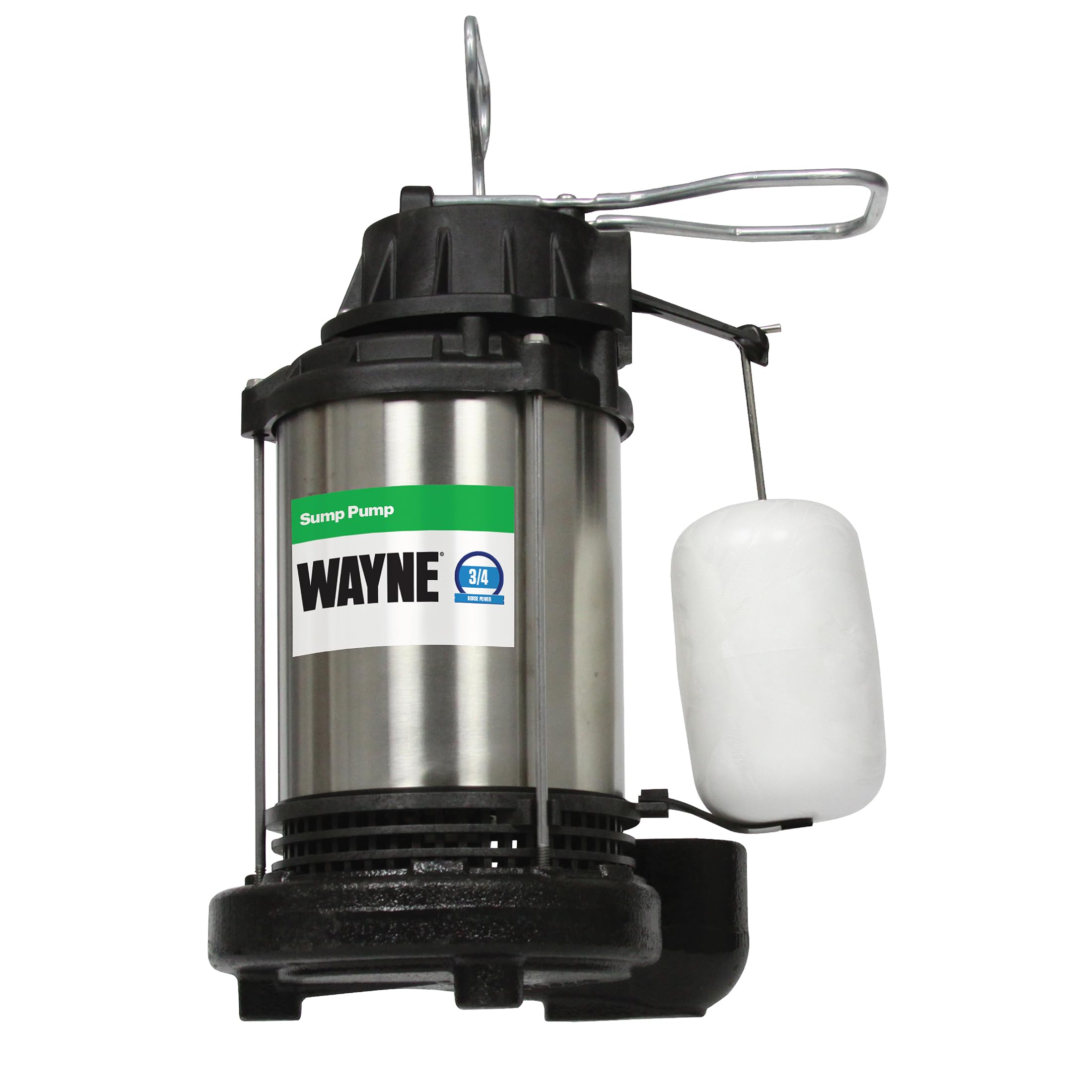
1. WAYNE CDU980E 3/4 HP Submersible Sump Pump
Our pick — over 4.5★ from 3,000+ verified ratings; the strongest balance of quality and price.
The high-volume cast iron workhorse that empties a sump pit in roughly 30 seconds.
The CDU980E carries the highest horsepower in this group at 0.75 hp — more than double the 0.3 hp rating on the WAYNE SPF33 and Rainbro 1/2 HP PSU051V. In a storm that fills your pit faster than a mid-tier pump can drain it, that headroom is the difference between a dry basement and a wet one.
The integrated vertical float switch fits into a narrow sump pit without modification, and the top suction design keeps debris from clogging the impeller — no weep hole needed at installation. The motor runs on 115V AC and handles heavy flooding rains without strain; a three-quarter-horse unit purchased as a backup suggests owners who’ve run one through a real storm tend to buy a second.
What wins people over is how quietly it runs — the motor hums at a steady, low pitch that’s easy to mistake for being off. Durability on long-term units gets more mixed feedback: some owners see years of service, while a smaller share report failures around the two-year mark. As for the size of the unit itself, its compact cast iron body sits in most standard pits, and buyers who’ve upgraded from a lighter or smaller pump typically report noticeably stronger output. If you want a high-flow submersible that moves serious water and won’t wake the house, this is the one to beat.
What sets it ahead
- 0.75 hp motor produces 92 gpm — the highest flow rate in this comparison
- Cast iron and stainless steel housing built for tough sump conditions
- Integrated vertical float switch fits narrow pits
- Top suction anti-airlock design prevents clogs without a weep hole
- Quiet enough that owners describe checking the discharge pipe to confirm it’s running
Where it asks patience
- Durability feedback is mixed — a small share of buyers report failures around the two-year mark
- Heavier and taller than budget 1/3 HP pumps, so a cramped pit needs measuring first
Best for: Anyone with a standard or oversized pit who wants the highest flow rate in this lineup and doesn’t want to hear the pump from upstairs.
Skip if: You have a truly shallow pit or need the lightest possible submersible — the 12-pound cast iron body and taller footprint won’t suit every basin.
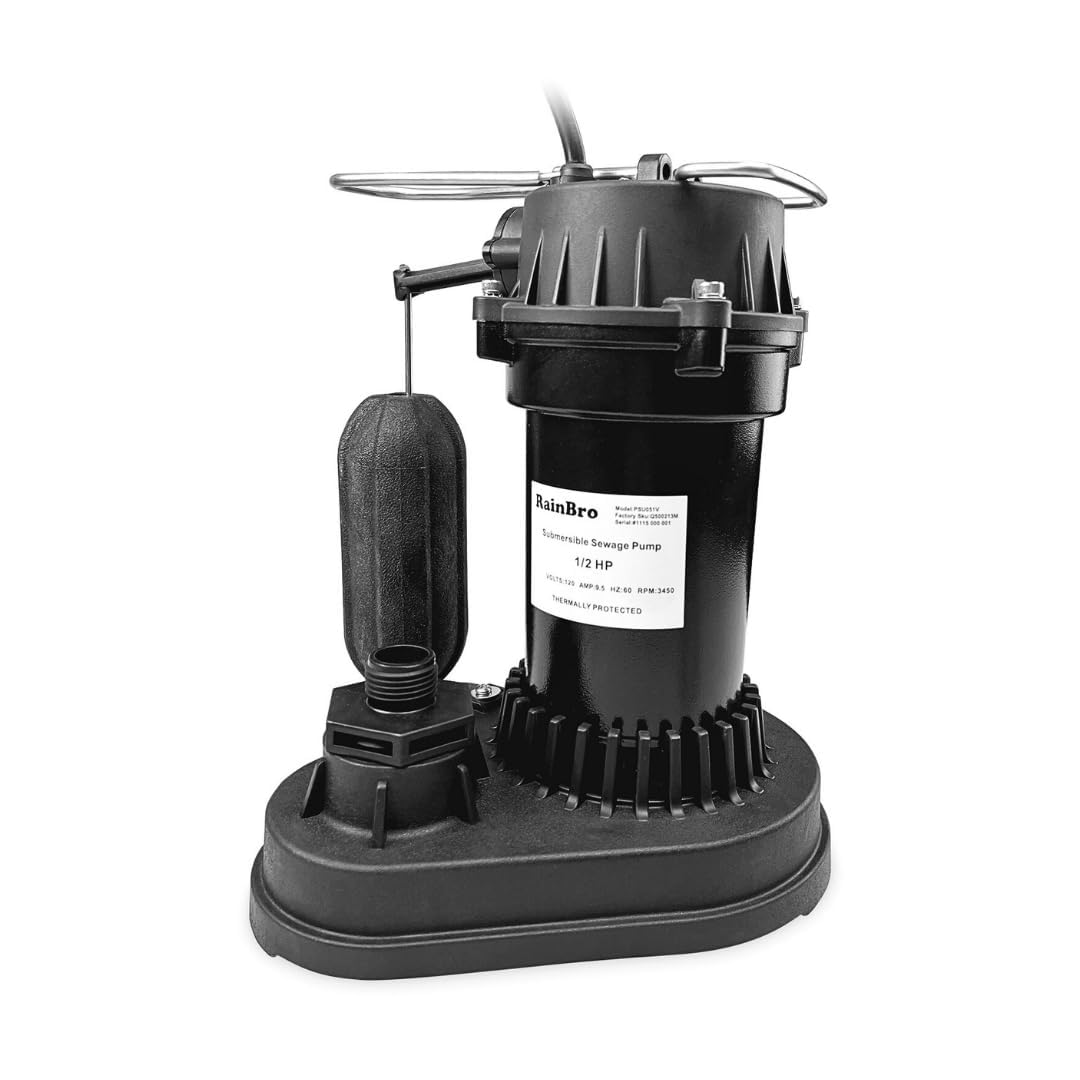
2. Rainbro 1/2 HP Thermoplastic Submersible Sump Pump (PSU051V)
A lightweight half-horse submersible that cleared a flooded crawl space in under an hour.
Half the horsepower of the WAYNE CDU980E and 10 pounds on the scale — two pounds lighter than the WAYNE SPF33’s 12. That weight gap matters more than you’d think: a lighter pump is easier to drop into a narrow pit single-handed, and easier to pull out for a quick impeller check each spring.
The numbers that count: 1/2 hp, 3,600 GPH, and 22 feet of maximum immersion depth (how deep the pump can sit fully underwater) with a 31-foot maximum head (how high it can push water). The snap-action vertical float turns the pump on at about 10 inches of water and off when the level drops back down — no manual cycling needed. It ships with a 10-foot power cord and two outlet sizes (3/4 inch and 1-1/2 inch), so you can match the discharge to your flow need. A thermal overload protector shuts the motor down if it gets too hot.
Owners describe it as quiet, easy to install, and good value. One detail worth flagging: this pump needs a sump basin of 14 inches or wider, so measure your pit before committing.
Worth knowing: The thermoplastic body trades some of the cast iron heft of pricier pumps for a lighter shell. In a pit that only runs a few times per season, that trade is easy to live with; in a pit that runs daily, metal housings tend to earn their price.
The right pick for: A first-time sump pump buyer or a spare-pump holder who wants decent flow without paying for cast iron.
Look elsewhere if: Your pit is under 14 inches wide — this one needs the wider basin to seat properly.
3. WAYNE 1/3 HP Sump Pump Coated Steel Thermoplastic SPF33
An entry-level submersible that runs whisper-quiet but asks owners to watch the float switch.
At 0.3 hp, the SPF33 is the smallest Wayne in this lineup — the same horsepower as the Zoeller M53 and M63, but with the lower entry price of the three. It moves 3,750 GPH at zero lift and steps down to 2,718 GPH at 10 feet, which is a real-world reference point since sump pumps almost always have to push water up before it exits the house. That’s less flow than the WAYNE CDU980E’s 92 gpm, so it suits a moderate-volume pit rather than a storm-charged 24-inch basin.
The 12-pound coated steel body has a corrosion-resistant thermoplastic shell over a metal frame — a hybrid that Wayne describes as long-lasting in tough sump conditions. The vertical float switch automatically turns the pump on when water rises. The top suction design helps resist clogs from dirt and debris without the weep-hole maintenance that traditional pumps need. It’s indoor-use only, and assembly is in the USA with a 1-year warranty — shorter than the double-digit warranties you’ll see on premium pumps.
Owners say this pump runs quietly — even a steady hum won’t announce itself every ten minutes. Long-term durability gets mixed feedback: some owners mention several seasons of use, while a few say it failed inside the first year. So it earns its low price, but it isn’t the pump to trust with a finished basement. The WAYNE CDU980E costs more and gives you a bigger motor and a longer warranty; the SPF33 is the pick when you need dependable basic drainage without spending more.
Who it’s for: A shallow pit in a mild-climate basement where the pump only kicks in a handful of times per season.
Where it falls short: The 1-year warranty is short, and the mixed long-run feedback means it’s better as a lightweight-duty primary than a heavy-storm workhorse.
Go with this if: You need a quiet, small, budget-friendly pump for a pit that doesn’t fill fast.
Pay up instead if: Your sump runs often during storms — the bigger warranty on the CDU980E is worth the upgrade for a heavily-cycled pit.
4. Superior Pump 92551 1/2 HP Cast Iron Pedestal Pump
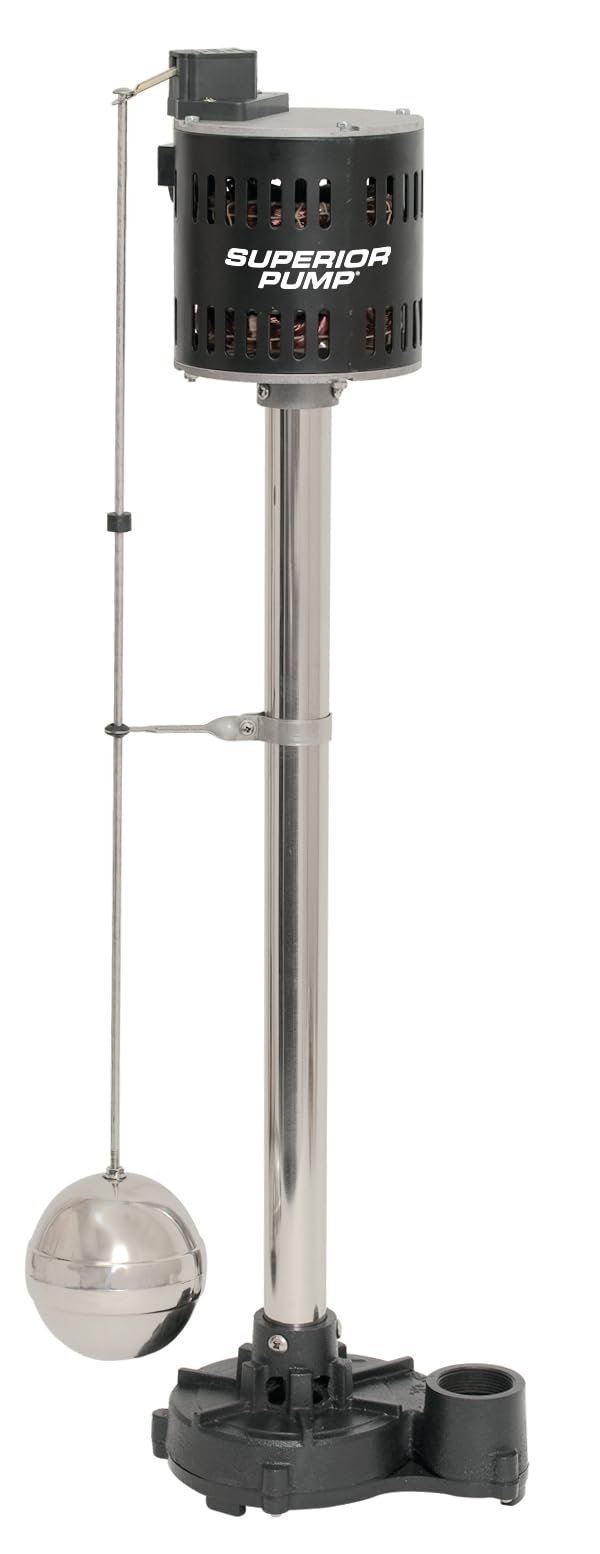
A 36-inch-tall pedestal pump for shallow pits where submersibles cycle too hard.
Pedestal pumps solve a specific problem: in a shallow or rubble-bottomed sump, submersible pumps with float switches cycle on and off too often and wear out. The Superior 92551 puts the motor up on a column while only the intake sits in the water — which means it never gets fully submerged and, per the manufacturer, will handle liquids up to 180 degrees Fahrenheit. At 16.5 pounds with a 36-inch height, it’s the bulkiest pump on this list, so it’s for a pit with headroom above the water line.
The 1/2 hp motor moves 60 gpm, which is close to the 56 gpm of the Rainbro and 72 gpm of the WAYNE SPF50 — mid-tier flow, plenty for a typical residential pit. The stainless steel and cast iron housing, solid steel drive shaft, and non-corrosive impeller are built for years in a wet environment. The metal switch arm is adjustable, which lets you fine-tune how high the water rises before the pump kicks on — useful in pits where the standing water level is unusual. It’s cULus Listed and CSA Certified, and the 5-year warranty matches what premium submersibles carry.
What owners rave about is the build quality and how quiet it runs even at 3 to 4 feet away — the kind of quiet that makes you check the water level just to confirm it’s working. That said, one buyer has suggested setting it on a paver or flat stone if your sump bottom is rocks or dirt, so the intake doesn’t pull in muck and pebbles. This is the pick for a shallow or awkward pit where submersibles haven’t been happy.
Choose this when: Your pit is shallow, has a rocky or dirt floor, or cycles often enough that submersible float switches keep failing.
Think twice if: You don’t have the vertical clearance for a pedestal — a 36-inch column needs headroom, and this pump won’t fit in a low-profile basin.
Best for: The DIYer with a farmhouse sump or an old-house pit where submersibles have become a maintenance headache.
Not for: Anyone with a standard deep submersible pit — the extra height of a pedestal would be wasted space.
5. The Basement Watchdog Cast-Iron ½ HP Submersible Sump Pump (SIT-50D)

Two floats in one cage — the redundancy play for narrow pits and dirty water.
Most submersible pumps rely on a single float switch, and if it fails, your basement floods. The Basement Watchdog SIT-50D packs two floats into a protective cage, so if one float gets wedged or stops responding, the second one still turns the pump on. The cage also blocks debris and stray wires from snagging the floats. At 6.25 by 6.25 inches wide, it’s the narrowest footprint in this lineup — tailored for tight pits where a standard pump won’t seat.
The 1/2 hp motor moves 73.3 gpm, slightly faster than the Rainbro’s 56 gpm and just above the WAYNE SPF50’s 72 gpm. The copper-wound PSC motor (permanent split capacitor — a design that runs cooler and draws less electricity) is built for longevity. Dual carbon-ceramic shaft seals and a Buna-N seal protect the motor from water intrusion. The top-discharge design lets you adjust the float height on the discharge pipe, so a smaller pit isn’t a deal-breaker — the pump adapts.
The mixed feedback on this model centers on the discharge location and float cage — some owners find the top-discharge plumbing fussier than bottom-discharge setups, especially in tight spaces. The genuine bright spot is the customer service behind it: owners who receive a unit with a damaged controller or a failed part describe replacement parts shipped quickly, and the manufacturer’s direct support being unusually hands-on. For a pit too narrow for anything else on this list, that combination is hard to argue with.
Why it earns a spot
- Two floats in a protective cage — redundancy standard pumps don’t offer
- Narrowest footprint here at 6.25″ x 6.25″, fits cramped pits
- 73.3 gpm flow rate beats most 1/2 HP competitors
- Copper-wound PSC motor runs cooler and pulses less electricity
- Adjustable float position on the discharge pipe adapts to your pit depth
What to expect
- Top-discharge layout can be tight to plumb in very shallow pits
- Occasional units arrive with a damaged controller — the fix is handled directly
Pick this if: Your sump pit is narrower than standard and you want a redundant float setup.
Reconsider only if: You strongly prefer bottom-discharge plumbing — the top-exit design takes some getting used to.
6. WAYNE 1/2 HP Sump Pump Coated Steel Thermoplastic SPF50
No mechanical float to snag — a pressure switch and an epoxy-coated cast iron shell.
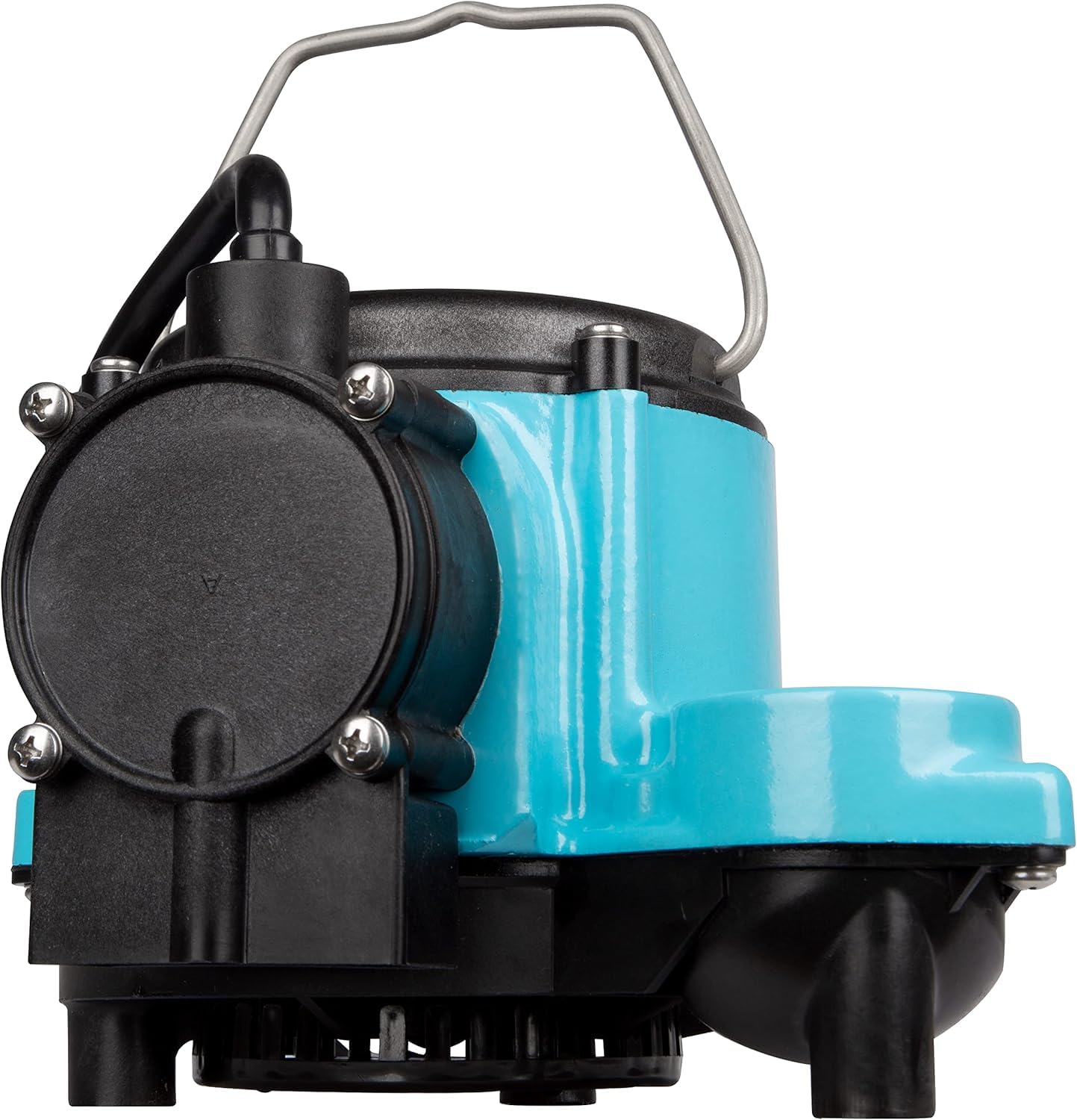
Most submersible pumps use a moving float to turn on, but the Little Giant 6-CIA uses a built-in diaphragm pressure switch instead — a sealed sensor that turns the pump on at 7 to 10 inches of water and off at 1 to 4 inches. That means no float arm to snag on debris and no float cage to clean. That design choice is the whole reason it makes this list.
The specs are tight and honest: 1/3 hp, 115 volts, 9.0 running amps, 14.3 starting amps, 720 watts, thermally protected, CSA listed in the USA and Canada, and rated for a 140-degree maximum fluid temperature. It moves 2,760 GPH at 5 feet of lift and shuts off at 18 feet of vertical lift. The epoxy-coated cast iron housing with a non-clog vortex impeller and nitrile/carbon/ceramic shaft seal is built for continuous-duty use. Little Giant specifically does not recommend it for general dewatering or emergency water removal — it’s designed to live in a sump pit and cycle regularly.
What owners appreciate is the compact 9.5″ x 8.5″ x 6″ housing — one of the shortest footprints here, so it fits low-clearance pits. The electronics hold up well for several years in typical service, with the diaphragm switch eventually wearing out as the failure point; at that point replacing the unit is usually the simpler call.
Reasons to consider it
- Diaphragm pressure switch — no float to snag on debris or wires
- Epoxy-coated cast iron body with non-clog vortex impeller
- Continuous-duty rated with thermal protection
- Short 6-inch housing fits low-clearance sump pits
- CSA listed in the USA and Canada
Trade-offs to know
- 46 gpm flow rate is the lowest in this lineup — better for small pits than large ones
- Not rated for emergency water removal or general dewatering
- Diaphragm switch is non-adjustable, so on/off levels are fixed
Best fit: A low-clearance sump pit where a float switch has been a recurring source of trouble.
Steer clear if: You want a pump for emergency dewatering or general water removal — this one is built strictly for sump pit duty.
7. Liberty Pumps 257 1/3 HP Cast Iron Sump Pump

The reliability-first 1/3 HP that empties a pit down to a few inches of standing water.
Reliability is the single trait that everything else on this list has to beat — and the Liberty 257’s owner feedback leads on exactly that in a way no other pump here comes close to matching. What owners rave about is how long it keeps working, with the pump’s owner reports describing it running through major storms without a hiccup. Buyer write-ups repeat one pattern: it’s the pump people buy after replacing pumps every few years.
The specifications back that up. Solid one-piece cast iron housing with a durable epoxy powder coat finish that eliminates the lower motor seal — the failure point that trips up many cast iron pumps. At 1/3 hp it produces 50 gpm and lifts water up to 21 feet, and it runs on 115V with an external built-in float valve. The 15.2-pound body makes it lighter than the Basement Watchdog’s 20 pounds, which helps during installation and removal.
Owners describe it emptying a sump pit down to 3 to 4 inches of standing water in about five seconds, which is the kind of dead-basin drawdown that keeps a pit from short-cycling. The built-in float switch and pre-drilled vent hole mean no field modifications during setup. The main thing to weigh is that 1/3 hp is not the biggest motor on the list — for a pit that fills very fast during storms, the WAYNE CDU980E’s 3/4 hp gives more headroom.
Where it shines: If you’ve had two cheap pumps fail in three years and want to stop thinking about it, the Liberty 257’s build quality and durability reputation are why it gets chosen again and again.
The catch: The 2-year manufacturer warranty is shorter than the 5-year warranties you’ll find on the Superior pedestal and the Zoeller M63 — but the owner longevity stories here suggest 2 years is a very conservative floor.
Ideal for: The homeowner replacing a whole string of failing pumps and who wants the single most reliable 1/3 HP unit in this lineup.
Pass if: Your pit demands the maximum flow rate available — 50 gpm won’t keep pace with the highest-volume storm runoff.
8. Zoeller M63 Automatic Submersible Sump Pump (3/10 HP)
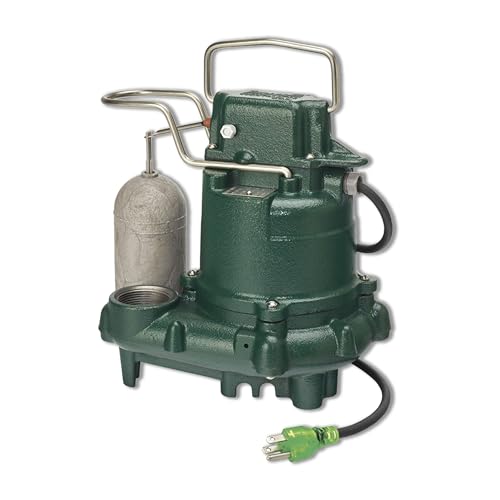
The all-cast-iron Zoeller with a 5-year warranty and a tank-like reputation.
Where the M53 uses a plastic vortex impeller, the M63 steps up to a corrosion-resistant cast iron impeller — the difference owners notice in long-term durability and wear. Yes, the M63 carries the same 0.3 hp rating as the M53 and moves the same 43 gpm, but the all-cast-iron construction and the 5-year limited warranty are what justify the higher price. Every unit is also 100% factory-tested — submerged in water before it leaves the line.
The oil-filled motor with a cast iron housing dissipates heat well, which extends pump life in the pit. The 9-foot cord and LED plug make verifying power at a glance a non-issue. A 10-foot power cord and LED lighted plug complement the installation process, so buyers describe the wiring setup as one of the easier parts of the job.
Owners praise the build most — the phrase “tank-like” comes up repeatedly in owner write-ups, and one reviewer sums it up: “Better quality than the hardware stores carry.” Durability feedback is more mixed: some reviewers point out many years of quiet service, while a smaller share say units arrived damaged or failed quickly — more a shipping and quality-control issue than a design one. If you want the M63’s all-cast-iron build and its 5-year warranty, this is the flagship Zoeller in this lineup.
Why it earns premium status
- All cast iron body and impeller — no plastic parts in the wear path
- 5-year limited warranty, the longest-matched in this lineup
- 100% factory-tested: every unit submerged in water before shipping
- Oil-filled motor with cast iron housing dissipates heat well
- LED power plug verifies power at a glance without flipping breakers
Keep in mind
- Same 43 gpm flow rate as the M53 — horsepower doesn’t step up with price
- Some units arrive with shipping damage; inspect on delivery
Designed for: Someone who’ll pay more for all-cast-iron construction and a real 5-year warranty.
Step down to the M53 if: You don’t need the cast iron impeller and want to save on the same horsepower output.
9. Zoeller M98 Flow-Mate Sump Pump (1/2 HP)
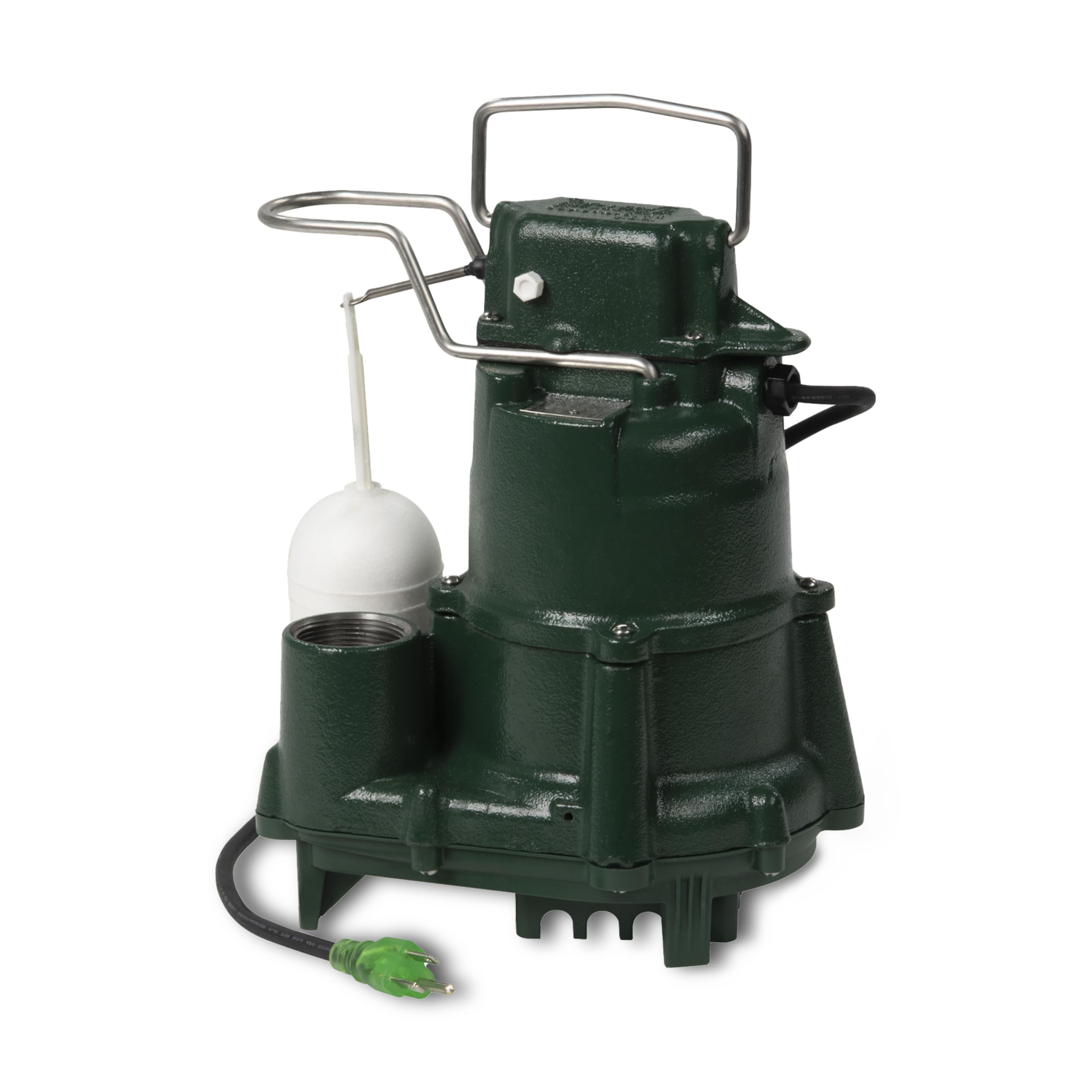
The high-flow Zoeller that pumps like a 1/2 HP should — and looks built to keep doing it.
The M98 strikes the best balance in the Zoeller line for buyers who want more flow than the M53 or M63 without leaving the brand. Vertical lift tops out at 23 feet, higher than the M63’s lift capacity, so it works with a deeper discharge climb.
Construction stays true to Zoeller’s premium approach: cast iron housing, oil-filled motor for heat dissipation, snap-action float switch, vortex impeller, and stainless steel hardware with a float guard. The 9-foot cord terminates in an LED power plug for at-a-glance power verification. The unit handles a heavy water load during storms without straining.
Longevity stories run strong here too — buyers describe replacing M98 units that ran over a decade before the switch finally wore out, and the motor was still working. Owners also note it handles a heavy water column well and that its float positioning gives more flexibility in the pit than some other designs. For a pit that moves real volume during storms, this is the balance in the Zoeller range.
Where it lands: 72 gpm flow rate at 1/2 hp, premium Zoeller construction, and the same casting philosophy as the flagship M63 with a bigger motor.
Honest caveat: It’s one of the highest-priced units on this list, so if you don’t need the extra flow, the M53 or M63 covers a moderate pit for less.
Made for: A homeowner who’s already burned through two pumps in big storms and wants the Zoeller reputation paired with real high-volume output.
Not the one for: A tiny shallow pit or a first-time buyer who just needs basic coverage — the Zoeller M53 handles that role without the bigger spend.
Understanding the Specs
Flow Rate (GPM and GPH)
Flow rate is how much water the pump moves in a given time — gallons per minute (GPM) or gallons per hour (GPH). Higher numbers mean faster water removal, which matters most during a storm when the pit refills quickly. The catch is that flow rate is usually quoted at zero vertical lift, when the pump is just circulating water. Real-world performance drops as the water has to climb to the discharge pipe. Look for both ratings when you can — for example, the WAYNE SPF33 moves 3,750 GPH at zero feet but 2,718 GPH at 10 feet.
Horsepower and Motor Build
Horsepower is the motor’s raw output, and it loosely tracks flow rate but not perfectly — a well-built 1/2 HP pump can outperform a poorly-designed 3/4 HP one. Beyond horsepower, look at the motor’s heat management. Cast iron housings and oil-filled motors dissipate heat better than thermoplastic shells, which extends pump life in a pit that cycles often. Pumps with a caged or dual-float design also give you a safety net if one float fails, which is why the Basement Watchdog SIT-50D carries two floats in a protective cage.
What size sump pump do I need for my basement?
It depends on your pit’s water volume and how high the water has to be lifted. A 1/3 HP pump like the Zoeller M53 or Little Giant 6-CIA handles a typical residential pit in moderate water conditions, moving 43 to 46 gpm. Move up to 1/2 HP — the Rainbro, WAYNE SPF50, Basement Watchdog, Superior, or Zoeller M98 — when your pit refills quickly or sits in a high water table. Reserve 3/4 HP for large basins or storm-heavy climates, the tier the WAYNE CDU980E occupies at 92 gpm.
How long does a sump pump typically last before it needs replacing?
The design life varies by build quality and how often the pump cycles. Cast iron pumps with oil-filled motors generally outlast thermoplastic models in the same pit. Zoeller M98 owners describe replacing units that ran over a decade before the switch wore out, and the Liberty 257 has buyer write-ups describing pumps that keep working through major storms across many seasons. Budget thermoplastic pumps can last several seasons in a light-duty pit but tend to have shorter lifespans when they cycle often. Replacing the switch is sometimes possible but usually the whole pump is the better call.
Is a cast iron sump pump better than a thermoplastic one?
For a pit that cycles often, cast iron and stainless steel are worth the extra cost because they resist corrosion and heat better than thermoplastic. The WAYNE CDU980E uses cast iron and stainless steel; the Zoeller M63 uses an all-cast-iron body and impeller. Thermoplastic bodies can be fine in a pit that only runs occasionally — the Rainbro 1/2 HP uses a thermoplastic shell and its shoppers say it running fine in residential pits. The deciding factor isn’t the material name alone; it’s how often your pump runs per season.
What is the difference between a submersible and a pedestal sump pump?
A submersible pump sits down in the pit and is designed to be covered by water — most pumps on this list follow that design. A pedestal pump keeps the motor on a column above the water line, with only the intake in the pit; the Superior Pump 92551 is the pedestal pick here, standing 36 inches tall. Pedestal pumps suit shallow pits with a rocky or dirt floor where submersibles cycle too often and their float switches wear out quickly.
What is the difference between a vertical float switch and a diaphragm switch?
A vertical float switch rises and falls with the water level to trigger the pump on and off — it needs clearance in the pit and can snag on debris or wires if not caged. The Basement Watchdog SIT-50D packs two floats into a protective cage for redundancy. A diaphragm switch uses pressure instead of a moving float: the Little Giant 6-CIA triggers on at 7 to 10 inches and off at 1 to 4 inches, and eliminates float-related snags but eventually wears out on its own cycle count.
Can I install a sump pump myself or do I need a plumber?
For most homeowners, replacing a sump pump is a straightforward DIY job. The WAYNE SPF50 and SPF33 owners describe hooking the pump to existing 1-1/2 inch NPT discharge plumbing without needing adapters, and the Rainbro 1/2 HP is described as easy to install. If you’re cutting new PVC or adding a check valve, expect a one to two hour job with basic tools. Hire help only if your discharge routing is unusual or you need electrical work beyond plugging into an existing outlet.
Why does my sump pump need a check valve?
A check valve keeps water from flowing backward down the discharge pipe and re-entering the pit once the pump shuts off. Without it, every off-cycle would dump the standing water in the pipe back into the basin and the pump would cycle again immediately. Liberty 257 owners note that adding a quiet check valve eliminates the loud thud you hear when the pump turns off. It’s a small part but it extends pump life by preventing short-cycling.
How much vertical lift does my sump pump need to handle?
Measure from the bottom of your sump pit to the highest point your discharge pipe reaches before it exits the house — that’s your vertical lift. Pumps on this list handle different heights: the Zoeller M53 tops out at 19.25 feet, the Liberty 257 at 21 feet, the Basement Watchdog SIT-50D and Zoeller M98 at 23 to 25 feet, and the Rainbro at 31 feet of maximum head. Choose a pump whose lift rating comfortably exceeds your actual climb, since flow rate drops as the lift height rises.
What should I do if my sump pump runs constantly during storms?
Frequent cycling during a storm is normal if your pit refills quickly from a rising water table. What you want to avoid is short-cycling — turning on and off in seconds — which indicates your pit is too small or your pump is oversized for the inflow. Look at float switch placement first: raising the on-level or widening the on/off range (the pedestal Superior 92551 lets you adjust the switch arm) is often the fix. If cycling is still constant, a pump with the highest flow rate you can fit, like the WAYNE CDU980E or Zoeller M98, clears the pit faster and reduces run time per cycle.
How do I know if my sump pump is powerful enough to keep the basement dry?
The practical test is whether the pump empties your pit faster than the pit refills during the heaviest rain you see. Match the flow rate to your conditions: a 43 gpm pump like the Zoeller M53 handles a moderate water table, while a 72 gpm pump like the Zoeller M98 or WAYNE SPF50 keeps pace in a faster-filling pit. If you’ve flooded through with a working pump, the flow rate was too low — step up a horsepower tier and pick a pump with a higher gpm rating at 10 feet of lift.
What size sump pump do I need for my basement?
How long does a sump pump typically last before it needs replacing?
Is a cast iron sump pump better than a thermoplastic one?
What is the difference between a submersible and a pedestal sump pump?
What is the difference between a vertical float switch and a diaphragm switch?
Can I install a sump pump myself or do I need a plumber?
Why does my sump pump need a check valve?
How much vertical lift does my sump pump need to handle?
What should I do if my sump pump runs constantly during storms?
How do I know if my sump pump is powerful enough to keep the basement dry?
Final Thoughts: The Verdict
For most basements, the best of these best basement sump pumps is the WAYNE CDU980E. Its 0.75 hp motor and 92 gpm flow rate (gallons per minute) give you serious headroom for a storm-charged pit, the cast iron and stainless steel build holds up in a wet environment, and the top suction design avoids the weep-hole maintenance that trips up cheaper pumps. It’s the pick to buy when you want one pump that covers the worst week of the year.
If reliability is your first priority and your pit doesn’t need the highest flow rate, grab the Liberty Pumps 257 — its owner longevity across years of storm duty is the strongest reliability signal in this lineup. And for a budget-friendly first pump that keeps things simple and light, the Rainbro 1/2 HP Submersible is the one to reach for.
Whatever you choose, plan for the next pump before this one fails — Keep a spare on the shelf — every pump on this list eventually cycles its last.
How We Picked
We do not accept paid placement. Every pick is matched to a real buyer and a real use-case; we do not hands-on test units.
Sources & Methodology
Specifications: manufacturer listings and product documentation. Review insights: verified customer reviews, as of September 2026. Pricing: not shown on this page (it changes often); check the current price via the retailer link.
As an Amazon Associate, KitchPrep earns from qualifying purchases. This does not affect which products we feature.
Related Guides
