
Specs are compiled from manufacturer listings and verified buyer reviews and can change over time — please confirm the key details on the product page before buying.
Your grill already cooks well, so the only question is whether a griddle top sits flat on your specific grill and drains grease into a trough instead of onto your burners. Get it wrong and you own a 24-pound slab of iron that rocks on the grates and fits no cabinet. This guide sorts nine real flat-tops by what they physically do: how thick the plate is, how much of your grill it covers, how the drippings drain, and whether the coating is bare metal or something you have to baby. A two-burner camping stove needs a different fit than a four-burner Spirit. One note before you scroll: the Weber insert below is the crowd favorite at 4.7 stars across 600+ owners, and everything else here is measured against it.
I’m Mohammad Maruf — the founder and writer behind KitchPrep. This guide is built by comparing the manufacturers’ published specifications and the patterns across verified customer reviews, so you get each pick’s real strengths and trade-offs instead of marketing spin.
Fit comes first, then thickness, then how the grease drains away from your food. That order is what keeps a heavy plate flat and your burgers off the burners. This breakdown of the bbq griddle top market covers plate thickness, sidewall height, and where drippings actually go.
Our Picks at a Glance


How To Choose The Best BBQ Griddle Top
You already own the cooking surface — your grill. You are shopping for a slab that takes it over completely, and the whole decision depends on four numbers and one design choice. Get those right and the griddle drops in flat, drains clean, and stays put. Get them wrong and you will be tilting a hot plate over the side of your grill to pour out bacon grease while your guests wait.
Measure your grill before you read a single listing
The most common mistake is buying a griddle that is too big or, just as often, too small. A 25″ x 16″ plate is a full-grill replacement on most four-burner gas grills. A 13″ x 8.25″ plate is a single-station pan for a camp stove. Those two products are built for entirely different cooks, and neither one is wrong. So pull a tape across the cooking area from side to side and front to back, and write both numbers down before you compare anything. If you are swapping out grates rather than laying a plate on top, check whether the griddle has to sit over the flavorizer bars or replace them. Leaving the bars in place keeps heat spread even and shields the burners.
Thickness and material decide whether it stays flat
A thick plate holds its shape when it gets hot, so your food stays put; a thin one cups upward in the middle and your food slides to the edges. That is the real difference between a griddle built from heavy cast iron and one stamped from thin metal. Thicker metal also takes longer to heat but recovers faster when you drop a cold patty on it, which matters on a smash burger. Cast iron and carbon steel both need seasoning — a layer of baked-on oil that becomes the nonstick surface — while a ceramic-coated griddle skips that chore entirely and asks you to use only silicone, wood, or plastic utensils instead.
Where does the grease actually go
Grease management is the design detail you will feel at every single cook. A trough, a groove, or raised sidewalls all do the same job: move rendered fat away from the food and off your burners. If the trough is shallow, you may have to lift and tilt the plate to drain it once it fills. A griddle that scoots its drippings into your grill’s existing collection system spares you that step. The worst outcome is a flat surface with nowhere for liquid fat to go — that is how you get flare-ups and a smoke show on a quiet weeknight.
Quick Comparison
| Model | Best For | Cooking Surface | Plate Thickness | Material | Amazon |
|---|---|---|---|---|---|
| Weber® Rust‑Resistant Griddle Insert★ Best Overall | Whole-grill conversion on a Weber | 22.67″L x 17.29″W | 1.19″ | Carbon Steel | Amazon |
| GGC Cast Iron Reversible GriddleBest for Small Grills | Camp stoves and small grills | 13″L x 8.25″W | 0.5″ | Cast Iron | Amazon |
| 2-in-1 Reversible 14” x 16” GriddleBest Mid-Size Pick | Two-burner stoves and campfires | 16″ x 14″ | 1″ | Cast Iron | Amazon |
| onlyfire Universal BBQ Griddle | No-seasoning, low-maintenance cooks | 18″L x 12.6″W | 2.8″ | Ceramic-Coated Cast Iron | Amazon |
| Onlyfire Pre-Seasoned 23″ x 16″ | Large families and big gatherings | 23″L x 16″W | 2.6″ | Cast Iron | Amazon |
| Utheer 25×16 Ceramic Griddle | Cooks who refuse to season metal | 25″L x 16″W | 2.6″ | Cast Iron, Nano-Ceramic | Amazon |
| SHINESTAR 25″x16″ Carbon Steel Griddle | Portable flat-top for camping | 25.2″L x 16.22″W | 2.76″ | Carbon Steel & Ceramic | Amazon |
| Hisencn 25″x16″ Flat Top Griddle | High-heat searing on big grills | 25″L x 16″W | 2.6″ | Carbon Steel | Amazon |
| DELSbbq 6788 Full-Size Griddle | Genesis II 300 series owners | 25.6″L x 18.7″W | 3″ | Carbon Steel | Amazon |
In‑Depth Reviews
1. Weber® Rust‑Resistant Griddle Insert
Our pick — over 4.5★ from 650+ verified ratings; the strongest balance of quality and price.
The plate that turns a whole Weber into a flat-top without buying a second grill.
If you already own a Spirit or Searwood, this is the least fussy way to get griddle cooking. The insert measures 22.67″ long by 17.29″ wide at 1.19″ thick, and it was built to cover the entire grilling surface rather than sit on it like a tray. That is a different job than a universal plate: the Weber drops in as a replacement, so there is no wobble and nothing to shim. Carbon steel is the material, and the plate arrives pre-seasoned, which means you can cook the first meal without a prep step. It is rated to a maximum temperature of 500 °F, which is plenty for smash burgers and caramelized onions. The weight is the price of that stability at 21.8 pounds, backed by a 2-year manufacturer warranty.
What wins people over is the build itself — the sheer heft of the plate is the thing that gets talked about again and again, with fit running a close second. The real-world payoff is even heat you can trust: the surface holds temperature so the last pancake browns like the first. Owners also report it earning its keep in cold weather, which is not something you can say about every flat-top. Rimmed edges keep oil and seasonings where they belong rather than running onto the burners. Grease drains through the grill’s existing collection system, so you are not wiping down a tray after every cook.
Be honest about two things before you buy. First, the fits-like-a-glove story only applies to the listed models: Spirit 4-burner grills made since 2025, Spirit and Spirit II 3-burner grills from 2016 through 2024, and Searwood pellet grills. Second, buyers describe the price as “not cheap, but cheaper than a new grill” — which is the right way to think about it, since the alternative is a whole second appliance taking up patio space. This is a replacement part, so a different brand of grill means starting the search over.
What the Plate Gets Right
- Full-surface coverage at 22.67″ x 17.29″ — the whole grill becomes griddle, not a corner of it
- 1.19″ thick carbon steel holds heat steadily and resists warping better than thin surfaces
- Pre-seasoned and cook-ready the moment it is from the start
- Drips into the grill’s own grease system, so no separate tray to scrub
- Rimmed edges fence in oil, seasoning, and loose vegetables
Where It Asks Something of You
- 21.8 pounds of steel — you will feel it every time you lift it off
- Only fits the listed Spirit and Searwood models, so measure or check the model list first
- The storage bag is sold separately, so plan where the plate lives between cooks
- Owners describe the cost as real, though still below buying a second grill
Settle here if: you have a compatible Spirit or Searwood and want the whole cooking surface converted with zero fit guesswork.
Pass if: your grill is a different brand — this insert is drilled to one family of grills and will not bridge to yours.
2. GGC Cast Iron Reversible Griddle
Two cooking surfaces in one plate that fits a Coleman stove and a small Weber alike.
Flip it one way and you get a smooth flat-top for eggs and pancakes. Flip it the other way and the ridges lay sear marks across a steak. That reversible design is the whole appeal of this 13″L x 8.25″W plate, and at 0.5″ thick with sturdy side handles it is light enough to move from camp stove to kitchen burner without a wrestling match. The 15.5″ overall width with handles gives you something to grab with a mitt. Rated to a maximum of 500 °F, cast iron throughout, and built to sit on a gas grill, a stovetop, or open fire. It is the smallest footprint in this lineup, and for a lot of cooks that is the point.
The plate earns its keep on the road. It is a solid, heavy piece of cast iron that people choose by dimensions for a Coleman camp stove, exactly the kind of camping and road-trip cooking it was made for. It also does real work at home: it fits three salmon fillets, which lets you blacken fish outdoors and keep that smell out of the kitchen. Build quality is the standout strength, with versatility right behind it. The honest caveats here are size and cleanup, both of which land in mixed territory for owners. The plate surfaces on this one arrive unseasoned, so you coat it with oil and heat it before the first cook — about 10 to 15 minutes on a stovetop over medium, or roughly an hour upside down in a 350 °F oven. It also carries a bigger warning than most: never soak it longer than 15 minutes, dry it immediately, and keep steel wool away from the matte coating.
Here is the catch people run into most. Buyers report: “Make sure to read the size your ordering. I received a bit smaller then I expected.” That is a fair flag, because the listing’s photo can make an 8.25″-wide plate look like it covers a bigger grill than it does. Read the numbers, hold a tape measure to your cooking area, and decide whether a small griddle is what you actually want. If it is, the value holds up at this tier. The 15.5″ span with handles will not cover a four-burner grill, though — this one is for small setups and single-station cooking.
The case for it: the only plate here that gives you flat and ribbed surfaces on demand, and it fits places the big 25″ slabs simply cannot go.
What to expect: a small cooking area by design, an unseasoned surface you prep yourself, and cast iron’s usual cleaning rules — quick soak, dry fast, oil lightly.
Reach for this if: you cook on a Coleman stove, a small gas grill, or a single kitchen burner and want flat and grill sides in one piece of iron.
Look elsewhere if: you need to cover a full-size grill — the 13″ x 8.25″ surface is a single station, not a whole cooking area.
3. 2-in-1 Reversible 14” x 16” Pre-Seasoned Cast Iron Cooking Griddle
A two-burner-sized slab that covers half your grill and sears like a full flat-top.
This is the middle path. The 14″L x 16″W cooking area is specified to span both burners of a two-burner propane stove, which makes it a genuine flat-top solution for compact setups rather than a single-station pan. At 1″ thick it is twice the plate of the GGC above, and cast iron all the way through. The reversible build gives you a smooth side for eggs, pancakes, and bacon, and a ridged side for steaks, burgers, fish, chicken, and vegetables. A recessed design lets fat drain downstream, which is a small but real detail. You can run it on a gas stove, in an oven, on a grill, or over a campfire.
Functionality is the quality that carries this plate, with durability close behind. The daily-use crowd is the right audience: it replaces the grill for breakfast, lunch, and dinner for some owners, flat side for omelets and flipped for seared meat. It cooks a whole chicken through without scorching it, leaving just a crispy skin, and it does it without flare-ups. Despite weighing 4.87 kg, owners still count the weight as a positive because that heft is what holds heat steady. Heat spreads evenly, the surface wipes clean, and a coat of peanut oil after each cook keeps it releasing food. One flavor you should know about: it arrives unseasoned, and a few cooks find the first round of food sticks until that layer builds up.
Size is the one place reviews split. The plate is advertised at 16″ x 14″, and a share of owners mention it is not as large as they pictured. Note too that one buyer used a 16″x24″ griddle on a combo pellet and gas grill, which is a much bigger plate than this one — so if you saw that kind of surface in a photo, size down your expectations accordingly. On the smaller two-burner stoves this fits as intended. On anything bigger, you are owning half a cooking area on purpose, which is a perfectly good plan if you only use one side of the grill anyway.
The strength to lead with: a full two-burner footprint at 14″ x 16″ in one solid piece — enough for several steaks or a batch of pancakes, and reversible for searing when you want it.
Prep it right and it is easy: the surface is cast iron, so it wants a light oiling before storage and a dry, ventilated home between cooks.
Buy it if: you run a two-burner propane stove or compact grill and want flat and ridged surfaces covering both burners.
Skip the size-and-heat combo if: you want a plate that covers a full-size grill surface — this one is built around a two-burner footprint and nothing more.
4. onlyfire Universal BBQ Griddle with Handles, 18″ x 12.5″
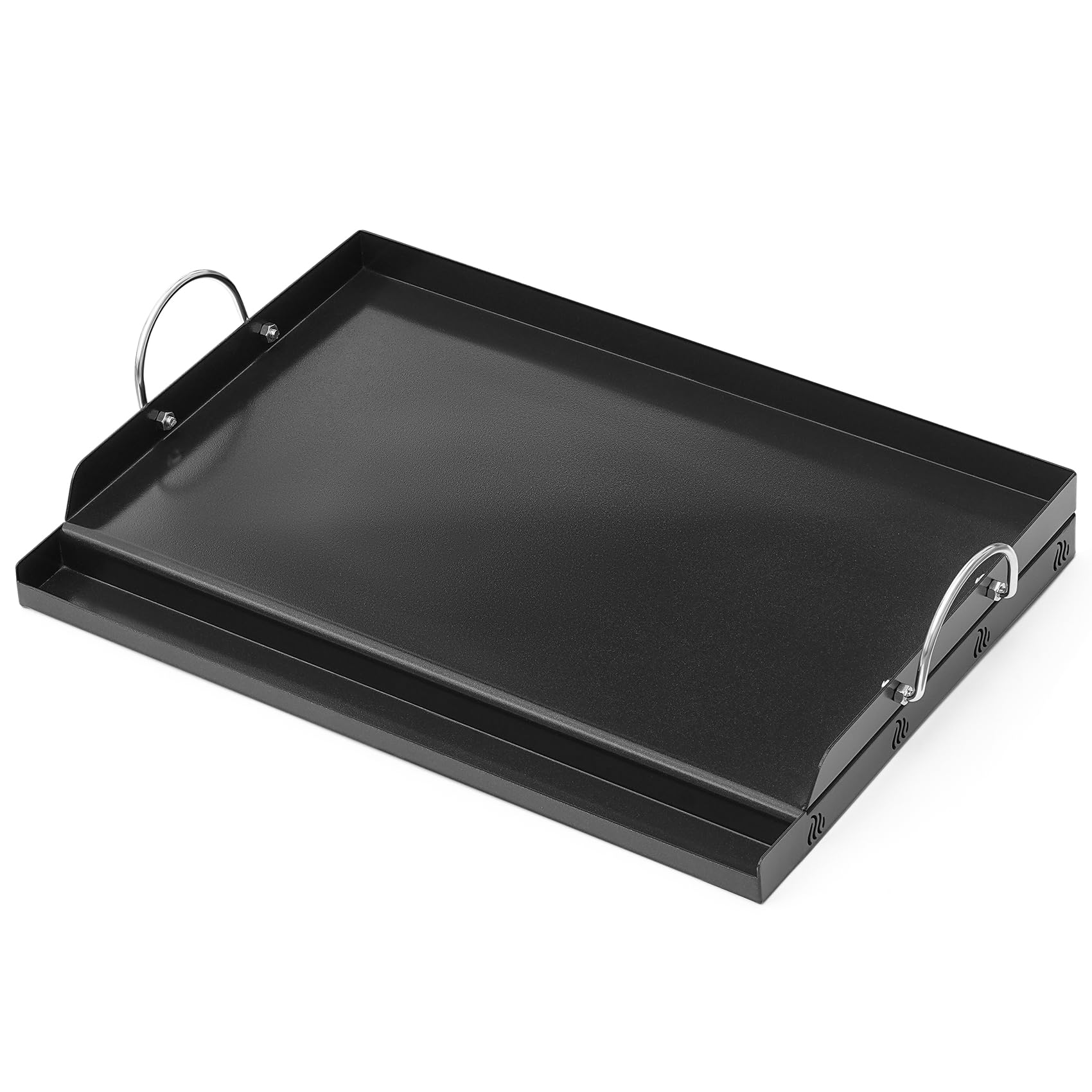
The griddle you can use the day it lands, because nothing needs seasoning first.
The headliner here is the coating. A ceramic layer sits on the cooking surface of this cast iron plate, and the maker states plainly that you do not need to season it — you can use it directly from the start. That is a real difference from the other eight picks in this guide, all of which expect you to build a seasoning layer yourself with oil and heat. The cooking area is 18″L x 12.6″W on dimensions of 18″L x 12.6″W x 2.8″Th, with raised sidewalls that keep food from sliding off when you flip it, and handles on both sides so you can lift a hot plate safely. A grease trough collects drippings and helps head off flare-ups. It is rated to a maximum of 500 °F and is built for patio cooking, parties, and tailgating.
Quality is what owners rate highest on this one, with easy cleaning right behind it. The coating story is the reason: it wipes down without the scrubbing routine that bare cast iron demands. Fit gets steady praise from people cooking on outdoor grills, and the grease trough earns its place — fat slides off into the trough instead of sizzling on the burners. It measures out to a mid-size footprint, smaller than the 23″ and 25″ plates above, which is right for a two- or three-burner setup. The raised sides also mean less chasing food around the plate with a spatula.
The one real caution involves the coating itself. Stick with silicone, wood, or plastic utensils when you can, because a sharp metal edge can cut into a ceramic surface in a way it would not on bare iron. And while most customers note an easy cleanup, that is not a universal result — a heavy steak residue can still take work to lift. Measure your cooking area before ordering, because the handles can be mounted either inside or outside the plate, and their placement changes whether the griddle clears your grill’s lid and side tables.
Reasons It Tends to Win People Over
- Ceramic-coated surface means no pre-seasoning step — cook the day it arrives
- Grease trough collects drippings and helps prevent flare-ups mid-cook
- Handles on both sides let you lift it off the grill safely
- 2.8″-tall sidewalls keep food and oil on the plate, not on the burner
- Mid-size 18″ x 12.6″ footprint works on two- and three-burner grills
Worth Knowing Before You Order
- Coated surface calls for silicone, wood, or plastic utensils to keep it intact
- Handles mount inside or outside — check placement so your lid still closes
- A tough residue can still need a reheat-and-scrape, coating or not
- It is not a full-grill plate; this is a mid-size surface by design
Perfect for: anyone who wants to start flat-top cooking today without the seasoning ritual or an extra pan to clean.
Think twice if: you plan to scrape hard with metal tools — the coating prefers a gentler utensil, and the plate is mid-size, not full-grill.
5. Onlyfire Pre-Seasoned Universal Cast Iron Cooking Griddle, 23″ x 16″

A 23-inch flat-top with walls high enough to keep a full pound of bacon from running.
Nothing else on this list leans as hard into grease containment. The design brief behind this plate is extra-high sidewalls that hold oil and grease securely in place, with the goal of a no-spill surface and fewer flare-ups. It is a pre-seasoned cast iron griddle measuring 23″L x 16″W x 2.6″Th, and its strength is durability — owners note it will not warp the way a carbon steel plate can. That same 23″ x 16″ surface is sized for large families and weekend parties, fits most grills and 4-burner ranges, and weighs 10.56 kg. It is built to work indoors on a stove as readily as outdoors on a grill.
Durability is the strongest quality here, with fit right behind it. The reason people trust it is heat: cast iron spreads warmth evenly, wipes down easily, and nothing sticks once it is seasoned. The high walls genuinely do their job, and the handles on both sides let you carry a hot plate inside without a mitt fight. It handles the full range of food — pancakes, bacon, sandwiches, eggs, salmon, grilled cheese, chicken, burgers, sausages, and vegetables all get named as use cases. One practical limit to note: on a four-burner range the trough is too shallow to catch everything, so you will lift and tilt the plate to drain. Handles add width, which can keep the griddle from fitting inside an oven.
The weight lands in honest mixed territory, and that is the main thing to price in. It is heavy, and a large plate plus a large family is exactly the equation where weight stops being a virtue. There is also a heat-retention nuance that one long-time user called out: without a heat source underneath, it does not hold temperature on its own, but it performs beautifully while it is being heated. That is just how cast iron behaves, and it is a reminder to leave the burner on while you cook rather than pulling the plate off early. Storage is the other cost — a 23″ plate with handles does not tuck into a cabinet quietly.
Why it holds up: cast iron construction that resists warping far better than thinner metal, paired with sidewalls deep enough to trap a serious amount of rendered fat.
The trade you accept: 10.56 kg of plate, shallow enough on some four-burner ranges that you tilt it to drain, and wide enough with handles that it will not fit an oven.
Grab it if: you cook for a crowd on a large grill or a four-burner range and want the grease to stay on the plate, not on the burners.
Overkill if: you cook for one or two, or you want to slide the griddle into an oven — the handles add width and the plate is genuinely heavy.
6. Utheer 25×16 Pre-Seasoned Nonstick Ceramic Cast Iron Griddle
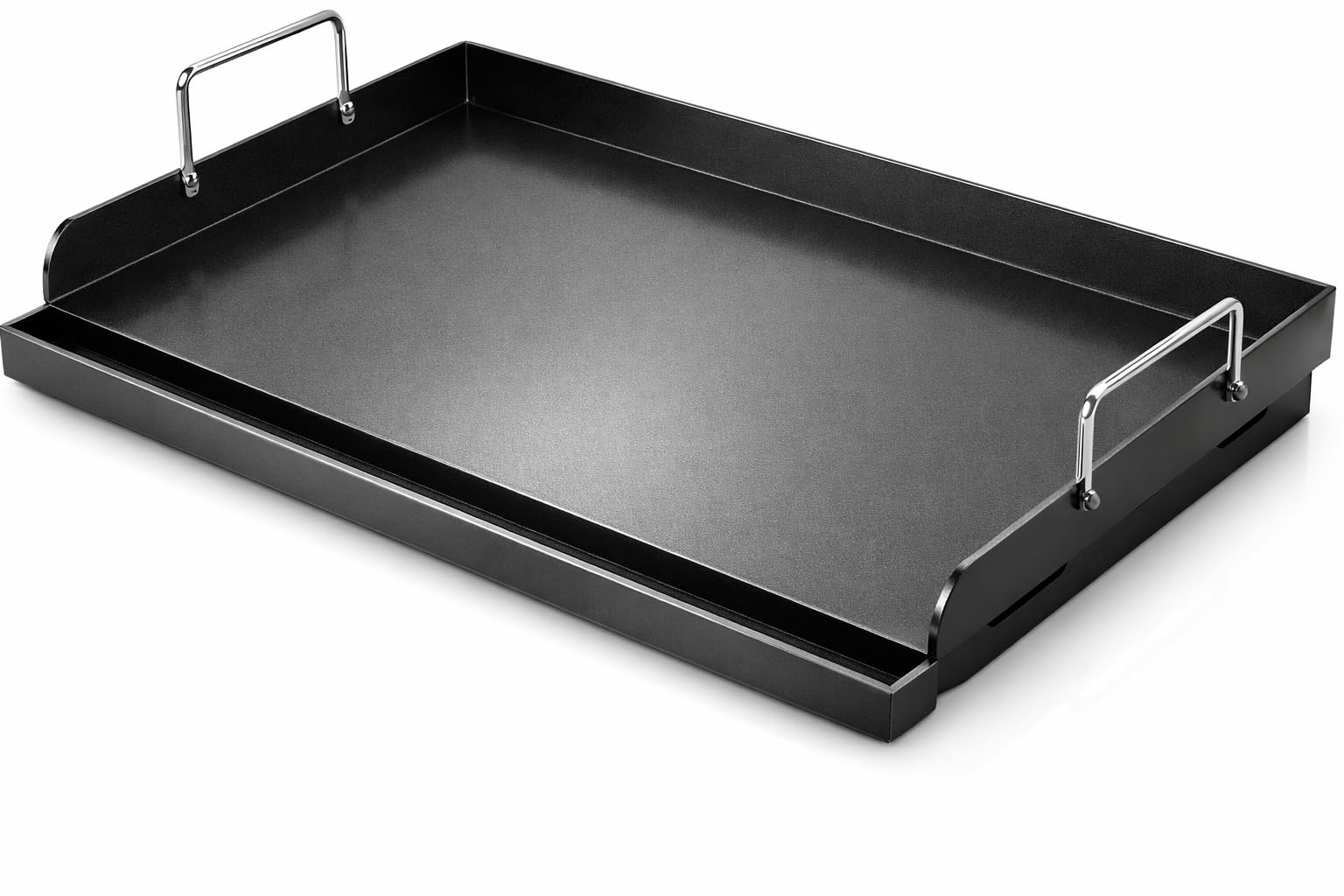
A 25-inch flat-top with a ceramic surface that releases eggs without a seasoning ritual.
This plate pairs a big cooking area with a smooth nano-ceramic coating, and the material list is the reason to look at it: the surface is made without PFOA, PFAS, PFOS, PTFE, lead, and cadmium. The plate itself is cast iron underneath at 25″L x 16″W x 2.6″Th, rated to a maximum of 500 °F, with reinforced bottom support built in to help reduce warping at high heat. That 25″ x 16″ surface is designed for most standard gas and charcoal grills. The handles come off, which changes the math on storage. With them installed, the plate measures 27.1″ in total length, and the handle height is 2.64″. If the handles eat into your cooking space or hit the lid, they can be removed or flipped to face inward.
Quality is the clear strength here, with easy cleaning a solid second. The coating is what makes bedtime cleanup short: food releases and the plate wipes down after it cools. Buyers describe it cooking eggs, turkey scramble, chicken, and vegetables without sticking, and it works as well as an indoor flat-top on a gas range as it does outside on a grill. It heats evenly, handles chicken, steak, pork chops, and smash burgers in a single week of cooking, and one owner uses it on public grills specifically to keep food off the grates. It also covers three of four burners on one grill while still letting the lid close. Temperature is steady and there is no warping reported at high heat.
The surface is the honest trade-off, and it cuts both ways. Some buyers find food slides off easily; others report initial sticking until the plate is seasoned and oiled each time. The surface is also genuinely slippery, slick enough that you want grill gloves to fish food out of the grease groove rather than chasing it with tongs. The routine that keeps it happy is simple: season it, use a little oil every cook, hand wash with a soft sponge after it cools, dry it immediately, and stick to silicone, wood, or plastic utensils. Weight is on the heavy side at 11.86 kg, which is normal for a 25-inch cast iron plate and worth knowing if you plan to move it often.
Where It Delivers
- Ceramic nonstick surface made without PFOA, PFAS, PFOS, PTFE, lead, or cadmium
- Full 25″ x 16″ cooking area covers most gas and charcoal grills
- Reinforced bottom support helps hold the plate flat at high heat
- Removable handles help it clear the lid and fit storage
- Built-in grease groove collects oil and keeps the surface cleaner
The Honest Costs
- Coating can stick at first until you season it and oil each cook
- Surface is very slick, so hot grease and loose food move around — grill gloves help
- 11.86 kg plate is not something you move casually
- Requires silicone, wood, or plastic utensils to keep the coating intact
Worth it for: high-heat griddling on a standard gas or charcoal grill where you want an easy-release ceramic surface and detachable handles for storage.
Look elsewhere if: you want zero stick on day one without any oiling, or you plan to handle a 25-inch plate on and off the grill often.
7. SHINESTAR 25″x16″ Carbon Steel Griddle for Gas & Charcoal Grills

A full-size carbon steel flat-top that weighs 17 pounds, so it can actually travel.
Carbon steel is the light cousin of cast iron, and this plate shows why that matters. It measures 25.2″L x 16.22″W x 2.76″Th and weighs just 17 pounds. Put that next to the 21.8-pound Weber insert or the heavy 25-inch cast iron plates, and the difference in how it feels to lift is noticeable — and 17 pounds is a plate one person can carry alone. It is built from carbon steel with a ceramic nonstick coating, and the maker lists it for grills with a cooking area larger than 27.5″ x 16.5″, including the popular Blackstone 36-inch griddle. Foldable handles and a grease groove round out the design, and it works on gas grills, stovetops, and campfire setups.
Fit is where this plate earns trust, and quality sits at the top of the list. Reviewers point out it fitting a 4-burner NexGrill and holding up better than the grates the grill shipped with — heavy, sturdy, and holding a thick steak without flexing. The ceramic coating means food releases easily and cleanup goes fast with a wipe-down, and owners specifically call out that it resists rust, which is the usual weak spot on a carbon steel surface left outdoors. It reaches temperature quickly, and the foldable handles make it easier to move and tuck away than a fixed-handle plate. It is rated for both indoor and outdoor use, and it adapts to a gas grill, a stovetop, or an open fire.
The honest snag is size and storage, not performance. It is a big plate — 25.2″ by 16.22″ — and even at 17 pounds that adds up when you are finding somewhere to put it. One user put it plainly: it is “very heavy and large, making it difficult to store,” while still calling it a perfect griddle and chalking the bulk up to a professional-level cooking surface. There is also a material question the maker should clear up: the coating and steel get praised, but the exact makeup draws mixed reactions, with some buyers expecting solid stainless steel. It is marketed as carbon steel with a ceramic coating, so read that description closely and buy for the coating and weight, not for stainless.
Best of both worlds: the same 25-inch footprint as the biggest plates here, but 17 pounds with foldable handles instead of a fixed, immovable slab.
The catch: it is large enough to be a storage problem even when light, and the material spec has drawn mixed reactions from people expecting stainless steel.
The pick for: campers, tailgaters, and anyone who wants a full-size griddle they can carry and store without a two-hand lift.
Not the one if: you want the densest possible heat-holding plate or you need stainless steel specifically — this is a 17-pound carbon steel griddle with a ceramic coating.
8. Hisencn 25″x16″ Flat Top Griddle for Gas Grill and Stove, 4-5 Burner Grills
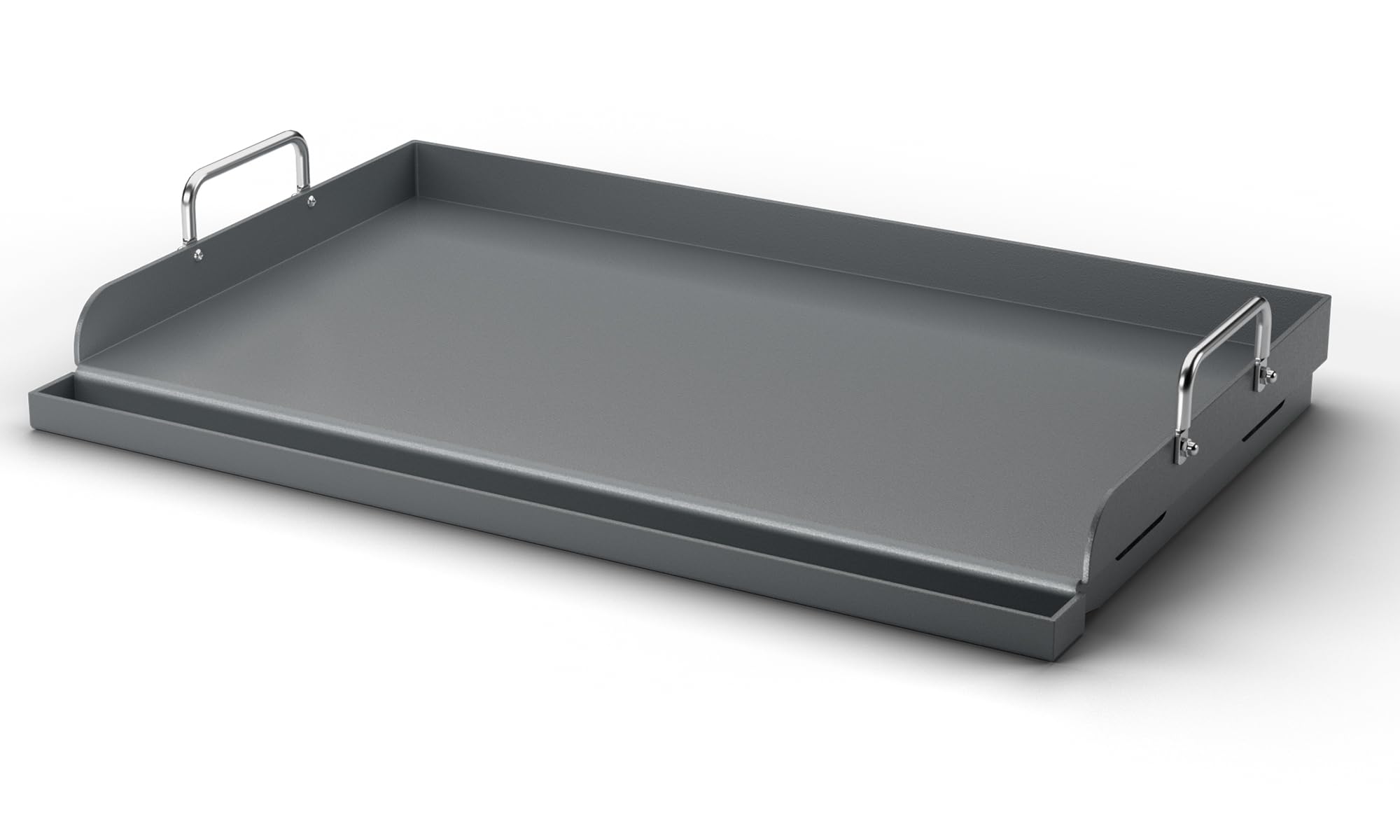
A 24-pound carbon steel plate built to take screaming-high heat without peeling.
This is the heavy hitter of the lineup. The plate measures 25″L x 16″W x 2.6″Th and weighs 24 pounds of carbon steel — the densest griddle here, and the reason it holds heat the way it does. It is specified to fit most 3-to-5 burner gas grills and charcoal grills across Weber, Blackstone, Charbroil, Nexgrill, and Kenmore, so the fit range is wide. The surface is pre-seasoned to build a natural nonstick layer over time, and the maker states there are no synthetic coatings, no PFOA, and no PTFE. Raised side walls contain grease and food, and an integrated grease channel sends excess oil away from the cooking surface. It is built to run at extreme grill temperatures without warping or peeling.
Quality is the top strength by a wide margin, with fit and durability close behind. The reason is that plate weight: it gets screaming hot for a proper smash-burger crust and stays flat while it does it, holding a thick steak with no deflection. Searing is where this griddle makes its name — one owner cooked smash burgers in 2 to 3 minutes, and it releases food easily once the seasoning sets in. Steaks, fajitas, fried eggs, and vegetables all get cooked on it in normal use. It also earns points for versatility, working on a charcoal grill and, in one owner’s setup, doubling as a pan on the largest electric stovetop burner. It will not rust through or peel like a cheap coated griddle.
Be honest with yourself about the weight, because it is at the far end of what most people want to move. At 24 pounds, this plate needs a sturdy grill and a real storage plan — it is not a plate you casually pull off mid-cook. There is also a temperature note worth flagging: one owner found it needs around 350 °F to avoid bowing, and a grill that runs hotter than that can bowl it temporarily before it settles back flat. That is an edge case, not a pattern, but it is the kind of thing a high-output grill owner should know going in. Carbon steel also rusts if you neglect it, so lift it off after use and dry it thoroughly.
What Sets This One Apart
- 24 pounds of carbon steel — the heaviest plate here, and it holds heat accordingly
- Pre-seasoned with no synthetic coatings, no PFOA, and no PTFE
- Raised side walls and an integrated grease channel keep the cooking surface cleaner
- Wide compatibility across 3–5 burner gas grills and charcoal grills
- Handles extreme heat without peeling or warping under normal use
What You Are Signing Up For
- 24 pounds is a genuine lift, and it needs a sturdy grill to sit on
- Carbon steel rusts easily — remove and dry it after every cook
- On grills running hotter than roughly 350 °F, the plate can bow temporarily
- The overflow tray can be fiddly to clean and no cleaning tool is included
Choose this when: searing is the point — the 24-pound plate gets brutally hot and stays flat while you press a smash burger into it.
Think again if: you want a plate you can pull off and stow easily, or your grill exceeds roughly 350 °F at the surface and you want zero movement.
9. DELSbbq 6788 Full-Size Griddle for Weber Genesis II 300 Series Grills

The widest plate here, cut to drop into a Genesis II 300 in under a minute.
If your grill is a Weber Genesis II 300 series, this is the nearest thing to a factory part you will find short of buying one. It measures 25.6″L x 18.7″W x 3″Th — the 18.7″ width is the widest in this roundup, matched to the Genesis II 300 footprint — and it is made from carbon steel. The clean part is the swap: pull the grates, drop this in, and the maker says your grill becomes a flat-top station in under a minute. Leave the flavorizer bars in place, since they keep spreading heat evenly and protect the burners. The compatibility list is long and specific, covering Genesis II E-310, E-315, E-330, E-335, S-310, S-335, S-345, SE-310, SE-335, LX E/S-340, and the 2022 Genesis E-325s, S-325s, EX-325s, E-335, S-335, and EX-335. A handle and gloves are included.
Fit, performance, and ease of cleaning are the three qualities that carry this plate, and they all trace back to that cut-to-size shape. It sits flat in the Genesis II 300, heats quickly, cleans easily, and the cleanup slot works as intended — scrape with water and a spatula, re-oil, and you are done. The surface is nonstick in use, with nothing sticking once it is properly seasoned. Seasoning follows the cast iron routine: coat with oil and run it at 450 °F for 30 minutes. The plate sears well once it is hot, handles smash burgers, steaks, and vegetables, and has held up through hibachi meals at home. Assembly is minimal — only the handles need attaching with four screws.
There is one small quirk to plan around. The surface has a slight slope toward the back, so eggs can drift toward the drip slot on their own. That is easy to manage by keeping your food to one side and the drip where it belongs, and it is a design feature from the plate sitting flush against the grill’s own drain. Do not confuse this with the smaller Spirit III 4-burner fit either — this plate is built for the Genesis II 300 series specifically. If your model is not on the compatibility list, this one is not for you.
The fit is the feature: at 25.6″ x 18.7″ it is the widest griddle here, cut to the Genesis II 300 opening so it drops in flat with no shimming or rocking.
One quirk to plan around: the slight rearward slope sends eggs toward the drip slot, but a little food positioning keeps everything where you want it.
Just buy it if: you own a Genesis II 300 series grill from the compatibility list and want a full-size flat-top that swaps in and out fast.
Move on if: your grill is a Spirit, a different Genesis series, or another brand entirely — the 25.6″ x 18.7″ shape is built for the Genesis II 300 opening and will not seat in anything else.
Understanding the Specs
Plate Thickness and What It Buys You
Thickness is the number that decides whether a griddle stays flat and how much heat it holds. In this lineup it runs from 0.5″ on the small GGC reversible plate up to 3″ on the DELSbbq Genesis II insert, with most mid-size and full-size griddles sitting between 1.19″ and 2.8″. A thinner plate heats through faster and weighs less to carry. A thicker plate takes longer to warm up, but it recovers temperature the moment you drop a cold burger on it instead of sagging toward the middle. Thicker cast iron and carbon steel also resist warping — the slow curl that leaves your food sliding to the edges. If you cook smash burgers or sear steaks, reach for the thicker plate. If you are packing a camp stove, a thin 0.5″ griddle is the one that fits in the bag.
Coating Versus Bare Metal
You have two routes here, and the right one depends on how much upkeep you want. Bare cast iron and carbon steel arrive either pre-seasoned or unseasoned. A pre-seasoned plate — like the Weber, the Onlyfire 23″, the Hisencn, and the DELSbbq — can be cooked on straight away. An unseasoned plate, like the GGC and the 14″ x 16″ reversible, needs an oil-and-heat session first; the maker’s own guidance for the GGC is 10 to 15 minutes over medium heat or about an hour upside down in a 350 °F oven. In return for that prep, bare metal builds a natural nonstick layer that improves the more you cook, with no synthetic coating to wear through. A ceramic-coated griddle skips the seasoning entirely — the onlyfire 18″ x 12.5″ and the Utheer 25×16 both take that route — but asks you to use silicone, wood, or plastic utensils and to hand wash with a soft sponge. Bare metal rewards patience. Coating rewards convenience.
Height, Handles, and Storage
Three physical measurements decide whether a griddle fits your grill and your kitchen after the cook. The first is overall height including sidewalls, which runs from 1.19″ to 3″ here and controls how much food and oil the plate holds. The second is handles: removable and foldable ones — on the Utheer, SHINESTAR, and onlyfire — let you clear your grill’s lid and tuck the plate away. Fixed handles, like those on the Onlyfire 23″, add width that can keep the griddle out of an oven. The third is the plate’s own weight once you factor in 4.87 kg to 10.56 kg of metal, which is what you will lift every time you want the grates back. Measure your cooking area, decide whether the handles need to move, and check where the plate will live between cooks before you commit to a full-size slab.
Grease Control and Where Drippings Land
Every griddle here moves fat somewhere, and the design tells you how clean your cook will be. Raised sidewalls and high sidewalls — the signature of the Onlyfire 23″ and the Hisencn — trap oil and rendered fat on the plate rather than letting it hit the burners. A trough or grease groove, found on the onlyfire 18″ x 12.5″, the Utheer, the SHINESTAR, and the Hisencn, collects drippings for a fast wipe-down. Higher-end splurges drain directly into your grill’s existing grease collection system, which is the least fussy outcome, since there is no separate tray to scrub. The one thing to watch is depth: a shallow trough means you will lift and tilt the plate to empty it once it fills. Whether you cook bacon for six or burgers for two, the drippings have to go somewhere — pick the design that puts them where you want them.
FAQ
Will a 25 x 16 griddle fit my four-burner gas grill?
Do I need to season a pre-seasoned griddle?
How do I stop a cast iron griddle from rusting?
What is the difference between a reversible griddle and a flat top?
Will a griddle plate warp at high heat?
Do I need special utensils for a nonstick coated griddle?
Can I use a BBQ griddle top indoors on my stove?
What is the best way to clean grease off a griddle plate?
How heavy is a full-size griddle top to lift off the grill?
Is cast iron or carbon steel better for a griddle top?
Final Thoughts: The Verdict
Match the plate to your grill’s cooking area and you will wonder why you did not do this sooner. For Weber Spirit and Searwood owners, the Weber® Rust‑Resistant Griddle Insert is the cleanest path — a full-surface carbon steel plate at 22.67″ x 17.29″ that drops in over the existing grease system and arrives pre-seasoned, which is why it tops this list. If you want the widest, cut-to-size fit and you own a Genesis II 300, grab the DELSbbq 6788 Full-Size Griddle. And for anyone who cooks on a smaller two-burner stove or camp setup, the 2-in-1 Reversible 14” x 16” Cast Iron Griddle is the one to reach for, covering both burners with a flat side and a ridged side to flip between. One last nudge: if fit is what you are unsure about, measure twice and buy once — the plate that seats perfectly beats the plate that is a hair too big every single time.
How We Picked
We do not accept paid placement. Every pick is matched to a real buyer and a real use-case; we do not hands-on test units.
Sources & Methodology
Specifications: manufacturer listings and product documentation. Review insights: verified customer reviews, as of September 2026. Pricing: not shown on this page (it changes often); check the current price via the retailer link.
As an Amazon Associate, KitchPrep earns from qualifying purchases. This does not affect which products we feature.
Related Guides
