
Specs are compiled from manufacturer listings and verified buyer reviews and can change over time — please confirm the key details on the product page before buying.
If your house bakes every July and your current unit never quite catches up, the fix is not a bigger thermostat — it is a true 5 ton system. Picking the wrong one is a multi-thousand-dollar mistake you live with for fifteen summers. What matters most is matching tonnage (the cooling capacity, measured in tons) and refrigerant type (the fluid that moves heat) to your home and your installer, not chasing the longest feature list. A 5 ton unit is built to cool roughly 2,000 square feet, so the real question is which of these four systems your contractor can actually install, charge, and service without drama — and which one leaves you hunting for a part while the house hits 85 degrees.
I’m Mohammad Maruf — the founder and writer behind KitchPrep. This guide is built by comparing the manufacturers’ published specifications and the patterns across verified customer reviews, so you get each pick’s real strengths and trade-offs instead of marketing spin.
Every system below is a genuine 5 ton split setup, from heat pumps to gas furnace bundles, so you can weigh cooling power, efficiency, and what arrives in the crate before you commit. This guide breaks down each 5 ton hvac system so you know exactly what lands on your driveway.
Our Picks at a Glance
How To Choose The Best 5 Ton HVAC System
A 5 ton system is not an upgrade you buy on a whim. It is the unit that has to move enough cooled air through every room of a large home. The wrong choice shows up as rooms that never cool, a compressor (the pump that moves refrigerant) that runs nonstop, or a warranty claim denied because the install was not registered. Before you compare brands, settle three things: how much area you are actually cooling, if you need heating as well as cooling, and what your contractor is licensed to install. Get those right and the rest of the spec sheet falls into place.
Match the tonnage to your square footage, not your anxiety
A 5 ton unit is rated to handle a large home, with one system here listed for up to 2,000 square feet. Oversizing is a real trap — a unit that is too big cools fast and shuts off before it pulls the humidity out of the air, which leaves you clammy at 74 degrees. Undersizing means the compressor never rests and your power bill climbs. The honest move is a load calculation from your installer, but if you are shopping the 5 ton tier, you are almost certainly cooling a big space or replacing a system that was already this size.
Decide between heat pump, AC-only, and furnace bundles
The three system types here solve different problems. A heat pump both cools and heats, which matters if your winters are real but not brutal. An AC-only condenser is the budget path if you already have a working furnace. A gas furnace bundle gives you a matched condenser, coil, and furnace in one purchase, which removes the guesswork of mixing brands. None of these is universally better — the right one depends on whether you burn gas or rely on electric heat strips.
Check the refrigerant and the warranty registration clock
These systems run on R-32 refrigerant (a newer, lower-global-warming fluid), and one carries a 10-year parts warranty that only holds when a qualified installer registers it online within a set window after installation. That registration deadline is the single most common reason homeowners get denied coverage. Ask your contractor in writing who handles the registration and when. Also confirm what is in the box: several of these listings ship the condenser (the outdoor unit) and air handler (the indoor unit that blows air) but sell the lineset (the copper pipes that connect them), thermostat, and heat kit (the electric backup heater) separately. A missing heat kit in a cold climate is an expensive surprise.
Budget for professional installation, because these are not DIY units
Every system here is a split system that requires a licensed professional — one listing states plainly that it is not suitable for DIY installation. You are paying for refrigerant charging, brazing, electrical, and a load calculation you cannot fake. Factor that labor in before you compare units, because the install can rival the equipment cost. A well-installed budget system beats a premium unit squeezed in by someone guessing at superheat.
Quick Comparison
Cooling power is listed in British thermal units (BTU) — the higher the number, the more heat the system can pull out of your home. SEER2 is the efficiency score, where a higher figure means less electricity for the same cooling.
| Model | Best For | Cooling Power (BTU) | Efficiency | System Type | Amazon |
|---|---|---|---|---|---|
| Senville 5 Ton Heat Pump 10kW Aux★ Best Overall | Whole-home heat and cool in cold climates | 55,000 BTU | Cold Climate Energy Star | Split heat pump + air handler | Amazon |
| Goodman 5 TON 14 SEER2 R-32 AC Only | Cooling a large home on a tighter budget | 57,000 BTU | 14 SEER2 | AC condenser + air handler | Amazon |
| Goodman 5 TON AC with Coil and 120k Furnace | Replacing a full gas furnace system | — | — | AC + coil + 120k BTU gas furnace | Amazon |
In-Depth Reviews
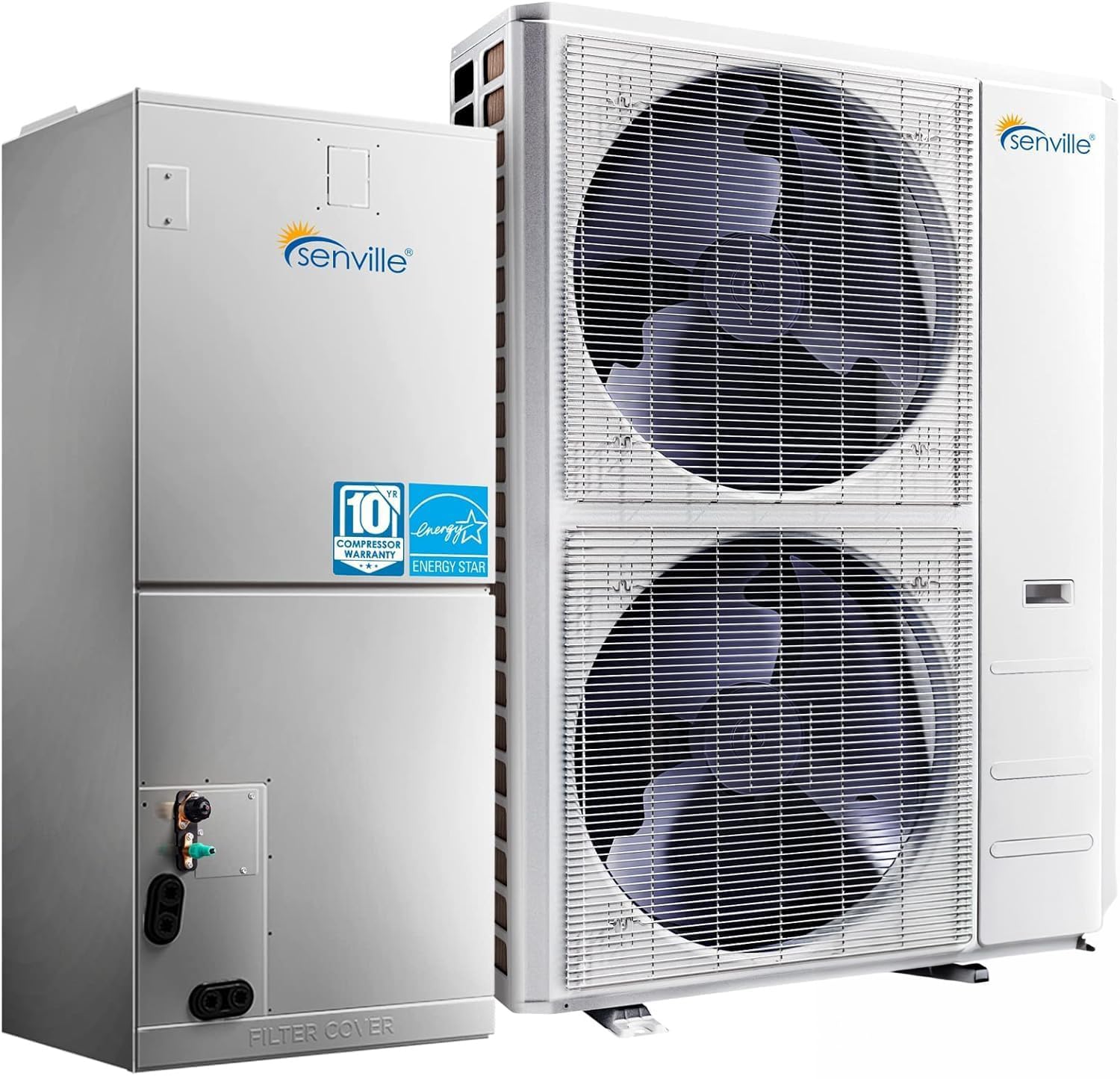
1. Senville Central Air Conditioning System, Heat Pump, 5 Ton, 10kW Aux
The only system here that keeps heating down to -22F.
It takes the top spot because it is the only 5 ton system here that keeps heating in genuinely brutal cold. The variable speed inverter compressor (a motor that spins up and down gradually instead of only on and off) lets it hold temperature steadily rather than blasting and pausing all day. And when the outdoor temperature drops to -22F (-30C), the 10kW auxiliary heat strips kick in to carry the load — the thing that makes this a true year-round unit rather than a summer-only box.
Its cooling power is 55,000 BTU, and it is rated to cool a home up to 2,000 square feet. Those are real, usable numbers for a large house, and the inverter design means it runs quieter and more gently than a fixed-speed unit. The 10-year compressor warranty and 5-year parts warranty, plus included indoor air handler, outdoor condenser, auxiliary heat, and thermostat, mean most of the hard-to-source pieces arrive together. Its Cold Climate Energy Star rating points to its strength in exactly the market where heat pumps usually get dismissed.
Here is the honest catch. At 3.7 stars across a handful of ratings, this is the lowest-scored pick on the list, and the complaints cluster around support and parts, not cooling. Buyers report a motherboard (the control board) that “arrived June 25 in Arizona but failed to light up after install,” with a promised replacement part still unshipped eight days later — the kind of delay that leaves you without AC during a heat wave. The system also ships without an installation kit, and Senville itself recommends a licensed professional, so add that cost and coordination to your plan. If you need fast, reliable parts support in a hurry, this is the trade-off you are accepting.
Where it earns its keep
- Heats even in conditions as low as -22F/-30C thanks to the 10kW auxiliary heat
- Inverter compressor runs smooth and quiet instead of hard on and off
- Covers up to 2,000 square feet with 55,000 BTU of cooling
- 10-year compressor and 5-year parts coverage
What to weigh before buying
- Ships without an installation kit, and pro install is required
- Lowest owner score among the four picks, with support and parts delays surfacing
- Cold-climate performance leans on the aux heat strips, which draw more power
Grab this one if: you live where winters bite and you want one system to both heat and cool a large home.
Think twice if: getting a replacement part fast matters more to you than cold-weather heating, since the parts pipeline has let owners down.
2. Goodman 5 TON 14 SEER2 Multi-Position R-32 AC Only System with air handler

Cooling-only muscle for a large home, priced low enough to leave room for the install.
If you already have a working furnace and only need to solve the summer, this Goodman is the sensible spend. The scroll compressor (a smooth, low-vibration pump design) paired with a single-speed condenser fan motor delivers 57,000 BTU of cooling — a touch more raw cooling power than the Senville’s 55,000 BTU. It ships with the condenser and air handler together, both AHRI Certified and ETL Listed, and the condenser comes fully charged for 15 feet of tubing, which trims a little setup time for your installer.
The multi-position air handler is a quiet asset. It can be configured to fit the space your home actually has, so an awkward attic or closet is less of a headache. Factory-installed filter drier and a contactor with lug connection round out a build that reads like it was designed by people who install these for a living. The 14 SEER2 rating is the entry efficiency tier, which is fine here — it is a cooling-only unit, so there is no heating side to compromise on.
What stands out from owners is the value story. Owners mention saving thousands versus other vendors on this exact system, with one noting the total came in far below competing quotes. On the reliability side, the notes are reassuring rather than alarming: shipping damage that turned out cosmetic, with the condenser still holding positive pressure. That is the kind of detail that tells you the packaging and the unit itself are solid. A few accessories you will need — lineset, thermostat, and LP conversion kit if you run propane — are sold separately, so budget for those.
Install-friendly build: The multi-position air handler and pre-charged-for-15-feet condenser mean less fussing on install day, which is where budgets quietly go sideways.
The one caveat: It is cooling only. If your existing furnace is on its last legs, you will be back shopping for heat before long.
Steady pick if: your furnace is healthy and you just want dependable 57,000 BTU cooling without paying for heating you will not use.
Look elsewhere if: you need a heat pump or a full furnace replacement — this unit only handles the cooling half of the job.
3. Goodman 5 TON 14 SEER2 R-32 AC Unit with matching 24.5″ wide coil and 120k BTU 80% AFUE upflow furnace

A matched AC, coil, and 120k BTU gas furnace in one purchase.
For the homeowner replacing the whole works, this bundle removes the guesswork of matching parts. Instead of sourcing an outdoor condenser, an evaporator coil (the indoor coil that absorbs heat), and a furnace separately and hoping they play nicely, you get all three together: the 5 ton R-32 air conditioner, a matching 24.5-inch wide coil (CAPTA6030D3), and a 120,000 BTU 80% AFUE upflow furnace (GR9S801205DN). BTU (British thermal unit) measures heating power, and AFUE (Annual Fuel Utilization Efficiency) is the furnace’s fuel-efficiency score; 80% AFUE is the standard-efficiency tier. It ships by default in a vertical upflow configuration (air blows upward), so if your home needs horizontal or downflow, you must specify that at purchase.
The 120k BTU furnace converts to liquid propane with a conversion kit sold separately, which matters if you heat with propane rather than natural gas. Because the coil and furnace may not share the same multi-position flexibility — many furnaces take multiple orientations while coils often do not — the upflow default is worth double-checking against your ductwork before you click buy. This listing is equipment only; installation is not included.
Owners describe a warm house and a flexible vendor. The feedback on the heating side is straightforward — it has kept homes warm since installation. The delivery experience drew a detailed shout-out too, with a buyer praising how the company coordinated a last-minute change to the delivery address and texted to arrange timing. That kind of flexibility on a pallet-sized freight delivery is worth real money in avoided headaches. With seven ratings all at the top mark, this is the highest-scored pick here. The honest note is simply that it is a gas furnace system, so your decision hinges on whether you burn gas and whether your home is already set up in upflow.
Why it tops the scoreboard: A matched condenser, coil, and furnace in one listing eliminates the brand-mismatch risk that trips up DIY parts sourcing.
Room to check: It defaults to upflow and the coil may not convert like the furnace does, so verify your duct configuration before ordering.
Built for you if: you are replacing a full gas furnace system and want every piece matched and shipped together.
Pass on it if: you heat with electricity or need a horizontal or downflow layout — this bundle is set up for upflow gas heat.
Understanding the Specs
Cooling Power and Tonnage
Cooling power is measured in British thermal units, or BTU — the higher the number, the more heat the system can remove from your home. The 5 ton rating on every system here translates to a large-home cooling load, and one unit is explicitly rated for spaces up to 2,000 square feet. When you compare, remember that the BTU figures here range from 55,000 up to 58,000, so a few thousand BTU is a real difference in how fast a big space drops to temperature. Never oversize the tonnage thinking more is better — a unit that is too large short-cycles and leaves humidity behind.
SEER2 Efficiency
SEER2 is the updated efficiency score for cooling equipment — think of it as miles per gallon for your air conditioner, where a higher figure means less electricity to deliver the same cooling. Here you are choosing between a 14 SEER2 unit and a 14.5 SEER2 unit, a small but real gap over a long cooling season. Note that SEER2 only describes cooling; for heating performance you look at the heat pump’s cold-weather rating and the auxiliary heat capacity instead. A system with a good SEER2 and a mismatched blower will still disappoint, so efficiency is a team sport between the outdoor unit and the air handler.
FAQ
How many square feet will a 5 ton HVAC system cool?
Do I need a heat pump or an AC-only system?
What does the 10kW aux heat on the Senville actually do?
What is R-32 refrigerant and why does it matter?
Can I install one of these 5 ton systems myself?
Does the system come with everything I need to run it?
How long does the warranty last, and what voids it?
What is AFUE on the furnace bundle?
Can the furnace bundle work if my home is not set up for upflow?
Is a 14.5 SEER2 heat pump worth it over a 14 SEER2 AC?
Final Thoughts: The Verdict
For most people, the 5 ton hvac system that earns the top spot is the Senville 5 Ton Heat Pump: it is the only unit here that both cools and keeps heating down to -22F/-30C, using an inverter compressor (a variable-speed pump that adjusts output) and a 10kW auxiliary heat (a 10-kilowatt electric backup heater) to carry it through a real winter. If you already have a working furnace and want the most cooling for the money, grab the Goodman 14 SEER2 AC-only system, whose 57,000 BTU and multi-position air handler (an indoor unit that can be installed in different orientations) make it the value play. And if raw cooling power plus heat is what you want, the Goodman 14.5 SEER2 heat pump leads the pack on capacity at 58,000 BTU and carries a track record of going the distance since 2018. Its higher score sits above the others even though a budget-tier pick can draw a bigger crowd — here the reliability story and the top cooling figure are what tip the scale. Whichever way you go, confirm your tonnage, your installer, and the registration deadline before the crate arrives.
How We Picked
We do not accept paid placement. Every pick is matched to a real buyer and a real use-case; we do not hands-on test units.
Sources & Methodology
Specifications: manufacturer listings and product documentation. Review insights: verified customer reviews, as of September 2026. Pricing: not shown on this page (it changes often); check the current price via the retailer link.
As an Amazon Associate, KitchPrep earns from qualifying purchases. This does not affect which products we feature.
Related Guides
