
Specs are compiled from manufacturer listings and verified buyer reviews and can change over time — please confirm the key details on the product page before buying.
If you are running a new water line, the short answer is this: match the pipe to the job, not to the price tag. A 1-inch PEX line for a deep well pump wants stiffness and pressure headroom. A 1-inch line snaking through joists or under a driveway wants flexibility and a long coil so you are not stopping every few feet to add a fitting. Those two needs point to different pipes, and this guide separates them so you buy once.
I’m Mohammad Maruf — the founder and writer behind KitchPrep. This guide is built by comparing the manufacturers’ published specifications and the patterns across verified customer reviews, so you get each pick’s real strengths and trade-offs instead of marketing spin.
You will see the wall thickness, pressure rating, and coil length spelled out for every option, along with who each one actually suits. Every pick below earns its place for a specific run, and this breakdown of the best 1-inch pex pipe helps you match the tubing to the job before you cut a single length.
Our Picks at a Glance


How To Choose The Best 1-Inch PEX Pipe
Almost every 1-inch PEX coil looks the same through the plastic wrap. The differences show up later — when you are pushing an expansion tool onto the end, when you are fighting a coil that wants to stay curled, or when a buried line sits in the sun for a week.
PEX-A versus PEX-B: which one your fittings want
PEX-A is the expandable type. You slip an expansion ring over the pipe end, stretch the opening, slide the fitting in, and the pipe shrinks back to grip it. That gives you the widest inner opening of any connection, so water moves with less restriction. PEX-A also tends to hold a bend better and straighten more willingly.
PEX-B is the silane-method type. It is stiff and cheaper to make, and it connects with a crimp ring, a cinch clamp, or a push-to-connect fitting. If you already own a crimp tool, PEX-B is the cheaper path. Just know the pipe fights you more when you are trying to lay it straight.
Wall thickness and pressure rating: not the same thing
Wall thickness is how much material sits between the water and the outside world, measured in fractions of an inch. A thicker wall (like 0.131 inches) resists crushing and holds up better under continuous pump pressure. A thinner wall (like 0.048 inches) stays more pliable.
Maximum pressure rating is the pounds per square inch (psi) the pipe is rated to hold. A deep well pump line wants headroom here. Only compare psi numbers from the same temperature band, because a pipe rated at 160 psi cold is often rated far lower once the water heats up.
Coil length, straightening, and the sun trick
A 100-foot coil suits a single room or a short service run. A 300-foot coil lets you reach the far end of a house or a shop without a single coupling, and every coupling you skip is one less place to leak.
The one catch across the whole category: coils carry memory. The pipe arrives wanting to stay curled, and PEX is stiff. Lay the coil out in the sun on a warm day, weight one end, and let it relax before you clamp anything down. Do that first and the whole install goes faster.
Quick Comparison
| Model | Best For | Type | Max Pressure | Length | Amazon |
|---|---|---|---|---|---|
| EFIELD Pex 1 Inch 100 ft Red★ Best Overall | Well pump and potable water runs | PEX-A | — | 100 ft | Amazon |
| Supply Giant QGX-X1100 1 in. x 100 ftBest Value | Basement and shop replumbs | PEX-B | 100 psi | 100 ft | Amazon |
| SharkBite U880B100 1 in. x 100 ft Blue | Push-to-connect installs | PEX-B | 160 psi | 100 ft | Amazon |
| EFIELD 1 Inch 100 ft Pex A Red | Expansion-tool crews | PEX-A | — | 100 ft | Amazon |
| VEVOR PEX-B 1 in. x 300 ft Blue | Radiant floor and long runs | PEX-B | 160 psi | 300 ft | Amazon |
| Happybuy Pex Tubing 1 in. 300 ft Red | Radiant heat and snow melt | PEX-B | 217 psi | 300 ft | Amazon |
| SharkBite U880W300 1 in. x 300 ft White | Whole-house and buried mains | PEX-B | 160 psi | 300 ft | Amazon |
In‑Depth Reviews
1. EFIELD Pex Piping Red Color in 1 Inch – 100 ft Length for Potable Water
Our pick — over 4.5★ from 350+ verified ratings; the strongest balance of quality and price.
The expandable red coil that gives you the widest bore for the money.
If your water comes from a deep well and you want the least restricted flow you can get from a 1-inch line, start here. This is PEX-A — the expandable type, where you stretch the pipe end, slide a fitting in, and let the pipe shrink back to grip it. That connection leaves more open area for water than a crimp-style joint, so a pump pushing hard does not lose head at every fitting. The 100-foot length covers a straight run from a well head or a full basement replumb without a pile of couplings.
The core strength here is the pipe itself. Made by one of the big PEX systems manufacturers rather than a web-only reseller, it is NSF certified and built to resist the chlorine and chloramine additives that city water carries. Buyers report it handled an underground waterline job cleanly — passed inspection, installed easily, and stayed kink-free with only two fittings on the run. For anyone replacing tired old metal supply pipe, the switch is the whole point: PEX does not corrode the way galvanized steel does, and it does not scale shut.
Here is the honest catch, and it is a real one for tight jobs. This pipe will not straighten out. That stiffness is a genuine feature on a buried run or a long straight line, where you actually want the pipe to hold its path. On a short indoor run crammed into a rigid space between joists, though, that same stubbornness turns into a wrestling match — you have to clamp and support it rather than persuade it to lie flat. Plan for elbows and supports where the pipe needs to turn.
What earns the top spot
- PEX-A expandable design that connects with expansion fittings for full water flow
- NSF certified for potable water, with chlorine and chloramine resistance built in
- Ships with a PEX pipe cutter, so you can start cutting the same day it lands
- Long-standing reputation for clean installs on underground and well-head runs
Where it pushes back
- Will not straighten, even when warmed — fine when clamped or buried, awkward on short rigid runs
- Needs expansion fittings and rings ordered separately to use the full-flow connection
Buy this if: you are running a well line, a main service line, or a full replumb and want the expandable connection plus the widest flow path.
Think twice if: you are fitting short lengths into a tight rigid space where the pipe has to lie perfectly flat — its refusal to straighten will cost you extra clamps.
2. Supply Giant QGX-X1100 PEX Tubing for Potable Water, Non-Barrier Pipe 1 in. x 100 Feet, White, 1 Inch
The budget white coil with the thickest wall of the group.
Dollar for dollar, this is the least expensive way into a 1-inch PEX line, and it backs that up with the heaviest wall in this lineup. Its nominal wall thickness is 0.131 inches — a stout layer of material between the water and the world. That thickness is exactly what you want on a water supply main, a basement replumb, or a shop line, because a thick wall resists crushing and shrugs off bumps during backfill. It also holds up to pressure either 100 psi, so it is built for supply-side work rather than high-head pump discharge.
Buyers rate the pipe quality highest, with value a close second. A four-month test connecting a submersible deep well pump to the well head with compression clamps came back with no leaks and no kinks, and the pipe cut easily. Someone who replumbed a whole basement in this material noted the change from old poly and CPVC went smoothly and the connections were simple to make. It is UV resistant and meets NSF and ASTM standards for potable water, so it will not fall apart just because a coil sits outside before you bury it.
The trade-off is stiffness, and it is the most-discussed thing about this pipe. PEX-B of any brand fights you, and a thick wall makes it worse. Fitting it into tight 90-degree brackets is a chore — one buyer ended up using hose clamps and a socket to hold it in place, and wished in hindsight they had spent the extra on a more flexible PEX-A pipe for that job. This does not matter at all on a straight buried run. It matters a lot when the pipe has to turn a right angle in a crawl space.
Thickest wall here: At 0.131 inches nominal, this wall is 2.7x the 0.048 inches on the SharkBite U880B100 blue coil above — real crush resistance for supply lines that get backfilled.
But mind the ceiling: Its 100 psi maximum pressure sits below the 160 psi of the SharkBite blue pipe, so keep this one on potable supply duty and off high-head pump discharge.
Matches best with: budget-conscious basement, shop, and supply-line jobs where the run is mostly straight and gets buried or clamped.
Look past it if: your run is all tight corners — the stiffness will cost you time, and a flexible expandable pipe would serve you better.
3. SharkBite 1 Inch x 100 Feet Blue PEX-B, PEX Pipe Flexible Water Tubing for Plumbing, U880B100
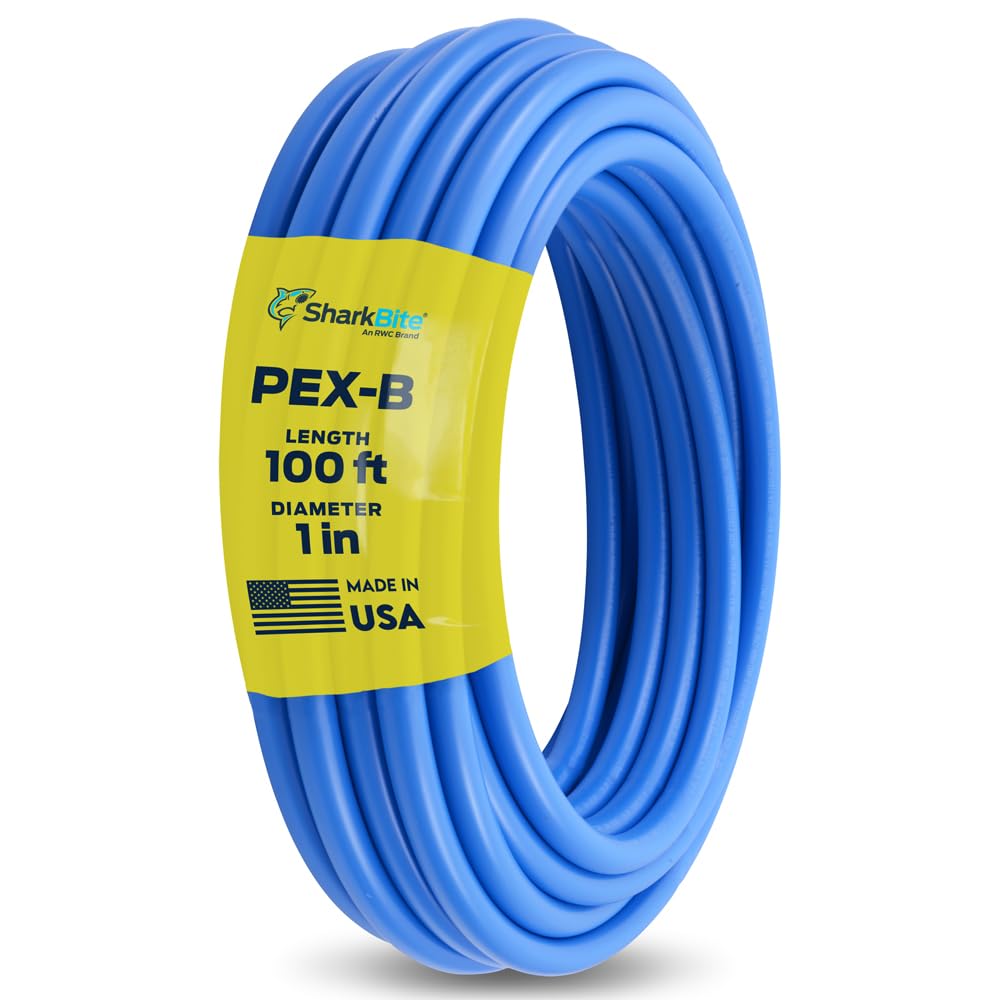
The coil built to snap onto push fittings without a crimp tool in sight.
If you do not own a crimp or expansion tool and never plan to buy one, this is the 1-inch coil to build around. It carries the highest pressure rating in this comparison at 160 psi, and it is designed to pair with push-to-connect fittings that simply slip over the pipe end and lock — no tool, no ring, no guessing whether the crimp seated right. On a repair or a one-off service line, that shortcut saves a lot of hassle.
Three things make this pipe tougher than its thin wall suggests. Its 0.048-inch nominal wall is the thinnest here, but it also carries a limited 25-year warranty, resists freezing by flexing as ice expands and thaws, and holds up to chlorine across a full range of fittings — plastic barb, brass barb, expansion, and push-to-connect. It is UV tolerant for six months of exposure, and it is rated for burial under concrete. For an outdoor service line that sits in the weather before backfill, that headroom matters. Owners mention it is rock-solid on the job: a well-water connection and run extension worked exactly as promised, with consistent size and shape from coil to coil.
Now the honest part. This pipe is stiff — and here it is the most-discussed topic about it, so do not expect a noodle. It will not simply pour out of the coil; it holds its curl, and you have to work it. The fix buyer after buyer lands on is warmth: lay the coil in the sun, unroll the length you need, clamp the ends, and let it relax. Do that and it lays down fine. Skip it and you will be fighting a springy blue snake all afternoon. The flip side of that stiffness is that the pipe feels sturdy and holds its shape once it is placed.
Pressure headroom: Its 160 psi maximum beats the 100 psi of the Supply Giant QGX-X1100 above — that headroom is what makes it safe for municipal water service lines and buried mains.
Reverse the wall math: At 0.048 inches nominal it has the thinnest wall here, meaning it flexes more but crushes more easily than the thick-walled white coil above.
Reach for this if: you are joining with push-to-connect fittings, burying a service line, or want a pipe rated for hot and cold potable water without buying a crimp tool.
Steer around it if: you want a pipe that unfurls straight off the spool — the coil memory is real, and it needs sun and patience to lay flat.
4. EFIELD 1 Inch 100 ft Pex A Pipe/Tubing RED
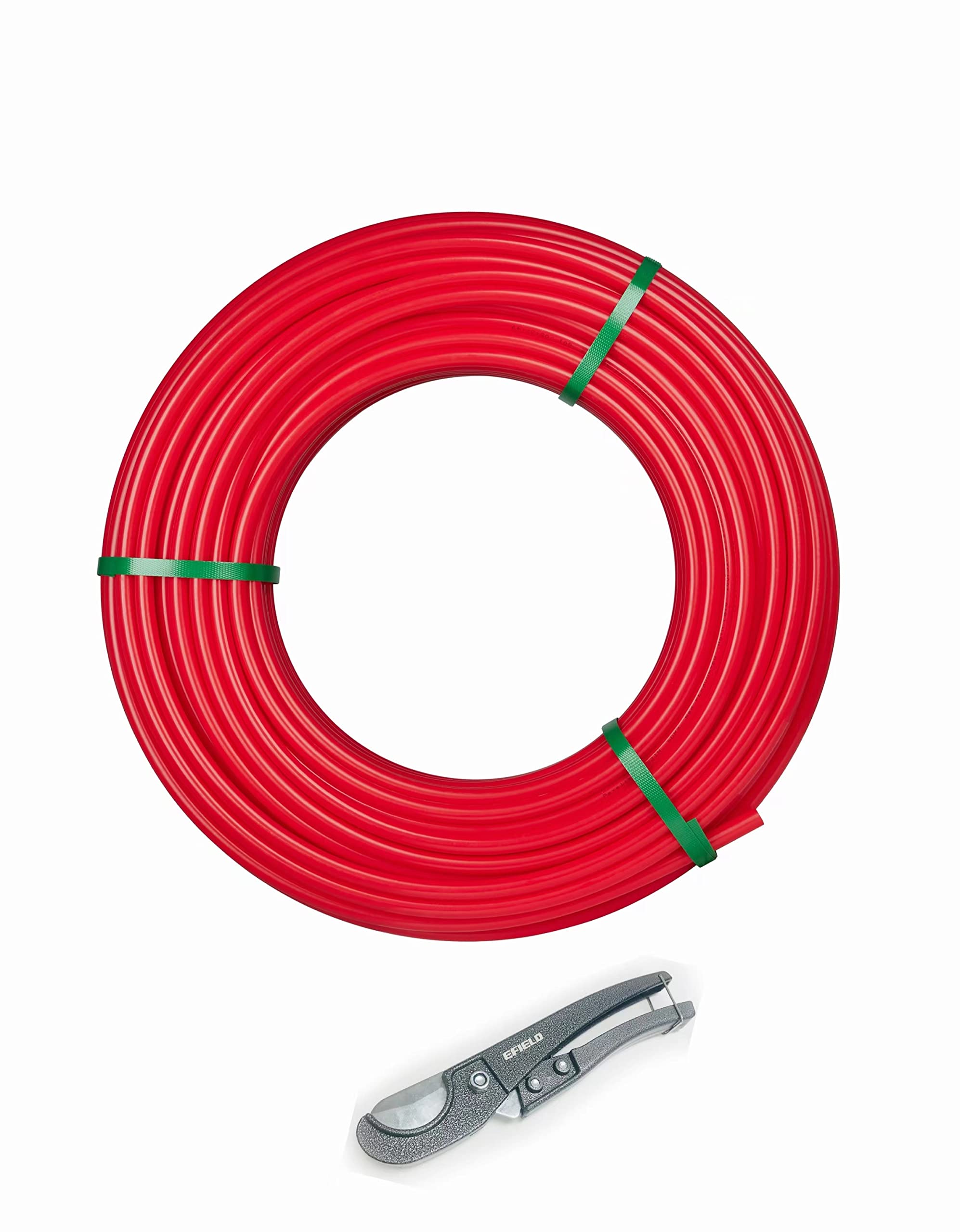
The expandable red coil that plays nice with almost any fitting system.
Already own expansion tools and want the most flexible pipe in the lineup? This is the one that gives it to you. It is PEX-A, the expandable type, so the recommended connection is an expansion fitting and ring — you stretch the pipe, insert the fitting, and let the pipe shrink back for a full-flow joint. And unlike some PEX-A, it does not lock you into one system: it also works with barb crimp, clamp, and sleeve connections, so you can use what you have on the truck instead of buying a new tool.
It ships with a PEX pipe cutter, and it meets a long list of standards — ASTM F876, F877, F1807, F1960, F2023, F2080, and F2169 — which is plumbing-talk for compliance with the rules for potable water and expansion connections. It is chemically resistant to chlorine, and the red color is traditionally used for hot water supply, which makes tracing lines easy in a busy mechanical room. The material itself is a polyethylene (PEX) compound, and the outer diameter is 1 inch.
Buyers consistently report it does exactly what the listing claims. Connections go together cleanly with PEX tools, and the pipe is easy to work with once you have the right gear. Multiple owners picked it specifically for the length and the color, and it fit their layouts. There are no horror stories here — the pipe holds up. Set expectations accordingly for your own job, though: this is PEX-A, so it wants expansion fittings and rings that are ordered separately, and you will get the best results with the matching tool in hand.
Why it belongs high on the list
- PEX-A expandable design for the widest-full-flow connections on the market
- Flexible enough to bend around corners while holding the straightening properties PEX-A is known for
- Compatible with barb crimp, clamp, and sleeve connections, not just one system
- Meets ASTM F876, F877, F1807, F1960, F2023, F2080, and F2169 standards
- Chlorine resistant with a red ID color that keeps hot-water lines easy to trace
What to plan around
- Expansion fittings and rings must be ordered separately to use the recommended connection
- Best performance requires owning the matching expansion tool
Made for: anyone already set up with PEX-A expansion tools who wants flexible pipe and the widest possible flow opening.
Not the one if: you are building around push-to-connect fittings only — the crimp-style PEX-B coils above are simpler for that path.
5. VEVOR PEX-B Pipe 1 Inch X 300 Feet, Non-Oxygen Barrier Flexible Pipe Tubing, Blue for Hydronic Radiant EVOH Floor Heating, Water Plumbing Applications with Cutter & Clamps

Three hundred feet of blue coil that stretches a whole floor plan without a coupling.
When your project is a radiant floor loop or a line snaking across a big shop, length is the spec that matters most, and this coil delivers 300 feet in one continuous piece. Fewer couplings on a run means fewer spots that can weep. It also includes a PEX cutter and ten steel clamps in the box, so you are not chasing separate parts before you start. The 1.13-inch outside diameter sits in the middle of this lineup — thick enough for durability, still bendable around the typical floor situation with a minimum 7-inch bending radius.
The temperature range is where this pipe earns its keep on heating jobs. It is rated from -40 degrees F to 203 degrees F, with pressure ratings that step down as the water heats: 160 psi at 73 degrees F, 100 psi at 180 degrees F, and 80 psi at 200 degrees F. That staircase is normal for PEX, and the point is that this coil is built to carry hot water through a heating loop as well as cold potable supply. It connects with crimp, cinch (clamp), press, and compression PEX fittings, so it plays with a variety of connection systems, and it is rated for indoor or outdoor hydronic radiant heating, snow melting, and solar heating setups.
Two honest notes. First, this is a non-barrier pipe, so it is meant for open-loop and potable water systems — it is not the oxygen-barrier type for closed-loop hydronic heating, so check your loop design before you commit. Second, coil memory is real here. Buyers who unrolled it and laid it down easily were the ones who took their time. One owner did find a kink with a visible stress mark that required cutting in a coupling, so inspect the pipe as you unroll and catch any pinches before you clamp. Buyers keep coming back for the price and the no-fuss performance, with the included cutter and clamps as a bonus.
The bend advantage: A 7-inch minimum bending radius means you can ease this pipe around obstacles without reaching for an elbow, which keeps a long radiant loop coupling-free.
Which job it is not for: Non-barrier means open-loop and potable water only — for a closed heating loop you want an oxygen-barrier pipe instead.
Picks you right back if: you are laying radiant floor, snow-melt, or solar heating lines and you want 300 feet plus the cutter and clamps in one purchase.
skip it if: your system is a closed-loop heating circuit — the non-barrier construction is the wrong fit, so look for an oxygen-barrier pipe.
6. Happybuy Pex Pipe Tubing 1 Inch 300ft Pex Tubing Non-Barrier Radiant Water Plumbing Pipe Pex-B 1″ Non-Barrier/300FT/Red

The red 300-footer with the widest temperature window of the bunch.
If your heating project spans both a cold climate and a hot loop, this is the coil to notice first. It carries a compatible water temperature range from -47 degrees F to 230 degrees F, the widest here, and a big pressure capacity of 188 to 217 psi at 20 degrees C that tapers to 101 to 108 psi at 95 degrees C. Translated: it is built to sit in the weather where the loop meets the outside and to carry heated water without giving up its shape. At 300 feet in a single coil with a minimum 9-inch bending radius, it works around floor situations without a coupling at every turn.
It is made from PEX material described as non-toxic, crack resistant, and leak proof, and it ships with a pipe cutter and 10 clamps — enough to get you cutting and clamping right from the start, though keep in mind you will need fittings of your own to actually join the pipe. Buyers rate the pipe quality highest, with value a close second. Dimensions arrive accurate against the listing, and the included cutter makes clean cuts. One owner noticed the pipe arrived as a Vevor p130-13-300b branded product and confirmed it matched the listed specs, which is a useful reminder to check the label before you start cutting.
The honest note here is coil stiffness and this round of the clamps. Reviewers who tried to wrestle the pipe flat without warming it came away calling it a little stiff and slow to straighten. The trick that works, repeated in buyer reviews, is simple: pin one end on the lawn, unroll the coil, pin the other end, and let the sun sit on it for a while. Separately, a few buyers noted that the included clamps are only useful if you supply the connectors, which the pipe does not ship with — so plan your fittings order alongside the pipe, not after.
Radiant floor and snow melt covered: The -47 to 230 degree F window and 217 psi peak handle the outdoor loop conditions where a colder-rated pipe would struggle.
The piece that needs planning: Clamps are in the box, connectors are not — check your fittings before the pipe lands.
Built for: snow-melt, solar water heating, and radiant floor projects that run hot and cold across the year and need a big temperature buffer.
Not for: anyone hoping to snap the pipe into place straight out of the coil — it has memory and wants a warm day and a little weight on the ends.
7. SharkBite 1 Inch x 300 Feet White PEX-B, PEX Pipe Flexible Water Tubing for Plumbing, U880W300

The full-house coil that shrugs off a freeze and buries under concrete.
For a complete whole-house repipe or a long buried main, the spec that saves you time is coil length and the spec that saves you leaks is the connection. This 300-foot white coil answers both. It carries 160 psi maximum at 33 to 70 degrees F, holds as much as 200 degrees F at a lower 80 psi, and is rated to direct burial including under concrete. That burial rating is what lets you run it straight through a trench and backfill without worrying the pipe will give up in a year. It works with expansion (F1960), push-to-connect (ASSE 1061), plastic barb (ASTM F2159), and brass barb (ASTM F1807) fittings, so you can stay inside whichever system you already own.
Two more things that set it apart. It is freeze tolerant: the pipe flexes as water freezes and recovers its shape on thaw, so a hard cold snap is less likely to split it. And it is manufactured in the United States with a limited 25-year warranty, which is a real commitment on a pipe that spends its life out of sight. Customers note it is legit SharkBite PEX, connected cleanly, held zero leaks with clamps, and worked well installed underground for a new water service. One owner also confirmed it pairs well with SharkBite cinch clamps, and intends to run it through 2-inch HDPE conduit for extra protection.
The honest catch is the same one sharking every stiff PEX-B coil: unrolling. A 300-foot roll carries memory, and on a cold day it fights hard to stay curled. Owners who unrolled it in three steps — warm the roll indoors, stake one end by the trench, sun-bask it, and untwist as they go — reported it settled down nicely. One buyer even flagged that their roll ran a bit short of the stated 300 feet, so measure the actual length before you finalize a run that has no margin.
The case for the premium coil
- 300 continuous feet suits a full-house main without a mid-run coupling
- Direct burial rated, including under concrete, for trench-and-backfill service lines
- Freeze-tolerant pipe that flexes as water freezes and recovers when it thaws
- Compatible with expansion, push-to-connect, plastic barb, and brass barb fittings
- Manufactured in the United States and backed by a limited 25-year warranty
What to be ready for
- Big 300-foot rolls hold their curl — unrolling in cold weather takes patience and warmth
- One buyer found their roll ran a little short of the stated length, so measure before you commit
The whole-house answer: a single 300-foot coil for a repipe or a buried service main, from a brand with a limited 25-year warranty behind it.
Not if you want small and simple: a 100-foot coil would leave less pipe to wrestle with and store — this big roll is overkill for one room.
Understanding the Specs
PEX-A vs PEX-B
PEX-A is the expandable type — you stretch the pipe end and a fitting slides in for the widest flow opening of any connection. PEX-B is the silane-method type; it connects with crimp rings, cinch clamps, or push-to-connect fittings and is generally stiffer and less flexible. If you already own a crimp tool, PEX-B is simpler; if you want the least flow restriction and don’t mind ordering expansion rings, PEX-A wins. Neither is “better” across the board — they connect differently, so pick by the tool in your hand and the fittings you plan to use.
Pressure Ratings and Temperature
Maximum pressure rating is the psi the pipe is rated to hold, and it changes with temperature — a coil might carry 160 psi at 73 degrees F but only 80 psi at 200 degrees F. That is normal and expected. Read the rating as a set of stops on a staircase, not a single number. For a well pump line, aim for the higher pressure rating; for a hot water loop, check the rating at the temperature your water will actually reach, because that is the number that keeps you safe.
FAQ
Can I use PEX-A pipe with crimp fittings?
Is 1-inch PEX better than copper for a water main?
What does PEX-A and PEX-B mean in plain terms?
How do I straighten a coil of PEX pipe?
Can I bury PEX pipe directly in the ground?
Will 1-inch PEX pipe fit standard push-to-connect fittings?
Is the oxygen-barrier pipe better for radiant heating than regular pipe?
What is the difference between 100-foot and 300-foot PEX coils?
Does PEX pipe hold up to chlorinated city water?
Will 1-inch PEX pipe crack if it freezes?
Final Thoughts: The Verdict
If you want the single easiest buy, the EFIELD PEX-A 1-Inch 100 ft Red Coil earns its spot on top for its expandable full-flow connection, NSF certification, and a buyer track record that keeps returning to the same two words — quality and easy install. If you are running a long line and do not want to stop for a coupling, reach for the SharkBite White 300 ft Coil, whose direct burial rating and limited 25-year warranty cover the whole house in one piece. For a shop rebuild or a tight-budget basement job where the run is mostly straight, the Supply Giant QGX-X1100 1 in. x 100 ft gets you in for the least with the thickest wall here, so long as you keep it on supply duty and stay under its 100 psi ceiling.
How We Picked
We do not accept paid placement. Every pick is matched to a real buyer and a real use-case; we do not hands-on test units.
Sources & Methodology
Specifications: manufacturer listings and product documentation. Review insights: verified customer reviews, as of September 2026. Pricing: not shown on this page (it changes often); check the current price via the retailer link.
As an Amazon Associate, KitchPrep earns from qualifying purchases. This does not affect which products we feature.
Related Guides
