
Specs are compiled from manufacturer listings and verified buyer reviews and can change over time — please confirm the key details on the product page before buying.
When the lights go out, you need a backup that can run your fridge, charge your phone, and still have power left by morning. A 1000 Wh power station (a battery pack that stores 1,000 watt-hours of electricity) hits that balance for most homes and campers—big enough to matter, small enough to move. Here are ten top models compared on real-world output, charging speed, and battery longevity.
I’m Mohammad Maruf — the founder and writer behind KitchPrep. This guide is built by comparing the manufacturers’ published specifications and the patterns across verified customer reviews, so you get each pick’s real strengths and trade-offs instead of marketing spin.
We’ve matched each unit on true capacity, surge output, and recharge speed so you can pick the right 1000 wh power station without overpaying or undersizing for your gear.
Our Picks at a Glance

How To Choose The Best 1000 Wh Power Station
Before you click buy, know that the single most important number is capacity — measured in watt-hours (Wh). This tells you how much total energy the battery holds. A 1070Wh unit, for example, can run a 100-watt appliance for roughly ten hours before draining. It’s the size of your gas tank, not your engine.
Match Output to Your Heaviest Load
Continuous AC output (in watts) decides what you can plug in at all. A 1500W station runs a fridge and a TV at the same time; an 1800W unit gives you headroom for a microwave. Always check both numbers: the rated continuous output and the surge peak that handles motor start-up for a few seconds.
Prioritize Battery Chemistry for Longevity
LiFePO4 (lithium iron phosphate) batteries are the modern standard. They tolerate far more charge cycles than older lithium-ion cells — typically 3,000 to 4,000 cycles before hitting 80% capacity. That translates to a decade or more of daily use—a key factor at this price point.
Quick Comparison
| Model | Best For | Capacity | AC Output | Weight | Amazon |
|---|---|---|---|---|---|
| Jackery Explorer 1000 v2★ Best Overall | Best Overall | 1,070Wh | 1,500W | 23.8 lbs | Amazon |
| DJI Power 1000 V2Fastest Recharge | Fastest Recharge | 1,024Wh | 2,600W | — | Amazon |
| Anker SOLIX C1000Premium Pick | Premium Pick | 1,056Wh | 1,800W | 27.6 lbs | Amazon |
| OUPES Mega 1 Lite | Fast Charging | 1,024Wh | 2,000W | 26.7 lbs | Amazon |
| BLUETTI Elite 100 V2 | Compact Pick | 1,024Wh | 1,800W | 25 lbs | Amazon |
| BROWEY S1600 | Built-in Solar | 1,024Wh | 1,600W | 26 lbs | Amazon |
| Anker SOLIX S2000 | High Capacity | 2,010Wh | 1,500W | 35.7 lbs | Amazon |
| EF ECOFLOW Delta 3 Classic | Solar Bundle | 1,024Wh | 1,800W | — | Amazon |
| EF ECOFLOW DELTA 3 Max | High Power | 2,048Wh | 2,400W | — | Amazon |
| BLUETTI AC200L | Expandable Backup | 2,048Wh | 2,400W | 61.4 lbs | Amazon |
In‑Depth Reviews
1. Jackery Explorer 1000 v2
Our pick — over 4.5★ from 3,500+ verified ratings; the strongest balance of quality and price.
The 23.8-pound all-rounder that powers a campsite, a worksite, or a boat at anchor all night long.
You get a 1,070Wh battery that fills from empty in one hour when you switch to emergency charging in the Jackery App — otherwise it defaults to a gentler 1.7 hours to protect the cells. That makes it unusually flexible: top it up fast before a storm, or charge it slowly overnight at a whisper-quiet 30 dB so it doesn’t disturb your sleep.
The outputs cover almost everything. Two USB-C ports (one delivering 100W PD — enough to fast-charge a laptop), one USB-A, one DC car port, and three pure sine wave AC outlets. Pure sine wave matters because it produces clean power that sensitive electronics and CPAP machines run happily on. Buyers report it kept car fridges charged for up to two days, and one ran a full-size 16 cubic-foot refrigerator for 6-1/2 hours.
Durability is the quiet headline here. The LiFePO4 battery retains over 70% capacity after 4,000 cycles, supporting Jackery’s decade-long lifespan claim. Buyers call the build rugged and the output steady, with one detail that keeps coming up: it runs quieter than comparable EcoFlow units. The gripes are minor and few — some note the Wi-Fi won’t stay on overnight for status checks, and a few mention that cheap charging adapters can heat up.
Owners love
- Quality and charging speed are the two most-praised traits by a wide margin
- Light enough to carry one-handed with the foldable handle
- App control for emergency, quiet, and eco charging modes
Know before you buy
- Solar panel sold separately
- No 12V barrel ports — only a single DC car port
- Heavy for hiking, perfect for car camping
Grab it for: the buyer who wants one reliable station for camping, outages, and powering tools on the job.
Think twice if: you need a huge solar array or RV-grade 30A output — this stays a mid-size portable.
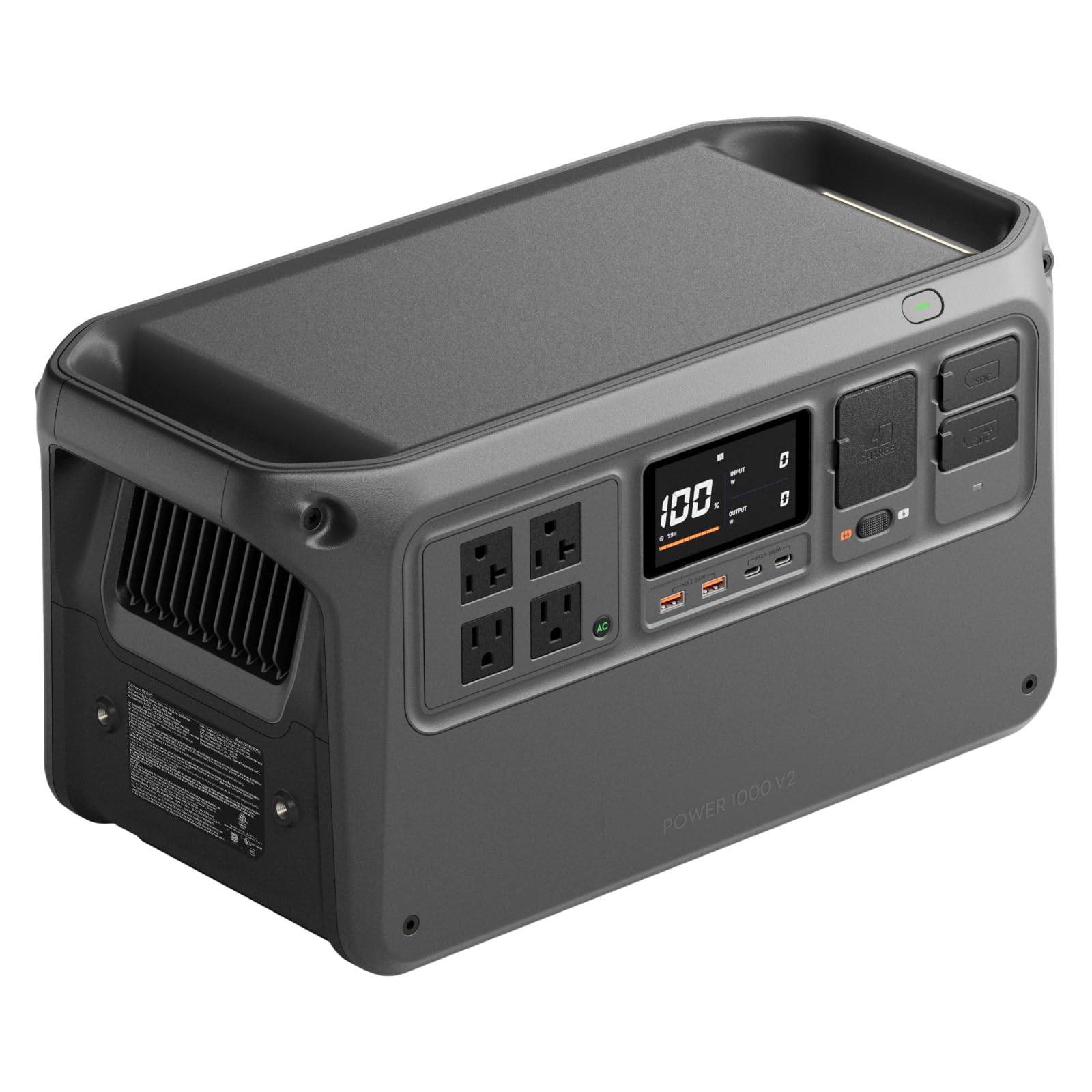
2. DJI Power 1000 V2
Recharges to 80% in 37 minutes flat, making it the fastest-refueling 1kWh station here.
This DJI unit packs a 1,024Wh LiFePO4 battery and a stunning 2,600W stable AC output — a full 73% more sustained wattage than the Jackery Explorer 1000 v2’s 1,500W, per verified specs. That headroom means you can run a kettle, a saw, a projector, or a drill without tripping the inverter, and DJI claims it drives 99% of common household appliances.
The catch is physical size. The DJI is 17.64 inches long versus the Jackery’s 12.87 inches — about 37% longer, so it eats more trunk space. It also uses proprietary SDC connectors, and one cable needed for a 12V socket connection is sold separately, which frustrates some owners. Buyers call the build high quality and the grid scheduler a standout — you can limit input to 600W from your wall to avoid peak-hours pricing.
Real-world feedback is strong but not flawless. The review pages sum it up: “Dead on arrival; DJI troubleshooting failed” captures a rare but painful experience with the warranty process. A few others mention it heats up fast under load, with a burning smell that caused concern — note if you’ll run it hard indoors. Most owners, though, praise the fast AC charging and steady output, especially as a UPS for network gear during storms.
The upside
- Class-leading 2,600W stable output drives heavy tools
- 0-80% recharge in 37 minutes is fastest in this list
- App scheduler cuts grid draw during peak hours
The trade-offs
- Large footprint — 17.64 inches long
- Proprietary connectors and a missing 12V cable
- Warranty support can be slow per some owners
Reach for this if: you run high-wattage tools or appliances and hate waiting hours for a recharge.
Look elsewhere if: trunk space is tight or you want standard DC ports without add-on cables.
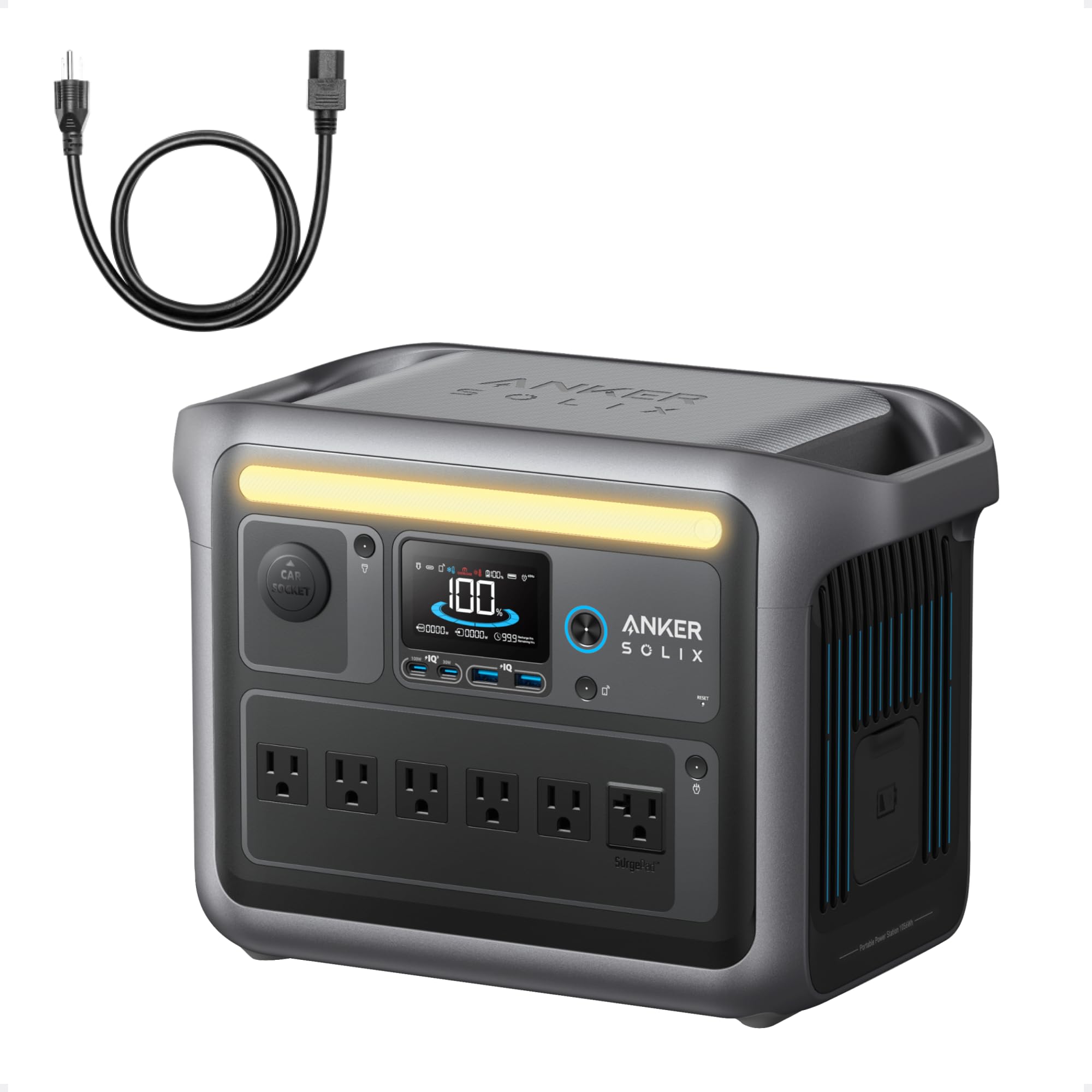
3. Anker SOLIX C1000
Hits 80% charge in 43 minutes and runs a full-size fridge for a day and a half.
Anker’s SurgePad technology pushes this 1,056Wh station to a huge 2,400W peak output, so a microwave or a space heater fires up without complaint even though the continuous rating is a solid 1,800W. Eleven ports mean you can run a fridge, charge two phones, and power a laptop all at once — no juggling cables.
Real-world endurance is the story here. Owners mention it ran an 18-cubic-foot Frigidaire for 36 hours in a garage, and a kitchen side-by-side for 12 hours, holding the freezer at 0-8°F and the fridge below 40°F throughout. For hurricanes and short outages, that’s exactly the confidence you’re paying for. Owners also rave about Anker’s customer service—one called a “user error” issue handled flawlessly.
It’s 27.6 pounds, and while Anker says it’s 15% smaller than comparable 1kWh units, this is still a two-hand carry. Solar recharging tops out at 600W, taking about 1.8 hours in full sun — decent, though not the fastest here. Reliability is the most-praised trait after quality, with a 3,000-cycle LiFePO4 battery rated for a 10-year lifespan.
Why owners pick it
- 2,400W surge handles demanding appliances
- Proven 36-hour fridge runtime in real reviews
- Excellent app and top-tier customer support
Small cautions
- 600W solar input is moderate for off-grid use
- 27.6 lbs needs two hands
- UltraFast mode requires a smartphone to enable
Best suited for: homeowners who need reliable, multi-day fridge backup and want premium support.
Not ideal for: minimalists who want a single-handed carry or need blazing 800W+ solar input.
4. OUPES Mega 1 Lite
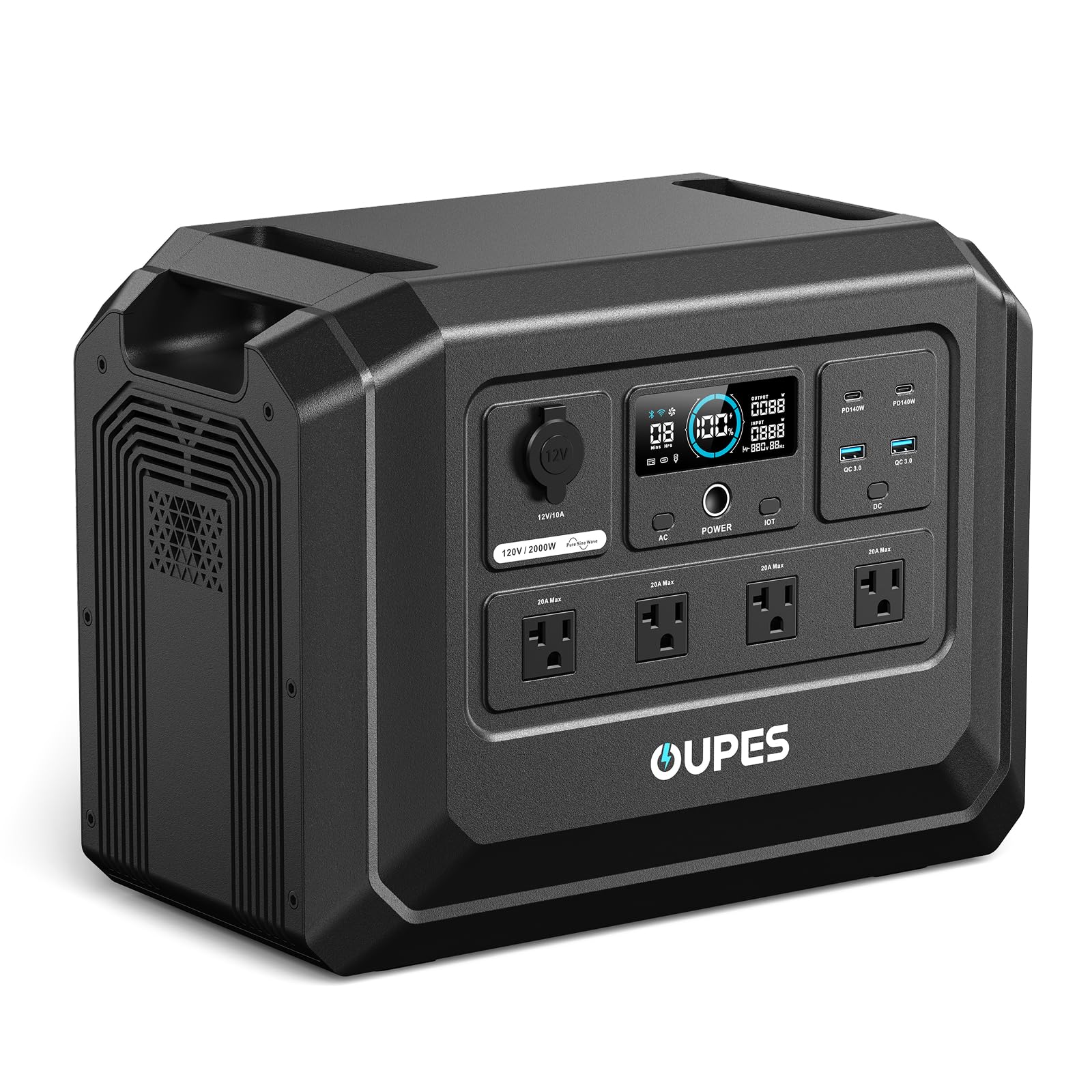
A 26.7-pound unit that recharges from wall juice in under an hour and surges to 4,500W.
With a 1,400W AC input, the Mega 1 Lite jumps from 0 to 100% in just 46 minutes — lunch-break fast. That same wall socket urgency carries over to the outputs: 2,000W rated with a 4,500W surge capacity, enough to start a fridge or a power tool with massive headroom, delivered as clean pure sine wave power.
Two USB-C ports deliver 140W each, which is the fastest laptop-charging spec in this comparison — even faster than the Jackery’s single 100W PD port. Nine ports total keep every device fed simultaneously. The 1024Wh LiFePO4 battery is rated for over 3,500 cycles to 80% capacity, translating to up to a decade of use.
Solar input hits 800W via the Anderson port (a standard solar connector), fully recharging in about 70 minutes with three 240W panels—among the fastest sun-to-full times here. The <20ms UPS switchover (a backup that kicks in faster than a blink) keeps a CPAP machine or router running smoothly through an outage. Owners replace gas generators with it, noting it’s quiet, fume-free, and reliable, though the solar panel isn’t included in the box.
Standout strengths
- 46-minute full recharge from a wall outlet
- Dual 140W USB-C PD ports charge laptops at max speed
- 800W solar input for fast off-grid refills
Worth weighing
- Higher price for the capacity class
- Solar panel not included
- Fewer total reviews than bigger brands
Choose it for: fast wall and solar refueling plus serious 4,500W surge protection.
skip it if: you want the most established review base and don’t need 140W laptop charging.
5. BLUETTI Elite 100 V2
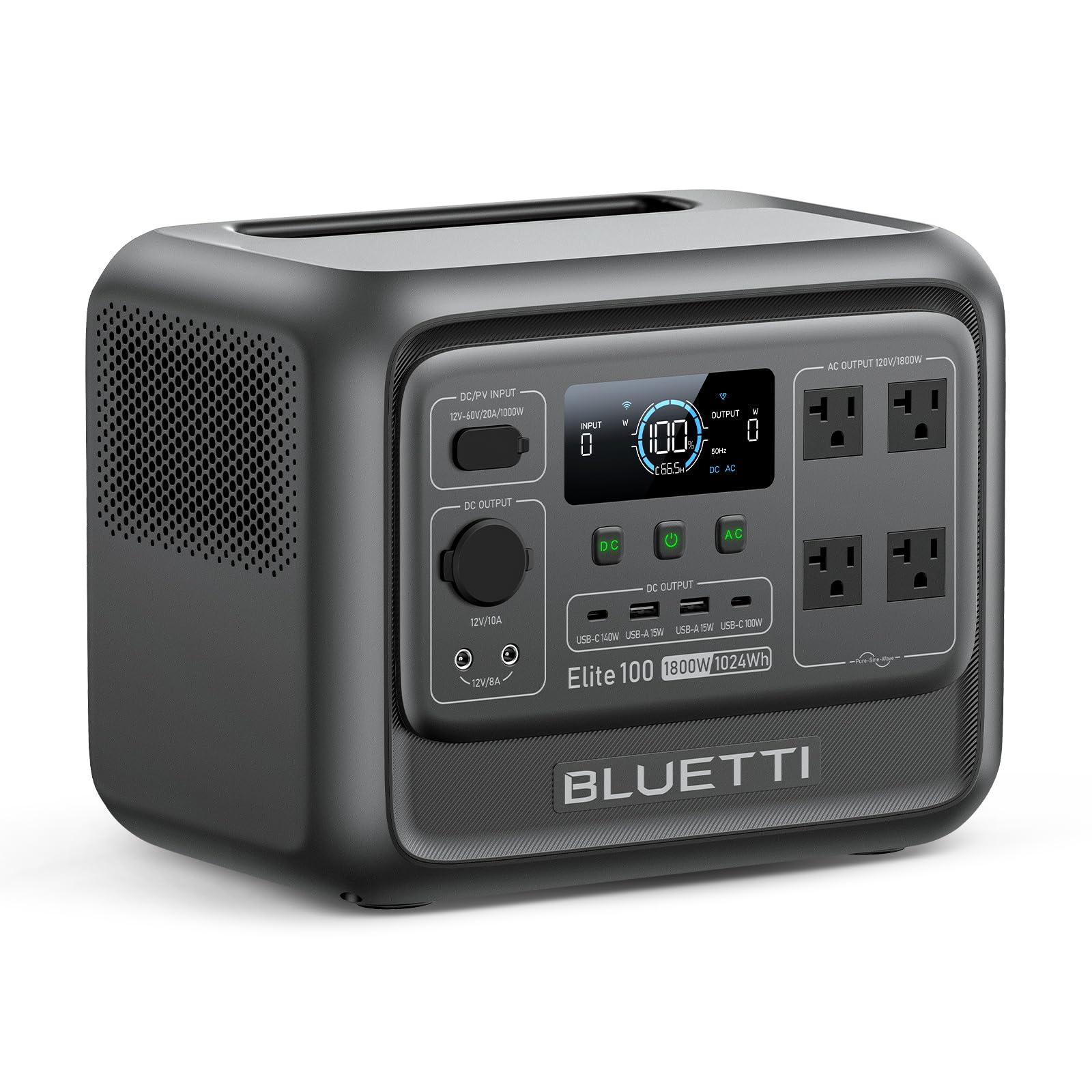
The 25-pound champ that’s 35% smaller than rivals yet still surges to 3600W.
BLUETTI trimmed the Elite 100 V2 down to a 17-liter footprint and 25 pounds, so you can grab it one-handed by the hidden top handle. That portability doesn’t cost output: 1,800W continuous and 3,600W surge, plus 11 ports, powers roughly 90% of everyday appliances. Owners even run it on astrophotography trips, keeping a mount, cameras, a mini PC, and a tablet alive for 6-7 hour sessions.
Charging is genuinely quick. At 1200W TurboBoost AC input it fills to 100% in about 70 minutes, or you can plug into up to 1,000W of solar — BLUETTI claims the fastest solar charge for a 1kWh station. A 10ms UPS switchover and 30dB silent mode make it a night-friendly home backup that won’t buzz you awake during an outage.
The battery is the long-game winner: LiFePO4 rated for over 4,000 cycles to 80% capacity, supporting a 10-year lifespan. Customers note it runs refrigerators up to 8 hours during outages and call its display crisp in the dark. The trade-offs: at 25 pounds it’s still heavier than it looks, and solar charging in real-world clouds is slower than the 70-minute wall figure. A rare hardware failure with a loud fan was reported by an owner who also found BLUETTI support unresponsive, so buy with a warranty in mind.
What shines
- 35% smaller and 30% lighter than the category norm
- 4,000+ cycle battery for decade-long use
- Quiet 30dB mode for bedrooms and tents
What to expect
- Still 25 pounds despite the compact build
- Solar charging needs strong sun to hit 70 minutes
- Support reaction time varies on hardware faults
Perfect for: campers and field workers who carry power daily and want the smallest possible package.
Reconsider if: you plan to run it at 100% load for hours — the fan and heat will be noticeable.
6. BROWEY S1600

The only station here with a solar panel built into the lid, ready to harvest daylight on arrival.
This iF Design Award winner folds a 40W solar panel right into the top, so you start collecting sunlight the moment you unpack it. An MPPT controller (a smart charger that squeezes maximum power from panels) tops up the 1,024Wh LiFePO4 battery (a long-life lithium battery type) even while the station is powering your fridge and phone at the same time—no waiting for a full charge before you plug things in.
Output is a dependable 1,600W continuous with 3,200W peak, clean pure sine wave. Eight ports include a 100W USB-C PD, enough to fast-charge a laptop, plus AC, DC, and USB-A. Owners have powered a refrigerator, washing machine, window AC, and even a lawn mower simultaneously — and one kept a ham radio setup running through an entire Field Day event.
The built-in panel charges at 40W, which is slow on its own; the station also accepts an external solar input via the Anderson port for faster sun-tapping. Buyers love the versatility and the company’s willingness to stand behind the product, though one long-term owner’s replacement unit arrived defective, so check the unit thoroughly on arrival. Quality and reliability are the two most-praised traits in reviews.
Unique strengths
- Built-in 40W solar panel charges while in use
- 8 ports with 100W USB-C PD
- 10 DC plug adapters included for odd devices
Honest limits
- Built-in panel alone recharges slowly
- Manual is thin on shutdown instructions
- Heavier to haul at 26 pounds
Buy it for: off-grid living and emergency preparedness where every bit of free sunlight counts.
Pass if: you need the fastest wall recharge — 3 hours to 80% is slower than others here.
7. Anker SOLIX S2000
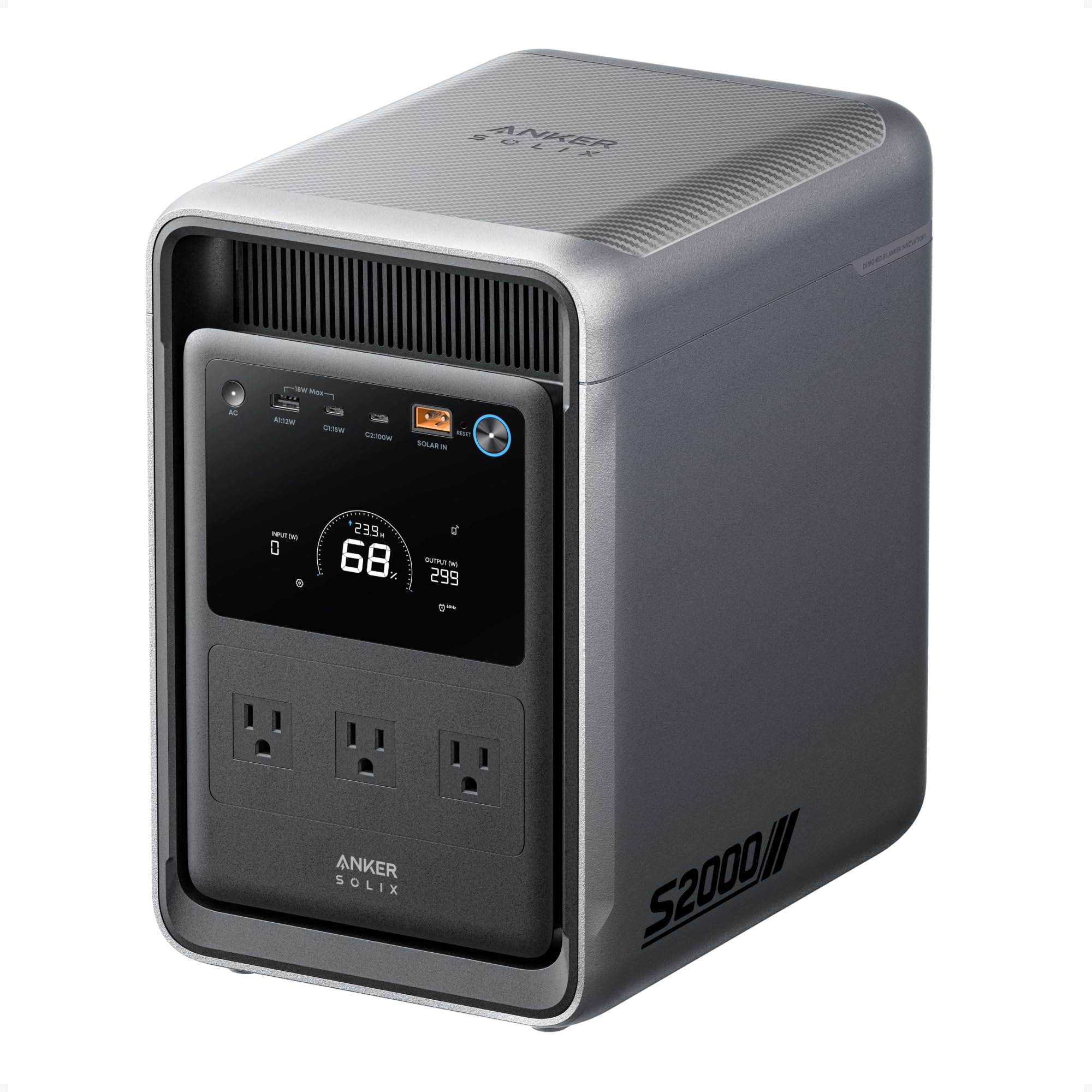
Doubles your capacity to 35 hours of fridge backup while staying svelte at 35.7 pounds.
This is the answer if 1,000 Wh feels like half a tank. At 2,010Wh with a 6W idle draw and 10% higher efficiency, Anker claims it runs 20% longer than other 2kWh systems — a full-size fridge for about 35 hours. During a real 13-hour outage, owners powered a lamp, fridge, coffee maker, and tankless water heater and still had 30% left.
The 314Ah LFP cells are rated for 10,000 cycles, which Anker translates to a 15-year lifespan—the longest in this lineup. Eight outlets split front and rear, letting you plug always-on appliances like a router in the back and keep the front clean for daily devices. A <10ms UPS switchover protects computers and medical gear during blips.
At 8.19 inches long, the S2000 is 30% smaller and 25% lighter than the industry average for its capacity — impressive single-handed portability for a 2kWh unit. Owners call it exceptional value, with one noting it ran continuously for 35 hours as advertised. The honest caveats: the fan gets noisy at 1,200W load, and a few report a strong burning smell on first charge that dissipates after. There’s no 12V DC port, so car accessories need a different route.
Big-picture wins
- 2,010Wh runs a fridge ~35 hours
- 10,000-cycle battery — 15-year lifespan
- Compact for its class at 35.7 lbs
Fine print
- Fan noise noticeable at high load
- No 12V DC car port
- 1,500W continuous is modest vs its 3,000W peak
Pick this for: whole-room backup and multi-day outages where 1kWh won’t cut it.
Choose another if: you need to power a 2,000W+ tool continuously or want a 12V socket.
8. EF ECOFLOW Delta 3 Classic with 110W Panel
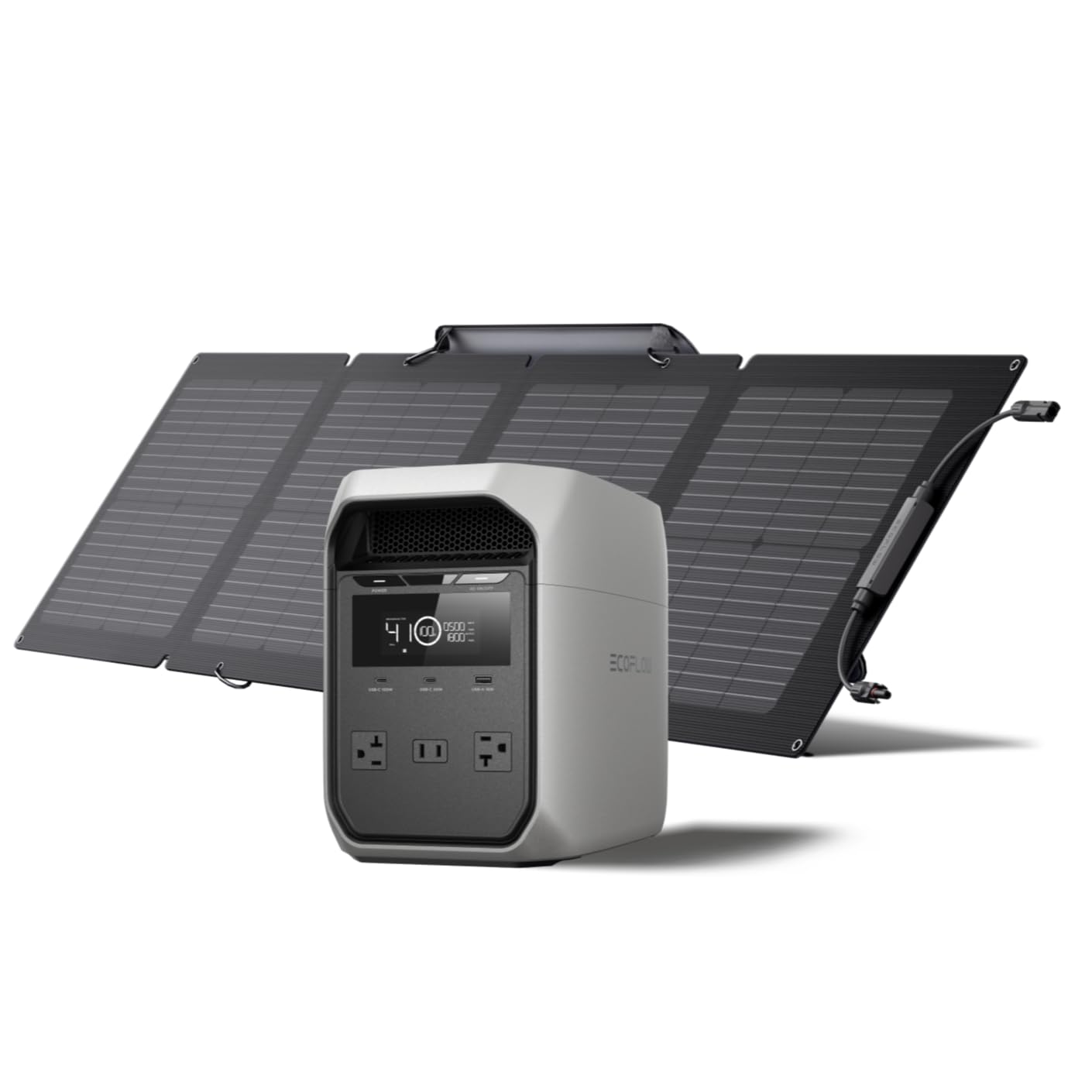
Comes with a 110W solar panel and recharges from empty to 80% in 45 minutes on wall power.
This bundle is the complete off-grid starter kit. The 1,024Wh station pairs with EcoFlow’s 110W panel, which uses a 23% conversion rate to capture more sunlight than typical panels. That panel alone takes 11.6 hours to refill the battery, so it’s a slow drip — but the station’s X-Stream AC charging hits 0-80% in just 45 minutes when you’re near a wall.
Output is 1,800W continuous with 3,600W surge, expandable to 2,600W with X-Boost for brief heavy loads. The <10ms UPS keeps PCs and servers alive through outages, and owners have powered a Starlink Mini, phones, tablets, a projector for a full movie, and even a window AC on trips. A 100W USB-C output fast-charges a laptop while other ports run simultaneously.
At this capacity tier, owners call it compact, light, and surprisingly sturdy, with one noting it kept a mini fridge running 18 hours on a charge. The 110W panel is a real inclusion — most competitors sell panels separately — but it’s slow if the sun is weak. Note that the station and panel ship separately and may arrive on different days.
Bundle benefits
- 110W solar panel included
- 45-minute fast wall recharge
- 3,600W surge with X-Boost
What to watch
- 11.6-hour solar refill is for steady sun only
- Panels and station arrive separately
- No built-in solar panel like the BROWEY
Best for: first-time buyers who want one box with both a station and a solar panel ready to go.
Consider alternatives if: you need heavy 2400W+ continuous output or 800W+ solar input.
9. EF ECOFLOW DELTA 3 Max
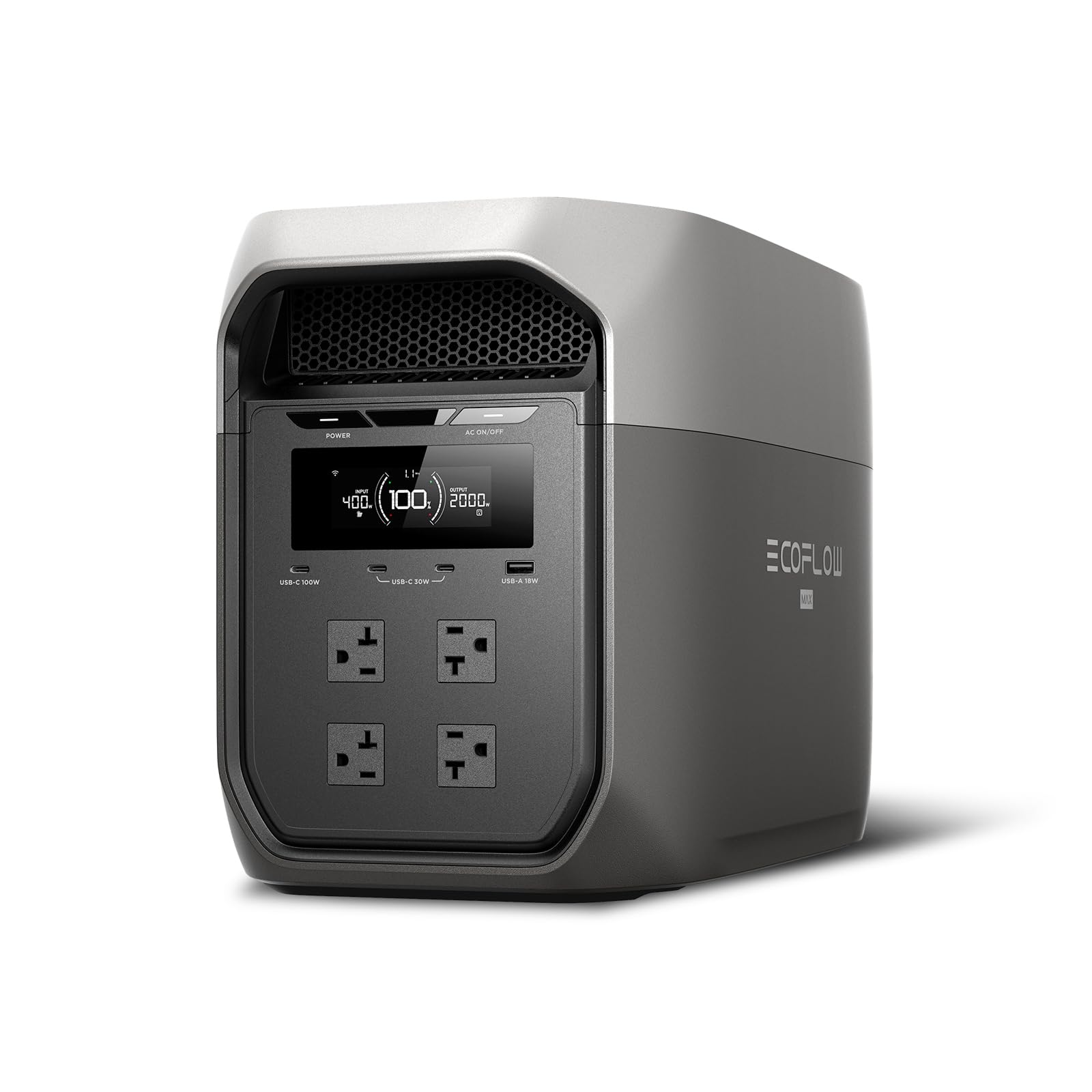
A 2,048Wh powerhouse that hits 80% in 1.13 hours and surges to 3,400W for heavy gear.
If your appliances include a microwave, a power tool, or a space heater, this is the station built for them. The DELTA 3 Max delivers 2,400W continuous and an eye-watering 3,400W in X-Boost mode, enough to run 99% of household appliances without tripping. A 2,048Wh LiFePO4 battery backs all that output, giving you multi-day backup for essential devices.
Recharging is a highlight: X-Stream technology (EcoFlow’s fast-charging system) refills from empty to 80% in just over an hour—1.13 hours to be exact. The <10ms transfer time kicks in smoothly for computers and medical devices, and owners praise the ultra-quiet operation. The LiFePO4 battery is rated for a decade of daily use, backed by EcoFlow’s 5-year service plan.
In practice, reviewers point out it charges “super fast” and that the battery “lasts forever,” with one noting it can run in surge mode for several seconds — enough to start a demanding motor. At this size it’s a two-hand carry, but owners call it lighter than expected for the capacity. The app lets you set charging and discharging schedules to time-shift your electricity costs, which is a nice home-backup bonus.
Heavyweight performance
- 3,400W X-Boost runs demanding appliances
- 0-80% in 1.13 hours
- 5-year EcoFlow service plan
Heavyweight reality
- Big and heavy for travel
- Solar panel not included
- Peak watts require X-Boost, not continuous
Reach for this if: you need to power high-wattage appliances for hours and value a 5-year warranty.
Look elsewhere if: you need something you can lift into a tent or carry on a plane.
10. BLUETTI AC200L

The expandable workhorse that starts at 2,048Wh and scales to 8192Wh with add-on batteries.
This is the station for people who know their power needs will grow. The AC200L ships with 2,048Wh and supports expansion batteries — up to two B300K (2,764Wh each), two B210, two B300, or one B230 — to reach a maximum 8,192Wh. It’s an upgraded AC200MAX with 2,400W continuous output and 3,600W Power Lifting surge, plus a 30A RV port on top of the usual AC, USB, and car outlets.
Charging is fast and flexible: up to 2,400W AC input hits 0-80% in 45 minutes, and 1,200W solar input fully refills in 1.7 to 2.2 hours in good sun. A 48V/8A DC port can charge an RV’s battery with the optional D40 regulator. Owners run a 1,500W kettle, a 12,000 BTU A/C for about 4 hours on solar, and even a 1,500W leaf blower — heavy gear without hesitation.
The honest cost is weight: 61.4 pounds is a two-person lift, and several owners note it’s genuinely heavy despite the handle. Battery life drew mixed feedback in reviews, so check the state of charge carefully. But performance is the most-praised trait, with buyers calling it versatile, fast-charging, and reliable for off-grid living, long weekends, and even Cuba’s frequent outages. The ≤10ms UPS switchover and quiet fan make it a strong home-backup candidate.
Expandable edge
- Scales from 2,048Wh to 8,192Wh
- 30A RV port included
- 45-minute fast recharge to 80%
Plan around
- 61.4 lbs is a two-person lift
- Expansion batteries add significant cost
- Battery life feedback is mixed
Grab it for: RV owners and off-grid setups that want one base unit with room to grow.
Pass if: you need something you can carry alone or want a single all-in-one without add-on modules.
Understanding the Specs
Watt-Hours (Wh) vs Watts (W)
Wh is the battery’s fuel tank — total energy stored. W is the engine — how fast you can draw that energy. A 1,070Wh station running a 100W fridge lasts about 10 hours; running a 1,000W kettle drains it in about an hour. Check both numbers before comparing units.
Surge vs Continuous Output
Continuous watts is what the inverter sustains for long periods. Surge (or peak) watts covers the brief spike a fridge motor or power tool needs to start. The OUPES Mega 1 Lite surges to 4,500W but rates 2,000W continuous — that gap protects your devices and your station.
FAQ
How long will a 1000 Wh power station run my refrigerator?
What is the difference between LiFePO4 and standard lithium-ion batteries?
Can I charge a 1000 Wh power station while it’s powering my devices?
How long does it take to fully recharge these stations?
What does pure sine wave AC output mean for my devices?
Can I expand the capacity of my power station later?
Is a 1000 Wh station safe to use inside a tent or bedroom?
What is the UPS switchover time and why does it matter?
Do I need to buy solar panels separately?
How many watts do I need to run a CPAP machine all night?
Final Thoughts: The Verdict
Across the board, the 1000 wh power station winner is the Jackery Explorer 1000 v2 because it pairs a 1,070Wh battery with 1,500W output, one-hour fast charging, and a proven track record of reliability—the crowd favorite with over 900+ ratings behind it. If you want premium build and 2,400W surge for heavier appliances, grab the Anker SOLIX C1000. And for the fastest wall-to-full refuel at a budget-friendly tier, the OUPES Mega 1 Lite refills in 46 minutes and surges to 4,500W.
How We Picked
We do not accept paid placement. Every pick is matched to a real buyer and a real use-case; we do not hands-on test units.
Sources & Methodology
Specifications: manufacturer listings and product documentation. Review insights: verified customer reviews, as of September 2026. Pricing: not shown on this page (it changes often); check the current price via the retailer link.
As an Amazon Associate, KitchPrep earns from qualifying purchases. This does not affect which products we feature.
Related Guides
