
A microwave is one of those “simple” appliances that quietly runs your entire day: coffee that went cold, leftovers that need a second life, a bowl of oats before work, a late-night snack that shouldn’t wake the whole house with five loud beeps. And yet, buying one can feel weirdly stressful because the online advice is usually shallow: “more watts is better,” “sensor is nice,” “choose stainless.”
If you’re specifically shopping for a 1.4 cubic feet microwave, you’re in the sweet spot: roomy enough for real dinner plates and family portions, still compact enough for most countertops, and widely available in models that range from basic “press start” units to smart, inverter-driven machines that reheat like they actually understand food.
Here’s what most buying guides miss: microwaves don’t get loved because of a bullet list. They get loved because of how they behave during the five moments that happen every day in real kitchens:
- The reheat moment: Does it warm evenly, or does your pasta come out lava-hot on the edges and cold in the middle?
- The defrost moment: Does it soften gently, or does it half-cook the outside while the center stays icy?
- The control moment: Can you set power and time without squinting, mis-pressing, or fighting a stiff keypad?
- The sound moment: Can you mute or soften beeps, or is it announcing your midnight tea to the whole house?
- The “why won’t the door open?” moment: Does it have a two-step lock routine that surprises guests and annoys you daily?
This guide is built around those friction points using real-life owner patterns: the little complaints that show up again and again (dim interior lights, hard-to-read buttons, overly aggressive sensor programs) and the little wins that make people keep the same microwave for years (quiet operation, intuitive controls, solid door feel, consistent reheating).
Below you’ll find 13 standout countertop picks in the “around 1.4 cu. ft.” world (including a few 1.3 and 1.5 models that make sense for specific needs), organized in a way that helps you choose confidently without feeling like you need five more tabs open.
In this article
- How to choose the right microwave for your real routine (not a showroom fantasy).
- Quick comparison table of 13 standout models.
- In-depth reviews of each microwave, with pros and cons.
- How microwave heating actually behaves (and how to make any model feel better).
- FAQ: the practical answers people actually need before buying.
How to Choose the Right 1.4 Cubic Feet Microwave
A microwave is “good” when it disappears into your routine: it heats evenly, it doesn’t shout at you, it fits your space, and it doesn’t make you think too hard. The trick is that two microwaves with similar capacity and wattage can still feel completely different to live with because of control design, sensor behavior, and power delivery style.
1. Start with the only spec that can’t be “fixed later”: fit
Before features, measure your actual counter reality. A microwave that’s technically “countertop” can still feel like a brick if:
- Your upper cabinets are low and you need a lower profile unit.
- You keep it in a nook where the door swing and handle clearance matter.
- You’re tight on depth and the unit sticks out beyond the counter edge.
- You use a microwave cart and need the feet to sit fully stable.
2. Watts matter… but not the way most people think
Yes, higher output can mean faster reheating. But the “feel” of cooking quality is more about how the microwave delivers power. Two common real-life situations show this:
- Leftovers with edges: Rice bowls, pasta, casseroles, burritos. If a microwave blasts full power in short cycles, you’ll often get hot edges and a cold core.
- Defrosting proteins: Chicken, ground meat, fish fillets. If power is delivered in harsh bursts, the outside can start cooking while the center stays frozen.
That’s why some people swear their “lower watt” microwave heats better than a higher watt one. It’s not magic. It’s power delivery design and how well the microwave’s presets match real portion sizes.
3. Inverter vs “cycling” power: the biggest upgrade most buyers miss
Most standard microwaves create lower power levels by turning full power on and off (cycling). That works, but it can be rough on delicate reheats. “Inverter” style microwaves are built to deliver more consistent, controlled power at lower settings, which tends to improve:
- Defrost quality: Less “cooked edge” while the middle stays icy.
- Reheating texture: Less rubbery pasta and less dried-out rice.
- Gentle heating: Better for butter softening, chocolate melting, and warming without boiling over.
If you use your microwave for more than just popcorn and coffee, inverter-style options are one of the most meaningful “daily life” upgrades. In this list, Panasonic’s inverter models and Sharp’s inverter-equipped option are the standouts for controlled power behavior.
4. Sensor cooking is useful… when you use it the right way
A humidity or “steam” sensor isn’t reading your mind. It’s watching for moisture changes and trying to guess the remaining cook time. When sensor cooking shines, it feels like a superpower. When it fails, it feels like your microwave is trolling you.
Here’s what makes sensor features actually work in real kitchens:
- Use it for moist foods first: soups, stews, rice bowls, reheating plated meals with sauce. Sensors usually do best here.
- Cover your food (but vent it): a vented microwave cover traps steam so the sensor has a clearer signal and you get less splatter.
- Avoid “tiny portions” with sensor: a small cup or snack can confuse sensors and overshoot quickly.
- Expect popcorn to be its own thing: bag sizes vary a lot. Popcorn presets can be excellent, but they’re rarely perfect across every brand and size.
A microwave with excellent sensor logic can make busy weeks dramatically smoother. But the best strategy is always: use sensor for what it’s good at, and manual time for what it’s not.
5. Controls are not a cosmetic detail: they’re usability
The control panel is where great microwaves win or lose. In owner feedback, the most common “surprise regrets” are:
- Hard-to-read buttons: black-on-black layouts, dim labeling, or reflective panels that glare in sunlight.
- Stiff keypads: some models require a firm press and can feel annoying if you use them many times per day.
- Overcomplicated power-level steps: if changing power is a multi-step ritual, most people stop doing it and just blast high power (then complain about uneven heating).
- Dial vs keypad preference: a dial can be amazing for quick adjustments, but some users prefer a classic number pad for muscle memory.
If anyone in your household is older, low-vision, or just easily annoyed by clunky controls, prioritize clarity. And if voice control is your thing, smart models can be genuinely helpful for accessibility and hands-full cooking moments.
6. The “beep problem” is real (and it affects what you buy)
If you live in a small apartment, have a sleeping baby, work odd hours, or just value peace, the end-of-cycle beep matters more than brands admit. Look specifically for:
- Mute / sound on-off options: some models explicitly include it (Toshiba is known for this feature).
- Quiet operation and softer tones: even without a full mute, some microwaves simply run and beep less aggressively.
- Display dimming / ECO mode: if a bright clock lights up your kitchen at night, ECO mode can be a tiny-but-big win.
7. Child locks and “two-step door unlock” features: know what you’re signing up for
A lot of newer microwaves include a two-step lock behavior by default. Sometimes it’s a true child lock, sometimes it’s a “door unlock after cooking” routine, and sometimes it’s both. This is one of the biggest sources of negative reviews because people don’t expect it.
Before buying, decide what you want:
- If you have kids: you may love the extra safety and the forced “pause” before door access.
- If you don’t: you may find it annoying every single day—especially if guests think the microwave is broken.
- If your power blinks often: some models reset their lock behavior after outages, which can feel like a recurring nuisance.
There’s no universal right answer. It’s lifestyle-dependent. The key is simply knowing it exists so you don’t get surprised.
8. Reliability: read reviews like an adult, not like a panic shopper
Here’s the most useful way to interpret microwave complaints:
- Shipping damage complaints: these are common across brands. The smart move is to keep the box for a few days and test immediately.
- “It’s loud” complaints: separate “fan hum” (normal) from “rattling or grinding” (not normal). Good reviews often clarify this.
- “Sensor doesn’t work” complaints: many people don’t cover food or use too-small portions. Look for patterns across many reviews, not one.
- Early failure complaints: if many people report similar failure timing, take it seriously. If it’s a handful among many, it may be normal defect variance.
Quick Comparison: 13 1.4 Cubic Feet Microwave Picks
Use this table to find the models that match how you actually live, then jump to the full reviews for the “human details”: control feel, beep behavior, door-lock quirks, and the kinds of issues owners mention after the honeymoon period.
On smaller screens, swipe or scroll sideways to see the full table.
| Model | Capacity | Heat style | Best match | Amazon |
|---|---|---|---|---|
| Panasonic NN-SV79MS Smart Inverter (Alexa) | 1.4 cu. ft. | Inverter + sensor + smart voice control | “One and done” buyers who want premium everyday reheating | Amazon |
| Farberware 1.3 cu. ft. (1100W) White Platinum | 1.3 cu. ft. | High power + sensor cook + memory | Style-forward kitchens that still want real performance | Amazon |
| Panasonic NN-SD67LS Genius Sensor | 1.3 cu. ft. | Sensor cooking + keep warm simplicity | People who want “classic Panasonic feel” without smart extras | Amazon |
| SHARP 1.4 cu. ft. Stainless (Inverter) | 1.4 cu. ft. | Inverter + sensor cook + carousel turntable | Even reheats, simple daily use, and “Sharp loyalist” reliability vibes | Amazon |
| GE® 1.4 cu. ft. Countertop Microwave | 1.4 cu. ft. | Sensor controls + express cook keys | Families who want familiar buttons and low learning curve | Amazon |
| TOSHIBA ML-EM34P(SS) Smart Microwave (Alexa) | 1.3 cu. ft. | Humidity sensor + Alexa + mute/ECO | Smart home kitchens and anyone who cares about quieter beeps | Amazon |
| SHARP 1.4 cu. ft. Black | 1.4 cu. ft. | Sensor cook + soften/melt + quiet-friendly options | People who want Sharp’s “just works” layout in a dark finish | Amazon |
| SHARP 1.4 cu. ft. White | 1.4 cu. ft. | Sensor cook + express cook simplicity | Bright kitchens that want the same Sharp workflow in white | Amazon |
| COMMERCIAL CHEF 1.4 cu. ft. Stainless | 1.4 cu. ft. | Simple digital control + strong everyday heating | “I just want a big cavity and clear buttons” shoppers | Amazon |
| COMMERCIAL CHEF 1.4 cu. ft. Black | 1.4 cu. ft. | Same core design in a darker finish | Budget-conscious kitchens that still want a roomy interior | Amazon |
| FRIGIDAIRE Stainless Microwave (Multi Function) | 1.5 cu. ft. | Simple presets + roomy feel | If you want slightly more room and a straightforward control panel | Amazon |
| BLACK+DECKER EM036AB14 (Stainless) | 1.4 cu. ft. | Classic keypad + push-button door | Small kitchens needing a lower profile and familiar presets | Amazon |
| Farberware 1.3 cu. ft. (1000W) Stainless | 1.3 cu. ft. | Simple power levels + one-touch programs | Practical buyers who want press-and-go convenience | Amazon |
In‑Depth Reviews: 13 Countertop Microwaves That Feel Great to Use
Now we go model by model. I’m not going to pretend you’re choosing between “good” and “bad” appliances. You’re choosing between different kinds of convenience: smarter reheats, quieter nights, simpler controls, cleaner interiors, better defrosts. So I’ll focus on the stuff that actually changes your day.
1. Panasonic NN‑SV79MS Smart Inverter – The “Everything Feels Easier” Microwave

If you want one microwave that makes daily cooking feel smoother (not just “hotter”), the Panasonic NN‑SV79MS is the best overall choice in this lineup. It earns that spot because it solves the three things people complain about most: uneven reheats, annoying controls, and the constant guesswork of “how long?”
The core experience is inverter-style heating. In real life, that shows up as better texture: leftovers that don’t turn rubbery as easily, defrosting that’s less likely to cook the edges, and warming that feels more controlled. It’s the kind of microwave that encourages you to use power levels properly because the results are actually rewarding (instead of just slower).
The second superpower is the “smart” side. For many people, Alexa control sounds like a gimmick until your hands are messy, you’re holding a mug, or someone in your household benefits from voice accessibility. Owners who rely on voice control often describe it as a genuine independence upgrade, especially when most modern microwaves have flat panels that are hard to use by touch.
The trade-offs are also real. Some people need time to adapt to the interface style (especially if they’re used to a classic number pad), and some report that the built-in lock behavior can feel like “one extra step” after cooking. If you’re the kind of person who wants a microwave to be pure muscle memory with no learning curve, you might prefer a simpler keypad model. But if you want the most “premium daily life” feel, this one is hard to beat.
Why you’ll like it
- Inverter-style heating feels more even – especially for reheating leftovers and gentler defrosting.
- Strong sensor + smart routines – less time guessing, more time just pressing (or saying) “reheat.”
- Quiet, confident build feel – many owners describe it as stable and well-finished.
- Accessibility win – voice control can be genuinely helpful for low-vision users or anyone who hates finicky panels.
Good to know
- If you love a traditional number pad, the control style can feel different at first.
- Some users dislike the “extra step” lock behavior after cooking (a safety feature, but still a daily routine change).
- Sensor programs are strong, but still benefit from smart habits (covering food and using realistic portions).
Ideal for: households that reheat daily, want better texture (not just heat), and like the option of voice control or smart convenience.
2. Farberware 1.3 cu. ft. (1100W) White Platinum – Style, Power, and “Press-and-Go” Confidence

Most microwaves are either “boring black box” or “stainless rectangle.” This Farberware is for people who want their microwave to look intentional without sacrificing real performance. It’s powerful, it’s roomy for its footprint, and it leans into the kind of features that matter daily: multiple power levels, straightforward presets, sensor-style cooking options, and a memory function for your repeat meals.
Where it stands out in real-life feedback is the “solid appliance” feel. Owners often describe it as heavy (in a good way: stable on the counter), with a darker interior that looks cleaner between wipe-downs. The heating performance gets consistent praise, especially for simple tasks like reheating, warming, and quick one-touch cooking.
The two most common day-to-day critiques are also worth knowing upfront: the keypad can require a firmer press than you expect, and the microwave can be louder than some quieter-running competitors. Those are not dealbreakers for everyone, but if you’re sensitive to sound or you want feather-touch buttons, you should factor that in.
My expert take: this is a “happy kitchen” microwave. You buy it because you want power, you want it to look good, and you want the confidence of pressing a one-touch option without babysitting. If you treat sensor and presets as helpers (not perfect mind readers), it’s a very satisfying daily driver.
Why it’s a standout
- Design that actually elevates a counter – the white platinum finish is a rare look in microwaves.
- Strong everyday heating – fast, effective reheats without feeling underpowered.
- Memory + one-touch convenience – great for repeat routines (coffee, oatmeal, leftovers, kids’ snacks).
- Dark interior hides mess better – it looks cleaner between wipe-downs, especially in busy homes.
Good to know
- Some owners report the keypad needs a firm press to register reliably.
- Noise level can be higher than quieter competitors (fan + run sound).
- If you want the largest cavity possible, you may prefer a 1.4–1.5 cu. ft. model instead.
Ideal for: style-forward kitchens that still want serious performance and convenient presets for daily life.
3. Panasonic NN‑SD67LS – Sensor Simplicity That Feels Like a Grown-Up Upgrade

If you want Panasonic’s “sensor cooking brain” without smart assistants or extra complexity, the NN‑SD67LS is a smart move. It’s the kind of microwave people buy when they want their appliance to feel dependable and mature: clean design, practical presets, and sensor routines that reduce daily guesswork.
The real-life value of this model is how it handles the most common tasks: reheating plated meals, warming leftovers, and keeping food warm without continuing to cook it aggressively. For many households, that “keep warm” behavior becomes a quiet hero feature because it supports real schedules (kids interruptions, deliveries arriving, someone taking a call mid-meal).
Owner feedback tends to focus on a few themes: it looks good on the counter, it reheats effectively, and it’s easy to keep clean. The consistent “watch-outs” are also useful: some people wish the interior light were brighter, some find the display bright at night, and some report shipping dents (which is why immediate inspection is always a smart move with any microwave).
Expert tip: Panasonic sensors usually reward good habits. Cover saucy foods with a vented cover, avoid using sensor for tiny snacks, and let food rest for 30–60 seconds after a sensor cycle. You’ll get noticeably better “evenness” with almost no effort.
Why it works so well
- Sensor cook that matches real meals – especially reheating plates, bowls, and saucy leftovers.
- Compact footprint for the capacity – easier to fit in smaller kitchens without feeling tiny inside.
- Keep Warm is genuinely useful – protects texture when dinner timing gets messy.
- Clean, practical control layout – a “learn once, use forever” kind of interface.
Good to know
- Some owners want a brighter interior light for spotting splatter quickly.
- Like many microwaves, shipping dents happen; inspect immediately and keep the box briefly.
- If you want voice control or app routines, the NN‑SV79MS is the better Panasonic fit.
Ideal for: people who want sensor convenience and a polished daily experience without “smart home” complexity.
4. SHARP 1.4 cu. ft. Stainless (Inverter) – The Quiet Workhorse With Classic Carousel DNA

Sharp has a long-standing reputation in the microwave world for one simple reason: people keep them forever. And this inverter-equipped 1.4 cu. ft. stainless model carries that same “made to be used daily” energy. It’s not trying to be flashy. It’s trying to be reliable, intuitive, and consistently good at reheating.
The inverter piece matters because it changes how lower power levels behave. Instead of harsh on/off bursts, inverter cooking tends to feel smoother—especially with reheats where texture matters. That means you’re more likely to actually use medium power for leftovers (which is the secret sauce for better results), and you’re less likely to scorch edges while the center stays cold.
Owners often describe this style of Sharp as user-friendly and simple, with controls that feel less “gimmick-heavy” than some modern touch panels. The carousel turntable system is also a big deal for evenness: combined with basic good habits (stirring halfway, letting food rest), it makes everyday reheats more predictable.
Where the real-world critiques show up: interior light brightness and the learning curve of any child-resistant door routine. Most people adapt quickly, but if you want a microwave that feels like “open door, press 30 seconds” with zero extra steps, it’s worth knowing. Overall though, if you want a strong inverter alternative without going full smart microwave, Sharp is a very safe bet.
Why it’s a strong pick
- Inverter behavior improves texture – gentler power delivery helps with leftovers and defrosting.
- Sharp’s “simple controls” reputation – easy to use daily without a manual nearby.
- Turntable evenness – carousel-style rotation helps reduce hot/cold zones.
- Quiet, steady operation – many owners describe it as less annoying than louder competitors.
Good to know
- Some users want a brighter interior light for spotting spills faster.
- Door lock behaviors can surprise guests at first; it becomes routine quickly, but it’s a thing.
- If you want voice control, choose the Panasonic or Toshiba smart models instead.
Ideal for: people who want even reheats and long-term reliability vibes without needing smart assistants.
5. GE® 1.4 cu. ft. Countertop Microwave – Easy, Practical, and Surprisingly “Family-Perfect”

This GE is the microwave you buy when you want the experience to be familiar for everyone in the house: press 1–6 for quick time starts, hit +30 when you’re in a hurry, use sensor reheat when you want less guessing, and don’t think too hard about it.
Real owners often describe it as “bigger than expected” (in a good way) while still fitting neatly on a counter. It’s powerful enough to feel fast, and it handles frozen meals and general reheating with the kind of reliability you want from a big-name brand: predictable, not fussy, and not overly complicated.
The most common “almost-complaints” are usability details: button visibility in certain lighting and the existence of a two-step lock feature that can confuse people at first. The good news is that many households either disable the lock behavior or simply adapt to it quickly. Once the microwave becomes muscle memory, it tends to stay liked.
My expert angle: if multiple people use your microwave (partner, kids, guests, roommates), don’t underestimate the value of intuitive controls. A microwave that’s “technically better” can still get hated if the interface slows everyone down. This GE is a classic “everyone can use it” pick.
Why it fits real homes
- Familiar keypad logic – quick-start keys make daily use effortless.
- Sensor cooking helps with leftovers – especially plated meals and common reheats.
- Good capacity feel – fits real plates and bowls without feeling oversized outside.
- Strong “family appliance” energy – easy for multiple users to learn fast.
Good to know
- Button visibility can depend on your kitchen lighting and viewing angle.
- Lock behaviors can confuse at first; learn the routine early (or disable if you don’t need it).
- If you want inverter-style gentle heating, Panasonic or Sharp inverter models are better.
Ideal for: households that value easy controls, fast reheats, and a low-learning-curve microwave everyone can use.
6. TOSHIBA ML‑EM34P(SS) – Smart Control, Mute Mode, and “Actually Helpful” Convenience

The Toshiba ML‑EM34P is one of the most “lifestyle aware” microwaves in this guide. It’s built for modern kitchens where people care about three things beyond heating: smart control, quieter operation, and less visual clutter. If you’ve ever wished your microwave would stop screaming at midnight, you’ll understand why Toshiba’s mute feature gets so much love.
On the cooking side, the humidity sensor and preset menus aim to remove guesswork for common foods. When sensor routines land well, they feel like a small superpower: fewer “check, stir, check again” moments and more “walk away and trust it.” And if voice control matters, Alexa integration can make quick reheats and time setting easier when your hands are full.
The honest reality from owner feedback is that “smart” doesn’t always mean “perfect.” Some people find that sensor logic can miss for certain foods, especially very dry items or portions that don’t match what the preset expects. A common expert strategy is simple: use the smart features for moist reheats and common bowls/plates, and use manual time for fussy items like certain popcorn bag sizes. That hybrid approach usually turns Toshiba into a very satisfying daily appliance.
Where this microwave shines most is quality-of-life: mute mode, ECO considerations, and the feeling that it was built for real households— not just for looking good on a product page.
Why people choose it
- Mute mode is a game-changer – especially for apartments, night owls, and families with kids.
- Alexa control can be genuinely useful – hands-free convenience and accessibility benefits.
- Sensor reheat helps with common foods – especially bowls and plated leftovers.
- Solid feature set without feeling “cheap” – practical extras like ECO mode and memory behavior.
Good to know
- Like many sensor microwaves, results depend on portion size and covering habits.
- Button visibility and touch feel can vary by lighting and user preference; smart doesn’t always mean “simple.”
- If you want inverter-style heating, go Panasonic/Sharp inverter instead of a sensor-only approach.
Ideal for: smart home users and anyone who prioritizes quieter operation and modern convenience.
7. SHARP 1.4 cu. ft. Black – Simple, Quiet-Friendly, and Easy to Live With

This Sharp is the “I want a microwave, not a project” option—especially if you like a darker finish. It’s built around the kind of usability that makes Sharp fans loyal: clear programs, consistent heating, and a control layout that doesn’t try to reinvent the wheel. For many people, that’s exactly what makes a microwave feel premium: it behaves predictably.
Owners often praise Sharp for the “everyday ease” factor: express cook that works the way you expect, a turntable that helps with even heating, and straightforward softening/melting functions that reduce the need for guesswork. It’s the kind of unit that you can hand to a guest and they won’t look at you like you handed them cockpit controls.
One real-world detail that matters: some Sharp models include quiet-friendly options (like silent mode) that make them easier to live with in small spaces. Not every household cares about this, but if you do, you care a lot. Pair that with the gray interior and improved lighting style many users appreciate, and it becomes a very easy microwave to recommend.
If you’re choosing between the black and white Sharp versions, the biggest difference is aesthetic. Functionally, you’re choosing the same “Sharp simplicity” personality—just with a finish that fits your kitchen mood.
Why it’s lovable
- Sharp-style simplicity – controls feel intuitive and fast for daily use.
- Good evenness for the class – turntable + sensible presets reduce hot/cold frustration.
- Quiet-friendly vibe – many users like how it fits apartment and night-time routines.
- Black finish hides fingerprints – a practical win in busy kitchens.
Good to know
- Interior light brightness is “fine,” not stadium-level; spill spotting can depend on your kitchen lighting.
- Child-resistant door/lock routines can surprise first-time users (then become routine).
- If you want inverter power delivery, choose Sharp’s inverter model instead.
Ideal for: people who want a clean Sharp experience in black: straightforward controls, reliable reheating, and a no-drama daily feel.
8. SHARP 1.4 cu. ft. White – Bright Kitchen Friendly, Same “Just Works” DNA
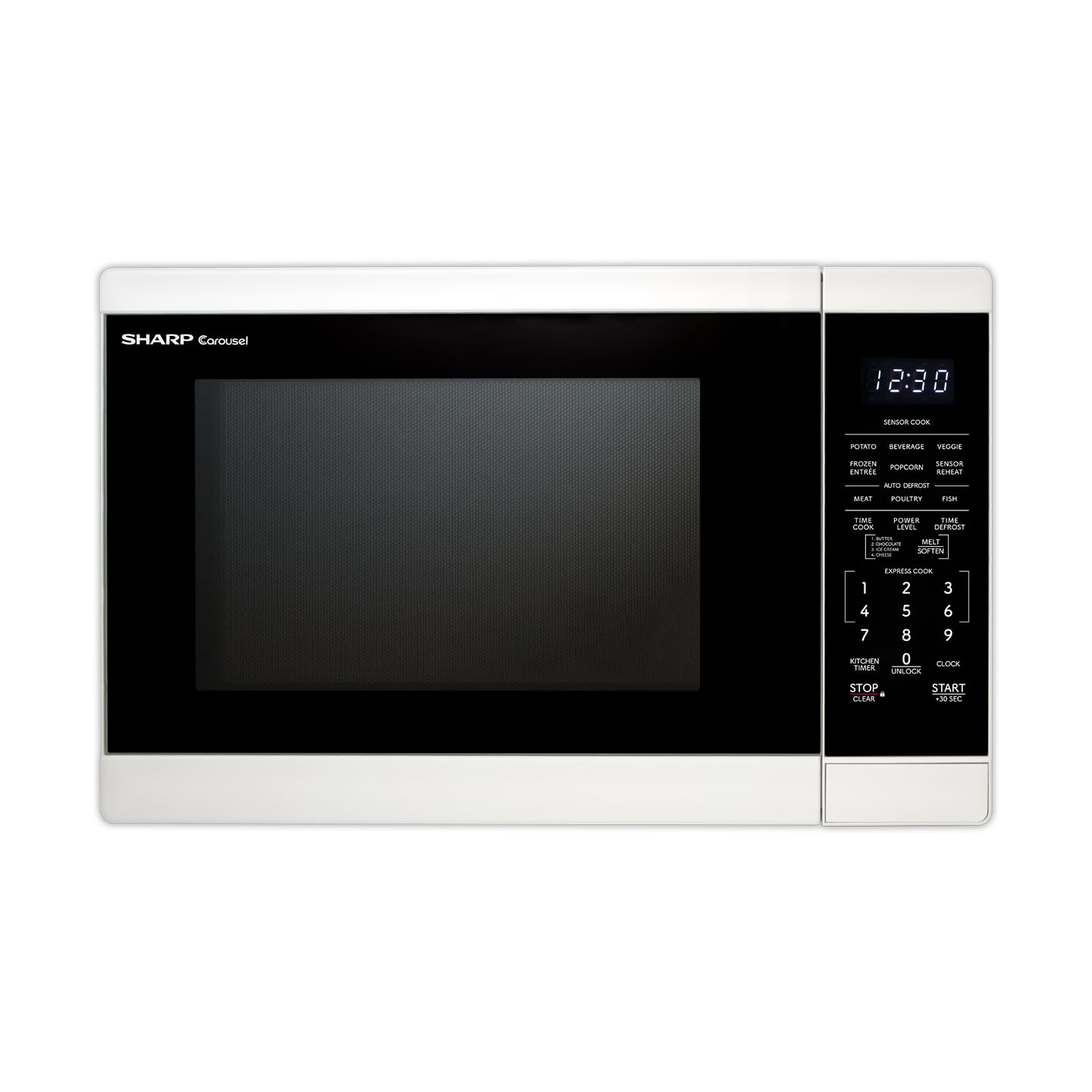
If your kitchen is light, bright, and you hate the “big black box” look on a counter, this white Sharp is an easy win. It delivers the same core Sharp strengths—predictable heating, practical presets, and user-friendly controls— but in a finish that blends into white cabinetry and lighter countertops.
In real owner feedback, Sharp tends to get love for long-term dependability and ease of use. People talk about it like it’s a kitchen tool, not a gadget: it heats accurately, the door feels good, and the controls do what you expect. Those are “boring” traits that become extremely valuable after the novelty of any new appliance wears off.
This model’s everyday sweet spot is reheating and quick cooking for one to four people. It’s large enough for normal dinner plates, it has the quick-start style keys most people use constantly, and it avoids the over-designed layouts that make some microwaves feel annoying after a week.
If you’re choosing between this and a higher-end smart or inverter model, ask yourself a simple question: do you want better texture and smarter automation, or do you want a microwave that feels immediately familiar and stays out of your way? This Sharp is the second one.
Why it’s a smart choice
- White finish looks clean and intentional – great for bright kitchens and white cabinetry.
- Simple controls – quick to learn, easy for guests and family members.
- Consistent daily performance – reheats and cooks without feeling fussy.
- Sharp’s reliability reputation – many owners stick with Sharp after older units last years.
Good to know
- Interior lighting can still feel modest; wipe-down habits matter more than “perfect visibility.”
- Door/lock routines can confuse at first (then become routine quickly).
- If you want gentler inverter power behavior, Sharp’s inverter stainless model is the upgrade path.
Ideal for: anyone who wants a bright-finish microwave that feels familiar, dependable, and easy to use every single day.
9. COMMERCIAL CHEF 1.4 cu. ft. Stainless – The Straightforward Workhorse With Real Power
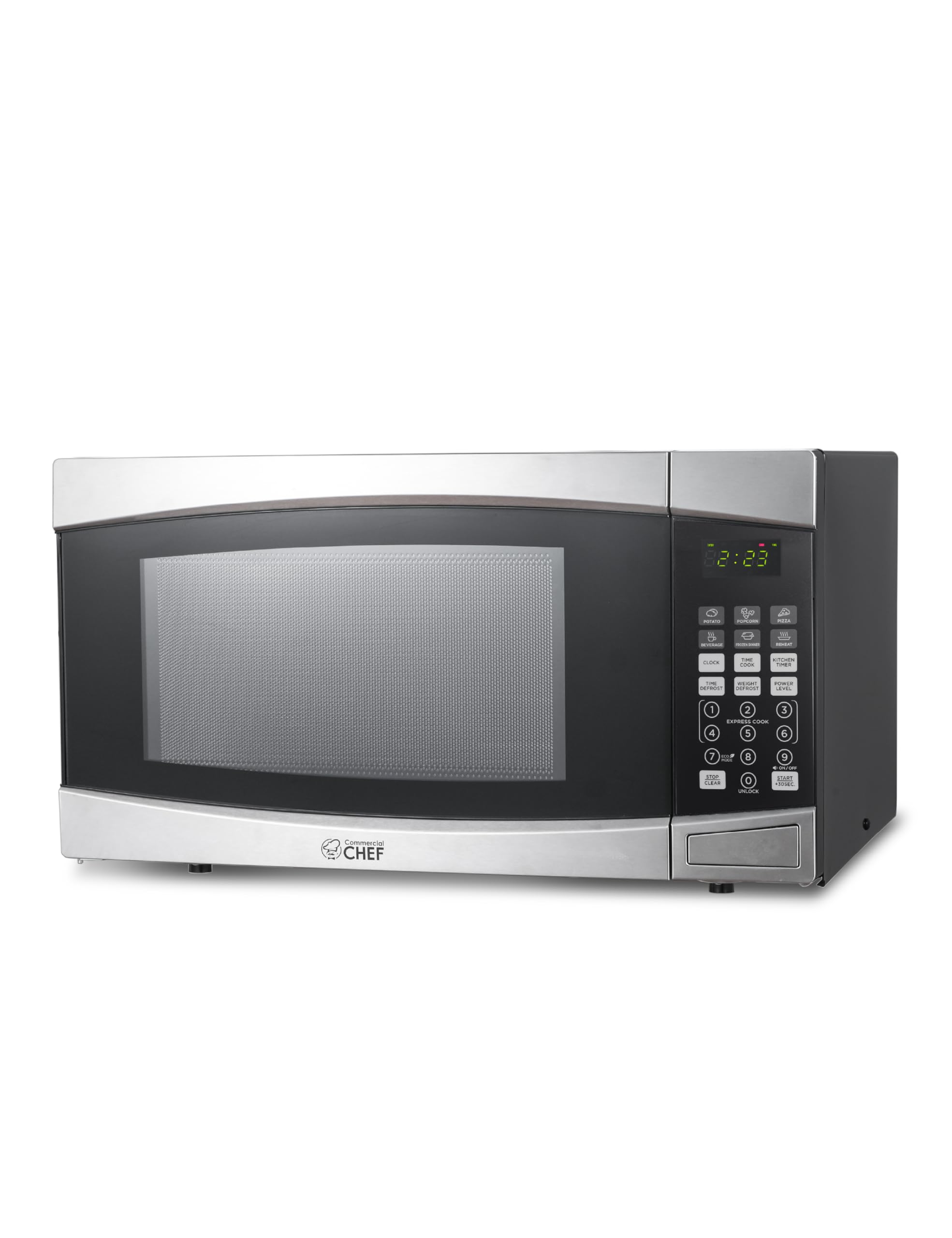
The Commercial Chef 1.4 cu. ft. stainless model is for people who want a roomy interior and strong heating without paying for brand ecosystem hype. It’s a practical microwave with the features most households actually use: multiple power levels, a clear timer, defrost options, and a set of presets for common tasks.
Where it shines is simple: it heats fast and it fits real bowls and plates without feeling cramped. If you’re upgrading from a tiny microwave (the dorm-sized kind), the jump in usability feels huge. Big plates spin comfortably, larger containers fit, and you stop playing Tetris every time you warm dinner.
Real-world feedback tends to be split into two themes. One group says, “great microwave, heats fast, roomy interior.” The other group flags quality control issues like dents on arrival or, in a smaller number of cases, odd clock behavior over time. That pattern tells you something useful: this is a strong value pick, but you should do the smart buyer routine—inspect immediately and test for a week. If you get a good unit, it’s a very satisfying daily appliance.
Expert tip: microwaves like this often reward using medium power more often. When you reheat leftovers, try 60–70% power for longer instead of 100% for shorter. You’ll get better texture and fewer “hot edge / cold center” moments.
Why it’s a good buy
- Roomy interior – fits real dinner plates and larger bowls comfortably.
- Strong, fast heating – doesn’t feel underpowered for daily cooking.
- Simple digital controls – clear timer, straightforward power levels, easy routine use.
- Practical feature set – presets and defrost options cover most real-world needs.
Good to know
- Shipping dents get mentioned sometimes; inspect immediately and keep packaging briefly.
- Long-term clock drift or glitch reports appear in some feedback; not universal, but worth noting.
- If you want premium sensor logic or inverter power control, Panasonic/Sharp inverter models will feel more “refined.”
Ideal for: shoppers who want a spacious, powerful microwave with simple controls and strong daily performance.
10. COMMERCIAL CHEF 1.4 cu. ft. Black – Same Practical Workhorse, Different Look
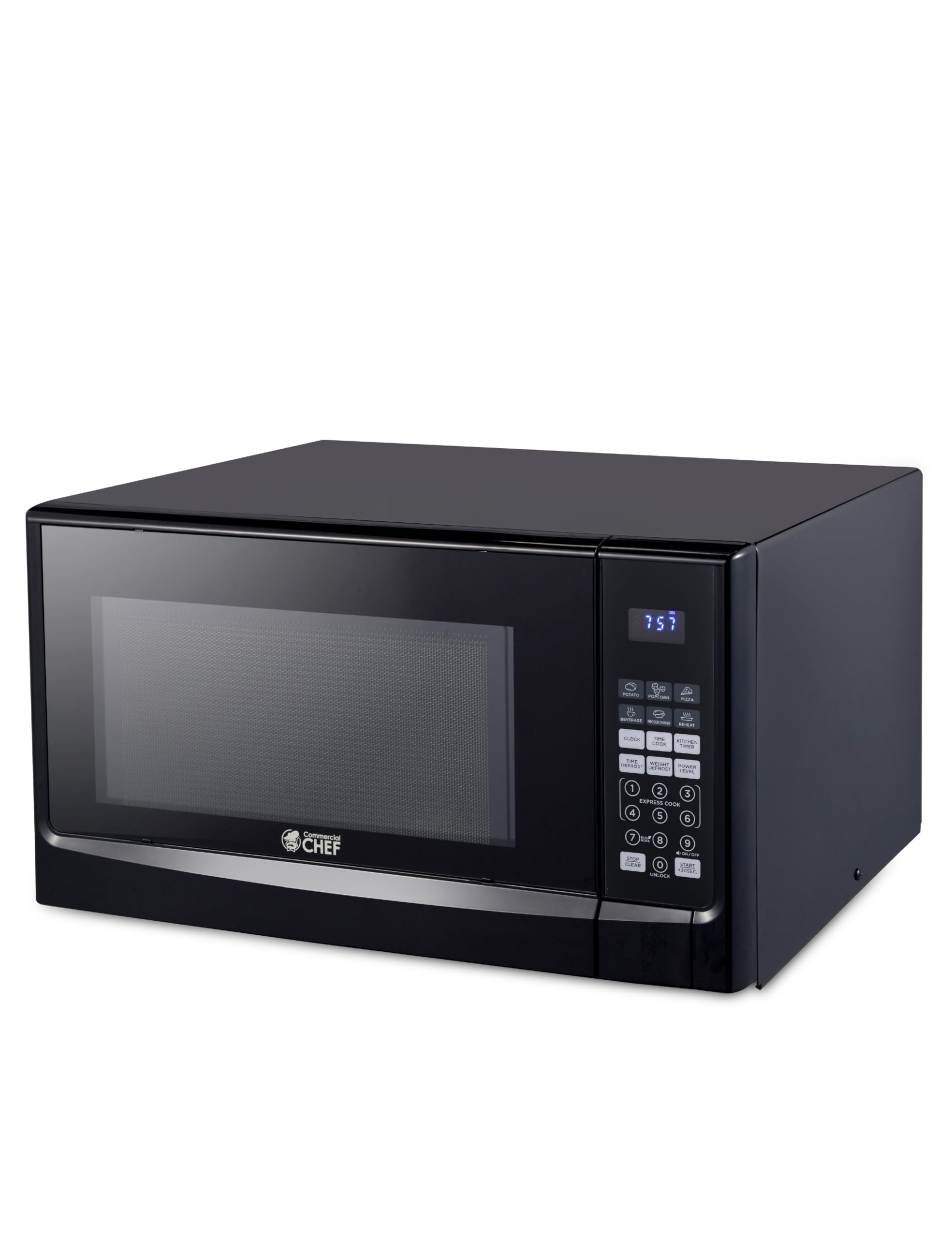
This black Commercial Chef model is essentially the same idea as the stainless one: roomy interior, straightforward controls, strong everyday heating. The reason to choose it is aesthetic and maintenance. Dark finishes often hide fingerprints and smudges better in busy kitchens, especially when kids are pressing buttons all day.
The daily-use experience is the same practical rhythm: quick reheat, defrost when needed, power levels when you remember to use them. It’s not trying to be a premium sensor machine. It’s trying to be a reliable “workhorse box” that heats food consistently and fits larger dishes.
In owner feedback, the same pattern tends to show up: people love the performance and capacity, but recommend inspecting for shipping dents. That’s not unique to this brand—microwaves ship poorly across the industry—but it’s especially important in value-focused models where the box may take more abuse in transit.
Expert tip: if you want this to feel like a more “premium” microwave, adopt two habits: cover food with a vented cover, and use medium power for longer reheats. Those two changes solve a surprising percentage of microwave frustration.
Why it’s worth considering
- Roomy interior – makes daily cooking easier with real plates and bowls.
- Dark finish hides smudges – practical for high-traffic kitchens.
- Simple controls – easy for anyone to use, no “smart” learning curve.
- Fast reheating – gets the job done efficiently for busy routines.
Good to know
- Inspect for dents and test early; shipping issues are the most common complaint type.
- Not the best choice if you rely heavily on sensor logic for perfect auto-reheat results.
- If quiet beeps are a priority, Toshiba or Sharp models tend to fit better.
Ideal for: anyone who wants a roomy, practical microwave in a dark finish with simple controls and strong everyday performance.
11. FRIGIDAIRE 1.5 cu. ft. Stainless – The “Slightly Bigger Bowl” Advantage
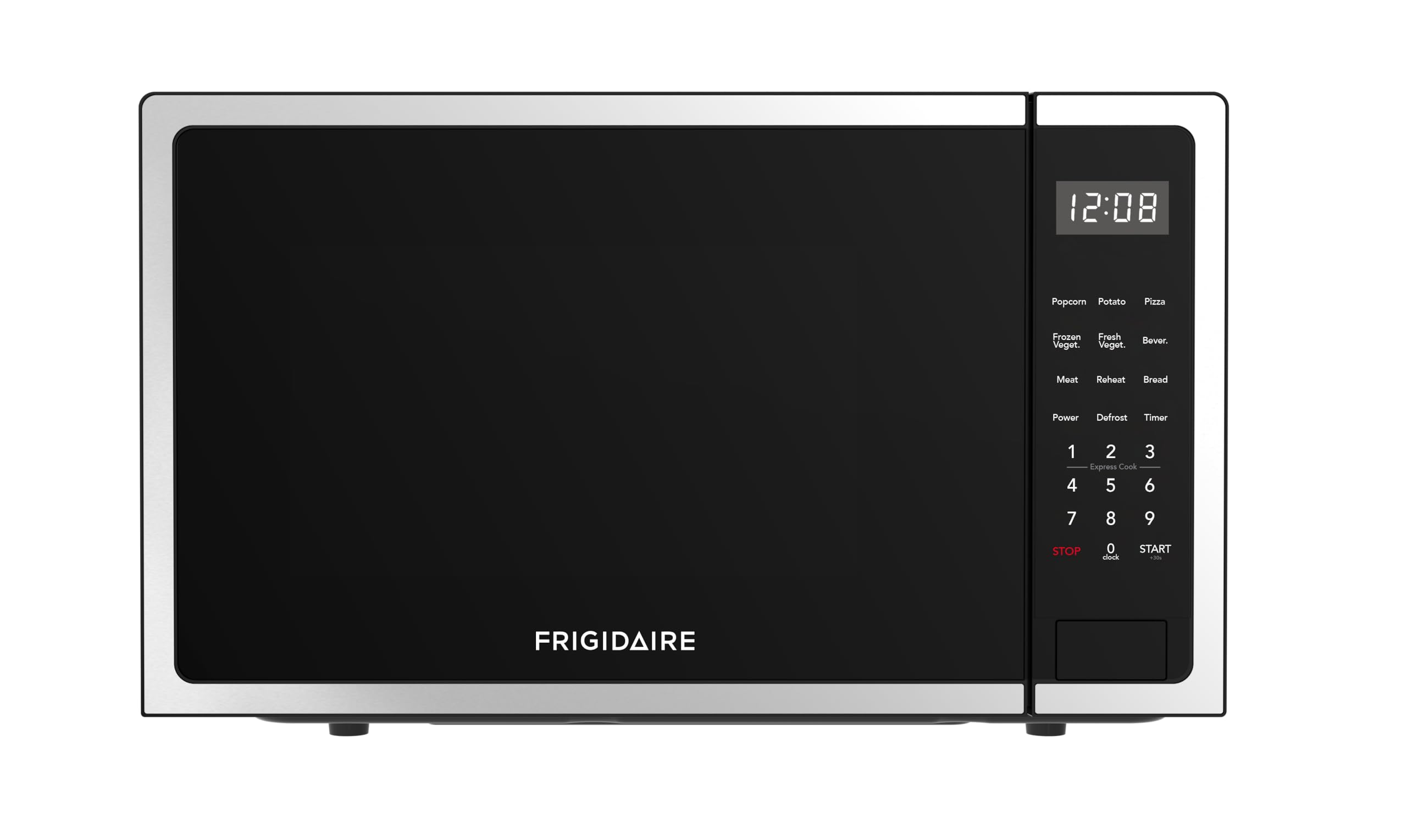
This Frigidaire steps slightly above the 1.4 crowd in capacity, and that extra bit of space can be more useful than it sounds. It’s not just about “bigger.” It’s about which dishes fit without banging the sides, which bowls can sit centered without wobbling, and how easy it feels to use larger containers for family meals.
What Frigidaire does well here is keep the feature set straightforward. You get the auto-cook options most people actually use (popcorn, potato, pizza, beverages, reheat), plus the standard defrost and power level controls. The white interior is also a quiet advantage: it makes splatter easier to see, which helps you clean before mess becomes baked-on odor.
The big thing to know from real-life feedback: some users report a door safety lock behavior that can feel annoying. It’s the kind of thing that makes people say, “Why won’t it open?” until they learn the routine. If you have kids, you may appreciate the safety. If you don’t, you may want a model with a simpler door flow.
And like many microwaves, shipping condition matters. Some negative experiences are clearly “arrived damaged” situations, which is why immediate inspection and testing is always the smart move.
Why it’s useful
- Extra interior room – helps with larger bowls, plates, and family portions.
- White interior visibility – easier to spot splatter and keep it clean.
- Simple, practical presets – covers daily needs without overcomplication.
- Frigidaire familiarity – straightforward “appliance brand” experience.
Good to know
- Door lock routines can annoy some users; learn it early and decide if it fits your life.
- Shipping damage complaints exist; inspect and test immediately.
- If you want smarter sensor behavior or inverter-style heating, look at Panasonic/Sharp inverter picks.
Ideal for: kitchens that want a bit more room than 1.4 offers, without moving into truly oversized countertop territory.
12. BLACK+DECKER EM036AB14 – Practical Presets, Good Fit, and “Does the Job” Convenience

Black+Decker’s EM036AB14 is the definition of “practical microwave for normal humans.” It has the presets people actually use (popcorn, potato, pizza, beverage, dinner plate), a simple 30-seconds express option, a push-button door, and a form factor that tends to fit well under cabinets. If you’ve ever bought a microwave that technically fit… but felt awkward, you’ll understand why profile matters.
Where this model wins is routine convenience. It’s designed so you can operate it half-awake: press time, press start, move on. It’s also easy to clean because the interior and turntable setup are straightforward, and the overall shape doesn’t feel fussy. This is the kind of microwave that fits apartments, condos, and small kitchens where counter space is precious.
Real-world feedback is also honest about the compromises that come with value-focused models. Some users report it being loud (especially door clicks and end-of-cycle sounds), and there are occasional complaints about inconsistent heating or durability quirks over time. That doesn’t mean it’s a bad buy—it means you should treat it like a practical appliance: test it early, keep the box briefly, and don’t ignore early signs of a lemon.
Expert tip: to make this microwave feel “more consistent,” stop using full power for everything. For coffee and leftovers, 70% power for a bit longer usually produces more even results and fewer “surprise boiling” moments.
Why it fits many kitchens
- Simple presets and controls – low learning curve and easy daily rhythm.
- Good countertop fit – profile often works well under cabinets and shelves.
- Push-button door – convenient access without a bulky handle sticking out.
- Easy to keep clean – straightforward interior and removable turntable.
Good to know
- Some owners report louder operation (door + beeps) than expected.
- Occasional durability/consistency complaints appear; test early and keep packaging briefly.
- If you want premium reheating texture, inverter models will feel more refined.
Ideal for: small kitchens and practical buyers who want familiar presets and a microwave that fits easily into everyday routines.
13. Farberware 1.3 cu. ft. (1000W) Stainless – Straightforward Cooking With a Full-Size Feel

This Farberware is the practical sibling to the higher-power “statement” model. It keeps the same basic idea—full-size usability in a compact footprint—while focusing on the features most people actually touch: power levels, multi-stage cooking, defrost by time or weight, and a handful of one-touch programs that make daily life faster.
In real owner feedback, Farberware microwaves often get described as “good quality for the money” and “works great” once set up. People like the full-size feel, the decent capacity, and the fact that it can handle normal dinner plates. The stainless look also fits most kitchens without trying too hard.
The most frequent critiques match what you’d expect from this style of microwave: some users mention it can be loud while running, some dislike display color aesthetics, and some report the keypad needing a firm press. Those aren’t dealbreakers for everyone, but they matter if you’re sensitive to noise or you want feather-touch controls.
My expert angle: if you want a simple microwave that’s roomy and straightforward, this Farberware does the job. If you want a microwave that feels more “refined” in reheating texture, inverter models will outperform it. But for press-and-go daily cooking, it’s a dependable option.
Why it’s a solid choice
- Full-size usability – handles normal plates and bowls comfortably for daily cooking.
- Clear power level options – easy to use medium power for better reheats.
- One-touch convenience – simple presets cover most common foods.
- Classic stainless look – fits a wide range of kitchen styles.
Good to know
- Noise level and keypad stiffness are common owner complaints across this style of Farberware unit.
- If you rely heavily on sensor programs for perfect reheats, Panasonic models tend to feel smarter.
- If you want premium texture control, inverter models remain the best upgrade path.
Ideal for: practical buyers who want a straightforward microwave with a roomy feel and classic controls.
How Microwave Heating Actually Works (and Why Some Models Feel “Better”)
Microwaves don’t heat food the way ovens do. They energize water molecules and create heat internally—which is why you can get a steaming edge and a cold center in the same bowl. Once you understand that, you can predict why inverter power, turntable behavior, and “standing time” make such a difference.
What makes a microwave feel even in real life
- Power delivery that isn’t harsh – inverter-style heating often improves texture at lower power levels.
- A turntable that rotates smoothly – helps distribute energy instead of blasting one side.
- Sensor logic that matches your portions – best for normal bowls and plates, not tiny snacks.
- Interior visibility – if you can see splatter early, you clean early (odor and performance stay better).
- Controls that make power levels easy – when power is easy to change, people actually use it, and reheats improve.
A microwave that “heats evenly” is rarely doing one magic thing. It’s doing a handful of small things well. That’s why premium models often feel calmer and more predictable: they reduce friction in multiple places at once.
Habits that make any microwave perform better
- Use medium power for leftovers – try 60–70% for longer. Texture improves dramatically.
- Cover food (vented) – traps steam for more even warming and reduces splatter.
- Stir or rotate once – especially for soups, rice, pasta, and anything thick.
- Let it rest – 30–90 seconds “standing time” allows heat to equalize inside the food.
- Salt + fat change microwave behavior – saucy foods heat differently than dry foods; adjust time accordingly.
- Clean the ceiling and door edges – old residue can trap odor and make the microwave feel “stale” fast.
If you do nothing else: use lower power more often. It’s the easiest way to turn “microwave food” into “normal food.”
FAQ: 1.4 Cubic Feet Microwave Questions People Actually Ask
Is inverter technology really worth it, or is it just marketing?
Why do some microwaves heat unevenly even when they have high wattage?
Should I choose sensor cooking or manual time cooking?
My microwave has a child lock / door unlock routine. Is that normal?
What capacity is best for most kitchens: 1.3, 1.4, or 1.5?
How do I avoid the “microwave smell” over time?
Final Thoughts: Buy the Microwave That Makes Your Day Easier
A microwave doesn’t need to be exciting. It needs to be dependable, intuitive, and quietly good at the daily stuff you actually do. When you choose based on your real friction points (uneven reheats, loud beeps, annoying lock routines, hard-to-read controls), you end up with an appliance you don’t think about—which is the highest compliment a microwave can earn.
Here’s the simplest way to translate this guide into the right buy:
- Want the best overall “premium daily life” microwave? Start with the Panasonic NN‑SV79MS Smart Inverter. It’s the best blend of controlled reheating, smart convenience, and “this feels refined” performance.
- Want a microwave that looks stunning on the counter? Choose the Farberware White Platinum (1100W). It’s a style upgrade that still delivers real everyday power.
- Want sensor convenience without smart-home extras? Pick the Panasonic NN‑SD67LS for a clean, dependable “classic Panasonic” experience.
- Want inverter-style evenness without going fully smart? The SHARP Stainless Inverter 1.4 is the best “even reheat” alternative with a simple daily workflow.
- Want familiar controls that everyone can use quickly? Go with the GE® 1.4 countertop microwave for easy express keys, sensor options, and low learning curve.
- Need smart control and quieter operation? The TOSHIBA ML‑EM34P(SS) is a great fit if mute/ECO and Alexa convenience matter to your household.
- Want Sharp simplicity in a finish that fits your kitchen? Pick either the SHARP Black 1.4 or the SHARP White 1.4 depending on your countertop style.
- Want a roomy workhorse with simple controls? Choose the COMMERCIAL CHEF Stainless 1.4 or its Black version for practical “big cavity” daily use.
- Want a touch more room than 1.4 offers? Try the FRIGIDAIRE 1.5 cu. ft. if you regularly heat larger bowls and family portions.
- Want a simple, counter-friendly microwave with familiar presets? The BLACK+DECKER EM036AB14 is a practical, low-profile routine pick.
- Want straightforward Farberware cooking in stainless? Choose the Farberware 1.3 (1000W) Stainless for simple power levels and press-and-go programs.
Pick the 1.4 cubic feet microwave that matches how you actually eat, reheat, and live—quiet nights or loud family days, smart automation or simple buttons, extra room or tight counter space—and you’ll end up with the best kind of appliance: the one you never have to think about again.
