
Water is the first domino. When it falls, everything else gets harder: your decision-making, your body temperature control, your ability to hike, cook, or even think clearly. And the scary part? In a real emergency, “water” is usually everywhere… just not in a form you can safely drink.
That’s why a reliable survival water filter system isn’t a “nice-to-have accessory.” It’s the bridge between a questionable source (rain runoff, a creek, a hotel tap in a risky area, a storage tote after a storm) and the one resource you cannot negotiate with: hydration.
But here’s the trap: most buying guides talk like every filter does the same job. They don’t. Some excel at removing sediment and bacteria but do almost nothing for taste. Some make water taste amazing but are fragile if you drop them once. Some are perfect for one person on a trail and painfully slow for a family of four. And some look “tactical” but become useless the first time you try to clean them in the field.
This guide is written for the real world: people who want to make one smart purchase, build a plan around it, and never think about it again until they actually need it. I pulled the thread on what users repeatedly praise (and what they repeatedly complain about), then translated that into a simple decision system you can trust.
We’ll cover exactly how these systems behave when water is clear vs. silty, how to prevent cross-contamination (the silent mistake that ruins “filtered” water), which designs are truly “one-person friendly,” and how to store a filter so it still works months or years later. Then we’ll break down 15 strong options—each with a clear best-use scenario—so you can match gear to your life, not the other way around.
In this article
How to Choose a Survival Water Filter System That Fits Your Real-World Plan
Before you pick a product, pick your scenario. This sounds obvious, but it’s where most people get burned: they buy a “highly rated” filter that’s perfect for someone else’s life, then wonder why it feels slow, annoying, or oddly stressful to use. If you only remember one thing from this guide, remember this: your best setup is the one you can operate confidently when you are tired, cold, and slightly panicked.
1. Start with the only question that matters: “What am I filtering for?”
Water problems come in three big categories, and filters solve them differently:
- Particulates (dirt, silt, algae, rust): This is what makes water look nasty. It also clogs filters fast. A good pre-filter (or settling) matters more than “extra stages.”
- Biological threats (bacteria, protozoa, parasites): Many outdoor filters are built for this. This is the core reason hikers filter water.
- Chemicals/taste (chlorine, odors, some organics, “swampy” flavor): Activated carbon helps here. It’s also the difference between “technically drinkable” and “I’m actually willing to drink enough.”
2. Understand “micron” without falling for the trap
Micron ratings are useful, but only when you treat them like a capability indicator, not a magic guarantee. Here’s how to think about it in normal-person terms:
- 0.1 micron filters are common in gravity bags and straws. They’re excellent for bacteria and protozoa in many real outdoor situations.
- 0.01 micron ultrafiltration filters tend to be “tighter” and can give more confidence against smaller biological contaminants and fine turbidity. These show up in many pump-style systems.
- Activated carbon doesn’t replace a membrane. It’s the taste and odor specialist. Think “would I drink this every day?”
A tight membrane with terrible usability is not a win. If the hose kinks, the outlet drips into dirt, or the unit is awkward to hold while pumping, you’ll cut corners—and corner cutting is how “filtered” water becomes “contaminated water in a clean bottle.”
3. Decide your “operating style”: straw, gravity, pump, or countertop
The fastest way to choose is to match the mechanism to your reality.
- Personal Straw Filters: Lightest, simplest, and perfect for “I found water, I need to drink now.” The trade-off is volume. Straws are not fun for cooking water, group hydration, or filling containers fast.
- Gravity Bags: Best effort-to-water ratio. Fill the dirty bag, hang it, do something else. The trade-off is that flow slows down in silty water unless you maintain and backflush.
- Hand Pumps: Great control and often more consistent in variable sources. The trade-off is fatigue and the fact that many pumps work best as a two-person job (one pumps, one holds bottle/hose).
- Electric Pumps: Massive comfort upgrade when your hands are cold, you have joint pain, or you need to filter a lot daily. The trade-off is power logistics and taking care of the motor like a tool, not a toy.
- Countertop Gravity Systems: The “set it and forget it” option for boil alerts and outages. The trade-off is portability—these shine at home base.
4. The clean-container rule (the part most people skip)
Your filtration is only as good as the clean side discipline. The most common real-world failure isn’t the filter “not working.” It’s a clean hose touching the dirty bag, the output nozzle brushing a muddy glove, or someone setting the “clean bottle” on the same rock used for scooping dirty water.
- Assign roles: Dirty-hand and clean-hand. One person touches source water and intake parts. The other touches the bottle and outlet parts.
- Use a dedicated clean container: A bottle or jug that never touches source water—ever.
- Keep outlet hoses off the ground: Clip, hold, or route the hose so it never dips into the filling container.
5. Flow rate is a system, not a spec
Manufacturers often list an ideal flow rate. Your real flow rate depends on:
- Source quality: Clear mountain stream vs. silty pond is not the same game.
- Head pressure: Gravity systems flow faster when the dirty bag is high and full.
- Hose behavior: Kinks, bends, and stiff tubing can ruin a “fast” system.
- Maintenance habits: Backflushing before storage and after heavy use restores performance.
If you’re building a go-bag, your ideal survival water filter system is the one that keeps working even when you’re sloppy, because in an emergency you will be slightly sloppy. That’s why designs with easy cleaning, protected ports, and simple “where do I put this hose?” answers tend to win long-term.
6. Power strategy: choose redundancy you’ll actually maintain
Electric systems are incredible—until you run them dead and realize your backup plan is “hope.” If you choose electric, be intentional:
- Battery standardization: Systems that run on common batteries (AA) or USB power banks reduce panic.
- Solar/hand-crank: Useful, but think of them as “slow emergency topping,” not a full-time charger.
- Manual backup: Some hybrid systems include a hand pump mode. That’s not a gimmick; it’s an actual safety net.
7. A simple, high-success field protocol (steal this)
This is the “don’t overthink it” approach that dramatically improves results:
- Pick the best source you can: moving water beats stagnant water. Clear beats cloudy. Upstream beats downstream.
- Settle when possible: let water sit so sediment drops. Even 10 minutes helps.
- Pre-filter if needed: cloth, bandana, coffee filter—anything that catches grit before your membrane sees it.
- Filter with clean-side discipline: keep outlet parts clean. Don’t let hoses drag.
- Backflush and dry: restore flow now, store safely later.
Quick Comparison: 15 Survival Water Filter Systems at a Glance
These are organized by “most broadly useful” first, then more specialized solutions (home base, high-volume groups, ultralight kits, and budget backups).
On smaller screens, swipe or scroll sideways to see the full table.
| Model | Type | Best For | Key Feature | Amazon |
|---|---|---|---|---|
| Survivor Filter PRO X (Electric) | Electric Pump | Best all-around use | USB or AA power flexibility | Amazon |
| Purewell 3-Stage Stainless Gravity (2.25G) | Countertop Gravity | Home outages & boil alerts | Stainless body + long-life filters | Amazon |
| Outback Emergency Bucket System | Gravity Bucket | Families & disaster prep | High daily capacity design | Amazon |
| Katadyn Hiker Pro | Hand Pump | Backpacking reliability | Field-cleanable AntiClog design | Amazon |
| Greeshow Electric Filter (Solar + Crank) | Electric Hybrid | Vanlife & go-bags | Solar + hand-crank + power bank | Amazon |
| BKLES BK-3000 Solar Electric + Hand Pump | Electric Hybrid | Redundancy-focused kits | Electric + manual pumping modes | Amazon |
| Survivor Filter PRO (Manual) | Hand Pump | Manual confidence | Compact pump + easy backwash | Amazon |
| TRAILGO Pro Water Purifier (High Volume) | Hand Pump | Groups & basecamp | Fast pumping for gallons/day use | Amazon |
| Uzima UZ-2 Bucket System | Gravity Bucket | Simple community filtering | Stacked buckets + long-life cartridge | Amazon |
| Practical Survival Gravity Bag Kit (2 Bags) | Gravity Bags | Hunting & backpack camps | Dual bags + backflush plunger | Amazon |
| Waterdrop Gravity Straw + 1.5G Bag | Straw + Gravity | Ultralight versatility | Backwashable straw + hanging bag | Amazon |
| 5-Pack High-Capacity Emergency Straws | Straw Pack | Family kits & vehicles | 5 straws + 5 plungers included | Amazon |
| LifeStraw Personal (Multi-Pack) | Straw Pack | Minimal, proven backup | Iconic simplicity + long shelf life | Amazon |
| BKLES BK-2000 Electric Filter | Electric Pump | Hands-free filtering | Electric dispense + light + power bank | Amazon |
| SurviMate 0.01 Micron Hand Pump | Hand Pump | Budget manual backup | High flow for its size | Amazon |
In‑Depth Reviews: 15 Systems Built for Real Emergencies
I’ve organized these based on “real-world utility”—how confidently you can use them when conditions are messy, time is short, and you need clean water without drama. Specs matter, but the experience matters more.
1. Survivor Filter PRO X (Electric) – The Everyday + Emergency Workhorse

If you want one system that can live on your kitchen counter and travel in a go-bag, the PRO X is the rare pick that genuinely makes sense. Users love it because it removes the most annoying part of filtration: repetitive pumping when you’re filtering every single day, or when your hands are cold, tired, or sore.
The power flexibility is the real win. A lot of “electric” outdoor filters secretly assume you’ll always have the right cable, the right battery, and the right charger. The PRO X-style approach (USB power bank + common batteries) makes the system feel less like a gadget and more like a tool. That matters because power is usually the first thing that gets complicated in an outage.
Where this unit shines in real life is the “routine filter.” Many owners build a small habit: keep a dirty-water pitcher, filter into a clean dispenser, and you have reliable drinking water without re-plumbing your house. That same habit transfers outdoors: put the intake hose in a source, route the output into a bottle, press the button, and you’ve got clean water while you pack up camp.
The most repeated complaint is also helpful because it teaches you how to win with it: treat the power button like a tool switch. Pack it in a way that prevents accidental activation, and consider removing a battery for transport if you’re stuffing it into a tight bag. The systems that last are the ones that are stored thoughtfully.
Why it’s the top pick
- Low-effort output: Press-and-filter beats fatigue in real emergencies.
- Power flexibility: Works with common charging and battery habits.
- Daily-use friendly: Useful even when nothing is “wrong,” so you actually learn it.
- Quiet, steady operation: Makes it easy to filter large jugs without stress.
Good to know
- Electric systems require a power plan (bank, batteries, or both).
- Hose routing and clean-side discipline still matter—electric doesn’t prevent user error.
Ideal for: Anyone who wants one dependable system for home, travel, RV life, and emergency kits—without committing to a bulky bucket setup.
2. Purewell 3-Stage Stainless Gravity (2.25G) – The “No Power, No Panic” Home Base

The Purewell style of system is what experienced preppers quietly prefer for home readiness: it does not rely on electricity, it’s easy to understand at a glance, and it creates a “water routine” that is calm instead of chaotic. In other words, it’s the kind of filter that reduces stress—not just contaminants.
In real reviews, people consistently talk about taste. That might sound like a luxury, but it’s actually a survival advantage: if your water tastes clean and smooth, you drink enough. If it tastes flat, chlorinated, or weird, you unconsciously ration—even when you shouldn’t. The Purewell approach (multi-stage + carbon + gravity) often wins on “I actually like drinking this.”
This is also one of those purchases that makes sense even before an emergency. People who deal with frequent boil alerts, unpleasant municipal taste, or questionable well water often keep a gravity tank as their daily drinking source. That’s a hidden benefit: you learn the system when life is normal. So when life isn’t normal, you don’t have to learn under pressure.
Two real-world usage notes matter. First: gravity systems can overflow if you mindlessly top off the upper chamber when the lower chamber is already full—so your habit should be “check the bottom level first.” Second: countertop filters are at their best when you treat them like a clean appliance: wipe the spigot, clean the chambers periodically, and don’t let stagnant water sit for ages.
Why it wins at home
- No electricity required: Works during outages, storms, and boil alerts.
- Daily-drinking friendly: People stick with it because the water tastes good.
- Stainless durability: Less “crack risk” than large plastic pitchers.
- Simple operation: Fill top, drink from bottom—easy for families.
Good to know
- Not a backpacking solution—this is a home base tool.
- Gravity systems benefit massively from pre-settling cloudy water.
Ideal for: Home emergency readiness, daily drinking, boil alerts, and anyone who values “calm and reliable” over “tactical and complicated.”
3. Outback Emergency Drinking Water Filter – The Family-Scale Disaster System

The Outback-style bucket system exists for one reason: volume. If your emergency plan includes more than one person (or if you expect neighbors, family, or community needs), your biggest problem isn’t “can I make one bottle safe?” It’s “can I keep producing enough safe water, day after day, without destroying my hands?”
Gravity bucket systems are psychologically underrated. They don’t feel “high tech,” but that’s exactly why they’re dependable: no motor, no pumping seals, no battery anxiety. You pour in raw water, you get clean water out. And in extended emergencies, simplicity is a force multiplier.
Here’s the honest, expert-level reality: people who struggle with bucket systems usually struggle because they treat every source like it’s identical. If you pour silty water straight into a gravity system, you’re asking the filter to do double duty—clarification and biological filtration—and flow will slow dramatically. The winning habit is to let cloudy water settle (or pre-filter it) first. That single step often turns “slow and disappointing” into “steady and reliable.”
If your goal is true household resilience, a bucket system like this pairs beautifully with a smaller portable filter. The bucket handles daily volume at home base; the portable handles movement and scouting. That division of labor is how you stay sane.
Why it’s a disaster-ready pick
- High-volume design: Built to supply more than one person.
- No power required: Gravity doesn’t run out of batteries.
- Simple to train: Easy for multiple family members to operate correctly.
- Long-term mindset: Better for “weeks,” not just “a day hike.”
Good to know
- Real output depends heavily on source clarity and pre-settling.
- Bucket systems take space; they’re a home base tool, not an ultralight tool.
Ideal for: Families, community-focused preparedness, long outages, off-grid cabins, and anyone who wants steady production without pumping fatigue.
4. Katadyn Hiker Pro – The “Handled by Teenagers” Reliability Test Winner

There’s a special kind of credibility that comes from rough handling. A filter that survives repeated use in training environments—where gear is moved fast, set down in dirt, and operated by people who aren’t gentle—tells you something important: the design tolerates reality.
The Hiker Pro’s best feature isn’t a flashy spec. It’s the field-cleanable anti-clog approach. In the wild, filters don’t fail because the membrane “stops filtering.” They fail because flow drops and people get impatient. Being able to quickly clean the intake/filter protector in the field keeps output consistent and reduces the urge to cut corners.
The pumping experience matters more than you think. An ergonomic handle doesn’t sound exciting until you’ve pumped multiple liters for a small group. Users repeatedly describe this as “easy enough” that even younger hikers can operate it—meaning it can be a shared responsibility instead of one exhausted person doing all the work.
One real-world note to reduce confusion: first use can sometimes produce odd-looking water until the system is fully flushed and the carbon stage settles. That’s not unique to Katadyn; it’s a “new filter break-in” reality. The fix is simple: flush and discard the first run, then move forward confidently.
Why it stays popular
- Field-cleanable: Keeps flow more stable across multiple days.
- Comfortable pumping: Easier to sustain for 1–2 people (or more).
- Carbon helps taste: Especially noticeable in algae-y or “pondy” sources.
- Pack-friendly: Compact for a real pump filter with hoses.
Good to know
- Like most pumps, it’s faster with two people (pump + bottle holder).
- Best results come from keeping intake water as clear as possible.
Ideal for: Backpackers who want a proven pump system that can handle real field use—not just perfect weekend conditions.
5. Greeshow Electric Filter (Solar + Hand Crank) – The “One Device, Three Problems” Solution

This is the kind of product that makes immediate sense to van lifers and go-bag builders because it combines three survival chores: water filtering, lighting, and device charging. That “combination” can be either brilliant or gimmicky—so here’s the expert way to evaluate it: does each feature reduce friction in the field, or does it add complexity that breaks under stress?
The electric pumping is the daily comfort win. People who have used manual squeeze or pump systems often describe electric filtering as a huge lifestyle upgrade: you set the intake, route the output, press a button, and you’re free to manage camp tasks while water is being processed. That “hands-free” effect is not laziness; it’s efficiency.
Solar and hand-crank are best treated as resilience tools, not primary power sources. Solar helps maintain charge over time when you’re living outdoors, and crank is the “last-ditch get a little power” option. The fact that it’s built in is valuable—because in a real emergency, separate devices get lost, forgotten, or dead.
The reality trade-off is that anything with a motor is a mechanical device. A few users report that motors can fail after repeated use or after filter changes. The smart strategy is to treat the unit like a piece of gear you maintain: keep sediment out with a pre-filter, use the backwash function as intended, store it dry, and avoid running it in conditions where it’s ingesting grit. If you do that, you dramatically improve the odds that it keeps earning its spot in the kit.
Why it’s a smart “combo”
- Hands-free filtering: Press once, then do other tasks while it runs.
- Multiple charging paths: USB-C, solar, and hand-crank add resilience.
- Built-in light: Night water collection becomes safer and easier.
- Power bank function: Supports phone essentials when the grid is down.
Good to know
- Electric gear requires care: pre-filtering and backwashing protect the motor and flow.
- Heavier than minimalist backpacking filters (better for car/van/go-bags).
Ideal for: Go-bags, vehicle kits, vanlife, and preparedness setups where one device handling water + light + power is a real advantage.
6. BKLES BK‑3000 (Solar Electric + Hand Pump) – The “If One Fails, Keep Going” Pick

If you’re the type of person who believes “one is none, two is one,” this style of system is for you. The BK‑3000 concept is simple: enjoy electric filtering when life is normal, but keep a manual path available when power becomes unreliable.
The most important part is that the manual backup isn’t an afterthought. In real outdoor use, batteries and power banks can die faster than expected—cold weather, heavy use, or simply forgetting to top them off. When that happens, having a built-in hand pump means your water plan doesn’t collapse. You slow down, you work a bit more, but you still get water.
Solar charging is genuinely useful for long trips or storm aftermath, but the expert expectation should be realistic: it’s often best at “keeping you topped up,” not instantly refilling a dead battery in bad weather. Users who succeed with solar do two things: they place the panel strategically (full sun, not shade) and they build a habit of charging whenever the opportunity exists.
This system also teaches a valuable lesson: tubing discipline matters. Several users mention that laying out the tubes to avoid kinks makes the difference between smooth flow and frustration. It’s not a flaw; it’s just part of operating any hose-based filtration system in the field. Practice it once at home, and you’ll be dramatically faster when it counts.
Why it’s built for real problems
- Electric + manual modes: Convenience and resilience in one kit.
- Solar support: Helps maintain charge during extended off-grid periods.
- Emergency lighting: Useful for night collection and camp organization.
- Device charging support: Helpful when you’re relying on phones for maps or comms.
Good to know
- Like all hose systems: avoid kinks, keep the clean outlet protected.
- Solar works best as “maintenance charging,” not instant refuel in storms.
Ideal for: Families who camp, storm-prep households, and anyone who wants a single system that stays functional when power gets complicated.
7. Survivor Filter PRO (Manual) – Compact, Confident, and Field-Friendly

Manual pumps remain the confidence king for a specific reason: they don’t require an external energy plan. If you can move your arms, you can make water. That simplicity is why manual filters still dominate serious kits, even among people who love electric comfort.
What sets this style apart is the “complete kit” thinking. Instead of forcing you to improvise cleaning tools, it often includes an intentional backwash method (like a syringe). That matters because flow loss is what makes people abandon their filters. When you can backwash efficiently, you keep performance stable and avoid turning your filter into a clogged paperweight.
In group hiking reviews, you’ll notice a pattern: the filter works best when the team behaves like a team. One person pumps, another manages the clean bottle and hose. The moment you treat it like a one-handed operation while balancing a bottle on a rock in moving water, you introduce contamination risk and frustration. That isn’t a product flaw; it’s the nature of pumping systems.
One of the most practical “expert tweaks” people do is connecting the outlet hose to common hydration connectors so they can fill bladders more cleanly. Even if you don’t customize it, the lesson still applies: route clean water in a way that avoids touching questionable surfaces.
Why manual still matters
- No power dependency: Works in extended outages and deep backcountry.
- Maintenance-friendly: Backwash tools help restore flow and extend usability.
- Good “kit completeness”: Typically includes the hoses and accessories you actually need.
- Confidence factor: Simple mechanics reduce “will it charge?” anxiety.
Good to know
- Often easiest as a two-person system for speed and cleanliness.
- Intake management matters—avoid sucking air in moving water.
Ideal for: People who want a dependable manual filter for real emergencies and don’t want their water plan tied to batteries.
8. TRAILGO Pro Water Purifier (High Volume) – When “One Bottle” Isn’t the Mission
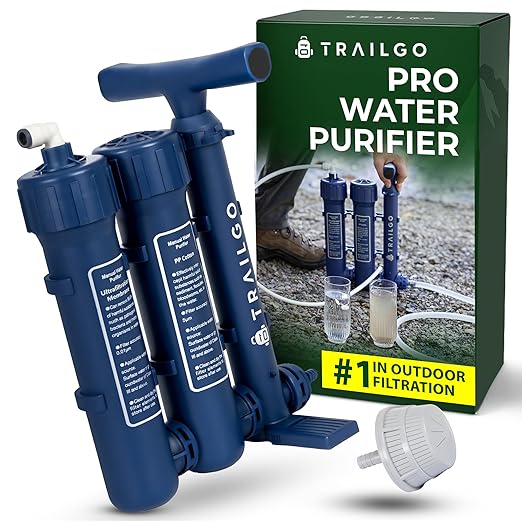
This is the kind of pump you choose when you’re thinking in gallons, not cups. If you’re filtering for a small group at basecamp, a hunting party, or an off-grid routine where you’re repeatedly topping off containers, high-volume pumping changes the entire experience.
The big advantage is time compression. Smaller pumps can be fine, but the psychological friction of “we need six liters and it’s going to take forever” adds up. High-volume pumps reduce that friction, which makes people more likely to actually filter enough water for cooking, cleaning, and hydration—rather than rationing because filtration feels tedious.
The most repeated user complaint in this category is a surprisingly important detail: hose management. When hoses are packed in ways that create kinks, it slows output and makes setup annoying. The fix is simple and extremely worth doing: when you unpack, straighten the hose, warm it if it’s cold, and route it with gentle curves. Many “this is slow” complaints disappear when hoses behave.
This is also a system where clean-side discipline becomes easier: because it’s designed for volume, you can set it up in a more stable station-style layout (dirty container on one side, clean containers on the other). That layout is how you prevent accidental re-contamination while filtering repeatedly across the day.
Why it’s a group favorite
- High-volume workflow: Better for multiple people and repeated refills.
- Less fatigue per liter: Designed for “keep going” use.
- Good for basecamp stations: Easier to keep dirty and clean areas separated.
- Practical long-session tool: Makes it more likely you’ll filter enough water.
Good to know
- Bulkier than ultralight filters—think “car camp” and “basecamp,” not “fastpacking.”
- Hose kinks can sabotage performance if you don’t manage them.
Ideal for: Group camping, hunting camps, off-grid routines, and anyone who needs a pump that won’t feel punishing when output demands rise.
9. Uzima UZ‑2 – The “Community Emergency” Gravity Setup

The UZ‑2 wins in the category of “straightforward emergency practicality.” It’s not trying to be a tiny hiking straw or a fancy countertop appliance—it’s a gravity-fed bucket system designed for households and small communities who need dependable water production without electricity.
Users consistently praise the concept: easy to store, easy to deploy, and easy to clean via backflushing. That last piece matters because gravity systems are only as good as their maintenance habit. If you can backflush in a simple, obvious way, you keep flow healthier and reduce the “it slowed down so I stopped using it” problem.
Here’s the real-world nuance you’ll want to know before buying: many bucket systems ship with instructions that aren’t great, and some people report that the included spigot feels flimsier than they’d prefer. In practice, that’s not a deal-breaker; it’s a reminder that your system can be upgraded in small ways if your environment is demanding. What matters is that the core concept—gravity filtration with a cartridge you can maintain—remains strong.
One of the most compelling use-cases is mission travel and group trips where bottled water has historically made people sick. Gravity systems create a controlled, consistent source for the whole group. That’s a different type of value than “I can drink from a stream.”
Why it’s a smart emergency choice
- No electricity needed: Reliable when infrastructure fails.
- Family/community friendly: Designed for shared use, not solo sipping.
- Simple maintenance: Backflushing is part of the intended workflow.
- Compact storage: Easier to store than many rigid home systems.
Good to know
- Expect a short learning curve during assembly; do one practice run at home.
- Bucket systems benefit greatly from settled/clearer water for best flow.
Ideal for: Emergency kits for families, community preparedness, storm regions, and anyone who wants gravity filtering without countertop metal hardware.
10. Practical Survival Gravity Bag Kit (2 Bags) – The “Hang It and Move On” Camp System

Gravity bags are the “effort-to-output” champion for camping and hunting camps. The reason is simple: your hands do the work once (fill the dirty bag), and gravity does the work for the rest. That makes hydration feel automatic instead of labor.
The dual-bag setup is more useful than it sounds. One of the most common camp frustrations is having a single dirty bag and then constantly swapping hoses, containers, and positions. With dedicated dirty and clean bags, your workflow becomes cleaner and faster—and it reduces contamination risk because you’re not repeatedly improvising where “clean water” should go.
Users praise the compatibility: thread patterns that play nicely with common bottle/filter standards mean you’re not locked into one fragile ecosystem. That matters for resilience. If something tears, you can often adapt. If you want to attach a different filter style, you can.
The real-world caution is exactly what experienced outdoorspeople expect: bags are durable, but they’re still bags. Protect them from sharp objects, don’t drag them, and don’t store them with grit inside. Also, if you ever see slow flow in a source you expected to be “clean,” backflushing is your friend. The included plunger concept is a legitimate value because it makes maintenance less of a chore.
Why gravity bags are so practical
- Low effort for high output: Fill once, then let it run.
- Two-bag clarity: Dirty vs clean separation reduces mistakes.
- Backflushing support: Helps restore flow after algae/silt exposure.
- Great for camp life: Keeps water available for bottles and cooking.
Good to know
- Bags can leak if damaged; store and pack them carefully.
- Flow slows in silty water unless you settle/pre-filter and backflush.
Ideal for: Backpacking camps, hunting trips, basecamps, and anyone who wants clean water “running” while they do other tasks.
11. Waterdrop Gravity Straw + 1.5G Bag – Versatility Without Bulk

This kit is popular for a reason: it gives you multiple ways to use one filter. You can run it as a gravity system with the included bag, connect it to bottles, or even drink directly like a straw. That flexibility is a big deal for travelers and hikers because water access varies wildly by location.
The most “expert useful” part is that it encourages smart behavior. People who like this style tend to adopt a clean workflow: dirty bag hangs, clean bottle fills, straw stays protected. It’s compact enough that you actually carry it, which is the most important feature any survival gear can have.
There are a couple of field notes that matter. First: treat the bag as a bag, not a canteen. Some users report that if it’s filled and then laid down or tipped, it can leak at the fold-top closure. That’s not a defect so much as a design reality. The solution is simple: fill it, carry it by the handle, and hang it soon after—don’t throw it full into your pack and expect it to behave like a rigid bottle.
Second: backwashing is not optional if you use it in algae-y or silty sources. The good news is that people who backflush are often shocked at how much gunk comes out—and how quickly flow returns. That’s exactly the maintenance behavior you want in any long-term kit.
Why it’s so versatile
- Multiple modes: Gravity, bottle, or direct drinking.
- Compact: Easy to pack, easy to justify carrying.
- Backwashable: Restores flow and extends usable life.
- Good for travel: Helps reduce reliance on questionable tap water.
Good to know
- Don’t rely on a fold-top bag as a long-distance “sealed canteen.”
- Expect flow to slow in algae-heavy sources unless you maintain it.
Ideal for: Ultralight hikers, travelers, and anyone who wants a compact kit that can adapt to multiple water collection styles.
12. 5 High‑Capacity Emergency Water Straws – The “Everyone Gets One” Readiness Upgrade
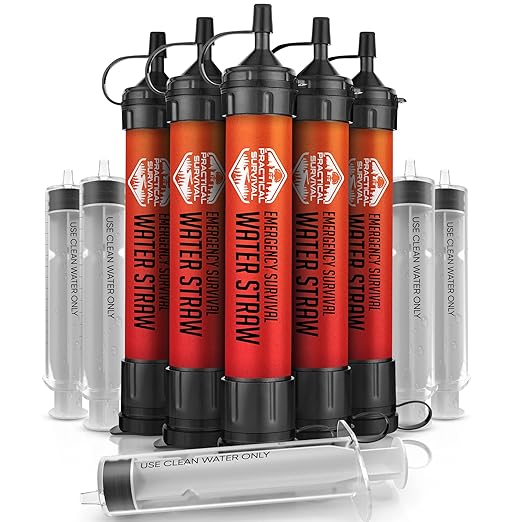
Multi-packs solve a problem that single “hero” filters can’t: distribution. In an emergency, you don’t want one person holding the only filtration tool while everyone else waits. You want redundancy, and you want it cheap enough that you’ll actually buy it.
What makes this pack more than “just five straws” is the inclusion of a dedicated flushing plunger for each straw. That’s not a cute accessory—it’s the difference between a straw that clogs and gets tossed, and a straw that stays useful long-term. Many people underestimate how quickly debris can build up in membrane-based filters, especially if kids use them without care.
The right mental model is this: a straw pack is a personal survival layer. It’s not your family’s cooking water system. It’s not your “fill the whole sink” system. It’s what you keep in vehicles, kits, and backpacks so that if you find water, you can drink safely without improvising.
Expert usage tip: straws perform best when you “prime” them and maintain them. Let the intake soak briefly, then sip. After use, backflush with clean water and dry. That routine sounds small, but it dramatically extends performance and keeps the straw from becoming slow and frustrating.
Why packs beat singles
- Distribution: Everyone can have a personal filter in a kit.
- Backflush tools included: Supports real maintenance, not wishful thinking.
- Easy storage: Perfect for car kits and long-term preparedness.
- Low complexity: No hoses, no setup, no power plan.
Good to know
- Straws are not efficient for filling cooking pots or group containers.
- Keep them from freezing when wet; freezing can damage membranes.
Ideal for: Family preparedness kits, vehicles, bug-out bags, and “one in every backpack” readiness planning.
13. LifeStraw Personal (Multi‑Pack) – The Classic That Still Earns Its Spot

LifeStraw became famous because it’s a simple answer to a scary question: “What if I need to drink from that?” It remains relevant because simplicity is still a survival advantage. There’s no hose routing, no pumping seals, no bag to hang. You drink through it, and you move on.
Where people love it most is as a backup layer: go-bags, first aid kits, glove boxes, hiking day packs. It stores easily and doesn’t demand that you become a filtration hobbyist. In a world where gear often gets complicated, a familiar tool has real value.
But let’s be honest and precise: this is primarily a “drink now” tool, not a “run a kitchen” tool. If your emergency plan includes cooking, washing, and filling multiple containers, a straw becomes tedious. That doesn’t make it bad—it just means it belongs in the correct slot: personal hydration safety, not household production.
The best way to maximize a straw is to treat it like a membrane tool, not a magical tube. Prime it, keep it clean, dry it before storage, and don’t let it freeze when wet. If you do those things, it stays fast and useful far longer than people expect.
Why it’s still worth owning
- Ridiculously portable: Easy to keep in multiple kits without noticing the weight.
- Fast to deploy: No setup, no parts, no power requirements.
- Familiar and trusted: Many people already know how to use it.
- Excellent personal backup: Great for day hikes and emergency travel.
Good to know
- Not efficient for filtering cooking water or supplying groups.
- Like any membrane: store dry and avoid freezing when wet.
Ideal for: Minimalist emergency backups, personal hiking safety, and “I want something in every bag” peace of mind.
14. BKLES BK‑2000 (Electric) – Set It, Forget It… Then Learn the One Pro Trick
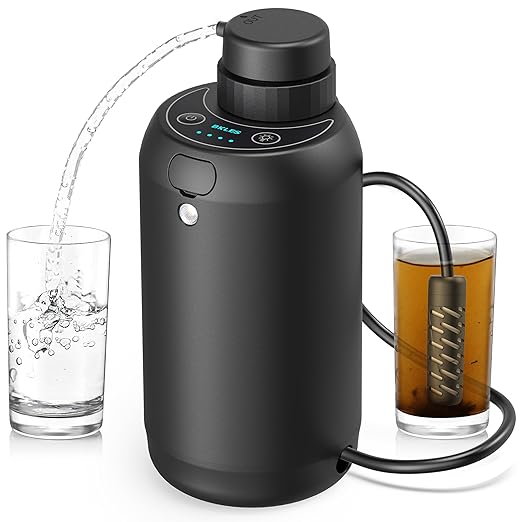
The BK‑2000 style of electric filter is popular because it removes the “sit and pump” tax. Press the button, let it run, and you can handle other camp tasks. Users report filtering cloudy rain-caught water, lake water for RV use, and even unusual non-drinking applications—because the system acts like a small portable pump with filtration.
Here’s the critical expert insight that makes or breaks electric hose systems: the outlet hose must stay clean. One of the most intelligent user modifications is simply preventing the clean hose from ever dipping into the receiving container. If your outlet hose gets contaminated, you can accidentally reintroduce grime to the clean water side and undermine your whole process.
This matters even more because electric systems encourage “walk away” behavior. That’s great for convenience, but it increases the chance that you’ll overflow a container or let the outlet hose flop into a dirty area. The best practice is to clip, hook, or hold the outlet so it stays suspended above the clean container opening.
Quality control complaints do show up occasionally in this category (for example, a tube not fitting correctly). That’s why the smartest way to treat a value electric filter is to do one full practice run at home: assemble, run, backflush, disassemble, and pack it. Once you’ve done that, you’ll know whether your specific unit is “ready for the field.”
Why people like it
- Hands-free convenience: Filtering while you do other tasks is a huge win.
- Good for repetitive use: RV, camping, and preparedness routines benefit.
- Emergency lighting: Makes night filtering simpler and safer.
- Backwashing: Helps restore flow after a heavy session.
Good to know
- Outlet hose hygiene is non-negotiable—keep it off dirty surfaces.
- Practice assembly once at home so you’re not troubleshooting under stress.
Ideal for: Campers, RV owners, and households that want electric convenience but still value compact, portable storage.
15. SurviMate 0.01 Micron Hand Pump – The Compact Backup That Belongs in a Truck
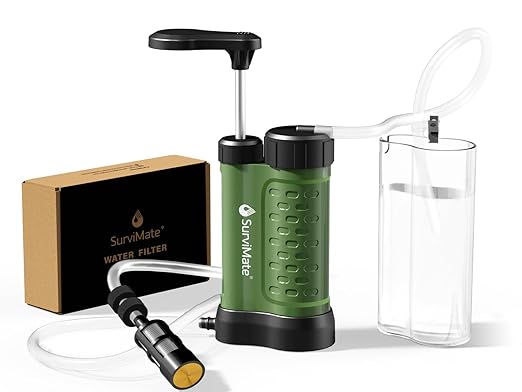
This is the kind of filter you buy because you want a backup you can afford to duplicate. One in the truck, one in the go-bag, one in the closet. And it’s a smart idea—because redundancy is how you avoid a single point of failure.
The honest reality from user feedback is that the build can feel “less premium” than higher-end pumps. That doesn’t mean it can’t work. It means you should treat it like a compact emergency tool: protect the ports, keep it in its bag, and don’t let it bounce around loose in the vehicle. If you treat it gently, it’s much more likely to be ready when you finally need it.
The best way to get great performance from compact pumps is to be picky about your intake water. Even if you’re filtering “dirty” water, try to avoid sucking up grit and heavy sediment. Let water settle. Scoop from a clearer spot. Pre-filter through cloth. Those small habits massively extend filter life and keep pumping effort reasonable.
This is also a good “training filter.” Practice with tap water, learn how long it takes to fill a bottle, and learn how to keep clean and dirty components separate. The value isn’t just the device—it’s the confidence you build by actually using it before the emergency arrives.
Why it’s worth considering
- Compact and portable: Easy to stash in vehicles and small kits.
- Manual reliability: No charging required to produce water.
- Great as redundancy: Affordable enough to place in multiple locations.
- Simple concept: Pump + hoses + container discipline.
Good to know
- Durability depends on how you store and protect it (don’t toss it loose).
- Performs best when you avoid heavy sediment and keep intake water as clear as possible.
Ideal for: Vehicle kits, backup redundancy, and anyone who wants a compact manual option as a “just in case” layer.
Power Guide: Understanding Filtration Without the Marketing Hype
To choose wisely, you don’t need a chemistry degree—you just need to know what the numbers and “stages” actually mean in daily use.
Microns: what “smaller” really changes
Micron ratings describe the size of particles a membrane is designed to block. Smaller microns can improve confidence against fine turbidity and many biological contaminants, but the trade-off can be faster clogging in silty water. That’s why pre-filtering and settling often matter more than chasing the smallest number.
If you camp in alpine streams, you can get away with smaller, lighter systems. If you expect storm runoff, muddy creeks, or rooftop rainwater, your success depends on managing sediment before it hits the membrane.
Carbon: the “will I actually drink this?” stage
Activated carbon is your taste-and-odor specialist. It can reduce the “pool water” flavor of chlorine and tame swampy notes from algae-heavy sources. In a true survival scenario, taste still matters because dehydration is often caused by people drinking too little, not just having too little.
A great strategy is to treat carbon as your comfort layer: use it when you can. But don’t mistake carbon for a full-spectrum solution to every chemical risk. The practical goal is safer water that you’ll actually consume consistently.
Flow rate: the hidden “effort tax”
Flow rate is affected by source clarity, temperature (cold water can move differently through membranes), hose kinks, and how you store the filter. Most people blame the filter when flow drops, but the fix is often maintenance: backflush, protect the intake, and store dry.
Gravity filters feel effortless but can slow down dramatically if you feed them cloudy water. Pumps feel faster but cost energy. Electric systems feel easiest but require power discipline. Choose the “effort tax” you can realistically pay.
Maintenance: the part that decides whether you’ll still own it next year
Every membrane-based system benefits from three habits: keep sediment out, backflush when flow slows, and dry before long-term storage. If you do those things, you extend lifespan and keep performance stable.
Also: avoid freezing when a filter is wet. Ice can damage membranes internally, and that’s not always visible. If you camp in cold conditions, keep the filter inside your jacket or sleeping bag so it stays above freezing.
FAQ: Survival Water Filtration Habits That Actually Matter
What’s the #1 mistake people make with filtration systems?
Do I need to pre-filter cloudy water?
Can I store a filter wet?
What if my filter gets slow in the field?
Is electric filtering “better” than pumping?
Should I choose a straw, gravity bag, pump, or countertop system?
Final Thoughts: My Survival Water Filter System Verdict
If you want one do-it-all pick that fits most people’s real lives, start with the Survivor Filter PRO X for its low-effort filtering and practical power flexibility. For home base resilience with zero electricity dependency, the Purewell Stainless Gravity System is a calm, daily-usable solution. And if you’re building for family-scale output, the Outback Emergency Bucket System is the kind of “steady production” tool that shines when weeks matter.
