
The Definitive MEGA Guide to Salmon Temperature
Category: Culinary Science / Food Safety
Author’s Note: This is not just a recipe. This is a comprehensive technical dossier. By the end of this guide, you will understand the thermodynamics of fish muscle, the biological nuances of different species, and the precise thermal tactics required to cook world-class salmon.
Introduction: The “Goldilocks” Protein
Salmon is the crown jewel of the sea. It is the most popular fish in Western kitchens, celebrated for its rich Omega-3 fatty acids, vibrant color, and luxurious texture. Yet, it is arguably the most frequently ruined protein on the planet.
We have all been there: You spend good money on a fresh fillet, imagining a dinner that rivals a Michelin-starred restaurant. Fifteen minutes later, you are chewing on a dry, chalky brick of pink cardboard that requires a glass of water to swallow.
What went wrong? Temperature.
Cooking salmon is a high-stakes game of thermodynamics. Unlike a beef brisket, which requires hours to break down, or a chicken thigh, which has a wide window of forgiveness, salmon is delicate. A difference of just 5 degrees Fahrenheit—a variance that occurs in seconds—is the difference between a fillet that is buttery and translucent, and one that is ruined.
In this massive guide, we are stripping away the myths. We will explore the molecular changes happening inside the fillet, the “Safety vs. Quality” debate, and the exact strategies for every cooking method known to man.
Part 1: The Biology of Heat (Why Temperature Matters)
To master cooking, you must first understand the chemistry of the ingredient. Salmon flesh is fundamentally different from land animals. It consists of short muscle fibers called myotomes, held together by extremely thin sheets of connective tissue called myocommata (collagen).
Because this connective tissue is so weak, it dissolves quickly. This is why fish cooks fast and why it “flakes.” But it also means there is no barrier to protect the meat from drying out.
1.1 The Protein Denaturation Timeline
As heat penetrates the fish, proteins denature (uncoil) and coagulate (bond). Here is the molecular timeline of cooking salmon:
- 90°F – 100°F (32°C – 38°C): The Tempering Zone.The fats begin to soften. Natural enzymes (calpains and cathepsins) activate, slightly tenderizing the flesh. The fish is technically raw but loses its “fridge-cold” resistance.
- 110°F – 120°F (43°C – 49°C): Myosin Coagulation.Myosin is the primary fiber protein. At this temperature, it uncoils. The fish changes from a translucent, jelly-like “raw” state to a soft, semi-opaque “rare.” It holds its moisture perfectly.
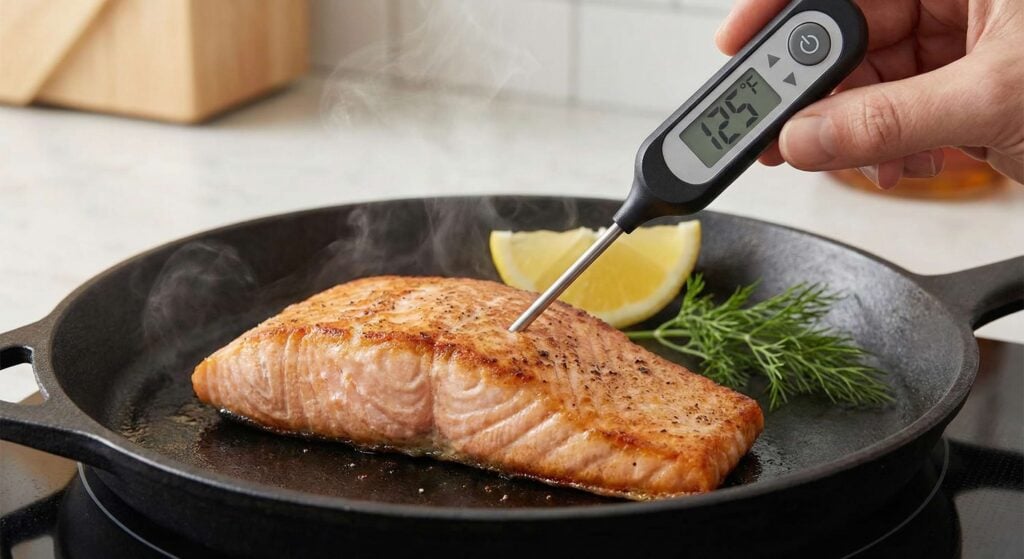
- 125°F – 130°F (52°C – 54°C): The Culinary Sweet Spot.This is where the magic happens. The collagen (connective tissue) dissolves into gelatin, allowing the flakes to separate cleanly. The fish is opaque pink, warm, and incredibly juicy.
- 140°F (60°C): The Actin Danger Zone.Actin is the structural protein that ruins dinner. When salmon hits 140°F, actin denatures and shrinks rapidly. Imagine wringing out a wet towel; the protein lattice tightens and physically squeezes the water out of the cells. The texture becomes fibrous, dry, and chalky.
- 150°F+ (65°C+): Thermal Destruction.The fish has expelled over 50% of its moisture weight. Albumin has curdled on the surface. It is now “cat food.”
1.2 The “White Stuff” (Albumin)
One of the most common questions is: “What is that white stuff oozing out of my salmon?”
- The Science: That is Albumin. It is a liquid sarcoplasmic protein found in raw muscle fibers.
- The Cause: When you cook salmon too fast (high heat) or too long (overcooked), the muscles contract violently. This pressure forces the liquid albumin out to the surface, where it hits the heat and instantly coagulates into a white, curd-like foam.
- The Fix: Albumin is safe to eat, but it indicates the fish is likely overcooked. Cooking “Low and Slow” (e.g., 275°F) prevents this muscle contraction, keeping the albumin inside the meat.
Part 2: The Great Debate – FDA Safety vs. Culinary Quality
This is the most controversial topic in seafood. There is a massive gap between what the government says and what professional chefs do.
2.1 The FDA Guideline: 145°F (63°C)
The USDA and FDA recommend cooking all finfish to an internal temperature of 145°F.
- The Logic: At 145°F, thermal death for bacteria (Salmonella, Listeria) and parasites (Anisakis) is instantaneous. It is a “zero-liability” recommendation.
- The Reality: At 145°F, salmon is well-done. It is safe, but for lean species like Sockeye, it is culinarily ruined.
2.2 The Chef Standard: 120°F – 125°F (49°C – 52°C)
High-end restaurants serve salmon Medium-Rare.
- The Logic: Chefs prioritize texture. They rely on the quality of the supply chain (sourcing) and freezing protocols to mitigate risk.
- The Pasteurization Curve: Bacterial death is a function of Temperature + Time.
- Bacteria die instantly at 145°F.
- Bacteria also die if held at 130°F for ~30 minutes (Sous Vide).
- Parasites: Most commercial salmon (especially “Sushi Grade”) has been flash-frozen to -31°F, which kills parasites before you even buy it.
2.3 Who Should Stick to 145°F?
Do not gamble if you are in a high-risk group. Stick to FDA guidelines or use pasteurized sous-vide methods if you are:
- Pregnant.
- Elderly.
- Immunocompromised.
- Serving young children.
Part 3: The Salmon Doneness Spectrum (Detailed Matrix)
Stop guessing based on time. Use a thermometer and this chart to determine your perfect finish.
Table 1: The Salmon Doneness & Texture Matrix
| Doneness Level | Internal Temp (°F) | Internal Temp (°C) | Visual Appearance | Texture Profile | Best Application |
| Sashimi / Raw | < 110°F | < 43°C | Deep, translucent, shiny. | Soft, slick, slight resistance. | Poke, Sushi, Tartare. |
| Rare | 110°F – 115°F | 43°C – 46°C | Translucent center, opaque edges. | Warm but very soft. Not flaky. | Connoisseurs, King Salmon. |
| Medium-Rare | 115°F – 120°F | 46°C – 49°C | The Culinary Ideal. Opaque edges, translucent pink core. | Buttery, melting, moist. Flakes gently. | Standard for Searing/Grilling. |
| Medium | 125°F – 130°F | 52°C – 54°C | Opaque pink throughout. No translucency. | Firm, distinct flakes, juicy. | Family dinners, Meal prep. |
| Medium-Well | 135°F – 140°F | 57°C – 60°C | Pale pink to white. Albumin visible. | Firm, fibrous, slightly drying. | Salads, Flaking into pasta. |
| Well Done | 145°F + | 63°C + | Dry, chalky, white/grey. | Chewy, crumbly, dry. | FDA Strict Adherence. |
Part 4: Species Matters – Adjusting for Fat Content
Treating a Sockeye fillet like a King Salmon fillet is a rookie mistake. The fat content acts as an insulator and a lubricant.
Table 2: Species-Specific Temperature Strategy
| Species | Fat Content | Characteristics | Thermal Strategy | Ideal Target Temp |
| King (Chinook) | Very High (12%+) | Thick filets, intense marbling. The “Wagyu” of salmon. | Forgiving. High fat renders and bastes the meat. Can be cooked higher to render fat. | 125°F – 130°F |
| Atlantic (Farmed) | High (10-12%) | Large flakes, mild flavor. Consistent fat distribution. | Forgiving. The fat protects the meat from drying out. Good for high heat. | 125°F |
| Coho (Silver) | Medium (6-8%) | Subtle flavor, smaller flakes. | Moderate. Treat gently. Great for poaching. | 120°F – 125°F |
| Sockeye (Red) | Low (Lean) | Deep ruby color, dense muscle, intense flavor. | Unforgiving. Has no fat buffer. Dries out INSTANTLY past 125°F. | 115°F – 120°F |
| Pink / Chum | Very Low | Soft flesh, pale color. | Difficult. Best used for patties, cakes, or canning. | 140°F (Fully Cooked) |
Part 5: Detailed Temperature Guides by Cooking Method
The method you choose dictates how heat enters the fish (Conduction vs. Convection vs. Radiation). This changes your target “Pull Temperature” because of carryover cooking.
5.1 Pan-Searing (High Conduction)
- The Goal: Crispy skin, moist interior.
- The Physics: High direct heat (375°F+) creates a steep temperature gradient.
- The Strategy: Cook 90% of the time on the skin side. The skin acts as a heat shield, protecting the delicate meat while crispening up. Flip only for the last 30-60 seconds to “kiss” the top.
- Pull Temp: Remove at 115°F. The residual heat from the hot skin will carry it to 125°F.
5.2 Slow-Roasting (Low Convection)
- The Goal: Uniform doneness edge-to-edge. No albumin.
- The Physics: Low ambient temp (275°F) gently raises the fish temp without drying the surface.
- The Strategy: Brush with oil. Bake at 275°F for 25-35 minutes.
- Pull Temp: Remove at 123°F. Low heat means very little carryover.
5.3 Grilling (Radiation)
- The Goal: Smoky char.
- The Physics: Intense heat (500°F+).
- The Strategy: Use the “Two-Zone” method. Sear on the hot side for marks, move to the cool side to finish.
- Pull Temp: Remove at 115°F. Carryover on grills is massive.
Table 3: Cooking Method Master Chart
| Cooking Method | Device Temp | Target Finish Temp | Pull Off Heat At… | Carryover Rise |
| Pan Sear | Med-High | 125°F | 115°F | +10°F |
| Fast Roast | 400°F | 125°F | 118°F | +7°F |
| Slow Roast | 275°F | 125°F | 123°F | +2°F |
| Grill | High/Zone | 125°F | 115°F | +10°F |
| Air Fryer | 375°F | 125°F | 118°F | +7°F |
| Poaching | 170°F (Liquid) | 125°F | 125°F | 0°F |
Part 6: Sous Vide – The Ultimate Temperature Hack
If you want perfection with zero margin for error, Sous Vide is the answer. By sealing the salmon in a bag and submerging it in water held at a precise temperature, you eliminate the risk of overcooking.
Table 4: Sous Vide Temperature & Time Guide
| Desired Texture | Water Bath Temp | Time (Standard Fillet) | Result Description |
| Mi-Cuit (Rare) | 104°F (40°C) | 30 – 40 mins | Barely set, incredible mouthfeel. “Warm Sashimi.” |
| Buttery (Med-Rare) | 115°F (46°C) | 30 – 45 mins | Highly Recommended. Soft, moist, luscious. |
| Classic (Medium) | 122°F (50°C) | 30 – 45 mins | Flakes reveal themselves. Traditional restaurant texture. |
| Firm (Well) | 130°F (54°C) | 30 – 45 mins | Firm, pink. Good for flaking into salads. |
| Pasteurized | 130°F (54°C) | 90 – 120 mins | Safe for immunocompromised. Texture will be soft/mushy. |
Warning: Do not cook salmon sous vide for longer than 3 hours. The enzymes will turn the fish into mush.
Part 7: Smoking Salmon (Hot vs. Cold)
Smoking is unique because you are often modifying texture through curing, not just heat.
7.1 Cold Smoking (Lox/Nova Style)
- The Process: Curing in salt/sugar followed by smoking.
- Temp: < 80°F (27°C).
- The Science: You are not cooking the fish. You are flavoring raw, cured fish. If the temp goes above 80°F, the proteins denature, and the texture is ruined.
- Safety: MANDATORY: You must cure the salmon with nitrates (Prague Powder) or heavy salt to prevent Botulism in the smoker.
7.2 Hot Smoking (Kippered Style)
- The Process: Cooking with smoke.
- Temp: Smoker at 225°F.
- Target Internal: 140°F.
- The Science: Unlike a steak, hot-smoked salmon is best cooked slightly “well done.” The goal is a firm, flaky texture that separates easily (like for a bagel spread).
Part 8: Storage, Freezing, and Reheating
Temperature management applies to storage just as much as cooking.
8.1 The Bacterial Danger Zone
Bacteria multiply exponentially between 40°F and 140°F.
- Raw Fish: Store in the coldest part of your fridge (bottom shelf). Ideally, place the wrapped fish on top of a bowl of crushed ice.
- The 2-Hour Rule: Never leave salmon out for more than 2 hours. If it is hot (>90°F), discard after 1 hour.
8.2 Thawing and Freezing
- Thawing: Never thaw on the counter. Thaw in the fridge overnight or in cold water.
- Sushi Grade: To eat raw, salmon must be frozen to -31°F for 15 hours or -4°F for 7 days to kill parasites. Home freezers rarely get this cold.
8.3 Reheating
Microwaves destroy salmon. They boil the internal moisture, exploding the cell walls.
- Best Way: Eat it cold.
- Second Best: Low oven (275°F) with a splash of water, covered in foil, until it reaches 120°F.
Table 5: Storage & Safety Limits
| State of Salmon | Storage Location | Max Temperature | Shelf Life |
| Fresh Raw | Fridge | < 40°F | 1 – 2 Days |
| Cooked | Fridge | < 40°F | 3 – 4 Days |
| Frozen | Freezer | 0°F | 3 – 6 Months |
| Hot Holding | Buffet | > 140°F | 2 Hours Max |
| Thawing | Fridge | 35°F – 38°F | 12 – 24 Hours |
Part 9: Troubleshooting – When Things Go Wrong
- Problem: “White gunk” everywhere.
- Cause: Heat too high or overcooked.
- Fix: Scrape it off. Next time, brine the fish (1 tbsp salt + 1 cup water) for 15 mins before cooking, or cook at a lower temp.
- Problem: Burnt outside, raw inside.
- Cause: Pan too hot or fish too cold.
- Fix: Temper your fish (let it sit out for 20 mins before cooking). If it happens, move the pan to a 350°F oven to finish gently.
- Problem: Skin sticks to the pan.
- Cause: Pan not hot enough (Leidenfrost effect) or skin was wet.
- Fix: Dry skin thoroughly. Heat stainless steel pan until water droplets “dance.” Add oil, then fish. Press down for 10 seconds.
Part 10: Frequently Asked Questions (FAQ)
1. Is it safe to eat salmon pink in the middle?
Answer: Generally, yes. For healthy adults, eating salmon Medium-Rare (120°F) is the culinary standard and is considered low risk if the fish is from a reputable source. However, strict safety guidelines (FDA) recommend 145°F to guarantee sterilization.
2. Why does wild salmon taste drier than farmed salmon?
Answer: Wild salmon (like Sockeye) are athletes; they have lean muscle and low fat. Farmed salmon have high fat content from their diet. Fat lubricates the fibers. You must cook lean wild salmon to a lower temperature (115°F) than fatty farmed salmon (125°F) to perceive the same moistness.
3. Can I cook salmon from frozen?
Answer: Yes, but do not sear it. Roast it. Rinse the ice glaze off, oil it, and bake at 400°F covered with foil for 15 minutes (to steam/thaw), then uncover to finish. It takes about 50% longer than fresh fish.
4. How do I calibrate my thermometer?
Answer: Fill a glass with crushed ice and water. Stir. Insert the probe. It should read 32°F (0°C) exactly. If it reads 36°F, your thermometer is off by 4 degrees; adjust your cooking targets accordingly.
5. What is the “Cake Tester” method?
Answer: If you lack a thermometer, insert a thin metal skewer into the thickest part of the fish for 5 seconds. Touch it to your bottom lip.
- Cold = Raw.
- Warm = Medium-Rare (Perfect).
- Hot = Well-Done.
6. Does lemon juice “cook” salmon?
Answer: Chemically, yes. Acid denatures proteins, turning them opaque and firm (like in Ceviche). However, it does not kill parasites or bacteria. It changes texture, not safety.
7. Why is the tail always overcooked?
Answer: The tail is thin; the loin is thick. Technique: Tuck the thin tail section underneath itself to create a double-thickness layer that matches the loin. This ensures the whole fillet finishes at the same time.
8. How long should I rest the salmon?
Answer: Rest small fillets for 3-5 minutes and large sides for 8-10 minutes. This allows the juices to thicken and redistribute. Cutting instantly causes the juice to run out, drying the fish.
9. Can I re-freeze thawed salmon?
Answer: Safety-wise, yes (if it was thawed in the fridge). Quality-wise, no. Re-freezing creates sharp ice crystals that shred the muscle fibers, turning the texture to mush.
10. What is the best temperature for Air Fryer salmon?
Answer: Air fryers are intense. Set to 375°F. Check a standard fillet at 7 minutes. It cooks faster than a standard oven due to the rapid air circulation.
Conclusion
You now possess the knowledge of a professional chef. You understand that “cooked” is not a destination, but a spectrum. You know that Sockeye needs a gentle hand, while King salmon can take the heat.
Your Checklist for Perfection:
- Buy a Thermometer. It is non-negotiable.
- Know Your Species. Adjust for fat content.
- Respect the Carryover. Pull 5 degrees early.
- Rest Your Fish. Patience yields juice.
Go forth and cook the perfect fillet.
