
Outdoor cooking should feel like a vibe — not a logistics problem. But if you’ve ever tried to balance a hot griddle on a wobbly camping table, hunt for tongs while the onions burn, or carry your whole setup across the patio like you’re moving apartments… you already know the real enemy isn’t heat. It’s workflow.
That’s why the right portable grill carts can be the single biggest upgrade to your cooking life. Not because they’re “nice to have.” Because they solve the three things that ruin outdoor sessions: instability, clutter, and transport pain. When a cart is designed well, the cook becomes calmer. Your tools live where your hands naturally reach. Your propane tank has a safe home. Your paper towels don’t roll into a puddle. And your prep space exists even when the picnic table is 50 feet away (and covered in dust).
This guide is not a shallow “features list.” I’m going to talk like someone who cares about what happens mid-cook: why some carts wobble when you scrape a griddle, how wheel design changes the feel of turning corners with a loaded top, why a “suitcase fold” can be brilliant (or annoying) depending on how the accessories attach, and how to spot the little details — shelf placement, lock geometry, handle leverage, metal thickness, hardware quality — that separate “looks good online” from “feels solid for years.”
Below are 15 standout carts and stands that cover the full spectrum: heavy-duty prep stations, fast-fold travel rigs, compact balcony-friendly frames, pizza-oven-ready rolling tables, and a few budget picks that surprise you (with some honest caveats).
How to Choose the Right Portable Grill Carts
Most people shop for a cart the wrong way. They look at the photo, count the shelves, and assume “more stuff = better.” But the best cart isn’t the one with the most attachments — it’s the one that stays stable when you cook, moves smoothly when you roll, and makes your tools feel like they’re exactly where they should be.
Here’s the decision framework I use when I’m trying to pick a cart that will still feel awesome after the “new gear honeymoon” ends.
1. Start with your cooking reality: stationary, semi-mobile, or travel?
Every cart design is a compromise between stability, storage, and portability. So identify your main use case first:
- Stationary backyard station: You’ll leave it outside (probably with a cover), roll it occasionally, and want maximum workspace + storage.
- Semi-mobile patio life: You’ll move it from garage to patio, or shade to sun, and you need easy rolling and lockable wheels.
- Travel / camping / tailgating: You want a cart that folds flat quickly and survives being loaded and unloaded repeatedly.
- Balcony / small deck: You need compact footprint, easy turning radius, and a cart that doesn’t feel top-heavy.
- Indoor-to-outdoor pizza oven: You need smooth casters, confident locking, and a top that doesn’t flex under a heavy oven.
2. The “wobble” problem: why some carts feel shaky even when they’re rated for huge weight
Here’s a secret: weight capacity numbers don’t tell you how a cart will feel while cooking. A cart can technically “hold” a heavy griddle and still feel annoying when you scrape, press, or chop. Wobble almost always comes from one of these:
- Leg geometry: Narrow stance + tall height = more leverage working against you.
- Weak cross-bracing: If the bottom shelf is the only brace, the cart may feel flimsy until it’s installed — and still flex under lateral force.
- Loose hardware paths: Thin bolt holes or soft metal can allow micro-movement that grows over time.
- Wheel placement: Wheels too close together (or without real brakes) can make the whole cart “dance.”
- Top flex: If the tabletop is thin sheet metal without reinforcement, it can oil-can (that subtle “boing” flex) under load.
You’re not just buying a table. You’re buying a platform under force. Griddle cooking especially is aggressive: scraping, smashing, pressing, and sliding tools across a hot surface. A good cart absorbs that force without translating it into movement.
3. Wheel science: two wheels vs four casters (and why “lockable” isn’t enough)
There are two main wheel philosophies:
- Two large wheels (hand-truck style): Great for rolling across grass and uneven ground because the wheel diameter does more work. These often feel stable while cooking because two legs are planted. But turning in tight spaces can be harder, and they’re usually best for “move it out, cook, move it back.”
- Four casters (shopping-cart style): Amazing for small patios, indoor floors, and precise positioning. But casters need real brakes. A weak brake locks the wheel but not the swivel — so the cart still shifts sideways. The best designs lock both rolling and swiveling.
Also: handle leverage matters. A comfortable handle lets you guide a loaded cart with control. A thin, sharp-edged handle feels fine in photos and miserable in real life. If you see reviews mentioning “carry handle could use padding,” that’s not nitpicking — it’s your wrist talking.
4. Height is the silent dealbreaker (and it’s personal)
A cart can be beautifully built and still wrong if the height doesn’t match your body. Too low and you’ll feel it in your back after 10 minutes. Too high and you’ll lose leverage when scraping and flipping.
- Shorter cooks often love lower carts because the griddle feels controllable and close.
- Taller cooks usually want taller height or adjustable settings so they’re not bending over.
- Mixed households (or families who host) get the most value from adjustable-height carts.
In this guide, I call out carts that owners specifically mention as “perfect height” — and the ones that shorter users love but taller cooks should measure carefully.
5. Storage that helps vs storage that becomes clutter
Not all storage is equal. The best storage features share one trait: they reduce your steps. The worst ones add tiny chores (remove this before folding, reattach that, where do I store the accessory bag?). Here’s the storage hierarchy that actually matters:
- Bottom shelf (must-have): The best place for a propane tank, pellets, a cooler, or a bin of tools. Bonus points if it stabilizes the frame.
- Tool hooks (useful): Great for tongs, spatula, scraper — but only if they don’t fall out when you roll.
- Magnetic strip (high value for griddle cooking): Keeps metal tools in the “grab zone,” especially when you’re working fast.
- Condiment caddy / basket (situational): Awesome for oil bottles and rubs; annoying if it rusts, rattles, or blocks your movement.
- Paper towel holder (only good when placed well): If it’s too close to heat or too far from your hands, you’ll ignore it.
6. Weather reality: what rust complaints actually mean
If you plan to leave a cart outdoors, you need to think in layers:
- Finish quality: Powder coat done well resists corrosion; thin paint chips and invites rust.
- Accessory exposure: Many carts use removable attachments (seasoning trays, paper towel holders) that rust faster than the main frame. If you live in a rainy area, you’ll either store those accessories or cover the cart well.
- Hardware: Screws and bolts are the weak link — cheap hardware corrodes and makes future adjustments painful.
A cart can be a great buy even if one accessory rusts quickly — as long as the core structure is solid and the fix is simple (remove and store that piece, or replace it). I’ll point out where owners report early rust so you can plan accordingly.
7. “No assembly required” vs “you’ll still be doing something”
Some listings say “no assembly,” but in practice you may still attach wheels, handles, or accessories. That’s not bad — it’s normal. What you want is a cart that doesn’t make you feel like you’re building a bicycle in the driveway.
- Best case: unfold, lock, cook (maybe install wheels once).
- Okay case: 15–30 minutes, clear instructions, everything lines up.
- Annoying case: missing bolts, confusing screw maps, or parts that don’t align without forcing.
8. The “fit” question: grills, griddles, pizza ovens, and that one surprise you didn’t plan for
Most carts here target a common top size around the portable-griddle world (especially the 17–22 inch Blackstone and similar tabletop formats), but “fits” can mean two different things:
- Surface fit: the grill/oven sits fully on the top without overhang.
- Workflow fit: you still have room for plates, a cutting board, oil bottles, and a landing zone for cooked food.
The carts that feel “premium” are the ones that give you workflow space — not just enough metal to set the grill down.
Quick Comparison: 15 Portable Grill Carts Worth Your Money
Use this table to find the cart that matches your cooking style, then jump to the full reviews for the real-life details — like stability under scraping, how annoying (or easy) the folding process is, and which storage features actually get used.
On smaller screens, swipe or scroll sideways to see the full table.
| Model | Cart style | Real-world strength | Best match | Amazon |
|---|---|---|---|---|
| BBQMall Adjustable Height Quick-Fold Cart | Adjustable height | Comfort-first height options + big workspace + fast fold for storage | Most people who want one cart that does everything well | Amazon |
| Raynesys 440lb Folding Grill Cart | Heavy-duty station | Excellent stability + big prep space + propane-tank-friendly storage | Backyard/patio cooks who want a “real workstation” | Amazon |
| LKVHV Suitcase-Fold Grill Stand | Travel fold | Fast folding + smart tool access (mag bar, towel holder) + easy storage | Campers and garage-to-patio movers | Amazon |
| JiRiCHMi 20-Second Setup Folding Cart | No-tools fold | Quick deploy + stable once shelf is in + excellent grab-and-go vibe | Travel cooks who want speed and simplicity | Amazon |
| EUTRKei “Built for the Pro” Griddle Cart | Pro tool hub | Safety locks + magnetic holder + caddy system for organized cooking | Tool-heavy griddle cooks who love everything in reach | Amazon |
| Leteuke Grill Cart with Seasoning Tray | Storage-heavy | Big storage ecosystem (hooks, knife slot, tank spot) + sturdy frame | Deck cooks who want “everything has a place” | Amazon |
| DeintYei Fold-Flat Blackstone Table | Fold-flat | Compact storage + generous top space + practical extras | RV/camping cooks who want a “packs like a suitcase” table | Amazon |
| GVGBUK Heavy-Duty Prep Table (Wheels) | Wide top | Big work surface + strong steel feel + folds for transport | Hosts who want more prep space than “grill-only” carts | Amazon |
| Arribueno 500lb Foldable Grill Cart | High capacity | Strong rating on paper + useful tool organization + tank mount | Buyers who want max-rated capacity with a travel fold style | Amazon |
| QuliMetal Weber Q + Blackstone Cart | Weber Q fit | Stable “X-frame” feel + side shelf + practical hooks | Weber Q owners who want a purpose-fit cart | Amazon |
| Broil-X Folding Cart for Weber Q Series | Compact frame | Lightweight, stable enough for small spaces, easy to roll and store | Balcony/deck cooks who want compact convenience | Amazon |
| Cuisinart Take Along Grill Stand | Ultra portable | Lightweight, fast setup, side tables with cup holders | Small portable grills & “simple table” campers | Amazon |
| KHAMAL Foldable Two-Tier Cart | Fast deploy | Quick open/close + solid lock system + compact storage profile | Pizza oven users and quick weekend cookouts | Amazon |
| GVGBUK 4-Caster Pizza Oven/Grill Cart | Indoor/outdoor | True casters + lockable wheels + multi-shelf storage | Rolling a heavy oven from inside to outside | Amazon |
| Yozoia 32×20 Double-Shelf Grill Table | Budget cart | Surprisingly useful prep space + easy rolling + simple storage | Budget shoppers who want a basic, practical station | Amazon |
In‑Depth Reviews: 15 Carts That Make Outdoor Cooking Easier (Not Harder)
Now we go model by model. I’m going to focus on the stuff that changes your day: stability under scraping, how the cart rolls when loaded, whether the storage is genuinely useful, and what owners tend to praise (or complain about) after real use.
1. BBQMall Adjustable Height Quick‑Fold Cart – The “One Cart” Solution That Feels Thoughtfully Designed
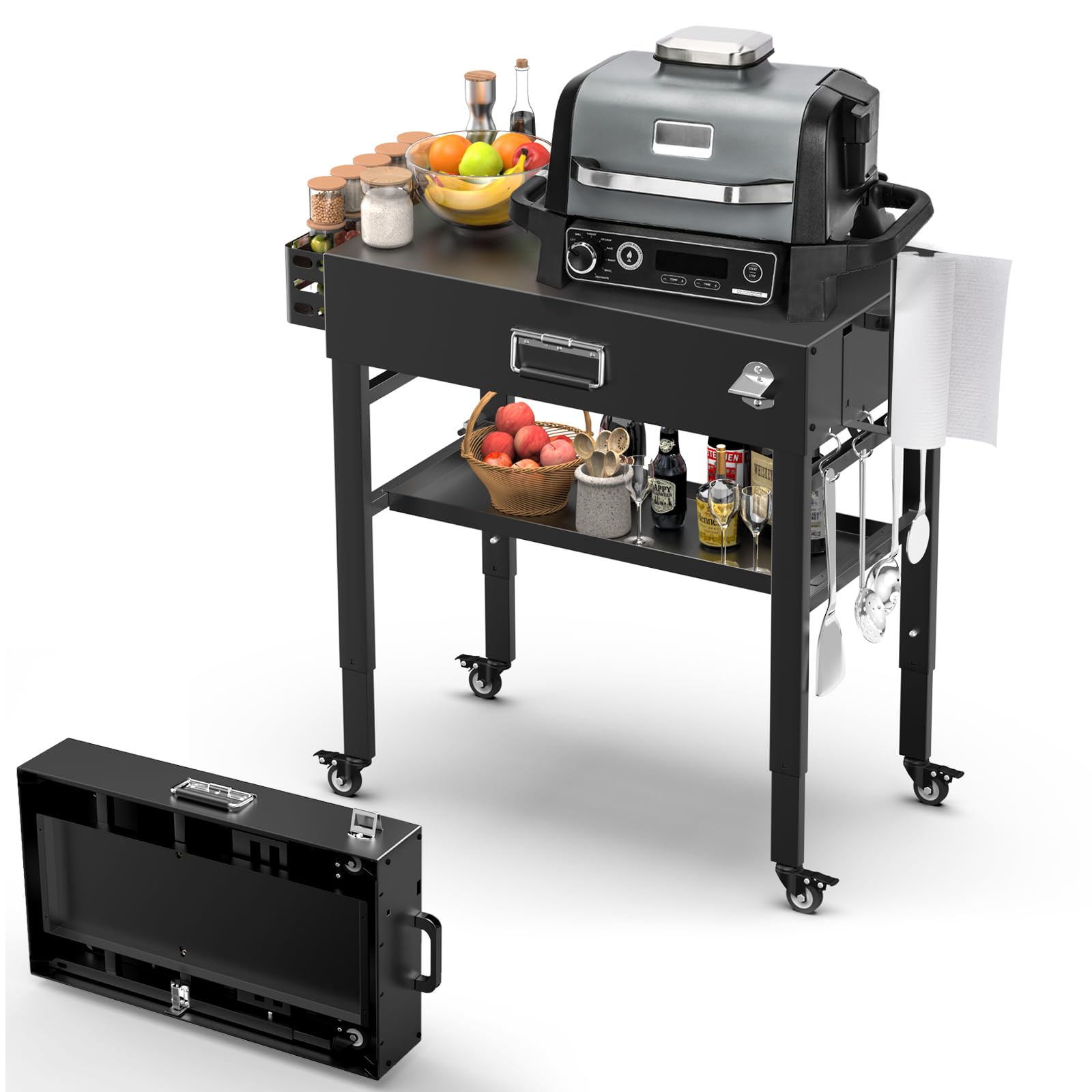
If you want one cart that can handle the real world — backyard sessions, camping trips, a pizza oven weekend, and the occasional “let’s move it into the shade” shuffle — this is the strongest all-around match in the lineup. The reason is simple: it focuses on the two things most carts ignore: human comfort (height) and real portability (fast fold without drama).
Height sounds boring until you’ve cooked on a too-low cart and felt your lower back complain halfway through smash burgers. This cart gives you height options so you can dial in your stance instead of adapting your body to the table. That single detail makes it feel like a cart you can keep for years, even as your setup changes.
The second win is “folding that doesn’t punish you.” A lot of foldable carts look portable on paper but require a mini routine: remove a shelf, detach accessories, find a place to stash the hooks, then fold. Here, the folding concept is designed to be fast — which matters because the carts you love are the ones you’ll actually store properly, not the ones you leave outside because folding is annoying.
Where it shines most is overall cooking flow. With a big top and side space, you can create a true “cook line”: raw zone, hot zone, finished zone, tools zone. That’s how restaurant-style outdoor cooking feels calm — everything has a place, and you stop wandering.
Why it earns “best overall”
- Comfort-first height options – You can match the cart to your body, not the other way around.
- Fast fold that encourages good habits – Easier storage means less weather damage and more long-term satisfaction.
- Big workflow space – Enough surface area to cook, prep, and stage food without juggling.
- Rolling control – Four wheels can be a blessing when the locks are solid and the frame stays planted.
Good to know
- Like many large carts, it’s best when you treat it like a “mobile station,” not something you lift frequently.
- If your accessories are mounted near heat, be mindful of placement (paper towels and heat don’t mix).
- Practice the fold/unfold once so you understand the lock points before you load it with a heavy appliance.
Ideal for: anyone who wants one cart that feels comfortable, stable, and genuinely easy to store — the closest thing to a “buy once” outdoor workstation.
2. Raynesys 440lb Folding Grill Cart – The “Real Prep Station” for Serious Backyard Cooks

This is the cart for people who don’t want a “stand.” They want a station. The kind of station where you can keep tools, seasonings, oil bottles, trays, and a propane tank all in one place, and the whole thing still feels planted when you scrape or press.
The most underrated part of this cart is how it supports a real cooking rhythm. A good prep extension doesn’t just add inches — it adds order. You can keep raw items separate from cooked items. You can stage buns without stacking them on a cooler lid. You can put a cutting board down and actually chop without the cart vibrating. That’s the difference between “I’m cooking outside” and “I’m running an outdoor kitchen.”
Owners tend to mention two patterns with carts like this: (1) the storage capacity makes everything feel easier, and (2) once assembled, it feels stable enough to treat like a permanent setup. That stability often comes from geometry: the triangular support approach and the way the bottom shelf ties the legs together. When that shelf is installed snugly, the cart stops behaving like four legs and starts behaving like one rigid frame.
The honest caveat is that “more station” usually means “more parts.” If you want instant fold-and-go every weekend, a lighter suitcase-style cart may feel simpler. But if your goal is to make your patio cooking feel clean, organized, and efficient, this is a strong upgrade.
Why it’s a powerhouse
- Workstation-level storage – Two-tier space + side storage makes outdoor cooking feel organized.
- Stable under force – Better for aggressive griddle scraping and pressing than “light frame” carts.
- Better safety flow – A tank-friendly shelf design keeps fuel management less awkward.
- Foldability for seasonal storage – Great if you store it in the garage during winter.
Good to know
- Some accessory placements may not fit everyone’s grill layout; you may adjust where you mount towel holders.
- If you plan to travel constantly, pick a more minimal cart for fewer pieces to manage.
- As with all carts, a good cover and dry storage will extend the finish dramatically.
Ideal for: backyard cooks who want a “real station” that keeps everything within reach and feels stable during heavy-duty griddle work.
3. LKVHV Suitcase‑Fold Grill Table – Fast to Store, Easy to Roll, Built for Practical Camping Life
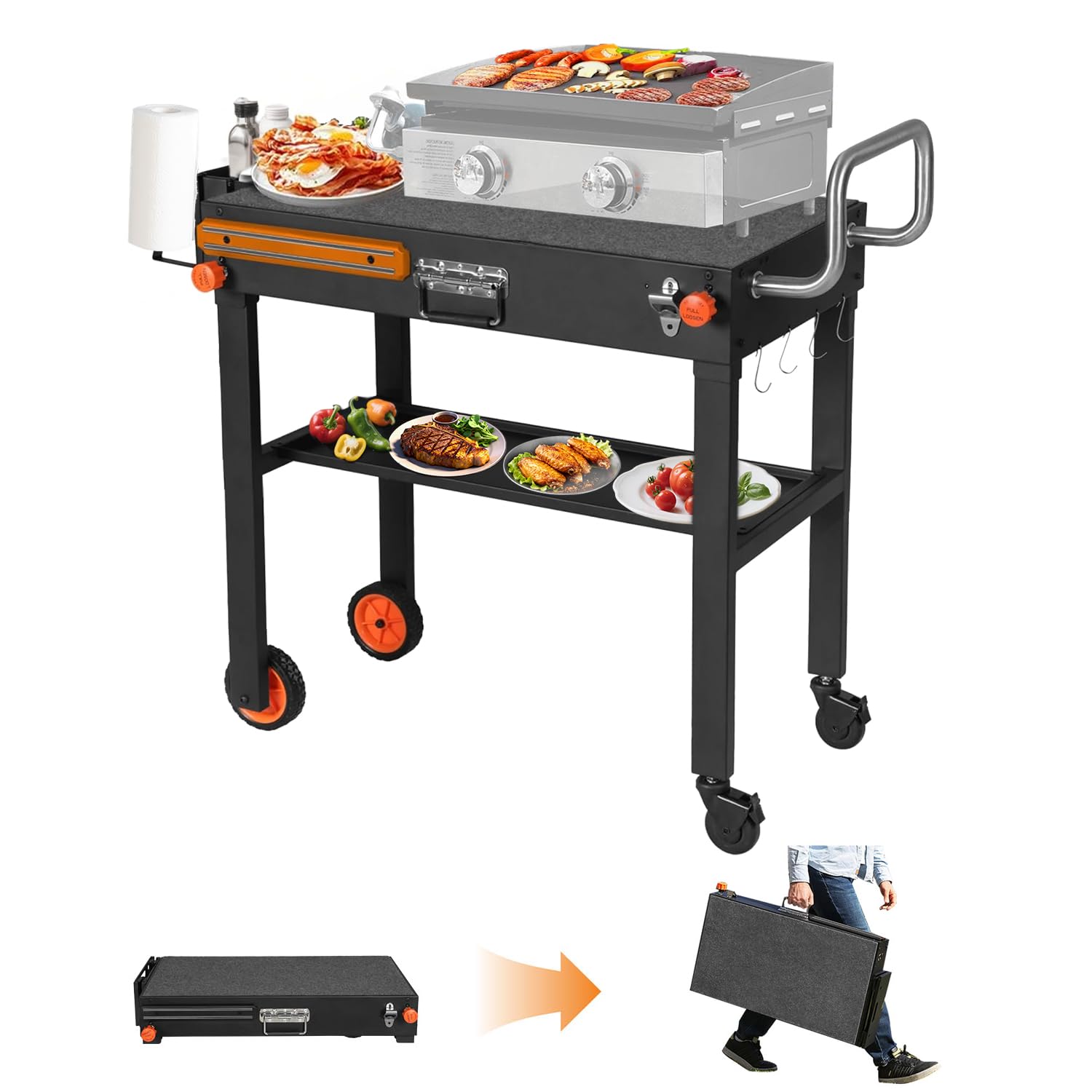
This cart hits a sweet spot: it feels “serious enough” to cook on confidently, but it also respects that your life includes storage. If you’re the kind of person who hates bulky gear, the suitcase-fold concept here is the kind of feature you’ll use constantly. It’s the difference between “we’ll leave it out for now” and “we’ll store it properly every time.”
The real value is not just folding — it’s the whole “grab zone” design. A magnetic tool bar changes the way you cook on a griddle: you can set a metal spatula down instantly without hunting for a hook. A paper towel holder placed well makes cleanup feel effortless, and cleanup is what determines whether you cook outside again next weekend. This cart is built around those little wins.
Many owners mention an important dynamic: it feels more stable once the bottom tray is attached. That’s a sign that the shelf isn’t just storage — it’s a structural brace. So if you buy a cart like this, don’t treat the shelf as optional. Treat it like part of the frame. Once you tighten everything down, the cart “locks in” and stops feeling like it wants to twist.
This is also one of the better picks for seasonal storage. If you store your griddle indoors in winter, a cart that folds cleanly is a real quality-of-life upgrade. You’re not wrestling a full-size station through a doorway; you’re storing a flat rectangle.
Why it’s a travel favorite
- Suitcase fold convenience – Easy to store without feeling like you’re dismantling a machine.
- Tool access design – Magnetic strip and hooks keep the work zone clean and fast.
- Stable once assembled – Bottom shelf adds structural rigidity, not just storage.
- Great for campers – Compact storage footprint is a win for RV and garage organization.
Good to know
- Folding styles vary: make sure you understand what accessories need removal before folding.
- If you want “zero assembly,” choose a cart that arrives almost fully built.
- Like most portable carts, it’s happiest on reasonably flat ground for maximum stability.
Ideal for: people who want a practical, easy-to-store cart that still feels stable and organized during real cooking sessions.
4. JiRiCHMi 20‑Second Folding Cart – The Quick‑Deploy Choice for Trips and Weekends

This is the cart you buy when you care about one thing: speed. Not “speed on the listing.” Speed in the parking lot, at the campsite, and at the tailgate, when you want to start cooking instead of starting a build project.
The design idea is simple: a collapsible frame that doesn’t require a tool routine. Owners often describe the same arc: it feels a little less stable before the lower shelf goes on, then the shelf tightens everything up and the cart becomes confident. That’s exactly what good cross-bracing does — it turns a foldable frame into a rigid platform.
The best detail here is how it supports “grab-and-go cooking.” A built-in handle, wheels that move without drama, and a structure that collapses into a compact shape makes it feel like part of your travel kit, not a separate bulky station. And the included “small extras” — things like a top mat, a condiment bin, or a magnetic strip — can be the difference between “tools everywhere” and “tools in one predictable zone.”
I also like this style of cart for people who cook in multiple locations around the house. If you have a small backyard and you move your setup to avoid smoke drifting into the house, quick fold and easy rolling becomes a weekly luxury.
Why it’s a smart pick
- Fast setup mindset – Designed to deploy quickly, especially helpful for camping and tailgating.
- Stability improves with shelf installed – A good sign: the cart gets rigid when assembled correctly.
- Easy to move – Wheels and handle make short-distance moves painless.
- Compact storage profile – Good for garages, sheds, and RV storage.
Good to know
- If you cook aggressively (heavy scraping), you’ll want to ensure every fastener is snug for max rigidity.
- As with many portable carts, accessory placement may be “close enough” rather than perfect for every grill shape.
- For huge, heavy appliances, a workstation-style cart may feel more planted.
Ideal for: people who want quick setup and easy storage, and prefer a cart that feels like it belongs in a travel kit.
5. EUTRKei Pro Griddle Cart – The “Everything Has a Home” Setup for Fast, Messy Cooks

If your cooking style is “high tempo” — smash burgers, stir-fry, breakfast griddle runs, lots of flipping and scraping — this cart feels like it was built for you. The standout is not the surface area. It’s the organization system. Because when you cook fast, the only thing that slows you down is tools that don’t have a place to land.
The magnetic strip is a small feature that becomes addictive. You stop placing tools down on the surface, stop hunting for tongs, and stop knocking things over. The foldable condiment caddy also acts like a mini mise-en-place station: oils and seasonings live in one predictable zone, so you don’t keep reaching across hot surfaces.
This cart also includes safety-lock thinking that’s easy to overlook but meaningful. Folding carts are great — until a leg shifts while you’re handling the frame. A multi-lock approach reduces the “accidental collapse” fear and makes the cart feel more confident during transport. That’s especially useful if you cook in different places and fold it often.
The one thing to pay attention to is height. Some owners love it because it feels comfortable and controllable; others (especially tall cooks) may want to double-check the measurements so they’re not bending over. Height isn’t a universal positive — it’s a personal fit factor.
Why it’s a standout
- Tool flow is excellent – Magnetic strip + hooks + caddy = faster cooking and less clutter.
- Designed for real griddle behavior – Holds up to scraping and fast movement when assembled tightly.
- Safety lock approach – Helps folding/unfolding feel controlled and secure.
- Compact transport concept – Folds down for truck/RV use without needing a full station.
Good to know
- If you fold it, remove loose hooks so they don’t drop or rattle in transit.
- Taller cooks should confirm height is comfortable for long sessions.
- As with most carts, the best stability comes after a careful “first assembly” tightening pass.
Ideal for: griddle lovers who want tools and seasonings in reach, minimal clutter, and a cart that’s designed for real cooking rhythm.
6. Leteuke Grill Cart – The Organized Deck Setup (With a Smart Rust Strategy)

This cart is built around one promise: make outdoor cooking feel like a real kitchen station. That’s why it includes a bottom shelf sized for a propane tank, multiple hooks, a knife holder, a tissue box holder, and a seasoning tray. If you’re the kind of cook who brings sauces, oils, rubs, and tools outside every time, this kind of ecosystem saves you trips — and trips are what break momentum.
The frame design is sturdy enough that owners often describe it as stable under real load, even with heavier tabletop smokers or big electric grills. Assembly is generally described as quick (around the “15-minute with two people” range), and the wheels get praise for smooth rolling and lockability on decks. That lock feature matters: deck boards aren’t always perfectly flat, and a cart that creeps while you scrape is instantly annoying.
Now the important honesty: several owners mention early rust on the condiment/seasoning holder after rain. That doesn’t automatically mean “bad cart.” It means you need a simple strategy: treat removable accessories like indoor items — store them in the included bag when not in use, or keep the cart covered. The core frame often holds up better than the smaller add-ons.
Once you use a cart like this for a week, you’ll notice the difference between “storage” and “workflow storage.” A knife slot and hook system keeps your tools from lying flat on the top (where they get greasy), and the seasoning tray keeps bottles from tipping. Those are the little things that make your setup feel grown-up and intentional.
Why people love it
- Big storage capacity – Tank spot + tools + seasonings all in one mobile station.
- Stable working height – Feels like a real prep table, not a temporary stand.
- Wheels + locks – Easier deck positioning and less creeping while cooking.
- Good surface area – Room for plates and staging food next to the grill.
Good to know
- Plan to protect or store small accessories if you leave the cart outdoors (especially after rain).
- Knife holders and hooks are only useful if you actually use them — keep your “grab zone” intentional, not cluttered.
- If you never use propane, the tank cutout may be unused space (still useful for a storage bag or bin).
Ideal for: cooks who want a deck-ready, organized station with lots of storage — and who don’t mind storing small accessories to keep them clean and rust-free.
7. DeintYei Fold‑Flat Blackstone Table – Compact Storage, Big Utility, Great for Camp Life

This is one of the most “camp-life practical” carts on the list. The fold-flat concept is genuinely useful when you live out of a camper, pack gear in a truck bed, or simply hate bulky patio furniture. But what makes it more than a folding table is the thoughtful “griddle cook” features: a condiment bin, hooks, magnetic tool holder, a table mat, and locks that help transport feel controlled.
In real feedback, you’ll see a few consistent wins: people love that it folds flat, they love that it’s light enough to move around a campsite, and they love that it’s large enough for the common 22″ tabletop griddle footprint with some wiggle room. That wiggle room matters because you need a safe “landing zone” for utensils, oil bottles, and finished food. A cart that only fits the grill and nothing else forces you back into chaos.
This cart also demonstrates a key truth: “sturdy enough” is about the right use case. If you’re trying to sit on it or abuse it like scaffolding, you’ll be disappointed. If you’re using it as a griddle platform and prep zone, owners generally describe it as stable and dependable.
The small annoyances are the kind you can live with if you value portability: a carry handle that could be more comfortable, and accessory storage when folded. That’s the trade. The value is that you can store it cleanly and keep your outdoor setup from becoming permanent clutter.
Why campers love it
- Folds flat – Perfect for RVs, garages, and truck-bed travel setups.
- Thoughtful extras – Magnetic strip, hooks, bin, and mat help keep cooking organized.
- Good top size – Room for the grill plus the workflow items that matter.
- Easy to move – Wheels make it campsite-friendly once loaded.
Good to know
- Accessory storage while folded can take a minute to figure out; set up a “fold routine” once and it’s easy.
- The non-slip mat can attract debris outdoors; many people store it and use it only while cooking.
- If you want maximum rigidity for aggressive scraping, a heavier workstation cart may feel more planted.
Ideal for: RV and camping cooks who want a fold-flat station that still feels like a real cooking setup, not a temporary table.
8. GVGBUK Heavy‑Duty Prep Table – The “Hosting Cart” With Big Workspace Energy
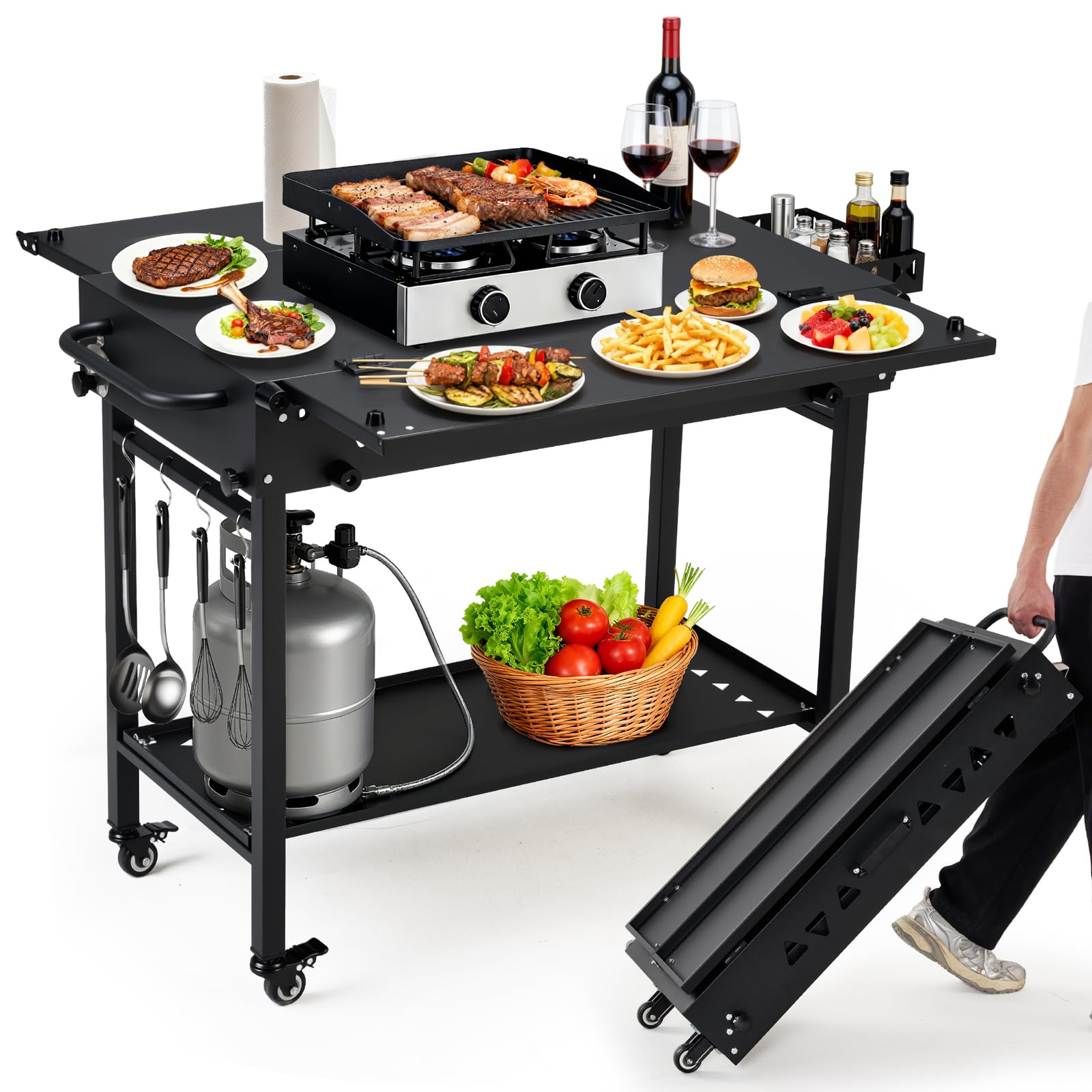
Most grill carts are built around one appliance. This one feels built around an event. The wide top and “prep table” personality makes it a strong pick for people who host — because when you host, your biggest need isn’t just holding the grill. It’s having space for plates, buns, seasonings, foil trays, and the inevitable pile of tools.
Owners frequently mention that the table feels solid once assembled, rolls smoothly (even on imperfect surfaces), and folds down in a way that makes storage and transport realistic. One of the most interesting themes is how people use it beyond grilling: workshop table, plant station, party cart. That versatility is a sign that the surface and frame feel trustworthy enough to handle real life.
There are also a couple of honest realities that show up in feedback: (1) some units arrive with cosmetic issues (a bent top or missing bolt), and (2) some people wish the folding design had an “in-between” mode, where the side panels fold down instead of closing over the top. Those aren’t dealbreakers for most, but they’re worth knowing if you want the cart to serve as a compact everyday table.
This is the type of cart I recommend when you want “space first.” If your cooking style is heavy on prep and serving — pizzas, tacos, big family cookouts — a cart with more tabletop changes your whole rhythm. It turns your outdoor area into a real staging area instead of a balancing act.
Why it’s a host’s favorite
- Big prep surface – More room to stage food, tools, and serving trays.
- Rolls well – Easier to move your setup around the patio or yard.
- Foldable storage – Helps keep your outdoor space uncluttered between sessions.
- Multi-purpose value – Useful beyond grilling (workbench, serving cart, garden station).
Good to know
- Occasional reports of missing hardware or minor shipping bends; inspect on arrival so you can address quickly.
- If you want a “compact working mode,” the folding style may feel all-or-nothing.
- Wide carts take up more space — perfect for patios, less perfect for tight balconies.
Ideal for: hosts and backyard cooks who want a big prep-and-serve surface that still rolls and stores cleanly when the party ends.
9. Arribueno 500lb Foldable Cart – A Feature‑Packed Option (Just Know the “Portability Tax”)
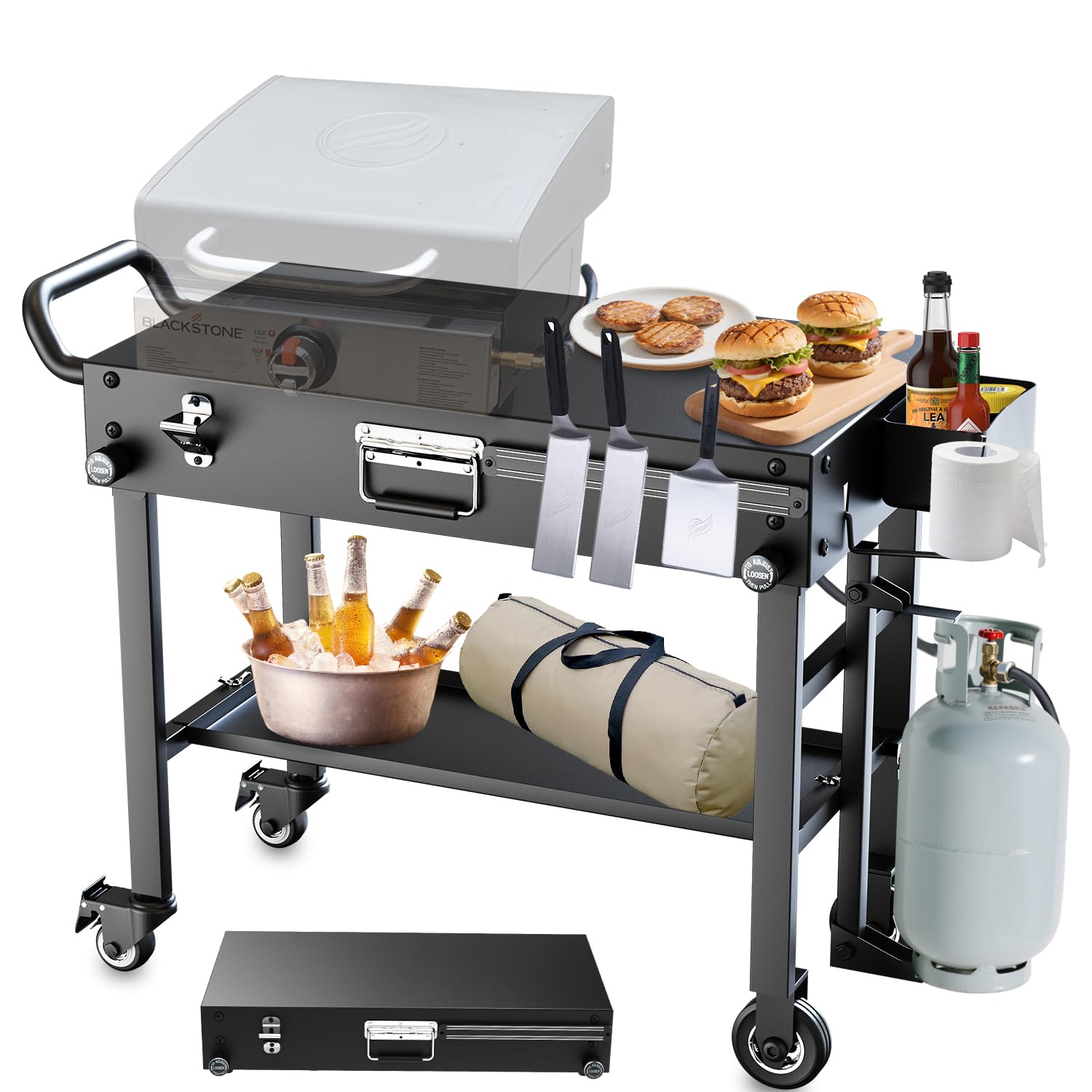
This cart is appealing because it combines two things buyers love: strong capacity claims and a long list of practical features. You’re getting the “organization package” — condiment tray, paper towel holder, magnetic tool strip, bottle opener, storage shelf, and a dedicated place for your fuel. On paper, it’s the kind of cart that says: “Stop juggling. Put everything on me.”
In real use, the experience tends to split into two groups: people who treat it like a home station (garage to patio, occasional moves) and love it, and people who expect “true travel simplicity” and feel the portability isn’t as effortless as the marketing. That’s the portability tax: when a cart has a lot of attachments, folding can require extra steps. If accessories are screwed in, you may not get the clean “one motion suitcase fold” you imagined.
The smartest way to buy this cart is to match it to the right rhythm: if you want a feature-rich cooking hub that stays mostly assembled and gives you a clean workstation, it’s a strong option. If you plan to fold it weekly and pack it into a car with zero fuss, pick a simpler folding design that’s built around fast storage.
Also: do a quick inspection of welds and wheels on arrival. A lot of carts are excellent once assembled but can arrive with one minor issue (a wheel weld, a fastener, a bracket). Catching it early keeps your experience smooth.
Why it’s compelling
- Feature-rich workflow – The tool and condiment organization can make outdoor cooking feel clean and efficient.
- Strong on paper for capacity – Built for heavy appliances and lots of accessories on board.
- Fuel management support – A dedicated tank spot is safer and more convenient than ad-hoc placement.
- Mostly ready out of the box – Great when you want quick setup without deep assembly.
Good to know
- “Portable” may involve more steps if accessories are attached with multiple fasteners.
- Thin sheet metal can dent if treated roughly during frequent loading/unloading; pack thoughtfully.
- Always inspect wheels and weld points early to avoid surprise issues mid-season.
Ideal for: people who want lots of built-in organization and a strong “workstation” feel — and who treat folding as occasional, not constant.
10. QuliMetal Weber Q Cart – The “Purpose-Fit” Stand That Makes Your Q Feel Like a Full Grill
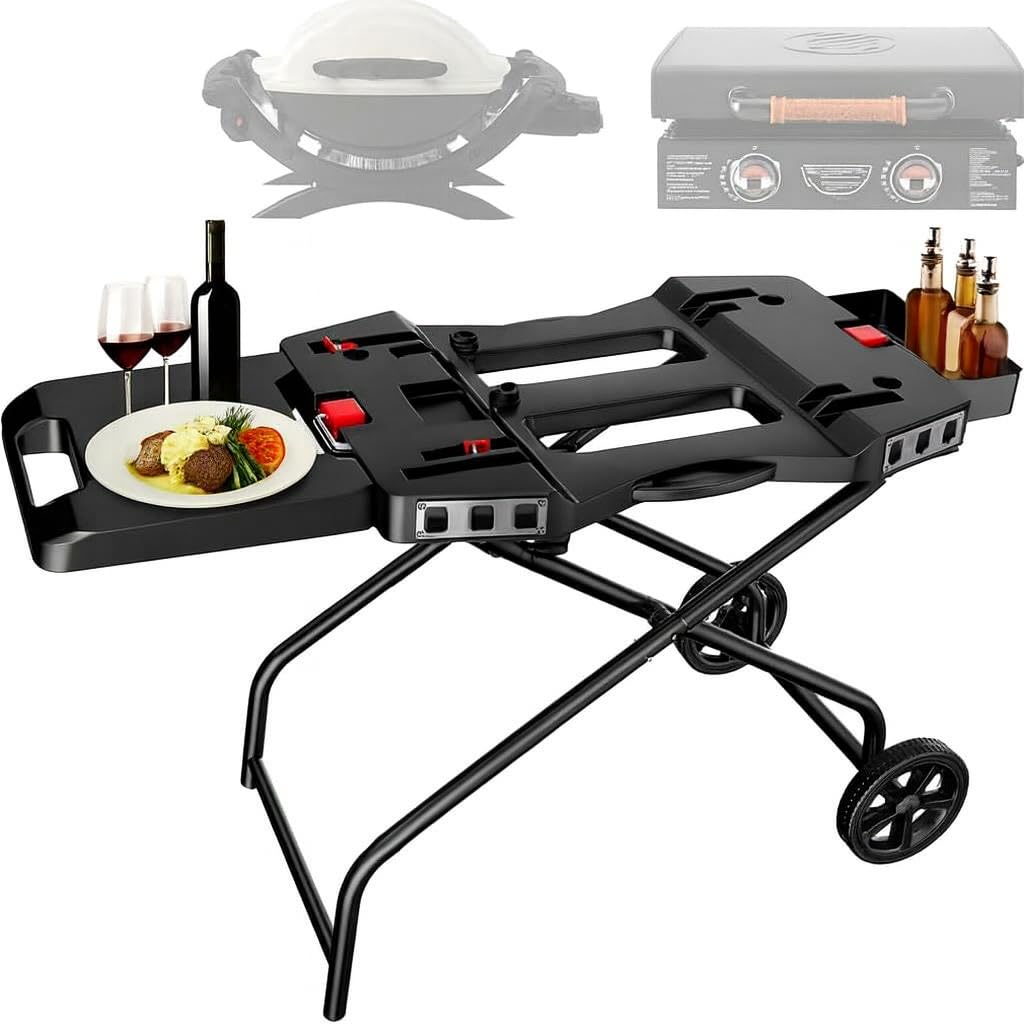
If you own a Weber Q, you already know why carts matter: the Q is an excellent cooker, but it feels much better at a proper height with real prep space. This cart is built around that exact upgrade — turning a small grill into a more complete “cooking station.”
The standout is the stability style. An X-frame design often feels more planted than simple four-leg tables, especially on patios and decks. It also tends to roll well in a “move it out, cook, move it back” rhythm, which matches how most people use the Weber Q: bring it to the cooking spot, lock in, and leave it for the session.
The second value is the “quality of life” space: a side shelf for plates, bowls, sauces, and tools, plus hooks and a paper towel position. This matters because the Weber Q is a smaller footprint grill — your workflow space needs to come from the cart. When the cart gets this right, you stop reaching back to the house for one more item.
Some owners note assembly can be a little annoying (short screws, easier with two hands), and there are occasional manufacturing hiccups with wheel supports. But when it’s assembled correctly, the cart tends to deliver what Weber Q owners want: a sturdier, more usable station that makes cooking feel smoother.
Why it’s great for Q owners
- Purpose-fit vibe – Designed to match the Weber Q footprint and improve daily usability.
- Stable X-frame feel – Helps reduce the “rickety small stand” frustration.
- Useful prep zone – Side shelf and hooks make the Q feel bigger than it is.
- Better cleaning workflow – A stable platform makes scraping and cleaning easier and safer.
Good to know
- Assembly may be easier with two people; take your time to avoid cross-threading or misalignment.
- Wheel components are worth inspecting early (a quick check avoids future annoyance).
- If you want tight indoor rolling, a 4-caster cart may maneuver better than a 2-wheel style.
Ideal for: Weber Q owners who want a stable, practical cart that makes their grill feel like a complete backyard setup.
11. Broil‑X Weber Q Folding Cart – Lightweight Convenience for Small Spaces (With Value Caveats)

This cart is best understood as a “small space helper.” It’s designed around the Weber Q footprint and also claims compatibility with certain Ninja Woodfire models. The main appeal is that it’s lightweight, folds down for storage, and rolls easily — exactly what balcony and small deck cooks need. If your outdoor area is tight, the ability to store the cart without it feeling like a permanent fixture matters.
When owners love it, they love it for the obvious reasons: it fits the grill, it feels stable enough, it’s easy to roll, and it’s compact. The included basket and hooks also add a little “station” functionality without turning the cart into a big workstation. That’s a good thing in small spaces — too much cart becomes clutter.
The caveat is value perception. Some buyers feel carts in this category can be overpriced relative to how sturdy they feel, especially if the metal feels light or the structure is minimal. So here’s the smart move: if you prioritize compact storage and easy rolling, it’s a good match. If you want “workstation rigidity” for aggressive scraping and heavy loading, step up to heavier-duty designs.
Also: some listings mention using elastic straps to secure certain grills. That’s not a dealbreaker, but it does mean you should confirm your exact grill model and decide whether you’re comfortable with that security approach.
Why it works in small spaces
- Compact fold – Easy to store on a balcony or in a small shed.
- Lightweight mobility – Rolls easily for quick repositioning.
- Simple organization – Basket + hooks keep essentials nearby without overbuilding.
- Good for Weber Q footprint – Purpose feel without a massive cart.
Good to know
- Value opinions vary — if you want heavy-duty feel, pick a more rigid station-style cart.
- Always confirm your exact grill model for best fit (especially for Ninja compatibility).
- Minimal carts can feel less stable during heavy scraping; tighten everything well.
Ideal for: balcony and small-deck cooks who want a compact, foldable cart that keeps their grill at a better height without taking over the space.
12. Cuisinart Take Along Grill Stand – The Simple, Lightweight “Just Give Me a Table” Classic

Not everyone needs a full steel workstation. Sometimes you just need a stable, lightweight table that gets your portable grill off the ground and gives you a little prep space. That’s exactly what this Cuisinart stand is for — and it’s why it remains popular with campers and tailgaters who prioritize simplicity.
The side tables are deceptively useful. Cup holders aren’t just for drinks — they’re great for keeping squeeze bottles upright, holding small spice jars, and preventing that “everything slides off the edge” feeling on uneven ground. Tool hooks also matter more than people think: a hook keeps a spatula clean and accessible, instead of lying in grease on the tabletop.
Where this stand wins is ease: it folds fast, it’s light to carry, and it stores without effort. That makes it an excellent choice for smaller portable grills and lighter tabletop cooking appliances. It’s also a good “multi-use” buy — some owners use it as a general folding station when they’re not grilling.
The honest limitation is that this isn’t the cart you choose for a very heavy griddle plus aggressive scraping. It’s a stand. A good stand — but not a tank. If you’re using a heavier appliance, you’ll want a steel cart with a more rigid frame and stronger shelf bracing.
Why it’s still a favorite
- Lightweight and easy – Perfect for people who don’t want heavy gear.
- Fast setup – Great for camping and quick weekend cooking.
- Side tables add function – More staging space than most basic folding tables.
- Tool hooks + cup holders – Small features that improve real cooking flow.
Good to know
- Best with lighter grills; heavy griddles may feel more stable on steel workstation carts.
- Some tops can feel slick — a thin non-slip mat can help if your grill feet slide.
- On uneven surfaces, any lightweight stand benefits from careful placement and level ground.
Ideal for: campers and tailgaters with lighter portable grills who want a simple, lightweight stand that improves height and organization without bulk.
13. KHAMAL Foldable Two‑Tier Cart – “Unfold, Lock, Cook” Simplicity for Pizza Ovens and Griddles
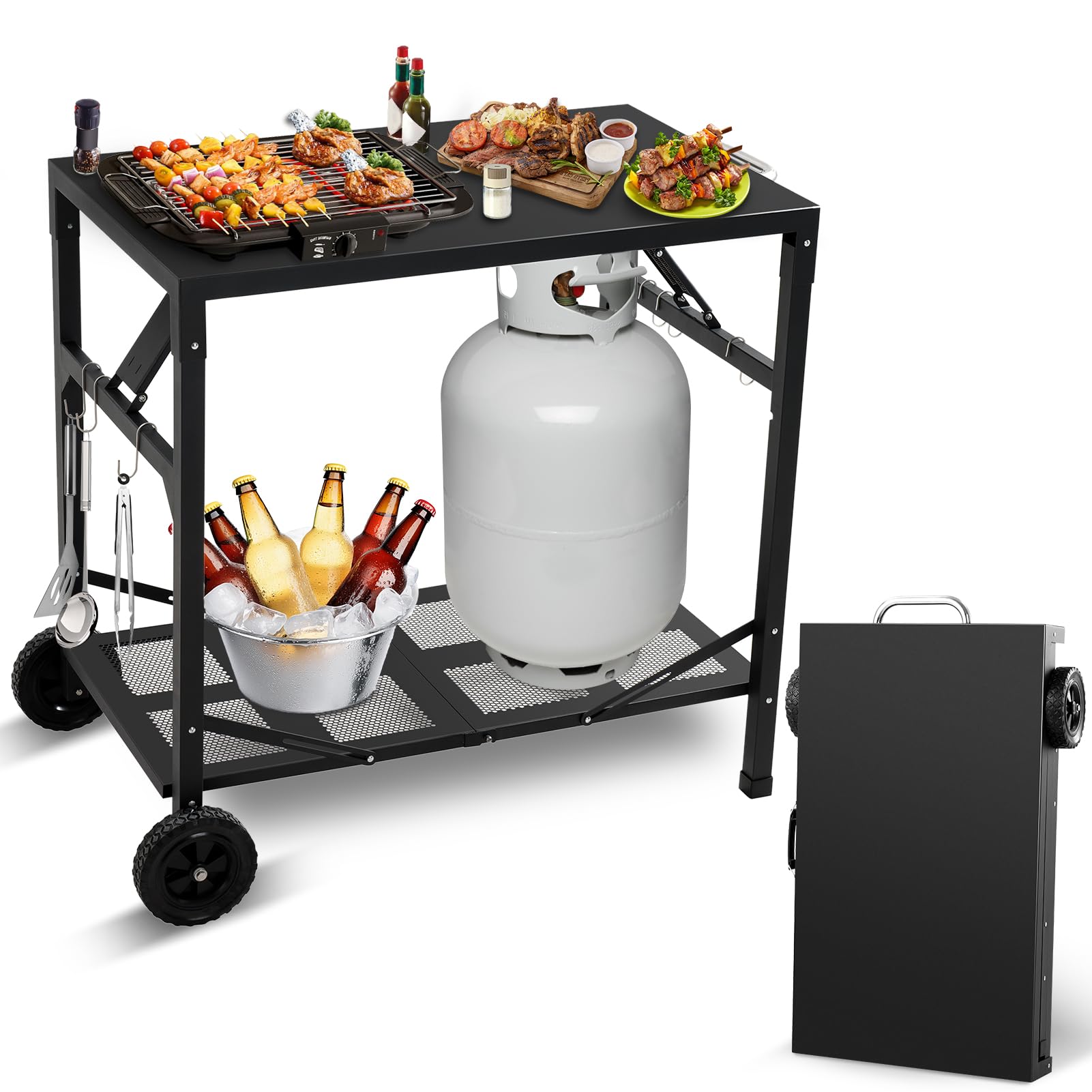
This cart is for people who love the idea of a dedicated outdoor station but don’t want a permanent fixture. It’s designed to open quickly, lock into place, and then fold down into a slim profile when you’re done. That’s perfect for pizza-oven owners who want to bring the oven out for a session, then store everything cleanly.
The key detail is stability through locking. Foldable carts can be annoying when they feel like they’re “almost locked.” This one emphasizes a multi-layer locking approach when unfolded, which is exactly what you want for safety and confidence. When a heavy appliance is on top, psychological stability matters as much as physical stability — you want to feel like the cart is committed to being open.
The two-tier design is also practical: top for the appliance and prep, bottom for fuel, accessories, or a bin. And the included hooks help keep tools off the surface. That sounds simple, but it’s the difference between wiping down one tabletop and wiping down a tabletop plus four greasy tools.
The biggest “real-world” tip with carts like this: decide your storage strategy. If you store it in an RV or tight garage, slim fold is amazing. If you leave it outside, a cover and dry storage for accessories makes the cart last longer and look nicer season after season.
Why it’s a great weekend cart
- Fast open/close – Perfect for quick sessions when you don’t want setup drama.
- Locking stability mindset – Helps the cart feel secure under a heavy oven or griddle.
- Two-tier storage – Keeps fuel and accessories off the ground.
- Compact when folded – Great for storage in tight spaces.
Good to know
- Handle installation can be fiddly on some units; take your time and use a magnetic driver if needed.
- Two-wheel designs roll best on smoother surfaces; for rough terrain, larger wheels help more.
- If you want “workstation prep wing” space, a larger cart may suit you better.
Ideal for: pizza oven owners and weekend grillers who want a quick-open, easy-store cart that feels stable and organized without becoming permanent patio furniture.
14. GVGBUK 4‑Caster Multi‑Shelf Cart – Smooth Rolling for Heavy Ovens (With a “Check for Shake” Reality)

If you keep your pizza oven indoors (or in a protected space) and roll it out when you cook, this cart style is incredibly satisfying. Four casters with locks are the right tool for “inside to outside” movement because they turn tight corners easily and glide over smooth flooring. It makes the whole setup feel intentional: roll, lock, cook, roll back.
What makes this cart useful is the storage structure. Multi-shelf designs let you keep accessories close: peels, gloves, a bin of tools, a tank (depending on your setup), and cleaning supplies. When a cart becomes a “home” for your gear, you stop losing pieces and you stop carrying a dozen separate items to the patio.
The honest part: carts in this category can vary in rigidity depending on assembly and frame thickness. Some users describe them as sturdy and smooth-rolling; others describe a little shakiness. That usually comes down to tightening, floor surface, and how well the casters lock. If you buy a 4-caster cart, give it a proper “first tightening session” and test the locks before you put heat on top.
This cart is also a good example of “accessory placement matters.” Paper towel holders, spice caddies, and hooks are only helpful when they don’t get in the way. Once you set your oven and your working stance, you’ll quickly learn whether the default placement fits your style. The best thing about simpler carts is that you can customize your layout without feeling like you’re disrupting a system.
Why it’s useful
- Great indoor rolling – Casters make moving heavy appliances feel easy and safe.
- Locks add control – A good lock turns “mobile cart” into “stable workstation.”
- Multi-shelf storage – Keeps your oven accessories organized and close.
- Simple structure – Easier to customize than overly complex folding carts.
Good to know
- Some units may feel shakier than expected; proper tightening and lock testing helps a lot.
- If you need outdoor all-terrain rolling, larger wheels often perform better than small casters.
- Paper towel holders can be flimsy on some carts; treat them as a bonus, not the core reason to buy.
Ideal for: pizza-oven and tabletop-grill owners who roll a heavy appliance from indoors to outdoors and want smooth movement plus organized storage.
15. Yozoia 32×20 Double‑Shelf Cart – A Budget-Friendly Prep Platform That “Just Does the Job”

This is the kind of cart a lot of people buy for one clear reason: you want a functional platform without paying for a complex system. And honestly, that’s valid. Not everyone needs a multi-lock folding workstation with a dozen accessories. Sometimes you just want a sturdy, movable table that holds your appliance and gives you a lower shelf for stuff.
Where this cart tends to win is “basic usefulness.” It’s usually described as easy to assemble, the size is practical for common tabletop appliances, and it rolls easily between spots. A 32×20-ish surface gives you enough space to set down plates and tools, which is already a major upgrade from balancing on a tiny side table.
The honest trade is that budget carts can vary in stability feel. Some users love it and say it holds a heavy pizza oven without wavering once assembled. Others describe it as “not as stable as expected” — which often comes from thinner metal, less bracing, or a slightly flexy top. That doesn’t mean it’s unusable. It means you should treat it like a practical table, not a heavy-duty commercial workstation.
Also, accessory quality can be hit-or-miss at this level. Paper towel holders are sometimes flimsy, and hooks may be basic. If the core cart is solid, those are easy upgrades — but don’t buy a budget cart for the accessories. Buy it for the platform.
Why it’s a good budget pick
- Practical size – Enough space for an appliance plus a little staging area.
- Two shelves – Bottom shelf makes outdoor cooking less cluttered.
- Easy to move – Great for patios and poolside cooking.
- Simple and straightforward – No complicated folding systems to learn.
Good to know
- Stability feel can vary; tighten everything well and avoid uneven ground for best results.
- Accessory pieces may be basic; treat them as “nice to have.”
- If you plan to do aggressive griddle scraping, a heavier-duty cart may feel more planted.
Ideal for: budget shoppers who want a basic rolling prep platform that improves height and organization without paying for premium folding systems.
The Mechanics of Great Grill Carts: Stability, Wheels, Heat & “Why This One Feels Better”
Most frustration with carts is mechanical, not emotional. When a cart feels annoying, it’s usually because the design is working against physics: leverage, torsion, wheel drift, and top flex. Once you understand those forces, you can predict which carts will feel good long-term.
How to predict stability (even from photos)
- Look for cross-bracing: A bottom shelf that bolts firmly into the legs often doubles as a brace. If the shelf is “floating” or lightly attached, expect more twist.
- Wider stance = calmer cart: A cart that spreads its legs wider is harder to tip and less likely to wobble under scraping force.
- Triangular support is powerful: Triangles resist racking (side-to-side twist). That’s why some heavy-duty carts feel “planted.”
- Top reinforcement matters: Thick metal or reinforced edges reduce top flex when you press or chop.
- Locks should be obvious: If a cart has multiple lock points, it usually feels more confident during folding/unfolding.
If you want the most predictable “solid” feel, choose designs where owners mention the cart becomes stable once the bottom shelf is installed. That’s a sign the shelf is acting as a structural brace — not just extra storage.
Wheel strategy: making “portable” actually feel portable
- Big wheels for rough terrain: If you roll across grass, gravel, or dirt, big wheels matter more than fancy casters.
- Casters for tight spaces: Four swiveling casters are amazing on decks and indoor floors where turning matters.
- Brakes should lock swivel + roll: A weak brake can stop rolling but still let the wheel swivel — that’s “side drift.”
- Handle leverage is comfort: A good handle reduces wrist strain and helps you steer a loaded cart smoothly.
- Plan your path: The best cart in the world feels annoying if your route includes steps, narrow gates, or deep gravel.
If you roll a heavy appliance often, choose a cart that matches your terrain. No design beats physics: tiny casters hate gravel; small wheels hate deep grass; and all wheels hate steps.
Heat and surfaces: what “heat resistant” really means in daily use
- Radiant heat matters: Even if your grill is insulated, heat radiates downward. A sturdy top and smart spacing reduce long-term wear.
- Keep paper products away from heat paths: Place paper towel holders and napkins on the “cool side” of your cook line.
- Use a mat wisely: Non-slip mats can stabilize appliances, but they also collect debris outdoors. Store them when not cooking.
- Metal tops are forgiving: They handle hot accessories well, and cleanup is easier with a scraper and wipe-down routine.
- Plastic surfaces can work — with the right appliance: For lighter grills, plastic can be fine. For high-heat, heavy setups, steel feels safer.
If you cook with a pizza oven or high-output burner, aim for a cart that feels “built like metal first.” If you cook with a small portable grill, a lighter stand can be perfect.
Three “pro tricks” that make any cart feel better
- Do a second tightening pass: Assemble, then come back after one cook and tighten again. Heat cycles and movement settle hardware.
- Add a bin system: Put oils, rubs, and tools in a small tote on the bottom shelf. It reduces clutter and makes cleanup faster.
- Create zones: Left = raw prep, center = appliance, right = finished food (or flip it). Zoning prevents cross-contamination and mental chaos.
- Lock before you scrape: Always set brakes before scraping aggressively — you’ll feel the difference instantly.
- Protect the finish: A cover and dry storage for removable accessories extends the cart’s “new” look dramatically.
When you eliminate tiny friction points, outdoor cooking becomes easier — and you’ll do it more often.
FAQ: Portable Grill Carts (Answers Without the Confusion)
What’s the biggest mistake people make when buying a grill cart?
How do I know if a cart will wobble with a griddle?
Should I choose two wheels or four casters?
Do I need a propane tank holder?
How do I stop rust on outdoor carts?
What’s the best cart if I cook with a pizza oven?
Final Thoughts: Buy the Cart That Makes You Cook More Often
The best outdoor gear isn’t the flashiest. It’s the gear that makes you think, halfway through cooking, “Wow — this is easier than last time.”
Here’s the simplest way to turn this guide into a confident purchase:
- Want the best all-around cart with comfort and smart design? Start with the BBQMall Adjustable Height Quick‑Fold Cart. It’s a balanced pick that fits most cooking styles without feeling overcomplicated.
- Want a true backyard workstation with lots of prep space? Choose the Raynesys 440lb Folding Grill Cart. It’s a “station,” not just a stand — and it makes outdoor cooking feel organized.
- Want suitcase-style storage for camping, RV, or garage life? The LKVHV Suitcase‑Fold Grill Stand is a strong blend of portability, tool access, and day-to-day usability.
- Want the fastest setup for trips and weekend sessions? Go with the JiRiCHMi 20‑Second Folding Cart. It’s built for speed and quick storage.
- Want the best “tool organization” for griddle cooking? Pick the EUTRKei Pro Griddle Cart for a clean work zone with a magnetic strip and smart caddy flow.
- Own a Weber Q and want a purpose-fit cart? The QuliMetal Weber Q Cart turns your compact grill into a more complete station.
- Just want something lightweight and simple for a small portable grill? The Cuisinart Take Along Grill Stand is a clean, easy upgrade when you don’t need a heavy steel workstation.
The “right” choice is the one that matches how you actually cook: how hard you scrape, how far you roll, how often you store, and how much you hate clutter. Pick the portable grill carts style that fits your reality, and your outdoor setup stops feeling like a puzzle — it starts feeling like a kitchen.
