
A “small meal” doesn’t feel small when you’re hungry, busy, and staring at a sink full of dishes. It’s the after-meeting lunch you forgot to plan, the midnight snack that becomes a full plate, the “I need something warm but I can’t deal with the oven” moment.
If you’re shopping for a personal air fryer, you’re not really buying a gadget. You’re buying relief: fewer pans, less decision fatigue, and a shortcut to food that actually tastes good—crispy on the outside, juicy in the middle, and not weirdly rubbery like microwave leftovers.
But here’s what most buying guides miss: air fryers don’t fail people because of missing features. They fail because of friction. The basket is annoying to clean. The airflow is uneven. The “nonstick” starts to feel delicate. The unit is loud. The basket shape encourages stacking, so fries steam instead of crisp. Or the one feature you wanted—like a viewing window—ends up being pointless because the light is dim and the glass fogs up.
This guide is built around real-life ownership: the foods people actually cook (wings, fries, veggies, salmon, reheated pizza), the parts that collect grime, the smells people notice, the learning curve for raw proteins, and the little design details that quietly make you use the air fryer more often—like a sturdy handle, an easy “shake reminder,” or a glass bowl you can wash like a mixing dish.
Below you’ll find 17 standout models—from true mini units for dorms and offices to premium, restaurant-feel machines that can handle meal prep without bullying your countertop. The goal is simple: by the time you reach the bottom, you’ll know exactly which option fits your kitchen and your eating style.
How to Choose the Right Personal Air Fryer
A great small air fryer isn’t “the one with the most modes.” It’s the one that makes you cook more often because it removes three pain points: time, mess, and guesswork. The decision becomes much easier when you evaluate models the way you’ll actually use them: weeknight snacks, quick proteins, leftovers, and the occasional “let’s cook something real” meal.
1. Start with your most common job: reheat, snack, or real cooking
Most people buy an air fryer for one reason and then keep it for a different reason. Identify your anchor use:
- Reheat-first households: Pizza, fries, wings, roasted veg, burritos, and “make it crisp again” leftovers.
- Snack & convenience cooks: Nuggets, frozen appetizers, fries, potstickers, and quick sides.
- Protein & meal builders: Salmon, chicken thighs, tofu, burgers, steak bites, roasted vegetables.
- Meal prep: Bigger batches, repeatable results, and easy cleanup so you’ll actually do it weekly.
Why this matters: a reheat-first buyer benefits from strong airflow and a basket shape that spreads food out, while a meal-prep buyer needs usable surface area, consistent heating, and a setup that doesn’t feel like a chore.
2. Capacity is less important than “usable crisping area”
This is the part that changes everything: the crispness comes from hot, moving air touching the surface of your food. That means the best small air fryers behave like a wide pan, not a tall cup.
- Square baskets usually win for crisping because they give you more flat space for fries, nuggets, and vegetables.
- Tall, narrow baskets tempt you to stack food—stacking creates steam, and steam kills crunch.
- Glass bowls let you monitor browning without opening the basket, which prevents heat loss (and prevents you from “checking” five times).
3. Choose your “control personality”: dials, buttons, or guided smart cooking
Controls aren’t just aesthetics—they shape how confidently you cook.
- Analog dials are fantastic for simplicity and low mental load. They’re also surprisingly forgiving when you’re just reheating or cooking frozen foods.
- Digital presets are great for consistency and repeatability (especially if more than one person uses the machine).
- Smart/app features can be genuinely useful if you like guided recipes and remote monitoring—but only if you’ll actually use them after week two.
The best control system is the one you’ll use when you’re tired. If you hate menus, don’t buy a menu-heavy unit. If you love repeatable “press one button” results, presets are your friend.
4. Materials: glass vs ceramic vs standard nonstick (and why it changes your routine)
Materials are more than a “safety” conversation—they affect cleaning, durability, and how you treat the fryer day to day.
- Glass bowl models are the easiest to visually manage. You can stop cooking at the exact moment your fries hit golden brown. They also clean like a bowl—no hidden corners. The tradeoff is weight and “drop anxiety.”
- Ceramic-coated baskets can feel smoother and easier to wipe clean than some traditional coatings. They’re often chosen by shoppers trying to avoid certain chemicals. The tradeoff is you still need gentle tools and good habits to keep the surface pristine.
- Standard nonstick baskets are common, often very easy to clean, and usually crisp fast. The tradeoff is long-term care: avoid metal utensils, avoid aggressive scrubbers, and don’t treat it like a cast-iron pan.
5. Power & temperature range: what matters (and what doesn’t)
More wattage doesn’t automatically mean better food—but it often means faster recovery when you open the basket to shake, and stronger crisping at the end of a cook cycle.
- High max temperature is useful for finishing: that “two-minute blast” that makes wings and fries feel fried, not baked.
- Lower temperature modes matter more than you think for fish, delicate reheats, and avoiding dried-out leftovers.
- Fan speed control can improve evenness and texture—especially for vegetables and thicker cuts.
6. The real cleanup test: how many places can grease hide?
Some air fryers are “easy to clean” only if you clean them immediately, every time. Look for:
- Basket surfaces that release food without scraping.
- Simple crisper plates that lift out easily.
- Minimal seams and corners where cooked-on grease can harden.
- Dishwasher-safe parts you’ll actually dishwash (many people still prefer quick hand washing).
7. Windows and lights aren’t gimmicks—if they’re done well
A good viewing window reduces “heat dumping,” which is the number-one reason small air fryers cook unevenly. When you open the basket, temperature drops and the fan has to recover—especially in lower-powered minis. If a window is clear and the light is bright, you’ll check visually instead of physically, and your food cooks more predictably.
8. Don’t ignore the “kitchen geometry” details
Compact doesn’t always mean “fits everywhere.” Pay attention to:
- Height under cabinets: some wide models sit low; some tall models need clearance for ventilation.
- Rear vents: many air fryers need space behind them so heat can escape properly.
- Handle comfort: if it feels flimsy or awkward, you’ll hate shaking fries.
Practical tip: If you use parchment liners, choose perforated liners whenever possible, and never run a liner alone without food weighing it down. Lightweight paper can lift into the heating area in high airflow modes.
Quick Comparison: 17 Personal Air Fryer Picks
Use this table to find the models that match how you cook—then jump to the reviews for the real-life details: how fast they reheat leftovers, how annoying (or painless) cleanup is, and who each one is actually best for.
On smaller screens, swipe or scroll sideways to see the full table.
| Model | Style | Everyday strength | Best match | Amazon |
|---|---|---|---|---|
| Ninja Crispi 4-in-1 Glass Air Fryer System | Glass system | Fast, clean, and surprisingly versatile with stackable storage containers | People who want “crispy + easy cleanup” without a bulky drawer unit | Amazon |
| Cosori Iconic Stainless Steel 6.5 Qt Smart Air Fryer | Premium smart | High-end build + consistent results + guided recipe support for repeatable cooking | Home cooks who want “restaurant-feel” performance and a polished countertop look | Amazon |
| Ninja XL Single Basket Air Fryer 5.5 QT (AF150AMZ) | XL basket | Big-batch crisping with strong power and multi-function modes | Meal-prep and “feed more than one person” kitchens that still want a single basket | Amazon |
| Ninja Air Fryer 4 QT (AF101) | Classic pick | Reliable, repeatable crisping with simple controls and proven daily performance | Most people who want a “works every time” compact drawer-style fryer | Amazon |
| Cosori TurboBlaze 9-in-1 6 Qt | High-temp | Strong airflow control + wide temperature range for crisp finishes and gentle cooking | People who want speed, even results, and a quieter kitchen vibe | Amazon |
| 5 Quart Glass Air Fryer (Uncoated Borosilicate Bowl) | Glass bowl | Visible cooking + uncoated glass feel with easy “wash-like-a-bowl” cleanup | People avoiding coated surfaces who still want family-size capacity | Amazon |
| GreenLife Compact Electric Air Fryer Oven 5.3 QT | Window + ceramic | PFAS-free ceramic drawer + window + presets in a family-friendly size | Buyers who want a windowed, coating-conscious option without going premium | Amazon |
| Instant Pot 4Qt Vortex 6-in-1 Mini Air Fryer | Window mini | ClearCook window + internal light makes timing easier for new users | People who want compact size with visibility and easy, guided-style controls | Amazon |
| AROMA Glass Air Fryer & Countertop Convection Oven 3 Qt | Dial + glass | Watch food crisp in real time with ultra-simple time dial operation | People who want maximum simplicity and don’t need deep temperature control | Amazon |
| bella 4Qt Slim Air Fryer (EverGood Ceramic) | Slim design | Fits-anywhere profile with a rectangular basket that’s great for slices and longer foods | Small kitchens that want a good-looking fryer that stores easily | Amazon |
| COSORI 2.1 QT Mini Air Fryer (Lite) | Mini | Compact footprint + reheat mode + app recipes for small-portion cooking | Singles/couples who want easy leftover crisping in a tiny unit | Amazon |
| Dash Digital Tasti-Crisp 2.6 Qt | Compact digital | Simple, quick, and easy-to-clean with a fun small-space footprint | People who want “press-and-go” snacks and roasted veggies without a large appliance | Amazon |
| CHEFMAN 2 Qt Mini Air Fryer (Grey) | Space-saver | Shake reminder + square basket in a narrow frame | Small counters, simple meals, and people who want reminders to prevent uneven crisping | Amazon |
| CHEFMAN 2 Qt Mini Air Fryer (Black) | Space-saver | Same workflow as the grey model, with a darker finish that hides scuffs and splatter | Small-space buyers who want the same features in a different look | Amazon |
| Elite Gourmet Glass Air Fryer 2.4 Qt (Ceralast rack) | Compact glass | Small-batch cooking with visibility and simple knob controls | 1–2 person kitchens that want glass monitoring without a full-size unit | Amazon |
| COMFEE’ Compact 2.1 Qt Air Fryer | Budget compact | Very small footprint with menus and basic controls that cover daily snacks | Dorms, offices, and “I just need something easy” cooks | Amazon |
| Elite Gourmet EAF-1121X 1.1 Qt Compact Air Fryer | Ultra-mini | True single-serving size with low noise and low-power convenience | Travel/work setups, tiny kitchens, and “just me” cooking | Amazon |
In‑Depth Reviews: 17 Personal Air Fryer Models That Actually Earn Their Space
Now the fun part: real-world reviews. I’m going to talk like someone who actually cooks in a small kitchen—not like a spec sheet. You’ll see what each model does well, where it can annoy you, and which cooking personality it matches best.
1. Ninja Crispi 4‑in‑1 Glass Air Fryer System – The Cleanest “Crisp” Setup for Real Life

Most drawer-style air fryers are built around one idea: “pull the basket, shake the basket, wash the basket.” The Ninja Crispi flips the script. Instead of a deep drawer, you’re cooking in glass containers with a top-mounted “PowerPod.” That sounds like a gimmick until you live with it for a week—then you realize it’s a workflow upgrade.
Here’s why it wins for everyday use: the glass containers behave like real cookware. You can cook, store leftovers, and reheat in the same ecosystem. That means fewer transfers, fewer dishes, and less greasy handling. People who hate cleaning traditional air fryers often love this design because the “mess zone” is basically a bowl and a crisper plate—both of which are straightforward to wash (and dishwasher-safe, too).
Performance-wise, the Crispi is a crisping machine when you treat it like what it is: a high-power top heater with strong airflow. It excels at re-crisping leftovers (pizza, fries, wings, roasted veg) because the elevated plate keeps food out of the rendered fat and moisture. That separation matters. It’s the difference between “crispy again” and “soft, warmed, and slightly sad.”
The learning curve is small, but it exists. This system doesn’t ask you to pick a precise temperature every time; it asks you to pick a mode (Max Crisp vs Air Fry vs Bake vs Recrisp). That’s not a downside—just a different mindset. Once you understand the temperature “personality” of each mode, it becomes fast and intuitive, especially for small meals.
The only reason it’s not perfect for everyone is shape and volume. If you constantly cook tall, bulky items (think huge roasts), you’ll hit physical limits. And if you’re the type who wants absolute temperature control for baking projects, you may prefer a model that lets you set exact degrees.
Why it’s a daily-life winner
- Cleanup feels “normal” – glass bowls and plates clean like standard dishes, not like an appliance with hidden corners.
- Built for leftovers – elevated crisping keeps food from sitting in juices, which is huge for re-crisping.
- Storage-friendly system – the containers nest and the setup stores more neatly than many drawer units.
- Quick meals without oven energy – small container heats fast, so it’s perfect for solo portions and short cook times.
Good to know
- Mode-based cooking means you choose “style” (bake/air fry) more than exact temperatures.
- Very tall foods can be tight in the containers; it shines most for flat-ish foods and smaller proteins.
- As with any high-airflow cooker, lightweight items should be secured so they don’t lift toward the heater.
Ideal for: people who want crispy results with minimal mess, and who love the idea of cooking + storing in the same glass containers.
2. Cosori Iconic Stainless Steel 6.5 Qt Smart Air Fryer – “Restaurant Consistency” at Home
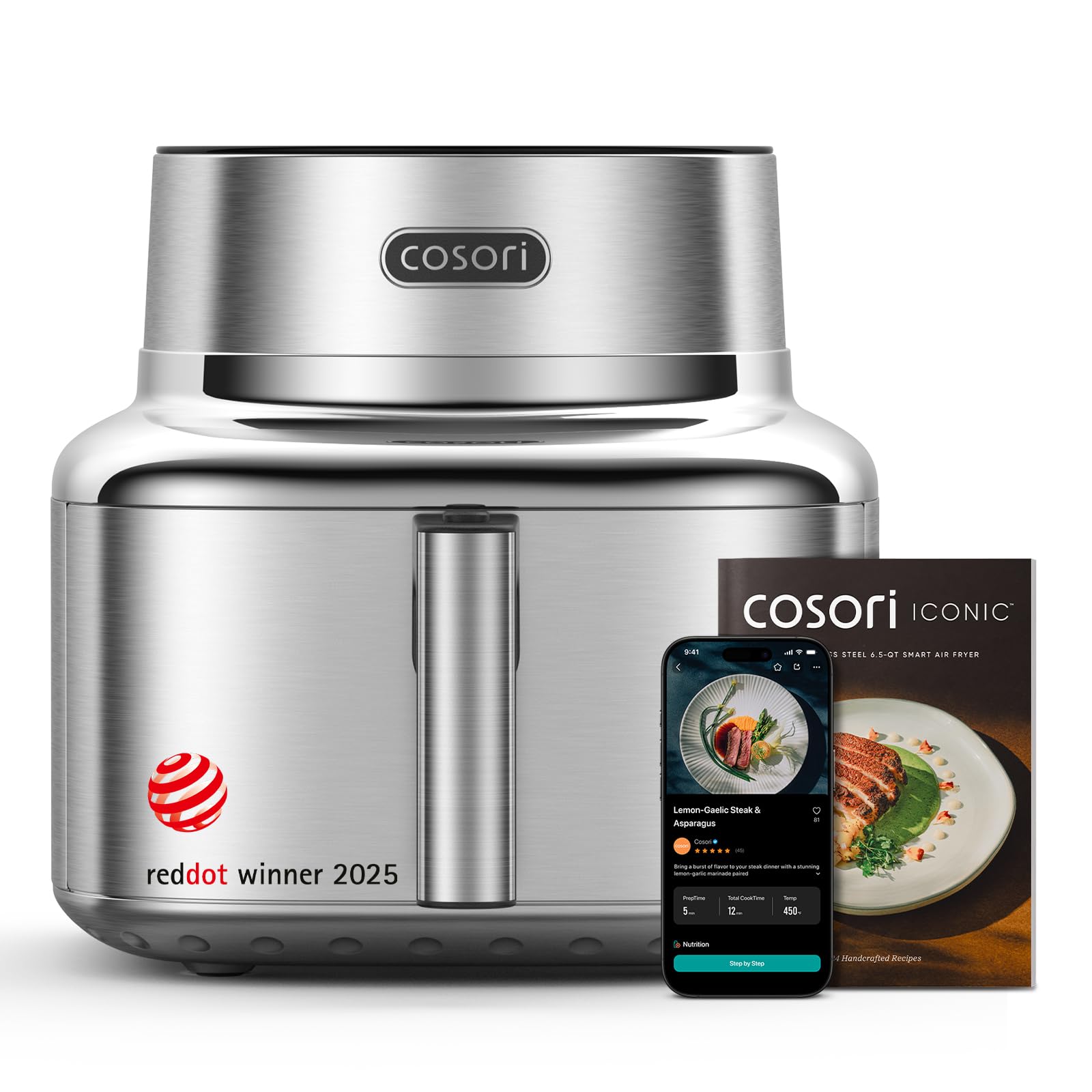
The Cosori Iconic is for the person who doesn’t want an air fryer that feels like a toy. It’s the “I want this to look good on the counter, cook like it means business, and be easy enough that I’ll use it on a random Tuesday” option.
What makes it feel premium isn’t just the stainless exterior—it’s the consistency mindset. The cooking chamber is designed for repeatable results, and the combination of strong airflow with higher-temperature headroom gives you that “finished” texture that cheaper units sometimes miss. This matters most for foods that live in the gray zone between roasted and fried: wings, breaded cutlets, tofu, and anything you want browned without drying out.
The smart side can be genuinely helpful when you treat it as guidance, not a novelty. Guided recipes and app control are best used for two scenarios: (1) you’re learning new air fryer patterns and you want timing confidence, or (2) you do meal prep and want repeatable results while you’re doing other tasks. If you’re the kind of cook who thrives on a consistent routine—same salmon, same potatoes, same batch of veggies—this style of machine quietly improves your week.
The ceramic-coated basket surfaces are chosen for easier release and cleaning, and the high max temperature can be used strategically: cook at a moderate heat to protect moisture, then finish hot for texture. That two-step approach is how you make chicken taste “juicy” and “crispy” at the same time.
One reality check: premium air fryers still need a break-in cycle. Like many appliances with new components, initial smells can happen in early uses. The best habit is simple: run a test cycle, wipe the interior, and then let the machine earn trust through repetition. Once it’s in your routine, this is the kind of fryer that can replace multiple countertop behaviors (toaster oven reheat, pan crisping, and quick roasting).
Why it feels “worth it”
- High-end consistency – strong airflow plus higher-heat finishing helps foods brown evenly without guesswork.
- Countertop presence – looks intentional in a kitchen, not like an appliance you hide when guests come over.
- Smart guidance that can actually help – useful for repeatable routines and learning timing without over-checking.
- Versatile modes – air fry, roast, bake, dry, proof, and reheat cover most daily cooking needs.
Good to know
- It’s larger than mini models; make sure your counter or storage space fits your reality.
- If you hate apps, you can still use it manually—but the “smart” value is part of the package.
- Like many new appliances, an initial test run is a smart move before your first meal.
Ideal for: home cooks who want premium build quality, repeatable results, and a fryer that can handle both quick snacks and real cooking.
3. Ninja XL Single Basket 5.5 QT – The “Big Basket, Fast Results” Workhorse

Some air fryers are “nice for snacks.” This Ninja XL is the one you buy when you want the air fryer to become a main cooking lane. It’s especially strong for people who batch cook—wings for two meals, roasted vegetables for the week, or the “I want dinner and leftovers” lifestyle.
The experience people describe again and again is speed and payoff: the food comes out crisp, the house doesn’t smell like deep frying, and the cleanup is manageable because the basket is designed for daily use. The extra capacity isn’t just about feeding more people— it’s about spreading food into a single layer so air can do its job. That’s the secret to great air frying, and this basket makes it easier.
Where it really shines is in the “finish” stage. If you’ve ever had fries that looked done but tasted pale, you know the frustration: they’re hot, but they’re not crisp. A strong final blast fixes that. The Ninja’s approach to crisping makes the last few minutes feel like a transformation, not just “more heat.” It’s also why people end up reheating things like pizza and pastries in it—because texture comes back to life.
The dehydrate function is a bonus that’s more useful than it sounds. It’s not just fruit chips; it’s also a way to dry out foods that need it (think: making crouton-like toppings, crisping leftover fries, or reducing moisture in certain vegetables before finishing hot). It’s a texture tool.
The main tradeoff is physical footprint. This is a larger unit, and that’s part of the deal: you’re buying crisping area. If your kitchen is extremely tight, you’ll feel it. But if you have the room and you want an air fryer that can actually replace some oven behavior, this is a confident choice.
Why it’s a powerhouse
- Real usable basket space – easier to keep foods in a single layer, which is the key to crunch.
- Fast cooking for busy weeks – strong heating helps you cook and reheat without a long preheat routine.
- Versatile modes – air fry, roast, bake, reheat, and dehydrate cover a wide range of meals.
- Great “upgrade” feel – many people notice a big step up from generic fryers in crispness and speed.
Good to know
- It needs counter space; if you plan to store it away, measure your cabinet first.
- Large baskets tempt overfilling; crispness still requires spacing and occasional shaking.
- Nonstick surfaces last longer with silicone tools and gentle cleaning habits.
Ideal for: anyone who wants one basket that can handle snacks, dinner, and meal-prep without feeling cramped.
4. Ninja AF101 4 QT – The “Simple, Reliable, Always Crisp” Classic

If you want an air fryer that feels like it was designed for real humans—busy, hungry, and not interested in babying an appliance—the AF101 is a strong answer. It’s the kind of model people keep for years because it’s predictable. It heats quickly, it crisps well, and it doesn’t require a long “getting to know you” phase.
The best way to describe it is “confidence.” When you put food in, you feel like you know what’s going to happen. That matters a lot for proteins. Chicken thighs, salmon, steak bites—these are foods that punish uncertainty. A consistent fryer reduces that stress because it behaves the same way each time.
The 4‑quart size sits in a sweet spot. It’s compact enough for smaller kitchens and small households, but big enough to make a real plate of food without multiple batches. It’s especially good for two-person meals: a protein plus a side, or a tray of wings without making the basket feel like a crowded subway.
Where it really earns its keep is the reheat function. Reheating is where many people “fall in love” with air frying: leftovers taste intentional again. Fries get their crunch back. Pizza gets a crisp bottom. And because the AF101 is simple, you’ll actually use it for these small wins instead of defaulting to the microwave.
The tradeoff is that it doesn’t chase every modern feature trend (like built-in windows or app control). But that’s also why it stays straightforward. If your goal is “I want crispy food fast,” this is one of those models that just does the job.
Why people stick with it
- Consistent crisping – predictable airflow and heating helps you repeat results without constant tweaking.
- Right-sized for small homes – enough space for real meals, still compact enough to live on the counter.
- Easy daily cleanup – removable parts are straightforward to wash; routine cleaning is simple.
- Versatile cooking – air fry, roast, reheat, and dehydrate cover most common use cases.
Good to know
- No built-in window; you’ll rely on timing and quick basket checks.
- Like all drawer fryers, overfilling reduces crispness—single-layer cooking wins.
- Nonstick surfaces last longer with gentle tools and non-abrasive sponges.
Ideal for: anyone who wants a dependable compact fryer with strong crisping performance and minimal fuss.
5. Cosori TurboBlaze 6 Qt – The Texture Control Lover’s Pick

The TurboBlaze is built for people who care about texture, not just “cooked vs not cooked.” It’s the kind of air fryer that can do a gentle cook for delicate foods and then crank up for that final crisp—without you needing a second appliance. That range changes how you use an air fryer day to day.
The fan-speed system is the quiet superstar here. Not all foods want the same airflow. Lightweight foods can lift and dry out under aggressive fans, while thicker foods need stronger circulation to crisp evenly. Having multiple fan speeds makes the fryer feel more controlled and less “blast furnace.” It’s a big reason owners tend to describe results as even and reliable once they learn the settings.
The square basket design is also a practical win because it supports the golden rule: spread food out. A wide, deep basket lets you do wings or fries without building a mountain, and that helps you get crunch with fewer mid-cook interruptions. If you cook for two people regularly—or you do “snacks for a crowd” occasionally—this size feels useful without becoming gigantic.
I also like the preheat flexibility. Some people love preheating because it speeds browning and improves crispness. Others hate it because it feels like extra steps. The TurboBlaze approach lets you use preheat when it helps (breaded foods, frozen items) and skip it when it doesn’t (reheating leftovers, thinner veggies).
One very real tip: check the included envelope and materials (manual/recipes) before tossing packaging. It’s a small thing, but it’s part of making the first week smoother. And as with many new appliances, a test run helps reduce early odors so your first meal tastes like food, not “new appliance.”
Why it’s great for texture
- Wide temperature range – makes it easier to cook gently, then finish crisp without drying food out.
- Fan-speed control – helps you tailor airflow to different foods instead of blasting everything the same way.
- Square basket practicality – better usable crisping area for fries, wings, nuggets, and veggies.
- Quiet-ish operation – strong performance without making your kitchen sound like a workshop.
Good to know
- High airflow can move very light foods; use racks or weigh down liners appropriately.
- Like most fryers, results jump when you avoid overcrowding and shake mid-cook.
- A first “test run” helps clear initial manufacturing odors before cooking meals.
Ideal for: people who want even cooking, crisp finishes, and more control over airflow and heat than basic models provide.
6. 5‑Qt Glass Air Fryer (Uncoated Borosilicate) – The “Watch It Crisp” Peace‑of‑Mind Pick
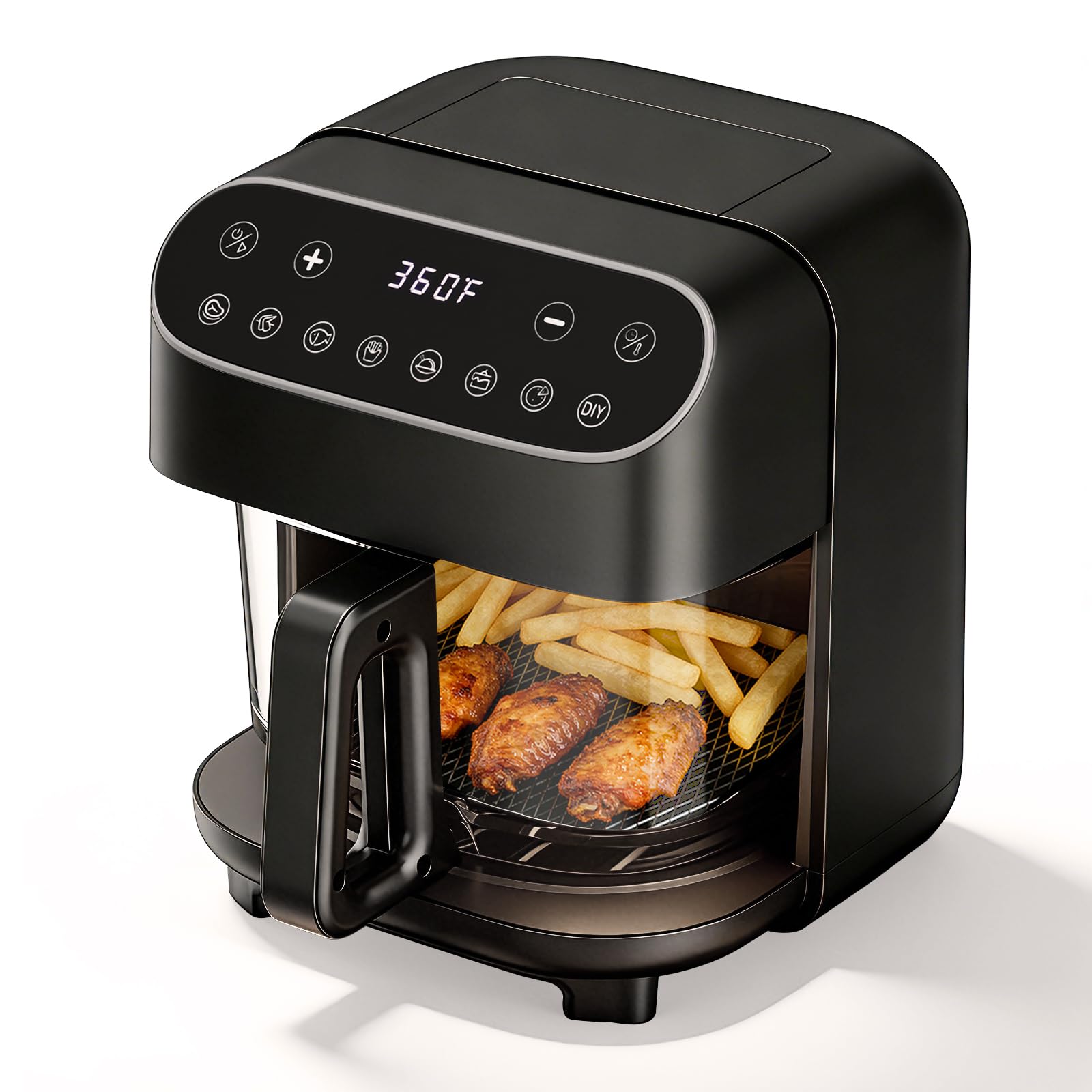
If you’ve ever thrown out an air fryer because the coating bothered you—or because smells made you uneasy—this style of glass-bowl fryer is a breath of fresh air. The core value is simple: a thick borosilicate glass pot that’s uncoated, paired with a stainless rack. It’s “what you see is what you get,” and for many kitchens, that’s the entire point.
The second value is control through visibility. With drawer-style fryers, people tend to open the basket repeatedly to check browning. That dumps heat, delays crisping, and increases uneven cooking. A clear bowl lets you monitor without interrupting the cycle. Over time, that actually improves results because you stop over-correcting.
Real-life users often describe a short adjustment period: the bowl is heavier than a typical basket, and you feel that when it’s full of food. That weight is a quality signal, but it’s also a responsibility—this is not the model you want small kids pulling out unsupervised. Once you treat it like “hot glass cookware,” it becomes easy to love.
The flip reminder and auto-pause are not fluff. They solve two common mini-fryer problems: (1) forgetting to toss food and ending up with uneven browning, and (2) accidentally pulling the basket and getting a faceful of hot air. This unit’s “pause on removal” makes mid-cook checks safer and more comfortable.
Cooking speed can feel slightly different versus some high-powered drawer models. Glass holds heat differently than a thin metal basket, and some users notice it can take a little longer to hit the same crisp level. But once you adjust your timing, the results are still very satisfying—and many people consider the material tradeoff worth it.
Why glass-bowl fans love it
- Uncoated glass cooking surface – chosen by people who want to avoid traditional nonstick coatings.
- See your food cook – fewer interruptions, fewer overcooked meals, better timing confidence.
- Auto-pause and reminders – safer mid-cook handling and more even browning.
- Cleaning is straightforward – the bowl washes like glass cookware, without tricky corners.
Good to know
- Heavier bowl means you should handle it like hot cookware—great for adults, less ideal for unsupervised kids.
- Glass shows splatters; a quick wipe keeps it looking crystal clear.
- Some users find it slightly slower than high-power drawer models until they dial in timing.
Ideal for: cooks who prioritize visible cooking and uncoated surfaces, and who want family-size capacity without a giant appliance.
7. GreenLife 5.3 QT – The Viewing Window Option for Coating‑Conscious Buyers

GreenLife built this model for a specific buyer: someone who wants the familiarity of a drawer-style air fryer but also wants more comfort around materials—plus the practical benefit of a window and interior light. That combination makes it feel more “guided,” especially if you’re new to air frying or you’ve had uneven results with older models.
The window matters because it reduces the urge to open the drawer. For smaller and mid-sized fryers, opening the basket repeatedly is the silent killer of good results. You lose heat, you lose momentum, and the fan has to rebuild crisping conditions. A clear view window helps you time the stop point more accurately.
The PFAS-free ceramic nonstick interior is also part of its appeal. In daily use, the “feel” people tend to like is that food releases more easily, and cleaning can be a wipe-down rather than a scrape-and-soak situation. That said, ceramic surfaces still reward gentle care. Use silicone or wood tools, avoid harsh scrubbers, and clean regularly so grease doesn’t bake on.
Where you should be honest with yourself is expectations. This isn’t trying to be the most powerful 450°F beast. It’s trying to be a balanced, approachable, easy-to-use model that covers the common foods: fries, wings, vegetables, fish, and simple meals. If you want aggressive “char-level” crisping, you’ll prefer a higher-temp model. If you want a calmer daily cooker with visibility, this fits.
Some users mention design quirks—like controls that can feel unintuitive mid-cook or more plastic presence than they expected. That doesn’t mean it won’t cook well. It means it’s smart to treat this as a “value-friendly” tool rather than a luxury build. If your priority is the combination of window + ceramic + family capacity, it delivers a lot in one appliance.
Where it shines
- Window + light – easier timing without opening the drawer repeatedly.
- Material comfort – PFAS-free ceramic coating appeals to buyers avoiding certain coatings.
- Family-sized drawer – enough room for real meals while still staying “counter manageable.”
- Preset convenience – quick starting points for common foods when you’re not in the mood to think.
Good to know
- Top temperature is lower than some high-heat competitors; crisping “finish” may be milder.
- Exterior heat and plastics vary by unit design; give it breathing room while running.
- Controls can have small quirks—learn the buttons once and it becomes routine.
Ideal for: buyers who want a windowed drawer fryer with a ceramic interior and a practical, everyday cooking focus.
8. Instant Pot Vortex 4Qt Mini – The “Sneak a Peek” Learning-Friendly Fryer
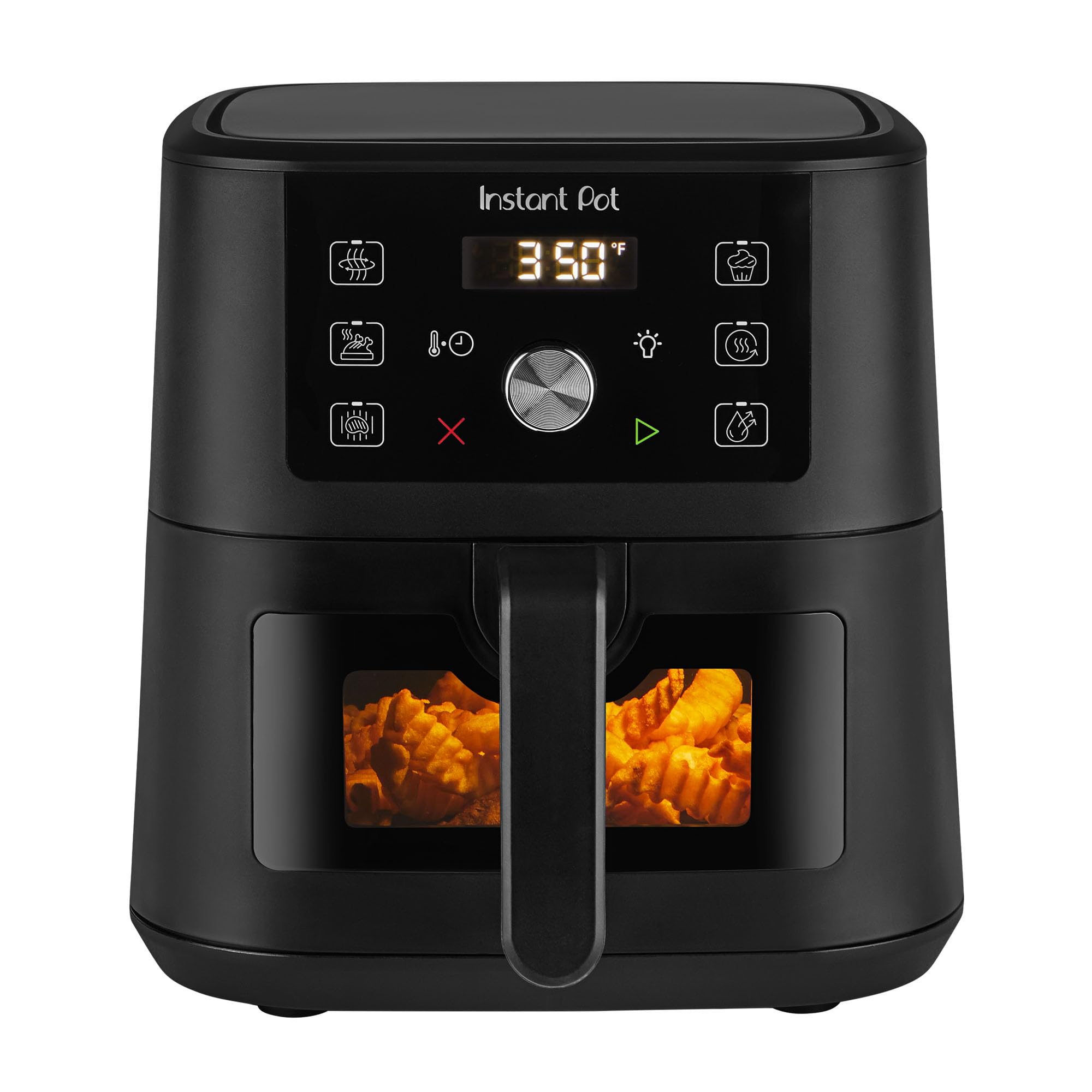
The Vortex Mini is a confidence builder. It’s compact, it’s feature-rich, and the window + light combo helps you learn timing without constantly interrupting cooking. That matters more than people think—especially if you’ve never cooked proteins in an air fryer and you’re nervous about overcooking. Seeing the browning happen makes the whole appliance feel less mysterious.
Owners often describe a small “break-in” routine: running a couple cycles before cooking real food to reduce manufacturing odors. That’s normal for a lot of countertop appliances, and once it’s done, the experience becomes smooth. The unit is designed for quick cooking, but it’s also not magic—preheating can take a few minutes depending on temperature and mode. Still: compared to an oven, it’s a massive convenience upgrade for small meals.
Where this model is especially good is fish and vegetables. Many people discover that air fryer fish tastes more like restaurant fish when the timing is right—crisp edges, moist interior. The EvenCrisp-style circulation is built for that “outside texture, inside tenderness” result, and the window helps you stop at the right moment.
A practical note from real users: the beeper can be subtle. If you’re in another room, you might miss the “ready” beep. That’s not a dealbreaker, but it changes how you use it—either stay within earshot during preheat, or set your own external reminder. Once you’ve cooked a few favorite foods, you’ll know your timings and you won’t depend on the beeps as much.
If you want intense high-heat finishing or the most aggressive crisping, you’ll prefer a higher-temp machine. But if you want a compact, approachable fryer that’s easy to learn on—and you love the idea of “peek without opening”—this is a very friendly daily option.
Why it’s beginner-friendly
- Window + interior light – helps you learn browning cues without opening the basket.
- Compact but useful capacity – small footprint, still enough for real meals for 1–2 (and sometimes more).
- Versatile cooking modes – covers common needs without needing another countertop appliance.
- Easy everyday wins – great for fish, vegetables, potatoes, and reheats once you learn timing.
Good to know
- Preheating may take longer than you expect if you’re coming from “instant” marketing.
- Beep volume can be subtle; consider staying nearby or using a phone timer.
- As with most fryers, avoiding overcrowding is key to even crisping.
Ideal for: new air fryer users who want visibility, guided confidence, and a compact fryer that’s easy to live with.
9. AROMA Glass Air Fryer 3 Qt – The Minimalist’s “Set Time, Watch Crisp” Cooker

This Aroma glass fryer is for a specific type of person: someone who values simplicity more than features. No menus. No temperature fiddling. You set the timer and you watch the food through glass as it browns. If you love the idea of “visual cooking” but hate digital interfaces, this model is charming in a very practical way.
In real kitchens, this unit often becomes a snack-and-reheat machine. Frozen foods, quick fries, fast warm-ups—these are the scenarios where a single-temperature approach feels effortless. You don’t overthink; you just watch. And watching matters because this fryer can cook fast. Owners commonly describe it as “don’t walk away on your first few tries.” That’s not a flaw; it’s a reminder that this is a high-airflow cooker in a compact format.
The glass basket is a major cleaning advantage. There are fewer hidden crevices than a deep drawer design, and the bowl can be washed like glass cookware. For people who dread scrubbing baked-on grease, that’s a daily-life win. Some users also get creative by swapping racks—using stainless alternatives—because they prefer to avoid certain coatings on accessories.
There are honest limitations. Because temperature control is minimal, this model can be less forgiving for thick meats. Some users report that the outside can brown quickly while the inside needs more time—especially if the food is thick or crowded. That means this is a better pick for thinner cuts, smaller pieces, or foods where you can stir and monitor easily. It’s also a model where “break-in smell” is a real first-day event—ventilation and a test run are a smart move.
Finally, there’s a small ergonomic reality: the glass container has to seat correctly for the unit to run. A few users mention needing to align it carefully so the unit stays engaged. If you want a “slam it in and forget it” drawer, this may feel fussier. If you want a simple glass cooker you can babysit visually, it’s a satisfying niche pick.
Why minimalists like it
- Visual cooking – you can monitor browning without interrupting cooking.
- Simple timer dial – easy for teens, older adults, and anyone who hates complex controls.
- Glass cleanup – washes easily compared to baskets with tight corners.
- Fast for snacks – great for frozen foods and quick crisping when you stay attentive.
Good to know
- Limited temperature control can make thick meats trickier; thinner items are easier.
- First-use odor can be intense; a ventilated test run helps.
- Some users report alignment sensitivity when seating the glass bowl.
Ideal for: people who want glass visibility and simple controls, and who mainly cook snacks, sides, and quick reheats.
10. bella 4Qt Slim – The Countertop “Fits Anywhere” Air Fryer That Looks Good Doing It

Most air fryers are shaped like bricks. The bella Slim is shaped like it actually belongs in a real kitchen with limited space. Its tall-and-slim footprint is the kind of design you appreciate every time you’re trying to move things around on the counter or slide an appliance into a pantry without playing Tetris.
The basket shape is quietly excellent. A rectangular basket is practical for the foods people actually eat: a slice of pizza, longer fish fillets, strips of chicken, or asparagus that doesn’t fit well in round baskets. That geometry also supports better crisping because you can lay food flatter instead of stacking.
Aesthetically, it’s a standout. Many people want appliances that don’t look industrial, and this model leans into softer lines and a calmer color palette. That sounds superficial—until you realize a nicer-looking appliance is one you’re more willing to keep on the counter, and the one you keep on the counter is the one you use.
Performance is exactly what you want from a compact everyday fryer: good crisping for frozen foods, strong reheat results, and quick meals without turning on the oven. Like all smaller fryers, there’s a learning curve for bigger proteins and breaded foods, but once you learn your timings, it becomes a reliable part of the routine.
The EverGood ceramic nonstick coating is designed for easy release and simpler cleanup, but the same care rules apply: no metal utensils, avoid abrasive scrubbers, and clean frequently so grease doesn’t become a permanent resident. When you treat it well, it’s the kind of fryer that stays pleasant to own—clean, tidy, and not visually loud in the kitchen.
Why small kitchens love it
- Space-smart profile – stores more easily than bulky box-shaped fryers.
- Rectangular basket utility – great for pizza slices, longer foods, and single-layer crisping.
- Looks intentional – design-forward enough to keep on the counter without resentment.
- Simple presets – quick starting points for common daily foods.
Good to know
- Capacity is practical, but not “party size”—large batches may still need multiple rounds.
- Like all coated baskets, it rewards gentle tools and regular cleaning habits.
- Expect a short learning curve if it’s your first air fryer.
Ideal for: small kitchens that want a good-looking, easy-to-store fryer with a basket shape that matches real food.
11. COSORI Lite 2.1 QT – The Tiny Reheat Specialist That Actually Makes Sense

Mini air fryers can be disappointing when they’re too small to be useful. The Cosori Lite avoids that trap by focusing on the real mini use case: small portions, fast reheat, and “I don’t want to heat the oven for this.” It’s not trying to be everything. It’s trying to be the appliance you reach for daily.
The reheat mode is the headline feature, and it’s more important than people realize. Reheating isn’t just “warming.” It’s moisture management. You want the inside warm without turning the outside into cardboard. A dedicated reheat approach helps leftovers come back to life—especially fries, wings, pizza, and roasted vegetables. This is exactly the kind of food many people eat most often, which is why this little unit gets used a lot.
The compact footprint is also a real win. People who live in small apartments, use limited counter space, or store appliances between uses often choose this model because it’s physically easy to live with. It’s light enough to move around and tuck away, which matters more than you think if your counter doubles as your prep space.
The practical side of mini ownership: you still need airflow space around the unit. Many users mention leaving clearance behind the fryer for ventilation. That’s a normal safety reality with air fryers, but it’s especially important with small units that vent hot air close to the wall. If your kitchen is tight, plan a spot where you can pull it forward when it’s running.
Cleanup is straightforward. The basket is small enough that washing it feels like washing a bowl, and the nonstick surfaces make quick rinses realistic. If you’re someone who hates scrubbing, you’ll appreciate a fryer that doesn’t create a huge greasy surface area.
Why mini users love it
- Reheat mode is genuinely useful – makes leftovers crispy without over-drying.
- Small footprint – easy to keep on the counter or store away without hassle.
- Simple, daily-friendly operation – great for snacks, sides, and single servings.
- Fast cleanup – small basket + nonstick surfaces make quick washes realistic.
Good to know
- It’s not for big batches; it’s best when you embrace small portions and quick rounds.
- Provide ventilation clearance behind/around the fryer for best performance.
- Mini baskets cook fast—start with conservative timing and adjust upward.
Ideal for: singles and couples who reheat a lot of food and want a tiny, easy-to-clean fryer for everyday use.
12. Dash Digital Tasti‑Crisp 2.6 Qt – The Friendly Little Fryer You’ll Actually Use
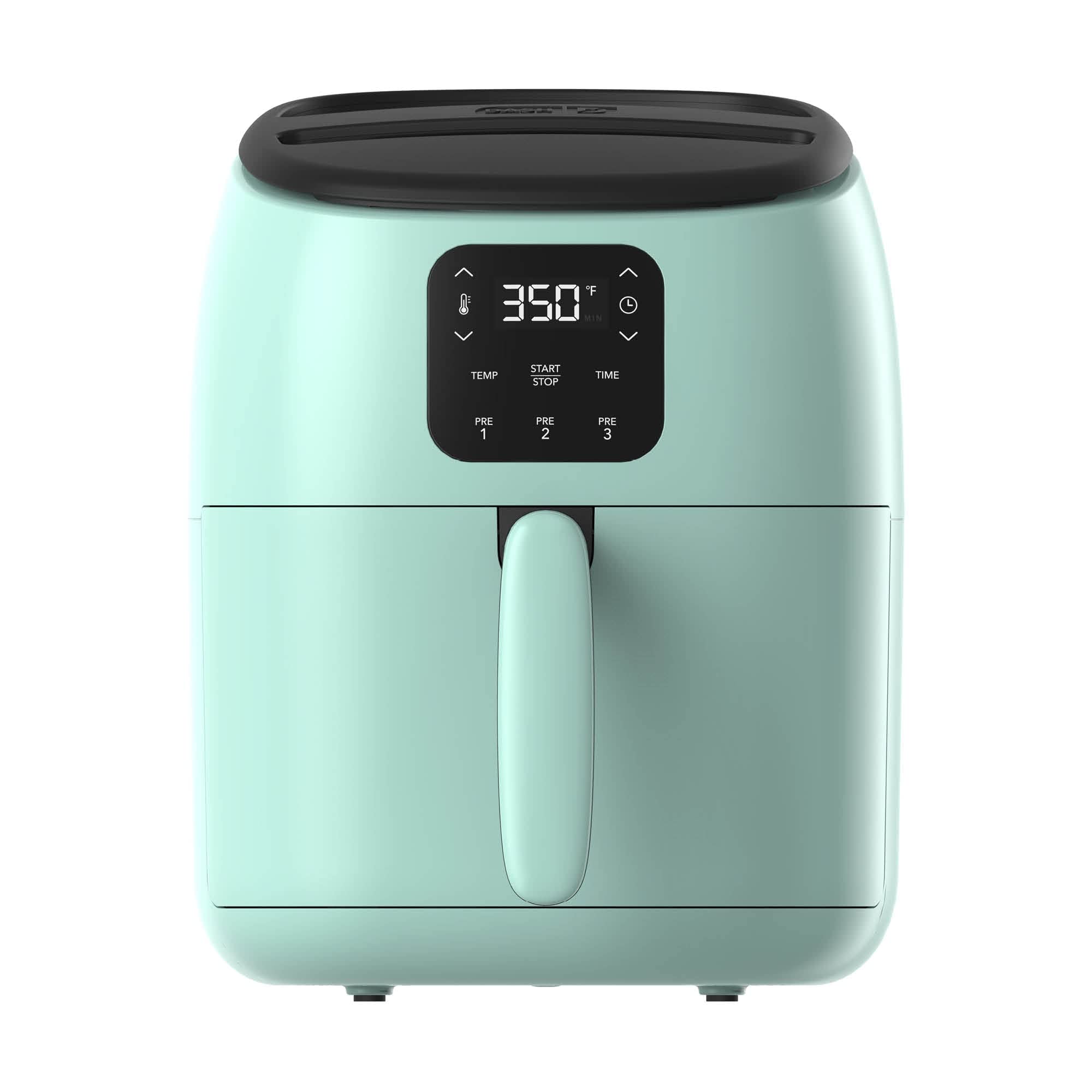
The Dash Tasti‑Crisp is the “just right” starter air fryer for people who want convenience without committing to a big countertop machine. It’s compact, approachable, and it tends to do the core air fryer jobs well: roasted vegetables, fries, nuggets, small proteins, and quick reheats. If you live alone or cook for two, this size can be exactly what you need.
One of the most consistent owner themes is frequency of use. People who like it tend to use it a lot—because it’s simple and it doesn’t punish you with cleanup. You can cook, eat, and wipe down quickly. That matters for daily-life cooking more than any “extra function” does.
It’s also a model that teaches you the real truth about air frying: you will flip or toss food sometimes. Even good air fryers benefit from mid-cook movement, especially with vegetables and fries. The Dash makes that easy because the basket is small and manageable. You don’t feel like you’re wrestling a heavy drawer.
The compact size is a win, but it also defines the boundaries. If you try to cook big batches, you’ll stack food, and stacked food steams. That’s not the fryer’s fault; it’s physics. If you keep portions realistic, the results can be impressively “restaurant-like” for common snack foods.
Another quiet advantage: many people describe it as fairly quiet compared to larger multi-function appliances. That makes it easier to run while you work or relax. If your kitchen is part of your living space (studio or small apartment), noise matters more than you’d expect.
Why it’s lovable
- Simple digital controls – easy to learn, easy to repeat.
- Compact footprint – great for small counters and small households.
- Quick cleanup – small basket and simple design makes wiping and rinsing easy.
- Great for everyday foods – roasted veg, fries, nuggets, and small reheats feel “effortless.”
Good to know
- It’s not built for big batches; multiple rounds are normal if cooking for more than two.
- Expect occasional shaking or flipping for the crispiest results.
- Minimal included recipe guidance; most people learn via quick experiments.
Ideal for: singles and couples who want an easy, compact fryer for snacks, vegetables, and reheats—without a bulky appliance.
13. CHEFMAN 2 Qt Mini (Grey) – The “Shake Reminder” Model for Even Crisping

The Chefman 2‑quart mini is built around a smart behavioral truth: most “bad air fryer results” happen because people don’t shake or flip food. Not because the appliance can’t crisp. Because the food sits still, steams, and browns unevenly. The shake reminder exists to fix that habit.
For small households and small kitchens, this model is especially appealing because the footprint is narrow and the workflow is simple: set time, set temperature, and the unit nudges you halfway through so you don’t forget the step that improves crispness. If you cook fries, nuggets, small vegetables, or bite-sized proteins, that reminder can take you from “pretty good” to “actually crispy.”
Where this fryer quietly shines is for people who don’t love cooking. Some owners describe it as a life upgrade because it reduces tool decisions, reduces dishes, and makes the whole “feed myself” routine less overwhelming. The basket is small enough to clean quickly, and the results are consistent enough that you gain confidence fast. That’s a big deal if you’ve been burned by complicated recipes or unpredictable ovens.
The limitations are honest and simple: it’s small. That’s the point. If you want bigger portions, you’ll need multiple batches. But if you’re buying a mini because you want fast, easy meals for one or two people, it’s a good match. The square basket shape helps maximize usable space within a compact body, which is exactly what you want in this category.
If you’re deciding between this and a bigger fryer, ask yourself one question: do you want to cook big batches, or do you want to cook more often? This model is designed for frequency.
Why it’s smart for minis
- Shake reminder – improves crispness and even browning without you having to remember.
- Square basket efficiency – better use of space than many round minis.
- Fast learning curve – simple controls, repeatable results.
- Easy cleanup – small basket means cleaning is quick enough to do daily.
Good to know
- Portions are small; plan on multiple rounds for larger appetites.
- Bigger meat cuts can take longer and may need flipping for even doneness.
- As with all minis, crispness improves when you avoid stacking food.
Ideal for: tiny kitchens, dorms, and anyone who wants a mini fryer that actively helps prevent uneven cooking.
14. CHEFMAN 2 Qt Mini (Black) – Same Great Workflow, A More Forgiving Look

The black version of this Chefman mini is essentially the same cooking engine and workflow as the grey version, but the finish changes how it feels on your counter. A darker exterior tends to hide fingerprints, small scuffs, and “life marks” better—especially in busy kitchens or dorm setups. If you keep appliances out full-time, that cosmetic difference can matter more than you’d expect.
Functionally, this remains a strong mini for one key reason: it’s designed to keep you from making the most common air fryer mistake. The shake reminder pushes you into the habit that makes food crisp evenly. That matters whether you’re reheating fries, cooking frozen snacks, or roasting small vegetables.
The basket shape is also a quiet advantage. Square minis often feel larger than their stated capacity because the usable floor area is better. That means you can fit food in a flatter layer, which improves airflow contact and browning. If you’ve used a round mini before and felt like everything piled up into a mound, this style can feel like a relief.
This is also a strong pick for people who want a low-stress cooking tool. If you don’t love cooking (or you’re the kind of person who gets overwhelmed by too many kitchen steps), a small, simple fryer can change your relationship with meals. You season something, you press a few buttons, and food comes out crisp without multiple pans.
Just keep your expectations aligned: it’s designed for small meals and daily convenience. If you want to cook multiple components at once, you’ll want a larger basket. But if you want a mini you’ll use constantly, this is a very practical little machine.
Why this finish can be the right choice
- Darker exterior hides wear – looks cleaner longer in high-use environments.
- Same shake reminder advantage – better browning with less guesswork.
- Square basket efficiency – maximizes usable cooking space in a mini body.
- Great daily convenience – quick meals, fewer dishes, and simple routine cooking.
Good to know
- Still a mini—batch cooking is normal if you eat larger portions.
- For best crispness, avoid stacking and use the reminder to actually shake food.
- Like most small fryers, you’ll learn timing quickly after a few favorite foods.
Ideal for: anyone who wants the same compact Chefman cooking experience in a finish that blends into more kitchens.
15. Elite Gourmet Glass 2.4 Qt – Visibility + Knob Simplicity for 1–2 People
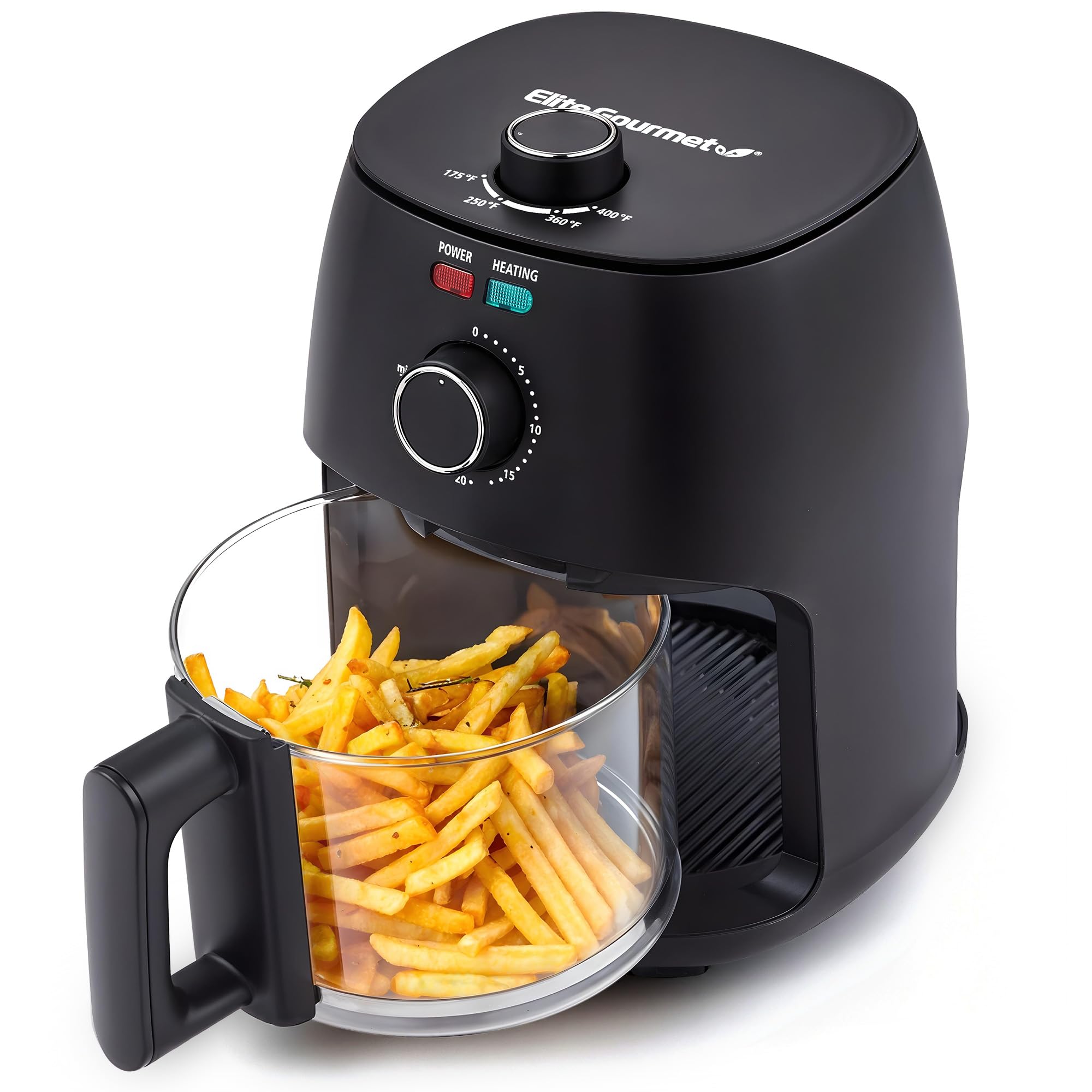
This Elite Gourmet glass fryer sits in a sweet spot: small enough for apartments, dorms, and couples, but still capable enough to cook real food—not just snacks. The glass bowl gives you the biggest advantage of glass-based cooking: you can monitor browning without constantly opening the unit. That means more consistent heat, better timing, and fewer “oops, I overcooked it” moments.
Owners who love this style tend to love it for the same reason: it’s not mentally demanding. Knobs are intuitive. You don’t need perfect eyesight for tiny touchscreen icons. And because the bowl is glass, cleaning feels like cleaning cookware rather than cleaning an appliance. That’s a huge psychological win for people who stop using gadgets when cleanup becomes annoying.
There’s also a reliability theme that shows up in real-life ownership: simpler machines often last longer because there’s less to go wrong. That doesn’t mean digital models are bad. It means if you want a “no-frills tool” that just does the job, knob + bowl systems are appealing. Some users mention long-term use where the only reason they replaced the unit was physical damage (dropping it), not performance failure.
The limitations are the normal compact limitations. It’s best for small portions. If you cram it full, you’ll get uneven cooking and you’ll need to rearrange food more often. Also, temperature increments can be slightly quirky—some people notice charts that don’t perfectly match the available dial steps. That’s not a dealbreaker; it just means you cook by observation and small adjustments, which the glass bowl makes easier anyway.
One honest caution is customer service variability. If you get a unit with a damaged part, replacements and responses can vary. In that case, it’s smart to inspect promptly and handle exchanges quickly. Once you have a solid unit, the daily experience is simple, fast, and satisfying—especially for small meals like potatoes, fish, and snack-style foods.
Why it’s a strong small-kitchen tool
- Glass visibility – fewer interruptions, better browning control, less overcooking.
- Knob simplicity – intuitive for beginners, seniors, and anyone who hates touchscreens.
- Great for small meals – ideal for one or two servings without heating the oven.
- Easy cleaning – bowl-style cleanup feels more like dishes and less like appliance maintenance.
Good to know
- Small capacity means larger portions require stirring and sometimes multiple rounds.
- Dial temperature steps may not match “perfect” recipe numbers—cook by observation.
- Inspect on arrival; glass models should be handled carefully and checked promptly.
Ideal for: 1–2 person kitchens that want glass visibility and simple controls in a compact footprint.
16. COMFEE’ 2.1 Qt – The Small-Space “Does the Basics Well” Air Fryer

Sometimes you don’t need a “premium experience.” You need a small appliance that crisps food, fits your counter, and doesn’t become annoying. That’s where this COMFEE model sits: compact size, simple operation, and enough presets to cover the foods most people actually cook in a mini air fryer.
The best use case is snack and quick-meal life: fries, wings, small fish portions, reheated leftovers, and the kind of “I want something fast” meals that otherwise push you toward microwaved food. The rapid air circulation approach makes it quicker than conventional ovens for small portions, and the minimal oil style is what most people want from air frying.
The design tends to work well for dorm rooms and small apartments because it’s physically manageable. It doesn’t demand a permanent “counter shrine.” You can keep it out or store it without fighting for space. That matters when you’re living with limited cabinets and you don’t want a giant appliance dictating your kitchen layout.
The key expectation to set is capacity and crispness. Like all minis, it performs best when food is spread out. If you cram the basket, you’ll steam the food. Use smaller portions, shake once mid-cook, and you’ll get the crisp results you bought it for. Also, timing can feel different if you’re switching from a larger fryer—small chambers can cook faster than you expect.
Cleaning is one of the reasons small fryers get used often. A 2.1-quart basket is quick to wash, and removable dishwasher-safe parts make it easier to maintain good habits. If you treat it like a daily tool (wipe and rinse regularly), it stays pleasant to use. If you let grease build up, any fryer becomes a chore.
Why it’s a solid basic pick
- Compact for small spaces – good for dorms, RVs, offices, and small counters.
- Preset convenience – menu options reduce guesswork for common foods.
- Auto shut-off – adds safety and reduces “did I leave it on?” stress.
- Easy cleaning – small basket and removable parts support daily use.
Good to know
- Mini capacity means you’ll cook in rounds for larger appetites or multiple people.
- Crispness depends on spacing and shaking—avoid stacking food.
- Like many compact units, cooking times may differ from full-size fryer recipes.
Ideal for: dorms, small apartments, and budget-minded buyers who want a compact fryer for everyday snacks and quick meals.
17. Elite Gourmet 1.1 Qt – The “Office, Dorm, Travel” Micro Air Fryer

This is not the air fryer you buy for family dinners. This is the air fryer you buy because your space is tiny and your meals are personal. Think: office lunches, dorm snacks, truck/RV cooking, or travel situations where you want hot food without relying on a shared kitchen. It’s a niche product—and in its niche, it makes a lot of sense.
The biggest win is portion precision. Many people don’t need a big basket; they need a way to cook one serving of something properly: a couple hash browns, a single piece of protein, a small batch of fries. This unit is sized for that reality. The controls are simple, and the small chamber doesn’t waste energy heating a huge space.
Real-life users often describe it as quieter than expected—more “small fan” than “shop vac.” That makes it easier to use in shared living spaces or workplaces where you don’t want to announce your lunch to everyone in the building. They also mention that cooking times can be longer for some foods because smaller units in this category can be lower power than larger fryers. That’s not a flaw; it’s the tradeoff for portability and lower power draw.
The size constraints are very real. A typical chicken drumstick can fit, but a full leg can be awkward. You’re cooking small items or trimming/positioning larger ones to fit. If you buy this expecting it to behave like a 4‑quart fryer, you’ll be disappointed. If you buy it because you want a small, contained cooking tool for one person, it can be surprisingly satisfying.
A practical hack some users love: using a small insert dish (like a ramekin) inside the drawer pan for easier cleanup. That’s the kind of micro-cooking mindset this fryer is designed for—small portions, simple cleanup, repeatable routine.
Why it’s useful in its niche
- True single-serving size – perfect for one person meals without wasted space.
- Simple dial controls – low learning curve and easy daily use.
- Low noise feel – quieter than many people expect from an air fryer.
- Great for constrained spaces – office, dorm, RV, or tiny apartment setups.
Good to know
- Very small capacity; many foods require creative positioning or smaller cuts.
- Cooking times can be longer than larger fryers because of lower power and smaller chamber behavior.
- Not designed for multi-person meals—this is strictly a “for me” appliance.
Ideal for: ultra-small spaces and single servings—especially office/dorm setups where a full-size fryer is unrealistic.
The Crispness Equation: Why Small Air Fryers Win (and How to Make Them Even Better)
Air fryers are not magic. They’re tiny convection ovens designed to move hot air aggressively around your food. When you understand the mechanics, you stop guessing—and you start getting crisp results on purpose.
1. Crispness = dry surface + hot airflow + space
If you remember one thing, remember this: crispness is a surface event. The outside of your food has to dry and brown. That requires hot moving air contacting the surface. If your fries are stacked, the inside pieces don’t get airflow. Instead of crisping, they steam.
- Dry surface: pat moisture off raw foods, especially potatoes and proteins with wet marinades.
- Hot airflow: preheat helps for frozen foods and breaded items because it starts browning immediately.
- Space: single layer beats “more food at once.” If you need more food, do two rounds.
2. The “two-stage cook” makes food taste expensive
This technique is how you get juicy insides with crisp outsides:
- Stage 1 (cook through): use moderate temperature so the inside cooks without drying out.
- Stage 2 (finish): add a short high-heat blast to brown and crisp the outside.
It’s especially good for chicken thighs, salmon, tofu, and leftover pizza. A lot of people think their air fryer “dries food out,” but the real problem is blasting high heat for the entire cook. Finish hot—don’t cook hot the whole time.
3. Oil isn’t the enemy—wrong oil strategy is
Air frying is often marketed as “no oil,” but the best texture often comes from very small oil use. A light mist helps browning and reduces dryness. The trick is restraint:
- Use a fine spray (not a heavy pour).
- Oil the food, not the basket (except for sticky foods).
- For frozen foods, many already have oil—test before adding more.
4. The basket shape tells you how to cook
Square baskets and wide baskets are built for single-layer cooking. Use them like a sheet pan: spread food out, shake once, finish crisp. Tall narrow baskets are built for smaller portions and more frequent shaking. Glass bowls are built for observation—watch and stop at perfect golden brown instead of “following the box.”
5. The “steam trap” mistake (and how to avoid it)
The most common reason fries come out soft is trapped steam. Here’s how to fix it:
- Don’t overcrowd the basket.
- Shake halfway through, even if the machine doesn’t remind you.
- For fries: cook a little longer at the end rather than starting too hot.
- For wings: elevate on a rack/plate if your model supports it, so rendered fat drips away.
6. Using liners the right way
Basket liners can be amazing for easy cleanup, but they can also sabotage airflow if used incorrectly.
- Perforated liners support airflow better than solid liners.
- Always weigh liners down with food (never run paper alone).
- Trim oversized liners so edges don’t lift into the heating area.
- For glass bowl models, liners are often unnecessary because cleanup is already easy.
7. Keep the fryer “pleasant,” and you’ll use it more
Air fryers become gross when grease accumulates and burns. The solution isn’t deep-cleaning every day—it’s small habits: wipe the basket after cooking, rinse removable parts regularly, and don’t let oil build up for weeks. A clean fryer runs more consistently and smells better.
FAQ: Small Air Fryers (Without the Confusion)
What size should I get if I’m cooking for one?
Do I need to preheat an air fryer?
Why do my fries come out soft instead of crispy?
Are glass bowl air fryers harder to use?
What’s the easiest way to keep an air fryer from smelling?
Can I cook raw chicken or fish in a small air fryer?
Final Thoughts: Pick the Model You’ll Use on Your Tired Days
The best air fryer isn’t the one with the most marketing. It’s the one you’ll still use when you’re hungry, low-energy, and trying to avoid dishes. If a fryer feels easy to clean, easy to time, and easy to store, it becomes part of your routine. That’s the real win.
Here’s the simplest way to translate this guide into the right purchase:
- Want the cleanest daily experience with great crisping? Start with the Ninja Crispi. It’s a smart system for people who want less mess and more “use it constantly” convenience.
- Want a premium, consistent cooker that feels like an upgrade? Go for the Cosori Iconic Stainless Steel Smart Air Fryer for high-end performance and repeatable results.
- Need real basket space for meal prep and bigger rounds? Choose the Ninja XL 5.5 QT for the kind of usable space that makes crisping easier.
- Want a proven, dependable “works every time” compact fryer? The Ninja AF101 is a classic for a reason.
- Love visibility and want to avoid coated cooking surfaces? Try the 5‑Qt Glass Bowl Air Fryer or, for a dial-first minimalist approach, the AROMA Glass model.
- Want the best tiny leftover crisping machine? The COSORI Lite 2.1 QT is built for small portions and daily reheats.
- Need the smallest true single‑serve option? Pick the Elite Gourmet 1.1 QT for tight spaces and solo meals.
Choose the personal air fryer that matches how you actually eat—reheat-heavy, snack-driven, protein-focused, or meal-prep— and you’ll end up with the one outcome that matters: a small appliance you truly use, not one that becomes countertop clutter.
