
There are two kinds of people at an oyster night: the ones who happily slurp and smile… and the brave soul in the kitchen doing hand-to-hand combat with a shell that feels like it was designed by nature to test your patience.
If you’ve ever tried “winging it” with a random knife and a tea towel, you already know the truth: oysters don’t just resist — they snap, they slip, and they love to make you question your life choices. The fastest way to go from “this is fun” to “why is there shell grit in everything?” is using the wrong setup. The real unlock is the right technique and the right oyster shucker tool for the way you actually eat oysters.
Here’s what most buying guides get wrong: they treat every opener like it’s the same gadget with a different logo. In the real world, a classic New Haven-style knife behaves totally differently than a slim French-style blade. A lever machine can be a miracle for parties — or a shell-crushing mess if it’s wobbly, misaligned, or mounted wrong. And restaurant-grade shuckers can be jaw-droppingly fast… within their “sweet spot” of oyster sizes.
This guide is built like a chef’s prep station: practical, brutally clear, and aimed at helping you buy once. I pulled patterns from real owner experiences (what bends, what breaks, what feels “life-changing”), cross-checked how different designs are meant to be used, and then ranked these 13 tools by how they perform when oysters are cold, hands are wet, and the pressure is on.
In this article
- How to choose the right shucking setup for your style (and avoid the common mistakes).
- Quick comparison table of 13 standout openers and kits.
- In‑depth reviews: what owners love, what they hate, and what actually matters.
- Mechanics guide: tip shape, leverage, and clean hinge pops.
- FAQ: safety, shell fragments, cleaning, and storage.
How to Choose the Right Oyster Shucker Tool for Real‑World Shucking
The best opener isn’t the “strongest.” It’s the one that matches your oyster size, your volume, and your confidence level. If you get those three right, shucking stops being stressful and becomes weirdly satisfying.
1. Pick Your Platform: Knife vs. Lever Machine vs. Restaurant Bench
There are three categories in this guide, and they behave like completely different tools — because they are.
- Handheld Oyster Knives: Best for control, portability, and minimal shell damage. They reward technique: a short twist at the hinge beats brute force every time. Great for 6–24 oysters at a time.
- Lever / Clamp Machines: Best for safety, speed, and fatigue-free shucking. You’re using leverage instead of wrist strength. Ideal for parties, older hands, or anyone tired of “knife wrestling.” Most still require a small knife to release the meat after the hinge pops.
- Commercial Bench Shuckers: Built for throughput. In the right size range, they’re ridiculously efficient. But they can be picky about shell size and shape — and they demand countertop space like a small appliance.
2. Match the Tool to Your Oyster “Personality”
Oysters aren’t uniform. Even within the same bag, you’ll see different hinge shapes, lip thickness, and shell curvature. That’s why some tools get glowing reviews from one coast and grumpy returns from another.
- Stubborn, thick shells (often Gulf-style): Favor stronger leverage (lever machines) or a proven hinge-focused knife design (New Haven-style).
- Medium, consistent shells (many farmed East Coast oysters): Almost any approach works, but cleaner results come from stable leverage and predictable alignment.
- Delicate or thin shells (some river or smaller oysters): Too much force can crush and shed fragments. You want control: a sharp, predictable tip and a “stop early” workflow.
3. The Shell Fragment Problem (And How Pros Prevent It)
When people say an opener “ruined the oysters,” they’re usually describing one of these:
- Misalignment: The spike hits shell instead of the hinge seam, so the shell fractures.
- Over-leverage: A long handle makes it easy to apply more force than you realize.
- Shell type mismatch: Softer shells can crush when a machine is tuned for tougher hinges.
4. Why “Wobble” is the Silent Dealbreaker
In review after review, owners don’t complain about “not enough power.” They complain about play in the hinge, flex in the base plate, or clamps that don’t sit right on a countertop. Even a strong opener feels frustrating when the pivot has slack.
- Look for: stable grooves, multiple height settings, a clamp (or strong suction cups), and a handle that feels tight at the pivot.
- Expect: if you shuck by the dozen regularly, you’ll want something that can be mounted to a board or locked down consistently.
5. Gloves: What They Protect (And What They Don’t)
Cut-resistant gloves dramatically reduce the “oops” factor, especially if your hand is bracing the oyster. But they don’t magically make shucking risk-free — a puncture is different than a slice. The smartest move is pairing gloves with technique:
- Grip: the glove should feel snug so the oyster can’t rotate in your palm.
- Direction: keep the blade’s “failure path” away from your hand and wrist.
- Stability: a non-slip base (or a clamped machine) prevents the oyster from skidding at the worst possible moment.
6. Cleaning & Storage: Don’t Let a Great Tool Become a Funky Tool
Shellfish prep is wet, salty, and messy. Stainless steel and aluminum parts rinse easily, but wood bases need extra attention. Your best practice looks like this:
- Rinse immediately after use so brine and shell grit don’t dry like cement.
- Hand wash wood-handled knives and dry them fully to protect the handle.
- For machines: wipe pivots and joints, then dry before storing to avoid corrosion and stiffness.
Quick Comparison: 13 Oyster Shucker Tool Options at a Glance
This table is arranged the way most people actually shop: start with the highest-confidence all‑rounders, then go deeper into specialty picks (restaurants, high volume, pure knife craftsmanship, and budget-friendly machines).
On smaller screens, swipe or scroll sideways to see the full table.
| Model | Type | Best For | Key Feature | Amazon |
|---|---|---|---|---|
| TDOCK Lever Opener (with case) | Lever Machine | Best all‑round home pick | Foldable + adjustable height | Amazon |
| Vollrath (1853) Oyster King | Commercial | Restaurants / high volume | One‑stroke bench shucker | Amazon |
| R Murphy “New Haven” Knife | Knife | Best pure knife option | Curved tip leverage + control | Amazon |
| King Kooker 5500 Lever Opener | Lever Bench | Outdoor / stubborn hinges | Long handle leverage + grip base | Amazon |
| Colinktool Adjustable Lever Set | Lever Machine | Parties & beginners | Stability grooves + clamp kit | Amazon |
| BIUWING Lever Machine (Upgraded) | Lever Machine | Speed shucking at home | Long handle for fast batches | Amazon |
| CANALHOUT Narrow‑Blade Opener | Lever Machine | Precision hinge popping | Narrow blade design + suction cups | Amazon |
| ZeroPone Adjustable Machine Kit | Lever Machine | Accessory-heavy value kit | 5 height settings + suction + clamp | Amazon |
| Koconic Adjustable Shucker Kit | Lever Machine | Best budget-friendly machine | 5 heights + full starter kit | Amazon |
| NH Lever Opener Set | Lever Machine | Simple starter machine | Triple stabilization concept | Amazon |
| Cpbikan Wood‑Base Lever Opener | Lever Bench | No‑assembly convenience | Pine base + 304 steel grooves | Amazon |
| Melocean Knife + Glove Set (Listing A) | Knife Kit | Giftable safety bundle | Full tang knife + cut‑resistant glove | Amazon |
| Melocean Knife + Glove Set (Listing B) | Knife Kit | Size/availability option | Same kit concept, alternate listing | Amazon |
In‑Depth Reviews: 13 Oyster Openers Ranked by Real‑World Use
Specs won’t save you when your hands are wet and the hinge is stubborn. So these reviews focus on what matters in real kitchens: stability, alignment, control, cleanup, and how owners say the tool behaves after the “honeymoon phase.”
1. TDOCK Lever Opener (with Storage Case) – The Party-Proof Workhorse

If your goal is to serve oysters confidently (without turning your kitchen into a tension-filled “who’s shucking?” standoff), TDOCK hits the sweet spot. It’s built around a simple truth: leverage beats brute force. You seat the oyster, align the hinge seam under the point, press down, and the hinge pops — then you use the included knife to free the muscle.
Where this style shines is consistency. Owners who’ve shucked for decades describe these lever machines as “life-changing” because the tool does the scary part (initial entry) in a controlled way. The foldable/packable angle is also underrated: if you do seafood nights at a friend’s place, at an outdoor kitchen, or at a cabin, a storable machine is the difference between “we’ll do oysters” and “nah, too much hassle.”
The honest trade-off: a lever machine can be too strong. If you press past the first “pop,” you can fracture shell and drop grit into the meat. With softer shells, technique matters even more. Think of this like cracking an egg: just enough pressure to break the seam, then you switch to finesse.
Why it earns “Best Overall”
- Fast learning curve: Great for first-timers who want safer opening.
- Adjustable setup: Handles a range of oyster sizes with less frustration.
- Stability features: Grooves + clamp-style support make alignment easier.
- Storage-friendly: A machine you’ll actually take out and use.
Good to know
- Clamp fit can be awkward on some countertops (especially with drawers/overhangs).
- Over-pressing can crush shells — controlled “pop” technique matters.
Ideal for: Anyone who wants fast, safer shucking at home — especially for get-togethers where speed and confidence matter.
2. Vollrath (1853) Oyster King – The High-Volume Bench Shucker

This is the “I run a raw bar” option — or the “I host oyster parties like it’s my side hustle” option. The Oyster King is designed to open oysters and clams with a quick, repeatable stroke on a stable base. When it’s working inside its ideal size range, it turns shucking from a chore into a production line.
But here’s the expert caveat: commercial tools are often optimized for consistency, not universal compatibility. Owners who love it talk about how sturdy it feels and how it saves hands. Owners who return it usually hit one of two issues: the oyster size doesn’t match the tool’s “sweet spot,” or the shell shatters (especially with larger grilling-style oysters or certain thick-lipped shapes).
If you’re shopping this level, think like a restaurant manager: you don’t need it to open every oyster. You need it to open your oyster reliably. If you buy consistent oysters (same farm/size band) or you’re happy to sort by size, this can be a serious time saver.
Why pros choose it
- Throughput: Built for repeatable, high-volume opening.
- Stability: Bench-style footprint keeps movement controlled.
- Less fatigue: Saves wrists compared to knife-only sessions.
Good to know
- Can be picky about oyster size and shape — sorting helps.
- If the shell shatters, you’ll spend time rinsing grit instead of enjoying oysters.
Ideal for: Restaurants, seafood events, or serious home hosts who want a commercial workflow on a countertop.
3. R Murphy “New Haven” Knife – The Control Freak’s Favorite

Some people don’t want a machine. They want a knife that feels like an extension of their hand — controlled, predictable, and fast once muscle memory kicks in. That’s exactly what the New Haven-style knife is built for. The curved/upturned tip is the design “secret”: it helps you find purchase at the hinge and apply leverage with a small twist, not a dangerous shove.
Owners describe it as “easy insertion without excessive force,” and that’s not just comfort — it’s safety. When the blade enters smoothly, you’re less likely to slip. The shape also helps you ride high inside the oyster so you can pop the hinge without bulldozing the meat.
This is the kind of tool that makes you better at shucking over time. It doesn’t do the work for you — it teaches your hands what “right” feels like.
Why it’s a classic
- Control: Minimal shell damage when used with the twist method.
- Leverage geometry: Curved tip reduces the urge to over-force.
- Comfort: Balanced handle for longer sessions.
Good to know
- Requires practice — your first dozen won’t feel like your fiftieth.
- Knife-only shucking still demands attention to hand placement and grip.
Ideal for: Anyone who wants the “pro knife” route: clean opens, less grit, and a tool that rewards technique.
4. King Kooker 5500 Lever Opener – The Stubborn-Hinge Tamer

This is a classic “hinge popper” design: a sturdy lever arm driving a point down into the hinge while the oyster rests on a grippy wood base. People who shuck bushels love tools like this because it turns a hand-risky move into a controlled mechanical action.
The most useful real-world detail owners mention is how the point behaves. A conical point can be more forgiving than a blade-like wedge because it finds the seam and breaks it with pressure instead of slicing into shell layers. Done right, you get a hinge pop without dumping the oyster liquor.
Two honest realities: first, the tool doesn’t “finish” the oyster — it starts it. You still need the included knife (or your favorite oyster knife) to cut the muscle. Second, some oysters have a hinge that’s partially overgrown by shell, and no lever tool loves that. In those cases, you do a tiny amount of manual work to expose the seam, then the lever does the heavy lifting.
Why people swear by it
- Leverage: Makes tough hinges feel manageable.
- Stable resting surface: Wood base helps prevent shell skid.
- Beginner-friendly motion: Press down, pop, then finish with knife.
Good to know
- Bulky footprint — not a “drawer tool.”
- Some hinge shapes (overgrown hinges) still require manual finesse.
Ideal for: Backyard oyster bars, outdoor kitchens, and anyone regularly facing tough, tight shells.
5. Colinktool Adjustable Lever Set – The “Where Has This Been?” Machine
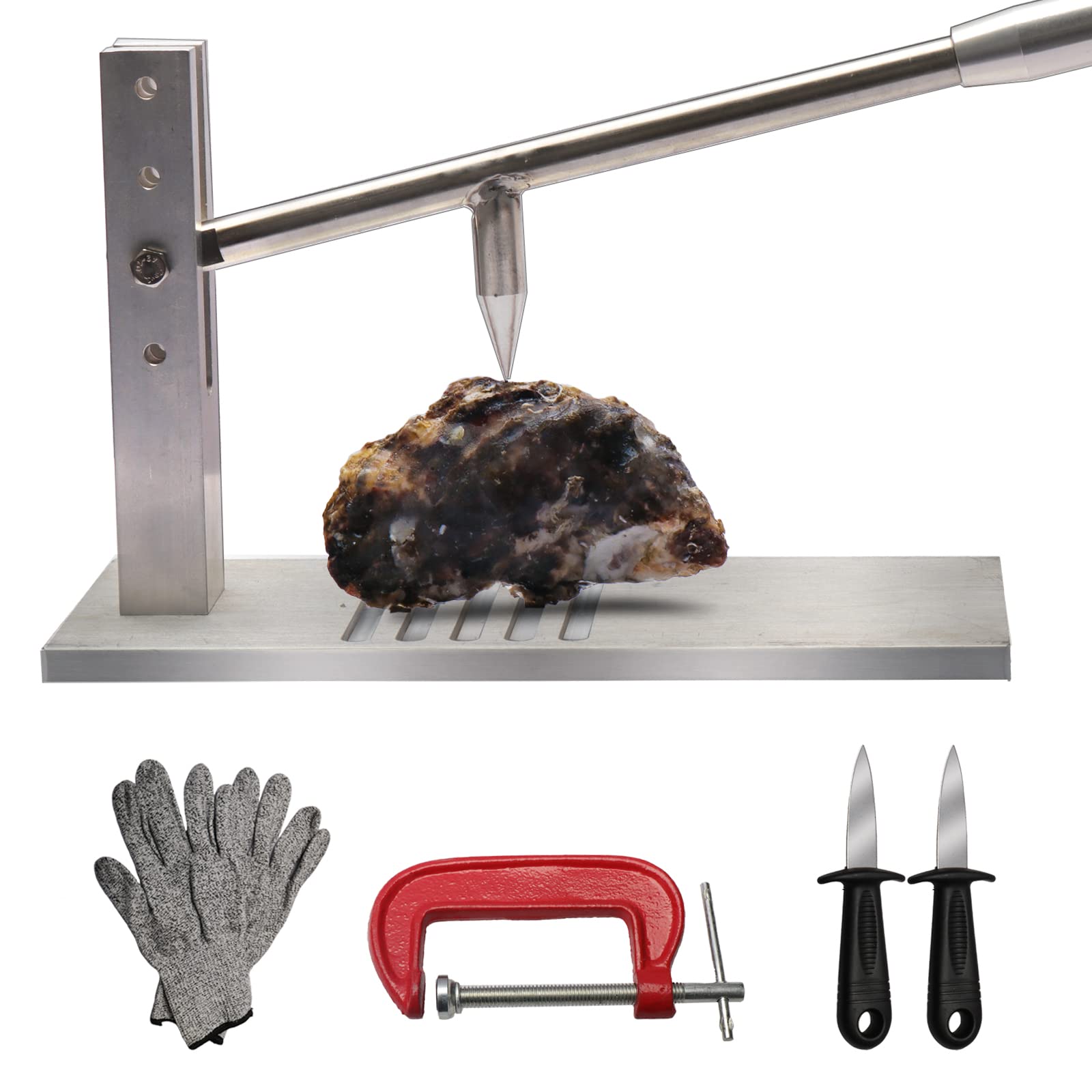
Some tools get polite reviews. This style of lever machine gets emotional ones — especially from people who’ve shucked for decades and collected scars along the way. The reason is simple: it removes the scariest part (getting the shell started) and replaces it with a stable press motion.
What makes this style work well is the trio of practical features: grooves to seat the oyster, adjustable height so the spike meets the hinge seam at the right angle, and a clamp to stop the base from walking around your counter. It’s not glamorous. It’s just… effective.
If you host and you want other people to help, this is the kind of tool that turns “everyone disappears when it’s time to shuck” into “people line up to try it.” That’s the hidden value: it makes oysters social instead of stressful.
Why it’s a crowd-pleaser
- Confidence boost: Great for beginners and nervous shuckers.
- Speed: Efficient for dozens without hand fatigue.
- Stability: Grooves + clamp reduce slip risk.
Good to know
- Like all lever machines, it still needs a finishing knife cut.
- Countertop setup matters — clamp it if you want the best experience.
Ideal for: Hosts who want safe, fast shucking for gatherings (and who want helpers to actually volunteer).
6. BIUWING Lever Machine (Upgraded) – Built for Speed… With Setup Smarts
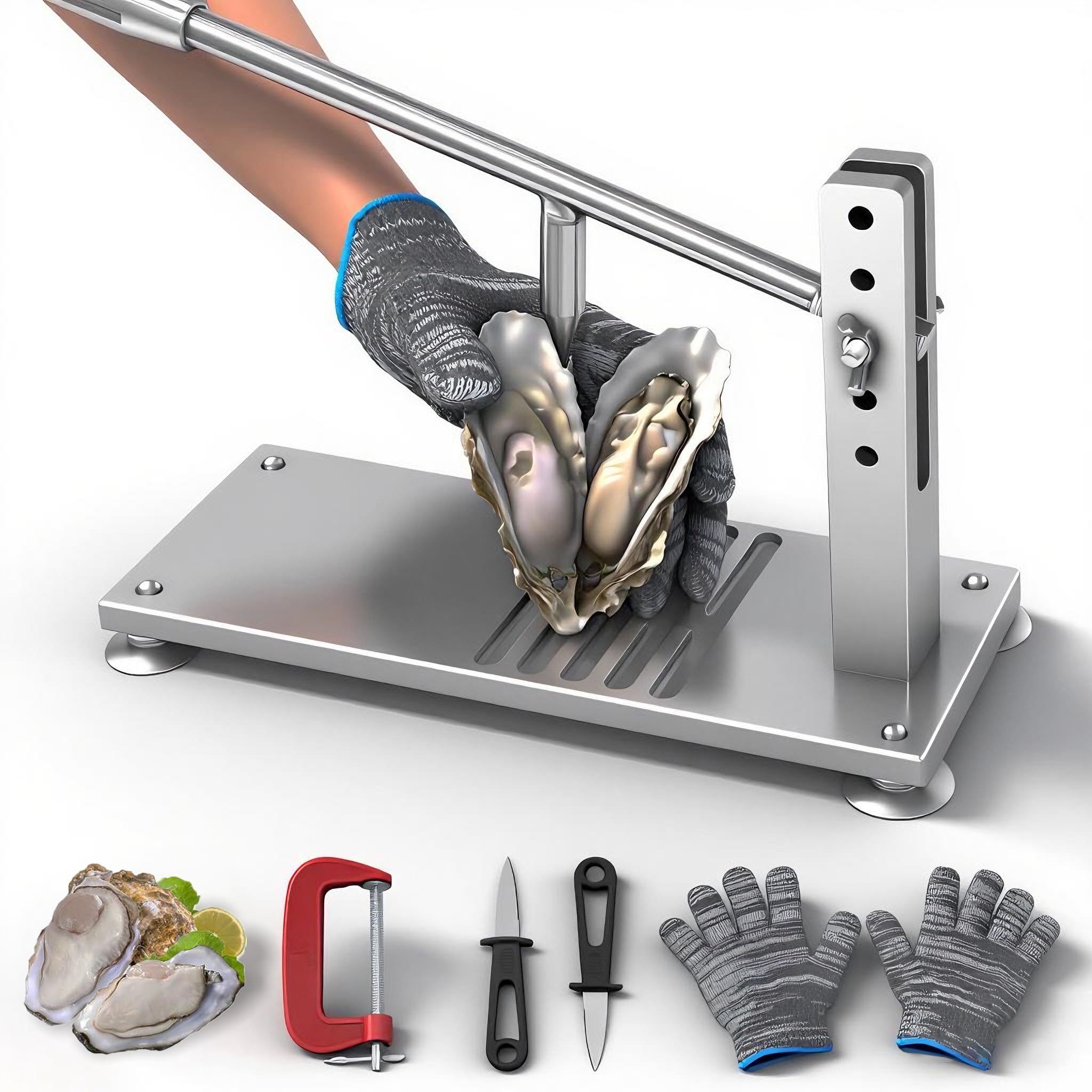
When you see owners talk about shucking cases of oysters quickly with a lever machine, this is the kind of design they’re using: extended handle, stable seating grooves, and a repeatable press motion. Once the technique clicks, you can get into a rhythm — one person pops, the other does the cleanup cut.
The catch is quality control and rigidity. Some owners report alignment/assembly issues (like parts not sitting perfectly perpendicular) or base flex under pressure. That matters because even a small tilt can turn a clean hinge pop into a cracked shell. The good news: you can often “solve” this class of issue by mounting the base to a larger board, tightening hardware, and making sure the vertical tower is square before your first oyster.
Why it’s a speed tool
- Rhythm-friendly: Great for high-volume home sessions.
- Long handle: Less effort per oyster once aligned properly.
- Grooved base: Helps seat shells consistently.
Good to know
- Some units may need extra attention to alignment and rigidity.
- If the base flexes, you’ll see more cracking on tough hinges.
Ideal for: People who shuck big batches and don’t mind spending a few minutes “dialing in” the setup for smoother performance.
7. CANALHOUT Narrow‑Blade Machine – Cleaner Pops When You Nail Alignment

A narrow blade is an interesting design choice because it can reduce “shell bulldozing.” Instead of pushing broad force into the shell, it concentrates pressure into the hinge seam — which can lead to cleaner hinge pops if the machine is stable and the height is set correctly.
Owners who love it talk about speed and safety, especially for gatherings. More critical feedback tends to focus on rigidity: if the frame flexes, a narrow blade can bind or bend because the pressure isn’t traveling straight down into the seam.
This is a tool that rewards doing the basics right: set height carefully, clamp or rely on strong suction, and avoid the temptation to force the handle when the point isn’t seated perfectly. If it doesn’t feel right, reset the oyster — you’ll be faster overall because you won’t be picking shell grit out of meat later.
Why it can be excellent
- Focused force: Narrow blade can create cleaner hinge pops.
- Stable base concept: Strong suction helps reduce movement.
- Portable machine workflow: Great for home and small events.
Good to know
- Frame rigidity matters more with narrow blades — alignment is everything.
- Expect a short learning curve to find the “sweet spot” for your oyster type.
Ideal for: People who want a machine approach but care about cleaner hinge pops and are willing to take a minute to dial in height.
8. ZeroPone Adjustable Machine – Good Concept, Best When Reinforced

On paper, this is what people want: multiple height settings, an aluminum alloy base, suction cups, a clamp, plus knives and gloves. In practice, owner feedback shows the typical lever-machine truth: the design works, but stability and pivot tightness decide whether it feels premium or “a bit wobbly.”
A common smart move from experienced users is reinforcing the base by mounting it to a larger board. That sounds small, but it’s huge: a longer base footprint prevents the tool from tipping or rocking when you press the handle. Once it’s stable, the leverage does what it’s supposed to do — open oysters with less drama than a knife-only approach.
Why people buy it
- Versatility: Height settings help across oyster sizes.
- Complete kit: Includes the common “missing pieces” (glove + knives).
- Leverage-based safety: Less hand strain than manual knife prying.
Good to know
- Some users report wobble; mounting/reinforcement can help a lot.
- Durability can vary under heavy, repeated high-force sessions.
Ideal for: Buyers who want a feature-rich kit and don’t mind doing a simple stability upgrade for a smoother experience.
9. Koconic Adjustable Shucker Kit – The “Wish I Bought This Years Ago” Pick
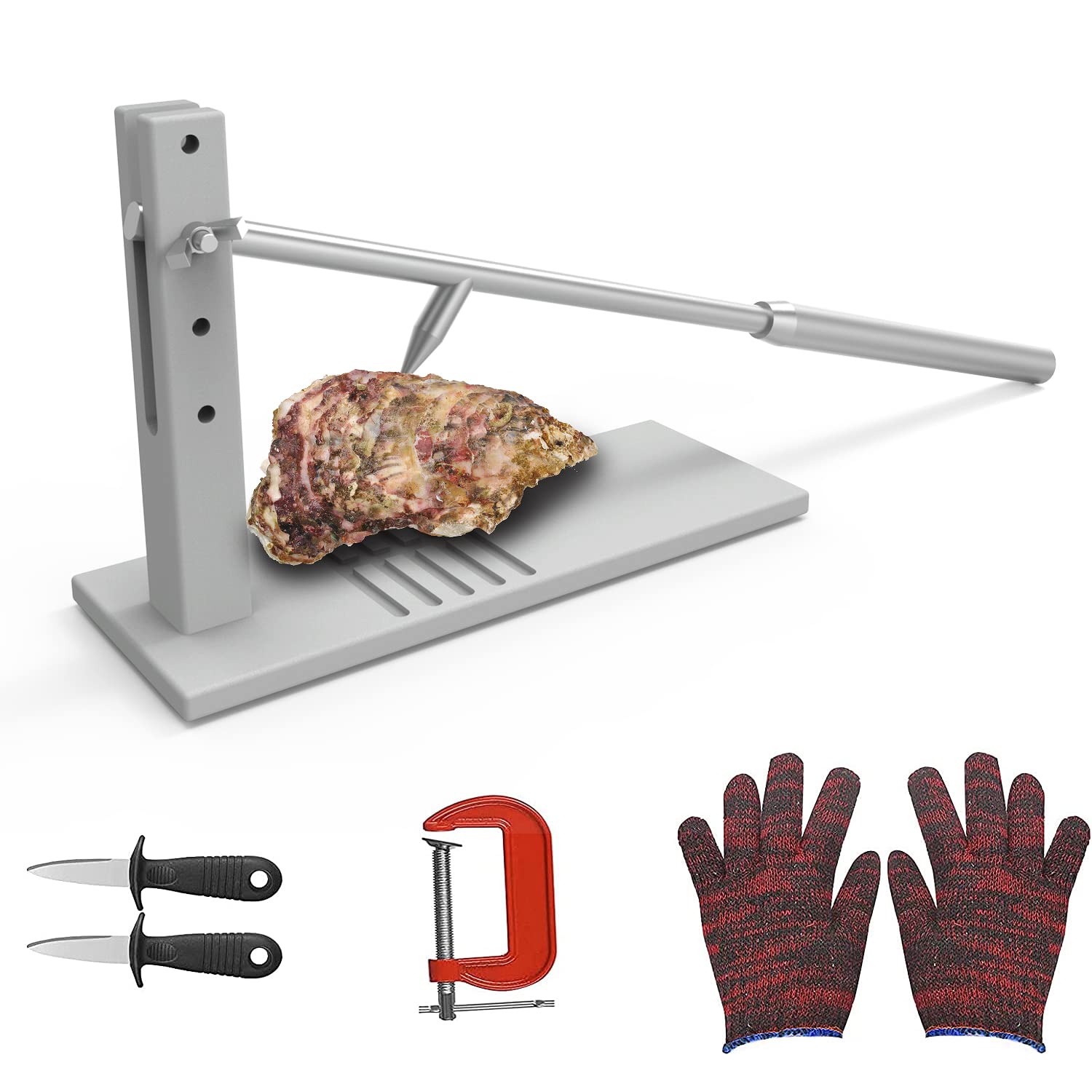
If you want a lever machine experience without going full commercial, this kit hits a practical value lane: multiple height settings, grooves for seating, and the basics included. Owners consistently describe the feeling of relief — less worry about stabbing yourself, less frustration with stubborn shells, and faster results for casual oyster nights.
The most common “minor gripe” in this class is hinge play (the pivot feels a little sloppy). That doesn’t automatically ruin performance, but it can reduce precision — meaning you may need to pay more attention to oyster placement. The upside is that a little play is often manageable with careful setup and consistent technique.
Why it’s a smart buy
- Beginner-friendly: Leverage reduces the scary part of shucking.
- Adaptable: Multiple height settings improve consistency.
- Complete kit: Knives + glove + clamp support a safer workflow.
Good to know
- Some play at the pivot can reduce precision (set up carefully).
- Not a commercial bench tool — treat it as a home machine.
Ideal for: First-time machine buyers who want easier shucking without overthinking the purchase.
10. NH Lever Opener Set – Great When Assembled and Tightened Correctly

This is the “starter machine” archetype: adjustable height holes, base grooves, and a clamp to keep it in place. Many owners love it because it simply makes shucking easier and safer than knife-only methods. Others have a bad experience when assembly is unclear or a unit arrives with an issue.
Here’s the expert reality with this category: if fasteners aren’t tight, the tool feels weak — not because the lever lacks force, but because the pivot “wastes” force in play. When everything is square and snug, performance improves dramatically.
Why it’s worth considering
- Stability concept: Feet + grooves + clamp give you multiple anchors.
- Adaptable sizing: Height holes help match different oysters.
- Easy workflow: Pop hinge, then finish cut with a knife.
Good to know
- Instructions can be minimal; assembly attention matters.
- Quality can vary; inspect parts before your first use.
Ideal for: Budget-minded buyers who want a lever workflow and don’t mind a careful initial setup.
11. Cpbikan Wood‑Base Lever Opener – Simple, Handy, and Pantry-Friendly

This one stands out because it feels more like a “kitchen gadget” than a workshop tool. The base is wood, the grooves are metal, and the unit is designed to be portable and easy to store. For a lot of households, that’s the real win: you’ll actually pull it out instead of leaving it buried under appliances.
Owners describe it as a safer alternative to knife-only shucking, especially for people who’ve seen (or experienced) the classic hand injury scenario. The included knives are handy for the second step: freeing the meat from the shell once the hinge is started.
The trade-off is hygiene and weight. Wood bases can feel “rustic” or “gross” depending on your tolerance. If you like the concept, just treat the base like a cutting board: clean it thoroughly, dry it completely, and consider keeping it dedicated to seafood nights.
Why it’s useful
- Convenient: No-fuss setup and easy storage.
- Safer workflow: Leverage reduces risky knife prying.
- Handy extras: Small knives help with the muscle cut and cleanup.
Good to know
- Wood base needs extra cleaning/drying attention.
- Only a few height settings, so placement matters more.
Ideal for: Home cooks who want a simple, stashable lever opener and prefer “grab it and go” convenience.
12. Melocean Knife + Glove Set (Listing A) – Great Kit, But Use It the Right Way

As a bundle, this is one of the easiest gifts to give an oyster lover: a dedicated shucking knife plus a cut-resistant glove, presented like a proper kit. Owners often praise the comfortable handle and how much more confident they feel with hand protection.
Now the important expert truth: some negative experiences come from a method mismatch. A portion of buyers try to pry hard at the hinge the way they were taught with other knives — and report bending the tip early. In those cases, the issue isn’t “this is a bad tool” so much as “this tool is happier with a different approach.”
Think of it like this: some knives are hinge-first bruisers; others are seam separators. If your instinct is heavy hinge prying, use a New Haven-style knife (like the R Murphy above) or a lever machine. If you’re open to a more controlled side/seam method, this kit can feel smooth and effective — especially paired with the glove for grip.
Why it’s loved
- Confidence: Glove support makes beginners calmer and safer.
- Gift-ready: Presentation and extras make it easy to give.
- Comfort: Handle design feels secure when hands are wet.
Good to know
- Not ideal for heavy hinge-prying if that’s your ingrained technique.
- Like any glove, fit matters — too loose reduces grip control.
Ideal for: Beginners who want a safety-forward kit, and oyster fans who prefer a controlled seam/twist approach over brute hinge prying.
13. Melocean Knife + Glove Set (Listing B) – Same Concept, Alternate Listing Choice
This is essentially the same “knife + glove” kit idea, offered as an alternate listing (often useful when you’re choosing glove sizing/availability options). If you already like the concept of a shucking kit that prioritizes hand protection and gift-ready presentation, this gives you another route to purchase the same style bundle.
The key to getting the best experience is glove fit. Too tight and you’ll feel clumsy. Too loose and the oyster rotates in your hand — which is exactly what you’re trying to prevent. A snug glove turns shucking from “slippery chaos” into controlled prep.
Why it’s useful
- Alternate purchase path: Helpful for availability and sizing needs.
- Safety-first bundle: Glove + dedicated knife in one kit.
- Beginner confidence: Less anxiety than towel-only shucking.
Good to know
- Technique still matters; this isn’t a push-button machine.
- If your oysters are extremely stubborn, consider a lever machine for hinge popping.
Ideal for: Anyone who wants the kit approach and prefers buying based on the listing that matches their glove size/availability.
Mechanics Guide: Tip Shape, Leverage, and Clean Openings
Once you understand the mechanics, buying becomes easy. You’re not shopping for “strong.” You’re shopping for predictable force and controlled entry.
Blade & Tip Geometry
Most frustration is geometry, not strength. Here’s how tips behave:
- New Haven / upturned curved tips: Designed for hinge entry and a short twisting “key turn.” Great for control and minimal shell damage.
- Slim seam blades (often called French-style): Best when you separate the shells along the seam with controlled motion. Less happy with heavy hinge prying.
- Machine spikes / points: Built to pop hinges mechanically. Fast and safer for many users, but alignment is everything.
Stability & Leverage
Leverage is a superpower — and it can also be a liability. The more leverage you have, the more your setup must be stable.
- Clamp beats “hope”: If your base can move, your tip will slip off the seam.
- Stop at the pop: Press just enough to break the hinge seal, then finish with a knife.
- Base footprint matters: Longer, heavier, or better-anchored bases reduce rocking and cracking.
FAQ: Oyster Shucking Tools
Do I still need an oyster knife if I buy a lever machine?
How do I avoid shell fragments in the meat?
Are cut-resistant gloves “enough” for safety?
What’s the easiest setup for a home oyster night?
How should I clean and store these tools?
Final Thoughts: Oyster Shucker Tool Verdict
If you want the safest “most people will love this” pick, go with the TDOCK Lever Opener for its confidence-building workflow and party-ready speed. If you’re chasing pure knife control, the R Murphy New Haven is the kind of tool you grow into and keep for years. For sheer leverage against stubborn hinges, the King Kooker 5500 is a classic bench-style option. And if you’re running a serious oyster operation, the Vollrath Oyster King is the closest thing to a pro prep-line at home.
Pick the tool that matches your volume and your comfort level, then commit to the clean-pop workflow. Once you do, a great oyster shucker tool doesn’t just open shells — it turns oyster night into something you’ll actually look forward to hosting.
