
If you’re here, you’re not looking for another shallow “it has two baskets and it’s big” write-up. You want the kind of guide that makes the decision feel obvious—because you can picture exactly what your weeknight cooking will look like with this machine on your counter.
In this Ninja Foodi 10 Qt Air Fryer Review, I’m going to zoom in on the details that actually decide satisfaction: how DualZone changes the rhythm of dinner, how the Foodi Smart Thermometer changes your relationship with chicken and steak, what “10 quarts” really means in terms of surface area (the secret to crispness), and the few non-obvious limitations that only show up after you’ve lived with a dual-basket air fryer for a while.
Warm promise from me: I’m not going to be pushy. I’m going to be useful. By the end, you’ll know whether this is the exact air fryer that fits your home—or whether you’d be happier with a smaller single-basket model, a FlexBasket style, or even a stacked dual-basket design.
Quick Navigation
- Full Technical Specs (Easy Reference)
- At a Glance: Choose Your Listing / Finish
- The 60-Second Verdict
- DualZone Explained Like a Real Cook
- Smart Thermometer: Why It’s a Big Deal
- Cooking Programs: When to Use Each
- Capacity Reality: What Fits, What Doesn’t
- Performance, Crispness, Speed, Heat
- Noise, Counter Space, Daily Practicality
- Cleaning & Longevity (Nonstick Reality)
- Pro Tips That Make It Feel “Next Level”
- FAQ
- My Honest Recommendation
Full Technical Specs (Easy Reference)
| Spec | Ninja Foodi Smart XL 10-qt 2-Basket (DZ550 Series) |
|---|---|
| Overall capacity | 10 qt total (2 × 5-qt baskets) |
| Cooking programs | 6 programs: Air Fry, Air Broil, Roast, Bake, Reheat, Dehydrate |
| Temperature range | 105°F–450°F (wide enough for dehydrating through high-heat crisping) |
| Power | 1690W, 120V, 15A (rated) |
| DualZone features | Smart Finish + Match Cook + IQ Boost power management |
| Smart thermometer | Integrated Foodi Smart Thermometer (probe-based doneness control) |
| Dimensions (L × W × H) | 18.94″ × 15.39″ × 14.8″ |
| Weight | 21.61 lb |
| Cord length | 32 in |
| Warranty | 1-year limited warranty |
On smaller screens, swipe sideways to view the full table.
At A Glance: The Breakdown
Below are two common Amazon listings you’ll see for this 10-qt DualZone Smart XL setup. Think of this as “choose your finish / listing,” not “pick a winner.” The cooking concept is the same—your decision is usually availability, color, and which listing has the best overall deal at the moment (without me naming prices).
Ninja DZ550 Foodi 10-Qt DualZone Smart XL (Black)
 Check Price on Amazon
- Best For: Busy families who want a main + side done together without timing stress
- The Big Win: Two truly independent baskets (not a divider) for real “two meals at once” flexibility
- Thermometer Edge: Probe-guided doneness so chicken and steak stop being a guessing game
- Daily Feel: Touch controls, straightforward presets, and a “set it, then live your life” vibe
- Cleanup Reality: Nonstick baskets + dishwasher-safe parts help keep it low-drama
- Counter Space Check: This is a large appliance—plan the footprint before you commit
- The Catch: Dual-basket capacity is huge, but each basket still has limits for extra-large portions
Ninja DZ550GY 10-Qt DualZone Smart XL (Grey)
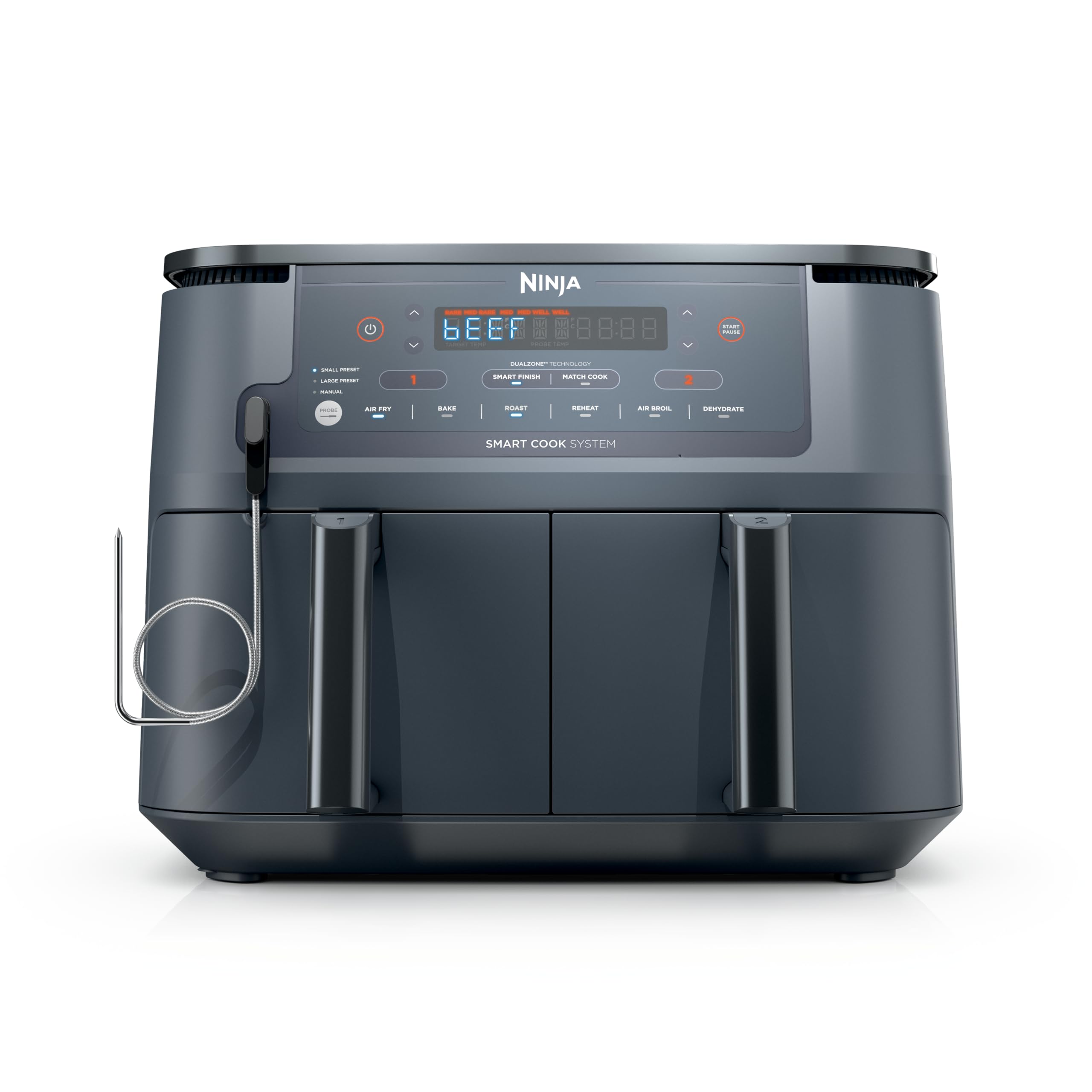 Check Price on Amazon
- Best For: People who cook often and want repeatable results (especially proteins)
- The Big Win: Smart Finish + Match Cook lets dinner land on the table together, not in stages
- Thermometer Edge: Great for salmon, chicken breast, pork chops, and steak “to temp” cooking
- Ease Factor: Many owners describe it as intuitive—less menu-diving, more cooking
- Noise Expectation: Lots of users find it reasonably quiet; some find it loud in open-plan spaces
- Size Reality: Fantastic for family meals, but still not a replacement for a full oven on holidays
- The Catch: If you routinely cook for a crowd, you may still batch cook (even with 10 qt)
Now for the part most reviews skip: what you’re actually buying is not “an air fryer.” You’re buying a new system for weeknight food—one where timing is automated, doneness is measurable, and the oven becomes optional more often than you’d expect.
Ninja Foodi 10 Qt Air Fryer Review: The 60-Second Verdict
If you want the fastest path to clarity, here’s the framework I’d use:
- You’ll love this if dinner usually includes two components (protein + side, or two different sides) and you’re tired of “one is hot while the other is still cooking.” DualZone is built for that life.
- You’ll especially love this if you cook meat often and want consistent doneness without babysitting. The Foodi Smart Thermometer is the difference between “hope” and “confidence.”
- You should pause if your kitchen has very limited counter space, or if you mostly cook for one person and rarely need two zones.
- You should also pause if you want a “mega single basket” mode for oversized items. This dual-basket design is about two separate chambers, not one big shared drawer.
That’s the 60-second answer. Now let’s do the part that actually matters: the lived experience details—how this machine behaves, how to get the best crisp, and what quirks to know before you buy.
What DualZone Really Changes (It’s Not Just “Two Baskets”)
Dual-basket air fryers look obvious: two drawers, two fans, two heaters, done. But the reason people get obsessed with this setup isn’t the hardware—it’s the timing control. In a normal kitchen, most “stress cooking” comes from timing. You’re not struggling to cook. You’re struggling to make everything finish together.
This is why owners keep calling the dual basket design a “game changer.” It’s not hype—it’s the practical reality that dinner becomes more predictable when the machine handles the coordination.
Smart Finish: The Feature That Makes Dinner Feel Effortless
Smart Finish is for when you’re cooking two different foods with different cook times, and you want them to finish simultaneously. Think:
- Chicken thighs on one side, roasted vegetables on the other
- Salmon on one side, crisped potatoes on the other
- Frozen snacks for kids on one side, a grown-up side dish on the other
In real life, Smart Finish is “dinner choreography.” You set up both zones, and the unit manages the start/hold logic so your shorter cook doesn’t sit there getting cold while you wait for the longer one to end.
My practical tip: when you use Smart Finish, think about “who needs a head start?” Dense, bulky foods (thicker potatoes, bone-in chicken, breaded items in a full layer) usually need more time. Lighter foods (vegetables, fish, reheats) are usually the short cook. Smart Finish turns that mental load into a button press.
Match Cook: The “Big Batch” Button That Saves Your Weekend
Match Cook is for when you’re cooking the same food across both baskets and you want the settings mirrored automatically. This is the feature that makes the 10-qt capacity feel real.
Because here’s the truth: “10 quarts” is a volume number, but crispness comes from surface area. Two baskets means you can spread food out more evenly instead of piling it up. That’s why owners often describe food as coming out crisp without feeling dried out—air can actually move around the pieces.
Match Cook is particularly satisfying for:
- Chicken wings when you’re cooking for multiple people
- Fries (fresh or frozen) when you want “everyone eats at once” portions
- Meal-prep vegetables where you want consistent roast-like edges
IQ Boost: What It Means in Human Terms
IQ Boost is Ninja’s way of managing power and airflow across the baskets to keep cooking efficient. You’ll see it described as optimizing distribution across baskets. The way I think about it is simple: it’s there so the machine can stay fast and effective across different dual-zone scenarios, instead of feeling like two weak baskets sharing a limited heater.
You don’t “use” IQ Boost like a separate mode. You feel it as the unit staying responsive when you cook in one zone or both zones—especially when you’re doing real meals, not tiny snack batches.
The Foodi Smart Thermometer: The Upgrade That Changes Everything
Most air fryer reviews obsess over crispness. That makes sense—air fryers exist for crispy textures. But in day-to-day cooking, the biggest failure point is not crispness. It’s protein doneness.
Overcook chicken and it gets chalky. Undercook it and you’re stressed. Overcook salmon and it flakes into dryness. Steak is a whole emotional event. And most people solve this by hovering, cutting, checking, guessing, and re-running the cook.
The smart thermometer turns that into a system: you insert the probe correctly, pick your protein type and target doneness, and the unit monitors internal temperature and stops cooking when the target is reached. That’s a different level of confidence compared to “I think it’s done.”
Important Reality: The Probe Is Zone 1 Only
Here’s a detail that matters: the Foodi Smart Thermometer works in Zone 1 (one side), not both. That’s not a dealbreaker—it’s actually a logical design choice for a dual-basket unit—but you should know it so your mental model is correct.
In practice, it means you put the “precision item” (like chicken breast, steak, pork chops, salmon) in Zone 1 with the probe, and you run your side dish in Zone 2 the normal way. This is also where Smart Finish becomes extra powerful—because you’re coordinating a “done by temperature” item with a “done by time” item.
Why It Feels So Good for Weeknights
When owners say things like “I reverse sear steaks,” “my salmon and chicken are perfect,” or “it’s the best appliance I’ve owned,” what they’re usually describing is the emotional relief of not having to guess.
Cooking to temperature does three things for normal people:
- Consistency: the same cut cooked the same way lands closer to the same result.
- Confidence: you stop opening the basket “just to check,” which improves cook quality too.
- Freedom: you can actually make a salad, pack lunches, help kids, or clean while cooking—without anxiety.
Probe Rules That Prevent Disappointment
If you want the thermometer to feel magical instead of annoying, follow these simple rules (they’re the difference between “wow” and “why is this acting weird?”):
- Insert into the thickest part and avoid bone, fat pockets, and gristle. The probe needs the true center heat.
- Use it on properly sized cuts. Thin cuts are harder for any probe system to read reliably.
- Don’t use it with frozen protein. Let protein thaw first so internal temperature behavior makes sense.
- Rest matters. Even when the unit stops at target, proteins continue carry-over cooking for a few minutes. That rest is part of the “perfect” result.
My favorite way to use it: cook the protein to target doneness in Zone 1, and use Zone 2 for something that benefits from a crisp finish—like broccoli florets, Brussels sprouts, potatoes, or even reheating leftover pizza slices. You get a “fresh dinner” vibe without touching the oven.
Cooking Programs: When to Use Each (And How to Think Like a Pro)
This unit’s value isn’t just capacity. It’s versatility. The presets are essentially different airflow + heat behaviors, and learning when to use each is how you go from “air fryer owner” to “this appliance runs my kitchen.”
1) Air Fry (Your Daily Driver)
Air Fry is the crisping workhorse. If you want golden edges, crunchy exteriors, and that “fried but lighter” vibe, this is the mode you’ll live in.
Best for: wings, fries, breaded frozen foods, crisp vegetables, tofu, small meat pieces, and “make it crunchy” leftovers.
Pro move: crispness is mostly about airflow and spacing. If you want the best result, resist the urge to overfill. Two baskets makes this easier because you can split a batch instead of stacking it.
2) Air Broil (Fast Browning, Big Flavor)
Air Broil is about intense top-end heat and browning. If you like edges on proteins, caramelization on vegetables, or a quick “finish” to create a more roasted flavor, this mode shines.
Important limitation: Air Broil isn’t designed to run in both baskets at the same time. That matters if you imagined broiling two different things simultaneously. The workaround is simple: broil your protein in Zone 1, and Air Fry/Roast your side in Zone 2.
Pro move: use Air Broil as a finishing step. If something is cooked through but you want extra color, a short broil can make food taste like it came out of a much hotter oven.
3) Roast (The “Oven Replacement” Mode)
Roast is the mode that surprises people. It’s what turns a dual air fryer into an oven alternative for smaller meals. You get a more rounded roast-like heat behavior, which is great for vegetables and proteins that don’t need “fried” crisp but do need browning.
Best for: roasted potatoes, carrots, Brussels sprouts, chicken pieces, sausage, and tray-bake style meals (but in baskets).
Pro move: toss vegetables with a small amount of oil and salt, then roast until edges color. If you want “restaurant style,” finish with a quick shake and an extra few minutes.
4) Bake (When You Want Gentle Structure)
Bake is for when you want a more stable, less aggressive cook—useful for things that benefit from a “set” rather than a blast of crisp air.
Best for: small bakes, reheating baked goods without turning them into crackers, and some casserole-like experiments in a basket-friendly dish.
Reality check: an air fryer is still a compact convection environment. Baking works, but results can differ from a full-size oven because airflow is stronger and the cooking chamber is smaller. Think “small and fast,” not “identical to an oven.”
5) Reheat (The Mode That Saves Leftovers From Sadness)
Reheat is one of the most underrated features. Most people microwave leftovers because it’s easy—but the microwave trades texture for speed. Reheat mode exists so leftovers taste like food again.
Best for: pizza, fries, roasted vegetables, chicken pieces, and anything you want warm without becoming soggy.
Pro move: reheat in a single layer whenever possible. If you stack leftovers, you trap steam—steam is the enemy of crisp.
6) Dehydrate (More Useful Than People Expect)
Dehydrate sounds niche until you realize it’s basically “low heat + time + airflow.” That’s useful for:
- making dried fruit slices
- drying herbs
- creating crunchy veggie chips (with the right prep)
- small-batch jerky experiments (if you’re careful and follow food safety best practices)
Pro move: dehydrate works best with consistent slicing thickness. If thickness varies, some pieces finish while others stay chewy. A simple slicer can make dehydrating feel “effortless” instead of “guessy.”
Capacity Reality: What 10 Quarts Means (And the Part Nobody Explains)
People shop air fryers by quarts, but the real quality-of-life metric is this:
How much food can you lay flat in a single layer without crowding?
That’s why dual baskets are so effective. You’re not just getting “more volume.” You’re getting more usable surface area. And surface area is what produces even browning and crispness.
Who 10 Quarts Actually Serves Well
- Families: this size exists for households where cooking “just one thing” isn’t the normal dinner.
- Meal preppers: you can run protein in one basket and vegetables in the other, then portion.
- Entertainers (light): appetizers and sides become much easier to time.
The Honest Limitation: Basket Size vs “Crowd Cooking”
Some owners mention that the baskets feel a bit smaller than expected for very large portions. That’s not a contradiction. It’s the difference between:
- volume (you can fit a lot if you pile), and
- performance capacity (you get the best results when food is spread out).
So yes—this is a big air fryer. And yes—if you’re feeding a larger group and you want everything perfectly crisp, you may still cook in batches for certain foods. The upside is that batches are usually fast, and you can run them in parallel when you split foods intelligently across two zones.
Performance: Crispness, Evenness, Speed, and Heat Behavior
Let’s talk about what people actually want: “Does it cook evenly? Does it get crispy? Does it take forever?”
When a dual-basket air fryer is good, it feels like a cheat code. When it’s mediocre, it feels like a bulky fan box that you keep using only because you already bought it.
This model is widely recognized for strong frying performance and fast cooking. The dual-chamber design also helps with crispness because you can spread food out rather than crowding one big basket.
It Can Run Hot: Why That’s Not Always a Bad Thing
One nuance that comes up in more technical evaluations is that the unit can run a bit hot. That sounds scary, but it’s actually common with compact convection appliances. What matters is how you respond:
- If your food browns too fast the first time you follow a recipe, slightly reduce temperature next time.
- Use the thermometer for proteins so “hotter air” doesn’t translate into “overcooked inside.”
- Lean into this behavior for crisp foods—running hot can be a feature when you want fast browning.
My practical approach: treat your first week as calibration. Cook a few familiar foods (wings, fries, broccoli, chicken breast) and adjust your personal “normal settings.” After that, it becomes a very repeatable machine.
Preheat: The Quiet Debate
You’ll see two philosophies in the air fryer world:
- Team “no preheat”: the unit heats quickly, so just start cooking.
- Team “quick preheat”: a couple minutes of heat can improve early crisping, especially for breaded items.
The most helpful truth is this: you don’t need to overthink it. If you want maximum crisp on frozen breaded foods or wings, a short preheat can help. If you’re cooking a full meal and timing matters more than micro-optimizing texture, skip preheat and let Smart Finish do its job.
Noise, Counter Space, and Daily Practicality
Dual-basket air fryers are bigger. That’s unavoidable. So the practical question becomes: will it live on your counter, or will it become the “appliance you drag out sometimes”?
Counter Space: Measure Before You Fall in Love
This unit is not a tiny gadget. It’s designed to be a primary cooking tool. If your counter is already crowded, you should plan where it will live—and how close it can sit to the wall without blocking airflow from the back vents.
Real-life tip: if it’s going to be stored in a cabinet, check the weight and the “lift and slide” feeling. A heavier appliance is less likely to come out daily, which defeats the point of buying a convenience machine.
Noise: Most People Find It Fine—Some Don’t
User experiences on noise can vary. Many describe it as relatively quiet for an air fryer—mostly fan sound. Others (especially in open-plan homes) say it can feel loud enough to compete with TV audio.
Here’s the simplest truth: if you’re sensitive to appliance noise, any powerful convection air fryer will be noticeable. What makes this unit worth it for many people is that the noise buys you speed and crispness. Still, if you live in a studio apartment and crave silence, that’s a legitimate deciding factor.
Cleaning & Longevity: How to Keep the “Nonstick Magic” Alive
Owners regularly highlight cleaning as one of the most satisfying parts—nonstick baskets, easy wipe-down, and dishwasher-safe components. That matters, because the best air fryer in the world is useless if you dread cleaning it.
The Cleaning Routine That Keeps It Easy
- Right after cooking: let baskets cool slightly, then wipe out grease while it’s still soft.
- For stuck-on bits: soak with warm water and mild soap before scrubbing. Patience beats force.
- Avoid harsh tools: keep metal forks and abrasive pads away from coated surfaces.
- Dishwasher use: convenient, but hand-washing can preserve coatings longer over years.
The “Slippery Nonstick” Feeling: Why People Love It
When people say “it cleans up like brand new every time,” they’re describing a specific satisfaction: you cook something greasy, and the basket doesn’t feel like a permanent crime scene afterward.
That said, any nonstick surface is a relationship. Treat it gently, and it stays slick longer. Treat it like a cast iron pan you can attack with metal tools, and it will eventually lose its charm.
Pro Tips That Make This Air Fryer Feel Like a “Chef Tool”
This is where most guides fail. They tell you what buttons exist. They don’t tell you how to cook in a way that makes the purchase feel brilliant.
1) Design Your Meal Around Two Different “Finish Needs”
The fastest way to feel the DualZone magic is pairing foods with different finish profiles:
- Zone 1 (precision): protein with the thermometer (or time-based if not using probe).
- Zone 2 (texture): vegetables, potatoes, reheats, or crisped sides.
This turns dinner into a predictable system: one basket is about doneness, the other is about crunch and warmth.
2) Stop Overcrowding (Two Half-Full Baskets Beat One Stuffed Basket)
Overcrowding is the #1 reason people say “my air fryer doesn’t get crispy.” It’s not the machine. It’s physics.
If food is piled, moisture gets trapped, and you steam instead of crisp. With two baskets, you can split a batch and keep airflow strong. You get better results and usually faster cooking because the air doesn’t have to fight through a dense pile.
3) Use Smart Finish Like a Scheduler, Not a Mystery Button
Smart Finish isn’t random. It’s scheduling. If one side needs 22 minutes and the other needs 12, the unit coordinates so they’re done together. Your job is simply to pick reasonable settings.
My tiny but powerful habit: set the longer cook first (protein or dense side), then set the shorter cook second. It keeps the mental flow simple and helps you spot obvious mismatches before you press start.
4) Use the Probe for “High Regret” Foods
Some foods are forgiving. Others are expensive or emotionally important. Use the thermometer for the foods where being wrong feels bad:
- steak and pork chops
- salmon
- chicken breast (the easiest thing in the world to dry out)
- whole chicken (if you attempt it)
Even if you don’t use the probe every night, having it for these moments is a major value add.
5) Don’t Sleep on Reheat
If you buy this and only use Air Fry, you’ll still be happy. But if you use Reheat properly, leftovers become part of your meal strategy instead of a guilty compromise.
Think of it like this: the microwave is “hot fast,” the air fryer is “hot with texture.” That’s why people who reheat pizza or fries in an air fryer often stop microwaving them entirely.
FAQ
Can I cook two different foods at two different temperatures?
Yes. That’s the core value of two independent baskets. You can run separate time and temperature settings, then use Smart Finish to coordinate the end time.
Is the 10-qt size too big for a small household?
If you mostly cook for one person, it may be more air fryer than you need—unless you love leftovers, meal prepping, or you frequently cook two components at once. The size is amazing when you use it, but it does occupy real counter space.
Do I have to use oil?
No—but a small amount often improves browning, crispness, and flavor, especially for vegetables and homemade fries. Many people use far less oil than traditional frying while still getting satisfying texture.
Will it replace my oven?
For many weeknight meals, it can reduce oven use dramatically. For large baking projects, big roasts, and holiday cooking, an oven still has advantages. The sweet spot is “small-to-medium meals, fast.”
Is the probe worth it if I’m not a steak person?
Still yes for chicken and fish. Chicken breast and salmon are two foods where “to temperature” cooking makes a noticeable difference in juiciness and consistency.
Can I use both baskets as one large cooking zone?
With this dual-basket design, think “two separate chambers” rather than “one convertible mega drawer.” If you want a single large basket that can be divided, Ninja’s FlexBasket-style models are closer to that concept.
Is it hard to clean?
Most owners find it easy: nonstick baskets, wipe-down surfaces, and dishwasher-safe parts. The easiest path is cleaning soon after cooking instead of letting grease cool and harden overnight.
Why do some people say it’s loud?
Air fryers move a lot of air. In open-plan homes or small spaces, fan noise is more noticeable. Many users still consider it worth it because cooking is fast, and the sound is “fan noise,” not a harsh mechanical grind.
What’s the biggest reason people love it?
Two independent baskets + synchronized finish time. It simplifies real dinners: protein + side, two sides, or dinner + kid food simultaneously.
What’s the biggest reason someone might not love it?
Space. If you don’t have room to keep it accessible, it may not become a daily tool. Also, if you only cook small single items, a compact single-basket model can feel more convenient.
Ninja Foodi 10 Qt Air Fryer Review: My Honest Recommendation
If your kitchen life looks like this—“I’m making two parts of dinner, I want them done together, and I want meat cooked confidently”—this model makes an unusually strong case. DualZone reduces timing stress, and the thermometer reduces doneness stress. That combination is why the experience feels so satisfying for so many owners.
If you’ve read this Ninja Foodi 10 Qt Air Fryer Review up to here and you’re still undecided, here’s the simplest tie-breaker I can give you:
- If you regularly cook two foods at once (or you wish you could), go DualZone.
- If you regularly cook proteins and want repeatable doneness, prioritize the thermometer version.
- If you’re tight on counter space or cook tiny portions, consider a compact single basket instead.
My Honest Recommendation
If you want the classic “DualZone + Smart Thermometer” experience in a clean, straightforward listing, I’d start with the Ninja DZ550 (Black). It’s the version many families gravitate toward because it makes the daily protein + side routine feel smooth and coordinated.
And if you prefer the grey finish or that listing is the better overall value when you’re shopping, the DZ550GY (Grey) gives you the same core idea: two independent baskets, Smart Finish timing, and probe-guided doneness when you want dinner to be both fast and confidently cooked.
Either way, the “win” isn’t the color—it’s the system: DualZone for timing, and the smart probe for doneness. If those two problems are the ones you want solved, this is one of the most satisfying 10-qt setups you can put on a countertop.
