
Grinding and chopping meat at home isn’t “just a kitchen hobby.” It’s a control move. You control the cut (brisket vs chuck vs thigh), the fat ratio, the texture (chunky vs fine), and the freshness window. You also control what doesn’t go in—mystery fillers, excess water, and that “store grind” mush that can ruin burgers, dumplings, or meatballs.
If you’re shopping for a meat chopper machine, you’re already thinking like a serious home cook: you want repeatable results, less mess, and a workflow that feels smooth instead of stressful. And here’s the honest truth most guides won’t tell you: the “best” machine isn’t the one with the loudest power number. It’s the one that keeps the meat cold, cuts cleanly, stays stable on the counter, and cleans up without leaving you with greasy, oniony regret.
This guide is built around real-life friction points that show up in owner feedback again and again: jamming on sinew, “smearing” instead of grinding, motor overheating during big batches, bowls that slide around, lids that are annoying to align, and machines that technically do the job… but make you dread doing it.
You’ll see two categories in this lineup: dedicated meat grinders (best for true ground meat, sausage, and kibbe) and food choppers / processors (best for fast mincing, small-batch prep, and everyday kitchen speed). Both can be the “right” choice—depending on what you cook, how often you batch prep, and how picky you are about texture.
Below are 12 strong options—organized in an order that matches how real kitchens buy: a balanced “best overall” choice first, then heavy-duty grinders for big batches, then versatile processors and choppers for everyday life, and finally compact and specialty tools that solve very specific problems brilliantly.
How to Choose the Right Meat Chopper Machine for Your Kitchen
A good machine doesn’t just “process meat.” It protects your texture, your time, and your patience. The goal is simple: get the result you want without fighting jams, overheating, or a cleanup that feels like a full-time job. Here’s the decision framework I use when I’m helping someone pick the right tool for the way they actually cook.
1. Start by choosing your “texture engine”
This is the single biggest decision—and it’s why so many buyers feel disappointed after purchase. A grinder and a bowl chopper can both turn meat into “smaller meat,” but the end result is not the same.
- Choose a dedicated grinder if you want classic ground meat texture (burger crumbles, sausage bind, kebab meat, kibbe-fine grind). A grinder pushes meat through a plate; that extrusion style is what gives you that clean “ground” look and feel.
- Choose a bowl chopper / processor if you want fast mincing, dumpling filling, taco-style mince, or mixed prep (onion + herbs + meat). This style chops by impact; it can be amazing for speed, but it’s easier to go from “perfect mince” to “meat paste” if you hold the button too long.
- Choose a full-size food processor if you want slicing/shredding for vegetables and occasional meat work. It’s the “one machine, many tasks” pick—especially useful for meal prep households.
2. Understand power claims without getting played by marketing
You’ll see big “Max” numbers everywhere. Here’s the reality: what matters in your kitchen is not the loudest peak number—it’s usable torque under load, plus how the machine handles heat during real sessions.
- Rated power is the realistic running power (the one you feel during grinding).
- Max / locked power is often a peak or stall figure—useful for marketing, not a guarantee of “I can run nonstop for 30 minutes.”
- Gear material matters: metal gears and solid drive parts usually hold up better under heavy use than cheaper internal builds.
That’s why some “lower-rated” machines feel stronger in practice than a louder spec sheet—and why overheating protection and duty cycle guidance matter. You want a machine that encourages healthy habits: grind steadily, rest briefly during big batches, and don’t force-feed sinew like you’re trying to win a contest.
3. Plates, blades, and the “clean grind” difference
A grinder’s plates and blades are your texture controls. In real cooking:
- Coarse plates are great for chili meat, rustic burgers, and stew-style grind where you still want bite.
- Medium plates are the everyday sweet spot for burgers, meatballs, and most home recipes.
- Fine plates shine for dumpling filling, kibbe, and smoother blends (but they also increase friction and heat if you rush).
Blades matter too. A sharp blade against a clean plate edge cuts; a dull blade smears. If you’ve ever made ground meat that looks glossy, sticky, or “smeared,” that’s usually a temperature + sharpness problem, not a recipe problem.
4. Anti-jam strategy is half machine, half technique
Reverse buttons and auto-reverse features are fantastic, but they aren’t an excuse to ignore prep. The most common jam causes are predictable:
- Sinew and membrane wrapping around the auger (this is why trimming matters).
- Too-warm meat turning soft and stringy (this is why chilling is non-negotiable for clean texture).
- Overloading the throat (pushing too much too fast builds pressure and slows the cut).
- Trying to grind “the wrong stuff” like tough vegetable fibers that twist and clog in grinder-style machines.
The best grinders make unclogging less scary (reverse, overload protection). The best choppers make safety automatic (lid interlocks, auto-stop). Either way, your goal is to avoid turning “prep” into “rescue mission.”
5. Think in “batches” and respect heat like a pro
Heat is the silent texture killer. It melts fat, softens protein structure, and turns “crumbly” into “sticky.” That’s why big-batch grinders often recommend a work rhythm:
- Prep everything first: cube meat, trim sinew, and portion it into trays.
- Chill the metal parts: cold auger + cold plate = cleaner cut.
- Grind in short sessions: steady feed, brief rests, repeat.
If you’re making sausage or burger blends, think like a butcher: cold meat, quick movement, and no long “idle running” where the motor heats the head.
6. Accessories: love the versatility, but don’t overvalue it
Sausage tubes, kibbe kits, and shredding/slicing attachments can be genuinely useful—especially for home cooks who want “one tool” instead of a cabinet full of gadgets. But here’s the expert truth:
- Integrated accessories are best for small batches (weeknight sausage, occasional kibbe, quick shred of cheese or vegetables).
- Dedicated tools are best for frequent heavy work (a dedicated sausage stuffer beats stuffing through a grinder when you’re doing big runs).
- Storage matters: if accessories live in a drawer chaos pile, you’ll stop using them. Built-in storage or a tidy box is a real quality-of-life win.
7. Cleanup and hygiene are part of performance
A machine can be powerful and still be a bad buy if you hate cleaning it. Real-world cleaning pain usually comes from:
- Grease traps where meat paste hides (corners, gear recesses, lid channels).
- Rust anxiety if parts aren’t dried quickly and thoroughly.
- Mixed-material bowls where you want one bowl for meat and one for everything else (this is why dual-bowl sets are so popular).
My best advice: choose the machine you’ll actually clean correctly. That’s the machine you’ll use for years.
8. Choose the machine that matches your “real kitchen identity”
Most people fall into one of these patterns:
- The burger perfectionist: wants a clean grind, repeatable fat ratio, and minimal smear.
- The sausage experimenter: wants tubes, seasoning control, and a machine that doesn’t panic when the mix gets sticky.
- The weeknight meal prepper: wants fast onion + herb + meat mince, easy bowl cleaning, and minimal counter mess.
- The pet food planner: wants reliable chopping/grinding for cooked ingredients and predictable cleanup.
- The small-kitchen realist: wants compact storage and a tool that’s not a counter hog.
Once you identify your pattern, choosing becomes easy—and this guide will feel like a map instead of a maze.
Quick Comparison: 12 Meat Chopper Machine Picks
Use this table to find the models that match your cooking style, then jump into the reviews for the details that actually matter— like how they behave with sinew, how stressful cleanup is, and which machines owners say they reach for week after week.
On smaller screens, swipe or scroll sideways to see the full table.
| Model | Machine type | Real-life strength | Best match | Amazon |
|---|---|---|---|---|
| AAOBOSI 4‑in‑1 Electric Meat Grinder (Stainless) | Meat grinder | Balanced “do it all” setup: grind + sausage + kibbe + shred/slice for everyday kitchens | Most home cooks who want one dependable grinder with useful extras | Amazon |
| Sinyder Heavy Duty Electric Meat Grinder (Stainless) | Meat grinder | Big-batch confidence: durable build, metal gears, and a workflow that handles serious sessions | Hunters, batch preppers, and “I grind 20+ lbs” households | Amazon |
| AAOBOSI Touch Screen Meat Grinder (Built‑in Storage) | Meat grinder | Low-stress anti-jam experience: smart controls, auto-reverse, and tidy accessory storage | Families who want modern usability and fewer “stuck auger” moments | Amazon |
| Aiheal Electric Meat Grinder (Black) | Meat grinder | Budget-friendly grinder that still feels capable for home batches (with smart rest breaks) | Occasional grinders who want sausage tubes + plates without overbuying | Amazon |
| COOKLEE 12‑Cup Food Processor (6 functions) | Full processor | Meal-prep versatility: slice, shred, mince, puree, and dough work in one machine | Families who want one appliance to cover “everything prep” | Amazon |
| Ganiza Upgraded Button Chopper (Overheat Light) | Bowl chopper | Exceptionally even chopping with excellent control—great for onions, herbs, and meat mince | Weeknight cooks who want speed without turning food into mush | Amazon |
| GANIZA Dual‑Bowl Processor (Blue) | Bowl chopper | Compact powerhouse with two bowls—easy daily use for baby food, pet food, and prep | Homes that want one small machine used multiple times per week | Amazon |
| GANIZA Dual‑Bowl Processor (Grey) | Bowl chopper | Two-bowl hygiene advantage + fast mince for mixed prep (veg + meat workflow) | Meal-preppers who want “meat bowl” and “veg bowl” separation | Amazon |
| GANIZA Dual‑Bowl Processor (Black) | Bowl chopper | Simple, proven dual-bowl system that covers daily chopping needs with minimal setup | Small kitchens that want a straightforward “do the basics well” unit | Amazon |
| KOIOS 500W Food Chopper (2 bowls) | Bowl chopper | Power-per-footprint: fast results, two bowls, and strong blade pull for smooth workflow | People who want a compact machine that feels “seriously strong” | Amazon |
| BUMET 500W Dual‑Bowl Chopper | Bowl chopper | Huge speed for the space: quick chops in seconds, strong safety interlocks, easy storage | Budget shoppers who still want a dual-bowl setup (with smart drying habits) | Amazon |
| KitchenAid 3.5‑Cup Food Chopper (Contour Silver) | Mini chopper | The small-batch specialist: sauces, dressings, emulsions, and quick veggie chops | Home cooks who want a compact “I’ll actually use this daily” helper | Amazon |
In‑Depth Reviews: 12 Home Grinders & Choppers That Earn Their Counter Space
Now we’ll go model by model. I’m going to talk like a real home cook and batch-prepper—not a spec sheet: what feels smooth, what gets annoying, what owners consistently praise after weeks of use, and what you should do to get the best results.
1. AAOBOSI 4‑in‑1 Electric Meat Grinder – The Balanced “One Machine” Choice

If you want one grinder that feels genuinely useful in a normal home kitchen (not a “commercial fantasy” you’ll use twice), this AAOBOSI 4‑in‑1 is a smart first stop. The reason it wins “best overall” is balance: it gives you the core grinder performance people want—plus the accessories that actually get used, like sausage and kibbe attachments and a shred/slice setup that can cut down prep time on busy nights.
Owners tend to describe the same pattern: easy setup out of the box, compact counter footprint, surprisingly strong grinding performance, and a cleanup routine that doesn’t feel like punishment. That “easy to break down and clean” note matters more than most people admit— because the grinder you hate cleaning becomes the grinder you stop using.
Where this machine really shines is in its beginner friendliness. For first-time home grinders, the learning curve is usually: (1) keep meat cold, (2) don’t feed sinew like spaghetti, (3) use reverse when you feel resistance. This unit’s safety-focused design (locking knob, overload protection, reverse) supports that learning curve without making you feel like you need a mechanical engineering degree.
One detail I love for real kitchens: the shred/slice attachments are not just “bonus clutter.” They’re useful when you’re doing lasagna night (shred cheese), taco night (slice veg), or meal prep (quick veg processing), and you don’t want to pull out a full-size processor. That’s how you end up using the machine weekly instead of seasonally.
Why you’ll like it
- Versatility that actually gets used – The accessory set supports real weeknight cooking, not just “one day a year” projects.
- Beginner-friendly workflow – Simple operation, reverse for clogs, and safety features that reduce stress.
- Compact but capable – Owners often call it a “small machine with big functionality,” which is exactly the home-kitchen sweet spot.
- Cleanup is approachable – Easy disassembly makes it more likely you’ll keep using it consistently.
Good to know
- Avoid bones, tendons, and thick skin—this is true for home grinders in general, and it prevents jams and motor strain.
- To keep parts looking new, dry metal pieces quickly after washing (air-drying on a rack is great, but “wet overnight” is not).
- Like most multi-tools, it’s strongest when you use the right attachment for the right job—don’t expect vegetable grinding through meat plates to feel amazing.
Ideal for: home cooks who want one grinder that covers everyday ground meat, occasional sausage/kibbe, and practical kitchen prep without taking over the counter.
2. Sinyder Heavy Duty Electric Meat Grinder – Built for Serious Sessions
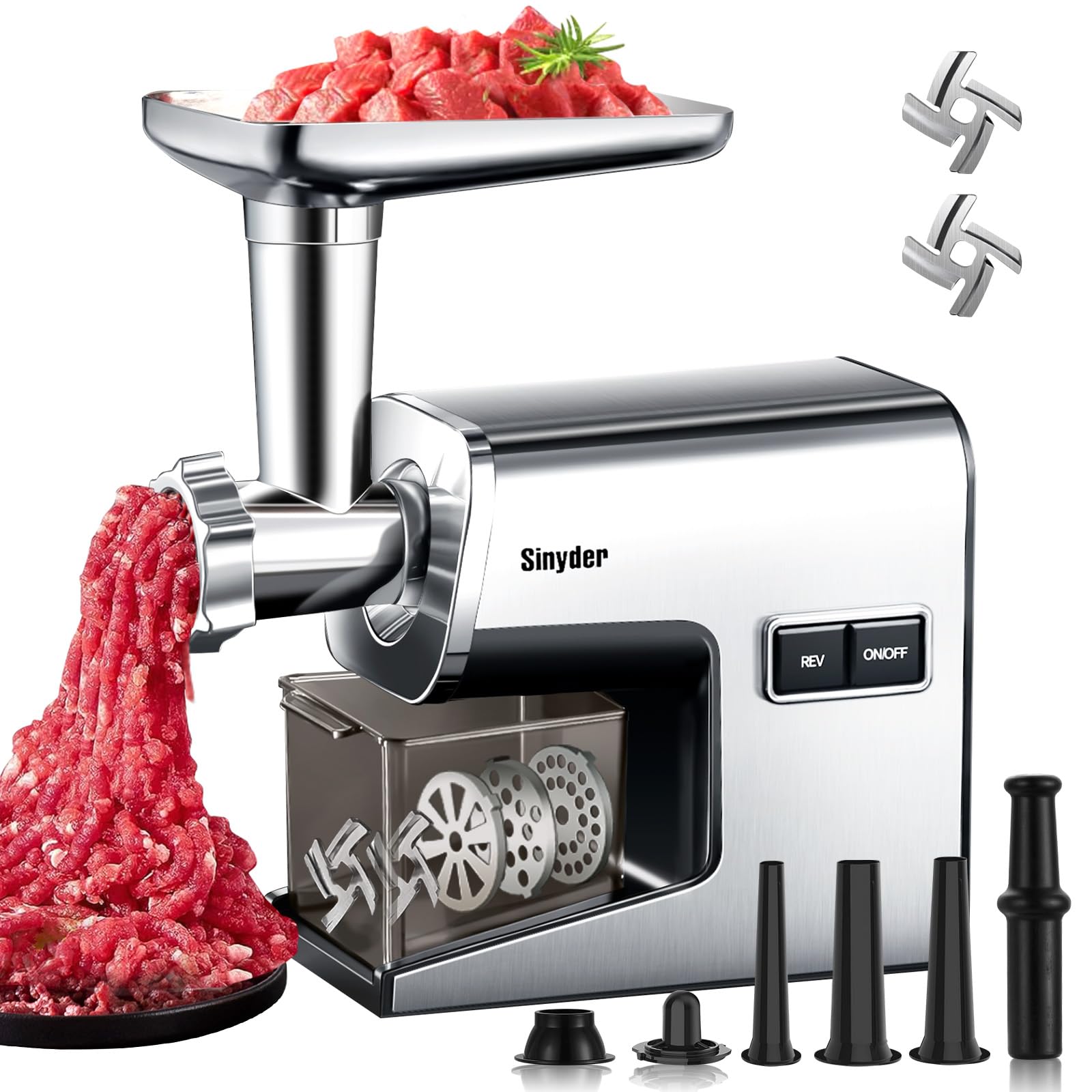
This is the grinder you buy when your “batch” isn’t two pounds—it’s a real project. If you grind deer, process big family freezer packs, or you’re the kind of cook who makes homemade sausage in enough volume to justify doing it properly, the Sinyder is designed to feel stable and durable while doing sustained work.
Two things in owner feedback stand out: the motor feels strong under load and the machine feels “solid” (not flimsy plastic energy). That matters because big-batch grinding isn’t only about raw power—it’s about how confidently you can keep a steady feed rate without the machine stuttering, walking on the counter, or heating up instantly. The metal gear detail is also not a throwaway spec; it often correlates with that “I can trust this” feeling during longer sessions.
From an expert workflow perspective, this is where the Sinyder shines: it encourages a professional rhythm. You can set up a tray system (chilled meat cubes in, ground meat out), keep the head cold, and maintain a steady grind without constant intervention. Owners who’ve run large quantities often mention it handling the job “without a hiccup,” which tells you the auger + blade + plate combination is doing its job efficiently.
One subtle but important lesson that pops up in reviews: don’t treat it like a dishwasher-first appliance. Some attachments may be dishwasher safe, but key grinder components often aren’t. If you’re willing to do the classic “hand wash, towel dry, air dry” routine, this type of grinder becomes a long-term kitchen asset.
Why it stands out
- Confidence in longer sessions – Built to feel steady when you’re processing real quantity.
- Versatile accessory kit – Plates + sausage tubes + kibbe kit cover a wide range of home projects.
- Strong build feel – Owners often compare it favorably to cheaper plastic grinders they outgrew.
- Practical controls – One-button operation plus reverse makes it easier to recover from clogs.
Good to know
- Like most heavy-duty grinders, it rewards good prep: trim membranes, chill meat, and avoid forcing the pusher.
- Some parts need hand washing—plan a simple cleaning routine so you don’t delay cleanup (delays are where grease turns into a “project”).
- Grinding vegetables can be frustrating; grinder plates are designed for meat texture, not wet fiber-heavy produce.
Ideal for: hunters, bulk buyers, and serious batch-prep households who want a grinder that feels sturdy during bigger jobs and comes with the attachments to expand beyond basic ground meat.
3. AAOBOSI Touch Screen Meat Grinder – Modern Controls, Cleaner Workflow

Some people love “simple knobs forever.” Others want a machine that feels like it belongs in a modern kitchen—clean interface, intuitive modes, and fewer moments where you’re trying to remember what button does what. If you’re the second type, this AAOBOSI touch screen model is a great pick because its features solve real problems, not imaginary ones.
The star feature here is the anti-jam approach. Jams happen to everyone eventually—usually when a strand of fascia wraps around the auger or when the meat warms up and gets stringy. The auto-reverse function is valuable because it turns “panic” into “pause, recover, continue.” Instead of forcing the pusher (which is how people overheat motors), you get a smoother recovery loop that’s kinder to the machine.
The built-in accessory storage also matters more than it sounds. Most grinders come with a bunch of parts, and parts that aren’t easy to store become lost parts. Lost parts become “I guess we’re not making sausage tonight.” Keeping everything together increases your real-world usage rate—and that’s the difference between a grinder you “own” and a grinder you actually “use.”
This model is also a smart choice for households that grind more than one type of meat. Switching from beef to chicken (or doing a blend) is easier when the workflow is tidy: quick disassembly, clear parts, a clean interface, and a reset point that feels obvious. Owners frequently mention it grinding quickly and evenly, plus the stainless build giving it a sturdy, durable feel.
Why you’ll love it
- Auto-reverse reduces frustration – It helps you recover from jams without stressing the motor.
- Touch screen is genuinely intuitive – Easy for beginners and smoother for multi-step cooking.
- Built-in storage keeps your kitchen sane – Fewer loose parts, fewer “where is the tube?” moments.
- Fast, even grinding – Owners often describe consistent results and strong “home kitchen power.”
Good to know
- Even with auto-reverse, prep still matters: trim membranes and keep meat cold to protect texture.
- Avoid continuous long runs; use a steady batch rhythm to prevent heat buildup (especially during sausage work).
- Dishwasher-safe parts vary—hand wash the main grinder components if you want the finish to stay clean long-term.
Ideal for: home cooks who want a modern, low-stress grinding experience with smart anti-jam recovery and a cleaner “all accessories stored together” workflow.
4. Aiheal Electric Meat Grinder – Strong Value for Home Batches (With Smart Rest Breaks)

This is a classic “home grinder” value play: you get the plates you need, sausage tubes, a kibbeh option, and a stainless build— without paying for premium brand overhead or fancy interface features. And for a lot of families, that’s the exact right purchase: you want to grind your own meat a few times a month, maybe do some deer in season, and occasionally experiment with sausage.
Owner feedback tells you exactly how to get the best experience: treat it like a home machine, not a nonstop commercial unit. People report it grinding quickly and cleanly, handling sizable batches, and being easy to assemble and wash. But you’ll also see a consistent “pro tip” pattern: grind for a few minutes, then allow a short cool-down period. That isn’t a weakness—it’s normal for home equipment and actually a sign you’re using it correctly.
What I like most here is the practical accessory set. Three plate sizes cover a wide range of real recipes: coarse for chili meat, medium for burgers and meatballs, fine for dumplings and sausage texture. The sausage tubes also let you step into homemade sausage without buying a dedicated stuffer immediately. Is stuffing through a grinder slower and messier than a stuffer? Yes. But for small batches at home, it’s still incredibly satisfying—and very doable.
The key to loving this grinder is to cook like a pro: chill the meat, cut it evenly, remove tough membranes, and don’t overload the feed. Do that, and this machine behaves far above its “budget” category. Ignore that, and you’ll blame the grinder for what is really a technique problem.
Why it’s a great value
- Capable home performance – Handles common meats well when you feed steadily.
- Useful plate + tube options – Good flexibility for burgers, meatballs, dumplings, and beginner sausage runs.
- Easy breakdown for cleaning – Owners routinely mention straightforward disassembly and wash-up.
- Reverse function helps – A practical fix when you hit a sinew snag.
Good to know
- Respect cool-down breaks on big batches to protect the motor and avoid overheating.
- Attachments typically need hand washing and thorough drying—especially if you want to avoid oxidation.
- If you grind very large quantities often, a heavier-duty grinder will feel less “stop-and-go.”
Ideal for: home cooks who want an affordable, capable grinder for occasional big batches and everyday ground meat—especially if you’re happy to follow a smart “grind, rest, repeat” rhythm.
5. COOKLEE 12‑Cup Food Processor – The Meal‑Prep Multitasker

If your kitchen reality is “I chop everything,” a full-size processor can be the smartest purchase—because it replaces multiple tools, not just one. The COOKLEE 12‑cup model is built for that lifestyle: chop, mince, slice, shred, puree, and even handle dough. It’s a true meal-prep partner, not just a “meat thing.”
The biggest real-life benefit here is workflow speed. This kind of machine is what lets you do a full prep run without getting stuck in the slow lane: slice vegetables for stir-fry, shred cheese, mince onions and garlic, puree sauces, and prep fillings. For households that cook often, the time saved compounds fast.
There’s a learning curve note owners frequently mention: alignment matters. The bowl and lid lock system is designed for safety, and it won’t run unless everything is seated correctly. That’s a good thing, but it means you need a “calm setup habit”: line up the markings, twist into place, and don’t try to force it at an angle. Once you’ve done it a few times, it becomes automatic—and then the machine feels effortless.
For meat work specifically, this is best for mincing and mixing rather than “classic ground meat.” It excels at dumpling fillings, meat mixtures for meatballs, and quick mince for tacos or lettuce wraps. If you want burger-style ground texture with clean strands, you’ll still prefer a dedicated grinder. But if you want one appliance that supports a wide cooking range—and handles meat as part of that—this is a strong pick.
Why families love it
- True multi-function prep – Slice, shred, mince, puree, and dough work in one appliance.
- Safety-first dual-lock design – Won’t run unless assembled correctly, which reduces accidents.
- Sharp attachments – Owners often call out performance on slicing/shredding and the overall “strong for home use” feel.
- Dishwasher-friendly cleanup – Removable parts support faster clean-up after big prep runs.
Good to know
- Alignment is key—if you rush assembly, you may trigger error behavior until everything is seated correctly.
- For burgers, a grinder-style machine will produce a more classic “ground meat” texture.
- It’s a larger base than mini choppers, so plan your storage spot if your counter is tight.
Ideal for: meal-prep households that want one appliance to cover slicing/shredding/mincing tasks—plus occasional meat prep—without constantly switching tools.
6. Ganiza Upgraded Button Chopper – The “Perfect Pulse” Weeknight Hero

This is the kind of chopper that quietly becomes “the most used tool in the kitchen.” Why? Because it nails the one thing weeknight cooks actually care about: control. You can pulse in short bursts and get clean, even pieces—without turning onions into water, herbs into sludge, or meat into paste. That’s a big deal, because most bowl choppers are either underpowered (uneven chunks) or too aggressive (instant mush).
Owners repeatedly praise the cut quality: it cuts rather than tears, pulls ingredients into the blades efficiently, and creates an impressively even mince when you pulse properly. That last part matters: pulse control is the skill that separates “great results” from “why is this soup?” And Ganiza’s button design makes pulsing easier on your hands—less fatigue, better rhythm, more repeatable outcomes.
The dual-bowl setup is not just a nice bonus—it’s a hygiene win and a flavor win. You can reserve stainless for meat tasks and glass for vegetables, herbs, and sauces, which helps avoid lingering smell transfer and “onion perfume” in everything you chop. Owners also love the sturdiness of the thick glass bowl (just treat it like glass: no hot water shock, no careless drops).
The overheat protection light is one of those features that looks small on the listing but feels big in real life. It gives you feedback. Feedback changes behavior. Behavior extends lifespan. Instead of guessing “am I overworking this?”, you get a clearer cue to pause, scrape the sides, or let it rest. That’s how a compact chopper survives daily use.
Why it’s a standout
- Excellent “pulse control” feel – Easy to stop at the exact texture you want.
- Very even chopping – Owners repeatedly highlight consistent results without watery mush.
- Dual-bowl hygiene advantage – Use separate bowls for meat vs vegetables to reduce cross flavor and odor.
- Smart overheat feedback – Helps you protect the motor during frequent use.
Good to know
- Like all bowl choppers, it rewards pulsing over long continuous runs (especially with onions and soft ingredients).
- Glass is durable, but it’s still glass—avoid hot water shock and store it where it won’t get bumped.
- For classic burger-grind texture, a plate-style grinder will still be the best tool.
Ideal for: busy cooks who want fast, even chopping for vegetables and meat mince—and who care more about control and consistency than about “commercial grinder” fantasies.
7. GANIZA Dual‑Bowl Processor (Blue) – Compact Power for Baby Food, Pet Food, and Prep

This GANIZA dual-bowl unit is a “small appliance that gets used constantly” kind of purchase. It’s compact, powerful enough for everyday chopping tasks, and designed around a workflow home cooks actually live with: one bowl for meat tasks, one bowl for everything else, quick pulse control, easy cleanup, repeat.
A pattern that shows up in real owner notes is how practical it feels for non-glamorous real life: making dog food, prepping baby food, chopping vegetables in seconds, and handling small-to-medium meat tasks without turning your kitchen into chaos. That’s the real win. It’s not trying to be a butcher shop machine. It’s trying to make daily cooking easier—and it succeeds.
Two bowls matters here more than most people expect. Stainless is excellent for meat and strongly flavored ingredients because it tends to be less “odor clingy” over time, while glass is great for visibility (you can watch texture change as you pulse). The “two blade sets” angle is also practical because sharp blades are performance—and performance is time. Having a spare blade set means you can rotate or replace without turning your machine into a paperweight.
My expert tip for this style of chopper: use short pulses, scrape once, pulse again. That’s how you get even pieces instead of a top layer of chunks and a bottom layer of paste. Also, don’t overload the bowl—overfilling is the fastest way to get uneven results.
Why people keep using it
- Compact but strong – Feels powerful for its size and doesn’t hog counter space.
- Two bowls = cleaner workflow – Better hygiene and less flavor transfer between tasks.
- Fast results – Seconds to chop vegetables, fruits, and mince ingredients.
- Easy cleanup – Removable blades and bowls support quick wash-and-reset cooking.
Good to know
- Use pulses for best texture control—continuous runs can overprocess soft ingredients fast.
- Let the unit cool if overheating protection triggers; it’s a safety feature doing its job.
- It’s not a plate-style grinder, so don’t expect classic “ground meat strands” for burgers.
Ideal for: households that want a compact, frequently-used prep machine for baby food, pet food, vegetables, and meat mince—without the bulk of a full-size processor.
8. GANIZA Dual‑Bowl Processor (Grey) – The “Separate Bowls, Faster Prep” Advantage

If you meal prep even a little, you know the truth: the worst part isn’t cooking—it’s repetitive chopping. This GANIZA grey dual-bowl unit is designed for the kind of prep flow that makes weekly cooking feel light: chop onions and peppers, mince garlic, prep herbs, then switch to meat mince in the stainless bowl without the “wash everything first” delay.
That dual-bowl separation is the core value here. It’s not just about avoiding flavor transfer; it’s about speed. You can keep momentum. Momentum is the difference between “I’ll cook at home” and “let’s order again.” And because it’s a two-speed machine, you can choose a slower approach for softer ingredients and a faster approach for tougher ones. That gives you better texture control and reduces the chance of accidental puree.
This style of chopper also shines for mixed recipes—think dumpling filling, meatball mixes, or taco mince with onion and herbs. A dedicated grinder will produce a more classic “ground” texture, but a bowl chopper can produce a better “mixed” texture for certain dishes because it combines ingredients efficiently without a separate mixing step.
To get the best results, think in layers: add meat in cubes, pulse to break it down, then add aromatics and pulse again. If you throw everything in at once, you’ll often get uneven processing (fine at the bottom, chunky at the top). A two-step approach makes the machine feel smarter than it is—and gives you better, repeatable results.
Why it’s great for meal prep
- Dual-bowl workflow – Faster prep and cleaner separation between meat and vegetables.
- Two-speed control – Helps prevent accidental overprocessing on softer ingredients.
- Fast daily chopping – Designed for frequent use, not “special occasion” prep.
- Easy to clean – Detachable parts make it easy to reset and move on.
Good to know
- Don’t overfill—overfilling reduces circulation and leads to uneven results.
- If the motor gets warm, pause and let it cool; consistent use is best with short sessions.
- For sausage-making and true ground meat texture, a grinder remains the better tool.
Ideal for: meal preppers and weeknight cooks who want speed, bowl separation, and predictable control for both vegetable chopping and meat mincing.
9. GANIZA Dual‑Bowl Processor (Black) – The Straightforward “Do the Basics Well” Choice

Some buyers don’t want “smart lights” or fancy interfaces. They want a machine that shows up, does the job fast, and stores easily. This GANIZA black dual-bowl unit is that kind of product. It’s built around the essentials that matter in real kitchens: good blades, two practical bowls, and a simple two-speed approach that fits everyday cooking.
The strength of this style is versatility without complexity. Chop onions in seconds. Mince garlic. Make guacamole. Prep salsa. And when you need to mince meat for dumplings, meatballs, lettuce wraps, or quick taco filling—swap to the stainless bowl and pulse to your preferred texture. The two-bowl system is the reason these units get loved: it makes the workflow feel clean and organized without needing extra tools.
Expert tip: treat this like a “precision pulse” machine, not a blender. For onions and watery vegetables, do short pulses and stop while pieces still look slightly larger than you want. Carryover chopping happens as ingredients settle and blades continue moving. For meat, keep it cold, cut into cubes, and pulse in bursts—then scrape the sides once and pulse again. That technique produces a mince that looks intentional instead of overworked.
If you’re choosing among multiple dual-bowl options and you want the most straightforward “buy it and use it” approach, this one earns its spot. It’s the kind of machine you can give to a busy parent or a new cook and they’ll figure it out immediately.
Why it’s easy to live with
- Simple two-bowl setup – Clean separation for meat vs vegetables, less odor carryover.
- Fast everyday results – Great for quick chops that would otherwise slow dinner down.
- Compact storage – Fits real kitchens where cabinet space matters.
- Easy to learn – Minimal “figuring it out” before you get good results.
Good to know
- Like all bowl choppers, pulsing is the secret; long runs can turn ingredients into paste fast.
- Glass bowls are strong but should be treated gently—avoid temperature shock and hard drops.
- If your goal is sausages and classic ground meat strands, step up to a grinder.
Ideal for: small kitchens and practical cooks who want a straightforward dual-bowl chopper that handles everyday ingredients quickly and cleanly.
10. KOIOS 500W Food Chopper – Compact, Strong, and Surprisingly Precise

KOIOS tends to attract a very specific type of buyer: someone who wants compact storage but refuses to tolerate weak performance. And this 500W dual-bowl chopper fits that personality. Owners often describe it as “more powerful than expected,” especially for tasks like chopping meat for salad-style mixes, pureeing cooked vegetables quickly, or doing fast weeknight prep without dragging out a full-size processor.
The two-bowl setup here is practical for the same reasons as Ganiza: separation and workflow. But KOIOS adds a “power pod” style top motor that makes the unit easy to store—lift the pod, rinse the bowls, done. That top motor design does have a real-life cleaning consideration: you want to wipe down the underside and any recess areas where mist or tiny food particles can travel. It’s a quick wipe, but it’s a habit worth building if you want long-term cleanliness.
The blade design is also a real advantage. Bi-level “S” blades tend to pull ingredients down and circulate them more effectively than some single-plane designs, which is why you’ll see faster, more even results—especially if you pulse rather than run continuously. This is one of those machines where technique turns it into a “wow” tool: pulse 3–5 times for vegetables, scrape once, pulse again; for meat, pulse in short bursts while it’s cold.
I also like that KOIOS is honest about overheating protection behavior. That’s a sign the machine is designed to protect itself, which is exactly what you want if you’re buying a compact unit to use frequently. The best compact choppers aren’t the ones that “never stop”—they’re the ones that stop before damage happens.
Why it’s a smart buy
- Strong performance in a compact size – Great for small kitchens that still want fast results.
- Two bowls keep flavors clean – Easier to keep meat tasks separate from veg/sauce tasks.
- Bi-level blades improve circulation – Helps create more even chopping with fewer pulses.
- Protection systems built in – Overheat safeguards support longevity if you use it often.
Good to know
- Wipe the underside of the motor pod after use; it keeps things sanitary and prevents residue build-up.
- Hold the bowl steady during operation if your counter is slick—compact units can vibrate on high power.
- Dishwasher temperature guidance matters for plastics; if you use the dishwasher, keep it gentle.
Ideal for: people who want a compact, powerful prep tool for frequent use—especially if you love quick mince, sauces, and small-batch meal prep.
11. BUMET 500W Dual‑Bowl Chopper – Fast Results, Smart Safety, Small Storage
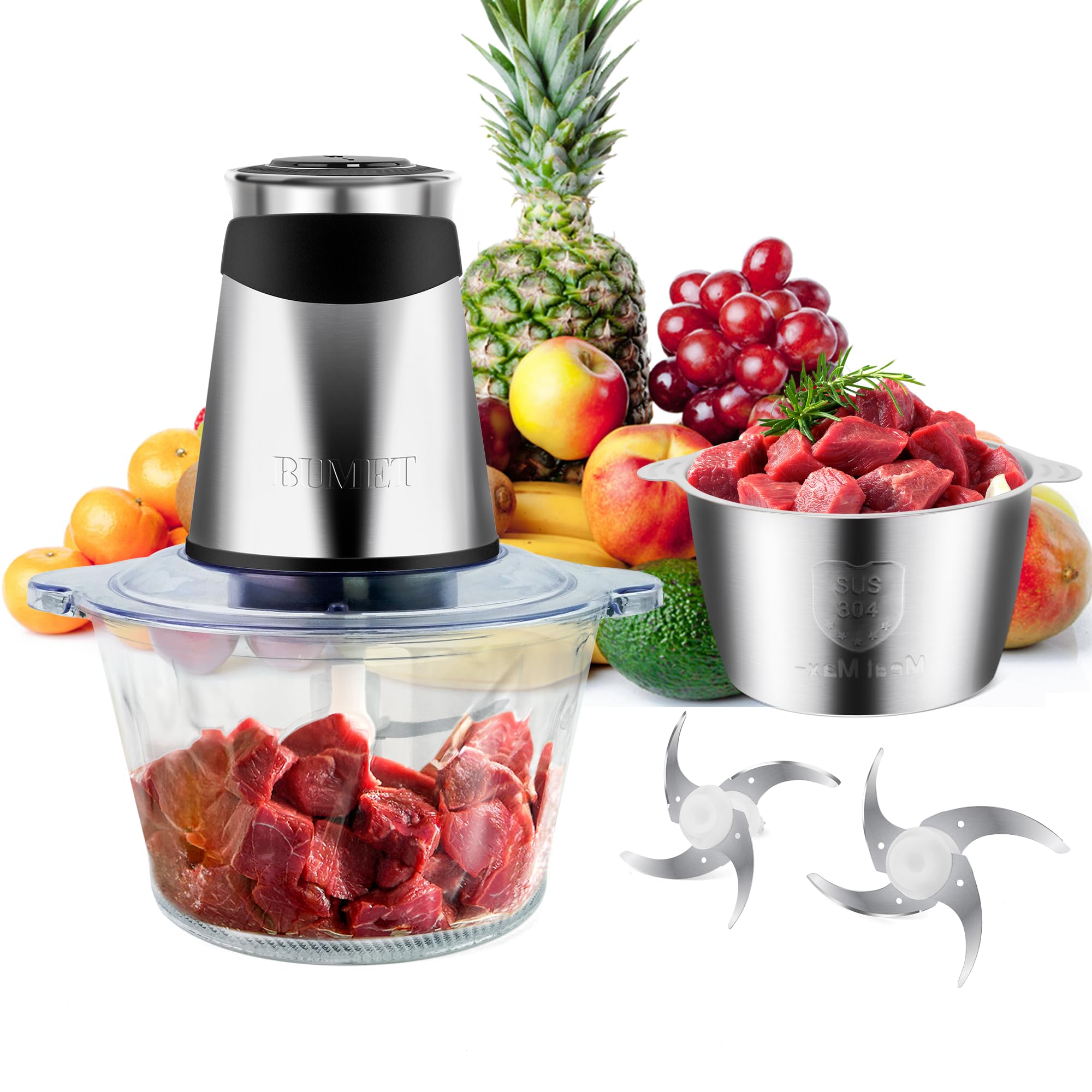
The BUMET is a classic “I want speed and I want it cheap, but I still want it to feel safe” buy—and it earns that position well. Owners love how quickly it chops (seconds, not minutes), how compact it is compared to full-size processors, and how the safety system prevents the motor from running unless everything is seated correctly. That’s exactly what you want in a household where people might rush prep.
Where it really wins is the everyday usability: it doesn’t take over your counter and it doesn’t require a long setup ritual. The dual-bowl setup is again the real-life hero here: glass for visibility and sauces, stainless for meat tasks or strong-smelling ingredients. The non-slip base concept also helps reduce the “machine dancing” problem—especially when you’re pulsing quickly.
Now for the honest expert-level warning that separates good buying from regret: a handful of owners report blade rust. That doesn’t mean “this product is bad,” but it does mean you should adopt a pro drying habit: wash immediately, dry thoroughly, and don’t leave metal parts wet on the counter or soaking in the sink. Rust is usually a storage-and-drying issue more than a chopping issue. If you’re someone who routinely leaves parts damp overnight, pick a machine where you’re comfortable being strict about drying.
If you treat it correctly, this can be a fantastic little workhorse—especially for veggie chops, salsa prep, and quick mince for cooked meat or cold, cubed meat in small batches. If you want true ground-meat texture for burgers, move up to a grinder. But for speed and daily prep convenience, this is a strong budget contender.
Why it’s loved
- Very fast chopping – Great for onions, garlic, herbs, and quick prep runs.
- Compact storage footprint – Easy to put away and actually keep using.
- Dual-bowl flexibility – Helps keep meat tasks separate and reduces smell carryover.
- Safety-focused design – Motor won’t run unless assembled properly.
Good to know
- Dry blades thoroughly to reduce rust risk—don’t leave metal parts wet or soaking.
- Pulsing gives better control than long runs (especially with watery vegetables).
- For large meat batches and classic ground texture, a dedicated grinder is the better tool.
Ideal for: budget shoppers who want fast daily chopping and a dual-bowl setup—especially if you’re willing to be disciplined about drying metal parts.
12. KitchenAid 3.5‑Cup Food Chopper – The Sauce, Dressing, and Small-Prep Legend

This isn’t the machine you buy to grind 20 pounds of meat. It’s the machine you buy because you’re tired of chopping small stuff by hand and you want a compact tool that does small batches beautifully. The KitchenAid 3.5‑cup chopper is one of those appliances that earns long-term loyalty because it fills a daily niche: pico de gallo, chopped herbs, quick onions, salad dressings, aioli, mayo, sauces, and “tiny prep” that still takes time when done manually.
The drizzle basin is a deceptively powerful feature. It enables emulsions and dressings in a controlled way without stopping the machine, which is exactly what you want when you’re making mayo, aioli, or a smooth dressing and you don’t want to babysit the process. And the two-speed behavior is actually useful: one speed for chopping, one for blending/pureeing—so it’s not just “two buttons that feel identical.”
Real-life user notes also highlight a couple truths: chopping performance is excellent for the size, cleanup is easy, and the footprint is tiny enough that you’ll actually keep it accessible. The main complaint is usually about the lid: it can feel finicky or annoying to separate for deep cleaning, and some people wish the control design was more straightforward. That’s not a dealbreaker, but it’s worth knowing if you’re someone who gets irritated by “fussy lid engineering.”
If you pair this with a larger grinder or bowl chopper, it becomes the perfect companion tool: use the grinder for meat texture, then use the KitchenAid for sauces and finishing prep that makes meals taste “restaurant-level.” That’s where this little machine becomes a serious upgrade to your cooking life.
Why it’s a classic
- Perfect for small batches – Sauces, dressings, herbs, quick veggie chops without a big setup.
- Drizzle basin is genuinely useful – Makes emulsions and dressings easier and more consistent.
- Compact and easy to store – The kind of appliance you keep accessible and actually use.
- Two-speed results feel distinct – Low for chopping, high for blending/pureeing style tasks.
Good to know
- Not designed for large meat grinding—think sauces and small prep, not bulk processing.
- The lid can be temperamental for some users; take a minute to learn the clean-and-separate routine.
- If your main goal is burger or sausage texture, start with a grinder and add this later.
Ideal for: home cooks who love sauces, dressings, and small-batch prep and want a compact chopper that’s easy to use daily—especially as a companion to a larger machine.
How Grinding & Chopping Actually Works (and Why Technique Beats Wattage)
Most disappointing results aren’t caused by “bad machines.” They’re caused by heat, overload, and the wrong workflow. Once you understand what’s happening inside the head or bowl, you can get pro-level results from home equipment.
The “clean texture” formula: cold + sharp + steady
- Cold: cold meat holds structure and cuts cleanly. Warm meat smears and sticks. Chill cubes and (if possible) chill metal parts.
- Sharp: a blade that bites cleanly gives you crumbles or strands. A dull edge gives you paste.
- Steady: feed at a consistent pace. Don’t force the pusher. Pressure creates friction, friction creates heat.
If your grind looks glossy or sticky, don’t change your recipe first—change your temperature. If your chopper makes watery onion mush, don’t blame the blades—use pulses and stop sooner. These are technique issues that feel like “machine issues” until you see the pattern.
How to prevent jams without babying the machine
- Trim membranes: the thin shiny “silver skin” and tough tendon strands are the #1 clog culprit.
- Cut evenly: consistent cubes feed more predictably than random chunks.
- Use reverse early: when you hear strain, don’t power through—reverse, clear, continue.
- Don’t grind the wrong materials: fibrous vegetables can wrap and clog grinder heads; use a chopper/processor for those.
Why “overheating” is usually a workflow problem
- Continuous running builds heat even if you’re not actively feeding meat. Motors warm the head over time.
- Stuffing through a grinder is heavier work than grinding alone. Expect to pause more often during sausage making.
- Overfilling choppers makes motors work harder because circulation gets blocked and blades fight dense mass.
A “pro” approach is simple: do short bursts, scrape once, let the machine rest briefly during big work, and keep everything cold. That rhythm protects your texture and extends your machine’s life.
How to get better results instantly (no new equipment)
- Do a two-pass strategy when you want clean texture: a first coarse pass, then a second pass for finer texture.
- Use pulses for choppers and stop early—carryover chopping makes food finer after you release the button.
- Dry and store metal parts correctly to avoid rust and to keep edges clean.
This is the hidden truth: the best results come from pairing a decent machine with a smart technique. That combo beats “buying the biggest number” almost every time.
FAQ: Buying and Using a Home Grinder or Chopper (Without Guesswork)
What’s the difference between a meat grinder and a bowl chopper for meat?
Why does my ground meat sometimes turn into paste?
Can I grind vegetables in a meat grinder?
What plate size should I use for burgers, meatballs, and dumplings?
Is stuffing sausage through a grinder “good enough”?
How do I avoid rust on grinder plates and blades?
Why do some bowls slide or vibrate during chopping?
Final Thoughts: The Meat Chopper Machine You’ll Love Using Every Week
The right choice isn’t about chasing the biggest motor number—it’s about matching the machine to your real cooking life: your recipes, your batch size, your tolerance for cleanup, and how much you care about texture.
If you want one confident purchase, pick the meat chopper machine that solves your most annoying problem: jams, uneven chopping, too much manual prep, or a cleanup routine that makes you avoid cooking at home. Here’s the quickest way to translate this guide into the right buy.
- Want the best balanced “one machine” grinder? Start with the AAOBOSI 4‑in‑1 Electric Meat Grinder. It’s versatile in a way that actually fits normal kitchens.
- Grinding big batches (hunting season, freezer packs, bulk prep)? Choose the Sinyder Heavy Duty Electric Meat Grinder. It’s built for sessions where “a few pounds” is just the warm-up.
- Want the most modern, low-stress grinder experience? The AAOBOSI Touch Screen Meat Grinder is the pick for smart anti-jam recovery and tidy accessory storage.
- Need a budget-friendly true grinder that still feels capable? Grab the Aiheal Electric Meat Grinder and use a smart “grind, rest, repeat” rhythm for bigger jobs.
- Want one appliance for slicing/shredding/mincing plus occasional meat prep? The COOKLEE 12‑Cup Food Processor is the meal-prep multitasker.
- Want the most even, controlled chopping for weeknights? The Ganiza Upgraded Button Chopper is the “perfect pulse” option that many people end up using constantly.
- Want compact dual-bowl prep power for daily use? Pick your preferred color/listing of GANIZA dual-bowl models: Blue, Grey, or Black.
- Want compact power with a strong performance feel? The KOIOS 500W Food Chopper is a great “small but serious” option.
- Want a budget dual-bowl setup with speed? The BUMET 500W Dual‑Bowl Chopper is fast and compact—just be disciplined about drying metal parts.
- Want a tiny daily tool for sauces and dressings? The KitchenAid 3.5‑Cup Food Chopper is a small-batch legend that upgrades everyday cooking instantly.
Pick the machine that matches your real kitchen rhythm, learn the “cold + pulse + steady feed” method, and you’ll get results that feel deliberate—every single time.
