
If you want two foods done together without timing chaos, Gourmia’s 10‑qt dual-basket air fryer is a strong value—big, simple, and built for real dinners.
Full Technical Specs (Quick, Accurate, Useful)
| Spec | Gourmia 10 Qt Dual Basket Digital Air Fryer (GAF966 / GAF966CA) |
|---|---|
| Capacity |
10 qt total (9.4 L) Dual-zone: (2) baskets, ~5 qt (4.7 L) each |
| Cooking zones |
2 independent zones (Zone 1 + Zone 2) Smart Finish syncs end times for different foods Match Cook mirrors settings across both baskets |
| Cooking functions (7) | Air Fry, Bake, Roast, Broil, Dehydrate, Reheat, Keep Warm |
| Temperature range |
Air Fry / Bake / Roast / Reheat: 170–400°F Broil: 400°F (fixed) Dehydrate: 90–170°F Keep Warm: 150–200°F |
| Time range |
Air Fry / Reheat / Broil: 1–60 min Bake / Roast: 1 min–2 hours Dehydrate: 30 min–24 hours Keep Warm: 1 min–8 hours |
| Power | 120V~ 60 Hz, 1600W |
| Controls |
Touch control panel Optional Preheat + Turn Reminder prompts Sound mute toggle (beeps) °F / °C toggle |
| Size & weight |
14″D × 16″W × 14.5″H 17.5 lb (approx.) |
| Materials |
Metal + plastic + stainless steel accents Nonstick-coated baskets + removable crisper trays |
| Cleaning |
Dishwasher-safe baskets & crisper trays (top rack recommended) Hand-wash friendly with non-abrasive sponge |
| Warranty | 1-year limited warranty (proof of purchase required; US validity noted in manual) |
On smaller screens, swipe sideways to view the full table.
At A Glance: The Breakdown
Gourmia Dual Basket Air Fryer — 10 Qt (GAF966CA)
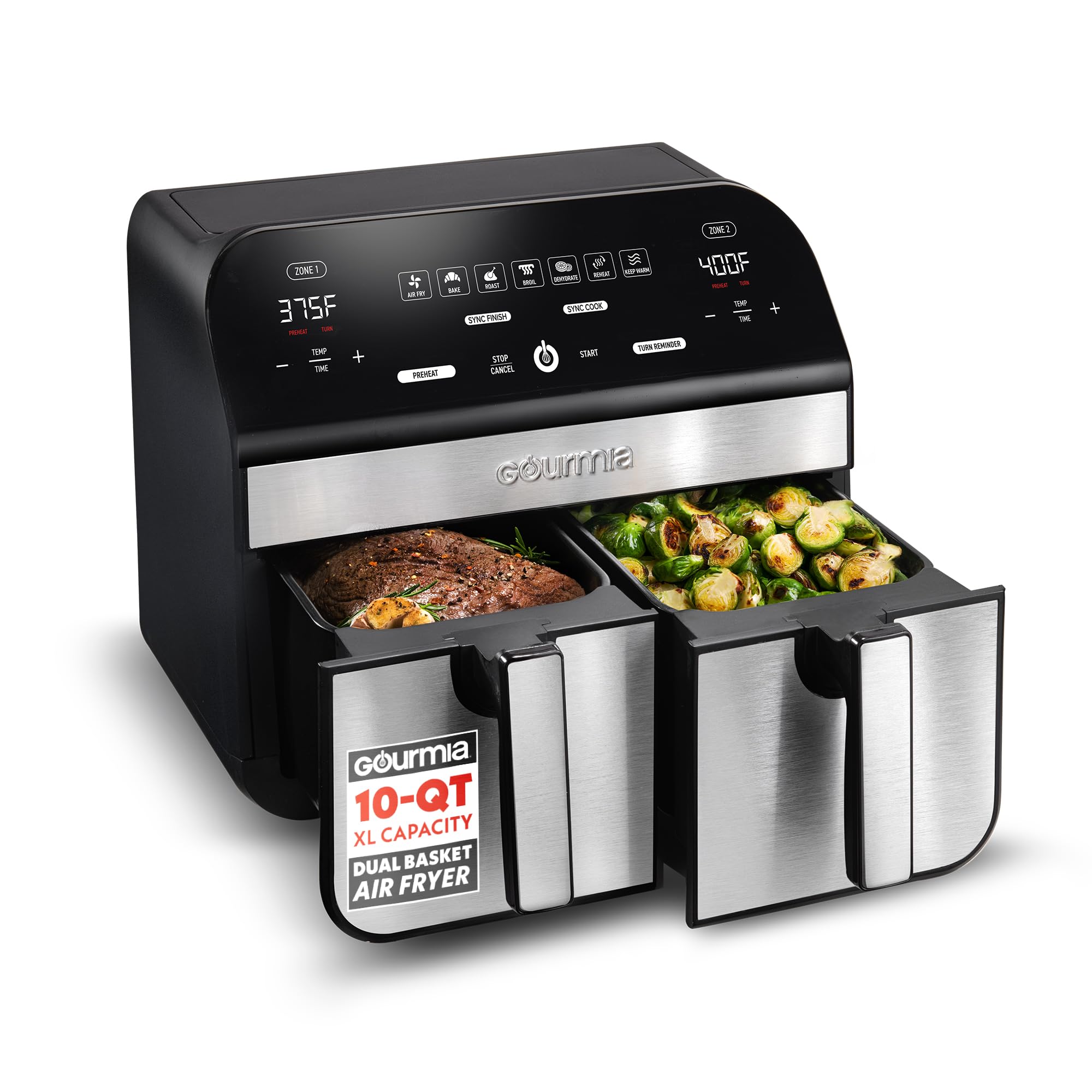 Check Price on Amazon
- Best For: Families, meal-preppers, and “two-food” dinners (protein + side) without juggling the oven
- Signature Feature: Smart Finish syncs end times when foods need different temps and cook lengths
- Big Reality Check: It’s a large countertop appliance—plan your space and airflow clearance
- Controls: Simple touch interface + optional preheat + optional “turn food” reminder
- Cleanup: Dishwasher-safe baskets and crisper trays (top rack is the gentle move)
- Great When: You want crispy results with minimal oil and you like guided prompts
- The Catch: Like any budget-friendly dual-zone unit, performance depends on not crowding and being smart with timing
Jump to what you care about:
- The 60-second verdict
- Smart Finish vs Match Cook (the real reason this exists)
- Countertop space & “big and bulky” reality
- Daily workflow (controls, prompts, settings)
- Crispiness & cooking results (what makes it “work”)
- Preset-by-preset deep dive
- Cleaning & durability (how to keep it nonstick)
- Common mistakes that make any dual-basket fryer “feel weak”
- Who should buy (and who shouldn’t)
- FAQ
I’m going to be blunt in the most helpful way: most reviews of dual-basket air fryers are written like a shopping receipt. They list “two baskets,” “touch screen,” and “dishwasher safe,” then they tell you to buy it.
That’s not what you need. What you actually need is confidence—confidence that you understand how a dual-zone air fryer behaves when you’re tired, hungry, and trying to cook a real meal (not just frozen fries) without turning dinner into a timing puzzle.
So in this Gourmia Dual Basket Air Fryer Review, I’m going to do the useful thing: I’ll explain how this model fits into real kitchens, what the features mean in practice, where people get amazing results, where they get disappointed, and how to use the machine in a way that makes it feel like a “cheat code” instead of a bulky gadget.
If you stick with me, you’ll finish this guide knowing whether the Gourmia dual-basket style is the right tool for you—and if it is, you’ll know how to get the crispy, even results that make people use it almost daily.
Gourmia Dual Basket Air Fryer Review: The 60-Second Verdict
If you want the fast answer, here’s the decision framework I use:
- This is a smart buy if your typical meal looks like protein + side and you want both to finish together without babysitting the oven.
- This is a smart buy if you like the idea of cooking two different foods at two different temperatures (and not serving one of them cold).
- This is a smart buy if you’re okay with a large appliance on the counter and you’re willing to give food a little breathing room instead of cramming the baskets.
- You should skip it if counter space is tight or you need one giant, wide, single basket more than you need two zones.
- You should skip it if your cooking style is mostly very greasy foods (lots of rendered fat), because that’s where air fryers can smoke and get annoying if you don’t manage it well.
Now let’s get into the part that actually matters: why dual-zone cooking can be incredible… and why some people buy a dual-basket unit and still feel like dinner takes too long.
What You’re Really Buying: Two-Zone Timing Control
Here’s the key insight: a dual-basket air fryer isn’t “a bigger air fryer.” It’s a two-zone cooking system. The win isn’t capacity alone. The win is timing.
Most weekday dinners fail for one reason: the foods don’t finish at the same time. Your chicken is done… your vegetables are still pale. Your salmon is perfect… your fries need “just five more minutes.” Then the first food gets cold while the second food catches up.
Gourmia solves that weekday reality with two features that sound similar but behave very differently:
1) Smart Finish: Different Foods, Same Finish Line
Smart Finish is the feature that makes a dual basket actually feel “premium.” You set each basket independently (temperature and time), and the machine sequences the start times so both zones finish together. The manual even shows “Hold” as a display state—meaning one zone can intentionally wait while the other runs. That’s the system doing timing math for you.
Why it matters: This is how you do “steaks in one basket, vegetables in the other” without guessing. It’s also how you do “reheat leftovers” alongside something that needs higher heat to crisp.
2) Match Cook: One Big Batch, Same Settings
Match Cook is for the opposite scenario: you want the same settings on both baskets to create a “full-capacity” batch. That’s the move for party wings, big fries nights, or meal prep when you don’t want to cook in waves.
Why it matters: Dual baskets only feel like a win if you actually use both. Match Cook removes the friction of setting Zone 1, then copying everything manually to Zone 2.
Once you understand the difference, you stop shopping this like a gadget and start using it like a system.
Size, Weight, and the “Big and Bulky” Truth
Let’s address what people notice immediately: this is not a cute little air fryer. It’s designed to feed more than one person—so yes, it’s going to take up real counter real estate.
On paper, you’re looking at roughly 14″ deep × 16″ wide × 14.5″ tall, and around 17.5 pounds. In real kitchen terms: it’s wide, it’s stable, and it’s not something you casually shove to the side with one hand while you wipe the counter.
The more important point is airflow. The user manual is specific about leaving at least 4 inches of free space around the unit (back, sides, and above). That’s not legalese—it’s how you keep hot air moving properly and avoid heat bouncing into cabinets or walls.
My practical advice: before you buy any large dual-basket unit, measure the space where you plan to park it. Not just the footprint—also the “breathing room.” If you’re putting it under low cabinets with no clearance, you’re going to hate the experience, no matter how good the cooking performance is.
Daily Workflow: Why This One Feels Easy (When You Use It Right)
This model’s day-to-day usability comes down to one thing: the control panel is built for two zones without turning your brain into a spreadsheet.
You pick Zone 1 or Zone 2, choose a function, set time and temperature, and hit start. That’s the baseline. But the real “quality of life” features are the optional prompts and toggles—the stuff most reviews skip because it sounds boring.
Optional Preheat: Helpful, But You Should Use It Strategically
Preheating helps air fryers crisp faster because food starts in an already-hot environment. Gourmia gives you a PREHEAT toggle so you can turn it on when it matters (crisping, browning, “I want this to feel fried”) and turn it off when it doesn’t (basic reheating, gentle warming, dehydration).
Also important: the manual warns not to preheat with parchment paper or liners unless food is already in place to hold it down. That’s a real-world safety detail—air fryers have fans, and loose liners can move.
Turn Reminder: The Difference Between “Okay” and “Evenly Crisp”
The TURN REMINDER feature is underrated. Shaking, tossing, or flipping halfway through is how you get even browning—especially for fries, nuggets, small vegetables, or anything piled up.
What I like about having it built in is simple: on a busy night, reminders save you from “out of sight, out of mind” cooking—where one side crisps and the other steams.
Sound Mute + °F/°C Toggle: Small Features, Big Sanity
There’s a built-in sound mute toggle for beeps, plus an easy way to switch between Fahrenheit and Celsius. These aren’t flashy, but they matter if you’re cooking while kids are asleep, or you’re sensitive to appliances that scream at you every time you touch a button.
The “Two-Basket Reality” the Manual Admits
Here’s something refreshingly honest: the cooking tips note that when cooking in both baskets simultaneously, you may need to add additional cook time to each zone. That’s not a flaw—it’s physics. Two zones running together can mean the system behaves slightly differently than a single basket unit, depending on what you’re cooking and how full it is.
Translation: if you load both baskets heavily and expect the exact same timing you saw in a single-basket recipe, you’ll think the machine is “slow.” If you plan for it (don’t crowd, shake when needed, add a little time), you’ll think it’s a weeknight cheat code.
Crispiness & Results: What Makes It “Work”
Gourmia markets this as FryForce 360° air frying—meaning powerful heated air circulation designed to cook evenly with little to no oil.
But crispiness isn’t magic. It’s a combination of:
- Airflow around food (not blocked by overcrowding)
- Surface dryness (water = steam = softness)
- Enough heat to brown (and the right time at that heat)
- Mid-cook movement (shake/flip for even exposure)
- A tiny bit of oil when crispness really matters (oil is a browning helper, not the “main cooking method”)
And this is where real owners tend to fall into two camps:
- Camp A (“It changed the way we cook”): They use both baskets intentionally—often protein in one, vegetables in the other—and lean on Smart Finish/Match Cook to make dinner easy.
- Camp B (“Why is this taking so long?”): They overload both baskets or treat it like an oven tray, then wonder why things aren’t evenly crisp.
So let me help you cook like Camp A.
Use Case 1: Protein + Vegetables (The Classic Dual-Basket Win)
A common real-life pattern is exactly what you’d hope: steak (or chicken) in one basket, vegetables in the other. People love this because it turns dinner into a single appliance workflow: season, set, walk away, come back to a complete plate.
The key move: use Smart Finish when the two foods have different needs. Vegetables often like a slightly different time/temperature than proteins, and Smart Finish makes that feel effortless instead of annoying.
Use Case 2: “Match Cook” for Big Batches
If your household does a lot of fries, wings, nuggets, roasted vegetables, or meal prep, Match Cook is the feature that makes 10 qt feel real. Without Match Cook, you’re essentially programming two machines. With it, you’re scaling one recipe across two zones.
The key move: don’t treat this like “double the food, same crowding.” Treat it like “two separate baskets, each with good airflow.” That’s how you get even browning instead of a mix of crispy + soft.
Use Case 3: Reheat That Doesn’t Taste Like the Microwave
A lot of people buy air fryers for “fried” food… and then fall in love with them for reheating. Reheat mode is basically the “make leftovers taste alive again” function—especially for pizza, fries, chicken, roasted vegetables, and anything breaded.
If you’ve ever reheated something in the microwave and thought “the flavor is fine but the texture is sad,” you understand the value immediately.
Use Case 4: Dehydrate and Keep Warm (The “Bonus Features” That Can Actually Matter)
Dehydrate isn’t a gimmick if you like making dried fruit, veggie chips, or jerky-style snacks. What matters is the lower temperature range and long time range—which this unit supports. Keep Warm is simpler, but it’s handy if one person eats later, or you’re trying to keep food ready while you finish the other basket.
Most people won’t buy it only for these. But if you’ll use them, they add value without adding complexity.
Preset-by-Preset Deep Dive (So You Know What To Press)
This air fryer has seven functions, and what matters isn’t the icon—it’s what the function is tuned for. Below is how I’d think about each one in a real kitchen.
| Function | Best For | How to get “great” results |
|---|---|---|
| Air Fry | Fries, wings, nuggets, veggies, “crispy everything” | Don’t crowd; preheat when crisp matters; shake/turn halfway; use a light oil mist when needed |
| Bake | Small bakes, pastries, reheating baked goods, “oven-ish” tasks | Use an oven-safe dish/pan inside the basket for batters; lower temp from standard oven recipes; watch browning |
| Roast | Vegetables, potatoes, proteins when you want “roasted edges” | Cut size matters; toss halfway; don’t overload; add time if both baskets are running |
| Broil | Fast top browning, finishing, crisping edges | Think “short and hot”; check early; great for finishing a protein or crisping a topping |
| Dehydrate | Dried fruit, veggie chips, jerky-style snacks | Slice evenly; avoid overlapping; expect long runs; plan the space because it’s on for hours |
| Reheat | Leftovers that should stay crisp (pizza, fries, chicken) | Use a lower temp than air-fry; don’t stack; check early; this is about texture revival |
| Keep Warm | Holding food while the other basket finishes | Keep it short; don’t expect crisp; it’s for timing and serving, not “cooking” |
On smaller screens, swipe sideways to view the full table.
The Preset Defaults Matter More Than People Think
Here’s why I care about defaults: they tell you what the machine is “expecting.” For example, Air Fry defaults hot and relatively short (because it’s assuming crisping), while Dehydrate defaults low and very long (because it’s assuming slow moisture removal).
If you’re the type who likes guidance, the default behaviors plus the prompts (preheat/turn reminder) make the machine feel intuitive. If you’re the type who likes control, the ranges give you room to tune.
Cleaning & Durability: How to Keep It Nonstick (and Keep Your Sanity)
One reason people use this kind of air fryer “almost every day” is that cleanup doesn’t feel like punishment. You’ve got removable baskets and crisper trays, and they’re designed to be straightforward to wash.
But here’s the expert-level part: the way you clean an air fryer determines whether it stays easy to clean.
Dishwasher-safe… but be smart about it
Yes, the baskets and crisper trays can go in the dishwasher. The manual specifically calls out the top rack as the safe move, and it also warns against abrasive cleaning tools and metal utensils that can damage the nonstick coating.
My practical rule: if you want nonstick to stay nonstick for the long haul, treat it like premium cookware. Use silicone tools, avoid metal scraping, and don’t “sandpaper” stuck-on bits with harsh pads.
The cooking spray mistake that quietly ruins coatings
This is a detail most people miss: the manual recommends using regular cooking oil (like an oil mister/spray bottle) instead of aerosol cooking spray, noting that cooking spray may damage accessories.
Why it matters: if you’ve ever had a nonstick pan turn sticky or hard to clean over time, this is one of the culprits. If you want crispness, use a light mist of oil or brush a small amount—not an aerosol that leaves residues.
Smoke and odor: what to expect (and what to do)
Air fryers are basically compact convection ovens. That means grease management matters. The troubleshooting section explains that white smoke can appear when greasy ingredients cause oil to leak into the basket and heat up, and it emphasizes cleaning after use.
Also, if you notice a “hot plastic” smell in the first few uses, the manual says that can be normal as new materials heat for the first time—and it should fade after those early runs.
Performance Reality: Where People Get Blown Away (and Where They Don’t)
Let’s translate real expectations into real outcomes.
What people love
- “Full meal at once” convenience: the dual-basket setup makes dinner feel simpler because you’re not running an oven + stovetop dance for basic meals.
- Even cooking (when not crowded): when airflow is respected, food can come out evenly browned and crisp.
- Ease of use: the interface is approachable—especially with Match Cook and Smart Finish doing the “boring work.”
- Cleanup comfort: removable nonstick parts keep it from becoming a “special occasion appliance.”
What can frustrate people
- Counter space: the footprint is real. If your kitchen is tight, the experience can feel like clutter.
- Timing surprises when both baskets are loaded: running both zones doesn’t automatically mean everything is fast—especially if you pack food in thick layers.
- Preheat feels slower for some users: if you’re coming from a smaller, single-basket unit, the preheat behavior may feel different.
- Reliability variance (rare but important): like many small appliances, you’ll see occasional reports of early failure—so warranty awareness matters.
The “secret” is that the frustrations usually show up when a dual-basket fryer is used like a wide oven tray. When it’s used like two baskets (airflow, spacing, shaking, timing), the strengths show up fast.
The 7 Mistakes That Make Dual-Basket Air Fryers Feel Disappointing
These are the mistakes I’d fix first if someone told me, “It’s not crisp” or “It takes forever.”
1) Overfilling (the #1 texture killer)
Air fryers need air circulation. When food is piled high or pressed together, it steams. The troubleshooting table literally calls out overfilling and “too many ingredients” as reasons food won’t cook evenly.
2) Not shaking/turning halfway
Fries, small vegetables, nuggets—anything layered—benefits from movement. The built-in Turn Reminder exists for a reason. If you want even browning, let the reminder be your friend.
3) Treating “two baskets” like “double capacity” without changing your approach
Two baskets are better than one, but they still need space. The best dual-basket strategy is: fill each basket reasonably, not both baskets aggressively.
4) Using the same oven instructions without adjusting
The manual suggests reducing temperature by about 25°F when following standard recipes or packaging instructions. That’s the difference between “outside too dark” and “even browning.”
5) Expecting identical timing when both baskets run
The cooking tips explicitly say you may need to add time when cooking in both baskets simultaneously. Plan for it, and you’ll feel smart instead of annoyed.
6) Using aerosol cooking spray on nonstick parts
If you want the baskets to stay easy to clean, avoid the spray mistake. Use an oil mister or brush oil lightly instead.
7) Cooking very greasy foods without a plan
Grease can smoke when it heats. If you do fatty foods, keep batches smaller, clean after use, and understand that “air frying bacon” is a different game than “air frying veggies.”
Who This Air Fryer Is Perfect For (And Who Should Pass)
Perfect for you if:
- You want two foods at once and you care about them finishing together (Smart Finish is the point).
- You cook for more than one person and a small basket air fryer feels limiting.
- You want an appliance that actually gets used because it’s simple to operate and clean.
- You like the idea of doing “main + side” without turning the oven on.
- You meal prep and want to scale a recipe across two baskets (Match Cook makes this easy).
Skip it (or rethink the style) if:
- Your kitchen has tight counter space and the footprint will annoy you every day.
- You frequently need to cook one very large, wide item that won’t fit nicely in a 5-qt basket format.
- You want “set and forget” results even when you pack baskets full (air fryers reward airflow, not crowding).
Gourmia Dual Basket Air Fryer Review: FAQ (Real Questions, Real Answers)
Can I cook two different foods at two different temperatures?
Yes—this is what Smart Finish is for. You set each zone independently, and it syncs finish times so both foods are ready together.
Can I make one big batch with the same settings?
Yes—Match Cook duplicates the settings across both baskets so you can scale a recipe without extra button work.
Do I need to preheat?
Not always. Preheating generally helps crisping and browning, and the manual says it “will generally deliver the best results,” but it’s optional and you can toggle it per zone.
Why does food sometimes take longer when I use both baskets?
This can be normal—especially when baskets are loaded. The cooking tips state you may need to add cook time when both baskets run simultaneously. The fix is usually: reduce crowding, shake/turn midway, and add a little time.
Can I put parchment paper in the baskets?
Yes, but don’t preheat with loose parchment/liners. The manual warns that liners should be secured by food so they don’t move around inside the unit.
Is it easy to clean?
Yes, as long as you keep up with it. Baskets and crisper trays are designed to be cleaned easily, and dishwasher use is supported (top rack is the gentle choice). Avoid abrasive tools and metal utensils on nonstick parts.
What if I notice smoke?
If you’re cooking greasy ingredients, oil can heat up and create white smoke. The troubleshooting guidance points to grease management and cleaning as the solution. Smaller batches and good cleanup usually prevent repeat issues.
My Practical “Make It Amazing” Setup (What I’d Do Week One)
If you want the “we use it almost every day” experience, here’s how I’d set yourself up for success fast:
- Pick a permanent spot with at least a few inches of breathing room on all sides. If you have to move it every time, you’ll use it less.
- Run a simple first cook (like vegetables or frozen fries) just to learn how the prompts feel and how quickly it browns in your kitchen.
- Use Smart Finish early with an easy pairing (protein + side). That’s when you “feel” why dual baskets are worth it.
- Use an oil mister instead of aerosol cooking spray. Small habit, big long-term cleaning payoff.
- Start checking a few minutes early. Air fryers are fast, and your batch size changes everything.
Once you get that rhythm, this appliance stops being “an air fryer” and starts being “how dinner gets done.”
And that’s really the heart of this Gourmia Dual Basket Air Fryer Review: if your life is busy and your meals are real, a dual-zone setup can be one of the most practical upgrades you make in the kitchen—especially when you use the features the way they were designed.
My Honest Recommendation
If you want a dual-basket air fryer that focuses on the real weeknight win—two foods finishing together—this Gourmia is a strong, practical pick. The key is to treat it like two airflow baskets, not one big crowded tray. Do that, and the convenience-to-effort ratio gets very good, very fast.
If you’re ready for the full specs and current availability, here’s the listing for the Gourmia Dual Basket Air Fryer (10 Qt). It’s especially satisfying for families, meal-preppers, and anyone who’s tired of serving one part of dinner hot and the other part late.
