
A “small kitchen” doesn’t mean you cook small meals. It usually means the exact opposite: you’re juggling weekday dinners, quick breakfasts, and “I need something crispy right now” snacks… all while working with a counter that’s already hosting a coffee machine, a toaster, and a cutting board that never really has a home.
That’s why air fryers became the countertop hero. But here’s the messy truth: the word “compact” gets abused. Some models are “compact” because they’re short. Others because they’re narrow. Others because they stack baskets vertically like a mini high-rise. And then there are toaster-oven style units that look bigger, but replace three appliances, which is its own kind of compact.
If you’ve ever bought a “space saver” that still somehow steals the only usable prep spot in your kitchen, you already understand the stakes. This guide is built to prevent that regret. I’m going to help you pick a model that fits your real life: how you cook, how you clean, how much you hate beeping buttons, and whether you want to do one chicken breast at a time—or feed a family without batch cooking.
The goal is simple: choose one of these compact air fryers with total confidence, and then actually enjoy using it every week—not just for the first two “wow” meals.
I leaned heavily on owner feedback patterns (what people praise after the honeymoon phase, what annoys them after month three), along with the practical realities most listings skip: basket geometry, airflow behavior when food overlaps, window usefulness (it’s not always as helpful as it sounds), and which designs are easiest to keep clean without turning it into a weekend project.
In this article
- How to choose a compact air fryer that fits your kitchen and your cooking style.
- Quick comparison table of the 16 picks in this guide.
- In‑depth reviews: the real strengths, the real annoyances, and who each model is for.
- Heat & airflow guide: what actually drives crispness and even cooking.
- FAQ: liners, coatings, odors, noise, and “why is my food not crispy?”
How to Choose Compact Air Fryers for a Kitchen You Actually Use
Let’s get one thing straight: “compact” is not a vibe. It’s math, ergonomics, and workflow.
A great air fryer in a small kitchen isn’t the one with the biggest marketing number. It’s the one that lets you cook a full meal without turning your counter into a traffic jam, and without forcing you to do three batches because the basket design can’t breathe.
1. The 3 Types of “Compact” (and why they feel totally different)
Most people shop by capacity first. That’s the trap. Shop by form factor first, because it determines whether the appliance is easy to live with.
- Basket / Drawer Style (most common): Fast, simple, and usually the easiest to get crispy results. The key difference is whether the basket is tall and narrow (good footprint, but you’ll stack food) or wide and square (better crisping, sometimes a bit more counter space).
- Toaster‑Oven Style: Looks larger, but can replace a toaster, a small oven, and an air fryer. Great for toast, pizza, baking, and “flat foods” like fish fillets that you don’t want to fold. Cleaning is different: crumb trays and racks instead of a single basket.
- Stacked Dual‑Basket / Vertical DoubleStack: The “I need a lot of food, but I don’t have wide counter space” solution. Incredible for cooking mains and sides together. The trade‑off: taller, heavier, and you’ll want to learn how to arrange food for even airflow across two zones.
2. Basket Geometry: Surface Area Beats “Quarts” for Crispness
Here’s the most important concept in this entire guide:
Air fryers crisp best when food sits in a single layer with space between pieces.
That means a “smaller” basket with a wider floor can outperform a larger basket that forces you to pile fries like a mini mountain. When food overlaps, it steams. The outside goes pale, the inside goes soft, and you end up adding time… which dries out the thinner pieces.
- Square / rectangular baskets: Usually better for real meals (salmon, chicken cutlets, veggie spreads) because you can lay food flat without awkward gaps.
- Round baskets: Often feel smaller than their capacity number suggests. They can still be great—especially for snacks—but you’ll be rotating and shaking more often.
- Extra‑long baskets (slim designs): A hidden win for “long foods” like pizza slices, strips of bacon, asparagus, or fish fillets. These designs can be surprisingly practical.
3. Heat Strategy: “High Heat Finish” is a Real Thing
Some models offer a high‑heat boost feature near the end of cooking. In real kitchens, that matters because many foods only need intense heat for the final crisp, not the entire cook.
- Why it helps: You can cook the inside gently (better moisture retention), then crisp the outside at the end (better texture).
- Where you’ll notice it most: Wings, battered frozen snacks, reheated pizza, and any fry that tends to turn leathery if you cook too hot too long.
The main idea: look for a model that gives you control, not just presets. Presets are helpful starters, but the best results come from tiny adjustments: 1–2 minutes here, 10–15° there, plus shaking or flipping at the right time.
4. Windows & Lights: Helpful… but only if the basket layout cooperates
A viewing window sounds like a must-have. Sometimes it is. But here’s what owners learn quickly:
- Windows are best for “visual timing” foods: mozzarella sticks, cookies, toast, anything where color matters more than internal temp.
- Windows are less useful for tall foods: a pan inside the basket, a pile of wings, or anything that blocks the view from the lower angle.
- Lights that auto‑shutoff: Some models do this to reduce heat on the lens and electronics. It’s not “bad,” but it surprises people.
5. Coatings: What matters for longevity (and why some baskets age better)
Most air fryers are easy to clean when they’re new. Longevity is about how the surface behaves after repeated heating, scrubbing, and dishwasher cycles.
- Ceramic-coated baskets: Often loved for easy release and simpler cleanup. They’re not indestructible—avoid metal utensils and harsh abrasives—but many people prefer the feel and cleaning behavior.
- Traditional nonstick baskets: Can be excellent performers. Longevity depends heavily on care: silicone tools, gentle sponges, and avoiding aggressive scraping.
- Stainless interiors (often toaster-oven style): Great if you prefer avoiding coated cooking chambers. The trade-off is more “rack and tray” cleaning rather than a single basket rinse.
6. Controls: Top vs Front vs Dials (this is more important than you think)
Controls are daily friction. A fryer can cook beautifully and still get used less because it annoys you.
- Manual dials: Surprisingly satisfying, especially if you hate touch panels. Many people like the “set it and go” feel. You may need your own external timer for certain modes, depending on the design.
- Touch panels on top: Easy to wipe clean. But if you’re shorter, or store the unit under cabinets, top controls can be less visible.
- Touch panels on front: Easier to see. But they can collect grease in edges and seams (depends on the build).
7. Dual baskets: the “no more cold fries” advantage
If you regularly cook a main and a side, dual baskets can feel like a lifestyle upgrade:
- Sync finish: The feature you’ll actually use. It prevents the “my chicken is done but the veg isn’t” problem.
- Match cook: Perfect for batch meals when you want identical settings in both zones.
- The reality: Two smaller baskets can feel tighter than one big basket. The trick is learning the best foods for each zone and using racks strategically.
8. The “Clean Up Tax” (what you’ll tolerate after a long day)
The easiest air fryer to maintain is the one that matches your cleaning style:
- Quick rinse person: Choose a basket model with a smooth interior and dishwasher-safe parts.
- Dishwasher person: Make sure the basket and rack are dishwasher-safe (and accept that coatings can age faster with harsh cycles).
- Wipe-down person: Choose a model with sealed, flat control surfaces and fewer crevices.
- “I use liners” person: Use them correctly (more on that later). Liners can be helpful, but the wrong liner can sabotage airflow and crisping.
Quick Comparison: 16 Compact Air Fryers
This list is intentionally organized from higher-capability, higher-upside picks (great for daily meals and long-term satisfaction) down to the simplest mini options (perfect for singles, dorms, and snack duty).
On smaller screens, swipe or scroll sideways to see the full table.
| Model | Type | Best For | Key Feature | Amazon |
|---|---|---|---|---|
| Tastee Ceramic Air Fryer (5.5QT) | Basket | Precision & consistency | Smart probe + window | Amazon |
| Ninja DoubleStack XL (SL401) | Dual Basket | Family meals in less space | Stacked zones + Smart Finish | Amazon |
| Breville Smart Oven Air Fryer Compact | Oven | Toast + bake + air fry | Super convection + “A Bit More” | Amazon |
| Dual Basket Air Fryer (12.6QT DoubleStack) | Dual Basket | Big households & batch cooking | SyncFinish + tall footprint | Amazon |
| Cuisinart TOA-26 Air Fryer Toaster Oven | Oven | Simple multi-function cooking | Dial controls + wide temp range | Amazon |
| COSORI Pro LE (5QT Ceramic) | Basket | Everyday meals, low fuss | High-heat crisp + easy cleaning | Amazon |
| Chefman Air Fryer (6QT, Hi-Fry) | Basket | Roomy cooking on a tighter counter | Extra crisp finish mode | Amazon |
| BELLA 4QT Slim Air Fryer | Slim Basket | Small counters, long foods | Extra-long basket footprint | Amazon |
| Instant Pot Vortex Mini (4QT) | Basket | Beginner-friendly monitoring | Window + internal light | Amazon |
| Chefman (4QT Hi-Fry, Window) | Basket | 2–4 people, visual timing | Window + crisp finish | Amazon |
| Chefman (4QT Hi-Fry, No Window) | Basket | Simple daily use | Same crisping power, fewer parts | Amazon |
| Cartman Ultra‑Flat (4QT) | Low-Profile | Under-cabinet clearance | 6.7″ height + wide basket | Amazon |
| Cuisinart AIR‑80 (2.6QT Basket) | Mini Basket | 1–2 people, quick snacks | Window + toss reminder | Amazon |
| Dash Digital Tasti‑Crisp (2.6QT) | Mini Basket | Singles & simple meals | Easy cleanup + compact body | Amazon |
| COSORI Lite Mini (2.1QT) | Mini Basket | Dorms, RVs, small portions | Fast reheats + tiny footprint | Amazon |
| Chefman Mini (2QT) | Mini Basket | Absolute smallest routines | Simple controls + shake reminder | Amazon |
In‑Depth Reviews: 16 Space‑Smart Air Fryers That Actually Make Sense
A helpful review isn’t a spec sheet. So in each section below, I’m going to focus on how the fryer behaves in real kitchens: how it crisps when food overlaps, what owners say after the novelty fades, what cleaning feels like on a tired weeknight, and which little design details quietly make a big difference.
1. Tastee Ceramic Air Fryer (5.5QT) – The “Stop Guessing” Smart Basket

If you’ve ever loved air frying in theory but hated the mental load of “is this chicken actually done?”… this is the kind of upgrade that changes your relationship with the appliance.
The Tastee’s headline feature is the smart probe system. In plain English: instead of cooking by vibes and hoping your timing matches your portion size, you can cook by doneness. Owners who cook proteins often (salmon, steak, chicken thighs) tend to rave about the consistency—because the fryer is doing what a good cook does: watching the internal temperature and using airflow and heat to land in the right zone without drying the outside into jerky.
This model also leans into “confidence cooking” with a clear window and internal light. That combination sounds basic, but it’s powerful for foods where color is the real signal: roasted veg, wings, breaded snacks, and anything that can go from perfect to overdone in a short window. The window keeps you from opening the basket repeatedly, which prevents temperature drops and the “why is it suddenly taking longer?” spiral.
The ceramic-coated basket is another real-life win. People who use the fryer daily talk about cleanup as a deciding factor, and ceramic coatings can make that nightly rinse-and-wipe routine feel fast instead of sticky. Many owners use parchment liners for extra ease, but the basket itself tends to release food well even without them.
Now the honest friction: the control panel placement and readability. Some shorter users mention that top-mounted controls can be annoying if the fryer lives under cabinets or in a corner. There’s also a small learning curve to the sub-menus and presets (especially if you’re the kind of cook who wants one “my bacon” button). The good news is that once you find your go-to patterns, the day-to-day operation becomes simple: you’re mostly picking a mode, checking the window once or twice, and letting the probe do what it does best.
Why it earns “Best Overall”
- Probe-driven consistency: Great for people who cook meat and want repeatable results without babysitting.
- Window + light: Lets you time “color foods” without heat loss from constant opening.
- Ceramic-coated basket: Daily cleanup feels easier and less “scrub-prone.”
- High-heat capability: Helps with browning and fast crisp finishes when you want real crunch.
Good to know
- Top controls can be harder to read if you’re short or store it under cabinets.
- The app and presets can feel optional at best (many owners prefer manual control once they learn it).
- Like any basket fryer, crispness drops if you overload and stack too high.
Ideal for: Anyone who wants a compact basket-style fryer that feels “smart” in the ways that matter—especially protein lovers who want less guesswork and more consistency.
2. Ninja DoubleStack XL (SL401) – Big Output, Small Footprint Mindset

If your biggest air fryer problem is not crispness—it’s throughput—this is where the Ninja DoubleStack shines.
The vertical two-basket design is the core advantage: you get the “two-zone life” (cook protein and sides at the same time) without the wide, sprawling footprint that side-by-side dual baskets usually demand. In kitchens where counter width is the real bottleneck, a stacked build can feel like the only dual-basket option that doesn’t take over the room.
Owners who love it tend to talk about rhythm: wings in one drawer, fries in the other; reheat leftovers up top, roast vegetables down below; meal prep in parallel instead of in batches. That’s the type of benefit that sticks around long after the novelty fades, because it saves actual weeknight time.
The racks unlock the second layer in each basket, which is both the magic and the skill requirement. When you stack food, you must respect airflow: don’t plaster everything flat, don’t block circulation, and rotate/flip when needed. People who treat it like convection cooking (move food halfway, shake baskets, give air a path) report even results. People who expect “set and forget” perfection sometimes complain it cooks slower than older single-basket models. That’s not necessarily failure—it’s often the physics of distributing heat across a taller, multi-zone chamber.
Two very real owner notes: first, the “feedback sounds” can be loud and a bit obnoxious at startup and finish. Second, the instructions can feel too thin for a machine that has multiple layers and syncing logic. The good news is that once you internalize the few core moves—how to use Smart Finish, when to Match Cook, where to place dense vs delicate foods—it becomes second nature.
Why families keep it on the counter
- Two baskets, vertical footprint: Dual-zone cooking without needing wide counter space.
- Smart Finish: Helps mains and sides land together (less “cold fries” frustration).
- Stacked racks: Lets you cook more at once when you arrange food correctly.
- Easy cleaning: Many owners find the baskets easy to wash with quick scrubs or dishwasher cycles.
Good to know
- Beep volume can be surprisingly loud (especially at start/end).
- Learning curve is real if you want to use racks and syncing features well.
- Cook time can run longer than some single-basket fryers when heavily loaded (airflow and food movement matter).
Ideal for: Busy households that want the time-saving advantage of dual-zone cooking, but don’t have the counter width for side-by-side dual baskets.
3. Breville Smart Oven Air Fryer Compact – The “Small Kitchen Chef” Move
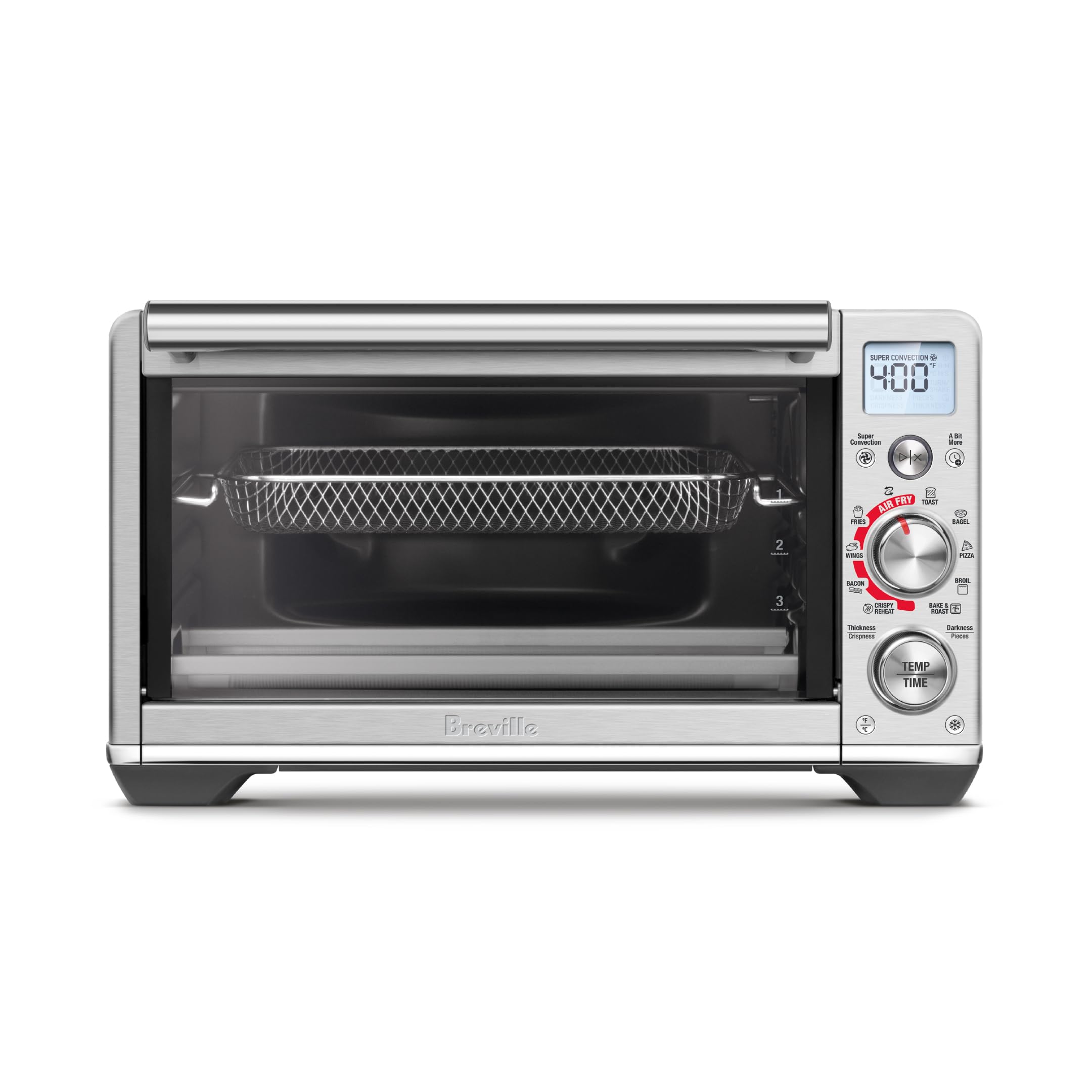
A basket air fryer is amazing at one thing: fast convection crisping. A toaster‑oven air fryer is amazing at being the center of a small kitchen. That’s the difference.
The Breville Smart Oven Air Fryer Compact is for the person who wants one appliance to handle toast, bagels, pizza, bake/roast, broil, and air-frying style crisping—without dragging out multiple gadgets. Owners who cook in apartments, condos, and RVs tend to love the footprint-to-output ratio: it’s not tall and awkward, it looks “built-in,” and it can handle real cooking tasks without feeling like a toy oven.
The biggest real-world win is evenness and control. People talk about fish fillets coming out evenly cooked, vegetables roasting well, and wings browning nicely on the automatic modes. The “Crispy Reheat” concept is especially useful if you eat leftovers: it’s designed to bring back crunch without turning the inside dry. In practical terms, it’s the difference between sad leftover fries and “oh wow, these are actually good again.”
And then there’s the small feature that becomes addictive: the “A Bit More” button. Every experienced home cook knows that food doesn’t always match the timer. A slightly thicker piece of chicken, a wetter batch of vegetables, or a colder starting temperature can mean you need just a little extra. Instead of resetting time and rethinking settings, you tap one button to push it over the finish line. It’s a tiny quality-of-life thing that matters because it reduces decision fatigue.
The honest downside is that oven-style units have more “stuff” to keep tidy—racks, trays, crumb areas—and some owners wish there were an interior light for easier viewing. But if you’re already used to toaster ovens, this is normal. The payoff is versatility: you can cook flatter, wider foods without bending them into a basket shape, and you can do small bakes without heating your whole kitchen.
Why it’s worth the premium
- Multi-appliance replacement: Toast, bake, roast, reheat, and crisp in one compact station.
- Better for flat foods: Fish fillets, pizza, pastries, and “single-layer” roasting are easier than in baskets.
- Great leftover performance: Crisp reheating is a daily-use superpower.
- Refined controls: Feels like a serious cooking tool, not a gadget.
Good to know
- More parts to manage than a single-basket fryer (racks/trays/crumb areas).
- Some owners miss having an interior light.
- Air-fry “crisping” works best when food is spread out (use the rack space well).
Ideal for: People who cook often and want one compact countertop oven to replace multiple devices—especially if you toast daily and want better baking/roasting flexibility than basket-style fryers.
4. Dual Basket DoubleStack (12.6QT) – The “Feed Everyone” Vertical Workhorse
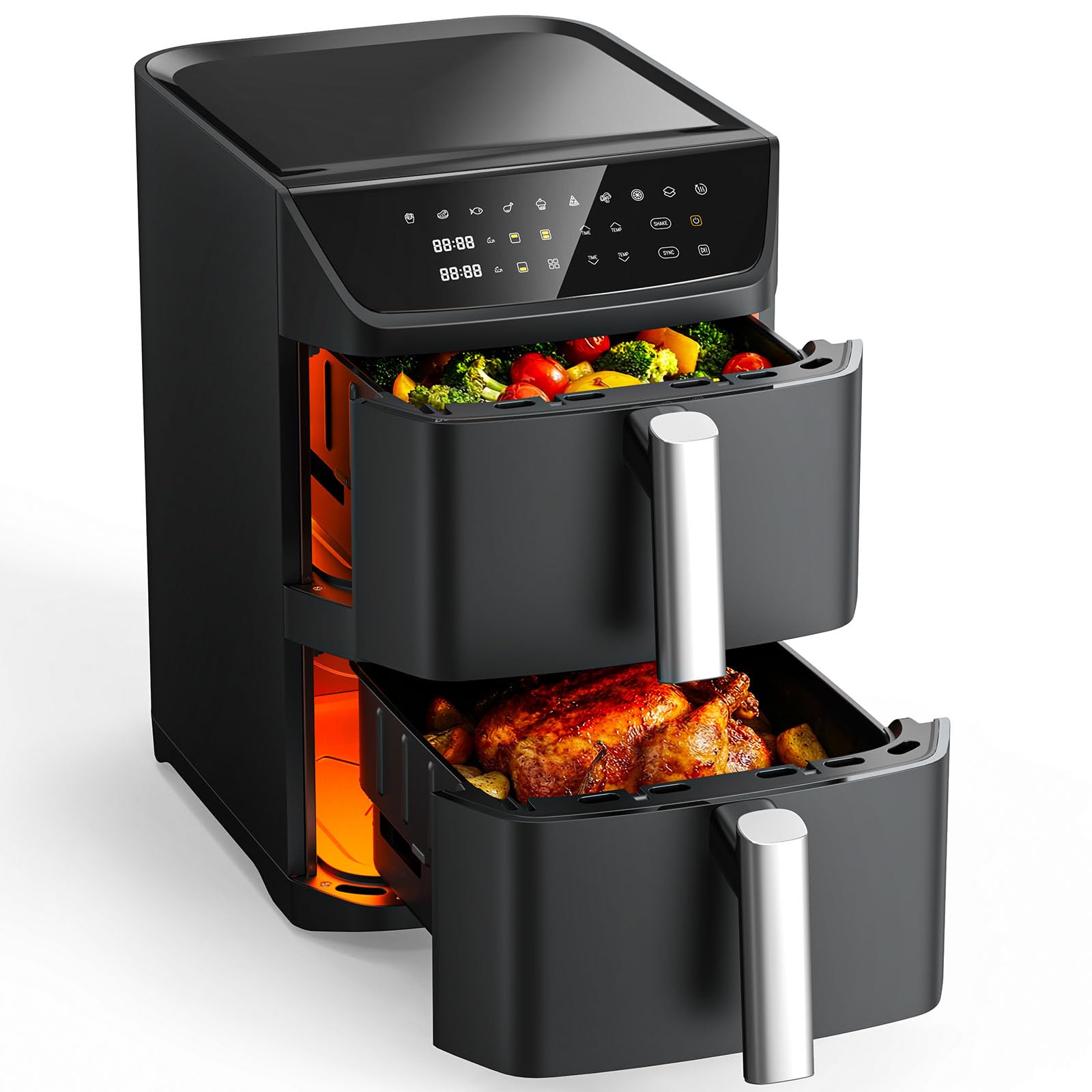
This is the kind of air fryer you buy because dinner time is a logistics problem.
For bigger households, the pain isn’t “can I air fry?” It’s “can I serve everything hot at the same time without running two appliances and still batch cooking?” A stacked dual-basket fryer solves that with one move: you cook mains and sides together, then SyncFinish helps them land at the same time. Owners who have kids, busy schedules, and weeknight time pressure often describe this as the moment air frying becomes a real system instead of a snack gadget.
What makes the vertical format feel compact is that it’s not wide. You can often fit it where a single wide basket wouldn’t work—especially if you’re sharing counter space with other appliances. The trade-off is height and weight: it’s a bigger presence. But the “compactness” comes from replacing multiple cooking rounds with one machine.
In real use, the best strategy is to split foods by behavior: put the thing that needs more crisp airflow (fries, wings, breaded items) in the basket where you’ll have the easiest time shaking and redistributing. Put the more stable item (veg, roasted proteins) in the other basket. And always respect the airflow rule: if you fill each drawer like a bucket, you’re back to steaming.
The owners who love this style most are the ones who stop treating air frying as one setting. They use reheat, dehydrate, and the syncing features as a routine. The result is less chaos: fewer cold sides, fewer extra pans, and fewer “we’ll eat in shifts” dinners.
Why it works for large households
- Two baskets: Cook different foods simultaneously without mixing flavors.
- SyncFinish: Helps meals hit the table together—massive weeknight benefit.
- Vertical footprint: Big capacity without the wide sprawl of many dual-basket designs.
- Easy cleanup: Dishwasher-safe baskets reduce the cleanup tax after big meals.
Good to know
- It’s tall and heavy—plan where it lives before you buy.
- Two baskets means learning to distribute food for airflow (overloading leads to softer results).
- Dual-zone controls can feel like “a lot” at first, but become easy once you establish your routine.
Ideal for: Families who want a single appliance that reduces batch cooking and gets full meals on the table fast—especially if counter width is limited but you can accommodate height.
5. Cuisinart TOA‑26 – Compact Toaster‑Oven Air Frying Without Touchscreen Drama

There’s a certain type of person who hates touchscreens on kitchen appliances. If that’s you, the TOA‑26 makes immediate sense.
Owners consistently describe this model as “small but capable,” especially in apartments. The compact cavity warms quickly, and people often comment that it crisps food in a way that feels efficient—as if the tight interior concentrates convection better than a larger oven. It’s the kind of appliance that earns its space if you do two daily things: toast and air fry.
The strongest real-world advantage is that it’s a multi-tool with a familiar interface. Dials feel intuitive; you don’t need an app; you don’t need to memorize button sequences. That matters if you want something your partner, kids, or guests can operate without a tutorial.
Now the honest stuff owners complain about: the air fry basket can be rough on fingers (the metal weave can feel sharp). Some users have reported door behavior that can interrupt cooking if the door sensor doesn’t stay fully engaged—annoying, but also a reminder that oven-style designs rely on good door alignment. The bright spot is that many users also report strong customer support experiences when issues appear.
Here’s the best way to think about the TOA‑26: it’s not trying to be a futuristic gadget. It’s trying to be a practical countertop oven that air fries well, toasts reliably, and keeps your kitchen from overheating during summer cooking. If that’s the job you want done, it’s a strong candidate.
Why people choose it
- Dial controls: Simple, quick, and less fussy than touch panels.
- Compact efficiency: Owners often report fast heating and great crisping.
- Multi-function: Toasting plus air frying is a daily-use combination.
- Good support reputation: Many owners describe responsive warranty help.
Good to know
- Basket weave can feel sharp—handle carefully and consider gloves for cleaning.
- Some users report door/sensor quirks; keep the unit stable and don’t let the door get bumped while running.
- No-frills design means fewer convenience extras (like interior lighting) depending on your expectations.
Ideal for: People who want toaster‑oven versatility with air frying power, but prefer manual controls and a straightforward cooking routine.
6. COSORI Pro LE (5QT, Ceramic) – The “I Use This Daily” Sweet Spot

This is the kind of air fryer that wins not because it’s flashy—but because it behaves well in real routines.
Owners who use it nearly daily talk about consistency: it preheats quickly, cooks evenly when food is spread out, and handles a wide range of “normal life” foods—frozen snacks, chicken, vegetables, reheated leftovers, even quick breads. It’s particularly strong when you treat it like what it is: a small convection oven with a basket and aggressive airflow.
The ceramic coating is a quiet MVP. Many people buy an air fryer thinking “cleanup will be easy,” and then discover that some coatings get sticky with repeated use, or require careful handling to stay nice. A ceramic surface can make the release behavior feel more forgiving, which lowers the barrier to using it frequently.
One underrated design detail: the sealed top control surface. Crumbs and grease can’t hide in notches the same way they can on some front-panel designs. That matters for long-term cleanliness. Owners also mention that the touch controls are responsive and easy to wipe down.
The frustrations are specific (and useful to know upfront): some people dislike that presets aren’t user-programmable; many end up setting time/temp manually every cook because presets can overcook depending on portion size. There are also reports that the unit can be a little “beep-happy,” and that you should wait a moment after reinserting the basket before mashing buttons—otherwise the panel can feel momentarily unresponsive.
If you want a dependable, mid-size basket fryer that doesn’t demand a learning curve, this is one of the most sensible picks in the entire lineup.
Why it’s a daily driver
- Balanced size: Big enough for real meals, still manageable on most counters.
- Ceramic-coated basket: Easier cleanup and strong food release for frequent use.
- Sealed control surface: Quick wipe-down, fewer grime traps.
- Even cooking: Strong results when food is laid out without overcrowding.
Good to know
- Preset programs may overcook; many owners prefer manual time/temp control.
- Beeping can feel excessive if you’re sensitive to appliance noise.
- Touch panel can be finicky if you press immediately after reinserting the basket—pause a beat.
Ideal for: People who want a reliable, easy-to-clean basket air fryer for everyday meals—and don’t mind using manual settings to dial in perfection.
7. Chefman 6QT (Hi‑Fry) – The “Crisp It at the End” Crowd‑Pleaser

This Chefman is popular for a very practical reason: it delivers that “fast, crispy, done” outcome without asking you to become an air fryer scientist.
Owners—especially college students and shared households—tend to describe it as the appliance that replaces the microwave. That’s a big statement, and it happens when an air fryer is large enough to be useful (wings, sandwiches, nuggets, roasted vegetables), simple enough to run repeatedly, and easy enough to clean that nobody argues about dishes.
The Hi‑Fry concept is the real appeal: a high-heat bump at the end of cooking is exactly how you get restaurant-like texture on fries and breaded foods. It’s also great for “fixing” foods that cooked through but didn’t brown enough. Instead of recooking the inside until it dries out, you finish hot and short.
Owners who use it for wings specifically mention how crisp they can get with minimal or no oil. The key is spacing and shaking. If you load the basket like a bowl of laundry, you’ll steam. If you give the food a single layer (or close to it) and shake at the reminder, you’ll get the texture people buy air fryers for.
The main downside reported is minor but real: some users say the basket can be a little hard to close all the way. That’s usually alignment—making sure the basket is seated fully and the drawer rails aren’t blocked by crumbs. It’s not an everyday dealbreaker, but it’s worth knowing because a partially seated basket can interrupt cooking or reduce airflow efficiency.
Why it’s a crowd favorite
- Roomy capacity: Works for small families, roommates, and meal prepping without constant batch cooking.
- Hi‑Fry finish: Great for fries, wings, and breaded foods when you want a true crisp edge.
- Simple UI: Easy for anyone to operate without reading a manual.
- Easy cleanup: Owners consistently describe washing as quick and low-effort.
Good to know
- Some users mention the basket can feel “stiff” to close—keep rails clean and ensure full seating.
- Presets are helpful starters, but real perfection comes from small time/temp tweaks.
- Like any fryer, results drop if food is stacked too high (especially fries).
Ideal for: People who want a straightforward, satisfying air fryer for 3–5 servings—and love the idea of a quick high-heat crisp finish for fries and wings.
8. BELLA 4QT Slim Air Fryer – The “Long Basket” Space Hack

If you’ve ever looked at your counter and thought, “I don’t have room for a wide basket,” this BELLA is designed for exactly that moment.
Its slim profile is the headline, but the real advantage is the extra-long basket geometry. That shape is quietly brilliant for foods that don’t like being bent or stacked: a slice of pizza, strips of bacon, salmon fillets, asparagus, even toasted sandwiches. Owners mention that the rectangular format feels more usable than they expected, especially for one or two people cooking real food—not just nuggets.
The ceramic nonstick behavior is another quality-of-life win. People describe it as easy to wipe down, and many note that it doesn’t have the “funky smell” some new appliances can have. The overall design gets praise too: instead of a utilitarian plastic bucket, it looks like something you wouldn’t mind leaving out.
Performance-wise, this is a solid daily air fryer when you respect its size category. It can handle family meals, but it’s not a “dump everything in and walk away” unit. Like all compact baskets, it rewards single-layer cooking and occasional flipping/shaking. Owners who treat it as a fast convection crisp tool tend to be happy; people who try to overload it for four hungry people in one batch may feel limited.
One practical tip: because of the longer basket, think in “rows” instead of “piles.” Lay food across the length, leave small gaps, and rotate longer items halfway if one side browns faster.
Why it’s a smart slim pick
- Long basket layout: Better for pizza slices and long proteins than many round minis.
- Ceramic coating: Easy cleanup behavior for daily use.
- Looks good on the counter: Owners often mention the design as a “leave it out” appliance.
- Simple operation: Presets help beginners get started fast.
Good to know
- Still a compact unit—overfilling reduces crispness and increases cook time.
- Best results come from spacing food, not stacking.
- If you cook for 4+ often, you may prefer a larger basket or dual-basket setup.
Ideal for: Small counters, narrow spaces, and people who cook “long foods” often and want a slim-profile air fryer that doesn’t feel bulky.
9. Instant Pot Vortex Mini (4QT) – The “Watch It Cook” Confidence Builder
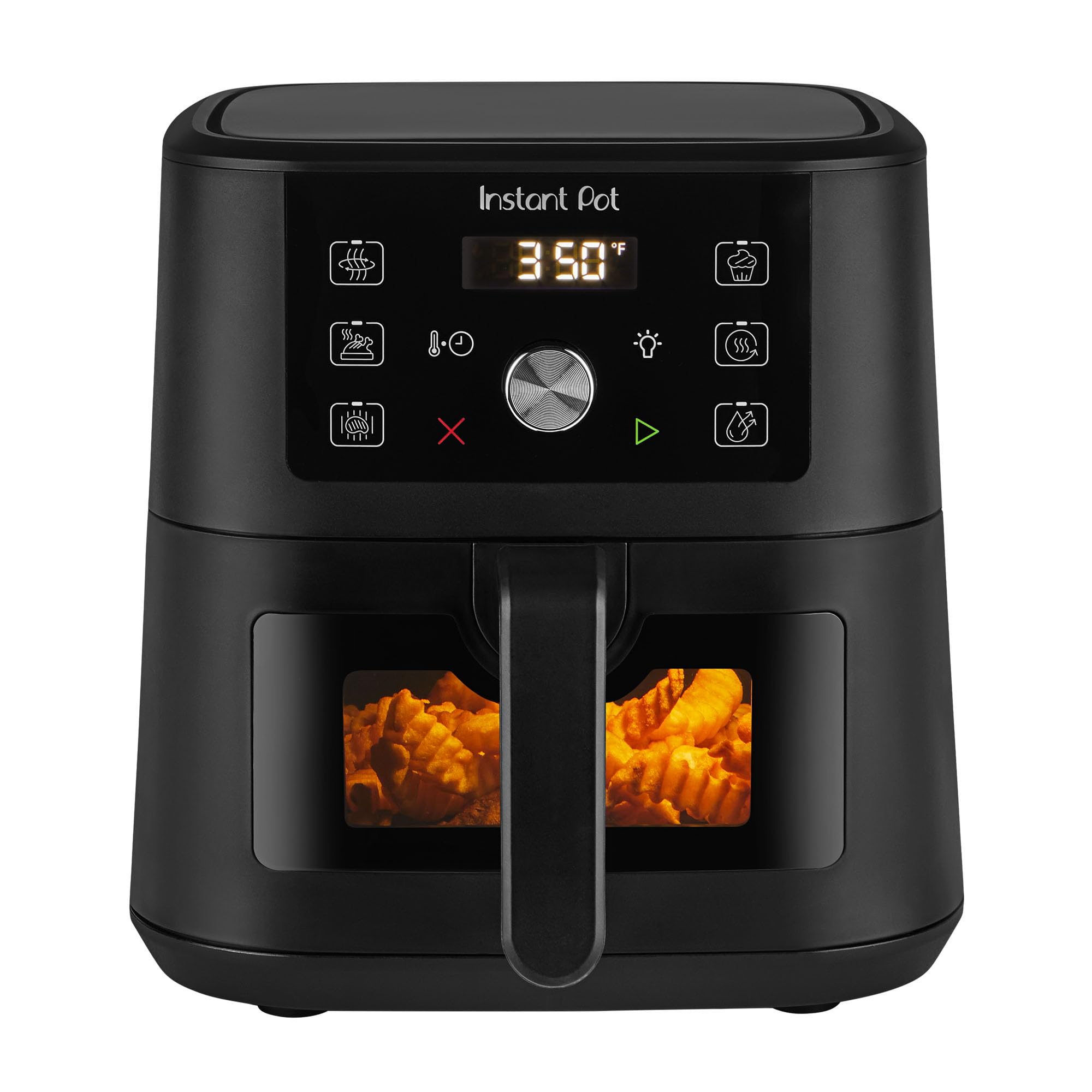
Some people don’t want more features—they want fewer mistakes. The Instant Vortex Mini earns its place by making air frying feel predictable.
The window and internal light are the standout for real beginners. Instead of opening the basket repeatedly (and losing heat every time), you can check progress visually. That’s a big deal when you’re learning how quickly different foods brown. Owners often describe the moment they “get” air frying as the moment they stop treating it like a microwave and start watching color and texture.
Real owner feedback tends to highlight two things: the food comes out tasty and the unit feels easy to live with. Cleanup is simple, and many people find themselves using it far more than expected once they get comfortable—fish, roasted vegetables, frozen snacks, baked potatoes, and quick reheats.
The honest nitpicks are very human: some users wish preheating were faster than it is in real life, and some find the beeper quieter than they’d like (meaning you either keep an ear out or stay nearby). There are also occasional mentions of a “new appliance smell” during early runs—many people eliminate that by running a couple of empty cycles in a ventilated space and washing the basket before first use.
The bigger picture: for someone who wants a compact 4-quart basket fryer with strong “visibility” and low intimidation, this is a very reasonable pick.
Why beginners love it
- Window + light: Builds confidence and reduces overcooking while you learn timing.
- Simple functions: Covers the basics without complexity overload.
- Easy cleaning: Works well for frequent use with minimal cleanup friction.
- Great for 1–2: The size is practical for small households and quick meals.
Good to know
- Preheating isn’t instant in real kitchens—plan a few minutes for full heat.
- Beeper volume may be quiet; don’t wander too far on your first few cooks.
- Like many appliances, it can benefit from a couple of initial “burn-in” cycles for odor reduction.
Ideal for: First-time air fryer owners who want a compact basket model with a window so they can learn crisping visually and cook with more confidence.
10. Chefman 4QT (Window + Hi‑Fry) – The “Small Footprint, Big Crunch” Pick

This is a great example of why “4 quart” doesn’t automatically mean “small usefulness.”
Owners who upgrade from tiny 2-quart units often say the same thing: a square-ish 4-quart basket can feel like a massive improvement without taking over the counter. You get space to cook real portions—meatballs, chicken thighs, vegetables—without stacking everything into a steaming pile.
The window is genuinely useful here, especially because 4-quart baskets tend to keep food closer to the viewing angle. For quick items like meatballs or wings, you can watch browning and decide whether to shake early, flip, or simply finish with a crisp boost. It’s the kind of visual feedback that makes cooking feel less like gambling.
Owners also mention the unit being quiet and sturdy, which is a huge quality-of-life factor. An air fryer that screams like a hair dryer can be “fine,” but it’s harder to love. Quiet appliances get used more.
Here are the nuanced downsides: the light may auto-shutoff quickly, so you may have to tap it again. Also, windows don’t magically solve airflow—liners can still interfere with circulation, and stacked food still steams. The best use is still single-layer crisping with a shake halfway, especially for fries and breaded snacks.
Why it’s the best 4QT window pick
- Compact but capable: Feels big enough for real meals without a big footprint.
- Window + light: Great for visual doneness, especially for browning-sensitive foods.
- Hi‑Fry finish: Helps you punch up crunch near the end.
- Easy cleaning: Owners consistently describe quick cleanup routines.
Good to know
- Light may auto-off; it’s normal to tap it again during longer cooks.
- Windows don’t fix overcrowding—give food room to breathe for best crisp.
- Basket visibility can be limited if you cook in deep pans or tall liner trays.
Ideal for: 2–4 people who want a compact air fryer with a window, and love the idea of a crisp finish option for fries, wings, and reheats.
11. Chefman 4QT (Hi‑Fry, No Window) – Same Crunch, Less Visual Fuss

If you like the Chefman approach (simple presets, crisp finish), but don’t care about peeking through a window, this version is the cleaner choice.
In daily use, a no-window basket can actually be easier to keep looking nice. No glass to smear, no condensation film to wipe down, and fewer “why can’t I see through this today?” moments. You rely on the shake reminder, your routine timings, and occasional basket pulls (which are quick if you don’t do it every two minutes).
Owners who use this style often talk about how intuitive it becomes: you learn your favorites (chicken thighs, reheated pizza, roasted broccoli), you establish a couple of custom time/temp patterns, and the fryer becomes the appliance you reach for instead of turning on a full oven.
The Hi‑Fry crisp finish remains the star. The best way to use it is as a texture “polish,” not the whole cook. Cook the food through, then crisp at the end for the kind of surface browning people crave. It’s especially useful for frozen foods that can go from pale to overdone if cooked hot for too long.
Just like the window model: it still rewards spacing, shaking, and not using thick liners that block airflow. The best crisp results come from giving air a path around the food.
Why it’s a smart simple pick
- Less to maintain: No window means fewer surfaces to keep clean and clear.
- Same crisp capability: Hi‑Fry finish helps you dial texture near the end.
- Compact footprint: Great for small counters and daily cooking for 1–3.
- Easy to learn: Owners often describe it as intuitive and low-friction.
Good to know
- No window means you’ll rely on routine timing (but the shake reminder helps).
- Overcrowding still causes steaming—spread food out for crisp.
- Liners can cause airflow issues if they’re not perforated or properly weighted by food.
Ideal for: Anyone who wants a compact 4-quart basket fryer with strong crisping results, but doesn’t care about window viewing.
12. Cartman Ultra‑Flat 4QT – The Low‑Profile “Fits Anywhere” Specialist
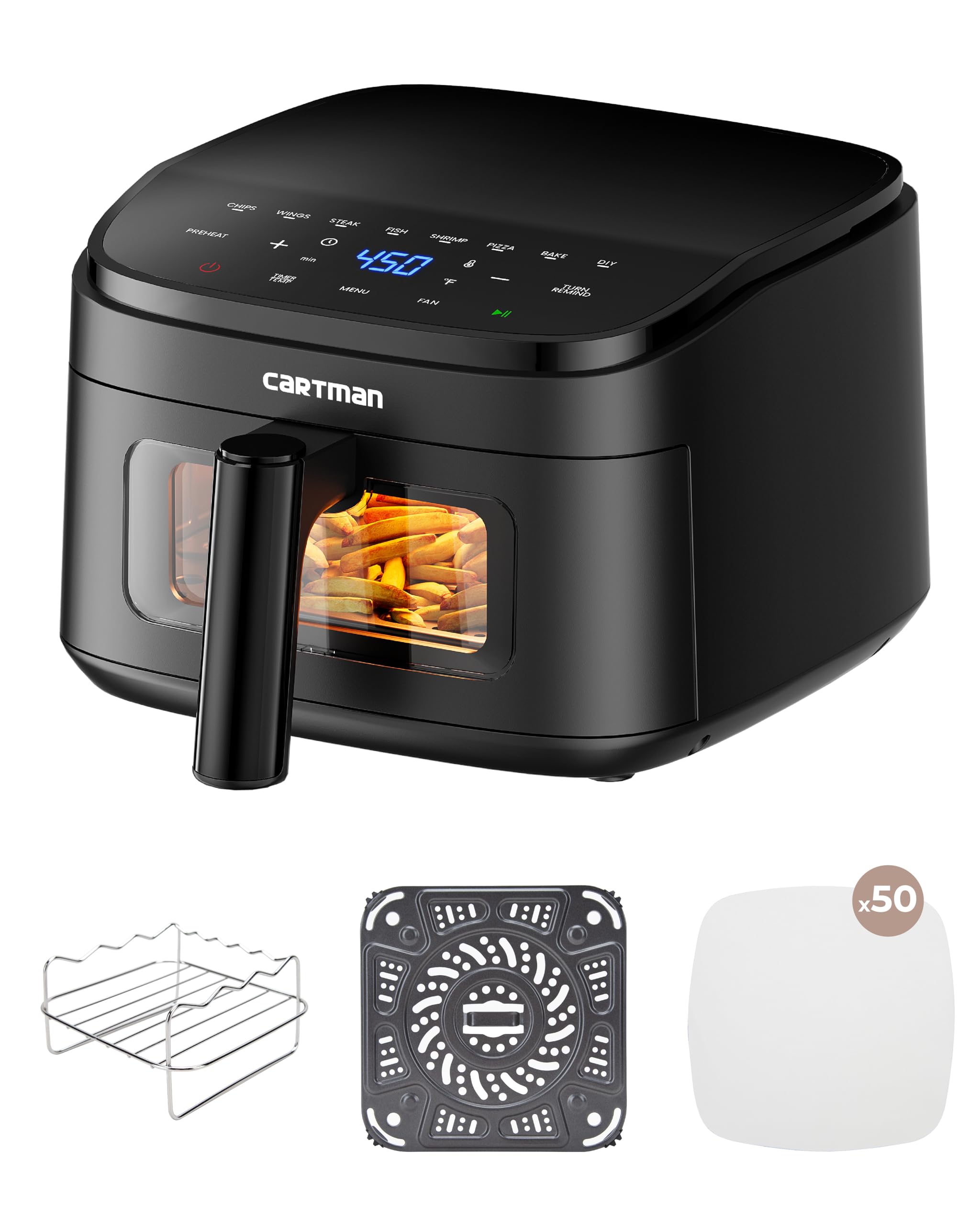
If your kitchen problem is height—low cabinets, awkward shelves, or a counter that can’t host tall appliances—this Cartman design is genuinely different.
A low-profile air fryer changes the “where does it live?” question. Instead of pulling it out from a pantry every time, you can often keep it out without it blocking cabinet doors or looking like a tower. That’s a real convenience factor, because appliances that are easy to access get used more.
The wide, rectangular basket is another advantage. Low-profile units can’t be deep, so they often make up for it with surface area. That’s exactly what you want for crisping: more single-layer room, less stacking. For fries, vegetables, and flat proteins, this can produce very satisfying results when you spread things out.
The viewing window is fun and practical—especially for snacks where timing is about color. And the included accessories (like liners) are a nice “starter kit” touch for beginners.
Now the candid reality: smaller brands sometimes have a wider quality spread. Owner feedback can be mixed—some people love the concept and performance, while others report confusing display messages or early issues. The smartest approach with any less-established model is to test it thoroughly early: run a few cooks with different foods, confirm the controls behave consistently, and decide quickly if it’s a keeper for your kitchen.
Why the form factor is special
- Ultra-flat height: Fits under cabinets where taller air fryers don’t.
- Wide basket floor: Encourages single-layer cooking for better crisping.
- Window: Helpful for visual doneness and quick snacks.
- Starter accessories: Useful if you’re new and want to begin fast.
Good to know
- Mixed owner feedback suggests quality can vary—test early and thoroughly.
- Low-profile designs may require more careful spacing of food to maintain airflow.
- Support ecosystem may be lighter than major brands (keep documentation handy).
Ideal for: Kitchens with low cabinet clearance or limited vertical space, where standard air fryers simply don’t fit comfortably.
13. Cuisinart AIR‑80 (2.6QT) – Small Portions, Big Convenience

For one or two people, a mini air fryer can be the most “honest” purchase you make—because you’ll actually use it every day.
The AIR‑80 is built around that reality. It’s small, it’s fast to get going, and it includes the two features that make small air fryers feel more premium: a viewing window with light and a toss reminder. Those features matter more in minis because timing is tighter and food browns faster when it’s closer to the heating system.
Owners who love small air fryers often describe the same routine: quick frozen snacks without sogginess, roasted vegetables without a full oven, reheated pizza that comes back crispy, and “one portion meals” that feel easy instead of annoying. That’s exactly what this unit is designed for.
The key to getting great results from a 2.6-quart basket is discipline with portion size. Cook in a single layer, embrace quick batches, and treat it like a high-powered toaster oven drawer. When you do that, minis feel magic. When you try to feed a family of four from a mini basket, you end up frustrated.
The window is also especially useful here because mini baskets can brown aggressively. You’ll find yourself tapping the light and making micro-adjustments—pulling the basket 2 minutes early, adding a quick crisp finish, or shaking sooner than the reminder.
Why it’s a great mini
- Perfect for 1–2: Quick meals and snacks without wasting oven energy.
- Window + light: Useful in small baskets where browning happens fast.
- Toss reminder: Helps avoid uneven crisping without memorizing timing.
- Easy cleanup: Dishwasher-safe parts reduce friction for daily use.
Good to know
- Small capacity means you must avoid overcrowding for crisp results.
- Minis cook fast—watch your first few batches to learn browning speed.
- If you cook for 3+ often, step up to a 4–6 quart basket for less batch cooking.
Ideal for: Singles, couples, and snack lovers who want a premium-feeling mini basket with a window and easy controls.
14. Dash Digital Tasti‑Crisp (2.6QT) – The “No Fuss” Starter Fryer
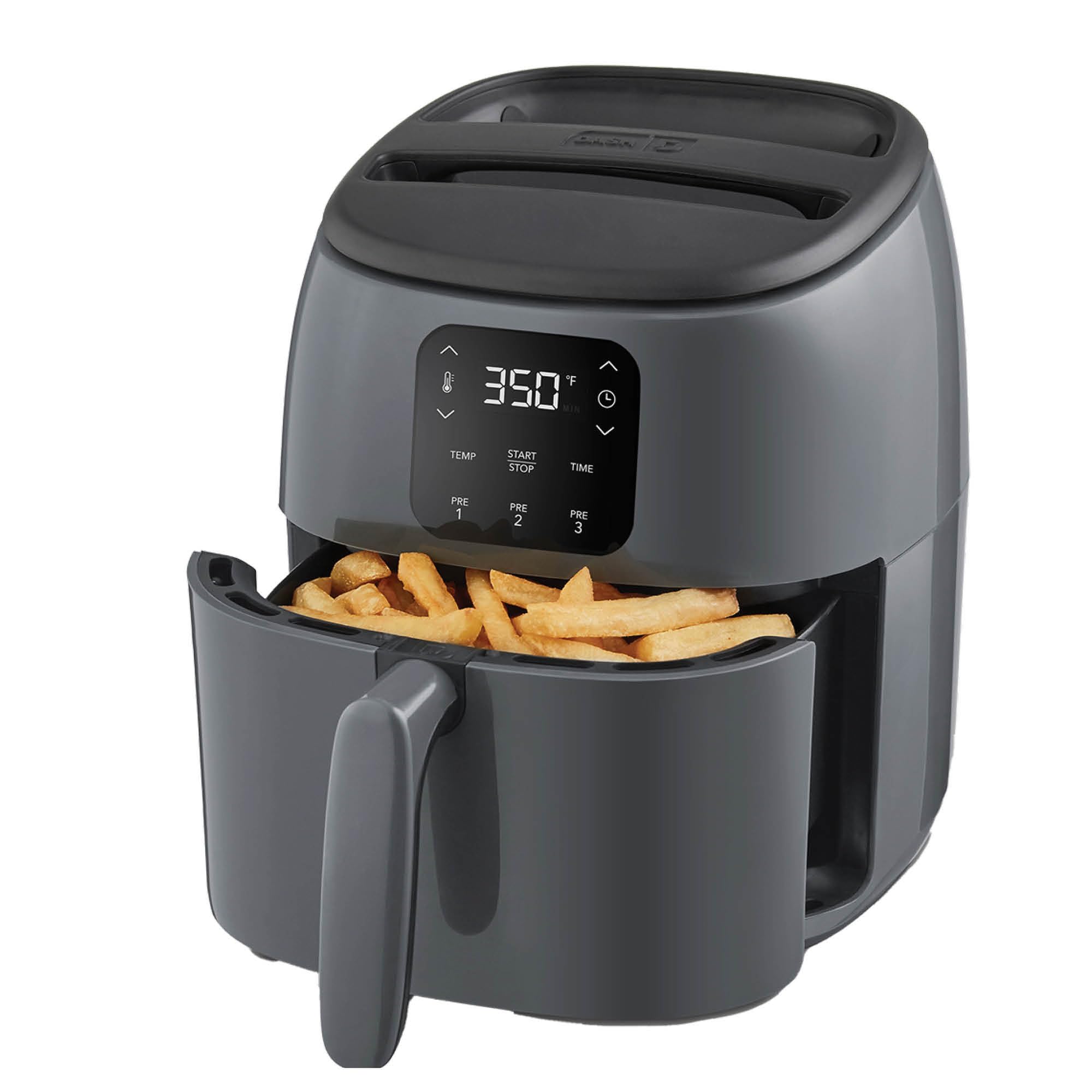
Dash makes a strong case for the simplest version of the air fryer idea: small, easy, and surprisingly satisfying.
Owners who love this model tend to talk about two things: it works consistently, and it’s ridiculously easy to clean. That matters because the best air fryer is the one you don’t dread using. If you’re cooking for one, or making quick snacks and small meals, a 2.6-quart unit can feel perfectly sized—and you avoid the “why am I heating a big machine for a tiny portion?” feeling.
The most important “real life” learning with this unit is the shake/flip rhythm. Minis crisp very well, but they can brown unevenly if you never move the food. Once you accept that you’ll toss fries once halfway, or flip a sandwich once near the end, you’ll get consistently great results.
This model also tends to win over people who dislike loud appliances. Owners mention quiet operation compared to larger “all-in-one” machines. That kind of comfort feature doesn’t show up on a spec list, but it matters when you live in a small space or cook late at night.
The limit is obvious: it’s small. It’s not for big batches, and it’s not for cooking multiple components at once. But as a “daily snack and small meal engine,” it’s very easy to recommend.
Why it’s a great starter
- Simple operation: Minimal learning curve—great for first-time users.
- Easy cleanup: Owners consistently describe fast, painless washing.
- Compact: Fits small counters and small kitchens easily.
- Quiet feel: Many users notice lower noise compared to bigger units.
Good to know
- Small portions only—great for 1–2, not ideal for families.
- Best results require shaking/flipping at least once mid-cook.
- Heavier foods crisp more evenly than very light foods (which can dry quickly).
Ideal for: Singles and couples who want an easy, compact fryer for quick meals and snacks—and prioritize simple cleanup over advanced features.
15. COSORI Lite Mini (2.1QT) – Tiny Footprint, Surprisingly Useful

This is the air fryer you buy when space is the boss—and you still want crisp food.
Owners love it for the exact reasons you’d expect: it’s light, it has a small footprint, and it beats heating a full oven for one or two servings. It’s especially good at the “daily little wins” category: roasted vegetables for one, reheating fries so they aren’t sad, crisping frozen snacks, browning small pastries, and cooking small portions of protein quickly.
The hidden skill with a 2.1-quart basket is portion sizing. If you treat it like a mini oven drawer and cook one layer at a time, it’s fantastic. If you try to cook like it’s a family fryer, you’ll end up with uneven results and longer cook times. The people who are happiest are the ones who embrace its role: a personal cooker, not a batch machine.
Another real-world factor owners bring up: airflow clearance. Minis are often used in tight spaces, but they still need breathing room. That means you either place it with space behind and above, or you pull it forward during cooking and slide it back afterward. It sounds small—but it’s exactly the kind of behavior that makes a tiny fryer workable in a truly small kitchen.
If you want a travel-friendly air fryer for an RV, dorm room, or tiny apartment counter, this is one of the most realistic choices in the category.
Why it’s perfect for small spaces
- Very small footprint: Fits where larger fryers simply can’t.
- Fast personal meals: Great for 1–2 servings without wasted energy.
- Reheat mode: Useful for bringing leftovers back to crispy life.
- Easy cleaning: Small basket means fast washing and quick resets.
Good to know
- Not for big portions—single-layer cooking is the key.
- Requires airflow clearance; plan placement in tight kitchens.
- Cooking times can vary by portion size, so do a few test runs to learn your favorites.
Ideal for: Dorm rooms, RV kitchens, tiny counters, and anyone who wants a true “personal” air fryer for fast snacks and small meals.
16. Chefman Mini (2QT) – The “I Don’t Cook… But Now I Do” Gateway

Every now and then, owner feedback tells you something bigger than specs. This is one of those cases.
People who struggle with cooking—whether because they hate mess, hate complexity, feel overwhelmed by the stove, or just want something that works—often describe a mini air fryer as a genuine lifestyle change. The Chefman 2QT is exactly that kind of tool: small, quick, and simple enough that you can go from “I don’t cook” to “I just made dinner” without the emotional tax.
In practice, it’s a compact convection drawer that handles the basics beautifully: crisp frozen foods without rubbery microwave texture, roasted vegetables with minimal prep, quick salmon bites, small steaks, and even baked potatoes (yes, really) when you’re patient with timing. The shake reminder is helpful because it prevents the common beginner mistake: leaving fries untouched and getting uneven browning.
This kind of mini unit also has the lowest cleanup barrier. Small basket, quick wash, done. That’s why people use it more than they expect. And because it heats quickly, it’s ideal for late-night snacks or “I just need something warm” meals.
The limitation is the point: it’s small. It will not cook a family dinner in one go. But as a personal, approachable, consistent mini cooker, it’s a strong choice—especially if you’re trying to cook more at home without turning your kitchen into a disaster zone.
Why it’s a gateway cooker
- Extremely approachable: Simple controls and predictable results.
- Fast cooking: Great for quick meals without heating a full oven.
- Low cleanup burden: Small basket = easy washing and frequent use.
- Great for 1–2: Perfect portion sizing for small households.
Good to know
- Very limited capacity—best for personal meals and snacks.
- Small baskets can brown quickly; watch your first few cooks.
- Best results come from shaking/flipping once mid-cook.
Ideal for: People who want the simplest possible entry into air frying, live in very small spaces, or need a personal cooker that won’t overwhelm them.
Heat & Airflow Guide: What Makes an Air Fryer Actually “Good”
Most buying guides obsess over capacity numbers. The better approach is to understand what creates the result you’re actually buying: crisp edges, browned surfaces, and fast cooking without drying food into cardboard.
1) Airflow is the engine
Air frying is convection cooking with attitude. The fan moves hot air fast. When that hot air can reach the food’s surface evenly, you get browning and crispness. When airflow is blocked (overcrowding, thick liners, stacked food), you get steaming and softness.
A wide basket floor often beats a deep basket because it supports the single-layer rule. If you want crisp fries, don’t shop for “quarts.” Shop for “how much basket floor do I get for my counter space?”
2) Temperature control matters more than max temperature
High heat is great—but control is what creates repeatable results. Many owners discover that presets are often too hot or too long for their portion size. The best air fryer isn’t the one that promises the most; it’s the one that lets you adjust quickly and predictably.
A “high heat finish” feature can be especially useful: cook the inside gently, then crisp the outside at the end. That combination often produces better texture than blasting high heat from minute one.
3) Basket shape influences moisture management
Moisture is the hidden enemy of crispness. When you cook wet foods (marinated chicken, frozen fries, vegetables with high water content), moisture needs somewhere to go. If the basket forces stacking, moisture gets trapped and food softens.
That’s why square and rectangular baskets often feel “better” in practice: you can spread food out, which lets moisture escape and allows airflow to do its job.
4) The cleaning reality affects how often you’ll use it
An air fryer that’s annoying to clean becomes a “sometimes” appliance. Owners consistently keep using models that are easy to rinse, wipe, and reset. Dishwasher-safe baskets can be a win, but even hand-washers benefit from smooth surfaces and simple shapes.
Tip: if you use liners, choose ones that don’t block airflow and always weigh them down with food. Loose liners can lift into the heating area and disrupt cooking.
FAQ: Compact Air Fryers
Why is my food not getting crispy?
Do I need to preheat an air fryer?
Are basket liners worth using?
What’s the real difference between a basket air fryer and a toaster‑oven air fryer?
Why do some air fryers cook unevenly?
My air fryer smells weird when new—normal?
Should I buy bigger “just in case”?
Final Thoughts: The Verdict
If you want one pick that balances modern features, consistency, and daily usability, the Tastee Ceramic Air Fryer is the standout because it reduces guesswork and makes “perfect doneness” easier to repeat.
If your priority is feeding a household without giving up counter width, the stacked approach of the Ninja DoubleStack XL is a genuine time-saver once you learn the airflow rhythm.
If you want a premium multi-function “small kitchen oven” that can replace multiple appliances, the Breville Smart Oven Air Fryer Compact is the kind of upgrade you feel every day—toast, roast, crisp, reheat, repeat.
And if you just want a dependable, easy-to-clean basket fryer that gets used constantly, the COSORI Pro LE is the kind of “simple but satisfying” buy that rarely disappoints.
Whichever direction you go, remember the rule that makes or breaks compact air fryers: single-layer airflow equals crispness. Buy the shape you’ll actually use, cook with space, and you’ll get the results you wanted in the first place.
