
Specs are compiled from manufacturer listings and verified buyer reviews and can change over time — please confirm the key details on the product page before buying.
When the grid drops, the only thing that matters is whether your fridge, furnace, and sump pump keep running. A whole-house standby generator handles that automatically — no extension cords, no hauling a portable unit out of the garage in the rain. The picks below are all permanently installed, run on natural gas or propane, and pair with an automatic transfer switch (ATS — a smart switch that senses the outage and moves your home onto generator power by itself).
I’m Mohammad Maruf — the founder and writer behind KitchPrep. This guide is built by comparing the manufacturers’ published specifications and the patterns across verified customer reviews, so you get each pick’s real strengths and trade-offs instead of marketing spin.
Three units made the cut, and the differences between them come down to capacity, installation complexity, and how much of your house stays lit.
Our Picks at a Glance
How To Choose The Best Whole-House Backup Generator
The mistake most first-time buyers make is buying on kilowatts alone. A standby generator is a system: the generator box, the automatic transfer switch inside your electrical panel, the fuel line from your meter or tank, and the concrete pad it sits on. Get the sizing wrong and you either overpay for capacity you never touch, or you watch the unit shed circuits mid-outage.
Start with your fuel, not your wattage
Every standby generator here runs on either natural gas or liquid propane. Natural gas means no tank, no refills, and no delivery — the line is already in your house. Propane means a tank you own or lease and refill, which matters if you live somewhere the gas main does not reach. One catch worth knowing up front: running on propane typically requires a conversion kit, and that kit is not always in the box.
Match the transfer switch to your panel
The transfer switch is the part that actually moves your house off the grid and onto generator power. Its rating in amps (A) sets the ceiling on how much of your home can run at once — a 100 A switch backs up fewer circuits than a 200 A switch. Service-entrance-rated switches let the generator sit between the utility meter and your main panel, while load-shedding switches automatically drop heavy appliances like a dryer so the generator never gets overwhelmed.
Plan the install before the unit arrives
Standby generators are heavy, permanently wired, and typically require a licensed electrician plus a concrete pad. Distance from your electrical panel and gas meter drives the labor. Budget the install as part of the purchase, and confirm a local service technician exists before you commit — that single detail decides how fast a warranty repair actually happens.
Quick Comparison
| Model | Best For | Max Power | Transfer Switch | Engine Displacement | Amazon |
|---|---|---|---|---|---|
| Generac Guardian 26kW★ Best Overall | Whole-home coverage with heavy loads | 26 KW | 200 A | 999 cc | Amazon |
| Generac Guardian 10kW | Essential circuits on a smaller budget | 10 KW | 100 A (16-circuit) | 460 cc | Amazon |
| Kohler 20RESCL-200SELS | Fast switchover with load shedding | 20,000 W | 200 A, service entrance rated | — | Amazon |
In‑Depth Reviews
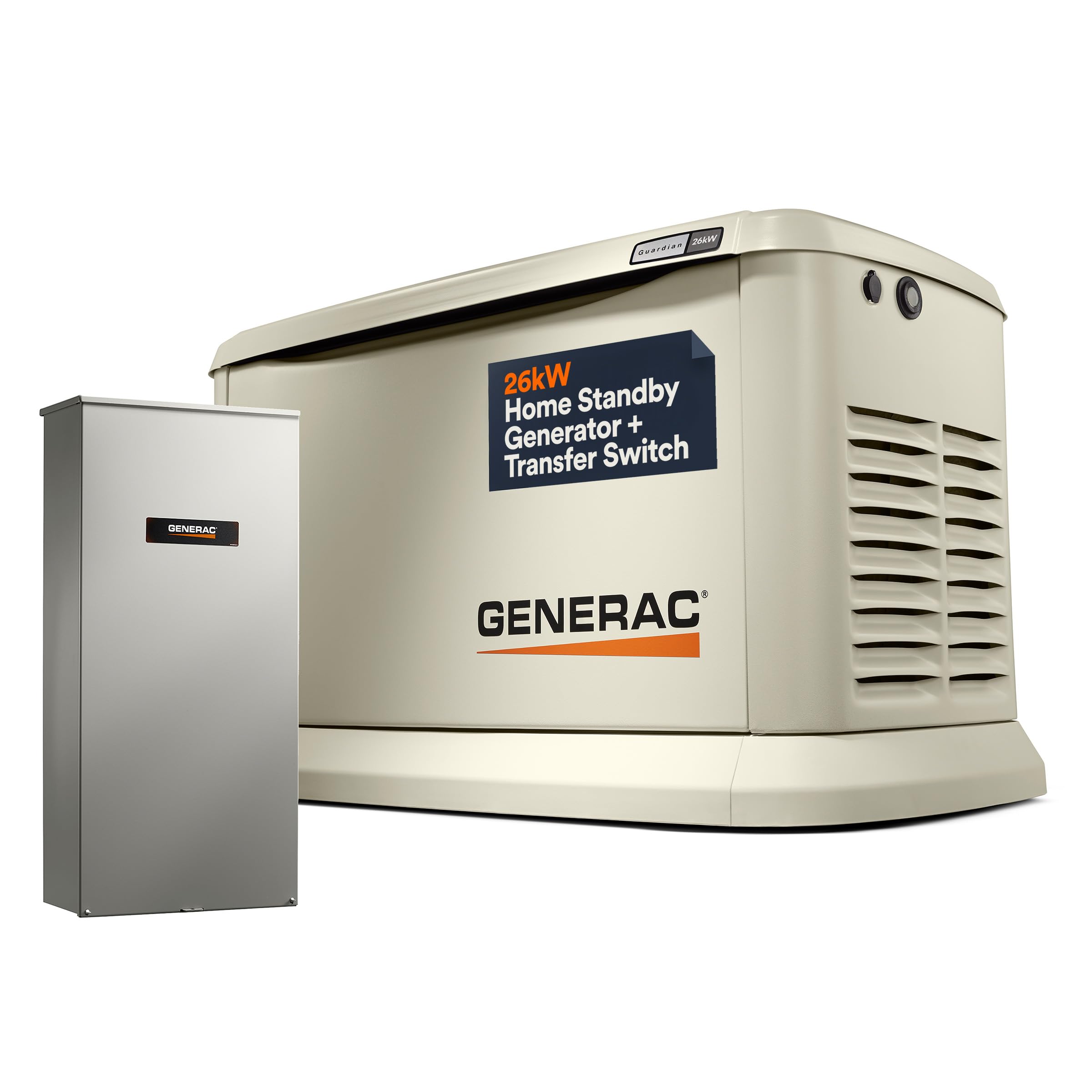
1. Generac Guardian 26kW Home Generator, Transfer Switch & WiFi Monitoring
Our pick — over 4★ from 50+ verified ratings; the strongest balance of quality and price.
A 26kW generator with a 200A transfer switch that can carry central air, a well pump, and an electric range at once.
If your house has central air, a well pump, or an electric range, this is the unit that does not make you choose. It puts out 26 KW of maximum engine power and 200 A of current through its transfer switch — roughly two and a half times the output and double the amperage of the 10kW Generac below. In plain terms, a 200 A switch can carry far more of your panel at once, so the air conditioning can stay on while the freezer keeps freezing.
Its 999cc engine is more than double the 460cc unit below, so it holds heavy loads without straining. The engine measures 999 cubic centimeters of displacement (the total internal volume of its cylinders, which sets how much work the engine can do comfortably), a much larger powerplant than the 460 cc unit down this page. Generac calls it the G-Force 1000 Series. True Power Technology delivers 26,000 watts with under 5% harmonic distortion — that is a measure of how clean the electrical wave is, so sensitive electronics like a furnace control board or a home office setup are not being fed dirty power.
Owners consistently point to the Mobile Link WiFi monitoring, which shows generator status and runs the weekly self-test from your phone. You can check generator status from your phone, schedule the weekly self-test that keeps internal parts lubricated, and get an alert if something throws an error. Several owners describe it as the feature that turns the generator from a mystery box in the yard into something they can actually watch over. Practically speaking, one owner’s experience captures the point: they report the unit was “the second one I have purchased for two different homes,” which says more about repeat trust than any spec sheet can.
The recurring complaint is delivery logistics, not the machine. A buyer reports “It took 10 days to get it delivered after it was in town,” which is a delivery-logistics gripe rather than a generator flaw — but on a purchase this heavy and this permanent, the wait matters. And a couple of voices flag that a propane conversion kit and a battery are not included, so confirm exactly what ships before install day.
Where it wins outright
- 26 KW with a 200 A transfer switch — the strongest whole-home coverage of the three picked here.
- True Power Technology holds harmonic distortion under 5%, which is kind to electronics and motor-driven appliances.
- WiFi monitoring lets you run scheduled self-tests and catch maintenance alerts from anywhere.
- Engineered and assembled in the USA, with a 5-year limited warranty on the transfer switch.
The fine print to know
- Propane operation needs a conversion kit that is not stated as included.
- A starting battery for the unit is not listed in the box contents.
- Install and delivery scheduling are the recurring friction points buyers raise.
Built for the fully loaded house: if you want the heater, the AC, and the kitchen all running through an outage without flipping breakers, this is the pick.
Check your fuel plan first: if you are running propane rather than natural gas, sort out the conversion kit and battery before the crate shows up.
2. Generac Guardian 10kW Home Generator, Transfer Switch & WiFi Monitoring

Half the muscle of the flagship — and for many homes, exactly the right amount.
Not every house needs the biggest box on the pad. This one runs 10 KW of maximum engine power through a 100 A, 16-circuit transfer switch. Sixteen circuits is the real headline here, because that is the number of individual breakers you can route to backup power. Route the furnace, fridge, well pump, a few lighting runs, and the internet router to those 16 breakers and the essentials stay live.
Its 460cc engine draws less fuel than the 999cc unit above, which matters over a multi-day outage. The engine is a G-Force 400 Series at 460 cubic centimeters of displacement, less than half the size of the 999 cc unit above. That translates to lower fuel draw when it is running, which is the quiet advantage of a smaller generator over a long multi-day outage. Like its bigger sibling, it uses True Power Technology with under 5% harmonic distortion and the same 5-year limited warranty. It also offers the same Mobile Link WiFi monitoring, though several buyers report that getting the WiFi itself connected is the fiddly part — the app is fine once it links, but pairing it is the step that trips people up.
Owners keep coming back for the durability: one reports their previous unit “lasted 24 years” before replacement. One sums up the brand loyalty cleanly, reporting their previous unit “lasted 24 years” before being replaced — a concrete number that speaks to why people keep coming back to this line. Others describe the 10 KW capacity as genuinely sufficient for whole-house backup on a modest home, and note the unit sounds like a lawn mower outside but stays quiet enough indoors that you forget it is running.
The trade-off to plan around is placement. Installation cost swings widely depending on how far the unit sits from your electrical panel and your gas meter — the further the run, the more copper and labor. Owners also point out that the purchase does not include every cable, so it pays to review the install requirements before your electrician arrives rather than during.
Right-sized for essentials: the 16-circuit transfer switch is the defining spec — it caps what you can back up, but it also keeps this unit affordable and efficient for a home that does not need to run everything at once.
Grab this if you want dependable coverage of your core circuits without paying for capacity you will never draw.
Look at the 26kW instead if your home runs central air and electric heat together — 16 circuits will not carry a fully loaded panel.
3. Kohler 20RESCL-200SELS 20,000W Air-Cooled Standby Generator with 200 Amp Whole-House, Service Entrance Rated, Load Shedding Automatic Transfer Switch

Twenty kilowatts that decide for themselves what to drop and what to keep.
You get whole-home backup without pre-picking circuits. Instead of asking you to pre-pick 16 circuits, this unit pairs a 20,000-watt air-cooled generator with a 200 A service entrance rated transfer switch that handles load shedding — meaning it sits between your utility meter and your main panel and automatically drops heavy appliances so it never overreaches. The payoff is split-second return: Kohler states power is back to your home in 10 seconds.
One buyer reports the unit “Ran 12 hrs smoothly during outage; user unaware power was out.” One buyer reports the unit “Ran 12 hrs smoothly during outage; user unaware power was out” — the outage essentially never registered inside the house. The enclosure is 100% corrosion-proof, which is aimed squarely at coastal homes dealing with salt air, and the unit carries a 5-year/2000-hour limited warranty. It runs on a Group 51 battery, which is a widely stocked size rather than a specialty part.
Where this pick asks more of you is service. The recurring theme across owner experiences is technician availability — the unit leans on a good local Kohler servicing dealer, and a couple of buyers found their nearby techs unfamiliar with the retail model. There is also a soft spot in the monitoring: no reset button, so reconnecting certain controls requires a laptop, and it reports voltage and frequency but not a live percentage of power being drawn. If you like to watch your equipment closely, that is a gap.
Weighing it honestly: at 4.1 stars the reliability picture here is more mixed than the two Generac picks, and the loudest owner note is that a good dealer relationship is the difference between a smooth five years and a frustrating one. That is a fit consideration, not a reason to walk away — for a coastal home that wants fast, self-managing switchover, the feature set lines up well.
Set-and-forget switchover: the load-shedding, service-entrance switch is the standout — it manages demand for you instead of making you curate circuits.
Put a dealer on speed dial: confirm a Kohler-savvy technician is within reach before you buy, because this model rewards having one.
Reach for this if you are near the coast, want the fastest automatic switchover, and prefer the switch to decide what gets shed.
Think twice if you want detailed live power monitoring or do not have a Kohler dealer nearby for service.
Understanding the Specs
Kilowatts (kW) and Watts
This is the total power the generator can produce. A higher number means more appliances can run at the same time. Think of it as the size of the hose: a 26 KW unit can carry a fully loaded house, while a 10 KW unit comfortably runs a chosen set of essential circuits. The number on the label is the ceiling, not a guarantee — what you actually keep powered depends on how your transfer switch is wired.
Transfer Switch Amperage (A)
The transfer switch is the automatic gatekeeper that moves your home between utility power and generator power. Its amp rating caps how much load it can pass: a 200 A switch like the ones on the Generac 26kW and the Kohler can handle a large panel, while a 100 A, 16-circuit switch on the Generac 10kW lets you choose sixteen circuits to back up. Load-shedding switches, like the Kohler’s, drop heavy loads automatically.
Engine Displacement (cc)
Measured in cubic centimeters, this is the total volume of the engine’s cylinders. More displacement generally means the engine can produce more power without straining. The 26kW Generac runs 999 cc against the 10kW Generac’s 460 cc — a much larger powerplant for the heavier workload. A bigger engine also tends to draw more fuel when running.
True Power and Harmonic Distortion
Both Generac picks use True Power Technology, delivering clean power with under 5% harmonic distortion — a low figure for disturbed electrical wave. In everyday terms, cleaner power is gentler on electronics and motor-driven appliances, so furnace boards and home office gear are not fed a rough supply.
FAQ
What size whole-house standby generator do I actually need?
Can a standby generator run on natural gas or propane?
How fast does a whole-house generator restore power?
Do I need a licensed electrician to install a standby generator?
What is a load shedding transfer switch and do I need one?
Will a standby generator keep my furnace and AC running during an outage?
How long does a whole-house backup generator last?
What is not included with a standby generator purchase?
How does WiFi monitoring work on a standby generator?
Final Thoughts: The Verdict
For most homes that want to run everything, the winner is the Generac Guardian 26kW — 26 KW through a 200 A transfer switch, the largest engine here at 999 cc, and WiFi monitoring that keeps you ahead of maintenance. If you want dependable coverage of your core circuits for less, grab the Generac Guardian 10kW, whose 16-circuit switch is a proven formula for a modest home. And for coastal properties or anyone who wants the fastest switchover with the unit deciding what to shed, the Kohler 20RESCL delivers power back in 10 seconds inside a corrosion-proof enclosure — just make sure a Kohler-savvy technician is nearby first.
How We Picked
We do not accept paid placement. Every pick is matched to a real buyer and a real use-case; we do not hands-on test units.
Sources & Methodology
Specifications: manufacturer listings and product documentation. Review insights: verified customer reviews, as of September 2026. Pricing: not shown on this page (it changes often); check the current price via the retailer link.
As an Amazon Associate, KitchPrep earns from qualifying purchases. This does not affect which products we feature.
Related Guides
