
Specs are compiled from manufacturer listings and verified buyer reviews and can change over time — please confirm the key details on the product page before buying.
When you shop for a water filter system for bacteria, the first thing to know is that simple carbon filters won’t remove living organisms. You need reverse osmosis (RO) or a certified ultra-fine filter that physically blocks or kills them. The systems below all meet that standard, but they differ greatly in water output, power needs, and installation effort.
I’m Mohammad Maruf — the founder and writer behind KitchPrep. This guide is built by comparing the manufacturers’ published specifications and the patterns across verified customer reviews, so you get each pick’s real strengths and trade-offs instead of marketing spin.
Find the right water filter system for bacteria that matches your home setup, water pressure, and daily drinking needs by comparing real filtration specs and owner feedback side by side.
Our Picks at a Glance


How To Choose The Best Water Filter System for Bacteria
Your choice depends on how strict you want protection to be and how much plumbing you’ll tackle. Decide first between a certified RO system with a storage tank, a tankless (on-demand) system that needs electricity, or a heavy-duty absolute-rated filter for an RV or whole-house setup.
The Bacteria Removal Core: RO vs UV vs Absolute Filters
Reverse osmosis systems push water through a semi-permeable membrane with pores so small that most microorganisms are physically blocked. A 0.0001-micron RO membrane is the tightest common standard and is what serious home systems use.
UV (ultraviolet) sterilization is different — it doesn’t filter the water; it zaps living organisms like bacteria and viruses with light. A quality system often pairs an RO membrane with a built-in UV light for double-layer protection.
For non-RO systems like those used in RVs, look for an “absolute” rating. That means every single pore in the filter is the rated size — not just some of them — so a 0.2-micron absolute filter genuinely blocks bacteria like Legionella and E. coli.
Certification and What It Actually Means
These are independent testing labs, not marketing claims. If a system is certified to NSF/ANSI 58, it has been tested for reverse osmosis performance. NSF/ANSI 372 confirms the materials are lead-free. You’ll see these badges on systems that have gone through rigorous third-party checks rather than just self-reported specs.
Flow Rate Versus Your Daily Life
Flow is measured in gallons per day (GPD). A 75 GPD system with a storage tank might fill a glass slowly but keeps a reserve ready. A 500 GPD tankless system can fill a cup in about 10 seconds but needs a power outlet and a pump to keep up the pressure. Match the flow rate to how much water your household actually drinks and cooks with, not just the biggest number.
Installation Reality Check
Every under-sink RO system requires connecting to your cold water line and a drain. Some need you to drill a hole in the countertop for a separate faucet, and some need electricity. Check your under-sink space, whether you have a nearby outlet, and your comfort level with basic plumbing before committing to a specific model.
Quick Comparison
| Model | Best For | Capacity | Filtration | UV Sterilization | Amazon |
|---|---|---|---|---|---|
| iSpring RO5004F★ Best Overall | High-volume homes & fast fills | 500 gallons | 6-layer RO | Yes (8,000 hrs) | Amazon |
| iSpring RCC7AK-UVTop Performer | Certified all-in-one with tank | 75 gallons | 7-stage RO + Alkaline | Yes (LED) | Amazon |
| Home Master TMHP-LPremium Pick | Mineral-added, EPA-registered UV | 2000 gallons | 9-stage RO | Yes (EPA #97952) | Amazon |
| NU Aqua WU-100GPD | Bundled kit with faucet & tank | 100 gallons | 7-stage RO + Alkaline | Yes | Amazon |
| APEC ROES-PHUV75 | Well water heavy metals | 75 gallons | 7-stage RO + Alkaline | Yes | Amazon |
| Waterdrop T3-C | Compact tankless w/ smart alerts | 450 gallons | 8-stage RO | No (auto-flush) | Amazon |
| Clearsource Premier | RV & well water bacteria block | 2000 gallons | 2-stage 0.2-micron absolute | No | Amazon |
| Clearsource Ultra | RV virus defense (NASA tech) | 4.5 gallons | 3-stage VirusGuard | No | Amazon |
In-Depth Reviews
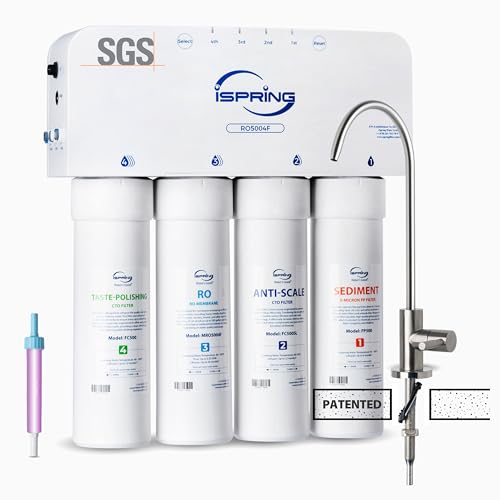
1. iSpring RO5004F Tankless RO System
Our pick — over 4.5★ from 950+ verified ratings; the strongest balance of quality and price.
The tankless powerhouse that fills a cup in 10 seconds while quietly stripping out living organisms and heavy metals together.
You get an on-demand flow of 500 gallons per day — more than 5x the output of traditional tank-style RO systems — because there is no storage tank slowing things down. That means a cup of water in about 10 seconds, not a slow trickle while you wait for a pressurized tank to empty.
The 6-layer setup runs water through a PP sediment filter, anti-scale filter, CTO carbon, a 0.0001-micron RO membrane, and a taste-polishing stage before hitting a built-in UV light rated to last up to 8,000 working hours. A status indicator on the unit tells you the UV is actually running, which is the peace-of-mind feature you want when bacteria is your worry. Buyers report their TDS (total dissolved solids — a measure of dissolved minerals and impurities) dropping from 270 to 7, and one owner’s hard water with a chlorine smell was fully resolved.
If your home has low water pressure, a built-in pump boosts flow, and it runs quietly enough that noise rarely comes up in reviews. The tankless design saves under-sink space compared to bulkier tank systems. The trade-off: the unit weighs 6.8 kg — still 31% lighter than the Waterdrop T3-C below — and owners mention it works best with decent water pressure and room to work. A leak-stop valve automatically shuts the system off if a fitting loosens, protecting your cabinets from water damage.
Built to last and easy to maintain
- Fast 500 GPD tankless flow fills a cup in 10 seconds
- 0.0001-micron RO membrane plus a UV light rated for 8,000 hours
- Twist-to-open up filters with automatic replacement reminders
- Leak-stop valve shuts off the system automatically
What deserves a second look
- Needs a power outlet for the built-in pump
- Quality is solid but durability gets mixed feedback, so treat the fittings gently
- Premium-tier pricing reflects the high flow and UV stage
Reach for this if: you want the fastest bacteria-and-contaminant defense with UV and a tankless footprint.
Look elsewhere if: your under-sink cabinet has no power outlet nearby.
2. iSpring RCC7AK-UV
America’s most-reviewed certified RO system, pairing NSF 58 protection with a mercury-free LED UV stage and mineral boost.
This is the system people buy when they want the whole thing independently certified, not just a few parts. It holds NSF/ANSI 58 & 372 certification for the entire system, meaning the full unit was tested, not just individual components. The certified filtration performance is specific: it reduces asbestos by over 99.7%, lead by 98.9%, fluoride by 97.4%, and TDS by 97.9%.
The LED UV stage is mercury-free and maintenance-free, with smart flow activation — it only turns on when water actually flows through it. That’s a thoughtful detail that saves energy and extends the life of the UV element. Beyond the UV kill-stage, the natural mineral AK stage adds back a balanced pH and essential minerals, so you do not get the flat, empty taste that bare RO water sometimes has.
Installation is the most-discussed topic among owners — almost universally positive — and a patented top-mounted faucet design lets you tighten the nut from above the counter instead of contorting under the sink. The transparent first-stage housing lets you physically see what the filter catches. Customers note it beats Brita and Pur pitchers dramatically, makes coffee less bitter, and even solves regional water problems like the bitter taste of Myrtle Beach tap water. Owners advise inspecting the unit before install and expecting a heavy, awkward setup, but praise the resulting water quality.
Why owners stick with it
- Entire system certified to NSF/ANSI 58 & 372
- Mercury-free LED UV activates only when water flows
- Remineralization adds back a balanced pH and minerals
- Transparent housing lets you see caught contaminants
The honest trade-offs
- Requires drilling into the waste pipe for the drain
- Leakage is the most-cited negative aspect, so check fittings at install
- 75 GPD output means the storage tank refills gradually
Best suited for: buyers who want third-party NSF certification plus a UV kill stage and healthier mineral taste.
Think twice if: you lack a drill or are uncomfortable cutting into your drain pipe.
3. Home Master TMHP-L HydroPerfection
A 9-stage purification tower with an EPA-registered UV sterilizer and mineral water on tap that rivals premium bottled brands.
This is the loaded model for people who want everything in one box. It ships with the brushed nickel Lux RO faucet, a fridge connection kit, a Dow Filmtec high-performance RO membrane at 0.0001 micron, and a garbage disposal drain adapter. The patented 2-pass remineralization system adds calcium and magnesium twice during the purification process, which owners say produces water comparable to Fiji bottled water.
Flow is genuinely fast for a tank system: it fills a large pot in 2-3 minutes, with a max flow rate of 1 gpm. Reviewers point out installation takes about 3 hours using push-to-connect fittings with no leaks, and annual filter changes cost less than six months of countertop filter replacements. The unit is bulky — one owner called it “perfect for the basement” — and the included refrigerator kit tubing runs short. Still, the 5-year limited warranty and multiple owners buying a second unit show deep satisfaction.
Why it stands apart: The EPA-registered UV stage, 1:1 waste ratio, and 4.5-second fill rate make this the most complete, high-performance RO package on the list.
Watch out for: The bulky footprint under the sink and the physical effort of a heavier install — this is a premium, permanent fixture.
4. NU Aqua Platinum 7-Stage UV & Alkaline
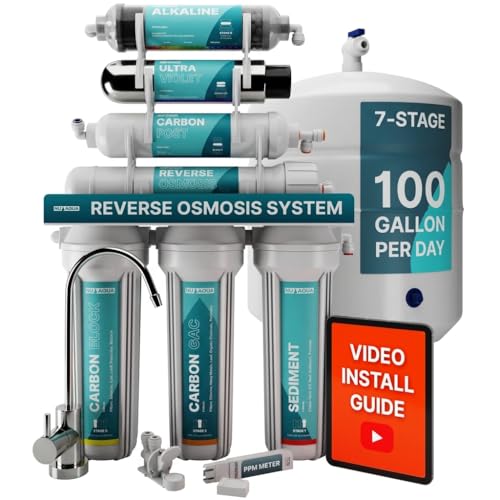
A complete under-sink bundle with faucet, tank, and PPM meter, backed by a 120-day home trial and 3-year warranty.
NU Aqua removes guesswork by shipping everything you need: filters, an NSF 100% lead-free stainless steel designer faucet, the storage tank, parts, and a bonus PPM meter (a device that measures dissolved particles) so you can test your water the day you install. The 7-stage system runs at 100 GPD (gallons per day), doubling the output of standard under-sink systems while increasing rejection rates.
The UV and HydraCoil membrane combination is the centerpiece here, paired with carbon filters designed for a higher absorption rate so even the smallest particulates get caught. The system achieves up to a 99% rejection rate of 1000+ total dissolved solids, and shoppers say actual PPM readings in the 20s and 30s from tap water starting well over 500. One long-term owner has bought three of these units — for himself, his brother, and his parents — and reports no leaks in 8 years.
Installation is approachable: color-coded tubing, quick-connect fittings, and a setup that fits under any standard kitchen sink in under an hour. The 28-pound weight tells you the tank is substantial. Owners give mixed feedback on the instructions, and a couple of buyers found the remineralization stage added an off taste or sulfur smell — most simply removed that stage and the water improved dramatically. The 120-day home trial plus 3-year warranty gives you a real safety net that few competitors match.
Everything included, ready to go
- Faucet, tank, and PPM meter shipped in the box
- 100 GPD flow with up to 99% TDS rejection
- Color-coded quick-connect installs in under an hour
- 120-day home trial and 3-year warranty
Know before you buy
- Some owners remove the 6th remineralization stage due to taste
- The heaviest tank on the list at 28 pounds
- Instructions get mixed reviews — watch NU Aqua’s videos
Grab it if: you want a self-contained kit with a long warranty and a free PPM meter to verify the output yourself.
skip it if: under-sink space is extremely tight, because the tank takes up real room.
5. APEC ROES-PHUV75
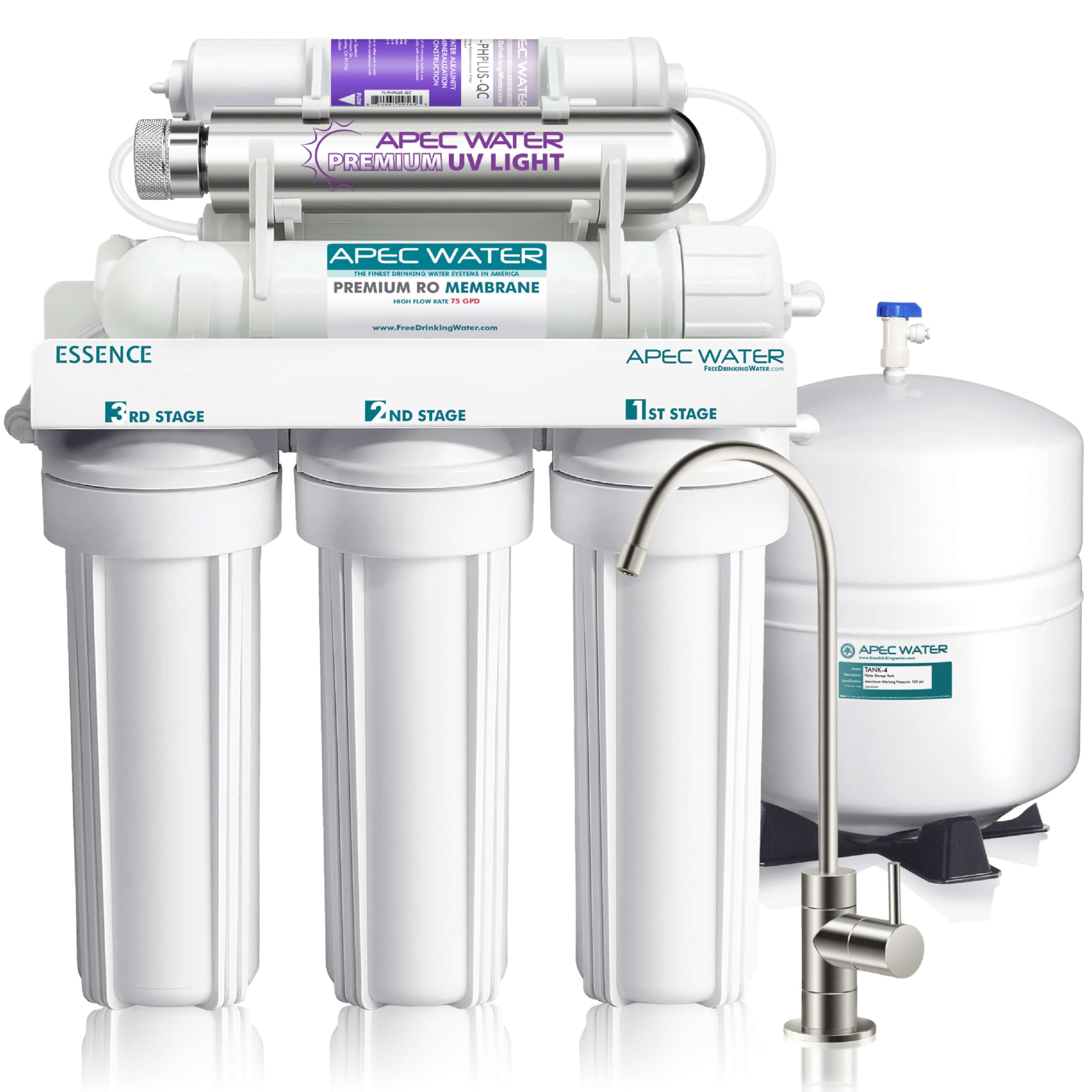
A USA-designed 7-stage system that tames hard, high-iron well water and then adds calcium for a crisp finish.
APEC designs for challenging source water. The 7-stage ROES-PHUV75 reduces up to 99% of impurities including arsenic, chlorine, lead, fluoride, heavy metals, and 1000-plus contaminants, and it is NSF 372 certified for lead-free materials. The continuous UV filter targets “various living impurities” — meaning bacteria and other organisms — as an extra layer beyond the RO membrane.
The alkaline stage uses food-grade calcium from a trusted source to safely raise pH and add minerals, which owners say makes even Florida’s hard water drinkable. The cartridge system includes a 100% lead-free designer faucet plus certified JG food-grade tubing. Long-term owners with high-iron well water report clear ice and a dramatically improved taste — one measured tap water over 500 ppm dropping to the low 20s on the RO output.
The flow rate is the real trade-off: 0.07 gpm maximum means this is a slower, storage-tank-dependent system, and the UV light can make the first water run hot if you draw large amounts quickly. Owners strongly recommend a booster pump for well water and diligent, preemptive filter changes — stage 1 every 3 months and stage 2 every 6. While taste and filtration performance earn the most praise, leakage from the UV filter housing is the most-cited negative. This pick suits buyers comfortable with ongoing maintenance and who value certified heavy-metal removal above pure convenience.
The strong point: Outstanding at taming hard, high-iron well water with a UV stage and alkaline finish — buyers report clear ice and TDS dropping from 500+ to the 20s.
The fair warning: It is a slower 75 GPD system needing diligent filter changes, and the UV housing has the most leakage reports in its data.
6. Waterdrop T3-C Tankless RO
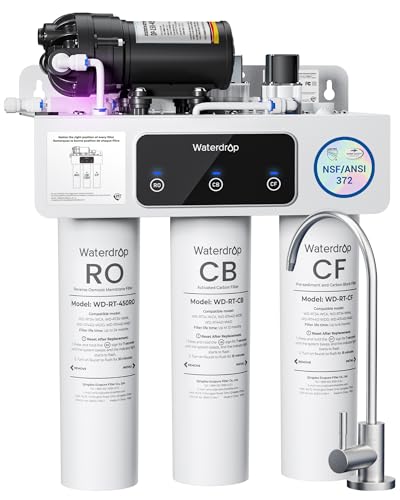
A tankless 8-stage system with smart filter alerts and a 450 GPD flow that saves up to 70% of under-sink space.
Waterdrop’s T3-C is built for people who hate the bulky storage tank of traditional RO systems. The compact tankless design can mount under the sink or on a wall, freeing up to 70% of the under-sink space a tanked system would consume. It uses an 8-stage filtration process with a 0.0001μm RO membrane to reduce heavy metals, chlorine, PFOA, and PFOS, with third-party laboratory testing behind it.
The standout feature is the smart alert system. A visible LED display reminds you when to change filters, and the all-in-one cartridge design means replacement takes seconds rather than wrestling with multiple housings. The filter life cycles are staggered sensibly: the CF filter lasts 6 months, the CB filter 12 months, and the RO filter 24 months. The 2:1 pure-to-drain ratio means for every 2 cups of clean water, only 1 cup goes to waste — a real water-saving advantage over older 1:1 systems.
Owners say the purified side tastes better than bottled water and similar to a ZERO pitcher, with the alkaline option described as crisp and clean. Owners note the flow feels slower than the 450 GPD spec, and some found the alkaline output had an off taste, preferring the straight RO. Buyers also report the installation is easy but may need extra couplings due to a thread mismatch, and the unit requires both a plug-in electrical connection and a countertop hole for the faucet. At 8.89 kg, it is the heaviest unit on this list — 31% heavier than the iSpring RO5004F above — despite its compact footprint.
Smart and space-saving
- 450 GPD tankless flow saves up to 70% under-sink space
- LED smart alerts with easy all-in-one cartridge swaps
- 2:1 pure-to-drain ratio conserves water
- Third-party lab tested for PFOA & PFOS reduction
Honest limitations
- Requires electrical outlet and countertop drilling
- Some owners mention flow lower than the 450 GPD spec
- Alkaline output can have an off taste for some
Choose it for: a compact, plug-and-play tankless system with modern smart alerts and easy filter changes.
Pass if: you cannot drill a countertop hole or have no outlet under the sink.
7. Clearsource Premier RV Filter
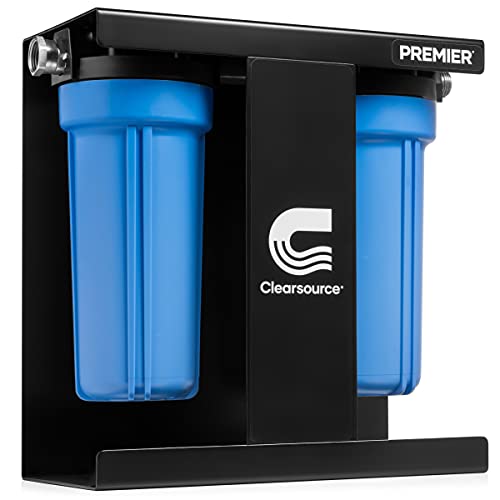
The RV filter that actually earns “hospital-grade” — a 0.2-micron absolute rating catches bacteria other filters miss.
This is not an RO system — it is a whole-vehicle point-of-entry filter built specifically for RVs, and it targets bacteria through pure physical filtration. The centerpiece is a 0.2-micron “absolute” rated filter, meaning every single pore is the rated size or better, unlike “nominal” filters where only some pores meet spec. That absolute rating is what lets it remove or reduce bacteria like Legionella and E. coli, plus cysts like Giardia.
The two-stage design pairs that hospital-grade filter with a first-stage coconut shell carbon block that improves taste and smell while reducing sediment, chlorine, chloramines, and volatile organic compounds. Clearsource claims this is tighter protection than other in-line, single, or dual canister RV systems — most of which offer only 0.5-micron nominal filtration. The max flow rate of 6.5 gpm keeps water moving fast enough for real RV use, not just a drinking tap.
The construction is the other selling point: a powder-coated standalone chassis, oversize canisters for maximum flow, and stainless-steel fittings for durable, sanitary plumbing. Customers note the cleanest water test results they have seen compared to Camco and Watts systems, with no bacteria growth and monthly tests coming back clean. One well-water user eliminated a sulfur smell for 6-plus weeks and stopped buying bottled water entirely. The honest note: installation can be difficult due to fixed fittings — you will need hose gaskets — and the unit is heavy-duty enough that owners describe it as “built like a tank” after 45 days and 2,500 miles without any pressure drop.
What wins owners over: Genuine 0.2-micron absolute filtration that passes monthly bacteria tests, with a bulletproof metal chassis that shrugs off life on the road.
Prepare for: A finicky first install with fixed fittings, and a premium price tag — though owners consistently call it worth it.
8. Clearsource Ultra RV Filter with VirusGuard
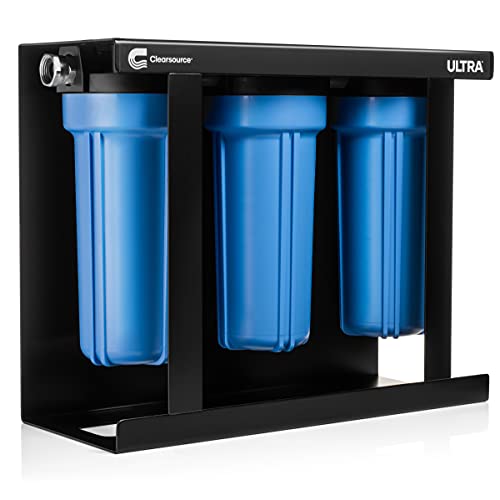
The only RV filter stepping up to viruses — an electrically charged VirusGuard stage using NASA-developed technology.
Clearsource’s Ultra escalates the Premier: it adds a third stage that targets viruses, which no other RV water filter claims to do. The VirusGuard filter uses an electrically charged coating to trap even the smallest viruses. Clearsource explains that 0.2-micron filters only catch rare, larger viruses and let the vast majority pass, so they built a technology that uses electrical charge rather than pore size alone.
The three-stage system works in layers. A 5-micron filter catches rust and sediment, a 0.5-micron coconut shell carbon block improves taste and reduces chlorine and volatile organic compounds, and the third-stage VirusGuard removes or reduces bacteria like E. coli, cysts like Giardia, and — uniquely — all types of viruses. The max flow rate is 4.5 gpm, which keeps up with regular RV faucet use.
Construction mirrors the Premier’s reputation: a rugged, industry-exclusive powder-coated metal chassis with stainless steel fittings, weighing 32.3 pounds. Owners praise it for emergencies like flood or boil-water situations, with one calling it the best small water purification unit they have experienced and noting it can adapt for shower use via hoses. Owners call it “bulky, but worth it” and advise checking storage dimensions; one reported filters clogging in under a month with continuous cold-weather use, though customer service sent free replacements. Genuine replacement filters are available on Amazon as a three-pack, making long-term upkeep straightforward.
Protection that goes further
- VirusGuard traps viruses via electrically charged coating
- 3-stage design from sediment to carbon to VirusGuard
- Rugged metal chassis with stainless steel fittings
- Replacement filter three-pack available on Amazon
What to weigh up
- Bulky 32.3-pound freestanding unit needs storage space
- Continuous heavy use can clog filters fast
- Most expensive pick on this list
Best for: RV owners or emergency prep who want the only filter that also removes viruses, not just bacteria.
Not for: anyone with tight storage or who only needs simple drinking-water filtration.
Understanding the Specs
Micron Rating & Pore Size
The micron rating tells you the largest particle that can pass through the filter. A 0.0001-micron RO membrane is the tightest common standard, physically blocking nearly everything — including most microorganisms and heavy metals. An “absolute” rating at 0.2 micron means every pore is that size or smaller, which genuinely blocks bacteria like Legionella and E. coli.
UV Sterilization vs Physical Filtration
UV light kills living organisms by damaging their DNA so they cannot reproduce, but it does not filter anything out. RO membranes physically trap contaminants but do not necessarily kill everything. The most sturdy systems pair both — an RO membrane to catch and a UV stage to neutralize. Some UV units only activate when water flows, which saves energy and extends bulb life.
NSF/ANSI Certifications
Independent lab testing is the only way to verify a manufacturer’s claims. NSF/ANSI 58 covers whole-system reverse osmosis performance. NSF/ANSI 372 confirms the product contains no more than 0.25% lead in wetted surfaces. If a system lists only its own “tested by SGS” or “third-party laboratory” claim, that is a company-commissioned test rather than a product certification.
Gallons Per Day (GPD) Flow Rate
GPD measures how much purified water the system produces in a day. Tankless systems like the 450 and 500 GPD units deliver on-demand flow — you get a cup in seconds. Tank systems in the 75-100 GPD range refill a storage tank gradually, so draws can slow down during heavy use. Match GPD to your household’s actual daily consumption, not just peak numbers.
TDS and the PPM Meter
TDS (total dissolved solids) is a measure of dissolved minerals and impurities in water, read in parts per million (ppm). A TDS meter gives you a before-and-after reading to verify your RO system works. Tap water often reads in the 200-500+ ppm range, while a healthy RO system typically outputs in the single digits to low 20s.
Pure-to-Drain Ratio
RO systems reject contaminants in a waste stream. A 1:1 ratio means for every gallon of clean water, one gallon goes down the drain. A 2:1 ratio is more efficient — two gallons of clean water for every one gallon of waste. If you are on a well or pay for water, a better pure-to-drain ratio saves real water over years of use.
FAQ
Can a regular carbon filter remove bacteria from water?
What is the difference between UV sterilization and an RO membrane?
Is a 0.2-micron absolute filter enough to protect against bacteria in an RV?
Do I need an electrical outlet for these systems to work?
How often do I need to replace the filters?
What does NSF 58 certification actually guarantee?
Will an RO system work if I have low water pressure?
Does the UV light make the water hot?
Final Thoughts: The Verdict
For most people, the best water filter system for bacteria is the iSpring RO5004F because it combines a 0.0001-micron RO membrane with UV sterilization and a fast 500 GPD tankless flow. If you want entire-system NSF certification with a mineral-boosted taste, grab the iSpring RCC7AK-UV. And if you are an RVer wanting absolute-rated bacteria protection, the Clearsource Premier is the one to reach for — or step up to the Clearsource Ultra if viruses are your concern too.
How We Picked
We do not accept paid placement. Every pick is matched to a real buyer and a real use-case; we do not hands-on test units.
Sources & Methodology
Specifications: manufacturer listings and product documentation. Review insights: verified customer reviews, as of September 2026. Pricing: not shown on this page (it changes often); check the current price via the retailer link.
As an Amazon Associate, KitchPrep earns from qualifying purchases. This does not affect which products we feature.
Related Guides
