
Specs are compiled from manufacturer listings and verified buyer reviews and can change over time — please confirm the key details on the product page before buying.
A steamy mirror that won’t clear and a ceiling you can’t cut into are two common reasons people search for a wall-mounted bathroom exhaust fan. Unlike ceiling units that need attic space above, these fans push damp air straight through an outside wall. This guide breaks down the nine best options by airflow, noise, and how hard they are to actually fit into your home.
I’m Mohammad Maruf — the founder and writer behind KitchPrep. This guide is built by comparing the manufacturers’ published specifications and the patterns across verified customer reviews, so you get each pick’s real strengths and trade-offs instead of marketing spin.
Here is exactly how to choose a wall-mounted bathroom exhaust fan that clears steam fast without sounding like a jet engine in your hallway.
Our Picks at a Glance
How To Choose The Best Wall-Mounted Bathroom Exhaust Fan
To pick a wall-mounted fan that actually clears steam and fits your home, you need to match three numbers: airflow (CFM, or cubic feet per minute), noise level (Sones, a loudness scale), and wall thickness. Get these right, and the fan will ventilate quietly and install without surprises.
Match Airflow (CFM) to Your Room Size
The single most important spec is CFM, which tells you how many cubic feet of air the fan pushes out each minute. A small bathroom needs around 80 CFM to clear a shower’s worth of steam, while bigger rooms or garages want 200 CFM or more. Buy too little airflow and the mirror stays foggy no matter how long the fan runs.
Understand Noise (Sones) Before You Commit
Noise is measured in Sones, a scale where 1.0 is a quiet whisper and 4.0 is noticeably loud conversation. If the fan sits next to a bedroom or living area, aim for 1.0 to 1.5 Sones; if it’s in a garage or utility room, you can tolerate a louder unit that moves far more air.
Check Wall Thickness and Duct Size
Through-the-wall fans need to fit your specific wall. Some units have adjustable ducts that extend to handle thick walls, while others are built for standard 2×4 or 2×6 construction. Always measure your wall depth and the hole size required before ordering to avoid a return.
Quick Comparison
| Model | Best For | Airflow (CFM) | Noise Level | Installation Type | Amazon |
|---|---|---|---|---|---|
| Broan-NuTone LP80★ Best Overall | Quiet in-wall retrofit | 80 cfm | 1.0 Sone | In-Wall | Amazon |
| RLOZUI 8-InchPowerhouse Pick | High-volume spaces | 735 cfm | Not specified | Wall Mount | Amazon |
| HG Power 6-InchMost Versatile | Reversible intake | 310 m³/h | 3 speeds | Wall/Window | Amazon |
| Allvent 6-Inch | Budget wall mount | 141 cfm | Below 41 dB | Wall/Window/Ceiling | Amazon |
| Zeyzer Black 110 CFM | Style-forward rooms | 110 cfm | Below 34 dB | Ceiling/Wall | Amazon |
| Quini 6-Inch | Thick-wall flexibility | 80 cfm | 4.0 Sones | Through-the-Wall | Amazon |
| Panasonic FV-0810VSS1 | Continuous low-speed venting | 30–100 cfm | Whisper quiet | Ceiling/Wall | Amazon |
| Broan-NuTone 509S | Garages & large rooms | 200 cfm | 8.5 Sones | Through-the-Wall | Amazon |
| Panasonic FV-0510VSC1 | Auto humidity control | 50–100 cfm | Very quiet | Ceiling/Wall | Amazon |
In‑Depth Reviews
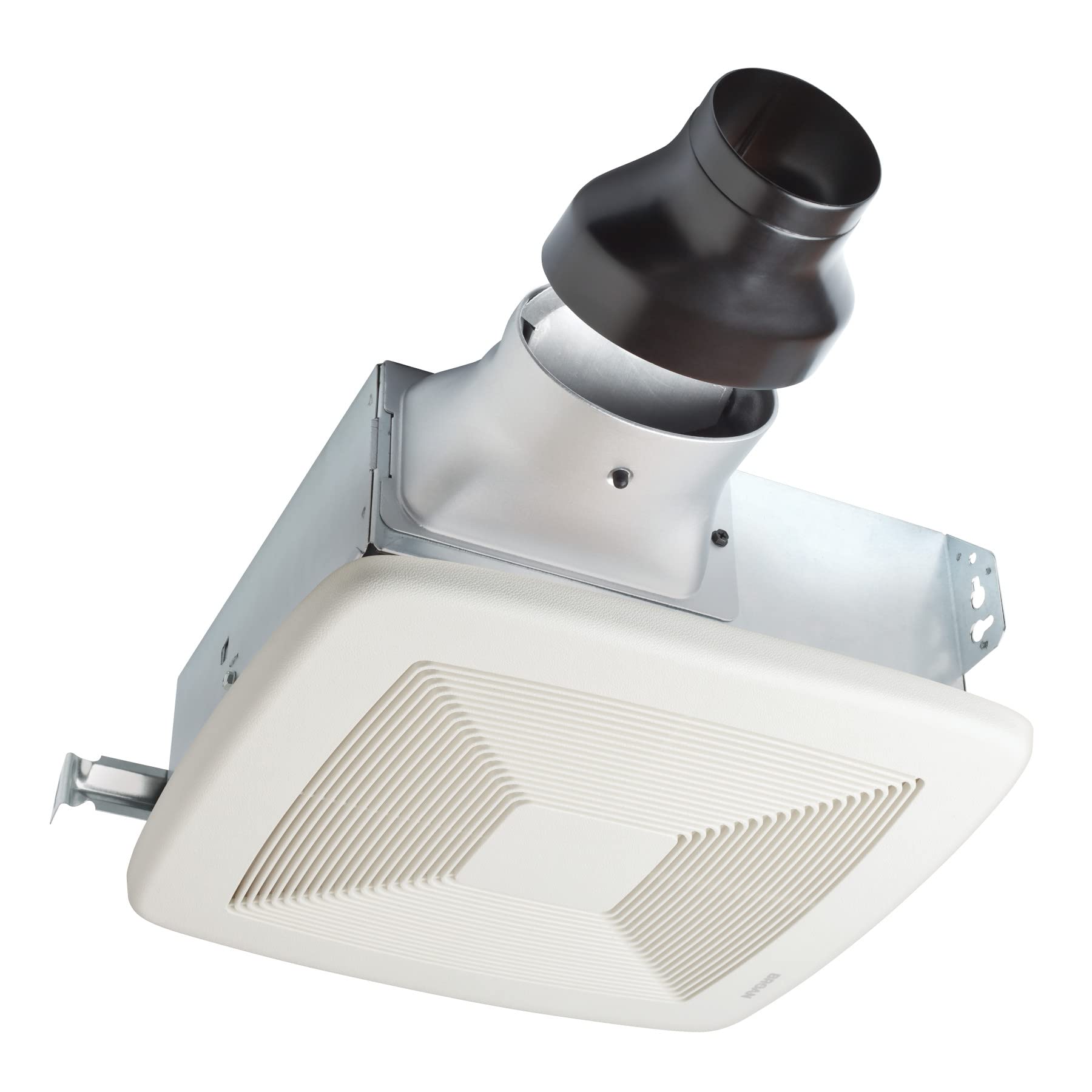
1. Broan-NuTone LP80 ENERGY STAR LoProfile Fan
Our pick — 4.5★ from 300+ verified ratings; the strongest balance of quality and price.
The whisper-quiet in-wall pick that slides between 2×4 studs where ceiling fans won’t fit.
This is the fan for anyone whose bathroom has no attic access and no room above the ceiling. Its galvanized steel housing measures just 4 inches deep, so it fits inside a standard 2×4 wall cavity — the very spots where conventional ventilation simply wouldn’t fit. It runs on 80 CFM, enough to ventilate a room up to 75 square feet or a modest one-car garage without breaking a sweat.
What wins people over is the noise level — the top praise across the review pages. At 1.0 Sone, it is quiet enough that buyers report it is barely audible in adjacent rooms, making it a strong fit near bedrooms. The motor is plug-in and permanently lubricated, and the dynamically balanced centrifugal blower wheel keeps operation steady. On the spec sheet it also meets ASHRAE 62.2 local ventilation requirements by pushing more than 50 CFM at 0.25-inch static pressure.
Buyers who installed it in modular homes with tight attic spaces say it is a solid replacement for cheap builder units, and many report the fan has run daily for months with zero problems. It mounts on a ceiling or wall, and includes both 4-inch oval and 3-inch round duct connections, so you can match whatever ducting your home already has. The trade-off is the retrofit reality: the external corner brackets are not usable when replacing an old unit, and some buyers had to secure it with wood screws straight into the stud, plus patch drywall around a larger hole.
The crowd favorite holds a strong 4.5-star average across several hundred owners — the kind of consistent satisfaction that makes it our top recommendation for a proper in-wall installation.
Why it wins
- Quiet 1.0 Sone operation that you can barely hear next door
- Fits the tight 4-inch cavity between standard 2×4 studs
- ENERGY STAR certified with both 3-inch and 4-inch duct hooks
- Built tough with a galvanized steel housing
What to know
- Retrofit installs need a bigger drywall hole and some patching
- External corner brackets don’t work for every replacement job
Reach for this if: you need a genuinely quiet fan that fits inside a thin wall cavity in new construction or a stud-to-stud replacement.
Look elsewhere if: you want a true drop-in swap with no drywall work — this one demands a clean opening and a little patience.
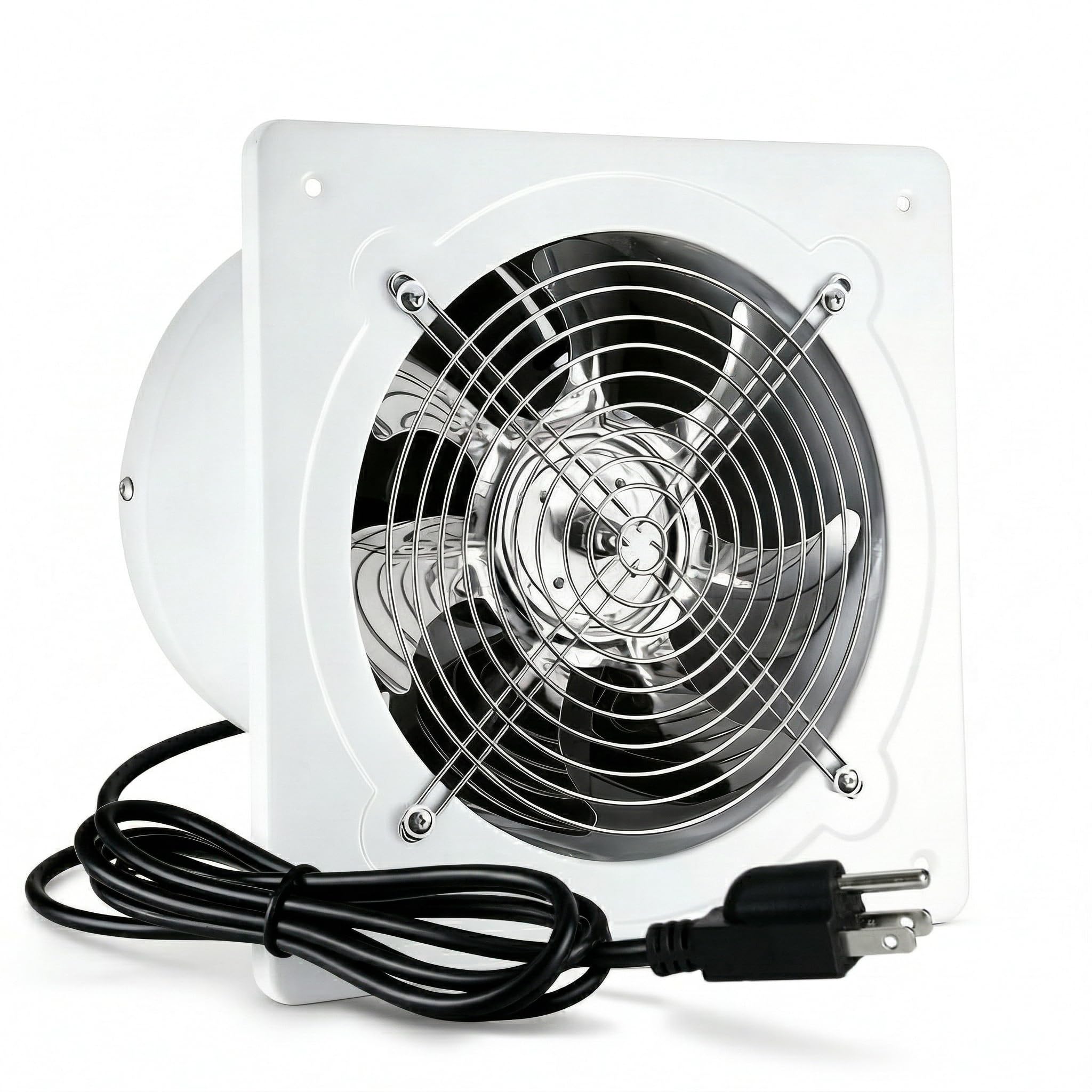
2. RLOZUI 8-Inch 735 CFM Wall Mount Fan
A brute-force 735 CFM air mover for garages and attics, not hushed powder rooms.
If your problem is a stuffy garage, a hot attic, or a workshop full of fumes, this 8-inch unit moves a staggering 735 cfm — more than nine times the air of the Broan-NuTone LP80 above (80 cfm). It runs on 110V at 80W with a double ball bearing outer rotor brushless motor, and the metal body is built to resist corrosion and scratches in rough environments. The built-in automatic closing valve stops outside air and debris from drifting back in when the fan is off.
Owners mention it has been mounted and running for months with no problems, and several describe how it completely empties a room quickly, pulling hot air up and out of attics on summer days. It even has a built-in overheating protection device that cuts power to the motor if things get too hot — a smart safety net for continuous-duty use. Owners praise its quality and performance most, and the flow-to-noise balance earns genuine compliments from people who installed it as a replacement for a 1950s-era unit.
The honest catch is that this is not a subtle machine. Noise gets mixed feedback — some call it very quiet, others find it slightly loud — so it belongs in spaces where a little whir is acceptable. Durability also draws some concern, with a few units stopping after around 4 months of heavy use, so it is best matched to jobs where raw air-moving power beats salon-level silence.
Built for volume: a 2800 r/min motor with 80W output that shifts serious air in big spaces.
Who it’s for: garage, attic, and workshop owners who want one fan to clear a whole room fast, not a near-silent bathroom whisperer.
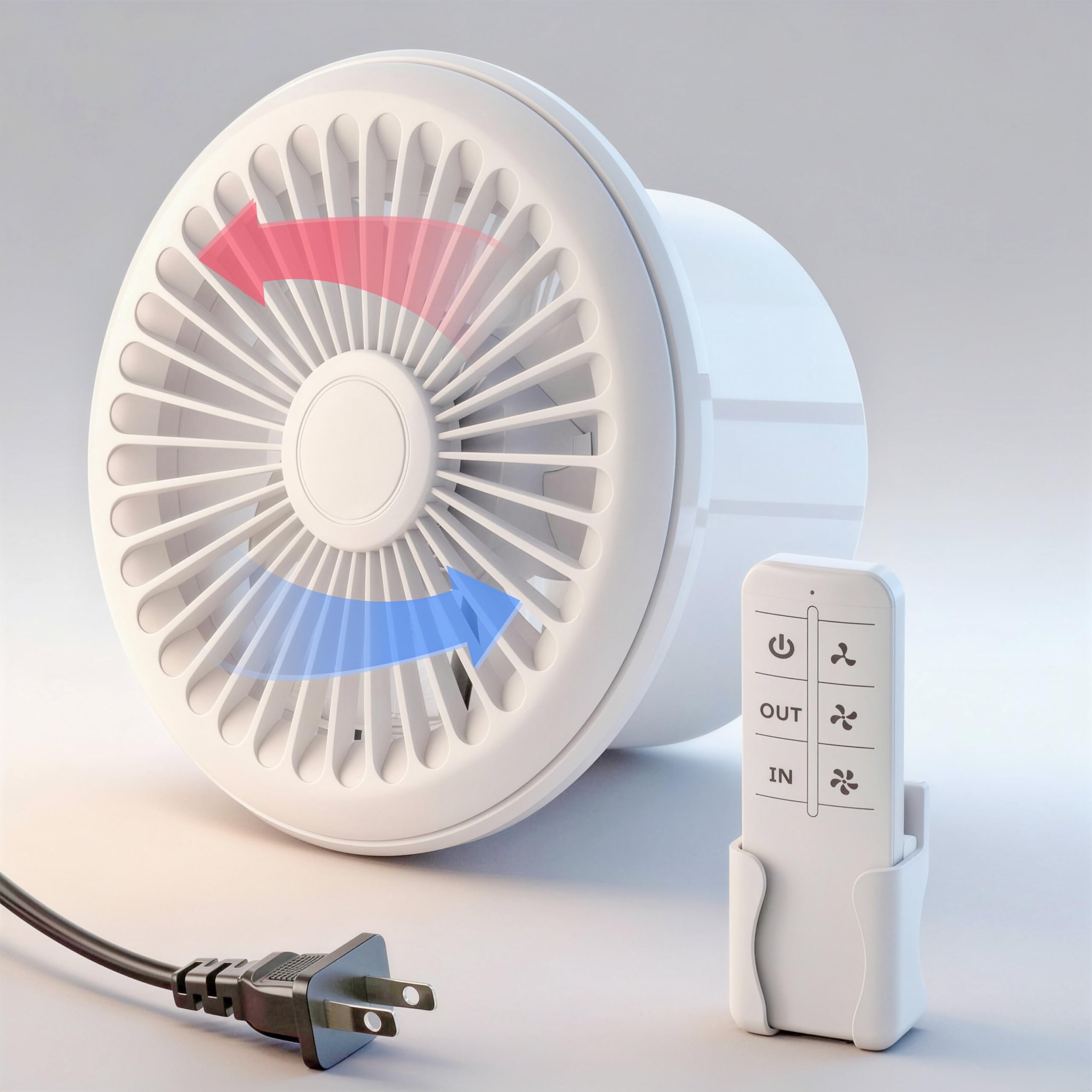
3. HG Power 6-Inch Reversible Remote Fan
One fan that both exhausts stale air and blows in fresh — controlled from your chair.
This is the fan for people who want options. It is reversible, meaning with a press of the included remote you can switch it from pulling stale, humid air out of a room to pushing fresh outside air in. That makes it genuinely useful for an office that gets stuffy, a bathroom that needs a boost, or a garage that could use a cross-breeze on a mild day.
Three speed presets let you pick the right tool for the moment: Turbo mode accelerates moisture removal, Medium balances airflow with energy efficiency, and Low runs with minimized noise. The remote controls on/off, speed, and direction without you getting up, which owners find surprisingly handy. Protective mesh screens keep debris from getting into the blades, and the durable ABS plastic body holds up to everyday wear. On its lowest setting it is genuinely quiet, though stepping up to settings 2 and 3 brings noticeable noise.
Buyers single out quality most, and owners use it in very small bathrooms and as a transfer fan to cool a stuffy office. A few note a quirk: when you plug it in it turns on automatically and defaults to intake mode, which can be annoying if you have a weather door in the duct. It also runs on a 6.56-foot power cord with a US plug, so you’ll want an outlet or an extension run nearby rather than hardwiring it in.
One fan, two jobs: the 2-in-1 intake/exhaust design plus remote makes it the most flexible unit in this lineup.
Fair warning: expect audible operation on higher speeds and an automatic power-on when plugged in.
4. Allvent 6-Inch 141 CFM Wall Mount Fan

An affordable 141 CFM mover with a self-closing check valve to stop backdrafts.
At worth of value, this fan gives you solid mid-range airflow on a budget. It pushes 141 cfm on just 18W of power with noise rated lower than 41 dB, which is the kind of efficiency that keeps electricity bills down while still clearing a bathroom or small kitchen. It can mount on a wall, window, or ceiling, giving you real placement freedom when you buy.
The standout feature is the check valve — a spring-loaded flap that stays shut when the fan is off. That stops cold drafts, dust, and outside smells from drifting back through the duct when you are not running it. If you do not need the valve, you can simply take it off. Owners have used it for everything from a small bathroom to a greenhouse cabinet, and one reviewer noted it fit perfectly into an old dryer vent and looked great.
It also comes with a 3-foot cord plug, and several owners pair it with a WiFi smart plug to schedule it from their phone. The honest trade-off: some buyers found the airflow weaker than expected and the noise level is a matter of debate, with a few calling it super quiet and others finding it noisy. The included manual is reportedly not very helpful and wrongly claims features the fan doesn’t have — but once installed, customers note it works well even after 18 months of use.
Why it’s a deal
- 141 cfm at just 18W keeps running costs low
- Spring check valve blocks backdrafts when off
- Mounts three ways — wall, window, or ceiling
- Simple 3-foot plug-in cord, no hardwiring needed
Keep in mind
- Airflow is moderate, not a heavy-duty air mover
- Skip the manual — it has errors and could mislead you
Best for: budget shoppers who want a plug-in fan with backdraft protection for a mid-size bathroom or small workshop.
Not for: anyone tackling a large, high-humidity space that needs serious CFM muscle.
5. Zeyzer Black 110 CFM Wall Mount Fan

The black square grille that vents a bathroom without clashing with modern decor.
Sometimes a white plastic grille ruins the whole look of a nicely finished bathroom. This Zeyzer fan comes in black, so it blends with dark fixtures, black-framed mirrors, and charcoal tile in a way most fans can’t. The 7.6-inch square panel and 5.9-inch duct push 110 cfm, and the anti-ultraviolet ABS housing is made to resist fading and yellowing over time.
Noise is genuinely low for the price, rated below 34 dB thanks to a ball motor design, and owners repeatedly describe it as quiet while still airing out a bathroom quickly. It suits ceilings and walls alike, and installation needs only an opening between 6.3 and 6.7 inches — no fastening ring required, though you do need to connect your own duct to carry the air outside. The easy install and clean appearance are what buyers compliment most.
The catch is the outside. Since the fan itself doesn’t ship with an exterior vent cover, several owners struggled to find a matching cover for the back side, and one called the fan louder than the 1.0 Sone spec suggests. Others note the 5.9-inch duct is larger than standard residential vents, so you might need to adapt or trim around the rough opening. For a wall install, think of this as the indoor half of a two-part system.
Design-first choice: rare black finish that owners say looks great and fits modern rooms.
Plan ahead: budget for sourcing an exterior wall vent cover that matches this non-standard duct size.
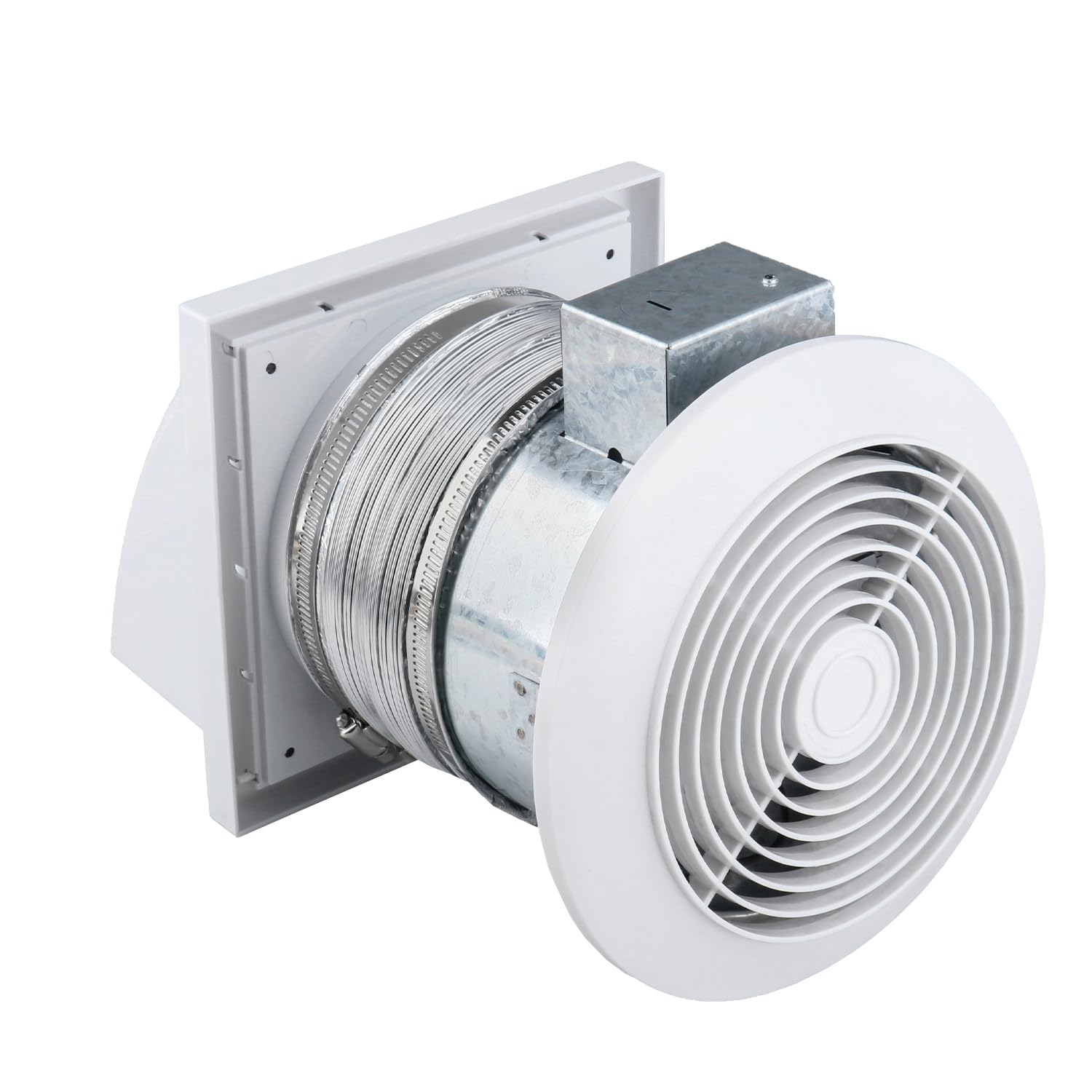
6. Quini 6-Inch Through-Wall Fan
A true through-wall fan with an aluminum duct that stretches to fit walls up to 19 inches thick.
Most bathroom fans assume you have a standard thin wall, but homes with thick exterior walls, added insulation, or unusual construction need something adjustable. This Quini unit delivers with an aluminum foil duct that extends from 2 to 15 inches, fitting walls between 6 and 19 inches thick. The duct diameter is 6.2 inches, and it includes a flap to stop air from flowing back inside.
It moves 80 cfm to ventilate up to 65 square feet, ideal for spot ventilation near a workbench, a small bathroom, or a laundry room. The copper motor coil is built to last, and the outer wall cover offers rain and wind protection while a screen keeps out birds and mosquitoes. Owners consistently praise how easy it is to install and how well it clears cooking smells and post-shower steam while staying relatively quiet in operation.
Buyers praise its functionality and installation, and many call it money well spent. You will need to cut an opening of about 6.4 inches in both the interior and exterior walls and wire it to a switch, and a few buyers with thinner 5-inch walls had to add framing to make it fit.
The thick-wall specialist: the only unit here that adjusts to walls from 6 to 19 inches deep.
Who it suits: anyone with an unusually thick exterior wall who wants a complete through-wall kit with a rain-resistant outer cover.
7. Panasonic FV-0810VSS1 WhisperValue Fan
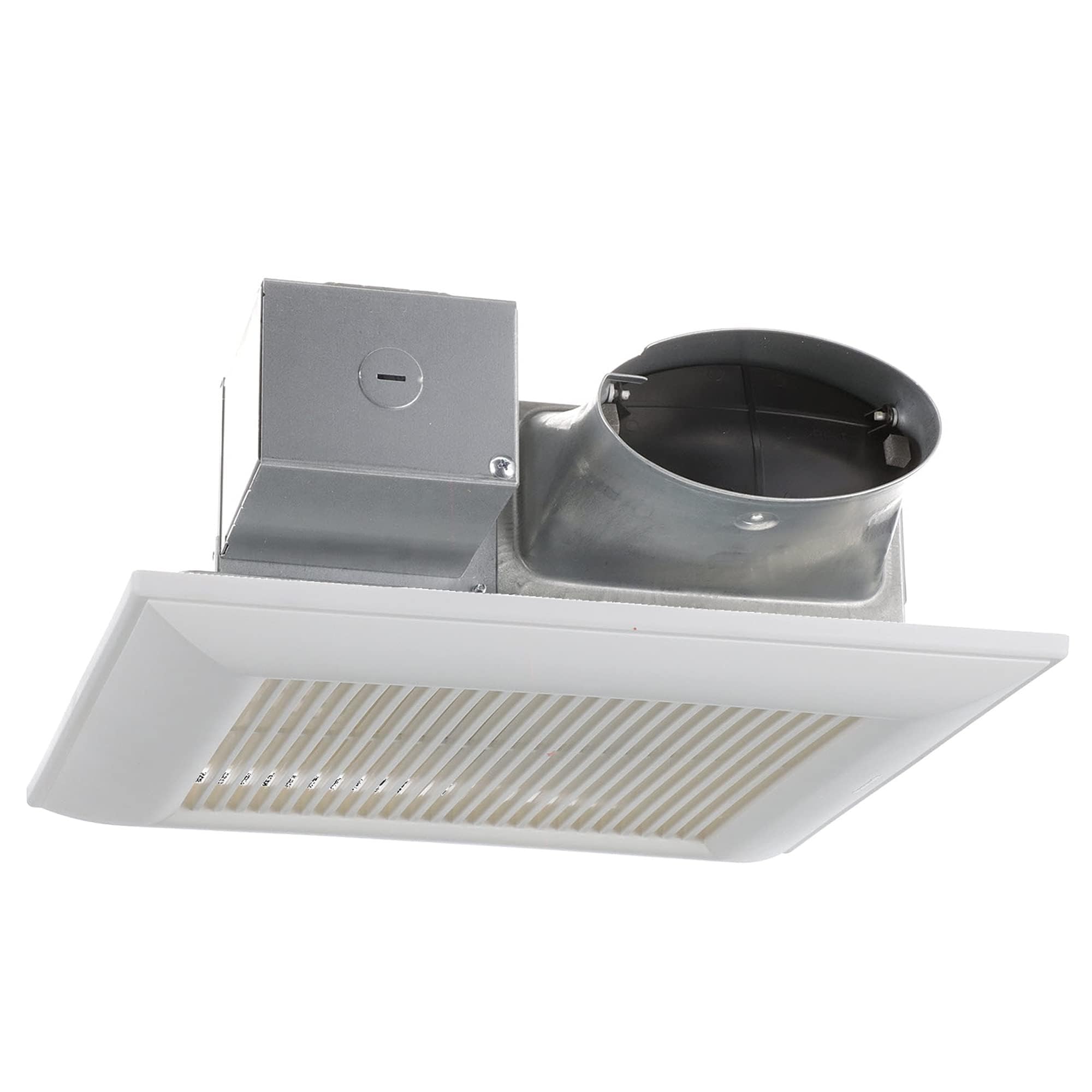
An ultra-slim premium fan that trickles air continuously, then kicks up to 100 CFM on demand.
This is the fan for people who hate coming back to a musty bathroom. Inside sits a DC/ECM motor (a direct-current, electronically commutated motor) with SmartFlow technology that runs continuously at a preset low level you choose (from 0 up to 30-70 CFM in 10 CFM increments), then automatically jumps to a maximum of 80 or 100 CFM when you flip the wall switch. That means constant background ventilation to keep humidity and odors from ever building up in the first place.
It is ENERGY STAR certified and remarkably thin — the housing is just 3-3/8 inches deep, so it squeezes into tight ceiling or wall spaces where rafters block standard fans. The unique L-shaped bracket simplifies the install, and it carries a UL listing for ceiling, wall, and even tub/shower enclosure mounts when protected by a GFCI. Owners praise its quality and performance most, with several calling Panasonic fans the best available in US box stores, noting they are very quiet with very high flow.
There are two things to know before you buy. First, the fan takes 5 to 10 seconds to slowly ramp up to speed on start, which can make it seem broken at first — it’s not. Second, the duct is a 4-inch oval, and while it is not silent at maximum speed, the low noise floor is a big part of why buyers love it for tight installations. Plan to have a helper on hand for the ducting and wiring work.
Why it’s worth it
- Continuous low-speed venting stops musty air before it starts
- Slim 3-3/8-inch housing fits impossibly tight spaces
- ENERGY STAR certified DC motor sips power
- Adjustable speed in 10 CFM steps up to 100 CFM max
Know before installing
- Slow 5-10 second ramp-up can look like a fault at first
- Higher initial cost than standard wall fans
Choose this if: you want premium build quality and the ultimate defense against bathroom mustiness through continuous air trickle.
Think twice if: you just need a loud, cheap blast of airflow for a garage — this is refined, not raw.
8. Broan-NuTone 509S Through-the-Wall Fan

A 200 CFM workhorse with its own on/off switch and exterior cap built in.
If the space is a garage, a workshop, or a rec room where you need serious air movement without running ductwork, this Broan unit delivers. It operates at 200 CFM, enough to ventilate a one-car garage or rooms up to 195 square feet, and it includes a built-in exterior wall cap and vent — so there is no ducting to install at all. The galvanized steel housing shrugs off the elements, and a built-in bird screen keeps critters out of your wall.
The truly handy part is the on/off switch built right into the cover. That means no wiring to a separate wall switch is needed, and the motor assembly locks in with a fast twist-lock motion. Owners rave most about airflow and value for money, and the review pages are full of long-term owners who have bought this fan three times over — with each unit lasting a solid 10 to 12 years of service. One owner describes it as much more powerful than expected, moving a ton of air through an old kitchen wall vent.
Be honest about the noise before you commit: at 8.5 Sones (a loudness scale where 1.0 is a quiet refrigerator) this is the loudest fan in this guide, so it is not meant for a hallway near a bedroom. Owners say it is ideal for a utility room with a toilet or a garage, where the whoosh is acceptable. The 14.25 x 14.25 x 8-inch housing adjusts to fit walls from 4.5 to 9.5 inches thick, and the biggest install complaint is that retrofit into existing drywall takes work because of the large junction box and flanged exterior vent.
Raw moving power: 200 CFM with zero ductwork needed — just cut a hole, twist in the motor, and flip the built-in switch.
The honest catch: 8.5 Sones is genuinely loud; reserve this one for garages and utility spaces, not quiet bathrooms.
9. Panasonic FV-0510VSC1 Humidity Sensor Fan
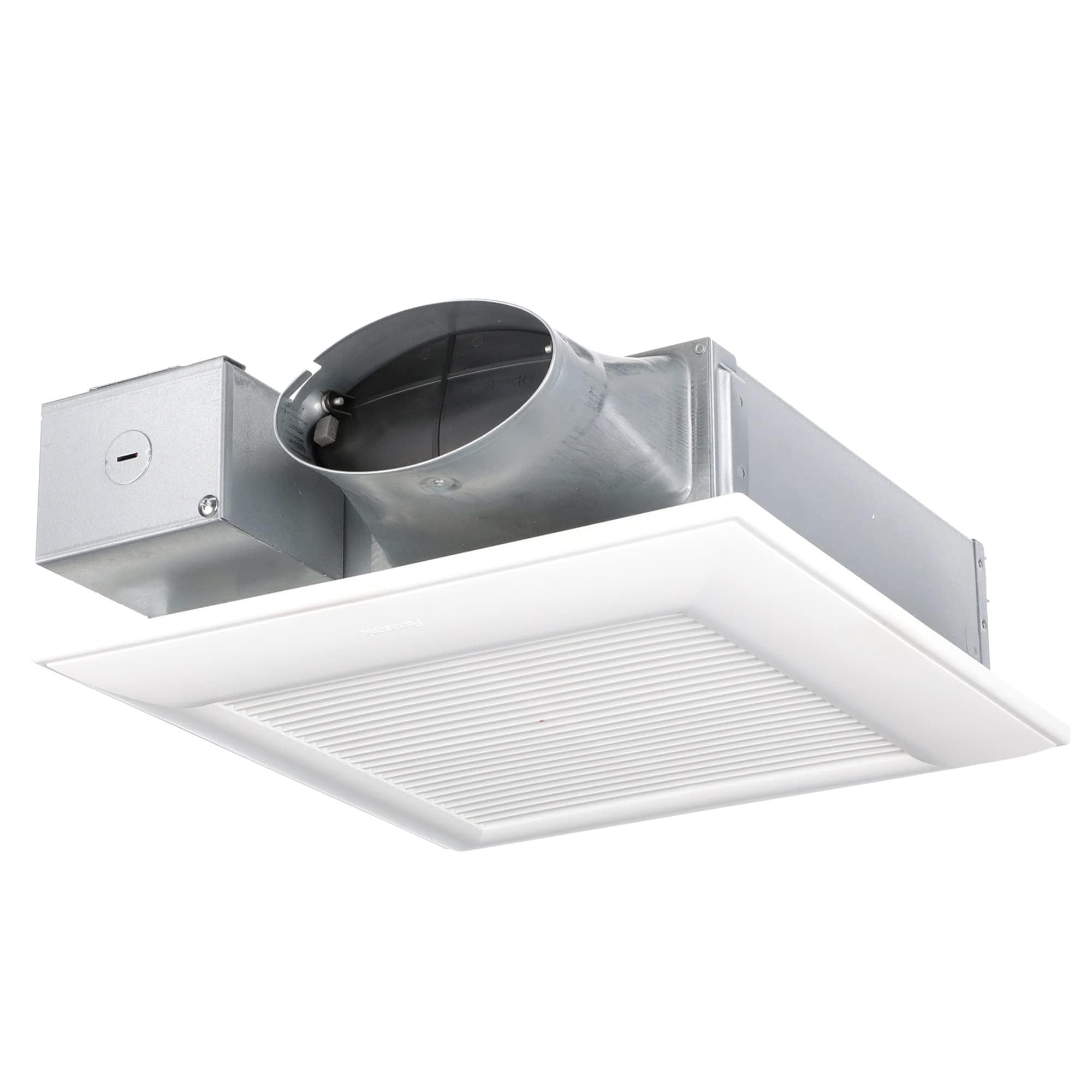
A smart fan with a built-in condensation sensor that turns itself on when the room gets steamy.
This is the fan for anyone who forgets to switch on the vent until the mirror is already fogged. Its built-in condensation sensor watches humidity levels and kicks the fan into action automatically, so the steam from a long shower gets cleared before you even think about it. You pick your airflow with the Pick-A-Flow selector — 50, 80, or 100 CFM — to match the room size and your noise tolerance.
The ECM motor is extremely quiet, and noise level is the thing owners praise most, with many describing it as very, very quiet while still clearing bathroom fog fast. The housing depth is just 3-3/8 inches, so it fits tight ceiling and wall cavities, and the L-shaped mounting bracket simplifies the job. Owners who pair it with a manual wall switch say the combination works almost perfectly: the built-in sensor manages the speed, and the switch gives you manual control when you want it. One owner summed up the experience: if you want a dry bathroom, this might be the best option you’ll find.
The quirks are worth understanding. The old-work mounting is genuinely difficult if you are retrofitting into existing drywall — it’s much easier in new construction. The fan also runs for roughly 21.5 minutes after it senses humidity, which some owners find longer than needed, and a few report the sensor itself not working reliably. For most buyers, the auto-humidity feature is exactly the hands-off convenience they want after a shower.
Set-and-forget ventilation: the condensation sensor catches steam automatically so you never walk into a foggy mirror again.
Who it’s for: new builds or accessible retrofits where you can manage a trickier mounting process and want hands-free humidity control.
Understanding the Specs
CFM — How Much Air It Moves
CFM stands for cubic feet per minute, the volume of air the fan pushes out every 60 seconds. This is the single most important number for a wall-mounted fan because it determines whether your bathroom actually clears. A small bathroom needs around 80 CFM, a larger one wants 110 CFM or more, and a garage needs 200 CFM or above. Match the CFM to the room size or you will be staring at a fogged mirror regardless of how long you run the fan.
Sones — How Loud It Really Is
Sones are the standard unit for perceived loudness. The scale is not linear: 1.0 Sone is about as loud as a quiet refrigerator hum, while 4.0 Sones is roughly the noise of normal conversation, and 8.5 Sones is genuinely loud. For a fan near a bedroom or living space, stick to 1.0 to 1.5 Sones. For garages and utility rooms where you only run the fan when you are in the space, a higher Sone fan is a fair trade for far more airflow.
FAQ
What is the difference between a wall-mounted and a ceiling-mounted bathroom fan?
How many CFM do I need for my bathroom?
Can I install a wall-mounted exhaust fan myself?
Why does my bathroom fan need a backdraft damper or check valve?
Is a higher CFM fan always better?
What is the best way to run a bathroom fan for a humid bathroom?
Can a wall fan be used in a garage or workshop?
How do I know if a fan will fit my wall thickness?
Is a bathroom exhaust fan with a humidity sensor worth the extra cost?
Final Thoughts: The Verdict
For the majority of shoppers, the best Wall-Mounted Bathroom Exhaust Fan is the Broan-NuTone LP80 — it is genuinely quiet at 1.0 Sone, fits inside a standard 2×4 wall, and carries a strong satisfaction record from hundreds of owners. If you want continuous background ventilation to stop musty air before it starts, the Panasonic FV-0810VSS1 is the premium pick with its ultra-slim dual-speed design. And for a garage, attic, or workshop that needs serious air moved without ductwork, the Broan-NuTone 509S at 200 CFM is the heavy-duty choice to beat.
How We Picked
We do not accept paid placement. Every pick is matched to a real buyer and a real use-case; we do not hands-on test units.
Sources & Methodology
Specifications: manufacturer listings and product documentation. Review insights: verified customer reviews, as of September 2026. Pricing: not shown on this page (it changes often); check the current price via the retailer link.
As an Amazon Associate, KitchPrep earns from qualifying purchases. This does not affect which products we feature.
Related Guides
