
Specs are compiled from manufacturer listings and verified buyer reviews and can change over time — please confirm the key details on the product page before buying.
Your old tank heater is the reason you ration showers. A tankless unit ends that — it heats water the instant you turn the tap, so you get an endless stream at a steady temperature. The real question is which type fits your home: a whole-house gas unit, a dedicated electric point-of-use model, or a portable propane option for the RV. This guide ranks the top performers so you can pick the one that keeps your family’s morning showers hot.
I’m Mohammad Maruf — the founder and writer behind KitchPrep. This guide is built by comparing the manufacturers’ published specifications and the patterns across verified customer reviews, so you get each pick’s real strengths and trade-offs instead of marketing spin.
From powerful whole-house gas units to compact electric point-of-use models, these tankless water heaters deliver endless hot water while freeing up floor space.
Our Picks at a Glance

How To Choose The Best Tankless Water Heaters
You want a tankless water heater that never leaves you shivering mid-shower. To get that, you need to match three things: your peak hot water demand, your home’s fuel type, and your incoming water temperature. Get these right, and you’ll enjoy endless hot water; get them wrong, and you’ll face lukewarm showers.
Match the flow rate to your home
Flow rate, measured in gallons per minute (GPM), is the spec that decides everything. A single shower pulls about 1.5 to 2 GPM. If three people shower at once, you need a unit that handles 6 GPM or more. A point-of-use electric unit with a 2.6 GPM flow is perfect for one bathroom or a kitchen sink, while a whole-house gas unit with 9 GPM can run a shower, laundry, and dishwasher simultaneously.
Electric vs. gas vs. propane
Electric tankless units are compact and need no venting, but they draw enormous power — a 28.8kW unit requires three dedicated 40-amp breakers and a 200-amp service. Gas units (natural or propane) heat faster and handle more simultaneous use, but they need a vent pipe to exhaust fumes. Propane portables shine for camping and RVs where no electric service exists. Your home’s existing setup usually decides this for you.
Understand temperature rise
Every spec assumes a certain temperature rise — the difference between your cold inlet water and your desired hot temperature. A unit rated for a 35°F rise works fine in warm climates but struggles in northern winters when ground water drops to 40°F. Buyers in cold states should look at the maximum temperature output and winter performance reviews before committing.
The installation reality check
Tankless heaters are not a simple swap for most homes. Electric units may require heavier gauge wiring and new breakers. Gas units need proper venting and gas line sizing. Many owners in the review data paid for a licensed electrician or plumber, and for good reason — a 199,000 BTU gas unit is not a weekend project. Factor installation into your decision before you buy.
Quick Comparison
| Model | Best For | Flow Rate | Heat Output | Fuel Type | Amazon |
|---|---|---|---|---|---|
| Stiebel Eltron Tempra 29 Plus★ Best Overall | Whole-home electric | 3 gpm | 28,800 watts | Electric | Amazon |
| ThermoMate 11kWBest Value | Point-of-use value | 2.6 gpm | 11,000 watts | Electric | Amazon |
| Eemax EEM24013Compact Pick | Compact electric | — | 13 kW | Electric | Amazon |
| EcoSmart ECO 8 | Single-fixture electric | 2 gpm | 8 kW | Electric | Amazon |
| CAMPLUX BW264 | Camping & outdoor | 2.64 gpm | 68,000 BTU | Propane | Amazon |
| Ranein Indoor Propane | Indoor propane whole-home | 4.3 gpm | 100,000 BTU | Propane | Amazon |
| Ranein RA65EH RV | RV replacement | 3.9 gpm | 65,000 BTU | Propane | Amazon |
| FOGATTI InstaShower 9 Pro | Premium RV upgrade | 3.6 gpm | 66,000 BTU | Propane | Amazon |
| Rheem RTG-70DVLN | Whole-home natural gas | 7 gpm | 160,000 BTU | Natural Gas | Amazon |
| MIZUDO 199,000 BTU | Large whole-home gas | 10.3 gpm | 199,000 BTU | Natural Gas | Amazon |
| Rinnai RU160iN | Whole-home condensing | 9 gpm | — | Natural Gas | Amazon |
In‑Depth Reviews
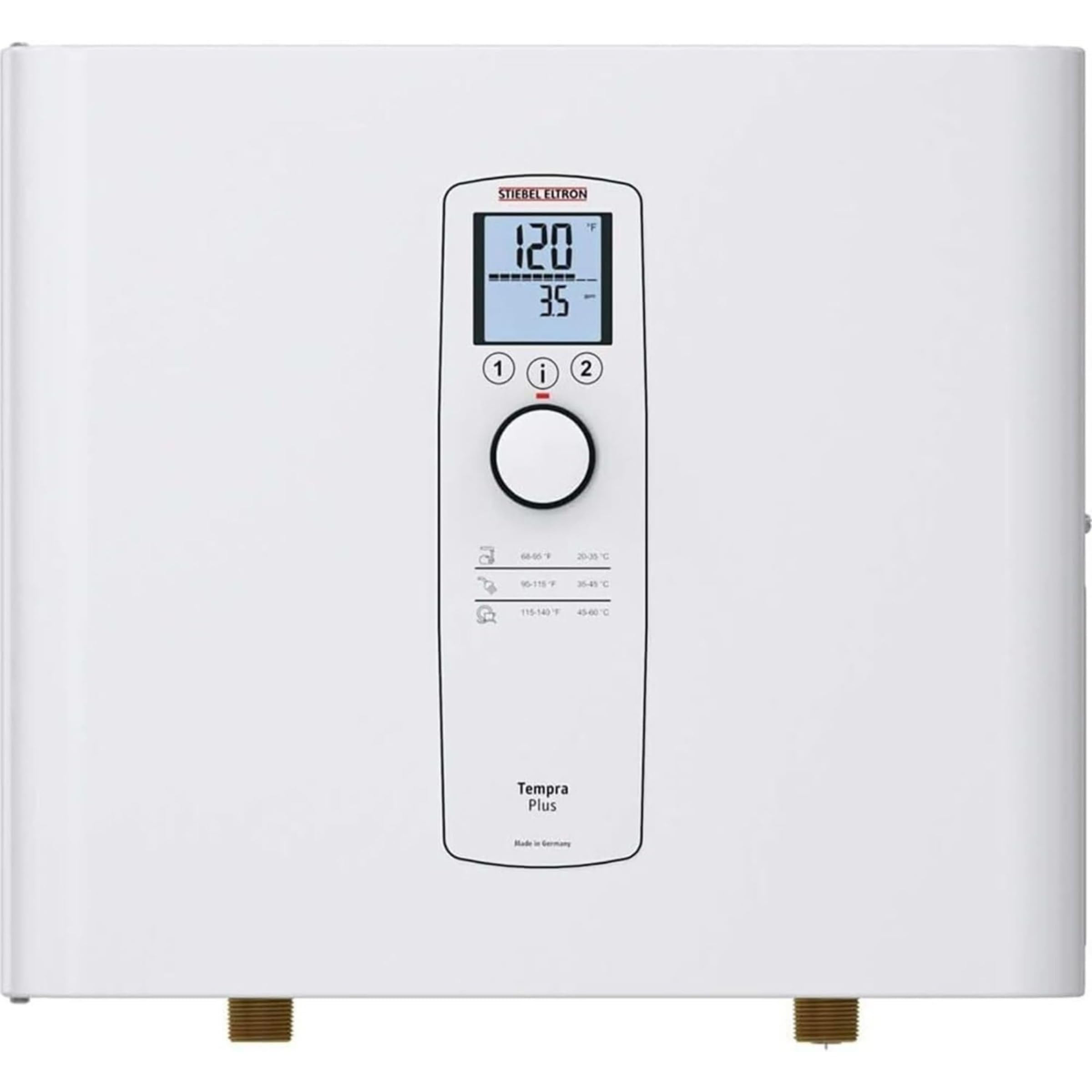
1. Stiebel Eltron Tempra 29 Plus Electric Tankless Water Heater
Our pick — over 4★ from 450+ verified ratings; the strongest balance of quality and price.
The electric unit that ended a 5-person family’s cold showers for good.
This German-made 28.8kW unit is the answer for a home that wants endless hot water from electricity, not gas. Owners confirm it keeps up with two bathrooms running at once in a 4-bedroom, 5-person home — the kind of real-world proof that matters. It delivers a continuous 3 gpm flow, which covers most household needs, and it requires no venting at all, so you can mount it almost anywhere.
Two features make daily life easier here. It has two temperature memory presets, so you can switch between a tub-filling temperature and a normal shower setting with one touch. It also holds the temperature accurately, which owners say means no more fiddling with the tap mid-shower. Buyers report flawless operation after 4-5 years of use, with the only minor quirk being that it won’t ignite at very low flow — under 0.5 GPM — which rarely matters in practice.
The main trade-off is the heavy electrical demand. This unit needs three separate dedicated 40-amp breakers with 8-gauge copper wiring, and your home needs a minimum 200-amp service. Owners mention installation by an electrician can. But for a family that wants reliability without gas lines, this is the unit owners upgrade to and stay with for years.
What wins people over
- Endless hot water with two bathrooms running at once
- Two temperature memory presets for tub vs. shower
- No venting needed — mounts in tight spaces
- Proven reliability through years of daily use
What to plan for
- Requires 3 dedicated 40-amp breakers and 8-gauge wire
- Needs a 200-amp home service — check first
- Professional electrician cost is substantial
Built for reliability: a whole-home electric unit for families who want zero maintenance and won’t run gas lines.
Think twice if: your home has less than 200-amp service or you want a DIY weekend install — plan for an electrician.
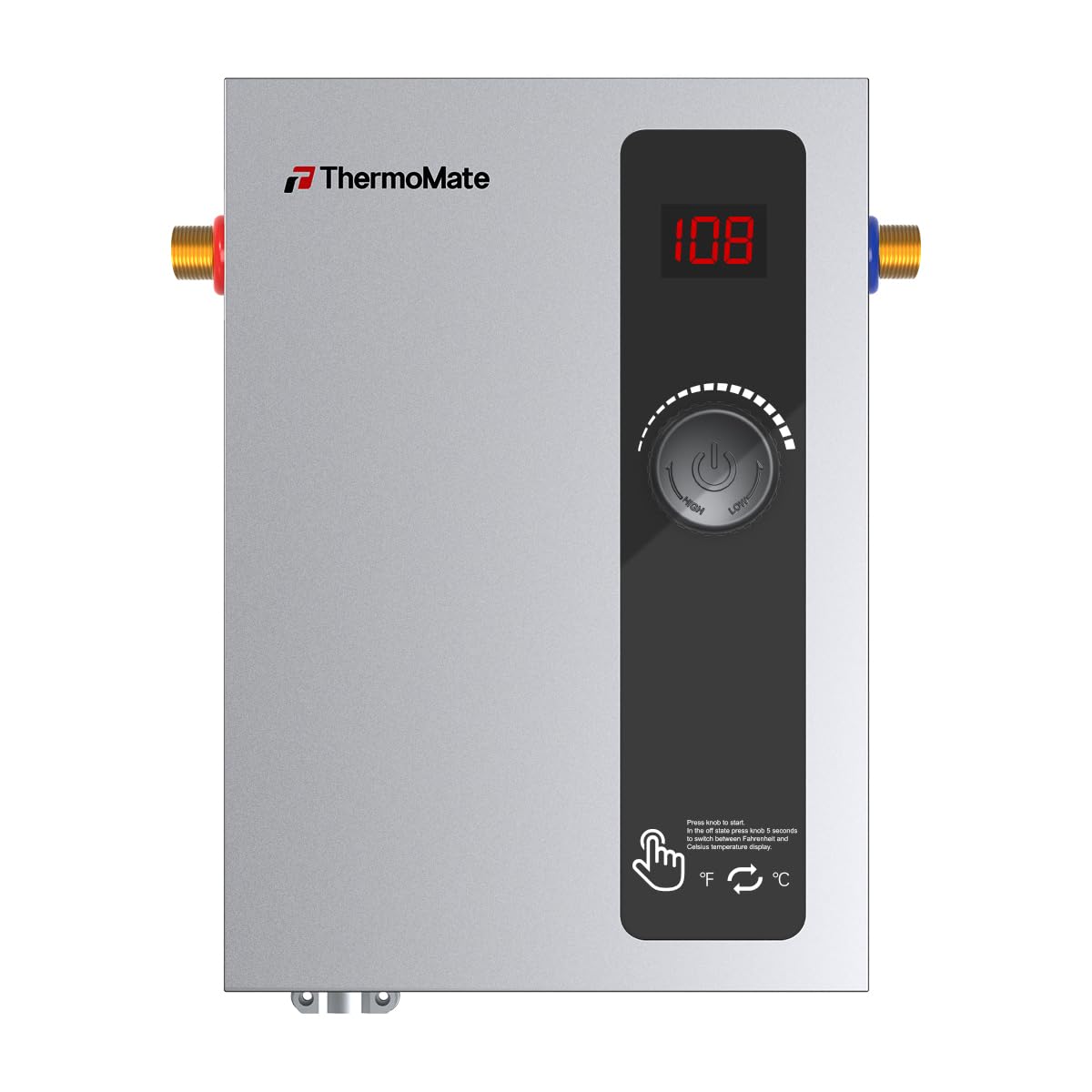
2. ThermoMate Tankless Water Heater Electric, 11kW 240 Volt
A compact electric unit that kills the shower-to-shower wait while staying affordable.
This 11kW point-of-use heater is the budget-friendly champion for a single bathroom or kitchen sink. Owners mention it gets used daily and heats up quickly, replacing an old Bosch unit and running “a bit hotter” while costing significantly less.
The standout engineering is the cast aluminum heating chamber, which separates the heating element from the water. That means less scale buildup on the element and a lower risk of leaks, which owners in hard-water areas appreciate. It is also self-modulating, meaning it only draws the energy it needs based on the water temperature and flow it detects — no wasted power when you just want a quick rinse.
Performance is the most-praised aspect here, with over 50 owners singling it out. The honest caveat is that it needs a double-pole 50-amp breaker and 6 AWG wire, so it’s not a plug-and-play swap. It is also a point-of-use model, not a whole-house unit — best placed near the bathroom or sink it serves.
Why it wins fans
- Cast aluminum chamber resists scale and leaks
- Self-modulating — only draws the energy needed
- Heats quickly with a max 131°F output
- Light at 11 pounds, wall-mounts anywhere
Before you buy
- Needs a 50-amp breaker and 6 AWG wire
- Point-of-use — not for a whole house
- Mixed feedback on long-term heating consistency
Reach for it: a dedicated bathroom or sink heater if you want endless hot water on the cheap.
Look elsewhere: whole-house needs — this one serves one or two fixtures at a time.
3. Eemax EEM24013 Electric Tankless Water Heater, Blue
The pint-sized electric heater that puts hot water at the sink in 10 seconds flat.
If you have a sink or small bathroom that always runs cold, this 13 kW Eemax is made for you. Its self-modulating technology adjusts energy input based on how much hot water you need, so it only works as hard as necessary. Customers note hot water at the kitchen sink in just 10 seconds — a dramatic upgrade over waiting for a distant tank to push hot water through the pipes.
You can hide this unit under a sink or in a small cabinet because it measures just 8 inches wide by 11.5 inches high, so it won’t steal your storage space. Its stainless steel body and 99.8% efficiency rating (the share of energy turned into heat) mean nearly every watt goes into your water, not wasted standby heat. You also get a 5-year warranty on leaks and 1-year on parts for basic protection.
Functionality is the top praise here, with 36 owners calling it out, and water temperature is the second most-liked feature. The catch? It draws 43A and needs 6-gauge wire, which several owners say is hard to bend and work with — and hiring a plumber or electrician adds roughly to the project. Works best for a 2-person household or as a dedicated point-of-use unit.
What owners love
- Hot water at the sink in 10 seconds
- Compact 8″ x 11.5″ size fits tight spaces
- Stainless steel build with 5-year leak warranty
The practical notes
- Needs 6-gauge wire that is hard to handle
- Professional install adds cost
- Best for 2 people or single fixtures
Grab it if: you want near-instant hot water at one sink and have a tight space to fill.
Pass if: you need to run multiple showers — this is a point-of-use specialist.
4. EcoSmart ECO 8 Tankless Water Heater, Electric 8-kW

An entry-level electric unit perfect for one sink or bathroom on a budget.
At just 4.8 pounds and 8 kW of power, the EcoSmart ECO 8 is the lightest whole-unit option here and one of the simplest to install. It is built for a single fixture — owners mention using it for bathrooms and small appliances, and one noted it heats “really fast” even at the furthest bathroom. It only activates when water flows, so it uses zero standby energy.
What wins people over is the temperature control. A simple knob lets you dial in your exact preferred temperature, and the modulating thermostat holds it steady — owners say no more temperature swings from an on/off heater. The 99.8% efficiency rating means nearly all electrical energy converts to heat. Satisfaction with the /month electric savings reports shows the value of on-demand over a tank.
Set your expectations correctly and this is a great buy: it is not a whole-house heater. The 2 gpm flow limits it to one shower or a sink at a time, and in colder climates it may struggle to keep water hot at high flow. It also runs on a 40-amp breaker, which some owners had to install fresh.
What makes it easy
- Dial temperature control holds your exact setting
- Only draws power when water flows
- Light 4.8-pound body, easy wall mount
Where it fits
- 2 gpm flow — one fixture at a time
- Mixed reviews on keeping hot water at high flow
- Best for warm climates or low-flow use
Best for: a budget single-bathroom or sink install where you want dial-in temperature control.
Not for: cold-climate whole-home use — the 2 gpm limit will disappoint.
5. CAMPLUX 2.64 GPM Propane Portable Gas Water Heater

A propane-powered outdoor shower that sets up in 15 minutes anywhere.
This CAMPLUX is the camping and outdoor specialist. It runs on a standard propane tank, delivers 2.64 gpm of instant hot water at up to 68,000 BTU, and weighs just 18 pounds so you can carry it to the campsite, the pool, or the barn. Owners use it for everything from dog washing to keeping an 8-foot stock tank pool warm for extra months — and they praise its quiet operation and easy setup.
Safety is the priority here. It is CSA certified with a flame failure device, anti-freezing protection, and overheat protection that shuts the unit off above 176°F. The anti-freeze drain plug lets you empty residual water for cold-weather storage or long periods of disuse. It also automatically stabilizes water pressure between 3.6 and 110 PSI, so you do not have to manage gas and water flow constantly.
The 11.5% energy-saving technology reduces gas consumption, and the included kit — a 5-foot gas regulator, shower head, and installation kit — means you are ready to go from the start. Just heed the manual’s warning: never wrap Teflon tape between the gas regulator and inlet pipe, as improper sealing can cause fire.
Why it shines outdoors
- Portable 18-pound design with mounting bracket
- Anti-freeze drain plug for cold storage
- Includes gas regulator and shower head
- Quiet operation praised by owners
Set expectations
- Outdoor use — not for indoor installation
- Temperature tuning can be touchy
- High water pressure may trigger shut-off
Reach for it: camping, pool season, or any off-grid spot where you need hot water on demand.
Skip it: permanent whole-home use — this is built for the outdoors and portability.
6. Ranein Propane Gas Tankless Water Heater, 4.3 GPM Indoor

A propane indoor unit that keeps up with a houseful of kids and never runs cold.
This Ranein is a serious indoor propane performer for homes that want gas heat without a natural gas line. It delivers 4.3 gpm of hot water with 100,000 BTU of power, supporting up to 3-4 water points at once. Reviewers point out it handles a full household — one noted it works for 5 kids and 3 adults — with unlimited hot showers and no temperature change even when the kitchen, laundry, and shower run simultaneously.
The intelligence here is the four preset modes: 4-season auto-match, Kitchen at a default 100°F, Bathtub, and Shower. The temperature range adjusts from 95°F to 155°F with a high-temp lock to prevent scalding — a real safety feature for families with kids or older adults. Reliability is the most-praised aspect by far, with over 90 owners calling it out, followed by easy installation and strong value.
It comes with a vent pipe included, so no extra purchases are needed for the indoor install. An LED display shows real-time temperature, status, and fault codes, and the temp memory keeps your preferred setting across power cycles. Just note it is not recommended above 2,000 feet elevation and should be installed by licensed professionals.
What makes it reliable
- 4 preset modes for season, kitchen, tub, and shower
- 95°F to 155°F range with anti-scald lock
- Vent pipe included for indoor install
- Oxygen-free copper heat exchanger
Considerations
- Not for elevations above 2,000 feet
- Requires licensed professional installation
- Occasional reports of fitting leaks
Built for: propane homes with high simultaneous demand — showers, laundry, and kitchen at once.
Think twice: high-altitude properties or DIY installs; this needs a pro and the right elevation.
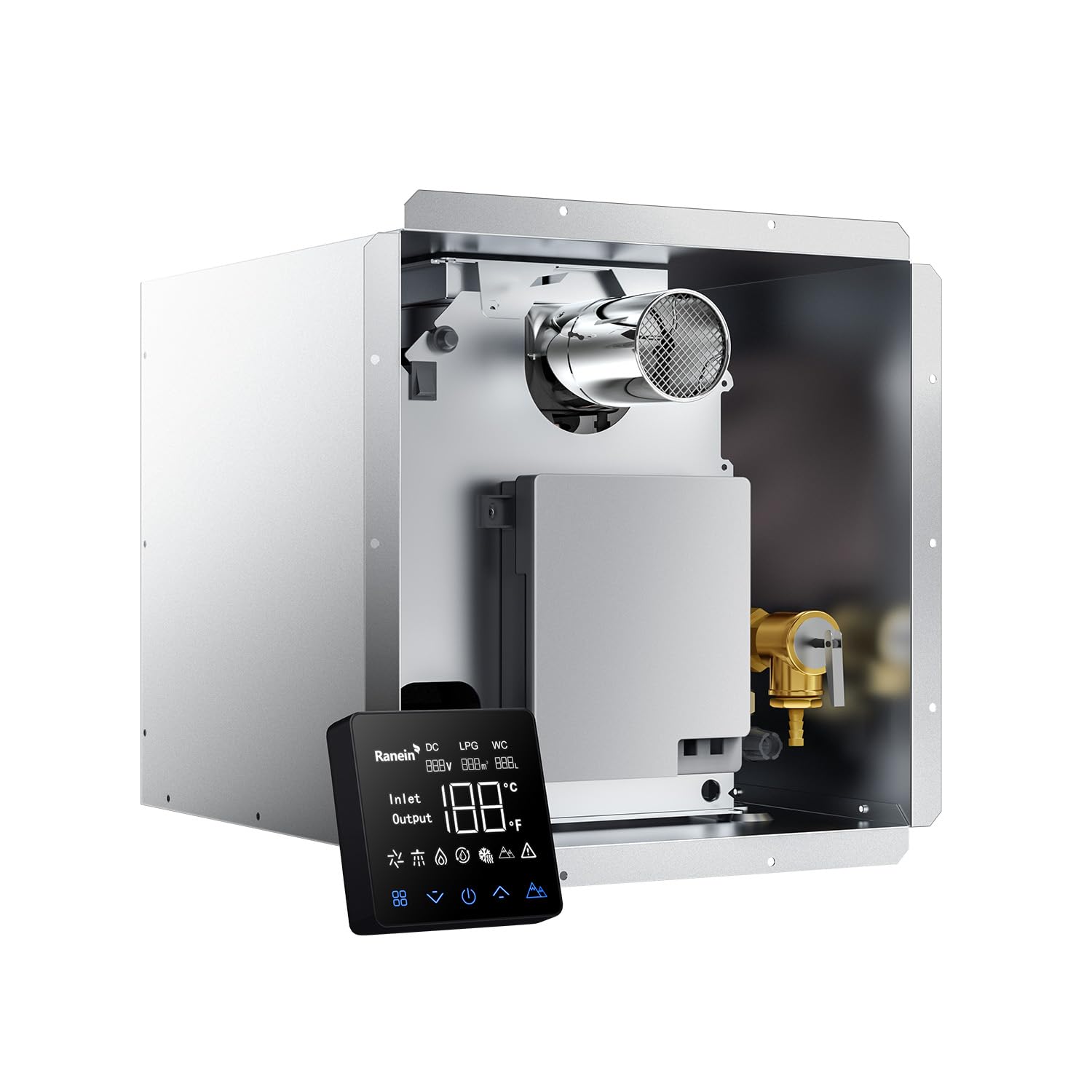
7. Ranein RV Tankless Water Heater, 65,000 BTU
The RV upgrade that turns 6-gallon tank limits into endless 40-minute showers.
If you live in an RV and hate rationing showers, this Ranein ends that. It drops into the standard 12.8-inch by 12.8-inch opening, replacing most Suburban and Atwood 6, 10, or 12-gallon tank heaters. Shoppers say a full 40-minute shower with zero temperature drop — impossible with a 6-gallon tank. Its 65,000 BTU burner (a measure of heat output) pushes up to 3.9 gallons per minute, holding steady even in cold weather.
The 12V DC powered design integrates directly with your RV’s electrical system — no inverter needed. The upgraded multi-function remote shows gas consumption, voltage, water flow in GPM, and anti-freeze activation in real time. It is tune for altitudes up to 9,800 feet, making it suitable for mountain camping that other units can’t handle.
Anti-freeze protection activates automatically below 42.8°F to protect internal components, and the built-in flame failure protection shuts off gas automatically. Owners consistently praise the fit, the endless hot water supply, and the value — noting it costs about half of a comparable Suburban while working better.
RV owners love
- Fits standard 12.8″ x 12.8″ RV cutouts
- 40-minute showers with no temperature drop
- 12V DC — no inverter needed
- Works at altitudes up to 9,800 feet
RV realities
- Not plug-and-play — may need replumbing
- Exterior door not included
- Pressure relief valve can leak above 60-100 psi
Made for: full-time RVers and cold-weather campers who want real showers, not 6-gallon rinse-offs.
Expect: some RV plumbing work — owners mention replumbing and propane line adjustments.
8. FOGATTI InstaShower 9 Pro RV Tankless Water Heater

The RV tankless heater with a built-in mixing tank for rock-steady shower temperatures.
This is the third-generation FOGATTI, and the defining upgrade is the built-in mixing tank that stabilizes extreme temperature swings. With 66,000 BTU and up to 3.6 gpm of flow, it runs the RV bathroom and kitchen simultaneously. Buyers report they have “honestly never ran out of hot water” after months of full-time use — the exact experience tankless is supposed to deliver.
Precision is the headline feature. It holds temperature within ±1°F, and the burner adapts to the season: two rows of flames in summer to prevent overheating, five rows in winter for full warmth. It also operates at altitudes up to 9,800 feet, and the upgraded NIDEC fan delivers 300Pa of power to keep the flame stable even in high winds. Owners praise the easy swap-out from older Girard units.
Quality is the most-cited strength here, with over 40 owners calling it out, followed by straightforward installation. It comes with a 150 PSI pressure relief valve, a 15″ x 15″ door, a trim ring, and an intelligent remote controller that works up to 6.6 feet away — extras that normally cost extra. Some owners mention finicky temperature regulation depending on RV plumbing, and one noted an early motherboard failure.
Premium features
- Mixing tank prevents temperature fluctuations
- ±1°F precise temperature control
- Operates at 9,800 feet altitude
- Includes pressure relief valve and door
Weigh these
- Heavier at 30.9 pounds
- Some reports of temperature regulation issues
- Reliability concerns in rare early failure cases
Reach for it: a premium RV upgrade where stable temperature and quality matter more than price.
Consider the cost: this is the pricier path — cheaper tankless units exist, but owners who switched say the quality gap is real.
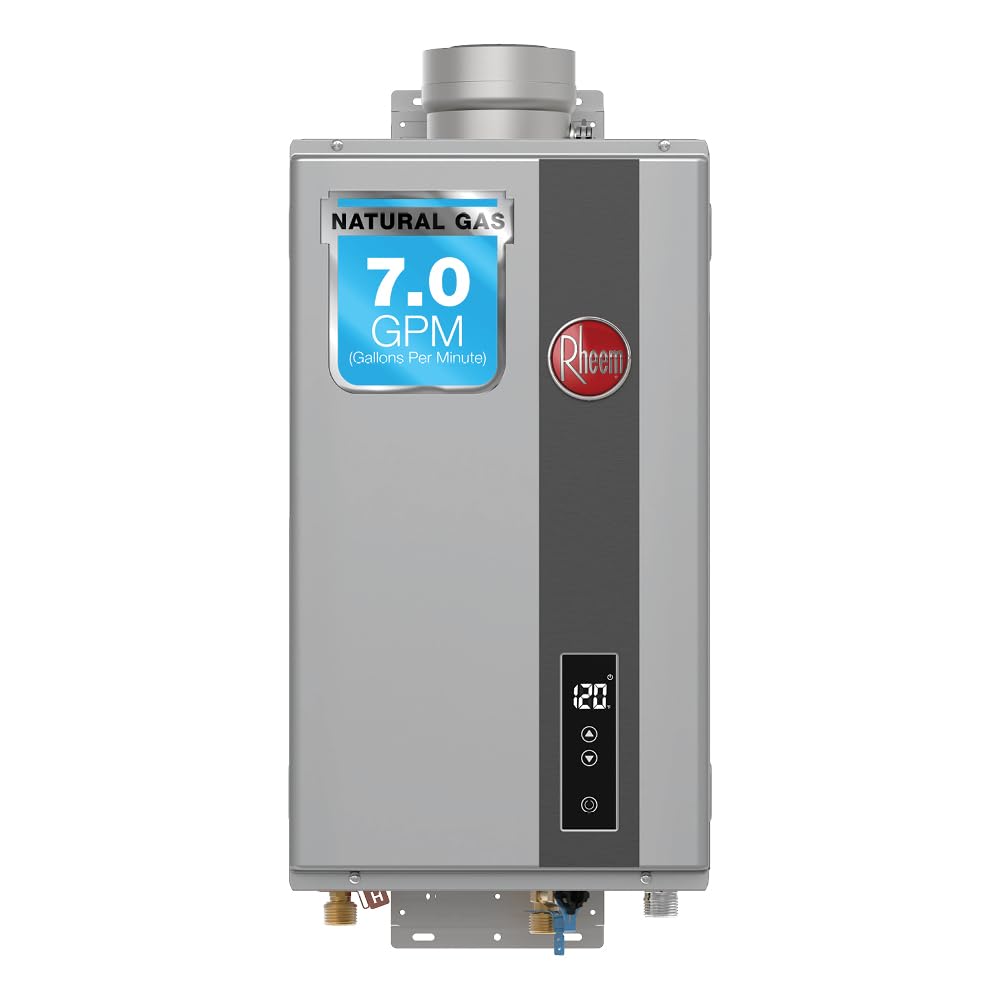
9. Rheem RTG Series 7.0 GPM Natural Gas Tankless Water Heater
A natural gas whole-house unit that runs 2-3 showers and never blinks.
Rheem is a name homeowners trust, and this RTG Series unit backs that reputation. It delivers 7.0 gpm at a 35°F temperature rise, with 160,000 BTU/hr of output — enough for 2-3 simultaneous showers. A family of four confirmed it runs shower, laundry, and dishwasher all at once without running out, and the gas bill only went up -3 per month over electric. That is the real-world math that convinces owners.
The efficiency story is strong. This non-condensing unit has a 0.82 Uniform Energy Factor (UEF) and saves up to 34% on energy costs compared to a 50-gallon electric tank. It uses on-demand heating only — no standby loss while you sleep. The digital LED panel adjusts temperature in precise ±1°F steps, and the built-in LeakGuard detects internal leaks to protect your home from water damage.
Owners highlight the effective heating, with hot water coming on right away, plus the strong value. The 15-year heat exchanger warranty shows confidence in the build. Plan for professional installation — this needs a direct vent system and dedicated power, and one owner mentioned buying all new venting was “pricey but high quality.”
Homeowner wins
- 7 gpm handles 2-3 showers at once
- 0.82 UEF saves up to 34% on energy
- LeakGuard detects internal leaks
- 15-year heat exchanger warranty
Installation notes
- Requires direct vent system
- Needs dedicated power supply
- Venting purchase adds to project cost
Best for: families with natural gas service who want a trusted brand and real energy savings.
Plan for: professional venting installation — not a DIY swap for most homes.
10. MIZUDO Natural Gas Tankless Water Heater, 199,000 BTU
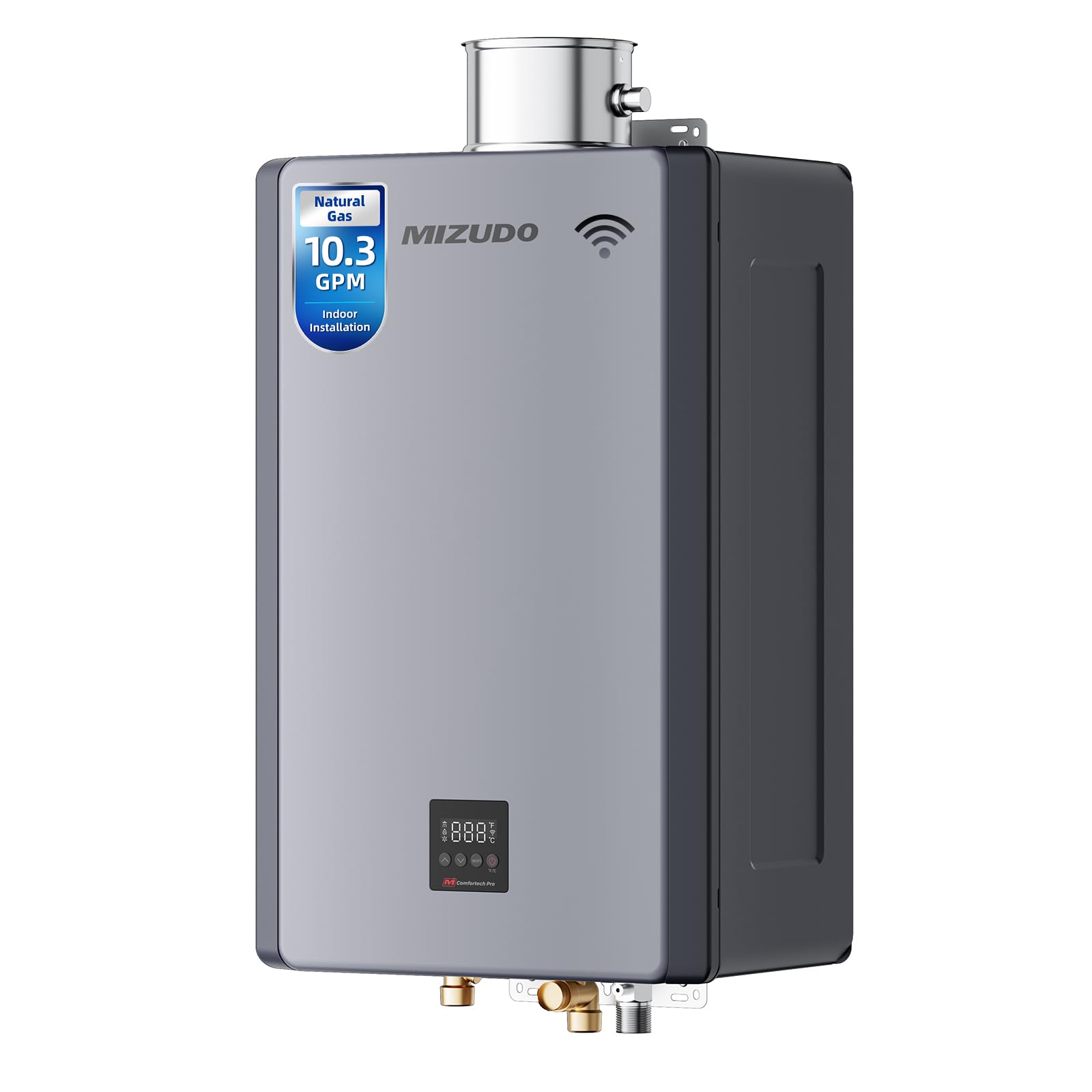
The 10.3 gpm gas giant that powers an entire busy household at once.
This MIZUDO is the highest-capacity unit in the lineup, delivering 10.3 gpm from 199,000 BTU of heat. That is enough to run 2-3 bathrooms plus the kitchen, laundry, and dishwasher simultaneously — the true whole-house solution for busy families upgrading from a 50-gallon tank. Owners say hot water comes out in seconds, and it is a popular choice for tiny homes where space is at a premium.
The smart features set it apart. WiFi control via an app lets you check status, fine-tune temperature, and get instant abnormal alerts from anywhere — and it works with Amazon Alexa for hands-free adjustment. Temperature stays within ±1°F across an adjustable range up to 149°F, perfect for deep soaking tubs and heavy-duty laundry cycles. The 0.53 gpm low-flow activation means even a small faucet trickle triggers heating.
Quality is the most-praised aspect, with 57 owners calling it out, followed by easy installation. The sealed concentric direct-vent system draws outdoor air for combustion and expels exhaust outward, preventing backdraft in windy weather. It is roughly the size of a carry-on suitcase — 24.8″ x 15.9″ x 10.4″ — and fits easily in closets or basements. The 2-year full unit and 5-year heat exchanger warranty backs it.
The power list
- 10.3 gpm handles 2-3 bathrooms plus appliances
- WiFi app and Alexa control
- Up to 149°F with ±1°F precision
- Compact carry-on-suitcase size
Before install
- Not for elevations above 3,000 feet
- Needs dedicated 3″ x 5″ concentric vent kit
- Professional installation recommended
Built for: large families and multi-bathroom homes that want the highest flow and smart controls.
Avoid: mountain homes above 3,000 feet — the manual explicitly rules that out.
11. Rinnai RU160iN Condensing Tankless Hot Water Heater

The near-silent condensing unit that heats a whole house and barely makes a sound.
This Rinnai is the efficiency champion of the list. It is ENERGY STAR qualified with a 0.97 Uniform Energy Factor — the highest efficiency rating here — because it is a condensing unit that captures extra heat from exhaust gases. It delivers up to 9 gpm, accommodating up to 6 appliances at once, and customers note hot water arrives in seconds with quiet, barely audible operation even in a small 1,100-square-foot home.
The Circ-Logic feature pairs with an external pump for scheduled or on-demand recirculation, so you do not wait for hot water to travel through long pipe runs. One owner measured 90 seconds to reach 110°F at the furthest shower — about half the time of their old tank. The warranty is the strongest in the lineup: 15 years on the heat exchanger, 5 years on parts, and 1 year on labor.
Performance is the top praise here, with 22 owners leading on it, plus strong marks for heat generation and easy installation. Homeowners note the newer technology makes exhaust mounting simpler than older tankless units. The main consideration: it produces condensate that needs a drain line, and some owners note a slight pressure drop when multiple fixtures run. Professional installation is strongly recommended.
Efficiency highlights
- 0.97 UEF — highest efficiency on this list
- 9 gpm runs up to 6 appliances at once
- Circ-Logic pairs with recirculation pump
- 15-year heat exchanger warranty
Plan for these
- Condensate drain line required
- Slight pressure drop with multiple fixtures
- Professional installation recommended
Reach for it: the highest-efficiency whole-home gas solution if you want the lowest energy use and longest warranty.
Expect: a condensate drain and pro install — this is a premium, permanent home upgrade.
Understanding the Specs
Flow Rate (GPM)
Gallons per minute measures how much hot water the unit can produce at once. This is the single most important number. A 2.6 gpm unit serves one shower; a 7 gpm unit runs three showers plus appliances. Match the GPM to how many fixtures you realistically run at the same time, especially during morning routines.
Heat Output (BTU & kW)
British Thermal Units (BTU) for gas and kilowatts (kW) for electric measure the raw heating power. Gas units range from 65,000 to 199,000 BTU for whole-home duty. Electric units range from 8 kW for a single sink to 28.8 kW for a whole home — but the higher the kW, the heavier the electrical service your home needs.
Temperature Rise & Maximum
Temperature rise is the difference between your cold inlet water and the heated output. A unit rated for a 35°F rise works in warm climates but struggles in cold winters. Check the maximum temperature output too — 131°F to 155°F covers showers and household use, while 149°F+ handles deep soaking tubs and heavy-duty laundry.
Electrical & Venting Requirements
Electric tankless units need serious power. An 11kW unit draws 46 amps and needs a 50-amp breaker with 6 AWG wire. A 28.8kW unit needs three 40-amp breakers and 200-amp service. Gas units need vent pipes to exhaust fumes — condensing models like the Rinnai use smaller PVC venting, while non-condensing models need stainless steel flues.
FAQ
Can I install a tankless water heater myself?
Will a tankless water heater work during a power outage?
What size tankless water heater do I need for a family of four?
How does flow rate affect my shower experience?
What’s the difference between condensing and non-condensing gas tankless heaters?
Can a tankless water heater replace my existing tank unit?
How long do tankless water heaters last?
What maintenance does a tankless water heater need?
Are tankless water heaters more energy efficient than tank models?
Why does my tankless water heater need so many breakers?
Final Thoughts: The Verdict
If you want one dependable pick, the tankless water heaters winner is the Stiebel Eltron Tempra 29 Plus because it delivers whole-home electric reliability with precise temperature memory presets and no venting — the crowd favorite across hundreds of owners. If you want a budget-friendly point-of-use electric unit, grab the ThermoMate 11kW. And for natural gas whole-home power with the highest capacity, the MIZUDO 199,000 BTU is the one to reach for.
How We Picked
We do not accept paid placement. Every pick is matched to a real buyer and a real use-case; we do not hands-on test units.
Sources & Methodology
Specifications: manufacturer listings and product documentation. Review insights: verified customer reviews, as of August 2026. Pricing: not shown on this page (it changes often); check the current price via the retailer link.
As an Amazon Associate, KitchPrep earns from qualifying purchases. This does not affect which products we feature.
Related Guides
