
Specs are compiled from manufacturer listings and verified buyer reviews and can change over time — please confirm the key details on the product page before buying.
When the lights go out, a solar backup bank for a home is the difference between a minor inconvenience and a real problem. The best units keep your fridge cold, phone charged, and Wi-Fi running through an outage with zero setup. This guide ranks the top picks by capacity, output, and solar recharge speed so you can match a unit to your home’s outage needs.
I’m Mohammad Maruf — the founder and writer behind KitchPrep. This guide is built by comparing the manufacturers’ published specifications and the patterns across verified customer reviews, so you get each pick’s real strengths and trade-offs instead of marketing spin.
The right solar backup bank for a home keeps your essentials running through any outage without noise, fumes, or fuel.
Our Picks at a Glance
How To Choose The Best Solar Backup Bank for a Home
Before you scroll through specs, understand the two numbers that drive every decision: capacity and output. Capacity (in watt-hours) is your fuel tank — it decides how long a fridge or a fan can run. Output (in watts) is your engine — it decides what you can plug in at all.
Match Capacity to Your Critical Loads
Make a list of what must stay on during an outage: a fridge, a router, a lamp. A 2000Wh unit can run a full-size fridge for roughly a day. If you want multiple days or bigger appliances, look at 3000Wh-plus units. Higher capacity extends runtime but adds weight, so balance your outage needs against how much you can lift.
Solar Input Determines Recharge Speed
The solar input spec (in watts) tells you how fast panels can refill the battery. A lower input like 800W is fine for trickle charging; a higher input like 1600W or 2400W means you can top up in a few hours of good sun. If you live in a cloudy area, higher solar input is your friend.
Check the Transfer Time for Sensitive Gear
If you want to protect a computer, a router, or a CPAP machine, look at the UPS (uninterruptible power supply) switch time. Units that switch in 10ms or faster keep sensitive electronics running without a blip when the grid fails. Slower switches can cause a momentary dropout, which is fine for a fridge but rough on a PC.
Quick Comparison
| Model | Best For | Capacity | AC Output | Solar Input | Amazon |
|---|---|---|---|---|---|
| EcoFlow DELTA 3 Max★ Best Overall | Fast charging all-rounder | 2048Wh | 2400W (3400W X-Boost) | — | Amazon |
| GRECELL Acc2400Best Value | Value whole-home backup | 1843.2Wh | 2400W | 800W MPPT | Amazon |
| DABBSSON 2000LLightest 2kWh | Lightweight 2kWh power | 2048Wh | 2200W (3300W boost) | 800W MPPT | Amazon |
| BLUETTI AC200L | Expandable backup | 2048Wh | 2400W (3600W lifting) | 1200W | Amazon |
| BLUETTI Elite 200 V2 | Efficient 2kWh pick | 2073.6Wh | 2600W (3900W lifting) | 1000W | Amazon |
| PECRON F3000LFP | Big 3kWh capacity | 3072Wh | 3600W | 1600W | Amazon |
| ABOK Ark3600 | Wheeled heavy lifter | 3840Wh | 3600W (4500W peak) | 2000W | Amazon |
| Jackery HomePower 3000 | Compact 3kWh home backup | 3072Wh | 3600W (7200W surge) | — | Amazon |
| Anker SOLIX F3000 | Ultra-fast recharge | 3072Wh | 3600W | 2400W | Amazon |
| EcoFlow DELTA Pro | Massive expandable power | 3600Wh | 3600W (4500W X-Boost) | — | Amazon |
| Anker SOLIX F3800 Plus | Whole-home dual-voltage | 3840Wh | 6000W | 3200W | Amazon |
In‑Depth Reviews
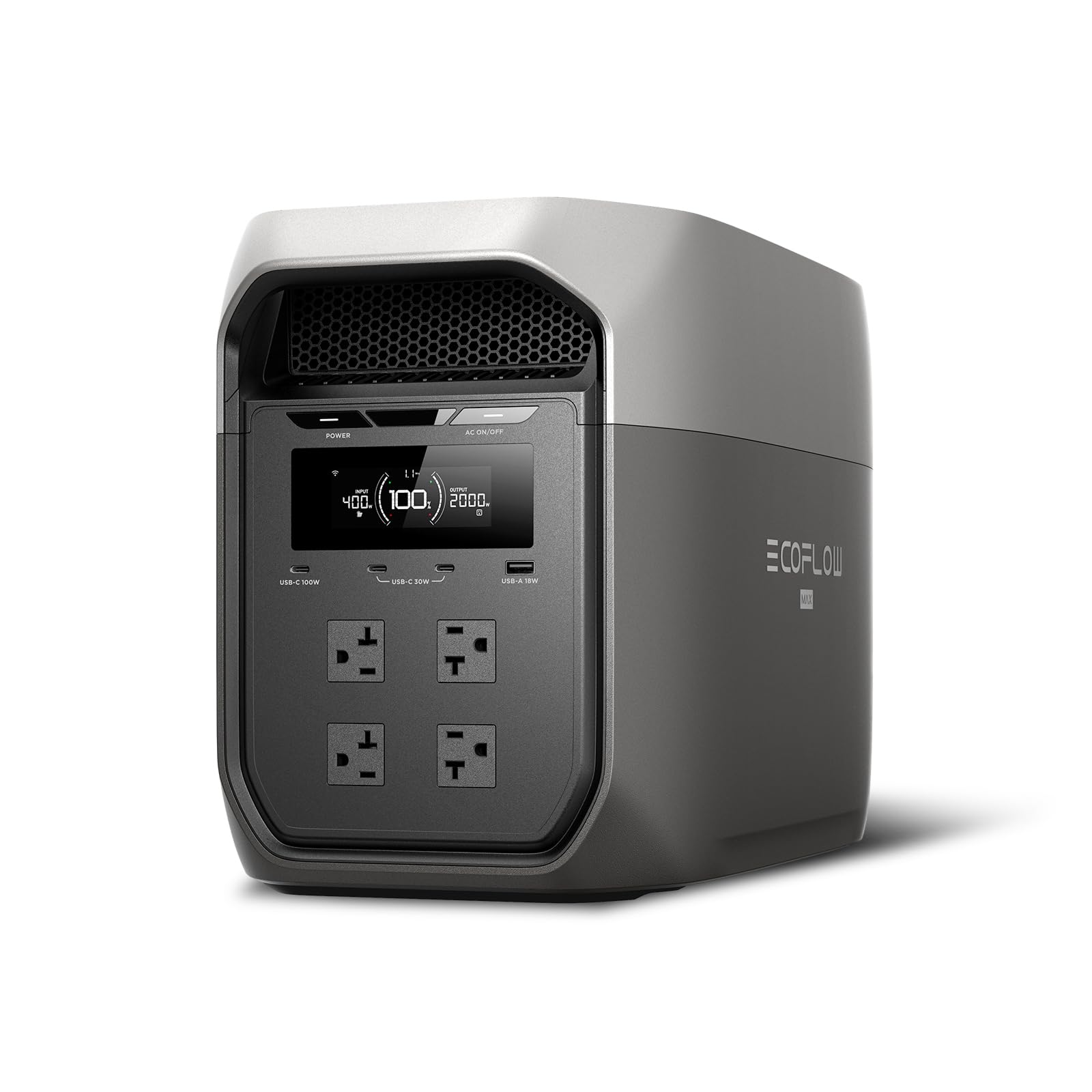
1. EF ECOFLOW DELTA 3 Max
Our pick — over 4.5★ from 500+ verified ratings; the strongest balance of quality and price.
The fastest-refilling 2kWh bank around, charging 0–80% in just about an hour.
Recharge speed is the standout feature here. Thanks to EcoFlow’s X-Stream technology (their proprietary fast-charging system), the DELTA 3 Max goes from empty to 80% in roughly an hour, so you are never stuck waiting long to have power ready for the next outage. Owners back this up — buyers report charging speed is a little over an hour for a full top-up.
For running your appliances, it delivers 2400W of continuous output, and X-Boost mode (EcoFlow’s power-boosting feature) pushes that up to 3400W for high-draw gear like fridges and microwaves. The 2048Wh LiFePO4 battery (lithium iron phosphate, the safer, longer-lasting chemistry) is rated for ten years of daily use, and the unit itself is lighter than most rivals at this capacity.
When the grid blips, the sub-10ms transfer time keeps computers and medical devices running without a hiccup, and the quiet operation means no noise through the night. The smart app lets you monitor energy use and set charging schedules to cut costs. Its narrow 9.4″L x 12″W x 19.44″H footprint tucks into a closet corner without dominating the room.
Why owners love it
- Ultra-fast 0–80% charge in about 1.13 hours
- 10-year battery lifespan with mild, comfortable weight
- Runs nearly any home appliance via 3400W X-Boost
Who should look elsewhere
- Heavy enough that carrying it upstairs is a two-hand job
- Solar panels sold separately, so add that cost to your budget
Reach for this if: you want the fastest way to a full battery and a proven brand for home backup.
Consider another if: you need a specific solar input rating, since this spec isn’t listed here.
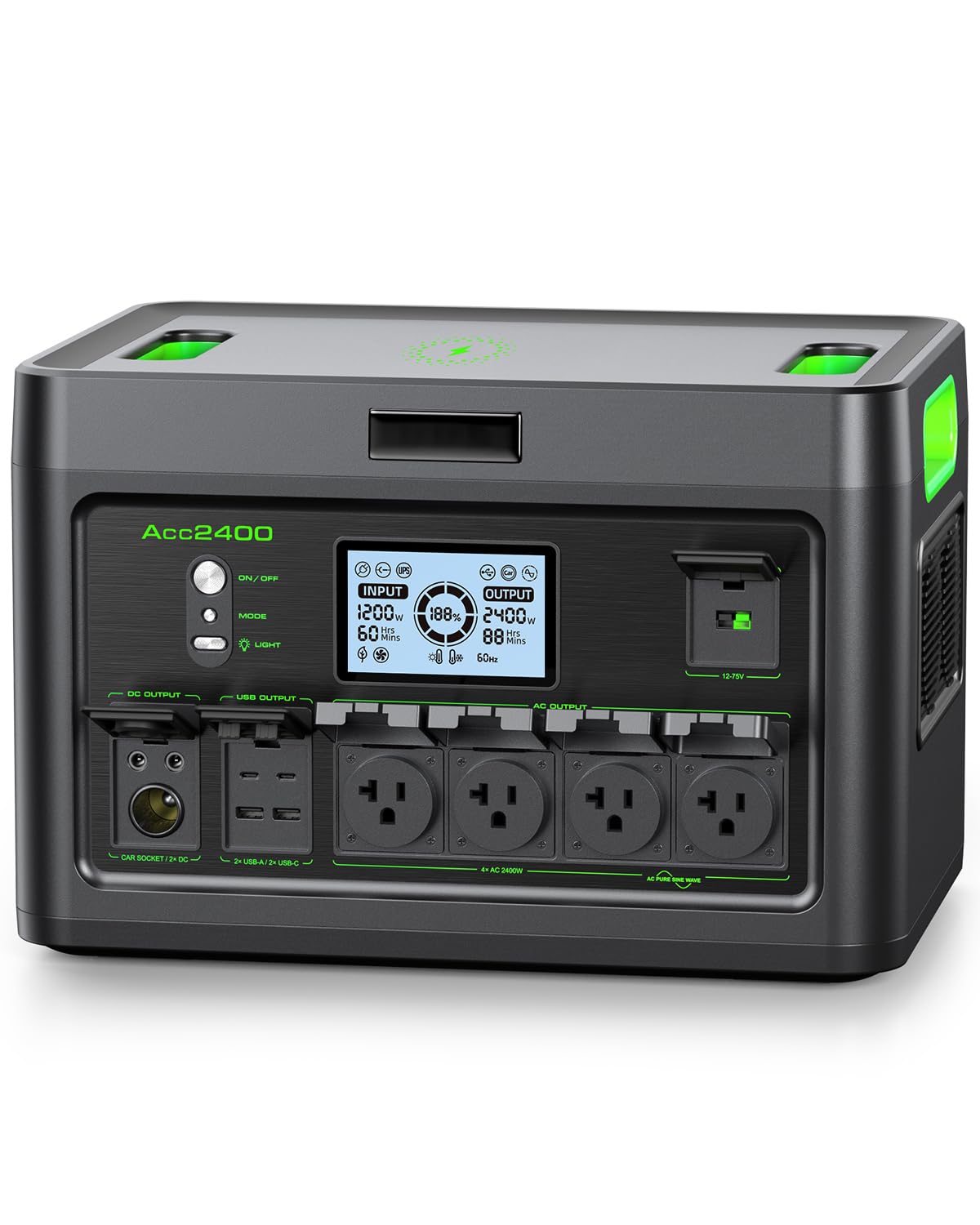
2. GRECELL Acc2400 2400W Solar Generator
Mid-range money for whole-home backup with a UPS switch and 12 ports.
The 1843.2Wh capacity runs 99% of household appliances, from refrigerators to CPAP machines, and its pure sine wave inverter (which produces clean, utility-quality electricity) protects sensitive gear from damage. When the grid drops, the built-in UPS switches to battery in just 0.1 seconds, so a desktop computer or network server won’t lose data mid-task.
What makes this a value play is the sheer output flexibility. It offers four 2400W AC outlets, two 100W USB-C PD ports for laptop charging, plus USB-A, DC, and a 12V car port — 12 outlets total — plus a 10W wireless charging pad and a four-mode LED light. Owners mention it works well with solar panels during a 3-day outage, and one notes it runs a 26-inch TV with subwoofer and two speakers for about 4 hours.
Recharging is flexible too: full AC recharge in 1.6–2.5 hours, or combine 800W MPPT solar with AC to finish in as little as 1.8 hours. The automotive-grade LiFePO4 cells promise 3500+ charge cycles. At 55.5 pounds, it’s heavier than some peers but still easy to store in an RV, and customers note it works as a true UPS without any setup.
What wins people over: reliability is the top praise here — buyers consistently call it a dependable backup that handles the essentials through multi-day outages.
The honest trade-off: one owner reports the power cord runs excessively hot while charging, so keep an eye on it during long top-ups.
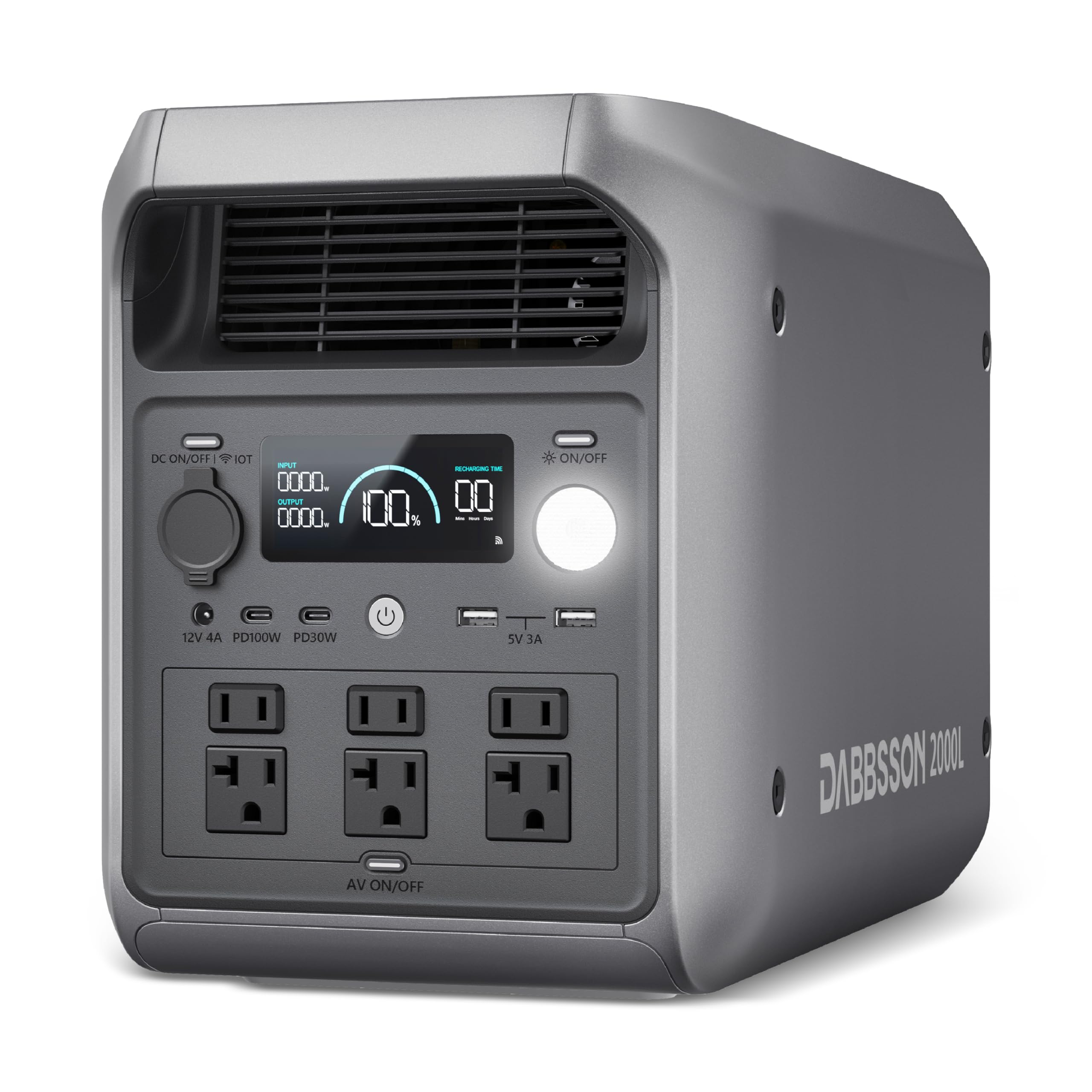
3. DABBSSON Portable Power Station 2000L
A 2kWh bank that weighs just 41 pounds, so one person can actually move it.
Portability is the defining trait here. At 41 pounds with a 2048Wh semi-solid LiFePO4 battery, it’s noticeably easier to carry than most high-capacity stations — you can haul it from the garage to the campsite or between rooms without a second person. The newer semi-solid cell design also promises 4000+ deep cycles and a 10+ year lifespan.
Performance holds up its end: 2200W continuous output with a 3300W surge boost runs refrigerators, heaters, and power tools, and the 6 AC outlets plus a full port set let you power multiple devices at once. An ultra-fast <10ms EPS switch (emergency power switch) protects computers and routers from power loss. One owner reports it peaked over 4000W and ran a kettle, toaster, and coffee maker without issue.
Recharge to full in just 1 hour via AC, or use up to 800W MPPT solar, plus hybrid dual-input that combines both for maximum flexibility. The Dabbsson App adds Wi-Fi/Bluetooth control to adjust charging speed and set schedules. The trade-off some owners flag: the 800W solar input is on the low side, and the fan can be loud when it cycles even at zero load.
The standout: reliability is what owners praise most — a daily user reports it powers lights and tools without issue, and it’s a favorite for weekend camping.
Know before buying: the fan noise draws mixed feedback, so if you want near-silent operation, look at the quieter picks above.
4. BLUETTI AC200L

A 2kWh unit that grows to 8192Wh — buy the base now, expand when your needs do.
This is the pick for buyers who want a path to more power later. The AC200L starts at 2048Wh with 2400W output, and you can bolt on extra battery packs — up to 2x B300K (2764Wh each) or 2x B210 (2150Wh each) — to reach a maximum 8192Wh. For an RV owner, the dedicated 30A RV port feeds a camper directly, and a 48V/8A DC port can charge your RV’s battery with the optional D40 voltage regulator.
Charging is genuinely fast: max 2400W AC input gets you 0–80% in 45 minutes, and up to 1200W solar input means a full charge in 1.7–2.2 hours of good sun. That beats the 800W solar input on the DABBSSON above, so if solar speed matters, this unit pulls ahead. Its 3600W power lifting mode tackles heavy appliances, and the ≤10ms UPS backup protects sensitive electronics.
Owners praise its performance and reliability after years of use, with one running a 1500W kettle and a 12000 BTU A/C on solar alone. The honest downsides: at 61.4 pounds it’s heavy, and the weight draws consistent negative feedback — moving it is a two-person job. App-based monitoring is a plus for tracking solar input and setting grid-switch thresholds.
Why it stands out
- Expandable to 8192Wh with multiple battery add-ons
- 0–80% charge in just 45 minutes on AC
- 1200W solar input for fast sun-powered refills
Where it stumbles
- 61.4 pounds is genuinely heavy to move
- Expansion batteries push total cost well beyond the base unit
5. BLUETTI Elite 200 V2

Wastes almost no power at idle, stretching every watt farther than the 2kWh peers.
Efficiency is this unit’s superpower. Standby draw drops to just 10W — roughly three times lower than comparable stations — which means less wasted energy and longer runtimes for the same load. In practical terms, it can run a 120V 60W diesel heater for 3.3 days on a charge, which is 13% longer than similar products. Owners note over 95% AC efficiency in real use.
Performance is equally strong: 2600W continuous output with 3900W power lifting mode runs refrigerators, hair dryers, and coffee makers, powering up to 9 devices simultaneously. The BLUETTI TurboBoost fast charging hits 0–80% in about 1 hour in Turbo Mode, or you can choose Standard or Silent modes to balance speed, noise, and battery protection — Silent Mode runs at 16–30dB, which is whisper-quiet. Solar works too, with a full charge in 2.4 hours using 1000W of panels.
Owners run freezers, air fryers, and microwaves simultaneously without a hiccup, and one says the 95%+ inverter efficiency is the best of any BLUETTI unit. The 2073.6Wh LiFePO4 battery is rated for 6000+ cycles, backed by a CNAS-certified automotive-grade build. At 53.4 pounds it’s mid-pack on weight, and the compact 13.78″L x 9.84″W x 12.74″H frame is noticeably smaller than rivals of the same capacity.
The thing everyone notes: this is the most power-dense, efficient 2kWh station they’ve owned — it runs a fridge for 24 hours while staying quiet.
Worth flagging: there’s no 30A 12V RV output, so if you need a direct camper hookup, the AC200L above is the better fit.
6. PECRON F3000LFP
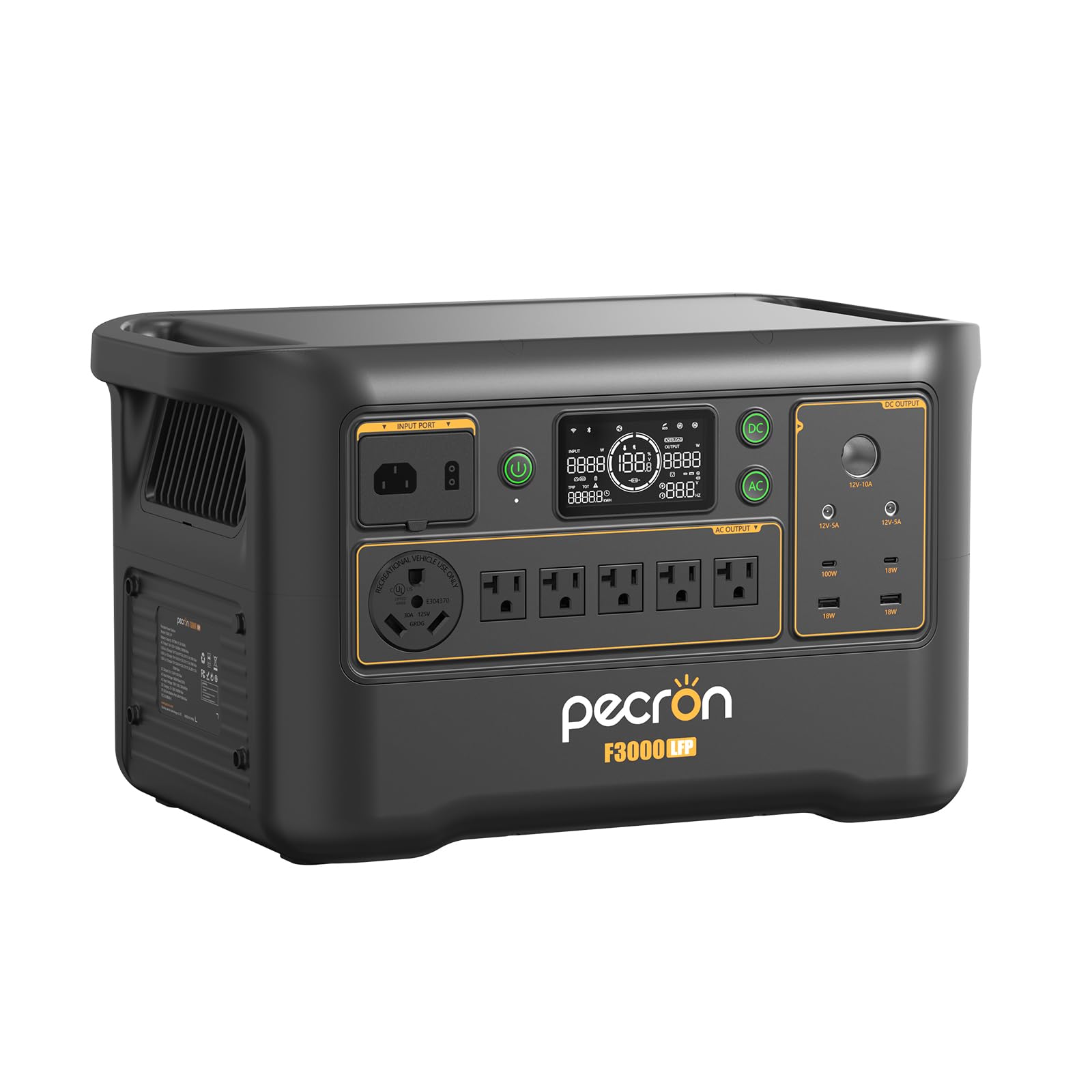
Step up to 3072Wh for multi-day home essentials, expandable to a mighty 10752Wh.
If you need more than overnight backup, this unit keeps your home essentials running for 2–3 days on its 3072Wh capacity. Its 3600W pure sine wave output (a clean power type that protects sensitive electronics) runs refrigerators, air conditioners, and power tools — up to 13 devices at once across 13 ports, including 6 AC outlets, 2 USB-C (100W PD), and 2 USB-A. One owner notes it handles up to 1600W of load with room to spare.
Recharging is fast: 0–100% in just 2 hours via AC input at 1800W, which owners confirm. Solar capacity is strong at 1600W max (25–120V input), making this a solid choice for off-grid topping up. The UPS mode switches in 8–20ms to protect computers and medical devices during outages, and the app gives real-time usage monitoring.
Unlike the 2kWh class, this one grows with you: you can expand it to 10752Wh by adding the EP3800-48V battery (sold separately, requiring a special XT120-M cascade cable). Owners call it the best power station they’ve owned, reliable through 40+ outages, and note the fan stays quiet despite the heavy load. At 63.3 pounds, it’s heavy but compact for the capacity. The cons: some low-level noise is mentioned, and the app has middling reviews.
The strengths
- 3072Wh runs a fridge for 2–3 days of essentials
- Full recharge in 2 hours from a wall outlet
- Expandable to 10752Wh for serious off-grid needs
The trade-offs
- 63.3 pounds is a real lift, not a carry-on
- Solar input can drop to 0W below 100W in partial shade
7. ABOK Ark3600
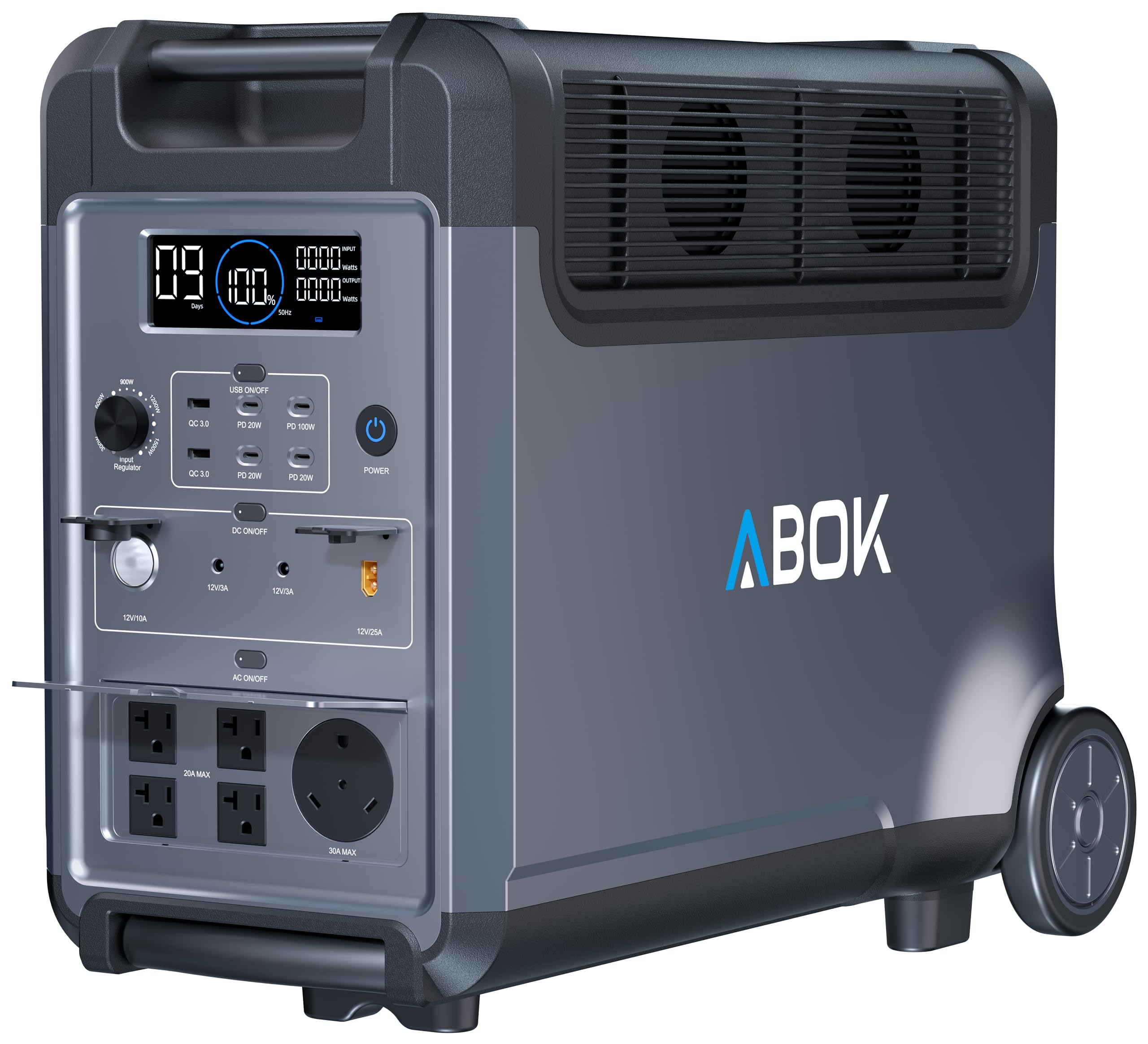
A rolling 3840Wh station with a telescoping handle — huge power that actually follows you.
The Ark3600 solves the classic big-battery problem: how do you move 92 pounds? An extendable telescoping handle and durable wheels turn this into a rolling suitcase of power rather than a dead lift. That mobility makes it genuinely practical for storm season — roll it to the fridge, the sump pump, or the camper as needed.
Under the hood, it delivers 3600W rated output with 4500W peak power, supported by 15 output ports including a 30A AC outlet, four 20A AC outlets, and a 100W USB-C PD port. The 3840Wh EV-grade LiFePO4 battery is rated for over 4000 cycles and a 10-year lifespan, and it’s expandable up to 11520Wh. Recharge via AC (1500W) or solar (2000W) — combine both for a full charge in 1.29 hours.
Owners rate this highly against pricier rivals: one calls it the “BLUETTI killer,” praising the adjustable input wattage knob and dual input/output LED display. Another ran a heat gun, an SDS-Max drill, and tool batteries simultaneously and still had 22% left after a full day. The Bluetooth app monitors performance remotely. Real-world caveats: a solar-only charge takes about 3 days, the unit is 120V-only (no 240V), and you should only charge it in environments above 32°F.
The clincher: 3600W of output with wheels is rare — owners consistently praise the mobility and build quality over similarly priced competitors.
Think twice if: you need 240V output or plan to charge in freezing temperatures, since the 120V-only design and 32°F charging limit are real constraints.
8. Jackery HomePower 3000
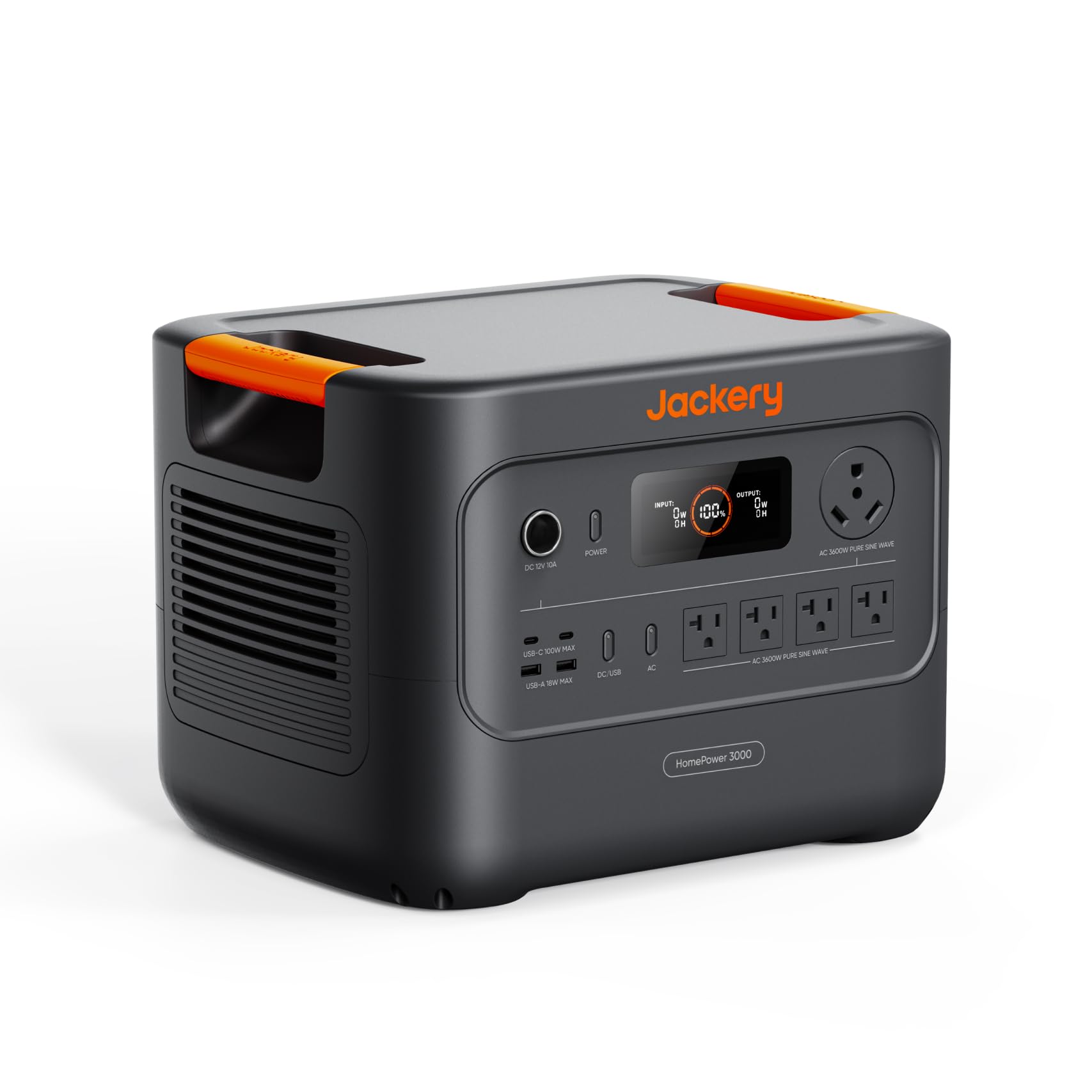
Jackery’s first 3kWh station that’s 47% smaller and 43% lighter than comparable models.
This is the pick for buyers who want 3kWh-class power without the usual bulk. Jackery’s CTB technology (cell-to-body, where the battery cells integrate into the chassis) makes the HomePower 3000 47% smaller and 43% lighter than comparable units, yet it still packs 3072Wh and a 3600W output with 7200W surge. The integrated design also boosts space efficiency by 14%.
For home backup, it powers a household for up to 15 hours or keeps a refrigerator running for 1 to 2 days — owners confirm a Whirlpool side-by-side fridge runs 30+ hours on a charge. The ≤20ms UPS switch keeps security cameras, medical refrigerators, and Zoom calls running through outages. A built-in TT-30 RV port offers plug-and-play power for campers, and dual 100W PD ports fast-charge phones and drones.
Recharging is versatile: full in 1.7 hours via hybrid AC and DC, 2.2 hours via AC alone, or with 2x SolarSaga 200W panels to hit 80% in 9 hours of sun. The ChargeShield 2.0 technology (Jackery’s battery-management software) extends lifespan to 4000 cycles at 70% capacity. Owners chose it over BLUETTI specifically for the 30A outlet for direct camper hookup. The catches: at 59.5 pounds it’s still heavy, and the fan hits around 60dB under load — too noisy for a daily UPS next to your desk.
Why it earns its spot
- 47% smaller and 43% lighter than same-capacity rivals
- TT-30 RV port for direct camper hookup
- Runs a full-size fridge for 30+ hours
What to know
- Fan noise around 60dB under heavy load
- Weight still requires two hands to move around
9. Anker SOLIX F3000
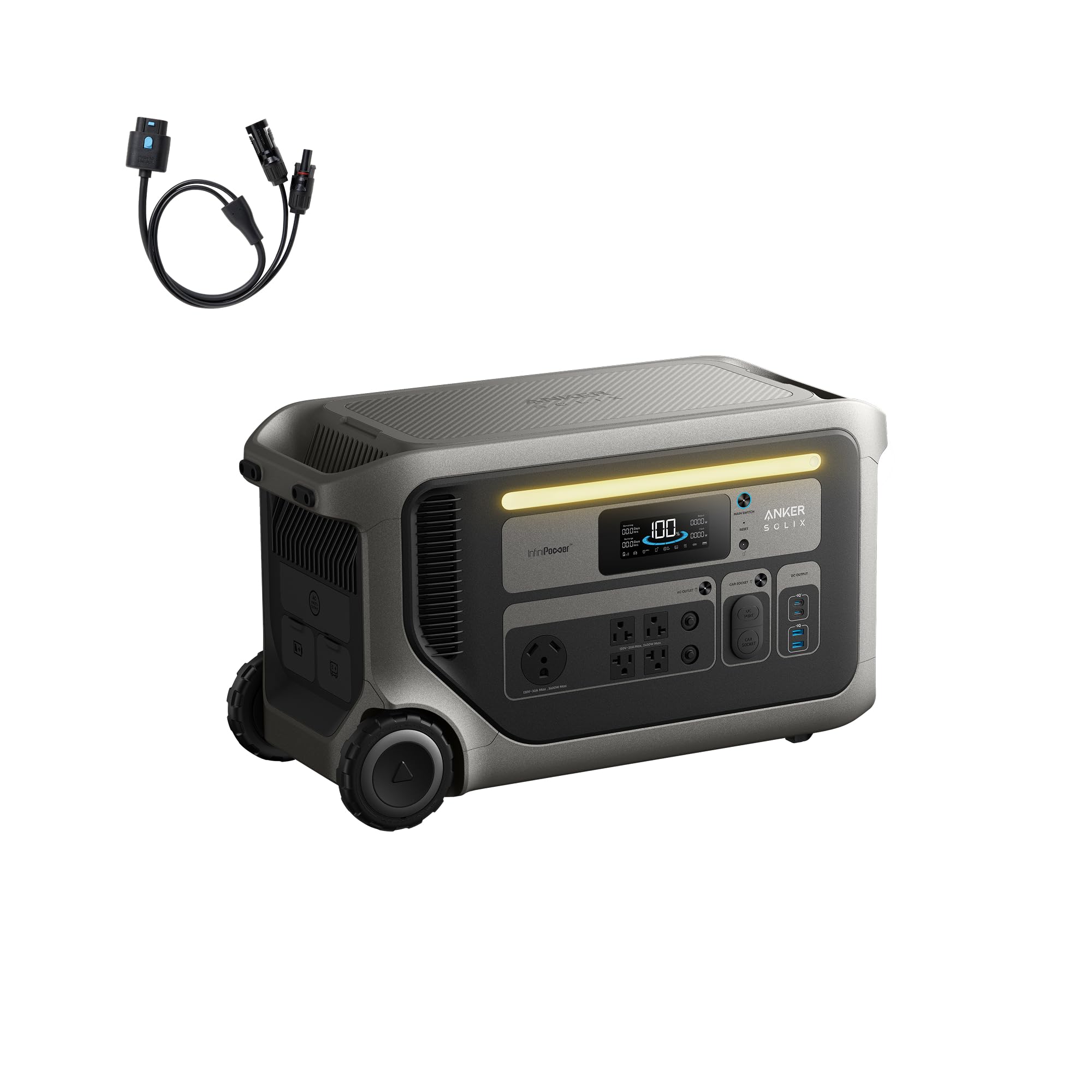
Recharges at 6000W when you stack a generator and solar, so outage downtime is minimal.
Anker built this to solve the “how do I get power back fast” problem with the industry’s highest recharge input — 6000W when you combine a fuel generator and solar. That’s not a typo; it means a 3kWh battery can refill dramatically faster than any of the 800W–1200W peers, and owners confirm it charged quickly on arrival.
The 2400W solar input is the highest on this list, so you can top up from panels more aggressively than any other 3kWh unit here. It also runs a 190W fridge for 42 hours or holds AC idle standby for 125 hours — the low idle draw means less wasted energy. Output is 3600W at 120V, and you can pair two units for 240V to run demanding appliances.
Owners love the suitcase handle and wheels, noting the ~100-pound unit is easy to maneuver despite the heft — one literally calls the wheels “great.” Another powered an RV AC for 4+ hours quietly. The battery expands to 24kWh with add-ons for 80 hours of outage-proof energy. Two caveats: there’s no 240V split phase on a single unit, and the USB ports draw about 1W each with no way to switch them off via hardware — you’ll use the app for that.
The differentiator: this is the fastest-recharging 3kWh station on the list, and the wheels make the 91.5-pound weight a non-issue in practice.
Hold on, though: port layout and installation get mixed feedback, so plan to spend a little time with the app to set charge limits and port memory.
10. EF ECOFLOW DELTA Pro
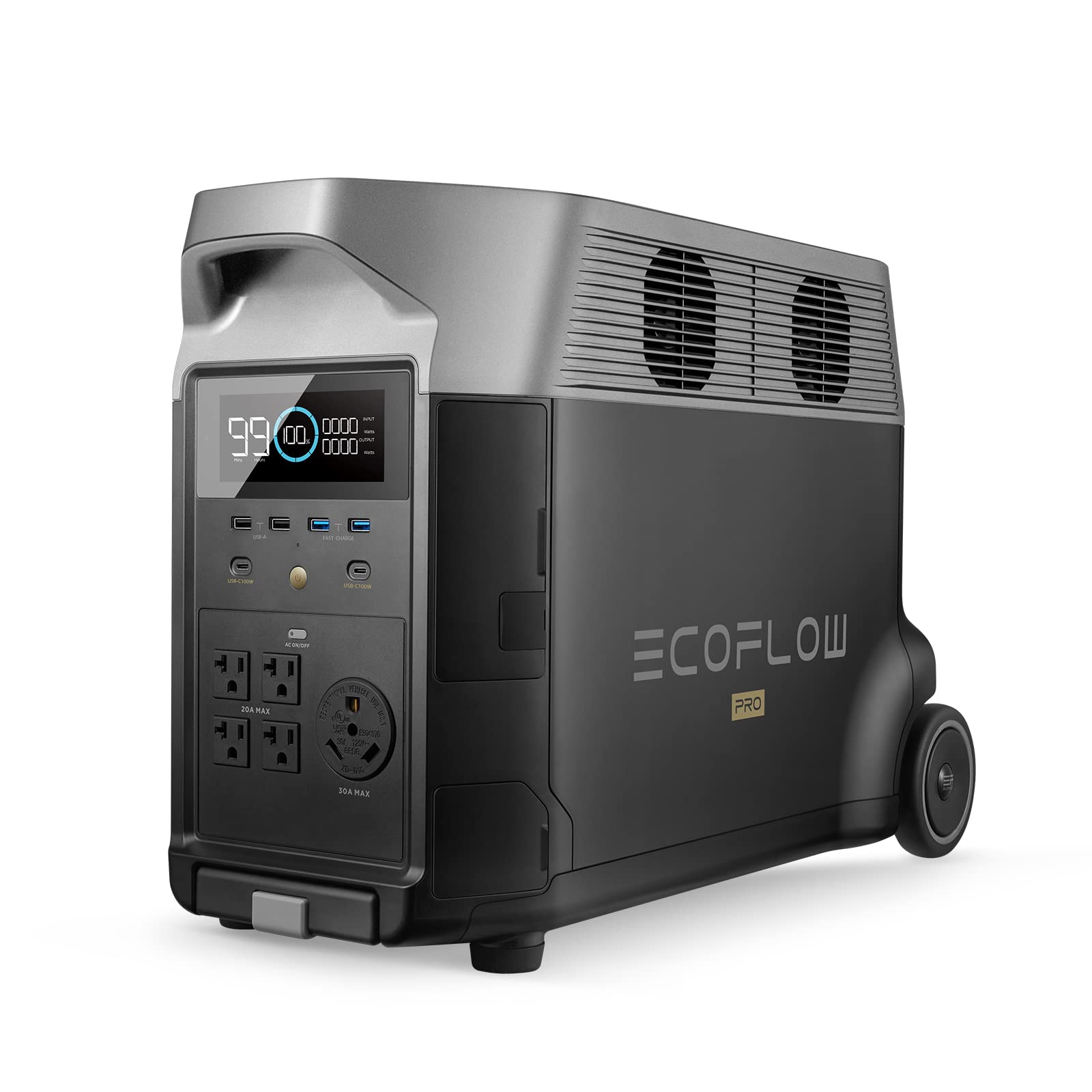
The 3600Wh unit that scales to 25kWh — a serious home backup system, not just a battery.
This is the station that blurs the line between portable generator and home battery backup. It starts with a 3600Wh LiFePO4 capacity and 3600W AC output, expandable up to 4500W with X-Boost, and you can pair two units for a combined 7200W of output. Add DELTA Pro Extra Batteries or Smart Generators and the system scales from 3.6kWh all the way to 25kWh — enough to run a whole home for days.
Charging is flexible in ways nobody else matches. Pick from EV station charging, solar, wall outlets, a smart outdoor generator, or a car outlet. Full recharge takes 1.8 hours with 240V outlets at 3000W, 2.7 hours from standard 1800W wall outlets, or 2.8 hours with 4x 400W solar panels, thanks to a solar conversion efficiency of up to 23%. Owners confirm the 2.7-hour wall recharge in daily use.
The 15 output methods include 2 USB-C (100W), 5 AC outlets, and an Anderson port, so you can power multiple devices at once. One owner runs a heat press at vendor markets flawlessly all day, while another says it powered a fridge and lights overnight with 30% still left. The 99-pound weight is the obvious trade-off, and the fan gets noisy under heavy load. Owners also note the smart app is genuinely useful for monitoring charge level and customizing input/output settings remotely.
The payoffs
- Scales from 3.6kWh to 25kWh for whole-home backup
- Charges from EV stations, solar, wall, generator, or car
- Full wall recharge in 2.7 hours
The price of power
- 99 pounds — moving it is a serious two-person job
- Fan spins up loud under heavy loads
11. Anker SOLIX F3800 Plus with Home Power Panel
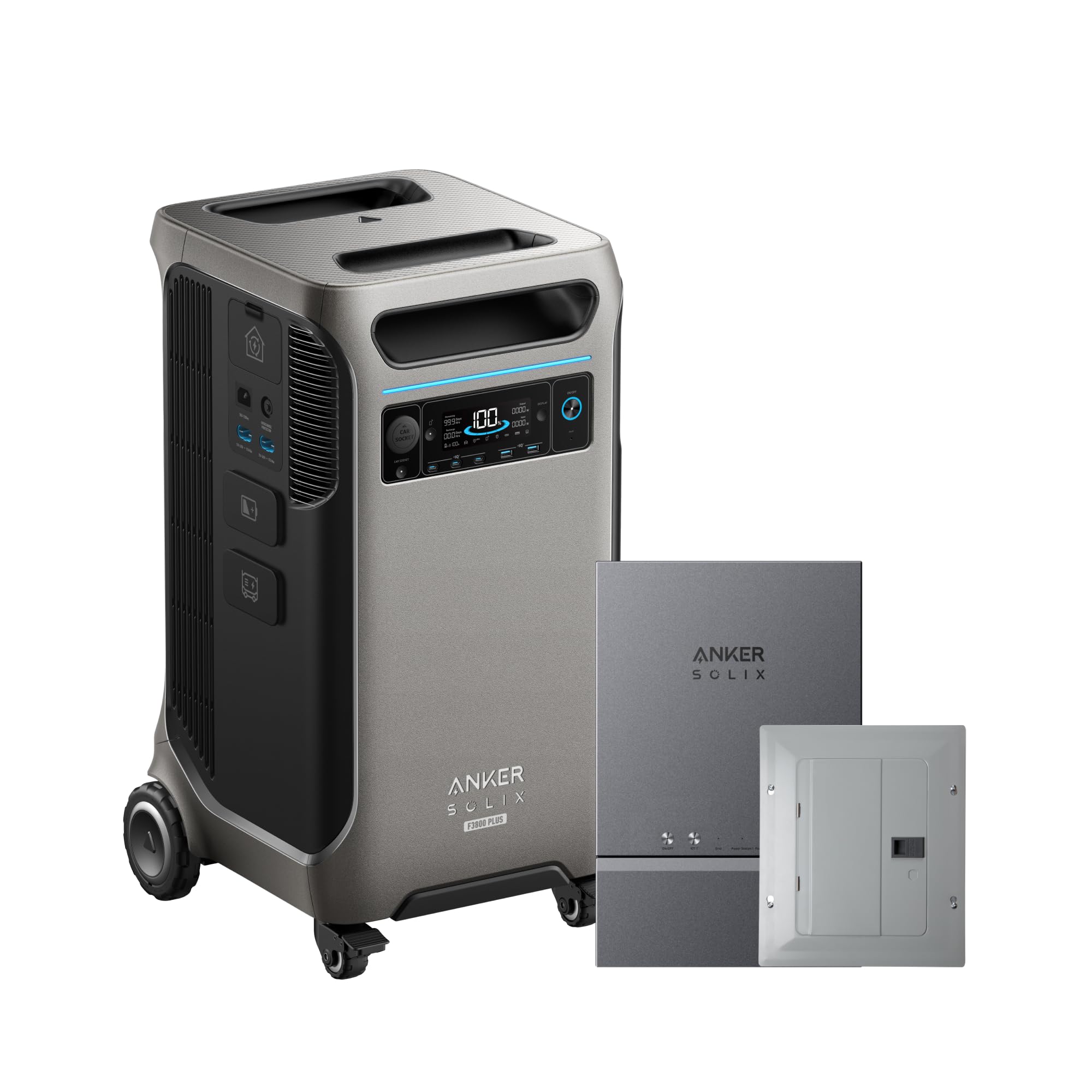
The only unit here with 120V/240V output and a hardwired panel — real whole-home backup.
This is the closest thing to a permanent home battery you can install without a full solar contractor. The F3800 Plus delivers 6000W of output — 58% more than other stations at the same capacity — with 120V/240V dual-voltage support, so you can even run your dryer. The included Home Power Panel connects to your existing circuitry, letting you power fixed circuits during an outage rather than running extension cords.
Capacity starts at 3.84kWh, enough for a full day of home power, and expands to 26.9kWh with 6 batteries or 53.8kWh with 12 — literally weeks of power. Recharge in 63 minutes via solar and generator combined, or use the 3200W solar input and 240V gas generator bypass (6000W) for flexible refills. Owners confirm it runs appliances using more than 400 watts continuously without issue, and one says it provided clean power for 4+ hours through existing circuitry.
The Anker InfiniPower system with EV-grade LFP batteries and smart temperature management backs a 5-year warranty and 10-year lifespan target. The dual-voltage capability means a standard electric dryer, a well pump, or an EV charger can all draw from this unit. The catches: at this level of integration, setup is more involved — the panel needs installation — and the value opinion is genuinely mixed among owners. A couple of units have arrived with shipping damage due to the weight.
What owners agree on: quality is the top praise — it’s a high-grade, powerful system that behaves like serious infrastructure, not a camping accessory.
The honest caveat: the price tag draws mixed reactions, and the included panel means an installation step that simpler portable units skip.
Understanding the Specs
Watt-Hours (Wh) — Your Fuel Tank
This number tells you how long the battery lasts. A 2048Wh unit can run a 100W appliance for roughly 20 hours. For home backup, think about what you need: a fridge for a day, a router overnight, a few device charges. Higher watt-hours extend runtime but add pounds, so match capacity to your critical loads, not your wish list. Size the battery to your must-run appliances, not every gadget you own.
AC Output Watts — Your Engine
This decides what you can plug in at all. A 2400W output runs most fridges and electronics, but a microwave or a space heater may need more. Look at surge or boost ratings (like X-Boost or Power Lifting) — these let the unit fire up appliances with a big startup draw, then settle back to continuous output. If you plan to run a hair dryer or power tools, aim for 3600W or higher.
FAQ
How long will a solar backup bank run my refrigerator?
Can I charge a solar backup bank during an outage?
What does the UPS transfer time actually mean for my devices?
Is a LiFePO4 battery really worth the extra cost?
How heavy are these units, realistically?
Can I run a 240V appliance like a dryer or well pump?
Can I expand the capacity later if my needs grow?
How fast can a solar backup bank recharge from a wall outlet?
Final Thoughts: The Verdict
Across the board, the solar backup bank for a home winner is the EcoFlow DELTA 3 Max because it pairs the fastest recharge in its class with a 10-year battery lifespan and enough boost output for nearly any appliance. If you want expandability from day one, grab the BLUETTI AC200L, which grows to 8192Wh as your needs change. And for a true whole-home setup with 240V output, the Anker SOLIX F3800 Plus is the one to reach for.
How We Picked
We do not accept paid placement. Every pick is matched to a real buyer and a real use-case; we do not hands-on test units.
Sources & Methodology
Specifications: manufacturer listings and product documentation. Review insights: verified customer reviews, as of August 2026. Pricing: not shown on this page (it changes often); check the current price via the retailer link.
As an Amazon Associate, KitchPrep earns from qualifying purchases. This does not affect which products we feature.
Related Guides
