
Smoking looks mysterious from the outside. You hear words like bark, stall, thin blue smoke, wrap, and suddenly it feels like you need a weekend course just to cook ribs for your family.
Here’s the truth that makes beginners breathe again: smoking is not “hard,” it’s just unforgiving when your setup is fussy. Most first-time frustration comes from the same handful of problems—temperature swings, dirty/bitter smoke, a cooker that leaks like crazy, or a machine that forces you to open the door constantly (which kills heat and stretches cook times).
If you’re searching for the best smoker for beginners, you’re not really asking for the fanciest box of metal. You’re asking for repeatable wins: a smoker that makes it easy to produce clean smoke, hold a steady cooking temperature, and finish food on time without babysitting coals or second-guessing every decision.
This guide is built around real-world friction points—what actually happens on your patio (wind, cold, sun), what happens on your counter (smell, power draw, cleanup), and what happens after the third cook (grease management, gaskets, “why is my smoke suddenly weak?”). You’ll get a clear decision framework, a fast comparison table, and 14 in-depth reviews that tell you what Amazon listings usually don’t.
The picks below intentionally cover different beginner realities: apartment-friendly indoor smoking, plug-and-play outdoor electric cabinets, propane “set and forget” control, all-in-one electric grill/smoker combos, and charcoal units for people who want to learn fire management without feeling overwhelmed.
How to Choose the Best Smoker For Beginners
Beginner smokers don’t fail because they “don’t have the right rub.” They fail because their cooker makes the basics hard. When you choose your first smoker using the right framework, your learning curve gets dramatically shorter and your food gets better, faster.
1. Start with your reality: where will you cook?
Most buying guides start with “What do you want to smoke?” but the smarter first question is: where will you smoke, consistently? Your space decides your fuel type and your stress level.
- Apartment / condo life: indoor solutions (or compact electric outdoor units) matter more than raw capacity. You want control, filtration, and easy cleanup.
- Small patio / balcony: portability and footprint matter. An all-in-one electric grill/smoker can be the easiest “single appliance” win.
- Backyard / driveway: vertical cabinet smokers shine because they’re stable, roomy, and beginner-friendly.
- Camping / tailgating: a compact charcoal vertical/bullet smoker can be perfect—if you’re okay with more hands-on heat management.
2. Pick your “effort level” (this is the real secret)
There’s no shame in wanting easy. The best smoker is the one you’ll use on a random Wednesday—not just on a holiday. These are the main beginner paths:
- Electric cabinet smokers: simplest learning curve. You set a temperature, feed wood chips, and focus on meat temps. Great for “first wins.”
- Propane vertical smokers: more heat range and strong control, with smoke generated separately. Great if you want simplicity but don’t want electronics.
- Electric grill/smoker combos: extremely practical if you want one outdoor cooker that can grill and smoke without a separate smoker footprint.
- Charcoal bullet/vertical smokers: best for learning fire and airflow. You get incredible flavor potential, but you’ll do more “hands-on” work.
- Offset smokers (grill + side firebox): fun, classic, and capable—but this is the most demanding style to run well.
3. Learn the 4 beginner failure modes (and buy to avoid them)
Every frustrating first cook usually traces back to one of these. When you know them, you can choose a smoker that naturally prevents them.
- Dirty smoke (bitter flavor): usually caused by choking airflow, smoldering wood, or adding too much wood too fast. Beginners need easy airflow and a predictable smoke system.
- Temperature swings: wind, thin metal, poor seals, or a fire that isn’t established. Beginners do best with insulated-ish cabinets or simple fuel systems.
- Constant door opening: “Let me check it” becomes a habit, and it kills heat. A window and a meat probe change your whole behavior for the better.
- Mess + cleanup dread: if cleanup feels gross, you’ll stop cooking. Grease management, removable trays, and easy-to-wipe surfaces matter more than most people admit.
4. Don’t shop by size—shop by how you’ll actually load it
Capacity isn’t just “square inches.” It’s whether the racks fit the shapes you cook. A smoker can advertise a big number and still be annoying if the rack depth is awkward for pans or the spacing makes large cuts difficult.
- If you’ll use pans: pay attention to rack dimensions and whether common trays sit flat without blocking airflow.
- If you’ll cook directly on grates: focus on how easy it is to clean and whether grease drips into an easy-to-remove tray.
- If you’ll smoke multiple items: look for rack spacing that keeps food from touching (crowding ruins airflow and bark).
5. Temperature control: don’t confuse “display” with “accuracy”
Many built-in thermometers are “ballpark,” not truth. Serious beginner success comes from two things:
- Stable heat output: a smoker that doesn’t wildly overshoot or struggle to recover after a door opening.
- Reliable food temperature tracking: a built-in probe is great, but even better is learning to cook by internal temp instead of time.
If you only take one habit from this guide, take this one: cook to temperature, not to the clock. That single shift makes ribs, chicken, and pork shoulder feel predictable.
6. Smoke generation: chips vs pellets vs charcoal (and what beginners should know)
Beginners often assume “more smoke” means better. It usually doesn’t. You want clean, steady smoke—not thick, white clouds that taste harsh.
- Wood chips (electric/propane cabinets): easy and forgiving. Great for learning. Add small amounts consistently instead of dumping a full tray.
- Pellets (electric pellet smoke systems): convenient and tidy, but you must respect airflow and keep the burn clean.
- Charcoal + wood chunks: best classic flavor potential. The trick is controlling oxygen so the fire burns steadily, not erratically.
7. The “you’ll still love it in month 3” checklist
- Easy access to fuel: side chip loaders and front doors matter. If fuel access is annoying, you’ll stop adding smoke and your food will taste flat.
- Grease management: removable trays prevent flare-ups and reduce the “smells like last weekend forever” problem.
- A door that seals reasonably well: perfection isn’t required, but huge leaks make temperature control harder than it needs to be.
- Weather reality: cold and wind change how every smoker behaves. Cabinets help. Thin metal needs shielding or a windbreak.
Quick Comparison: 14 Best Smoker For Beginners Picks
Use this table to match your “beginner style” fast, then jump to the reviews for the real-world details—like which units beginners say feel genuinely effortless, which ones need simple sealing upgrades, and which smokers make you want to cook more often.
On smaller screens, swipe or scroll sideways to see the full table.
| Model | Smoker type | Beginner superpower | Best match | Amazon |
|---|---|---|---|---|
| EAST OAK Ridgewood Pro 30″ Electric Smoker (Stand) | Electric cabinet | Window + probe + long chip sessions + comfortable height | Most beginners who want easy, repeatable outdoor smoking | Amazon |
| Ninja Woodfire Pro XL OG850 (Grill + Smoker) | Electric 4-in-1 | One appliance that grills, smokes, air fries, and bakes | Beginners who want “one cooker” for everyday outdoor meals | Amazon |
| Pit Boss 3-Series Gas Vertical Smoker | Propane cabinet | Wide heat range + fewer electronics + consistent control | “Set it and let it run” beginners who prefer gas reliability | Amazon |
| GE Profile Smart Indoor Pellet Smoker | Indoor electric | Real wood smoke indoors with active smoke filtration | Apartments and “I need to smoke in my kitchen” lifestyles | Amazon |
| EAST OAK 30″ Electric Smoker (Window + Probe) | Electric cabinet | Simple “set it and forget it” workflow with window | Backyard beginners who want easy batches and easy checks | Amazon |
| Masterbuilt 30″ Digital Electric Smoker (Side Loader) | Electric cabinet | Add wood without opening the door (less heat loss) | Beginners who want a proven, classic outdoor electric smoker | Amazon |
| Masterbuilt 30″ Analog Electric Smoker | Electric cabinet | Simple dial control (less to “break” mentally) | Beginners who want basic, reliable, no-screen smoking | Amazon |
| Char-Broil Bullet Charcoal Smoker 16″ | Charcoal bullet | Easy airflow system + steady low-and-slow potential | First-time charcoal smokers who want control without chaos | Amazon |
| Royal Gourmet CC1830S Offset Smoker + Grill | Offset smoker | Learn fire management while still having a full grill | Beginners who want the classic “pit” experience | Amazon |
| Cuisinart 16″ Vertical Charcoal Smoker | Charcoal vertical | Quick setup + mod-friendly fixes for leaks | Hands-on beginners who like upgrading and tinkering | Amazon |
| Realcook 17″ Vertical Charcoal Smoker | Charcoal vertical | Hooks + dual doors + good portability | Beach/camping/backyard cooks who want vertical flexibility | Amazon |
| VINGLI 4-Tier 3-in-1 Vertical Charcoal Grill | Charcoal multi-zone | Stacked cooking zones for experimenting with heat levels | Beginners who want to cook multiple foods at once | Amazon |
| SUNLIFER 16″ 4-in-1 Charcoal Smoker | Charcoal portable | Compact, rugged, and beginner-friendly airflow access | Small patios + camping + “I want to learn charcoal” cooks | Amazon |
| Masterbuilt Charcoal Bullet Smoker | Charcoal bullet | Low-cost “learn the basics” entry with easy storage | Beginners who want to try smoking without a big commitment | Amazon |
In‑Depth Reviews: 14 Beginner‑Friendly Smokers You’ll Actually Enjoy Using
Now we’ll go model by model. I’m not going to waste your time with generic “it has racks” summaries. Instead, you’ll learn how each smoker behaves on real cook days: how steady it holds temperature, how the smoke system acts when the weather changes, how annoying (or easy) cleanup feels, and what beginners tend to love or regret after a few months.
1. EAST OAK Ridgewood Pro 30″ Electric Smoker – The “First Win” Machine with Better Ergonomics

If you want a smoker that feels like it was designed specifically to reduce beginner mistakes, this is it. The Ridgewood Pro takes the “electric cabinet” formula that’s already beginner-friendly and adds the two things that shorten learning curves the fastest: a clear viewing window and a built-in meat probe.
Here’s why that matters: the biggest beginner habit to break is the constant “peek.” Every time you open a smoker door, you dump heat and stretch cooking time. With a window you actually trust and a probe feeding you real internal temps, you stop opening the door just to calm your nerves. That one behavior change can make your ribs and chicken dramatically more consistent.
The other underrated win is the elevated stand. Beginners spend a surprising amount of time loading, checking, adjusting, and cleaning—especially during the first month when you’re learning your process. Being able to work at a comfortable height makes longer cooks feel more relaxed (and it reduces the chance you rush and spill grease or drop a rack).
Why beginners love it
- Window + probe reduce “door peeking” – better temperature stability, less anxiety, better results.
- Side chip loader keeps heat inside – you can add smoke without restarting the cooking environment.
- Comfort height matters – easier loading, less crouching, smoother cleanup routine.
- Large batch friendly – enough space to cook for family gatherings without feeling cramped.
Good to know
- Like most electric cabinets, top-end heat is designed for low-and-slow rather than screaming-hot searing.
- Outdoor temperature affects every cabinet smoker—windbreaks and preheating improve consistency.
- Beginners get best smoke by adding chips in small, steady cycles instead of overloading early.
Ideal for: most beginners who want outdoor smoking to feel predictable, clean, and low-stress—especially if you value visibility, a built-in probe, and a smoother day-to-day workflow.
2. Ninja Woodfire Pro XL OG850 – The Beginner Shortcut to Smoked Flavor (Without Owning a Full Smoker)

Some beginners don’t want “a smoker.” They want smoked flavor—and they want it without buying a huge dedicated cabinet that only does one job. That’s exactly where the Woodfire Pro XL shines. It’s a compact outdoor workhorse that can smoke when you want BBQ, then switch back to everyday cooking like grilling and air-frying sides.
The built-in thermometer is the real beginner advantage here. A lot of first-time smokers overcook because they chase time-based recipes. This unit naturally nudges you toward the right habit: cook to internal temperature and stop when the food is actually done. When your chicken hits the target temp, you get that “how did I nail this on my first try?” feeling.
Another thing people don’t say loudly enough: beginners often quit smoking because it feels like an “event.” The Ninja makes smoking feel like a normal dinner option. That means you practice more often, which means you get good fast—because repetition is the real teacher.
Why it’s a beginner superpower
- It replaces multiple outdoor appliances – fewer purchases, less space, more weeknight use.
- Thermometer-driven cooking – helps you stop guessing and start cooking accurately.
- Fast learning curve – smoked flavor without managing charcoal baskets, vents, or fireboxes.
- Great for “BBQ + sides” flow – smoking your main while crisping sides outdoors is an underrated lifestyle win.
Good to know
- It’s not a huge cabinet—if your goal is massive batch smoking every weekend, a vertical smoker fits that rhythm better.
- Pellet usage is about flavor infusion, so you’ll want to keep the hopper habits consistent for repeatable results.
- Power cord length can affect placement; plan your outdoor outlet setup before cook day.
Ideal for: beginners who want smoked food to become a regular part of their routine—and who prefer one flexible outdoor cooker over a dedicated “smoker-only” cabinet.
3. Pit Boss 3-Series Gas Vertical Smoker – The “No Electronics Anxiety” Set-and-Run Option
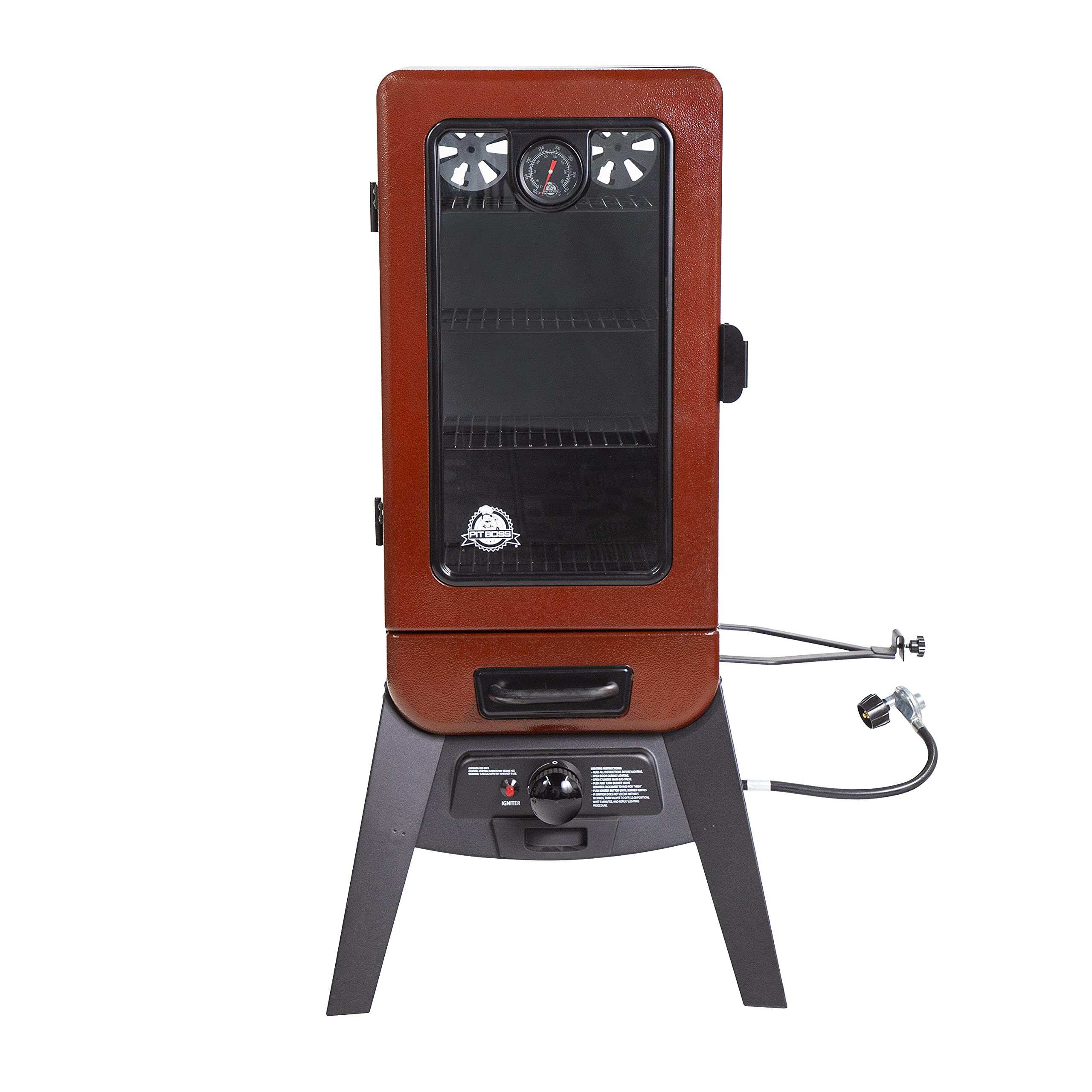
If you’re the kind of beginner who worries about electronic boards failing, error codes, or “why won’t it power on today,” propane smokers are emotionally calming. The Pit Boss 3-Series is built around that calm: a gas cabinet that can run steady heat with a wide range and let you focus on technique instead of troubleshooting.
The dual-burner concept is the real beginner advantage. One burner supports cabinet temperature, while the wood chip system handles smoke. That separation makes it easier to avoid harsh smoke because you’re not constantly shocking the system by opening the door or dumping fuel. Once you learn a simple routine—preheat, add chips in measured intervals, and trust your thermometer—this style of smoker feels almost “too easy.”
A window sounds like a gimmick until you’ve smoked your first pork butt and realized the stall is a psychological event. The window lets you check surface color and bark development without repeatedly dumping heat. That helps beginners stay patient, which is the hidden skill.
Why it works for beginners
- Gas stability – steady heat without learning charcoal airflow on day one.
- Wide temperature range – useful for smoking, finishing, and warming.
- Simple control philosophy – fewer electronics, fewer “mystery failures.”
- Roomy racks – great for ribs, roasts, and multi-item weekends.
Good to know
- Some smoke leakage can happen around doors and trays; simple sealing habits (or minor gasket upgrades) can improve it.
- Wood chip cadence matters—too many chips at once can give an aggressive smoke note.
- If you want “pure plug-in” simplicity, an electric cabinet feels even more hands-off.
Ideal for: beginners who want reliable outdoor smoking with fewer electronics—and who like the idea of gas control with real wood smoke flavor.
4. GE Profile Smart Indoor Pellet Smoker – Real Wood Smoke for Apartments (With a Learning Curve You Can Handle)

Indoor smoking is one of those ideas that sounds impossible—until you see it done well. The GE Profile Smart Indoor Smoker is designed for a very specific beginner: the person who can’t run a smoker outside, but still wants real smoke flavor, not “liquid smoke shortcuts.”
The key design detail is that pellets are used for smoke generation while electric heat handles cooking. That separation is exactly what makes indoor smoking workable: you’re not relying on pellets to heat an entire cook chamber like a backyard pellet grill. Instead, you’re controlling smoke intensity independently from cooking temperature, which makes results more consistent once you learn the system.
Real-world feedback tends to land in a very honest place: it’s genuinely impressive that it works indoors, but it’s still smoking—meaning you’ll notice smoky aroma, especially if your space is small. The filtration system helps, but the experience is not “odorless cooking.” Think of it as controlled indoor BBQ, not magic.
Where this smoker earns its keep is in repeatability. Once you dial in your personal routine—pellet amount, smoke level, and a “don’t rush the clear cycle” habit—you can turn out ribs, wings, brisket portions, salmon, and even smoked cocktail ingredients with a level of precision that most outdoor beginners don’t reach quickly.
Why it’s special
- Indoor smoking is real here – a rare category where this unit stands out as a serious option.
- Independent smoke control – you can dial smoke intensity without wrecking cooking temperature.
- Precision + presets – great for beginners who want guidance without losing control.
- Strong “first wow” factor – people are often shocked at how legit the flavor can be.
Good to know
- Capacity is naturally smaller than outdoor cabinets—plan cooks in “family-sized,” not “party-sized.”
- Cleaning is part of the ownership experience; lining trays and wiping after cooks keeps it pleasant.
- Power draw can be significant for long cooks—run it on a stable circuit with enough headroom.
Ideal for: apartment and indoor cooks who want real smoke flavor without outdoor space—and who are willing to learn the unit’s smoke-clearing and cleanup rhythm.
5. EAST OAK 30″ Electric Smoker – The Smooth “Set It, Watch It, Probe It” Backyard Starter

This is the kind of smoker that turns beginners into “people who smoke every weekend” because it removes the most annoying parts of early learning. The window gives you confidence without heat loss, and the built-in probe keeps you anchored to the metric that actually matters: internal temperature.
A theme that shows up in user experience is that it’s genuinely easy to use once you respect one simple rule: generate smoke at a higher setting first, then cook at your target temperature. Many electric smokers produce their most consistent smoke when the heat system is actively cycling; starting hot helps the smoke box do its job. Once you have smoke rolling, you can drop to your cook temperature and let the cabinet settle.
Another underrated beginner advantage is the door seal behavior. Cabinets that seal “pretty well” make smoking feel easy because your heat doesn’t run away. You spend less time fighting the smoker and more time learning the fun parts—seasoning, timing, and how different woods taste on different meats.
Why it’s beginner-friendly
- Window reduces mistakes – less door opening means steadier temps and better bark.
- Built-in probe builds good habits – you learn temperature-based cooking immediately.
- Easy smoke management – side loader keeps the cooking environment stable.
- Durable feel + helpful support reputation – owners often mention good experiences when questions pop up.
Good to know
- Like most cabinets, it’s built for low-and-slow. You finish with heat, not flame.
- Rack sizing can feel non-standard for some pans—plan to cook directly on racks for best space use.
- Exterior can scratch if you drag tools along it; treat it like an appliance, not a shovel.
Ideal for: beginners who want a straightforward outdoor electric smoker that delivers consistent results and teaches the right habits with a window + probe workflow.
6. Masterbuilt 30″ Digital Electric Smoker – The “Old-School Simple” Electric That Teaches You the Craft

Masterbuilt is one of those brands that shows up again and again in beginner stories for a reason: the workflow is simple, the learning curve is reasonable, and the results can be shockingly good when you stop overthinking it. This 30-inch digital cabinet is especially friendly because of the side wood chip loader.
That little detail matters more than it sounds. Beginners lose smoke and heat because they open the door to add wood. With a side loader, you can feed chips without resetting the environment you worked to build. That makes your smoke more consistent, your cook time more predictable, and your meat juicier—especially on longer cooks.
The most helpful “advanced beginner” lesson with this unit is understanding smoke production in different weather. In hotter outdoor temperatures, electric heating elements cycle off more often, which can reduce smoke output. Instead of panicking, you learn small adjustments: start the cook without a long preheat on hot days, add chips on a consistent cadence, and avoid constant door opening so the element doesn’t spend its life catching up.
Why it earns long-term fans
- Side chip loader – keeps smoke and heat inside, which makes your cooks more stable.
- Roomy interior – great for ribs, pork butts, chickens, and meal-prep smoking.
- Simple digital control – beginners can focus on food temps instead of fire management.
- Teaches fundamentals – great “training wheels” smoker that still produces legit BBQ.
Good to know
- Assembly can take longer than the box suggests; take your time and tighten carefully.
- Like many electric cabinets, you’ll get best results by using a separate probe at grate level for accuracy.
- Shipping dents happen with big metal boxes—inspect panels before you fully assemble.
Ideal for: beginners who want a proven, straightforward electric smoker with an easy wood-loading system and enough space to grow into bigger cooks.
7. Masterbuilt 30″ Analog Electric Smoker – The “Less Thinking, More Cooking” Dial-Control Starter

Some beginners don’t want menus, screens, apps, or presets. They want a dial, a target temperature, and a smoker that gets out of the way. That’s the appeal of the analog Masterbuilt: it’s the “simple appliance” version of smoking.
The psychological benefit is real. With digital systems, beginners sometimes chase tiny temperature changes like they’re flying a plane. With a dial, you learn the more useful truth: smoking is a range, not a single number. You stabilize the environment, trust your meat probe, and let the smoker do its job.
This style also teaches a great beginner discipline: don’t chase the built-in cabinet thermometer. Instead, cook by internal meat temperature and observe trends. Once you learn your smoker’s personality—how it behaves on a calm day vs a windy day—you get consistent results without constant adjustments.
Why it’s a great first smoker
- Dial simplicity – fewer settings to overthink, easier to learn the fundamentals.
- Plenty of cooking space – big enough for real weekend BBQ without huge complexity.
- Humid cooking option – water pan helps beginners avoid dry results early.
- Easy to operate – a solid “start smoking without a new hobby in electronics” pick.
Good to know
- Analog doesn’t mean “precise”—use an external probe for true grate and meat temperatures.
- Chip tray access can be more disruptive than side-loader designs; plan your wood additions in advance.
- Cold weather will extend preheat time; give it time to stabilize before loading food.
Ideal for: beginners who want a simple, no-fuss electric smoker and prefer a dial-based approach over digital features.
8. Char-Broil Bullet Charcoal Smoker 16″ – A Beginner-Friendly Way to Learn Real Fire Control

If you want the satisfaction of charcoal smoking without feeling like you adopted a high-maintenance pet, the Char-Broil bullet is a strong entry point. It gives you the classic “low and slow over charcoal” flavor profile, but with an airflow control approach that many beginners find easier to understand than cheaper bullets.
The first real skill you learn here is fire stability. When beginners fail on charcoal, it’s usually because the fire never becomes steady: they add too much fuel too fast, choke vents, or open lids repeatedly. A bullet smoker rewards patience—once you learn a stable fuel method (like a slow-burn charcoal setup with a hot starter core), it can cruise for hours.
The second skill you learn is smoke quality. A bullet makes it obvious: dirty smoke happens when airflow is wrong. Once you experience the difference between harsh smoke and clean smoke, you stop chasing “more smoke” and start chasing “better smoke.” That’s the moment you become a real smoker cook.
Why it’s a great first charcoal smoker
- Teaches real technique – airflow, fuel management, and smoke quality in a beginner-sized system.
- Good heat endurance potential – long cooks are achievable once dialed in.
- Water pan flexibility – helps beginners control heat and moisture while learning.
- Upgradeable ecosystem – gaskets and probe thermometers can level it up fast.
Good to know
- Charcoal smoking always requires some attention—this is “fun hands-on,” not “push button.”
- Lid thermometers are rarely accurate at grate level; use a dedicated probe for true temps.
- Wind affects every charcoal smoker; a windbreak improves consistency dramatically.
Ideal for: beginners who want to learn charcoal smoking properly and enjoy the craft—without jumping straight into the chaos of an offset firebox.
9. Royal Gourmet CC1830S Offset Smoker & Grill – The Beginner Offset That Can Still Teach You Real BBQ
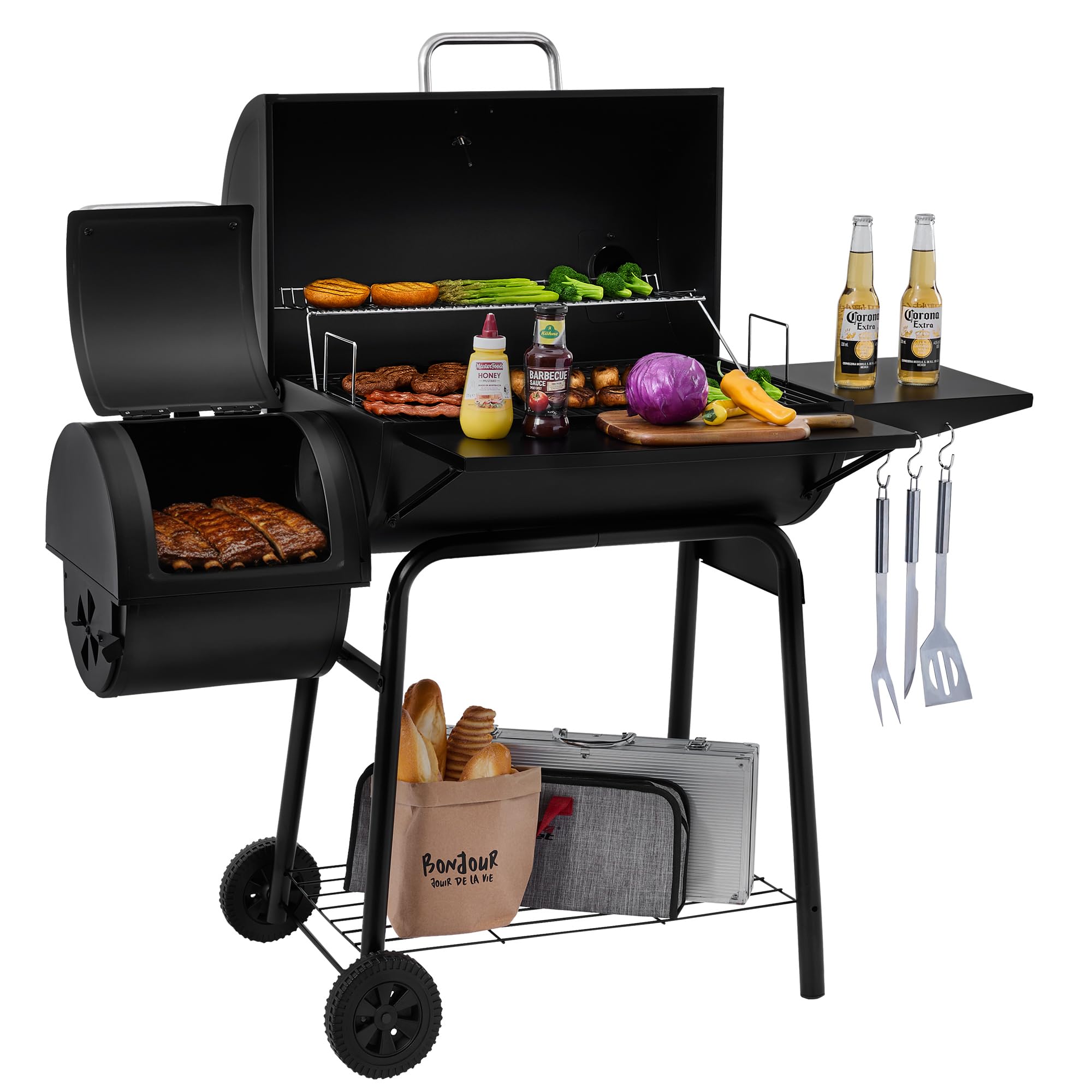
Offset smokers are the “romantic” version of BBQ: fire in a side box, smoke rolling through the main chamber, and that classic pit look. They’re also the hardest style to run well—so if you want an offset as a beginner, you need one that won’t punish you too harshly for normal mistakes. That’s what makes the Royal Gourmet interesting: it’s approachable, affordable, and functional enough to learn on.
The key is setting expectations. This style is rarely airtight at this tier, which means you’ll lose heat and smoke through gaps. Beginners who succeed with this smoker do two things: they accept that a little leakage is normal, and they use simple upgrades (like high-temp sealing methods) to reduce leaks and improve control.
Once you do that, the offset becomes a teacher. You learn fire management, fuel cadence, and airflow like a pitmaster—because you have to. And the payoff is real: when you nail ribs or a chuck roast on an offset, you’ll feel like you earned it.
Why it’s a good beginner offset
- Teaches classic BBQ skills – fire control, airflow, and smoke management.
- Full grill + smoker combo – useful even when you’re not smoking.
- Adjustable charcoal pan – helps you manage heat more actively.
- Surprisingly capable – with practice and sealing, it can hold stable smoking ranges well enough for great food.
Good to know
- Expect some leakage—many owners improve it with sealing during assembly.
- Offsets require attention; if you want pure ease, choose electric or propane instead.
- Windy days demand more fuel management—plan your first big cook on a calm day if possible.
Ideal for: beginners who want the classic offset experience, enjoy learning fire management, and like the idea of a grill + smoker in one footprint.
10. Cuisinart 16” Vertical Charcoal Smoker – A Solid Starter That Gets Even Better With Simple Tweaks

This smoker has a very specific personality: it can be a strong beginner tool, and it becomes noticeably better if you’re willing to do a couple of small “grown-up” improvements—like gasket sealing and smarter drip management. That’s why it shows up in so many long-term beginner stories: people buy it to learn, then keep it because they’ve tuned it to their style.
Out of the box, beginners often notice smoke leakage around the door and lid. That sounds scary, but it’s common in vertical charcoal units at this style. The trick is not to rage-return it; the trick is to treat leaks as a “control issue” you can solve. A simple gasket material on key edges can reduce leaks dramatically, helping you hold steady heat and keep the exterior cleaner.
Where it shines for beginners is the basic vertical logic: charcoal and wood work together, the water bowl buffers swings, and the vents teach you airflow control. Once you learn how little vent movement can change temperature, you stop chasing the gauge and start cooking with confidence.
Why it’s a smart starter
- Quick setup – beginners can be smoking fast without an assembly marathon.
- Teaches real charcoal skills – airflow, fuel burn, and smoke quality.
- Mod-friendly – simple gaskets and minor tweaks can elevate control a lot.
- Great “learn then keep” potential – many people outgrow the fear, not the smoker.
Good to know
- Expect leaks unless you seal it—this is common, not a defect, but it affects ease-of-use.
- Built-in thermometers are not precise; use a grate-level probe for true readings.
- Cold and wind can burn fuel faster; shielding improves performance noticeably.
Ideal for: beginners who want to learn charcoal smoking and don’t mind doing small, easy upgrades that make the smoker feel more controlled and refined.
11. Realcook 17″ Vertical Charcoal Smoker – Flexible Cooking, Dual Doors, and a Learning-Friendly Layout

The Realcook 17-inch vertical is a great example of a “simple design that teaches you a lot.” The two-door layout is more than convenience—it’s a heat-control advantage. You can check food from the upper door without dumping all the heat from the lower fire area, and you can add fuel from below without exposing your food to a big temperature crash.
Beginners also tend to love the hooks and crossbar concept because it opens up different cooking styles: hanging smaller cuts, using the racks for classic ribs/chicken, and experimenting with vegetables and fish without dedicating an entire grate. That flexibility keeps smoking fun, and fun is what makes you keep practicing.
This style of vertical charcoal smoker rewards a simple “steady fire” routine. When you treat it like a slow engine—small vent changes, steady fuel, no panic—you get surprisingly stable temperatures for a compact unit. And because it’s not huge, it’s easier to store, move, and bring to the places where smoking is most fun (beach, camping, tailgates).
Why it’s beginner-friendly
- Dual doors improve control – less heat loss during checks and fuel additions.
- Portable size – easier storage and transport than large smokers.
- Flexible cooking styles – racks + hooks let you experiment.
- Good “first brisket practice” platform – smaller cuts teach the same lessons without long risk.
Good to know
- Assembly can be easier if you sort hardware first and use basic sockets/wrenches.
- Some smoke leakage is normal in this category; sealing can improve control if you want it tighter.
- Thermometer fogging can happen; a separate probe thermometer makes everything easier.
Ideal for: beginners who want a portable vertical charcoal smoker with good access and flexibility—and who like learning by doing, not by reading a hundred rules.
12. VINGLI 4‑Tier 3‑in‑1 Vertical Charcoal Grill – Fun “Stacked Cooking” for Beginners Who Like Variety

Some beginners don’t want a single-purpose “meat-only” smoker. They want something that can smoke, grill, and handle multiple foods at once. That’s where a multi-tier vertical design can be genuinely fun: you can run different zones, learn how heat rises, and cook an entire meal in one unit.
The hidden beginner benefit is that stacked tiers teach you about positioning. You quickly learn that food closest to heat cooks differently, smoke behaves differently at different heights, and airflow is the boss of everything. That knowledge transfers to any smoker you ever own.
Owners often describe it as “just big enough” for patio life—meaning it doesn’t take over your outdoor space but still lets you feed a family. Cosmetic quirks can happen with high heat (like exterior finish reacting), but many beginners prioritize function: if it cooks great ribs and chicken, it’s doing its job.
Why it’s a fun beginner pick
- Multi-zone learning – stacked tiers teach heat and smoke behavior quickly.
- Cook multiple foods – great for “meat + sides” weekend meals.
- Compact but capable – patio-friendly footprint with meaningful cooking room.
- Beginner confidence builder – simple structure with big payoff when you get your routine down.
Good to know
- Like many charcoal units, it may take practice to reach higher smoking temps consistently—fire setup matters.
- Finish can react to heat over time; keeping it covered and dry improves longevity.
- Built-in thermometers are best treated as “trend indicators,” not truth.
Ideal for: beginners who like variety, want to cook multiple foods at once, and enjoy learning how heat behaves across different cooking levels.
13. SUNLIFER 16″ 4‑in‑1 Charcoal Smoker – A Small Footprint That Still Feels Legit
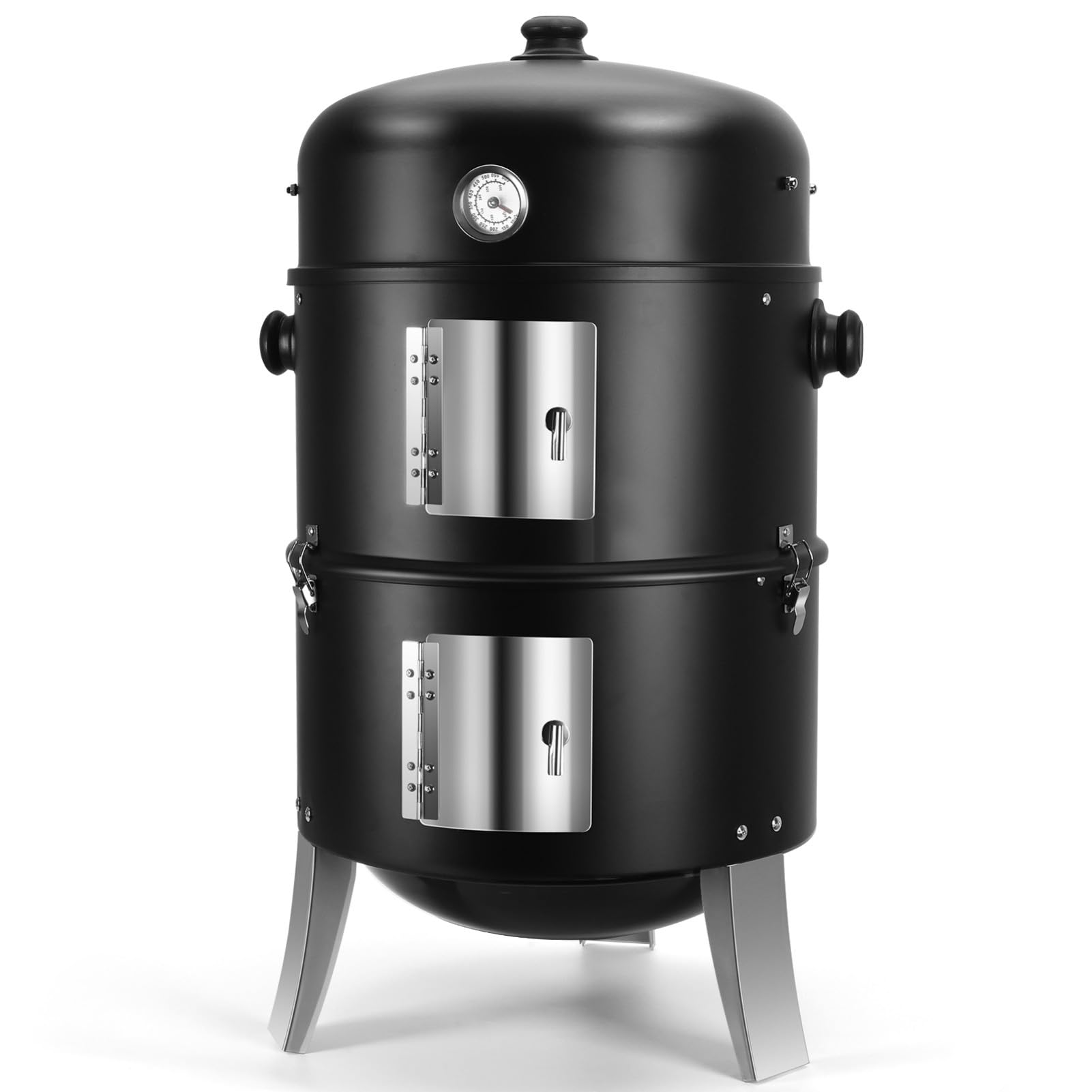
This is the kind of smoker that surprises beginners because it feels more capable than its size suggests. For small patios, camping, and “I want to smoke without owning a giant machine,” the SUNLIFER’s layered system and access doors make it a practical learning platform.
A big reason beginners like it is that the temperature can be held in that classic low-and-slow zone once you learn your vent settings. It’s not magic—it’s airflow and fuel discipline. But the smoker’s design makes that discipline easier to practice because you can add fuel and check progress without constantly dismantling the whole setup.
It also encourages a smart beginner strategy: start with cheaper, forgiving proteins (chicken quarters, sausage, pork ribs) and learn smoke flavor and temperature control, then graduate to longer cooks when you’re confident your fire can stay steady. Because the unit is compact, those practice cooks don’t feel like an all-day job.
Why it’s a strong starter
- Compact and portable – easy to store, transport, and actually use often.
- Multi-layer cooking – enough space for a small family meal plus sides.
- Access doors – makes fuel management less disruptive for beginners.
- Steady-temp potential – good vent response helps you learn control.
Good to know
- Assembly is easier with basic tools and sorting hardware first.
- Compact size means you may need to cut larger brisket-style cooks into smaller portions.
- As with many charcoal units, weather protection (cover/storage) improves long-term durability.
Ideal for: beginners with limited space or a travel/camping lifestyle who want a small smoker that still teaches real charcoal technique and produces legit results.
14. Masterbuilt Charcoal Bullet Smoker – The Simple Gateway Smoker for Learning the Basics

If your goal is simple—“I want to see if I even like smoking”—this is the kind of compact charcoal bullet that makes sense. It’s easy to store, easy to bring out, and capable of producing genuinely tasty food once you learn the basics of charcoal airflow.
The biggest beginner limitation is heat output consistency at higher smoking temperatures. Many beginners can hold a stable low range, but struggle to push it hotter for long periods without modifying airflow and ash management. That’s not necessarily a dealbreaker—it just means this is best for shorter or moderate-length smokes and smaller cuts.
What it does well is teach you the fundamentals without demanding that you become a pit engineer. You learn how fuel burns, how vents influence temperature, and why controlling ash matters. And if you decide you love smoking, you’ll know exactly what you want next—because you’ll have learned the craft in a hands-on way.
Why it’s a good starting point
- Simple and compact – easy storage, easy setup, less intimidation.
- Great for learning fundamentals – vents, fuel, ash, and smoke quality basics.
- Works well for smaller cooks – chicken, ribs, roasts, and quick smoke sessions.
- Easy “upgrade path” – small modifications and better thermometers can improve it if you enjoy tinkering.
Good to know
- May struggle to hold higher temps for long periods without airflow/coal-pan tweaks.
- Built-in thermometers can be unreliable; a wireless probe makes success easier.
- It’s not designed for huge briskets unless you break them down into smaller pieces.
Ideal for: beginners who want a compact charcoal bullet to test the smoking waters, learn the basics, and cook smaller batches with classic charcoal flavor.
How Smoke and Airflow Actually Work (and Why Beginners Get Bitter Results)
Most “bad first smokes” aren’t caused by the meat. They’re caused by physics: airflow, combustion quality, and temperature stability. Once you understand what your smoker is trying to do, you stop guessing—and you start producing clean smoke on purpose.
What “clean smoke” really means (in beginner language)
- Clean smoke is gentle and steady – often barely visible once your smoker is settled.
- Dirty smoke is thick and harsh – usually from smoldering wood, low oxygen, or dumping too much wood at once.
- Airflow is the boss – choking vents to “keep smoke in” often makes smoke worse, not better.
- Heat drives combustion – if your heat source cycles off too often (or your charcoal is weak), your smoke can turn inconsistent.
That’s why cabinet electrics and gas smokers are so beginner-friendly: they simplify the airflow game. And it’s why charcoal units feel “hard” at first: you’re managing combustion and heat at the same time.
The beginner “set-and-win” checklist
- Preheat until stable – don’t load food the moment the number flashes on the screen. Let the chamber settle.
- Add wood in smaller cycles – especially with chips. A little, consistently, beats a lot at once.
- Stop opening the door – use a window and probes; treat the smoker like an oven.
- Cook to internal temp – the clock is guidance, not truth.
- Plan your finish – if you want firmer bark or crisp skin, finish with heat (or a quick grill/oven blast) instead of burning wood harder.
Once you run this checklist a few times, smoking stops being mysterious. It becomes a repeatable process—like baking bread, but way more fun.
FAQ: Beginner Smoking Questions (Answered Like You’re Actually Cooking)
What’s the easiest smoker type for a true beginner?
Why did my first smoke taste bitter?
Do I need a water pan?
Should I trust the built-in thermometer?
What should I smoke first?
How do I get better without overcomplicating it?
Final Thoughts: The Best Smoker For Beginners Is the One You’ll Use
Here’s the goal: you buy a smoker, you cook on it often, and you get better fast because the experience feels manageable—not like a stressful science experiment. When a smoker fits your space and personality, smoking becomes a hobby you actually keep.
Use these shortcuts to land on a great pick quickly:
- Want the most balanced “beginner win” outdoor smoker? Start with the EAST OAK Ridgewood Pro 30″ Electric Smoker. Window + probe + easy chip loading is a confidence stack.
- Want one outdoor cooker that can smoke AND do everyday meals? Choose the Ninja Woodfire Pro XL OG850. It’s the “smoked flavor without owning a dedicated smoker” answer.
- Prefer propane reliability and fewer electronics? Consider the Pit Boss 3-Series Gas Vertical Smoker. It’s a steady, confidence-building cabinet style.
- Need a true indoor solution? The GE Profile Smart Indoor Pellet Smoker is built for real smoke flavor in spaces where outdoor smokers aren’t practical.
- Want to learn charcoal smoking the “right way” without going full offset? Start with the Char-Broil Bullet Charcoal Smoker 16″. It teaches airflow and clean smoke in a manageable package.
If you only remember one thing, remember this: the best smoker for beginners is the one that matches your real life—your space, your patience, and your desire for repeatable wins. Pick the smoker that makes you excited to cook again next weekend, and you’ll build skills (and bark) faster than you think.
