
Buying a juicer is easy. Living with one is where most people get burned.
Here’s the pattern I see again and again: you get excited, you buy something “powerful,” you juice twice… then it turns into a counter ornament because it’s loud, splashy, annoying to clean, or it makes juice that tastes like “air + foam + regret.”
So this guide is built around the real deal: tiny kitchens, tiny patience, busy mornings, and the very specific question, “Will I actually use this three times a week?”
If you’re hunting for a small juice machine, your #1 enemy isn’t “low wattage.” It’s friction. It’s the five-minute cleanup that becomes fifteen. It’s the awkward chute that demands endless chopping. It’s the pulp that clogs because you fed celery like it was a blender. And it’s the one part you can never fully rinse, so it starts to smell like yesterday’s kale.
I pulled together 16 standout picks across three categories that matter for small spaces: compact cold press (quiet, nutrient-friendly, better for greens), compact centrifugal (fast, great for “drink it now” juice), and citrus-only (if you’re mostly lemons, limes, oranges, and grapefruit).
You’ll also see two “same machine, different color” options and two “same idea, different bundle” mini options—because real buyers shop based on what’s actually available, what fits their space, and what they’ll use.
By the end, you won’t just know what to buy. You’ll know what to buy for your life: how you prep, how you clean, how you store, and what you drink. That’s how you end up with a juicer you keep—and love.
How to Choose the Right Small Juice Machine (Without Regrets)
A compact juicer isn’t “good” because a listing says “high yield.” It’s good because it fits your kitchen and your routine—so you keep using it. That’s why I’m going to focus on the parts most buying guides ignore: friction points, habit fit, and cleanup reality.
1. First, pick your juice personality: fast spin or slow press?
Every other decision becomes easier once you decide what kind of juice person you are.
- Fast spin (centrifugal): You want juice now. You don’t mind a bit more foam. You’re the “I’ll drink it immediately” type. These are typically faster and can be easier for quick batches, but they can be louder and sometimes less friendly for leafy greens.
- Slow press (masticating/cold press): You want smoother juice, less foam, and you’re more likely to juice greens. These are often quieter and more “steady,” but they can be slower and may need a bit more technique for fibrous produce.
- Citrus-only: You mostly want orange juice, lemon water upgrades, grapefruit mornings, or lime for recipes. Citrus-only units are the most compact and the least fussy—because they only do one job.
2. “Small” is not one size—measure the friction, not just the footprint
A lot of machines look compact in photos, then arrive and eat your counter. But even more important: some “small” machines feel big because of how you use them. Here’s the real checklist I use:
- Height vs cabinet clearance: Tall vertical cold press models save counter width but can be awkward under upper cabinets. If you have a low cabinet, the lid may not open fully.
- Parts count: If you dread disassembling a puzzle, you’ll avoid juicing. The best compact machines have a “three-piece habit” you can learn in one day.
- Dry-pulp behavior: Dry pulp is the easiest shortcut to “I’m getting my money’s worth.” Wet pulp usually means either the machine is less efficient for that ingredient, or you need a better feeding rhythm.
- Mess control: Look for drip-stop spouts, secure locking arms, and pulp containers that don’t sneeze pulp at you when you remove them.
- Cleaning geometry: Fine mesh baskets make great juice, but they punish you if you let them dry. If a machine needs immediate rinsing every time, it must fit your lifestyle.
3. The wide chute trap: less chopping, but more rules
Wide chutes are the most seductive feature in juicer shopping—and they can be genuinely amazing in a small kitchen. Less chopping means less mess. But here’s what people learn late:
- Wide chute doesn’t mean “anything goes.” Whole apples? Great. Whole beets? Usually a bad day. Long celery stalks? Also a bad day. Even big machines work best when fibrous produce is cut shorter.
- Self-feeding chutes still need “texture management.” Alternating juicy items (apple, orange, cucumber) with fibrous items (celery, kale) reduces jams dramatically.
- Chute width claims can be… optimistic. A chute marketed as extra-wide may still have internal flaps or safety gates that effectively narrow the opening. You’ll see that come up in real buyer feedback.
Bottom line: a wide chute is a huge win if you juice frequently, but your best results come from a simple feeding rhythm—especially in compact machines.
4. Noise is not just volume—it’s tone and timing
In small spaces (especially apartments), the sound profile matters as much as loudness:
- Centrifugal noise: Often higher-pitched and “vacuum-like.” It’s fast, so it’s over quickly—but it can be jarring.
- Cold press noise: Often lower and steadier. It can sound gentler, but it runs longer, so the total “noise time” can be similar.
- Citrus noise: Usually minimal and short—mostly motor hum and fruit friction.
My advice: if you’ll juice before 8am, prioritize a machine that owners describe as “quiet” or “doesn’t wake the house.” If you juice after work, speed can matter more than noise.
5. The two cleaning styles: “rinse now” vs “soak later”
Most people don’t fail at juicing because they don’t like juice. They fail because they don’t like cleanup. Here’s how to choose a machine you’ll keep using:
- Rinse-now machines: Fine mesh baskets and multi-part strainers often clean easily if you rinse immediately. If you’re the type who can rinse right away, these machines feel effortless.
- Soak-later machines: If you know you’ll leave parts in the sink, choose a design that tolerates it—simpler pulp paths, fewer tiny teeth, and parts that don’t clog into cement.
If you’re not sure which one you are, assume you’re a “soak later” person. Your future self will thank you.
6. The truth about “yield” in small machines
Small machines can be wildly efficient—sometimes shockingly so—if you feed them correctly. But yield depends on four things:
- Ingredient choice: Apples and oranges are easy. Leafy greens and celery are the “advanced level.”
- Cut size: Even if the chute is wide, short pieces often extract better and jam less.
- Feeding rhythm: Stuffing too fast creates wet pulp and clogs. Steady feeding creates dry pulp and smoother juice.
- Filter hygiene: A slightly clogged filter turns a high-yield machine into a “why is this dripping?” machine.
7. If you want nut milk or sorbet, your expectations need to be specific
A lot of 3-in-1 machines promise juice, nut milk, and sorbet. That can be fantastic—if you understand what it means:
- Nut milk: Great when you want fresh, simple nut milk without additives. Expect to soak nuts first, and accept that “ultra silky” usually requires straining after.
- Sorbet: Usually best with slightly thawed frozen fruit. If you feed rock-hard frozen chunks, you’ll stress any compact machine.
- 3-in-1 value: Worth it if you’ll actually use the extra functions monthly. If you won’t, a dedicated juicer often feels simpler and more reliable day-to-day.
8. Decide your “batch size” honestly
Small machines thrive in two scenarios:
- Daily single servings (a cup or two) where you want quick setup and minimal mess.
- Weekend prep sessions where you want to fill a couple bottles, then be done.
If you’re planning huge batches every time, you can still do that with compact machines—but you should choose one with a large hopper or hands-free feeding so you’re not standing there for an hour.
Quick Comparison: 16 Small Juice Machine Picks for Tight Counters
Use this table to match a machine to your habits, then jump into the full reviews for the “real life” details— like which ones are truly easy to clean, which ones are surprisingly loud, and which ones handle fibrous produce without a tantrum.
On smaller screens, swipe or scroll sideways to see the full table.
| Model | Type | Small-space strength | Best match | Amazon |
|---|---|---|---|---|
| AMZCHEF Cold Press Juicer (5.4″ chute) | Cold press | Slender stainless body + wide chute without giant footprint | Most households that want daily juice with less mess | Amazon |
| Breville Juice Fountain Plus JE98XL | Centrifugal | Fast “juice now” workflow + classic froth control pitcher | Busy mornings, quick juice, drink immediately | Amazon |
| TUUMIIST 3-in-1 Cold Press (6.5″ chute) | Cold press | Huge hopper for hands-free loading (less prep, less babysitting) | Families and batch-preppers who still want countertop sanity | Amazon |
| EanOruus 3-in-1 Cold Press (Premium Gray) | Cold press | 3-in-1 strainers + dishwasher-safe parts for faster cleanup | Multitaskers (juice + nut milk + sorbet) who love convenience | Amazon |
| EanOruus 3-in-1 Cold Press (Bright White) | Cold press | Same workflow, different look—great for bright kitchens | Same performance, “I want it to match my counter” buyers | Amazon |
| Breville Juice Fountain Compact BJE200XL | Centrifugal | Premium compact footprint + “juice in minutes” speed | People who want Breville feel without a giant machine | Amazon |
| YPONE Cold Press Juicer (5.8″ chute) | Cold press | Wide chute + slow squeeze yield in a tidy shape | Cold-press fans who want “whole produce” convenience | Amazon |
| ECOSELF Wide-Chute Cold Press (hands-free) | Cold press | Self-feeding design reduces babysitting (great for routines) | Daily juicers who want “set it and pour” simplicity | Amazon |
| LQZ Cold Press Juicer (5.4″ chute) | Cold press | Very compact body—easy to store, easy to pull out | Solo juicers and tiny counters that still want cold press | Amazon |
| Magic Bullet Mini Juicer (MBJ10100) | Mini centrifugal | Space-saving, quick cleanup, great for small batches | “One cup a day” people who want speed in a tiny form | Amazon |
| Magic Bullet Mini Juicer with Cup | Mini centrifugal | Juice directly into a to-go cup (fewer dishes) | Quick breakfast juice, take it with you, rinse fast | Amazon |
| HOUSNAT Centrifugal Juicer (3 speeds) | Centrifugal | Fast juicing with flexible speed control in a modest size | Meal-prep juicers who want speed and simple controls | Amazon |
| QCen 500W Centrifugal Juicer | Centrifugal | Budget-friendly speed + wide mouth for quick prep | New juicers who want “good enough” and easy cleanup | Amazon |
| GDOR 800W Juicer (dual speed) | Centrifugal | Foam-control pitcher + easy-to-learn setup | Families who want quick juice without complicated parts | Amazon |
| BLACK+DECKER CJ625 Citrus Juicer | Citrus | Super small + adjustable pulp + easiest cleanup style | Orange juice lovers and lemon-lime cooks | Amazon |
| Elite Gourmet EJX600 Mini Slow Juicer | Cold press | True micro footprint for dorm/RV/single-serve life | One-person households who want cold press in tiny space | Amazon |
In‑Depth Reviews: 16 Compact-Friendly Juicers People Actually Keep Using
Now we’ll go machine by machine. I’m going to talk like a real kitchen: how it behaves when you’re tired, how it cleans, what clogs it, what it’s best at, and what kind of buyer ends up genuinely happy after the honeymoon phase.
1. AMZCHEF Cold Press Juicer – The “Daily Juice” Sweet Spot for Small Counters
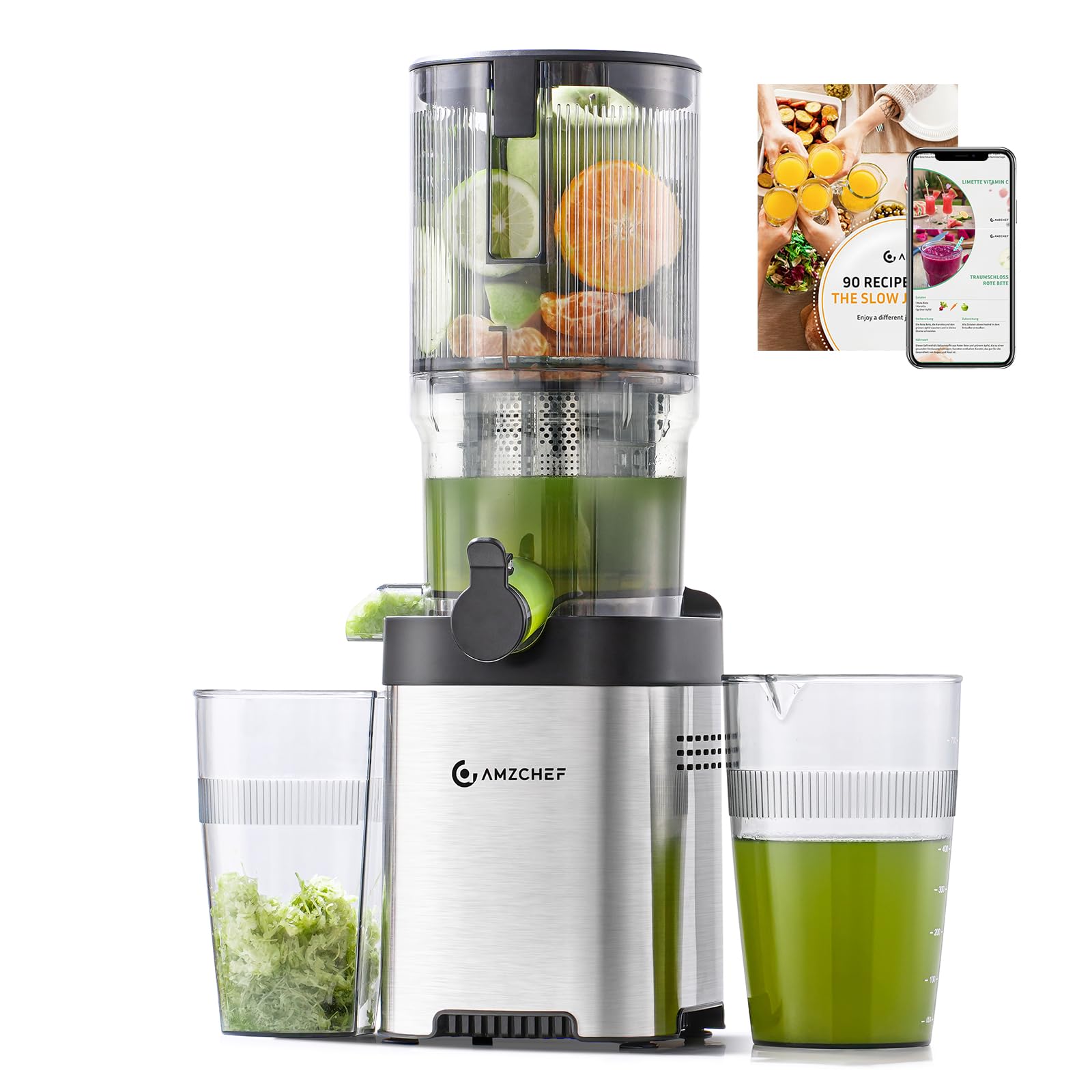
This is the kind of juicer that earns the “best overall” slot not because it’s the fanciest, but because it’s the most likely to become part of your week. AMZCHEF nailed the compact-kitchen balance: a body that feels tidy on the counter, a chute that reduces prep pain, and a workflow that doesn’t punish you with a 20-minute teardown after one glass.
The hidden win here is confidence. With many cold press machines, first-time users feel like they’re negotiating with a spaceship. AMZCHEF’s style tends to reward “normal human behavior”: steady feeding, quick rinse, repeat. Owners commonly describe the cleanup as refreshingly simple when rinsed right away, and the juice as smooth with noticeably “drier” pulp than they expected for a compact unit.
But there’s also a very real “user tip” that separates happy buyers from confused ones: on this style of machine, the top/lid lock sequence matters. If the lid isn’t aligned and locked the way the mechanism expects, people assume it’s broken when it’s actually just not seated. Once you learn the feel of that lock, it becomes muscle memory—and then the machine feels easy.
Where it shines most is daily blends: apple-celery-ginger shots, carrot-orange combos, cucumber-heavy “hydration juices,” and green juices (where you alternate greens with something juicy so the auger stays happy). You can absolutely juice greens here, but your results improve dramatically when you treat greens like “layers,” not like a single giant wad of spinach.
Why you’ll like it
- Compact without feeling “toy sized” – It looks clean on the counter and doesn’t demand a dedicated corner of your kitchen.
- Prep time drops fast – A wide chute changes your habits because juicing feels doable on a weekday.
- Strong yield when fed correctly – Alternating textures produces drier pulp and smoother juice.
- Easy cleanup rhythm – Rinse immediately and this feels closer to “quick rinse” than “kitchen project.”
Good to know
- Cold press machines love a steady pace—forcing fibrous produce too fast can clog any compact unit.
- Like many vertical juicers, you’ll get best green-juice results by alternating greens with juicy ingredients.
- Locking and unlocking becomes effortless after a few tries—practice once before your first “busy morning.”
Ideal for: most households that want a dependable cold press routine in a small kitchen—especially if you value smooth juice and lower foam.
2. Breville Juice Fountain Plus JE98XL – When You Want Juice in Minutes, Not a Lesson

If cold press is “slow, steady, ritual,” centrifugal is “hit the switch, pour the glass.” And the JE98XL is the classic gateway drug into home juicing because it’s fast, straightforward, and feels like it was designed by people who actually care about the experience.
This machine is for the person who wants juice right now—especially on busy mornings. You feed, it spins, you pour. Done. That speed is not just convenience; it’s motivation. When the whole process takes one song instead of a full playlist, you’re more likely to do it even when life is chaotic.
Where most centrifugal machines lose people is foam and mess. Breville’s workflow is built to reduce the “why is everything frothy?” frustration with a jug designed to help separate froth, and the overall build tends to feel stable instead of rattly. Owners also learn a simple truth: if you keep the pusher in place while feeding, you prevent the occasional “ingredient pop” that can happen when spinning blades meet a loose chunk of produce.
Now for the expert tip most listings won’t explain: centrifugal juicers reward ingredient prep and pacing. Yes, the chute is wide. But if you drop whole hard produce constantly, day after day, you can stress any motor. Chopping dense items into manageable pieces is not “extra work,” it’s a long-term reliability habit. The good news is you don’t need perfect chopping— you just need “not a whole beet” energy.
Taste-wise, this style makes bright, fresh juice quickly, but it’s at its best when you drink it soon after juicing. If you love the idea of filling bottles for days, cold press is usually your friend. If you love the idea of “one glass and go,” this is a top-tier pick.
Why it works
- Speed is the habit-maker – Fast juicing means you actually keep doing it.
- Simple learning curve – It feels intuitive even if you’re brand new to juicing.
- Solid build and stability – Less “rattle and wobble,” more confident countertop feel.
- Great for fruit-heavy blends – Apples, citrus, pineapple, and carrots shine in a fast spin setup.
Good to know
- Centrifugal machines are often louder; if you’re in an apartment, morning use may be noticeable.
- Foam happens—use the included jug strategy and pour patiently for the smoothest glass.
- Dense and fibrous produce should be cut smaller to reduce strain and splatter.
Ideal for: people who want the fastest path to fresh juice and plan to drink it immediately—especially fruit-forward or classic veggie blends.
3. TUUMIIST 3‑in‑1 Cold Press – The “Load It and Walk Away” Family-Style Option
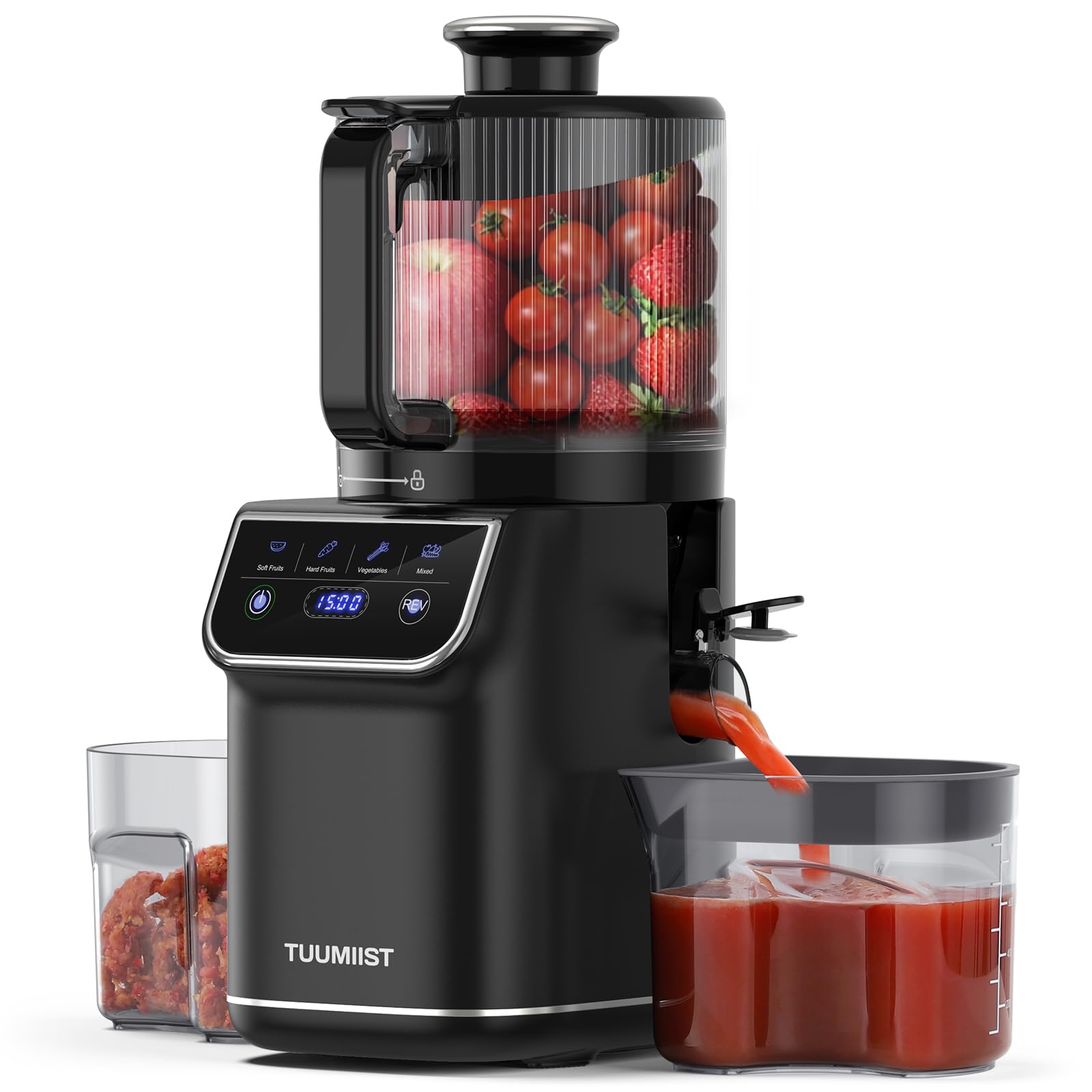
This is the machine you buy when you’re done with “tiny chute, tiny batches, endless chopping.” TUUMIIST is built around a wide, self-feeding style hopper and a more modern control experience—meaning less babysitting and less “did I assemble this right?” guesswork.
In real owner feedback, three themes show up repeatedly: prep time drops, cleanup feels surprisingly quick, and the pulp comes out dry when you feed it sensibly. That last part matters, because “dry pulp” is the most honest sign of efficient extraction. When people say, “It gives great yields and the pulp is dry,” what they’re really saying is, “I don’t feel like I’m wasting produce.”
The second “confidence feature” is the way the machine communicates status. Touch controls can be gimmicky, but they’re valuable when they reduce mistakes: clear modes, clear reverse, and signals when the lid isn’t seated correctly. For beginners, that’s the difference between “I’m scared to use this” and “okay, this is easy.”
Now, the expert reality check: big hoppers still require smart feeding if you want long-term happiness. Whole apples and chunks of cucumber are perfect. Dense, fibrous items (ginger knobs, raw beets, tough celery ends) are where people destroy juicers. The trick is simple: cut very dense produce into shorter pieces and alternate textures. If you do that, this style of machine feels like a cheat code.
Also: this is a strong choice if you like nut milk and sorbet. A 3‑in‑1 machine is only valuable if you actually use those functions, and TUUMIIST is one of the better “do it all” styles because it’s built for volume and routine—not just one fancy weekend project.
Why families love it
- Wide chute convenience – Less chopping means you’ll juice more often.
- Quiet, steady cold press vibe – Better for early mornings than most fast-spinners.
- Quick rinse design – Owners often report a fast cleanup rhythm with minimal scrubbing.
- 3-in-1 flexibility – Juice, nut milk, and sorbet in one machine when you want variety.
Good to know
- Big capacity doesn’t mean “feed anything whole.” Dense fibrous produce should be cut smaller.
- If you love ultra-smooth green juice, you’ll still get best results by alternating greens with juicy produce.
- Large machines are easiest to love when you have a consistent storage spot and a rinse routine.
Ideal for: families, batch-preppers, and “I don’t want to chop everything” buyers who still want smooth cold press juice in a reasonable workflow.
4. EanOruus 3‑in‑1 Cold Press (Premium Gray) – Juice + Nut Milk + Sorbet Without Extra Appliances
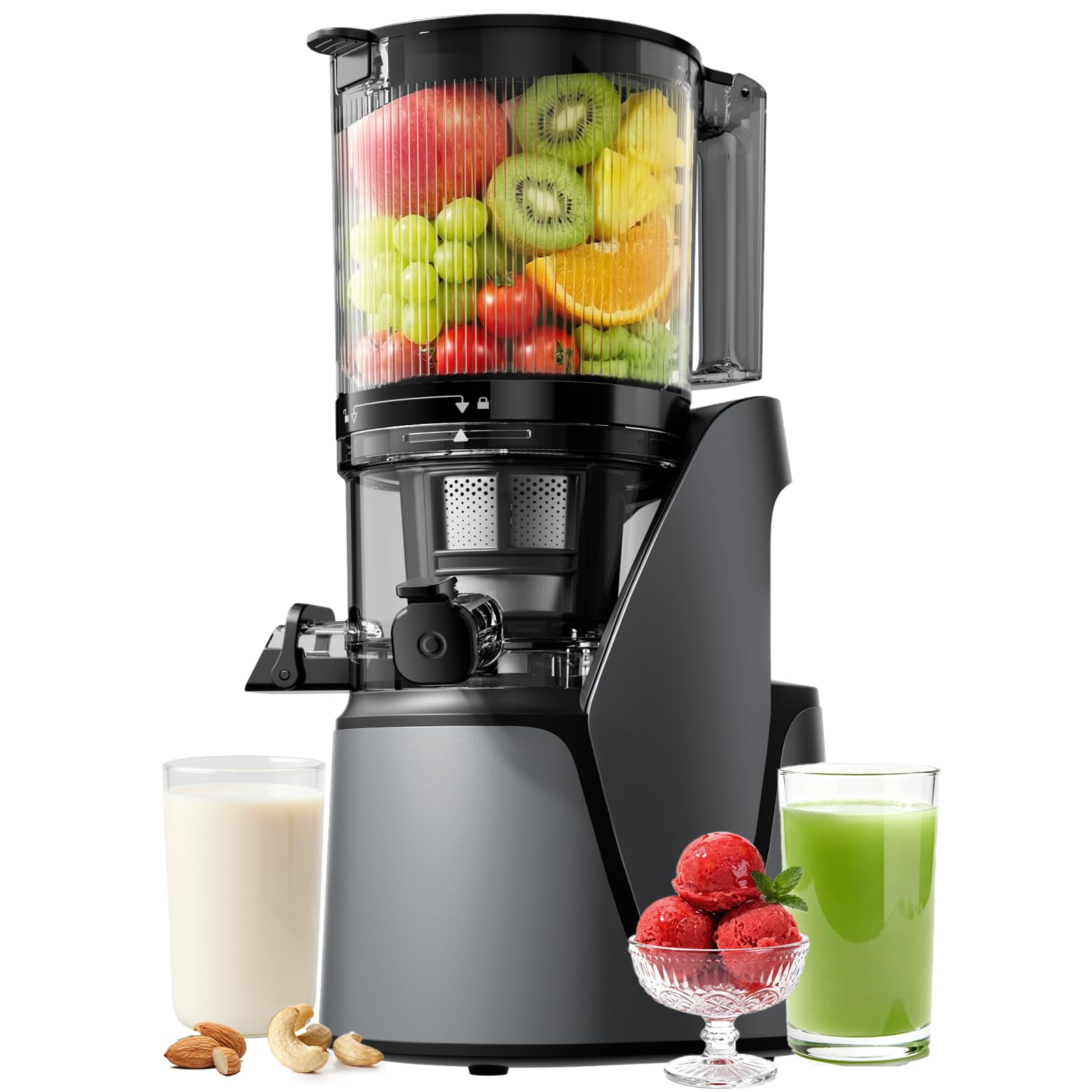
This is the machine for the person who wants a juicer, a nut-milk setup, and a “healthy dessert” option—without buying three separate gadgets. EanOruus leans into the 3‑in‑1 idea with interchangeable strainers and a workflow designed to feel approachable, even if you’re new to cold press juicing.
The most useful thing I can tell you from real usage patterns is this: people love it when it feels simple enough to repeat. In buyer feedback, the repeating wins are “easy to assemble,” “easy to clean,” and “really dry pulp.” That’s the trifecta that turns a new health habit into a real one.
Now, there are two “truths” that make you a happier owner:
- New-machine smell can happen. Some users report a mild plastic smell at first (common in many new appliances). A thorough wash and a quick “water run” usually improves this fast.
- Break-in noise is real. A small percentage of buyers report a weird squeak or unpleasant sound early on that disappears after reassembly or a couple of sessions. That’s often alignment + friction + brand-new seals. It’s not fun, but it’s fixable.
What makes this style of machine feel “small kitchen friendly” is the dishwasher-safe approach for detachable parts (use sensible settings and treat gaskets gently). If you’re a person who will not hand-scrub a filter basket every time, that alone can be the difference between “I use it” and “I don’t.”
Function-wise, juice mode is straightforward. Nut milk is where your expectations matter: soak your nuts, don’t overpack, and expect to strain again if you want cafe-level silk. Sorbet mode is the fun one—use slightly softened frozen fruit rather than rock-hard chunks, and you’ll get a smoother, less stressful result.
Why it’s worth it
- 3-in-1 space savings – One footprint instead of multiple appliances.
- Beginner-friendly workflow – Easy assembly encourages repeat use.
- Strong extraction when fed correctly – “Dry pulp” feedback shows up often.
- Cleanup is less intimidating – A big deal for anyone who hates scrubbing.
Good to know
- Chute width claims can be optimistic; treat it as “wide enough to reduce chopping,” not “never chop.”
- Any unusual sound early on is often assembly alignment—re-seat parts and try again.
- For nut milk, soaking and small batches produce the best texture.
Ideal for: multitaskers who want juice plus nut milk and occasional sorbet, and who prioritize easy cleanup so the machine actually gets used.
5. EanOruus 3‑in‑1 Cold Press (Bright White) – Same Great Workflow, Cleaner Counter Aesthetic
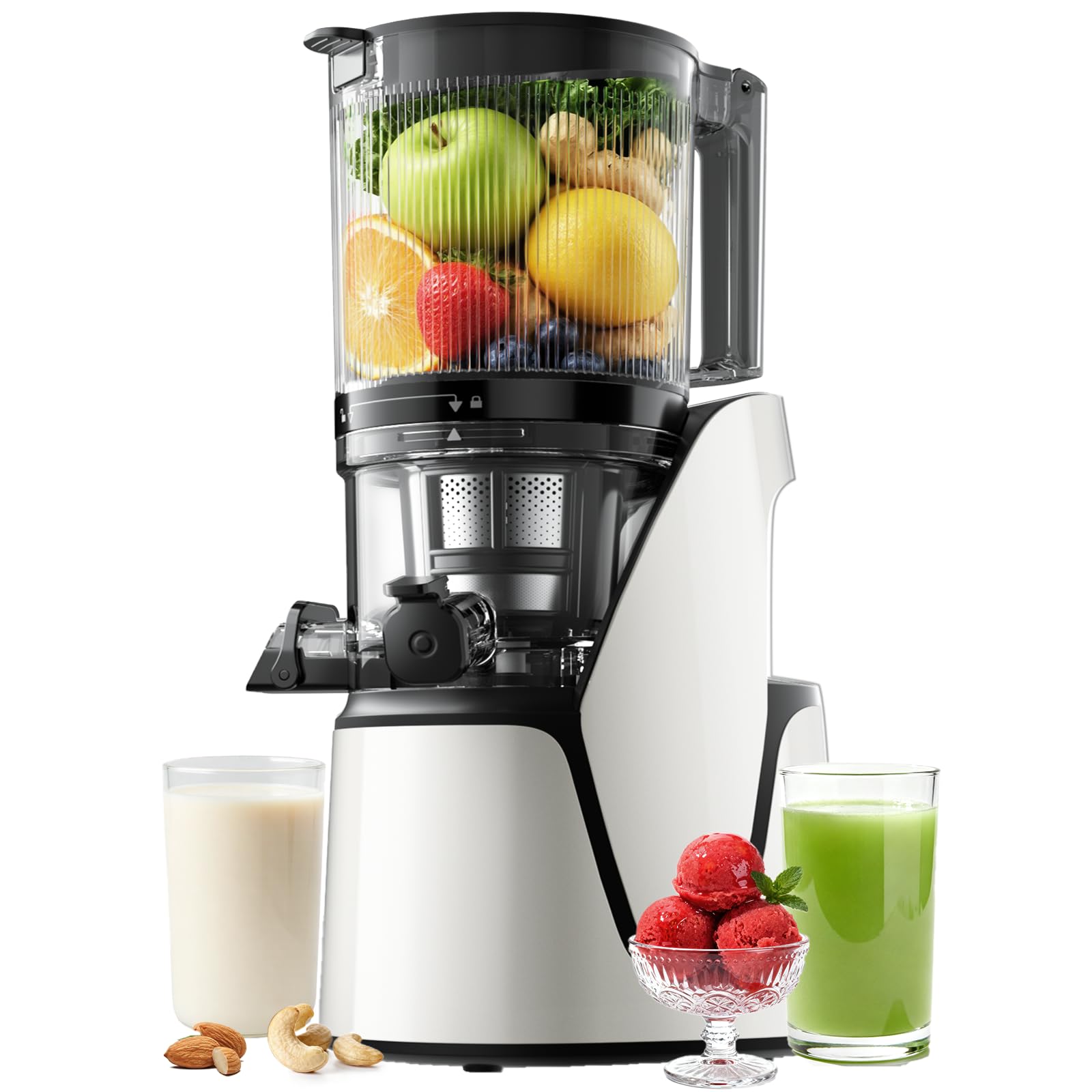
Yes, this is basically the same machine as the gray version—just in a bright white finish. And that matters more than people admit. In a small kitchen, if you hate how an appliance looks, you’ll hide it. If you hide it, you’ll use it less. If you use it less, your “healthy habit” becomes an idea instead of a routine.
The reason I’m comfortable listing both is availability and preference. Some kitchens are dark and modern; some are bright and minimalist. A white juicer can feel cleaner on the counter, especially if you’ve got light cabinets or a small, airy space. And if that makes you more likely to leave it out, it makes you more likely to juice.
Performance-wise, you should expect the same strengths: easy assembly, strong extraction when fed steadily, and the fun of switching between juice, nut milk, and sorbet. And you should expect the same reality checks: wash thoroughly at first, keep seals clean, and don’t feed fibrous produce like you’re trying to win a speed contest.
Here’s the “expert quality-of-life” tip for white appliances: rinse and wipe immediately after use. Fruit pigments (carrot, beet, berries) can stain plastic surfaces if they sit. A quick wipe with warm soapy water right after juicing keeps it looking new. If you do get a stubborn stain, a paste of baking soda and a gentle scrub works surprisingly well—just avoid abrasive pads that scratch.
If you’re deciding between the two, don’t overthink it. Pick the one you’ll enjoy seeing on your counter. That’s a real performance feature in a small space.
Why you’ll choose this version
- Bright, clean look – More likely to stay on the counter (which means more use).
- Same 3-in-1 versatility – Juice, nut milk, sorbet without extra gear.
- Easy to understand – Beginner-friendly controls and parts.
- Solid yield for daily blends – Great for apples, citrus, carrots, and “balanced” green mixes.
Good to know
- White finishes show staining faster—rinse and wipe right away for best long-term looks.
- Chute size reduces chopping, but dense items still benefit from smaller cuts.
- As with all cold press units, steady feeding beats stuffing.
Ideal for: buyers who want the EanOruus 3‑in‑1 workflow but prefer a bright, minimalist countertop vibe.
6. Breville Juice Fountain Compact BJE200XL – Premium Compact Speed That Fits Real Kitchens

This is the “I want Breville quality but I don’t want a beast on my counter” model. And it’s a strong answer for small kitchens because it has one job: make fresh juice quickly, with minimal fuss, in a footprint that doesn’t feel like you moved in a new roommate.
What’s special here isn’t a million features—it’s the balance of speed, design, and daily usability. Owners consistently talk about the joy of making juice without turning it into a full kitchen event. It’s fast enough to fit into mornings, and the core parts are designed to come apart and clean without an engineering degree.
But this is where expert reality matters: compact centrifugal juicers reward a simple cleaning habit. The filter basket is where the magic happens, and it’s also where dried pulp becomes concrete. If you rinse the basket right away (even a 30‑second hot water rinse), cleanup stays easy. If you let it sit, you’ll need the brush and a little more patience. This isn’t a flaw—this is how fine mesh filters work.
In terms of juice quality, this unit shines with apples, citrus, pineapple, cucumber, carrots, and “juice shop style” blends. Leafy greens are doable, but this is not where centrifugal machines are naturally strongest. If your life is mostly green juice, you’ll be happier with cold press. If your life is “quick fruit + veggie cups,” this is fantastic.
One more “small kitchen” advantage: it stores well. Cord storage and a compact build mean you can tuck it away without feeling like you’re playing appliance Tetris. That matters when you’re short on counter and short on patience.
Why it’s a small-space favorite
- Fast juice, minimal drama – Great for people who want juice without a long process.
- Compact premium feel – Breville build quality without a giant footprint.
- Easy storage – Works well for “pull it out, juice, put it away” kitchens.
- Great for classic blends – Fruit-forward juices and everyday veggie mixes come out bright and fresh.
Good to know
- Like all fine mesh baskets, it’s easiest to clean if rinsed immediately.
- Centrifugal noise is real—fast, but not silent.
- If leafy greens are your main event, cold press typically gives smoother results.
Ideal for: small kitchens that want premium, fast juicing for daily cups—especially if you plan to drink your juice soon after making it.
7. YPONE Cold Press Juicer (5.8″ chute) – High Yield Feel Without Overcomplication

YPONE is a strong pick if you want the cold press “quiet-ish, steady extraction” vibe, but you don’t want a machine that feels complicated. The wide chute is designed to cut down prep time, and the overall approach is “simple controls, steady performance.”
In real buyer feedback, people talk about three things: (1) it’s easier to clean than they expected, (2) it’s not painfully loud (even with carrots), and (3) it produces enough juice that it feels satisfying—especially for fruit and everyday veggie mixes. That’s a pretty honest snapshot of why this model is popular: it behaves like a reliable home tool rather than a finicky gadget.
What I like most from an expert standpoint is the “safety + usability” combo. A safety lock that stops the machine when the lid is open isn’t just about safety—it prevents the “I opened it mid-run and now everything is messy” moment. That’s a small-kitchen mess prevention feature disguised as safety marketing.
Now, cold press machines like this one work best when you adopt one simple habit: don’t rush fibrous ingredients. If you feed celery like you’re feeding a shredder, you’ll clog any compact juicer. If you feed it in shorter pieces and alternate with juicy items, this style can produce impressively dry pulp and smooth juice.
Also: if you’re coming from a centrifugal juicer, you’ll notice the pacing difference. Cold press feels calmer and often yields smoother juice, but it’s not a 10‑second process. The payoff is usually less foam, a more “dense” juice, and a quieter overall vibe in small spaces.
Why it fits small kitchens
- Wide chute convenience – Less chopping = more likely to juice on weekdays.
- Steady, lower-tone operation – Often feels gentler than fast spin machines.
- Simple assembly – You don’t need a “manual every time” mindset.
- Great yield on common produce – Apples, oranges, carrots, cucumber, and ginger blends do well.
Good to know
- Hand washing is part of the deal for many cold press units—rinsing immediately makes it quick.
- Cold press is slower; if you need “instant juice,” centrifugal may suit you better.
- For fibrous produce, short pieces + alternating textures prevents clogs.
Ideal for: cold press fans who want a wide-chute convenience boost and a simple, repeatable routine without a huge appliance footprint.
8. ECOSELF Wide-Chute Cold Press – The “Self-Feeding” Option That Makes Daily Juicing Easier
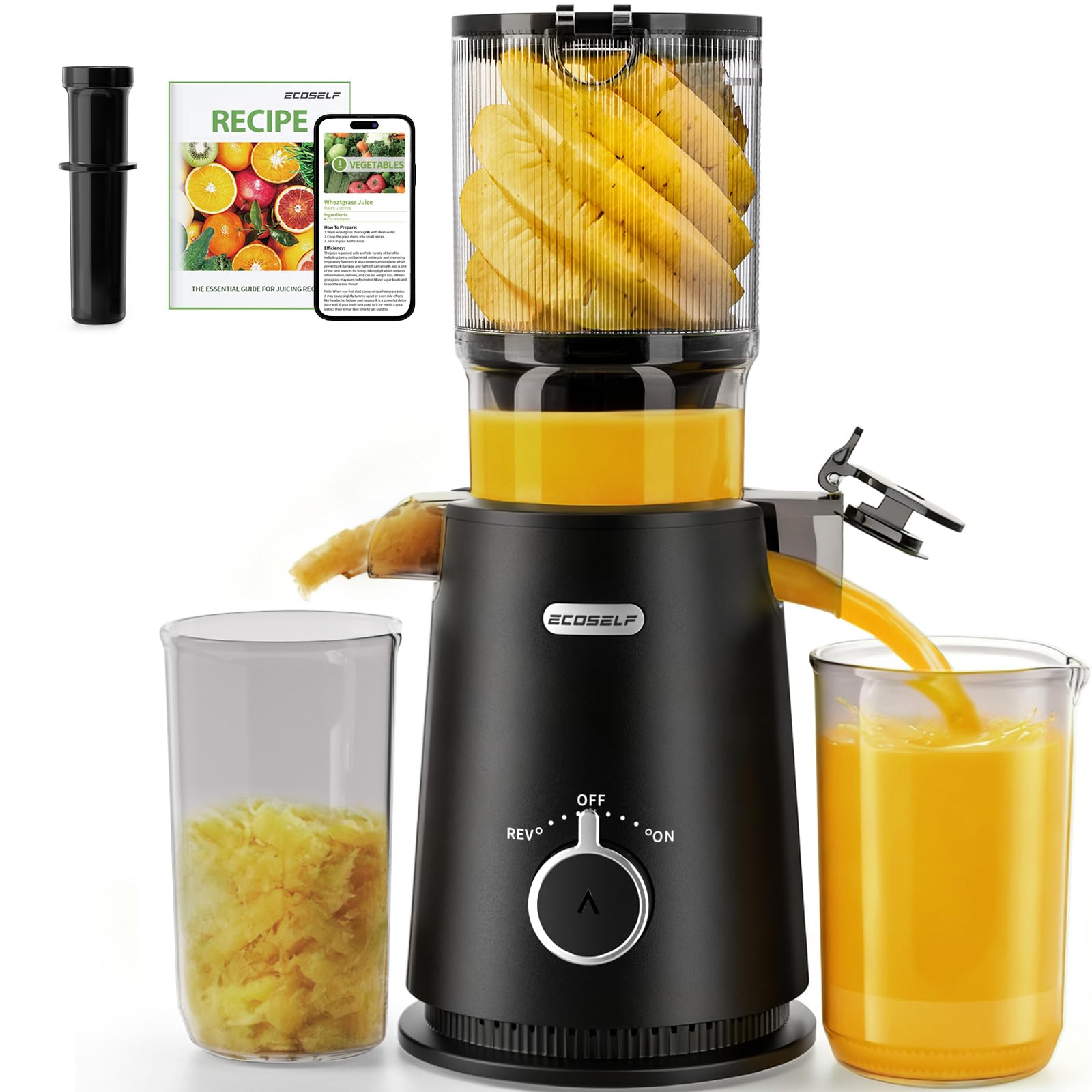
If your biggest barrier to juicing is “I don’t want to stand there babysitting it,” this is the style you should look at. A self-feeding chute changes the experience: you load, it pulls ingredients in, and you can do something else while it works. In a small kitchen where you’re juggling breakfast, kids, or simply your own sanity, that’s a big deal.
Owners consistently highlight the same daily wins: whole-fruit convenience, strong yield (often described as “very dry pulp”), quiet-ish operation, and surprisingly easy cleanup for a cold press machine. That combination is exactly what makes a juicer feel like a habit tool rather than a weekend project.
Here’s the expert insight: self-feeding systems are only “hands-free” when you respect ingredient order. If you load a giant pile of leafy greens first, you’ll choke the auger. If you load a mix—juicy chunks first, then greens, then more juicy chunks—the machine behaves smoothly and feels almost automatic. Think of it like building a sandwich: structure matters.
Another underrated feature is the reverse function. People treat it like an emergency button, but it’s actually a maintenance tool. If you feel resistance or notice juice slowing, a quick reverse can clear the auger before a clog becomes a teardown. That’s one of the best “small kitchen” features because it prevents mess escalation.
One honest caveat: this isn’t a tiny, micro-sized juicer. It’s “compact” in the sense of a tidy footprint and straightforward design, but if you’re in a very tight apartment, measure your storage space. The payoff is workflow—this is the style that keeps people juicing because it reduces effort at the exact moment people quit.
Why daily juicers love it
- Hands-free feel – Self-feeding design reduces babysitting.
- Strong yield cues – Many users mention dry pulp and smooth juice.
- Reverse prevents drama – Fixes “almost clogged” situations quickly.
- Easy to assemble – A key habit feature for busy households.
Good to know
- Self-feeding still needs smart ingredient order—alternate textures for best results.
- It’s not the smallest physical machine on this list; measure your storage plan.
- Like most cold press designs, rinsing right away makes cleanup feel easy.
Ideal for: people who want a cold press routine with less babysitting—especially anyone who keeps quitting juicing because it feels like too much work.
9. LQZ Cold Press Juicer – The “Tiny Counter” Cold Press That Doesn’t Feel Fragile
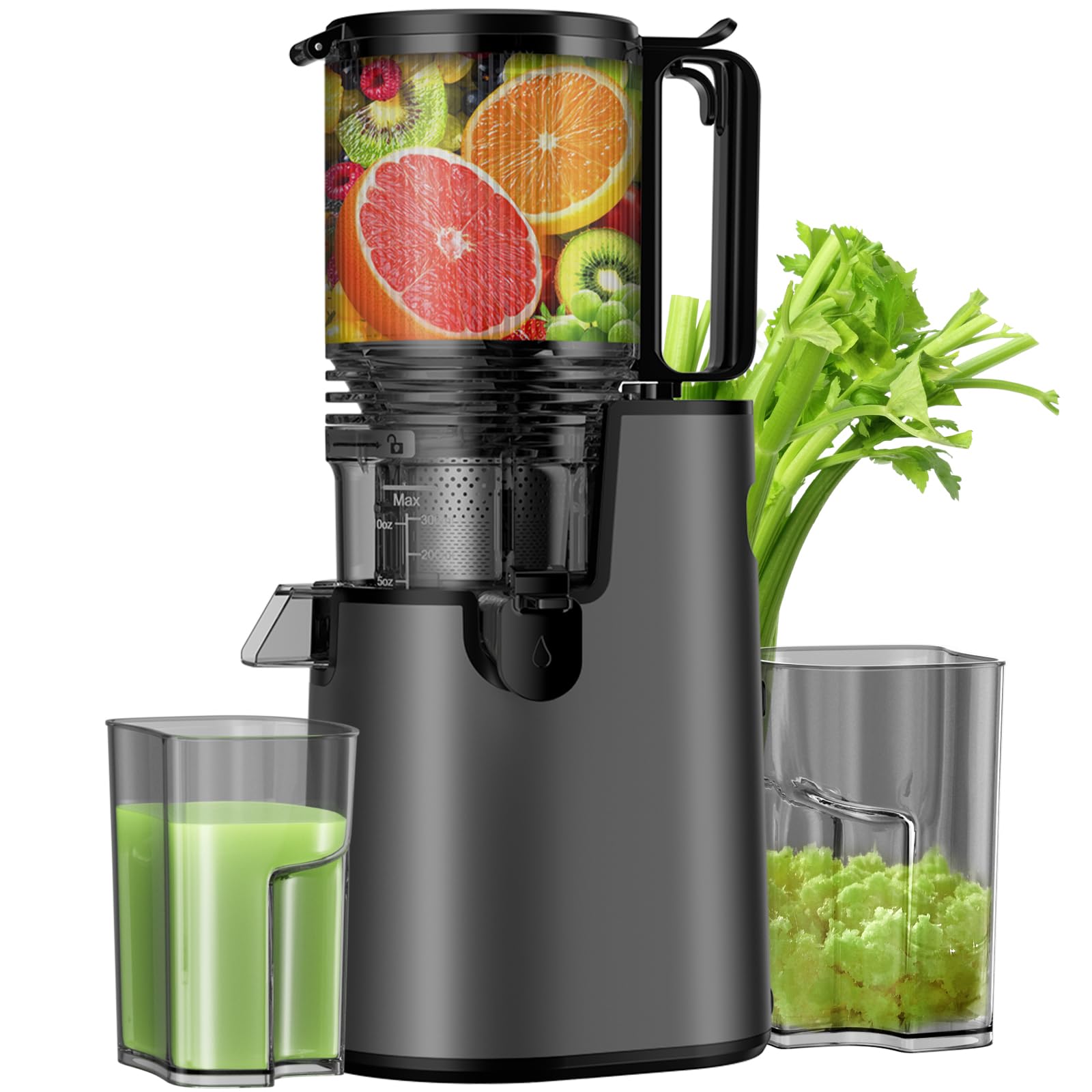
Some juicers are “compact” in marketing but still feel bulky in real kitchens. This one is the opposite: it’s designed for people who truly have limited counter space and want something they can store easily. That’s the entire point—and it’s why it deserves a spot on a small-kitchen shortlist.
Owners often describe it with the words you want to hear: quiet, easy to assemble, and good yield even with hard ingredients. That’s impressive for a smaller cold press unit, because hard produce is where compact machines can feel underpowered or slow. The secret is not magic—it’s the low-speed squeeze approach plus a feeding rhythm that doesn’t overwhelm the auger.
Here’s the “expert behavior” that makes this kind of machine feel premium:
- Cut fibrous produce shorter (celery, ginger, kale stems).
- Don’t overload the hopper—small machines like steady flow.
- Rinse quickly so the filter stays open and juice keeps flowing.
If you do that, you get the benefits people chase with cold press: less foam, smoother texture, and a calmer sound profile. And because the body is compact, it’s also easy to pull out for a quick “I just want one glass” moment without feeling like you’re committing your whole kitchen.
The honest con is the universal cold press complaint: cleaning can still feel like “a thing,” especially if you let pulp dry. Some owners love cleaning it; some hate cleaning any juicer ever. The best strategy is to treat cleanup like part of the process: fill a bowl with warm soapy water, drop parts in, rinse. Done.
If you’ve been avoiding cold press because you assume it’s big and complicated, this style can change your mind—because it fits the reality of small homes.
Why it’s a tiny-kitchen win
- Very compact body – Easy to store and doesn’t dominate the counter.
- Quiet-ish cold press vibe – More apartment-friendly than many fast spinners.
- Good yield for size – Strong performance when fed steadily.
- Beginner-friendly setup – Easy to assemble once you learn the lock alignment.
Good to know
- Cold press requires pacing—don’t treat it like a blender.
- Cleaning is easiest immediately after use; dried pulp is everyone’s enemy.
- For heavy green juice routines, use an “alternate ingredients” rhythm for best flow.
Ideal for: tiny counters, small apartments, and anyone who wants cold press benefits without a bulky appliance.
10. Magic Bullet Mini Juicer (MBJ10100) – Tiny, Fast, and Weirdly Addictive for Daily Use

This little machine has a personality: it’s small, it’s fast, it’s unapologetically “mini,” and people either love it immediately or buy it expecting a full-size juicer and get confused. So let’s set expectations properly: this is for small batches. One cup. Two cups. A quick daily juice. Not “juice for a family reunion.”
When it’s used as intended, it becomes the kind of appliance you actually keep on the counter because it doesn’t bully your space. Owners rave about how easy it is to set up and rinse, how much juice it produces for the size, and how dry the pulp can be when you feed it properly. Some also describe it as loud—think “tiny jet engine”—but the important part is that it’s loud for a short time. It finishes quickly.
Here’s the expert trick to get the best results from mini centrifugal machines:
- Pre-cut dense produce into smaller chunks (carrots, beets, big apples) so the machine doesn’t struggle.
- Use softer produce as “lubrication”—an orange chunk or cucumber slice between carrots reduces strain.
- Rinse immediately so the mesh stays clean and your next juice flows easily.
Now let’s talk about the “weird” thing that shows up in reviews: discoloration and staining. This isn’t unique to this model; it’s a reality of plastic parts meeting carrot and beet pigments. The good news is some stains fade after drying, and you can prevent most of it by rinsing fast. If you’re a perfectionist, consider dedicating this machine to lighter juices (apple, citrus, cucumber) and accept that carrots are a cosmetic commitment.
If you want a mini machine that’s so simple you’ll actually use it daily, this is one of the best “habit” choices on the list.
Why it’s a daily-driver
- Ultra small footprint – Great for tiny counters and easy storage.
- Fast results – Perfect for “one cup now” mornings.
- Easy cleanup – Quick rinse parts make it feel less like a chore.
- Great for beginners – Simple design, low intimidation factor.
Good to know
- It’s not built for big batches—small servings are where it shines.
- Can be loud; the trade is speed.
- Plastic parts may stain with carrot/beet-heavy routines—rinse quickly to reduce it.
Ideal for: one-person households, tiny counters, and anyone who wants quick, fresh juice without committing to a full-size appliance routine.
11. Magic Bullet Mini Juicer with Cup – Fewer Dishes, Faster Mornings, Less Excuse-Making

This is the same “mini juicer” concept, but the bundle focus changes the whole user experience: you juice directly into a cup, twist on a lid, and you’re out the door. That matters because “extra dishes” is one of the top reasons people stop juicing.
The best mini appliances are the ones that remove steps. This version removes a step. And in a small kitchen, reducing steps is basically a superpower. The core benefits are the same as the other mini model: compact footprint, quick operation, and a learning curve that’s measured in minutes, not days.
If you’re new to juicing, this “cup workflow” is especially friendly because it makes the process feel clean and contained. You’re not pouring from a pitcher, wiping a drip trail, and juggling a second container. You juice, cap, rinse, done. That simplicity is why owners describe it as “convenient” and “easy to clean” even when it’s used frequently.
The performance expectations should be the same: great for fruit, great for softer veggies, and surprisingly capable with carrots and ginger when cut appropriately. Leafy greens are possible, but mini centrifugal machines generally do better when greens are part of a blend rather than the main ingredient. If you want “pure green juice,” pick a cold press option higher up the list.
As with the other mini model, be realistic about noise and staining. It can sound powerful because it is powerful for its size. And pigments can stain plastic if you leave them sitting. But for the person who wants a quick daily cup and a rinse, this can be a “perfect habit machine.”
Why it’s so easy to keep using
- Juice directly into the cup – Less mess and fewer dishes.
- Portable routine – Great for commuters and busy mornings.
- Small but capable – Strong output for the footprint.
- Quick cleanup – The “rinse and go” vibe is real.
Good to know
- Still a mini machine—best for small batches, not big prep sessions.
- Noise can be noticeable; the upside is speed.
- Rinse quickly to minimize staining and keep the filter flowing well.
Ideal for: anyone who wants fresh juice with minimal dishes—especially commuters, students, and “I need this to be effortless” buyers.
12. HOUSNAT Centrifugal Juicer – Fast, Flexible, and Surprisingly Solid for the Routine Builder

HOUSNAT is one of those “quietly practical” picks that makes sense for people who want speed but also want control. The reason speed control matters in real life is simple: soft produce behaves differently than hard produce. A one-speed machine can still be great, but a multi-speed option lets you reduce foam on softer items and push harder items with more force.
Owners often describe it as efficient and easy to clean, with dry pulp that signals decent extraction. That’s what you want in any centrifugal juicer: fast output without leaving half your produce in the pulp bin. People also mention it’s good for meal prep and daily routines, which usually means it fits into real life without demanding too much fuss.
Now the honest part: centrifugal juicers can be loud. Some users describe units like this as “loud like a lawn mower,” especially with hard produce. That’s not a dealbreaker if you juice at reasonable hours, but it’s something to know. The upside is that the machine finishes quickly—so you get a short burst of noise rather than a long session.
For small kitchens, HOUSNAT’s value is the “do the job fast” factor. If you’re the type who will avoid juicing if it takes too long, this style keeps the barrier low. And if you’re the type who wants to experiment—soft fruits one day, harder veggie blends the next—the speed control helps you dial in the texture you like.
Expert tip: if you care about the smoothest glass, pour slowly and let foam settle. Centrifugal machines can introduce foam, but you can reduce how much foam ends up in your glass by pausing a few seconds before pouring and using the foam separation features when included. Also, rinse the strainer immediately—especially if you juice leafy greens or anything that clogs the mesh.
Why it’s a strong “fast juicer” pick
- Speed flexibility – Better control for soft vs hard produce.
- Fast output – Great for busy routines and quick daily cups.
- Good extraction for the category – Dry pulp feedback suggests solid yield.
- Easy to learn – Simple operation encourages frequent use.
Good to know
- Noise can be noticeable, especially with hard produce.
- Mesh strainers need quick rinsing to stay easy to clean.
- Leafy greens are usually better in cold press machines, though blends work fine.
Ideal for: people who want fast juice with a bit more control than one-speed machines, and who don’t mind a short burst of noise for quick results.
13. QCen 500W Centrifugal Juicer – The “Start Juicing Without Overthinking It” Choice

QCen is a “get the job done” centrifugal juicer that shows up in real kitchens because it’s approachable. People buy it because they want to try juicing without spending months researching, and they want something that feels simple to use and simple to clean. For that audience, it delivers.
One of the most common positive experiences is exactly what you want: fast juicing, smooth output, and parts that come apart easily for cleanup. Owners often describe it as stable on the counter and surprisingly effective for the price category. It’s also a very common “replacement buy” for people whose expensive machine died and who don’t want to invest heavily again right now.
Now for the honest friction point that shows up with many centrifugal machines (including this style): splatter and “ingredients jumping.” This happens when produce hits a spinning disc and there’s nothing holding it down. The fix is simple and practically free: keep the pusher ready, cover the chute quickly after dropping pieces in, and you can even place a small towel over the top during heavy juicing. It’s not elegant, but it works.
This juicer is happiest with apples, carrots, citrus, cucumber, pineapple, and most “normal” kitchen produce. If you’re trying to juice mainly leafy greens, you’ll likely prefer cold press. But if you’re doing everyday mixes and you want speed, this is a very practical entry point.
Expert tip: insert a compostable bag or liner into the pulp container (if it fits your setup) before you start. It makes cleanup faster and keeps the pulp bin from turning into a sticky mess. This single habit is one of the most underrated ways to make juicing sustainable.
Why it’s a great starter
- Simple and fast – Great for building the habit without complexity.
- Easy to clean – Parts detach easily, which matters for beginners.
- Good everyday performance – Works well on common fruits and veggies.
- Budget-friendly confidence – Many users are pleasantly surprised by how well it performs.
Good to know
- Some splatter can occur if the chute isn’t covered quickly—use the pusher and a towel trick.
- Centrifugal machines can be noisier than cold press options.
- Leafy greens are usually better handled by masticating/cold press machines.
Ideal for: beginners who want fast, straightforward juicing without spending big—especially for fruit and classic veggie blends.
14. GDOR 800W Juicer – A Quick, Family-Friendly Spinner with “Less Foam” Intentions

GDOR is a classic “family-friendly” centrifugal juicer: simple to operate, quick output, and built around the idea that you don’t want a complicated appliance when you’re just trying to drink more fruit and veggie juice. The built-in foam separation pitcher is a smart touch because foam is the #1 complaint new juicers have with fast spin machines.
Owner feedback tends to be enthusiastic about ease of use and ease of cleaning, with a lot of “great value” energy. That’s a sign the product meets expectations: it doesn’t pretend to be a luxury machine, it tries to be easy. And in small kitchens, easy usually wins.
One consistent “good to know” note shows up with this style: the chute can be short, and if you drop produce in without covering it quickly, pulp or juice can jump. That sounds dramatic, but it’s incredibly common with centrifugal designs. The fix is simple: keep the pusher at the top of the chute, feed steadily, and cover the opening quickly after each drop. After two uses, it becomes automatic.
What this machine does well is exactly what many households need: apples and carrots for classic juice, citrus for bright flavor, cucumber for volume, and spinach blended into fruit juices for nutrition. If you’re trying to do pure leafy green juice, cold press is usually your best bet. But for normal “we want juice” life, this is a practical tool.
Expert tip: if you want noticeably less foam, reduce speed for softer produce and don’t overstuff the chute. Foam is partly air, and air increases when produce is smashed too aggressively or when the basket is partially clogged. A quick rinse between batches can also keep foam down by keeping the mesh open.
Why it’s a solid value
- Fast results – Great for busy households and quick routines.
- Foam separator helps – Makes the “centrifugal foam” issue less annoying.
- Easy to operate – Simple controls are beginner-friendly.
- Easy to clean – Owners often highlight quick cleanup as a major win.
Good to know
- Shorter chutes can fling pulp if not covered quickly—use the pusher technique.
- Noise is typical for fast spinners; it’s quick, not quiet.
- For heavy greens-only routines, cold press usually makes smoother juice.
Ideal for: families who want fast juice with less foam frustration and a simple, repeatable workflow.
15. BLACK+DECKER CJ625 Citrus Juicer – The Smallest, Simplest Way to Upgrade Your Citrus Life

If your juice life is mostly citrus—orange juice, grapefruit, lemons for recipes, limes for drinks—this is the compact move that makes the most sense. Citrus juicers don’t pretend to do everything. They do one job, and they do it with the least mess and the least cleanup. In a small kitchen, that’s gold.
Owners love this style for three reasons: it’s easy to use, easy to clean, and it’s gentle on hands compared to manual squeezing. If you’ve ever tried to squeeze a pile of lemons and felt your wrists protest, you understand the appeal immediately. The adjustable pulp control is also more useful than it sounds: it’s not just “pulp preference,” it’s texture control for recipes and drinks.
The “small kitchen” advantage is huge: it stores easily, rinses quickly, and doesn’t create pulp mess everywhere. Because you’re not dealing with fibrous produce, you’re not scrubbing micro-mesh baskets or unclogging augers. This is the cleanest juicing experience you can buy.
The honest cons are also simple: it can be a bit noisy (many citrus reamers are), and it’s plastic—so treat it with care. If you’re rough with it, you can break pieces. If you treat it like a normal kitchen appliance, it lasts for years for many households.
Expert tip: for maximum juice extraction, press steadily rather than aggressively. Aggressive pressure can make the reamer struggle and can stress the parts. Steady pressure extracts well and keeps everything calmer.
Why it’s a tiny-kitchen hero
- Smallest footprint on the list – Easy to store, easy to leave out.
- Fast, simple cleanup – No fibrous pulp, no complex strainers.
- Adjustable pulp control – Makes it more useful for different recipes.
- Hand-friendly – Great for anyone who struggles with manual squeezing.
Good to know
- It only does citrus—no apples, carrots, or greens.
- Noise is normal for electric reamers; it’s short and manageable.
- Plastic components last longer with gentle use and careful storage.
Ideal for: citrus lovers who want the easiest possible juicing habit in the smallest possible package.
16. Elite Gourmet EJX600 Mini Slow Juicer – Cold Press for One (Dorm/RV/Minimal Counter)
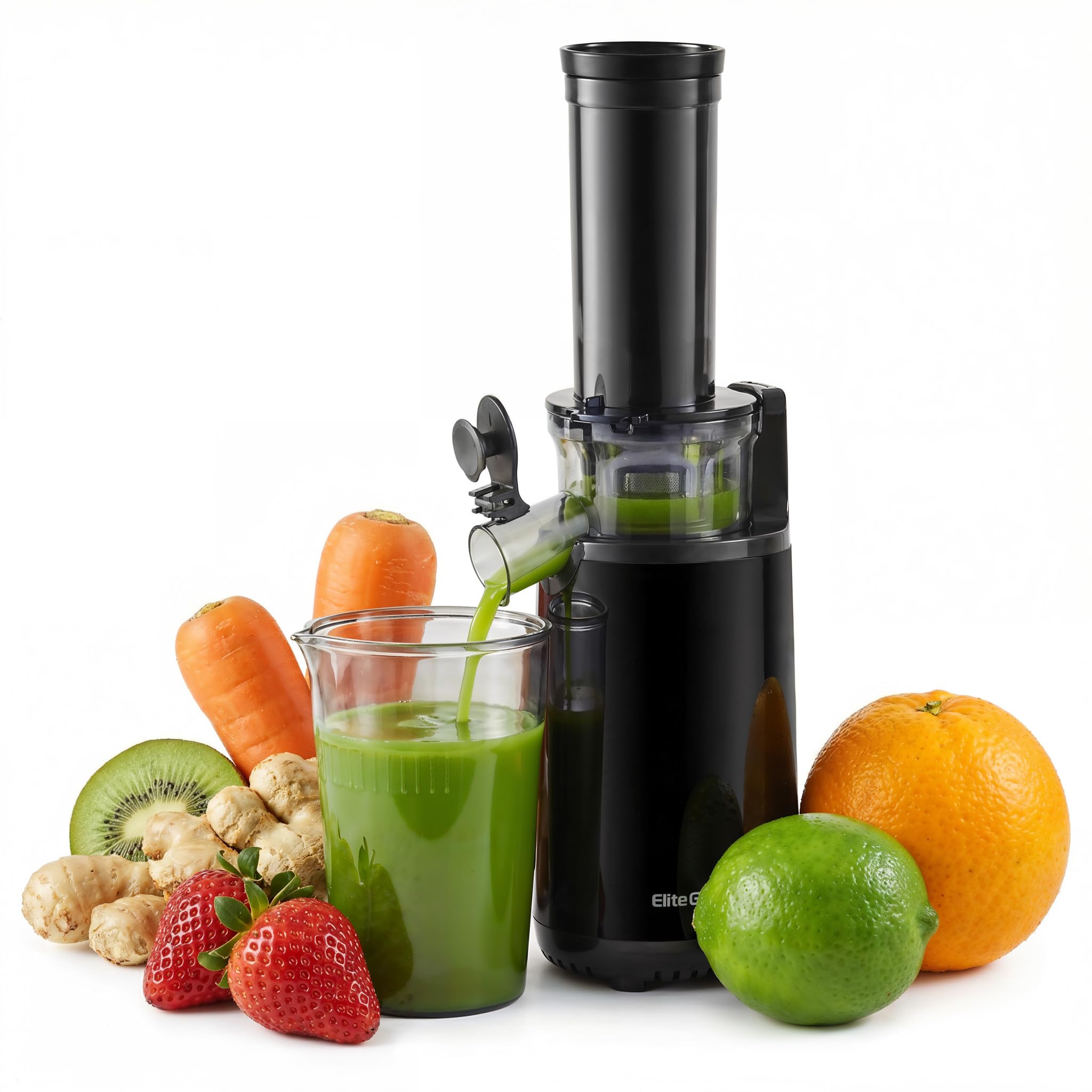
This is the smallest “real cold press” experience in the list—and it’s perfect for a very specific person: someone who juices for one, has limited storage, and wants something they can actually keep without sacrificing their kitchen. Dorms, RVs, tiny apartments, minimalist counters—this is your lane.
The key here is expectation management. This is a mini cold press machine with a small feed chute. That means you’ll prep more. You’ll cut ingredients smaller. And you’ll feed it patiently. If you do those things, it rewards you with smooth juice and a calmer sound profile than many fast spinners. If you try to shove huge chunks in quickly, you’ll clog it and hate it.
Real buyers often describe a tiny learning curve where they initially press too hard and cause clogs—then they learn to let the machine work slowly. That’s the cold press mindset: steady pressure, not force. Once you get it, the machine feels easy. People also love how little space it takes and how simple it is to clean, because fewer parts usually means fewer problems.
One honest disappointment that shows up in owner experiences: juice separation still happens. Cold press often reduces foam compared to centrifugal, but it doesn’t magically stop all separation—especially with certain ingredients. If you want perfectly consistent bottled juice for days, you’re chasing a myth more than a machine. For single-serve, drink-now life, it’s great.
Expert tip: for fibrous ingredients like pineapple core or celery, cut into short pieces and mix with softer ingredients. Also, rinse the filter and auger immediately after use. Small machines stay easy when you don’t let pulp dry and harden.
Why minimalists love it
- True micro footprint – Fits in spaces full-size juicers never will.
- Cold press texture – Smooth juice with less foam than typical fast spinners.
- Easy to clean – Fewer parts makes cleanup feel manageable.
- Great for one or two servings – Perfect for daily single-serve routines.
Good to know
- Small chute means more prep; this is the trade for micro size.
- Needs patient feeding—forcing produce causes clogs.
- Juice can still separate; it’s normal, especially if stored.
Ideal for: solo juicers, tiny kitchens, dorm/RV life, and anyone who wants cold press benefits in the smallest possible format.
How Juicers Actually Work (and Why Small Machines Need Different Tactics)
Once you understand the mechanics, you stop blaming the machine for problems that are actually technique—and you get better juice from any model. Small machines are not “weaker.” They’re just less forgiving when you feed them like a full-size commercial unit.
Fast spin vs slow press: what’s really happening
- Centrifugal (fast spin): A spinning disc shreds produce and flings juice through a mesh filter using centrifugal force. It’s fast and satisfying, but it can introduce foam (air) and it can be louder. If the mesh clogs, juice flow slows and foam increases.
- Cold press (masticating): An auger crushes and presses produce slowly, pushing juice through a filter. It tends to create less foam and can handle greens better, but it’s more sensitive to “ropey” fibers like celery and kale stems.
- Citrus reaming: A cone presses juice out of citrus halves. No fibers, no mesh basket drama, and the easiest cleanup—just limited to citrus.
Small machines amplify these realities: a small mesh basket clogs faster if you ignore rinsing, and a small auger will jam faster if you feed long fibers too aggressively. The fix is technique, not panic.
The 7 tactics that make any compact juicer feel “high-end”
- Rinse the filter immediately – The number one secret to “easy to clean” is not letting pulp dry.
- Cut dense produce smaller – Beets, ginger knobs, thick carrots: smaller pieces protect motors and improve yield.
- Alternate textures – Especially in cold press: juicy → fibrous → juicy prevents clogs and improves extraction.
- Don’t overpack – Compact machines like steady flow, not pressure-stuffing.
- Use reverse early – Reverse isn’t for disaster; it’s for prevention when you sense resistance.
- Control foam with patience – Let juice settle a few seconds, pour slowly, use foam separators if included.
- Clean seals gently – Gaskets and silicone parts last longer when rinsed well and not attacked with harsh tools.
Do these, and even a compact machine can produce dry pulp, smooth juice, and a routine you actually want to repeat.
FAQ: Compact Juicers (The Stuff People Wish They Knew Earlier)
What’s the best type for a small kitchen: cold press or centrifugal?
Why does my juicer clog on celery and greens?
How do I get “drier pulp” and better yield?
Is it normal for juice to separate when stored?
What’s the fastest way to clean a compact juicer?
Should I buy a 3-in-1 juicer for nut milk and sorbet?
Final Thoughts: Choose Your Small Juice Machine Based on Your Real Life
The “best” juicer is the one that fits your counter and your habits so well that you don’t talk yourself out of using it. That’s the whole game.
Here’s the quickest path to a confident buy:
- Want the most balanced daily cold press pick? Start with the AMZCHEF Cold Press Juicer. It’s the best “small kitchen + real routine” blend of convenience, yield, and cleanup sanity.
- Want fast juice in minutes (and you drink it right away)? Go with the Breville Juice Fountain Plus JE98XL. It’s the “speed makes the habit” choice—especially for fruit-forward and classic blends.
- Want a big hopper for family-style batches without constant feeding? Pick the TUUMIIST 3‑in‑1 Cold Press. It’s built for volume and convenience, which matters when you’re fueling more than one person.
- Want 3‑in‑1 versatility (juice + nut milk + sorbet) and easy cleanup? Choose either EanOruus finish: Premium Gray or Bright White, depending on what you’ll actually enjoy seeing on your counter.
- Need Breville quality in a more compact fast-spin footprint? The Breville Juice Fountain Compact is a premium “small but serious” speed pick.
- Want a true tiny daily cup routine? The Magic Bullet Mini Juicer (or the Mini Juicer with Cup) is the easiest way to make juicing feel effortless in a tiny kitchen.
- Only want citrus (and want the smallest cleanup)? The BLACK+DECKER CJ625 is the simplest upgrade you can make for orange juice, lemons, and limes.
- Need the tiniest cold press option for one-person life? The Elite Gourmet EJX600 is built for minimal counters and single-serve routines—just remember it loves patient feeding and smaller cuts.
The best purchase is the one you’ll still enjoy when you’re tired, hungry, and not in the mood to “deal with an appliance.” Pick the small juice machine that matches how you actually live—fast cup or slow press, single serve or family batch—and your juicer stops being a gadget and becomes a habit.
