
A food scale looks like the simplest tool in your kitchen… right up until you rely on one every day. Then you discover the parts that separate “works fine” from “why is this making me cranky at 7 a.m.”: the auto‑off timer that cuts out mid‑recipe, the bowl that blocks the display, the touch buttons that don’t register when your hands are dusty with flour, and the readings that lag just long enough to make you overshoot your target.
If you’re here because you want a best rated food scale, you’re not just shopping for a gadget. You’re buying consistency: dough that hydrates the same way every time, coffee that tastes repeatable, meal prep that actually matches your goals, and portions that don’t quietly creep bigger week after week.
Most buying guides stop at “capacity, units, and tare.” That’s not enough. Real value lives in the friction points: how quickly the scale stabilizes when you pour, whether it remembers your favorite unit, whether it stays on long enough to build a full recipe, how easy it is to wipe clean after raw meat or sticky syrup, and whether the platform shape works with the bowls you already own.
In this guide, I’m going deep on use patterns—baking, meal prep, coffee, nutrition tracking, and high‑volume prep— and pairing them to 16 standout scales (including smart nutrition models, plug‑in workhorses, and commercial units). You’ll get crisp recommendations, but you’ll also get the “why” so you can choose with confidence and stop shopping.
How to Choose the Best Rated Food Scale for Real Kitchens
A scale can be “technically accurate” and still be the wrong purchase for your life. The right one feels calm: it turns on fast, tares instantly, stays awake long enough to finish your recipe, and gives you a reading you trust without making you do a weird dance around the display. Here’s the decision framework I use to match a scale to the way you cook.
1. Start with your main job: baking, meal prep, coffee, or bulk prep
Different cooking styles punish scales in different ways. Identify your primary use first—then you can choose features that matter and ignore the ones that don’t.
- Baking (bread, sourdough, pastry): You want fast stabilization, a “bowl-friendly” display, reliable tare, and enough platform space for mixing bowls.
- Meal prep and portioning: You want quick reads, easy unit switching, and a timer that doesn’t shut off mid‑container swap.
- Nutrition tracking (macros/calories): You want clean data flow—either on-screen nutrition without fuss, or an app that makes logging painless.
- Coffee and micro-ingredients: You want fine resolution for small weights, plus a workflow that doesn’t reset when you blink.
- Bulk prep or small business: You want high capacity, durability, easy cleaning, and a platform that doesn’t flex or wobble under heavy loads.
2. Choose the “precision lane” you actually need
Precision is not one thing—it’s the combination of resolution (the smallest increment it displays), stability (how much it jumps), and repeatability (whether it reads the same when you repeat the same test).
- 1g resolution: Perfect for the majority of home cooking: flour, sugar, meat portions, meal prep, and most baking. The win here is stability and speed.
- 0.5g resolution: A sweet spot for more exact baking and coffee beans without going into ultra‑sensitive “draft and vibration” territory.
- Fine‑precision secondary platform: If you routinely weigh yeast, spices, or tiny add-ins, dual‑platform designs can replace having two separate scales.
If you’ve ever watched a scale dance between two numbers, that’s not automatically “bad”—it’s often the stabilization algorithm doing its job. What you want is a scale that settles quickly and doesn’t drift when you do simple real-life actions like nudging a bowl or adding a drizzle of oil.
3. Capacity isn’t about “how heavy” your food is—it’s about your bowl and your workflow
A high capacity sounds like a nice-to-have, until you put a heavy ceramic bowl on the scale, start adding ingredients, and suddenly you’re closer to the limit than you expected. Capacity also changes how a scale feels under load: some smaller scales are accurate but feel “springy” with heavy bowls, while sturdier models stay calm.
- 5 lb capacity: Great for portioning and everyday ingredients if you don’t use heavy bowls.
- 11 lb class: The practical sweet spot for home kitchens—heavy bowls, bulk flour, and meal prep containers without stress.
- 22 lb class: Ideal for bulk cooking, big batches, and anyone who hates “overload” errors.
- 66 lb commercial: Not for recipes—this is for production: dough balls, large meat portions, and business workflows.
4. Display ergonomics: the “bowl shadow” problem is real
If you weigh into bowls (most of us do), the display needs to be readable while the bowl is on the scale. This is one of the biggest hidden separators between a scale you love and one you tolerate.
- Pull‑out displays: The best solution. You can use wide bowls and still see the number without lifting anything.
- Hold functions: Helpful when the bowl blocks the display—freeze the reading, then move the bowl and read it.
- Raised or angled screens: Better than flat, but still not as bowl-proof as a pull-out design.
5. Buttons, cleanup, and “kitchen reality” durability
Food scales live through flour storms, syrup drips, raw chicken moments, and the occasional splash from a rinsed measuring cup. The surface and buttons determine whether cleaning is effortless—or nerve‑wracking.
- Glass tops: Wipe clean beautifully and resist staining, but touch controls can be less satisfying with wet hands.
- Stainless platforms: Durable and forgiving, especially if the platform removes for washing.
- Sealed controls: A quiet luxury—less chance of crumbs and liquids sneaking into seams.
- Water resistance: A huge quality-of-life upgrade if you cook messy or wash down counters aggressively.
6. Power and timers: the hidden reason people replace scales
Auto‑off is meant to save batteries, but it also ruins flow if it’s too aggressive. The best scales either stay on longer, dim instead of shutting down immediately, or offer a hold/lock feature that keeps your number visible while you work.
- Battery scales: Most convenient, but timer behavior matters a lot.
- Rechargeable scales: Great if you hate swapping batteries, and often paired with smart features.
- Plug‑in capable scales: The “set it on the counter and rely on it” choice—especially for bakers.
7. Smart nutrition scales: choose the “logging style” that won’t burn you out
Nutrition scales can be incredible, but only if the workflow fits you. There are three common patterns:
- On-screen nutrition (minimal phone use): Great for people who want info at a glance without constantly grabbing a device.
- App-first tracking (reports and goals): Great if you like seeing trends by day/week/month and building targets over time.
- Offline code-based tracking: Great for privacy-minded cooks who want macro awareness without accounts and syncing.
Quick Comparison: 16 Best Rated Food Scale Picks
Use this table to spot the models that match your cooking style, then jump to the deep reviews for the “real life” details— like which ones handle big bowls, which ones stay on long enough to finish a recipe, and which ones make macro tracking actually doable.
On smaller screens, swipe or scroll sideways to see the full table.
| Model | Scale type | Standout strength | Best match | Amazon |
|---|---|---|---|---|
| OXO Good Grips 11‑lb Stainless Steel (Pull‑Out Display) | Everyday | Pull‑out display fixes bowl shadowing + sturdy, quick reads | Most home cooks who weigh into bowls | Amazon |
| My Weigh KD‑8000 | Baking | Plug‑in capable workhorse + big platform + baker‑friendly features | Sourdough and serious batch bakers | Amazon |
| Salter Heston Blumenthal Precision 1140A | Precision | Fast response + 0.5g increments + aquatronic liquid modes | People who want tighter measurements without complexity | Amazon |
| Cosori Smart Nutrition Scale (Rechargeable) | Smart nutrition | On‑screen nutrient info + app tracking + USB‑C charging | Macro tracking without daily friction | Amazon |
| Etekcity Smart Nutrition Scale (Nutritionix + VeSync) | Smart nutrition | Solid tracking ecosystem + stainless platform + 19 nutrient reporting | People who love data, trends, and goal setting | Amazon |
| KUAIVO Smart Nutrition Scale (TFT Display) | Smart nutrition | Full‑color screen makes nutrition visibility effortless | Meal preppers who want info on the scale, not just the phone | Amazon |
| Greater Goods Nourish (Offline Nutrition Codes) | Nutrition | No‑app tracking + label‑style display + cumulative totals | Privacy‑minded macro tracking and recipe building | Amazon |
| RENPHO Smart Nutrition Scale (App + Timer) | Smart nutrition | Macro tracking + barcode scanning + coffee timer workflow | People who track meals and also weigh coffee regularly | Amazon |
| KitchenAid KQ909 Dual Platform | Dual‑platform | Large + micro platform in one unit for spices/yeast and bulk ingredients | Bakers who want “two scales in one” | Amazon |
| Greater Goods 22‑lb High‑Capacity Scale | High capacity | Big capacity + hold + clean, minimal daily workflow | Bulk cooks, bread makers, and big‑container meal prep | Amazon |
| Etekcity 22‑lb Waterproof Rechargeable (IPX6) | Waterproof | IPX6 water resistance + USB‑C charging for messy kitchens | People who cook messy and clean aggressively | Amazon |
| Nicewell 22‑lb Glass Top (Black) | Value | Large platform + steady performance + simple controls | Everyday cooks who want big capacity without bulk | Amazon |
| OXO Everyday Glass Scale (11 lb) | Glass | Wipe‑clean glass top + clear display + simple unit switching | People who want easy cleanup and clean aesthetics | Amazon |
| OXO 5‑lb Scale (Pull‑Out Display) | Compact | Pull‑out display + great “timeout behavior” for real cooking | Small kitchens and light‑to‑medium daily weighing | Amazon |
| San Jamar Digital Food Scale (66 lb) | Commercial | Workhorse durability + sealed buttons + removable stainless plate | Restaurants, bakeries, and high‑volume prep | Amazon |
| CAMRY Price Computing Scale (66 lb) | Commercial | Dual LED display + pricing workflow + rechargeable battery | Farmers markets, deli counters, pop‑ups | Amazon |
In‑Depth Reviews: 16 Food Scales People Actually Love Using
Now we’ll go model by model. I’m going to talk like someone who actually cooks: how the workflow feels, where the annoyances hide, what the controls are like with messy hands, and which scale makes you think, “Oh… this is easier than I expected.”
1. OXO Good Grips 11‑Pound Stainless Steel (Pull‑Out Display) – The “Bowl‑Proof” Daily Driver

If you weigh into bowls (and most of us do), the pull‑out display is not a “nice feature.” It’s the feature that changes your entire relationship with your scale. Instead of lifting bowls to peek at the number—or guessing and hoping—you just pull the display forward and keep moving. That one design choice removes the most common daily frustration: bowl shadowing.
In daily use, this scale tends to feel calm and predictable. Turn it on, hit tare, add ingredient, read the number—done. That sounds basic, but it’s the difference between “I love weighing” and “I’ll just eyeball it.” The platform is sized well for plates and mixing bowls, and the stainless surface is practical for real kitchens because it doesn’t get precious about normal use. It’s also easier to keep looking clean, which matters if your scale lives on the counter.
What makes it a best‑overall choice is balance: enough capacity for serious cooking, enough clarity for quick portioning, and a workflow that stays friendly even when you’re rushing. If you only buy one scale for the next few years, this is a very safe, very satisfying decision.
Why you’ll like it
- Pull‑out display = no bowl shadowing – You can use wide bowls without losing visibility.
- Great everyday capacity – Handles meal prep containers and baking bowls without “overload anxiety.”
- Simple, fast workflow – Power, tare, weigh, repeat without fuss.
- Easy cleaning – The platform design supports quick wipe‑downs and regular kitchen messes.
Good to know
- Like most everyday kitchen scales, it’s not built to be washed like a dish—wipe clean is the move.
- If you regularly weigh ultra‑tiny spice amounts, you may want a secondary fine‑precision option.
- Stainless looks professional; if you prefer colorful décor, it’s more “tools” than “cute.”
Ideal for: home cooks and bakers who weigh into bowls and want a “no drama” scale that simply works day after day.
2. My Weigh KD‑8000 – The Plug‑In Workhorse Bakers Keep on the Counter

The KD‑8000 is the kind of scale that feels like equipment, not an accessory. It’s built for people who weigh often, and who get annoyed when consumer‑grade tools force them to slow down. The platform is generous, the display is big, and the whole unit has that “stable on the counter” presence that makes baking feel organized.
Where it really earns its keep is long sessions: scaling ingredients for bread, portioning dough, building recipes in batches, or doing prep where you’re repeatedly taring and adding. Many scales are accurate but impatient—this one is designed to support a workflow without making you fight it. The hold function is a practical win when you’re using large bowls, and the option to run on AC power (with an adapter) is the quiet luxury bakers fall in love with. No battery swapping. No mid‑recipe fade.
There’s also a “mess management” story here that people appreciate: protective covers help when you’re working around spills, powders, or sticky ingredients. It’s a small thing that adds up when you actually cook.
Why bakers swear by it
- Countertop stability – Feels steady with big bowls and repeated taring.
- Plug‑in capable – Excellent for people who weigh daily and hate battery management.
- Hold feature helps with big bowls – Freeze the reading when your container blocks the view.
- Protective cover options – Practical for flour, dough, spills, and sticky kitchens.
Good to know
- This is a larger footprint scale; great for counters, less ideal for tiny drawers.
- If you rely on the hinged cover, display readability can vary depending on angle and lighting.
- Auto‑off behavior exists for battery saving; learn the rhythm and it’s fine.
Ideal for: sourdough, bread, and batch bakers who want a durable scale that supports long prep sessions with fewer interruptions.
3. Salter Heston Blumenthal Precision 1140A – Fast, Confident Measuring for Baking + Coffee

If you want a scale that feels crisp—quick to turn on, quick to tare, and quick to settle on a number—this Salter is a standout. The 0.5 g increments hit a sweet spot: tighter than most everyday scales, but not so sensitive that every tiny vibration or air draft becomes a problem. For bakers, that can mean more confidence with salt, yeast, and small add‑ins. For coffee drinkers, it means a more repeatable scoop without turning your counter into a lab bench.
What makes this model especially pleasant is how it supports real recipe flow. The add‑and‑weigh approach lets you build ingredients in one bowl without doing mental math, and the display is designed to stay readable even with a mixing bowl on top. The stainless platform is hygienic and easy to wipe, which matters more than it sounds when you’re weighing sticky honey or wet ingredients.
The honest “expert note” here is durability: like many slim electronics, how you treat it matters. If you want a scale you can be rough with, there are sturdier tanks in this guide. But if you want speed, precision feel, and a smart everyday design, this is a really enjoyable tool.
Why it’s satisfying to use
- Fast on + fast tare – Great for multi‑ingredient baking.
- 0.5 g increments – More control for small ingredients without fussy sensitivity.
- Aquatronic liquid modes – Helpful when you’re weighing liquids with unit conversion built in.
- Readable display with bowls – Designed to reduce the “blocked screen” problem.
Good to know
- It’s a slim precision tool; gentle cleaning and storage habits keep it happy longer.
- Max capacity is solid for most homes, but bulk cooks may prefer a 22‑lb class model.
- If you want micro‑scale precision for ultra‑tiny doses, consider dual‑platform options.
Ideal for: home bakers and coffee lovers who want faster stabilization, tighter increments, and a premium-feeling daily experience.
4. Cosori Smart Nutrition Scale – The “I’ll Actually Track This” Macro Workflow
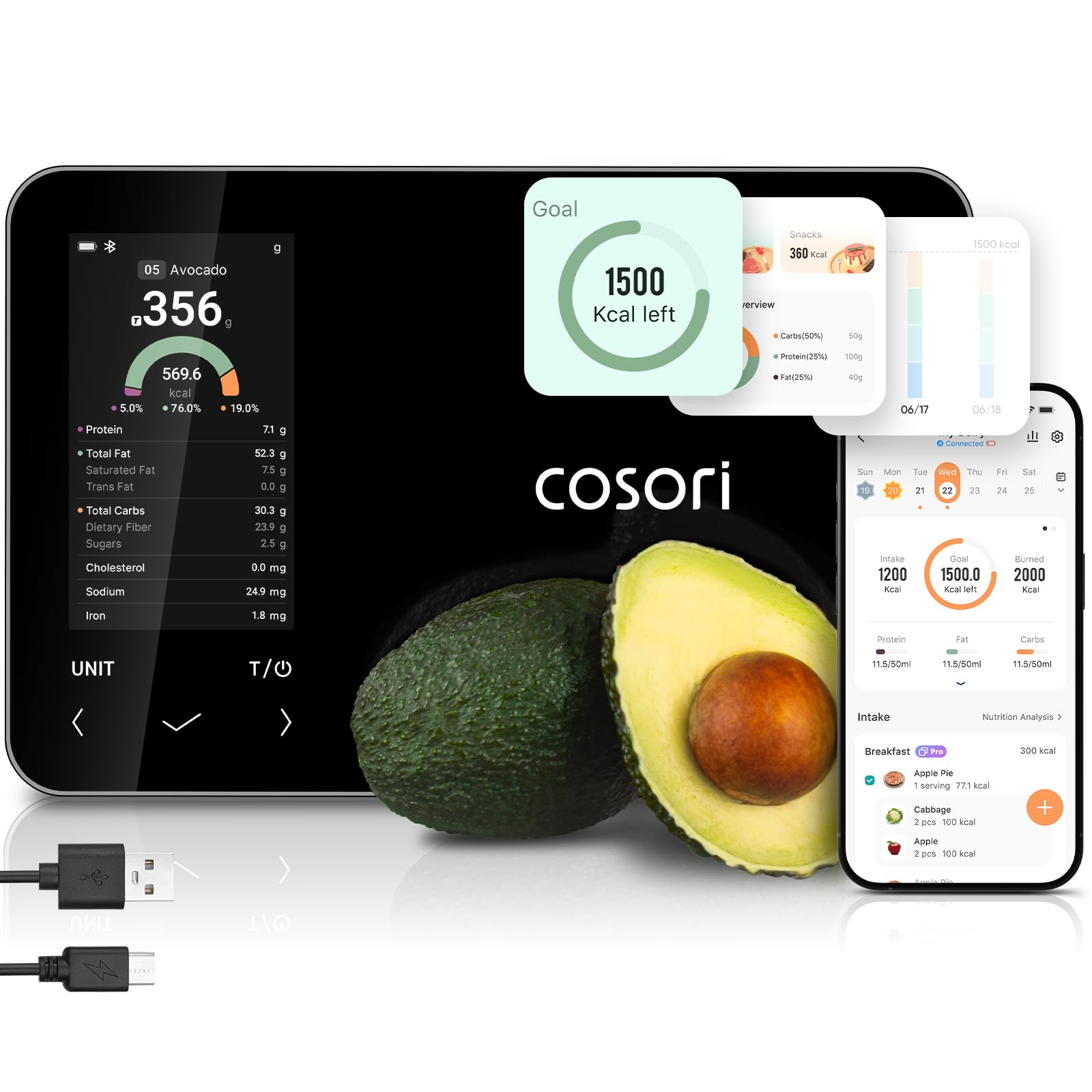
Smart nutrition scales win or lose on one thing: whether the “tracking process” feels easier than not tracking. Cosori’s approach is built around reducing friction—showing nutrition info clearly, offering multiple ways to identify foods (presets, barcode scanning, search, and AI scan via the app), and pairing it with goal tracking that can evolve over time.
Here’s the real-life value: it turns “I’ll start tracking tomorrow” into “I tracked without thinking.” That happens when the display is easy to read, the unit switching is quick, and the scale can keep up with normal meal prep tempo. The rechargeable battery is another daily win—because the moment batteries die mid‑week is the moment people stop logging.
A smart scale is also a relationship: you’re trusting a database and an app. Cosori’s strength is giving you multiple paths to get your food identified so you’re not stuck scrolling for ten minutes. If you’re new to nutrition scales, expect a learning curve on day one—then a much smoother experience once your common foods are saved and your habits are set.
Why it’s a tracking powerhouse
- On‑screen nutrient visibility – You can see key info fast without living on your phone.
- Multiple food input methods – Presets + scanning + searching reduces daily friction.
- USB‑C rechargeable – Great for people who hate battery swaps.
- Goal-oriented logging – Helpful if you want progress views by day/week/month.
Good to know
- Smart scales are only as smooth as your setup—plan a short “first week” learning phase.
- Very small amounts can be less satisfying for some nutrition workflows; weigh tiny ingredients slowly.
- If you want zero app dependence, offline code-based options may fit better.
Ideal for: meal preppers and fitness-focused cooks who want nutrition tracking that feels fast, modern, and repeatable.
5. Etekcity Smart Nutrition Scale – Clean Tracking With a Durable, No‑Nonsense Build

If you like the idea of nutrition tracking but you don’t want a fussy, fragile device, the Etekcity smart nutrition scale is a strong pick. The stainless platform is practical for daily cooking, the form factor is slim enough to store easily, and the “smart layer” is designed to surface useful nutrition data without demanding a complicated routine.
What this scale does well is reduce double-entry work. You weigh once, then the app helps translate that weight into meaningful nutrients so you can see patterns over time. This matters for real people because “tracking fatigue” is the #1 reason nutrition habits collapse. The smoother the logging, the more likely you keep doing it—especially when you’re tired and hungry.
It’s also a good choice for households where multiple people care about health goals (or just want a reality check on portions). Once you build a library of your repeat foods, tracking becomes much faster. And if you ever want to use it as a normal kitchen scale, it still behaves like one—simple units, tare, and quick reads.
Why it’s easy to live with
- Smart nutrition tracking – Turns weights into trends you can actually use.
- Durable stainless surface – More forgiving for everyday cooking messes.
- Clean, slim footprint – Stores easily and doesn’t dominate counter space.
- Good “regular scale” behavior – Works fine even when you’re not in tracking mode.
Good to know
- Barcode scanning availability depends on where you live; plan to search or enter foods when needed.
- Smart features require app setup; if you want offline-only, choose a code-based nutrition scale.
- As with all nutrition scales, accuracy of nutrition data depends on selecting the correct food entry.
Ideal for: people who want nutrition tracking support in a slim, durable scale that still feels like a normal kitchen tool.
6. KUAIVO Smart Nutrition Scale (TFT) – When You Want Macros Visible Without Phone Gymnastics

One of the biggest problems with nutrition tracking is attention. You weigh your food, then you look at your phone, then you get distracted, then your food gets cold. A scale with a strong on-device display solves that in a surprisingly powerful way. KUAIVO’s TFT screen is built for “glance tracking”—weight plus macro info readable without squinting or switching apps.
For meal prep, the workflow can feel almost satisfying: pick a food, weigh it, see calories/macros immediately, then keep building your container. That’s the behavior you want if your goal is consistency. And because it still operates like a normal kitchen scale (with tare and unit choices), it doesn’t punish you when you’re not in tracking mode.
The most important mindset with this scale is rhythm. Smart scales often have auto‑off behavior to protect battery life, which means you get the best experience when you set up your ingredients first, then weigh in sequence. Do that, and the device feels fast and helpful. Try to weigh in a stop‑and‑start way, and you may bump into timeouts.
Why it stands out
- TFT color screen – Fast nutrition visibility without always using your phone.
- Great for meal prep flow – Weigh, see macros, build the container, move on.
- Slim and counter-friendly – Doesn’t feel bulky in smaller kitchens.
- Tare works cleanly – Essential for multi‑ingredient bowls and containers.
Good to know
- Smart features are strongest with the companion app; plan for a short setup phase.
- Auto-off behavior means you’ll want a “prep then weigh” routine.
- Nutrition accuracy depends on choosing correct entries—always verify if you eat highly specific branded foods.
Ideal for: meal preppers who want macro feedback on the scale itself and don’t want to be glued to a phone while cooking.
7. Greater Goods Nourish – Macro Tracking Without Accounts, Syncing, or App Dependence

If smart nutrition scales feel like “too much,” the Nourish is the antidote. It’s designed for people who want macro awareness without signing up for accounts, syncing devices, or relying on cloud features. You use codes to select foods, and the display shows nutrition in a label-style layout that’s surprisingly intuitive once you learn it.
The real strength is recipe building. Because it totals nutrition as you add ingredients, you can assemble a dish and see the macro picture without leaving your counter. That’s powerful for anyone managing carbs, sodium, calories, or protein—especially if you cook from scratch. It’s also one of the more satisfying designs to clean because the glass surface wipes down easily and doesn’t trap grime in seams.
The trade-off is modern convenience. There’s no barcode scanning, and the preloaded food list won’t match every fresh ingredient perfectly. So the best users are the ones who don’t mind a little “nutrition bookkeeping”: using custom entries for frequent foods, and keeping your code list organized. If that sounds like you, this scale becomes a surprisingly capable daily companion.
Why it’s a unique winner
- No app required – Works offline and keeps things private.
- Label‑style nutrition display – Easy to read like packaged food labels.
- Cumulative totals – Great for building recipes and multi‑ingredient bowls.
- Sealed, wipe‑clean surface – Practical for daily kitchen mess.
Good to know
- Codes require a bit of organization; it’s not “scan and go.”
- Nutrition values may require rounding and manual handling for perfect precision.
- Food lists can feel limited for very specific modern products; custom codes help.
Ideal for: people who want nutrition awareness without app dependence and who like the idea of building recipes with cumulative nutrition totals.
8. RENPHO Smart Food Scale – Macro Logging Plus a Surprisingly Useful Coffee Workflow
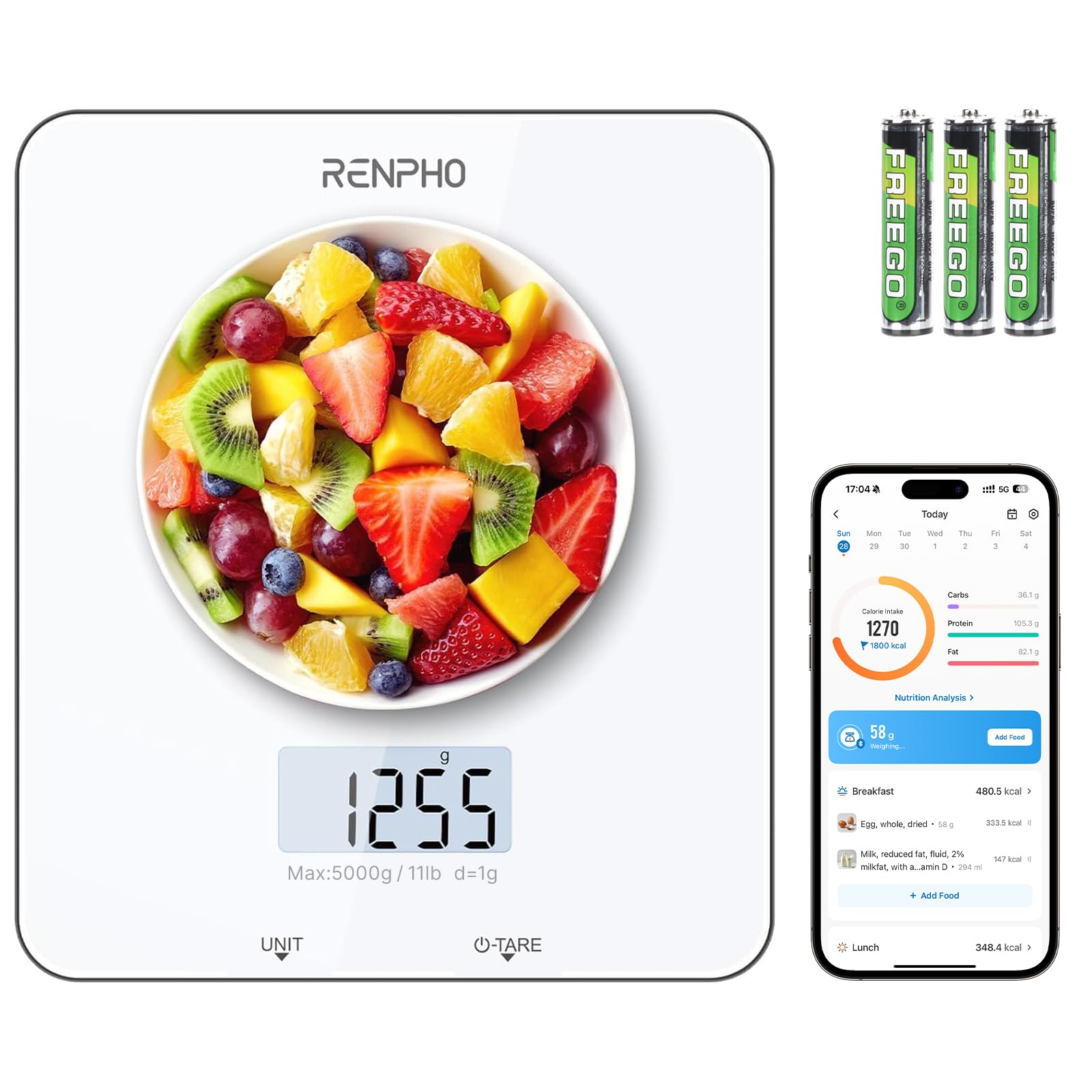
RENPHO is a strong “hybrid lifestyle” pick: it’s useful for macro tracking, but it also caters to the people who weigh coffee and care about ratios and timing. That matters because a scale that fits multiple daily habits gets used more. And the scale you use more is the one that actually changes outcomes.
In practice, the device feels compact and easy to store, but stable enough to rely on for regular meal prep. The tare function is clean, the display is readable, and the smart layer can reduce your logging time once you’ve set up common foods. For many people, that’s the real win: not perfect nutrition theory, but less friction between “I ate this” and “I logged this.”
The key decision here is comfort with accounts and syncing. Like many app-connected tools, you’ll get the best experience after you’ve paired, set goals, and saved your recurring foods. If you love data, you’ll enjoy it. If you hate setup, you may prefer a simpler offline nutrition model.
Why it’s popular
- Smart nutrition tracking – Helps translate weight into useful daily macro awareness.
- Coffee timer + ratio workflow – Great for pour-over and daily coffee habits.
- Compact storage – Easy for small kitchens and travel-friendly setups.
- Clear LCD readout – Practical in low light and early mornings.
Good to know
- Smart features shine after setup; the first week can feel “configure-heavy.”
- Some users prefer nutrition integration with common third‑party tracking apps; compatibility varies.
- Occasional error behavior can happen—power cycle fixes are a common quick solution.
Ideal for: people who track nutrition and regularly weigh coffee, and want one scale that supports both habits.
9. KitchenAid KQ909 Dual Platform – Big Batches + Tiny Ingredients in One Station

Dual-platform scales are one of the smartest concepts in home cooking: a big platform for flour and dough, and a micro platform for yeast, salt, and spices. If you’ve ever tried to measure “a gram of yeast” on a basic scale that refuses to move until you dump half the packet, you already understand why this matters.
KitchenAid’s execution is genuinely convenient when it’s working at its best. The two‑line readout lets you see both platforms without toggling, and physical buttons are a huge advantage when your hands are wet, dusty, or sticky. That “button confidence” sounds small, but it’s a daily win. For scratch bakers, the ability to weigh large and tiny ingredients in the same session can make your recipes more consistent with less effort.
The expert note: dual-platform scales ask more from sensors and design, and long-term feedback can be mixed depending on how hard the unit is used and how it’s cleaned. If you’re gentle with tools, you may love it. If your kitchen is messy and your cleaning style is aggressive, consider a more sealed or water-resistant design for longevity.
Why it’s clever
- Two platforms = two workflows – Bulk ingredients and micro ingredients in one station.
- Dual display – Less toggling, more cooking.
- Physical buttons – Better control with messy hands than pure touch panels.
- Great for baking consistency – Especially helpful for yeast, salt, and spice precision.
Good to know
- Not water resistant—avoid sprays and heavy liquid exposure during cleaning.
- Precision platform is best for small containers; wide bowls can feel awkward.
- If you want “one rugged tank,” a single-platform commercial-style scale may last longer.
Ideal for: bakers who want one station for both big-batch measuring and tiny ingredient precision, and who prefer physical buttons over touch controls.
10. Greater Goods 22‑lb High‑Capacity Scale – Minimalist, Bright, and Built for Big Bowls
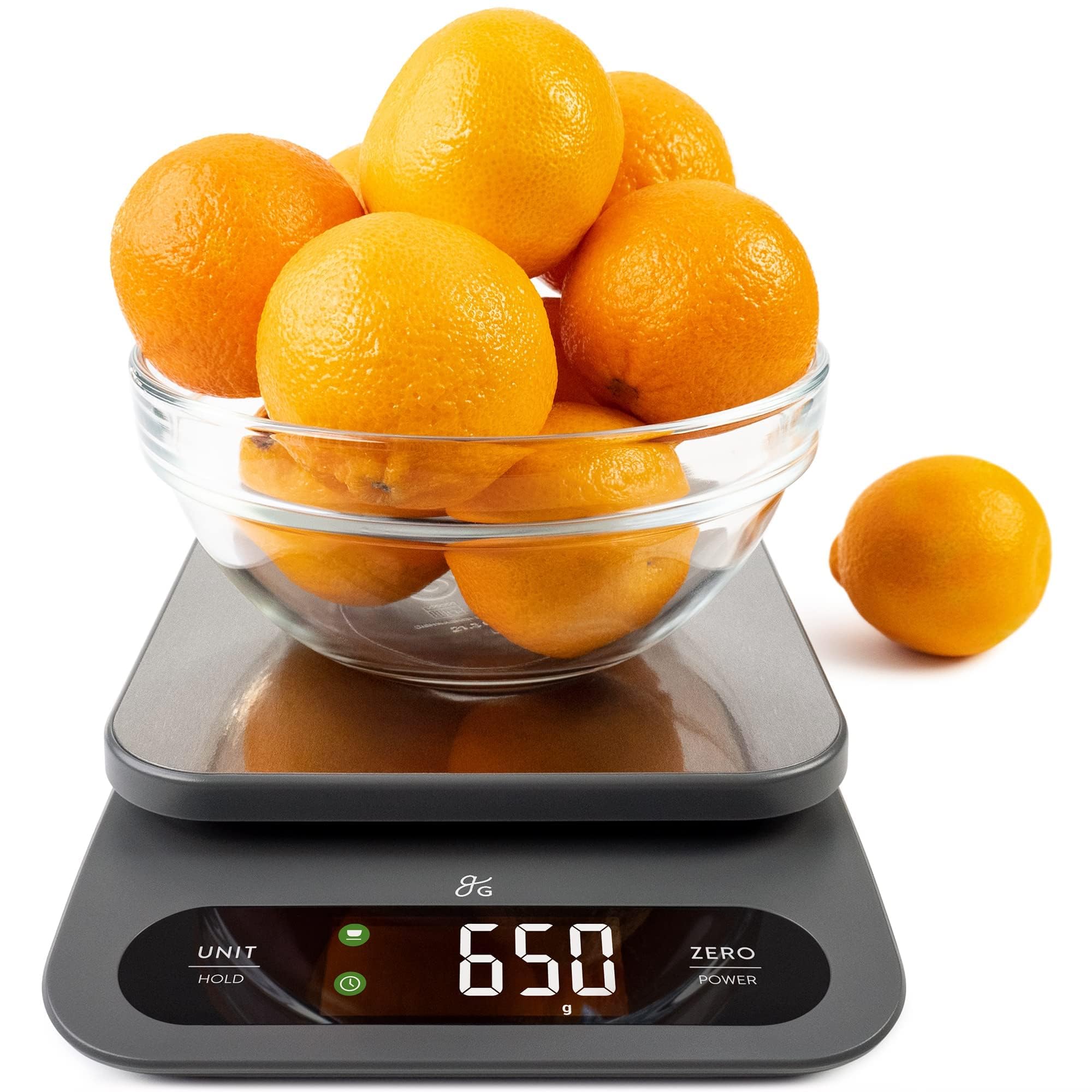
This Greater Goods model is a “quietly excellent” choice for the people who cook in big containers: meal prep bins, mixing bowls, stock pots (within reason), and bulk batches. The 22‑lb capacity changes your kitchen comfort level because you stop thinking about limits. You just cook.
Where it really shines is daily readability and workflow. The digits are high-contrast and easy to see, and the hold feature is a practical tool when your container blocks the screen. That’s a very real problem in big-bowl kitchens, and hold solves it without requiring a fancy pull-out display. It also tends to support a simple habit: keep it on the counter, use it several times a week, wipe it down, move on.
One subtle advantage in real life: unit memory. Scales that force you to reselect grams every time become annoying fast. When a scale remembers your default, it disappears into your routine—in the best possible way.
Why bulk cooks love it
- 22‑lb capacity – Comfortable with big bowls and meal prep containers.
- Hold function – Useful when containers block the display.
- Bright, clear readout – Easy to read from an angle and across the counter.
- Slim storage – High capacity without an oversized footprint.
Good to know
- Like many high-capacity scales, add liquids slowly near your target—some lag is normal.
- Touch-sensitive controls can be triggered by accidental brushes; learn where your hands rest.
- If you want full water resistance, choose an IPX-rated model.
Ideal for: bulk cooking, large-bowl baking, and meal prep households that want high capacity with clean, no-fuss daily usability.
11. Etekcity 22‑lb Waterproof Rechargeable (IPX6) – The “Wipe It Down and Move On” Scale

This is the scale you buy when you’re tired of babying kitchen electronics. Water resistance changes the vibe: you spill something, you wipe it, you keep cooking. That’s how a kitchen should feel. IPX6 doesn’t mean you should dunk it in a sink, but it does mean splashes and normal counter cleanup are less stressful.
The second daily win is rechargeable power. If you cook often, batteries always die at the worst time. A USB‑C rechargeable scale is a “small upgrade” that feels big after a few months. Pair that with high capacity, and you get a scale that fits both careful recipes and chaotic cooking—big bowls, heavy meal prep, and lots of taring.
This model is especially strong for households that cook proteins, sauces, and liquid-heavy meals. It supports the reality that food is wet, counters get wiped, and tools should survive normal life.
Why it’s a lifestyle upgrade
- IPX6 water resistance – Less stress from spills and wipe-down cleaning.
- USB‑C rechargeable – No battery swapping, easier long-term use.
- High capacity – Comfortable with bulk ingredients and heavy containers.
- Hold + tare workflow – Helpful for big bowls and multi‑ingredient recipes.
Good to know
- Water resistance depends on keeping the charging port cover sealed during cleaning.
- If you weigh ultra‑tiny spice amounts, pour slowly—high-capacity sensors can stabilize slightly differently.
- Rechargeable tools work best when you build a simple habit (charge monthly, not “only when dead”).
Ideal for: busy kitchens, messy cooks, and anyone who wants a high-capacity scale that’s easier to clean and easier to keep powered.
12. Nicewell 22‑lb Glass Top – Simple, Sturdy, and Ready for Big Batches

Nicewell scales show up in a lot of real kitchens for one reason: they do the core job well. Big platform, clear display, straightforward units, reliable tare. This is the kind of scale that quietly improves your cooking because you stop measuring flour with cups and start measuring by weight without effort.
The large platform matters more than people expect. It helps with wide bowls, plates, and meal prep containers, and it reduces the “container balance” problem where small scales feel tippy with big dishes. The tempered glass surface also makes cleanup easier than porous plastic—wipe, done.
The primary caution is touch controls. If you’re the kind of cook who rests a hand on the counter near the buttons, you can accidentally trigger tare. That’s not a dealbreaker—just a “learn the placement” thing. Once you develop the muscle memory, it becomes a steady, dependable daily tool.
Why it’s a strong pick
- Large platform + high capacity – Great for meal prep and big-bowl baking.
- Easy tare workflow – Smooth multi-ingredient measuring.
- Wipe-clean surface – Glass top cleans up quickly.
- Clear display – Easy readout for daily cooking.
Good to know
- Touch controls can be sensitive; avoid brushing the button area mid‑weigh.
- Cosmetic scratches can happen over time—normal for daily use tools.
- As with most glass scales, avoid heavy impacts and store flat when possible.
Ideal for: home cooks who want a big, practical scale for daily use, especially meal prep and baking, without overcomplicating the purchase.
13. OXO Everyday Glass Scale (11 lb) – Clean Aesthetics, Clean Surface, Clean Workflow

If you want a scale that looks good on the counter and wipes clean with almost no effort, this OXO glass model is a great fit. Glass tops shine in real kitchens because they resist stains and don’t hold odors. If you’ve ever weighed garlic, fish, or strong spices and worried about “scale smell,” you’ll appreciate that.
Functionally, it does what you want: clear numbers, easy unit conversion, and a simple tare process so you can build ingredients in one bowl. It’s also slim enough to store easily, which matters if your counter is already crowded. The experience is straightforward and calm—no weird menus, no complicated features, just consistent weighing.
The main tradeoff is touch controls. Some people love the smooth surface; some people miss the certainty of physical buttons. If you typically cook with wet hands and want a “click,” choose a physical-button model. If you value wipe-clean convenience and a sleek look, this scale fits beautifully.
Why it’s easy to own
- Glass platform wipes clean – Great for sticky and messy ingredients.
- Large readable numbers – Easy viewing during cooking flow.
- Simple unit conversion – Helpful if you switch between baking and portioning.
- Slim storage – Doesn’t demand a lot of kitchen real estate.
Good to know
- Touch controls can feel less “certain” than physical buttons for some users.
- Power and tare can share controls; learn the press timing and it’s smooth.
- Not water resistant—wipe clean rather than spray-clean.
Ideal for: cooks who prioritize easy cleanup and sleek design and want a dependable everyday scale without “extra” complexity.
14. OXO 5‑lb Scale (Pull‑Out Display) – Small Kitchen Hero With Surprisingly Great “Stay‑On” Behavior

This is the scale for people who want the bowl-friendly pull‑out display experience, but don’t need full 11‑lb capacity. It’s excellent for portioning, everyday ingredients, and smaller bowl work—and it’s especially good in tight kitchens because it stores easily.
The underrated win is timer behavior. Instead of aggressively shutting off and wiping your reading, this style of scale tends to support real cooking pauses better: the display can dim, then return quickly, which feels much more forgiving when you step away to stir a pot or grab another ingredient. That little “patience” is exactly what makes a scale feel premium in daily life.
It also includes thoughtful usability touches like an easy-to-read display, a pull‑out screen to prevent shadowing, and simple controls for tare and units. If you’re a light-to-medium scale user, this is one of those purchases that makes you wonder why all scales aren’t designed this way.
Why it’s so likable
- Pull‑out display – Solves the “big plate blocks the numbers” problem.
- Great for everyday portions – Ideal for meal prep and daily cooking in smaller quantities.
- More forgiving timeout behavior – Helps during real cooking pauses.
- Removable platform – Easier cleaning compared to fixed surfaces.
Good to know
- 5‑lb capacity is limiting for heavy bowls and very large batch baking.
- If you cook in big containers often, the 11‑lb pull‑out model is a better fit.
- For bulk liquids, pour slowly near your target—small-capacity scales can react fast.
Ideal for: small kitchens and everyday portioning where readability matters more than heavy capacity.
15. San Jamar 66‑lb Digital Scale – Built for Real Production, Not Just Recipes

This scale is not trying to be cute. It’s trying to survive. If you’re weighing pizza dough in a busy kitchen, portioning meats in volume, or running a bakery where the scale gets used all day, a consumer model will eventually feel flimsy. The San Jamar is built for that heavier world: higher capacity, sturdier build, sealed controls, and a removable stainless plate that makes cleanup feel less risky.
The biggest “real kitchen” advantage is confidence under load. When you put a heavy container on it, it feels like the scale expects that. That’s a very different experience from a lightweight glass platform unit that flexes or wobbles. It also offers flexible power options—battery mobility for moving stations, or adapter power for a fixed prep area.
The tradeoff is speed polish. Some commercial scales prioritize durability over lightning-fast response. If you’re portioning deli items at speed, a tiny delay can be noticeable. But for most high-volume prep, the stability and toughness are worth it.
Why pros choose it
- High capacity – Built for big batches, heavy containers, and production work.
- Sealed buttons – Easier cleaning and better durability in messy environments.
- Removable stainless plate – Practical cleanup without babying the scale.
- Flexible power – Battery mobility or plug-in station use.
Good to know
- It’s heavier and larger than home scales—built for utility, not minimalism.
- Some users notice slight response lag compared to lightweight home models.
- If you need gram-level kitchen recipe work, this is overkill; it’s a production tool.
Ideal for: restaurants, bakeries, serious prep stations, and anyone who needs a scale that can take daily punishment and keep going.
16. CAMRY 66‑lb Price Computing Scale – The Pop‑Up Market and Deli Counter Specialist

This CAMRY model is a different category than a kitchen recipe scale. It’s built for selling and serving: weighing produce, meat, seafood, or packaged goods—and showing weight and pricing clearly for both seller and customer. The dual LED displays are the big win here, because they reduce confusion and speed up transactions in real market conditions.
It’s also designed to be portable and durable. A rechargeable battery matters when you’re at a farmers market booth or a pop-up, and the stainless platform plus sturdy body are built for repetitive daily use. Features like tare, zero, and item accumulation support a workflow where you’re weighing similar items over and over again, not carefully scaling flour for croissants.
The key buying clarity: this is not the tool for fine recipe work. It’s not meant to measure tiny grams of spices or micro doses of yeast. If your use case is commerce, volume, and visibility, it’s a smart buy. If your use case is baking and meal prep at home, choose a kitchen scale above.
Why it’s great for selling
- Dual bright LED displays – Seller and customer can see weight clearly.
- Built for repeat weighing – Useful controls for quick transactions and portioning.
- Rechargeable battery – Better portability for markets and pop-ups.
- Durable build – Designed for heavier daily use than home scales.
Good to know
- This is a kilogram/pound focused tool; it’s not designed for grams/ounces recipe precision.
- Some versions are labeled “not for trade” depending on regulations—check your use requirements.
- Bulkier than home scales; it’s meant for counters and stalls, not drawers.
Ideal for: farmers markets, deli counters, pop-ups, and small business owners who want a portable, readable, commercial-style weighing solution.
How Food Scale Accuracy Actually Works (So You Stop Second‑Guessing)
If you’ve ever watched your scale jump between two numbers, you’re not alone—and it doesn’t automatically mean your scale is “bad.” Most digital food scales use load sensors that take many tiny readings per second, then apply a stabilization algorithm to decide what number to show you. The better the algorithm (and the better the physical design), the faster your reading becomes stable and repeatable.
1. The three types of “accuracy problems” people experience
- Lag: the scale is accurate, but the number catches up slowly. You notice it most when pouring liquids or adding flour quickly.
- Drift: the number slowly changes even when you don’t add anything. This can happen from vibration, uneven surfaces, or sensor sensitivity.
- Inconsistent repeatability: you lift a bowl and put it back down and the reading changes more than you expect. This is the one that breaks trust.
2. The “stability triangle”: surface, container, and pour technique
Most scale complaints disappear when you fix these three things:
- Surface: put the scale on a firm, flat counter. Avoid soft mats, uneven butcher blocks, or counters that wobble when you knead dough.
- Container: use a bowl or container with a stable base. A bowl that rocks slightly will make readings feel jumpy.
- Pour technique: pour slowly as you approach your target. The final 10–20 grams of flour or the final drizzle of oil is where overshooting happens.
3. Tare vs. “container-first” zeroing
Tare is the classic method: put your container on the scale, press tare/zero, and add food. But many scales also support a “container-first” workflow: put your bowl on the platform before you power on, and the scale starts at zero automatically. That sounds tiny, but it’s one less button press every time—exactly the kind of micro‑friction that changes daily habits.
4. Liquids and mL modes: what your scale is really doing
When a scale offers mL or fluid ounce modes for liquids, it’s usually converting weight to volume using a density assumption. Water is straightforward, but milk (and other liquids) vary slightly. For everyday cooking it’s fine; for highly technical recipes, weighing in grams is often the most consistent approach. The scale isn’t “wrong”—it’s using an approximation that’s meant to be practical.
5. The “auto‑off trap” and how to avoid it
- Prep first: measure your ingredients and containers before you start, so you’re not searching for a lid while the scale powers down.
- Use hold: freeze the reading while you write it down or move the container.
- Choose forgiving timer behavior: some scales dim instead of shutting off immediately. That’s gold for real cooking.
When you understand these mechanics, you stop blaming yourself—and you also stop buying “more features” when what you really needed was better ergonomics, better stability, or a more patient timer.
FAQ: Food Scales (Without the Confusion)
Do I really need a food scale, or are measuring cups “good enough”?
What capacity should I choose: 5 lb, 11 lb, 22 lb, or commercial 66 lb?
Why does my scale jump between numbers when I’m not adding anything?
Is a pull‑out display actually worth it?
Are smart nutrition scale macros and calories “accurate”?
Which scale is best for sourdough and bread baking?
Which scale is best if I spill liquids and wipe down counters aggressively?
How do I keep from overshooting my target weight?
Do I need a dual‑platform scale?
Final Thoughts: Pick the Best Rated Food Scale That Fits Your Cooking Personality
A scale isn’t “the best” because it has the most features. It’s the best when it fits your hands, your bowls, your habits, and your cleanup style. So here’s the simplest way to translate this guide into a confident purchase.
- Want the best all‑around scale for most kitchens? Start with the OXO 11‑lb Stainless Steel with Pull‑Out Display. It solves bowl shadowing, supports real meal prep, and feels calm and dependable.
- Bake often and want a countertop workhorse? Go with the My Weigh KD‑8000. It’s built for longer sessions and big bowls, and plug‑in capability is a quality-of-life win.
- Want a precision-feeling scale that’s still easy? Pick the Salter Heston Blumenthal Precision 1140A for fast stabilization and tighter increments that feel satisfying in baking and coffee routines.
- Want macro tracking that actually sticks? Choose the Cosori Smart Nutrition Scale or Etekcity Smart Nutrition Scale depending on which workflow you prefer (rechargeable + on-screen info vs durable ecosystem tracking).
- Want nutrition tracking without app dependence? The Greater Goods Nourish is the offline, privacy-friendly choice that still delivers real macro awareness.
- Cook messy and want easier cleanup durability? Grab the Etekcity IPX6 Waterproof Rechargeable Scale. Water resistance changes your daily experience more than you think.
- Need a big platform without overthinking it? Choose the Greater Goods 22‑lb High‑Capacity Scale or the Nicewell 22‑lb Glass Top for a simple, roomy daily workflow.
- Running a production prep station or business? The San Jamar 66‑lb and CAMRY Price Computing Scale are built for durability and commercial workflows.
At the end of the day, your “perfect” scale is the one that removes doubt and keeps you moving. Pick the best rated food scale that matches how you cook—big bowls or small plates, macro tracking or pure baking, messy cleanup or minimal spills— and you’ll stop second‑guessing measurements and start getting consistent results that feel genuinely satisfying.
