
Paella is one of those dishes that feels like a celebration before it even hits the table: saffron-scented steam, bright vegetables, seafood that looks like it came straight from the coast, and that moment when you set the pan down and everyone leans in.
But here’s the part most people only learn after one disappointing cook: paella is not “a recipe problem.” It’s a heat-map problem. You can follow perfect steps and still end up with one of these heartbreak classics: burnt rice in the center, undercooked rice around the edges, proteins that steam instead of brown, or a mushy bottom that never turns into the crisp crust you wanted.
If you’re hunting for the best paella pan, you’re not really shopping for a circle of metal. You’re shopping for a pan that matches how you cook in real life: your stove type, your burner size, whether you cook indoors or outdoors, how many people you regularly feed, and how much maintenance you’re willing to do after the party ends.
This guide is built around the friction points that show up again and again in real owner feedback: pans that warp, pans that rust, pans that heat unevenly on induction, lids that trap moisture when you actually need evaporation, and “nonstick” surfaces that only behave when you respect their heat limits. You’ll also get the practical stuff that makes paella feel easy—like how to pick the right diameter by rice layer thickness, why some pans measure wider at the rim than the base, and the exact moment you should chase socarrat (without panic).
Below are 15 standout picks—from authentic Spanish carbon steel to induction-friendly stainless, plus low-maintenance enamel and modern hybrid surfaces— organized to help you make one confident decision and stop scrolling forever.
How to Choose the Best Paella Pan for Your Stove and Your Crowd
A paella pan is one of the few kitchen tools where the wrong match can make you think you’re “bad at paella.” You’re not. Your pan and heat source are just fighting each other. Use this framework and you’ll pick a pan that makes paella feel predictable—not stressful.
1. Start with your heat source (because it decides everything)
Most buying guides start with material. I start with heat, because the same pan can be a dream on one setup and a nightmare on another. Here’s what matters by cooking method:
- Gas stove: Great for paella because flame spreads naturally. You can also “chase” hot spots by nudging the pan and adjusting burner power in real time.
- Electric coil / radiant glass: Works well for medium-size pans. Large pans can have edge-cooling because the heat zone is smaller than the base.
- Induction: Powerful and precise, but the heat is concentrated where the coil is. You want a flat-bottom pan and, ideally, a heat-spreading layer (tri-ply or a heavy conductive base) to avoid a blazing center and sleepy edges.
- Outdoor paella burner: This is where big pans shine. A multi-ring burner gives you the closest thing to “perfect heat coverage” for large paella parties.
- Grill / live fire: Carbon steel and enamel are popular here. You’re trading precision for vibe—so pan shape and thickness matter more.
2. Choose size using the “thin rice layer” rule (not servings hype)
A lot of listings toss around serving numbers. The more reliable way to choose is to focus on the one thing that makes paella taste like paella: a shallow, even layer of rice.
When rice is piled deep, it cooks more like a pilaf or risotto—soft, steamy, and thick. When rice is spread thin, you get:
- Better evaporation (so flavors concentrate instead of turning watery)
- More even doneness (because liquid doesn’t have to travel “down” as far)
- More surface area for socarrat (the crispy bottom layer everyone fights over)
A practical rule: pick a pan that lets you spread the rice in a single thin layer after you add stock. If you routinely cook for 2–4, a smaller pan can actually produce better paella than a big pan because burner coverage is more complete. If you cook for 8–16, you’ll want a larger pan—but you’ll also want a burner that matches it.
3. Decide which material matches your patience level
Material is not just “what it’s made from.” It’s also the maintenance contract you’re signing after dinner. Here’s how the big categories behave in real kitchens:
- Carbon steel (traditional): Quick heating and responsive. Excellent for building socarrat, especially over flame. Requires drying and a light oil film to prevent rust. Over time it develops a seasoned patina that improves release.
- Stainless steel: Low rust worries, easy to scrub hard, and great for multi-purpose cooking. Needs technique to prevent sticking during the protein/sear phase. Performs best on induction when it has tri-ply construction or a thick heat-spreading base.
- Enameled steel: Carbon steel underneath with enamel on top. Much less rust stress and typically easier cleanup. Great for outdoor cooking. Enamel can chip if abused, so treat it like a “tough but not invincible” surface.
- Nonstick / ceramic / hybrid: Easy release and fast cleanup. Great for weeknights, fish-forward paella, and people who hate scrubbing. Often limited at very high heat—so your socarrat may be lighter (still delicious, just different).
4. Shape and thickness change the technique (flat vs “Valencian”)
This is the advanced detail that instantly makes you feel like you “get” paella. Not all paella pans are perfectly flat. Some traditional pans have a gentle convex shape—almost like a shallow belly. That shape can be a feature, not a flaw, depending on your heat source.
- Traditional (slightly shaped) pans: Fats and juices naturally pool toward the center. That can make it easier to brown proteins in one “hot zone,” then push them outward until it’s rice time.
- Flat-bottom pans: Better for induction and glass tops. They don’t rock, and they spread oil more evenly. The trade-off: you may need to brown proteins in batches because there isn’t a single pooling zone to help you.
Thickness matters too. Very thin carbon steel reacts fast but can develop stronger hot spots. Thicker carbon steel (often sold as “restaurant grade”) is more forgiving and holds heat a little more evenly, especially when your burner isn’t perfect.
5. A lid can help—or ruin your texture (use it strategically)
Traditional paella is usually cooked uncovered because evaporation is part of the job. But a lid isn’t “wrong.” It’s a tool—and in some home kitchens, it’s a lifesaver.
- When a lid helps: small burners, indoor stovetops, and seafood-heavy paella where you want gentle top heat without drying out the proteins.
- When a lid hurts: when you need evaporation for the final rice texture and crisp bottom. Steam trapped under a lid can soften the crust and keep the rice too wet.
The best workflow in many home kitchens is “uncovered most of the cook, optional short lid moment, uncovered again for the socarrat finish.” That’s why pans with lids can be convenient—if you understand that the lid is not meant to live on the pan the entire time.
6. Be honest about cleanup and storage (because that’s what determines long-term love)
A pan can cook beautifully and still become the pan you avoid if cleanup feels annoying or storage is a puzzle. Before buying, ask:
- Where will this live? Some wide pans need a dedicated cabinet or wall hook. If your storage is tight, look for detachable handles or a smaller everyday size.
- How do you feel about maintenance? If drying and oiling carbon steel sounds like a chore, choose stainless or enamel and cook more often.
- Who carries it? Large pans are a two-hand situation. Four handles can be safer for party pans, especially when the pan is full.
Quick Comparison: 15 Best Paella Pan Picks for Socarrat, Stove Types, and Crowds
Use this table to shortlist the pans that match your cooking setup, then jump into the reviews for the real-world details— like how each pan behaves on induction, how much maintenance it expects, and which designs are the most forgiving for first-timers.
On smaller screens, swipe or scroll sideways to see the full table.
| Model | Material | Signature strength | Best match | Amazon |
|---|---|---|---|---|
| DELARLO 14" Tri-Ply Paella Pan + Lid (Everyday) | Stainless | Flat, even heat + high-temp oven versatility (great “do-it-all” pan) | Most home cooks who want one reliable pan for paella + everyday meals | Amazon |
| Concord 20" Stainless Paella Pan (Triply Bottom) | Stainless | Heavy heat spreader for big cooks + induction-friendly stability | Large gatherings, especially on induction or powerful burners | Amazon |
| Garcima 16" Pata Negra Restaurant Grade | Carbon steel | Thicker “restaurant grade” carbon steel for classic technique and crust | Authentic paella cooks using gas, grill, or outdoor burners | Amazon |
| Garcima 20" Carbon Steel Paella Pan (Made in Spain) | Carbon steel | Big-party pan that excels over dedicated paella burners and live fire | Backyard paella nights for a crowd (with the right burner) | Amazon |
| GreenPan x Bobby Flay 15" Carbon Steel (Flat Bottom) | Carbon steel | Carbon-steel crust potential with induction compatibility | Induction cooks who still want a true carbon-steel feel | Amazon |
| Paelluxe 22" Enameled No-Rust Steel (16 servings) | Enameled steel | Low-maintenance crowd pan with easy cleanup for propane/gas burners | Outdoor cooks who want big capacity without rust stress | Amazon |
| Yeksum 14.5" Tri-Ply Stainless + Lid | Stainless | Lid + tri-ply heat control for indoor/outdoor flexibility | Families who want stainless durability with lid convenience | Amazon |
| Yeksum 14.5" Honeycomb/Hybrid + Lid (Nonstick) | Hybrid | Easier release with browning-friendly surface + party-ready depth | Beginner-friendly paella with faster cleanup | Amazon |
| DELARLO 14" Tri-Ply Hybrid Nonstick + Lid | Hybrid | Even heat + easier release; built for indoor/outdoor cooks | People who want “less scrub” without going full delicate nonstick | Amazon |
| Bzayeat 14" 5-Ply Ceramic-Coated (Detachable Handles) | Ceramic | High-temp oven finish + easy clean + space-saving handles | Stovetop-to-oven cooks and small-kitchen storage wins | Amazon |
| Cuisinart 15" Covered Paella Pan (Red) | Nonstick | Lid + easy release for weeknight paella-style meals | Home cooks prioritizing cleanup and gentle cooking | Amazon |
| Babish 13" Tri-Ply Stainless Paella Pan | Stainless | Even tri-ply heating with classic sloped paella geometry | Small-to-mid batches, especially on standard indoor burners | Amazon |
| LOLYKITCH 13" Tri-Ply Stainless + Glass Lid | Stainless | Compact lid-equipped pan for easy family meals and stovetop control | Apartment kitchens and “one-burner-friendly” paella | Amazon |
| Garcima 13.5" Pata Negra Restaurant Grade | Carbon steel | Small pan = better burner coverage and easier “learn socarrat” control | Two-to-four servings with authentic crust potential | Amazon |
| Paelluxe 13" Enameled No-Rust Steel (6 servings) | Enameled steel | Low-fuss pan for indoor/outdoor cooks who want easy cleaning | Starter pan for casual paella nights without seasoning routines | Amazon |
In‑Depth Reviews: 15 Best Paella Pan Options That Make the Result Feel Predictable
Now we go pan by pan. I’m not going to drown you in generic specs. Instead, I’ll focus on what changes outcomes: heat behavior, rice texture control, how each surface releases food, and the practical “day-after” realities like cleaning, rust prevention, and storage.
1. DELARLO 14" Tri‑Ply Stainless Paella Pan + Lid – The “One Pan That Actually Gets Used” Choice

If you want one pan that can do paella night and behave like a serious everyday skillet, this is the sweet spot. Why? Because it solves two common paella pan regrets at once: “my pan doesn’t heat evenly” and “my pan is too annoying to store/use often.” The tri‑ply build is designed to spread heat beyond the center (a big deal on induction), and the wide, shallow geometry supports the evaporation paella needs to taste concentrated instead of watery.
What makes it stand out for paella is its flat, stable feel. Several owners describe it as staying level with oil that doesn’t race to one side— a detail that sounds small until you’re trying to brown chicken pieces evenly or build a soffrito without one hot puddle. That flatness also makes it easier to judge when you’ve hit the right socarrat moment: the rice crackle tends to arrive more evenly, so you’re not saving one burnt circle while the perimeter is still wet.
The lid is a bonus when you cook indoors. Traditional paella is uncovered, but home burners aren’t always wide enough to heat the whole pan evenly. A short “lid assist” can help finish the top layer of rice or gently cook seafood without drying it out—then you remove the lid to let moisture escape and finish the crust. Owners who use the lid often love the convenience; the only recurring nit is that some lids can trap moisture around the rim and need a little extra attention when washing.
Why you’ll like it
- Even, confidence-building heating – tri‑ply construction helps reduce hot-center drama, especially on induction.
- Flat-bottom stability – better oil distribution and more predictable browning.
- High versatility – paella, pan pizza, frying, stir‑fry, and “big batch” cooking all make sense in this shape.
- Lid gives you options – helpful for indoor cooks who occasionally need gentle top heat.
Good to know
- It’s a wide pan—measure your storage space and oven fit if your kitchen runs compact.
- Stainless steel rewards technique; use enough oil and don’t rush the preheat when browning proteins.
- If your lid traps water along the rim, dry it fully after washing to avoid hidden moisture funk.
Ideal for: home cooks who want one reliable, induction-friendly, do-it-all paella pan that won’t become a once-a-year specialty item.
2. Concord 20" Premium Stainless Paella Pan – Big Heat Spreading for Big-Crowd Cooking

This is the pan you buy when you’re done pretending a small skillet can feed a crowd. A wide paella pan isn’t just “more food.” It’s better paella physics: a thin rice layer, more evaporation, and more room for proteins to brown without steaming. The Concord’s big advantage is its heavy heat-spreading base, which matters a lot for induction cooking and for any setup where the burner doesn’t naturally cover the whole pan.
Here’s an expert detail many shoppers miss: large pans are often measured at the rim, not the base. Some owners note that the cooking base can be smaller than the headline diameter (still big—just important for burner matching). That measurement reality explains why some people feel the flame sits at the edge or why they need a slightly different burner ring. It’s not a defect—just how paella pans are commonly sized. Plan your heat source around the base, not the rim.
On performance, stainless steel is a workhorse surface. It won’t rust in storage the way raw carbon steel can, and it tolerates aggressive scrubbing when rice starch bakes onto the bottom. Multiple owners also use this pan for induction griddle-style cooking (pancakes, searing, big breakfasts) because the base helps spread the coil’s heat outward. For paella, the same heat-spreading effect helps reduce the classic “nuclear center, cold edge” problem—especially when you’re doing a large batch where rotating the pan mid-cook isn’t realistic.
Why it’s a big-deal pan
- Heat-spreading bottom – a real advantage for induction and big-crowd consistency.
- No rust worry – stainless storage is easy and forgiving.
- Four handles – safer carry when the pan is full and heavy.
- Multi-purpose giant – doubles as a large griddle/sauté surface beyond paella night.
Good to know
- Big pans demand big heat—have a plan (outdoor burner, multi-ring setup, or oven-finishing strategy).
- Expect normal stainless cleanup routines: deglaze, soak briefly, then scrub.
- Storage is the real commitment; this is not a “tuck it anywhere” pan.
Ideal for: people who host and want a crowd-size pan that behaves well on powerful burners—especially induction setups that need better heat spread.
3. Garcima 16" Pata Negra – Restaurant-Grade Carbon Steel That Rewards Classic Technique

If you want paella that tastes and behaves like the real thing—responsive heat, aggressive browning when you ask for it, and a crust that forms with confidence— carbon steel is still the classic choice. The Garcima Pata Negra line is popular because it’s made from thicker, tougher carbon steel than ultra-thin traditional pans. That thickness makes the pan a little more forgiving: it doesn’t swing temperature quite as violently, and it can reduce the severity of hot spots when your burner isn’t perfectly matched.
The “expert-level” advantage of traditional paella pans is how they invite a specific workflow. Owners and long-time paella cooks often point out that slightly shaped carbon steel pans create a natural center zone where oil and juices collect. That makes it easier to brown proteins in the middle, then push them outward while you build your sofrito and rice base. A flat pan can still make excellent paella, but it often requires browning in batches—more steps, more juggling. This pan supports that classic “center-to-edge” movement that makes paella cooking feel fluid.
The trade-off is maintenance—and it’s not complicated, just consistent. Carbon steel wants to be dried immediately and lightly oiled after washing. It will darken over time. That dark patina isn’t damage; it’s the pan getting better at releasing food. If you’re the type of cook who enjoys tools that develop character (and performance) the more you use them, this is a satisfying pan to own.
Why paella purists love it
- Classic crust potential – carbon steel responds fast when it’s time to chase socarrat.
- More forgiving thickness – “restaurant grade” helps tame extreme hot spots compared with very thin pans.
- Traditional workflow-friendly shape – supports the center-browning, edge-holding technique many cooks prefer.
- Built for flame cooking – great on gas, grills, and outdoor burners.
Good to know
- Carbon steel requires care: dry immediately and rub with a thin film of oil to prevent rust.
- Not ideal for induction or some glass tops if the pan is slightly convex; check your setup before committing.
- Handles can get hot; plan for mitts when moving a full pan.
Ideal for: cooks who want the most authentic carbon-steel paella experience and don’t mind a simple post-cook maintenance routine.
4. Garcima 20" Carbon Steel (50 cm) – The “Real Paella Party” Pan for a Crowd
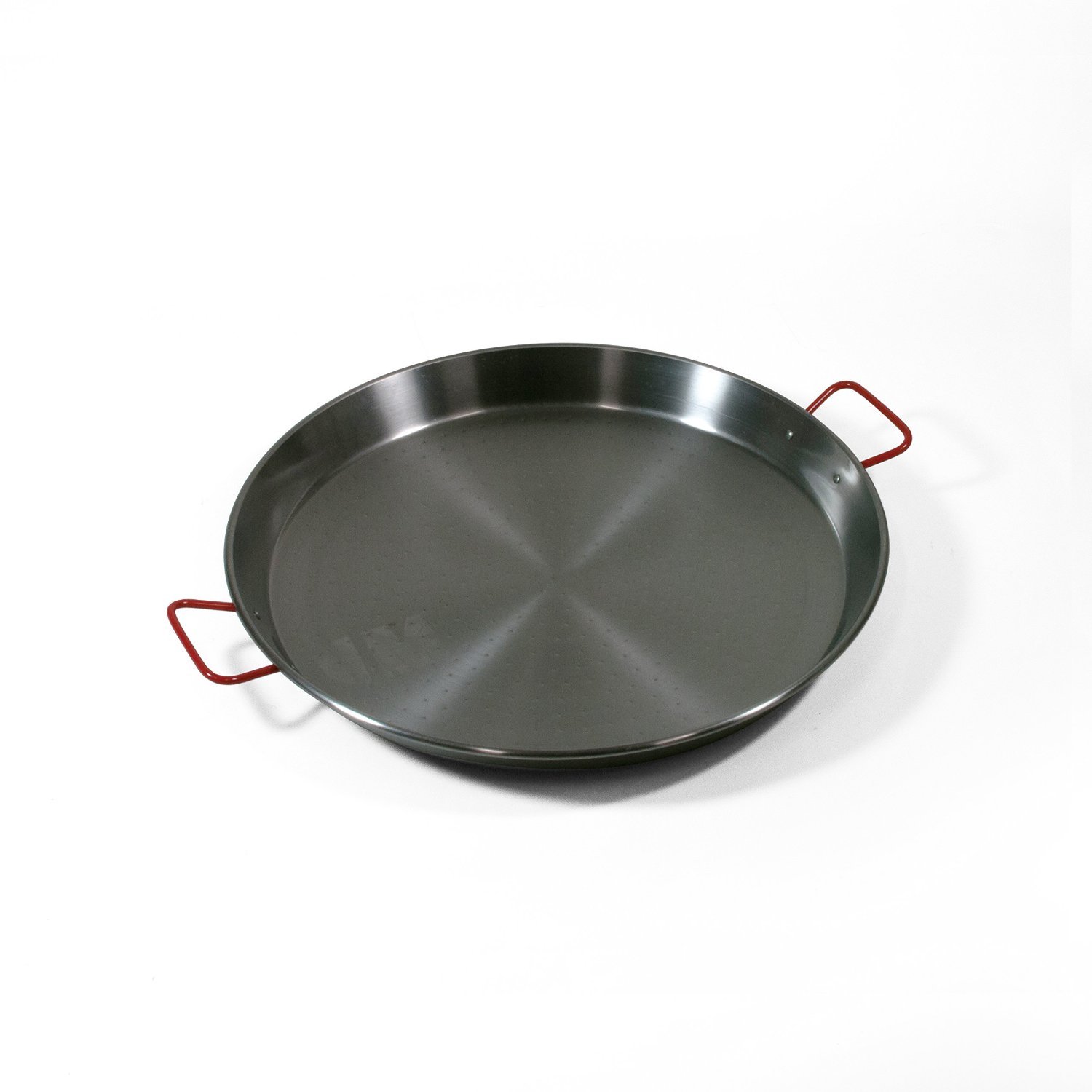
This pan is where paella becomes an event. The wide surface is the point: you can spread rice thin, keep proteins from crowding, and develop that “everyone smells it from the driveway” browning without steaming the ingredients into softness. When cooks say “paella needs a big pan,” this is the category they mean.
The most important real-world insight from owners is also the most important buying truth: a pan this wide needs a heat source designed for it. Many people recommend a dedicated paella burner for sizes like this because a normal indoor stove forces you into awkward hacks— using two burners, rotating constantly, or finishing in the oven to compensate for cold edges. On the right setup (a multi-ring burner, a Santa Maria-style grill, or a stable live-fire situation), carbon steel shines: it heats quickly, reacts instantly when you adjust the flame, and can produce a bold, satisfying crust.
Carbon steel also means “care is part of ownership.” Some people are surprised when the handle color changes over fire or the pan darkens with use. That’s normal. Dry it, oil it lightly, and it’ll stay happy. If rust ever appears, it’s usually superficial and can be scrubbed off—then you return to the dry-and-oil routine. The biggest practical downside is storage space. This is a large, wide piece of cookware. Buy it because you’re going to use it, not because it looks cool in a product photo.
Why it’s worth it
- True crowd-size paella – thin rice layer and big surface area make better texture and flavor.
- Fast, responsive carbon steel – excellent for browning and crisp crust control.
- Made for burners and grills – ideal for outdoor paella nights.
- Classic dimpled/hammered style – supports even cooking and traditional presentation.
Good to know
- You need a plan for heat coverage; this size is not naturally comfortable on most indoor stoves.
- Requires carbon-steel care (dry immediately, oil lightly).
- Large pans require large storage; measure your cabinet or wall space.
Ideal for: outdoor cooks and hosts who want real crowd paella and are willing to pair the pan with the right burner or grill setup.
5. GreenPan x Bobby Flay 15" Carbon Steel – Flat-Bottom Crust Power with Modern Convenience

Carbon steel is famously good for paella because it heats quickly and responds immediately—exactly what you want when you’re building a crust. The problem is that many traditional carbon steel paella pans aren’t ideal on induction because they can rock or heat too aggressively in the center. This is the modern twist: a carbon-steel paella pan designed to sit flat and work on induction while still delivering that classic “crisp-bottom potential.”
The pre-seasoned surface is a practical bonus, but it’s important to understand what “seasoned” really means. A carbon-steel pan is supposed to develop a darker patina over time. It may show marks or color changes, especially after high-heat cooks. That’s not the pan being ruined—it’s the seasoning evolving. Some negative feedback around carbon steel often comes from expecting it to stay cosmetically perfect. If you treat it as a working tool (clean, dry, thin oil film), it typically improves in release and performance.
For paella on induction, your best move is to think in stages: start with controlled heat to build your sofrito and brown proteins, then let the rice simmer steadily, and finally increase heat gradually to coax socarrat without scorching one central circle. Because induction can concentrate heat, a gentle rotation during the last stage (even a small shift every so often) can make a big difference. This pan gives you the option to cook carbon-steel style in an induction kitchen—something many traditional pans simply don’t do comfortably.
Why it’s a smart modern pick
- Carbon-steel responsiveness – great for browning and crisp crust timing.
- Flat-bottom induction compatibility – more stable and predictable than many traditional carbon steel pans on induction.
- High-heat flexibility – useful for searing proteins hard before the rice phase.
- Patina improves release – it can feel more nonstick-like over time if you maintain it well.
Good to know
- Carbon steel requires care: hand wash, dry immediately, and oil lightly.
- The surface will darken and show “character”—this is normal, not damage.
- If you want zero-maintenance cleanup, stainless or enamel may fit your lifestyle better.
Ideal for: induction cooks who want carbon steel’s crust-building strengths without the wobble and compatibility headaches.
6. Paelluxe 22" Enameled Steel – Big Capacity, Easy Cleanup, Outdoor Friendly
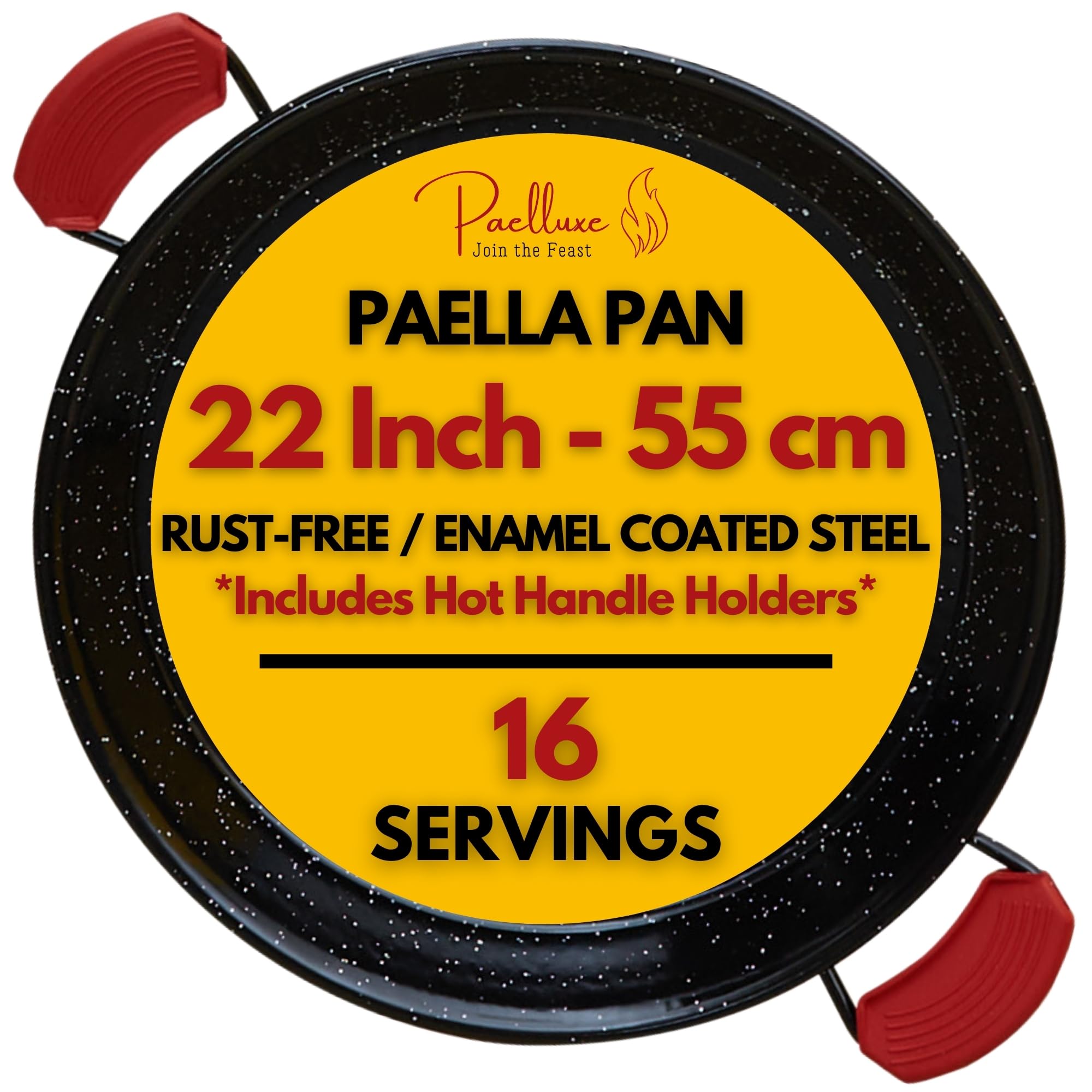
Enameled steel paella pans exist for one simple reason: people love big paella nights, but not everyone wants to babysit raw carbon steel after dinner. An enameled surface is much less stressful in storage because it resists rust, and cleanup is typically easier because starch and proteins don’t bond to the metal the way they can on raw steel.
This is a particularly strong fit for outdoor cooking—propane burners, paella burners, grills, and even controlled live-fire setups. Owners often mention it fitting well in deep grills and cooking evenly for large dinners. When you pair a large pan with a burner that can feed it, you get the outcome everyone wants: rice spread thin, flavorful evaporation, and a bottom crust that forms across a wider area instead of just a center spot.
The expert note with enamel is temperature discipline. Enamel is tough, but it doesn’t love abuse. Avoid violent thermal shock (like blasting the pan empty on maximum heat, then dumping cold liquid). Instead, warm the pan with oil in it, build your sofrito, then add liquids gradually. You can still achieve a satisfying crust— just do it with controlled heat rather than “let’s see how high this burner goes.”
Why outdoor cooks love it
- Low rust stress – enamel makes storage easier than raw carbon steel.
- Large-crowd capacity – great for parties and big family meals.
- Easy cleanup – enameled surfaces typically release starchy residue more easily.
- Outdoor versatility – works beautifully on burners and grills designed for big pans.
Good to know
- Not designed for induction cooktops—this is a gas/burner/grill style pan.
- Enamel can chip if you drop it or use harsh tools; treat it like durable glass.
- Because it’s large, you still need a real heat plan and storage space.
Ideal for: hosts who want a large paella pan for outdoor gatherings with easier cleanup and lower maintenance than raw steel.
7. Yeksum 14.5" Tri‑Ply Stainless + Lid – A Practical Home-Kitchen Paella Workhorse

This pan fits a very real lifestyle: you want a wide paella surface, you want stainless durability, you want induction compatibility, and you like the flexibility of having a lid available without needing a separate “paella-only” setup. Think of it as a jumbo stainless skillet that happens to be shaped correctly for paella.
The tri‑ply style construction is important because it helps heat travel—especially toward the sides. That matters for rice texture: if the edges stay cooler, you get uneven doneness and you’re tempted to stir (which paella doesn’t want). With a pan like this, you can keep the cook mostly uncovered for evaporation, then use the lid for a short, strategic moment if the top looks like it needs help. Then you remove it again for the final crust stage. That workflow is extremely effective on standard home burners.
Stainless does require “browning discipline.” When you sear proteins, give the pan time to preheat and use enough oil. If you rush, proteins stick, tear, and leave residue that can later burn under the rice layer. The good news is that stainless is easy to recover: deglaze with a splash of liquid during the sofrito stage and those browned bits become flavor instead of problems.
Why it makes sense
- Stainless durability – tough surface that can handle real cooking and real scrubbing.
- Lid flexibility – helpful for indoor burners and seafood finishing.
- Induction-ready – better fit for modern kitchens that need magnetic bases.
- Multi-purpose shape – paella, shallow frying, big sautés, and party sides all work well here.
Good to know
- Always confirm lid oven limits; many glass lids are not meant for high oven temps.
- Stainless needs technique to prevent sticking during the initial sear phase.
- Wide pans still benefit from burner planning (or a short oven finish) if your burner is small.
Ideal for: families who want a stainless pan that can do paella night and everyday cooking, with lid convenience for indoor control.
8. Yeksum 14.5" Honeycomb/Hybrid + Lid – Easier Release Without Giving Up Browning
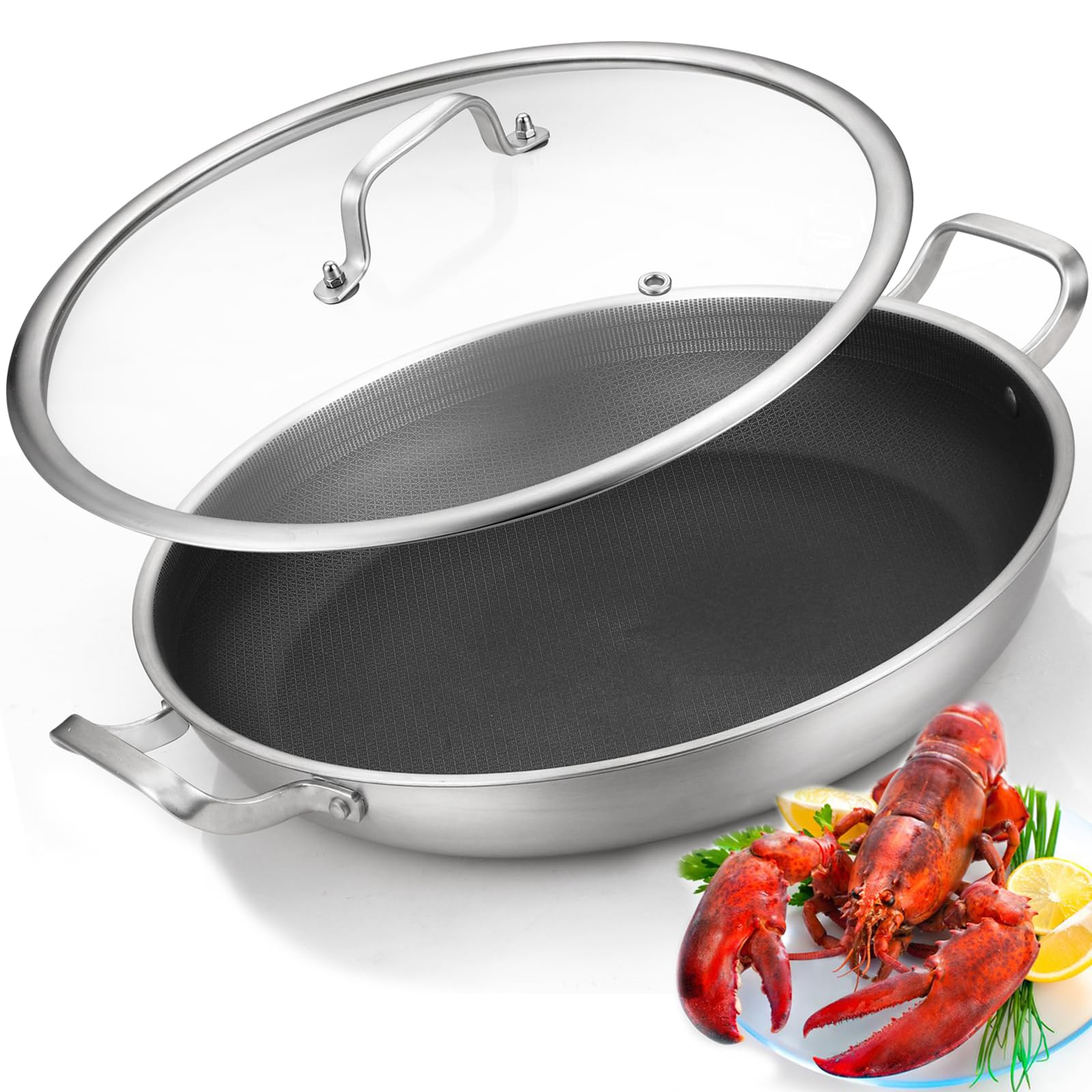
Hybrid “honeycomb” surfaces exist for cooks who want two things at once: easier food release and better browning than delicate nonstick. For paella, that combination can be a serious stress reducer. It helps you brown proteins without tearing, keeps the sofrito stage from sticking aggressively, and makes rice cleanup less of a chore—especially if you’re new.
Here’s the expert truth: no surface makes paella foolproof. Heat still matters. But hybrid pans often make the learning curve kinder. Owners frequently highlight even cooking and easier cleanup, and some note that the surface holds up well with regular use. The lid adds the same “home kitchen advantage” as other lidded pans: you can briefly cover to help the top cook, then uncover to push evaporation and finish the bottom crust.
To get the best performance, treat hybrid surfaces like a “smart nonstick,” not an “invincible nonstick.” Preheat gradually, use a thin layer of oil, and avoid blasting it empty on maximum heat. If starch bakes into the pattern, a warm soak and gentle scrub will usually release it without drama. That approach protects long-term performance and keeps the pan behaving like the easy-release tool you bought it to be.
Why it’s friendly for real life
- Easier release – especially helpful for first paellas and delicate seafood proteins.
- Browning still works – more sear-friendly than many traditional nonstick pans.
- Lid included – practical control for indoor burners and moisture management.
- Everyday versatility – doubles as a large skillet for parties, camping, and family meals.
Good to know
- Hybrid surfaces still prefer controlled heat; extreme overheating shortens their best years.
- Patterned surfaces can hold starch if you let rice dry fully before soaking—clean sooner, not later.
- If you want the most “authentic” carbon-steel crust, raw steel can still be more aggressive.
Ideal for: beginners and busy cooks who want easier cleanup and fewer sticking headaches while still getting good browning and a satisfying crust.
9. DELARLO 14" Hybrid Nonstick + Lid – Built Like Stainless, Acts Like “Less Scrub”

This is a good pick for cooks who want the structure and heat behavior of a tri‑ply pan but prefer a more forgiving cooking surface. In real owner feedback, people consistently talk about even cooking, easy cleanup, and using the pan for far more than paella—bacon, big breakfasts, stir‑fries, and “cook for a group” meals. That multi-purpose reality matters because the more you use a pan, the better you get at controlling it. And paella rewards familiarity.
An interesting real-world detail: some owners report that if they experience sticking early on, a very light “seasoning-style” oil bake improves performance. That makes sense for certain hybrid surfaces: a thin polymerized oil layer can smooth micro-roughness and increase release. For paella specifically, that can help during the socarrat finish because the rice crust is less likely to weld itself to the pan in one stubborn sheet. You still want oil and heat control—but you get a bigger margin of error.
The lid is convenient, but don’t let it turn paella into steamed rice. Use the lid as a short helper, not a permanent cap: uncovered for sofrito and evaporation, optional lid to finish the top, uncovered again to crisp the base. And if your center tends to burn first, that’s usually a burner coverage issue, not the pan itself—lower heat, rotate slightly, or finish in the oven for evenness.
Why it’s a strong “practical” choice
- Even heating – tri‑ply construction supports more uniform cooking.
- Easier cleanup – less scrubbing than raw stainless for many cooks.
- Lid flexibility – useful for indoor kitchens and seafood finishing.
- Built for heavy use – many owners use it as a daily big skillet, not just a paella pan.
Good to know
- Hybrid surfaces still prefer moderate heat; treat them as durable, not indestructible.
- Some lids may require occasional extra cleaning around seams or handles.
- If you want zero-maintenance storage, enamel is the easiest “store it and forget it” category.
Ideal for: cooks who want an easier-release surface in a sturdy, tri‑ply pan—and who like having a lid for controlled indoor cooking.
10. Bzayeat 14" 5‑Ply Ceramic‑Coated – Fast Heat Control + Detachable Handles for Real Kitchens
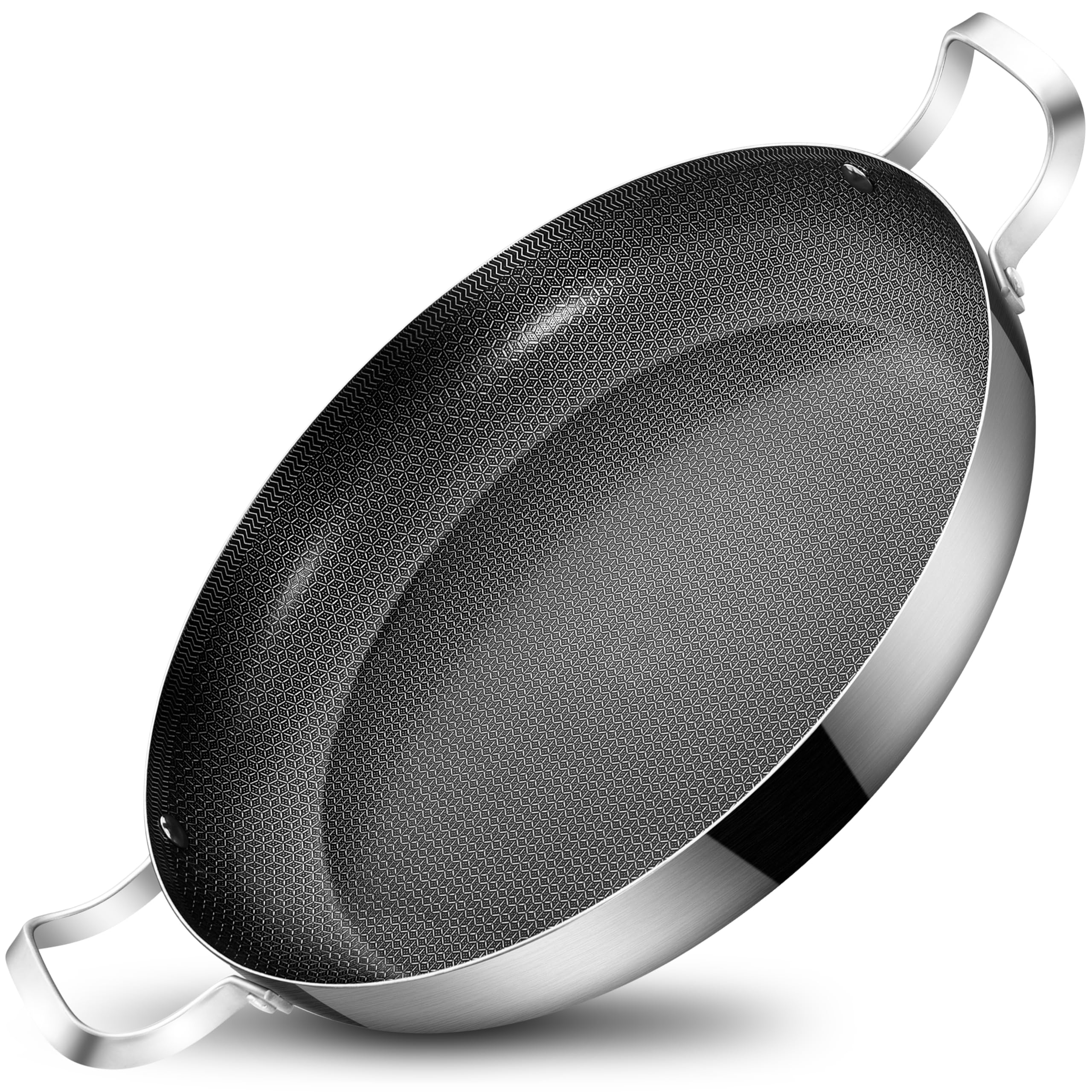
This pan is built like a modern hybrid skillet disguised as a paella pan—and for a lot of home cooks, that’s exactly the point. The multi-layer construction is designed for quick, even heating, and the ceramic-coated surface aims to reduce the “first paella fear” of sticking and cleanup. Owners often describe it as surprisingly manageable in weight for its size, with a premium feel and a finish that’s easy to wash after big cooks.
The detachable handles are not a gimmick; they solve two real problems. First: oven finishing. Paella often benefits from a short oven phase when your burner can’t heat the whole pan evenly. Second: storage. Wide pans can be annoying in cabinets; detachable handles make it easier to fit the pan into tighter spaces or smaller ovens. Several users mention using it for stovetop-to-oven dishes like shakshuka and finishing proteins after searing—exactly the kind of workflow that translates well to paella-style cooking.
Here’s the expert tip with fast-heating pans: treat them like sports cars. You don’t need long preheats, and you should expect the pan to respond quickly when you lower or raise the flame. That responsiveness is a gift during the socarrat stage, because you can back off instantly when you hear the crackle intensify. Use moderate heat, a thin layer of oil, and avoid thermal shock (hot pan + cold sink water) to protect long-term performance.
Why it’s a home-kitchen win
- Easy cleanup feel – ceramic coating reduces sticking stress for many cooks.
- Fast, responsive heating – makes fine-tuning socarrat timing easier once you learn the pan.
- Detachable handles – helps with storage and oven finishing strategies.
- Versatile shape – works for paella, big sautés, stir fry, and oven-to-table meals.
Good to know
- Ceramic surfaces last longest with gentle tools and sensible heat—avoid unnecessary max-heat blasts.
- Wide pans still need storage planning; detachable handles help, but it’s still a large footprint.
- When fully loaded with food, it can be heavy—two-hand lifting is normal at this size.
Ideal for: cooks who want an easier-clean surface, induction compatibility, and the practical convenience of detachable handles for oven finishing and storage.
11. Cuisinart 15" Covered Paella Pan – Gorgeous, Convenient, and Very Weeknight-Friendly

Let’s be honest: sometimes you want paella flavor without the “I’m managing a live heat map like an air traffic controller” energy. That’s where a covered nonstick-style paella pan can shine. Owners often love the look (that bold red is a vibe), the size, and the convenience of easy release when cooking delicate foods. It’s especially appealing for seafood-forward meals, paella-style rice, and skillet dinners that you want to move from stove to table without drama.
The expert truth is that this style of pan cooks a slightly different kind of paella. Traditional socarrat often requires confident, high-heat finishing. Many nonstick systems are happiest at medium heat and within specific oven limits. Some user feedback points out uneven heating (hot center, cooler edges) and notes that a stronger crust can be tricky. That doesn’t mean you can’t make a delicious meal—it just means your best strategy is to lean into what the pan does well: build flavor gently, use the lid for moisture control, and finish in the oven when needed for even doneness.
If you cook on induction, be especially thoughtful: some users mention exterior finish issues when the base rubs on certain induction surfaces and that high heat can create unpleasant smells if you overdrive the pan. Your winning approach is simple: medium heat, patient reduction, and silicone/wood tools to avoid scratches. If you want a pan for frequent use and easy cleanup, this one fits the brief. If your goal is “aggressive, restaurant-style socarrat,” carbon steel or stainless will deliver more.
Why it’s popular
- Convenient cleanup – easy food release for many weeknight cooks.
- Lid included – helpful for gentle simmering and seafood finishing.
- Attractive presentation – looks great as a serve-from-the-pan centerpiece.
- Comfortable handling – many owners like the handle feel and overall sturdiness.
Good to know
- Not the most “socarrat-aggressive” style; high heat is not the goal here.
- Some users report uneven heating on certain stoves—oven finishing can solve this.
- Protect the surface: avoid metal tools and harsh scrubbing to preserve longevity.
Ideal for: home cooks who prioritize easy release, lid convenience, and weeknight-friendly paella-style meals over ultra-traditional crust intensity.
12. Babish 13" Tri‑Ply Stainless Paella Pan – Simple, Solid, and Better Than It Looks on Paper
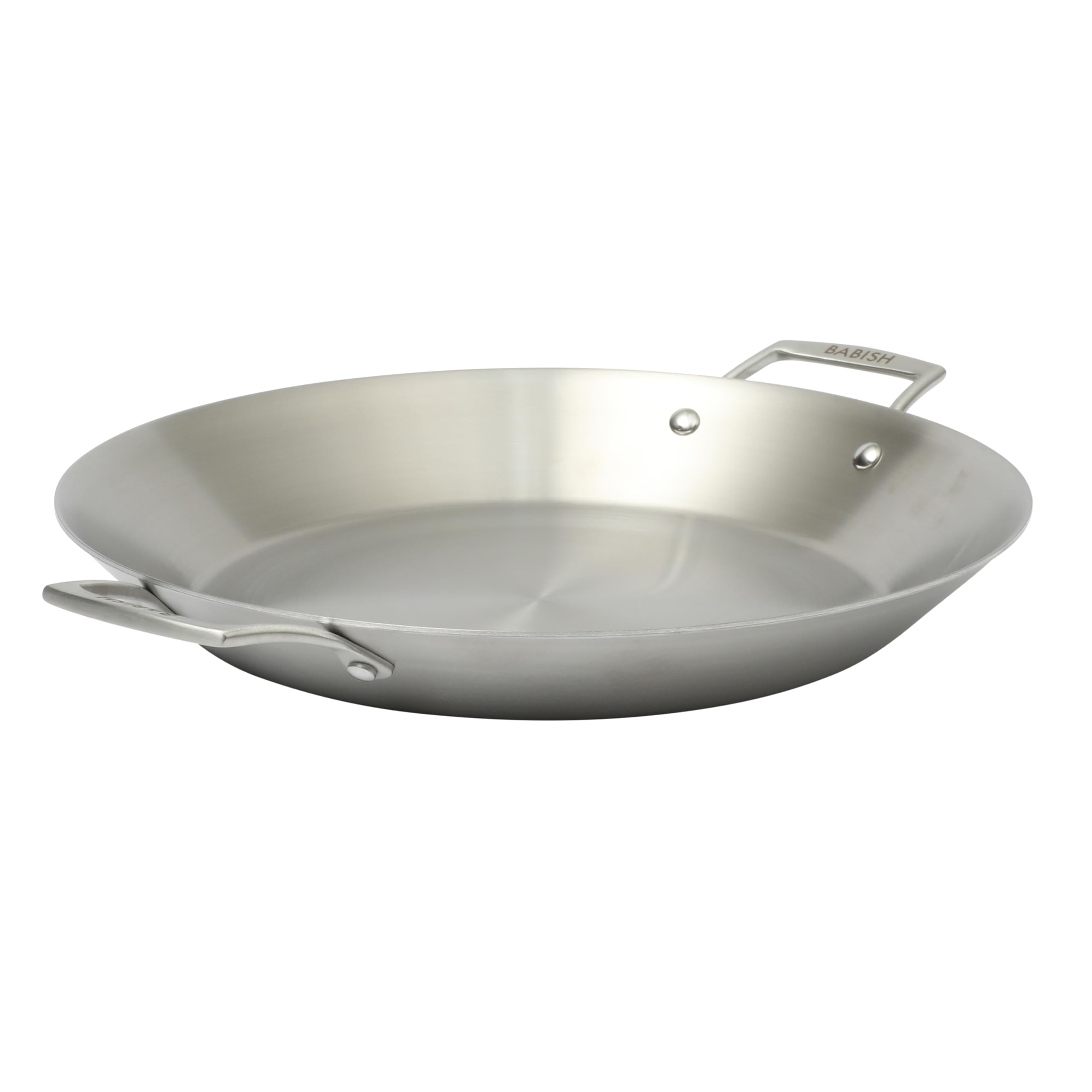
This is a “no gimmicks” paella pan that surprises people because it performs like a serious piece of tri‑ply stainless cookware. Owners often describe it as solid and weighty enough to feel stable, but still manageable to lift and move. A recurring theme in feedback is that it heats evenly for its thickness—and that’s exactly what you want in a 13" pan that will often sit on a single burner.
The paella advantage of 13" is underrated. It’s easier to get complete heat coverage on standard kitchen burners, which means fewer edge problems and less rotation. That makes this a strong “learn paella properly” size. It also explains why some users mention success cooking foods people assume require nonstick—like eggs—when they use proper stainless technique: preheat, oil, and patience. Stainless isn’t automatically sticky; rushed stainless is sticky.
Two smart reality notes show up in owner experiences: first, be mindful of heat. If you blast stainless too hard, you can burn the bottom quickly. Second, it doesn’t include a lid, so if your recipe expects one, you’ll improvise (many cooks use a sheet pan or foil when needed). For paella, that’s not a dealbreaker because paella is typically uncovered most of the cook anyway.
Why it works
- Tri‑ply heating – good heat travel helps reduce harsh hot spots.
- One-burner-friendly size – easier indoor heat coverage than oversized party pans.
- Stainless durability – scrub-friendly, no rust worries like raw steel.
- Versatile shape – paella, pancakes, searing, and big sauté cooking all make sense.
Good to know
- Watch the heat—stainless can burn the bottom if you go too aggressive too early.
- No lid included; plan an improv cover if your cooking style needs one.
- Side handles can get hot; mitts are your friend when serving.
Ideal for: cooks who want a straightforward, versatile stainless paella pan in a size that behaves well on typical indoor burners.
13. LOLYKITCH 13" Tri‑Ply + Glass Lid – Great Heat Control for Smaller Kitchens

This pan fits a common real-world constraint: you want paella geometry, but you’re cooking on a normal stove with normal burners. A 13" tri‑ply stainless pan is much easier to heat evenly than a massive party pan, and that alone can upgrade your results. Owners frequently describe even heating, fast cleanup, and a surface that doesn’t hold onto sticky residue when used with basic good technique.
The glass lid adds a home-kitchen advantage: visibility and control. Paella is usually uncovered, but a lidded 13" pan can be incredibly useful for small-batch cooking where you want to keep heat gentle while finishing proteins or helping the top layer of rice set without constantly adjusting the flame. The vented lid also helps prevent excessive pressure buildup—meaning you can cover briefly without turning your rice into steamed mush.
One review theme worth calling out is expectation management: some people think the pan will be deeper based on photos. Paella pans are meant to be wide and relatively shallow. That’s not a design flaw—it’s the whole point. If you want “deep pot” cooking, look for a rondeau or Dutch oven. If you want proper evaporation and thin rice layers, a pan like this is doing exactly what it should.
Why it’s a smart everyday pick
- Easy heat coverage – 13" size suits most indoor burners.
- Lid control – helpful for small kitchens, seafood finishing, and brief top-heat assistance.
- Tri‑ply stainless durability – easy to clean and built for frequent use.
- Balanced handles – many owners like the stability when lifting and serving.
Good to know
- Shallow design is intentional; if you need depth, this isn’t that style of pan.
- Glass lids have limits—avoid extreme high-heat abuse and confirm oven guidance for the lid.
- As with all stainless, don’t rush the preheat when browning proteins.
Ideal for: smaller households and apartment kitchens that want a lid-equipped paella pan in a size that heats predictably on standard burners.
14. Garcima 13.5" Pata Negra – The “Learn It Right” Carbon Steel Pan for 2–4 People

If you want to actually get good at paella—like “I can repeat this on purpose” good—start with a pan that matches your burner coverage. This size is a hidden advantage because it’s easier to heat evenly indoors, and carbon steel gives you the fast response needed to time the crust. For two to four people, a smaller paella pan often produces more consistent results than oversized pans that only get full heat in the middle.
Restaurant-grade carbon steel also means you get a more durable feel than ultra-thin steel pans. You can brown proteins confidently, build a deep sofrito, then add rice and stock and watch the whole pan behave like a single cooking surface instead of a “center cooks, edges wait” situation. That’s what makes learning easier: the pan’s feedback is clearer, and your technique improves faster.
The ownership contract is the same as other carbon steel pans: dry it immediately after washing and rub on a thin film of oil before storage. Over time it will darken and develop patina. That patina is your friend—it makes release easier and helps the pan behave more smoothly during the socarrat finish. If you want a low-maintenance tool, enamel or stainless will feel easier. If you want “classic paella energy” in a manageable size, this is a strong move.
Why it’s a smart “learning pan”
- Better burner coverage – easier to heat evenly indoors than big party pans.
- Carbon steel crust control – responsive heat helps you time socarrat without panic.
- Durable feel – restaurant-grade build stands up to frequent cooks.
- Authentic results potential – this is the traditional material for a reason.
Good to know
- Requires basic maintenance (dry + oil) to prevent rust.
- Not the easiest match for induction if the bottom isn’t perfectly flat; confirm your stove type.
- Carbon steel will change color—don’t buy it expecting “stays shiny.”
Ideal for: small households who want authentic carbon-steel paella and a size that’s easier to master on typical kitchen stoves.
15. Paelluxe 13" Enameled Steel – Easy Cleaning, No Rust Stress, Simple Paella Nights
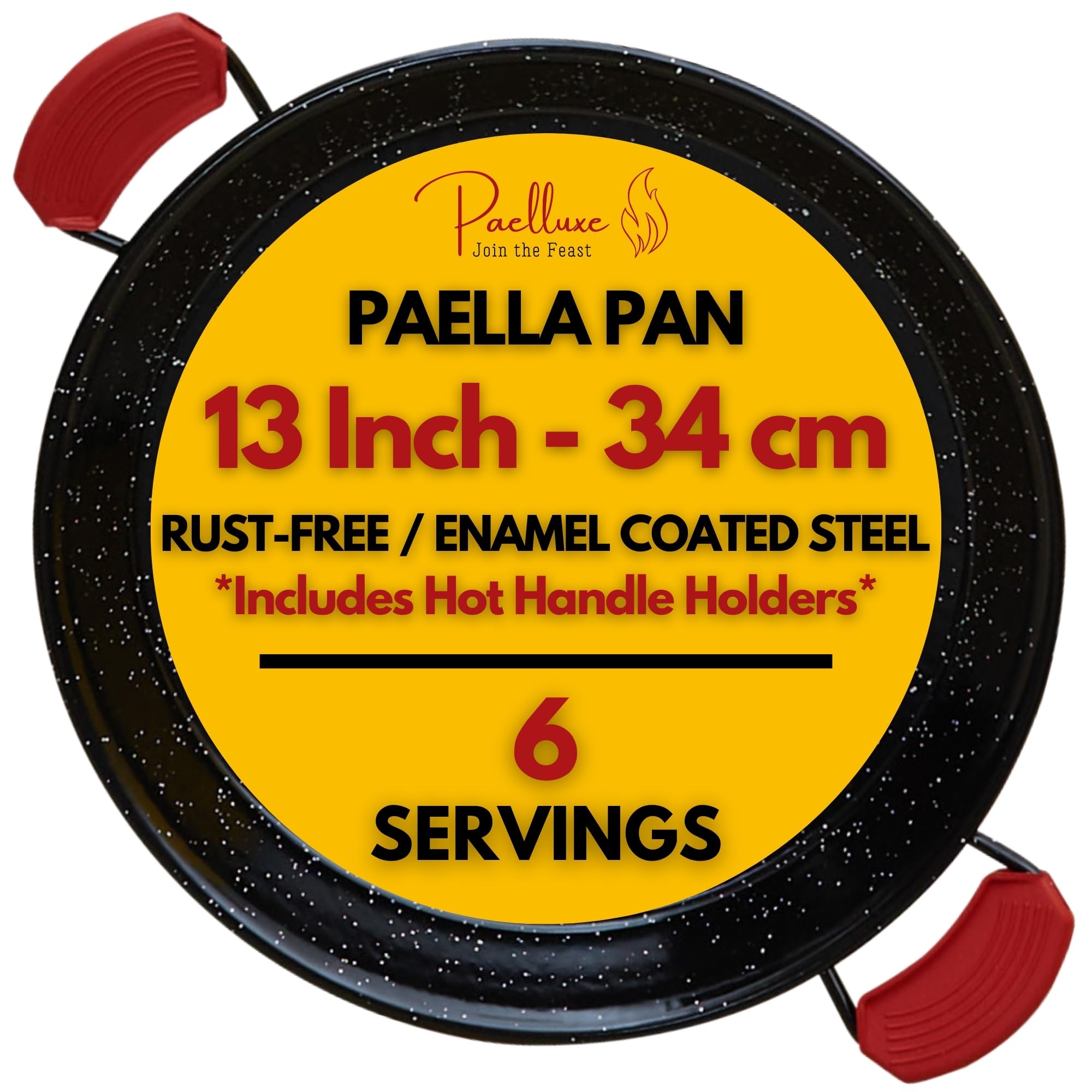
If the idea of seasoning, drying, and oiling a pan sounds like “not my life,” an enameled steel paella pan is a friendly entry point. The goal here is simple: a wide, shallow pan that cooks rice in the right shape, cleans easily, and doesn’t punish you with rust worries if you forget one tiny step. Owners often describe it as meeting expectations and being straightforward to use—exactly what a starter paella pan should be.
Enameled steel is especially comfortable for casual indoor/outdoor cooks. You can use it on a grill or gas burner, and you don’t need a special maintenance ritual afterward. The key expert tip is to avoid extreme abuse: don’t blast it empty on maximum heat and then shock it with cold liquid. Warm it with oil, build flavor gently, then cook steadily. You can still coax a nice bottom crust—just do it with controlled heat rather than aggressive scorching.
Because the pan is smaller, it’s also easier to heat evenly on standard burners. That translates to better rice texture for small batches, which is often the real “first paella win” people need. Once you can repeat good results on a 13" pan, scaling up to bigger pans becomes a confident choice instead of a gamble.
Why it’s a great starter
- Low-maintenance storage – enamel reduces rust stress compared with raw carbon steel.
- Easy cleanup – generally friendlier for rice residue and post-party washing.
- Indoor burner friendly – smaller size heats more evenly on many home stoves.
- Outdoor compatible – great for grill nights and casual patio cooking.
Good to know
- Not designed for induction cooktops (this style is typically gas/burner focused).
- Enamel can chip if dropped or scraped hard with metal tools—use sensible utensils.
- If you want the most aggressive traditional crust, carbon steel remains the top category.
Ideal for: beginners who want simple paella nights with easy cleanup and minimal maintenance, especially in smaller kitchens.
How Socarrat Actually Forms (and Why Your Pan Is a Heat-Map Tool)
Socarrat isn’t “burnt rice.” It’s controlled caramelization at the bottom of the pan—starch, oil, and concentrated broth sugars turning into a crisp layer. The reason it feels hard is that the final stage is fast and unforgiving when your pan and burner don’t match. But once you understand the stages, you can make great paella in almost any pan on this list.
What makes a pan socarrat-friendly in real life
- Wide, shallow geometry – evaporation is the engine of paella flavor and texture.
- Even heat travel – tri‑ply or thick bases help prevent the “center cooks, edges wait” problem.
- Responsive control – carbon steel reacts quickly; stainless holds heat longer; enamel sits in the middle.
- Stable flatness – rocking pans can be fine on flame, but flat bottoms make induction and glass-top cooking much easier.
- Reasonable release behavior – seasoning, hybrid surfaces, or good stainless technique prevent the crust from welding permanently to the pan.
In other words, the pan isn’t just a container. It’s the stage where evaporation, browning, and timing play out. Pick the pan that matches your heat source and you’ll feel the difference immediately.
The 5-step heat plan that fixes most paella mistakes
- Preheat with intention – warm the pan gradually with oil in it; don’t shock a cold pan with maximum heat and then blame the pan.
- Brown proteins without crowding – browning is flavor; crowding creates steam. Use the pan’s width properly.
- Build a deep sofrito – this is where “good paella” starts; take your time here and your rice will taste richer.
- Don’t stir once the rice goes in – stirring breaks the paella structure and pushes you toward mushy texture.
- Chase socarrat late, not early – let the rice absorb first; then increase heat gradually at the end, listening for the crackle.
If you’re nervous about burning, use a simple test: when you hear a steady crackle and smell toasted rice (not harsh smoke), count a short window, then reduce heat and rest the pan briefly. That pause lets the crust set without going from golden to bitter.
FAQ: Paella Pans (Without the Confusion)
Do I really need carbon steel to make “real” paella?
Why does my rice burn in the center but stay undercooked at the edges?
Do I need a lid for paella?
Can I use a large paella pan on an induction cooktop?
How do I maintain carbon steel without obsessing over it?
What’s the fastest way to pick the right size?
Final Thoughts: Choose the Pan That Makes Paella Feel Repeatable
A great paella pan doesn’t just make food. It makes you calmer while cooking—because the heat behaves predictably, the rice sets evenly, and the cleanup doesn’t feel like a penalty for hosting.
Here’s how to translate this guide into a confident purchase:
- Want one pan that works for paella night and everyday life? Start with the DELARLO 14" Tri‑Ply Paella Pan + Lid. It’s the best “use it often” blend of stability, even heating, and versatility.
- Cooking for a crowd and want serious heat spread? The Concord 20" Stainless Paella Pan is built for big surface cooking—especially helpful when induction needs better heat distribution.
- Want classic carbon-steel paella with restaurant-grade toughness? Choose the Garcima 16" Pata Negra for a traditional feel that rewards technique and produces a confident crust.
- Hosting real paella parties outdoors? Pair the right burner with either the Garcima 20" Carbon Steel or the Paelluxe 22" Enameled Steel, depending on whether you want classic raw steel performance or easier cleanup and storage.
- Induction cook who still wants carbon steel? The GreenPan x Bobby Flay 15" Carbon Steel is the modern “flat bottom + patina” answer.
- Want easier release without giving up browning? Try a hybrid surface like the Yeksum 14.5" Honeycomb/Hybrid + Lid or the DELARLO 14" Hybrid + Lid for a more forgiving learning curve.
- Need a flexible lid-equipped stainless option for indoor cooking? The Yeksum 14.5" Stainless + Lid and the smaller LOLYKITCH 13" Stainless + Lid make indoor heat control feel easier.
- Want the simplest “starter” path with easy cleaning? The Paelluxe 13" Enameled Steel is a low-fuss way to start cooking paella more often.
The right choice is the one that matches your burner coverage, your usual crowd size, and your cleanup tolerance. Pick the best paella pan for how you actually cook, and you’ll stop chasing “perfect paella” and start making paella nights feel easy.
