
A home meat slicer isn’t a “kitchen gadget.” It’s a control switch for your entire week. One slice thickness can turn leftovers into deli-style sandwiches, make homemade jerky actually consistent, and stop that tiny daily frustration of fighting a block of cheese with a knife.
If you’re hunting for the best meat slicer for home use, you’re not just shopping for a blade and a motor. You’re shopping for a smoother routine: faster meal prep, cleaner portions, better freezer packs, and that satisfying moment when your slices look like they came from a counter service deli.
Here’s the part most “buying guides” skip: slice quality is rarely about raw wattage alone. The real difference-maker is the full system—carriage stability, fence rigidity, blade style, torque behavior, how the machine handles semi-frozen meat, and whether cleaning feels like a five-minute reset… or a whole event. If you get those friction points right, you’ll use your slicer weekly. If you get them wrong, it becomes a dusty cabinet monument.
Below are 13 standout picks arranged in a way that makes sense for real kitchens: premium, near-commercial options first (for people who slice often), then strong mid-tier home units, and finally compact budget and manual tools for occasional use or small spaces. No price talk—just the real-life ownership experience that helps you buy once and feel good about it.
In this article
How to Choose the Best Meat Slicer For Home Use
A slicer is “right” when it gives you the cut you want without turning the kitchen into a mess, and without making you dread cleanup. This is the decision framework I use when I’m helping home cooks pick a slicer they’ll still be happy with after the honeymoon phase.
1. Start with your slicing personality (this matters more than you think)
Most people fall into one of these patterns. Identify yours first—then choose a machine built for that reality.
- The sandwich builder: You mainly slice roasts, turkey, ham, salami, and block cheese for lunches. You want thin, consistent cuts and easy cleanup.
- The jerky maker: You need repeatable thickness and clean edges. You’ll slice in batches, often with partially frozen meat.
- The bread + charcuterie host: You slice sourdough, hard cheese, cured meats, and fruit for boards. Serrated blade performance matters.
- The holiday carver: You slice large roasts and brisket for gatherings, then portion leftovers for freezer packs. Tray capacity and blade diameter matter.
- The small-kitchen realist: You want compact storage and a machine that’s light enough to move, even if it means slower slicing.
2. Choose your “tier” before you choose a brand
Home slicers live in predictable tiers. Pick the tier first, and your options instantly make more sense.
- Manual multi-blade cutters: Great for fresh (not deli) meat in small pieces, hot pot strips, and basic jerky prep—high output per stroke, but safety and technique are non-negotiable.
- Compact 6.7–7.5″ electric slicers: The most common home style. They can do a lot, but you’ll be managing capacity, pressure, and sometimes duty-cycle limits.
- Mid-size 8.7–9″ electric slicers: The “grown-up” home tier. Better for larger roasts, often more stable, and usually easier to get consistent slices without flex.
- Near-commercial 10″ slicers: The big jump. Heavier bodies, bigger trays, stronger feel, and less “fiddling.” If you slice often, this tier is where frustration tends to disappear.
3. Blade type is not a detail—it’s a slice “personality”
You’ll see two common blade styles:
- Serrated blades: Best for bread and some tougher skins. They “bite,” which helps crusty loaves—but that same bite can tear soft meat if your technique or temperature is off.
- Smooth blades: Better for clean deli slices, cheese, and most cooked meats. If your priority is paper-thin roast beef or turkey, smooth wins more often.
If your slicer comes with both, treat them like separate tools: serrated for bread, smooth for meat and cheese. That one habit fixes a shocking amount of “my slicer shreds everything” frustration.
4. The real secret to deli-thin: food temperature + gentle pressure
This is the pro trick that makes budget slicers perform like better machines:
- Cooked meats: Chill them fully. For very thin slices, firm them up further (many people use a short freezer rest so the meat is stiff but not rock-hard).
- Raw meats for jerky: Slice when the meat is partially frozen. Too soft = smearing and mess. Too hard = slow cutting and uneven edges.
- Cheese: Cold cheese slices cleaner. Soft, warm cheese can gum up the blade and smear.
- Bread: Let bread cool fully. Warm bread compresses, tears, and sticks.
Also: more force is not “more professional.” Pressing hard can flex the fence, widen the cut, and make slices wedge-shaped. Let the blade do the work, and use slow, steady strokes.
5. Cleaning is the real cost of ownership
Here’s the honest truth: almost every slicer feels great while slicing. The love-or-hate relationship begins at the sink. Before you buy, look for these “cleanup tells”:
- Removable blade + guard: If you can’t access the blade area easily, you’ll rush cleaning (and that’s when smells happen).
- Carriage removal: A tray that pops off or lifts off makes cleaning faster. Fixed trays can be fine, but you’ll need brushes and patience.
- Where juices hide: Juicy roasts drip into crevices. Machines with fewer seams and better access feel cleaner long-term.
- Reality check: “Easy to clean” often means “easy once you learn the order.” Expect a learning curve, then it gets fast.
6. Stability + safety features are performance features
A slicer that slides is a slicer you won’t trust. And if you don’t trust it, you’ll use it less. Look for:
- Weight or strong suction: Heavy units stay planted. Lighter units can work great, but only if suction feet actually grip your counter surface.
- Child locks / dual-switch starts: These reduce accidental power-ups and make the machine feel more controlled.
- Guard + pusher design: The best pushers keep your hand naturally behind the safe line, even when you’re rushing.
- Motor behavior: Some slicers run slower but with higher torque. That can feel “calmer,” quieter, and more controllable.
- Duty cycle: Many home slicers are not meant to run nonstop. If you batch slice often, upgrade tiers so the machine doesn’t feel like it’s constantly asking for breaks.
Once you choose your tier and match it to your slicing personality, the right pick becomes obvious. Now let’s make it even simpler with a quick table—then deep reviews.
Quick Comparison: 13 Best Meat Slicer For Home Use Picks
Use this table to find the models that match your needs, then jump to the full reviews for the “real life” details— like stability on different countertops, how fussy cleaning is, and which slicers owners say feel like a true step up.
On smaller screens, swipe or scroll sideways to see the full table.
| Model | Slicer type | Real-life strength | Best match | Amazon |
|---|---|---|---|---|
| VEVOR Commercial Meat Slicer (10″) | Near-commercial | Heavy, stable slicing with a built-in sharpener feel—great for roasts, holiday batches, and consistent thin cuts | Frequent slicers who want the “big jump” without going full deli shop | Amazon |
| KWS MS-10NT 10″ Commercial Meat Slicer | Near-commercial | Quiet, smooth operation with a sharpener included—built for people who hate loud kitchen machines | Apartment-friendly premium slicing with less “airplane motor” noise | Amazon |
| BESWOOD 10″ (BESWOOD250) | Pro upgrade | Industrial build, razor-sharp blade feel, and “cuts like butter” consistency—built to last | High-volume slicing, jerky makers, and “buy once” shoppers | Amazon |
| Weston Electric Meat Cutting Machine (9″) | Home heavy-duty | Belt-driven quiet motor vibe + a larger blade without a massive footprint | Home cooks who want “serious” slicing but still manageable storage | Amazon |
| CUSIMAX 200W Slicer (8.7″) | Wider range | Broad thickness range and larger blade size for a home unit—nice for bread and general slicing | Mixed-use kitchens that slice many different foods | Amazon |
| TOKASS 200W Meat Slicer | Strong mid-budget | Sturdy feel with safety lock start; popular for roasts + bread and “I want control” slicing | People who want a solid machine without going huge | Amazon |
| Borlebbi 200W Slicer (2 blades + tray) | Reliable starter | Strong suction + responsive customer support stories; great for roasts, cheese, and bread once you learn the lock | New slicer owners who want fast slicing and decent stability | Amazon |
| OSTBA 150W Slicer (7.5″) | Proven classic | Long-running popularity + easy cleaning access; best results when you slice slowly and chill foods properly | Occasional slicing, jerky prep, and weekly sandwich routines | Amazon |
| FOHERE 200W Slicer (Silver, 2 blades) | Bread + meat | Serrated blade shines on sourdough; solid suction feet; good “learnable” machine | Bakers who also slice meat and cheese | Amazon |
| Elite Gourmet EMT-625B (7.5″) | Light-duty | Simple, approachable slicer for roasts and bread once you learn the technique | Occasional use: leftovers, boards, and home bread slicing | Amazon |
| NutriChef 200W Slicer (Black) | Budget compact | Easy to store, easy to use, great for bread + simple deli slicing expectations | People who want a small machine for occasional slicing | Amazon |
| Pterying 200W Slicer (2 blades + tray) | Hot pot friendly | Child-lock start + thin slicing potential; best if you accept cleanup is part of the deal | Home hot pot, carpaccio-style slicing, and batch prep | Amazon |
| SupMaKin Manual Fresh Meat Slicer (17-in-1) | Manual cutter | High output per stroke for fresh meat strips—tiny, fast, but demands serious respect | Hot pot slices and jerky prep with small meat pieces | Amazon |
In‑Depth Reviews: 13 Meat Slicers Built for Real Kitchens
Now we’ll go model by model. I’m going to talk like a real home slicer owner—not a spec sheet: what feels stable, what feels fiddly, what makes slicing effortless, and what you should know before you commit.
1. VEVOR Commercial Meat Slicer (10″) – The “Big Jump” That Makes Home Slicing Feel Easy

If you’ve only used compact 7.5-inch home slicers, the first time you use a heavier 10-inch machine feels like stepping out of “toy mode.” The VEVOR’s big win is not one single feature—it’s the overall stability and confidence it gives you while slicing. When the body doesn’t wiggle, the fence doesn’t flex, and the carriage feels planted, you stop fighting the machine and start producing clean slices.
Owners who upgraded from smaller units describe the difference as “night and day,” especially when they’re chasing thin, uniform cuts for roast beef, prime rib leftovers, summer sausage, or jerky prep. The built-in sharpening setup is also a practical advantage for home use: you don’t want to remove and sharpen blades constantly—what you want is “maintain sharpness, keep momentum.”
Where the VEVOR asks for respect is cleanup and handling. This is a serious blade, and cleaning is most efficient when you build a routine: unplug first, set thickness back to zero, wipe and brush the crevices, then sanitize. If you slice juicy roasts, expect some fling—this happens with most slicers when you’re moving fast. The trick is placing the slicer near a backsplash or using a catch tray and a towel “barrier” behind the blade area.
Why you’ll like it
- Feels stable and “grown up” – The heavier body reduces sliding and improves slice consistency.
- Great for larger roasts – The 10-inch class blade means less trimming and better workflow.
- Sharpness is maintainable – The built-in sharpening concept supports long-term performance.
- Thin slicing gets easier – Less fence flex means fewer wedge-shaped “thick on one side” slices.
Good to know
- Cleaning takes longer than ultra-compact slicers—plan a routine and it becomes manageable.
- Blade removal may require tools; use gloves and handle carefully.
- It’s a larger footprint—choose a storage spot or make it a “counter appliance.”
Ideal for: anyone who slices weekly (or in batches) and wants the home experience to feel steady, efficient, and genuinely deli-adjacent.
2. KWS MS-10NT 10″ Commercial Meat Slicer – Smooth, Quiet, and Surprisingly Apartment-Friendly

If loud appliances ruin your kitchen mood (or your household peace), this is where the KWS MS-10NT stands out. Multiple buyers highlight the “quiet and smooth” feel, which matters more than people admit: when slicing is calmer, you use lighter pressure, you get cleaner slices, and the whole process feels safer. That quietness becomes a quality-of-life feature, especially in apartments or open-plan homes.
Performance-wise, it lives in the same “10-inch upgrade tier” as other near-commercial slicers: bigger capacity, a more planted stance, and a workflow that makes sense when you’re slicing pounds of turkey breast, ham, corned beef, or even firm cheese blocks. People who used store deli meats for years often buy a slicer like this after deciding they want more control over ingredients and portion sizes—and they tend to keep using it because it finally feels convenient.
The trade-off is the trade-off of every serious slicer: cleanup is never “fun,” it’s simply “worth it.” Owners who stay happy usually do two things: they slice in batches (so cleaning happens less often), and they keep cut-resistant gloves in the same drawer as the slicer so cleaning becomes a confident routine rather than a cautious shuffle.
Why it shines
- Quiet operation – A huge win for shared spaces and nervous first-time slicer owners.
- Big capacity slicing – Better for larger roasts and bulk prep than compact home units.
- Built-in sharpening approach – Keeps the blade ready without constant fuss.
- More metal, less “toy” feel – The premium tier is about confidence as much as cutting.
Good to know
- It’s heavy—great for stability, less great for frequent lifting.
- Expect real cleanup time; a brush and gloves make it faster.
- Full strip bacon can still be tricky for many slicers—plan to trim or firm it up.
Ideal for: home cooks who want premium slicing with a quieter, smoother vibe—and who value calm control as much as raw cutting ability.
3. BESWOOD 10″ (BESWOOD250) – The “Buy Once” Machine That Feels Like a Real Deli Tool

If you want the closest thing to “deli shop confidence” without actually installing a deli slicer in your house, BESWOOD is the name that shows up again and again for a reason. Owners frequently describe the build as solid, heavy, and professional—exactly the traits that reduce micro-wobble and help you hit consistent, thin slices with less effort. It’s the kind of machine that makes cheaper plastic-forward slicers feel like a temporary compromise.
Real-life use stories tend to sound the same: someone buys a smaller slicer, gets frustrated by shredding or sliding, then upgrades to this tier and suddenly slicing becomes smooth. Jerky makers also like machines like this because the blade stays sharp longer and the carriage feels stable when the meat is firm and cold. A common technique is to slice meat when it’s “firmed up” (not fully frozen) so the blade cuts cleanly rather than smearing. That’s where heavier, higher-quality machines shine: they keep the cut consistent when the product fights back.
Cleaning is the one area that scares people before purchase—and then becomes manageable once they learn the steps. Owners who stay happiest don’t remove the blade every single time; instead, they remove what comes off quickly (guard, carriage, sharpener housing if applicable), then wipe and sanitize in place with a brush for the tight spots. The key is: unplug first, thickness to zero, gloves on, then clean with intention—not speed.
Why people upgrade to it
- Industrial stability – Heavy build helps slices come out uniform and controlled.
- “Cuts like butter” feel – Less pushing, less tearing, fewer uneven edges.
- Holds sharpness well – Great for people slicing frequently or in big batches.
- Confidence on firm meat – Performs well when you slice chilled/partially frozen product.
Good to know
- It needs a real home: counter space or a dedicated storage spot.
- Cleaning is straightforward but not instant; gloves and a brush are essential.
- Because it’s serious equipment, treat setup and sanitation like part of the experience.
Ideal for: high-volume home cooks, jerky makers, and anyone who wants to stop “upgrading later” and just buy the slicer that feels right from day one.
4. Weston Electric Meat Cutting Machine (9″) – Quiet, Capable, and Easy to Love for Everyday Roasts

Weston hits a sweet spot: it feels meaningfully more serious than ultra-compact starter slicers, but it doesn’t demand the same “mini deli installation” mindset as some 10-inch machines. If you want a recognizable, home-friendly workhorse for slicing turkey, ham, cheese, and bakery bread, this is the kind of slicer that tends to earn long-term satisfaction.
Owner feedback often highlights how approachable it is: set it up, start slicing, get usable results immediately. People successfully slice paper-thin cold cuts, thicker sandwich slices, and even firm cheese blocks. The stability comes from a sturdier base and suction feet that help keep the machine planted. It’s also commonly praised as “easier to clean than expected” once you learn the removal order for the blade and guards.
The biggest “expert tip” with slicers in this tier is respecting continuous use limits. Many home slicers aren’t meant to run nonstop for long stretches. The easy fix is workflow: prep your meat into manageable pieces, slice in controlled batches, then clean once. You’ll get better results, the motor stays happier, and you avoid the frustration of rushing.
Why it works in real kitchens
- Balanced size – More capacity than tiny slicers, less space-demand than the biggest units.
- Quiet running feel – Belt-driven style tends to feel smoother than some direct-drive minis.
- Wide slice range – Thin deli cuts through thicker sandwich slices.
- Approachable learning curve – Many owners feel confident quickly.
Good to know
- Not a full commercial machine—don’t expect to slice at deli speed with deli pressure.
- Some parts may still require hand washing and careful wiping.
- For very large roasts, a 10-inch tier reduces trimming and speeds workflow.
Ideal for: home cooks who want a reliable “serious” slicer for roasts, cheese, and bread—without jumping to the biggest class of machines.
5. CUSIMAX 8.7″ Slicer – Wide Thickness Flex for Mixed Kitchens (With One Big Caution)

CUSIMAX is designed for households that slice a little bit of everything: meat, cheese, bread, and vegetables. The larger blade size compared with many starter machines helps with bread and bigger blocks, and the thickness range makes it easier to switch between deli-thin sandwich slices and thicker cuts for cooking. When it’s working well, users describe it as “easy to use” and “easy to clean,” especially for bread routines.
But here’s the expert reality check: mixed owner feedback strongly suggests you should treat this as a home slicer that rewards gentle technique. Some users report frustration with grip/spikes holding meat in place, and there are complaints about internal parts durability when the machine is pushed hard (especially with tougher cheese blocks or aggressive pressure). That doesn’t mean it’s useless—it means your expectations should match the tier. If you slice occasionally and you slice smart (chilled foods, light pressure, patience), it can be a helpful, flexible kitchen tool. If you slice frequently, or want a machine you can “lean on,” a heavier metal 9–10″ tier is the safer bet.
If you decide this is your tier, the recipe for success is simple: use the smooth blade for meats and cheese, keep foods cold, and avoid forcing the carriage. Let the blade cut at its pace and you’ll get cleaner results and a longer machine life.
Why people choose it
- Versatile thickness range – Easy to switch from thin deli cuts to thicker prep slices.
- Bigger blade than most starter units – Helps on bread and larger food items.
- Removable parts help cleaning – Carriage/blade access is a real usability win.
- Great for bread routines – Many owners like it specifically as a bread slicer.
Good to know
- Some owners report durability issues if the machine is pushed too hard.
- Grip stability can be a weakness on certain foods; smaller pieces help.
- If you want “lean-on-it” performance, upgrade to a heavier 9–10″ tier.
Ideal for: mixed-use kitchens that slice bread often and meats occasionally—and owners willing to use smart technique instead of brute force.
6. TOKASS 200W Meat Slicer – Sturdy, Confidence-Building, and Great for Roast Leftovers

This is a slicer for people who want control: control over thickness, control over portion sizes, control over cleanup timing, and control over the “store deli experience” (busy counters, mystery handling, inconsistent slices). Owners talk about slicing meats easily and quickly, dialing thickness the way they want, and removing the blade and parts for washing and sanitizing without feeling like they need a degree in appliance engineering.
It’s also a good reminder of an important truth: no home slicer is meant to cut bones. The best experience comes when you slice the right materials at the right firmness: chilled cooked roasts, partially frozen jerky cuts, firm cheese blocks, and fully cooled bread. Do that, and this style of machine can feel surprisingly professional for a home kitchen.
The practical ownership note is cleaning. Compared to fully foldable or ultra-compact slicers, you’ll still need to wipe down some areas that don’t fully disassemble. If that sounds annoying, here’s the fix: slice in batches so cleaning happens less often. That’s how slicers become “worth it.”
Why people like it
- Feels sturdy for its tier – Good for roast slicing and repeatable sandwich meat prep.
- Easy thickness control – Helps you actually hit the cut you imagine.
- Removable parts help sanitation – Blade and carriage access makes cleanup more realistic.
- Safety-lock start – Adds control and reduces accidental starts.
Good to know
- You’ll still wipe down some fixed areas—common in this tier.
- Best results come from chilled foods and light pressure, not rushing.
- If you slice weekly in large volumes, a heavier 9–10″ machine will feel easier.
Ideal for: roast-and-sandwich households who want reliable slicing control with a sturdy feel and a safer start mechanism.
7. Borlebbi 200W Slicer (2 Blades + Tray) – Strong Suction, Fast Slicing, and Standout Customer Support

This slicer earns its spot for a reason that doesn’t show up in spec charts: real ownership support. Multiple buyers describe strong responsiveness and replacement help when something goes wrong. That matters because small home slicers often live or die on one or two parts—and the worst feeling is loving the machine, then getting stuck when you need help. If you’re nervous about buying a slicer for the first time, that kind of support reputation is a comfort.
On the slicing side, the experience is generally “fast and satisfying” for roasts, turkey breast, and cheese blocks. There’s a learning curve with blade locking—some users report issues until they realize the blade needs to be fully rotated/locked before operation. Once that’s handled, slicing becomes straightforward. The suction is often praised too, which is huge for safety and confidence.
The big realism note is mess management: juicy roasts drip into places you can’t fully wash under running water. That’s not a flaw unique to this model—it’s the nature of many home slicers. The winning approach is to plan for wiping and sanitizing, keep a small brush nearby, and avoid putting liquids near motor housing areas. If you slice bread, cleanup is dramatically simpler. If you slice roast beef, cleanup is part of the contract.
Why it’s easy to recommend
- Strong suction stability – Less sliding and more confidence during slicing.
- Fast slicing workflow – Great for roasts and cheese blocks when foods are chilled.
- Removable parts help cleaning – Blade and carriage removal makes sanitation realistic.
- Standout support reputation – A big deal for first-time slicer buyers.
Good to know
- Learn the blade lock step-by-step—don’t rush setup the first time.
- Juicy roasts require careful wiping/sanitizing in crevices.
- Tray size can limit full loaves; cutting bread in half is common and normal.
Ideal for: first-time slicer owners who want fast results, strong stability, and peace of mind that support exists if needed.
8. OSTBA 150W Slicer (7.5″) – The “Learn the Technique, Get Great Results” Home Staple

OSTBA is one of those slicers that teaches you something important: a home slicer can perform really well if you use it the way it’s designed to be used. Owners who love it tend to repeat the same advice: go slow, keep foods chilled, and don’t push like you’re running a grocery store deli slicer. When those habits click, people slice jerky meat, hard summer sausage, bacon, roasts, and bread with results that feel “shockingly good for home use.”
The long-term ownership stories are especially valuable here. Some users report multi-year reliability with performance staying consistent “like day one,” and they attribute negative reviews to technique mistakes: pushing too hard, slicing warm/soft foods, or not understanding how the carriage and tray release. Whether you agree with every point or not, the big takeaway is real: this machine rewards patience and basic maintenance habits.
Stability depends on your counter surface. On smooth counters, suction tends to work well. On textured surfaces, suction may struggle (that’s true for many suction-cup designs). If your counter is textured, plan to set the slicer on a smooth board or mat so it stays planted. That one move improves safety and slice consistency immediately.
Why it keeps selling
- Great results with good technique – Chill food, go slow, and slices come out clean.
- Easy access cleaning design – Removable parts help sanitation feel possible.
- Compact and storable – Doesn’t demand permanent counter space.
- Child-lock start – Adds control and reduces accidental power-ups.
Good to know
- Not a deli-speed machine—pressure and patience matter.
- Suction depends on countertop texture; a smooth board can fix sliding.
- Small trays mean large roasts may need to be cut into manageable pieces.
Ideal for: people who want a popular, well-understood home slicer and are willing to learn the simple technique that makes it shine.
9. FOHERE 200W Slicer (Silver) – The Sourdough-Friendly Pick With Solid Everyday Slicing

If you bake at home, you already know the pain: one perfect loaf, then ten chaotic slices. This FOHERE model shows up in owner feedback as a reliable bread slicer—especially when you use the serrated blade. That matters because bread slicing is where many “meat slicers” fail emotionally: tearing, shredding, and uneven cuts. A slicer that handles sourdough cleanly earns trust fast.
Beyond bread, it performs well as a general home slicer for cold meat and cheese—especially when foods are properly chilled. Owners like the suction stability, the straightforward blade changes, and the learnable thickness dial. You’ll notice a recurring theme with machines in this class: you can get paper-thin slices, but you must use a calm stroke and light pressure. Rushing makes slices uneven and increases mess.
Design quirks exist (as they do in this tier). Some users mention small gaps or “fit” issues when slicing narrow items, which is why small food pieces and smart positioning matter. In practice, most people solve this by squaring off meat ends, using the pusher correctly, and slicing in consistent strokes.
Why bakers like it
- Serrated blade excels on bread – Sourdough slicing becomes cleaner and less stressful.
- Stable suction – Helps keep the machine planted on smooth surfaces.
- Dual blade flexibility – Smooth for meat/cheese, serrated for bread.
- Learnable thickness dial – Makes it easier to hit repeatable slice sizes.
Good to know
- Narrow items can be tricky; squaring pieces improves control.
- As with most home slicers, cleanup takes detail, not speed.
- For larger roasts, 9–10″ machines reduce trimming and improve flow.
Ideal for: bread bakers who also want reliable home slicing for meat and cheese—and who value a serrated blade that actually performs.
10. Elite Gourmet EMT-625B – A Friendly Starter Slicer for Leftovers, Boards, and Bread

Elite Gourmet’s appeal is approachability. If you’re not ready to jump into heavy machines, this is the kind of slicer that helps you confirm whether a slicer fits your life. Many owners buy it to slice homemade bread (especially loaves with a tough crust), then discover it’s also useful for shaving leftover pork loin, ham, or roast beef for sandwiches.
The key to enjoying this slicer is technique. Users who struggle often try to slice near-frozen meats or rock-hard salami and then feel disappointed. Users who love it treat it like a light-duty kitchen helper: chill meats until firm, slice at a steady pace, and accept that “deli perfection” comes easier on mid-tier or premium machines. For the tier, it does a lot.
Cleaning is the standard slicer reality: removable blade helps, and you’ll still be wiping down fixed surfaces. The big win is that it’s lighter and easier to move than many metal-heavy options, so it works well for people who want to slice, clean, and store without lifting a tank.
Why it’s beginner-friendly
- Easy setup – You can start slicing without a complicated learning curve.
- Great for leftovers – Turns roasts and ham into sandwich slices quickly.
- Nice for home bread – Especially helpful when crust is tough with a knife.
- Lightweight storage – Easier to move and put away than heavy metal slicers.
Good to know
- Not ideal for slicing fully frozen meats; let them soften slightly for cleaner cuts.
- Some thickness markings can feel less meaningful—dial by result, not by number.
- If you slice weekly, upgrade tiers for smoother performance and easier consistency.
Ideal for: first-time slicer owners who mainly slice leftovers, bread, and occasional charcuterie—without needing a heavy-duty machine.
11. NutriChef 200W Electric Meat Slicer – Small, Simple, and Great for “Just Enough” Slicing

NutriChef is the kind of slicer people buy when they want the convenience of slicing at home without dedicating a ton of space. Owners commonly use it for bread first (because bread slicing is the daily annoyance), then expand into lunch meats and cheese. It can also be surprisingly handy for building charcuterie boards because it helps you get consistent presentation slices quickly.
The realistic expectation is important: this is a compact home slicer, not a deli monster. Some users describe slicing as slower, and some want a sharper blade for faster bread cutting. That’s not a dealbreaker if your goal is “I want cleaner slices than a knife, and I want it to store easily.” If your goal is weekly jerky batches or large roasts, you’ll be happier in a heavier tier.
Where it earns points is usability: a straightforward thickness dial, removable blade for cleaning, and a body size that fits pantries and shelves. If you want a slicer you’ll actually put away neatly, this is a solid match.
Why it fits small kitchens
- Compact footprint – Easy to store and doesn’t dominate your counter.
- Adjustable thickness – Helpful for sandwiches vs thicker slices for cooking.
- Good for bread + charcuterie – Makes boards and loaf slicing more consistent.
- Easy-to-understand controls – You’ll use it confidently quickly.
Good to know
- It can feel slower on bread compared to larger, faster machines.
- Platform size may require you to support food at first until slices start.
- For high-volume slicing, step up to larger metal-body options.
Ideal for: occasional slicers and small kitchens that want a compact, usable machine for bread, cheese, and basic deli slicing needs.
12. Pterying 200W Slicer (2 Blades + Tray) – Thin Slices for Hot Pot and Carpaccio-Style Cravings
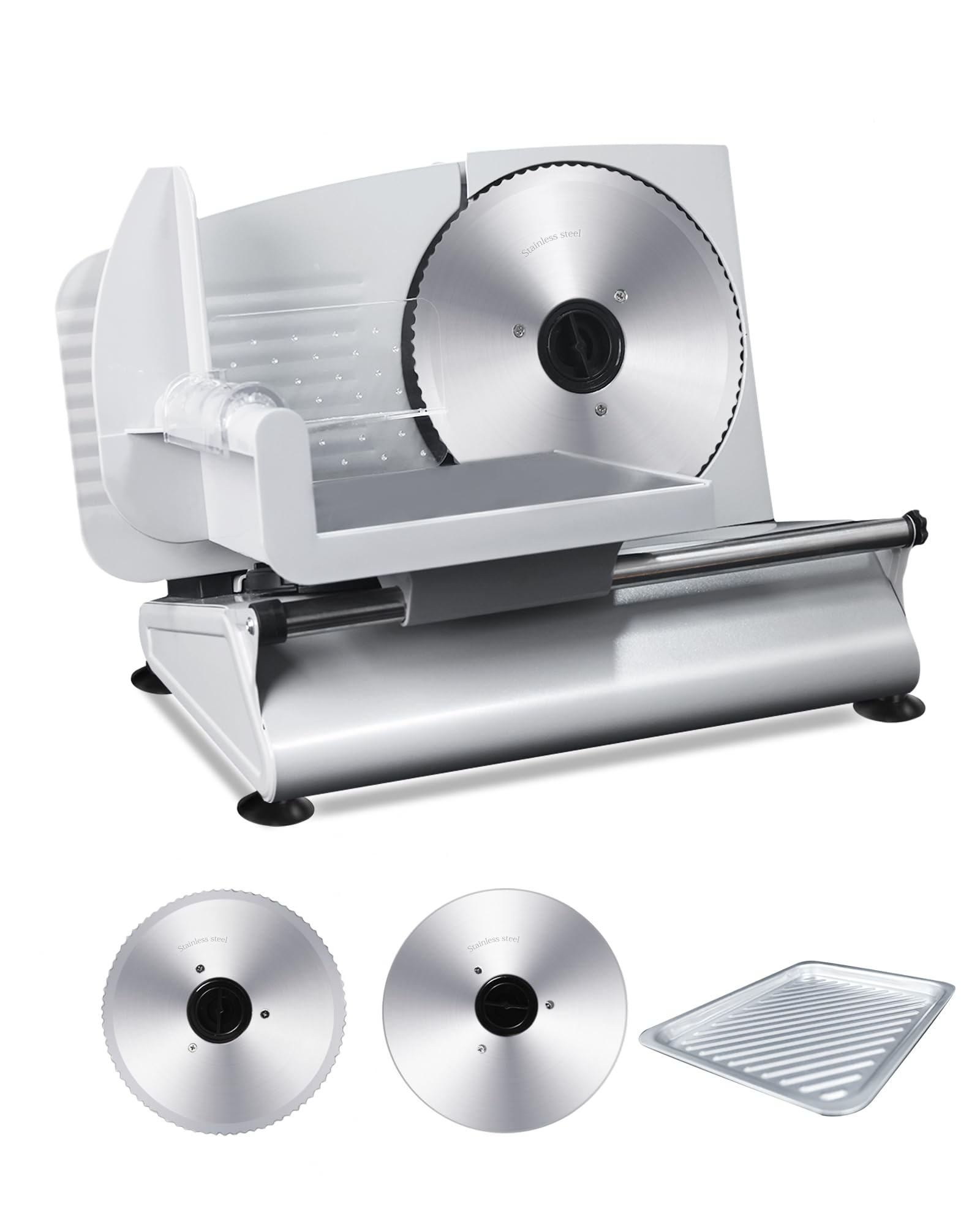
This slicer shows up with a very specific kind of happy owner: the person who wants thin meat slices for hot pot at home, or who loves ultra-thin beef carpaccio-style cuts. When it’s set up right and the meat is at the right firmness, users report clean, uniform slices—and they love the included accessories (extra blade, tray) that make the process feel more complete.
The child lock start is a confidence feature, especially if you have kids around or you’re nervous about accidental starts. The bigger “expert note” is cleaning: owners are honest that it’s a pain. That’s not unique to Pterying—most slicers require careful cleaning— but the key is to protect the gearing and motor area from water while still sanitizing food-contact zones thoroughly. Use a damp cloth (not dripping), a brush for crevices, and sanitize deliberately.
There’s also a very real “new machine smell” note with some slicers: initial operation may produce a warm smell due to manufacturing grease. It typically fades. The best practice is short initial runs, then a proper wipe-down. After that, the machine becomes a predictable part of your meal prep routine.
Why hot pot cooks love it
- Thin slicing potential – Great for hot pot-style meats and carpaccio-style cuts.
- Child lock start – Adds control and reduces accidental activation.
- Accessories included – Extra blade and tray improve workflow and reduce mess.
- Compact but sturdy – Feels solid for its intended home tier.
Good to know
- Cleaning is detailed; keep gearing area dry and use a brush for seams.
- Capacity is limited—expect to cut larger meat into manageable sections.
- Best results come from chilled/firm meat and steady, not rushed, strokes.
Ideal for: hot pot lovers, thin-slice enthusiasts, and anyone who values safety features—provided you accept that thorough cleaning is part of slicer life.
13. SupMaKin Manual Fresh Meat Slicer (17‑in‑1) – Fast Strips and Slices Without a Motor (Handle With Respect)

Manual multi-blade cutters are a totally different category. When they work, they’re wildly efficient: multiple slices in a single stroke, consistent thickness, and no motor noise. Some owners are genuinely surprised by how effective it is for jerky prep or Philly-style thin meat slices—especially when the meat is chilled and firm. The suction base is often praised for gripping hard, which is essential for safety and clean cutting.
But here’s the part you must take seriously: this style is dangerous if you treat it casually. Multiple blades mean multiple chances to get hurt, especially during cleaning. People who have good experiences follow the “safe hand placement” instructions strictly, use the recommended meat firmness (often slightly firm/chilled), and clean slowly with extreme care. If you’re someone who rushes kitchen tasks, this is not the category to “try for fun.”
It also has capacity limits. You’ll cut smaller pieces, not long Korean BBQ strips. The payoff is consistency—great for batch jerky or meal prep when you want repeatable slices. Think of it as a specialty tool, not a universal slicer replacement.
Why people love it
- Fast output per stroke – Multiple slices quickly without electricity.
- Consistent thickness – Great for jerky prep and uniform cooking slices.
- Small and storable – Tiny footprint and easy to keep in a drawer.
- Suction base stability – When engaged, it can grip very firmly.
Good to know
- This is a high-risk tool if handled carelessly—cleaning requires extreme caution.
- Works best with small pieces of chilled fresh meat; not for deli meats.
- Not ideal for long strips; expect to portion meat first.
Ideal for: experienced, careful cooks who want fast, consistent fresh meat slicing for hot pot or jerky—without committing to an electric machine.
How Home Meat Slicers Actually Work (and Why Some People Get Perfect Slices While Others Get Shreds)
If you take one idea from this whole guide, make it this: slice quality is a system. The same slicer can produce beautiful deli-thin roast beef in one kitchen and torn, uneven slices in another—because the user, food temperature, blade choice, and pressure create the outcome. This section is the “secret sauce” that turns a decent slicer into a great experience.
1. The “firm-but-not-frozen” rule
A slicer blade wants something firm to cut against. Soft meat compresses, smears, and tears—especially on serrated blades. That’s why the most consistent home results usually come when:
- Cooked meats are fully chilled (overnight in the fridge is ideal for roast slicing).
- Jerky meats are partially frozen so the muscle fibers hold shape instead of collapsing.
- Cheese is cold so it shaves cleanly rather than gumming up.
- Bread is fully cooled so the crumb doesn’t compress and stick.
2. Pressure is the silent slice killer
Home slicers aren’t built for deli-counter force. When you press hard:
- The fence can flex (creating wedge-shaped slices).
- The thickness setting can drift slightly under force.
- Meat can “ride” or bounce instead of cutting cleanly.
- The machine can slide, which is both annoying and unsafe.
Your goal is a steady, gentle feed. Think: “guide the food,” not “push the food.” If you need to push, the food is usually too soft, too large for the tray, or you’re using the wrong blade.
3. Serrated vs smooth—use them like pros do
Serrated blades are amazing for crusty bread because the teeth grab and saw cleanly. But those teeth can also grab soft meat fibers and tear them. Smooth blades are the “deli blade” for a reason: they shear cleanly and produce nicer edges on meats and cheese.
- Serrated: bread, some firm vegetables, crusty items.
- Smooth: cooked meats, deli slicing, cheese, most precise thin cutting.
4. Make cleanup fast by designing your “slice station”
People who love their slicer almost always do this: they make slicing a small system instead of a chaotic one-off event. Try this setup:
- Catch zone: place a tray or cutting board to catch slices (avoid “slice onto the counter”).
- Backstop towel: place a folded towel behind the blade area to reduce fling mess.
- Brush nearby: keep a small brush (even a cheap toothbrush) within reach.
- Gloves ready: cut-resistant gloves make cleaning faster because you’re not timid.
- End routine: unplug, thickness to zero, wipe, brush, sanitize, dry, store.
5. The sanitation mindset that keeps slicers from “smelling weird”
A slicer is food-contact equipment. That means you want a consistent cleaning habit after slicing meat, especially raw or juicy foods. Wash removable parts, wipe down non-removable areas carefully, and sanitize food-contact surfaces. The goal is not perfection—it’s consistency.
6. What not to slice
- Bones: slicers are not bone saws.
- Rock-hard frozen blocks: let meat soften slightly so the blade can cut without burning or chattering.
- Super wet, delicate bread: it can crumble and smear; let it cool and firm first.
Master these basics and you’ll get better results from any slicer—especially the compact home models. Now let’s wrap it up with quick answers and a clear “buy this for your life” ending.
FAQ: Meat Slicers at Home (Without the Confusion)
Do I actually need a meat slicer, or is a good knife enough?
Why does my slicer shred meat instead of cutting it cleanly?
Do I need a 10-inch slicer for home use?
Serrated or smooth blade: which one should I use?
How thin can home slicers really slice?
Can I slice cheese without making a mess?
What’s the fastest way to clean a slicer properly?
Is a manual multi-blade slicer a safe alternative?
How do I keep my slicer from sliding on the counter?
What should I buy if I want the most “deli-like” results at home?
Final Thoughts: Choose the Slicer That Fits Your Real Life
A great slicer isn’t the one with the most marketing. It’s the one that makes you think, halfway through your prep, “Wait… this is actually easy.” Here’s how to translate everything above into a confident purchase.
- Want the best all-around “big jump” for a serious home kitchen? Start with the VEVOR 10″ slicer. It’s the kind of upgrade that makes slicing feel stable and consistent, especially for roasts and batch prep.
- Want the most “pro tool” feel for long-term slicing? The BESWOOD250 is built for people who slice often and want the machine to feel like it belongs in a serious prep routine.
- Want premium slicing but with a quieter, smoother vibe? Look at the KWS MS-10NT 10″ if low-noise operation matters in your home.
- Want a strong brand-name mid-tier slicer that doesn’t dominate your kitchen? The Weston 9″ class slicer is a reliable “serious home” choice for meats, cheese, and bread.
- Want a solid, confidence-building home slicer with safety-lock start? The TOKASS 200W is a strong option for roast leftovers and sandwich slicing habits.
- Want a manual option for fresh meat strips and hot pot slices? The SupMaKin manual cutter can be extremely effective—if you’re careful and disciplined.
Here’s the final truth: the best meat slicer for home use is the one that matches how you actually cook. If you slice weekly, jump into the heavier tiers and enjoy the stability. If you slice occasionally, prioritize easy storage and simple operation. Either way, chill your food, choose the right blade, and slice with calm pressure—and you’ll get that clean, deli-style result that makes the purchase feel instantly worthwhile.
