
Specs are compiled from manufacturer listings and verified buyer reviews and can change over time — please confirm the key details on the product page before buying.
You do not need to spend a fortune to stop feeling watched in your own yard. The cheapest privacy fix is a reed or ivy roll zip-tied to a fence you already own, and the top pick here does exactly that for around the cost of a takeaway dinner. If you would rather have something freestanding that never needs a tie, a metal or cedar panel costs more but lasts far longer. This guide sorts out which path fits your yard.
I’m Mohammad Maruf — the founder and writer behind KitchPrep. This guide is built by comparing the manufacturers’ published specifications and the patterns across verified customer reviews, so you get each pick’s real strengths and trade-offs instead of marketing spin.
You will see exactly how much coverage each screen gives you and where the honesty gaps sit. The trick with a low-budget backyard privacy screen is knowing whether you are buying a full wall or just a thick curtain.
Our Picks at a Glance


How To Choose The Best Low-Budget Backyard Privacy Screen
The fastest way to pick wrong is to buy on height alone. Two screens can both stand four feet tall and still behave completely differently, because the number that decides whether your neighbor sees you is total coverage — the square footage the roll or panel actually fills. A 16.4-foot roll that is four feet tall covers a lot of fence line but leaves a wide gap at the top; a short two-panel cedar kit covers a small footprint completely.
Match the screen to what you are hiding behind
If you already have a chain-link or wood fence, a roll you tie on is the cheapest win and the trim-to-fit job takes minutes. If you have nothing to tie to, or you are screening an air-conditioning unit or trash cans, a freestanding panel or no-dig cedar kit is the better spend because it stands on its own. Think about what the screen is blocking before you think about the material.
The blackout number nobody reads
Reed and ivy screens are sold on how much view they block, and that figure is rarely total. A screen rated at 80% blackout stops the sun and most of the view but still lets light through — handy for reading, less handy if you want to be invisible. If full screening matters, plan to layer two rolls, or step up to a solid panel that blocks the view outright.
Staking, wind, and the storm question
Any screen light enough to hang by hand is light enough for wind to push around. Tied rolls stay put because the fence carries them; freestanding panels need their base anchored or weighted. Before you buy, work out whether you are willing to stake or weigh something down, because a screen that lifts in a gust is worse than no screen at all.
Quick Comparison
| Model | Best For | Type | Coverage | Assembly | Amazon |
|---|---|---|---|---|---|
| Natural Reed Fencing 4FT x 16.4FT★ Best Overall | Renters covering an existing fence line | Reed roll | 65.6 Square Feet | Zip ties included | Amazon |
| VEVOR Artificial Ivy Privacy Fence ScreenMost Realistic Look | Hiding a chain-link fence with greenery | Faux ivy panel | 48 Square Feet | Zip ties needed | Amazon |
| VEVOR Natural Reed Fencing 5.5ft x 16.4ftBest for Tall Boundaries | Taller screening on a garden boundary | Reed roll | — | Zip ties and 502 glue | Amazon |
| Amagenix Patio Shades Roll Up Outdoor Blinds | Shading and screening a porch or deck | Roller shade | 96″ x 96″ | Hardware included | Amazon |
| Artificial Ivy Privacy Fence Screen 40″x140″ | Covering a balcony railing or gate | Faux boxwood panel | 39 Square Feet | Zip ties and connectors | Amazon |
| 72″ Outdoor Privacy Fence Screen Metal Panel | Screening a patio corner that stays open-looking | Freestanding metal | 45.6″ x 71.9″ | Labeled parts, tools needed | Amazon |
| Enclo Charleston Privacy Screen Cedar Wood Kit | Low screening around utilities with airflow | Cedar no-dig kit | 42″ x 38″ | ~45 mins, no digging | Amazon |
| FENCY Metal Freestanding Outdoor Privacy Screen Panels | Decorative freestanding screening with color | Freestanding metal | 72″ H × 47″ W | Screw assembly, three panels | Amazon |
In‑Depth Reviews
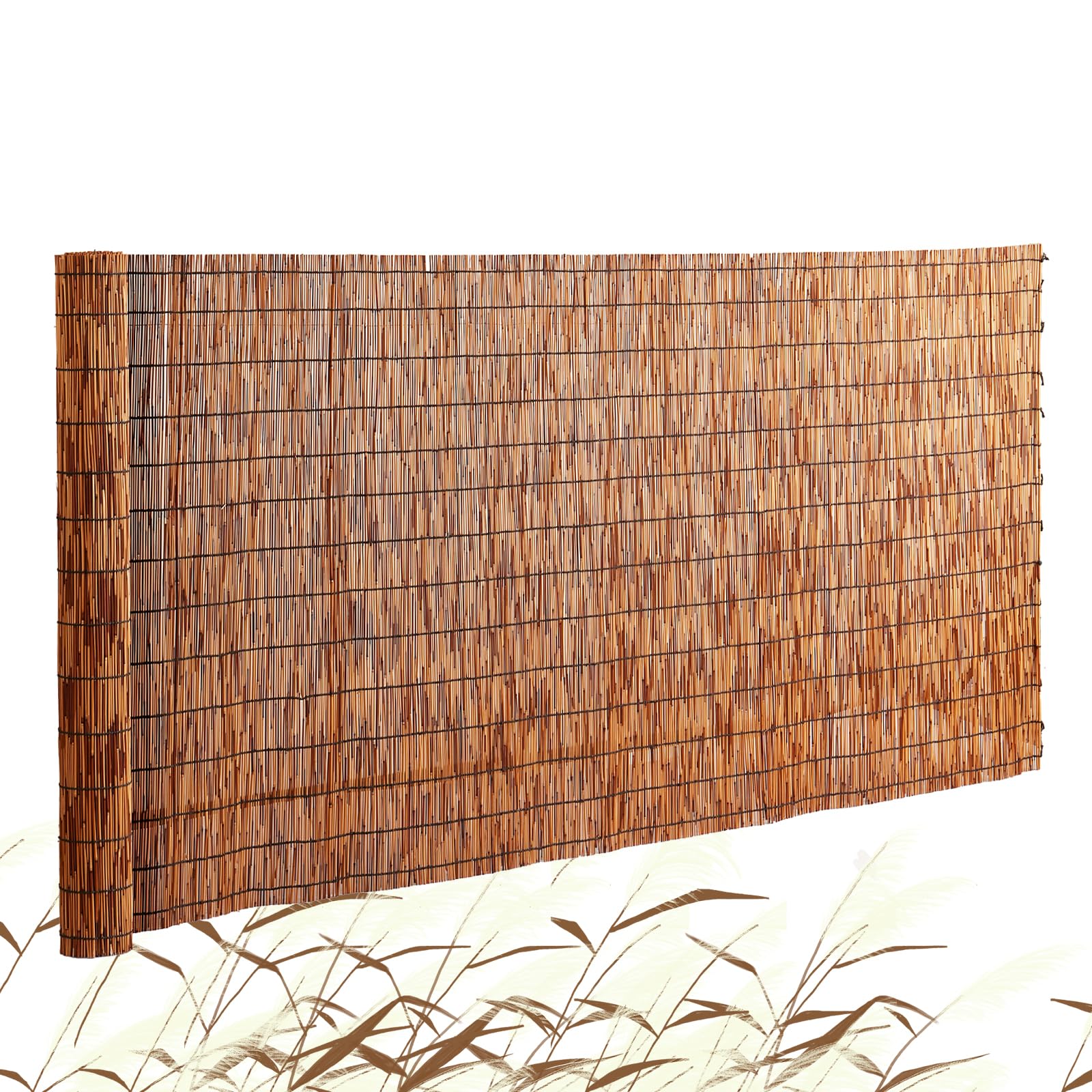
1. Natural Reed Fencing 4FT x 16.4FT Reed Screen
The cheapest way to hide a fence line behind something that looks like a garden.
The number that earns this one first place is 65.6 square feet of coverage from a single roll — deeper coverage than the VEVOR faux ivy panel, which fills 48 square feet of the same kind of fence run. That is roughly a third more screen from one box, and it is why this is the pick that covers the most ground per purchase of anything tied on a fence. You get one 16.4-by-4-foot roll plus 100 zip ties in the box, so a single person can fix it to a railing or post with no tools beyond the ties.
The reed itself is natural, woven with cotton thread rather than wire, which means it will not rust in the rain the way metal-thread fencing tends to. The listed 80% blackout blocks the sun and the neighbor’s view while still letting light through, so you can sit outside and read without sitting in shade. One-buyer feedback worth knowing: nobody who owns these describes them as a solid wall. The weave lets wind pass through rather than catching it, and layering two rolls turns a mostly-blocked view into a fully blocked one — the fix the review pages keep landing on when one roll feels too open.
What buyers talk about more than anything else is the build quality of the reed itself, with the value for money running a close second in the praise. It arrives tightly packed, and the honest trade-off is thinness — the reeds are not the thick bamboo stakes you see at a garden centre, so if you are after something that feels substantial in the hand, this will feel light. The surface can carry slight burrs, so wear gloves while installing, and a few owners note that the thinner stalks may not last through a brutal winter without being brought in.
What sells it
- 65.6 square feet from one roll — the widest single-roll coverage on this list.
- 100 zip ties included, so one person can hang it without buying extra hardware.
- Cotton thread instead of metal wire, so it will not rust in rain.
- 80% blackout lets daylight through while blocking the neighbor’s view.
Where it asks for patience
- Open weave means a single roll is not full screening — plan on a second layer.
- Thin reeds feel light and give little wind resistance on their own.
- Edge burrs mean gloves are a sensible install-day habit.
- Fragile enough that bending it hard while positioning can crease the weave.
Buy it if: you have a fence, railing, or post already in place and want the most square feet of coverage for the least outlay.
Think twice if: you need a total blackout on day one — this one is at its best with a second roll layered behind it.
2. VEVOR Artificial Ivy Privacy Fence Screen, 96 x 72 in
The greenery that turns a bare chain-link fence into a hedge a neighbor will compliment.
This is the option that claims 100% blockage, and that is the whole pitch: leaves packed closely enough to form a barrier that stops harsh sun and unwanted views. The 96-by-72-inch panel is built on silk cloth leaves over plastic frames with a PE mesh backing, and because the leaves sit dense, the screen reads as a solid hedge from the street even though the mesh behind still lets air move through. Faux foliage needs no watering, trimming, or pruning, which is worth something if you have killed a hedge before.
The realistic look is the second-most-praised thing about it, right behind the overall build. It arrives rolled to keep leaves from shedding in transit, and buyers report four pieces arriving in good shape — well-attached, sturdy, leaves staying put. Coverage is where the math gets interesting: at 48 square feet this panel covers less ground than the 65.6-square-foot reed roll above, but it does more per square foot because it blocks rather than filters. It installs horizontally or vertically, takes zip ties (not included) in a few minutes, and can be cut to fit a gate.
The recurring gripe across the review pages is durability — a handful of owners mention their panel falling apart within a year, and in a heavy wind the faux foliage can lift or shed leaves during install, so extra ties are the smart move. A few owners also had trouble with the snaps and connectors between panels lining up, which is a two-minute fix with black zip ties. It is worth saying plainly: this is a decorative screen, not a load-bearing fence, and it will not stand up to a storm the way the metal panels further down this list do.
Reach for this if: you want a fence covering that looks grown rather than bought, and you are happy adding a few extra ties when you hang it.
Look elsewhere if: you need something that shrugs off coastal wind for years — that is a job for steel or cedar.
3. VEVOR Natural Reed Fencing, 5.5ft x 16.4 ft
The taller reed roll for garden boundaries where four feet of screen does not cut it.
When four feet of reed leaves your neighbor’s upstairs window with a clear view of the patio, this is the step up: 5.5 feet tall across 16.4 feet of run, woven from 100% natural reed with cotton thread and closed tightly enough that it claims virtually no gaps. The weave is the point here — the tighter the reeds sit, the less daylight and the fewer eyes get through. It blocks debris and animals, holds its shape in a strong wind, and trims to fit an irregular corner with a simple cut and knot.
Install runs on the same system as the roll above: 100 black binding straps are in the box, and the maker’s advice for the cut edges is a dab of 502 glue before it dries and you trim. It weighs 14.1 pounds, which is light enough for one person to lift the roll into place but heavy enough to need a support to tie against. Appearance is the clear winner in the review pages — the color and the natural finish come in for steady praise, with the two-tone design singled out as a detail that makes the roll look considered rather than cheap. It gets its own look on a raised pond or work table, not just a fence line.
Here is the honest catch, and it is the same one the cheaper reed roll carries: reed is a curtain, not a wall. Owners describe the reeds as spaced wide enough that a determined eye still gets through, and one buyer was blunt that the gaps between reeds were as wide as the reeds themselves. If privacy is the whole job rather than the main job, order a second roll and layer it, or step up to a solid panel. As a decorative screen that breaks up a view and cuts the worst of the sun, it does exactly what the price promises.
The height advantage: 5.5 feet of tall reed across 16.4 feet of run covers the upper gap the shorter rolls leave — the reason to pick this over the cheaper reed roll above if your sightline is improve.
Read the fine print on privacy: the maker calls it tightly woven, but reed is naturally spaced, so treat this as shade and partial screening rather than full block-out.
Best pick for: a garden edge or pond surround where you want height, a natural smell, and a roll you can trim to shape.
Set your expectations: you will still see daylight — and a little of next door — through the gaps.
4. Amagenix Patio Shades Roll Up Outdoor Blinds, 8′ W x 8′ H

Not a fence at all — a roll-up shade you crank down when the sun and the street get too close.
Everything else on this list is a static screen. This one moves. The Amagenix rolls down on a wand-operated manual crank to a full 8 feet by 8 feet, then rolls back up when you want the light and the breeze, which makes it the only pick here that changes shape with the day. The fabric is 220 GSM 100% pure non-recycled HDPE — a dense knitted polyethylene — and it blocks 90% of UV rays while cutting glare and heat at the same time. On a west-facing deck that turns into an oven around five in the afternoon, that combination of shade and screening is doing two jobs with one panel.
The build quality is the runaway favorite in the review pages, with the ease of installation right behind it. Owners describe fitting it themselves — expect two people and a ladder for a job this size, since the 8-foot template needs holding — and the result is a porch that feels cooler and reads as private from both sides. It is not fully opaque, but two-way privacy is the point, and owners on hot-climate decks report a noticeable temperature difference once it is down. The detachable roll stick is a nice touch for stowing the fabric on a windy day.
Two things to plan for. First, it is mounted and held in place by hardware and gravity rather than staked into the ground, so it holds up well in a moderate breeze but is not built for stronger winds left down — many owners roll it up ahead of a storm. Second, the accessories are good but not complete for every install: the mounting template helps, and reviewers flag the lack of a centre bottom tie-down as the one addition they would make. Order it knowing you may want two extra hands on install day and a tie-down point once it is up.
Made for: a porch, pergola, or carport where you want shade you can raise and lower, not a permanent wall.
Skip if: you need a screen staked into soil and forgotten — this one wants to be rolled up before the wind picks up.
5. Artificial Ivy Privacy Fence Screen, 40″x140″ (39 SQFT)

The densest leaf panel here, and the best cover for a balcony railing.
Five thousand six hundred fake leaves packed onto a four-layer panel is the headline, and it is the number that separates this from the thinner ivy screens. Each panel runs 40 inches by 140 inches and covers 39 square feet, and the leaf build has a 3D depth to it that reads as a hedge rather than a printed mat. It is made from new PE — a flexible plastic that the maker says resists ultraviolet light and will not fade or wither within three years — and it is treated to be flame retardant. The leaves are attached to a base plate rather than stapled on, which is the design detail that keeps them from shedding in a breeze.
Assembly and appearance are what the review pages reward most here, alongside the quality of the leaf build. Panels interconnect and splice into a larger wall, come with 50 zip ties, and cut down easily with scissors or a utility knife to fit a railing or gate. The bottom plate is porous, so rain drains instead of pooling. On a fifth-floor patio railing it does a neat double job — screening the view and stopping a cat from lunging at birds. Plan a fluffing session before you hang it: the leaves arrive flattened by the packaging, and standing them up by hand or leaving the panel in the sun for one to three hours brings the density back.
The genuine friction is assembly time. Splicing many small pieces into one panel is slow, fiddly work, and the review pages are open that snapping panels together by hand for a large job leaves your fingertips sore and the process running into hours rather than minutes. The fluffing step adds to it. The upside is the finished panel: it looks dense enough to fool a passerby even if it reads as fake up close, and a single panel trims cleanly to a balcony width. If you are covering a long fence run rather than a railing, the reed roll above is the faster buy.
Reasons this earns its spot
- 5,600 leaves across 39 square feet — the densest leaf coverage on this list.
- PE construction the maker says holds color for three years without fading.
- Leaves attached to a base plate rather than stapled, so they stay put.
- Cuts with scissors or a utility knife to fit any railing or gate.
What to budget for
- Splicing many panels is slow, tedious work and tough on fingertips.
- Leaves arrive flattened and need a fluff — sun or a hairdryer brings them back.
- Small panels mean a wide fence run takes several boxes to screen fully.
- Looks artificial at close range even though it reads real from a distance.
Strongest match for: a balcony, railing, or short gate where density matters more than sheer area.
Reconsider if: you are screening a long fence line and do not fancy hours of snapping small panels together.
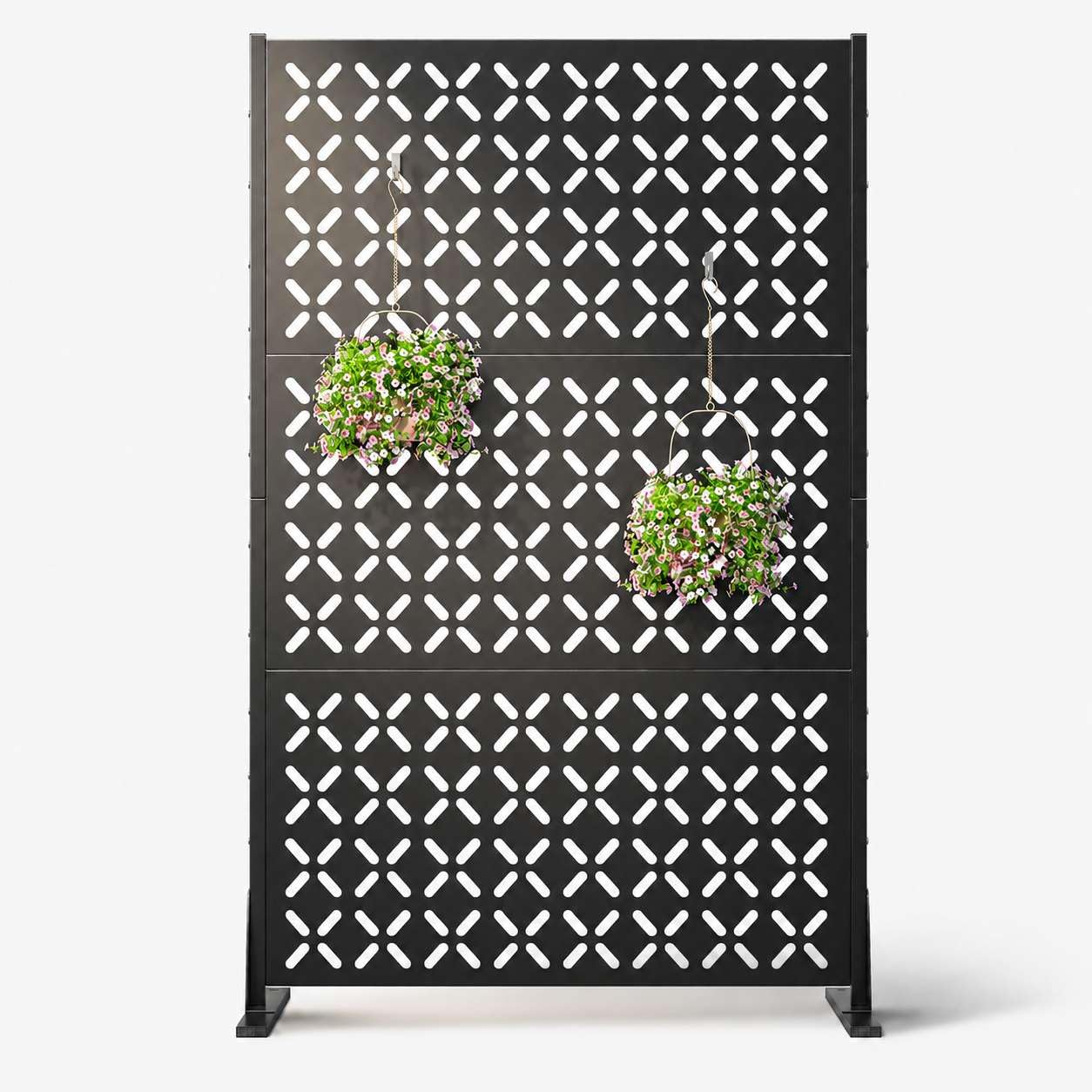
6. 72″ Outdoor Privacy Fence Screen Metal Panel
The one that stands up on its own and still looks like a design choice, not a barrier.
This is where the list leaves rolls behind. Three connected powder-coated steel panels form one screen measuring roughly 45.6 inches wide by 71.9 inches high, standing on wide 19.7-inch support feet so it holds itself up without a fence to lean on. The open geometric pattern is the clever part: it blocks the view while letting light and air through, so a patio does not end up feeling like a shed. That same open design cuts wind pressure compared with a fully solid panel, and the included ground stakes or expansion hardware let you anchor it to a suitable surface before a storm.
What people respond to is the look. The modern decorative design comes in for the most praise in the review pages with the build quality right alongside it — reviewers describe it as looking better in person than in the photos, sitting sturdy on its base, and doing good double duty screening trash cans and air-conditioning units. Assembly is labeled, so the parts and hardware carry matching letters to line up with the illustrated instructions, and an electric screwdriver speeds it up. Expect a couple of hours if you are working solo, and less with a second pair of hands and a bit of creativity on the second and third panels.
The trade-off is weight and weather. It arrives as 38.4 pounds of steel, so it is not something you move around on a whim, and while the structure is sturdy, the review pages do note that a panel that takes a fall can bend — treat it as a fixture rather than something to drag across the patio. For a small outdoor space where you want real standing privacy with an airy look, it earns the premium spend.
The right call when: you have no fence to tie to and want a screen that stands, looks sharp, and screens a seating or trash area.
Know before you buy: at 38.4 pounds with an open lattice, it is a fixture to anchor, not a screen to shove around when the wind changes.
7. Enclo Concord Privacy Screen, Cedar Wood DIY No Dig Kit

Real cedar, no digging, and the quickest way to hide an ugly air conditioner.
If the job is screening something specific rather than covering a whole boundary, one cedar panel beats a long roll every time. This kit assembles into a 60.5-inch-high by 38.6-inch-wide screen — about 5 feet of height for real privacy around a patio, deck, or garden — and it is FSC certified wood, so no two boards share the same grain, finish, or knot pattern the way printed vinyl panels do. That natural variation is why owners say it looks more expensive than it costs. Assembly runs about 90 minutes with a mallet and the included ground stakes tapped straight into the soil, so there is no digging involved.
Ease of assembly is the single most-praised thing about this panel, with the appearance a close second. It goes together fast after the first panel teaches you the rhythm, and it is designed to park in front of the things you do not want to look at — AC units, trash cans, pool equipment, children’s toys. Owners also note the cedar smell, which is a nice bonus for the first few weeks. Once built, you can stagger several panels a few feet apart to screen a narrow walkway, or line them up for a longer visual wall.
The honest caveats are wood’s. It needs a transparent or semi-transparent exterior stain about every six months to keep its natural look, and a few owners found the top boards split near the screws during gentle hammering, while others found it needed extra posts to firm up in wind. Stability shows up as the one clear weak point — several owners reinforced the base — so plan to stake it well and re-check it after the first windy week. It is a small, attractive, well-priced panel that wants a little maintenance in return.
Why it earns the spend: real cedar in a no-dig kit removes the hardest part of a wood privacy project — the post hole — and turns it into a 90-minute job with a mallet.
The upkeep clause: bare cedar wants a stain every six months and a firmer base than the kit provides, so treat this as a screen to tend, not to forget.
Serious contender for: hiding a single eyesore — an AC unit, bin store, or pool pump — with a wood finish that matches the rest of the yard.
Pass on it if: you want zero maintenance — wood needs a regular stain and a sturdier stake than the kit ships with.
8. Enclo Charleston Privacy Screen, Cedar Wood, DIY No Dig Kit

The low cedar kit built for air conditioners — slatted to keep the unit breathing.
Here is the smaller, faster sibling of the cedar panel above, and the difference is worth understanding before you pick. This kit builds into two panels totalling 42 inches high by 38 inches wide — about 3.5 feet of low screening — and it goes together in roughly 45 minutes using the same mallet-and-stakes, no-dig method. Same FSC certified cedar, same natural grain differences that separate real wood from a printed panel. The slatted design is the reason to choose this over the taller version when the thing behind it needs to breathe: owners picked the slatted face specifically to keep airflow to an air-conditioning unit while screening it from view.
Ease of assembly leads the praise in the review pages, with the appearance close behind, and the material quality gets a steady mention for the real wood and metal construction. Owners describe the look as clean and professional once finished, and the low profile makes it just as happy screening a set of bins or an electrical box as it is an AC condenser. Because it is only 3.5 feet tall, it is the pick for screening the base of something rather than a person’s eye line — which is exactly the job most people buy it for.
Two honest notes. The cedar here is light and thin, so a few owners found it needed anchoring or landscape staples to sit firmly, and this one asks for good judgement on placement. And like any bare wood outdoor piece it takes an exterior stain about every six months to keep its color, unless you are content to let it age grey. For a low, adjustable, real-wood screen that arrives as two panels and goes up in under an hour, that is a fair trade.
The airflow angle: the slatted face keeps an AC unit or electrical box screened without smothering it — the exact reason owners choose this over a solid panel.
The mounting reality: light cedar and a low 3.5-foot profile mean you will want to stake or weight the base rather than trust bare ground.
Fits best when: you are hiding an air conditioner, bin store, or utility box and want real cedar with airflow, up in under an hour.
Not for: eye-level privacy or a boundary wall — at 3.5 feet tall, this screens the base of things, not a whole yard.
9. FENCY Metal Freestanding Outdoor Privacy Screen Panels

The panel that reads as art from the street and screens the window from inside.
This is the most decorative screen on the list and it wears that on purpose. Each package holds three separate printed metal panels measuring 72 inches high by 47 inches wide in total, plus a set of stands and the screws to assemble them. The printing uses non-volatile inks with no harmful emissions, and the metal is finished to resist scratches, water, and sunlight so the image will not fade — which is why this one suits anyone who wants their privacy screen to double as a feature wall rather than something to hide. It installs vertically at adjustable heights of 72 inches or 76 inches, or horizontally for hanging or wall mounting.
What lands with owners is the finish and the look; quality runs alongside appearance as the most-praised pair in the review pages. People use it to keep window shades open without losing privacy, and it fits neatly lined up with privacy planters. It is a real wall-mountable divider, not a freestanding base panel, so it hangs on a fence, a courtyard wall, or a set of stands and can be used indoors as a room divider as readily as it screens a deck.
Two things to go in knowing. Assembly splits opinion — the hardware is many small nuts and bolts and it takes a while to put together, which some owners find easy and others find a chore. And it is light for a metal screen, so in a strong-wind spot it wants to be anchored or weighted at the base rather than trusted to stand alone; owners in exposed spots added blocks or brackets. Both are small trade-offs against a screen that looks this good and never needs a second thought about fading.
What it sells on: a printed metal face that will not fade in sun, scratch, or rust, mountable at 72 or 76 inches tall or laid horizontally — a screen that looks like decor.
The honest limit: light for metal and long on assembly steps, so anchor the base and set aside an afternoon with the screwdriver.
The pick for: a wall or courtyard where you want a screen that looks deliberate and needs no maintenance beyond the occasional wipe.
Give it a miss if: you want a panel that stands solid in open ground with no anchoring — this one is lighter than it looks and wants to be fixed down.
Understanding the Specs
Coverage in square feet
This is the number that actually tells you how much fence line a screen fills. It is the panel’s length multiplied by its height, so a long low roll and a shorter tall roll can end up nearly equal. Read it before you read the height — a roll claiming 16.4 feet of length still leaves a gap if it is only four feet tall, while a taller roll covers more of the sightline. When a screen is sold by dimensions rather than square feet, do the same thinking yourself.
Blackout and UV-block percentage
A screen’s blackout figure is how much of the view it stops, and a UV number is how much sun it blocks. An 80% blackout reed screen still lets light and a little of the view through, which is perfect for a shady reading spot; a claimed 100% blockage is a solid screen meant to stop the view entirely. The higher the percentage, the less airflow and daylight you get, so choose based on if you want to be hidden or to feel shaded but open.
Fabric weight, density, and UV resistance
On rolls and shades, a gram-per-square-metre figure signals how thick and heavy the material is, and heavier fabric tends to hold up better in sun and wind. Density on a leaf panel — the number of leaves packed onto it — decides whether it reads as a hedge or a sparse mat. UV resistance is why some panels hold their color for seasons while cheaper ones go pale within a month, so it is worth checking on anything left outdoors year-round.
Anchoring and how it holds in wind
The lighter the screen, the more it needs pinning down. Tied rolls rely on the fence behind them for stability; freestanding panels and shade blinds rely on their base or fittings. Ground stakes, cinder blocks, or brackets are all ways to stop a screen lifting or bending in a gust, and any screen described as freestanding still benefits from being anchored before storm season arrives.
FAQ
How do I stop a privacy screen seeing through in daylight?
Will a privacy screen survive the wind?
How many square feet do I need to cover my fence?
Cedar, reed, or metal — which holds up best outdoors?
Do these screens need to be dug into the ground?
Is reed fencing really waterproof?
How long does it take to install one of these screens?
Can a privacy screen keep an air conditioner or bin store out of sight?
Will an artificial ivy screen survive icy cold or baking heat?
Is it cheaper to layer two rolls or buy one taller screen?
Final Thoughts: The Verdict
For most yards, the low-budget backyard privacy screen winner is the Natural Reed Fencing 4FT x 16.4FT because it lays down 65.6 square feet of natural screen for the least outlay and comes with the ties to hang it — the crowd favorite at 4.6 stars across 300+ owners. If you want greenery that reads as a hedge on a bare chain-link fence, grab the VEVOR Artificial Ivy Privacy Fence Screen. And for hiding an air conditioner or bin store with real cedar up in under an hour, the Enclo Charleston Cedar Kit is the one to reach for.
How We Picked
We do not accept paid placement. Every pick is matched to a real buyer and a real use-case; we do not hands-on test units.
Sources & Methodology
Specifications: manufacturer listings and product documentation. Review insights: verified customer reviews, as of September 2026. Pricing: not shown on this page (it changes often); check the current price via the retailer link.
As an Amazon Associate, KitchPrep earns from qualifying purchases. This does not affect which products we feature.
Related Guides
