
Deep-frying at home has a reputation problem. People picture a greasy pot on the stove, oil smell that hangs around for days, and a mess that makes you swear you’ll “just use the air fryer next time.” But here’s what experienced home cooks learn pretty quickly: the problem usually isn’t frying. The problem is using the wrong tool for the batch size you actually cook.
If you’re searching for the best large deep fryer, you’re not chasing novelty—you’re chasing stability. Stability means the oil doesn’t crash in temperature the moment you drop in cold food. It means breading turns crisp instead of soggy. It means fish stays flaky instead of soaking up oil. And it means you can feed a family (or a small crowd) without standing there for an hour doing tiny batches like you’re running a one-person restaurant.
This guide is built around real-life friction points—things owners talk about after the honeymoon phase: the unit that heats fast but can’t recover between batches, the lid vent that sends steam straight into your cabinets, the “nice” digital panel you can’t read in normal kitchen light, the oil drain that’s great… until it’s not, and the double-tank fryer that seems genius until you realize your outlet setup can’t support it.
You’ll find 16 carefully-chosen options below: premium countertop fryers with oil filtration, high-capacity prosumer machines, true commercial-style tanks for big weekend fry-ups, an outdoor propane workhorse for pop-up style volume, and a couple of “smart simple” classics that people keep rebuying because they just… work.
In this article
How to Choose the Best Large Deep Fryer
A “large” fryer should do one thing exceptionally well: keep your food crisp, consistent, and fast across multiple batches. That sounds simple, but it’s where most deep fryer buying guides fail—because they focus on box features instead of the real-life chain of events that creates great fried food: preheat → drop → recovery → drain → repeat. Here’s the decision framework I use when I want you to end up with a fryer you’ll still love after the third big fry night.
1. Define “large” the way a cook experiences it
Marketing makes “large” sound like a number. In real kitchens, “large” is a feeling: how quickly you can finish the meal and how consistent each batch tastes. Two fryers can claim similar capacity while behaving completely differently.
- Food capacity is about the basket, not the tank: A wide, deep basket lets you fry chicken pieces without stacking them, so steam can escape and crust can set.
- Oil capacity is about stability: More oil is thermal mass. Thermal mass is what keeps your oil from crashing in temperature when you add food.
- Work surface is about workflow: Lids that open cleanly, baskets that hook to drain, and tanks that lift out without drama—these are “large” features because they let you keep moving.
2. Heat recovery is the whole game
If you remember restaurant fries as crisp and “dry” (in the best way), that’s mostly recovery. When you drop food into oil, the oil temperature drops. If the fryer recovers quickly, moisture flashes off as steam, crust sets, and the food doesn’t drink oil. If recovery is slow, food sits in lukewarm oil—steam becomes soggy condensation, and you get greasy results even if you “set the right temperature.”
- Higher wattage helps, but element design matters: Immersion-style heating elements and well-positioned coils deliver faster, more even recovery than weak, exposed designs.
- Thermostat behavior matters: Some dials run slightly hot or slightly cool. That’s not always bad—what matters is consistency and cycling behavior batch to batch.
- Large fryers can still fail at recovery: A big tank with weak heat can feel “large” but cook like a small fryer. You’ll see that in owner feedback: “heats up fine… but struggles after the first batch.”
3. Decide if you want “set-and-forget” or “cook-led control”
There are two good philosophies. The right one depends on how you cook.
- Set-and-forget comfort: You want a stable thermostat, a clear timer, a lid you can keep closed, and minimal fuss. This is where premium home fryers shine (think: refined baskets, predictable cleanup, safe lids).
- Cook-led control: You’re okay watching a thermometer, nudging heat, and managing oil like a pro. Outdoor propane fryers live here, and they can be beasts in the best way—especially for volume.
4. Your oil strategy should pick the fryer (not the other way around)
Most people buy a fryer and then panic about oil. Flip that. Decide your oil strategy first, then buy the fryer that supports it.
- If you want low-mess oil reuse: Look for built-in filtration or a drain/pour setup that’s genuinely easy to use.
- If you’re okay filtering manually: Favor removable tanks, smooth corners, and baskets that don’t shed crumbs everywhere.
- If you fry breaded foods often: You need a plan for crumbs. Burnt crumbs are the #1 cause of “my oil smells bad fast” and “everything tastes bitter.”
- If you want two oils: Dual tanks let you keep one “clean oil” (fries/dough) and one “savory oil” (fish/chicken) so flavors don’t collide.
5. Electrical reality: large fryers can be demanding
This is where people get surprised. Many large countertop fryers are powerful enough that your outlet setup matters. Some dual-element units have two plugs because they’re meant to split the load. If you ignore that and run everything on one circuit, you may trip breakers—or worse, stress wiring.
- Single-plug models: Usually simpler for most kitchens.
- Two-plug / dual element models: Often incredible performers, but you must plan where you’ll plug them in.
- Outdoor propane models: Skip indoor electrical issues entirely, but require outdoor-only discipline and temperature monitoring.
6. Safety isn’t a feature list—it’s a behavior list
Almost every fryer here has some combination of cool-touch handles, locking lids, or overheat protection. But the safest fryers are the ones that make safe behavior easy: a basket that drains without you hovering, a lid that reduces splatter, a stable base, and a cord that can’t yank the unit off the counter.
- Breakaway magnetic cords: They can be short and sometimes annoying—but they’re designed to prevent tipping if the cord is snagged.
- Overheat shutoff: Especially important on high-capacity units where a dry tank mistake can be costly.
- Vent direction: A small detail that becomes a big deal if steam blasts into cabinets or walls.
If you only remember one thing: big-batch frying is not about having “more room.” It’s about having more consistency. Choose the fryer that protects your oil temperature, your workflow, and your patience.
Quick Comparison: 16 Best Large Deep Fryer Picks
Use this table to quickly match a fryer to your cooking style, then jump to the full reviews for the details that matter in real life— like recovery behavior, oil handling, outlet planning, and what owners consistently praise (or complain about) after months of use.
On smaller screens, swipe or scroll sideways to see the full table.
| Model | Fryer type | Big-batch strength | Best match | Amazon |
|---|---|---|---|---|
| All-Clad Easy Clean Pro (3.5L) – Oil Filtration | Electric home | Premium build + “filter & store” oil workflow that reduces mess | Families who fry often and want cleanup to feel effortless | Amazon |
| EGGKITPO 10L Single Tank – Prosumer Countertop | Electric prosumer | Large single tank + timer + strong heat for frequent big batches | Home cooks who want “small shop” performance on a counter | Amazon |
| VEVOR Dual Tank Electric (2 × 11L class) | Electric commercial | Two tanks for flavor separation + strong heat for “fish fry night” volume | Hosts, fundraisers, and semi-commercial weekend cooking | Amazon |
| HTTSICHI 22L (3 baskets) – Massive Indoor Batch | Electric commercial | Big tank + multi-basket flexibility for large gatherings | Serious batch fryers who want capacity without going outdoors | Amazon |
| VEVOR Outdoor Propane Dual Tank (4 gal total) | Outdoor propane | High heat potential + outdoor volume with independent fire control | Outdoor cooks, pop-ups, and anyone who wants to keep frying outside | Amazon |
| Pocezo 24QT (3400W) – Huge Basket Setup | Electric commercial | Extreme capacity with multi-basket options for big party batches | Experienced users who want size and will plan power & handling carefully | Amazon |
| OSTBA 20.7QT (3200W) – Home-Friendly Commercial Size | Electric commercial | Fast heat + removable tank for frequent big-batch home frying | Families who fry often and want “bigger than big” capacity | Amazon |
| KHTD Dual Tank 12L class (3400W total) | Electric dual | Dual-tank flexibility with solid performance for moderate volume | Home + small venue use where you’ll often run one tank at a time | Amazon |
| Cuisinart CDF-200P1 (4 quart) – Big-Brand Workhorse | Electric home | Immersion heating element for strong recovery + easy cleaning | Most families who want a proven home fryer with real capacity | Amazon |
| HTTSICHI 12L Single Tank (1700W) – Compact Commercial Style | Electric prosumer | Single-tank simplicity + sturdy stainless build for consistent batches | Home cooks who want commercial feel without massive footprint | Amazon |
| Presto Kitchen Kettle XL (10-quart) – Multi-Cooker & Fryer | Multi-cooker | Wide, pot-style capacity + nonstick cleanup + multi-use cooking | Families who want one big vessel that can fry and do more | Amazon |
| Hamilton Beach 35042 (5L) – Huge Family Basket | Electric home | Large basket + lid + dishwasher-friendly parts for family portions | Family meals where you want easy draining and less splatter | Amazon |
| Hamilton Beach 35034 (4.5L) – 3 Basket Flex | Electric home | One large + two small baskets for timing and flavor separation | Fish + fries nights and families who hate batch juggling | Amazon |
| Vexon 5L (3 baskets) – View Window Value | Electric home | Three-basket versatility + easy teardown cleaning at a friendly size | Hosts who want flexibility without commercial bulk | Amazon |
| Chefman 4.5L – Accurate Dial, Strong Recovery | Electric home | Dial accuracy + quick recovery + wide basket for breaded foods | Home cooks who want reliable crispness without fiddly tech | Amazon |
| Presto GranPappy – Low-Oil Classic | Electric simple | Fast preheat + stores oil with lid + minimal parts to fight | Families who want easy fries and don’t need huge commercial volume | Amazon |
In‑Depth Reviews: 16 Large Deep Fryers That People Actually Enjoy Owning
Now we’ll go model by model. I’m not going to talk like a spec sheet—I’m going to talk like someone who has to live with the fryer: where it sits, how it drains, how it recovers, what it feels like on a busy night, and what you should know before you commit.
1. All-Clad Easy Clean Pro – The Premium “Fry Often, Clean Once” Machine

If you deep fry more than “once in a while,” the All-Clad has a superpower most big fryers don’t: it treats oil as part of the workflow, not an afterthought. The built-in filtration and oil storage system changes the emotional cost of frying. Instead of a messy, end-of-night oil transfer you dread, it becomes a controlled routine: cool the oil, switch to filtration, let the unit do the work, and store the oil for next time.
Owners consistently point to the same two wins: fast heat and solid recovery, and cleanup that doesn’t feel like punishment. That matters because large fryers live or die by whether you’ll actually use them. It’s easy to buy a high-end fryer. It’s harder to love it six months later when you’re wiping down fingerprints, draining oil, and trying not to spill. All-Clad’s build quality (sturdy walls, secure handles, refined fit and finish) is the “quiet luxury” that makes repeated use feel normal.
The real-life friction points are also important to know up front. A few owners mention the timer interface is not the most flexible (set it carefully), and the display can be hard to read in less-than-perfect lighting. There’s also a practical tip that shows up repeatedly: when pouring oil back from the storage container, hold the lid firmly so it doesn’t loosen mid-pour. None of these are dealbreakers—but they’re exactly the kind of tiny realities that separate a “great on paper” fryer from a “great to own” fryer.
Why you’ll like it
- Oil filtration that actually changes your habits – Less mess means you’ll fry more often (and enjoy it).
- Strong heat behavior – Heats up quickly and rebounds well when adding food.
- Easy-clean architecture – Many components are designed for simple cleanup and less “grease archaeology.”
- Premium stability feel – The whole unit feels confident and sturdy when handling hot oil.
Good to know
- Display visibility can be fussy in dim lighting—plan your fryer spot under good light.
- Be intentional when pouring oil from the storage container (hold the lid tight).
- Vent placement can send steam toward the back—avoid tight cabinet clearance.
Ideal for: frequent home fryers who want premium performance and a cleanup workflow that makes frying feel sustainable.
2. EGGKITPO 10L Single Tank – “Small Shop” Output in a Home-Friendly Footprint

This is the kind of fryer people buy after they’ve outgrown “cute countertop” models. A 10L-class single tank is where frying stops being a snack machine and starts being a real production tool: chicken pieces fit without being stacked into a steamy pile, fries can spread out, and you can keep a rhythm going without the oil feeling exhausted after one drop.
What owners love most is the combination of quick heating and predictable control. The timer is a genuine quality-of-life feature when you’re juggling batter bowls, trays, and draining racks. Several buyers describe “restaurant-style results” at home—crispy outside, tender inside—especially for fried chicken and dough. They also mention the build feels sturdy and the removable pieces make cleanup feel manageable for the size.
The real-world caution is exactly what you’d expect from a prosumer unit: you need to treat setup and handling with respect. A few owners note packaging/condition issues (occasionally arriving with cosmetic marks), and the included documentation isn’t always “home-cook friendly.” That doesn’t change performance—but it means you should already be comfortable with frying basics: don’t overload the basket, keep food dry, and give the oil time to recover between drops. Once you do, this fryer rewards you with volume that feels effortless.
Why it’s great for big nights
- Large single-tank capacity – Great for wings, fish fillets, fries, dumplings, and party snacks.
- Timer + temperature control – Helps you stay consistent across batches.
- Sturdy stainless structure – Built to feel more “equipment” than “appliance.”
- Good recovery habits – Designed for repeated drops without constant frustration.
Good to know
- Documentation can be light—this is better for confident cooks than absolute beginners.
- Like all big tanks, it needs thoughtful storage space when not in use.
- Best results come from batching smart, not stuffing the basket to the brim.
Ideal for: home cooks who want bigger, more consistent batches and don’t mind owning a fryer that feels like real kitchen equipment.
3. VEVOR Dual Tank Electric – The “Fish Fry Night” Setup With Flavor Separation

Dual-tank fryers are misunderstood. People buy them thinking “double the output,” then get annoyed because it “uses a lot of oil.” The right way to think about a dual-tank fryer is: control. Control of flavor. Control of timing. Control of workflow when you’re trying to serve food hot, not “whenever the last batch finishes.”
Owners who love this style typically use it like a mini kitchen line: one tank for fries/hush puppies/onion rings, one tank for fish/chicken/shrimp—or one tank kept as a “clean oil” for dough and desserts. That separation is how you keep fries from tasting like last weekend’s fish and how you keep breading crumbs from destroying a delicate donut batch. When you get it right, the fryer feels genuinely restaurant-like: steady heat, fast recovery, and the ability to keep food moving.
The key real-life detail: power planning. Big dual-element units often need sensible outlet use (sometimes two separate outlets/circuits). If you try to run everything through a single overloaded setup, you’ll trip breakers and blame the fryer when the real issue is electrical reality. Owners also mention it cleans up well for the size thanks to removable parts and a drain design—but like all bigger equipment, cleaning isn’t hard so much as it is “a step you plan for.”
Why it’s a crowd-feeder
- True two-zone cooking – Run seafood and fries without flavor bleed.
- Strong heat performance – Designed to bring oil up quickly and keep it there.
- Built-in timers – Helps keep batch rhythm steady when you’re busy.
- Drain-friendly design – Oil changes and cleanup are more manageable than you’d expect.
Good to know
- It’s best for people who will truly use two tanks (or at least value the option).
- Plan outlet usage before you buy—big units can stress a casual setup.
- Not intended for nonstop heavy commercial volume; treat it as “serious home/medium duty.”
Ideal for: hosts and families who do frequent fish fries, parties, or events and want two-tank control more than “one big tub.”
4. HTTSICHI 22L (3 Baskets) – Big Tank Energy Without Going Outdoors
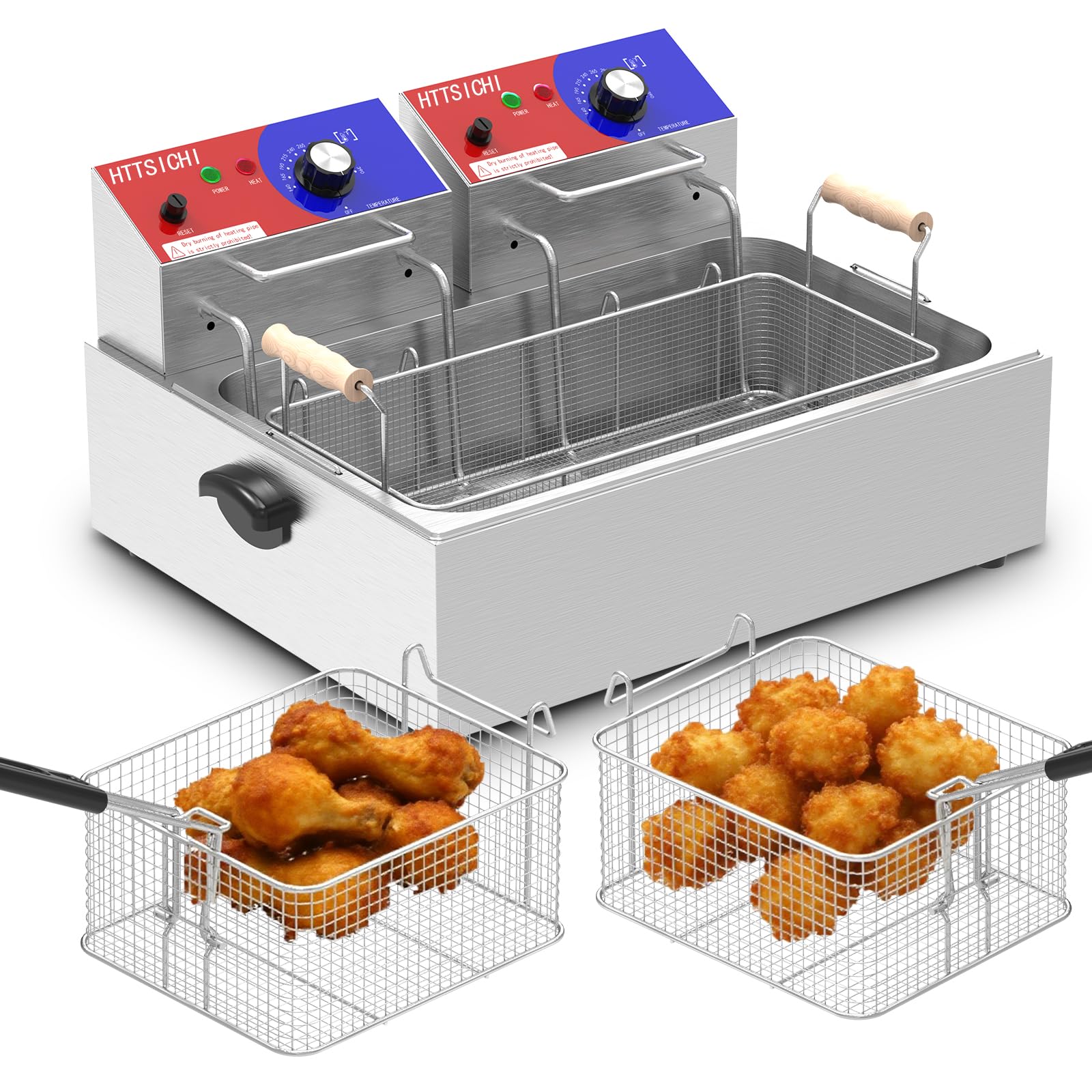
If your idea of “large” is frying a whole spread for a gathering—multiple pounds of wings, a mountain of fries, a tray of shrimp, or a big batch of fried dough—this is the kind of unit that finally makes it feel easy. A 22L-class tank paired with multi-basket options is basically the “catering brain” approach: you can choose the basket that matches the batch, keep cook times separated, and avoid turning your fryer into a cramped steamy stack.
Where this style shines is rhythm. Big tank + strong heat means you can run batch after batch with less waiting, and the built-in hangers for draining mean you’re not hovering with tongs trying to drip oil back into the tank. Owners tend to describe results as consistently crispy and even—exactly what you want when you’re serving people and can’t afford a weird undercooked batch.
The real-life tradeoffs are simple and honest: it’s big equipment. You need counter space, storage space, and a plan for oil handling. And because high-power fryers are demanding, you also need to be intentional about where and how you plug it in. If that doesn’t scare you, the payoff is huge: you stop “making fried food” and start “running a smooth fry station.”
Why big-batch cooks love it
- Massive tank capacity – Great for gatherings and repeated batches without constant waiting.
- Three basket options – Perfect for managing timing (small batches vs large drop).
- Even heat distribution mindset – Designed to keep results consistent across the tank.
- Detachable parts – Makes cleanup realistic for a fryer of this scale.
Good to know
- Requires real counter/storage planning—this isn’t a “tuck it in a drawer” appliance.
- Oil handling is part of ownership; you’ll want containers and a routine.
- Best for confident users who already understand batching and crumb management.
Ideal for: serious home fryers and hosts who want the biggest indoor capacity and the ability to serve a crowd efficiently.
5. VEVOR Outdoor Propane Dual Tank – The High-Heat, Keep-It-Outside Solution
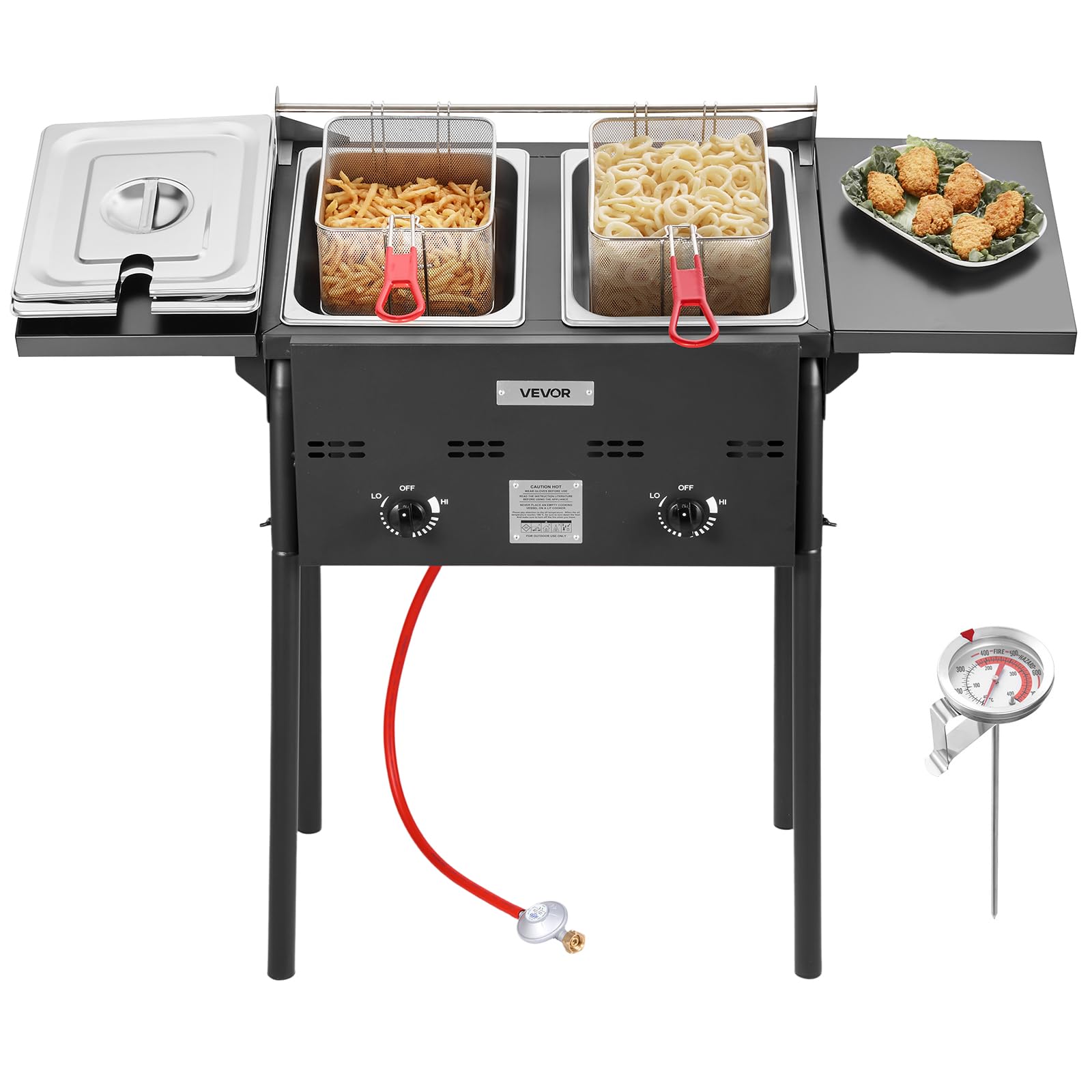
Some people don’t want to “manage frying indoors” at all. They want the smell outside, the mess outside, the heat outside, and the ability to run serious volume without caring about indoor outlets. That’s exactly where an outdoor propane dual-tank setup shines.
The biggest mindset shift: this is not an “appliance.” It’s closer to a cooking station. You’re controlling flame and monitoring temperature with a thermometer, like a cook would. Owners who love it describe it as sturdy, powerful, and capable of keeping up with high-volume demand—especially for fries at events and repeated back-to-back batches where weak electric units would struggle to recover. The side tables are not fluff; they’re workflow: trays, breading, tongs, salt, draining racks—all within reach.
The caution is equally real: no thermostatic babysitting means you must pay attention. That’s not hard, but it does require adult focus and a safe outdoor setup. Wind baffles help maintain steady heat, but you still cook with your eyes and thermometer, not just a dial. If you want the “most control” and the “most volume” while keeping everything outdoors, this style is incredibly satisfying.
Why outdoor fryers win
- High heat potential – Great for fast recovery and large volume frying.
- Two tanks, independent control – Run two foods or two oils without compromise.
- Outdoor-only convenience – Keeps smell, splatter, and heat out of your kitchen.
- Workstation features – Side tables and hangers make it feel like a real setup.
Good to know
- This is thermometer-led cooking—there’s no automatic thermostat to save you.
- Outdoor-only discipline matters: stable surface, safe spacing, careful handling.
- Oil tank metal can be thinner than premium commercial units—treat it with care over time.
Ideal for: outdoor cooks, big gatherings, and anyone who wants serious frying volume without indoor smell or electrical limits.
6. Pocezo 24QT (3400W) – A Giant Frying Basin (With “Respect the Power” Energy)

A 24QT-class fryer is for people who don’t want “a little more.” They want the kind of basin where you can fry for parties and stop thinking about whether you can fit the food. In the best-case scenario, this is the tool that makes your fry night feel effortless: steady heat, a lot of room, and baskets sized to handle real volume.
But here’s the expert truth: the bigger the fryer, the more it demands discipline. Owners highlight two realities: first, electrical setup matters (many large dual-element units are designed to split load across outlets), and second, build details matter because you’re handling large amounts of hot oil. Some feedback includes very serious safety concerns (including reports of malfunction and extremely sharp tank edges). That doesn’t mean every unit behaves that way—but it does mean you should approach a giant fryer like you would any powerful piece of equipment: inspect it carefully on arrival, handle the metal edges respectfully, and never shortcut the outlet guidance.
If you do those things, this style of fryer can be exactly what you want for football parties and big weekends: big basket space, rapid heating, and enough oil volume to keep temperature more stable during a full drop. If you want maximum peace of mind, you may prefer a premium home model or a more established commercial-style unit with stronger track record.
Why it’s tempting
- Huge capacity – Great for large gatherings and high-volume frying.
- Multi-basket flexibility – Helps manage timing and multiple foods.
- Strong heating design – Built to bring oil up quickly and maintain it.
- Commercial-style layout – More like equipment than a small home appliance.
Good to know
- Power planning is non-negotiable—don’t run heavy load through a single casual outlet setup.
- Some owner feedback raises safety/build concerns—inspect carefully and handle edges with care.
- This is better for experienced users who already have safe frying habits.
Ideal for: experienced batch fryers who want extreme size and will approach setup, inspection, and power planning seriously.
7. OSTBA 20.7QT (3200W) – Big Capacity That Still Feels Usable at Home
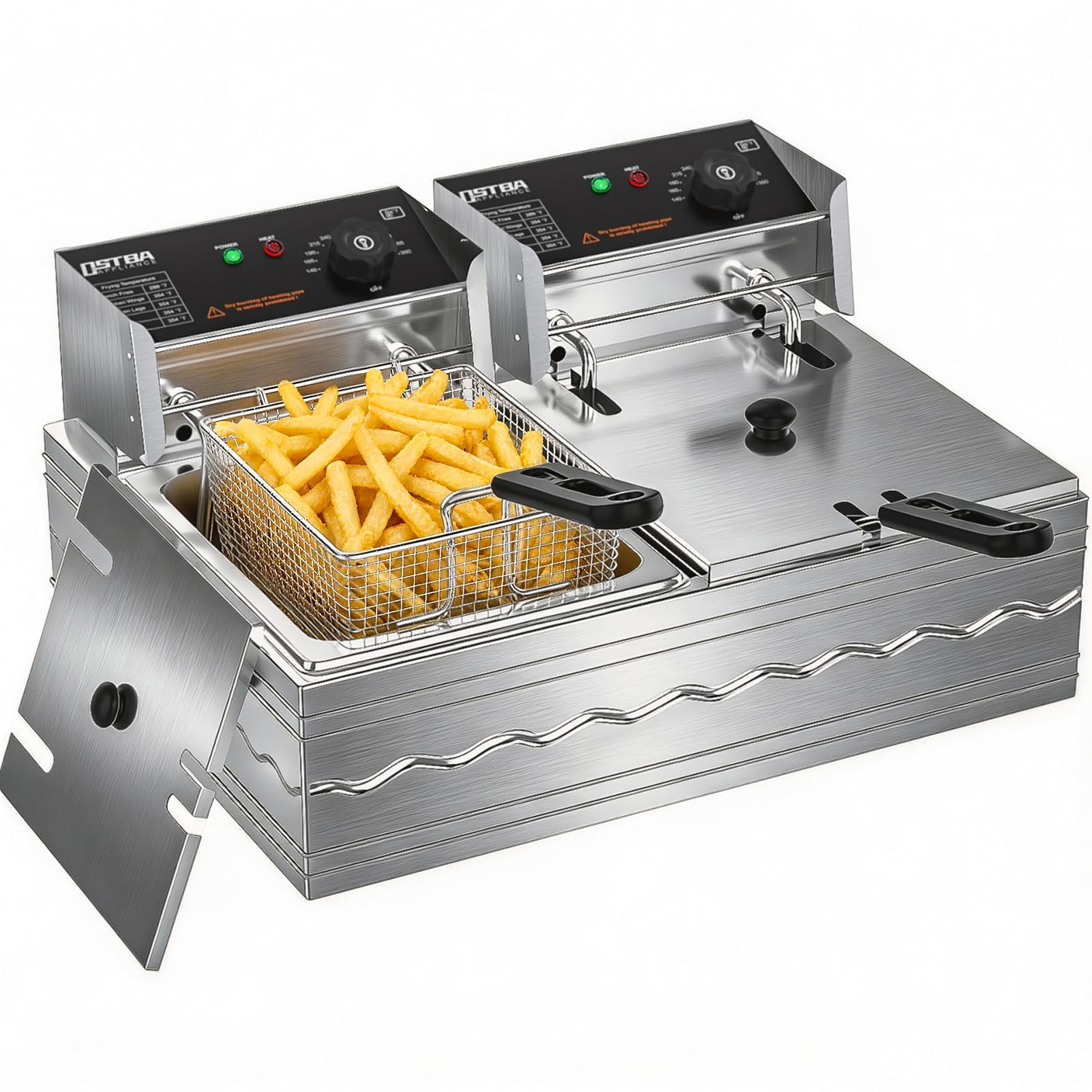
This is a “big tank” fryer that’s trying to be realistic for home kitchens: large enough to feel commercial, but designed around removable parts so cleanup and oil changes don’t feel impossible. Owners describe a familiar pattern: quick warm-up, steady heat, and consistent crispness across fries, chicken, and snacks. That steadiness is the real luxury of a larger unit—less babysitting, fewer surprise soggy batches, and a smoother rhythm when people are hungry.
What I like about the design mindset is how it supports repeat use. The removable basket and oil container make it easier to keep the fryer clean and “ready for next time,” which matters because the biggest reason people stop deep frying is not taste—it’s cleanup dread. The stainless exterior also makes wipe-down feel straightforward, which is exactly what you want after frying something breaded.
Because this is a large, powerful countertop unit, the pro move is to treat it like equipment: give it a stable home spot, plan for storage if you don’t keep it out, and build an oil routine (container, strainer, and a habit of letting crumbs settle before filtering). Do that, and you get a fryer that can handle back-to-back batches without feeling like it’s running out of breath.
Why it works for big batches
- Fast heating + steady temperature – Helps produce consistent crispness across foods.
- Removable tank design – Oil changes and cleanup are less intimidating.
- Stainless durability feel – Built for frequent use rather than occasional novelty.
- Great for gatherings – Large enough to reduce batch fatigue.
Good to know
- Big footprint—measure your counter and storage spot before buying.
- Large fryers reward good oil habits (crumb control, filtering routine, patient cooling).
- Like any high-power unit, give it a sensible electrical setup and breathing space.
Ideal for: families who fry often and want a large, steady fryer that doesn’t feel like a nightmare to clean and maintain.
8. KHTD Dual Tank 12.7QT Class – Dual-Tank Convenience Without Going Full Industrial

This is a very “real world” fryer category: dual-tank, strong heat, and enough capacity to feel like you can cook for a group— but still manageable for home and small-venue use. Owners who like it often describe it as a little workhorse: heats quickly, is easy to take apart, and makes it possible to run two different foods without cross-flavoring.
The most important pattern in owner feedback is also the most important buying tip: many people discover they don’t actually run both tanks at the same time because of oil volume and power draw. And that’s okay—because even if you run one tank most of the time, the second tank is still valuable as a choice: you can keep one side as “clean oil,” or keep one side empty until a party night.
If you’re considering this style, go in with a smart expectation: it’s great for occasional extended sessions (a fundraiser day, a busy lounge night, a big family gathering), but it may not be designed for nonstop heavy-duty commercial grinding every day. Used in its sweet spot, it’s a very satisfying step up from small home fryers.
Why it’s useful
- Dual-tank flexibility – Great for flavor separation and timing control.
- Fast heat behavior – Designed for repeated batches.
- Easy teardown cleaning – Owners like that it comes apart and cleans up well.
- Moderate-service friendly – Works well for events and busy weekend cooking.
Good to know
- Many users end up running one tank at a time—plan for that reality.
- Like other large units, outlet/circuit planning matters if you run full power.
- Stainless may feel lighter than premium “tank-like” units—treat it gently.
Ideal for: home cooks and small venues that want dual-tank flexibility, but don’t need heavy nonstop commercial output.
9. Cuisinart CDF-200P1 – Fast Recovery, Simple Controls, Family-Sized Output

This is the kind of fryer people buy when they want something that feels straightforward and capable: strong heat-up, solid recovery, and a size that makes sense for a family meal without turning your kitchen into a concession stand. The immersion-style heating element is the key performance piece—fast heat-up and the ability to rebound between batches so your fries don’t go limp and your breading doesn’t soak.
Owners often describe it in refreshingly simple terms: “it works.” That sounds basic, but it’s actually high praise in fryer-land. It means the basket drains well, the food comes out crisp, and cleanup is manageable enough that people keep using it. The removable enamel-coated oil container helps with oil handling and makes the unit easier to wash than many “fixed tank” designs.
The honest long-term note you’ll see in feedback is reliability variability—some users report heating element failures after extended use. But the interesting part is that some of those same people still buy the same model again because they like the cooking results that much. That’s a signal: when it’s working, it’s one of those “why did we wait so long?” fryers. If you want to maximize lifespan, treat it gently, keep it clean, and avoid running it in ways that stress the element (like aggressive overloading and constant high-temp cycling).
Why families like it
- Strong recovery behavior – Immersion heating helps keep oil temperature stable.
- Simple, usable capacity – Enough for family batches without huge equipment vibes.
- Easy cleaning design – Removable oil container and dishwasher-friendly parts help.
- Great “classic frying” results – Fries, fish, chicken, donuts—works across foods.
Good to know
- Some owners report element longevity issues—treat it well and avoid abusive overloading.
- Magnetic cord can be short; choose your counter spot intentionally.
- If you crave dual-tank separation, this is a single-tank workflow (still very effective).
Ideal for: families who want reliable home-scale volume with strong heat performance and no complicated learning curve.
10. HTTSICHI 12L Single Tank – A Clean, Stainless “Upgrade” That’s Still Manageable
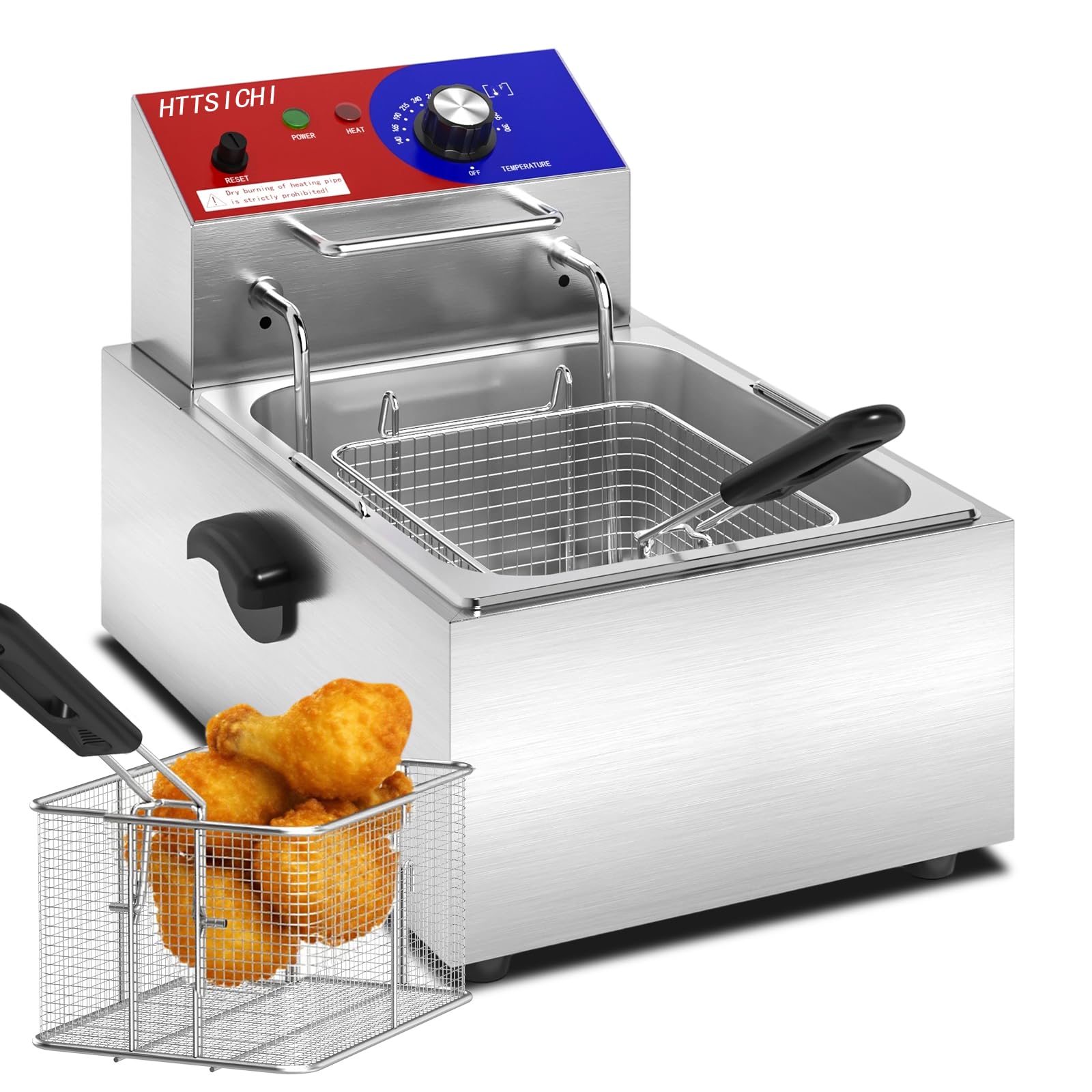
Not everyone wants a massive dual-tank unit. A lot of people want a single tank that feels sturdier than entry-level home fryers, heats confidently, and cleans up without a fight. That’s where a 12L-class stainless single tank can be a sweet spot: big enough to feel like you can cook for a group, but not so big that you need to redesign your kitchen to store it.
Owners highlight the core wins: heats up fast, holds temperature steadily, and produces crispy, even results. That “steady temperature” detail matters more than most people expect, because it’s what prevents the common spiral: first batch is great, second batch is greasy, third batch tastes like crumbs. A single tank with a clear max-fill line and a basket hanger helps you keep oil stable and drain food properly between drops.
This model’s value is simplicity. No complicated digital ecosystem. No fussy features you won’t use. Just a sturdy tank, straightforward controls, and an easy-to-clean stainless layout. If you want a cleaner, more equipment-like frying experience than a basic home fryer, this is a practical step up.
Why it’s a smart upgrade
- Simple, sturdy stainless build – Designed for repeat use and easy wipe-down.
- Consistent heat – Helps keep batches crisp instead of greasy.
- Basket hanger + lid – Better draining and less splatter.
- Good “middle size” – Big enough for gatherings, still manageable at home.
Good to know
- As a single-tank unit, you’ll manage flavor separation by sequencing (or swapping oil), not by tanks.
- Like all larger tanks, you’ll want an oil routine (cool, filter, store) to keep results clean.
- Big batches still require smart spacing—don’t stack food into a steamy pile.
Ideal for: home cooks who want a sturdier, larger single-tank fryer with a straightforward “commercial-ish” workflow.
11. Presto Kitchen Kettle XL – The Big “Pot That Fries” (And Does Everything Else)

If you want “large capacity” without owning something that looks like a restaurant machine, this is the sleeper pick. The Kitchen Kettle XL is basically a big, wide, nonstick multi-cooker that happens to deep fry extremely well. That pot-style identity is not just aesthetics—it affects how you store it, how you clean it, and how often you’ll actually use it. A lot of families like it because it doesn’t feel like single-purpose clutter.
Owners use it for big batches of frying (chicken, fish, fries, donuts) and then turn around and use it for pasta, soups, stews, steaming, blanching, and crowd cooking. The wide diameter is what makes it feel “XL”: you can spread food out, brown more evenly, and avoid overcrowding that causes sogginess. And because the pot is designed to be cleaned like cookware (with the heat control removed), people often find cleanup far easier than multi-part stainless fryer systems with hidden corners.
The honest reality is oil: a wide pot means a wide oil surface. That can mean you use more oil than you’d expect—especially if you want deep coverage for tall foods. Also, basket handle design can get hot during long sessions, so draining and lifting should be done with awareness. If you want one large vessel that can fry and also replace other big-pot duties, this is a uniquely practical choice.
Why it’s so practical
- Multi-use value – Fries well, but also steams, stews, boils, and batch-cooks.
- Nonstick cleanup – Many owners love how easy it is to wash compared with stainless fryers.
- Wide cooking surface – Helps reduce overcrowding and improves crispness.
- Looks like cookware – Easier to live with on a counter or shelf.
Good to know
- Wide shape can mean using more oil for deep coverage.
- Basket/handle ergonomics can get hot—lift and drain thoughtfully.
- If you want a sealed-lid “filter smell” system, this is more like an open cookware workflow.
Ideal for: families who want one large, versatile vessel that can deep fry big batches and still earn its space the rest of the week.
12. Hamilton Beach 35042 – The “Feed the Family Fast” Large Basket Classic

This is one of those dependable family fryers that keeps showing up in kitchens because it gets the basics right: big basket, strong heat, lid to reduce splatter, and a draining hook so you can let oil fall back into the tank instead of onto your counter. For family meals—wings, onion rings, fries, chicken tenders—this style hits the sweet spot of “large enough to matter” without feeling like commercial equipment.
Owners often talk about it as a great home deep fryer that holds temperature nicely while cooking. That’s the key phrase: “holds temp.” When you’re feeding people, a fryer that stays stable feels calmer. You can cook with less guessing, and your results stay more consistent across multiple drops. People also like that cleanup is easier than they expected because the oil tank, basket, and lid can be cleaned without complicated disassembly.
The small real-life notes are helpful: steam vent direction is something a few owners wish they could aim, and the magnetic cord can be short (a safety feature that sometimes forces you to choose a counter spot near an outlet). If you fry under a hood, this becomes a very satisfying, low-drama family fryer.
Why it’s a family favorite
- Large basket capacity – Great for family meals without endless batches.
- Lid reduces splatter – Helps keep the kitchen cleaner during frying.
- Drain hook workflow – Lets oil drip back neatly for crispier food.
- Easy-use design – Straightforward controls and manageable cleaning.
Good to know
- Steam vent direction may matter if you fry near cabinets—give it breathing space.
- Magnetic cord can be short; plan placement under good lighting and near an outlet.
- Like all home fryers, results improve dramatically when you avoid overcrowding.
Ideal for: families who want a large basket fryer with a simple, proven workflow for regular home frying.
13. Hamilton Beach 35034 (3 Baskets) – Timing Control Without the Dual-Tank Oil Commitment

Three baskets is one of those features that sounds gimmicky until you use it. The real benefit isn’t “frying more.” It’s timing control. You can drop fries in the big basket, then use the smaller baskets for quick-cook items like fish, hush puppies, or onion rings— pulling one basket without disturbing the rest. That means food hits the table hot together instead of arriving in staggered, sad batches.
Owners love the convenience: timer reduces mental load, view window lets you check without opening (which reduces splatter and heat loss), and the baskets hook to drain so you’re not juggling hot metal over a counter. People also consistently mention how much they enjoy not deep frying in a pot anymore—less mess, less stress, and better consistency.
The “real-life” negatives are also exactly the ones you want to know up front: magnetic cords can be short (and magnets can be a future wear point on some appliances), and if your kitchen lighting is dim, reading the dial can be annoying. And like any home fryer, very thick bone-in chicken can frustrate you if you expect it to cook like a pressure fryer. But for fish + fries nights, appetizers, and party snacks, this 3-basket design is genuinely useful.
Why 3 baskets matter
- Timing flexibility – Pull one basket without stopping the whole fryer.
- View window lid – Check doneness without opening and losing heat.
- Built-in draining hooks – Cleaner workflow and crispier food.
- Great for mixed meals – Fish + fries, wings + rings, snacks + sides.
Good to know
- Short magnetic cord can force placement near an outlet and under good light.
- Like many home fryers, thick bone-in chicken requires careful technique and patience.
- Oil filtering is manual—plan a simple straining routine for best flavor.
Ideal for: families who cook mixed fried meals and want better timing control without moving to a dual-tank commercial setup.
14. Vexon 5L (3 Baskets) – Versatility, Easy Cleaning, and “Old-School Simple” Controls
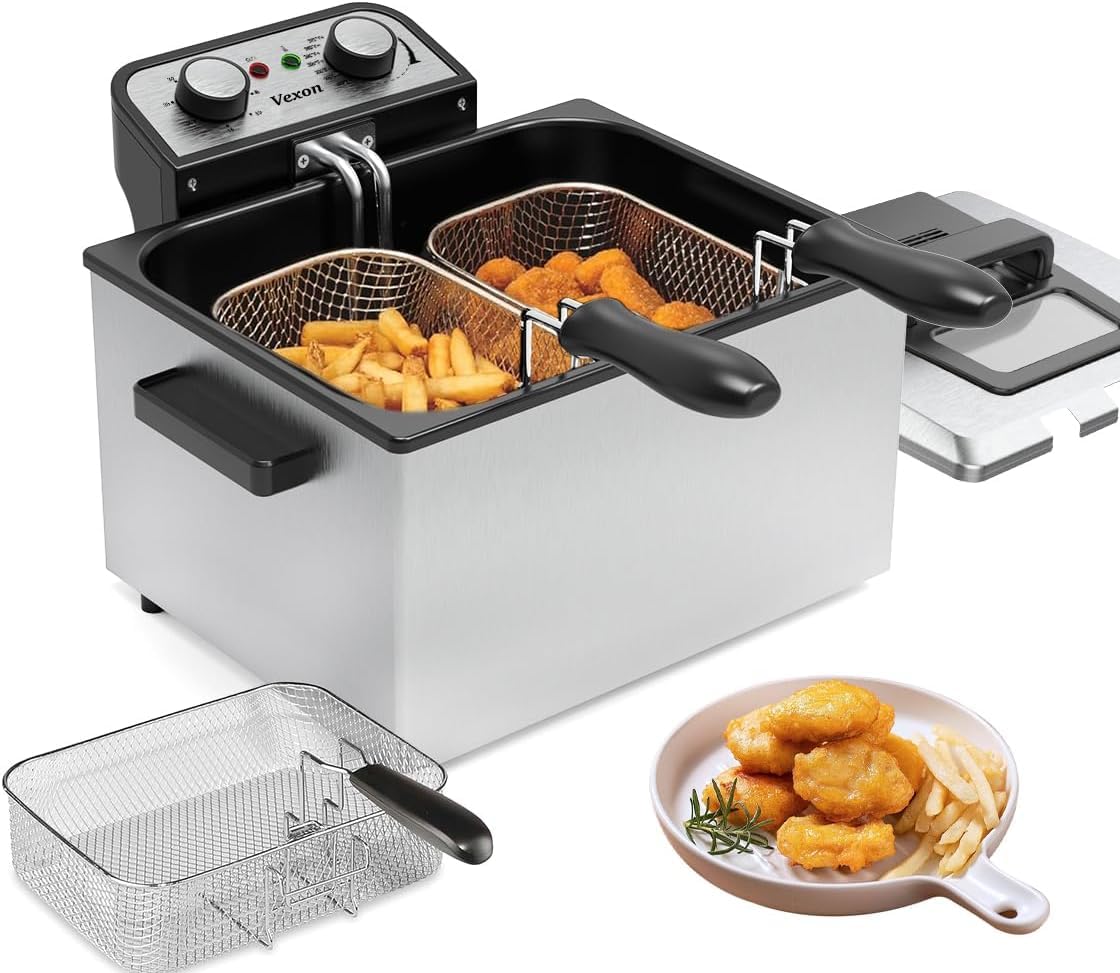
This is a great example of a fryer that wins by being useful instead of fancy. It’s a roomy 5L-style home fryer with a view window lid and three baskets (one large, two small), which is exactly the setup that makes home frying feel organized: separate foods, separate timing, less chaos. Owners repeatedly mention quick heat-up and even frying, with the baskets making it easy to manage different foods at once.
What’s especially interesting in owner feedback is the cleaning story. People who quit deep fryers usually quit because they get caked in grease and feel impossible to restore. This one is built to come apart so you can actually clean it thoroughly—an underrated design win. Several owners say they were surprised how easy it was to wash after letting everything cool and disassembling the parts.
The honest drawbacks are “quality of life” details: it has more old-school knob styling than premium brands, and because the basket can be very wide, shaking fries can sometimes splash oil if you’re not careful. There’s also a classic issue: no perfect place to rest a hot lid while you pull food. Those aren’t dealbreakers—they’re the kind of practical notes that help you set up your station (use a heat-safe plate or rack for the lid).
Why it’s a strong value
- 3-basket flexibility – Better control over timing and food separation.
- View window lid – Monitor without opening and splattering.
- Detachable parts – Makes deep cleaning realistic, which extends satisfaction long-term.
- Solid capacity – Great for families and small gatherings.
Good to know
- Old-school controls and look—more function than “premium aesthetic.”
- Wide baskets can splash if you shake aggressively; lift slowly and drain carefully.
- Plan a safe lid resting spot (simple station setup improves everything).
Ideal for: people who want flexible baskets, a view window, and easy cleaning—without stepping into heavy commercial size.
15. Chefman 4.5L – Surprisingly “Pro” Temperature Behavior for Breaded Foods

The Chefman earns loyal fans for one reason that serious fry cooks care about most: the dial tends to behave honestly. In owner feedback, you’ll see people talk about testing the oil temperature and finding the fryer actually hits what it claims. That matters because accurate temperature is the foundation of crisp, non-greasy breaded foods. If the dial lies, you end up chasing results and blaming your batter.
Another theme: recovery. Owners describe it heating quickly and rebounding well after adding food—exactly what you want for breaded okra, zucchini, mushrooms, shrimp, fish, and chicken pieces. One experienced reviewer makes a point that’s worth treating like gospel: don’t drop ice-cold food into any fryer and expect perfection. Cold food crashes oil temp and creates greasy results; letting food come closer to room temperature (safely) improves crispness dramatically. This fryer’s recovery strength makes it forgiving, but good technique still pays off.
The cleanup story is realistic: it doesn’t have a built-in drain, so you’ll use a funnel or controlled pour to move oil. But it’s designed to be easy to use, easy to clean, and safe (lid, viewing window, breakaway cord). If you want a large home fryer that behaves like a more serious unit without becoming a countertop monster, this is a strong pick.
Why it’s loved
- Accurate temperature behavior – Supports crisp results and repeatable cooking.
- Good recovery feel – Helps avoid greasy breading and limp fries.
- Viewing window + lid – Less splatter and less heat loss.
- Simple, reliable workflow – Easy to use without needing “special tricks.”
Good to know
- No built-in drain—plan a funnel/pour routine for oil changes.
- Best results come from smart batching and keeping food dry.
- Like all home fryers, crumbs at the bottom will shorten oil life—skim or filter regularly.
Ideal for: home cooks who want crisp, consistent breaded foods and appreciate a dial that behaves predictably.
16. Presto GranPappy – The “No-Fuss Fries” Classic That Stores Oil Like a Champ

This is the anti-drama fryer. No complicated UI. No endless parts. No “I need a user interface tutorial.” The GranPappy is a long-running classic because it focuses on what most people actually want: fast preheat, steady frying, and a simple way to store oil without turning your kitchen into an oil-transfer obstacle course. The snap-on lid is a big part of that story—once the oil cools, you can cover it and store the unit without leaks and lingering odor drama.
Owners who come back to this model often do so for a very practical reason: they got tired of stainless fryers that get sticky and greasy in hard-to-clean corners. With this style, cleanup can be as simple as cooling, dumping/filtering if you want, and wiping the nonstick interior. It’s also a surprisingly versatile vessel for small-batch cooking beyond frying (some owners use it like a tiny multi-pot).
The tradeoff is control: it doesn’t have a precision dial, and it may not have all the “signals” people expect (like an obvious ready light). That means you pay attention and learn its rhythm. For huge party volume, you’ll eventually want a bigger, higher-output unit—but for simple, reliable home frying, this classic still earns its place.
Why people keep rebuying it
- Fast, simple frying – Minimal learning curve and very little fuss.
- Stores oil with a lid – Makes reuse less messy and less intimidating.
- Easy cleanup mindset – Fewer parts and a wipe-clean approach.
- Great “first fryer” confidence – Helps people enjoy deep frying without overthinking.
Good to know
- No precision temperature dial—results depend on learning its timing and batching.
- Exterior can get hot; placement and handling matter.
- Not a commercial-volume machine—best for family fries and simple batches.
Ideal for: anyone who wants straightforward home frying, easy storage, and a fryer that feels simple instead of fussy.
How Large Deep Fryers Actually Deliver “Restaurant Crisp” (and Why Recovery Matters)
A lot of people think restaurants get better fried food because they have “better oil” or “secret batter.” Sometimes that’s true—but the real engine is equipment behavior: big oil volume, strong heat input, and fast recovery between drops. When you understand the mechanics, you can make almost any good fryer work like a pro.
What makes a fryer feel “powerful” in real life
- Recovery speed – The fryer’s ability to climb back to target temp after food goes in. Fast recovery = crisp crust, less oil absorption.
- Basket geometry – Wide baskets let steam escape. Stacked food steams itself and turns soft.
- Thermostat cycling – Stable cycling makes results repeatable. Wild swings make your first batch different from your third.
- Lid + vent behavior – Lids reduce splatter, but vents control where steam goes. Steam needs space so it doesn’t condense back onto food.
- Drain workflow – A basket that hooks to drain is not a “nice extra.” It’s how you keep food crisp and avoid counter mess.
If your fried food tastes oily, it’s almost always one of three things: oil too cool after the drop, overcrowding, or wet food. Fix those, and even simple batters start tasting like a restaurant.
Big-batch tips that instantly improve results
- Preheat longer than you think – Many fryers “reach temp” before the oil is truly stable. Give it a few extra minutes.
- Don’t overload the basket – Large fryers let you do bigger batches, but every fryer has a limit. Space equals steam escape.
- Dry your food – Moisture creates splatter and cools oil. Pat fish, potatoes, and battered items before dropping.
- Batch like a cook – Cook in waves: drop → recover → drop. A brief pause between drops often produces better crispness than one giant overloaded drop.
- Protect your oil – Skim crumbs, especially after breaded batches. Burnt crumbs ruin oil flavor fast.
- Use a draining rack – Paper towels can trap steam under food; a rack keeps the crust crisp.
Finally, treat oil like an ingredient. Filter it, store it cleanly, and don’t keep cooking through burnt crumbs. Your fryer can be perfect—but oil management is what keeps results tasting clean week after week.
FAQ: Large Deep Fryers (Answered Like a Real Cook)
What actually counts as a “large” deep fryer for home use?
Is a dual-tank fryer always better than one big tank?
Why do my fries turn out limp even when my fryer is “hot”?
How do I keep fried food from tasting like yesterday’s fish?
What’s the easiest way to handle oil without a mess?
Why does breading burn and make my oil smell bad fast?
Final Thoughts: The Best Large Deep Fryer for Your Kitchen
The right fryer doesn’t just make food crispy. It makes your whole night calmer. It turns “frying” from a stressful event into a smooth routine: preheat, drop, recover, drain, repeat—serve hot, clean up without dread.
Here’s the simplest way to choose from this list:
- Want premium performance with the easiest oil workflow? Start with the All-Clad Easy Clean Pro. The filtration-and-store routine is a real lifestyle upgrade if you fry often.
- Want “small shop” output on a counter? Choose the EGGKITPO 10L for big single-tank batches with a prosumer feel.
- Love the idea of two foods at once (and two oils)? Go for the VEVOR Dual Tank Electric or the KHTD Dual Tank depending on how heavy your typical cook nights are.
- Want the biggest indoor tank energy? The HTTSICHI 22L is built for gatherings where you want capacity and basket flexibility.
- Want to keep frying outside? The VEVOR Outdoor Propane is the “high heat, serious volume, no indoor smell” answer.
- Prefer a proven home workhorse from a major brand? The Cuisinart CDF-200P1 is a strong, simple, family-sized fryer that delivers classic results.
- Want large capacity without owning single-purpose “equipment”? The Presto Kitchen Kettle XL is the multi-cooker pick that fries and still earns its space all week.
- Want the simplest classic that still delivers? The Presto GranPappy is the no-fuss “just give me crispy fries” option.
If you take one thing away, let it be this: the best large deep fryer is the one that matches how you actually cook. If you fry often, prioritize oil workflow and cleanup. If you cook for crowds, prioritize recovery and basket space. And if you want frying to feel easy, pick the model that reduces the little frustrations—because those are what decide whether you’ll use it again.
