
A stand mixer isn’t “just a mixer.” It’s the difference between baking feeling like a hobby you love… and baking feeling like a sticky, flour-dusted workout that leaves you scraping the bowl, re-mixing the bottom, and wondering why your dough looks torn instead of smooth.
If you’re hunting for the best kitchenaid stand mixer, you’re not really shopping for a countertop appliance—you’re shopping for fewer kitchen frustrations: smoother batters, cleaner flour integration, quieter kneading, and a machine that still feels confident when your recipe gets thick (or when you decide to try bread “just once” and then… never stop).
Here’s what most buying guides miss: two mixers can have similar “headline specs” and still feel completely different in real life. The real difference shows up in the friction points that happen mid-recipe: how the bowl locks, how easy it is to add ingredients without flour storms, whether the beater actually reaches the bottom, how the motor behaves at low speeds, and whether the machine stays planted when the dough starts fighting back.
This guide is built around those real-life moments. I’m going to talk like someone who actually uses these machines: why one model feels like a calm, controlled tool and another feels like you’re constantly “babysitting” it. You’ll get clear, practical decision rules, plus deep-dive reviews of seven KitchenAid options—ranging from a compact tilt-head classic to an NSF-certified commercial beast, plus a hand mixer for kitchens where a full stand mixer just isn’t the vibe.
Below, you’ll find 7 standout options that cover the full spectrum: everyday home baking, big-batch holidays, bread-heavy households, serious attachment use (pasta, grinding, shredding), and small-space solutions.
In this article
- How to choose the right mixer for your kitchen and recipe style.
- Quick comparison table of 7 standout KitchenAid models.
- In-depth reviews of each product, with pros and cons.
- How stand mixer performance really works (and what most people miss).
- FAQ answers, plus final buying tips you’ll actually use.
How to Choose the Best Kitchenaid Stand Mixer for Your Kitchen
A mixer is “right” when it matches your life: your counter space, your batch sizes, your patience level for scraping, and whether you’re the kind of cook who makes frosting twice a year—or kneads dough every weekend. Here’s the decision framework I use when I want someone to buy once and feel good every single time they flip the switch.
1. Start with your real cooking identity (not your “aspirational” one)
Most people fall into one of these categories. Be honest here—this is where great purchases begin.
- The Everyday Baker: cookies, cakes, brownies, frosting, mashed potatoes, quick batters. You want easy access, quick setup, easy cleaning.
- The Bread Person: sandwich loaves, pizza, enriched doughs, cinnamon rolls. You need stability, torque, and a bowl that stays locked in when dough thickens.
- The Big-Batch Host: holidays, school events, cookie marathons. Capacity matters, but so does how well the mixer handles small batches too.
- The Attachment Addict: pasta rollers, shredders, meat grinders, ice-cream making. You need a mixer that feels confident as a “motor base,” not just a bowl spinner.
- The Small-Kitchen Minimalist: limited space, limited storage, fewer large-batch projects. You want the most capability per inch of counter.
2. Tilt-head vs bowl-lift: the choice that changes everything
This is the decision that shapes daily usability more than almost anything else. Both styles can be excellent. They just “feel” different—and one will match your habits better.
Tilt-head (the “fast and friendly” workflow)
Tilt-head mixers are popular for a reason: they’re intuitive. You pop the head up, scrape, add ingredients, swap attachments, and keep moving. If your mixing is frequent, varied, and not always heavy, tilt-head models can feel like the most natural everyday tool.
- Best for: cakes, cookies, frosting, whipped cream, meringues, mashed potatoes, lighter doughs.
- Why people love them: easy bowl access, easy ingredient adding, easy cleaning, easier to live with on busy days.
- Where they struggle: very stiff doughs and oversized batches can push the limits (especially if you ignore speed guidance and try to knead on high).
Bowl-lift (the “stable power platform”)
Bowl-lift models have a fixed head and a lever that raises the bowl into mixing position. That design looks “more industrial” because it is: it’s built to stay planted and stable when mixtures get heavy. If you knead dough often, or you do big batches, bowl-lift can feel like the calm, confident upgrade.
- Best for: bread dough, thick cookie dough, big-batch mixing, frequent kneading.
- Why people love them: stability, strength, and the feeling that the mixer isn’t “working hard” even when you are.
- Where they can annoy: adding ingredients can be less fluid (you often lower the bowl to add), and the overall footprint is larger and heavier.
3. Bowl size isn’t just “how big” — it’s also “how small”
This is a sneaky one. Bigger bowls sound better… until you try to whip a small amount of cream and the whisk barely touches it, or you make a single cake and the batter spreads too thin to mix evenly.
Here’s how to think about it:
- Your everyday batch is more important than your holiday batch. A mixer that’s perfect once a year but annoying every week is a regret machine.
- Tall bowls can be awkward for adding ingredients and scraping. Some owners of large-capacity machines end up buying a smaller bowl for daily use—and that’s actually a smart strategy, not a failure.
- Whisk reach matters. Small batches (like one egg white, or a tiny amount of cream) can be harder in large bowls. If you do a lot of small whipping jobs, pay attention to how often you’ll be using the wire whip.
4. “Power” is torque + control + thermal patience (not marketing)
In real kitchens, “powerful” doesn’t mean “fast.” It means:
- It starts smoothly without a violent jump that throws flour everywhere.
- It holds speed when dough thickens (no dramatic slowing, no strained sound, no constant babysitting).
- It stays cool enough for longer mixes without feeling like the machine is overheating or getting cooked internally.
- It has usable low speeds so you can fold delicate ingredients or start a dough gently without shredding it.
This is why the newer 11-speed bowl-lift style (with true low “fold” speeds) can feel like a different class of control than older 10-speed models. And it’s why the commercial series can feel shockingly calm even when mixing thick dough for a long time.
5. The attachment that quietly changes your whole life: flex-edge beaters
If you’ve ever stood there with a spatula, stopping the mixer every 45 seconds to scrape the bowl, you understand why flex-edge beaters have a cult following. A flex-edge beater has a flexible scraping edge that sweeps the bowl as it mixes. The result:
- less stopping and scraping
- more even incorporation (especially for butter + sugar creaming and sticky batters)
- cleaner sides, fewer unmixed “pockets” at the bottom
Some models include a flex-edge or double flex-edge beater in the box. Others don’t, and you add it later. Either way, in daily baking, this is one of the highest “joy per minute” upgrades you can make.
6. Coated vs stainless attachments: the part nobody thinks about until it chips
KitchenAid mixers often include:
- a flat beater (paddle)
- a dough hook
- a wire whip
Some sets are coated. Some are stainless. Both can work beautifully, but the user experience differs. If you love tossing everything in the dishwasher, coatings can be the pain point—some owners report wear or chipping over time, especially if the beater clearance is off or if the beater taps the bowl. Stainless accessories feel more “commercial,” and many people love them for durability and peace of mind.
7. The three friction points that decide “I love it” vs “I regret it”
These are the exact moments that shape your relationship with a stand mixer:
- Ingredient adding: Can you add flour without a powder cloud? Does the bowl lip help you pour? Do you have a pouring shield?
- Beater-to-bowl contact: Does the beater reach the bottom and sides enough to mix evenly without constant scraping?
- Stability under load: Does it stay planted when dough thickens, or does it wobble and “walk” on the counter?
If you want a truly dialed-in experience, you’ll learn one simple adjustment: beater clearance. When clearance is correct, mixing improves, wobble reduces, coatings last longer, and the machine feels more refined. I’ll show you the quick method in the performance section below.
8. Counter space and cabinet clearance are not “boring details”
This is where many people mis-buy. If your mixer lives under cabinets, a tilt-head that needs to lift up may require pulling it forward each time. If your mixer is tall and you have low cabinets, it might not fit where you want it. On the other hand, some people love a bowl-lift because it can stay in one spot permanently—you raise and lower the bowl, not the head.
Ask yourself:
- Will this live on the counter or in a cabinet?
- Will I move it often (weight matters), or will it be a permanent “station”?
- Do I need access to the top of the bowl while mixing, or do I usually set it and walk away?
9. The long-game: do you want your mixer to become a “kitchen engine”?
KitchenAid’s attachment hub is one of the biggest reasons people buy the brand. It turns your mixer into:
- a pasta rolling and cutting station
- a shredding/slicing helper
- a grinder for meat or vegetables
- a “batch cooking” tool that saves time, not just effort
If you plan to use attachments often, you want a mixer that feels calm at low speeds and doesn’t flinch under load. That’s where bigger bowl-lift models and the commercial series start to justify their footprint.
Quick Comparison: 7 Best Kitchenaid Stand Mixer Picks
Use this table to find the models that match your cooking style, then jump to the in-depth reviews for the “real life” details— like which one saves the most scraping time, which one feels calmest with dough, and which one makes sense if you’re buying your first KitchenAid.
On smaller screens, swipe or scroll sideways to see the full table.
| Model | Type | Best match | Real-life strength | Amazon |
|---|---|---|---|---|
| KitchenAid Artisan 5 Qt Value Bundle (KSM150FECU) | Tilt-head | Most home bakers who want one “do-it-all” mixer | Flex-edge beater included = less scraping, smoother daily baking | Amazon |
| KitchenAid 7 Qt Bowl-Lift Stand Mixer (KSM70) | Bowl-lift | Bread people, big-batch families, meal prep | 11 speeds + true low “fold” speed + double flex-edge scraping | Amazon |
| KitchenAid 8 Qt Commercial Series (KSM8990CU) | Commercial | Power users, heavy dough, serious attachment work | NSF build + calm torque + stainless accessories for long sessions | Amazon |
| KitchenAid Artisan 5 Qt (KSM150PSAQ) | Tilt-head | Everyday baking + gorgeous countertop “forever” mixer | Iconic workflow + pouring shield included for cleaner mixing | Amazon |
| KitchenAid 4.5 Qt Tilt-Head (KSM85PBER) | Tilt-head | Smaller households, classic baking, less counter bulk | Compact footprint + satisfying daily usability | Amazon |
| KitchenAid Classic 4.5 Qt (K45SS) | Value pick | First-time buyers who want KitchenAid reliability | Simple, sturdy, and does the fundamentals well | Amazon |
| KitchenAid 5-Speed Hand Mixer (KHM512) | Hand mixer | Tiny kitchens, quick jobs, stand-mixer alternative | Lightweight control + great “grab and go” mixing | Amazon |
In‑Depth Reviews: 7 KitchenAid Mixers That People Actually Love Using
Now we go model by model. I’m not going to waste your time with “it has a bowl and it mixes.” We’re talking real kitchen behavior: what feels effortless, what gets annoying, what owners praise after months of use, and how to know which one matches your baking style.
1. KitchenAid Value Bundle Artisan 5 Quart Tilt-Head (KSM150FECU) – The Sweet Spot That Keeps People Happy for Decades
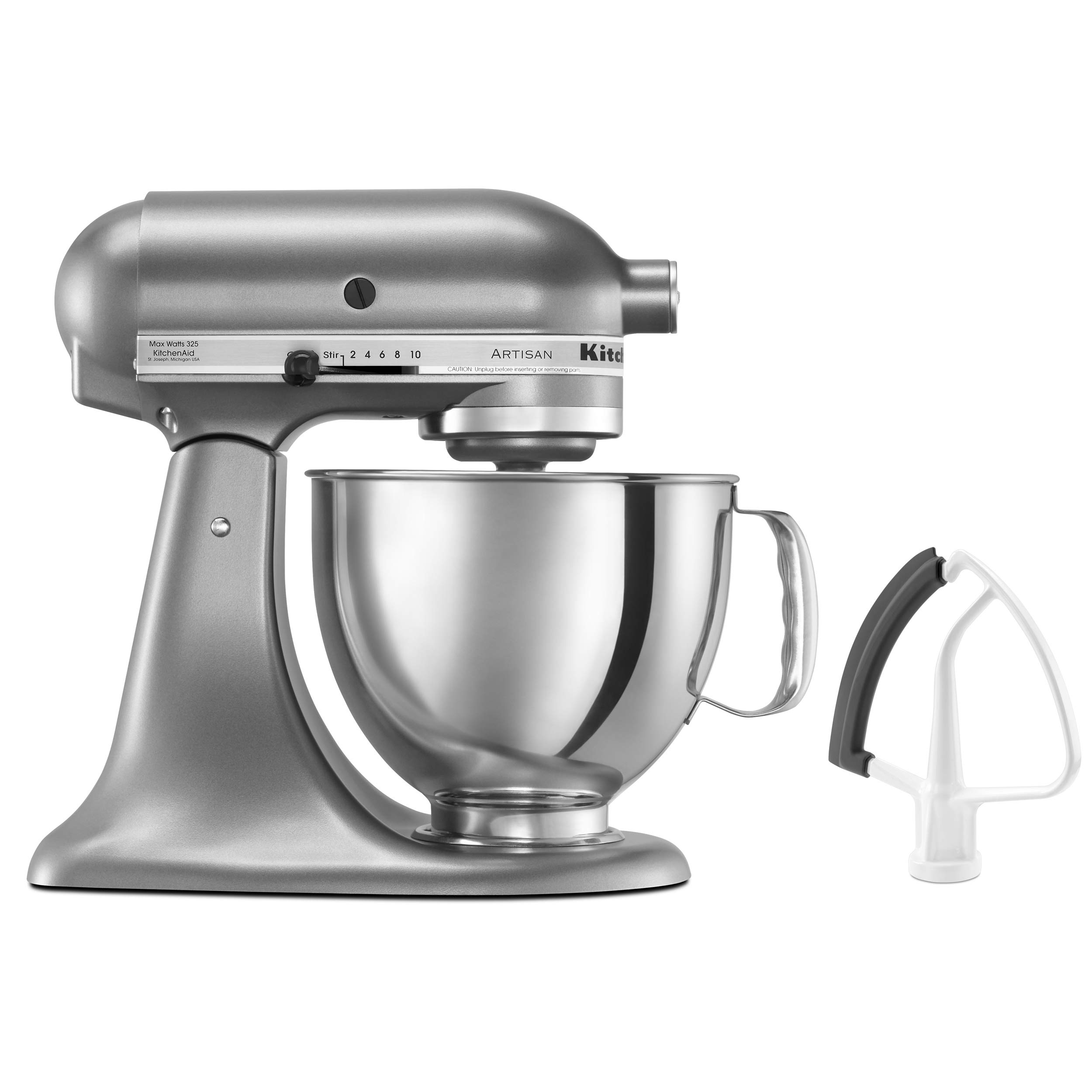
If you want one KitchenAid that feels like the “right answer” for most homes, this is it. The Artisan 5-quart tilt-head platform sits in that rare middle ground where it’s big enough for serious baking, but still friendly enough to use for small everyday tasks without feeling like you’re operating machinery.
The reason this bundle version wins “best overall” is simple: the included flex-edge beater changes the daily experience. Instead of stopping, tilting, scraping, restarting, and repeating… the mixer behaves like it’s cooperating with you. That sounds small until you’ve baked a few times and realize how much mental friction scraping creates. Creaming butter and sugar feels smoother. Sticky batters feel more “finished.” Even quick jobs like mixing cookie dough feel cleaner because the bowl sides aren’t collecting a ring of unmixed ingredients.
Real-life owners tend to describe the Artisan as the model they come back to—even after trying larger bowl-lift machines— because tilt-head workflow is just so natural. You lift the head, you add, you swap attachments, you lock it down, and you move on. If you bake often, that ease becomes the feature.
Now here’s the expert part that most guides skip: the Artisan isn’t “weaker” just because it’s tilt-head. It’s more accurate to say it’s optimized for the kind of mixing most people do most of the time: batters, frostings, cookie dough, mashed potatoes, whipped cream, and moderate doughs. If you treat dough like dough (keep kneading speeds sensible and batch sizes realistic), it handles bread beautifully. If you treat dough like a demolition derby (huge stiff batches at high speed), you’ll wish you bought bowl-lift.
What makes this model feel premium at home isn’t just the look. It’s the “control feel”: 10 speeds with a gradual ramp, a stable base, and a bowl size that works for both weeknight baking and holiday volume. If you’re building a kitchen tool you’ll use for years, that balance matters more than any single spec.
Finally: ecosystem value. If you think you’ll use attachments (pasta, shredding, grinding), the Artisan is the classic “hub motor base.” It’s the model that gets recommended again and again because it’s the one that fits the most lifestyles. Not the biggest. Not the most intense. Just the one that people actually keep using.
Why you’ll like it
- Flex-edge beater included – Less scraping, smoother incorporation, better “finished” batters.
- Tilt-head workflow is effortless – Adding, scraping, swapping attachments feels fast and natural.
- 5-quart capacity sweet spot – Big enough for batches, still friendly for everyday mixing.
- Excellent “first KitchenAid” choice – Owners often describe it as a lifelong kitchen upgrade.
- Strong attachment platform – Great if you want pasta, shredding, or grinding later.
Good to know
- If you knead very stiff dough weekly (bagels, very low hydration), bowl-lift will feel calmer and more stable.
- Like most tilt-head models, you’ll still scrape occasionally for extremely thick mixtures (the flex-edge just reduces it dramatically).
- Small-batch whisking (tiny amounts) can take technique—position ingredients near the whisk and start slow.
Ideal for: the majority of home bakers who want one mixer that feels easy on weekdays and capable on holidays—especially if you want less scraping and a smoother daily workflow.
2. KitchenAid 7 Quart Bowl-Lift Stand Mixer – Control-First Power for Dough, Folding, and Heavy Mixing

This is the mixer you buy when you want the machine to feel like it’s doing the hard part for you. Not “spinning faster,” but staying stable and controlled while dough builds strength and thickens. The bowl-lift design locks the bowl in with a professional-style stance, and that stability shows up exactly where it matters: dense cookie dough, enriched bread dough, pizza dough, double batches, and longer mixing sessions.
What makes this newer 7-quart platform especially interesting is not just size—it’s the speed control philosophy. The inclusion of 11 speeds (including a true 1/2 speed designed for folding) changes how refined the mixer feels. You can incorporate delicate ingredients (berries, chocolate chunks, whipped egg whites) with less fear of shredding them. You can start flour integration with less flour blowback. And you can build dough gradually instead of jumping from “barely moving” to “too aggressive.”
In real kitchens, that kind of control shows up as fewer mistakes and better texture:
- cakes with less over-mixing because you can stop exactly where you need to
- cookie dough that mixes evenly without pulverizing add-ins
- bread dough that develops strength without overheating as quickly
Then there’s the included double flex-edge beater, which is basically “scrape mode” built into the mixer. If scraping drives you nuts, this attachment alone is a quality-of-life upgrade. It does a better job keeping the bowl walls clean, which means your mix is more uniform and you’re not scraping down a ring of sugar-butter paste mid-cream.
Owner sentiment around 7-quart bowl-lift KitchenAids tends to sound like this: “quieter than expected,” “handles heavy batches,” “saves time,” “feels stable.” That stability can also reduce the feeling that you have to hover. When a mixer doesn’t wobble, you trust it more—and you can prep ingredients, clean up, or multitask without constantly checking it.
Now for the real talk: bowl-lift is a lifestyle. The mixer is heavier. The footprint is bigger. If you move your mixer in and out of a cabinet often, that gets old. And ingredient adding can be a bit less fluid than tilt-head—you’ll often lower the bowl to add flour or scrape, then lift again. If you’re primarily a quick-batter person, tilt-head can feel faster. But if you knead bread often, bowl-lift starts feeling like the “correct” tool.
If you bake bread regularly, or you’re tired of your current mixer feeling strained, this is the model that feels like a step into a calmer kitchen rhythm.
Why it stands out
- Bowl-lift stability – Stays planted when dough gets heavy and thick.
- 11-speed control (including 1/2 speed) – Better folding, gentler starts, and more precision.
- Double flex-edge scraping – Less manual scraping, more uniform mixes.
- Big-batch confidence – Great for holidays, meal prep, and dough-heavy households.
- Feels calm under load – Many owners describe it as quieter and more stable than older machines.
Good to know
- Heavier footprint means it’s best as a “leave it on the counter” station.
- Ingredient adding often means lowering the bowl—less fluid than tilt-head for quick batters.
- Small-batch whisking can be trickier in a larger bowl (a smaller bowl strategy helps if you do tiny batches often).
Ideal for: bread bakers, big-batch households, and anyone who wants more stability and speed precision—especially if kneading and heavy mixing are frequent.
3. KitchenAid KSM8990CU 8-Quart Commercial Series – When You Want “Beast Mode” Without Drama

This is the mixer for people who read recipes like challenges. If you’ve ever thought, “I want to grind meat, knead pizza dough, whip eggs, and make thick cookie dough in one weekend,” the commercial series is designed for you.
“Commercial” isn’t just a label here. In real kitchens, it translates to a different emotional experience: the mixer sounds steadier, it feels more planted, and it doesn’t act surprised when the dough gets serious. Owners who upgrade into this model often describe the same pivot point: they were tired of a lighter mixer feeling underpowered or strained, and they wanted something that mixes heavy dough as if it’s normal.
One of the most telling real-world behaviors: people call it quiet for its capability. Not silent—but “well-built machine” quiet, where you hear the gear drive doing work rather than a motor screaming. That calm sound matters because it signals lower strain and steadier torque. It also makes long mixing sessions feel less chaotic.
The included stainless accessories are another everyday win. In owner feedback, stainless beaters often get praised for feeling “serious,” easy to clean, and less finicky long-term. If you’re the type who hates worrying about coatings or cosmetic wear, this is the set that tends to create peace of mind.
Now, let’s get into the honest trade-offs (because this is where people mis-buy): the 8-quart bowl is tall. That’s great for huge batches, but it changes the workflow. Many owners report they lower the bowl to add ingredients because reaching into a tall bowl can be awkward. Some also keep (or buy) a smaller bowl for everyday mixing so they don’t feel like they’re operating a mixing silo just to make one batch of cookies. That’s not a flaw—it’s a pro strategy for using a big machine in a normal kitchen.
This model also tends to become a “permanent station.” It’s heavy, and once it’s in place, you leave it there. If you have the counter space, that’s a dream. If you’re constantly moving your mixer in and out of storage, it’s a lot.
Where this machine really earns its keep is heavy dough + attachments. For example, a meat grinder attachment can make some mixers feel like they’re straining. Owners of the commercial series often describe it as powering attachments almost as if nothing is happening. That’s the “engine base” effect—your mixer stops being a mixer and becomes a kitchen motor.
A final reality check: commercial design also means you may care more about serviceability and “parts logic.” Power users sometimes keep an eye on the planetary area (where attachments connect) and treat the mixer like a long-term machine. That mindset pairs well with this model. If you want the strongest KitchenAid platform in this list, this is it.
Why power users love it
- Calm, high-torque mixing – Handles thick dough and long sessions with less strain.
- NSF commercial build mindset – Designed for heavier use patterns.
- Stainless accessories included – Durable, easy to clean, less worry about coating wear.
- Attachment “engine” behavior – Great for grinding, shredding, and other hub-driven work.
- Stability that changes your confidence – Feels planted and less “wobbly” under load.
Good to know
- The tall 8-quart bowl can be awkward for adding ingredients; many owners lower the bowl to add.
- It’s heavy and best as a permanent countertop station.
- Small-batch whipping (tiny amounts) can be less convenient without a smaller bowl strategy.
Ideal for: serious home bakers, bread-heavy kitchens, and anyone using attachments frequently who wants the most “unbothered” KitchenAid experience available.
4. KitchenAid Artisan 5 Quart Tilt-Head with Pouring Shield (KSM150PSAQ) – The Classic Countertop Workhorse You’ll Actually Use

The standard Artisan 5-quart tilt-head is the model that made KitchenAid the “default answer” for home bakers. It’s not the biggest. It’s not the most extreme. It’s just consistently satisfying to use, and that’s why people keep it on the counter like a piece of kitchen furniture.
What owners love most is the daily rhythm: the tilt-head makes scraping and ingredient adding easy, and the machine feels sturdy enough that you don’t worry about it. It’s also the kind of mixer people gift and then hear about for years—because it becomes part of someone’s weekly cooking routine.
The pouring shield included here is more valuable than it looks. If you’ve ever dumped powdered sugar into buttercream and created a sugar fog, or added flour too quickly and covered the counter, you get it. A shield doesn’t make you a better baker—but it makes baking less messy and less stressful. And when baking feels cleaner, you do it more often.
Now let’s talk about the real “advanced” knowledge: included attachment materials. Many Artisan sets come with coated beaters and a wire whip. In normal use, they work great. But some owners are very sensitive to long-term wear, especially if they dishwash everything aggressively or if beater clearance is off. This is why so many experienced KitchenAid owners eventually upgrade two things:
- a flex-edge beater (for scraping and smoother mixes)
- stainless accessories (for long-term peace of mind)
If you want to keep the machine feeling “new” longer, the big trick isn’t babying it—it’s setting it up right. Correct beater clearance reduces bowl contact, reduces stress on coatings, improves mixing, and stops the annoying “paddle jump” people sometimes report. Once clearance is correct, the Artisan feels much more refined.
Performance-wise, this is an excellent machine for: cookies, cakes, frostings, whipped cream, mashed potatoes, shredding chicken, and moderate doughs (pizza, brioche, cinnamon rolls). If you regularly do extremely stiff dough, bowl-lift becomes the calmer tool. But for the vast majority of home baking, Artisan performance is more than enough.
One more real-life detail people don’t expect: emotional ownership. People mention loving the color, the look, and how it “belongs” in the kitchen. That sounds shallow until you realize it keeps the mixer out and ready. If you store your mixer, you use it less. If you love how it looks, it stays out—and you use it more.
Why it’s iconic
- Tilt-head ease – Scraping, adding ingredients, swapping tools is simple and fast.
- Pouring shield included – Cleaner flour and sugar adding (less mess, less stress).
- Excellent all-around capability – Handles the core home-baking tasks beautifully.
- Countertop-friendly design – Many owners keep it out because it looks great and gets used more.
- Huge attachment ecosystem – Great if you want pasta, shredding, and grinding later.
Good to know
- Some owners prefer to upgrade to a flex-edge beater for less scraping (not always included in this version).
- Coated attachments may show wear over time if clearance is off or if dishwashing is hard on them.
- If bread is your weekly identity, bowl-lift models feel more stable with dense dough.
Ideal for: everyday home bakers who want the classic KitchenAid experience—easy tilt-head workflow, reliable performance, and cleaner ingredient adding with the included pouring shield.
5. KitchenAid 4.5 Quart Tilt-Head Stand Mixer (KSM85PBER) – The Practical Classic for Smaller Batches

The 4.5-quart tilt-head category exists for one simple reason: not everyone wants a large bowl and a heavy footprint. If your household size is smaller, or your baking style is more “one batch at a time,” this kind of mixer can feel like the most sensible choice.
What people love about the KSM85-style mixer is the “classic KitchenAid feel”: solid metal construction, a smooth tilt-head workflow, and enough speed range to go from slow incorporation to faster whipping without drama. Owners often describe it as durable, reliable, and surprisingly easy to clean—exactly what you want if you’re going to use it regularly.
Here’s the real-world advantage of a smaller bowl: it’s easier to handle and it’s less intimidating for everyday use. You’re more likely to make a quick batch of frosting, whip cream, or mix cookie dough because it feels lightweight in your routine. And when a kitchen tool feels easy, it gets used.
This model is also popular as a gift mixer because it hits that emotional sweet spot: it looks like a “forever” kitchen tool, not a temporary appliance. Many KitchenAid owners talk about having older mixers that have lasted decades, and that reputation is part of why these smaller tilt-head machines stay popular.
Now, the honest limitation: 4.5 quarts is not designed for huge holiday marathons or heavy dough obsession. It can absolutely mix bread dough in reasonable batches, but if you’re kneading multiple loaves’ worth of stiff dough weekly, you’ll feel the difference compared to bowl-lift models. That’s not a flaw—it’s just choosing the right tool for the job.
If you want a real KitchenAid stand mixer experience with less bulk than a 5-quart or 7-quart machine, this is a very clean, practical choice.
Why it works so well
- Compact, daily-friendly – Great for smaller kitchens and smaller batch habits.
- Tilt-head ease – Quick access for adding, scraping, swapping attachments.
- Durable “classic KitchenAid” feel – Owners often praise long-term reliability.
- Easy cleanup – A simple setup that feels straightforward to maintain.
Good to know
- If you do frequent heavy dough or very large batches, 5–7 quart options will feel more relaxed.
- Smaller bowls can still need occasional scraping with very sticky batters (a flex-edge beater helps if compatible).
- If you plan to host big holiday baking days, consider sizing up so you’re not forced into multiple runs.
Ideal for: smaller households and everyday bakers who want a “real KitchenAid” experience in a more compact form factor.
6. KitchenAid Classic Series 4.5 Quart Tilt-Head (K45SS) – The Simple, Reliable Entry Point

The Classic series exists for one very practical reason: not everyone needs the “extra” right away. Some people just want a dependable stand mixer that mixes batter smoothly, whips cream properly, and kneads dough occasionally—without complicated upgrades or premium packaging.
Where the Classic wins is in confidence. It’s straightforward, it’s sturdy, and it gives you the KitchenAid ecosystem: a real tilt-head workflow, a stainless bowl, and the ability to add hub-powered attachments later when you’re ready. For a lot of first-time buyers, that matters more than having every premium accessory on day one.
Owners often describe the Classic as the mixer they waited years to buy. There’s something about finally having a stand mixer that changes cooking habits: you stop avoiding recipes because you don’t want to cream butter by hand, you stop dreading thick frosting, and you start making things from scratch because it becomes easier to do so. That’s the “life upgrade” factor people talk about.
Now, here’s the expert-level truth: the Classic can produce excellent results. A lot of “mixer performance problems” aren’t about the model—they’re about setup and technique:
- beater clearance too high (leaves ingredients at the bottom)
- starting too fast (flour clouds, sugar storms)
- kneading on the wrong speed (stresses the machine and can affect dough texture)
If you set clearance correctly and use sensible speeds, the Classic handles the fundamentals beautifully. It’s especially good for: cakes, cookies, quick breads, brownies, mashed potatoes, whipped cream, and buttercream. For bread, it does fine for moderate dough in sensible batch sizes. If you’re a heavy dough person, the bowl-lift models will feel calmer—no question.
One more “real life” note: the Classic is often chosen for its simplicity and aesthetic fit. Onyx black is a popular choice because it blends in with appliances and hides everyday fingerprints. If you keep your mixer on the counter, that matters.
Why it’s a smart first buy
- Fundamentals done right – Smooth mixing for the recipes most people make most often.
- Tilt-head convenience – Easy to add ingredients, scrape, and swap attachments.
- KitchenAid ecosystem access – Hub attachments can be added later as your cooking grows.
- Simple, sturdy, dependable – Many owners buy it as a long-term “finally” purchase.
Good to know
- Doesn’t always include premium extras (like flex-edge or pouring shield) depending on the exact package.
- Not the calmest choice for very stiff dough or huge batches—bowl-lift models feel more stable there.
- You may scrape a bit more compared to flex-edge setups (easy fix if you upgrade later).
Ideal for: first-time KitchenAid buyers and budget-conscious households who want a reliable stand mixer now—with the option to upgrade later based on real use.
7. KitchenAid 5-Speed Ultra Power Hand Mixer (KHM512) – The “Grab, Mix, Done” Backup You’ll Use Constantly

Not every kitchen needs a full stand mixer. Sometimes you need speed, storage simplicity, and a tool that you can grab for two minutes and put away. That’s where a good hand mixer is still a powerhouse—especially if you live in a smaller space, bake occasionally, or you want a strong “secondary mixer” even if you already own a stand mixer.
The KHM512-style KitchenAid hand mixer tends to get praise for a few practical reasons: it feels solid in the hand (not flimsy), the speed range is useful, and it handles common kitchen jobs without fuss. Speed one is gentle enough for stirring in chunks without flinging them, and the higher speeds are strong enough to whip and blend efficiently.
Here’s what it’s best at in real kitchens:
- whipping cream and frosting in small batches
- mixing cake batter quickly without hauling out a stand mixer
- mashed potatoes (especially if you want control and don’t want to dirty a big bowl)
- cookie dough in smaller amounts
Owners also frequently mention little usability details that matter: a cord that can move out of your way, easy eject button behavior, and beaters that clean up quickly. Those are the things that make a hand mixer feel like a tool you actually reach for, not a gadget you forget you own.
Now the honesty: if your identity is “bread person,” a hand mixer is not replacing a stand mixer. You’ll still be holding it, stabilizing a bowl, and it’s not built for long kneading sessions. But as a compact option (or as a secondary mixer for small tasks while your stand mixer is busy), it’s one of those purchases that quietly earns its keep.
Why people keep it
- Fast “grab and go” mixing – Perfect for quick batters, cream, and small frosting jobs.
- Compact storage – Big capability without giving up counter space.
- Useful speed range – Gentle low speed for mix-ins, stronger speeds for whipping.
- Easy cleanup – Less setup, less teardown, less kitchen mess.
Good to know
- Not designed for long kneading sessions or very stiff dough.
- You still hold it the whole time (stand mixers shine when you want hands-free mixing).
- For very large batches, a stand mixer is simply more efficient and consistent.
Ideal for: small kitchens, occasional bakers, and anyone who wants a reliable “backup mixer” for quick jobs—even if you already own a stand mixer.
How Stand Mixer Performance Actually Works (and Why Most People Misjudge It)
Most stand mixer regret comes from one misunderstanding: people shop by bowl size and a power number, then get surprised by how the mixer behaves when real ingredients hit the bowl. In real kitchens, performance is a system: torque, speed control, bowl geometry, attachment design, and beater clearance. When those line up, the mixer feels like a calm teammate. When they don’t, you feel like you’re constantly correcting it.
What makes a mixer feel “powerful” in real life
- Strong low-speed torque – The ability to keep moving steadily when dough thickens (without screaming).
- Soft, controlled starts – Less flour blowback, less mess, less “jump” when you turn it on.
- Stable stance – A heavy base and a secure bowl mount reduce wobble and “walking.”
- True low speeds – Especially for folding and gentle incorporation (where overmixing ruins texture).
- Thermal patience – It can run longer without feeling hot and stressed.
This is why the 7-quart bowl-lift with true low speeds feels so refined, and why the commercial series feels “unbothered.” They aren’t just mixing—they’re controlling.
The 3-minute setup that fixes most complaints
- Beater clearance (the “dime test”): Place a dime in the bowl, attach the flat beater, and run on low. The dime should move slightly with each pass. If it doesn’t move, clearance is too high (missed ingredients). If the beater hits hard, clearance is too low (tapping, wear). Adjust the screw according to your model’s guide.
- Start slow, then climb: Begin most recipes on the lowest speed to incorporate dry ingredients and prevent a flour cloud, then increase gradually.
- Use dough speeds wisely: Dough usually needs low-to-medium speed, not high speed. High-speed kneading is the fastest way to make a mixer feel strained and to overwork your dough texture.
It’s wild how many “my mixer is bad” stories turn into “my mixer is amazing” stories after one clearance adjustment and a slower start habit.
How to pick your “best” model by recipe type
- Cookies & cakes: tilt-head models shine because scraping, adding, and swapping tools is fast. A flex-edge beater is the biggest upgrade for daily baking.
- Buttercream & whipped cream: whisk reach and bowl size matter. If you do lots of small whipping jobs, a 5-quart tilt-head can feel easier than an extra-tall bowl.
- Bread & pizza: bowl-lift stability is the comfort upgrade. The machine feels calmer under load and you can do bigger batches with more confidence.
- Long mixing sessions: if you frequently mix thick dough for a long time, the commercial series is built for that “keep going” life.
- Attachment-heavy kitchens: grinding and shredding are easier when the mixer behaves like an engine base. Bigger, sturdier platforms tend to feel more confident here.
Mixing tips that instantly improve results
- Creaming butter and sugar: stop once it looks lighter and fluffy—don’t chase “whiter” for too long. Overcreaming can change cookie spread and cake crumb.
- Flour integration: start on the lowest speed to prevent flour storms and to reduce overmixing.
- Chunky mix-ins: fold in chocolate chips or berries on the lowest speed to keep them intact.
- Dough development: for bread, build strength gradually. Let dough rest if it’s fighting you—resting is a secret weapon for gluten development.
- Scrape smarter: scrape once at the right moment (after initial incorporation), not constantly. A flex-edge beater reduces how often you need to do it.
When your technique matches your machine, your mixer stops being a noisy gadget and starts being a reliable part of your cooking rhythm.
FAQ: KitchenAid Mixers (Answered Like a Real Person, Not a Spec Sheet)
Should I buy tilt-head or bowl-lift?
Is a 4.5-quart mixer “enough,” or will I regret not buying bigger?
Why do some people swear by the flex-edge beater?
My mixer leaves flour or butter at the bottom. Is it defective?
Can I knead bread dough in a tilt-head KitchenAid?
Do I need the commercial 8-quart model to be “serious”?
Final Thoughts: Picking the Best Kitchenaid Stand Mixer Without Second‑Guessing
A great mixer doesn’t just “mix.” It makes cooking feel easier, cleaner, and more possible on a busy day. The right one is the one you’ll still love when you’re tired, your recipe is thick, and you don’t feel like scraping the bowl every minute.
Here’s the simplest way to translate this guide into the right purchase:
- Want the best all-around daily baking experience with less scraping? Start with the KitchenAid Artisan 5 Quart Value Bundle (KSM150FECU). That included flex-edge beater is a daily quality-of-life upgrade.
- Bake bread often or love big batches? Go for the KitchenAid 7 Quart Bowl-Lift Stand Mixer. The stability plus extra speed control makes heavy mixing feel calm.
- Need maximum torque for dough and attachments? Choose the KitchenAid KSM8990CU 8-Quart Commercial Series as a serious “kitchen engine” platform.
- Want the iconic Artisan workflow with cleaner ingredient adding? The KitchenAid Artisan 5 Quart with Pouring Shield (KSM150PSAQ) is a classic for a reason.
- Prefer a compact, practical tilt-head for smaller batches? Consider the KitchenAid 4.5 Quart Tilt-Head (KSM85PBER). It’s the “classic KitchenAid feel” without the larger footprint.
- Want a reliable first KitchenAid without paying for extras up front? Start with the KitchenAid Classic Series 4.5 Quart (K45SS) and upgrade only after you learn what you actually use.
- Need a compact mixer for quick jobs (or a strong backup tool)? Grab the KitchenAid 5-Speed Ultra Power Hand Mixer (KHM512) for fast batters, cream, and small frosting work without the stand mixer footprint.
The best purchase is the one you’ll use confidently and often. Pick the best kitchenaid stand mixer for your real recipes—your typical batch size, your dough habits, and how much you care about scraping—and you’ll end up with a kitchen tool that feels like a genuine upgrade every single week.
