
Specs are compiled from manufacturer listings and verified buyer reviews and can change over time — please confirm the key details on the product page before buying.
When the power goes out, you want a battery that keeps your fridge cold, your router running, and your furnace blower starting without tripping a breaker. For most homes, the EF ECOFLOW DELTA Pro is the safest all-round buy, the Jackery HomePower 3600 Plus is the easiest to move around, and the budget AFERIY P280 gets you real backup power for far less. The other picks on this list each win on one specific job — whole-house hardwiring, huge expandable capacity, or raw starting watts for big motors. Here is how each one actually behaves when the lights go out.
I’m Mohammad Maruf — the founder and writer behind KitchPrep. This guide is built by comparing the manufacturers’ published specifications and the patterns across verified customer reviews, so you get each pick’s real strengths and trade-offs instead of marketing spin.
Storms, brownouts, and grid failures rarely announce themselves, and a generator you have to fuel and listen to is often the last thing you want to deal with at 2 a.m. That is exactly the gap a home battery backup system fills, storing energy quietly until you need it.
Our Picks at a Glance

How To Choose The Best Home Battery Backup System
Most people buy the wrong size first. They look at the biggest number on the box, ignore how the unit charges back up, and end up with a box that cannot run the one appliance that matters most during an outage. Get these four things right and you rarely regret the pick.
Match capacity to what you actually want to keep running
Start by listing the loads you refuse to lose — the fridge, the furnace blower, a few lights, your internet router. Capacity is measured in kilowatt-hours (kWh), which is simply how much total energy the battery holds. A bigger kWh number means more hours, but it also means a heavier box and a higher price. If you want the whole house running, look for a unit that is expandable, because you can start smaller and add battery packs later instead of replacing the whole system.
Check continuous watts and surge watts, not just capacity
Continuous watts tell you what the unit can run steadily. Surge watts — sometimes called peak watts — tell you what it can handle for the brief moment a motor starts, like a fridge compressor or a well pump kicking on. A unit with big capacity but modest output will trip the moment a furnace starts. Always check that the continuous rating clears the appliances you plan to run at the same time.
Decide if you want a wheeled unit or a hardwired one
A portable unit with wheels and a handle rolls between the garage and the kitchen and needs no electrician. A hardwired setup ties into a transfer switch or panel and behaves more like a permanent home system. Portables suit renters and anyone who wants flexibility; hardwired suits homeowners who want whole-home coverage and do not want to think about it again.
Quick Comparison
| Model | Best For | Capacity | Output | Weight | Amazon |
|---|---|---|---|---|---|
| EF ECOFLOW DELTA Pro★ Best Overall | All-round home backup | 3600Wh (to 25kWh) | 3600W (to 7200W paired) | 99 lb | Amazon |
| AFERIY P280Budget Powerhouse | Budget whole-home entry | 2048Wh (to 10.24kWh) | 2800W (peak 5600W) | 44 lb | Amazon |
| GROWATT HELIOS 3600Best Solar Bundle | Solar-bundled off-grid | 3600Wh (to 36kWh) | 3600W (7200W parallel) | 149 lb | Amazon |
| Jackery HomePower 3600 Plus | Easiest to move and use | 3584Wh (to 43kWh) | 3600W (7200W parallel) | 77.2 lb | Amazon |
| PECRON F5000LFP | Heavy loads on a budget | 5120Wh (to 35.8kWh) | 7200W | 123.9 lb | Amazon |
| Anker SOLIX F3800 | EV charging and RV use | 3.84kWh (to 26.9kWh) | 6,000W | 132.3 lb | Amazon |
| Jackery 5000 Plus | Long multi-day outages | 5040Wh (to 60kWh) | 7200W (14,400W surge) | 134.5 lb | Amazon |
| ECO-WORTHY Powermega | Permanent off-grid install | 16.1kWh usable | 10kW | 293.2 lb | Amazon |
| EF ECOFLOW DELTA Pro Ultra | Full whole-house coverage | 12kWh (to 90kWh) | 7200W (to 21.6kW) | 293.6 lb | Amazon |
In‑Depth Reviews
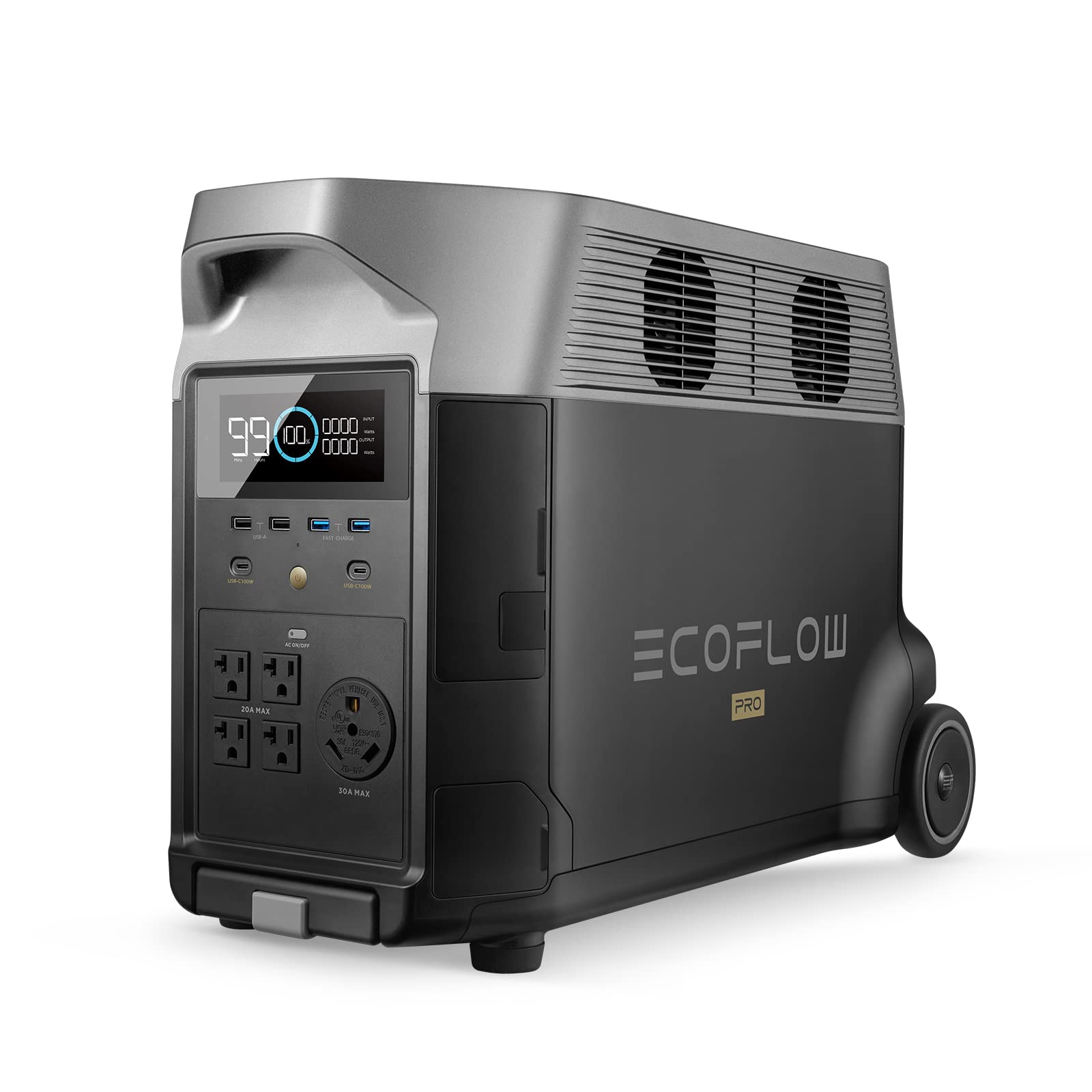
1. EF ECOFLOW Portable Power Station 3600Wh DELTA Pro, 120V 3600W AC Output
Our pick — over 4.5★ from 600+ verified ratings; the strongest balance of quality and price.
The 3600Wh workhorse that starts big appliances and keeps them running through the night.
One box that covers a fridge, lights, router, and a space heater without you thinking hard about it — that is what this pick does. It holds 3600Wh of LFP battery capacity (lithium iron phosphate, a battery type known for running cool and lasting through many charge cycles), which is why buyers report it holding up over years of use instead of a season or two. The 3600W AC output climbs to 4500W with X-Boost, and pairing two units doubles the available power to 7200W — enough headroom that a sump pump or a furnace blower will actually start rather than trip the breaker on the way up. If you want a single unit to cover the basics and you are willing to pay for the brand name, this is your pick; if you need to run a 240V dryer or well pump on one unit alone, look at the dual-voltage picks below instead.
What wins people over is how fast it comes back. A full recharge takes 1.8 hrs on a 240V outlet at 3000W, 2.7 hrs on a standard 1800W wall outlet, and 2.8 hours from four 400W solar panels — so you can refill it in a single afternoon and run it hard again that night. Owners have reported that a fully charged unit ran a neighbor’s fridge and lights during an outage and still had 30% left next morning. It also packs 15 output methods — 2 USB-A, 2 USB-A Fast Charge, 2 USB-C at 100W, 5 AC outlets, 2 DC outlets, a car power output, and an Anderson port — so phones, laptops, and appliances all share it at once.
The honest trade-off is size and weight. At 99 pounds and measuring 25″L x 11.2″W x 16.4″H, this is not a carry-it-anywhere box — it is closer to a small appliance that lives where you park it. For comparison purposes, the AFERIY P280 below weighs 44 pounds to this unit’s 99 pounds, so if you need true grab-and-go portability, that is the better fit. If you want capacity you can build on, however, this expands from 3.6kWh up to 25kWh with extra batteries or Smart Generators, and the EcoFlow app handles monitoring over Wi-Fi or Bluetooth.
What earns its spot here
- Fully recharges in 1.8 hrs on 240V or 2.8 hours from four 400W solar panels
- 15 output methods cover phones, laptops, appliances and an Anderson port in one box
- Expands from 3.6kWh up to 25kWh as your needs grow
The realistic catch
- 99 pounds means it stays put once placed
- Solar input is capped at 15A, so very large arrays cannot charge it faster
Settle on this one if: you want one unit that powers the essentials and can grow to 25kWh over time.
Look elsewhere if: you need something light enough to carry up stairs — this one is a wheel-it, not a lift-it.
2. AFERIY P280 Portable Power Station 2800W (Peak 5600W) UPS Solar Generator
A 44-pound box that hits 80% charge in 38 minutes and undercuts everything else here.
This is the pick for someone who wants real home backup without the weight or the spend. Its 2048Wh LFP battery expands to 10.24kWh with extra batteries, which the brand rates at 2 days of whole-home backup. The output is 2800W continuous with a 5600W peak, so the starting surge is where it earns its keep — that peak window is what lets a fridge compressor or a well pump spin up without tripping. It also includes a NEMA TT-30 outlet, which is the standard plug for RV shore power, so trailer owners get a direct fit instead of an adapter.
Two spec numbers really separate it from the pack. First, charging: 1800W AC input plus 1200W solar input get you from 0% to 80% in only 38 minutes. Second, the UPS mode responds in under 10ms, which is fast enough that a desktop computer or a router will not blink when the grid drops. Both input and output are pure sine wave, the same clean waveform your wall outlet provides, which is what protects sensitive electronics. Owners have reported running a CPAP machine for two nights at fan-only settings and drawing only 30% of the battery, and pellet-grill users have gotten roughly 20 cooks per charge.
Against the DELTA Pro above, this unit costs far less and weighs 44 pounds versus 99 pounds, which is the real reason someone picks it: it is portable in practice, not just on paper. The recurring honest gripe is that the AC charge rate can only be adjusted in the BrightEMS app, and the app’s permission list is broad, so some buyers set the rate once and then remove it. A few units have also arrived with charge faults, but the overwhelming majority of buyers describe it as serious equipment that beats expectations. Weigh that against a 10-year-rated LFP battery with 4000+ cycle life and it is a lot of system for the tier.
Where it pulls ahead: 38 minutes to 80% charging and a 10.24kWh expansion ceiling make this a genuine whole-home entry point rather than a camping toy.
The value play: buyers who want whole-home backup capability on an entry-level budget and value portability.
Worth a second thought for: anyone unwilling to use a phone app to control charge rate — the unit has no physical dial for it.
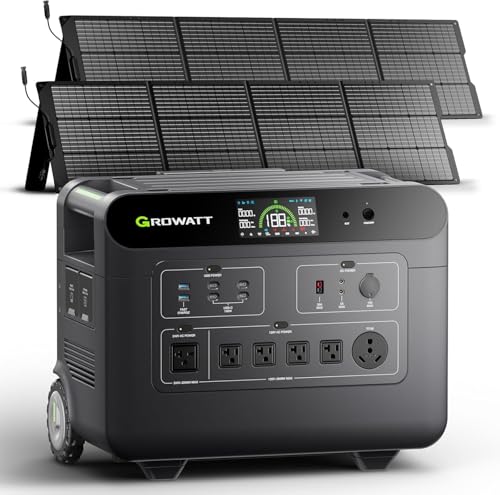
3. GROWATT HELIOS 3600 Portable Power Station with 400W Solar Panel
Ships with the panels already in the box — charge by sun on day one, no shopping.
Buyers who want a solar setup that works the moment it lands should start here. The box includes a 3600Wh power station plus two 200W solar panels as a matched set, so there is no guesswork about which panel pairs with which input. Shared specs make the head-to-head clean: the HELIOS holds 3600Wh to the AFERIY P280’s 2048Wh, and its 3600W output clears the P280’s 2800W. The 2000W solar charging rate refills it in about 2.5 hours from those bundled panels, which is fast for a unit this size, and Growatt rates MPPT tracking at 99% efficiency.
Two features are genuinely rare at this level. The 15ms EPS switch means that when grid power dies, the unit hands over to battery in the time it takes a light to flicker — fast enough that most equipment never notices. And cold start technology lets it run as low as -22°F, so a garage or cabin installation in a hard winter is not a problem. Owners are running 8,000 BTU air conditioners for about 5 hours per charge and treating it as a reliable outage backup, which lines up with the battery life being the most-praised trait of the unit.
Where it differentiates for the long haul is expansion. Two units can run in parallel to reach 7200W at 240V, and capacity expands to a maximum of 36kWh — enough for a whole-house setup. The EV-grade LFP cells are rated to keep 80% capacity after 4000 cycles, and the package is UL certified with a 5-year service card included. The catch is straightforward: at 149 pounds and 20.4″L x 12.3″W x 16.5″H it needs a permanent spot, and the heaviest complaint among buyers is exactly that. It is also worth knowing the app and connectivity feedback is mixed, so plan on the buttons as your primary control rather than the phone.
Why it stands out: the bundled 400W of solar and the -22°F cold start make this the natural pick for a cabin, garage, or off-grid shed.
Arguments for it
- Two 200W solar panels included, so it charges off-grid immediately
- 15ms EPS switch and -22°F cold start handle real winter conditions
- Expands to 36kWh and runs 7200W at 240V in parallel
Arguments against it
- 149 pounds and needs a fixed spot
- Connectivity and app functionality draw mixed feedback
Choose it when: you want solar included in the box and a unit built for freezing temperatures.
Not your match when: you need to relocate the system regularly — this one is a fixture.
4. Jackery HomePower 3600 Plus Power Station, 3584Wh, 3600W AC Output

The one that rolls like luggage — 77.2 pounds and still handles a 3-person household.
Anyone who has tried to shift a 100-pound battery across a garage will appreciate what Jackery did here. This unit weighs 77.2 pounds and uses a luggage-style design with wheels and a telescopic handle, so moving it from kitchen to garage to RV is a roll rather than a lift. It still holds 3584Wh and puts out 3600W, rising to 7200W in parallel, and it supports both 120V and 240V when parallel-connected — twin voltage is what lets it run a dryer or a well pump that single-voltage units cannot touch. Capacity climbs to 21kWh per unit or 43kWh with multiple units, which the brand rates at over 2 weeks for a 3-person household. If you want the easiest unit to move and you do not need the DELTA Pro’s 1.8-hour recharge, this is the one; if you need to hardwire into your home’s breaker panel, skip it and look at the transfer-switch picks below.
The safety engineering underneath is the quiet story. The cells use a high-temp ceramic membrane tested at 302°F to prevent thermal runaway, and are rated for 6,000 cycles with a 10-year lifespan. Combined with cold-weather operation down to -4°F, it is built for the two conditions that break lesser units: a hot garage in August and a February blizzard. That reliability shows up in owner experience — the system is reported to run a gas furnace, fridge, and freezer for up to 12 hours, and to recharge from 28% to 100% in under 2 hours. An induction cooktop dinner for two draws about 19% of the battery, which gives you a rough gauge for day-to-day use.
Charging flexibility is the other reason it ranks high. Hybrid AC plus DC gets it from 0–100% in just 2 hours, AC alone in 2.5 hours, solar in 4 hours, or a gas generator in 2.5 hours. That last option is the underrated one for long outages — a small generator can refill the battery faster than the battery drains. The design is plug-and-play with an MTS (manual transfer switch, the box that routes utility power to your chosen circuits), so no complicated installation. It is the smallest and lightest 3.6kWh LFP unit here at 34% smaller and 29.3% lighter than the brand’s reference models, and against the GROWATT above it is dramatically easier to reposition.
What owners keep coming back to: the wheels, the 2-hour recharge, and how quietly it runs — it powers a garage door opener and power tools without the drone of a fuel generator.
Reach for this if: you want backup power you can move yourself and refill in about 2 hours.
Skip the upgrade temptation if: your home needs 240V for every major circuit — this delivers dual voltage only in parallel.
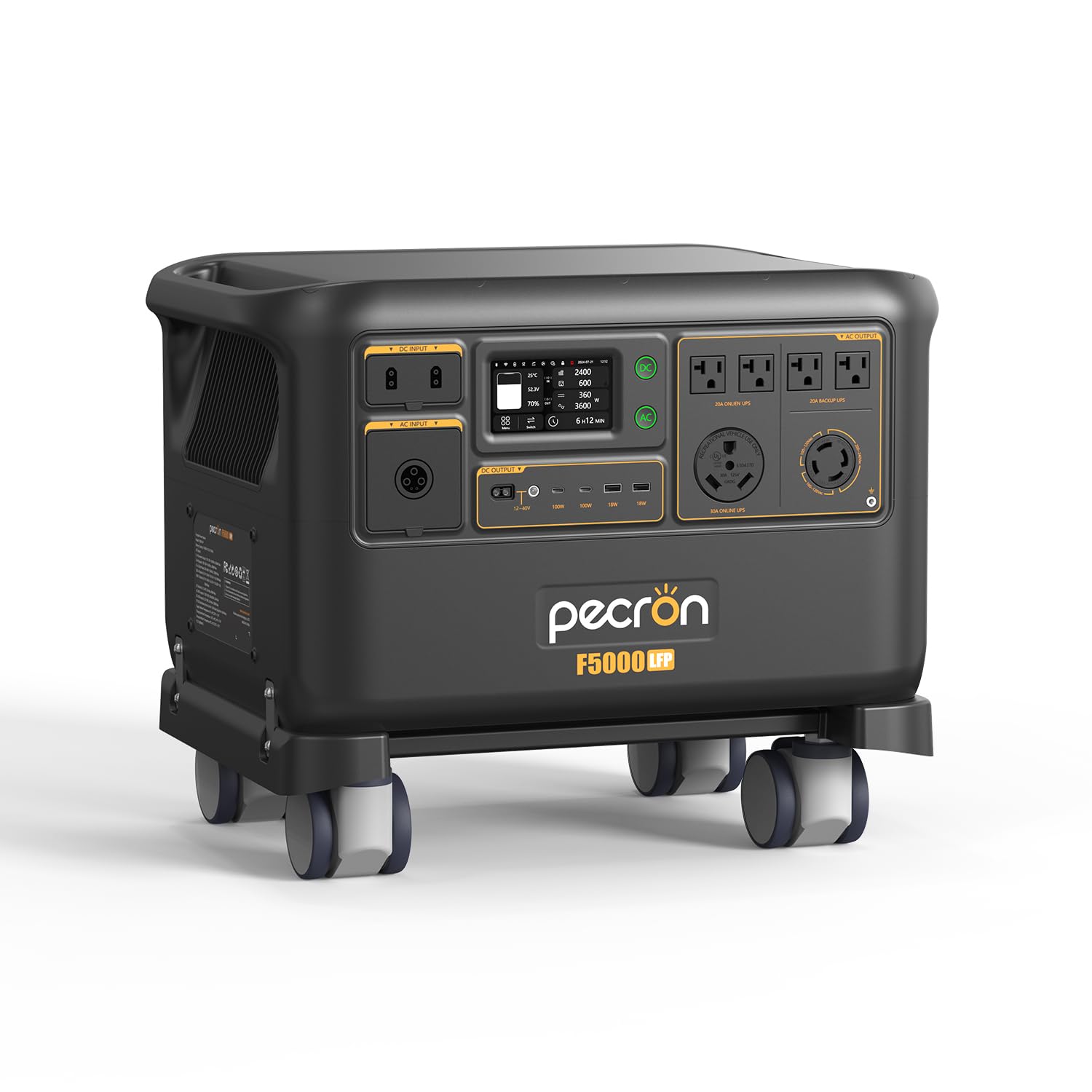
5. PECRON F5000LFP Power Station, 5120Wh, 7200W AC Output
Wall-sized output from a box that costs less than the premium crowd.
If your priority is raw wattage per dollar, this is the one to study. It delivers 7200W of AC output and dual voltage at 120V/240V, so a dryer, a water pump, or a 3-ton air handler is in play — that is a step above the Jackery HomePower 3600 Plus at 3600W, and it is why buyers who own high-draw equipment gravitate here. Capacity starts at 5120Wh — the brand rates that at up to 3 days of essential loads — and expands to 35.8kWh with six FP5000-48V batteries. Three recharge paths — AC, solar, and generator — can be combined, and solar input tops out at 6400W across two ports.
Two design details stand out for real-world use. The UPS outlets are rated 0ms transfer, the fastest switch on this list, so a Wi-Fi router, aquarium pump, or CPAP machine never notices the grid blip. And the unit runs at a 30dB noise level in its quieter mode, which is about the sound of a quiet room, so a bedroom installation for a CPAP user is realistic. The detachable cart makes it movable despite its 123.9 pounds and 21.7″L x 15″W x 13.1″H frame, and a battery heating function keeps it operating in winter. It carries 12 output ports total, including six AC and six DC, with a 100W USB-C and voltage-adjustable 5525 and XT-60 ports for laptops and specialty gear.
Be clear-eyed about the service side, though. Battery life feedback on this unit is genuinely mixed rather than glowing, so treat the runtime estimates as best-case. One owner hit a firmware bug that locked the unit in child-protection mode for days before a support update fixed it, and another reported a solar charge controller fault under a large array. The pattern is that the hardware performs but support responses can be slow and occasionally involve a language barrier. Pecron does honor replacements, and the vast majority of buyers describe it as a workhorse for the money.
Strengths worth the money
- 7200W output and 120V/240V dual voltage handle dryers and pumps
- 0ms online UPS outlets protect CPAP, routers, and aquariums
- 30dB quiet mode suits bedroom use
What to accept going in
- Battery life feedback runs mixed
- Support can be slow, with reported cases of firmware and charge-controller issues
Best fit for: households with high-draw equipment who want maximum wattage at a mid-tier spend.
Reconsider if: you need fast, frictionless support — this is a brand where you may wait.
6. Anker SOLIX F3800 Portable Power Station and Home Power Panel, 3,840Wh

Charges your EV, powers your RV, and holds the whole house if it has to.
What makes this unit different is not its capacity — it is the 120V/240V dual-voltage output at 6,000W, which means it can run a clothes dryer directly, and it climbs to 12,000W if you add a second unit. That is a meaningful jump for anyone whose panel is dominated by 240V appliances. The standout port is the NEMA 14-50, the same plug a home EV charger uses, so you can charge your electric vehicle at 6,000W without extra grounding accessories. It also powers an RV by plugging straight into the trailer’s power inlet, and popular RV models are compatible.
For whole-home duty, this is a system rather than a single box. It starts at 3.84kWh, expands to 26.9kWh with six battery packs, and up to two weeks of power if you add a second F3800 and twelve battery packs. Pairing with the Smart Generator 5500 adds auto start-stop for hands-free runtime — the generator wakes up, refills the battery, and shuts itself down. That combination is the practical answer for a multi-day outage. Owners describe the performance and reliability as the strongest traits, with setups reaching about 3 days of continuous power once expansion batteries are added.
Now the honest part, because any 240V system demands it. Charging speed and power output get mixed feedback — one buyer found the bundled 400W panel produced a high of 218W even in full midday sun, and a few report shorter battery life than expected. There is also a cold-weather caveat: the battery management system limits charging below 10°C/50°F to roughly 710W DC or 685W AC, so a cold garage slows charging until it warms. Anker InfiniPower and EV-class LFP cells back a 5-year warranty and a 10-year lifespan claim. Owners also flag that the app lacks usage tracking, so plan to manage consumption yourself.
Why it belongs on the shortlist: the NEMA 14-50 port and 12,000W parallel ceiling make it the most versatile unit for EV owners and RV travelers who also want home backup.
Ideal owner: someone with an EV, an RV, or a 240V appliance who wants one system to cover all three.
Pause before buying if: you plan to charge with solar in a cold climate — below 50°F the charging rate drops sharply.
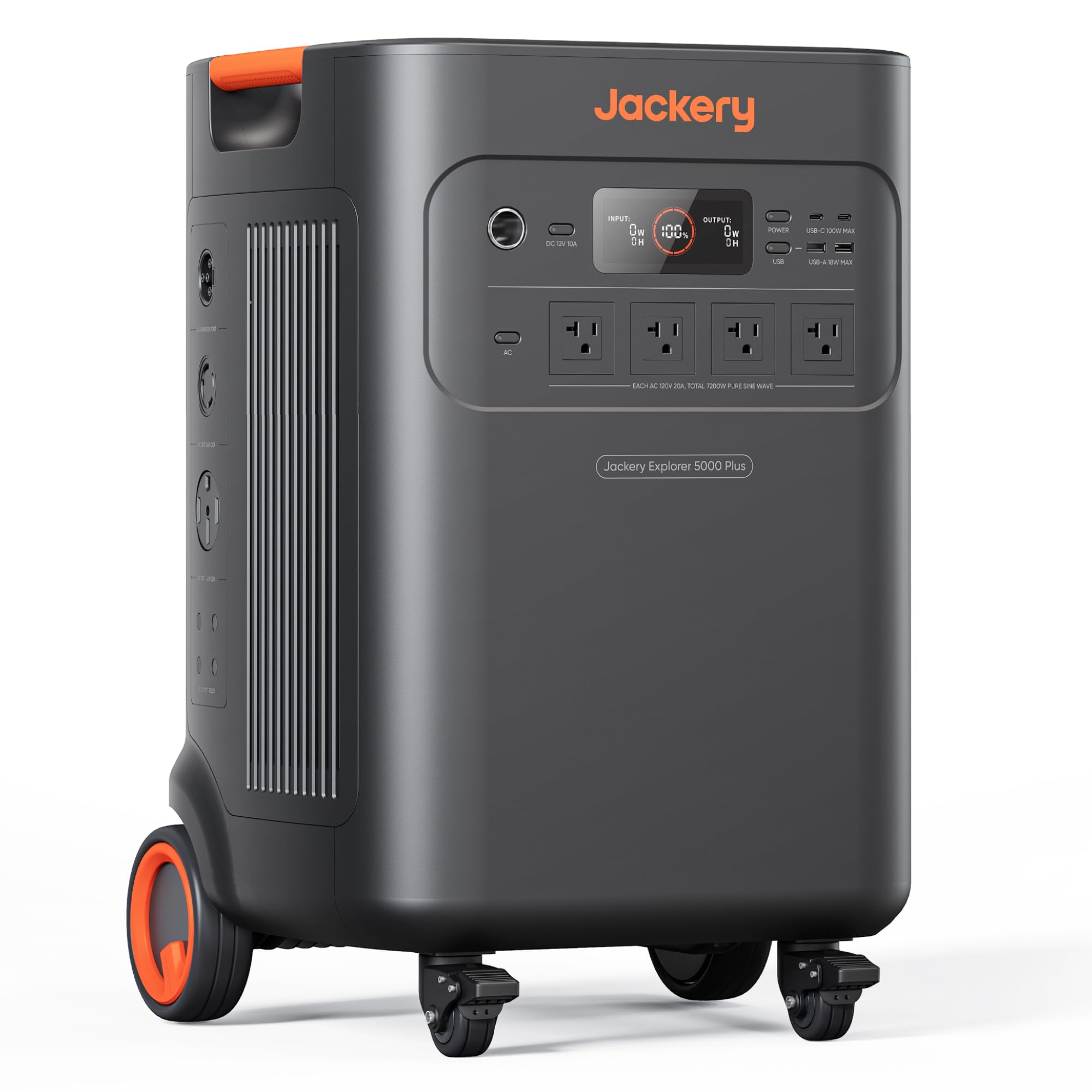
7. Jackery Solar Generator 5000 Plus, 5040Wh LiFePO4, 7200W 120V/240V AC Output
Built to carry a house through a 13-day outage, not just a stormy evening.
This is the pick for people who have lived through a week-long blackout and refuse to do it again. Capacity starts at 5040Wh and expands to 60kWh, which the brand frames as 13 days of home backup, while the 7200W rated output surges to 14,400W — enough to start a 5-ton central air conditioner. It supports both 120V and 240V, and it runs a water heater for a hot shower. For family coverage over an extended outage, the numbers put it near the top of this list.
The charging side is designed around speed when it counts. It is compatible with both high- and low-voltage solar panels and recharges in about 2 hours with up to 4000W of solar input. Pair it with the Jackery 60A Smart Transfer Switch, and it powers up to 12 circuits at 120V or 6 circuits at 240V — that is the component that turns it from a big battery into a wired home backup. On durability, its LiFePO₄ cells and ChargeShield 2.0 are rated for up to 11 years of daily use.
Set your expectations on runtime, though, because owners are emphatic about it. One widely echoed point is that heavy 240V loads draw down fast — a buyer running it hard in UPS mode found it gave roughly 5 hours at high 240V draw, so how you ration usage during a long outage matters. Battery life and reliability both draw mixed feedback, with some reporting significant daily self-discharge and others finding it rock solid. Firmware handling of overload codes has also been finicky for a few units. None of that changes the core appeal: if you want maximum days of coverage and a wired transfer-switch path, the expansion ceiling of 60kWh is the most generous on this list.
The number that matters: 60kWh of expandable capacity plus a 14,400W surge is what separates it from smaller 3.6kWh units that cannot start big HVAC loads.
Pick this for: homes that need multi-day coverage and want the option to wire into a transfer switch.
Think twice if: you plan to run heavy 240V appliances continuously — budget your usage or it drains quickly.
8. ECO-WORTHY Powermega 48V 314Ah LiFePO4 Energy Storage System with Liber 10KP 10kW Hybrid Inverter
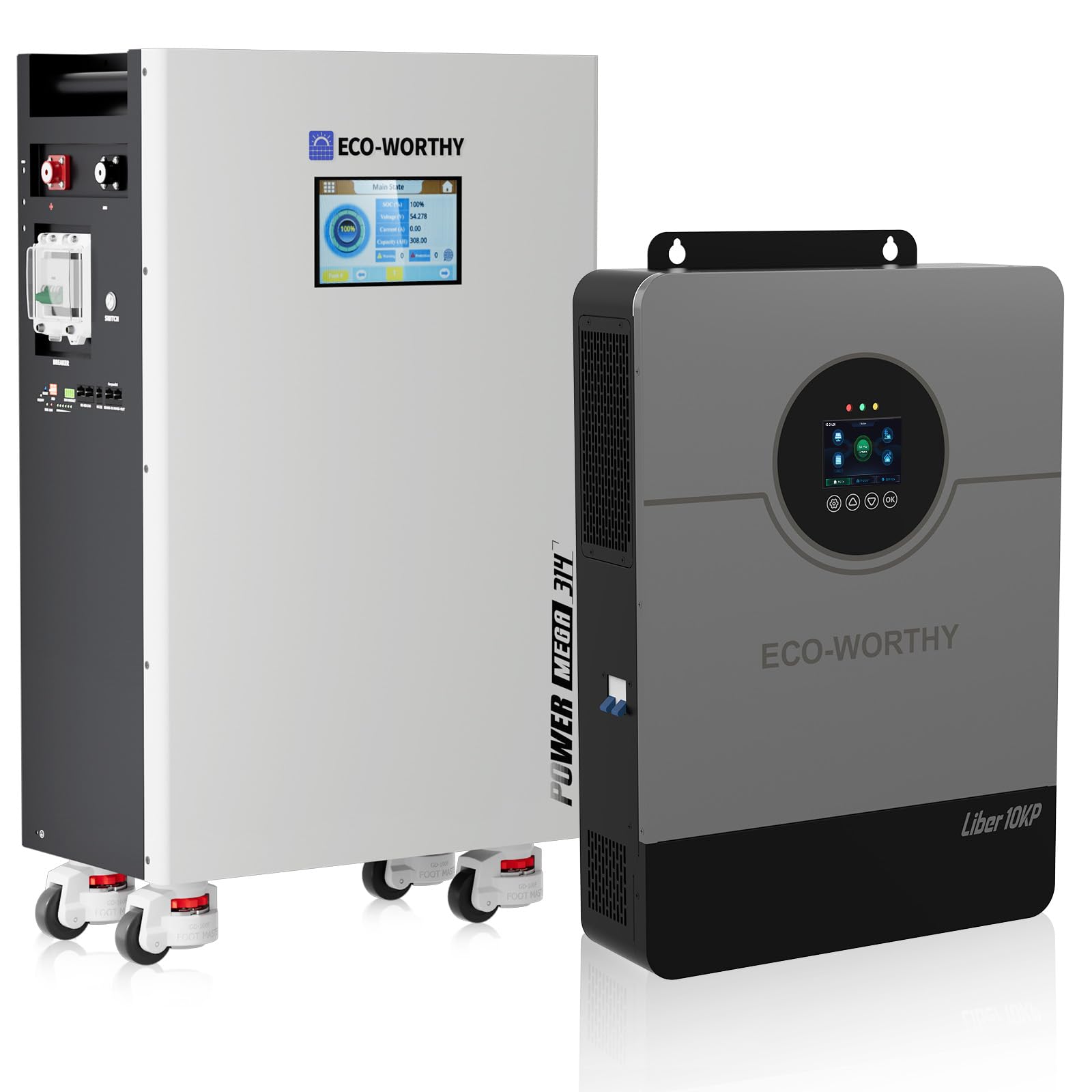
A hardwired battery-and-inverter system for cabins and off-grid builds, not a portable box.
This one is not wheeled to the kitchen — it is installed and left in place. The system pairs a 48V 314Ah LiFePO4 battery with a 10kW hybrid inverter, delivering 16.1kWh of usable energy, which is the largest single starting capacity on this list. It supports split-phase 240V and single-phase 120V output, so it can feed both standard outlets and heavy 240V circuits. If you are building out a cabin, a workshop, or a dedicated backup room, this is the architecture you want underneath it.
The safety and monitoring stack is unusually deep for this tier. The battery runs an Active Balancing Smart BMS — the circuit board that keeps every cell at the same voltage so none gets overworked — plus a built-in circuit breaker, an aerosol fire suppression module, and a buzzer alarm. It protects against over-charge, over-discharge, over-current, short circuit, and extreme temperatures, and it supports RS485, CAN, and RS232 communication for broad inverter compatibility. A built-in LCD shows real-time battery data, and built-in Wi-Fi and Bluetooth let you monitor from a phone. The 10kW inverter is rated up to 99.9% MPPT efficiency, and the battery delivers 9,000+ cycles at 80% depth of discharge.
Owners using it as a peak-rate saver report running a 1-ton AC, a washer, and a PC while integrating into Home Assistant for monitoring. A couple of practical notes matter here, though. The system ships in multiple packages on truck freight, and the return clock starts only when the battery arrives, so build that into your timeline. The inverter runs hot in summer — one owner added four computer fans to cool it and advises against a living-room install. The app also talks to the battery, not the inverter, so plan your monitoring accordingly. It is a 293.2-pound installation, not a weekend carry-home.
Why engineers like it
- 16.1kWh usable capacity with a 10kW hybrid inverter from day one
- Active Balancing BMS with circuit breaker and aerosol fire suppression
- 9,000+ cycles at 80% depth of discharge for long-term service
Plan around this
- Ships by truck freight in multiple packages, with the return window tied to battery delivery
- Inverter runs hot in summer and may need added ventilation
The right call for: off-grid cabins, workshops, and permanent backup rooms where capacity and safety hardware beat portability.
Wrong call for: anyone who wants to move the system after installation.
9. EF ECOFLOW 12kWh Power Station: DELTA Pro Ultra with Extra Battery

The system people buy when they want to forget the grid exists entirely.
This is the flagship pick for a homeowner who wants whole-house coverage without the fuel cans. The bundle includes an inverter and two batteries for 12kWh of capacity, and one inverter supports 120V and 240V at 7200W output — enough to run a 3-ton central air conditioner, a load smaller stations cannot approach. Capacity scales from one 6144Wh battery to fifteen for 90kWh total, which the brand describes as over 30 days of essential power for a standard North American household. Triple the inverters and output reaches 21.6kW, and it holds 7200W even while charging.
What owners value most is how it disappears into the background. The online UPS switches in 0ms, so sensitive electronics see no interruption at all, and all fans stay off for the first half hour of outputting 2000W, meaning it runs silent in ordinary use. Paired with a Smart Home Panel 2, it can fail over instantly across up to 12 circuits with no separate UPS needed, and one owner described the app as good for monitoring and control, though it will not combine EPS mode with scheduled failover tasks.
The honest caveats concern precision rather than power. Charging performance draws mixed feedback, with a few buyers reporting charging faults, and one van-life user found battery percentage readouts inaccurate — jumping from 50% to 70%, and reading 4% when thousands of watt-hours remained. Standby drain of 5–10% per day showed up in that same account, so factor that into long-idle storage. The build is heavy at 293.6 pounds and arrives as separate inverter and battery packages. None of this undercuts what the system is for: whole-home backup with the highest capacity ceiling here, backed by a modular design that owners describe as clever and genuinely easy to assemble.
The headline spec: 90kWh of expandable capacity paired with 21.6kW of parallel inverter output is the deepest whole-house setup on this list, and the 0ms UPS keeps everything online through the switch.
Built for: homeowners who want to run the entire house, including central AC, through long outages.
Know before you commit: percentage readouts and daily standby drain mean you should verify state of charge yourself rather than trust the app alone.
Understanding the Specs
Capacity in watt-hours
Watt-hours (Wh) measure how much total energy the battery stores — think of it as the size of the fuel tank. Higher Wh means longer runtime, but it usually means more weight and more space. Choose based on how many loads you want to run at once and for how long. If you might add more later, look for a unit listed as expandable rather than fixed.
Continuous and surge output
Continuous watts are what the unit can run steadily; surge (or peak) watts are what it can handle for the seconds a motor starts. A compressor, a pump, or an AC unit can draw several times its running watts at startup, so a unit with big capacity but low surge can still trip when a big appliance kicks on. Match the continuous rating to your total running load and the surge rating to your largest motor.
Battery chemistry
LiFePO₄ (lithium iron phosphate) is the chemistry most of the picks here use. It runs cooler, and it is generally rated for far more charge cycles than older lithium types, which is why makers quote lifespans of years rather than months. When you see an LFP or LiFePO₄ label, that is a signal the unit is built for repeated deep cycling, which is exactly what an outage machine does.
UPS transfer time
Transfer time is how long the unit takes to switch to battery when grid power drops, measured in milliseconds (ms). A 0ms online UPS is instant, so computers and routers never notice. Anything under about 20ms is typically fast enough that most electronics never reboot. This matters most for medical devices, network gear, and desktop computers rather than lamps or heaters.
FAQ
How many hours can a Home Battery Backup System run my fridge and furnace during an outage?
Can I run a central air conditioner on battery backup?
What is the difference between lithium iron phosphate and regular lithium batteries?
Do I need an electrician to install a home battery backup system?
How fast can a home battery backup system recharge between outages?
Will a home battery backup system keep my internet and router running during a blackout?
How much capacity do I need for a whole house versus essentials only?
Can these systems charge from solar panels as well as wall power?
How long does a home battery backup system last before it needs replacing?
Final Thoughts: The Verdict
Across the board, the home battery backup system winner is the EF ECOFLOW DELTA Pro, because it recharges in 1.8 hrs on 240V, runs 3600W output that climbs to 7200W when paired, and expands up to 25kWh as your needs grow. If you want the easiest one to live with — wheels, a telescopic handle, and a 2-hour recharge at 77.2 pounds — grab the Jackery HomePower 3600 Plus. And for budget-tier buyers who still want a 10.24kWh expansion ceiling and sub-40-minute charging, the AFERIY P280 is the one to reach for. If you have settled on the essentials-only plan, that entry pick is the smartest lower-cost starting point here — start there, add batteries as your confidence in the system grows.
How We Picked
We do not accept paid placement. Every pick is matched to a real buyer and a real use-case; we do not hands-on test units.
Sources & Methodology
Specifications: manufacturer listings and product documentation. Review insights: verified customer reviews, as of September 2026. Pricing: not shown on this page (it changes often); check the current price via the retailer link.
As an Amazon Associate, KitchPrep earns from qualifying purchases. This does not affect which products we feature.
Related Guides
