
Hand mixers are one of those tools you only notice when they’re bad: flour clouds, splatter on the backsplash, beaters clanking, and your wrist feeling like it just did a gym session you didn’t sign up for. The funny part? A genuinely good one can feel like a “shortcut” appliance—fast enough to skip hauling out a stand mixer, precise enough for meringue, and comfortable enough that you don’t dread the cleanup.
If you’re here for the best hand held mixer, I’m going to make this simple: we’re not picking based on “more speeds = better” or a random watt number. We’re picking based on how these machines behave in real kitchens—when the batter is thin, when the dough fights back, and when you need clean, repeatable results without drama.
Heads-up: this list is mostly classic handheld mixers (beaters/whisks/hooks). I also included two handheld immersion-style sets because a lot of people searching “handheld mixer” actually mean “I need to blend soup/smoothies/baby food without a countertop blender.”
What makes this guide different?
I built this roundup around what experienced home bakers and everyday cooks actually complain about (and celebrate): “slow start” that’s not really slow, beaters that trap dough, motors that smell hot after a minute, and the kind of balance that makes a heavier mixer feel easier than a lighter one. You’ll see me talk about things you usually only learn after owning a mixer for months—like how beater geometry changes cookie dough texture, why some mixers “walk” in thick batters, and what storage cases get right (and wrong).
Who this is for
If you bake cookies, make frosting, whip cream, mix pancake batter, mash potatoes, or do small-batch cakes and muffins—this guide is for you. If you routinely knead large bread batches, you’ll still benefit (I’ll show you what’s realistic), but you may want a stand mixer for that workload.
How to Choose the Best Hand Held Mixer for Your Kitchen
A hand mixer is basically a “power + control” tool. Most buyers obsess over power and ignore control—then wonder why the kitchen looks like a snowstorm after adding flour. The truth is: the best mixers feel predictable. They don’t surprise you with sudden RPM jumps, they don’t torque-twist your wrist, and they don’t force you to stop every 20 seconds to scrape the bowl.
1) Start with the three mixing “worlds” you live in
Almost everything you do with a hand mixer fits into one of these categories. Once you know your category, the right features become obvious:
- Air + foam: whipped cream, egg whites, meringue, chiffon-style batters. You need stability at higher speeds and a whisk that doesn’t wobble.
- Fat + sugar + emulsions: frosting, buttercream, creaming butter/sugar, cream cheese filling, mayo-style emulsions. You want steady torque and beaters that don’t trap sticky mix.
- Thick & chunky: cookie dough, brownie batter, mashed potatoes, chunky add-ins (nuts/chocolate chips). This is where “paper specs” break and real-world design wins.
2) Don’t worship wattage—look for usable torque and stable speed
Wattage can hint at potential, but it’s not a guarantee of real mixing strength. Two mixers can share the same watt rating and feel completely different in a dense dough. Why? Because the “mixing feel” comes from the motor type, the gear train, and how the control circuit behaves under load.
What you want: a mixer that holds its speed reasonably well when the mixture thickens, instead of bogging down or surging. If a mixer slows too much, you overwork parts of the batter while other areas stay unmixed. If it surges, it splatters and beats too aggressively.
3) “Slow start” matters—but only if it’s actually slow
Many mixers advertise slow start, but there are two very different realities:
- True gentle ramp: the beaters accelerate gradually, giving you a second to incorporate dry ingredients without a flour blast.
- Fast “low” speed: the mixer jumps immediately, and you still need a deep bowl and a prayer.
If you frequently do powders (flour, cocoa, powdered sugar), prioritize a model with a genuinely low first speed or a smooth ramp. It’s not just cleanliness—it also prevents pockets of dry ingredients that later turn into lumps.
4) Beater design is the hidden deciding factor
This is where most guides stop at “includes beaters.” That’s not enough. The shape changes how your mixture behaves:
- Open wire beaters: whip quickly and are easy to rinse, but some designs have less “mass” and can struggle in very thick mixes.
- Wider/flat beaters: tend to feel more confident in cookie dough and heavy batters because they push more material with each rotation.
- No-center-post beaters: a big deal for sticky mixtures; fewer places for dough to pack in and dry.
- Scraper/rubberized edges: reduce bowl clanging and cut down scraping stops—especially nice for buttercream and thick frosting.
5) Attachments: buy for what you’ll actually use
Extra attachments can be awesome, or they can be clutter. Here’s the honest breakdown:
- Whisk: worth it if you do whipped cream or meringue even occasionally. It’s faster and yields better volume than using standard beaters.
- Dough hooks: useful for small, soft doughs (like quick dinner rolls or enriched dough) in small batches. For stiff bread dough, they’re more of an emergency option than a daily plan.
- Chopper add-on: surprisingly handy if it’s designed well—think nuts, herbs, onions, cookie add-ins. It can replace a small food processor for quick tasks.
- Storage case: underrated. If you’ve ever lost a whisk attachment, you already understand the value.
6) Comfort is performance (because shaky hands = inconsistent mixing)
If you’re mixing a thick batter and the mixer fights your wrist, you’ll naturally change angle, move too fast, or lift beaters out of the mix—leading to uneven incorporation and extra air where you don’t want it. Comfort features to prioritize:
- Balance: weight centered over the beaters feels more stable than weight hanging behind your hand.
- Handle geometry: a natural wrist angle reduces fatigue in long frosting sessions.
- Swivel/lockable cord: keeps the cord out of the bowl and stops the “cord drag” that makes you tilt awkwardly.
- Stable resting position: the ability to stand the mixer upright without it tipping or smearing batter everywhere.
7) Durability: what breaks first (and how to prevent it)
Hand mixers usually fail in predictable ways: stripped gears, overheated motors, worn ejection mechanisms, or beaters that wobble from slight bending. The best longevity habit is also the easiest: match the job to the tool. Thick dough at high speed is the fastest route to heat buildup and gear stress.
Practical durability tips that actually work:
- Use low speed for thick mixtures, and increase only when the batter loosens.
- Stop and scrape the bowl instead of forcing the mixer to “power through” dry pockets.
- When mixing very thick dough, work in smaller batches and keep sessions short (think bursts, not marathons).
- Store beaters straight (bent beaters cause clanking, wobble, and extra wear).
8) A quick decision shortcut
If you don’t want to overthink it, here’s the simplest way to choose:
- You want the easiest “grab-and-go” experience: pick a quiet, stable mixer with scraper beaters and a smart speed system.
- You bake often and want a step-up without going full premium: choose a model with smooth start + multiple speeds + strong beaters.
- You hate losing attachments: prioritize a good storage case (the ones that lock well are life-changing).
- You mostly blend soups/sauces/smoothies: you may actually need an immersion-style handheld blender set instead of classic beaters.
Quick Comparison: 16 Best Hand Held Mixer Picks
Use this table to narrow to 2–3 finalists fast. Then jump into the reviews—because the “why” (control, comfort, real-life quirks) is what makes the right choice obvious.
| Mixer | Type | Speeds | Power / Motor | Best match | Amazon link |
|---|---|---|---|---|---|
| Breville Handy Mix Scraper (BHM800) | Hand mixer | 9 + Boost | High-performance motor + “Beater IQ” behavior | Quiet, low-mess mixing; frosting & cookies with less scraping | View |
| Cuisinart Power Advantage Plus (HM-90) | Hand mixer | 9 | 220W + automatic feedback | Serious home baking; stable speed under load; great attachments | View |
| KitchenAid 7-Speed (KHM7210) | Hand mixer | 7 | 250W class + pro whisk | Controlled low speed; quiet mixing; everyday baking confidence | View |
| Dualit Professional 4-Speed | Hand mixer | 4 | High-torque build; repairable gear design | Thick cookie dough feel; wide beaters; tidy cord storage | View |
| SMEG 50s Retro Hand Mixer (Red) | Hand mixer | 9 + Turbo | 220W + smooth start + timer display | Design-forward kitchens; cakes, cookies, and fun baking sessions | View |
| Braun MultiMix 5 (HM5130) | Hand mixer | 9 + Turbo | 350W + SmartMix weight-shift design | Low fatigue mixing; chopper add-on; very practical “multi tool” feel | View |
| SMEG 50s Retro Hand Mixer (Cream) | Hand mixer | 9 + Turbo | 220W + smooth start + timer display | Same SMEG performance; softer neutral aesthetic | View |
| Cuisinart Power Advantage (HM-50) | Hand mixer | 5 | 220W + swivel cord | No-frills strength; extra-long beaters; excellent everyday utility | View |
| KitchenAid 5-Speed Ultra Power | Hand mixer | 5 | DC-style efficiency + Turbo Beaters | Lightweight daily driver; quick batters and whipped tasks | View |
| Hamilton Beach Professional (62658) | Hand mixer | 5 + QuickBurst | DC motor + slow start | Budget-friendly control; neat case storage; surprisingly quiet | View |
| Hamilton Beach 6-Speed (Black) | Hand mixer | 6 + QuickBurst | 275W peak + accessory bundle | Most attachments for the money; case keeps everything together | View |
| Hamilton Beach 6-Speed (Blue) | Hand mixer | 6 + QuickBurst | 275W peak + accessory bundle | Same mixer, different colorway; ideal if you want the blue look | View |
| Hamilton Beach Vintage-Style (62601N) | Hand mixer | 5 + QuickBurst | DC motor + slow start | Quiet mixing + cute retro vibe; small kitchen friendly | View |
| Ganiza 5-in-1 Immersion Blender (GH10) | Immersion set | 16 + Turbo | 1000W copper motor | Soups, smoothies, baby food; chopper + whisk + frother versatility | View |
| turelar 5-in-1 Immersion Blender | Immersion set | Trigger-variable | 1100W copper motor | Fast blending; pot-friendly guard; great for soups & sauces | View |
| LILPARTNER 5-Speed Hand Mixer | Hand mixer | 5 + Turbo | 450W rated + storage base “scale cup” | All-in-one storage idea; best for light-to-medium mixing with care | View |
On smaller screens, swipe or scroll sideways to see the full table.
In-Depth Reviews: 16 Best Hand Held Mixer Options
Below, I’m not just listing features—I’m translating how each mixer behaves when it’s actually working: thin batters, thick doughs, sticky frostings, and messy add-ins. I’ll also call out the “little things” that turn into big things after a few months (storage design, ejection ergonomics, clanking, and whether the low speed is truly usable).
- Best Overall = easiest to live with, not just strongest on paper
- Best upgrades = noticeable performance jump without feeling gimmicky
- Best values = solves real problems (splatter, storage, control) without shortcuts
- Special-case picks = immersion sets for people who really want blending, not beating
1) Breville Handy Mix Scraper (BHM800SIL) — the “effortless” mixer that feels like cheating

This Breville is the hand mixer I recommend when you want the whole process to feel calmer: fewer loud clanks, fewer stops to scrape, fewer “oops, I just redecorated the counter with powdered sugar.” Its signature advantage isn’t a flashy spec—it’s the way it behaves under different attachments. You get a more predictable feel whether you’re whipping cream or pushing through a thicker batter.
The scraper beaters are the star. In real use, they do two things that matter: they keep ingredients moving off the bowl walls, and they keep the mixer quieter because there’s less metal-on-bowl chatter. Add the built-in light (seriously useful when you’re mixing dark batters) and the timer, and you end up with a tool that supports consistency instead of just “spinning fast.”
Best for: frosting sessions, cookie dough, cake batter, and anyone who hates stopping to scrape every minute.
Expert note: This is a “comfort performance” pick—meaning it often feels easier than some lighter mixers because the balance stays steady over the bowl.
Pros
- Scraper beaters reduce bowl scraping and clanging
- Stable control across tasks (whipping vs mixing)
- Light + timer help with repeatable results
- Feels premium in hand and stays composed in thicker mixes
Cons
- Heavier feel than ultra-light budget mixers
- Premium feature set is “overkill” if you only mix pancakes twice a month
- Scraper beaters shine most in bowls with a rounded wall (very sharp corners reduce the benefit)
2) Cuisinart Power Advantage Plus 9-Speed (HM-90BCS) — stable speed where most mixers flinch

This is the mixer I point to when someone says, “I bake enough that cheap mixers annoy me, but I don’t want a countertop stand mixer lifestyle.” The HM-90’s strength is the combination of a genuinely useful speed range and a control system that tries to maintain the feel of the chosen speed as mixtures thicken. That matters most in cookie dough, frostings, and dense batters—where lots of mixers either bog down or surge.
The extra-long beaters are a small design choice with a big impact: they reach deeper, incorporate faster, and the no-center-post style helps avoid that gross dough “plug” that forms on many traditional beaters. Real-world users tend to love how quickly it whips cream and how clean the beaters rinse, but a consistent note is that the mixer is “beefy”—in both size and sound (a cooling fan can be noticeable at higher speeds).
Best for: bakers who want consistent speed behavior, a real low range, and an attachment set that covers most home recipes.
Expert note: If you ever accidentally eject beaters mid-mix, it’s usually grip placement. Train your hand position before going into thick dough.
Pros
- Strong control feel in thicker mixtures
- Extra-long beaters clean easily and mix efficiently
- Useful set of attachments + storage case
- Low speeds are genuinely practical for dry ingredients
Cons
- Fan noise can be noticeable at higher speeds
- Heavier/large-body feel compared with compact models
- Thick dough is still a “short bursts” job, not a marathon
3) KitchenAid 7-Speed Hand Mixer (KHM7210) — the one that doesn’t launch flour into orbit

If your biggest pain point is splatter and “too-fast low speed,” this KitchenAid is the fix. The lower end of the speed range is calm enough that you can fold in powders and gently start thick doughs without the mixer immediately trying to sprint. That one trait makes it feel more professional than many “more powerful” models, because control is what keeps your batter consistent and your kitchen clean.
Users regularly praise how quiet it feels for a hand mixer and how the speed range suits real baking: low for adding chunks, higher for whipping. It also includes a pro whisk that performs better than standard beaters for whipped cream and egg whites. The only common nit is the tactile feel of the buttons—functionally fine, but not the most luxurious click.
Best for: everyday bakers who want calm starts, a strong whisk option, and reliable mixing without drama.
Expert note: Pair a controlled low speed with a deep bowl and you’ll cut splatter almost to zero—even with powdered sugar.
Pros
- Low speed is genuinely low (excellent for dry-to-wet mixing)
- Quiet operation for the category
- Pro whisk boosts performance for foams
- Swivel cord helps left- or right-handed mixing
Cons
- Button feel isn’t “premium tactile” for some users
- Not meant for large, stiff bread dough batches
- Storage case is not the headline feature (plan your storage)
4) Dualit Professional 4-Speed Hand Mixer — old-school torque, wide beaters, and a “built like a tool” vibe

The Dualit is the mixer people buy after getting tired of “flimsy wire beaters” that feel like they’re apologizing to cookie dough. Its wide, sturdy beaters create that heavyweight sensation—like the mixer is pushing the dough instead of bouncing off it. If you cream butter and sugar often, you’ll notice how quickly it gets the job done before the mixture warms up.
Real-world feedback is a mix of love and tough honesty. Fans describe it as powerful enough to feel stand-mixer-adjacent for many tasks, and they love the integrated cord storage for tidy cabinets. A recurring caution is that this power can splatter thin mixtures if you don’t start carefully (deep bowl + low speed), and there are occasional complaints about durability after heavy use. In practical terms: treat it like a strong machine—use the right attachment, don’t force stiff dough at high speed, and it will reward you.
Best for: frequent cookie dough makers and anyone who wants a sturdy, tool-like mixer with thoughtful storage.
Expert note: This mixer shines most when you keep ingredients moving—pause and scrape instead of trying to “power through” dry pockets.
Pros
- Sturdy wide beaters feel confident in thick mixtures
- Attachments cover most baking tasks
- Cord/plug storage keeps cabinets tidy
- Great for creaming and dense cookie batters
Cons
- Can splatter thin mixes if you start too fast
- Heavier “tool” feel isn’t for everyone
- Some users report durability issues after long-term use
5) SMEG 50’s Retro Hand Mixer (Red) — a countertop showpiece that still earns its keep

Let’s be real: people buy SMEG because it makes them want to bake. That’s not a silly reason—motivation is a kitchen feature. The good news is it’s not only a pretty face. The speed control is precise, the smooth start helps keep mess down, and the included accessory set covers standard home baking.
Where the SMEG fits best is “joyful baking”: cookies, muffins, cakes, and quick batters. Users who love it often call out consistent mixing and the satisfying premium feel. The most honest caution you’ll see from experienced bakers is about heavy dough: yes, there are dough hooks, but this is not the tool for large bread batches. Treat it as a premium hand mixer (not a stand mixer replacement) and it performs beautifully.
Best for: design-first kitchens, gift-giving, and anyone who wants a premium-feeling mixer for everyday baking.
Expert note: If you want SMEG mainly for bread, consider a stand mixer. If you want it for cakes and cookies, it’s a delight.
Pros
- Looks incredible and feels premium in hand
- Smooth start + good speed control
- LED display with timer is genuinely useful
- Accessories store neatly in the included bag
Cons
- Not the best match for large, stiff bread dough
- Buying primarily for power-per-dollar misses the point
- More of a “baking lifestyle” tool than a budget workhorse
6) Braun MultiMix 5 (HM5130) — powerful mixing with less hand fatigue (plus a genuinely useful chopper)

The Braun’s superpower is ergonomics that actually changes the experience. Instead of feeling like the mixer is “hanging” off your wrist, the design shifts the weight closer to the bowl. If you do longer mixing sessions—frosting, whipped potatoes, repeated batches—this matters more than you’d expect. It’s one of those “you notice it after five minutes” improvements.
Performance-wise, it’s legitimately strong for a hand mixer, and the speed dial style control is great for micro-adjustments without interrupting your flow. The chopper attachment is the quiet hero: quick nuts, chocolate chunks, herbs, onions—things that usually require a separate appliance. A practical tip from long-term users: always seat attachments correctly and keep beaters straight—any slight bend can cause wobble in high-speed whipping.
Best for: anyone who wants a hand mixer that feels easier to hold, plus a “mini food processor” bonus for prep.
Expert note: If you have smaller hands or grip fatigue, this style of balance can be worth more than extra watts.
Pros
- Ergonomic balance reduces fatigue in longer sessions
- Strong motor + wide speed control range
- Chopper attachment is genuinely useful for baking add-ins
- Sealed design helps keep the housing cleaner over time
Cons
- More components to store and clean (because it does more)
- Like all hand mixers, turbo + thick dough needs restraint
- If you never use the chopper, you’re paying for versatility you won’t touch
7) SMEG 50’s Retro Hand Mixer (Cream) — same SMEG charm, softer colorway

This is essentially the same “SMEG experience” as the red version—smooth start, a satisfying speed range, and that premium feel that makes it tempting to leave it out on the counter. The cream colorway is the pick if you want retro style without a bold pop.
In real use, it’s happiest in classic baking tasks: batters, cookie dough, whipped cream, and quick mixes. Where you’ll want to be realistic is heavy dough: SMEG includes hooks, but the mixer performs best when you keep dough batches smaller and softer. Think: enriched doughs, not stiff artisan loaves.
Best for: buyers who want SMEG’s premium feel but prefer a neutral kitchen palette.
Expert note: If you’re between colors, choose based on your kitchen style—performance is essentially the same.
Pros
- Premium look and feel; makes baking more inviting
- Smooth start helps reduce mess
- Timer display is useful for repeatable mixing
- Accessory bag keeps tools together
Cons
- Not built for large, stiff bread dough workloads
- Style-forward pricing isn’t for everyone
- If you store everything in drawers, the “display value” matters less
8) Cuisinart Power Advantage 5-Speed (HM-50) — simple, strong, and surprisingly satisfying

Not everyone needs 9 speeds. If your cooking is mostly “mix batter, whip cream, make frosting, mash potatoes,” this Cuisinart is the kind of straightforward tool that just works. The extra-long beater design is the quiet hero: it mixes deeper in the bowl and rinses clean without that center-post dough clog.
The swivel cord is also more important than it sounds. It keeps the cord from dragging into the bowl or forcing you into awkward angles—especially if you’re switching hands or working in a tight space. The speed range is simple but useful; if you want more micro-control, jump to the HM-90, but for most people this is the “clean, capable, uncomplicated” choice.
Best for: everyday mixing when you want strength and simple controls without a lot of extras.
Expert note: A well-designed 5-speed mixer beats a poorly designed 9-speed one every day—especially in thick mixtures.
Pros
- Strong real-world performance for a 5-speed format
- Extra-long beaters reduce clogging and mix efficiently
- Swivel cord improves handling and reduces mess
- Easy to wipe clean (few awkward crevices)
Cons
- No “premium comfort” extras like lights or timers
- Less speed granularity than multi-speed models
- If you want a storage case, you’ll need to plan separately
9) KitchenAid 5-Speed Ultra Power Hand Mixer — simple, tidy, and easy to like

This is the kind of mixer that earns its keep by being easy: light enough to grab for quick tasks, familiar controls, and a cord design that stays out of your way. People who love it tend to mention exactly what you want from an everyday hand mixer: it mixes well, it’s comfortable, and it doesn’t feel like a hassle to clean.
The big “real world” thing to understand is that this model shines in batters, frosting, whipped cream, and mashed potatoes—but it’s not built to bully stiff dough. If you often do heavy cookie dough, you’ll feel the difference compared to beefier designs with wider beaters. But for normal home baking, it’s a friendly, reliable tool that doesn’t overcomplicate your kitchen.
Best for: casual-to-regular home baking where comfort and simplicity matter more than maximum torque.
Expert note: If you ever struggle with splatter, the biggest upgrade is using speed 1 longer than you think you need.
Pros
- Lightweight and easy to handle for quick mixing jobs
- Cord locks left or right, which is genuinely useful
- Simple 5-speed range covers most everyday recipes
- Classic KitchenAid feel and easy cleanup
Cons
- Less “heavy dough confidence” than higher-torque models
- Some users prefer older, more solid beater styles
- Not the best match if you want lots of included attachments
10) Hamilton Beach Professional 5-Speed (62658) — slow start done right, plus a tidy case
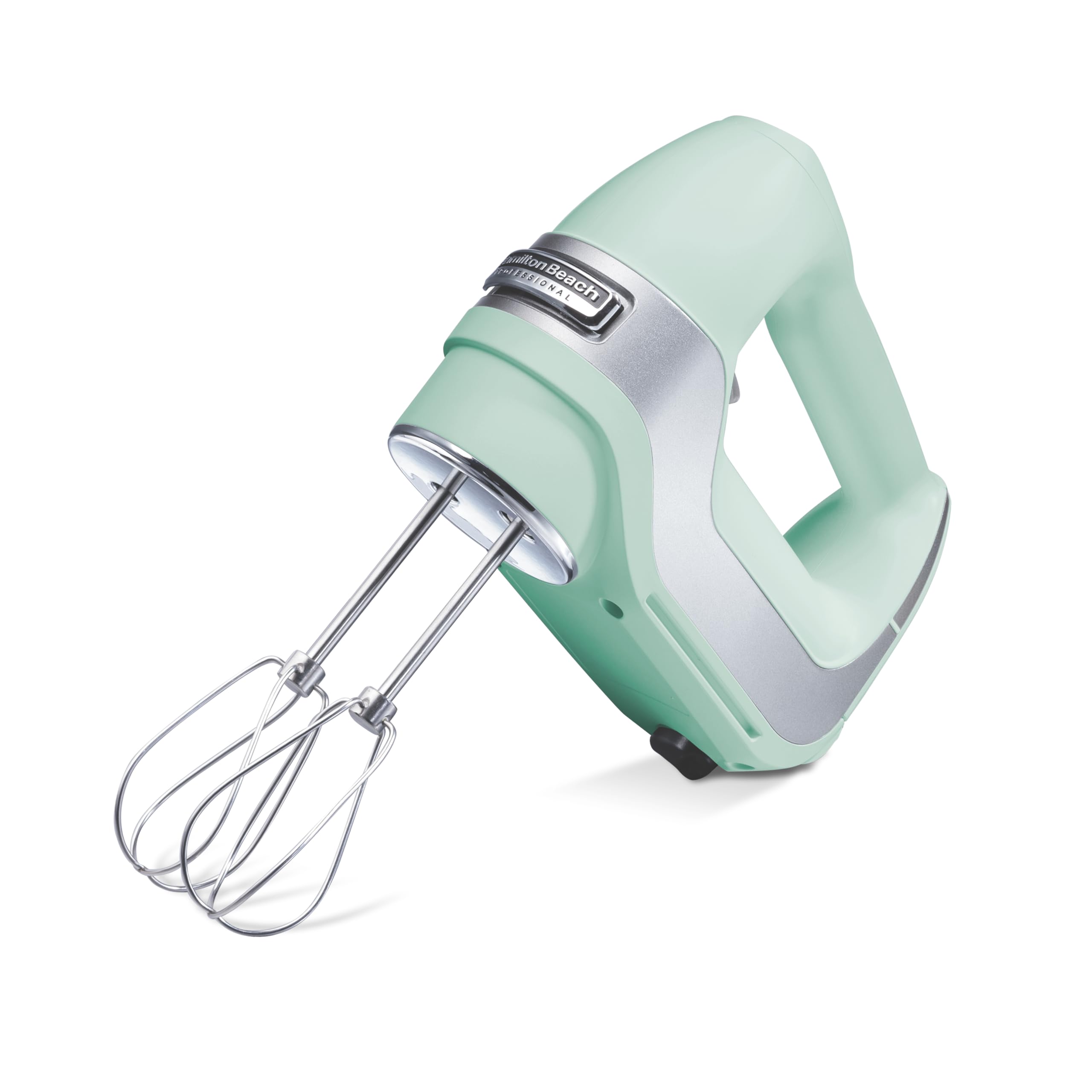
This Hamilton Beach “Professional” model wins on one thing that improves everyday baking immediately: it starts gently. That means fewer flour explosions, fewer batter freckles on your cabinets, and fewer moments of “why is the lowest speed so aggressive?” Add the storage case and you get the practical benefit most households love—everything stays together.
Real users often mention it feels powerful, quiet, and easy to handle, and that the whisk attachment covers most whipping tasks without needing a stand mixer. The most common critique isn’t mixing performance—it’s the storage tray mechanism itself, which some find slightly awkward until you get used to how the unit snaps in. If you value organization, that minor learning curve is usually worth it.
Best for: budget-minded buyers who want good control, less mess, and a storage case that prevents “lost beater syndrome.”
Expert note: The QuickBurst button is best treated as a short “push through” helper—not a default mixing mode.
Pros
- Gentle start reduces messy splatters
- Storage case keeps attachments organized
- QuickBurst adds short bursts of power when needed
- Whisk included and dishwasher-safe attachments
Cons
- Storage snap-in can feel fiddly at first
- No dough hooks in this set (more baking-focused than bread-focused)
- Not a stand mixer replacement for heavy dough
11) Hamilton Beach 6-Speed Hand Mixer (Black) — tons of tools, neat storage, and strong “weeknight utility”

If you want one purchase that covers lots of random kitchen tasks—mixing, whipping, and the occasional dough hook experiment—this Hamilton Beach bundle is a strong contender. You get multiple beaters (including “easy clean” styles), dough hooks, and a whisk, and it all stores together so the accessories don’t disappear into the drawer abyss.
The real-world feedback is very consistent: people love the attachment variety and the storage case. The one recurring caution is speed behavior on the lowest setting—some users say it still starts a little faster than expected, which can cause minor splatter if your bowl is shallow. The fix is simple: deeper bowl, start with beaters already submerged, and don’t rush to higher speeds.
Best for: households that want lots of attachments and tidy storage—especially for varied recipes.
Expert note: “Easy clean beaters” shine most in sticky mixes like brownie batter, where traditional beaters pack and clog.
Pros
- Excellent attachment bundle for broad kitchen use
- Storage case reduces lost/mismatched accessories
- Easy Clean beaters help reduce clogging
- QuickBurst is useful for short thick spots
Cons
- Lowest speed can still feel brisk for some users
- QuickBurst button behavior varies by user experience
- Dough hooks are best for small batches, not big kneads
12) Hamilton Beach 6-Speed Hand Mixer (Blue) — same feature set, different vibe

This blue version is here because a surprising number of people choose kitchen tools based on whether they’ll actually enjoy seeing them. Functionally, it’s the same practical bundle: multiple beaters, dough hooks, whisk, and a storage case that keeps everything together.
The same real-world advice applies: use a deeper bowl if you’re sensitive to splatter, start slow, and treat thick dough as a short-burst job. If you want a color pop without paying “designer appliance” pricing, this is a friendly way to get it.
Best for: buyers who want the full attachment bundle but prefer the blue look.
Expert note: Choosing a tool you’ll actually reach for is underrated. A mixer you like seeing is a mixer you use.
Pros
- Same broad attachment set as the black version
- Storage case keeps the kitchen organized
- Good “do everything” option for varied recipes
- Colorway is fun and kitchen-friendly
Cons
- Lowest speed may still feel fast for ultra-mess-sensitive users
- Not ideal for large stiff bread dough
- If you already own a whisk and dough hooks you love, the bundle matters less
13) Hamilton Beach Vintage-Style 5-Speed (Green) — calm, cute, and surprisingly capable for everyday mixing

This vintage-style Hamilton Beach is a fantastic reminder that “pleasant to use” is a feature. Users rave about how quiet it feels, how gentle the start is, and how nicely it stores in small cabinets. If you bake in a small space—or you cook while someone’s on a work call in the next room—quiet matters.
Performance is best described as “everyday strong.” It handles mashed potatoes and batters well, and the slow start is legitimately helpful for dry ingredients. The realistic limitation is heavy dough: it can do light kneading in small batches, but it’s not meant to be pushed like a stand mixer. Where it wins is the combination of calm control + tidy storage + a look that makes you want to use it.
Best for: small kitchens, quiet homes, and everyday baking where gentle control is more valuable than brute force.
Expert note: If a mixer “feels” calm, you tend to mix more evenly because you’re not fighting it.
Pros
- Very quiet compared to many budget mixers
- Slow start reduces flour clouds
- Storage case is genuinely space-friendly
- Retro look is charming without being delicate
Cons
- Not intended for big or stiff dough batches
- Power is “everyday strong,” not “bulldozer strong”
- Limited attachment variety compared to bundle kits
14) Ganiza Immersion Blender 5-in-1 — for soups, smoothies, sauces, and fast prep (not dough)

This isn’t a classic beater-style hand mixer—it’s an immersion blender set. But if your “mixer” needs are mostly soups, smoothies, baby food, sauces, and quick chopping, an immersion tool like this is often the smarter buy. Users consistently describe it as sturdy, powerful, and versatile, with enough speed control to avoid splashing hot soup everywhere.
The practical win is how many kitchen jobs it can compress into one tool: blend in a pot, chop add-ins, whisk a quick batter, froth drinks. The trade-off is simple: it’s not built for kneading dough or creaming butter and sugar like a true hand mixer. If your goal is baking texture, stick with beaters. If your goal is smooth soups and quick prep, this style is a home-run.
Best for: soup lovers, smoothie makers, baby-food prep, and anyone who wants handheld blending versatility.
Expert note: For hot liquids, always start on lower speed and keep the bell fully submerged before ramping up.
Pros
- Versatile set (blend, whisk, froth, chop)
- Strong blending performance for the category
- More speed control than many basic immersion sets
- Easier to clean than a countertop blender for quick jobs
Cons
- Not a true replacement for beater-style baking tasks
- More parts = more pieces to keep track of
- Chopping hard/frozen items can shorten lifespan if overdone
15) turelar 1100W Immersion Blender Set — fast blending with intuitive trigger control

Like the Ganiza above, this is an immersion-style set—not a beater mixer. The big difference is the trigger-style variable control, which many people find more intuitive than clicking speed buttons. In practice, that helps reduce splatter because you can “feather” the power as the mixture starts moving.
Users tend to highlight the strong blending performance and the convenience of multiple attachments for soups, smoothies, and sauces. One realistic durability note from real-world feedback: containers can be the weak link in some budget sets. If you’re hard on plastic cups, treat the included containers gently and don’t store them under heavy stacked weight. For blending performance, though, this set can be a serious time-saver.
Best for: people who prefer trigger control for blending and want a compact set for everyday soups and smoothies.
Expert note: With immersion sets, short bursts beat long runs—especially with thicker purees.
Pros
- Trigger control is intuitive and can reduce splatter
- Strong blending for soups, sauces, and smoothies
- Multiple attachments cover lots of quick kitchen jobs
- Pot-friendly guard helps protect cookware
Cons
- Not the right tool for creaming butter/sugar or cookie dough
- Budget-set containers may need gentle handling
- Hard frozen items can stress the motor if used improperly
16) LILPARTNER 5-Speed Hand Mixer (450W) — clever storage cup concept, but real-world reliability is mixed

The standout idea here is the storage base: it’s designed to keep attachments together and doubles as a measuring/holding cup concept. For many kitchens, that’s genuinely appealing—because the #1 way hand mixers become annoying is when accessories go missing.
Here’s the honest part: real-user feedback is split. Some people like the sturdy feel and the convenience, but there are also reports of overheating smells and early failure under load. If you choose this mixer, treat it as a light-to-medium duty tool: softer batters, room-temperature ingredients, short mixing sessions, and avoid pushing it through very thick dough. Used within those limits, it can still do everyday jobs—just don’t buy it expecting “stand mixer level” endurance.
Best for: occasional mixing and buyers who prioritize a compact all-in-one storage solution.
Expert note: If your mixer ever smells hot, stop immediately and let it cool. Heat is the enemy of long-term motor life.
Pros
- Clever storage base keeps attachments organized
- Includes dough hooks, beaters, and whisk
- Convenient eject button and compact footprint
- Good for quick, light mixing tasks
Cons
- Real-world durability feedback is inconsistent
- Lowest speed may still feel fast for some recipes
- Not a good match for heavy cookie dough or stiff batters
If you want the smoothest overall experience, go with the Breville. If you want a very practical baking upgrade with strong control, pick the Cuisinart HM-90. If your #1 priority is gentle low speed, choose the KitchenAid 7-Speed.
What “Power” Really Means (and How to Get Cleaner, Better Mixing)
Most people assume a hand mixer’s job is “spin fast.” In reality, a good mixer does three different jobs depending on the recipe: aeration (adding air), emulsification (making fats and liquids cooperate), and incorporation (evenly distributing dry ingredients without overworking). If you know which job you’re doing, your results improve immediately.
The two “power” problems that ruin results
- Too much speed too soon: causes splatter, traps dry pockets, and can over-aerate batters that should stay tender.
- Not enough torque in thick mixtures: causes bogging, uneven mixing, and forces you to move the mixer aggressively (which adds unwanted air and fatigue).
The splatter-proof start (works even without “slow start”)
This one technique makes almost any mixer cleaner to use:
- Put beaters/whisk fully into the mixture before switching on.
- Start on the lowest speed for longer than you think you need.
- Angle the bowl slightly or use a deeper bowl for powdered ingredients.
- Only increase speed once the dry ingredients have disappeared into the wet.
Whipped cream and meringue: how to get stable volume
- Cold matters: chill the cream and (ideally) the bowl for whipped cream.
- Clean matters: for egg whites, ensure the bowl and whisk are grease-free.
- Speed matters: start medium to build fine bubbles, then increase to finish. Going max speed immediately can create big unstable bubbles.
- Stop at the right moment: cream goes from perfect peaks to grainy quickly. Use the timer feature (if you have it) to repeat your sweet spot.
Cookie dough: the “thick mix” rules that save motors and improve texture
- Cream first, then slow down: cream butter/sugar until light, then reduce speed when flour goes in.
- Short bursts beat long runs: mix until just combined; finish by folding add-ins by hand if needed.
- Don’t chase perfection with the mixer: overmixing flour develops toughness. A few streaks disappearing with a spatula is often ideal.
- Let the mixer rest: if the housing feels warm, pause. Heat is what shortens motor life.
Dough hooks: when they work, and when they don’t
Dough hooks can be useful, but only if you respect the limits: soft doughs + small batches + low speed = reasonable results. Stiff doughs + large batches + high speed = overheated motor and stressed gears. If you want consistent bread kneading, a stand mixer wins. If you want occasional pizza dough for a small batch, hooks can help—just keep sessions short and let the motor cool.
Immersion blender sets vs. classic hand mixers (quick clarity)
If your goal is smooth texture (soups, sauces, smoothies), immersion sets are often the best tool. If your goal is baking structure (creaming butter/sugar, whipped egg whites for cakes, cookie dough), classic beaters are the right tool. Buying the “wrong type” is the fastest way to feel disappointed—even if the product itself is solid.
FAQ: Handheld Mixers, Answered
Do I need a hand mixer if I already have a stand mixer?
If you bake often, yes—because a hand mixer is faster to grab, faster to clean, and perfect for small batches (whipped cream, quick frosting, one-bowl cakes). Many people with stand mixers still use a hand mixer more frequently for everyday tasks.
What speed should I start on to avoid mess?
Always start on the lowest speed with beaters already submerged in the mixture. Increase only after dry ingredients have absorbed. A deeper bowl does more to prevent splatter than almost any “slow start” marketing claim.
Why do some mixers clank or the beaters hit each other?
Clanking usually comes from slight beater bending, poor beater alignment, or a design with tight tolerances under load. Check that beaters are inserted into the correct sockets, avoid dropping them in drawers, and replace bent beaters—wobble adds stress to the motor.
Are dough hooks actually useful on a hand mixer?
Yes—for small, soft doughs at low speed, in short sessions. No—for large, stiff dough batches. Dough hooks on a hand mixer are best treated as an occasional helper, not a daily bread solution.
Is a storage case worth it?
If you’ve ever lost attachments, absolutely. A case prevents missing pieces, keeps cords tidy, and makes the mixer easier to store without creating kitchen clutter.
What’s the fastest way to clean sticky batter off beaters?
Unplug the mixer, then rinse beaters immediately under warm water before batter dries. For very sticky dough, a quick soak and a soft brush helps more than scraping (scraping can bend wires over time).
Should I pick an immersion blender set instead?
Pick immersion blending if your main jobs are soups, smoothies, sauces, and baby food. Pick classic beaters if your main jobs are baking structure tasks—creaming, whipping, cookie dough, frostings.
How do I know I’m overworking my hand mixer?
The warning signs are heat, a “hot electrical” smell, slowing under load, or the mixer feeling strained. Stop, let it cool, and consider switching to a sturdier model if thick dough is a frequent task.
Final Thoughts: Your One-Buy Shortlist
At this point, choosing the best hand held mixer isn’t about chasing the biggest spec—it’s about matching the mixer’s “personality” to your kitchen reality. Do you need quiet control? A stable feel in thick dough? Storage that keeps your attachments from vanishing? Or do you actually need blending, not beating?
If you want the easiest, most confidence-building experience
Go with the Breville Handy Mix Scraper. It’s the pick that reduces the annoying parts of mixing: scraping, clanging, and “why is this so messy?” It’s the closest thing to a “premium daily driver” in this lineup.
If you bake often and want a practical performance upgrade
Choose the Cuisinart HM-90. It’s a serious home-baking tool with strong control, a wide speed range, and attachments that cover almost everything you’ll realistically do with a hand mixer.
If your #1 priority is controlled low speed (and less splatter)
Pick the KitchenAid 7-Speed. The usable low end makes it feel calm and predictable—the exact trait that helps beginners and experienced bakers alike.
If you love baking and want the mixer to be part of the kitchen vibe
SMEG is the “make me want to bake” option. If you’ll smile every time you see it, that’s real value—just keep dough expectations realistic.
If you mostly need soups, smoothies, and sauces
Don’t force a beater mixer to do a blender’s job. Choose one of the immersion sets (Ganiza or turelar) and enjoy fast, smooth blending without pulling out a countertop blender.
Want the simplest shortcut? Pick one “main job” you do most (cookies, frosting, whipped cream, or soups) and buy the tool designed for that job. Everything gets easier from there.
