
A blender is one of those appliances that feels “simple”… until you use it every day. Then you start noticing the stuff that never shows up on the spec sheet: the lid that burps smoothie mist on your backsplash, the gasket that traps chia seeds like it’s building a tiny museum, the jar that is technically dishwasher-safe but only if you enjoy unloading it like a dumbbell.
If you’re shopping for Best Glass Blenders, you’re usually chasing three things at once: cleaner-tasting blends, less plastic contact with your food, and a jar that doesn’t cloud up or hold odors after a hundred berry smoothies. That’s a great goal—glass can be a joy to live with—but here’s the honest truth: a “glass jar” label alone doesn’t guarantee a great blender.
The real difference between good and great shows up in the friction points: how the vortex forms (or doesn’t) in thick blends, whether the blade system actually pulls ingredients down without constant stopping and scraping, how easy it is to deep-clean under the blade area, and whether the drive coupling feels like a tank or like a future warranty email.
This guide is built around those real-life moments. I’m using product design clues, manual quirks, and recurring themes in owner feedback to answer the questions that matter when you’re standing in your kitchen half-awake: “Will this handle frozen fruit without me babysitting it?” “Will it leak?” “Will I dread cleaning it?” and “Does it actually earn its counter space?”
Below, you’ll find 16 standout options—from hot-and-cold glass pitchers that cook soup, to classic all-metal-drive workhorses, to glass-only personal cups for people who want a small, clean, no-fuss smoothie routine. If you want a single confident pick and a crystal-clear reason why it’s right for you, you’re in the right place.
And yes—because this comes up constantly: the term best glass blenders gets thrown around like it means “any blender with a glass jar.” In practice, it means “a blending system that makes glass worth it”—strong coupling, smart blade geometry, predictable results, and cleanup that doesn’t punish you for using it.
How to Choose the Right Glass Blender (What Separates the Best Glass Blenders)
A glass blender isn’t “better” just because it’s heavier. It’s better when the whole system—jar, blade stack, motor behavior, lid seal, and coupling—works together so your blends feel smooth, predictable, and clean. Here’s the decision framework I use when I’m trying to pick a model you’ll still like after the honeymoon week.
1. Start with your real use case (not your aspirational use case)
Most blender regret comes from buying for a fantasy routine: daily green smoothies, weekly nut milk, homemade hummus, and soup from scratch… and then you end up making protein shakes and frozen margaritas. Be honest. Which one of these sounds like you?
- The daily smoothie maker: You want a reliable vortex, decent ice performance, easy rinse-cleaning, and a jar you can live with every morning.
- The frozen drink person: You need serious ice crushing and “anti-jam” behavior so the blender doesn’t stall when the mix gets thick.
- The soup/sauce cook: Heating matters (or at least heat-safe glass and a lid that vents safely), plus good low-speed control to avoid splatter.
- The meal-prep multitasker: You want chopping, slicing, shredding, grinding—basically a blender that behaves like a small kitchen system.
- The plastic-minimal minimalist: You want glass contact for the blend and a simple workflow: blend, drink, rinse, repeat.
2. Know what “glass” really means (and where plastic still shows up)
Even the most glass-forward blenders usually include some plastic contact points: lid caps, sealing rings, sometimes a personal cup or grinder cup. That doesn’t make them bad—it just means you should focus on what matters most:
- Does the main pitcher/jar that holds the blend use glass? This is the big win for taste and stain resistance.
- Is the glass designed for thermal shock? Some glass jars handle hot-to-cold transitions better than others; rapid temperature swings are where cracks can begin.
- Is the base coupling robust? Glass jars are heavy. A wimpy coupling wears faster. Look for systems known for metal drive parts or long-standing replacement availability.
- Does the lid actually seal? A glass jar often has less “give” than plastic. You want a lid that locks in without needing gorilla strength.
If you’re switching from plastic because you’re tired of lingering odors or cloudy wear, glass is a strong upgrade. If you’re switching because you want a “no plastic touches anything ever” experience, focus on models that include glass containers for the blend itself (and understand lids are usually a mixed-material reality).
3. Ignore wattage hype. Look for torque behavior and blade geometry.
Wattage is not a lie, but it’s not a promise either. Two blenders can have similar numbers and feel wildly different because of torque delivery and blade design. Here’s what I watch for:
- Vortex formation: Does the blender pull ingredients down into the blades, or does it just spin a “donut” around the sides?
- Multi-level blades vs. bottom blades: Stacked blades can pulverize fast, but can also trap ingredients above the blade plane. Bottom blades rely on vortex and jar shape.
- Reverse/anti-jam modes: Some blenders reverse direction briefly to break up stalls. This matters more than most people realize for frozen drinks and thick smoothies.
- Pulse that’s actually useful: A good pulse is controlled and responsive—perfect for chunky salsa or folding in add-ins without pureeing everything.
If your top priority is “silky smooth, no seeds, no fibers,” you want a system that can keep ingredients feeding into the blades. That’s the difference between a blender that makes smoothies and a blender that makes you believe in smoothies.
4. The unsexy truth: cleaning design predicts long-term happiness
Some blenders are easy to use and annoying to clean. Others are slightly “old-school” in design but stay clean because you can access every surface. In the real world, the best cleaning experience usually comes from one of these designs:
- Self-clean cycle (with hot water): Add water + a drop of soap, run the cycle, rinse. Heating models can be especially good here because hot water loosens oils and nut residue.
- Removable blade assembly: You can fully wash the gasket area and avoid that “why does my smoothie smell weird?” problem. The trade-off: you must seat the gasket correctly to avoid leaks.
- Nonstick-coated glass pitchers: Not magic, but it reduces how much residue clings to the walls and under the blade area.
If you hate cleaning, choose a blender that respects that. The most powerful motor in the world doesn’t matter if you stop using it because it’s annoying to wash.
5. Glass changes weight, stability, and noise (plan for that)
A thick glass jar feels premium, but it also changes your experience:
- Weight: Expect two-handed lifting when the jar is full. If you have wrist/shoulder issues, this matters.
- Stability: Heavier jars often vibrate less on the counter (a good thing), but cheap couplers can wear faster (a bad thing).
- Noise: High-speed blending is loud. Glass can reflect sound differently than plastic. A silicone mat under the blender can make a bigger difference than you’d think.
If you make smoothies early in the morning, a “quieter” blender can be a relationship saver. If you blend frozen fruit daily, stability and coupling strength matter more.
6. Don’t buy features you won’t use—but do buy “anti-regret” features
You don’t need 14 programs to make a good smoothie. But you might need one or two features that protect you from regret:
- A tamper: Essential for thick blends (smoothie bowls, nut butter, frozen fruit with minimal liquid). If you want dense blends, a tamper is not optional.
- Reverse/anti-jam behavior: Turns “stall-prone” blends into hands-off blends.
- Long-standing parts ecosystem: Brands that sell jars, seals, and couplers keep your blender alive longer.
- Heating (if you’ll actually use it): If you love soup, a hot-and-cold blender can replace a pot + immersion blender workflow completely.
Pick the smallest feature set that solves your real problems. That’s how you get a blender you use for years instead of a blender you “should” use.
Quick Comparison: 16 Best Glass Blenders You Can Actually Live With
Use this table to match your needs fast, then jump to the full reviews for the real-life details—like which blenders stall on thick smoothie bowls, which lids behave under pressure, and which cleaning systems actually keep the “gasket funk” away.
On smaller screens, swipe or scroll sideways to see the full table.
| Model | Jar approach | Signature strength | Best match | Amazon |
|---|---|---|---|---|
| Ninja Foodi Heat-iQ (HB152) | Hot & cold glass | Heating + powerful blending + heated clean routine | “One appliance” soup, sauce, smoothie households | Amazon |
| Oster Extreme Mix (Glass Jar) | Large glass pitcher | Anti-jam reversing behavior + multi-level blade stack | Frozen fruit, ice, and thick blends without babysitting | Amazon |
| HoninJoy 10-in-1 Blender & Food Processor | Glass + system | Blending + chopping + slicing/shredding + dough + grinder | Meal prep people who want fewer appliances on the counter | Amazon |
| ASTRALSHIP ASH01-S (Stainless Steel Pro) | Heating glass | Hot blends + keep-warm + high-temp auto clean | Soup and nut milk makers who want one-touch routines | Amazon |
| ASTRALSHIP (Black Pro) | Heating glass | 6D vortex-style jar geometry + tamper for thick blends | Thick smoothie bowls, sauces, and fiber-heavy greens | Amazon |
| Vitamix Explorian E310 | Benchmark blender | Elite texture control + reliable vortex + self-clean | People who want ultra-smooth results (jar is not glass) | Amazon |
| Tribest PBG-5050-A Glass Personal Blender | Glass cups | Single-serve glass containers + simple control | Plastic-minimal, small-batch smoothie people | Amazon |
| KIDISLE 1200W (52oz Glass) | Glass pitcher | Touch controls + multi-speed feel + family-size jar | People who want digital control without complexity | Amazon |
| Oster Pro 1200 | Glass + to-go | Dual-direction blade + useful presets | Everyday smoothies with occasional salsa and ice | Amazon |
| Oster Heritage Classic (6-Cup Glass) | Classic glass | All-metal-drive mindset + simple reliability | People who want “boringly dependable” blending | Amazon |
| BLACK+DECKER Quiet Blender (Cyclone Glass) | Glass + quieter | Lower-noise design + glass jar vortex shape | Early-morning smoothie households | Amazon |
| Camic 750W (54oz Glass + extras) | Glass + kit | Starter bundle: jar + travel cup + grinder cup | New kitchens that want versatility with simple controls | Amazon |
| BLACK+DECKER PowerCrush (BL1230SG) | Value glass | Removable blade area + easy pour spout design | Everyday smoothies and sauces with easy cleaning | Amazon |
| BLACK+DECKER BL2010BG (10-Speed Glass) | Basic glass | More speed control + removable blade assembly | People who like dialing in texture (chunky to smooth) | Amazon |
| Oster Classic 8-Speed (6-Cup Glass) | Classic glass | All-metal-drive heritage + flexible speeds | “Simple but solid” kitchens that blend often | Amazon |
| Ninja Professional BL610 | Performance alt | Fast ice pulverizing + big pitcher (not glass) | If you care more about crushing than jar material | Amazon |
In‑Depth Reviews: 16 Glass‑Forward Blenders That Feel Good to Use
Now we’ll go model by model. I’m going to talk like someone who actually uses a blender all year—not like a brochure: how the jar behaves when you pour, what tends to annoy people over time, how to avoid the common pitfalls, and who each blender is truly built for.
1. Ninja Foodi Heat‑iQ (HB150C/HB152) – The Glass Blender That Replaces a Pot, Too

If you want a glass blender that doesn’t just make smoothies—but changes what you cook on weeknights—this is the one. The Ninja Foodi Heat‑iQ is a true “hot + cold” system: it blends like a high-speed countertop blender, then adds a dedicated heating element so you can cook soup, simmer sauce, melt chocolate, or build a hot drink right in the pitcher.
The biggest practical win is workflow. Classic soup-making is a two-step dance: cook in a pot, then blend with an immersion blender (and wipe splatter off your backsplash). With a hot blender, the pot disappears. You add ingredients, choose a program, and the machine handles heat and blend transitions while you do something else. That’s why households that actually use this model tend to describe it as “the blender that gets used all the time,” not “the blender that’s great when I remember I own it.”
Now let’s talk glass, because glass is the point here. The pitcher is substantial, heat-resistant, and designed for hot work. It also tends to stay cleaner than plain glass pitchers because the surface is engineered to release residue more easily—especially when you use the heated clean routine. For anyone who’s battled almond butter smears, curry stains, or oily pesto cling, this matters more than fancy speed numbers.
Where people get tripped up is expectations around one-touch programs. The auto programs are useful, but you still need to load ingredients intelligently. For soups: cut dense veg into reasonable pieces so the first heat stage cooks evenly. For smoothies: liquids first, then soft ingredients, then frozen last—so the blender can form a vortex without just spinning a frozen block on top.
Why it’s a standout
- Hot + cold capability changes your kitchen – Smoothies are easy, but the real magic is soup, sauce, and hot drink workflow.
- Glass pitcher feels “built for heat” – Great for people who don’t want hot food touching plastic.
- Cleanup is unusually satisfying – A heated clean routine plus smart pitcher design reduces sticky residue and lingering smells.
- Thick blends are more manageable – The system is designed to handle more than watery smoothies, especially with smart loading.
Good to know
- It’s a substantial appliance and not something you’ll want to move in and out of a cabinet daily—plan a counter spot.
- Glass pitchers are heavy when full; expect two-hand pouring for soup-sized batches.
- Programs help a lot, but good results still depend on ingredient prep and loading order.
Ideal for: people who want one glass appliance that handles smoothies, sauces, and soups—and who love the idea of a blender that also replaces cookware steps.
2. Oster Extreme Mix (Glass Jar) – Anti‑Jam Power That Feels Like a Shortcut

If you’ve ever made a thick smoothie and watched your blender spin helplessly while a frozen “doughnut” rides the walls, you already know the problem: most blenders aren’t actually failing because they’re weak—they’re failing because the ingredients stop feeding into the blades.
The Oster Extreme Mix is built around solving that exact issue. The signature feature isn’t just “more power.” It’s how the blender behaves when the blend gets stubborn. The reversing/anti-jam behavior is the kind of practical engineering that turns thick frozen blends from a babysitting session into a hands-off routine. Instead of making you stop, scrape, and restart, the blender changes direction to knock ingredients back into the cutting zone.
The second big deal is blade architecture. The multi-level stack means ingredients get hit at more than one height, which is great for ice and frozen fruit. But there’s a nuance: stacked blades can be amazing when the pitcher is properly loaded and the mix has enough movement; they can also punish you if you overfill with dry ingredients. The trick is to “build flow” early: liquid base first, then softer items, then frozen last. Once the mix starts moving, this blender tends to pulverize fast and clean.
Now let’s talk glass reality: the jar is large and heavy. That’s good for stability (it usually doesn’t “walk” on the counter), but it also changes your pouring habit. If you’re doing big batches of soup base, blended salsa, or frozen drinks for friends, you’ll love the capacity. If you’re a single-serve smoothie person, you may find yourself reaching for a smaller jar option more often.
Owner feedback tends to cluster around three themes: (1) it truly crushes ice, (2) it’s loud (it’s a powerful blender—no surprise), and (3) the jar weight is real. In my opinion, that’s the trade you accept for a blender that behaves confidently when ingredients get thick.
Why it stands out
- Anti-jam behavior is a daily quality-of-life upgrade – Thick blends stop feeling like a chore.
- Multi-level blade stack hits ice fast – Great for frozen cocktails, smoothie bowls, and crushed ice routines.
- Large glass jar is stable – Less “counter dancing,” more planted blending.
- Great “home substitute” for high-end blending – Especially if your biggest need is ice and frozen fruit performance.
Good to know
- The pitcher is heavy—full batches require two-hand handling.
- Very thick blends still benefit from smart loading order and occasional pulse to keep flow moving.
- If you want quiet blending, this isn’t the vibe. This is power-first.
Ideal for: frozen fruit lovers, ice crushers, and anyone who wants thick blends to feel easier without stepping up to ultra-premium blender pricing.
3. HoninJoy 10‑in‑1 Blender + Food Processor – The Counter Space Negotiator
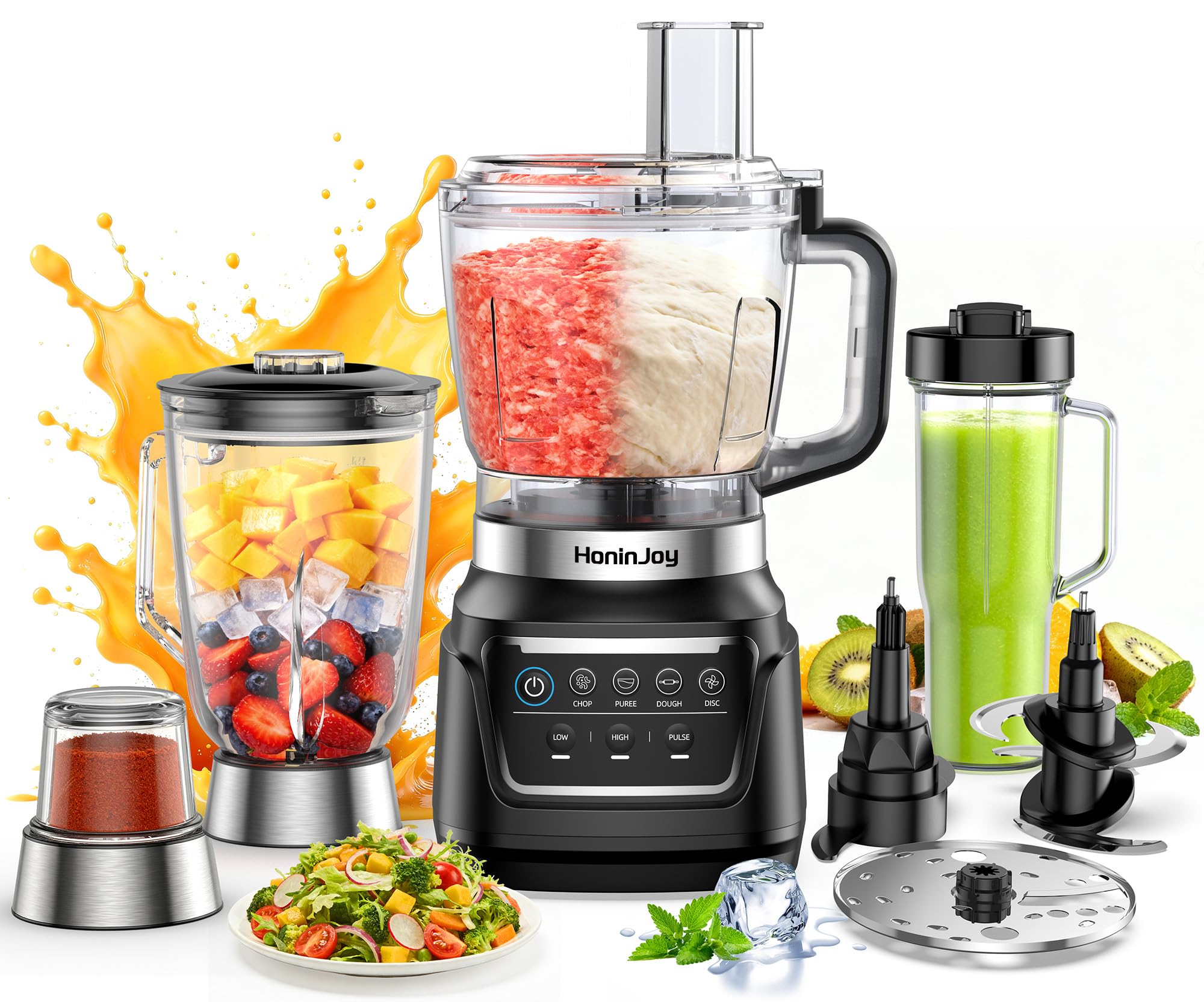
If your kitchen problem is “I don’t want six appliances,” the HoninJoy is worth a serious look. It’s not trying to be a boutique blender with a tiny feature set. It’s trying to be a small kitchen system: glass blender pitcher for smoothies and soups, food processor bowl for chopping and pureeing, slicing/shredding discs, a grinder jar for spices/nuts, and a travel bottle for grab-and-go.
Here’s the expert lens I use for combo systems: the value is only real if the switching friction is low. If swapping attachments is annoying, you stop using the extra pieces and you’re left with an overpriced blender. The recurring theme in owner feedback is that there’s a short learning curve—figuring out which attachment does what—but once you get a routine, it genuinely replaces multiple tools. That’s the right kind of learning curve: “confusing twice, then convenient forever.”
The glass pitcher matters here because it keeps the “main job” clean and odor-resistant. If you make garlic-heavy sauces, turmeric smoothies, or berry blends that normally stain plastic, glass makes the system feel more premium day-to-day. It’s also psychologically satisfying: you can see your vortex, see your texture, and stop when it’s perfect.
From a performance point of view, the real test is how it handles ice and fibrous produce. Owners consistently mention smooth blending and strong ice crushing, especially for typical home smoothie loads. The caveat is what I call “system reality”: if you stuff the pitcher with frozen fruit and no liquid, it’s going to need help—just like most blenders. The trick is to treat it like a system built for daily cooking: use the presets for guidance, add enough liquid to start flow, and use pulse to break up stubborn pockets before running it to smooth.
Cleaning is where this model can win hard, because the pitch is simple: most detachable parts go in the dishwasher. That’s a big deal for a multi-attachment unit. If you’re going to own a system blender, it must be easy to reset to “ready” after use—or it becomes a dusty corner resident.
Why it’s different
- True counter-space consolidation – Blender + processor + slicer/shredder + grinder + travel bottle in one footprint.
- Glass pitcher keeps blends tasting clean – Great for pungent sauces and staining ingredients.
- Dishwasher-friendly design (for the parts that matter) – Less “I’ll clean it later” procrastination.
- Meal prep becomes faster – Slicing/shredding and quick chopping changes weeknight cooking speed.
Good to know
- There’s an initial attachment-learning curve; set aside one “practice session” and it becomes easy.
- System units take more storage space for accessories—plan a drawer/bin strategy.
- Like most multi-tools, it’s best when you use it as intended (smart loading, correct attachment, correct preset).
Ideal for: cooks who want a glass blender plus food-prep capabilities and would rather learn one system than maintain multiple appliances.
4. ASTRALSHIP Stainless Steel Pro (Heating Glass) – Hot Blends, Keep‑Warm, and a “Lazy Cleaning” Button
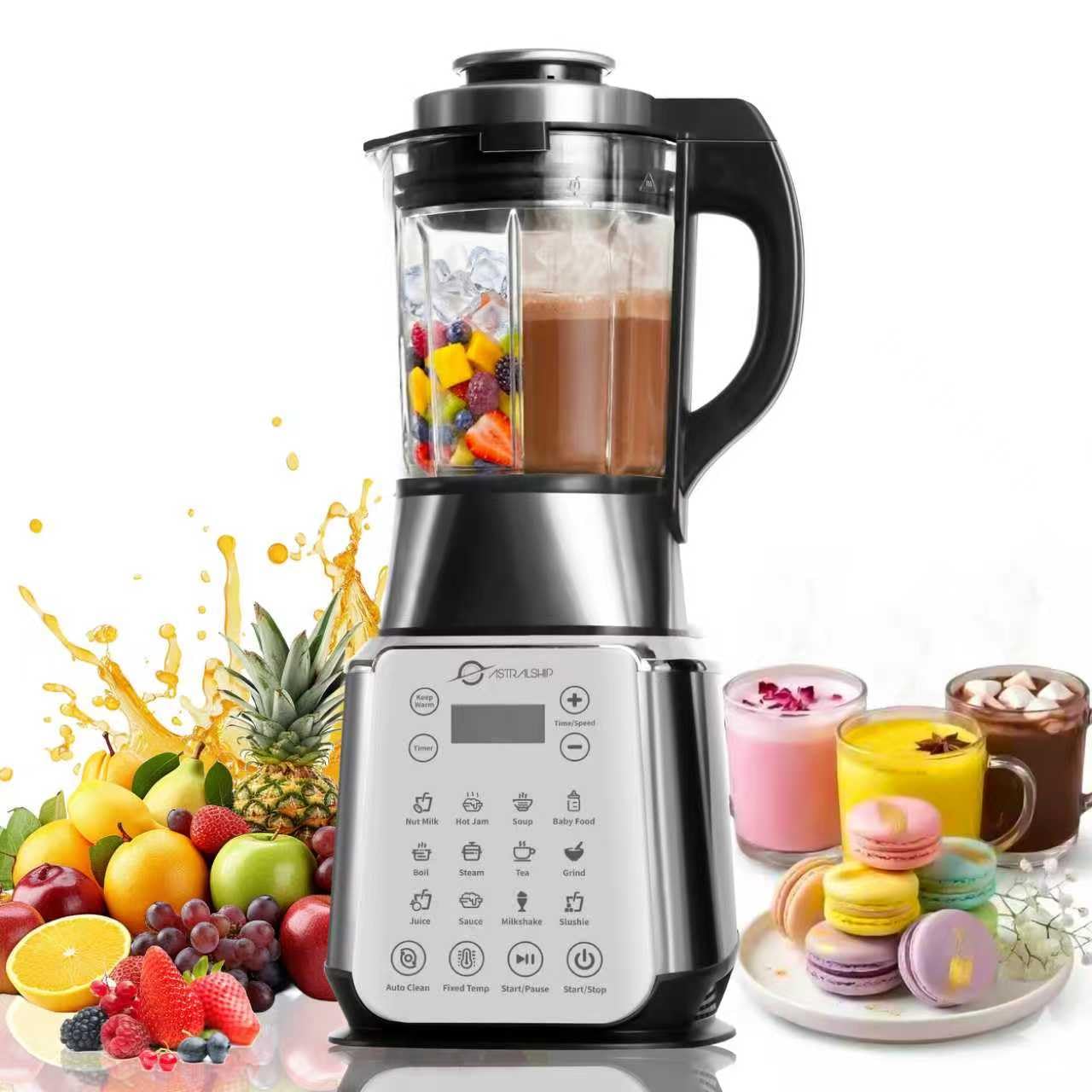
This is one of those blenders that makes sense the moment you understand its personality: it’s a countertop blender that behaves like a soup maker, a nut milk maker, and a smoothie blender—built around heat and automation.
The key features to care about here are not “how many presets” (although the presets are convenient). The features to care about are: (1) heat-safe glass for hot blending, (2) a tamper for thick blends, (3) a keep-warm behavior so you’re not racing to serve, and (4) an auto-clean cycle that uses hot water to lift residue. That last one matters more than people think. Hot water cleaning is the secret weapon for oily blends: nut milk residue, peanut butter, curry sauces, creamy soups. Hot water loosens what cold water leaves behind.
From owner feedback, the biggest consistent praise is speed-to-smoothness: add everything at once and it comes out drinkably smooth without long run times. That suggests two things are working: blade efficiency and jar geometry. When a blender can handle a “dump and go” smoothie without stopping, it usually means the vortex system is doing its job. That’s what you want if you’re making breakfast fast.
Where you need to be smart: heat-capable blenders reward patience. Let the program do its cycle instead of yanking the lid off early. And if you’re blending thick recipes (smoothie bowls or dense nut butters), use the tamper gently and keep enough movement in the jar so the blades can keep feeding. Thick blends are not a “set it and forget it” category on any blender; they’re a “help the blender succeed” category.
Also, note that heat-capable glass pitchers tend to be heavier than standard glass pitchers. That’s normal. It’s the price of heat-safe structure. If you’ll use the heating features weekly, it’s worth it. If you won’t, you may prefer a simpler glass blender.
Why people buy it
- Hot blending expands what a blender can do – Soup, sauces, and hot drinks become one-appliance jobs.
- Tamper makes thick blends realistic – Great for smoothie bowls and dense mixes that would stall cheaper blenders.
- Auto-clean with hot water is a legit advantage – Especially for oily residue and stubborn scents.
- Good “routine blender” feel – Presets and control simplify daily use when you’re busy.
Good to know
- Heat-capable glass is heavy. If you want a light jar, pick a simpler model.
- Touch panels are convenient, but keep them clean and dry for best long-term feel.
- As with all thick blends, technique still matters: enough liquid to start movement, then thicken.
Ideal for: soup lovers, nut milk makers, and anyone who wants a glass blender that behaves like a small cooking appliance with built-in cleaning support.
5. ASTRALSHIP Black Pro – The “Texture Dialer” for Smoothies, Baby Food, and Sauces
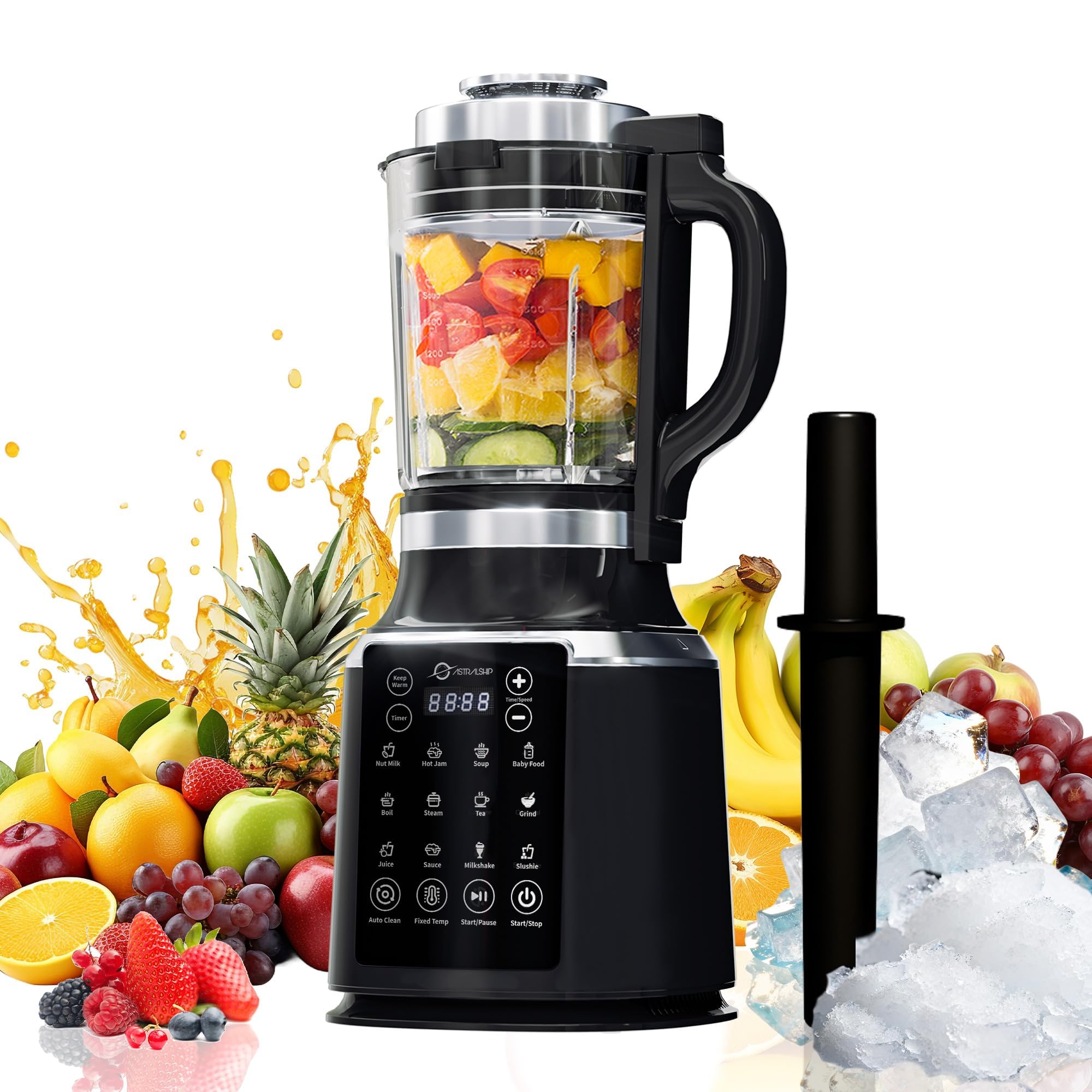
This model earns its spot because it’s trying to solve a very specific household problem: “I want my blender to nail texture without me guessing.” That’s why you see a focus on (a) manual speed steps for fine control, and (b) preset modes for common recipes like smoothies, soups, oatmeal, baby food, and nut milk.
The jar design is also not random. When you see language around multi-dimensional vortex design, what they’re describing is an interior shape that attempts to keep ingredients circulating—especially in the corners where cheaper blenders leave “unblended pockets.” In practice, jar shape can matter as much as motor power for smoothness. A good jar shape reduces the need to stop and scrape, because ingredients keep getting fed into the cutting zone.
Where this becomes valuable is with fiber-heavy recipes: leafy greens, flax/chia, skins and seeds, thick veggie soups. These blends need sustained circulation. If circulation fails, the blender either stalls or it produces that gritty “half smooth, half sandy” texture that people hate. Owners tend to describe this model as strong and smooth, with a useful tamper for thick blends. That matches the design intent.
Here’s the expert tip that will make or break your experience: use the presets as “starting points,” not as a personality test. If your smoothie is thick and you want it thicker, start with a smoothie program, then finish on a manual speed for a few extra seconds to polish the texture. If your soup is hot but not silky, finish with a longer high-speed run to emulsify it. The best results happen when you treat presets as “smart timing,” then use manual control to get it perfect.
Cleaning is also designed to be hands-off, but don’t confuse “auto clean” with “never rinse.” A quick rinse first prevents seed sludge from cooking itself onto the walls. Then the clean cycle does the final reset. Do that, and the pitcher stays far more pleasant over time.
Why it’s compelling
- Texture control is the point – Manual steps + presets help you land on “exactly right,” not “good enough.”
- Jar design is built to circulate – Less corner buildup, less scraping, smoother results.
- Tamper helps thick recipes succeed – Especially smoothie bowls and dense sauces.
- Great for “family cooking” recipes – Baby food, soups, oatmeal blends, nut milk routines.
Good to know
- It’s still a high-speed blender—expect normal high-speed noise at top settings.
- Auto programs are helpful, but the best results come from finishing with manual control when needed.
- Heat-capable glass pitchers are heavier; plan your counter space and lifting comfort.
Ideal for: people who care about texture and want a glass heating blender that can handle everything from smoothie bowls to soups with less guessing.
6. Vitamix Explorian E310 – The Smoothness Standard (Even Without a Glass Jar)
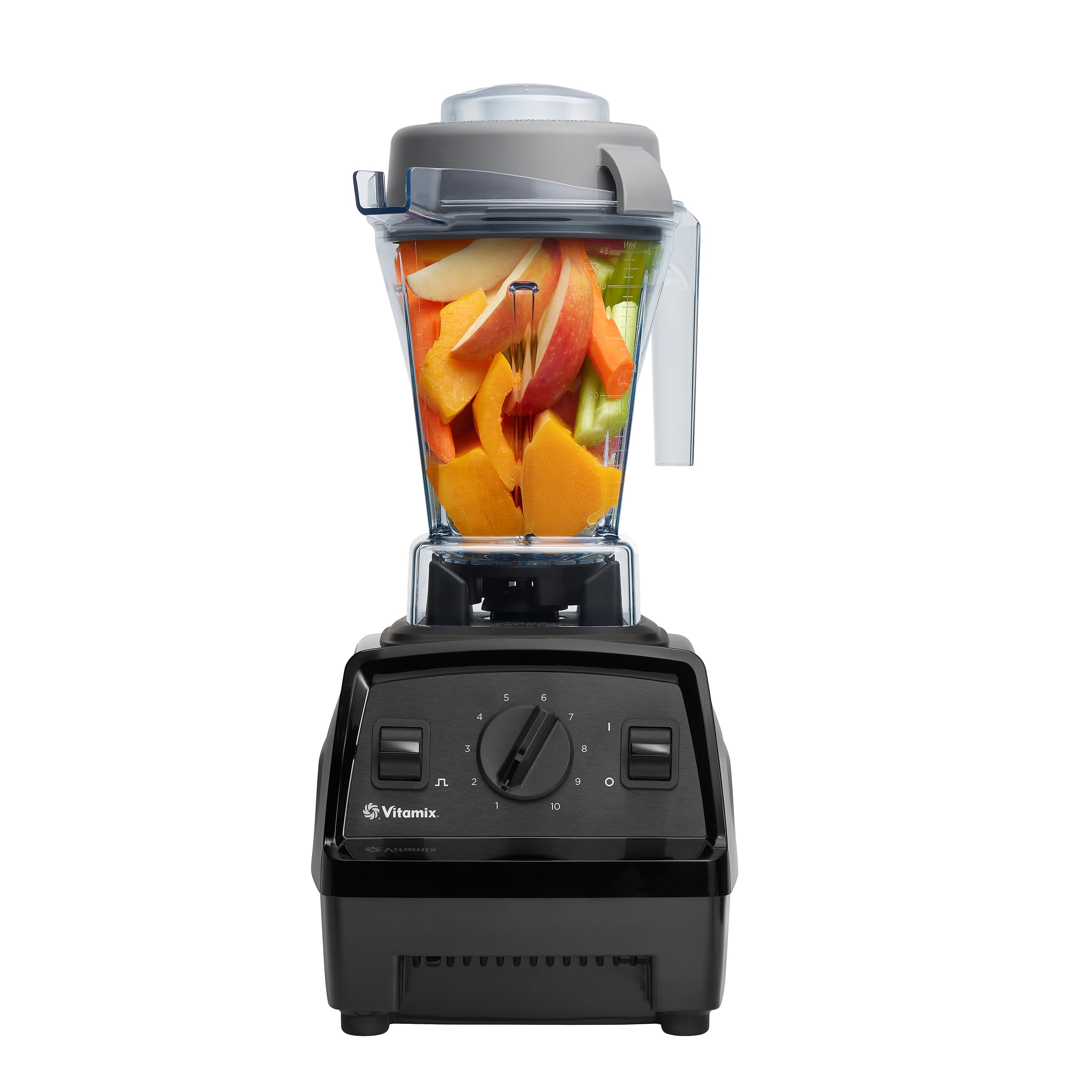
This guide is about glass-forward blenders, so I want to be very clear: the Vitamix E310’s container is not glass. It’s a durable, BPA-free polymer container. So why is it here? Because it sets the benchmark for one thing that matters to every buyer, glass or not: texture.
If your pain point is “my smoothies are never truly smooth,” Vitamix is the company that built its reputation on solving that. The E310 is the “no fancy programs, just performance” model: you get manual speed control, a pulse function, and a blending system that reliably forms a vortex when you load it correctly. That vortex behavior is the reason owners talk about “zero celery strings” and “no kale chunks” after switching from cheaper blenders.
Another underrated advantage is control. A lot of people think they want presets. What they actually want is repeatability. With Vitamix, repeatability comes from muscle memory: you learn your smoothie speed, your soup speed, your sauce finish speed—and then you can hit the exact texture you want every time. It feels less like “press a button and hope” and more like “I can drive this.”
The E310 also tends to earn trust because of longevity stories: people who have used older Vitamix machines for decades often buy a new one because they want a smaller container size or updated form factor, not because the old one died quickly. That kind of reputation doesn’t happen by accident.
So here’s the honest buyer logic: if glass is your absolute line in the sand, pick one of the strong glass options above. If your priority is maximum smoothness and you can live with a high-quality non-glass container, the E310 is the “stop shopping” option that makes many people finally understand why premium blenders cost more.
Why it’s here
- Texture is elite – The vortex system and blade efficiency produce genuinely smooth blends with fibrous ingredients.
- Manual control feels empowering – Once you learn it, you can dial in exact textures without guesswork.
- Self-clean workflow is fast – Warm water + a drop of soap + high speed resets it quickly.
- Strong long-term reputation – Many owners buy Vitamix as a “buy once, use forever” play.
Good to know
- The container is not glass—this is a performance benchmark inclusion.
- High-speed blending is loud; the smoothness comes from speed and friction-driven circulation.
- For very small batches, you need to learn minimum quantity technique so the blades stay engaged.
Ideal for: people who prioritize ultra-smooth results and want a proven blending system—even if glass is not part of this specific model’s jar design.
7. Tribest PBG‑5050‑A – The “No Plastic Touch” Single‑Serve Routine

The Tribest PBG‑5050 is for a very specific type of buyer: you want small-batch blending, you want glass containers, and you want the easiest possible “blend and go” workflow without a giant pitcher dominating your counter.
When personal blenders go wrong, it’s usually in one of two ways: (1) the motor is too weak and it burns out on frozen fruit, or (2) the containers are flimsy and you end up with cracks, leaks, or replacements that cost more than your patience. The Tribest is trying to fix both by using a sturdy base and glass containers that feel premium in-hand.
Owner feedback tends to be split in a useful way. Many people love the concept: small glass containers in multiple sizes, easy smoothie routines, good results on things like flax seeds and everyday blends. The most important “watch out” is durability of the glass over long periods for some users—particularly cracks forming around the base of the container. That kind of failure often comes from micro-stress over time: tightening too aggressively, repeated impact, or sudden temperature changes. So if you buy this model, treat the glass like glass: don’t torque it down like a car part, don’t shock it from hot rinse to ice blend immediately, and don’t knock it against your sink faucet when washing.
Performance-wise, understand what this is and what it isn’t. This is not a big-pitcher ice annihilator. It’s a personal blender that excels at “small, frequent, healthy blending” when you give it enough liquid to circulate. It can handle ice in many recipes, but very thick frozen banana “ice cream” blends can be a stress test. If you want thick frozen dessert blends daily, choose a bigger, tamper-friendly blender.
Where it shines: when you want glass contact and a neat, repeatable routine. Blend, swap lid, drink. Less friction means you’ll actually stick to the habit.
Why it’s loved
- Glass containers for single-serve blending – Great for people avoiding plastic contact in the blend cup.
- Multiple container sizes – Makes small batches easy without using a huge pitcher.
- Simple controls – One-touch pulse and straightforward operation.
- Habit-friendly – The easiest blender is the one you actually use daily.
Good to know
- Some owners report long-term glass durability issues; handle gently and avoid thermal shock and over-tightening.
- Not designed for constant ultra-thick frozen dessert blends; it’s best for smoothies and small blends with enough liquid.
- Replacement containers can be a consideration—treat the glass thoughtfully.
Ideal for: people who want a tidy, glass-first personal blending routine and prefer small batches over big pitcher blending.
8. KIDISLE 1200W (52oz Glass) – Touchscreen Control Without the “Too Smart” Headache

Some people love old-school toggles and knobs. Others want a clean digital interface they can wipe down in one pass. The KIDISLE is positioned for the second group: a glass pitcher blender with a modern control panel, multiple speeds, pulse behavior, and a “use it without thinking” layout once you learn it.
A glass pitcher at this size is a practical household move if you blend for more than one person. It gives you room for full batches of smoothies, sauces, and blended soups (as long as you’re not blending very hot liquids unless the manual says it’s designed for that use). And because it’s glass, it tends to resist color and odor retention better than budget plastic pitchers.
The nuance with touchscreen blenders is always the same: the motor can be strong, but thick blends can still stall if the jar doesn’t circulate well. So your technique matters. Start with liquids, then soft items, then frozen last. If you’re making thick veggie smoothies (celery, kale ribs, chia), give it a little longer at a mid-to-high speed to fully break down fibers.
Owner feedback highlights a couple of interesting quality-of-life points: a cleaning mode that reduces the need to disassemble, and a control surface that’s easy to wipe. That matters because the dirtiest part of your blender is often the part you don’t think about—sticky buttons, crevices around dials, and splatter residue that becomes “forever” if you don’t wipe it immediately. Smooth panels keep the experience cleaner.
I also like the “not too complicated” aspect. Some digital blenders drown you in modes. This one focuses on the basics: speed control, pulse control, and a few functions. That’s a sweet spot for people who want modern controls but still want to feel like they’re driving the blender, not negotiating with it.
Why it’s a solid pick
- Glass pitcher + modern interface – Clean, wipeable controls with a jar that resists stains and odors.
- Useful speed range – Lets you do chunky salsa, smooth soup base, and everyday smoothies with control.
- Good family-size capacity – Works well for multi-serving blends without feeling oversized.
- Low-friction cleaning habits – Built-in cleaning mode plus easy-to-wipe exterior supports daily use.
Good to know
- Glass pitchers are heavy; full batches require steady handling.
- Thick blends still demand proper loading order to avoid air pockets and stalls.
- Digital controls are best treated gently—wipe, don’t scrub aggressively.
Ideal for: people who want a glass pitcher blender with modern controls, good capacity, and a cleaner day-to-day user experience.
9. Oster Pro 1200 – The “Does the Job” Glass Pitcher Blender With Real Presets

The Oster Pro 1200 is a classic “sweet spot” blender because it does something many blenders fail at: it’s simple enough to use daily, but it has a few smart design choices that actually improve results. The big one is dual-direction blade behavior. Blending in forward and reverse isn’t a gimmick; it helps keep ingredients moving, especially when you have dense frozen pockets that would otherwise sit on top of the blades.
What owners love most is that it feels like an honest kitchen tool. It blends, it crushes ice reasonably well, it can do chunky salsas with pulse, and the glass jar cleans easily without turning cloudy. People who switch to glass from plastic often mention the same reason: they’re tired of plastic wear, odor retention, and the feeling that their jar is “aging” visually. Glass stays clearer longer.
There’s also a practical reality to this model: it’s not a silent blender. It’s also not trying to be a professional restaurant machine. It’s a home blender that hits a strong balance for everyday smoothies, sauces, and occasional frozen drinks. If your lifestyle is “smoothies most days, ice sometimes, salsa occasionally,” this model is remarkably easy to live with.
Now, here’s the tip that makes this blender feel better than it should: don’t overload the glass jar with frozen fruit first. If you pack frozen fruit at the bottom and liquid on top, you’ll get that frustrating “blade stuck under a frozen dome” moment. Instead, pour liquids first, then greens, then fresh fruit, then frozen last. That loading order helps the dual-direction blades do their job.
If you’re chasing the smoothest possible fiber breakdown (celery strings gone, kale ribs gone), premium blenders still win. But for most people who want a glass jar, everyday reliability, and a few useful presets, the Pro 1200 is the kind of blender you keep using because it doesn’t complicate your life.
Why it stays popular
- Dual-direction blade motion helps circulation – Better blending behavior for mixed loads.
- Glass jar is a real quality upgrade – Easier to clean, less odor retention, less “cloudy jar” frustration.
- Speed and preset options feel useful – You can do smooth blends and chunky blends with control.
- Parts ecosystem is a real advantage – Oster parts are generally easier to find than obscure brands.
Good to know
- It can be noisy; a soft mat underneath reduces vibration noise in many kitchens.
- Very thick frozen blends may need pauses/pulse to keep ingredients moving.
- Glass jar weight is noticeable—especially when full.
Ideal for: everyday smoothie households that want a glass jar, useful control options, and a reliable brand ecosystem.
10. Oster Classic Series Heritage (Glass Jar) – The “Built to Be Fixed” Classic

This is the blender for people who don’t want a “smart appliance.” They want a tool. The Oster Heritage is the kind of blender that has been in kitchens for years because it follows an old-school philosophy: fewer electronics, straightforward controls, and a drive system designed to keep working through daily use.
What makes it special in the glass blender world is not that it’s the most powerful thing on this list. It’s that it’s a “serviceable” style of blender—meaning parts, seals, and jars are typically part of the long-term ownership story. Many modern blenders are built like sealed gadgets. When they fail, you replace the whole thing. Classic Oster-style blenders tend to encourage maintenance: replace a seal, swap a blade assembly, keep going.
For smoothies, it performs best when you respect its style. It’s not an “add everything frozen and walk away” machine like some high-end or anti-jam models. It’s a “use correct loading order and blend a little longer” machine. A lot of experienced smoothie makers actually prefer that, because it’s gentler on the motor and can extend life: blend longer at a slightly lower speed instead of blasting at maximum every time.
The glass jar is thick and satisfying. It pours cleanly when you don’t overfill, and it doesn’t absorb smells like plastic. The blade area is accessible enough that you can clean thoroughly—especially if you do the classic “soap + warm water + blend” rinse right after use.
If you want a blender you can hand to a teenager and not worry they’ll destroy by pressing the wrong mode, this is your vibe. Simple toggles, predictable behavior, and a design that feels like it’s meant to keep working.
Why it’s a classic
- Simple, durable mindset – Less gadgetry, more “appliance that keeps working.”
- Glass jar stays clean and clear – Great for daily smoothies without plastic wear.
- Maintenance-friendly ownership – A style of blender that tends to support replacement parts and seals.
- Easy learning curve – No modes to decode; you just blend.
Good to know
- Not a “professional” high-speed blender; fibrous ingredients may need longer blend times.
- Two-speed simplicity is great, but some people prefer more fine control.
- Glass jar weight is noticeable—especially when full of thick blends.
Ideal for: people who want a glass jar blender with a durability-first mindset and a simple, serviceable style of long-term ownership.
11. BLACK+DECKER Quiet Blender (Cyclone Glass) – “Less Noise” Without Going Weak

“Quiet blender” is a bold phrase because blending is, by nature, a loud activity. What this model aims to do is reduce the harshness and perceived volume compared to basic budget blenders—especially in the frequency range that feels annoying early in the morning. If you make smoothies when other people are sleeping, this category matters.
The Cyclone glass jar shape is designed to encourage a vortex, and the blade setup is designed for faster breakdown of ice and frozen fruit. In real-world use, people often report that it can make a great smoothie—sometimes with one extra step: run the smoothie program, then finish on a manual high speed for an additional minute to polish the texture. That’s not a failure; it’s a normal reality of budget-adjacent blenders: the preset timing might be conservative to protect the motor, while your recipe needs a little more time.
What I like about this model is the pairing of a glass jar (for taste and stain resistance) with a more modern control panel that’s easy to wipe. Some cheap blenders have dials and seams that become grime traps. Digital sealed panels tend to stay nicer over time if you wipe them right after blending.
The included personal jar adds another layer of convenience: if you want a quick shake on the go, you don’t always need to dirty the big glass pitcher. That’s how you keep a blender habit alive: you reduce friction on the days you’re busy.
Expert tip: ingredient order matters a lot here. If your smoothie comes out chunky, don’t immediately blame the blender. Try this sequence: liquid first, then soft ingredients, then ice/frozen last. Then finish with a short high-speed run. In many kitchens, that turns “chunky smoothie mode” into “surprisingly smooth” results.
Why it’s practical
- Less harsh noise profile – Great for early mornings and shared spaces.
- Glass jar feels like an upgrade – Better taste, less staining, easier odor management.
- Easy-to-wipe controls – A clean panel stays nicer than old-school dials for many people.
- Personal jar increases usage – Small blends without hauling out the big pitcher.
Good to know
- Some recipes need a longer finishing blend than the preset provides—manual high speed solves it.
- Like all blenders, thick mixes require enough liquid to circulate well.
- “Quiet” is relative—this is quieter than many, not silent.
Ideal for: people who want a glass jar blender that’s friendlier for morning routines and still has the power to handle smoothies and ice with smart technique.
12. Camic 750W (54oz Glass) – Simple Knob Controls With a Useful “Three‑Jar” Setup
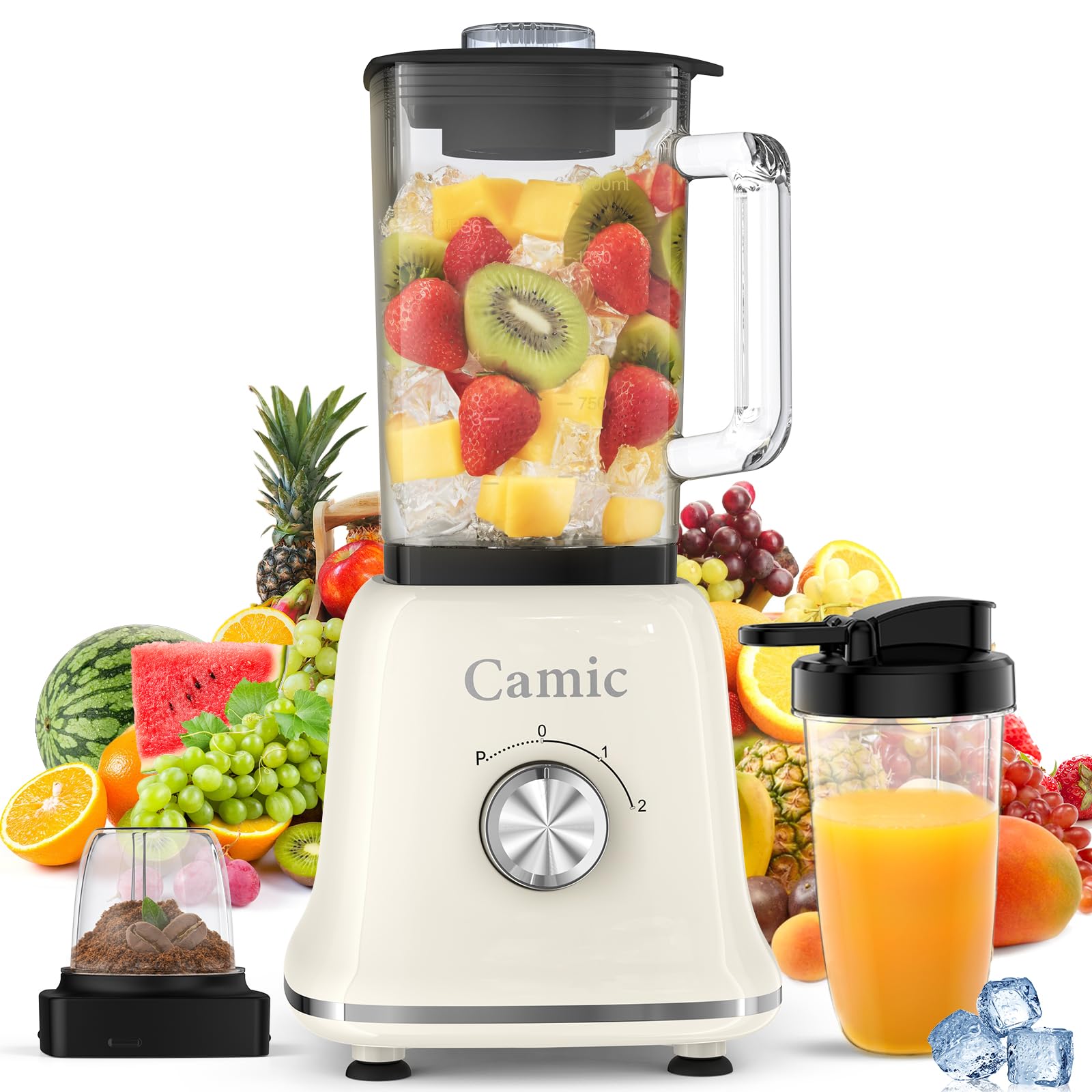
If you want a blender that feels approachable—minimal controls, straightforward use—but still gives you multiple ways to blend, this Camic kit is a strong “starter system.” The main jar is glass, which is typically the biggest reason people choose it: they want the primary blending surface to resist stains and odors and feel more “clean” over time than plastic pitchers.
The key detail here is not the number of speeds (two speeds plus pulse can be plenty). The key detail is how you use those speeds. A lot of people get better results by starting slow to build circulation, then finishing fast to polish texture. Pulse is the “problem solver” mode—use it to break up stubborn frozen pockets or to control chunkiness for salsa.
Owners frequently mention two things that matter in daily life: it’s quieter than “beast” blenders they’ve owned before, and it doesn’t require constant shaking-down to get ingredients to blend. That suggests the jar shape is doing a decent job guiding ingredients down. And when a blender doesn’t demand babysitting, you use it more.
There’s also an honest reality you should plan for: the glass jar is heavy. Many buyers actually choose glass specifically because they want that substantial feel and they’re willing to accept the weight. If you’re buying for an older parent or anyone who struggles lifting a full jar, consider whether a personal blender or a smaller glass jar model would be easier.
Cleaning is where this model can feel better than you’d expect. Many designs in this category allow blade removal for deeper cleaning. That’s great for hygiene, but it’s also where leaks happen if the gasket isn’t seated correctly. The “expert move” is simple: after washing, reassemble carefully, make sure the seal is flat, and don’t overtighten. Tight enough to seal is the goal—tight enough to stress glass is not.
Why it’s a good entry
- Glass jar primary blending – The main pitcher stays clearer and cleaner-feeling over time.
- Simple controls reduce user error – Two speeds + pulse is easy to learn and hard to mess up.
- Extra cups add versatility – Travel and grinder options make it feel like a mini system.
- Good “daily use” vibes – Many owners report it handles ice and frozen fruit without constant shaking.
Good to know
- The glass jar is heavy, especially when full.
- Deep-clean designs require correct gasket seating to prevent leaks.
- If you want ultra-fine green smoothie texture, you may prefer higher-end blending systems.
Ideal for: new kitchens, simple smoothie households, and anyone who wants a glass jar with a small “kit” of extra blending options without a steep learning curve.
13. BLACK+DECKER PowerCrush (Glass Jar) – The “Easy to Clean” Workhorse That Gets Used

This is the blender that wins on “daily life.” It’s not trying to be a chef’s trophy appliance. It’s trying to be the thing you use without thinking: make a smoothie, rinse it, move on with your day.
What makes the PowerCrush surprisingly loved is not just performance—it’s the cleaning and maintenance story. Owners consistently praise how easy it is to clean thoroughly because the blade area can be accessed and cleaned properly. That matters because most blender “grossness” comes from two places: the underside of the blade area and the gasket seam where moisture can linger. If a blender design makes that easy to clean, people keep using it.
Performance is solid for everyday tasks: smoothies, sauces, purees, and ice within normal home use. It’s also described as “solid and steady” on the counter, which often comes from a combination of jar weight and base design. The glass jar itself adds a premium feel and tends to resist the staining and odor issues that plague budget plastic pitchers.
Now, a very important realism note: powerful blending creates noise and vibration, and some owners mention this blender can be loud. That’s not unusual in this category, especially when crushing ice. The practical fix is a soft mat underneath and not running high speed longer than necessary. A well-loaded smoothie often blends faster than a poorly loaded one, which is the easiest “noise reduction” strategy you can do without buying a different blender.
This is also one of those products that earns trust when people have had an older version that lasted a long time. Long-term brand familiarity matters. When someone says, “My last one lasted ages,” that’s a clue that the basic design is capable of real service life when used sensibly.
Why it’s a smart pick
- Easy to clean thoroughly – Removable blade area helps prevent buildup and odors.
- Glass jar feels solid – Less staining, less smell retention, more “premium daily use.”
- Simple controls – Easy for anyone in the household to use without confusion.
- Great everyday performance – Smoothies, sauces, ice, and purees in a straightforward workflow.
Good to know
- Can be loud on ice crushing (normal for this tier); use a mat to reduce vibration noise.
- Not meant for constant heavy-duty thick blends like nut butter without enough liquid.
- As with all removable blade designs, reassemble carefully to avoid leaks.
Ideal for: everyday smoothie households who want a glass jar and a cleaning routine that doesn’t turn into a chore.
14. BLACK+DECKER BL2010BG – The “Dial In Texture” Glass Blender for Simple Kitchens

The BL2010BG is a good choice when you want a glass jar blender that keeps things simple but still gives you control. The extra speed settings aren’t about “being fancy.” They’re about matching the blend to the recipe: lower speeds for gentle mixing and chunky texture, higher speeds for smoother results.
The most practical feature here is the removable blade assembly. That’s one of the best designs for hygiene because you can clean everything: the gasket seam, the underside, and the jar base where residue hides. If you’ve ever had a blender that smelled “off” no matter how much you rinsed, you already know why this matters.
Performance is what you’d expect from a well-designed basic blender: good for smoothies, soups (when cooled appropriately), purees, and ice within reasonable loads. What it won’t do is behave like a professional high-speed blender on dense fibrous blends. If you’re making green smoothies with raw carrots, kale ribs, and minimal liquid, you’ll usually need longer blend times and may still get texture.
There’s an “ownership style” that makes this kind of blender feel excellent: use it gently, don’t run it forever at max speed, let thick blends rest between pulses, and do the soap-water blend clean immediately after use. People who treat budget-friendly blenders like that often get years of service and feel like they “beat the system.”
If you’re not chasing elite smoothness and you mainly want a dependable glass jar, decent control, and easy cleaning, this is a strong practical pick.
Why it’s worth considering
- Speed control helps texture – Chunky salsa to smoother sauces without over-blending.
- Removable blade assembly – Better deep cleaning, less hidden residue.
- Glass jar resists odors – Great for frequent smoothie use.
- Simple everyday reliability – A no-drama blender for most common recipes.
Good to know
- Not a heavy-duty nut butter machine; thick blends need enough liquid to circulate.
- Durability in this tier depends on smart use—avoid excessive continuous run times.
- Glass jar is sturdy but heavy; handle carefully when washing.
Ideal for: people who want a basic glass jar blender with better texture control and a cleaning design that helps it stay fresh over time.
15. Oster Classic Series 8‑Speed (Glass Jar) – Simple, Familiar, and Surprisingly Capable

This model is the kind of blender that quietly earns a place in a lot of kitchens because it hits an important middle: it’s not a bare-bones two-speed toggle, and it’s not a complicated digital appliance. It’s a classic blender with enough speed options to handle different textures, paired with a glass jar that feels more premium and stays clearer over time than many plastic pitchers.
People who like this blender tend to like it for the same reasons: it feels sturdy, it has adequate power for ice and frozen fruit in normal smoothie use, and it’s easy to clean. “Easy to clean” is not a throwaway compliment. It’s the reason a blender becomes a daily habit instead of a weekend tool.
There’s also a mindset advantage: familiar controls reduce mistakes. When a blender is intuitive, you’re less likely to overload it, run it too long, or abuse it. That means it tends to live longer. If you’ve ever killed a blender by forcing thick mixes without liquid, you know what I mean.
This is also a strong option for sauces, pestos, and pizza sauces because the speed control lets you stop at “still textured” without pureeing everything into baby food. For some cooks, that’s the entire reason they want a blender with more than two speeds.
Expert technique note: for smoothies, don’t chase speed first. Chase circulation first. Start at a low speed to build flow, then move higher. That keeps the motor under less stress and produces smoother results, especially with frozen ingredients.
Why it fits many kitchens
- Glass jar upgrade – Cleaner taste feel, less staining, better long-term appearance.
- 8 speeds provide useful range – Better control for salsa, sauces, and smoothies.
- Simple, familiar operation – Great for households with multiple users.
- Easy daily cleanup – Supports real routine use, not just occasional blending.
Good to know
- Not a high-end smoothie texture machine; fibrous greens may need longer blends.
- Glass jar weight is real—especially for full batches.
- As with most standard blenders, thick blends need enough liquid to circulate properly.
Ideal for: people who want a glass jar blender with familiar controls and enough speed options to handle a wider range of everyday recipes.
16. Ninja Professional BL610 – A Crushing Benchmark (Even Though the Pitcher Isn’t Glass)

This is the second “not glass” inclusion, and it’s here for the same reason as the Vitamix: context. If you’re shopping glass, you’re often comparing against Ninja because it’s known for aggressive ice crushing at a reasonable cost. So I want you to have an honest read on what you gain and what you give up if you choose glass instead.
The Ninja BL610 is built around stacked “total crushing” blades that pulverize ice quickly. That blade architecture is excellent for turning ice into snow-like texture fast. It’s also excellent for big frozen drink batches. If you’ve ever wanted “resort-style frozen drinks” at home without learning blender technique, Ninja’s stacked blades make that easy.
So why choose glass instead of this? Two reasons: jar material preference and long-term jar feel. Many people switch away from plastic pitchers because they dislike clouding, scratching, and odor retention over time. Glass solves that. But glass blenders must compensate for one thing Ninja does extremely well: brute-force ice pulverizing. Some glass models do it beautifully (like the Oster Extreme Mix). Others do it “well enough” but need better technique and slightly longer blends.
If your primary need is ice crushing and big batches, this is a strong performance benchmark. If your primary need is a clean-feeling glass blending surface, use this model as a reference point for “how fast do I want ice to turn to snow?” and pick a glass blender that matches that expectation.
Why it stays popular
- Fast ice crushing – The stacked blades pulverize ice quickly for frozen drinks and smoothies.
- Large capacity pitcher – Great for families and parties.
- Simple workflow – Less technique needed for frozen blends compared with some standard blade designs.
- Easy cleaning – Pitcher and parts are generally straightforward to wash.
Good to know
- The pitcher isn’t glass—this is included as a performance comparison point.
- Stacked blades are extremely sharp; cleaning requires attention.
- If your goal is minimizing plastic contact, prioritize the glass options above.
Ideal for: buyers who care more about crushing speed and big batches than jar material—and for glass shoppers who want a baseline performance comparison.
How Glass Blenders Really Work (and Why Vortex Beats Raw Watts)
Most blender disappointment has nothing to do with “not enough power.” It has to do with feeding. Blenders don’t just need blades that spin fast—they need ingredients to keep getting pulled into the blades. That’s why two blenders with similar motor specs can deliver totally different smoothie textures.
What creates a great blend (in real kitchens)
- Jar geometry that guides ingredients downward – Flat-walled jars often create “dead zones.” Angled interiors help circulation.
- Blade design that grabs and recirculates – Stacked blades can pulverize quickly, but they still need ingredients reaching each blade level.
- Enough liquid to start movement – Thick blends fail when the blades cavitate (spin in air) instead of pulling ingredients into the cutting zone.
- Smart torque behavior – Reverse/anti-jam pulses keep blends moving when the mix becomes thick and stubborn.
- Proper loading order – It’s not a myth: liquids first, then soft items, then frozen last makes a dramatic difference.
When you get these elements working together, the blender becomes predictable. You stop fighting it. And predictability is the secret ingredient in a “daily smoothie habit.”
Glass-specific tips that prevent regret
- Respect thermal shock – Avoid extreme hot-to-cold jumps that stress glass over time. Warm rinse before cold blends is a smart habit.
- Don’t overtighten removable blade assemblies – Tight enough to seal is the goal. Over-tightening can stress glass threads and gaskets.
- Use the “soap-water blend” clean immediately – This prevents oils and proteins from building residue under the blade area.
- Pour with control – Glass is heavy. Use two hands for thick batches and keep the lid secure during transport.
- Use a mat for noise and stability – A silicone mat reduces vibration and can make blending feel calmer.
If you’re switching from plastic to glass, you’re usually doing it for a cleaner-feeling kitchen experience. These habits protect that experience long-term.
FAQ: Glass Blenders (Without the Confusion)
Is a glass blender automatically “healthier” than plastic?
Why do some glass blenders struggle with thick smoothie bowls?
How do I prevent leaks on blenders with removable blade assemblies?
Can I blend hot liquids in a glass blender?
Why is my smoothie gritty even when I blend a long time?
What’s the easiest cleaning routine that actually works?
Final Thoughts on Best Glass Blenders: Pick Once, Blend for Years
The best blender isn’t the one with the loudest marketing. It’s the one that quietly removes friction from your day: it blends predictably, pours cleanly, cleans quickly, and doesn’t make you dread using it.
Here’s the simplest way to translate this guide into the right purchase:
- Want the most “complete” glass blender experience? Start with the Ninja Foodi Heat‑iQ (HB152). It’s the rare option that blends, heats, and cleans in a way that changes your weeknight workflow.
- Want frozen blends to stop feeling like a fight? Choose the Oster Extreme Mix (Glass Jar). Anti-jam behavior plus a strong blade system is a real quality-of-life upgrade for ice and thick smoothies.
- Want one system instead of multiple appliances? Go with the HoninJoy 10‑in‑1 Blender + Food Processor. If you meal prep, this kind of “one base, many jobs” setup is a smart counter-space move.
- Want soup + nut milk routines with a one-touch clean reset? Pick the ASTRALSHIP Stainless Steel Pro or the ASTRALSHIP Black Pro. These are built for hot blending, thick recipes, and easier cleanup routines.
- Want the smallest, glass-first daily habit? The Tribest PBG‑5050‑A is a neat single-serve solution when you want glass containers and a simple routine.
- Want modern controls with a family-size glass jar? Try the KIDISLE 1200W (52oz Glass) for a clean touchscreen experience and flexible speed control.
- Want reliable glass blending without overthinking it? The Oster Pro 1200 and Oster Heritage are dependable, familiar, and easy to work into daily life.
- Want a glass jar value pick that’s easy to keep clean? Look at the BLACK+DECKER PowerCrush (BL1230SG) or the BLACK+DECKER BL2010BG if you want glass + simple control and a cleaning-friendly design.
If you’re picking from this list, you’re already ahead—because you’re choosing based on how these blenders behave in real kitchens, not just on a box. Choose the best glass blenders for your actual routine (smoothies, soups, frozen drinks, meal prep, or single-serve habits), and you’ll end up with the one outcome every buyer wants: a blender you use constantly, with results you’re proud to drink.
