
Specs are compiled from manufacturer listings and verified buyer reviews and can change over time — please confirm the key details on the product page before buying.
If your full-size mattress dips in the middle or your old box spring finally gave out, you can usually fix it with a proper slat base instead of buying a whole new bed. What matters is slats cut to the right length, thickness, and spacing for how you sleep. This guide covers four full-size options that solve that problem in different ways — a vertical bunkie board that doubles as a box spring replacement, a lightweight horizontal slat set, a low-profile box spring with rounded corners, and a foldable wood base built for futon and floor sleepers.
I’m Mohammad Maruf — the founder and writer behind KitchPrep. This guide is built by comparing the manufacturers’ published specifications and the patterns across verified customer reviews, so you get each pick’s real strengths and trade-offs instead of marketing spin.
For a full-size bed, slat length is non-negotiable and the wrong width will not seat on your rails at all. That is why measuring your frame’s interior width before ordering matters more than any brand name.
Our Picks at a Glance
How To Choose The Best Full Bed Slats
Buy full-size slats by measurement first, not by thickness or material. Know the interior width of your frame — the gap between the side rails — because a set that is a few inches off will not seat, and once you cut wood down, there is no going back.
Measure the Long Side, Not the Mattress
A full mattress runs 54 inches wide by 75 inches long, which is why you see sets listed as 54×75 or 72×54. Those numbers describe how the slats seat, not how the mattress measures. Drop-in frames and platform frames take the full span across the rails; frames with side blocks need slats cut to fit around them. Lay a tape across the rail openings top and bottom, and write both numbers down.
Slat Spacing Decides What Your Mattress Sits On
Wide gaps are the number one cause of a mattress that sags in the middle after a year. Memory foam and latex are the most sensitive because they soften with body heat and follow whatever shape is underneath. Spacing under 2.5 inches gives near-continuous contact, which keeps the foam flat instead of letting it dip between boards. Traditional slat sets with 4 to 5 inch gaps are fine for a firm innerspring, but they let softer foam creep downward over time.
Support Rails and Centre Beams
A full frame that only has rails at the head and foot carries the whole load on the slats themselves. If your frame has a centre support rod or a mid-rail, the slats sit on it and the load spreads. If it does not, a centre support is worth adding for larger sizes, especially on softer wood. A centre rail is what separates a slat set that holds from one that bows within a month, so check your frame before buying.
Quick Comparison
| Model | Best For | Thickness | Weight | Slat Orientation | Amazon |
|---|---|---|---|---|---|
| Meliusly Full Bunkie Board 54×75★ Best Overall | Replacing a box spring | 0.6 inches | 34 pounds | Vertical | Amazon |
| Treaton 0.68-Inch Horizontal Bunkie Board | Budget frame reinforcement | 0.68 inches | 20 pounds | Horizontal | Amazon |
| VIPSHOW 2 Inch Full Sag-Proof Box Spring | Lowering a tall bed | 2 inches | 39.2 pounds | Horizontal slats on steel | Amazon |
| LOBOTOU Foldable Floor Bed Frame Full | Futon and floor sleeping | 1.18 inches unfolded | 42 pounds | Roll-up base | Amazon |
In‑Depth Reviews
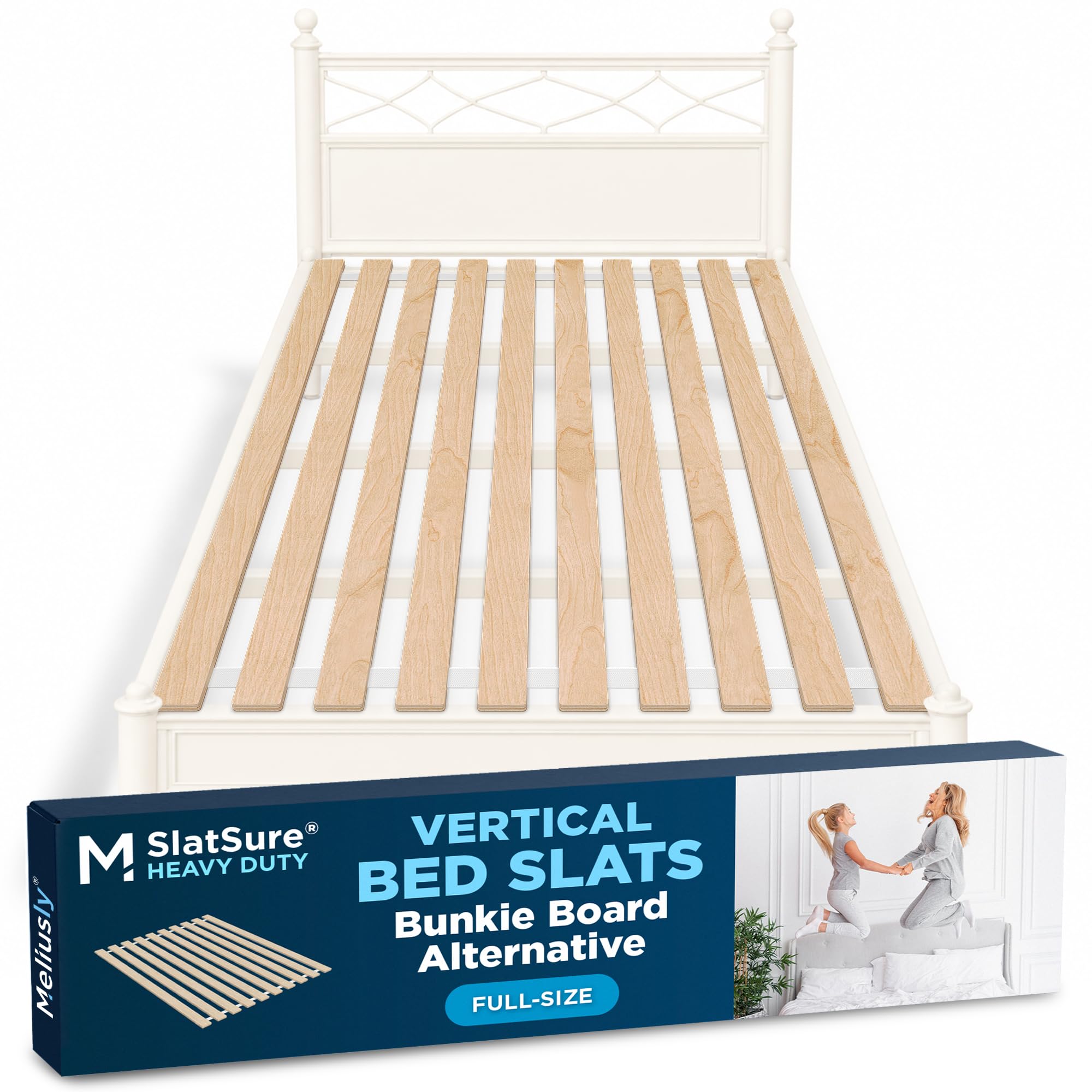
1. Meliusly Full Bunkie Board 54×75 – Heavy Duty Vertical Wood Bed Slats
Our pick — over 4★ from 300+ verified ratings; the strongest balance of quality and price.
The tight-spacing bunkie board that turns a slatted frame into a flat platform.
If your mattress sits on wide slats and you can feel the gaps under your back, start here. The Meliusly Full Bunkie Board is built as a full box spring replacement rather than a loose slat set — the boards run vertically and are bound into two folding sections, so it drops onto wood slats, metal bars, or an existing frame as one unit. The spacing runs under 2.5 inches, the tightest of the four here, so a memory foam, latex, or hybrid mattress stays flat instead of creeping down between boards.
Solidity is where it pulls ahead of the cheaper horizontal sets. Its boards are 0.6 inches thick, and because they are wider and bound together rather than resting loose, the panel feels firmer in practice than the 0.68-inch Treaton boards. The published comparison backs that up — this one weighs 34 pounds against the Treaton’s 20, so it sits heavier and flatter on the rails. Owners point to the build first: the quality of the wood and how rigid the finished panel feels are what win people over, and you feel that firmness the moment you lie down. The bottom carries an Oxford fabric with a silicone coating, which grips the frame so the assembly does not slide or creak as you move.
Setup is genuinely a one-person job. The two sections arrive assembled and joined by strong fabric straps and Velcro, so there is no drilling, no loose boards to line up, and no tools needed. Buyers report it “fits full metal frame perfectly” and that the “decreased slat width gives firm base,” which lines up with the tight spacing. One real trade-off: if your bed has side rails running head to toe rather than side to side at the head and foot, this board will not seat in the opening, so check the rail direction on your frame before ordering. It also sits fairly low, which suits you if you want a lower bed but takes adjusting to if you are used to a tall box spring.
What it does best
- Sub-2.5 inch slat spacing gives memory foam and latex near-continuous support with no dip between boards.
- Arrives pre-assembled in two folding sections — no tools, no loose slats, quick solo setup.
- Non-slip Oxford fabric with silicone coating on the underside grips the frame and cuts creaking.
- Doubles as a box spring replacement, so you skip the bulk of a traditional foundation.
Where it asks a little of you
- It needs a frame with rails side to side at the head and foot — a head-to-toe rail frame will not take it.
- Sits low, so a bed that was already low may feel very close to the floor.
Pick this when: your mattress is foam or hybrid and you want a flat, quiet platform without buying a box spring.
Check first: that your frame has rails running side to side at the head and foot, not end to end.
2. Treaton, 0.68-Inch Horizontal Wooden Bunkie Board/Bed Slats, 72″ x 54″, Beige

Twenty pounds of straightforward slats for the frame that just needs filling in.
This is the lightest option in the group and the simplest to think about: horizontal wood slats, 0.68 inches thick, laid across your rails and attached. No folding sections, no frame of its own. At 20 pounds it is the easiest of the four to handle alone, and compared with the 39.2-pound VIPSHOW box spring above it asks far less of your back on install day. The boards are spaced to let air move under the mattress, which keeps moisture from building up between a foam mattress and a solid base.
What it does well, buyers agree on. Owners describe the slats as well made and durable, easy to lay in place, and effective at preventing sag on frames that had none. It works with unusual setups too — there are accounts of it settling onto an antique rope bed and a floor bed frame that would not take a box spring. Getting them in is genuinely a lay-and-attach job with no extra assembly, which is the appeal if you just want the gap under your mattress closed.
Fit is the honest caveat here, and it is the most-discussed issue with this set. Treaton asks you to measure the width before ordering, and that is sound advice — owners mention boards landing a few inches over in width on a smaller frame, with cutting required to make them work. One reviewer noted the boards “were a few inches over in width for the twin bed I had, but I had the peices cut and they work perfectly.” Softer wood also shows up in the feedback, with the boards flexing more in the middle than a rigid bunkie board would, so add a centre support rail on a full frame.
Frame fit matters most: measure the interior width of your rails and allow for trimming before you buy, because these boards arrive at a fixed 72 x 54 inches.
On firmness: for a full-size mattress on a frame with a centre rail, the boards sit steady and do their job; on a frame with no mid-support, expect to add some.
Suits you if you want an affordable, lightweight slat set for a standard full frame and do not mind trimming to fit.
Think twice if your mattress is soft memory foam that needs tight, rigid spacing — the gaps here are wider than a bunkie board’s.
3. VIPSHOW 2 Inch Full Sag-Proof Wooden Slats Box Spring with Round Corners
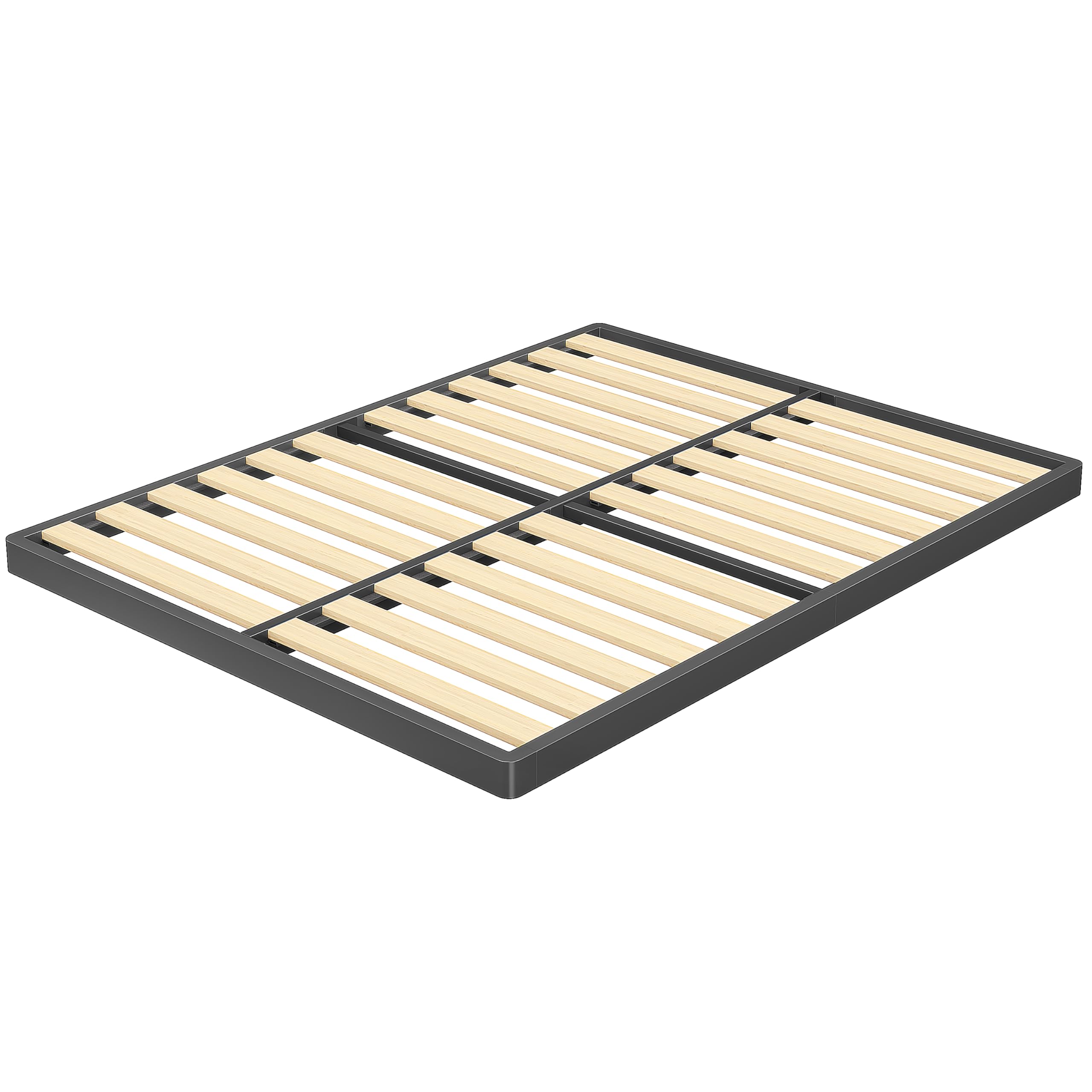
A 2-inch steel-and-wood foundation that fixes a bed that sits too tall.
Most slat sets keep your bed at the same height. This one is built to drop it. VIPSHOW uses a steel frame with widened and thickened support pillars, rated by the maker to hold 3000 pounds without deforming, topped with wood slats that set onto it with hook-and-loop fasteners. The metal carries the load, the wood spreads it, and the whole thing stands only 2 inches tall — the most substantial of the four here, at over three times the thickness of the 0.6-inch Meliusly board above.
Assembly is where this earns its keep. Owners name it the standout quality of the set, and the praise is specific: coded parts, included tools, and clear instructions let a single person put it together in minutes, with reports of a 68-year-old assembling it alone. Rounded corners on all four sides are a thoughtful touch on a frame this low — no sharp edges at shin height. The narrow slat spacing on top distributes weight evenly and keeps a mattress from bowing across the middle, and the hook-and-loop fastening keeps the wood quiet against the steel instead of rattling.
Weight and support are the two things to weigh carefully. At 39.2 pounds it is heavy, roughly double the Treaton’s 20 pounds, so plan for a two-hand carry if stairs are involved. More importantly, the maker states plainly that the bed frame needs a centre support rod to prevent sagging — and the feedback shows why: without that mid-support, some customers note the metal bowing and the middle caving in. On a frame that already has a centre rail, this is a stable, quiet base and the height reduction works exactly as intended. Check the requirement before you buy, and measure your frame’s interior against the size chart as VIPSHOW directs.
Built for a lower bed
- 2-inch profile drops a tall bed to a comfortable height without a bulky box spring.
- Steel frame with thickened support pillars rated to 3000 pounds.
- Assembly is genuinely solo work — coded parts and included tools, done in minutes.
- Rounded corners across all four sides reduce bumps at a low frame height.
The honest trade-offs
- Requires a centre support rod on the bed frame — without one, the middle can bow under load.
- At 39.2 pounds it is the heaviest setup here, so moving it is a two-hand job.
- Measure the interior dimensions against the size chart, because the fit is tight.
Reach for this if your bed frame has a centre support rail and you want to bring a tall bed down to a lower sleeping height.
Look elsewhere if your frame is a simple rail setup with no centre support — this foundation leans on that mid-rail.
4. LOBOTOU Foldable Floor Bed Frame for Japanese Futon Mattress Full Size
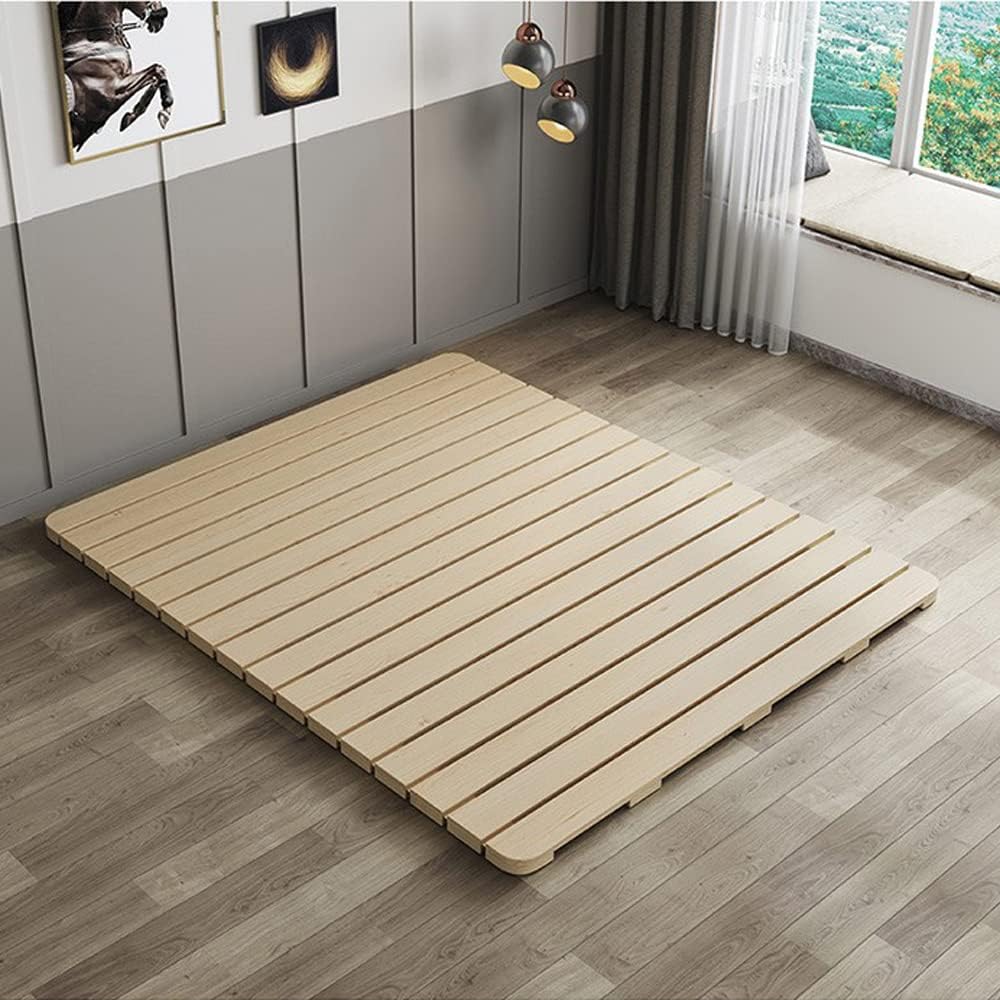
A roll-up wood base that lifts a futon off the floor and disappears when you are done.
This is a different animal from the other three. Rather than fitting into a bed frame, the LOBOTOU is a free-standing solid wood base you lay straight on the floor or a tatami mat. It measures 1.18 inches thick unfolded, which puts a breathable air gap under your mattress so moisture does not trap between a futon and the floor. Nylon straps connect the slats so the whole thing folds and rolls into a compact bundle for storage, and it arrives ready to use with zero assembly.
Owners put it to work in exactly the setups you would expect. It fits a full-size futon mattress, takes a standard fitted sheet, and gives firm support to Japanese floor mattresses and Montessori floor beds for toddlers. Guests sleeping on a mattress laid over it come back with reports of genuine comfort. The underside is set with black anti-slip mats that grip the floor and cut noise, and the edges are hand-sanded with a chamfer for a smooth finish instead of a raw cut.
Weight is the real consideration. At 42 pounds it is the heaviest piece in this group, and its bulk makes rolling and folding a chore rather than a daily habit — buyers describe it as sturdy and great for storage but not something you will want to move every morning. The wood itself draws mixed notes: solid and functional, though basic in grain and finish rather than fine furniture. Keep it in place as a low platform bed and that trade-off disappears; plan to roll it up nightly and the heft will wear on you.
What it is built for: durability and simple function — it needs no frame, no tools and no cutting, and 42 pounds of solid wood stays put once laid.
The weight trade-off: the foldability is real but not easy, so it rewards a fixed spot more than a nightly pack-up.
The right buy for futon and tatami sleepers or anyone building a floor bed who wants support without a frame.
Skip if you need something you can fold and move daily, or you want refined wood grain over basic, workmanlike boards.
Understanding the Specs
Thickness and What It Means for Firmness
Thickness tells you how much the slat resists bending under weight. Thicker, wider boards carry a mattress with less flex, which is why a 2-inch steel-and-wood foundation like the VIPSHOW feels stiffer than a 0.6-inch wood board. Thinner slats still work when the spacing is tight and the load spreads across more boards, but they flex more between supports. On a frame with no centre rail, thin slats sag sooner.
Slat Spacing and Mattress Compatibility
Spacing is the gap between one board and the next. Wider gaps let soft foam dip through; spacing under 2.5 inches keeps the mattress surface nearly continuous so memory foam and latex stay flat. Traditional sets with 4 to 5 inch gaps suit firm innerspring mattresses, while softer foams need the tighter spacing. If you are not sure how wide your gaps are, measure between two boards at the middle of the frame.
FAQ
What size slats fit a full bed frame?
How much slat spacing does a memory foam mattress need?
Do I need a centre support rail on a full bed frame?
Can full bed slats replace a box spring entirely?
Vertical slats or horizontal slats — which should I choose?
How long do wooden bed slats usually last?
Will full bed slats work with an adjustable bed frame?
Do slats help a mattress breathe and stay dry?
How do I stop my bed slats from squeaking?
Can I cut full bed slats to fit my frame?
Final Thoughts: The Verdict
The pick that handles the widest range of full beds is the Meliusly Full Bunkie Board, because its under-2.5-inch spacing safely supports memory foam and hybrid mattresses and it drops in as one pre-assembled panel without a box spring. To bring a tall bed down to a lower height on a frame with a centre rail, grab the VIPSHOW 2 Inch Full Sag-Proof Box Spring. For a futon or floor setup that rolls away for storage, reach for the LOBOTOU Foldable Floor Bed Frame. The Meliusly earns the top spot on hundreds of ratings — measure your frame, then buy with confidence.
How We Picked
We do not accept paid placement. Every pick is matched to a real buyer and a real use-case; we do not hands-on test units.
Sources & Methodology
Specifications: manufacturer listings and product documentation. Review insights: verified customer reviews, as of September 2026. Pricing: not shown on this page (it changes often); check the current price via the retailer link.
As an Amazon Associate, KitchPrep earns from qualifying purchases. This does not affect which products we feature.
Related Guides
