
Buying a grinder for espresso is not like buying a kettle or a scale. A grinder is the one tool that can make your espresso taste alive… or make it taste like sour brown water no matter how fancy your machine looks. That’s why “espresso grinder” listings can feel confusing: dozens of models promise espresso, but only a handful make dialing-in feel predictable instead of punishing.
Here’s the hard truth (and the confidence-builder): espresso isn’t hard because it’s “advanced.” Espresso is hard because it’s unforgiving. Tiny changes in grind size can flip a shot from under-extracted (sharp, lemony, thin) to over-extracted (bitter, dry, hollow). On budget grinders, those “tiny changes” are often hidden behind static mess, retention that changes your dose, and grind steps that jump too far.
So this guide is built around the real friction points that show up in actual kitchens: the portafilter that doesn’t sit quite right, the grounds that cling to a plastic cup, the “espresso” setting that works for a pressurized basket but falls apart on a bottomless portafilter, and the mysterious clogging that only happens when you switch to darker beans.
If you’re searching for the best espresso grinder under 100 usd, your mission is simple: pick a grinder that matches your basket type, gives you enough adjustment to tune flow, and doesn’t sabotage you with messy workflow. Do that, and you’ll get café-level shots more consistently than most people think is possible at this budget.
Below, I cover 14 grinders that all stay under that $100 ceiling—electric burr grinders, one “espresso-first” budget surprise, a manual grinder that punches wildly above its weight, and even a quiet blade grinder (included only because some people need a spice-and-coffee multitasker).
You’ll get a quick comparison table, then deep reviews that focus on what matters in real life: espresso capability (pressurized vs non-pressurized), adjustment range, mess control, dosing workflow, cleaning/maintenance, and who each grinder is genuinely for.
How to Choose the Best Espresso Grinder Under 100 USD (Without Guesswork)
At this budget, you’re not trying to “buy the fanciest thing.” You’re trying to buy the grinder that gives you repeatable espresso. Repeatable espresso comes from three things: (1) grind size control, (2) dose consistency, and (3) workflow that doesn’t fight you. Everything else—screens, cup presets, shiny finishes—is secondary.
1. Start with the most important question: pressurized or non‑pressurized?
This one decision explains most “my espresso is still bad” stories.
- Pressurized basket (often called double-wall): Your machine forces pressure through a tiny exit hole. This hides grinder flaws. You can get decent shots with many burr grinders, even if the grind isn’t perfectly uniform or perfectly fine.
- Non-pressurized basket (single-wall) or bottomless portafilter: Your puck is the pressure system. Now grind quality and step size matter a lot more. If your grinder can’t go fine enough, shots gush. If it goes fine enough but steps are too big, you’ll bounce between “chokes” and “gushes.”
2. Burr grinder vs blade grinder: why espresso cares
Espresso is obsessed with even particles. A burr grinder (conical or flat) tends to create a tighter particle distribution. A blade grinder chops randomly: you get powder and pebbles together, which causes uneven extraction—sour and bitter in the same cup.
- Burr grinder for espresso: The right move for anyone chasing crema, body, and consistency.
- Blade grinder: Only makes sense for spices, occasional drip coffee, or “I need something compact and quiet right now.”
3. Step size matters more than “number of settings” (but settings still help)
A grinder can claim 30, 48, or 51 settings and still feel jumpy for espresso if the steps are too wide where espresso lives. That’s why the style of adjustment matters:
- Micro-adjust / fine clicks (great for espresso): Smaller movement per click means you can correct a shot without overshooting the sweet spot. Manual grinders like the KINGrinder K6 are famous for this.
- “General purpose” steps (fine for pressurized, tougher for bottomless): Many budget electrics are tuned for drip/pour-over first and espresso second. They can still work, but you’ll rely more on dose, distribution, and puck prep to compensate.
4. Dose consistency: cup presets are nice, but scales are king
A lot of grinders offer “cups” or “single/double espresso” modes. These are convenient, but don’t confuse convenience with accuracy. Beans change. Roast levels change. Humidity changes. Static changes. Your “two-cup” dose drifts.
- Best workflow: weigh beans in → grind → weigh grounds out (even a tiny coffee scale makes this easy).
- Next best: timer dosing, once you calibrate it (timers drift less than cup presets).
- Least reliable: “cups” dosing without weighing (fine for drip, risky for espresso).
5. Retention and static: the hidden reason your shots swing wildly
Retention is the coffee that stays inside the grinder after you grind. Static is what makes grounds cling and spray. Both can sabotage espresso because they change your dose and distribution without you noticing. If one shot uses yesterday’s retained fines and the next shot doesn’t, your flow and taste change.
- Look for: anti-static designs, stainless collection cups, bellows/pump tops, and easy-access burr cleaning.
- Use this simple hack: a light spritz of water on beans (often called the RDT trick) reduces static dramatically on many grinders.
- Don’t ignore cleaning: on budget grinders, a little buildup can turn “consistent” into “why is this choking?” quickly.
6. Portafilter fit: the tiny detail that saves your counter
Grinding directly into a portafilter can be amazing… or it can be a mess factory if the cradle doesn’t fit your size or sits too low. Common home sizes are 51mm and 58mm. Some grinders support both; others only support 51mm; some require you to grind into a cup and transfer.
7. Choose based on your “espresso personality”
Most buyers fall into one of these patterns. Identify yours first, then pick the grinder that was built for it.
- The “I want real espresso” beginner: You want a grinder that can go fine enough and adjust precisely without making you hate mornings.
- The “pressurized basket” upgrader: You want better flavor and consistency than pre-ground, with clean workflow and low mess.
- The “small kitchen minimalist”: You need compact storage, quiet operation, and easy cleaning.
- The “dosing nerd”: You’ll weigh everything, chase repeatability, and want low retention + stable timing.
- The “I hate mess” person: Anti-static cups, magnetic catch, and tidy chute design matter more than screens.
Once you know your basket type and your workflow style, choosing the right grinder becomes surprisingly simple. The next section is a fast comparison table, and then we’ll go deep model-by-model.
Quick Comparison: 14 Best Espresso Grinder Under 100 USD Picks
Use this table to shortlist your top choices, then jump into the reviews for the “real kitchen” details— like which grinders tend to stay clean, which ones need a funnel for portafilter dosing, and which ones are genuinely capable when you move from pressurized baskets to bottomless practice.
On smaller screens, swipe or scroll sideways to see the full table.
| Model | Grinder type | Espresso strength | Best match | Amazon |
|---|---|---|---|---|
| SHARDOR Conical Burr Espresso Grinder (Precision Timer 2.0) | Electric burr | Espresso-first workflow + fine control for real dialing | Most people who want dependable espresso under $100 | Amazon |
| KINGrinder K6 Manual Grinder | Manual burr | Excellent espresso grind quality + fine click adjustment | Bottomless / single-wall users who want the best grind quality | Amazon |
| Tuni G1 Conical Burr Grinder (Touchscreen) | Electric burr | Feature-rich dosing + anti-static, great for espresso learning | People who want a modern UI and easy daily workflow | Amazon |
| AMZCHEF Burr Grinder (Espresso-Focused Kit) | Electric burr | Espresso modes + portafilter accessories (best for smaller PF) | Home baristas with 50mm portafilters or cup-dosing workflow | Amazon |
| KIDISLE Conical Burr Grinder (51 Settings) | Electric burr | Slow-grind flavor focus + stainless cup, but needs cleaning discipline | Drip + espresso households who care about taste clarity | Amazon |
| OXO Brew Compact Conical Burr Grinder | Electric burr | Compact + micro-adjust friendly (best for pressurized espresso) | Small kitchens and “daily coffee” grinders that still try espresso | Amazon |
| AYCHIRO Conical Burr Grinder (30 Settings) | Electric burr | Quiet, clean, simple—espresso-capable mostly for pressurized | People who want low mess and easy daily use | Amazon |
| IAGREEA Burr Grinder (Anti-Static + Magnetic Cup) | Electric burr | Clean workflow + surprisingly good crema reports for the category | Mess-haters who still want espresso-friendly dosing options | Amazon |
| Gevi Burr Grinder (35 Settings, Large Hopper) | Electric burr | Big-capacity convenience + clear manual guidance | Households that grind often (and want less refilling) | Amazon |
| Ollygrin Burr Grinder (Touchscreen, 30 Settings) | Electric burr | Great “quiet upgrade” from blade, espresso results vary by basket | Budget buyers who want a modern interface and easy cleaning | Amazon |
| Cuisinart DBM-8 Supreme Grind | Electric burr | Proven batch grinder (excellent for drip/cold brew, limited espresso) | People who want a reliable, no-nonsense “grind a lot” machine | Amazon |
| HSXJDAKI Conical Burr Grinder (38 Settings) | Electric burr | Compact, affordable espresso attempts; portafilter dosing needs a funnel | New espresso owners who want something small and simple | Amazon |
| SHARDOR Electric Burr Grinder 2.0 (Flat Burr) | Electric burr | Great value for drip, espresso mostly for pressurized use | Ultra-budget buyers who still want a burr grinder | Amazon |
| SHARDOR Super Silent Blade Grinder (Timed Knob) | Blade | Not espresso-precise; best for spices and “good enough” coffee | Multi-purpose kitchens that value quiet + removable cup | Amazon |
In‑Depth Reviews: 14 Espresso‑Ready Grinders That Make Buying Easy
Now we’ll go grinder by grinder. I’m going to talk like someone who actually dials espresso at home: what makes a grinder feel stable, what makes it feel chaotic, how to keep your counter clean, and how to get repeatable shots without turning your morning into a science fair.
1. SHARDOR Conical Burr Espresso Grinder (Precision Timer 2.0) – The Budget Grinder That Actually Behaves Like an Espresso Tool

If you want one grinder in this list that feels like it was designed with espresso as the “main event,” this is it. The biggest win is not just the number of settings—it’s the workflow: precise timer control, a modern interface, and a design that aims to keep your dose consistent and your mess low.
In real user feedback, the pattern is clear: people moving from basic grinders (including older entry-level burr grinders) often notice an immediate upgrade in espresso ability—finer grind potential, better consistency, and less “my shot is randomly fast today.” Several owners specifically mention using it with popular beginner espresso machines (like compact home setups) and getting satisfying lattes quickly, which is exactly what a best-overall pick should do: make good coffee easier right away.
Where this grinder earns “expert respect” is in the little details that support repeatability: direct-to-portafilter grinding can save time, and anti-static features reduce the drifting, clumpy dosing that makes puck prep harder. A few users note the portafilter holder can feel a bit loose or saggy depending on your handle shape—this is common at this budget. The fix is simple: use a dosing funnel and/or lightly support the portafilter for the final seconds. That tiny tweak turns “slightly messy” into “clean and fast.”
Why it stands out
- Feels espresso-first – The control style and fine adjustment approach make dialing-in more predictable.
- Timer dosing helps consistency – Once you calibrate time for your beans, daily espresso becomes repeatable.
- Low-mess design mindset – Anti-static + tidy output reduces the “grounds everywhere” problem.
- Great upgrade path – Strong pick for beginners who plan to learn single-wall/bottomless later.
Good to know
- Portafilter cradles on budget grinders can vary—use a dosing ring for cleaner results.
- Like all espresso grinders, it benefits from regular burr and chute cleaning to keep flow consistent.
- If you use very oily dark roasts at extreme-fine settings, expect to clean more often.
Ideal for: most people who want a genuinely espresso-capable grinder under $100 that makes daily shots feel stable, clean, and repeatable.
2. KINGrinder K6 Manual Grinder – The “Wait, This Is Under $100?” Espresso Quality Move

If your goal is single-wall espresso with real control—and you don’t mind using your hand for a minute—manual grinders can beat electric grinders at the same price. The KINGrinder K6 is the clearest example here. It’s built like a little tank, it has fine click adjustment, and users consistently describe it as smooth, consistent, and espresso-capable in a way that many budget electrics simply aren’t.
What makes the K6 special isn’t “manual vs electric.” It’s the combination of burr geometry and adjustment resolution. That means when your shot is slightly fast, you can tighten one or two clicks and actually land in the sweet spot instead of overshooting. For bottomless practice, that matters. For light-to-medium roasts, it can be the difference between “channeling chaos” and “clean, syrupy flow.”
Real owners also call out the practical perks: it’s compact, easy to store, great for small apartments, and it doesn’t create the static mess that can happen with plastic catch cups. The trade-off is effort: grinding espresso-fine takes some work, especially with very light roasts. But many users find it satisfying, and some even mention that the straight handle and grippy body make the routine easier than expected.
Why espresso people love it
- Espresso-grade adjustment – Fine clicks help you dial in single-wall shots without big jumps.
- Consistent grind quality – Manual burr sets at this level can deliver impressively even particles.
- Zero counter space drama – Small footprint, no bulky machine, easy to tuck away.
- Travel-friendly – Great for people who want real coffee quality on trips or small kitchens.
Good to know
- Light roast espresso requires more effort; if you pull multiple shots daily, electric may suit you better.
- It’s not “push button and walk away”—you are the motor.
- Like all manual grinders, keep it dry and clean (no water in the burr area).
Ideal for: anyone serious about espresso grind quality on a budget—especially single-wall and bottomless users who want control without spending big.
3. Tuni G1 Conical Burr Grinder – Touchscreen Dosing + Anti‑Static That Makes Daily Espresso Feel Organized

The Tuni G1 is for the person who wants espresso to feel “clean and modern,” not messy and improvised. It has a touchscreen interface, timer control, and a design that’s clearly aiming to reduce static and keep your coffee station tidy. Users repeatedly highlight two wins: grind consistency that feels impressive for the category, and a workflow that’s easy to learn.
Where it shines for espresso beginners is dosing flexibility. You can grind into a portafilter (with the included holder) or into a dosing cup when you want larger batches. The anti-static performance gets a lot of praise, and people often mention that it looks great on a counter next to popular home espresso machines—meaning it fits “coffee station life” well.
Now for the honest espresso detail that matters: the “cups” mode can be confusing if you treat it literally. Multiple users mention that the cup estimate doesn’t neatly translate to portafilter doses. The smart move is to use the timer: calibrate your beans once (weigh grounds out), then let the timer become your repeatability tool. Also, stay on top of cleaning—some owners note that buildup can reduce output over time, which is normal for grinders that see daily use.
Why it’s a strong pick
- Modern interface – Touchscreen timer control makes daily dosing feel repeatable and “set-and-go.”
- Anti-static actually helps – Less flyaway grounds means cleaner counters and easier puck prep.
- Portafilter + cup options – Lets you choose the workflow that stays clean in your kitchen.
- Looks and feels premium – Many users describe it as solid, stylish, and well-built for the budget.
Good to know
- No dedicated power switch is a recurring complaint—many people simply use a smart plug.
- Ignore “cups” for espresso; use time + a scale for the cleanest results.
- Some portafilters may not fit perfectly in the holder—cup dosing solves this instantly.
Ideal for: home baristas who want a feature-rich electric grinder that stays tidy, looks great, and makes espresso learning feel smoother.
4. AMZCHEF Burr Grinder – Espresso Modes + Accessories That Reduce Morning Friction
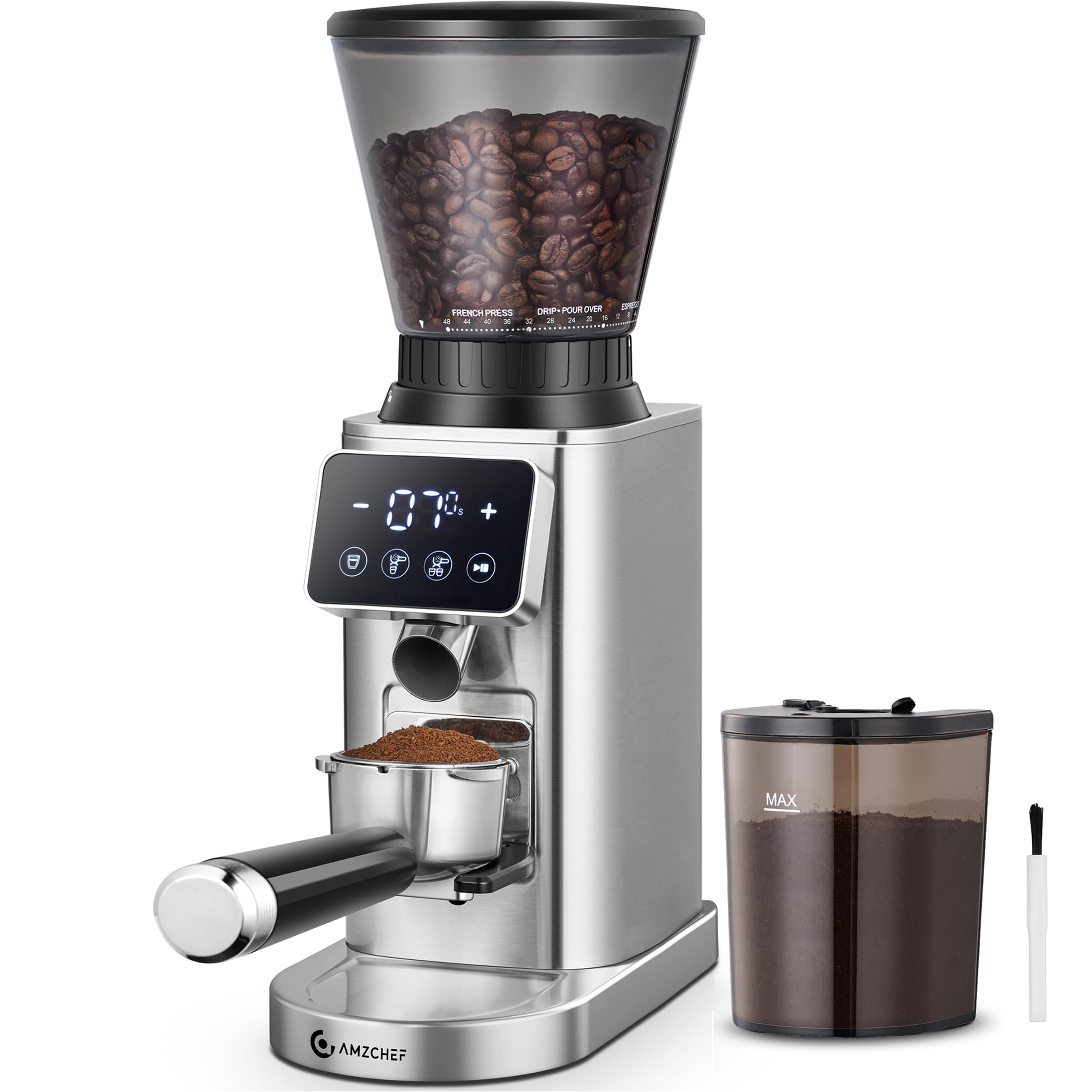
AMZCHEF’s approach here is simple: make espresso dosing easier by packaging the grinder with accessories and control modes that feel espresso-aware. You get multiple grind settings, an LED touch panel, and the ability to dose by time, cups, or espresso-style presets. For many users, that “choose your workflow” flexibility is the reason it becomes a daily driver.
Real-world feedback highlights the core strengths: consistent grind, easy operation, and a clean look that feels at home in a modern kitchen. People also appreciate the anti-static design, especially because espresso grinding tends to amplify mess when grounds cling and clump. If you’re upgrading from blade grinding or pre-ground coffee, this kind of grinder often feels like a “wow, this is smoother” jump.
The one nuance that matters: the included portafilter compatibility is best if your setup matches the holder size (many users with smaller portafilters love it). If yours doesn’t, don’t panic—grind into the included cup and transfer with a dosing ring. Also, a small but real daily-life note from users: some wish it saved the last cup setting, because scrolling every morning is mildly annoying. If you value “set it once and never touch it,” consider timer-only grinders or use a consistent time setting.
Why it’s easy to live with
- Espresso-friendly control modes – Timer and espresso presets help you get repeatable morning doses.
- Anti-static mindset – Less mess is a real quality-of-life upgrade for espresso workflow.
- Solid build and look – A grinder you won’t mind leaving on the counter.
- Good learning platform – Plenty of settings to explore espresso and filter coffee styles.
Good to know
- Portafilter holder fit depends on your portafilter size—cup dosing fixes mismatch instantly.
- First-use residue/purge is normal; run a small “throwaway” grind before your first real shot.
- Some users wish settings were remembered—timer dosing reduces daily button presses.
Ideal for: people who want an espresso-aware electric grinder with a clean workflow and enough control to grow into better shots over time.
5. KIDISLE Conical Burr Grinder – Slow Grinding, Stainless Cup, and a Surprisingly “Grown-Up” Coffee Taste
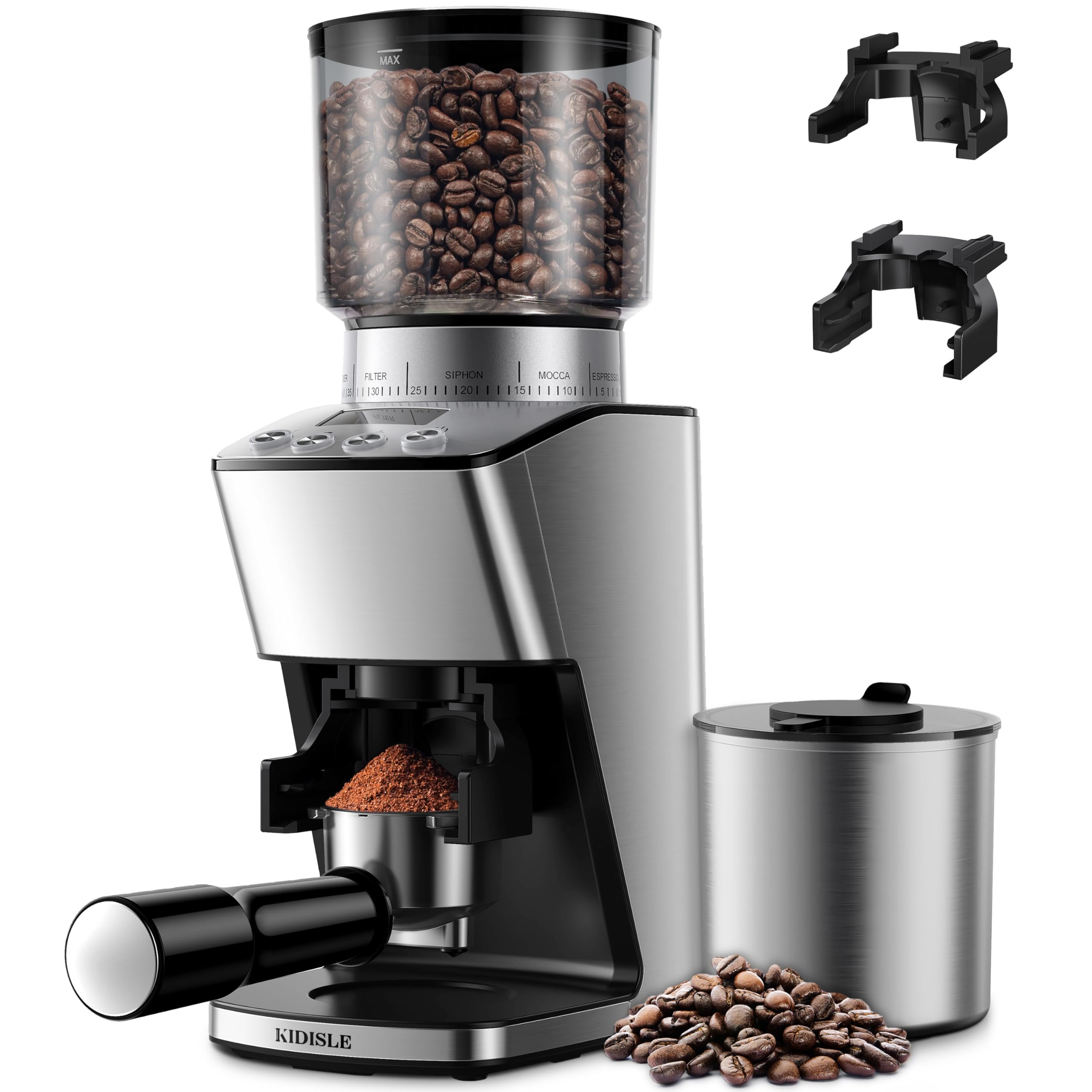
If you care about flavor clarity—especially in milk drinks where espresso can taste “flat” when the grind is inconsistent—this grinder is worth a look. One of the most practical design wins is the stainless grounds cup. Stainless tends to reduce cling compared to plastic, which means less static mess and fewer “mystery grams” stuck to the container walls.
Users frequently praise how quiet it feels compared to older burr grinders, and some specifically mention it handles a wider variety of beans well, including fresher beans that sometimes clog older entry-level machines. The grinder also leans into convenience: multiple grind options, timer/cup controls, and a hopper design that makes bean swaps less stressful (useful if you rotate between espresso and drip beans).
Here’s the expert caution, based on real owner experiences: very fine grinding can create buildup and clogging if you don’t keep it clean, especially when you’re pushing espresso-fine settings. If you’re using pressurized baskets, you can often stay slightly coarser and still get great results. If you’re aiming for bottomless single-wall shots, this grinder can work—but you need a cleaning routine and you should avoid letting oily residue accumulate. Think of it like owning a nice espresso machine: it’s better when you treat it like a tool, not a “never clean” appliance.
Why people keep it
- Stainless catch cup – Less static cling, easier dosing, cleaner workflow.
- Quiet and “solid” feel – Many users describe it as heavy-duty for the category.
- Wide grind range – Useful for espresso, drip, and percolator-style coffee.
- Good flavor payoff – Slow, even grinding can translate to noticeably better tasting cups.
Good to know
- Very fine grinding can require extra cleaning to avoid choke/clog behavior.
- Cup presets don’t replace a scale—use time + weighing for espresso repeatability.
- If you hate maintenance, choose a grinder with easier chute access or use coarser espresso settings (pressurized).
Ideal for: coffee drinkers who want better flavor and a cleaner cup workflow, and who don’t mind basic maintenance to keep espresso consistent.
6. OXO Brew Compact Conical Burr Grinder – Micro‑Adjust Control in a Small‑Counter Package

This is the grinder for people with small kitchens who still want control. The compact footprint is genuinely useful: it fits in cabinets easily, doesn’t dominate the counter, and still gives you meaningful grind adjustment (including micro-tweaks that help when you’re trying to tighten espresso flow).
Real users talk about the same wins: coffee tastes noticeably better than blade grinding, the grind is consistent, and it’s easy to take apart and clean. That last part matters more than people think. A grinder you can clean quickly is a grinder you will clean, which means your espresso stays more consistent over time.
Now, espresso honesty: this grinder can grind fine, but ultra-fine espresso grinding can push the motor protection limits. Some users describe the finest settings as slower, with the grinder timing out to prevent overheating. That doesn’t mean it’s “bad.” It means it’s optimized for everyday coffee and espresso attempts—especially with pressurized baskets— not for nonstop bottomless dialing with light roasts. If your espresso machine is pressurized, this grinder can be a genuinely enjoyable daily driver. If you’re chasing single-wall perfection, the manual K6 or the espresso-first SHARDOR will feel less restrictive.
Why it’s lovable
- Compact and cabinet-friendly – A real win for small kitchens and minimalist counters.
- Micro-adjust capability – Helps you refine espresso flow instead of jumping between extremes.
- Easy to clean – Removable burrs make maintenance realistic, not a chore.
- Better taste fast – Users consistently report a big upgrade from blade grinding.
Good to know
- Espresso-fine grinding can be slow; the grinder may time out on extremely fine settings.
- Some static is normal—use a light bean spritz to keep grounds from clinging.
- The grounds spout can be wide for tiny baskets; a small scoop or funnel solves it.
Ideal for: small kitchens and daily coffee drinkers who want a compact burr grinder that can still support espresso—especially with pressurized baskets.
7. AYCHIRO Conical Burr Grinder – The “Low Static, Low Noise” Upgrade That Feels Effortless
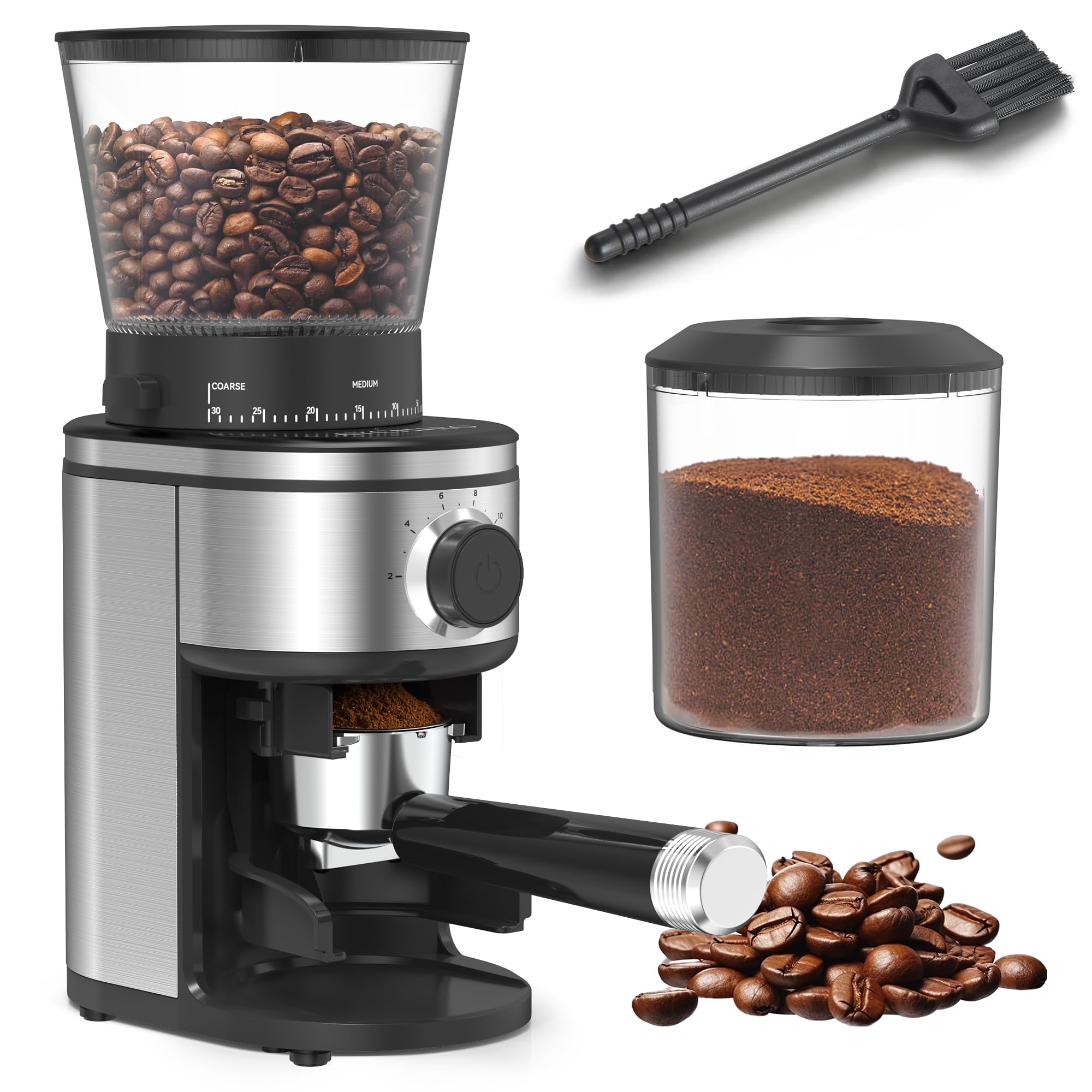
Some grinders win by doing fewer things, better. That’s the AYCHIRO vibe. Owners consistently mention three quality-of-life wins: it’s quieter than expected, it’s fast, and it keeps grounds from flying everywhere. If you’ve ever had a grinder that coats your counter in coffee dust, you already understand why that matters.
The 30-step range is designed to cover espresso through French press, and the interface is simple enough that you can use it half-awake. People also like the grounds cup design—powder drops down cleanly instead of spraying out the side—so you can pour into baskets and filters with less fuss.
The key limitation (and it’s a useful one to know upfront): the coarsest setting may still be “medium” compared with dedicated cold brew grinders. That doesn’t hurt espresso, but it tells you where this grinder is optimized: drip/percolator/filter coffee and entry espresso. For espresso, it tends to shine with pressurized baskets where you don’t need ultra-fine perfection, and where clean, consistent grinding matters more than micro-click dialing.
Why it’s a daily driver
- Cleaner grinding experience – Anti-static cup design reduces counter mess.
- Quiet and fast – Great for early mornings and shared households.
- Simple controls – Easy for families who want “push button, get coffee.”
- Uniform results for the price – Owners often describe the grind as consistent and sturdy.
Good to know
- Coarse range may not satisfy extreme cold brew lovers (not an espresso issue, but good context).
- No portafilter dosing focus—plan to grind into the cup and transfer for espresso.
- Like all grinders, it rewards occasional cleaning to keep output stable.
Ideal for: people who want a quiet, clean burr grinder that handles espresso in a practical way (especially pressurized), while also serving drip and filter coffee beautifully.
8. IAGREEA Burr Grinder – Anti‑Static + Magnetic Cup for People Who Hate Coffee Dust
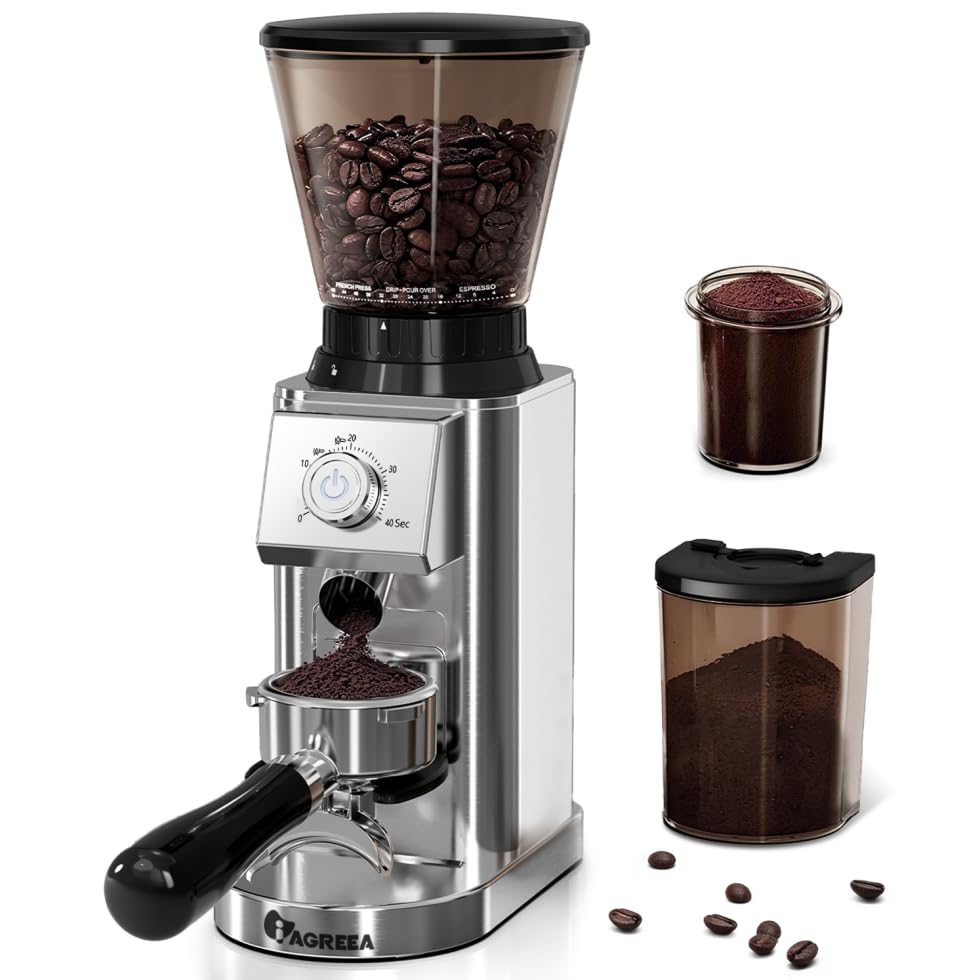
If your #1 grinder complaint is mess—grounds stuck to everything, static “snow,” powder flying out when you remove the cup— this model is built for you. The anti-static approach isn’t just marketing here; users repeatedly mention the workflow feels cleaner, especially when grinding directly into a portafilter or into a filter-top attachment for pour-over.
There’s also a small design detail that sounds minor until you live with it: the magnetic cup. A catch cup that sits firmly reduces wobble, reduces accidental spills, and makes the whole routine feel less fiddly. When you’re dosing espresso every morning, those micro-frictions add up.
Espresso performance feedback is surprisingly positive for the category. Some users specifically mention good crema and uniform grinding, which usually indicates the grinder can produce a consistent fine grind when paired with a compatible machine and basket. That said, treat this like a budget electric: for bottomless espresso, your success still depends on puck prep and dialing with a scale. For pressurized baskets, this grinder can feel like an instant upgrade.
Why people buy it
- Anti-static workflow – Less mess, less waste, and less daily cleaning.
- Magnetic catch cup stability – Small detail, big quality-of-life payoff.
- Wide grind range – Flexible enough for espresso, pour-over, and French press.
- One-touch simplicity – Easy to operate without overthinking the interface.
Good to know
- As with all budget grinders, espresso dialing is best done with a scale and timer, not just presets.
- If your portafilter is an odd shape, you may still prefer grinding into the cup and transferring.
- Regular brushing keeps performance stable—especially if you grind fine daily.
Ideal for: anyone who wants a cleaner espresso workflow and hates static mess more than they care about extra “smart” features.
9. Gevi Burr Grinder – Clear Manual Guidance + Large Capacity for Households That Grind Often
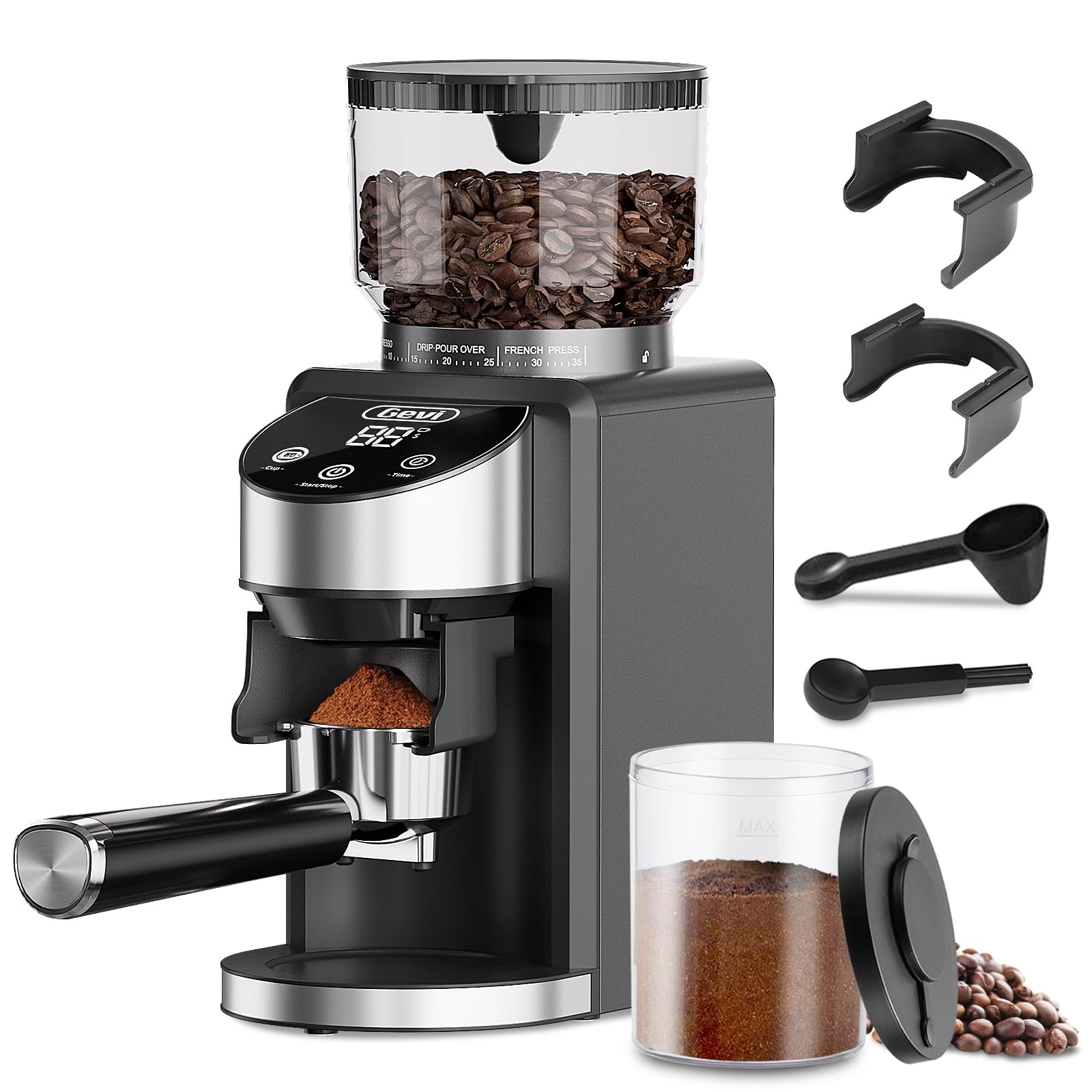
Gevi earns points for something that most listings ignore: clarity. Users mention the manual is unusually good—step-by-step, complete, and actually helpful when you’re learning espresso. That matters because espresso isn’t just “set it to fine.” It’s: set it, test it, adjust it, and understand why it changed. A good manual speeds up that learning curve.
This grinder also fits households that grind frequently. The hopper capacity is generous for the category, so you’re not refilling constantly if multiple people drink coffee. It offers cup selection, and it includes a portafilter cradle so you can grind directly into an espresso handle (often 51mm, and some users report additional holder options in the box). Even if you end up preferring cup dosing, the option is useful for keeping workflow fast.
One practical espresso note that shows up in user experiences: oily dark roasts can clog grinders when you crank the grind too fine. Gevi’s documentation even calls that out, and it’s good advice across the board. If you love dark beans, keep your grind slightly coarser, use a pressurized basket, and clean more often. If you love medium roasts and want to learn dialing, this grinder can be a very friendly starting point.
Why it’s useful
- Excellent learning support – Clear manual guidance helps you dial espresso without guesswork.
- Large hopper convenience – Great for multi-coffee households and frequent grinding.
- Portafilter option – Direct dosing can reduce steps if your portafilter fits the cradle.
- Solid everyday usability – Owners describe it as compact, easy to clean, and straightforward.
Good to know
- Some listings note 51mm compatibility; if you use 58mm, cup dosing + funnel is the safe strategy.
- Very oily beans + very fine settings can increase clog risk—cleaning becomes part of the routine.
- Cup presets vary by bean density; timer + weighing is best for espresso consistency.
Ideal for: households that grind often and want a clearer learning path for espresso—especially if you appreciate a large hopper and straightforward operation.
10. Ollygrin Burr Grinder – A Quiet, Modern Upgrade That Can Work for Espresso (With the Right Basket)
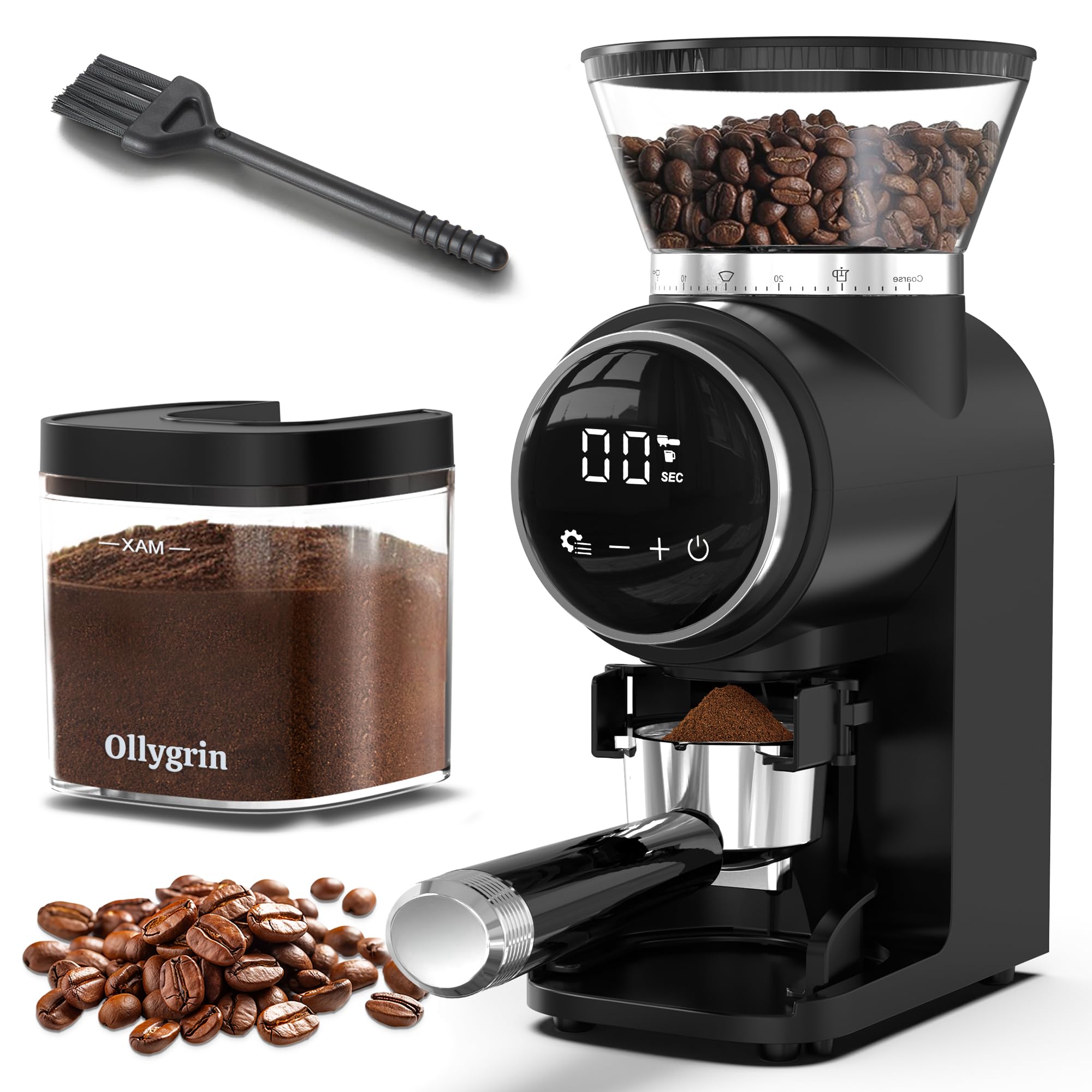
Ollygrin is the kind of grinder people buy when they want “better than blade,” but they also want the experience to feel modern: touchscreen controls, timer dosing, and a compact footprint that fits home and office setups. Several users describe it as quieter than expected and easy to disassemble and clean—two things that keep grinders from becoming annoying long-term.
For espresso, the feedback is mixed in a useful way (and this is common at this budget): some users report they can dial a fine espresso grind that works for their taste, while others mention that even the finest setting doesn’t create enough resistance for a bottomless portafilter on certain machines. That tells you exactly how to use this grinder intelligently: if you’re on pressurized baskets, you can get great results. If you’re on non-pressurized and chasing high pressure and slow flow, you’ll want the SHARDOR espresso-first pick or the KINGrinder K6.
One small “real kitchen” issue owners mention is the touchscreen being slightly fussy at first—finding the sweet spot where to tap. Once you learn it, it’s fine, but it’s not the kind of physical knob control that you can operate blind. If you want the most tactile, no-thinking interface, choose a simpler control panel grinder.
Why it’s a good buy
- Touchscreen timer dosing – Great for repeatability once you calibrate your shot dose.
- Quiet operation – A big upgrade for early-morning households.
- Easy cleaning – Removable parts make maintenance realistic.
- Consistent for most brews – Works well across drip, espresso-style, and French press grinding.
Good to know
- Bottomless/single-wall espresso may require a finer grinder depending on your machine and beans.
- Touch controls can feel sensitive until you learn them.
- Use a scale for espresso; timer dosing is best when it’s anchored by weighing.
Ideal for: people upgrading from blade grinding who want a quiet, modern burr grinder and plan to use pressurized espresso baskets or espresso-style drinks without obsessive bottomless dialing.
11. Cuisinart DBM‑8 Supreme Grind – The “Batch Grinder” Workhorse With a Real-World Longevity Reputation
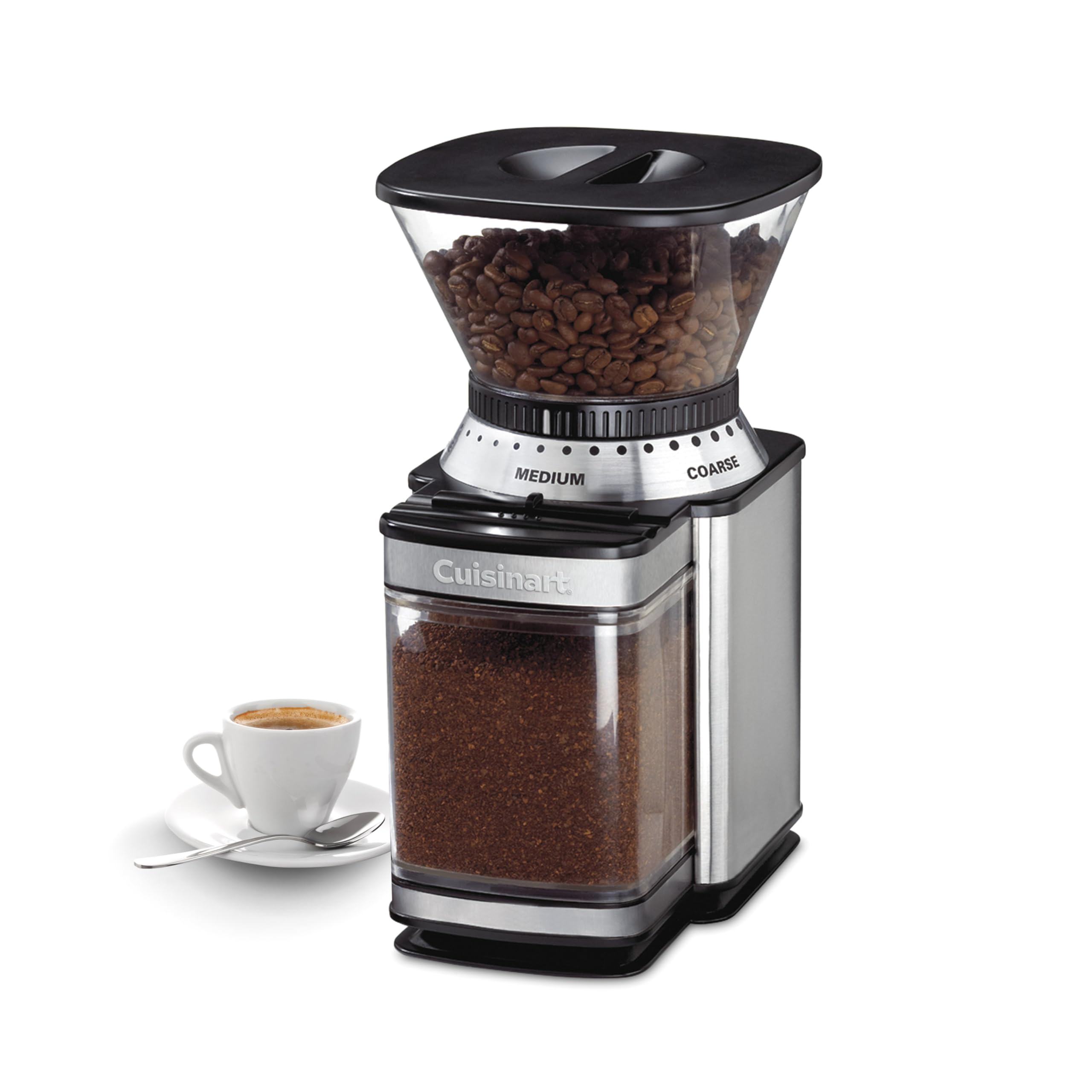
This grinder has been around long enough to earn something many budget grinders never get: a genuine “it lasted years” reputation. Owners often talk about using it daily, grinding for multiple cups, and getting consistent results with minimal drama. If you’re a batch grinder—someone who grinds for drip coffee, cold brew, or multiple servings at once—this style of machine makes life easy.
The grind selector and cup selector are simple, and the grinder stops automatically. People who switch from blade grinders often describe the difference as shocking: less bitterness, more sweetness, and coffee that tastes cleaner. That’s exactly what burr grinding should do. It’s also a popular “cold brew fix” tool because coarse, consistent grinding reduces harshness and makes extraction more even.
For espresso: set expectations correctly. This is not an espresso-first grinder. It can support espresso-style drinks and some espresso machines (especially with pressurized baskets), but it’s not built for the micro-adjust dialing that bottomless users crave. The other real-life drawback is static cling in the plastic grounds container. Many owners tap the container before opening or wipe it down regularly—annoying, but manageable.
Why it’s still popular
- Batch grinding convenience – Great for families, drip drinkers, and weekly grinding routines.
- Proven track record – Many owners report multi-year durability with basic upkeep.
- Noticeable flavor improvement – A classic “first burr grinder” that upgrades coffee immediately.
- Simple controls – Easy for anyone to use without learning a new interface.
Good to know
- Static in the plastic bin can be messy—tapping and occasional cleaning helps.
- Not designed for precision bottomless espresso dialing.
- It’s not the quietest; if noise is critical, consider newer anti-static designs.
Ideal for: drip/cold brew households and practical buyers who value proven reliability and simple batch grinding over espresso micro-adjust precision.
12. HSXJDAKI Conical Burr Grinder – Compact, Capable, and Better Than It Looks (If You Use a Funnel)
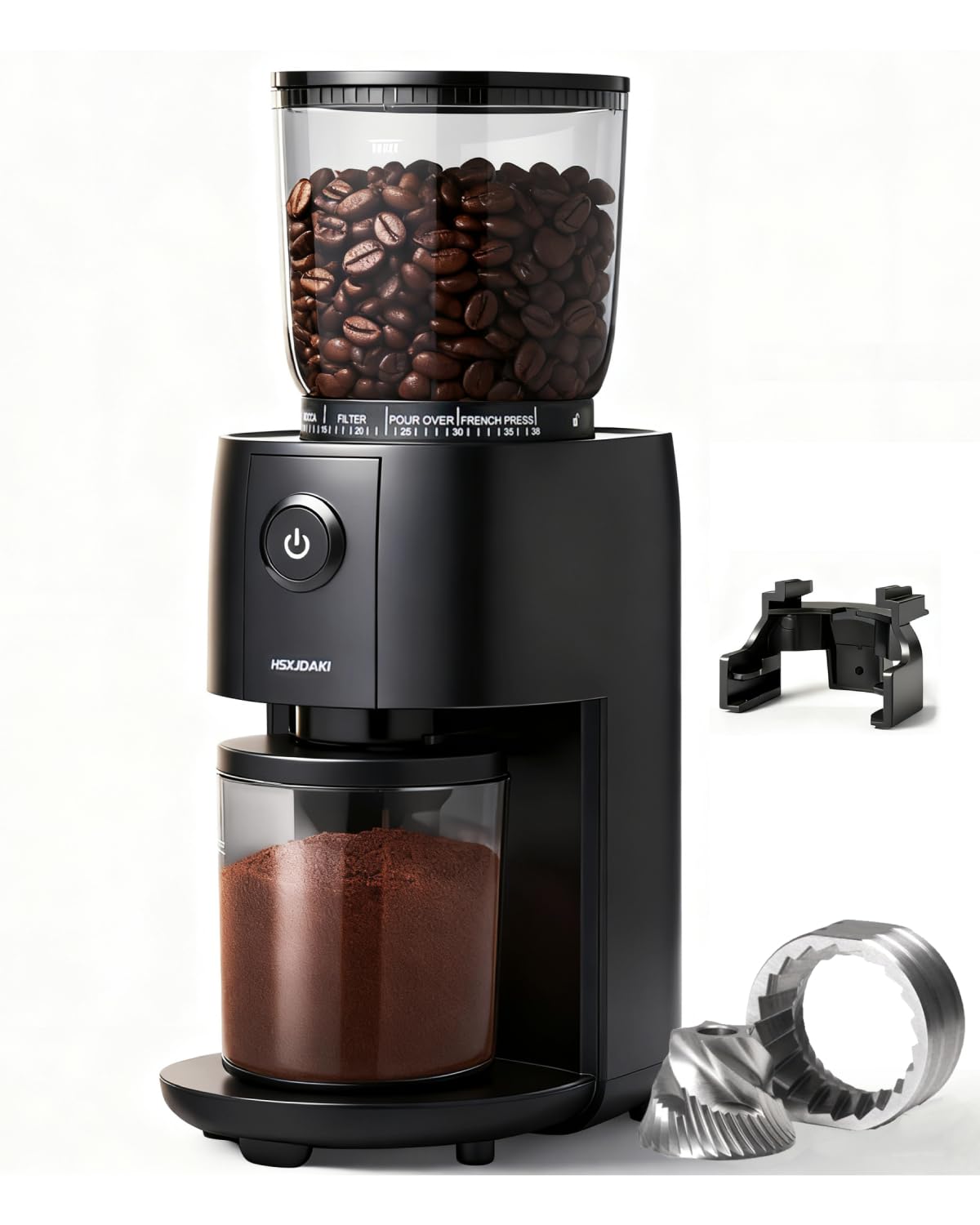
This grinder is a good example of a budget model that can still make people happy—especially when expectations match reality. Users describe it as consistent, not overly loud, and easy to clean. For espresso beginners who just want to start grinding fresh, that combination alone can be enough to dramatically improve morning drinks.
The most helpful real-world insight comes from owners who grind into a portafilter: the holder can sit the portafilter a little low, which can cause grounds to spill. This is not rare in budget grinders. The fix is also not complicated: use a portafilter funnel, hold the handle slightly, and pause briefly if grounds mound up. That single change makes the workflow feel much more “adult” and less like a cleanup task.
If you want to squeeze maximum espresso quality from this grinder, treat it like a single-doser: measure only the beans you need, grind in shorter runs if you’re worried about heat buildup, tap the hopper lid to knock loose retention, and store beans in an airtight container (not in the hopper) for freshness. Those habits make budget grinders act more consistent—because you reduce the “variables” they struggle with.
Why it’s worth considering
- Compact and lightweight – Easy to store, easy to move, great for small counters.
- Consistent enough to enjoy – Many users report satisfying daily coffee and espresso-style drinks.
- Simple to clean – Removable parts reduce the “I never maintain my grinder” trap.
- Good beginner platform – Helps you learn what grind changes do without overspending.
Good to know
- Portafilter dosing can spill without a funnel—add a funnel and the experience improves instantly.
- For bottomless/single-wall espresso, you may eventually want finer micro-adjust control.
- Like most budget grinders, tapping/clearing retention is part of clean dosing.
Ideal for: new espresso owners who want a compact burr grinder that improves coffee immediately, and don’t mind using a funnel for clean portafilter dosing.
13. SHARDOR Electric Burr Grinder 2.0 – The “It Lasted Years” Budget Burr That Makes Drip Coffee Shine

If your budget is tight but you still want the core benefit of burr grinding—more consistent particles, better flavor, less bitterness— this grinder is one of the simplest ways to get there. Users often mention buying a second SHARDOR after the first lasted years, which is the kind of real-life endorsement that matters.
It’s built for hands-free convenience: choose your grind setting, choose your cup amount, press go. For French press and drip, people report consistent results and improved morning routines. It also tends to be quieter and less static-prone than some older budget grinders, according to long-time users, which suggests the design has matured over time.
For espresso: keep it realistic. With 16 settings, the steps can be too wide for single-wall precision dialing. But for pressurized espresso baskets, moka pot, and espresso-style drinks, it can still be useful—especially if you’re upgrading from pre-ground. The biggest nit is mess when removing the grounds container. Many people accept it as a small annoyance at this price. If you want cleaner workflow and more espresso precision, step up to the espresso-first SHARDOR or the anti-static-focused models.
Why it’s a great budget move
- Affordable burr grinding – Big flavor upgrade from blade grinding and pre-ground coffee.
- Simple daily operation – No learning curve for families and shared kitchens.
- Good for drip/French press – Consistent results where this grinder’s step size is ideal.
- Real longevity stories – Many owners report multi-year use before replacing.
Good to know
- Espresso precision is limited by step size—best used with pressurized baskets.
- Some mess when removing the container is common; tapping helps.
- Not a “single-dose, low retention” espresso specialist—more of a practical household grinder.
Ideal for: budget buyers who want a reliable burr grinder for drip and espresso-style drinks, and who value simplicity over espresso micro-adjust perfection.
14. SHARDOR Super Silent Blade Grinder – The Quiet Kitchen Multitasker (Coffee + Spices)
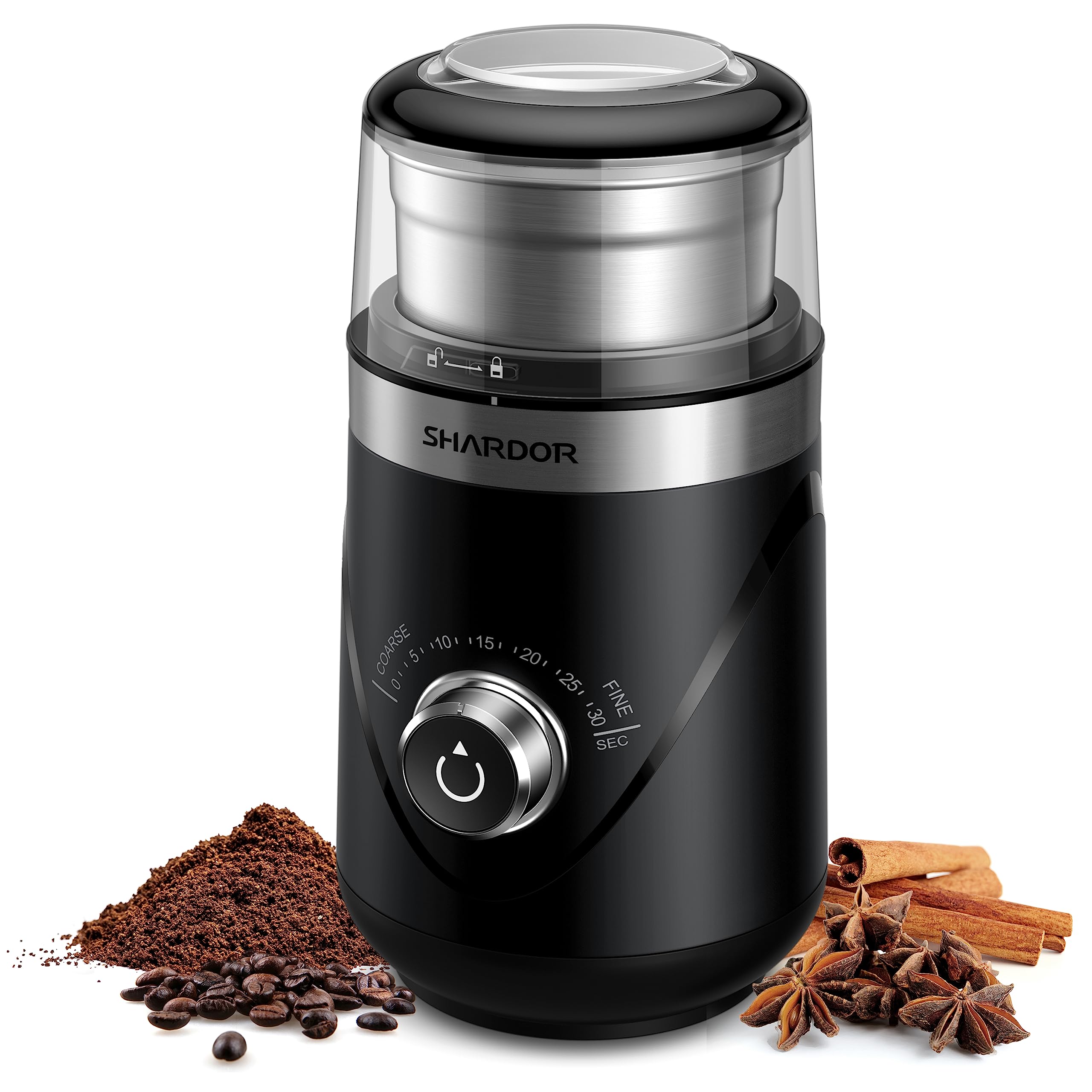
I’m including this blade grinder for one reason: some kitchens need a compact, quiet, multi-purpose grinder. Users often praise this model for being noticeably quieter than older blade grinders and for having a removable grinding cup, which makes pouring and cleaning much easier than “fixed cup” designs.
As a coffee tool, it can absolutely make your morning routine more enjoyable than buying pre-ground coffee— especially for drip, pour-over, or “good enough” espresso-style drinks. But as an espresso tool, a blade grinder cannot deliver the particle uniformity that single-wall espresso requires. You can get fine powder, yes, but you’ll also get boulders. That uneven mix is exactly how you end up with a sour shot and a bitter shot at the same time.
If you choose this grinder, use it for what it does best: spices, herbs, and quick coffee grinding where speed and quiet matter more than precision. A helpful real-life note from users: it can “dance” on the counter. The easy fix is simply keeping a hand on it (and not walking away), or adding a grippy pad underneath.
Why people like it
- Quiet for a blade grinder – A real upgrade for early mornings and apartments.
- Removable bowl – Easy to dump and clean without brushing grounds out of the base.
- Multi-use – Works for spices, herbs, and coffee, which is valuable in many kitchens.
- Simple timed control – You can repeat a grind length once you learn your preferred timing.
Good to know
- Not suitable for single-wall/bottomless espresso consistency.
- Can move on the counter—keep a hand on it or use a grippy mat.
- Grind uniformity will always be limited compared to burr grinders.
Ideal for: multi-purpose kitchens that prioritize quiet operation and easy cleaning, and use espresso-style drinks with pressurized baskets or non-espresso brew methods.
How Espresso Dialing Actually Works (and Why Budget Grinders Feel “Random”)
If espresso feels inconsistent, it’s usually not your machine—it’s the interaction between grind size, dose, and puck prep. Budget grinders can absolutely make delicious espresso, but you have to remove the hidden variables they introduce. Here’s the “espresso reality” explained in a way you can actually use tomorrow morning.
What changes when you adjust your grind
- Finer grind → slower flow → more extraction (more sweetness… until it turns bitter).
- Coarser grind → faster flow → less extraction (more brightness… until it turns sour/thin).
- More fines (tiny powder) → can choke flow and increase bitterness if overdone.
- More boulders (large chunks) → creates weak spots that channel and gush.
The reason some budget grinders feel “random” is step size and retention. If your grinder steps are too wide, one click can change flow dramatically. If retention is high, yesterday’s coffee can sneak into today’s dose and alter puck behavior. That’s why espresso-first grinders and fine-click manuals feel easier: they reduce overshooting and reduce dose drift.
If you want fast wins on any grinder in this guide: weigh your beans, grind, tap/clear the chute, and keep your puck prep consistent. Those habits do more for espresso quality than most people realize.
The budget-grinder dial-in routine that works
- Pick a starting setting and run a shot. Don’t chase perfection on shot one.
- Adjust one variable at a time: grind first, then dose, then puck prep technique.
- Use a dosing funnel if portafilter grinding is messy. Less mess = better distribution.
- Clear retention (tap the lid, use a bellows/pump top if included).
- Clean weekly if you grind espresso-fine daily—buildup changes flow more than you think.
This is how budget espresso becomes “easy”: you make the process stable, then you enjoy the coffee. And once you do, choosing the best espresso grinder under 100 usd stops being stressful, because you understand what the grinder is actually responsible for.
FAQ: Espresso Grinders Under $100 (Answered Like a Real Coffee Person)
Can an under-$100 grinder really make good espresso?
What’s the biggest mistake people make when buying a budget “espresso” grinder?
Do I need to grind directly into a portafilter?
Why does static matter so much for espresso?
My shots are sour and fast. What should I do first?
When should I choose a manual grinder instead of electric?
Final Thoughts: Pick the Grinder That Makes Espresso Feel Easy
A great grinder doesn’t just make better coffee—it makes you more likely to make coffee. When the workflow is clean, the adjustment is predictable, and your dose stops drifting, espresso stops feeling like gambling.
Here’s the simplest way to turn this guide into the right purchase:
- Want the most balanced, espresso-first pick under $100? Start with the SHARDOR Conical Burr Espresso Grinder (Precision Timer 2.0). It’s the best mix of espresso capability, repeatable dosing, and daily usability.
- Using single-wall baskets or a bottomless portafilter and want the best grind quality? Choose the KINGrinder K6. It’s a “serious espresso” tool that just happens to be budget-friendly.
- Want a feature-rich electric with a modern interface? Go with the Tuni G1. Use timer dosing and a scale and you’ll get repeatable espresso faster than you expect.
- Need an espresso-aware kit and like preset-style control? Look at the AMZCHEF Burr Grinder, especially if your portafilter size matches the included holder (or you’re happy cup-dosing).
- Small kitchen, compact storage, still want espresso attempts? The OXO Brew Compact Conical Burr Grinder is a great compact choice—especially with pressurized baskets and a clean workflow.
- Hate mess and want anti-static behavior that actually helps? Try the IAGREEA Burr Grinder. The magnetic cup + anti-static approach is a real quality-of-life upgrade.
- Need proven batch grinding for drip/cold brew with occasional espresso-style use? The Cuisinart DBM‑8 Supreme Grind is a classic workhorse with a long-standing user reputation.
- Shopping ultra-budget but still want burr grinding? The SHARDOR Electric Burr Grinder 2.0 is a practical “first burr grinder” for drip and pressurized espresso-style drinks.
If you came here searching for an espresso grinder and you want one confident decision, make it this: pick the grinder that matches your basket type, then commit to a simple repeatable routine (weigh, grind, clear retention, prep puck). That combination turns “budget espresso” into espresso you’re proud to serve.
