
An electric skillet looks simple. Plug it in, turn a dial, cook dinner. Easy… until you own one for a month. Then the real questions show up:
- Why do pancakes brown fast in the middle but stay pale on the edges?
- Why does chicken “steam” instead of sear when you add the second batch?
- Why does the temperature feel like it’s guessing—hot, then not, then suddenly hot again?
- Why do some nonstick surfaces wipe clean with one paper towel… while others become a scrubbing project?
That’s exactly why people keep searching for best electric skillets. Not to find “the biggest pan,” but to find the one that behaves like a calm, consistent cooking surface—so you can cook the way you actually live: weekday breakfast, family dinner, meal prep, potlucks, dorm rooms, RVs, office lunches, and those weekends where you’re feeding a crowd.
This guide isn’t a spec-sheet parade. I’m using real-life patterns from owner feedback (the stuff people only admit after weeks of use): how the thermostat cycles when food hits the pan, whether the nonstick survives daily eggs, how easy the probe is to remove with greasy hands, whether the lid helps or hurts, and what happens when you try “hard” foods like sticky sauces, fried potatoes, and browned meat.
Below are 17 standout picks—from foldaway storage legends to digital-precision skillets, deep-dish party pans, and hot-pot style cookers. I’ll help you pick the right one for your cooking personality, not just your kitchen counter.
In this article
How to Choose the Best Electric Skillets for Your Kitchen
If you’ve ever bought a skillet that looked perfect online—then felt “fine” at first but slowly annoyed you—this section is your shortcut. A great electric skillet isn’t the one with the most buzzwords. It’s the one that does three things consistently: heats predictably, cleans without drama, and fits the way you actually cook.
1. Start with the “job” you want it to do most often
Electric skillets are not one category. They’re multiple categories wearing the same name tag. Decide the main job first:
- The breakfast workhorse: pancakes, eggs, bacon, hash browns. You need stable mid-heat, even browning, and a surface that doesn’t punish you for cooking daily.
- The family dinner pan: stir-fry, fajitas, chicken cutlets, burgers, sautéed vegetables. You need heat recovery (so the pan doesn’t cool down when food hits) and enough room to avoid crowding.
- The deep-dish “one-pot meal” pan: chili, gumbo, spaghetti sauce, pot roast, ribs. You need depth, lid quality, and steady low heat that won’t scorch the bottom.
- The party / buffet server: meatballs in sauce, queso, pulled pork, casseroles. You need stable “keep warm,” safe handles, and a lid that controls steam instead of trapping chaos.
- The travel/dorm/RV cooker: simple meals, quick cleanup, compact storage. You need manageable size, safe design, and zero-fuss cleaning.
- The hot-pot / table cooker: ramen, sukiyaki, seafood boil, communal hot pot. You need quick response, easy-to-clean depth, and controls that make sense while people are eating.
2. Even heating is more than “wattage”
Wattage matters, but it’s not the whole story. What actually affects real-life cooking is:
- Heating element design: embedded elements (often in an “M” or ring pattern) typically reduce cold zones. Poor layouts create “center cooks / edges lag” problems.
- Heat transfer and base thickness: heavier cast bases tend to stabilize temperature better. Thin bases can cycle aggressively.
- Thermostat behavior: some dials swing wide (hot → cool → hot). Better controls cycle gently, keeping food in the zone you set.
- Heat recovery: when you add cold food, good skillets bounce back fast instead of turning into a steaming pan.
If you sear meat or cook big batches, prioritize heat recovery. If you simmer sauces, prioritize thermostat stability at lower settings. If you do both, look for a skillet that’s known for “even heat” in owner feedback (not just “it gets hot”).
3. Shape decides what your skillet is good at
This is the part most guides ignore. Shape matters because it controls crowding, evaporation, and how food browns.
- Rectangular (12" x 15"): best for griddle-style cooking—pancakes, bacon, chicken cutlets, meal prep. Easy to “line up” food.
- Square (12" x 12"): great compromise. Easier to store than huge rectangles, still roomy for dinner.
- Round / oval: often better for stirring and simmering (stews, sauces) and easier to place on a table without “corner overhang.”
- Extra-deep walls: less splatter, better for braises and saucy meals, but can trap steam if your lid isn’t vented (which can reduce browning).
If you keep burning or steaming food, crowding is often the hidden reason. Bigger cooking surface = better browning, because moisture has somewhere to go.
4. Coatings: what matters (and what’s noise)
There are three practical coating realities:
- Nonstick is a system, not a promise. The coating matters, but so does heat discipline, utensil choice, and cleaning style. Even “scratch resistant” surfaces can be wrecked by repeated high heat + metal tools + harsh scrubbing.
- Ceramic-style coatings often feel “cleaner” to some shoppers. Many ceramic-coated models are marketed as PFAS/PFOA/PTFE-free. They can be fantastic for easy release—especially early in life—but they typically reward gentle habits: moderate heat, silicone/wood tools, and avoiding thermal shock (like rinsing a blazing-hot pan with cold water).
- PTFE-style nonstick can be extremely slick when treated right. Great for eggs and pancakes. The trade-off is that it tends to demand “no metal, no rough scrubbing, don’t overheat it empty.” If you cook daily, consider whether your household can keep those habits long-term.
5. Cleaning and storage can make you love or hate the skillet
A skillet can cook beautifully… and still become the appliance you avoid. The deciding factors are often boring but powerful:
- Fully immersible: if the probe removes cleanly and the pan is safe to submerge, cleanup gets easier fast.
- Dishwasher safe: helpful, but only if the skillet actually fits and you’re okay with the dishwasher’s detergents over time.
- Probe release design: a good probe detaches with a confident click and doesn’t feel like it will break.
- Lid design: vented lids reduce boil-over drama and steam back-splash; snug lids help with braises and keeping food warm.
- Storage footprint: some models fold, nest, or store upright. That can be the difference between “daily use” and “forgotten on a shelf.”
If you’re short on space, prioritize storage innovation. It sounds small—until you’re holding a giant pan and wondering where it lives.
6. Temperature control: analog vs digital (and why it matters)
Analog dials can be great. Digital controls can be amazing. The key difference is precision and repeatability.
- Analog: usually simple, reliable, and fast to operate. You learn “my skillet’s 3 o’clock is perfect for pancakes.”
- Digital: better for narrow zones—like holding a sauce warm without scorching, or maintaining a steady simmer. If you like “set it and walk away,” digital precision can feel like leveling up.
One important habit either way: give the skillet time to stabilize. The first minute after it clicks “ready” is not the same as a stabilized cooking surface. Preheat with the lid on when appropriate (especially for pancakes and anything that wants even browning).
7. Read the “real reviews” like a detective
Instead of looking for “5-star” praise, look for patterns:
- Heat behavior: “even,” “no hot spots,” “recovers heat fast,” or complaints like “edges stay cold.”
- Coating life: “still nonstick after months” is gold. “Peeling after a few uses” is a red flag—unless the person admits they overheated it.
- Controls: “thermostat is hard to read” is annoying but manageable. “Temperature won’t hold” can be a dealbreaker.
- Convenience: mentions of storage, probe removal, and wiping clean are often what separates a keeper from a regret.
This guide does that sorting for you—so you can buy once, cook happily, and stop researching.
Quick Comparison: 17 Best Electric Skillets Worth Buying
Use this table to shortlist the models that match your cooking style, then jump into the deep reviews for the real-life details— like heat recovery, cleaning habits that keep the coating happy, and whether the lid actually helps.
On smaller screens, swipe or scroll sideways to see the full table.
| Model | Category | Real-life strength | Best match | Amazon |
|---|---|---|---|---|
| Presto 06857 16" Electric Foldaway Skillet | All-around pick | Even, dependable heat + folds for storage + easy everyday cleanup | Most households who want one skillet they’ll actually use | Amazon |
| All-Clad Electrics 7-Quart Electric Skillet | Premium power | Fast heat recovery + serious searing + oven/broiler capability | Foodies who want “stovetop-level” results from an outlet | Amazon |
| Zojirushi EP-RAC50 Gourmet d’Expert | Multi-cooker | Hot pot + grill + steam in one system with quick temperature response | Hot-pot nights, small kitchens, and “table cooking” families | Amazon |
| Cuisinart CSK-150NAS Oval Electric Skillet | Stainless look | High-heat range + roomy oval shape + attractive countertop presence | Home cooks who want a “pretty” skillet that can brown confidently | Amazon |
| Nuwave Medley XL Digital Skillet (Cinnamon) | Digital precision | Precise 5° adjustments + steady low heat + big cooking surface | Meal-preppers and “set-it-right-once” temperature control lovers | Amazon |
| Nuwave Medley XL Digital Skillet (Black) | Digital precision | Same Medley performance, different color option | Same buyer, different aesthetic | Amazon |
| Nuwave Medley XL Digital Skillet (Cozy Blue) | Digital precision | Same Medley performance, different color option | Same buyer, different aesthetic | Amazon |
| Electric Skillet 6-Quart Hot Pot (AUTUCU) | Hot pot | Timer + high power + deep pot for ramen, stew, and tabletop meals | Hot pot nights, dorms, offices, and small-counter cooking | Amazon |
| Presto 06852 16" Electric Skillet with Glass Cover | Classic 16" | Big, deep, buffet-friendly, and built for heavy weekly use | Large breakfasts, fried chicken, casseroles, and batch cooking | Amazon |
| Presto 06858 16" Slimline Electric Skillet | Storage saver | Low-profile design for easier storage without giving up cooking area | Families who want a big pan but hate bulky storage | Amazon |
| Elite Gourmet 12.5 Qt Xtra Deep (PFAS-Free Ceramic) | Deep family | Tall walls + big surface + easy cleanup for big meals | One-pan dinners, bacon/eggs, and “cook for 6–8” nights | Amazon |
| Elite Gourmet EG-6203# 10.5 Qt Extra Deep | Extra roomy | Huge cooking space + deep sides for sauces and roasts | Meal-preppers and big-batch cooks who hate crowding | Amazon |
| BLACK+DECKER 12" x 15" Electric Skillet | Rectangular daily | Simple, capable, and roomy—great everyday “cooktop helper” | Breakfast + dinner households who want familiar controls | Amazon |
| Dash Family Size Electric Skillet | Easy nonstick | Low-drama cooking surface + simple cleanup + modern design | Weekly meal prep, campers, and quick family meals | Amazon |
| bella Make & Take Electric Skillet | Potluck pick | Clamped lid + stores upright + designed to travel cleanly | Potlucks, tailgates, office parties, and holiday hosting | Amazon |
| Elite Gourmet EG6201 7.5 Qt Extra Deep (12" x 12") | Deep square | Family-friendly depth in a manageable footprint | Smaller kitchens that still cook big meals | Amazon |
| Elite Gourmet 12" x 12" PFAS-Free Ceramic Skillet | Compact | Portable size + fast heat + easy cleanup | Dorms, hotel cooking, RVs, and 1–2 person households | Amazon |
Best Electric Skillets Reviews: 17 Models That Feel Good to Own
Now we’ll go skillet by skillet. I’ll focus on what actually changes your daily cooking: how it browns, how it holds temperature, what the lid does, how annoying cleanup is, and the “little things” that make owners either rave… or quietly stop using it.
1. Presto 06857 16-inch Electric Foldaway Skillet – The “Use It All the Time” Choice

If you want one skillet that can replace a surprising chunk of your stovetop life, this is the one I’d start with. The Presto Foldaway has a rare combo: it’s genuinely roomy, it cooks evenly enough for “serious” meals, and it doesn’t punish you at cleanup time. Owners describe using it for everything—breakfast spreads, weeknight chicken, sautéed vegetables, casseroles, and big-batch meal prep— then wiping it down fast without turning the kitchen into a mess.
Here’s the real reason it wins: the Foldaway doesn’t feel fragile. It feels like an appliance designed for repetitive weekly use. The cooking surface is big enough that you can stop crowding food, which is the hidden key to better browning. When you have space, moisture escapes. When moisture escapes, chicken actually sears. Potatoes actually crisp. And you stop thinking “why does my food taste steamed?”
Then there’s the storage: fold-down handles and the ability to nest the base make it far easier to live with than many 16-inch skillets. In small kitchens, that matters. Appliances don’t die because they’re bad—they die because they’re annoying to store. This one fights that problem directly.
Why it earns “best overall”
- Real cooking space – Big surface means better browning and faster batch cooking.
- Everyday-friendly heat behavior – Owners consistently report even cooking and dependable results across the pan.
- Folds away without drama – Easier to store than most large skillets (huge quality-of-life win).
- Cleanup stays simple – A practical design for people who actually cook regularly.
Good to know
- Any fold-and-nest design can scuff surfaces if you store parts directly against the cooking area—use a thin towel or cloth as a buffer.
- Because it’s large, you still need a decent cooling/storing spot; “compact” doesn’t mean “tiny.”
- If you want ultra-precise temperature steps, a digital model can feel more repeatable—this one is about dependable simplicity.
Ideal for: households who want one skillet that handles breakfast, dinner, meal prep, and serving—without needing a learning curve or a giant storage sacrifice.
2. All-Clad Electrics 7-Quart Electric Skillet – When You Want “Stove-Level” Performance

This is the skillet for people who get annoyed when countertop appliances cook like countertop appliances. The All-Clad behaves more like a serious pan on a strong burner: it heats fast, rebounds quickly, and doesn’t collapse into “steaming” when you add food. That is the whole game for great browning. If you sear meat, cook burgers in batches, or do high-volume sautéing, heat recovery is the difference between “golden” and “gray.”
Owners who love this skillet talk about it like a cheat code: it handles big portions without feeling cramped, it holds temperature even when the pan is loaded, and it’s the kind of pan you can confidently use for “first sear, then finish.” The ability to move the cooking insert into the oven/broiler adds a very “real cookware” flexibility— think: sear chicken thighs, then finish gently; brown the top of a dish; tighten a sauce; melt and brown cheese. That’s a different level than most electric skillets.
The honest trade-off is weight and footprint. This isn’t a “tuck it away easily” skillet. It’s a serious piece of equipment. If you want that performance, you accept that it lives like a centerpiece appliance. Also, owners commonly mention the thermostat markings can be hard to see—small annoyance, but worth knowing.
Why it feels like an upgrade
- Heat recovery is excellent – Better browning, better searing, less “food steams itself.”
- Cookware-like versatility – The insert’s oven/broiler capability opens up finishing moves most electric skillets can’t do.
- Big capacity without feeling sloppy – Enough room to cook for a crowd without crowding.
- Built to be used hard – Owners often describe it as robust and restaurant-adjacent in feel.
Good to know
- It’s heavy and takes space—amazing if you’ll use it constantly, frustrating if you won’t.
- The thermostat can be hard to read; some people rely on the dial clicks and muscle memory.
- It can dominate your dishwasher if you choose that route—many owners wipe it clean between batches instead.
Ideal for: serious home cooks who want electric-skillet convenience without giving up searing and heat stability.
3. Zojirushi EP-RAC50 Gourmet d’Expert – The Hot Pot + Grill + Steam Power Move

This isn’t just an electric skillet. It’s a cooking format. The Zojirushi is built for the kind of meals where people hover, chat, add ingredients, and eat in rounds: hot pot, sukiyaki, fondue, seafood boils, quick simmered broths, and “cook it right here” family dinners. Owners regularly say they bought it for hot pot… and then realized it’s capable of far more: you can grill on the flat plate, simmer in the deep dish, and even steam with the included rack.
What makes it special in real-life use is how quickly the temperature responds. Hot pot gets annoying when heat takes forever to correct. This one reacts fast, and that changes the experience: you can keep broth gently bubbling instead of boiling over, and you can push heat higher briefly when you add a lot of cold food without waiting.
The wide shape is also a sneaky advantage. Owners talk about how it’s easier to find and manage ingredients because nothing disappears into a deep “abyss.” For communal eating, that matters—less fishing, less chaos, and fewer accidental “chopstick battles.” The magnetic cord is also a quietly brilliant safety detail: if someone trips, it can detach instead of yanking the whole unit.
Two important reality notes: first, this is a high-power appliance, and some households learn quickly that running multiple high-watt appliances on the same circuit can trip breakers. Second, like many ceramic-style surfaces, it rewards gentle habits: let it cool before washing, avoid aggressive scraping, and you’ll keep it happy longer.
Why owners keep praising it
- True multi-function setup – deep pan + grill plate + steam = multiple cooking styles without extra pots.
- Fast temperature response – makes hot pot and table cooking feel controlled, not chaotic.
- Wide, social-friendly shape – easier ingredient management and better “shared meal” flow.
- Smart safety detail – magnetic cord detaches to reduce yanks and accidents.
Good to know
- Replacement parts exist, but the lid and accessories are not “throwaway cheap,” so handle them carefully.
- High power means you should be mindful of what’s on the same circuit if your kitchen wiring is sensitive.
- It’s not a minimalist appliance—this is a “centerpiece cooker,” not a tiny griddle.
Ideal for: hot pot lovers, small kitchens that need one device to do many jobs, and anyone who wants meals that feel like an event.
4. Cuisinart CSK-150NAS Oval Electric Skillet – Beautiful on the Counter, Serious Heat Range

Some skillets are purely utilitarian. This one looks like it belongs in a grown-up kitchen. The brushed stainless housing and oval shape give it a “serve from the skillet” vibe that works for entertaining— fajitas, chicken piccata, sautéed vegetables, or a big brunch spread.
In real cooking, the Cuisinart’s appeal is its heat range and surface area. It can push into higher-heat cooking than many budget skillets, and that matters when you want browning: caramelized onions, crisped potatoes, browned sausage, and chicken that looks like you meant it. Owners who get a good unit often describe fast heat-up, even-enough cooking, and easy cleanup when they treat the nonstick respectfully.
Now the expert honesty: this model has two common “review realities.” One is that the handles (including the lid handle) can get hot, which is a design annoyance if you’re used to cool-touch. The second is that some owners report temperature-regulation inconsistencies over time, while others say theirs is rock-solid. That doesn’t automatically mean “don’t buy it”—it means test it early: do a controlled pancake run, a simmer test, and a sear test while you’re still in the easy-return window. If your unit holds steady, it’s a lovely skillet to own.
Why it’s loved
- Looks premium – stainless exterior is countertop-friendly and table-friendly.
- Roomy oval surface – easy for sauté, stir, and serving without cramped corners.
- High-heat capable – better for browning than many entry models.
- Easy cleanup (with good habits) – wipes clean when you avoid harsh scrubbing and metal tools.
Good to know
- Handles can get hot; plan to use mitts or a towel when lifting and serving.
- Some owners report thermostat inconsistency; test early and decide confidently.
- The nonstick surface benefits from gentle tools—this is not a “cut the steak in the pan” skillet.
Ideal for: cooks who want a handsome skillet that can genuinely brown, and who are willing to treat nonstick with respect.
5. Nuwave Medley XL (Cinnamon) – Precision Heating That Makes Cooking Feel “Easy”

If you’ve ever fought with an analog dial that feels like it has only two moods—“not hot enough” and “too hot”—the Medley XL is refreshing. Its digital temperature control is about repeatability. You can dial in the zone you want and actually stay there, which is a big deal for foods that punish inconsistency: pancakes, delicate fish, sauces, shallow-frying, and anything you want to hold warm without scorching.
Owners who love it talk about two things: even heating and how easy cleanup becomes when you’re not accidentally burning spots. It’s also a true “cook in more places” appliance: plug it in at a buffet table, in an RV, or in a small apartment kitchen and you’ve got a big controlled cooking surface without turning on the stove.
Now the expert caveat: digital systems add a failure point. A small percentage of owners report error codes or non-working controllers out of the box. That’s not unique to this brand—it’s the nature of electronics. The practical move is simple: test it immediately (boil water, simmer, then sear) so you know you have a solid unit. If it’s solid, it can become your “most used appliance” fast.
Why digital can be a game-changer
- Repeatable temperature control – makes simmering, warming, and consistent browning easier.
- Even heating focus – owners often praise reduced hot spots and smoother cooking.
- Big surface for batch cooking – great for meal prep and family dinners.
- Portable “extra burner” vibe – useful for gatherings, RVs, and small kitchens.
Good to know
- Electronics mean you should test early to confirm you got a strong controller.
- Digital controls add complexity—if you want ultra-simple, analog might suit you better.
- Because it’s sizable, plan storage like you would for a large griddle.
Ideal for: cooks who want precise control, meal-preppers, and anyone tired of guessing what their dial really means.
6. Nuwave Medley XL (Black) – Same Precision, Sleek Look

Same cooking engine, different look. If you want the Medley’s digital precision but prefer a classic kitchen aesthetic, the black version is the clean, neutral choice.
The practical benefits are identical: repeatable temperature control, a family-size cooking surface, and a workflow that’s friendly for batch cooking. If you’ve been trying to meal prep chicken cutlets, cook eggs for the week, or keep a warm sauce steady without scorching, digital control makes those routines feel less like gambling.
Why people choose this color
- Sleek, neutral appearance – blends into most kitchens and serving setups.
- Same precision performance – all the key Medley benefits without the brighter colorway.
- Great for repeatable weekly cooking – once you learn your temps, results stay consistent.
Good to know
- As with any digital unit, test early to confirm your controller is perfect.
- If you prefer “turn the knob, done,” analog options may feel simpler.
Ideal for: digital-control shoppers who want a neutral, classic look.
7. Nuwave Medley XL (Cozy Blue) – Precision Cooking with Personality

If you like appliances that don’t look like every other black rectangle, this is your Medley. Functionally it’s the same digital-precision skillet—so your buying decision here is purely “do I want this color in my kitchen?”
For hosting, this one is fun. It looks great on a buffet table, it keeps food warm with more control than many analog dials, and it gives you a large cooking surface without tying up your stovetop.
Why it’s a fan favorite
- Same precision benefits – consistent results, easier simmering, and stable warming.
- Looks great when serving – a colorway that feels intentional, not purely utilitarian.
- Big surface, big flexibility – cook at home, serve elsewhere, and keep control the whole time.
Good to know
- Digital means “test early” is still smart—make sure your controller is perfect from day one.
- It’s a sizable unit; plan a storage spot you actually like using.
Ideal for: digital-control buyers who want a more stylish serving-friendly color.
8. AUTUCU 6-Quart Electric Hot Pot Skillet – Deep, Powerful, and Built for Table Meals
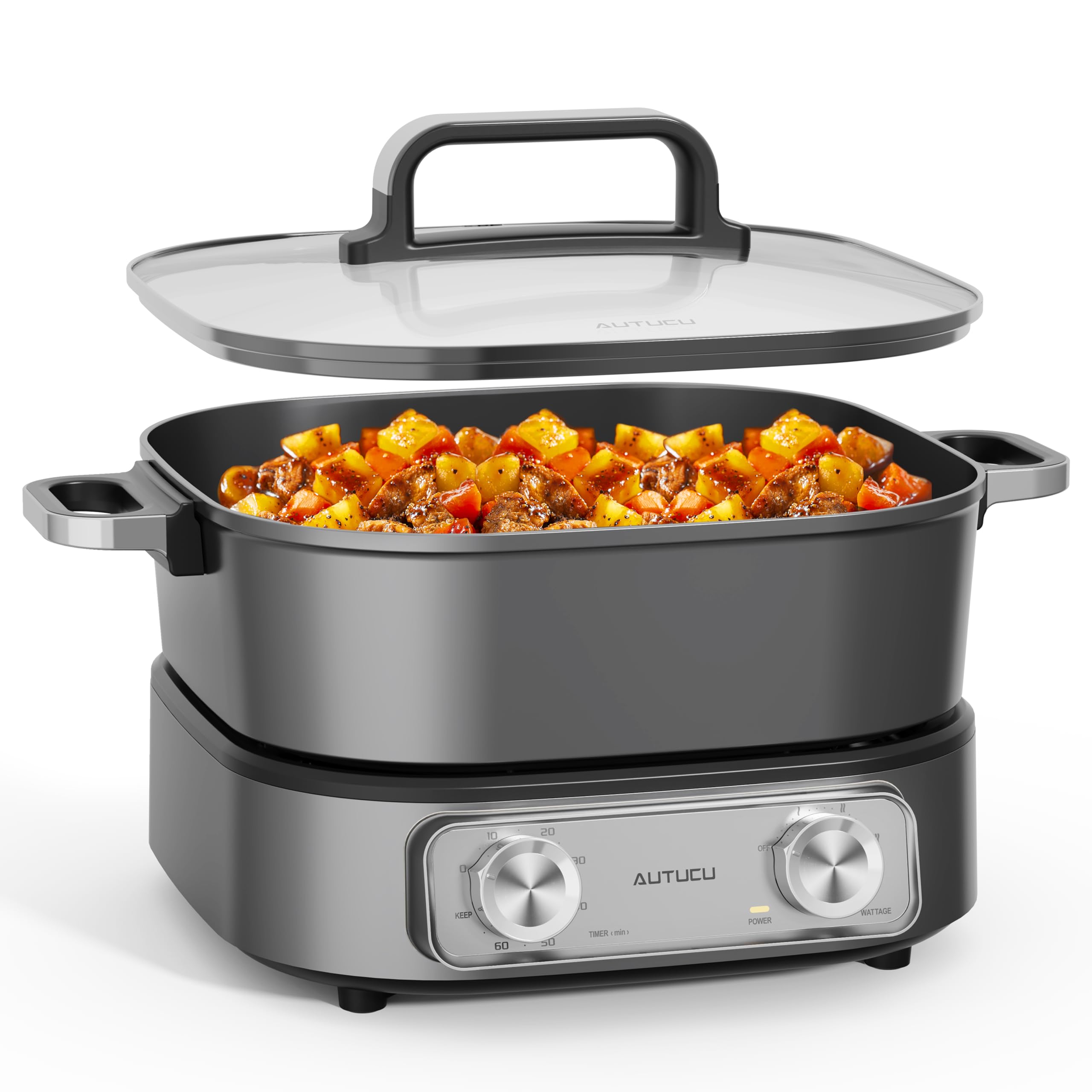
If your idea of “electric skillet life” is ramen nights, hot pot parties, seafood boils, stewed dishes, and quick stir-fries, this style of deep hot-pot cooker can be more satisfying than a flat skillet. The AUTUCU has the depth for broths and sauces, plus enough power to actually get things boiling without taking forever. That’s the difference between “fun table meal” and “why is this barely simmering?”
Owners who love it often mention the nonstick performance and how easy the removable pot is to clean. That removable pot is a practical win: it turns cleanup into a sink-friendly task instead of “wipe around the electrical base and hope.” The timer is another real-life feature that matters more than it sounds. For simmered dishes, it gives you a controlled endpoint, and for keeping food warm, it can take the anxiety out of hosting.
The trade-offs are exactly what you’d expect from a simplified control system: three heat levels instead of fine-grained temperature steps. That’s totally fine for boiling, simmering, and quick sautéing. If you’re trying to hold a delicate sauce at a narrow temperature band, a digital-control skillet will feel more precise. But for hot pot and deep cooking, this one hits a sweet spot.
Why it’s great for table meals
- Deep capacity – built for brothy meals, stews, and hot pot-style cooking.
- Timer adds control – helps with simmering and “keep warm” hosting routines.
- Removable pot = easier cleaning – a true usability upgrade for frequent cooks.
- Strong nonstick feedback – many owners praise easy release and wipe-clean behavior.
Good to know
- Only three heat settings; great for broad zones, not for fine culinary temperature nerding.
- High-power cooking still benefits from mindful utensil use (silicone/wood keeps coatings happier).
- If your priority is griddle-style cooking (pancakes, bacon), a wide flat skillet will be more efficient.
Ideal for: hot pot lovers, dorm cooks, office party heroes, and anyone who wants deep cooking capacity with simple controls.
9. Presto 06852 16-Inch Electric Skillet – The Big, Deep Workhorse

This is the skillet people buy after they realize their “cute” skillet can’t handle real batch cooking. The Presto 06852 gives you a generous cooking surface with high sidewalls—so you can fry chicken, simmer a big sauce, or cook a full breakfast spread without feeling like you’re playing pan Tetris.
In real life, owners often praise three things: size, nonstick release, and how it turns big meals into a single cleanup. It’s also a classic for entertaining because it can go from cooking to serving without transferring food. That keeps food hot, keeps your counters cleaner, and makes hosting feel less like a relay race.
The big caution with any large skillet is storage and handling. Big skillets are amazing when you’re using them, and mildly annoying when you’re storing them. If you have the cabinet space (or you don’t mind it living somewhere accessible), it’s a high-utility choice. If you’re in a tight apartment, consider the Slimline or Foldaway Presto models for the same “big surface” vibe with easier storage life.
Why it’s a long-time favorite
- Big surface + depth – ideal for fried foods, casseroles, and big-batch cooking.
- Buffet-ready – easy to serve from and keep warm during gatherings.
- Easy release and easy cleanup – owners often describe quick wiping and simple washing routines.
- Versatile meal range – breakfast through dinner, with fewer stovetop pots needed.
Good to know
- It’s a big pan—storage takes planning, especially in smaller kitchens.
- Glass lids need mindful handling when hot and steamy.
- For ultra-compact storage, Slimline or Foldaway designs can feel easier day to day.
Ideal for: families and batch cooks who want one big, dependable pan for breakfast spreads, frying, and party meals.
10. Presto 06858 16-Inch Slimline – Big Cooking Surface, Less Storage Pain

If you’ve ever loved the idea of a 16-inch skillet and hated the idea of storing it, the Slimline exists for you. The point isn’t “better cooking than every other skillet.” The point is big surface area in a shape that’s easier to tuck away and easier to serve from. It’s built to do the core jobs well: breakfasts, big sauté jobs, one-pan dinners, and buffet-style serving.
Owners consistently praise the generous room to spread food out. That matters more than people realize: when you spread food, you brown better, you flip easier, you cook faster, and you end up with less “pile steaming.” It’s also great for pancakes because you can do full batches without the first ones going cold.
The honest limitation is depth. Slimline designs can be slightly less “deep stew pot” and more “big cooking surface.” If you’re mainly doing soups and braises, an extra-deep model will feel more comfortable. But if your day-to-day is breakfast, sauté, and serving, Slimline can be the sweet spot.
Why it makes sense
- Big 16" surface without the bulk – easier storage than many large deep pans.
- Great for spread-out cooking – reduces crowding, improves browning.
- Buffet-ready profile – low, stable serving shape for gatherings.
- Simple cleaning workflow – built for everyday practicality.
Good to know
- If you want deep braises and big soups, choose a deeper skillet or hot pot style.
- Still a large pan; “slimline” helps storage, but it’s not a tiny appliance.
- As with any glass lid, treat it gently during hot-to-cool transitions.
Ideal for: cooks who want big cooking space for breakfasts and dinner—but don’t want a bulky, awkward-to-store appliance.
11. Elite Gourmet 12.5 Qt Xtra Deep (Ceralast Ceramic) – Big Meals, Easy Cleanup
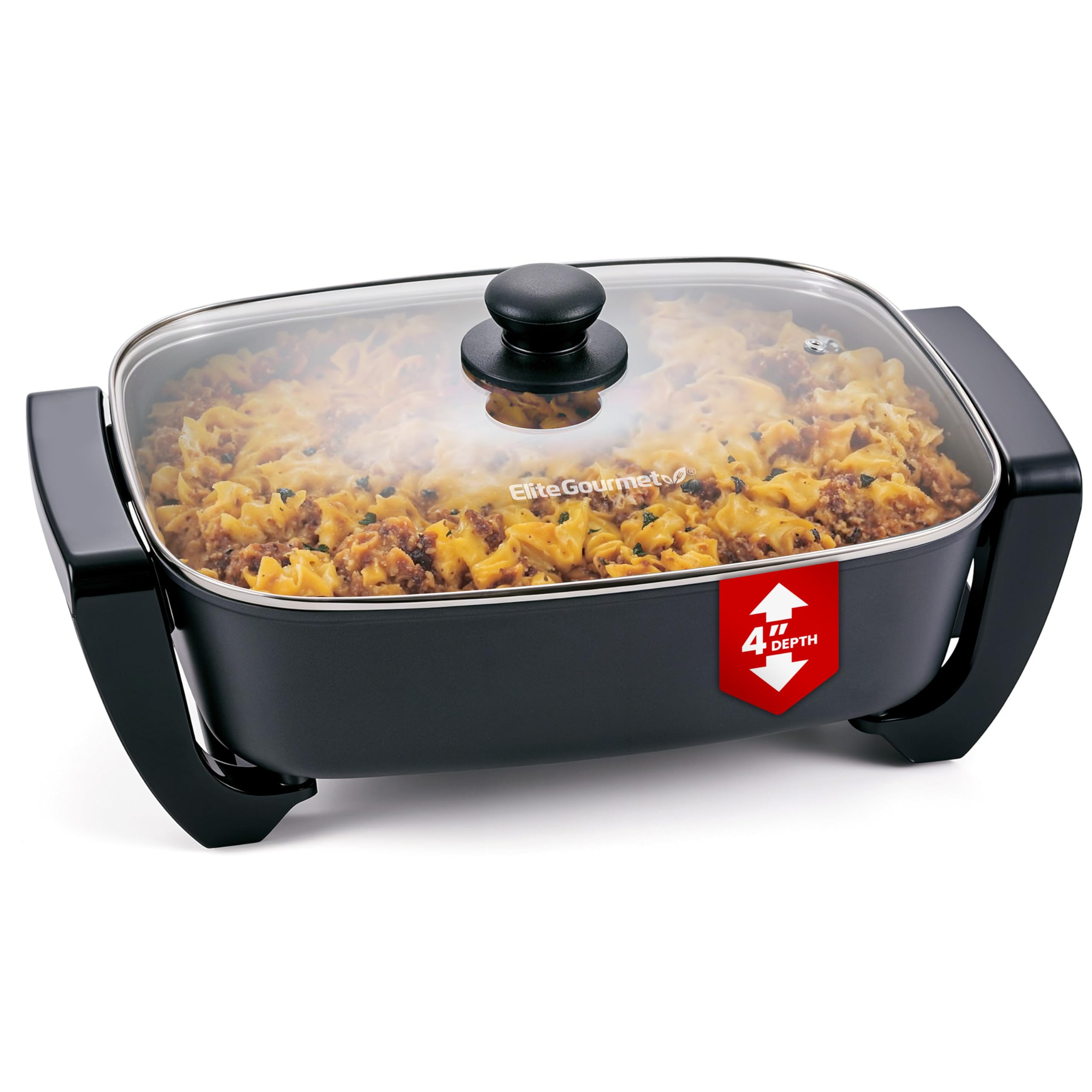
This is the kind of skillet that makes you say, “Wait… why did I heat up my whole stove for this?” The 12.5-quart capacity and tall walls give you the confidence to cook messy, saucy, family-sized meals without splatter anxiety: bacon and eggs, burgers, stir-fry, braised chicken, pasta bakes, and one-pan dinners that usually threaten to overflow smaller pans.
Real owner feedback tends to highlight the same win: cleaning gets dramatically easier. When the coating releases food cleanly, you stop dreading cooking. That sounds obvious, but it’s deeply behavioral—people cook more when cleanup doesn’t feel like a punishment. Multiple owners describe wiping it clean quickly (sometimes even burnt-on residue), and some run it through the dishwasher periodically for a deeper refresh—though many still prefer handwashing for long-term coating life.
Heat-wise, it’s designed to warm quickly and cook evenly enough for daily use. As with many coated skillets, it rewards a smart preheat strategy: bring it up gradually, especially if you’re planning higher heat, and use silicone/wood utensils for longevity. This is a “big family pan” that can become a weekly staple if you treat it like the hardworking coated cookware it is.
Why families love it
- Big capacity + tall walls – great for saucy meals, big breakfasts, and less splatter.
- Easy cleanup vibes – owners often describe wipe-clean convenience that changes how often they cook.
- PFAS-free ceramic approach – a strong match for shoppers prioritizing that materials story.
- Works for breakfast through dinner – burgers, grilled cheese, eggs, stir-fry, and more.
Good to know
- Like most coated pans, avoid harsh tools and overheating empty—longevity is about habits.
- It’s big; plan counter space and cooling space.
- If you want ultra-precise temperature steps, digital control models offer more repeatability.
Ideal for: families who want deep capacity, low-drama cleanup, and a PFAS-free ceramic cooking surface for everyday meals.
12. Elite Gourmet EG-6203# 10.5 Qt Extra Deep – The “I Can Finally Cook Everything at Once” Pan

There’s a moment every big-batch cook hits: you realize your skillet isn’t “too small,” it’s making your food worse. Crowded food releases steam, steam prevents browning, and browning is flavor. The EG-6203# fixes that problem by giving you a truly generous surface with deep sides. Owners rave about cooking big batches of potatoes, large pasta sauces, pot roasts, and even full “bake-like” meals in one pan.
What makes it especially practical is the depth. Deep sides reduce splatter and expand what you can cook comfortably: simmered sauces, stews, braises, and anything that wants headroom. The pour spout is a small feature with big real-life value—draining grease, pouring out liquids, or decanting a sauce is easier and cleaner.
Here’s the expert reality check: many owners love the nonstick performance, but some mention the thermostat/control component feels like the fragile part. That’s not uncommon in electric skillets. Treat the probe like a delicate part, avoid dropping it, and you’ll avoid most “oops” damage. Also, “scratch resistant” doesn’t mean “invincible”—use silicone or wood tools if you want it to look new longer.
Why it’s a big-batch hero
- Huge cooking surface – less crowding, better browning, faster cooking.
- Deep walls – great for sauces, roasts, and meals that splatter.
- Nonstick release is strong – many owners describe effortless cleanup.
- Pour spout is genuinely useful – helps drain and pour without mess.
Good to know
- The probe/control unit can be the most fragile part—handle it carefully.
- Large pan needs a real cooling and storage plan.
- If you want precise temperature stepping, digital control will feel more exact than analog.
Ideal for: meal-preppers and family cooks who want maximum surface area and depth without jumping to premium pricing.
13. BLACK+DECKER 12" x 15" Electric Skillet – Big, Simple, and Reliable for Daily Cooking

This is the skillet many people buy when they want a no-nonsense “extra cooktop” they can depend on. The rectangular 12" x 15" surface is practical for real meals: you can cook eggs, potatoes, sausage, and pancakes without constantly shuffling food around. Owners frequently describe it as the “family breakfast” pan and a dependable replacement for older skillets that finally retired.
The real-life wins are familiar: fast heat-up, nonstick cooking that makes eggs and pancakes slide out, and cleanup that doesn’t demand scrubbing. Some owners even use it as their main cooking surface when their stovetop struggles—because it gives a consistent, contained cooking area. The glass lid helps keep splatter down and lets you check food without lifting the lid repeatedly.
Two small reality notes show up often. One: some people wish the unit had better anti-slip feet (it can slide on slick counters). That’s easy to solve with a silicone mat or a folded towel under the base. Two: the lid doesn’t always have a perfect “resting” solution when you’re checking food, so plan a plate or trivet nearby. These are small annoyances, not dealbreakers—and for many households, the overall practicality wins.
Why it’s such a common favorite
- Great shape for real meals – the rectangle is perfect for breakfast and meal prep.
- Simple, familiar controls – easy to use without reading a manual.
- Easy cleanup routine – nonstick release keeps daily cooking low stress.
- Useful lid – reduces splatter and keeps cooking contained.
Good to know
- May slide on very slick counters; use a silicone mat or towel for stability.
- Some owners want a better “lid rest” solution—keep a trivet nearby.
- If you want precise low-temp simmering, a digital model may feel more controlled.
Ideal for: households who want a roomy, straightforward skillet for breakfast and dinner without premium complexity.
14. Dash Family Size Skillet – A Crowd-Friendly Nonstick That’s Easy to Love
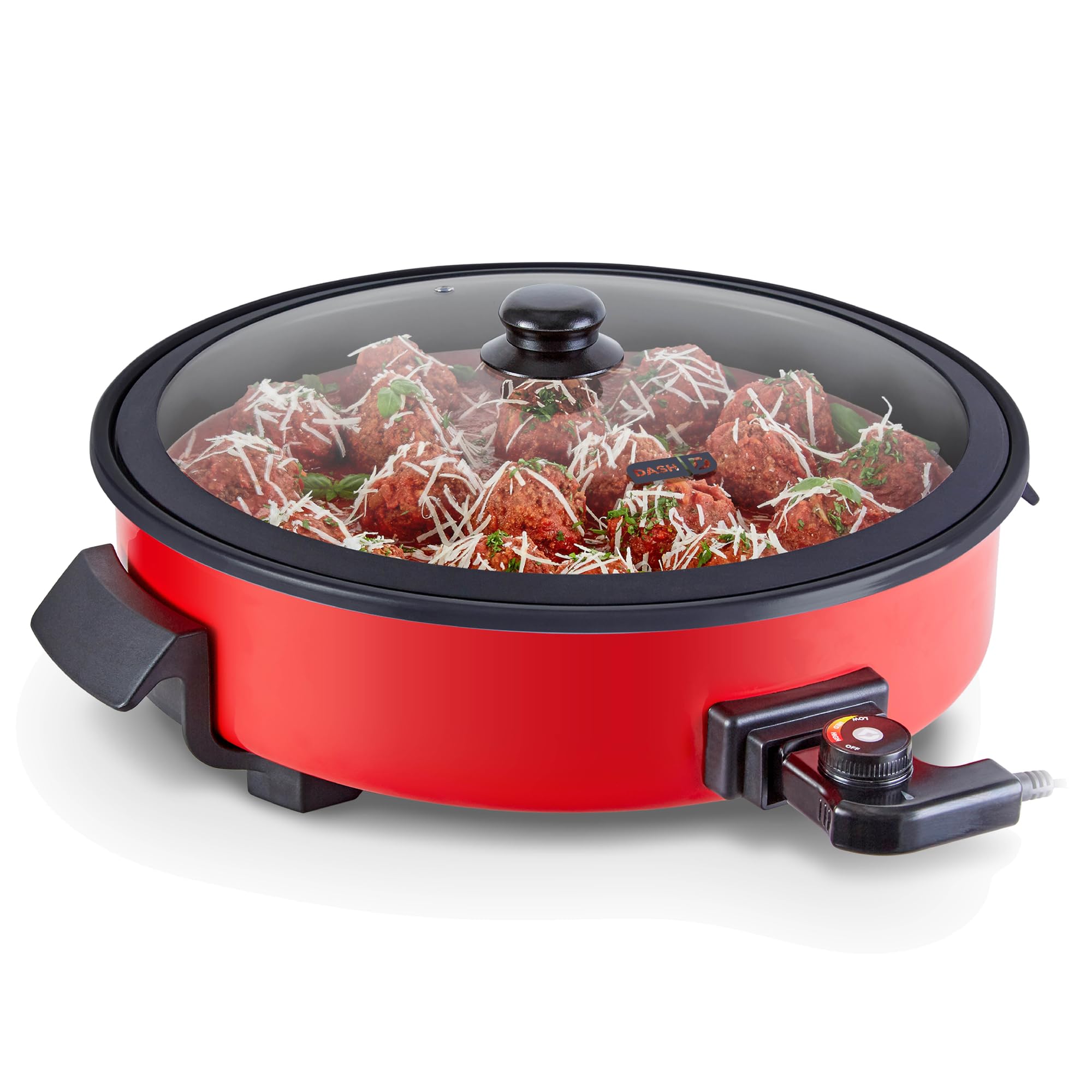
The Dash Family Size Skillet is popular for one core reason: it makes cooking feel effortless. Owners often describe it as one of their most-used appliances because it heats quickly, cooks evenly enough for daily meals, and cleans up without the “why did I do this to myself” feeling. That easy cleanup is not a small thing—when a skillet wipes clean, you cook more.
In real kitchens, it shines for stir-fries, fajitas, fried rice, pancakes, grilled cheese, and meal prep. The deep sides help prevent spills when you’re sautéing or simmering. The glass lid is great for controlling splatter and holding heat while food finishes— especially helpful when you want eggs to set gently or you’re reheating leftovers without drying them out.
This is not a “precision instrument” skillet. It’s a “make dinner easy” skillet. If you want ultra-exact temperature steps for delicate sauces, go digital. If you want a roomy, friendly, non-intimidating skillet that’s easy to use and easy to clean, Dash is strong. It’s also a favorite for campers and small-space kitchens because it replaces multiple pans in one footprint.
Why it’s a crowd-pleaser
- Fast, convenient cooking – great for weeknight meals and quick breakfasts.
- Nonstick cleanup is easy – owners frequently rave about wipe-clean convenience.
- Deep sides help – better for sautéing and simmering without spills.
- Good “kitchen MVP” energy – versatile enough to replace several pans.
Good to know
- PTFE-style nonstick benefits from silicone/wood tools and reasonable heat habits.
- If you want narrow temperature control, digital will feel more repeatable.
- Storage still requires a plan; family-size means family-size footprint.
Ideal for: families, meal-preppers, and campers who want a simple nonstick skillet that’s easy to use and easy to clean.
15. bella Make & Take Electric Skillet – Storage-Smart and Built to Transport
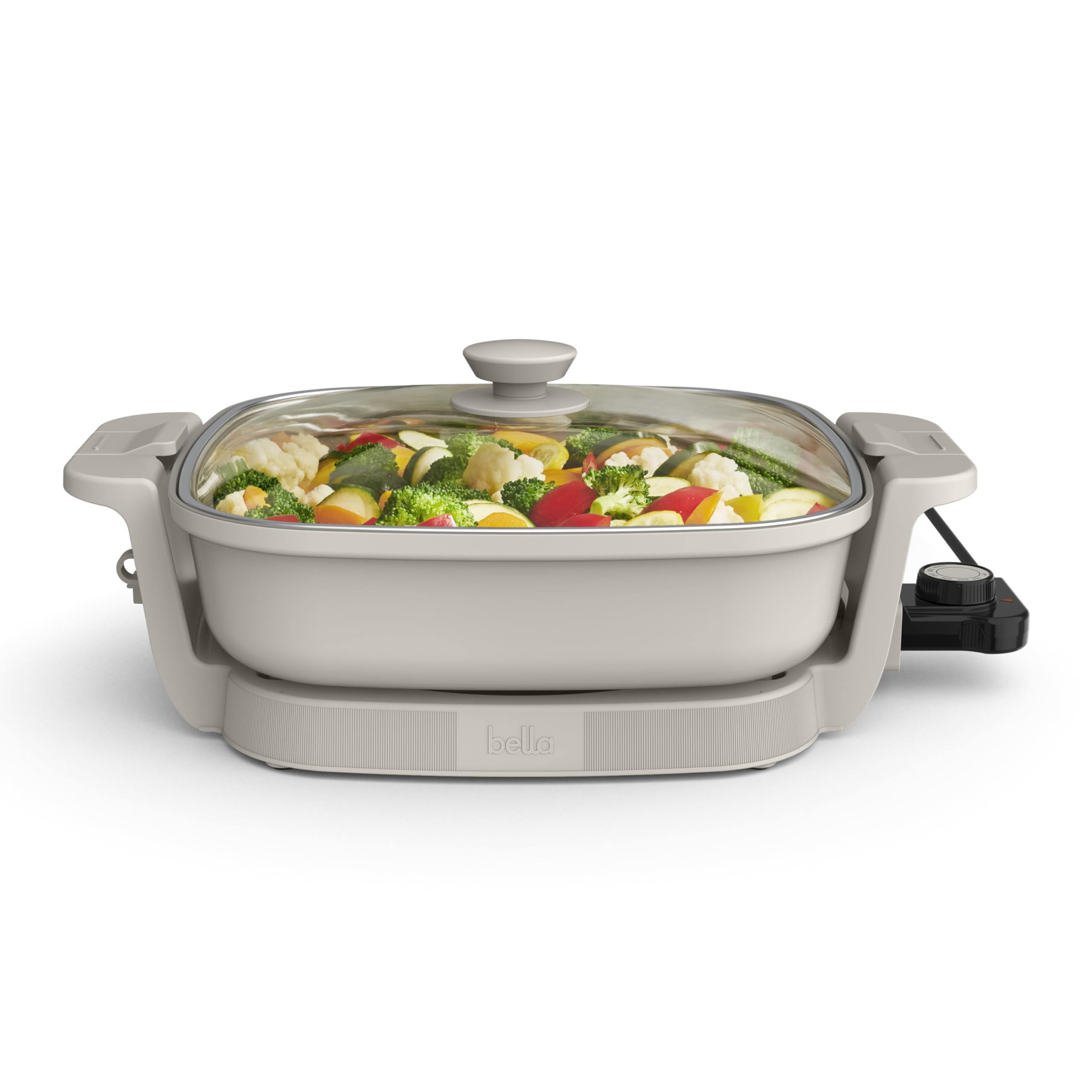
Most electric skillets are designed for cooking at home and staying at home. This one is designed to move. The Make & Take’s standout features—lid clamps and a storage-forward lid design— solve a real hosting problem: transporting food without spills, and storing a bulky skillet without sacrificing a whole cabinet shelf.
Owners often buy it as a replacement for an older skillet and immediately notice how much easier it is to cook and clean with a modern nonstick surface. It heats quickly, cooks evenly enough for daily meals, and has a “keep warm” style setting that works well when families eat in shifts (or when you’re serving at a gathering and people come back for seconds and thirds). That’s the kind of real-life utility you can’t see in a spec table.
One honest detail from real owners: some people assume the cooking pan fully lifts away from the base for transport and cleaning—this model’s setup can surprise them. So here’s the practical advice: treat it as a transport-friendly skillet with clamped lid security, not a fully “lift-away” system. If you buy it for potlucks, office parties, and holiday gatherings, it makes a lot of sense.
Why it’s a smart host pick
- Lid clamps reduce spill risk – makes transport feel safer and cleaner.
- Storage-forward design – stores upright to save cabinet space.
- Heats evenly and wipes clean – owners praise easy cooking and cleanup.
- Looks good on the table – modern design that serves well for gatherings.
Good to know
- Double-check the “lift-away” expectation—this model focuses on storage and transport security, not full separation of components.
- Handles can get splattered during cooking; wipe them before serving on the table.
- If you want ultra-large surface area, a 16-inch skillet will feel roomier (but less portable).
Ideal for: potlucks, tailgates, office parties, and anyone who values storage efficiency as much as cooking performance.
16. Elite Gourmet EG6201 7.5 Qt (12" x 12") – Deep Enough to Cook Big, Small Enough to Store

This is a strong pick for people who want deep-dish capacity but don’t want a massive 16-inch footprint. The 12" x 12" square shape is easy to place on a counter, the depth makes it useful for saucy meals, and owners often praise how quickly it heats and how easy it is to wash once the probe is removed.
A common real-life theme is portability and small-space usefulness. People use similar Elite Gourmet deep skillets in hotel rooms, RVs, small apartments, and even office settings. That’s not because it’s a “travel product”—it’s because it’s a practical self-contained cooking surface that doesn’t need a stove. The glass lid helps trap heat and reduce splatter, which makes it easier to cook without making a mess in small spaces.
Two “little” notes show up in owner feedback patterns for this style of skillet: cord length can be short (an extension cord plan helps), and some dials aren’t perfectly labeled in a way that makes instant sense. Neither is a dealbreaker, but it’s helpful to know so your first cook feels smooth instead of confusing. Once you learn the dial behavior, it becomes easy.
Why it’s a smart pick
- Deep sides in a smaller footprint – great for saucy meals without huge storage needs.
- Heats fast, cooks evenly enough – owners often report solid everyday performance.
- Easy cleanup – removing the probe makes washing much simpler.
- Useful in small spaces – good for dorms, RVs, and kitchens that need an extra cooking surface.
Good to know
- Plan for cord length; small-space cooks often use an extension cord responsibly.
- Some temperature dials can feel “learned” rather than instantly intuitive.
- Like any coated pan, silicone/wood tools are the long-term win.
Ideal for: smaller kitchens that still want deep capacity for real meals—and a skillet that’s easy to store and easy to clean.
17. Elite Gourmet 12" x 12" PFAS-Free Ceramic Skillet – The “Fits in Luggage” Cooker

This is the skillet that quietly solves a very real problem: cooking where you don’t have a full kitchen. Hotels, dorm rooms, RVs, offices, small apartments—this size makes it realistic. Owners commonly describe using it to warm soups, cook eggs and sausage, make ramen, toast bagels (yes, really), and handle simple meals with fast cleanup.
The best part is the practicality: it heats up quickly, it doesn’t take over your counter, and it’s designed to clean easily once the probe is removed. When the skillet is compact and easy to wash, it becomes the “default solution” for quick food. That’s exactly why many owners say it’s perfect for 1–2 people.
The one “real life” heads-up is the short cord mentioned by multiple users. That’s not a flaw in the cooking performance, but it’s a planning item. If you want to use this in a hotel room or office, you’ll likely want a safe extension cord plan. Once that’s solved, it’s an easy little workhorse.
Why it’s a small-space winner
- Compact and portable – realistic for dorms, RVs, hotels, and small kitchens.
- Fast heat-up – great for quick meals and warmups.
- Easy cleaning – designed for simple washing once the probe is removed.
- Perfect for 1–2 people – enough surface without wasted space.
Good to know
- Cord length can be short; plan accordingly for travel use.
- Compact size means it’s not for huge batches—choose a 16" or extra-deep model if you cook for many.
- Like all coated pans, gentle utensils protect the surface long-term.
Ideal for: dorms, hotel cooking, RV life, offices, and anyone who wants a compact skillet that cleans up fast.
How Electric Skillets Actually Heat (and How to Cook Evenly)
Most “bad skillet” experiences are actually heat management problems. The skillet isn’t always defective— it’s often doing exactly what its design allows, and your cooking method is colliding with that design. When you understand the mechanics, you can make almost any decent skillet cook better—and you can predict which ones will feel effortless.
What “even heat” really means in practice
- Preheat stability: the skillet should settle into a steady cycle, not swing wildly hot/cool.
- Edge performance: weak designs leave edges cooler, so pancakes brown unevenly and meats sear in the center only.
- Recovery speed: when you add cold food, strong skillets bounce back quickly instead of turning your sear into a steam bath.
- Moisture management: more surface area (and not crowding food) lets water evaporate, which improves browning and texture.
A surprising “pro move” for even pancakes: preheat with the lid on for a couple minutes after the indicator says it’s ready. This warms the air, reduces cold-edge effects, and helps the whole surface behave more consistently.
Why lids change everything
- For browning: lids trap steam. Great for finishing chicken through, not great if you want crisp edges.
- For eggs and delicate foods: lids help set the top gently and reduce splatter.
- For sauces and stews: lids reduce evaporation and make simmering more controlled.
The best habit: use the lid intentionally. Sear without the lid, finish with the lid. That one change fixes a huge percentage of “why won’t this brown?” complaints.
Heat habits that make your skillet last longer
- Avoid extreme empty preheats: coatings hate high heat with no food to absorb energy.
- Use the right tools: silicone and wood are the “keep it new” strategy; metal is the “accept aging sooner” strategy.
- Cool before washing: sudden cold water on a screaming-hot pan can stress coatings and warp thinner bodies.
- Wipe, don’t scour: if it’s mostly nonstick, wiping with a soft sponge and soap is usually enough.
- Don’t soak overnight: water intrusion and long exposure can shorten appliance life (and it’s unnecessary for most modern coatings).
Cooking tactics that fix hot spots
- Rotate the food, not the heat: if one corner runs hotter, rotate pieces through that zone instead of constantly changing the dial.
- Batch cook with breathing room: if you crowd the pan, you’re steaming. Cook in two batches and you’ll get better flavor.
- Use a “sear, then slide” pattern: let meat sear in the hottest zone, then move it to a gentler zone to finish.
- Warm plates when serving: electric skillets hold food nicely, but warm plates prevent the “first pancakes are cold” problem.
Once you learn how your skillet behaves, cooking becomes repeatable. That’s when the appliance stops feeling like a gadget and starts feeling like a tool.
FAQ: Electric Skillets (Real Answers, Not Marketing)
What should I prioritize first: size, coating, or temperature control?
Do I need a digital skillet, or is an analog dial fine?
Why does my food steam instead of sear?
Are “PFAS-free” ceramic skillets automatically better?
Can I use metal utensils?
Is dishwasher safe always a good idea?
What’s the best way to keep food warm during a party?
Why do cords feel short on some compact skillets?
Final Thoughts: Pick the One You’ll Actually Use
A great electric skillet doesn’t just cook food. It changes your habits. It makes weekday cooking feel doable, makes breakfast feel easy, makes hosting feel calmer, and turns “I don’t want to heat the whole kitchen” into a solved problem.
Here’s the fastest way to turn this guide into a confident purchase—without second-guessing:
- Want the most balanced, practical “buy once” pick? Start with the Presto 06857 Foldaway. It hits the sweet spot of usable size, dependable performance, and storage sanity.
- Want premium searing and heat recovery? Choose the All-Clad Electrics 7-Quart. This is the “I want it to cook like a serious pan” option.
- Hot pot nights and table cooking your thing? Get the Zojirushi EP-RAC50 or the AUTUCU 6-Quart Hot Pot depending on whether you want multi-plate versatility (Zojirushi) or deep pot simplicity with a timer (AUTUCU).
- Want digital precision and repeatability? Pick the Nuwave Medley XL (Cinnamon) or your preferred color: Black or Cozy Blue.
- Need big capacity for family meals without premium pricing? Look at the Elite Gourmet 12.5 Qt Xtra Deep or the Elite Gourmet 10.5 Qt for maximum room and deep-dish flexibility.
- Want a familiar, roomy everyday rectangle? Go with the BLACK+DECKER 12" x 15". It’s simple, capable, and does breakfast and dinner well.
- Potlucks and traveling with food? The bella Make & Take is designed for storage and transport in a way most skillets are not.
- Small space, dorm, hotel cooking, or a compact second skillet? Choose the Elite Gourmet 12" x 12" PFAS-Free Ceramic. It’s a practical “plug in, cook, wipe clean” helper.
If you came here searching for best electric skillets, the goal is simple: pick the model that matches your cooking rhythm. Big breakfasts? Go wide. Saucy dinners? Go deep. Hot pot nights? Go table-friendly. Precision simmering? Go digital. The right skillet makes cooking feel lighter—like you gained a burner, gained time, and lost stress.
