
Specs are compiled from manufacturer listings and verified buyer reviews and can change over time — please confirm the key details on the product page before buying.
Stop guessing which 12-volt brick will actually start your trolling motor on hour four of a windy day. The gulf between lead-acid and lithium is not a spec-sheet footnote; it is the difference between paddling back and fishing through. This guide sorts nine deep cycle batteries by what you will really feel on the water, in the RV, and off the grid—usable capacity, real weight, and whether the safety electronics actually do their job. You will leave knowing exactly which chemistry fits your setup and which amp-hour rating matches the loads you actually pull.
I’m Mohammad Maruf — the founder and writer behind KitchPrep. This guide is built by comparing the manufacturers’ published specifications and the patterns across verified customer reviews, so you get each pick’s real strengths and trade-offs instead of marketing spin.
For trolling motors, RVs, and solar setups, the best deep cycle batteries balance usable amp hours, weight, and cycle life, which is what this guide breaks down for you.
Our Picks at a Glance
How To Choose The Best Deep Cycle Batteries
Buying a deep cycle battery is not like buying a car battery. A car battery gives one big burst to start an engine; a deep cycle battery is built to discharge slowly and steadily over hours, powering a trolling motor, RV fridge, or solar bank. Choosing wrong means either lugging dead weight or running out of power halfway through your trip.
Lead-Acid (AGM) vs. Lithium (LiFePO4)
This is the fork in the road. A sealed AGM battery like the WEIZE 12V 100Ah weighs a hefty 60 pounds but costs less upfront and needs zero maintenance. Lithium iron phosphate (LiFePO4) batteries weigh roughly half as much for the same capacity and let you use nearly 100% of their rated amp hours, whereas AGM batteries are typically only drained to 50% before damage starts. That means a 100Ah lithium battery gives you roughly double the usable energy of a 100Ah lead-acid.
Cold Weather and Safety Electronics
Lithium batteries need a Battery Management System (BMS) — an internal computer that guards against overcharging, overheating, and shorts. If you camp in freezing conditions, look for low-temperature protection that stops charging below 32°F to keep the cells from being damaged. Lead-acid batteries handle cold better, which is why many budget buyers still choose them for winter cabins.
Capacity vs. Weight Trade-Off
Match the amp hours (Ah) to the job. A 50Ah unit keeps a small trolling motor moving for a morning; a 100Ah unit can run an RV fridge overnight; a 150Ah or 230Ah unit becomes real off-grid muscle. The catch with bigger capacity is weight — a 230Ah lithium weighs around 46 pounds, while equivalent lead-acid stacks far heavier. You buy the smallest battery that comfortably covers your longest outing.
Quick Comparison
| Model | Best For | Capacity | Weight | Chemistry | Amazon |
|---|---|---|---|---|---|
| LiTime 12V 100Ah TM Bluetooth★ Best Overall | Trolling motors & smart monitoring | 100Ah | 22.2 lbs | LiFePO4 | Amazon |
| Newport 12V 50Ah AGMBudget Champion | Budget marine & solar | 50Ah | 32 lbs | AGM | Amazon |
| DUMFUME 12V 150Ah MaxTop Performer | High-capacity solar/RV value | 150Ah | 41.03 lbs | LiFePO4 | Amazon |
| Mighty Max 12V 100Ah SLA | Budget solar & backup | 100Ah | 28 lbs | Lead-Acid | Amazon |
| Yeagulch 12V 150Ah Max | Off-grid solar value | 150Ah | 41 lbs | LiFePO4 | Amazon |
| WEIZE 12V 100Ah Group 31 | Heavy-duty AGM backup | 100Ah | 60 lbs | Lead-Acid | Amazon |
| HumsiENK 12V 100Ah Bluetooth | App monitoring & compact install | 100Ah | 19.7 lbs | LiFePO4 | Amazon |
| WEIZE Dual Purpose Group 24M | Starting & deep cycle combo | 90Ah | 50.7 lbs | AGM | Amazon |
| LiTime 12V 230Ah | Large RV & home backup | 230Ah | 45.98 lbs | LiFePO4 | Amazon |
In‑Depth Reviews
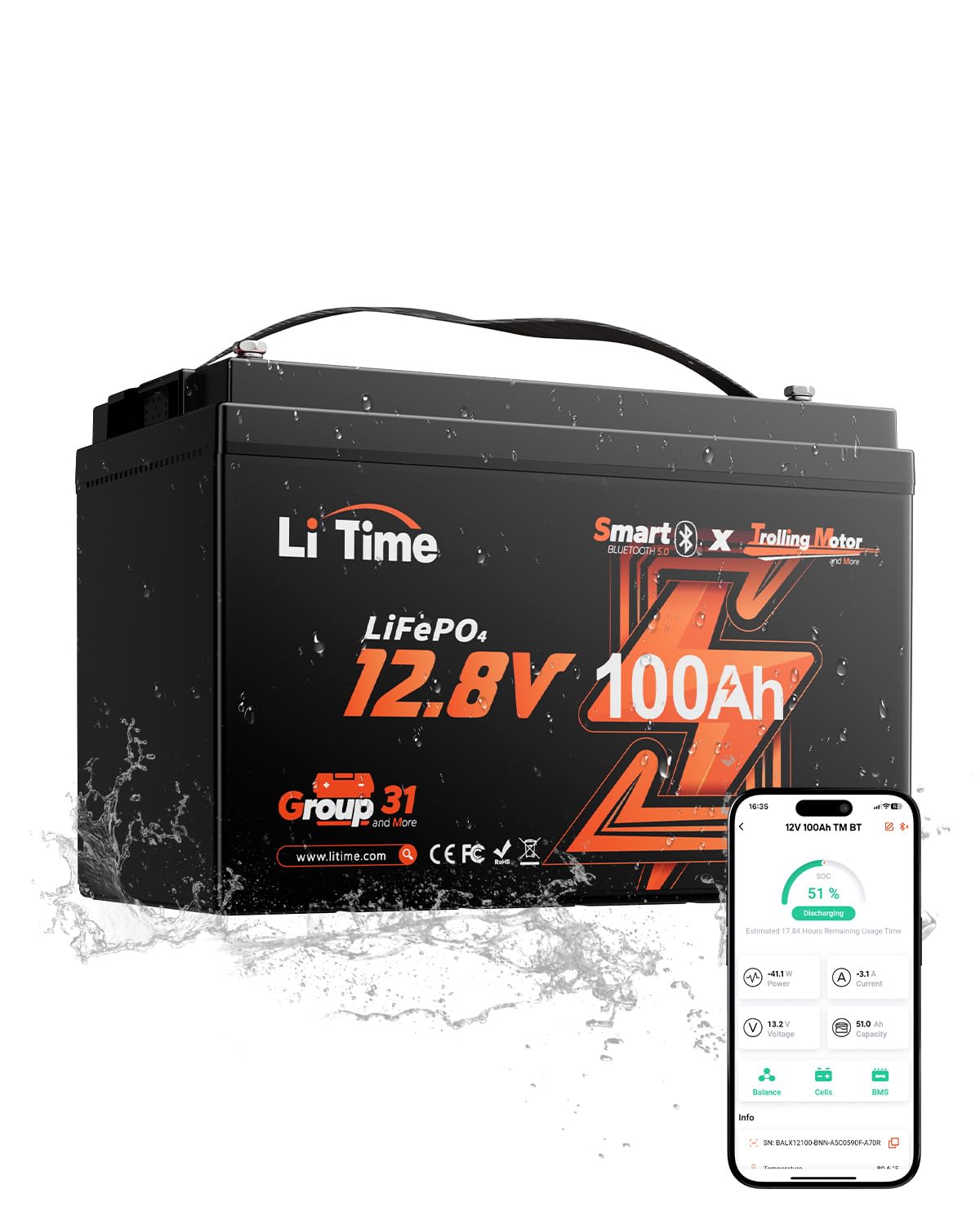
1. LiTime 12V 100Ah Trolling Motor LiFePO4
Our pick — over 4.5★ from 600+ verified ratings; the strongest balance of quality and price.
The smart pick for anglers who want phone-level control over every amp they burn
If you run a trolling motor until the wind picks up, the 1280Wh of energy in this 100Ah LiFePO4 is your safety net. Two in series powered a 24V trolling motor for four hours in 25mph wind, ending at 72% charge. The whole unit weighs just 22.2 lbs in a standard Group 31 size, which lightens your boat noticeably compared to the 32-pound Newport or the 60-pound WEIZE lead-acid farther down this list.
The battery quality is what wins people over here, backed by a BMS that stacks 20+ safety protections including dustproofing and IP65 waterproofing for salt spray. Charging stops below 32°F and discharging stops below -4°F, so winter storage will not kill the cells. The Bluetooth app auto-connects in seconds and lets you flip discharge on or off from your phone — buyers running a Garmin LiveScope stopped guessing state of charge entirely after a 10-hour session still showed 83Ah remaining.
The trade-off is that lithium needs a lithium-compatible charger or MPPT solar controller to wake the battery on first use, and this is strictly for energy storage — not for starting engines. That 5-year warranty and AIG product liability insurance soften the premium price, especially when owners note it “replaced an AGM at half the weight with fully usable 100Ah versus 50% of an 85Ah AGM.”
Angler’s Edge
- Smart Bluetooth app reports voltage, discharge, and system checks live
- 4000+ deep cycles at full 100% depth of discharge
- IP65 waterproof and salt-resistant for marine decks
- Weighs 22.2 lbs — roughly half a comparable lead-acid
Know Before You Buy
- Requires a lithium-activation charger or MPPT on first use
- Not for cranking engines, golf carts, or jacks
- Bluetooth app needs occasional re-login
Reach for this if: you fish hard with a 30-70lb trolling motor and want live charge data on your phone.
Look elsewhere if: you need a simple cranking battery — this one is pure energy storage.
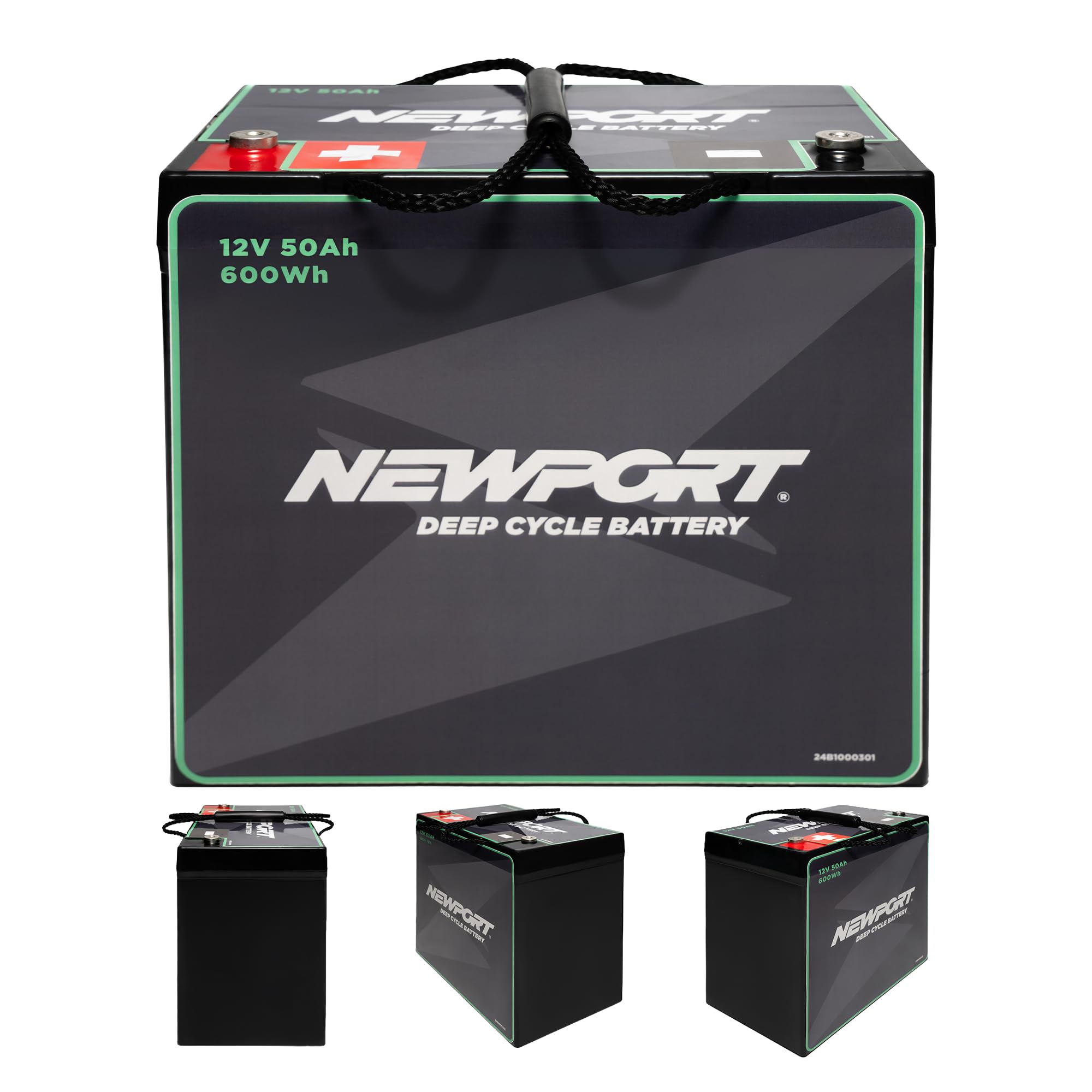
2. Newport 12V 50Ah Deep Cycle AGM Marine Battery
The lightweight AGM that keeps a 55lb trolling motor honest without emptying your wallet
Not everyone needs a phone app to enjoy the water. This sealed AGM lead-acid battery is for the budget-minded boater who wants dependable power without lithium’s upfront leap. It ran a 55lb trolling motor for 4+ hours at moderate speeds with stable voltage. At 32 lbs, it trims meaningful weight off the stern — a real advantage over the 60-pound WEIZE lead-acid in this lineup.
Battery life is the thing everyone cites, and the sealed, leak-proof construction means zero maintenance and no water checks between trips. It is a genuinely light and portable AGM with a solid build, which is exactly why owners also use it for depth finders and small solar rigs. The internal design resists vibration, so a rough chop will not rattle it apart the way a flooded cell might.
The honest compromise: there is no charge indicator on the unit, so you need an external meter to know where you stand. A few buyers also hit a snag pairing it with a Noco Genius 1A charger — that charger only tops up to 30Ah, so it will not fully charge this 50Ah pack. Buy a charger rated for 50Ah or more. This one-year limited warranty reflects its budget tier.
As owners put it: “Lightweight, portable AGM battery; 4+ hrs on 55lb trolling motor at moderate speeds; stable voltage; solid build, sealed, maintenance-free.”
Who it beats: pricier AGM brands on value for a small jon boat or pond prowler, and it undercuts every lithium here on upfront cost.
Who it does not beat: any 100Ah pack on runtime — 50Ah is a morning battery, not an all-weekend one.
Solid budget move if: you run a small trolling motor or depth finder and want a sealed, maintenance-free AGM at a friendly price.
The catch: plan to buy a charger rated above 50Ah, since small 1A units will not finish the job.
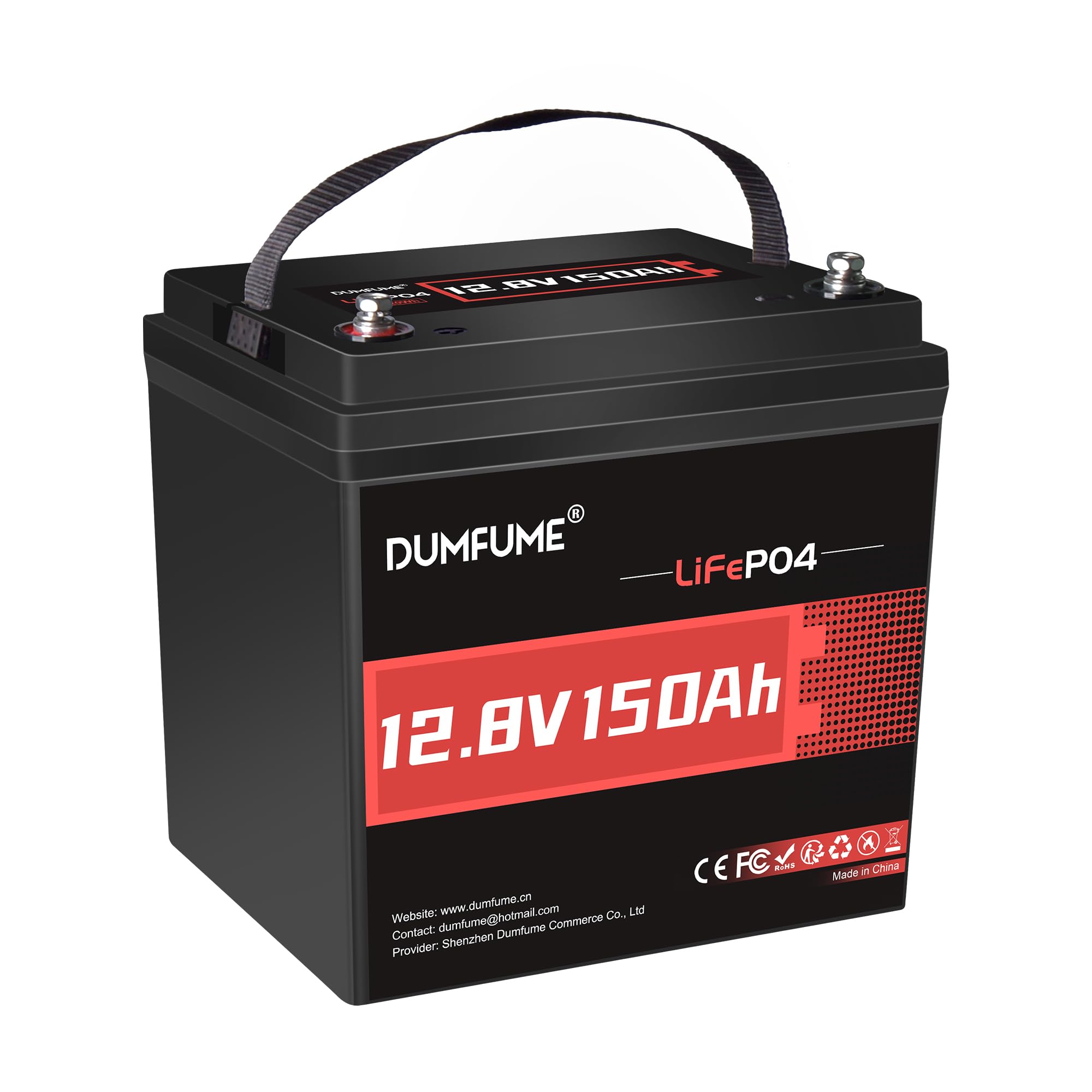
3. DUMFUME 12V 150Ah Max LiFePO4 Battery
A 1920Wh workhorse that runs an RV fridge and 100 watts of roof solar without breaking a sweat
Step up to 150Ah and you have crossed from “get me through the afternoon” into “run the whole weekend.” The DUMFUME packs a massive 1920Wh of energy at 12.8 volts and delivers over 4,000 cycles down to 80% capacity. RV buyers report pairing two of these for a 300Ah bank that runs the fridge easily on 800W of solar with a Victron inverter — and they picked it after a respected teardown video showed the internal build quality. Even a modest 100W solar panel on a Scamp camper keeps it topped off.
At 41.03 lbs and 10.04 x 7.68 x 9.84 inches, it slides into tight camper cabinets and is significantly lighter than the equivalent lead-acid stack. The built-in 100A BMS guards against overcharge, over-discharge, short circuit, and overheating to protect your solar panels and home backup gear. Support for series and parallel wiring up to 4S4P means you can scale voltage or capacity as your system grows.
Charging is where opinions split: two units bought directly from the maker arrived charged fine, while two from Amazon arrived at lower voltage and needed a parallel jump charge to activate the BMS. The maker warns this battery needs temperatures of 5°C or higher to charge. A rare but real complaint is a dead unit after a year under a heavy fridge load — check the warranty terms before relying on third-party sellers.
Energy Density
- 150Ah at just 41.03 lbs for real off-grid muscle
- 100A BMS with temperature and short-circuit protection
- Series/parallel expandable up to 4S4P
- Well-built internals that survived a public teardown
Heads-Up
- Charging requires 5°C or warmer conditions
- No smart app or Bluetooth monitoring
- Needs a full maintenance cycle every 6 months in storage
Best if: you are building an RV or solar bank on a budget and want max watts per dollar.
Think twice if: you camp in serious cold or want phone monitoring without adding a shunt.
4. Mighty Max 12V 100Ah Deep Cycle VRLA Battery

The UL-certified sealed lead-acid that proves you do not need lithium to keep the lights on
This is the sensible stepping stone for solar and backup power on a strict budget. The Mighty Max ML100-12 is a 12V 100Ah Group 27 sealed lead-acid battery — UL Certified and completely spill-proof — and it runs far longer than its price suggests. On a 12-foot Jon boat trolling motor, it delivered 8+ hours with 35% charge left. In a van, it kept four red lights lit after overnight use.
Performance and value are what keep showing up in owner experiences. The high discharge rate and wide operating temperature window make it a dependable choice for shed LED lighting, a fridge with a fan, or a 32″ TV through a 500W inverter — One buyer ran a TV and Roku for 4 hours, drawing just 1% of the charge.
The reality check: sealed lead-acid means you only safely use about half the rated capacity, so a 100Ah battery gives you roughly 50Ah of usable energy before you risk damage. And the group notes that long-term battery life is genuinely mixed — some units have lasted three years in a solar array while others needed replacement sooner. Returns require UPS hazardous shipping at your cost, so buy carefully.
The straightforward call: a budget-friendly, zero-maintenance AGM that shines for solar, sheds, and trolling motors.
The fit note: treat it as a 50Ah usable battery and pair it with a proper charger — the one-year warranty covers defects, not shipping.
Pick this if: you want a dependable 100Ah SLA for solar or backup without lithium’s price.
skip it if: you are counting on the full 100Ah — lead-acid needs a 50% discharge buffer.
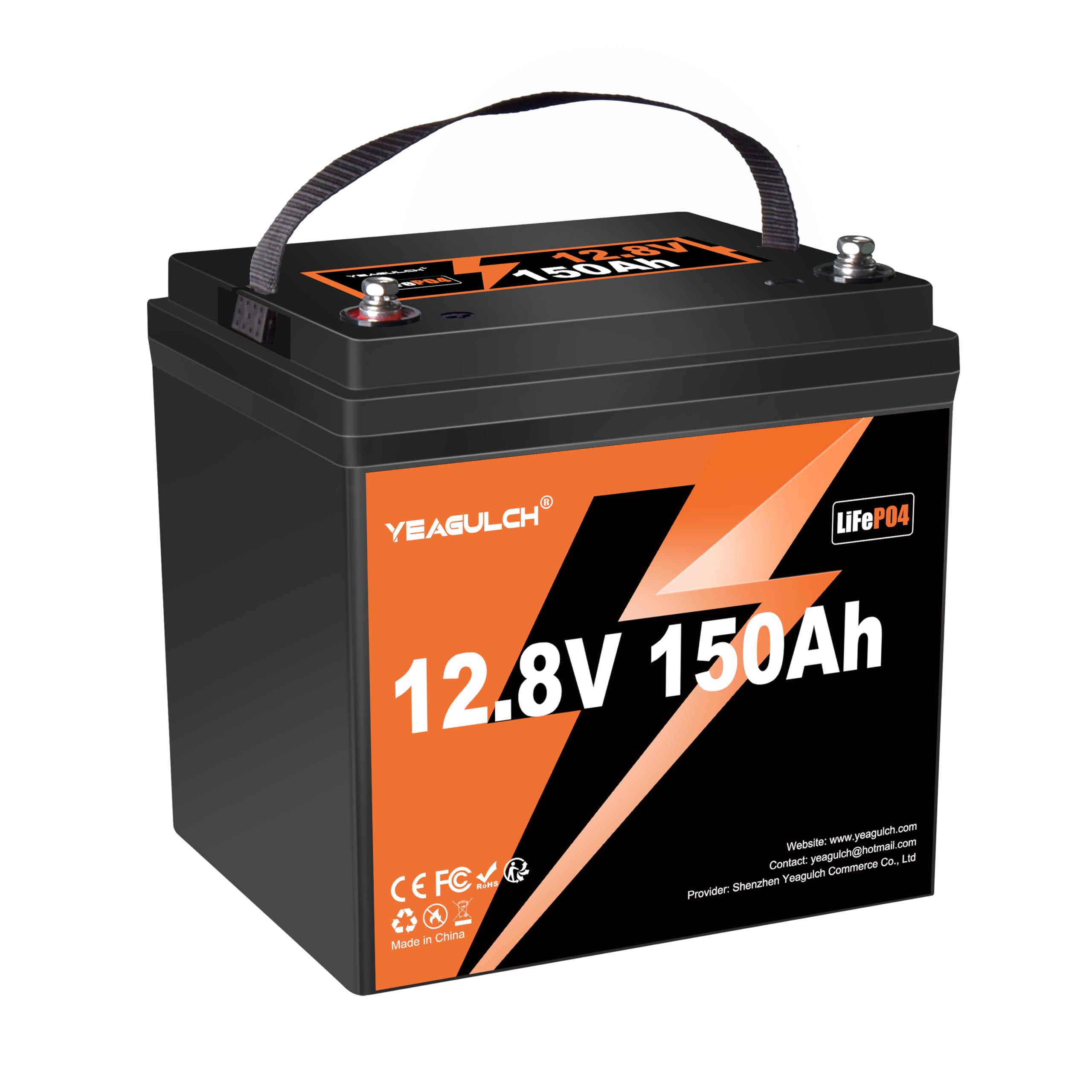
5. Yeagulch 12V 150Ah LiFePO4 Battery
The no-frills 150Ah lithium that still runs full power after six months of daily abuse
This is the pragmatist’s lithium: no Bluetooth, no self-heating, just a 1290Wh LiFePO4 pack that keeps delivering. Owners running solar stations and trolling motors report it still hits full power after six months of regular cycling, and it can handle up to 15,000 cycles at a 60% depth of discharge. On a trolling motor, one buyer ran all day on just a third of the charge and recharged in under 20 minutes.
At 41 lbs and 10.01 x 7.68 x 9.84 inches, it fits the same footprint as pricier 150Ah packs and drops easily into RV bays or boat lockers. The integrated 100A BMS cuts off charging at 32°F to protect the cells in winter and stops charging above 149°F for safety. You can link up to four in series for a 51.2V system or four in parallel to hit 600Ah.
Reliability is the top praise here, but battery life gets mixed marks — most owners see long runtime, while a few report it does not hold a charge as well as expected. Since there is no smart monitoring, you will need a shunt, charger, or solar controller to read the actual state of charge. Standard 12V voltage meters do not work accurately with this chemistry, so plan your monitoring setup ahead.
Workhorse Traits
- Low-temp cutoff prevents charging below 32°F
- Connects up to 4S4P for 600Ah or 51.2V systems
- Compact 10.01 x 7.68 x 9.84 inch footprint
- Weatherproof build tolerates outdoor solar racks
Keep In Mind
- No Bluetooth — requires external shunt or controller to monitor
- Battery life feedback is mixed, not universal
- Needs a full charge/discharge cycle every 6 months
Best value angle: a budget-conscious 150Ah lithium with excellent reliability for solar and trolling setups.
Who should pass: buyers who want app-based monitoring or who cannot add a third-party shunt.
6. WEIZE 12V 100Ah Deep Cycle AGM Battery

The beefy sealed AGM that runs 18 LED lights and 3 fans for 20+ hours straight
For home backup and serious off-grid loads, this Group 31 sealed lead-acid battery is a proven heavyweight. Four of these in parallel feed a 2000W inverter for whole-home backup — one owner powers 120V outlets, fans, and even a garage door, and charges the bank back up from a car alternator at 750-1000W. A motorhome owner powered 18 LED lights and 3 vent fans for over 20 hours. The 1150A max discharge current means it can surge hard when a big inverter demands it.
Battery quality and battery life are the twin pillars owners praise, and the maintenance-free, spill-proof design means no water checks — a real plus for commercial use in schools or property management. Two of these ran an off-grid RV for two years on 2x150W solar with zero issues on a 700W inverter. It arrives charged and ready, typically reading 12.3V from the start.
The weight is the honest anchor: at 60 pounds (spec sheet lists 63 lbs), this is a two-person lift, and several owners note it is simply heavy. It is also a sealed lead-acid, so treat the 100Ah as roughly 50Ah of safe usable capacity before you risk sulfation. Most who chose it over LiFePO4 did so for the lower upfront cost and the simplicity of no BMS to manage.
Why It Earns Its Keep
- 1150A max discharge for high-current inverter surges
- Maintenance-free and spill-proof sealed AGM
- Proven 2-year off-grid track record with solar
- Fits wheelchairs, scrubbers, UPS, and emergency lighting
The Heavy Reality
- 60 lbs makes solo lifting and repositioning a chore
- Only ~50% of rated capacity is safely usable
- No built-in meter or monitoring
Choose this for: stationary backup and solar banks where weight stays put and ruggedness matters more than grams.
Pass it by if: you move batteries often or want the full 100Ah usable — lithium does that better.
7. HumsiENK 12V 100Ah LiFePO4 with Bluetooth
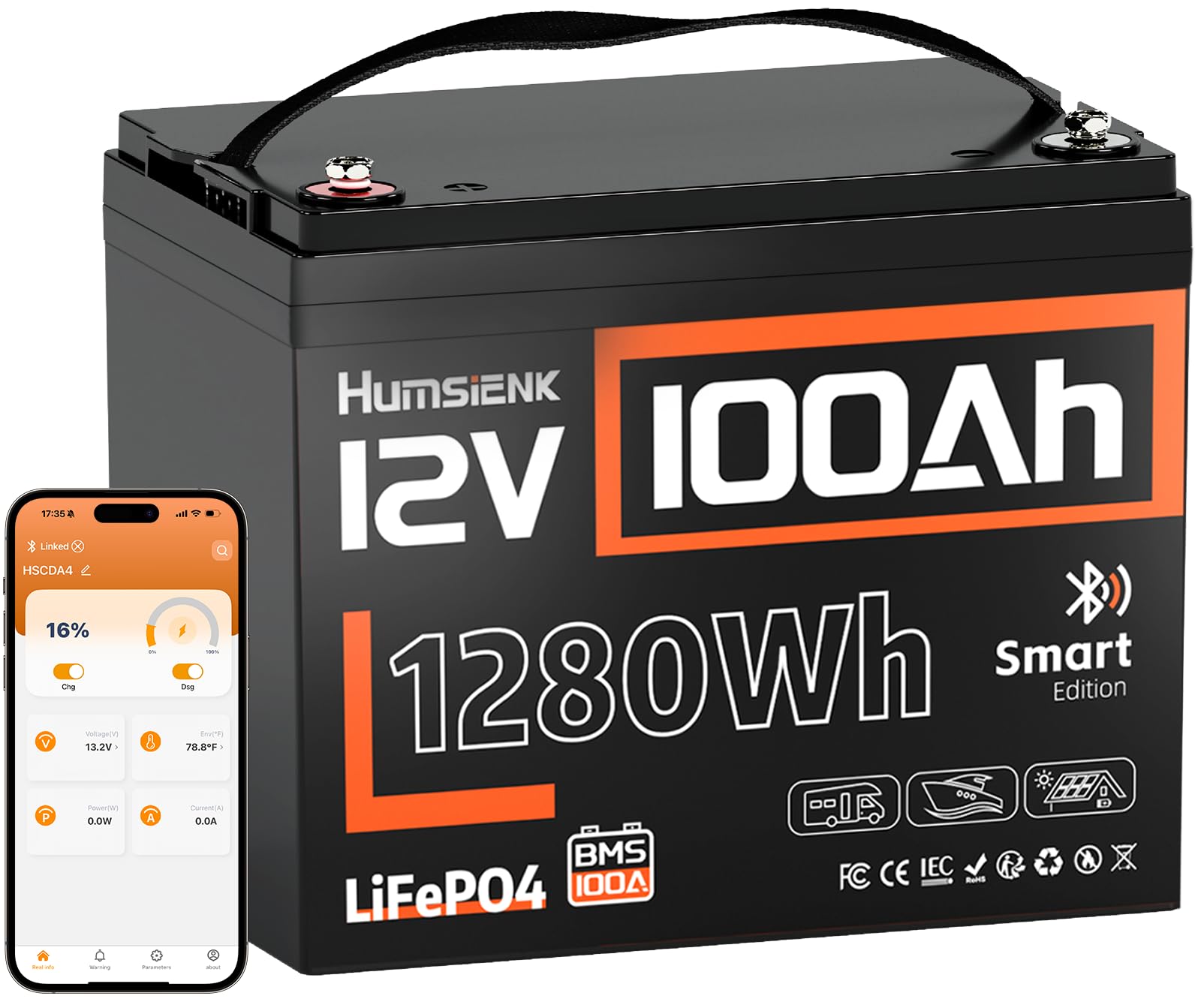
A featherweight 19.7 lbs with an app that shows live voltage, temperature, and current
This is the lithium that makes the weight argument impossible to ignore. At just 19.7 lbs in a BCI Group 24 size, it is over 60% lighter than equivalent lead-acid and roughly 23-26 lbs lighter in practice — you can lift it with one hand. It drops into any Group 24 to 31 battery box, which is why RV and marine owners call it a perfect direct swap. The 100A smart BMS pairs with a dedicated app that updates several times per second, showing voltage, state of charge, current, and temperature.
Battery quality earns the loudest praise, with owners measuring roughly 4150Wh per unit across three batteries — right on the nose of the 1280Wh-rated pack. It ran an 8000 BTU air conditioner in eco-mode for 11 hours to 50% drain. The A+ grade LiFePO4 cells are UL tested plus FCC and CE certified, carry an IP65 waterproof rating, and support up to 15,000 cycles. It handles 4S4P setups up to 48V and 20.48kWh.
Battery life shows the usual split — most see it hold charge perfectly while a few report it refuses to fully charge, so test your first full charge cycle early. The Bluetooth connection itself gets mixed notes: excellent when linked, but occasionally finicky. One owner hit a hot terminal during a 780W draw, and the seller replaced the battery immediately — a good sign for the 5-year warranty support.
Featherweight Smart
- Only 19.7 lbs yet holds a full 1280Wh (100Ah)
- Live app telemetry updates several times per second
- Operates from -4°F to 158°F with auto low-temp shutdown
- Fits all BCI Group 24 to 31 battery boxes
Small Print
- Bluetooth pairing can occasionally drop and need a reconnect
- A few units reportedly resist a full charge
- Terminal bolts need a snug fit for high draws
Grab this if: you want a genuinely light drop-in replacement with rich app data for RV, solar, or marine.
pass on it if: you plan to pull sustained high amps and want maximum terminal contact certainty.
8. WEIZE Dual Purpose AGM Battery Group 24M
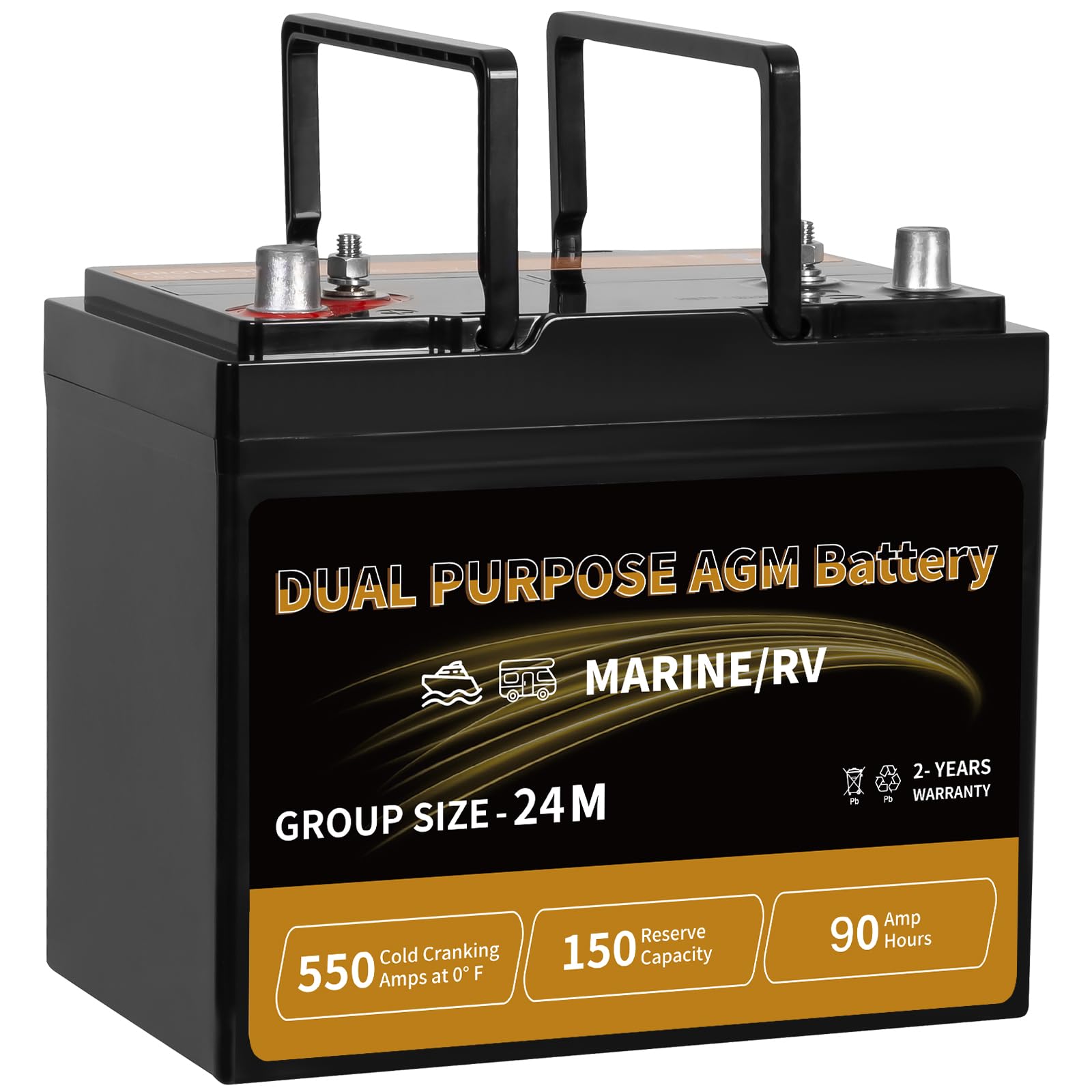
The one box that fires a 5.3L V8 in the morning and still runs your cabin lights at night
If your boat or RV needs one battery to do two jobs, this dual-purpose AGM splits the difference. The 550 CCA rating delivers the cold-cranking punch to start a 5.3L V8 engine, while the deep-cycle side offers 90Ah and 150 reserve capacity for running trolling motors and house loads. Owners note it outperforms a brand-name Interstate Group 31 in the same role, calling it “way cheaper” with better real-world results. The AGM chemistry doubles the cycle life of a traditional flooded marine battery.
The sealed design is practically maintenance-free and claims 20x more vibration resistance than flooded batteries, which matters when the hull is pounding through chop. It charges fast — up to five times quicker than standard flooded cells by the maker’s spec — using a constant 14.4V and max 15.8A. Multiple terminal options (DT, SAE/M8 stud, and threaded post) mean it adapts to whatever cabling your boat already has.
The 2-year guarantee is solid for this category, and owners consistently praise the packaging for a 50.7 lb unit arriving undamaged. As with any AGM, treat the 90Ah as roughly 45Ah of safe usable capacity for deep-cycle work. Rarely, a unit arrives as a dud, but the warranty path is straightforward — one buyer filed a claim and received prompt service.
The dual-role argument: one battery that starts the engine and runs the house bank saves space and cabling on smaller boats.
The compromise: it does neither job as deeply as a dedicated starter or a pure deep-cycle — perfect for dual use, not for extremes.
Best fit: boaters and RVers who want a single sealed AGM that handles both cranking and light cycling.
Not ideal for: heavy off-grid solar banks where a pure deep-cycle or lithium gives far more usable amp hours.
9. LiTime 12V 230Ah Deep Cycle LiFePO4
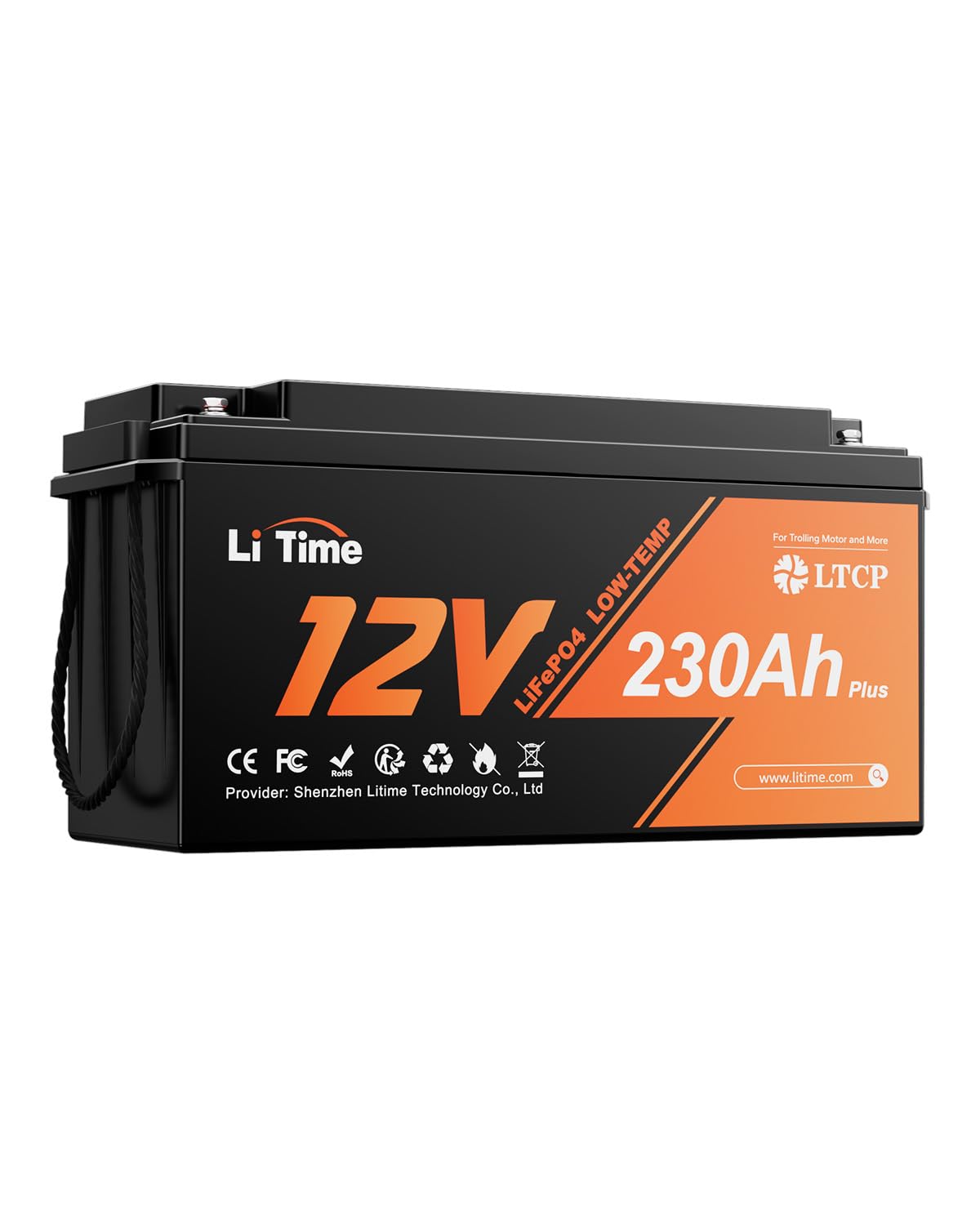
The 2944Wh giant that replaces two lead-acid bricks with one 45.98 lb lithium slab
This is the endgame for serious RV and travel trailer owners who want to stop thinking about power. The 230Ah LiFePO4 packs 2944Wh of stored energy at just 45.98 lbs — roughly one-third the weight of the lead-acid bank it replaces — and fits standard Group 4D battery boxes. It replaces two lead-acid batteries, adding 130Ah of usable capacity thanks to lithium’s 100% depth of discharge.
The built-in 200A BMS delivers 20+ safety protections, including low-temperature protection that pauses charging below 32°F. LiTime rates it for 4,000+ cycles at 100% DOD, which crushes the 200-500 cycles a typical AGM manages in about 3 years. The scale is genuinely expandable: you can link up to 16 batteries in a 4P4S layout for a 48V 920Ah system with 47.1kWh max output — enough for whole-home backup and large solar arrays. A 5-year warranty plus 24/7 technical support backs the purchase.
Buyers consistently call it an upgrade that exceeds expectations, with the 200-amp continuous capability standing out. If you run a big inverter or a residential fridge off-grid, this single pack covers it. The premium price reflects the capacity — this is far more battery than a weekend canoe angler needs. It is also strictly for energy storage, not for starting engines, so pair it with a proper lithium charger or MPPT controller.
Big-Rig Power
- 230Ah / 2944Wh in a 45.98 lb Group 4D package
- 200A BMS with 20+ safeguards and low-temp cutoff
- 4,000+ cycles at full 100% depth of discharge
- Scales to 16 batteries for a 47.1kWh system
Consider This
- Premium price — overkill for small trolling motors
- No Bluetooth on this particular model
- Requires lithium-compatible charging gear
Go big with this if: you live in an RV or trailer for weeks at a time and want a single-battery power solution.
Scale down if: your longest outing is an afternoon — you will pay for capacity you never use.
Understanding the Specs
Amp Hours (Ah) Could Be Misleading
On paper, a 100Ah lead-acid battery and a 100Ah lithium battery look identical. In practice, they are not. Lead-acid chemistry is damaged if you regularly drain below 50%, so you really only get about 50Ah of safe usable capacity. Lithium iron phosphate (LiFePO4) can be discharged to nearly empty without harm, meaning a 100Ah lithium delivers closer to 100Ah of usable energy. That is why a 100Ah lithium can feel like it doubles your runtime versus the same-rated AGM.
Watt Hours (Wh) and Real Energy
To compare energy across different voltages, look at watt hours — multiply volts by amp hours. A 12.8V 100Ah pack holds about 1280Wh; a 12V 150Ah pack at 1920Wh holds half again as much. This is the number that tells you how long a fridge, fan, or trolling motor will actually run. The 230Ah LiTime at 2944Wh holds more than double the energy of a standard 100Ah pack.
BMS: The Battery’s Bodyguard
A Battery Management System (BMS) is the internal computer that watches over lithium cells. It blocks overcharging, over-discharging, short circuits, and overheating before they can damage the battery or your gear. Higher-end BMS units add low-temperature protection, which stops charging below freezing — important because lithium cells can be permanently harmed by charging in the cold. Look for at least a 100A BMS for trolling motors and inverters; larger systems want 200A.
Weight as a Real Cost
Weight is not a vanity spec — it is the daily price you pay every time you lift the battery into the boat, trailer, or cabinet. A 60 lb AGM is a two-person job; a 22.2 lb lithium is a one-hand lift. For every pound you shave off a trolling-motor boat, the hull sits higher and runs more efficiently. The 100Ah lithiums here span from 19.7 lbs to 22.2 lbs, while equivalent lead-acid units weigh 28 to 63 lbs — the single clearest reason anglers switch chemistry.
FAQ
What is the difference between a deep cycle battery and a regular car battery?
Should I choose AGM lead-acid or LiFePO4 lithium?
Can I use the full amp hour rating of a deep cycle battery?
What does low-temperature protection do and why does it matter?
Will a 100Ah battery run my trolling motor all day?
Can I connect multiple batteries together for more power?
Do I need a special charger for a LiFePO4 battery?
How long will a deep cycle battery actually last?
What does IP65 waterproof rating mean for a marine battery?
Can I use a deep cycle battery to start my boat engine?
Final Thoughts: The Verdict
For most anglers and RV owners, the winner is the LiTime 12V 100Ah Bluetooth — it is the crowd favorite at 4.7 stars across 600+ owners, pairing a genuinely useful app with 100% usable capacity at just 22.2 lbs. If you want maximum dollars-per-watt for a solar bank, the DUMFUME 150Ah delivers 1920Wh on a budget. If you need one battery that starts an engine and runs a house bank, the WEIZE Dual Purpose Group 24M is the versatile pick. The single cheapest upgrade most boaters can make is moving from a 50Ah AGM to a 100Ah lithium — the usable energy doubles while the weight you haul to the dock is cut nearly in half.
How We Picked
We do not accept paid placement. Every pick is matched to a real buyer and a real use-case; we do not hands-on test units.
Sources & Methodology
Specifications: manufacturer listings and product documentation. Review insights: verified customer reviews, as of September 2026. Pricing: not shown on this page (it changes often); check the current price via the retailer link.
As an Amazon Associate, KitchPrep earns from qualifying purchases. This does not affect which products we feature.
Related Guides
