
Fresh citrus has a superpower: it can make the simplest food taste intentional. A squeeze of lemon lifts roasted vegetables. Orange brightens marinades. Lime turns a basic soda water into a “yes, I have my life together” drink.
But here’s the part nobody tells you until you’ve made a sticky mess on your counter: the tool you choose matters more than the fruit. One juicer will give you clean, seed-free juice with almost zero effort. Another will fight you, spray your backsplash, and leave so much juice in the pulp that you’ll feel personally offended.
This guide is built to help you pick one clear winner—the Best Citrus Squeezer for how you actually live. Whether you want an easy daily lemon-water routine, cocktail-ready lime juice, or weekend orange juice for the whole family, you’ll see exactly which style fits your needs (and which “features” you can ignore).
We’re covering 17 top-rated picks on Amazon—electric reamers, lever-style machines, handheld presses, and heavy-duty countertop squeezers—then translating real-world owner feedback into practical “what it’s like to use” advice you can trust. If you’ve ever typed “Citrus Juicer” into search and felt overwhelmed by look-alike options, you’re in the right place.
How to Choose the Best Citrus Squeezer for Your Kitchen
A citrus tool is one of those “tiny upgrades” that quietly changes your entire routine. The best ones make fresh juice so easy that you’ll use it for drinks and cooking. The wrong one gets shoved into a cabinet and only comes out when you’re desperate.
1. Start with your main “juice job”
Before you compare brands, decide what you’re really trying to do:
- Daily lemon water (1–2 lemons): Prioritize fast setup, easy cleaning, and a clean pour spout.
- Cocktails and cooking: A handheld press is usually faster than plugging in a machine, and it stores easily.
- Weekend orange juice (many oranges): A lever-style electric or countertop press will save your hands and time.
- Harvest season / lots of citrus at once: Focus on stability, duty cycle, and parts that rinse clean quickly.
Your “juice job” determines everything: the right size, the right style, and whether paying more is worth it.
2. Pick the right style: handheld, electric reamer, lever-electric, or countertop press
Here’s the plain-English breakdown (and where each style shines):
- Handheld press (metal or geared): Best for lemons and limes, fast cleanup, and small batches. The tradeoff is hand strength—geared models reduce effort, but you still squeeze.
- Electric reamer with a bowl/pitcher: The classic “push fruit on the cone” style. Great value, great for small-to-medium batches, and usually compact. The tradeoff is that you still apply pressure, and pulp can clog filters during long sessions.
- Lever-style electric: A powered cone + a lever arm that presses fruit for you. This is the sweet spot if you juice often and want low effort without going full commercial. The tradeoff is height and footprint (they’re taller), plus most have a recommended “rest” time if you run them nonstop.
- Countertop manual press (cast iron / heavy-duty): No motor, maximum leverage. This is what bars and juice setups love. The tradeoff is weight, counter space, and safety—some presses have heavy handles that can drop if you’re careless.
3. Capacity and clearance: measure before you fall in love
“Capacity” isn’t just the size of the bowl—it’s also how easily you can work:
- Glass clearance: Can a normal tumbler fit under the spout, or will you need to juice into a smaller cup and pour?
- Height under cabinets: Lever machines can be tall; leave space to lift the handle comfortably.
- Stability: Suction cups help, but heavy presses still need a solid, flat counter (and sometimes a steady hand on the base).
Pro tip: if you hate awkward pouring, choose a tool with a controlled spout or a bowl you can lift easily without drips. That single detail often decides whether the tool becomes “daily use” or “never again.”
4. Pulp control: don’t pay extra for pulp you’ll strain anyway
Pulp is personal. Some people love it; some people will politely drink it and then complain later. A good system gives you options:
- Adjustable strainers: Great if your household is split on pulp.
- Dual filters: Handy for switching between “cocktail-clean” juice and “breakfast with pulp” juice.
- Easy-to-rinse screens: More important than you think—fine mesh can clog fast when you do big batches.
5. Materials and cleaning: your future self cares a lot
Most juice tools are easy to clean if you rinse them right away. The friction comes from corners, tight mesh, and parts that trap pulp. In general:
- Stainless contact parts usually feel more durable and resist citrus oils better than soft plastic screens.
- Dishwasher-safe parts reduce the “I’ll do it later” temptation (and dried pulp is the enemy).
- Cast iron frames can last years, but you’ll want to keep them dry after rinsing—especially around bolts and joints.
If you know you’ll forget cleanup sometimes, prioritize simpler designs with fewer pieces and wide-open rinse paths.
Quick Comparison: 17 Citrus Juicer Picks That Make Sense
Use this table to spot the style and “best fit” fast. Then jump to the full review for the details, the real-world quirks, and the best way to use each tool without wasting fruit.
On smaller screens, swipe or scroll sideways to see the full table.
| Model | Squeezer style | Price | Best match | Amazon |
|---|---|---|---|---|
| Cuisinart CCJ‑500P1 Pulp Control | Electric reamer | $39.95 | Most households (easy, reliable, clean pour) | Amazon |
| LEBENLANG Electric (24 oz) | Electric reamer | $26.99 | Best budget electric for daily use | Amazon |
| BLACK+DECKER CJ625 (32 oz) | Pitcher electric | $28.99 | Families who want a quick, measurable pitcher | Amazon |
| Zulay Extra Large Hand Press (Black) | Handheld | $32.99 | Cocktails & cooking (fast squeeze, fast rinse) | Amazon |
| Zulay Extra Large Hand Press (Silver) | Handheld | $36.99 | Same tool, classic stainless look | Amazon |
| FOHERE Electric Stainless (Two Cones) | Electric reamer | $39.99 | Compact stainless pick for lemons-to-grapefruit | Amazon |
| Chef’n Dual-Gear Squeezer (15″) | Handheld gear | $47.94 | Low-effort squeeze for hands that get tired | Amazon |
| QCen Electric with Lever | Lever electric | $49.99 | Easy pressing + clean pour on a mid budget | Amazon |
| Zulay Electric (160W) | Lever electric | $56.99 | Quiet, higher-power everyday juicing | Amazon |
| Keerain One-Touch Electric | Hands-free electric | $59.99 | Simple button juicing in small spaces | Amazon |
| SUCCFLY Manual Press (550 ml) | Manual reservoir | $69.99 | Big handheld-style press that catches juice | Amazon |
| Eurolux Premium Electric (Lever) | Lever electric | $79.99 | Fast, polished machine for frequent juicers | Amazon |
| CO‑Z Countertop Manual Press | Cast iron press | $89.99 | Serious yield without a motor (bars love it) | Amazon |
| Sopito Countertop Manual Press | Safety-focused press | $89.99 | Manual press with a safer handle design | Amazon |
| OSTBA Cast Iron Manual Press | Cast iron press | $99.99 | Heavy-duty home press with quick rinse cleanup | Amazon |
| Vinci Hands-Free Electric (1 Button) | Hands-free electric | $119.99 | Lowest effort for lemon water & arthritis-friendly use | Amazon |
| Zulay Cast-Iron Countertop Press | Pro press | $129.99 | Commercial-style squeezing with lifetime support | Amazon |
In‑Depth Reviews: 17 Standout Citrus Squeezers & Juicers
Below, each pick is reviewed like an expert would explain it to a friend: what it does well, what it doesn’t, and the tiny usage details that decide whether you’ll love it for years—or return it after two weekends.
1. Cuisinart CCJ‑500P1 Pulp Control – The “Just Works” Daily Juicing Tool

If you want one affordable tool that fits most kitchens and most citrus habits, this is the one I keep circling back to. The CCJ‑500P1 is the classic “push the fruit, let it spin” style—yet it’s packed with small, practical upgrades that change the experience: a snap-up spout that stops drips, an auto-reversing cone that helps wring out juice, and pulp control settings that let you choose how “breakfast-y” your juice feels.
Here’s the expert angle: this isn’t the tool for showing off; it’s the tool for consistency. When you’re cooking and need exactly a quarter cup of lemon juice, it pours cleanly. When you’re doing a quick orange for a marinade, it’s ready and rinsed in minutes. And because it’s a long-running, widely used design, you’re buying into something with a proven reputation rather than a random “new brand of the month.”
Why you’ll like it
- Controlled pouring – The drip-stopping spout is a real quality-of-life feature, not a gimmick.
- Pulp options – Lets you serve “pulp lovers” and “no thanks” people from the same machine.
- Great for cooking – Easy to juice directly into a measuring cup without splashing.
- Low-drama cleanup – Few pieces, quick rinse, easy to keep in rotation.
Good to know
- For very small limes, you’ll get better yield if you pre-roll them and press with steady (not aggressive) pressure.
- During large batches, fine pulp can build up—pause to rinse the screen so the cone doesn’t “hydroplane.”
- Like most reamer-style units, it’s not truly hands-free; you still guide the fruit.
Ideal for: most households that want dependable daily juice for drinks, marinades, baking, and quick kitchen wins.
2. LEBENLANG Electric (24 oz) – Cheap, Capable, and Surprisingly “Daily‑Use”

When a tool is priced like a “backup” but behaves like a “main,” it deserves attention. The LEBENLANG is a budget electric reamer with two cone sizes and a roomy 24-ounce container—meaning you can make a couple of glasses of juice without stopping to empty every minute.
The real-world win here is that it’s simple: press down lightly, let it rotate, and pour. Owners who juice often mention it’s easy to take apart and rinse, which is the difference between “I’ll do fresh juice” and “I’ll just drink whatever’s in the fridge.” To get the best yield, treat it like a steady machine—not a wrestling match. Light pressure keeps the motor happy and the juice flowing.
Highlights
- Excellent price-to-utility – You get real capacity and a usable filter system for under $30.
- Two cone sizes – Helpful when you switch between lemons and oranges without fighting fit.
- Easy daily cleanup – Wide parts rinse quickly before pulp dries and sticks.
- Good “starter” choice – Great if you’re new to fresh juice and don’t want to overspend.
Good to know
- For long juicing sessions, plan quick rinse breaks so pulp doesn’t pack into the screen.
- Some listings/variants differ by motor power—judge it by performance and your batch size, not marketing numbers.
- Budget plastics can stain over time with heavy citrus oil exposure; a quick soap rinse helps.
Ideal for: shoppers who want an inexpensive electric option that still feels practical for everyday use.
3. BLACK+DECKER CJ625 (32 oz) – The Fast “Breakfast Pitcher” Move

If you want “fresh juice, no thinking,” a pitcher-style tool like this is underrated. The CJ625 collects juice in a clear, measured pitcher, so you can see progress instantly (and stop when you have enough). It’s also one of the few budget picks that makes sense for families because 32 ounces can cover breakfast without re-juicing mid-meal.
Here’s the honest expert advice: this isn’t the machine for an all-day orange harvest marathon. It’s built for normal home batches—breakfast, lemonade, recipes. Use it in sensible rounds, rinse the pulp screen during big runs, and you’ll get a lot of value for the money. People who treat it like a “quick kitchen appliance” are happy; people who expect commercial throughput get frustrated.
Why it’s popular
- Big, visible pitcher – Makes batch size obvious and avoids constant emptying.
- Pulp control dial – Simple adjustment that actually changes the result.
- Easy to assemble – Few parts, beginner friendly, and easy to store.
- Great for lemons too – Handy for lemonade and cooking prep.
Good to know
- During long sessions, pulp can pack into the strainer—keep a spoon or small brush nearby.
- It’s not the quietest; expect normal small-appliance noise.
- Best results come from “massage the fruit” technique while pressing, not brute force.
Ideal for: families and meal-preppers who want measurable juice fast, without paying premium prices.
4. Zulay Extra Large Hand Press (Black) – The Cocktail & Cooking Workhorse

A good handheld press is the fastest way to get clean juice into a recipe—no plugs, no parts pile, no drama. Zulay’s extra-large press earns its reputation because it feels like a real tool: heavy, sturdy, and built to handle repeated squeezing without the “is this going to snap?” anxiety you get from thin metal or cheap hinges.
The smart way to use it is also how you get better-tasting juice: place fruit cut-side down, squeeze until the rind flattens, then stop. Over-crushing can push bitter peel oils into the juice. For cocktail fans, this is huge—your margaritas taste brighter, not harsh. And for cooking, the built-in seed catching saves you from fishing seeds out of a bowl mid-recipe.
Why you’ll keep it out
- Fastest “one lemon” tool – Perfect for daily cooking and drink prep.
- Feels genuinely durable – The heft translates into confidence and better leverage.
- Seed control – Keeps most seeds out without extra straining.
- Easy storage – Slides into a drawer more easily than electric machines.
Good to know
- Because it’s extra-large, tiny lemons can sit a little awkwardly—folding/centering the fruit helps.
- If you want absolutely pulp-free juice, you’ll still strain (true for most handheld presses).
- For big orange batches, a lever machine is more comfortable than squeezing dozens by hand.
Ideal for: home bartenders, cooks, and anyone who wants the quickest route to fresh lemon/lime juice.
5. Zulay Extra Large Hand Press (Silver) – A Stainless Finish That Fits Any Bar Cart

Think of this as the “I want it to look nice and work hard” version of the same idea. Functionally, it’s the same extra-large hand press—sturdy build, comfortable handles, quick cleanup—just in a silver finish that blends into stainless kitchens and home bars.
Here’s the real advantage of owning a press like this (beyond cocktails): it makes you more likely to use fresh citrus in food. A squeeze of lemon over finished pasta, lime in a quick slaw, or orange in a vinaigrette becomes “easy enough to bother.” That’s the difference between a tool that sits in a drawer and one that quietly upgrades your daily meals.
Why it’s worth it
- Looks great on display – Stainless finish fits most kitchens and bars.
- Strong extraction – Good leverage for lemons, limes, and small oranges.
- Quick cleanup – Rinse, shake, done (especially if you rinse immediately).
- Fewer seeds – Helps keep juice clean without extra effort.
Good to know
- Big presses can be overkill if you only squeeze one lime a week.
- As with all presses, squeezing too hard can add bitter peel oils—stop once the rind is flattened.
- Not a replacement for big-batch orange juice—electric and countertop presses win there.
Ideal for: anyone who wants a premium-looking handheld tool for frequent lemons/limes (and the occasional small orange).
6. FOHERE Electric Stainless (Two Cones) – Quiet, Clean, and Counter‑Friendly
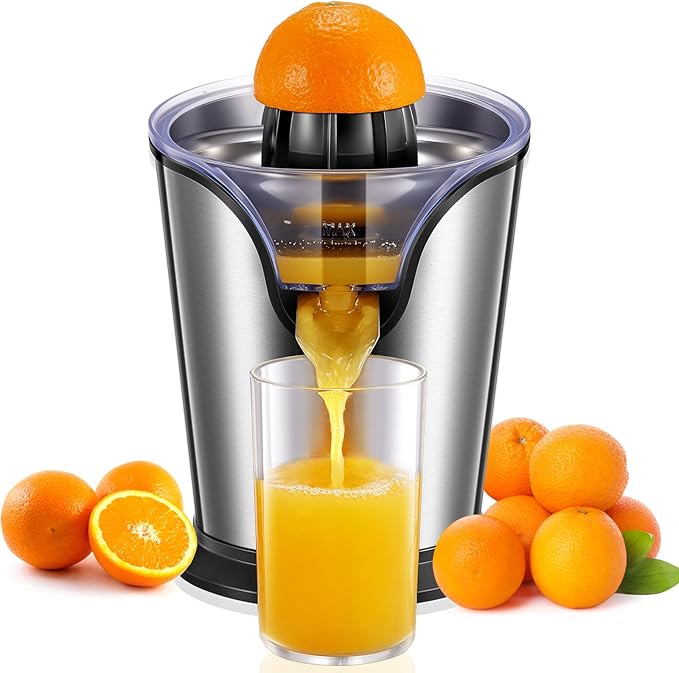
The FOHERE is a great example of “small upgrade, big payoff.” It’s an electric reamer with two cone sizes, a controlled spout, and a design that looks clean on the counter—so you’re more likely to leave it out and actually use it. Owners consistently praise the quiet operation and how little effort it takes compared to hand juicing.
Expert tip: this style works best with a light hand. Let the motor spin and do the work, and focus on steady pressure and a slow rotation of the fruit. If you mash down hard, the cone can briefly stall (a common protection behavior in compact motors). Use it like a calm machine, and you’ll be rewarded with consistent yield and less pulp escaping into the juice.
Why it stands out
- Two cone sizes – Easier fit for lemons through grapefruit without wasting fruit.
- Anti-drip spout – Lets you pause mid-juice without decorating your counter.
- Compact footprint – Looks tidy and doesn’t eat your workspace.
- Easy cleaning – Parts separate quickly; rinse before pulp dries and it’s painless.
Good to know
- Not built for endless marathon juicing—do big batches in rounds and rinse the filter.
- For ultra-clear juice, you may still strain once (especially for cocktails).
- As with most compact machines, technique matters: steady pressure beats hard pressing.
Ideal for: daily lemon/orange habits in smaller kitchens where you want stainless style without a giant machine.
7. Chef’n Dual-Gear Squeezer (15″) – Big Leverage Without Bulky Machines
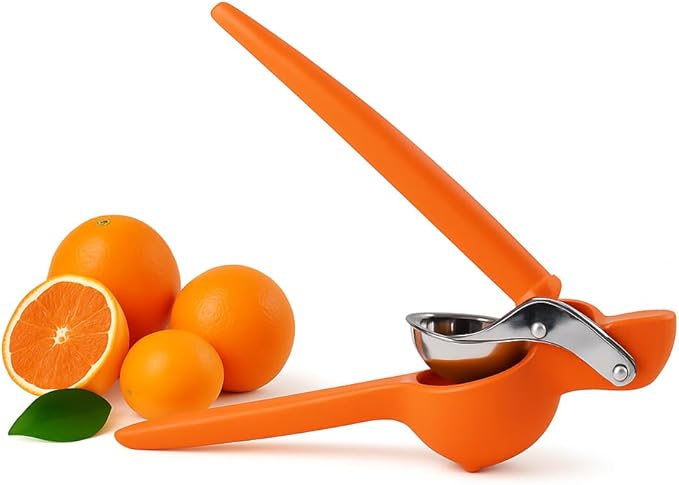
If traditional handheld presses make your hands tired, this is the “why didn’t I buy this sooner?” upgrade. Chef’n’s dual-gear mechanism multiplies your squeezing power, so you get more juice with less strain. Owners with achy hands often mention this is the first handheld tool that feels genuinely comfortable.
Here’s the expert nuance: geared squeezers are fantastic when you’re squeezing repeatedly—cocktail night, baking day, meal prep— because they reduce fatigue and help you keep pressure consistent. Consistency matters, because over-squeezing is where bitterness happens. With this tool, you can stop at the right moment (when juice slows) and avoid crushing peel oils into the cup.
Why it’s a smart buy
- Less hand strain – Great for frequent squeezing without pain.
- Strong extraction – Gets satisfying yield from lemons, limes, oranges, and small grapefruit.
- Easy cleanup – Rinse under water; occasional soap for citrus oils.
- Better control – Helps avoid “over-crush bitterness” with consistent leverage.
Good to know
- It’s bigger than standard presses; plan drawer space.
- For very large grapefruit halves, a countertop press may be easier than handheld squeezing.
- Like any geared tool, don’t force the mechanism beyond its natural stop—steady pressure wins.
Ideal for: anyone who wants handheld simplicity but needs extra leverage for comfort and repeat use.
8. QCen Electric with Lever – Easy Pressing, Clean Pour, Solid Value

Lever-style electric machines are where juicing starts to feel “effortless.” Instead of pressing fruit down by hand, you use the lever to apply controlled pressure. That control matters: it gives you better extraction with less mess, and it keeps your hands clean—especially useful when you’re squeezing multiple oranges in a row.
The QCen hits a practical middle ground. It’s not priced like a premium showpiece, but it offers the features that actually impact daily use: two cone sizes, an anti-drip spout, and a stable base that helps it stay put while you press. If you’re moving up from a basic reamer, the “lever comfort” feels like a genuine upgrade.
Why it makes sense
- Less hand fatigue – Lever pressure is easier than pushing down repeatedly.
- Stable counter feel – A steady base reduces tipping and keeps juice aimed where it belongs.
- Quick daily setup – The parts separate cleanly and rinse fast.
- Good all-arounder – Handles lemons through oranges well when sized correctly.
Good to know
- Some buyers expect metal cones and receive plastic—double-check what’s included when it arrives.
- Most lever electrics benefit from short pauses during huge batches, especially if pulp builds up.
- If you want “set it and walk away” automation, the Vinci style is more hands-free.
Ideal for: frequent juicers who want easier pressing and cleaner workflow without jumping to the highest price tier.
9. Zulay Electric (160W) – A Strong, Steady Daily Machine with Easy Cleanup

Zulay is known for leaning into “make it sturdy, make it simple,” and their electric lever machine follows that theme. You get interchangeable cones to match fruit size, a stainless filter that catches seeds and much of the pulp, and a controlled spout for clean pouring. Owners who squeeze lemons often like how quickly it powers through repeated fruit with minimal effort.
Here’s the expert detail that matters: use the lever to apply consistent pressure, not maximum pressure. Citrus yields best when you press until the juice flow slows, then stop. If you crush hard past that point, you’re not getting “more juice,” you’re extracting harsher peel oils. With a lever machine like this, it’s easier to stay in the “sweet spot.”
Why you’ll like it
- Easy pressing – Great for frequent lemon squeezing without sore hands.
- Useful cone sizes – Better fit across small and large citrus.
- Fast cleanup – Few parts; quick rinse; dishwasher-friendly removable components.
- Stable base – Helps keep the machine steady while you press.
Good to know
- Some users mention sharper metal edges on certain parts—use care during cleaning and handling.
- If you want very clear juice for cocktails, a second strainer still helps.
- Lever electrics take counter height; check cabinet clearance before you commit.
Ideal for: regular juicers who want low effort, reliable performance, and a machine that’s easy to rinse and repeat.
10. Keerain One‑Touch Electric – Simple Button Juicing with Easy Rinse Parts

This is the style you buy when you want juicing to feel like pressing a button, not doing a chore. Keerain’s one-touch approach is all about reducing steps: you load, press, let it run, and rinse. It also includes a cleaning brush, which sounds minor until you’ve cleaned pulp out of a fine screen—then it feels like a gift.
Expert tip: if you’re juicing small fruit (limes, small lemons), roll them on the counter first to loosen the interior, then cut cleanly. You’ll get better yield with less pushing. Also, pay attention to cup height—some compact machines sit low, so you may juice into the included container and pour into your glass afterward (which is still easy, just worth knowing).
Why it’s appealing
- Low-friction routine – One-touch style makes daily use feel easy.
- Compact storage – Good for small kitchens and limited counter space.
- Easy-to-clean parts – Detachable components + brush helps prevent screen buildup.
- Good value – Strong feature set for the price point.
Good to know
- Some users mention packaging variations (like missing a cone); check your box on day one.
- Glass clearance may be short; plan to juice into the container then pour.
- As with many compact units, best yield comes from light pressure and clean, sharp cuts.
Ideal for: people who want a straightforward, button-driven juicing routine in a smaller space.
11. SUCCFLY Manual Press (550 ml) – A “Catch the Juice” Hand Press for Bigger Jobs
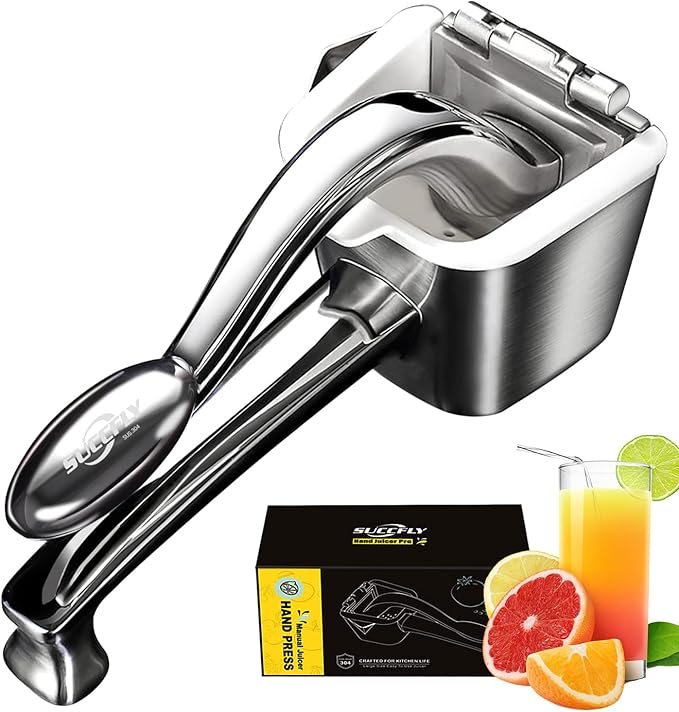
This is an unusual hybrid: it’s manual, but it behaves like a small station because it catches juice in a larger container. If you’ve ever tried squeezing many limes over a glass and ended up wearing half the juice, you’ll understand why that matters. It’s designed to let you work through fruit, then pour once—cleaner and less chaotic.
The big win is workflow. For cocktails, you can squeeze a pile of limes, pour into a measuring cup, and you’re done. For cooking, it’s the same story: clean juice, fewer seeds, and less “oops, it dripped off the edge.” The tradeoff is size. This is not a small drawer tool; it’s more of a dedicated piece. Also, with any hinged press, steady pressure beats snapping the handle— that’s how you protect welds and hinges long term.
Why it’s useful
- Built-in juice collection – Less splatter and fewer awkward balancing acts.
- Good for multiple fruits – Works across citrus types with smart cutting (grapefruit often needs quartering).
- Easy to disassemble – Detachable pieces help with cleaning.
- Great for entertaining – Efficient when you’re squeezing for multiple drinks.
Good to know
- It’s bulky; plan storage (it won’t fit in a standard utensil drawer).
- Some owners report hinge wear over years—using smooth, controlled pressure helps.
- Not ideal for tiny hands; it’s a “bigger tool” by design.
Ideal for: home bartenders and cooks who want less mess while squeezing larger quantities by hand.
12. Eurolux Premium Electric – A Polished Lever Machine for Frequent Juicers

Eurolux is the kind of machine you buy when you juice often and want it to feel like a “real appliance,” not a plastic gadget. The lever helps you press consistently, the stainless body looks premium, and the suction base keeps it steady—especially useful when you’re processing multiple oranges in a row for a big jug of juice.
From an expert perspective, this style shines because it protects your hands and improves repeatability. You can press with the same force each time, which helps extraction and keeps juice flavor consistent. If you’re using it for cocktails and cooking, consistency is the secret to not “sometimes bitter, sometimes perfect.” The main tradeoff is size: lever machines are taller. If you store it away, you may use it less. If you can leave it on the counter, you’ll get your money’s worth quickly.
Why it feels premium
- Comfortable lever press – Great for frequent juicing without hand fatigue.
- Stable base – Suction feet help it stay put during repeated pressing.
- Good extraction – Consistent pressure helps you get better yield with less effort.
- Easy parts cleanup – Components separate for quick washing after use.
Good to know
- It’s tall; check cabinet clearance if you want to keep it on the counter.
- For extremely large fruit, fit can be tight; aligning the fruit well makes pressing smoother.
- As with most lever electrics, very long continuous sessions can benefit from brief rest breaks.
Ideal for: frequent juicers who want a more polished, stable lever machine without jumping to commercial pricing.
13. CO‑Z Countertop Manual Press – Big Yield, No Motor, Bar‑Style Results

A countertop manual press is the “serious juice” move. No motor. No overheating worries. Just leverage. The CO‑Z is a popular value pick in this category because it delivers that bar-style pressing experience at a lower price than some premium presses, while still using stainless parts where fruit contacts the tool.
Here’s the expert reality: these presses reward smart setup. Use a stable counter. Choose a container that fits under the spout area (a wide-mouth jar or short measuring cup works well). And treat the handle like a heavy object—because it is. Some presses can drop if left upright, so develop a habit: one hand controls the handle; the other steadies the base if needed. Do that, and you’ll get incredibly dry pulp and satisfying yield from lemons, limes, oranges, and even pomegranate halves.
Why it’s a standout value
- Maximum leverage – Great extraction without powering anything on.
- Excellent for volume – Perfect for parties, prep days, and frequent cocktail squeezing.
- Easy-to-rinse contact parts – Stainless pieces wash fast after use.
- Feels “commercial” – The pressing action is what bars use for a reason.
Good to know
- It’s big and heavy; plan a dedicated counter spot or a sturdy storage area.
- Handle safety matters—don’t leave it upright where it can fall unexpectedly.
- Over time, bolts may need tightening (normal for high-leverage tools).
Ideal for: anyone who juices often and wants maximum yield without relying on a motor.
14. Sopito Countertop Manual Press – Built for Easier, Safer Lever Control
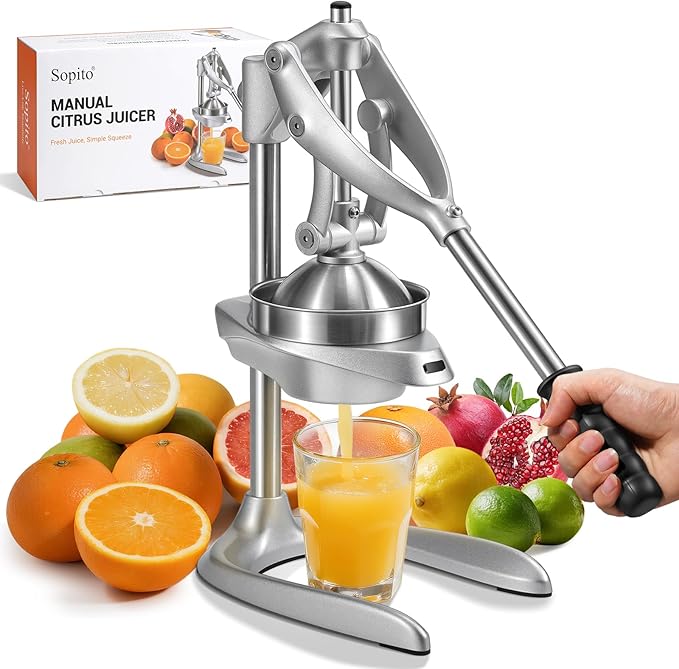
If you love the yield of a countertop press but feel nervous about heavy handles, Sopito’s safety-focused design is the reason it’s on this list. The brand highlights a handle that stays securely up instead of dropping—addressing the most common complaint with many traditional presses.
From an expert standpoint, this is the smarter type of innovation: it doesn’t try to reinvent squeezing; it reduces risk. That makes it easier to use in real life—busy kitchens, family counters, or shared spaces—because you don’t have to “remember to be careful” every single time. When you’re pressing lemons for lemonade or limes for cocktails, safety becomes a feature you appreciate daily, not just once.
Why it’s worth considering
- Safer handle behavior – Reduces the “heavy handle drop” worry common to presses.
- High yield potential – Leverage pressing extracts a lot with minimal effort.
- Good for many fruits – Works with oranges, lemons, limes, grapefruit, and more.
- Easy to clean – Fewer hidden corners than many electric machines.
Good to know
- Some users still report hardware wear under heavy use—smooth pressing helps reduce stress.
- It needs space; countertop presses aren’t subtle appliances.
- Best results come from aligning fruit well; off-center fruit can cause wobble in any press.
Ideal for: anyone who wants countertop-press yield but values safer, more controlled handling.
15. OSTBA Cast Iron Manual Press – Fast, Strong, and Built for Repeat Use

The OSTBA press is aimed at people who want “restaurant-style” pressing at home—strong frame, simple workflow, and fast extraction without the hassle of cords. When you’re doing a lot of fruit, manual presses can actually feel easier than electric, because you don’t stop for screens to clog or motors to cool; you just press, lift, and repeat.
Here’s the expert note: press stability is everything. Any countertop press can shift if you press off-center. The trick is to place the tool on a flat surface, align fruit in the middle, and press smoothly. If you do that, you’ll get drier pulp and better yield. If you press fast and off-angle, you’ll think the press is “wobbly,” when really the setup is the issue.
Why it works well
- High extraction – Great yield with minimal effort.
- No electricity – Reliable tool for home, camping setups, or any “no plug” situation.
- Simple cleaning – Smooth parts rinse quickly when cleaned right away.
- Good for volume – Great when you’re squeezing more than “a couple” of fruits.
Good to know
- Countertop presses can shift; holding the base (or placing it against a backsplash) helps.
- It’s heavy and not small—plan storage or a dedicated spot.
- If you dislike any pulp, keep a fine strainer nearby (manual presses can let pulp through).
Ideal for: households that juice in larger batches and want a strong press with straightforward cleanup.
16. Vinci Hands‑Free Electric (1 Button) – The “Press Start and Walk Away” Upgrade
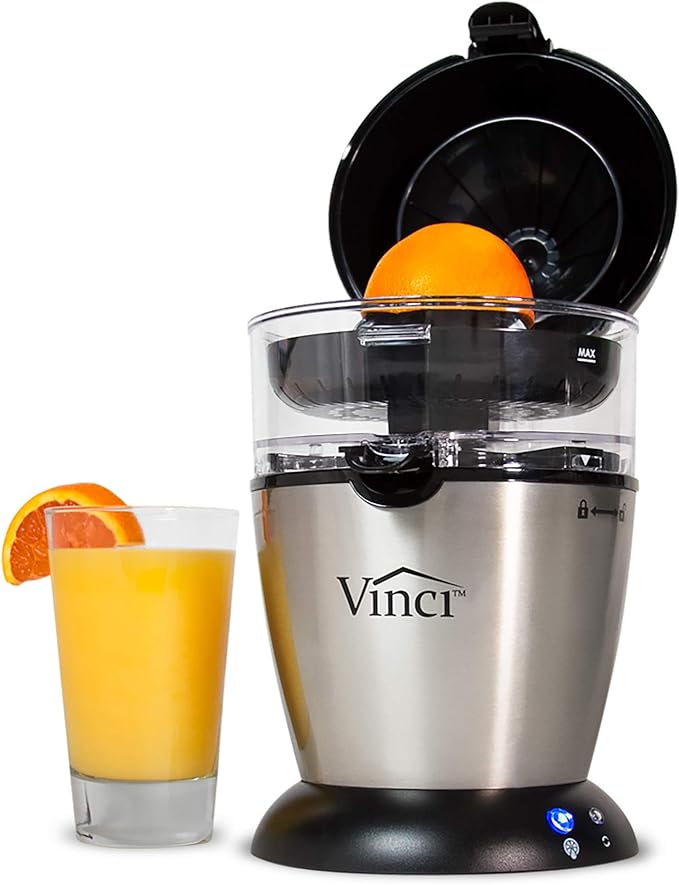
If you want the least effort possible, Vinci is in its own lane. You place the fruit, close the lid, press one button, and the machine does the pressing cycle for you. That matters for anyone with arthritis, wrist pain, or simply a morning routine where you don’t want one more task.
What makes it different is not just convenience—it’s consistency. When you remove human “how hard am I pressing today?” variability, your output becomes repeatable. That’s huge if you do lemon water daily, or if you like consistent citrus ratios for cocktails and recipes. And because the parts are designed to be removable and dishwasher friendly, it’s built for repeat use rather than occasional novelty.
Why people love it
- True low effort – One button operation reduces physical strain dramatically.
- Great for routine habits – Makes daily lemon water feel effortless.
- Works across sizes – Handles lemons, limes, oranges, and even larger fruit within size limits.
- Easy cleaning – Removable pieces simplify cleanup (especially if rinsed immediately).
Good to know
- Larger fruit can require careful placement and firm lid closure; alignment makes a difference.
- It’s a premium price because it’s doing more mechanically than standard reamers.
- For massive batch juicing, a countertop press can still be faster per fruit.
Ideal for: anyone who wants maximum convenience and minimal hand effort, especially for daily routines.
17. Zulay Cast‑Iron Countertop Press – Commercial Feel, Big Yield, Lifetime Support

If you want the “juice bar” experience at home, this is it. Zulay’s cast-iron press is built for heavy pressing and repeat sessions, and the leverage is exactly why people buy this style: it gets an impressive amount of juice quickly, without turning your hands into claws. It’s also a quiet tool—no motor noise, just the satisfying press.
Expert reality check: countertop presses are not “set it and forget it.” They’re powerful, heavy tools. Use them intentionally: place a stable container under the spout area, align fruit centered in the cup, and keep one hand aware of the handle. In return, you get the kind of extraction that makes supermarket juice taste flat. If you juice often—especially lemons and limes for drinks— this can absolutely earn its keep.
Why it’s a flagship
- Serious extraction – Great yield and dry pulp when used correctly.
- Built to last – Heavy-duty construction designed for repeated pressing.
- Great for bars & entertaining – Fast output for cocktails, lemonade, and parties.
- Simple cleanup – Detachable contact parts wash quickly.
Good to know
- It’s heavy and takes space—many owners keep it on the counter full-time.
- Handle safety matters; never leave it in a position where it can drop unexpectedly.
- If you hate pulp, keep a mesh strainer nearby (presses can let pulp through).
Ideal for: frequent juicers and cocktail lovers who want maximum yield and a commercial-style press at home.
How a Citrus Juicer Really Works (and How to Get Sweeter, Cleaner Juice)
All citrus tools do one job: break open juice sacs inside the fruit. But how they apply pressure changes everything— yield, pulp, bitterness, and cleanup. Once you understand the mechanics, you’ll get better juice from any tool you buy.
What actually increases juice yield
- Warm fruit – Cold fruit is stubborn. Let citrus sit at room temperature, or microwave for 8–12 seconds, then roll it.
- Rolling – Roll firmly on the counter to loosen the membranes before cutting.
- Cut the “right” way – For most citrus, cutting across the equator exposes more segments and improves yield.
- Consistent pressure – Lever machines and countertop presses shine because they keep force steady and repeatable.
- Clean screens – If a strainer clogs, juice flow drops. A quick rinse mid-batch often boosts yield immediately.
Counter-intuitive but true: “pressing harder” is not always “getting more juice.” Once juice slows, you’re mostly crushing peel and pith, which leads to harsher, more bitter flavors—especially noticeable in lemon and lime juice used for cocktails.
How to get cleaner flavor (less bitterness)
- Stop at the flatten – When the rind is flattened and juice slows, stop pressing. That’s peak flavor.
- Avoid twisting aggressively – Twisting can grind bitter pith into the juice in some reamer designs.
- Strain once for cocktails – A fine mesh strainer removes micro-pulp for smoother drinks.
- Keep the tool dry after cleaning – Especially for cast-iron presses; water left in joints can encourage rust over time.
- Use the right cone – A too-small cone wastes fruit; a too-large cone can shred the peel and add bitterness.
The best tasting citrus juice is “fresh, clean, and not overworked.” If you build that habit, you’ll notice the difference immediately— especially in lemonade, margaritas, dressings, and marinades.
FAQ: Citrus Squeezers, Answered
Which style is best: handheld, electric reamer, lever-electric, or countertop press?
Why does my juice taste bitter sometimes?
How do I keep pulp from clogging screens during big batches?
Are countertop manual presses safe?
Do I need a Citrus Juicer if I already own a handheld press?
Final Thoughts: Picking the Best Citrus Squeezer for You
Fresh juice shouldn’t feel like a project. The right tool makes it easy enough that you’ll use citrus more often—in drinks, in cooking, and in those “tiny upgrades” that make meals taste brighter.
Here’s a simple way to decide fast:
- Want one dependable everyday pick that fits most kitchens? Start with the Cuisinart CCJ‑500P1.
- Want the cheapest electric option that still feels practical? Try the LEBENLANG electric or the family-friendly pitcher style BLACK+DECKER CJ625.
- Mostly cocktails and cooking? Grab a strong handheld tool like the Zulay hand press (Black), Zulay hand press (Silver), or the low-effort geared Chef’n dual-gear squeezer.
- Want low-effort pressing with a lever? Look at QCen, Zulay Electric, or the premium-feeling Eurolux.
- Want the least effort possible (true automation)? Go with the Vinci hands-free.
- Want maximum yield without a motor? Choose a countertop press like CO‑Z, the safety-focused Sopito, the heavy-duty OSTBA, or the flagship Zulay cast-iron press.
Pick the style that matches your routine, use the simple technique tips above, and you’ll end up with the Best Citrus Squeezer for your kitchen—not just the one with the fanciest marketing. Once you’ve got the right tool, fresh citrus becomes a habit you’ll actually keep.
